1. Introduction
The intensification of climate change, geopolitical tensions, and energy security risks has made the development of green energy technologies a central issue in the global energy transition. In recent decades, renewable energy sources represented by solar and wind power have expanded rapidly and have gradually become important components of low-carbon power systems [
1]. However, solar and wind power are highly dependent on weather conditions and are characterized by considerable temporal variability, making it difficult for them to provide a stable and dispatchable energy supply on a continuous basis. Against this background, hydrogen has attracted increasing policy attention because it can serve both as an energy carrier and as a storage medium. It can connect renewable electricity production, industrial decarbonization, transportation, and end-use energy consumption [
2]. With its high energy density, zero carbon emissions at the point of end-use, and the possibility of producing green hydrogen through water electrolysis using renewable electricity, hydrogen is increasingly viewed as an important component of future clean, low-carbon, secure, and flexible energy systems [
3]. By 2024, more than 70 countries had announced clean hydrogen projects [
4], and several major economies had incorporated hydrogen into their national energy strategies and industrial transformation agendas [
5].
China has also positioned hydrogen development as an important component of its dual-carbon strategy and energy transition. As the world’s second-largest economy and the largest producer and consumer of hydrogen, China has continued to promote technological innovation, industrial chain development, infrastructure deployment, and application demonstrations in the hydrogen sector through a combination of national strategic guidance and local policy experimentation [
6,
7]. At the level of province-level administrative regions, local governments have issued a large number of hydrogen-related policies in accordance with their resource endowments, industrial foundations, technological capacities, and regional development strategies. These policies are important because they translate national strategic objectives into concrete measures for industrial layout, demonstration projects, infrastructure construction, and market cultivation. At the same time, because local economic conditions, renewable energy resources, industrial capabilities, and administrative priorities vary considerably, hydrogen policies across different province-level administrative regions differ substantially in their content priorities, instrument choices, governance levels, and implementation pace. This gives rise to an important question: how are China’s provincial hydrogen industry policies organized into policy systems as reflected in policy texts? To what extent do the policy themes, policy instruments, administrative actors, governance levels, and timing arrangements within these systems exhibit structural coverage, design completeness, and textual coordination?
Research on energy transitions provides important theoretical insights for understanding this question. Energy transition is no longer understood as a linear process driven by a single technological breakthrough or by isolated policy measures. Rather, it involves complex interactions among technological systems, industrial sectors, market arrangements, governance actors, and institutional environments. The analysis of energy policy therefore needs to examine the connections among different technological systems, industrial sectors, and governance processes, rather than focusing only on the use of individual policy instruments [
8]. Related studies have also shown that the effects of energy transition policies do not depend solely on any single policy measure but are shaped by interactions among policy objectives, institutional arrangements, governance capacities, and socio-technical change [
9]. Research on net-zero policy mixes and energy sector integration further suggests that the low-carbon transition is not simply the result of expanding renewable energy capacity; it also depends on the coordination of multiple policy instruments across interdependent sectors [
10]. Thus, for energy transition policy, the coordination among policy themes, policy instruments, governance levels, and industrial transformation needs provides an important conceptual basis for understanding policy systems.
Hydrogen industry policy is particularly characterized by this need for coordination. Unlike the promotion of a single energy technology, hydrogen development must address multiple issues simultaneously, including renewable energy supply, hydrogen production–storage–transportation–refueling infrastructure, industrial decarbonization scenarios, market demand formation, safety risk regulation, and sustainability certification. The diffusion of hydrogen technologies is strongly affected by regional economic development, infrastructure conditions, application barriers, and application scenarios, which means that hydrogen policy cannot be understood apart from local industrial foundations and application environments [
11]. In hard-to-abate sectors such as steel, chemicals, and transportation, the effectiveness of hydrogen applications also depends on the coordination of technological learning, demand creation, carbon reduction incentives, and sector-specific implementation mechanisms [
12]. In addition, the development of renewable and low-carbon hydrogen requires not only capacity expansion and project deployment but also credible certification mechanisms, transparent standards, and legitimate governance arrangements [
13,
14]. Therefore, a text-based evaluation of hydrogen industry policy should not only ask whether policies have been issued or what content is included in policy texts; it should also examine whether policy themes, instrument configurations, administrative responsibilities, governance levels, regional conditions, and sustainability-oriented governance arrangements are sufficiently represented and structurally connected in the textual design of provincial policy systems.
Existing studies on hydrogen industry policy have produced substantial findings on policy content, policy comparison, policy coordination, and policy performance. In different national contexts, research has gradually moved beyond the analysis of hydrogen technology support policies toward the examination of hydrogen policy systems as a whole. These studies show that hydrogen development is jointly shaped by energy strategies, regulatory frameworks, fiscal support, industrial policies, and innovation systems [
15,
16]. In addition, different hydrogen application scenarios require differentiated policy instruments. This is particularly true for green hydrogen, where policy design needs to provide stable market signals, reduce investment uncertainty, and support the formation of demand-side markets [
17,
18]. In major national practices, Germany’s hydrogen strategy places strong emphasis on green hydrogen, industrial decarbonization, and the development of international hydrogen supply chains [
19]; the United Kingdom’s hydrogen strategy gives greater attention to the commercial viability of low-carbon hydrogen projects, market support mechanisms, and investment risk sharing [
18]; and South Korea’s hydrogen industry policy highlights the transition from early strategic advocacy to institutionalized policy promotion, emphasizing the alignment between policy agendas, technological maturity, and industrial readiness [
20,
21]. From the perspective of institutional–technological co-evolution, hydrogen development is not merely a process of technological diffusion but the result of the joint effects of technological progress, institutional development, market formation, and policy coordination [
21,
22].
Existing studies on China’s hydrogen industry policy have primarily focused on domestic policy processes, local government action, and regional industrial promotion. They suggest that hydrogen policies issued by Chinese local governments are generally aligned with national strategic directions and that these policies mainly address key technological breakthroughs, infrastructure construction, the improvement of the hydrogen production, storage, transportation, and refueling chain, talent development, and industrial chain innovation [
23]. As the industry has continued to develop, policy attention has gradually expanded to application scenarios, industrial scale, and economic benefits. However, local policy priorities vary significantly. Economically developed coastal regions in eastern China tend to emphasize technological innovation, equipment manufacturing, and application demonstrations, whereas resource-rich regions prioritize hydrogen production and infrastructure construction by drawing on their advantages in renewable energy [
24]. Other studies have pointed out that China’s hydrogen policy system still faces challenges such as inconsistent industry standards, policy homogenization, insufficient cross-regional coordination, and inefficient allocation of hydrogen-related resources [
25,
26,
27]. Meanwhile, to better capture the structural complexity of such policy frameworks, recent studies have begun to employ text analytic methods, composite indices, and indicator systems to quantitatively assess hydrogen policy readiness and strategic orientations [
28,
29,
30]. Although these studies are valuable, they have not sufficiently explained how provincial hydrogen policy texts jointly constitute policy systems, how different components within these systems are configured, or how such configurations reflect the development stage, policy orientation, and governance challenges of China’s hydrogen industry policy.
Existing policy evaluation studies provide useful approaches for analyzing these issues. One strand of research focuses on policy implementation effects, commonly using quasi-experimental methods such as PSM-DID and double machine learning to evaluate the impacts of policies in areas such as public health, environmental regulation, technology finance, big data, and industrial land use [
31,
32,
33,
34,
35,
36,
37]. Another strand focuses on policy text evaluation, using topic models, natural language processing, content analysis, and PMC index models to analyze policy priorities, textual structures, and text-based policy coherence [
38,
39,
40]. For this study, the second type of method is more appropriate because this study does not seek to evaluate the actual implementation effects or industrial outcomes of hydrogen policies. Instead, it focuses on the structural coordination and design completeness of provincial hydrogen policy systems at the textual level. However, existing policy text evaluation studies often use topic identification, policy instrument classification, and PMC evaluation separately [
41,
42]. The analytical chain through which policy themes and policy instruments are transformed into indicators for evaluating policy systems remains insufficiently specified and thus requires further refinement.
Based on the above discussion, this study takes hydrogen industry policy texts from China’s 31 province-level administrative regions as its research object and constructs a textual analytical framework centered on “themes–instruments–text-based policy system coherence” to examine the content structure, instrument configuration, and textual structural coordination of provincial hydrogen policy systems. It should be noted that the term “provincial hydrogen industry policy system” in this study does not refer only to policy documents issued by provincial governments. Rather, it refers to a regional policy system composed of a set of policy texts issued by provincial-, municipal-, and county-level governments and relevant departments within a province-level administrative region in relation to hydrogen industry development
1. Specifically, this study uses the LDA topic model to identify policy themes, applies content analysis to classify policy instruments, and then employs the PMC index model to evaluate the text-based structural coherence and design completeness of provincial policy systems. Accordingly, this study seeks to answer three questions. First, what thematic structure characterizes China’s provincial hydrogen industry policy systems? Second, how are different policy instruments configured within these systems? Third, what differences in PMC-based text-level structural coherence and design completeness do hydrogen policy systems across different province-level administrative regions exhibit in terms of policy functions, issuing bodies, thematic coverage, instrument configuration, target groups, content fields, issuing levels, design quality, and timing arrangements?
This study seeks to make three contributions. First, conceptually, it treats provincial hydrogen policy not as a set of isolated policy documents, but as a policy system constructed around province-level administrative units. This perspective makes it possible to examine the multidimensional design of hydrogen industry policy across policy themes, policy instruments, administrative actors, governance levels, target groups, content fields, and temporal arrangements. Second, methodologically, this study develops a sequential text-based analytical framework that links the LDA topic model, content analysis, and the PMC index model. In this framework, LDA is used to identify the thematic structure of policy texts, content analysis is used to classify policy instruments, and the PMC index model is used as a standardized text-based evaluation tool to assess the structural coverage, design completeness, and textual coordination of provincial hydrogen policy systems. This design clarifies how policy themes and policy instruments can be incorporated into a broader text-based evaluation of policy system coherence. Third, substantively, this study aims to move beyond describing the content of provincial hydrogen policy texts by examining how their thematic coverage, instrument configuration, and textual structural coordination reflect, at the level of policy design, the development stage, policy orientation, regional variation, and multilevel governance challenges of China’s hydrogen industry policy. In doing so, the study provides a more systematic basis for understanding the formation logic and potential weaknesses of local industrial policy systems in China’s energy transition while offering policy implications for the design and coordination of hydrogen industry policies in China and other countries.
2. Data Sources and Research Design
2.1. Data Sources
Policy text collection provides the empirical basis for the text-based evaluation of provincial hydrogen industry policy systems. Following the principles of comprehensiveness, representativeness, and authoritativeness, this study collected hydrogen-related policy documents issued by governments and relevant administrative departments at the provincial, municipal, and county levels within China’s 31 province-level administrative regions. In this study, a “provincial hydrogen industry policy system” does not refer only to policy documents issued by provincial governments or provincial departments. Rather, it refers to a set of policy texts issued by different levels of government and relevant administrative actors within a province-level administrative region in relation to hydrogen industry development. This definition makes it possible to examine the thematic structure, instrument configuration, administrative participation, hierarchical linkage, and temporal arrangements of hydrogen policy systems at the scale of province-level administrative regions, as reflected in policy texts.
In the retrieval process, this study used keywords such as “hydrogen,” “hydrogen energy,” “hydrogen industry,” “green hydrogen,” “fuel cell,” and “hydrogen refueling station” to search the PKU Law database, the official websites of local governments and relevant departments, and general search engines such as Baidu and Google. The official websites of the central government and its departments were also used as supplementary channels to verify local policy information, trace policy sources, and identify omitted documents. However, national policy documents issued by the central government and its departments were not included in the evaluation sample in order to avoid conflating central policies with local policy systems. The retrieval period ended on 31 December 2025. After the initial collection, the documents were manually screened according to their relevance, authority, and substantive policy content. This study retained policy documents containing clear regulatory, planning, guiding, or supportive content, including laws and regulations, guiding opinions, implementation measures, development plans, action plans, and implementation schemes. Documents with relatively weak policy binding force or limited analytical relevance, such as policy interpretations, research reports, resolutions, approvals, news releases, and repealed documents, were excluded. For comprehensive policies involving multiple energy or industrial fields, only the sections directly related to hydrogen industry development were included in the corpus, whereas dedicated hydrogen policy documents were included in full. Duplicate documents and documents only marginally related to hydrogen were also removed.
Based on these criteria, 315 policy documents were ultimately selected. These documents constitute the basic corpus for the text-based evaluation of China’s provincial hydrogen industry policy systems. More importantly, the corpus does not merely serve as a collection of individual policy texts; it defines the empirical boundary of the provincial hydrogen industry policy systems examined in the following sections. Due to space limitations,
Table 1 lists only selected representative hydrogen industry policy texts.
2.2. Analytical Framework for Text-Based Policy System Coherence
This study takes text-based policy system coherence as its core evaluative concept. In the public policy literature, the concepts of “policy mixes” and “policy coherence” have been widely theorized to emphasize that multiple policy goals and instruments within a given domain should be logically consistent and mutually supportive, rather than fragmented or contradictory [
43,
44]. Building on this theoretical foundation, this study operationalizes policy system coherence for a quantitative, text-based evaluation. In this study, policy system coherence does not refer to the linguistic coherence of policy texts, nor does it directly measure actual policy coordination, implementation synergy, or the empirical functional interaction among policy components in practice. Rather, it refers to the degree of textual coverage, design completeness, and structural coordination among key components of a provincial hydrogen industry policy system, including policy themes, policy instruments, administrative actors, governance levels, target groups, content fields, and timing arrangements. Therefore, the focus of this study is to examine whether the textual design structure of provincial hydrogen industry policy systems is relatively complete, structurally connected, and continuous.
The provincial hydrogen industry policy system in this study refers to a policy text configuration formed by a series of interrelated policy texts issued by provincial-, municipal-, and county-level governments and relevant departments within a province-level administrative region. Compared with a single policy document, a system-level analytical perspective can better capture the policy orientation, instrument choices, administrative participation, hierarchical arrangements, and temporal layout of a region in promoting hydrogen industry development.
The use of policy system coherence as the object of evaluation is mainly based on the composite nature of hydrogen industry policy and the text-based research design of this study. On the one hand, hydrogen industry development involves multiple segments, including technological innovation, industrial chain construction, infrastructure deployment, market application, safety regulation, standards development, and green transition, and a single policy text often cannot fully present these policy arrangements. On the other hand, because this study is based on policy texts, it evaluates thematic coverage, instrument configuration, and structural coordination at the textual level, rather than policy implementation effects or industrial development outcomes.
Around the concept of text-based policy system coherence, this study constructs an analytical framework of “themes–instruments–text-based coherence.” First, policy themes reflect the content structure of provincial hydrogen industry policy systems. This study uses the LDA topic model to identify the thematic distribution and content priorities of policy texts. Second, policy instruments reflect the action structure of policy systems. Based on established policy instrument theory, this study applies content analysis to identify the main types of policy instruments and hydrogen industry-specific sub-instruments. Third, the PMC index model is used as a standardized text-based evaluation tool to assess the structural coverage, design completeness, and textual coordination of provincial policy systems across multiple dimensions. Unlike studies that evaluate single policy documents, this study takes province-level administrative regions as the unit of evaluation and incorporates policy functions, issuing bodies, policy themes, policy instruments, target groups, content fields, issuing levels, design elements, and timing arrangements into the evaluation system.
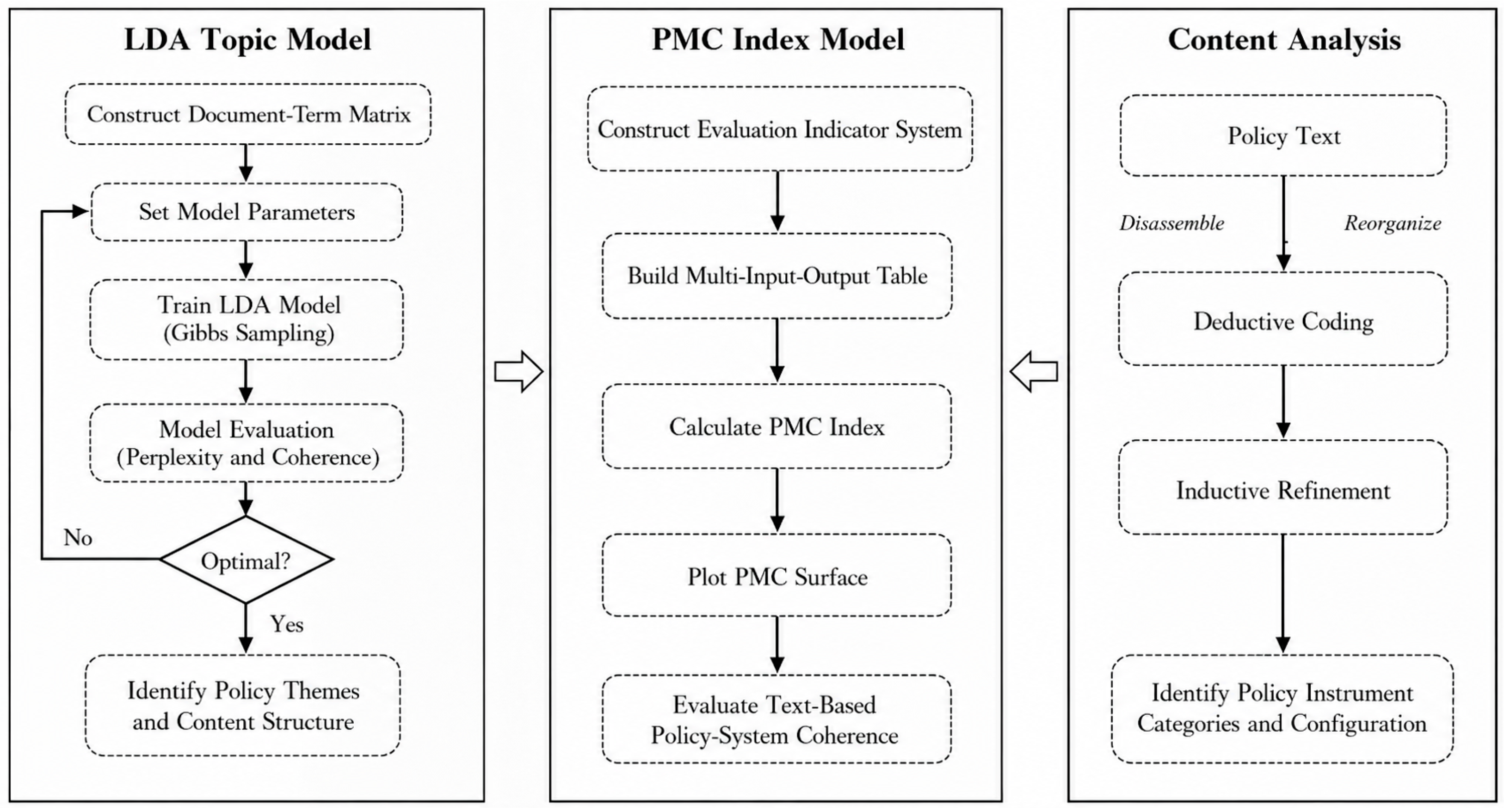
Therefore, this study integrates the LDA topic model, content analysis-based policy instrument coding, and the PMC index model to form a sequential analytical chain. As shown in
Figure 1, the LDA topic model is used to identify the content structure of the policy system, while content analysis is used to reveal its instrument structure. These two steps respectively provide empirical inputs for the thematic coverage and instrument configuration dimensions of the PMC indicator system. On this basis, the PMC index model converts the coverage, configuration, and linkage of different structural dimensions into comparable indicators for evaluating policy system coherence.
As shown in
Table 2, this study operationalizes the analytical framework for text-based policy system coherence into seven components: the boundary of the policy system, content structure, instrument structure, administrative structure, hierarchical and temporal structure, text-based policy system coherence, and textual structural weaknesses. Among them, the boundary of the policy system defines the empirical object of this study; content structure and instrument structure correspond to the results of LDA-based topic identification and content analysis-based policy instrument coding, respectively; and administrative structure, as well as hierarchical and temporal structure, is transformed into PMC evaluation indicators through policy text information extraction. On this basis, the PMC index model provides a standardized comparison of structural coverage, design completeness, and textual linkage among different dimensions. It further identifies potential weaknesses in provincial hydrogen industry policy systems in terms of thematic coverage, instrument configuration, actor participation, hierarchical linkage, and temporal continuity as reflected in policy texts. Thus,
Table 2 not only explains the operationalization process of the analytical framework but also presents the sequential relationship among LDA, content analysis, and the PMC index model.
It should be noted that this study does not use the PMC index model to evaluate policy implementation effects. Instead, it employs the PMC index model as a standardized text-based evaluation tool for measuring the structural coverage, design completeness, and textual coordination of provincial policy systems. Therefore, the PMC score obtained in this study should be understood as a “PMC-based text-level policy system coherence score,” rather than as an indicator of policy effectiveness, policy performance, industrial development outcomes, or actual implementation synergy. In addition, the equal weighting strategy used in the PMC model is intended to provide a standardized comparison across province-level administrative regions. It does not imply that each dimension has equal causal importance in practice. The secondary indicators in the PMC system should also be understood as operational observation items nested under broader evaluation dimensions, rather than as independent theoretical dimensions of policy system coherence. Through this framework, this study examines how policy themes, instruments, administrative actors, governance levels, and timing arrangements are represented and structurally connected in policy texts and whether provincial hydrogen industry policy systems exhibit text-based structural coherence and design completeness.
4. Evaluation of Text-Based Policy System Coherence Based on the PMC Index Model
4.1. Construction of the PMC-Based Textual Evaluation Model
In this study, policy system coherence specifically refers to the design completeness and structural coordination among different components of a policy system as reflected strictly at the level of textual design. It evaluates whether a provincial hydrogen industry policy system forms a relatively coordinated textual structure in terms of policy functions, issuing bodies, thematic coverage, instrument configuration, target groups, content fields, issuing levels, design quality, and timing arrangements. Therefore, the focus of this evaluation is the internal structure of policy texts, rather than the actual outcomes generated after policy implementation.
The policy modeling consistency index model, commonly known as the PMC index model, was proposed by Ruiz Estrada and is widely used for the quantitative evaluation of policy texts. The model enables systematic analysis of policy texts across multiple dimensions and provides a composite score for comparing the structural characteristics of different policy systems [
53,
54]. This study introduces the PMC index model to evaluate the text-based policy system coherence of China’s provincial hydrogen industry policy systems. Unlike approaches that directly evaluate individual policy documents, this study takes provincial policy systems as the unit of evaluation. That is, all hydrogen-related policy texts issued within each province-level administrative region are treated as a policy system, and the PMC index model is used to examine whether this policy system presents a relatively complete and coordinated textual structure.
The construction of the PMC indicator system in this study incorporates the results of the LDA topic model and content analysis-based policy instrument coding. Specifically, the LDA topic model provides the empirical basis for the thematic coverage dimension, while policy instrument coding provides the empirical basis for the instrument configuration dimension. In this way, the PMC index model functions as a standardized text-based evaluation tool, whereas LDA-based topic identification and content analysis-based policy instrument coding provide empirical inputs for specific dimensions of the coherence evaluation. This design also clarifies the sequential relationship among the three analytical procedures: LDA identifies the content structure of the policy system, content analysis identifies its instrument structure, and the PMC index model integrates these results with administrative, hierarchical, and temporal information to evaluate text-based structural coverage, design completeness, and textual coordination.
Based on the results of LDA topic analysis, content analysis-based policy instrument coding, and existing studies using the PMC index model, this study constructs an evaluation indicator system for the text-based policy system coherence of China’s provincial hydrogen industry policy systems. The PMC evaluation model includes nine first-level variables and 42 second-level variables, as shown in
Table 6.
The indicator system follows the logic of text-based policy system coherence. Policy functions reflect the basic functional orientation of the policy system. Issuing bodies capture horizontal departmental participation. Thematic coverage reflects the completeness of the policy content structure identified by the LDA topic model. Instrument configuration reflects the specific policy instrument structure identified through content analysis. Target groups and content fields capture the coverage of policy objects and governance fields. Issuing levels reflect vertical policy linkage as represented in policy issuance. Design quality reflects the standardization and completeness of policy text design. Timing arrangements reflect the continuity of policy support as reflected in policy texts. It should be noted that the 42 secondary variables are not treated as 42 independent theoretical dimensions of policy system coherence. Rather, they are operational observation items nested under the nine first-level dimensions. Their purpose is to capture the multidimensional and hydrogen-specific features of policy text design with sufficient granularity, while the overall evaluation structure remains organized around the nine first-level variables. Following methodological caution, the resulting PMC score should therefore be interpreted as a broad text-based measure of structural coverage and design completeness, rather than a definitive measure of actual empirical policy system coherence.
The instrument configuration dimension is mainly based on the policy instrument coding results presented in
Section 3.2. Hydrogen industry policy does not operate through a single broad type of policy instrument. Instead, it works through specific instruments such as organizational support, safety regulation, fiscal subsidies, talent development, infrastructure, innovation environment, industrial development, business environment, government demand, and institutional supply, which together constitute the action structure of the policy system. Incorporating these second-level policy instruments into the X4 dimension allows this study to more precisely identify the coverage and structural differences in instrument configuration across provincial policy systems. It also creates a closer connection between the preceding policy instrument analysis and the subsequent PMC-based coherence evaluation.
It should be noted that the inclusion of ten second-level variables under X4 does not increase the weight of the instrument configuration dimension in the PMC score. Like the other first-level variables, X4 is calculated as the mean value of its second-level variables and is normalized to a value between 0 and 1. The same logic applies to all other first-level variables: differences in the number of secondary variables do not change the equal-weight structure among the nine first-level dimensions. Therefore, this indicator setting improves the measurement granularity of instrument configuration without giving additional weight to the instrument configuration dimension.
The multi-input–output table is an important step in the PMC index model. It transforms the evaluation indicator system into a standardized assignment structure and provides the basis for assigning values to each second-level variable. Based on the above indicator system, this study constructs the multi-input–output table for evaluating text-based policy system coherence, as shown in
Table 7.
In this table, the nine first-level variables are treated as independent evaluation dimensions during scoring, and the second-level variables under each first-level variable are assigned equal weights. This setting does not imply that the components of the policy system are unrelated in practice, nor does it mean that different dimensions have equal causal or functional importance in actual implementation. Rather, the equal weighting strategy provides a standardized text-based comparison procedure that allows provincial hydrogen industry policy systems to be evaluated under the same criteria. Consequently, the resulting PMC scores should be interpreted as indicators of textual structural coverage and design completeness, rather than as weighted assessments of policy impact or implementation effectiveness.
In terms of variable assignment, this study adopts a three-value scoring method. If a provincial policy system clearly includes or satisfies a given second-level variable, the variable is assigned a value of 1. If it partially reflects or partially satisfies the variable, it is assigned a value of 0.5. If it does not include or satisfy the variable, it is assigned a value of 0. This scoring method can more precisely capture differences in textual coverage and structural configuration among provincial policy systems. These assigned values provide the basis for calculating the PMC-based text-level coherence scores in the following section.
4.2. Calculation and Results of PMC-Based Text-Level Coherence Scores
The calculation of the PMC-based text-level coherence score mainly involves four steps. First, the nine first-level variables and 42 second-level variables constructed in this study are incorporated into the multi-input–output table. Second, the policy texts of each provincial hydrogen industry policy system are compared and summarized according to the meanings of the second-level variables, and the specific values of the second-level variables are determined according to Equations (2) and (3). Third, Equation (4) is used to calculate the score of each first-level variable, namely the mean value of the second-level variables under that first-level variable. Fourth, Equation (5) is used to sum the scores of the nine first-level variables and obtain the PMC-based text-level coherence score.
Here, represents the value of the j-th second-level variable under the t-th first-level variable; denotes the number of second-level variables under the t-th first-level variable; represents the score of the t-th first-level variable; and the PMC index is obtained by summing the scores of the nine first-level variables.
For standardized textual comparison, this study classifies the PMC-based text-level coherence score into four textual design categories: Excellent, 7.5–9.0; Good, 6.0–7.5; Acceptable, 4.5–6.0; and Poor, 0–4.5. It should be emphasized that these categories are used only to describe structural coverage and design completeness at the textual design level. They do not refer to policy implementation effects, policy performance, or industrial development performance.
Based on the above indicator system and scoring rules, this study evaluates the hydrogen industry policy systems of China’s 31 province-level administrative regions.
Table 8 reports the scores of each province-level region on the nine first-level variables, the PMC-based text-level coherence score, the ranking, and the corresponding textual design category.
The overall results show that the average PMC-based text-level coherence score of hydrogen industry policy systems across China’s 31 province-level administrative regions is 6.75, indicating a generally good level of structural coverage and design completeness at the textual design level. According to the classification criteria, 11 province-level regions are classified as excellent, 10 as good, 10 as acceptable, and none as poor. This suggests that, from the perspective of textual structure, China’s provincial hydrogen industry policy systems have generally formed relatively complete textual structures, although significant differences remain among province-level regions.
In terms of the distribution of provincial scores, Guangdong, Beijing, Sichuan, Shandong, Shanghai, Inner Mongolia, Jiangsu, Zhejiang, Shanxi, Shaanxi, and Hebei fall into the excellent textual design category. Among them, Guangdong has the highest score, at 8.42, followed by Beijing and Sichuan, with scores of 8.40 and 8.35, respectively. These regions score highly on most first-level variables, suggesting that their policy systems have relatively complete textual structures in terms of functional orientation, thematic coverage, instrument configuration, design quality, and timing arrangements.
The good textual design category includes Jilin, Hubei, Qinghai, Xinjiang, Hunan, Liaoning, Tianjin, Ningxia, Henan, and Anhui. Their PMC-based text-level coherence scores range from 6.0 to 7.5, indicating that their policy systems have developed a certain degree of structural completeness at the textual design level but still show differences across specific dimensions. The acceptable textual design category includes Fujian, Hainan, Guizhou, Jiangxi, Tibet, Gansu, Chongqing, Yunnan, Guangxi, and Heilongjiang. Their scores range from 4.5 to 6.0, indicating that their policy systems contain the basic textual components of hydrogen industry policy but remain relatively insufficient in thematic coverage, instrument configuration, issuing levels, or timing arrangements.
At the level of first-level variables, policy functions have the highest mean score, at 0.85, followed by design quality at 0.83. Target groups, content fields, and timing arrangements score 0.78, 0.76, and 0.75, respectively. Issuing bodies and instrument configuration both score 0.74, while thematic coverage scores 0.72. Issuing levels have the lowest mean score, at 0.61. These results indicate variation across the first-level variables. Policy functions and design quality are relatively well represented in most provincial policy systems, whereas issuing levels remain the weakest textual dimension. Instrument configuration is no longer the lowest-scoring dimension, but it still shows room for improvement because different policy instruments are not evenly represented across regions and policy systems.
4.3. Structural Forms of PMC-Based Text-Level Coherence
Plotting the PMC surface provides a clearer and more intuitive way to reveal the textual structural strengths and weaknesses of hydrogen industry policy systems across different regions. If the overall surface is relatively regular and smooth, it indicates that the policy system shows relatively balanced coverage across multiple textual dimensions. If the surface shows obvious depressions, this suggests that the policy system has shortcomings in specific textual dimensions, such as thematic coverage, instrument configuration, issuing level, or temporal arrangement.
The PMC surface is constructed on the basis of a PMC matrix. Since this study includes nine first-level variables, the PMC matrix is constructed as follows:
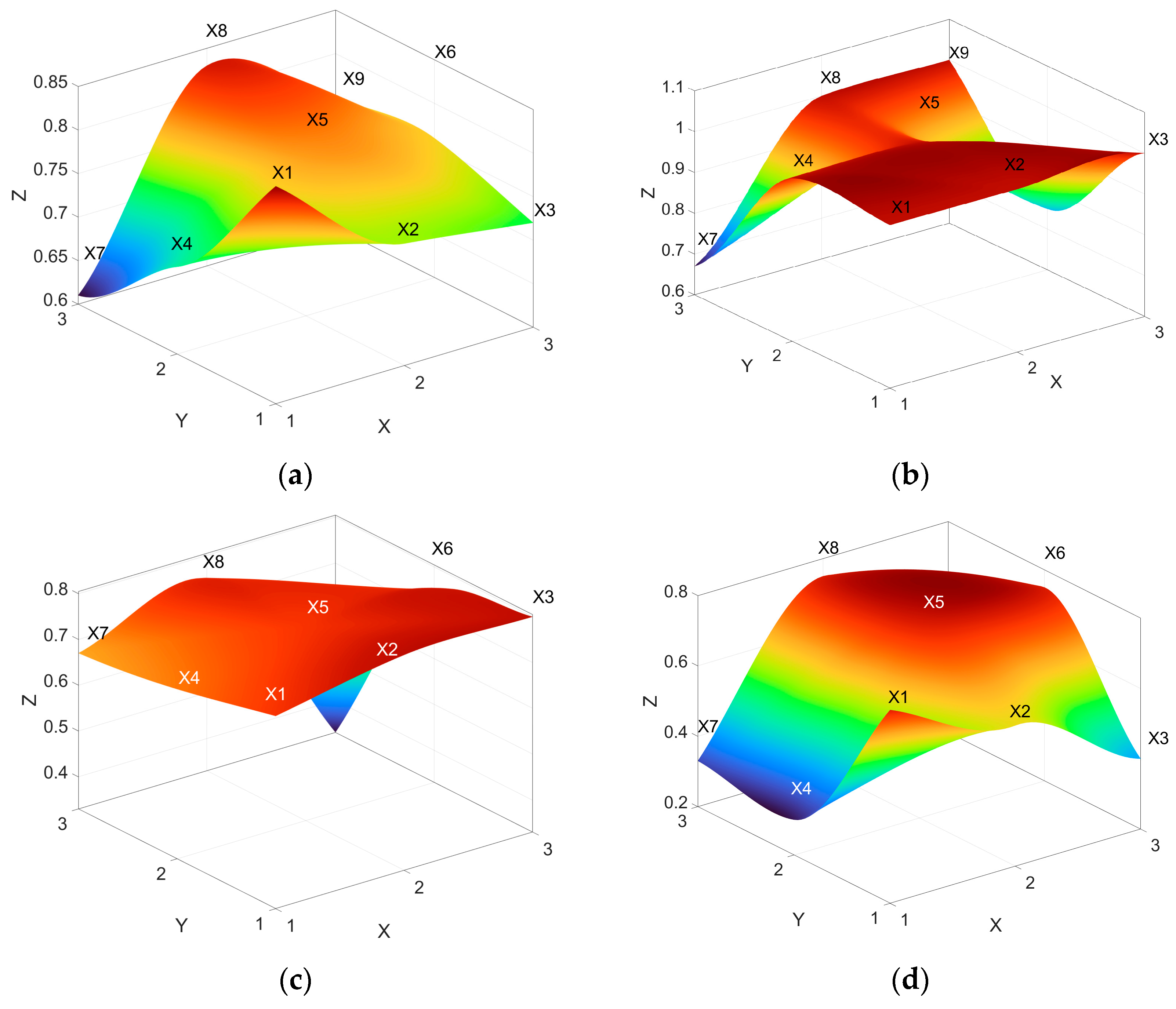
As shown in
Figure 3, this paper plots the national average PMC surface as well as the PMC surfaces of three typical provincial policy systems for visual comparison.
As presented in
Figure 3a, the national mean surface shows that policy functions, design quality, target groups, content fields, and timing arrangements are relatively high. This indicates that most provincial hydrogen industry policy systems have established relatively clear functional orientations, relatively standardized textual design, and a certain degree of coverage in policy objects, governance fields, and temporal arrangements. By contrast, issuing levels are visibly lower than the other dimensions, while instrument configuration and thematic coverage are also lower than policy functions and design quality. This structural form is consistent with the first-level variable means reported in
Table 8, suggesting that China’s provincial hydrogen industry policy systems perform relatively well in functional orientation and textual design, but still show weaknesses in vertical policy linkage and instrument configuration.
As presented in
Figure 3b, the PMC surface of Guangdong Province is generally high and relatively full. Its scores for policy functions, issuing bodies, thematic coverage, instrument configuration, target groups, design quality, and timing arrangements are close to or equal to 1. This indicates that Guangdong’s hydrogen industry policy system has a relatively complete textual structure across multiple dimensions. Although its issuing-level score is lower than several other high-scoring dimensions, it remains at a relatively high level. Overall, the surface form of Guangdong is characterized by high coverage and strong structural completeness, which corresponds to its leading PMC score.
As presented in
Figure 3c, the PMC surface of Hunan Province is at an intermediate level. Most of its first-level variable scores are concentrated between 0.70 and 0.80, indicating a certain degree of balance in issuing bodies, thematic coverage, instrument configuration, target groups, content fields, and design quality. However, Hunan’s timing-arrangement score is relatively low, creating a visible depression in the timing-arrangement dimension. This suggests that although Hunan’s hydrogen industry policy system has developed a relatively complete basic structure, its temporal continuity as represented in policy texts remains insufficient. In other words, the policy system has established a certain degree of thematic and instrumental coverage, but its long-term and staged policy support arrangements still need to be strengthened.
As presented in
Figure 3d, the PMC surface of Heilongjiang Province is lower overall and shows clear depressions in several dimensions, especially thematic coverage, instrument configuration, issuing levels, and timing arrangements. Among these, instrument configuration and issuing levels are particularly low, indicating that Heilongjiang’s hydrogen industry policy system has relatively limited policy instrument coverage and weak vertical linkage as reflected in policy issuance levels. In comparison, policy functions, target groups, content fields, and design quality remain at an acceptable level. This suggests that Heilongjiang’s policy system contains some basic textual elements, but its structural completeness and textual coordination remain relatively insufficient.
Overall, the PMC surface diagrams provide visual evidence consistent with the score results in
Table 8. Policy systems in the excellent textual design category usually have higher and fuller surfaces, indicating more complete textual coverage across multiple dimensions. Policy systems in the good textual design category tend to maintain medium-to-high scores in most dimensions but may show depressions in one or several specific dimensions. Policy systems in the acceptable textual design category often show multiple structural depressions, indicating insufficient textual coverage or design completeness in policy themes, instruments, issuing levels, and timing arrangements. Therefore, the PMC surface diagrams help reveal not only the overall PMC-based text-level coherence scores but also the internal textual structural weaknesses behind different scores.
4.4. Regional Distribution of PMC-Based Text-Level Coherence Scores
To further compare the regional characteristics of PMC-based text-level coherence scores in provincial hydrogen industry policy systems, this study analyzes the PMC evaluation results from a regional perspective.
Table 9 further reports the descriptive statistics of regional PMC-based text-level coherence scores.
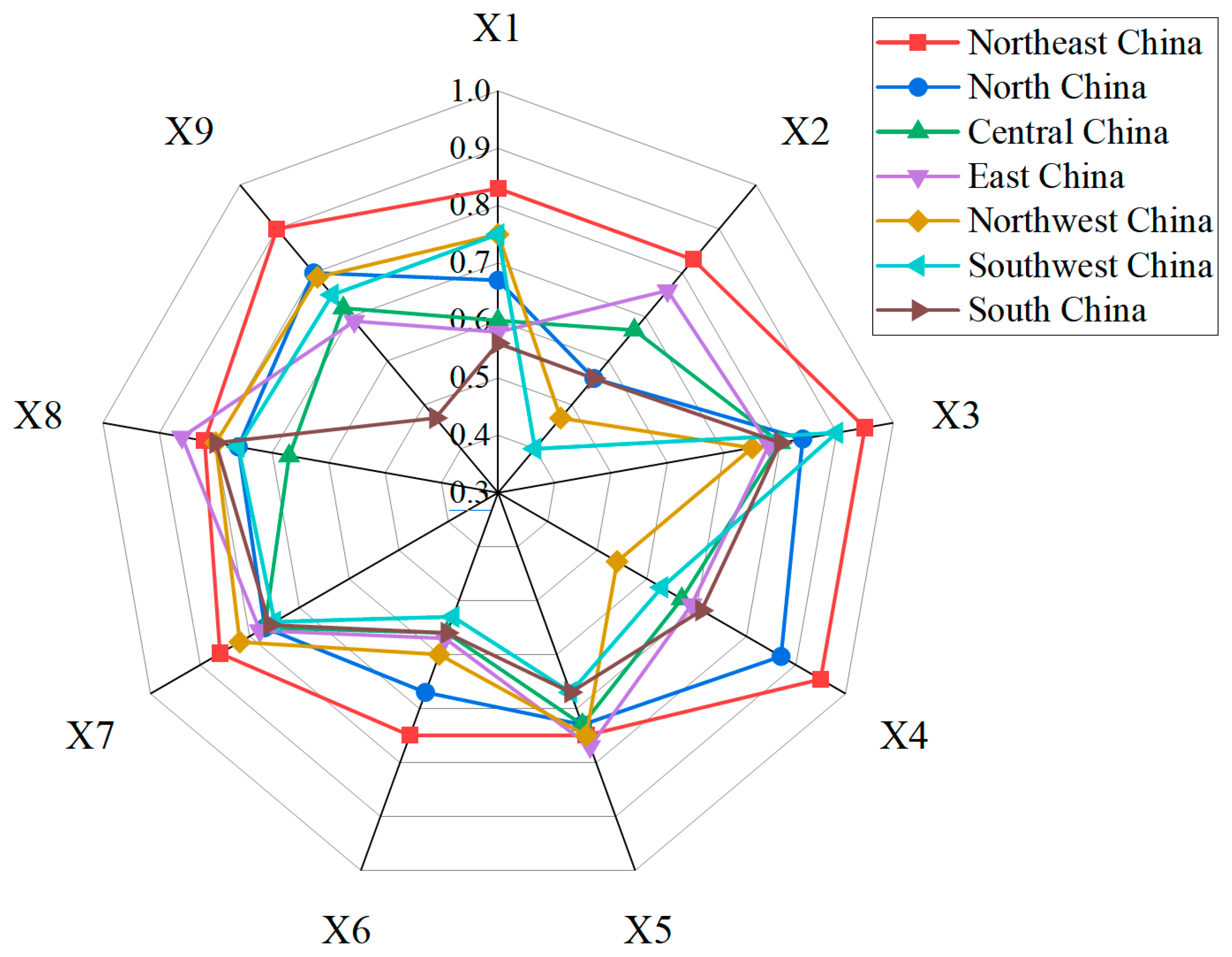
Figure 4 presents a radar chart of the average scores of the nine first-level variables across the seven regions.
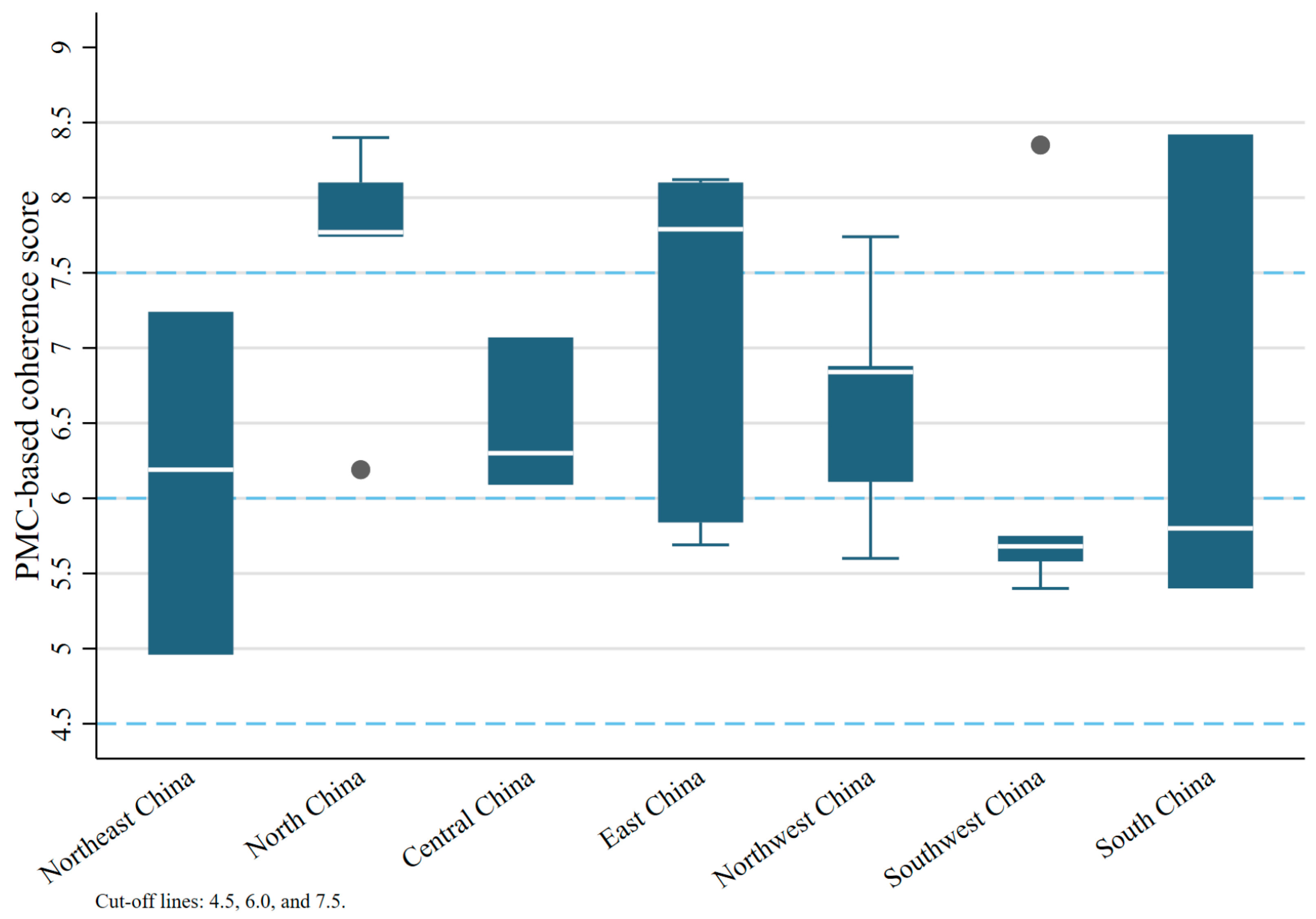
Figure 5 presents a box plot of PMC-based text-level coherence scores across the seven regions. The radar chart is used to show the structural profiles of different regions in terms of policy functions, issuing bodies, thematic coverage, instrument configuration, target groups, content fields, issuing levels, design quality, and timing arrangements. The box plot and descriptive statistics are used to show the distribution and dispersion of PMC-based text-level coherence scores within each region.
From the perspective of regional mean scores, the seven regions can be ranked as follows: North China, 7.64; East China, 7.10; Northwest China, 6.63; South China, 6.54; Central China, 6.49; Southwest China, 6.15; and Northeast China, 6.13. Among them, North China reaches the excellent textual design category on average, while East China, Northwest China, South China, Central China, Southwest China, and Northeast China are all within the good textual design category. This indicates that, at the regional level, China’s provincial hydrogen industry policy systems have already formed a relatively broad textual basis for structural coverage and design completeness, but clear gradient differences remain among regions.
The radar chart further reveals the structural profiles behind these regional differences. North China scores relatively high on policy functions, issuing bodies, content fields, issuing levels, design quality, and timing arrangements. Its radar profile is more outwardly expanded than those of the other regions, indicating stronger coverage across multiple textual dimensions. East China performs well in thematic coverage, instrument configuration, target groups, and design quality, although the scores across different dimensions still show some variation. Northwest China scores relatively high on policy functions, issuing bodies, and design quality, but its issuing-level score is relatively low, suggesting a weakness in vertical policy linkage. Central China shows a relatively balanced profile across variables, but its overall outward extension is weaker than that of North China and East China. South China scores relatively high on target groups, design quality, and timing arrangements, but relatively low on content fields and issuing levels. Southwest China performs relatively well in content fields and timing arrangements, but has lower scores in issuing bodies, instrument configuration, and issuing levels. Northeast China maintains a certain level of performance in policy functions, target groups, content fields, and design quality, but remains relatively weak in thematic coverage, instrument configuration, issuing levels, and timing arrangements.
Table 9 and
Figure 5 further show that regional mean scores alone cannot fully capture the internal distribution of PMC-based text-level coherence scores. North China has the highest regional mean score, at 7.64, with a median of 7.77, a standard deviation of 0.85, and a coefficient of variation of 0.11. This indicates that North China not only has a relatively high level of structural coverage and design completeness at the textual design level but also shows limited internal dispersion. East China has a mean score of 7.10 and a median score of 7.79, but its standard deviation is 1.16 and its range is 2.43. This suggests that East China contains both province-level regions in the excellent textual design category and those in the acceptable textual design category, resulting in more visible internal differences.
Northwest China has a mean score of 6.63 and a median score of 6.84, with a standard deviation of 0.82 and a coefficient of variation of 0.12. This indicates that the region as a whole shows a relatively good level of structural coverage and design completeness, with a moderate degree of internal dispersion. Central China has a mean score of 6.49, a median score of 6.30, a standard deviation of 0.52, and the lowest coefficient of variation among all regions, at 0.08. This suggests that the PMC scores of province-level regions in Central China are relatively concentrated.
By contrast, South China has a mean score of 6.54, but its median is only 5.80. Its standard deviation and coefficient of variation are 1.64 and 0.25, respectively, and its range reaches 3.02. This indicates that South China has the most obvious internal dispersion, and that its regional mean is strongly affected by the very high score of Guangdong Province. Southwest China has a mean score of 6.15, a median score of 5.68, a standard deviation of 1.24, and a coefficient of variation of 0.20, showing a certain degree of internal imbalance. The very high score of Sichuan Province raises the regional mean, while several other province-level regions remain within the acceptable textual design category. Northeast China has a mean score of 6.13, a median score of 6.19, a standard deviation of 1.14, and a range of 2.28, indicating that this region also shows noticeable internal differences.
Taken together,
Figure 4 and
Figure 5 and
Table 9 indicate that the PMC-based text-level coherence scores of China’s provincial hydrogen industry policy systems are characterized by both interregional gradient differences and intraregional dispersion. North China and East China have relatively high overall scores, but East China shows greater internal variation. Northwest China, Central China, and South China are all within the good textual design category, but their distribution patterns differ: Central China is more concentrated, whereas South China shows strong internal dispersion. Southwest China and Northeast China have relatively lower regional mean scores and show certain internal differences among province-level regions. Therefore, regional differences in PMC-based text-level coherence scores should not be interpreted only through mean scores. They should also be examined through structural profiles, score distributions, and descriptive statistical indicators.
5. Discussion and Conclusions
5.1. Provincial Hydrogen Policy Systems Have Taken Shape, but Text-Based Coherence Remains Uneven
This study shows that China’s provincial hydrogen industry policies are no longer limited to scattered policy advocacy as reflected in the collected policy texts. Instead, they have gradually developed into policy systems composed of themes, instruments, administrative actors, governance levels, and timing arrangements. The LDA results show that provincial hydrogen policy texts cover multiple themes, including hydrogen industry development, hydrogen technological innovation, hydrogen policy support, hydrogen industry regulation, and hydrogen operational management. The policy instrument analysis further shows that these policy texts contain a certain combination of instruments, including organizational support, fiscal subsidies, talent development, infrastructure, innovation environment, industrial development, and institutional supply. This indicates that, at the level of policy design, hydrogen has shifted from a single technological issue to a composite issue jointly shaped by local industrial policy, energy transition policy, and regional development policy.
However, the formation of policy systems does not mean that these systems are already fully coherent in textual design, let alone fully coordinated in actual implementation. The PMC-based text-level evaluation results show that the national average score is 6.75, indicating an overall relatively good level of design completeness and structural coverage at the textual level. Nevertheless, significant differences remain among province-level regions, and issuing levels and instrument configuration are still relatively weak textual dimensions. This suggests that China’s provincial hydrogen policy systems have already developed a basic textual structure, but internal structural imbalances remain. Some province-level regions show relatively complete textual combinations among industrial planning, technological innovation, fiscal support, and institutional arrangements, whereas others still rely mainly on planning-oriented, principle-based, and single-point support measures, with insufficient textual linkage among departments, governance levels, and policy instruments.
This finding reveals a key tension in China’s provincial hydrogen policy development: the number of policy documents has increased rapidly, but textual structural coordination and design completeness have not improved at the same pace across all regions. For the hydrogen industry, a larger number of policy documents does not necessarily indicate a more mature policy system. What matters more at the level of policy design is whether policy themes cover key links of industrial development, whether policy instruments are represented in a complementary manner, whether administrative actors are sufficiently represented and connected in policy texts, whether provincial-, municipal-, and county-level policy provisions are linked, and whether policy support forms a continuous temporal arrangement. Therefore, the future optimization of China’s hydrogen policies should not focus only on increasing the number of policy documents or introducing new support measures. Instead, it should shift toward improving text-based structural coherence, design completeness, and implementation readiness.
In this sense, the construction of China’s provincial hydrogen policy systems has entered a new stage. The early task was to place hydrogen on the policy agenda, whereas the current task is to organize dispersed policies into more coherent textual systems that can better support subsequent implementation. This also explains why China’s hydrogen industry policy cannot be fully understood from the perspective of individual policy documents alone. The central issue has shifted from whether policies exist to whether different policies structurally align at the textual design level. Therefore, the first conclusion of this study is that China’s provincial hydrogen industry policy systems have basically taken shape in policy texts, but their text-based coherence remains uneven.
5.2. Capacity-Building Orientation Is Prominent, While Market Formation and Institutional Supply Remain Insufficient
One of the most important findings of this study is that China’s provincial hydrogen policy systems show a strong capacity-building orientation in policy texts. In the thematic structure, hydrogen industry development and hydrogen technological innovation account for relatively high proportions. In the instrument structure, capacity-building instruments account for 55.87% of all coded policy instrument units, far exceeding other types of instruments. Industrial development, innovation environment, talent development, and infrastructure are frequently represented instruments, indicating that provincial hydrogen policy texts mainly emphasize industrial parks, demonstration bases, innovation platforms, enterprise cultivation, talent attraction, and infrastructure construction.
This capacity-building orientation is consistent with the current development stage of China’s hydrogen industry. The hydrogen industry has a long industrial chain, involving hydrogen production, storage, transportation, refueling, and utilization. It also requires large infrastructure investment, high technological thresholds, and long payback periods. At the early stage of industrial development, capacity-building instruments are important for compensating for market insufficiencies and reducing the initial barriers to industrial growth. In particular, when green hydrogen supply, hydrogen refueling infrastructure, fuel cell technologies, and application scenarios have not yet formed a stable market loop, the resource-organizing capacity and infrastructure investment capacity of local governments remain important.
The problem, however, is that capacity building mainly addresses whether the industry can be built, but it does not by itself address whether the industry can operate sustainably. If provincial hydrogen policy systems rely too heavily on infrastructure construction, project layout, platform building, and enterprise attraction in their textual design, while demand-side incentives, market transaction mechanisms, green hydrogen certification, safety standards, long-term procurement mechanisms, and cross-regional circulation rules remain insufficiently represented, the hydrogen industry may face the risk that projects, industrial parks, and plans are advanced faster than market application and commercial closed loops. In other words, capacity building can help the industry move from nonexistence to initial establishment, but it may not be sufficient to support the transition from demonstration to large-scale application.
The regional instrument structure further illustrates this point. Policy texts in Northwest China, Southwest China, and Northeast China show relatively high proportions of capacity-building instruments, suggesting that these regions place greater textual emphasis on resource development, infrastructure, and industrial foundation building. East China and North China are still dominated by capacity-building instruments, but their proportions of incentive instruments are relatively higher, indicating that their policy texts have begun to pay more attention to fiscal support, market cultivation, and enterprise incentives. South China has a relatively lower proportion of capacity-building instruments, while incentive instruments and system-changing instruments account for relatively higher shares, suggesting a stronger textual emphasis on market incentives and institutional supply.
These differences indicate that hydrogen policy priorities vary across China’s regions as reflected in policy texts. Resource-based regions tend to focus on transforming resource endowments into industrial foundations, while regions with stronger manufacturing bases and market conditions are more likely to move toward market cultivation and institutional optimization. Therefore, the main weakness of China’s provincial hydrogen policy systems is not that capacity-building instruments are excessive, but that these instruments are not sufficiently connected in textual design with market formation instruments, institutional supply instruments, and regulatory governance instruments. Therefore, the second conclusion of this study is that China’s provincial hydrogen policy systems remain strongly capacity-building oriented at the textual design level, while demand-side traction, market formation, and institutional supply need to be strengthened.
5.3. Regional Differentiation Reflects Local Conditions but Also Reveals Insufficient Multilevel Linkage in Policy Texts
The PMC-based text-level evaluation results show clear regional differentiation in China’s provincial hydrogen policy systems. North China and East China have relatively high overall scores, indicating that these regions have relatively complete textual structures in policy functions, issuing bodies, thematic coverage, instrument configuration, and design quality. Northwest China, Central China, and South China are generally within the good textual design category, but their internal structures differ. Southwest China and Northeast China have relatively lower regional mean scores, and some province-level regions still show weaknesses in thematic coverage, instrument configuration, issuing levels, and timing arrangements.
These differences should not be interpreted simply as a ranking of policy quality or implementation performance. China’s hydrogen industry is spatially embedded, and different regions have different conditions for hydrogen development. Northwest China has advantages in renewable energy resources and is more suitable for building policy systems around green hydrogen production, storage and transportation networks, and cross-regional hydrogen supply. East China, North China, and South China have relatively strong industrial foundations, manufacturing capacity, application scenarios, and market demand, making them more suitable for policy design around hydrogen equipment manufacturing, fuel cell vehicles, port logistics, industrial parks, and urban cluster applications. Some regions in Southwest China and Northeast China also have certain resource or industrial foundations, but the completeness and continuity of their policy text design still need improvement. Regional differentiation therefore reflects differences in how provincial policy texts translate resource endowments, industrial foundations, market conditions, and governance priorities into policy system design.
Behind regional differentiation, however, lies a deeper problem: insufficient vertical linkage as represented in policy texts. Issuing levels are the weakest dimension in the PMC-based text-level evaluation, indicating that many regions have issued provincial plans, opinions, or action programs, but municipal and county-level task decomposition, scenario implementation provisions, and supporting execution arrangements are less systematically represented in policy texts. Many key issues in hydrogen industry development do not occur only at the provincial level. They need to be implemented at the municipal, county, and industrial park levels, including hydrogen refueling station siting, project approval, land use support, fiscal policy fulfillment, safety regulation, operation monitoring, and demonstration scenario construction. Without sufficient municipal and county-level policy provisions, provincial policies may remain at the level of broad planning and principle-based support.
This means that China’s provincial hydrogen policy systems need to shift from planning-driven textual design to multilevel implementation-oriented policy design. Planning-driven design emphasizes goal setting, industrial layout, and policy advocacy. Multilevel implementation-oriented design requires the formation of continuous chains among provincial policies, municipal plans, county-level projects, industrial park scenarios, and enterprise actions. For an emerging industry such as hydrogen, which is characterized by uncertain technological routes, large investment scale, high safety requirements, and strong cross-regional circulation needs, macrolevel provincial planning alone is insufficient. A more complete policy system design requires a closed loop linking long-term planning, phased tasks, annual lists, project implementation, risk regulation, and dynamic evaluation.
Therefore, regional differentiation in China’s provincial hydrogen policies should not be addressed through policy homogenization. Instead, different regions should build differentiated policy systems according to their resource endowments, industrial foundations, and application scenarios. What needs to be strengthened is functional coordination across regions and implementation linkage across governance levels, while recognizing that the evidence provided in this study is based on policy text design rather than direct observation of implementation outcomes. Resource-based regions, manufacturing-based regions, and regions rich in application scenarios should form complementary divisions of labor around green hydrogen supply, equipment manufacturing, storage and transportation networks, standards mutual recognition, and market applications. Provincial, municipal, and county governments should also establish vertical linkages around project lists, responsibility allocation, fiscal fulfillment, safety regulation, and performance feedback. The third conclusion of this study is that China’s provincial hydrogen policy systems show significant regional differentiation at the textual design level, and their future development depends on strengthening both horizontal regional coordination and vertical multilevel linkage.
6. Policy Implications
Because the empirical analysis in this study is based on policy texts, the following policy implications mainly concern policy system design, textual review, and implementation readiness. They should not be interpreted as direct evidence of actual implementation performance or empirical policy coordination in practice. Rather, they indicate how provincial hydrogen policy systems may improve their structural coverage, design completeness, and textual coordination so as to provide a more robust basis for subsequent implementation.
6.1. Establishing Text-Based Policy System Coherence Review Mechanisms
The findings of this study suggest that China’s hydrogen policy optimization should shift from document-based policy expansion to system-based policy design and coordination. At present, many province-level regions have issued hydrogen-related policies, but the textual coherence among policy themes, instruments, issuing bodies, governance levels, and timing arrangements remains uneven. Therefore, future policy design should establish text-based policy system coherence review mechanisms. Such mechanisms should not only examine whether a new policy document is necessary, but also assess how it connects with existing policy documents, whether it fills gaps in the existing policy system, and whether it strengthens the complementarity among policy themes and instruments.
Specifically, province-level regions can establish periodic reviews of hydrogen policy systems. These reviews may examine whether policy themes cover key links such as hydrogen production, storage, transportation, refueling, application, safety regulation, green certification, and market formation; whether policy instruments include not only capacity-building support but also demand-side incentives, regulatory rules, and institutional supply; and whether provincial policies are linked to municipal- and county-level implementation mechanisms. Through such reviews, local governments can avoid fragmented policy accumulation and promote the transformation of hydrogen policies from scattered document supply to more coherent policy system design. In the process of reviewing policy coherence, local governments can also draw on the expertise of research institutes and universities to conduct policy evaluations in a more scientific and systematic manner and make timely adjustments.
6.2. Strengthening Demand-Side Traction Around Key Application Scenarios
The strong capacity-building orientation identified in this study indicates that provincial hydrogen policy texts devote substantial attention to industrial foundations, infrastructure, innovation platforms, and talent development. These policies are necessary for the early-stage development of the hydrogen industry. However, if demand-side application scenarios remain insufficient, capacity building may not translate into sustainable industrial growth. Therefore, hydrogen policy systems should further strengthen demand-side traction around key application scenarios. In regions where market development is lagging, governments should foster and guide the emergence and growth of the market through subsidies, direct procurement, and effective publicity.
In practice, local governments should focus on scenarios with clear demand foundations and public policy relevance, such as public transportation, logistics, ports, industrial parks, municipal services, distributed energy systems, and green industrial parks. Policy systems should provide more stable government procurement, long-term purchase agreements, operation subsidies, and demonstration application mechanisms for these scenarios. At the same time, demand-side policies should be connected with enterprise investment, infrastructure layout, and fiscal support arrangements so that hydrogen production, storage, transportation, refueling, and utilization can form more stable application loops. In this way, hydrogen policies can move beyond project construction and better support market formation.
6.3. Building Mechanisms Linking Green Hydrogen Certification, Carbon Accounting, and Price Compensation
For hydrogen to play a meaningful role in low-carbon transition, policy systems need to distinguish more clearly among different hydrogen production pathways and strengthen the governance of green hydrogen and low-carbon hydrogen. At present, many provincial hydrogen policies emphasize industrial scale, infrastructure construction, and project demonstration, but the institutional mechanisms for green hydrogen certification, carbon accounting, and price compensation remain insufficient. This may weaken the low-carbon orientation of hydrogen industry development.
Therefore, future policy design should establish mechanisms linking green hydrogen certification, carbon emission accounting, and price compensation. Green hydrogen certification should clarify the source of renewable electricity, the carbon intensity of hydrogen production, and the traceability of hydrogen products. Carbon accounting mechanisms should make the emission reduction contribution of hydrogen applications measurable and comparable, especially in hard-to-abate sectors such as steel, chemicals, transportation, and industrial parks. Price compensation or green premium mechanisms should reduce the cost gap between green hydrogen and conventional hydrogen, thereby improving the economic feasibility of green hydrogen applications. By linking certification, carbon accounting, and price support, policy systems can provide stronger incentives for the development and use of green hydrogen.
6.4. Improving Full-Chain Safety Regulation and Standards Systems for Hydrogen
Hydrogen industry development involves multiple safety-sensitive links, including production, storage, transportation, refueling, and utilization. The findings of this study show that safety regulation and institutional supply are less prominently represented than capacity-building instruments in many provincial policy systems. If regulatory rules and standards systems lag behind industrial expansion, hydrogen development may face safety risks, approval uncertainty, and implementation barriers. Therefore, future policy systems should strengthen full-chain safety regulation and standards construction.
Local governments should clarify regulatory responsibilities among energy, emergency management, transportation, market regulation, ecology and environment, industry and information technology, housing and urban–rural development, and other relevant departments. They should also improve technical standards for hydrogen storage and transportation, hydrogen refueling station construction and operation, fuel cell vehicle promotion, industrial hydrogen application, and emergency response. In addition, safety regulation should not be limited to restrictive control. It should also provide clear, predictable, and operable rules for enterprises so that safety governance and industrial development can support each other. A more complete safety and standards system can reduce institutional uncertainty, strengthen the long-term operability of hydrogen policy systems, and provide more predictable conditions for market growth.
6.5. Advancing Differentiated Policy Mixes Based on Regional Functional Positioning
The regional differences identified in this study indicate that China’s hydrogen industry policy systems should not follow a homogeneous policy model. Different regions have different resource endowments, industrial foundations, innovation capacities, and application scenarios. Therefore, province-level regions should develop differentiated policy mixes based on their functional positioning in the national hydrogen industry system.
Resource-rich regions, especially those with abundant renewable energy resources, can focus on green hydrogen production, storage and transportation networks, and cross-regional hydrogen supply. Manufacturing-based regions can prioritize hydrogen equipment, fuel cell systems, key materials, and industrial chain coordination. Regions with rich application scenarios can focus on transportation, port logistics, industrial decarbonization, integrated energy systems, and public service applications. At the same time, differentiated policy systems should be embedded in broader regional coordination mechanisms. Regions should strengthen coordination in infrastructure planning, standards mutual recognition, green certification, supply–demand matching, and cross-regional hydrogen transportation. This can reduce repetitive construction and low-level competition while promoting complementary regional division of labor.
6.6. Strengthening the Province–City–County–Industrial Park Implementation Readiness Chain
The PMC-based text-level evaluation results show that issuing levels are the weakest textual dimension of China’s provincial hydrogen policy systems. This suggests that many policy systems are relatively strong in provincial-level planning, but municipal-, county-level, and industrial park-level policy provisions are less systematically represented in policy texts. Hydrogen industry development requires concrete implementation in specific places, projects, facilities, and scenarios. Therefore, strengthening the province–city–county–industrial park implementation readiness chain is essential for improving text-based policy system coherence and supporting subsequent implementation.
Province-level governments should clarify strategic objectives, institutional frameworks, and policy support boundaries. Municipal governments should translate provincial strategies into industrial layouts, scenario plans, infrastructure projects, and supporting policies. County governments and industrial parks should further specify project lists, land use arrangements, approval procedures, fiscal support fulfillment, safety supervision, and enterprise services. Meanwhile, policy systems should establish dynamic feedback mechanisms linking project implementation, market response, safety risks, and policy adjustment. Through such an implementation readiness chain, hydrogen policies can move from one-time document issuance to continuous system governance.
7. Limitations and Future Research
This study has several limitations. First, the analysis is based on policy texts and mainly evaluates the thematic coverage, instrument configuration, and structural coherence of provincial hydrogen industry policy systems at the textual level. Therefore, the PMC-based text-level coherence score should not be directly interpreted as policy implementation effectiveness or hydrogen industry development performance. Policy texts reflect how local governments define policy objectives, organize policy instruments, and arrange administrative responsibilities, but they cannot fully capture actual policy coordination, implementation synergy, or the functional interaction among policy components in practice. Future research may further combine policy text analysis with interviews, case studies, and implementation process data to examine how textual policy system coherence is translated into actual governance practice.
Second, although this study combines LDA topic modeling, content analysis-based policy instrument coding, expert consistency checks, and the PMC index model to improve analytical transparency and reliability, the identification of policy instruments and the assignment of PMC scores still involve a certain degree of human judgment. In addition, the PMC model relies on an equal weighting strategy for standardized textual comparison. This strategy does not imply that different dimensions have equal causal or functional importance in actual implementation. The 42 secondary variables used in this study are also operational observation items nested under nine first-level dimensions rather than independent theoretical dimensions, but the indicator system remains relatively extensive. Future research may conduct sensitivity analyses, apply alternative weighting schemes, and further test whether some indicators can be consolidated or reweighted while preserving the hydrogen-specific features of policy design.
Third, this study mainly evaluates provincial hydrogen industry policy systems up to the end of 2025 and does not directly examine the relationship between text-based policy system coherence and industrial development outcomes. Future research can link the policy system coherence indicators developed in this study with outcome variables such as green hydrogen production capacity, hydrogen refueling station deployment, fuel cell vehicle adoption, hydrogen investment scale, hydrogen-related patent output, demonstration project implementation, and carbon reduction performance. In addition, because this study is situated in the context of China’s state-led and plan-oriented industrial policy system, future research may test whether the coherence framework and evaluation criteria remain applicable in more market-driven or cross-national settings.