Article

Policy Complementarity Between AI Innovation Pilot Zones and Supply Chain Innovation Pilots: Evidence from Enterprise Resilience in China

1
School of Business Administration, Northeastern University, Shenyang 110001, China
2
School of Business and Management, Jilin University, Changchun 130012, China
*
Author to whom correspondence should be addressed.
Systems 2026, 14(6), 673; https://doi.org/10.3390/systems14060673

Submission received: 26 April 2026 / Revised: 8 June 2026 / Accepted: 9 June 2026 / Published: 11 June 2026
(This article belongs to the Section Supply Chain Management)

Abstract

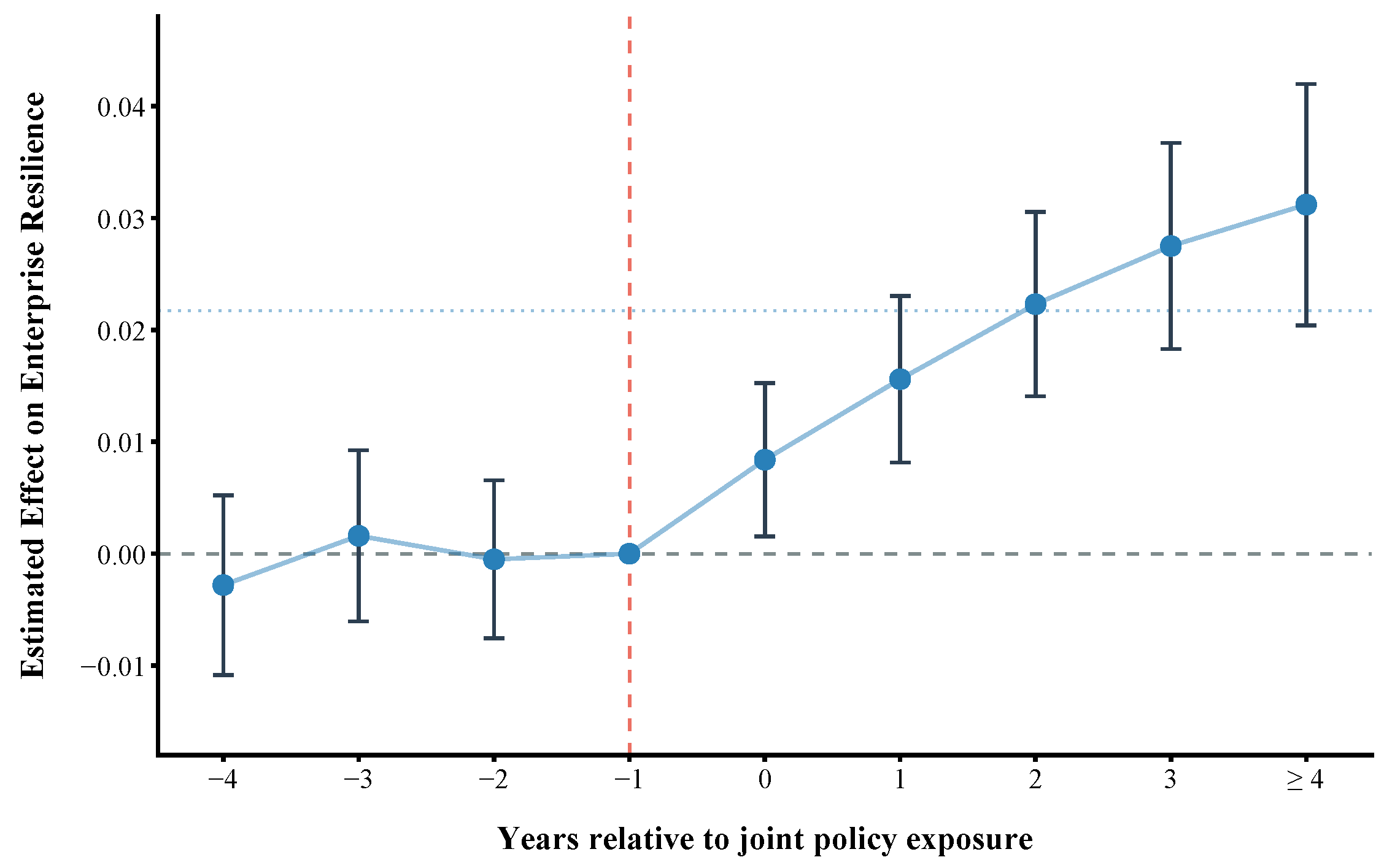
Firms increasingly face disruptions arising from technological change, supply chain instability, and uncertain policy environments, making enterprise resilience a key concern for both managers and policymakers. As firms operate within interconnected digital and supply chain systems, this study examines whether digital intelligence policy and supply chain coordination policy are jointly associated with enterprise resilience. Using a firm-year panel of Chinese A-share listed companies from 2010 to 2024, we investigate AI innovation pilot zones and supply chain innovation pilots, with a particular focus on whether their coexistence is associated with a complementarity premium. The results suggest that both AI innovation pilot zones and supply chain innovation pilots are positively associated with enterprise resilience. The interaction between the two policies is significantly positive, providing evidence consistent with an additional joint-policy association beyond their separate associations. Dynamic analysis supports the parallel trend assumption and suggests that the estimated complementarity association becomes stronger over time. Mechanism tests provide channel-consistent evidence that joint policy exposure is associated with higher values of the digital-transformation indicator, stronger supply chain coordination, and greater resource reconfiguration. Heterogeneity analysis further suggests that this association is more pronounced among non-state-owned firms, firms in supply-chain-dependent industries, firms located in cities with stronger digital infrastructure, and firms with higher risk exposure. These findings highlight the potential importance of coordinated policy design for supporting firm-level resilience.
Keywords: enterprise resilience; AI innovation pilot zones; supply chain innovation pilots; policy complementarity; digital transformation; difference-in-differences enterprise resilience; AI innovation pilot zones; supply chain innovation pilots; policy complementarity; digital transformation; difference-in-differences