1. Introduction
The impacts of big data analytics (BDA) are pervasive on Artificial Intelligence (AI) as well as governance and management [
1]. With the implementation of BDA becoming common in all industries, the aviation sector is increasingly aligning its mission more and more with the changing traveler needs to make passengers travel easy and to make sophisticated logistics systems operations efficient [
2].
Air transport is a multifaceted operations research (OR) problem, the dynamic growth of worldwide flight networks and the ever-growing frequency with which flights are operated have rendered the classical approach to air transport problems more intricate (purely from an operations research standpoint), calling for new analytical techniques. Classical OR remains foundational but struggles to fully leverage today’s heterogeneous operational data; aviation therefore complements OR with machine learning and predictive analytics. As a means to respond to these challenges, aviation has incorporated progressively smart practices—such as machine learning and predictive analytics—along with classical OR models. For example, ground and air resource optimization for flight scheduling have been improved by the application of AI methods to decision-making on the day of operations disruptions such as air traffic congestion or mechanical delays [
3].
Airports are now among the largest sources of big data in aviation and the size and relevance of airport datasets have a transformational potential. Airports are increasingly becoming smart data-driven hubs that employ big data analytics to support decision-making in order to be able to reduce cost and increase efficiency [
4]. Global deployment of smart airports underscores the importance of BDA as a platform architecture for future management process in the aviation [
5].
This is what McAfee and Brynjolfsson [
6] refer to when they assert that big data are not merely an evolution in technology but a revolution—as the term suggests, one which transforms the way businesses make decisions and keep knowledge control. This shift could replace intuition-based decision-making with evidence-based methodologies and push other industries like the aviation sector to embrace new managerial modes of reasoning and data oriented cultures, if they are to continue being competitive and flexible.
The airports are the crucial part of aerospace system, making it a prime context for leveraging big data in safety-critical information systems. At its base, flight is a networked activity, and the shape of these networks—the way they are built out and utilized (by airlines, by carriers, by controllers or regulators)—might have huge ramifications for everything else. The IGA is among such an example—a mega-hub representing the opportunities and challenges of big data application in aviation operations.
This managerial dimension establishes the foundation for the subsequent analysis of airport-level big data ecosystems. In this perspective, the present research bridges a significant gap in the literature by providing a holistic analysis of big data application within aviation as applied to large-scale, high-traffic hubs like IGA. While data privacy and security are well-addressed topics in big data literature, at airports these issues are aggravated by the multifaceted nature of merged heterogeneous data sources—such as passenger biometrics, internet-of-things (IoT)-enabled systems—and cross-border data governance frameworks such as the General Data Protection Regulation (GDPR) [
7] and International Civil Aviation Organization (ICAO) Annex 17 [
8].
Although previous research has analyzed big data’s impact on airport competition [
9] and passenger choice modeling [
10], little is known about the intricate process of integrating large volumes of data and enabling real-time decision-making at a hub airport. Indeed, it is possible to improve operational efficiency by addressing cross-system data integration, cybersecurity and legacy systems updating issues at IGA—which supervises more than 1400 daily flights and various data streams [
11,
12]. The entropy method and Decision-Making Trial and Evaluation Laboratory (DEMATEL) were applied in dealing with these problems. This methodological fusion is in line with the established multicriteria decision-making (MCDM) theory and practice that have developed systematic analytical methods for objective systems of complex decision environment by systematically standardizing the weights of factors and also modeling interrelationships between them [
13]. This integration improves the analytical richness with regard to both prioritization and causal effects between criteria. These two MCDM methods provide an objective quantification and mapping of the causal relationships between technical, operational, and strategic big data challenges.
Between them, these approaches present a balanced analysis framework that involves objective weighting and causal mapping. Entropy captures variability in expert judgments to derive objective weights; DEMATEL maps the direction and strength of inter-criterion influences. This two-method combination is essential for both the identification of key challenges and their interactions within airport data ecosystems [
14,
15].
These findings support the development of examinations, in both theory and practice, of big data difficulties in the aviation sector:
- ○
In principle, an approach will be created to connect the MCDM methods with the aviation-related data management problems.
- ○
In practice enabling IGA—and other airports worldwide—to adopt a set of actionable strategies helps align data ecosystems, manage risks and unlock AI led analytics for real-time decisioning.
This study integrates operations research and data governance approaches in order to propose a new framework for contemporary airport settings.
In recent years, airlines have increasingly adopted big data analytics in aviation as a fundamental strategy, recognizing its potential not only to reduce operational costs but also to enhance the quality of customer experience [
16]. The evaluation, integration, and utilization of newly accessible big data sources have emerged as significant strategic and organizational challenges for airline network planners [
17]. An example Altundağ and Wynn [
18] show that advanced analytics in strategic procurement processes of airlines can significantly expedite decision-making.
While big data has been extensively studied in the context of airlines, airport-level studies are relatively less common. This observation emphasizes the necessity to study big data applications not only in an airline but also in a more complex, data-rich environment of airports. The significance of data privacy has been widely recognized in the past studies, but few researchers have explored its causal relationships with other big data challenges especially from airports. This research therefore seeks to explore the mechanism through which both privacy and security affect (or are affected by) other system-level barriers.
Beyond the technical and organizational dimensions, the ethical governance of data-driven systems has become a central concern in recent scholarship, with Jobin, Ienca and Vayena [
19] highlighting five globally converging ethical principles—transparency, justice and fairness, non-maleficence, responsibility and privacy—within responsible AI/data governance in aviation. Transposing these into aviation underscores the importance of not only enabling airport-level big data applications to increase operational efficiencies, but also of ethical responsibility, stakeholder trust and regulatory compliance when doing so.
The power of big data is now universally recognized and has been impactful in every vertical, including aviation. The volume, variety and velocity of data from flights represents opportunities underpinned by challenges [
20]. In the field of aviation, there is a continuous flow of crucial data that those in the industry must manage. Pivotal information includes not only flight data and current weather and passenger profiles, but also maintenance records, as well as air traffic updates—with the added pressure of needing to process key datapoints rapidly from this large volume of incoming data into their systems.
Velocity, or the pace at which data is generated and analyzed and then acted upon, poses specific challenges in aviation operations. It is the factor that decides how well one can “think on her or his feet”. Big data issues in aviation include the processing of real-time sensor and weather service; merging various systems (e.g., air traffic control and maintenance logs); accuracy on safety-related decisions, and infrastructure for handling large volumes of data with exponential growth [
21].
The rapid development of technology has led to a steep increase in data in various sectors, such as air transport. Although BDA permits crucial findings from such datasets, there is a tendency in current works to disregard the interdependence of aspects including air conditioning performance, health monitoring systems, maintenance planning, and fuel consumption prediction. Furthermore, the airline industry encounters three main obstacles in the adoption of BDA which are data integration complexity, regulatory compliance demand and privacy/security threats from data [
22].
There are two major challenges for the aviation industry: improving safety and increasing performance. BDA provides revolutionary answers to these challenges through two fundamental dimensions: technological and managerial. BDA enhances aircraft design, real-time performance tracking, prognostic health maintenance and fault detection. Sensor-based analytics, for instance, offers a chance to proactively diagnose faults, thus bring technology into the improvement of safety operations. BDA can optimize ATC, route planning, flight environment control, cabin management of fleets, as well as crew scheduling and business operations. Big data platforms that are integrated will, in turn, help simplify decision-making and increase the efficiency in terms of managerial aviation workflows. However, the implementation of aviation big data platforms faces technical and operational challenges, including integrating data from heterogeneous systems as well as scaling the developed infrastructure to support large-scale big data requirements. Nevertheless, such platforms have the potential to transform aviation by integrating aeronautical science data (e.g., aircraft performance measures) with management data (e.g., insight into operational efficiency), leading to improved safety and sustainability of the industry [
23].
In summary, the previous research efforts have mainly addressed airway-level big data analytics for operational efficiency, cost and predictive maintenance. But these pieces seldom include an examination of airport settings, where integrating data and real-time analytics so the data can go through the right compliance channels is significantly more complicated. This paper addresses this gap by moving the focus of analysis away from airlines as operators, to airport-level ecosystems, and emphasizes how technical, organizational and ethical factors interrelate.
Prior to our work, analyses of big data applications and management challenges within aviation had mainly considered them over three dimensions: technical, organizational and ethical/regulatory. The challenges are mainly technical, such as data integration issues, data quality and integrity, privacy concerns (data flow both inwards to the registry and outwards to third parties), and regulation aspects, as highlighted by Aarthy et al. [
23] and Hanif & Jaafar [
22]. The organizational hindrances are associated with the workforce ability and they are also related to resistance to data-driven decision-making; furthermore, there is a lack of strong data culture in the aviation organizations [
24].
This tri-classification is the basis for a holistic understanding of the multidimensional challenge that big data adoption and management present in aviation.
In recent studies, multicriteria decision-making (MCDM) models have been widely utilized to solve complex problems in the aviation industry. For instance, DEMATEL and the Analytic Hierarchy Process (AHP), originally developed by Saaty [
25], were combined to analyze the interrelationships operating among selection criteria when selecting air traffic protection aircraft [
26]. Data-driven approaches have also been applied to assess the remaining useful life of aircraft components such as auxiliary power units for predictive maintenance [
27]. In a different study, SWARA and COPRAS integrated was used to consider two purchasing alternatives of aircrafts based on six criteria (related with purchase cost, fuel capacity, seat capacity, range, takeoff weight and cargo capacity), which demonstrates the real-world application possibility of hybrid MCDM models in airline decisions [
28].
Nevertheless, such contributions are far from analyzing the underlying causal relations between challenges in an educational context. This methodological gap emphasizes that a comprehensive model, which is able to rank the relative importance and interrelationships among aviation big data challenges should be integrated.
To fill this gap, the current paper employs a joint entropy–DEMATEL approach to systematically understand the main barriers to big data application in airport systems. The proposed approach allows for a dual analysis which merges objective weighting (entropy) with causal mapping (DEMATEL), and it overcomes the methodological fragmentation encountered in earlier studies. Leveraging insights from prior MCDM-facilitated studies, this framework not only minimizes the span between prioritization and causal analysis, it also provides more comprehensive comprehension about dovetailed challenging aviation big data constraints. In this way, the paper makes a twofold contribution to both the theoretical analysis of aviation big data challenges and the application of databased decision-making in complex airport context.
Compared with prior aviation MCDM approaches such as DEMATEL–AHP, SWARA–COPRAS, and fuzzy DEMATEL–VIKOR, the entropy–DEMATEL combination offers three specific advantages for big data governance problems. First, it removes the subjectivity of pairwise weight elicitation by deriving the criterion weights directly from the dispersion of the expert judgments. Second, unlike methods that produce only a single composite ranking, DEMATEL preserves the directional cause–effect structure among criteria, which is essential when interventions must be sequenced. Third, the procedure is computationally light and fully reproducible, which supports its adoption in operational airport settings. To the best of our knowledge, this is the first application of an entropy–DEMATEL framework to airport-level big data governance.
2. Materials and Methods
2.1. Case Study Context: IGA
IGA is home to one of the world’s largest and more technically advanced airports, serving approximately 76 million passengers a year with flights to about 100 countries. IGA was designed as a “smart airport” since its launch in 2018, incorporating digital infrastructure at every corner—from biometric passenger solutions and sensors for the IoT to self-service bag drop services and an integrated airport management platform [
29].
This complex environment of technology generates huge, diverse data flows in airside, terminal, and landside operations. It comprises flight operations information, ground services data and telecommunications with aircraft, power management operations (e.g., for a retailer) and passenger movement-related data. Control and protection of such database networks is extremely daunting, particularly in maintaining data confidentiality while achieving real-time integration and compliance (e.g., with GDPR and ICAO Annex 17).
These features make IGA a suitable case of examining big data application in airport management from an airport-specific perspective, complementing broader sector-wide approaches. Its wide scope and big data level offer an ideal environment to capture and understand large-scale, systemic problems for data-driven airport ecosystems. In this sense, IGA is an emblem not just of one locality, but a model enjoyed around the world for how major trunk lines are steering through the operational, technical and ethical thickets of BDA. IGA, with its operational magnitude and digital ecosystem, is one of the most data-rich airports in the world. The existing airport serves around 76 million passengers per year (as of 2024) with about 1400 daily flights and over 100 countries and approximately more than 300 destinations [
29].
The performance indicators of the airport include the passenger traffic, percentage of departure on time, baggage handling efficiency, and optimal management of airside traffic—all of which depend directly or indirectly on data-driven monitoring systems.
The airport incorporates more than 10,000 IoT sensors in combination with cutting-edge biometric identification systems and centralized data analytics platforms for terminal operations, ground handling and passenger experience [
29].
In summary, these characteristics render IGA a benchmark example for big data usage, as large-scale operations continuously generate highly heterogeneous, high-velocity data streams both from safety aspects and logistics and service management domains. At the time of writing, Istanbul Airport is undergoing a multi-phase expansion scheduled for completion by 2027, after which it is projected to operate with eight runways, 16 taxiways, a parking capacity of approximately 500 aircraft, and 36 baggage drop-off points, together with on-site medical, convention, and power-generation facilities. Because the number of heterogeneous data streams scales with apron and terminal capacity, the data governance challenges identified in this study are expected to intensify rather than diminish under the 2027 configuration. The present analysis therefore constitutes a 2025 baseline against which the post-2027 state can be benchmarked.
2.2. Expert Panel and Sampling
The sampling design of this study is purposive (judgmental); it is not based on random, stratified, or convenience sampling [
30]. The sample was a purposive one used in this study to select the expert panel and it is suitable for studies that demand informed judgment on specific topics. Purposive sampling or judgmental sampling is the selection of study participants based on a knowledge-laden criterion [
30] (p. 3). A similar rule was followed in the present study by selecting experts who had a particular knowledge and experience related to research context.
The expert group comprised five experts who have rich experience in aviation management, BDA, aviation IT systems and security systems. All experts had at least five years of relevant work experience in the aviation or BDA industry, which ensures the credibility and reliability of their views. The panel featured executives from IGA, IST Systems and IST Bilişim A.Ş. (see
Table 1).
Before they were asked to provide data, the experts received information on the aims and methods of this study. Introductory brief online discussions were held to introduce participants to the assessment context. Confidentiality, voluntary participation, and anonymity were strictly respected to ensure honest and unbiased evaluations. The sampling design of this study is purposive (judgmental) rather than random, stratified, or convenience-based. The experts were eligible only if they had at least five years of relevant experience in aviation or big data analytics, held decision-making responsibility in the relevant domain, and were familiar with all nine criteria. In expert-based MCDM and DEMATEL studies, the adequacy of an expert panel is judged by domain coverage and the consistency of judgments rather than by statistical power, and panels of three to 10 experts are common [
31]. Accordingly, the present study is best regarded as an initial, exploratory expert-based assessment whose findings are to be validated with a larger panel in future work.
2.3. Data Collection Process
The data collection was systematically conducted, including expert outline and structured questionnaire. Following an initial online discussion of the study aims and scope, detailed scoring matrices were emailed to each expert for completion.
The importance and causality relations of nine general big data challenges for aviation are assessed by experts. The list of these criteria, which were chosen based on a thorough review of the literature and expert validation, is as follows:
Data privacy and security
Data integration challenges
Data management issues: organizing and managing data
Technological and application issues (establishing a big data platform and data processing technologies)
Lack of qualified workforce and knowledge
Organizational reluctance and lack of a data-driven culture
Data quality and huge volume of data
Regulatory compliance and need for policy recommendations
Ethical considerations
The assessment was based on two related study designs:
Entropy assessment matrix: experts independently assessed the importance of each criterion using a pre-determined numerical scale, which has made it possible to objectively weigh challenges according to the variation in responses.
DEMATEL evaluation matrix: this matrix was used by experts to assess the impacts of factors on each other and showed how much a factor has affected others. This resulted in the examination of underlying cause and effect relations between challenges.
Data gathering was accomplished during a designated time frame from 9 April till 11 April 2025. All five of the invited experts were able to successfully deliver their entire set of ratings within the standardized time limit, and no missing data or half-empty matrices were encountered. The correct and timely expert responses were a significant factor in the accuracy and continuity of subsequent analytic processes.
Internal validation was extensive and included, among others, consistency and completeness checks. In particular, the data were reviewed systematically to ensure that all responses were within plausible scale ranges and logically consistent. Furthermore, the answers were double-checked by different team members of the research team thus allowing the data to be checked for consistency. This challenging verification process was an important step in demonstrating the strong methodological base of this study prior to using the entropy and DEMATEL analyses.
In the entropy computation, the scores were normalized for expert rating, and entropy was calculated to validate the data distribution and ensure the correct application of transformation rules This matrix was normalized for equal comparison of the impact values, and then calculated for total relation matrix including the indirect and direct effects between criteria. We estimated the threshold value (α) as the average of all elements in matrix
T, similar to most DEMATEL applications [
14,
15]. After discarding nonsignificant relationships an appropriate threshold value was used to further filter away weaker links, thereby enabling the associated influence diagram to concentrate on more important causal pathways.
This made it possible to carry out an analysis that not only measures the relationships with numbers, but also explains how the relationships establish systemic interactions among challenges.
Ethical issues were kept in focus during the application period. All of the expert comments were handled with full confidentiality and anonymity according to strict academic ethical standards, for open and honest opinions.
2.4. Criteria Selection and Justification
Though much of the work is represented by early seminal work (e.g., [
31]) identifying the distinctive challenges posed by big data—primarily resurrected from volume, variety, and velocity—subsequent research has changed course towards application in specific sectors. For this contribution, the literature review focused on more recent work up to 2021–2025, so that new related technological and organizational developments in airport data ecosystems are reflected, while still recognizing earlier conceptual underpinnings. The requirements analyzed in this paper were extracted and narrowed down using the general search on recent (2021–2025) academic publications. The criteria describe principal problems from applications of big data in aviation. We identified these challenges because of their prevalence and importance in more recent literature, providing strong justification for their inclusion in this study.
Table 2 is a summary of each criterion with references to supporting literature.
These criteria were extracted from the reviewed papers and finally condensed to nine dimensions (
Table 3) for the final analysis.
The criteria listed below were derived from recent literature (2020–2025) and validated by expert consultation to confirm their relevance and practical implications for big data application in aviation. As a whole, these criteria can be considered relevant factors causing the success of integrating and utilizing big data in aviation industry, and build the solid basis for subsequent analysis.
2.5. Analytical Methods (Entropy & DEMATEL)
The scientific term, “entropy,” developed by Rudolf Clausius in 1865, is a gauge describing the disorder within all systems; the higher the entropy, the greater the disorder. Nowadays, entropy is a good and interesting concept used in management and engineering, etc. [
32] (p. 444). Claude E. Shannon in his paper “
A Mathematical Theory of Communication” (1948) used the entropy method, this proved to be a basic principle of information entropy. For the information entropy theory, it is proved that the adequacy and quality of information in decision-making plays a significant role in the reliability and accuracy for decision-making problems. Furthermore, the entropy model served as an effective criterion for evaluating how much valuable information is supplied by data if different evaluation scenarios were adopted in various group decision-making problems [
33] (p. 5163).
In the early 1970s, the Geneva Research Centre of the Battelle Memorial Institute proposed a method called “Decision-Making Trial and Evaluation Laboratory (DEMATEL)”. It was originally developed for solving difficult real-life problems by investigating and discussing several dimensions and factors with many stakeholders [
15,
34,
35]. The use of the DEMATEL procedure was first reported in 1972 as a method for solving complex problems.
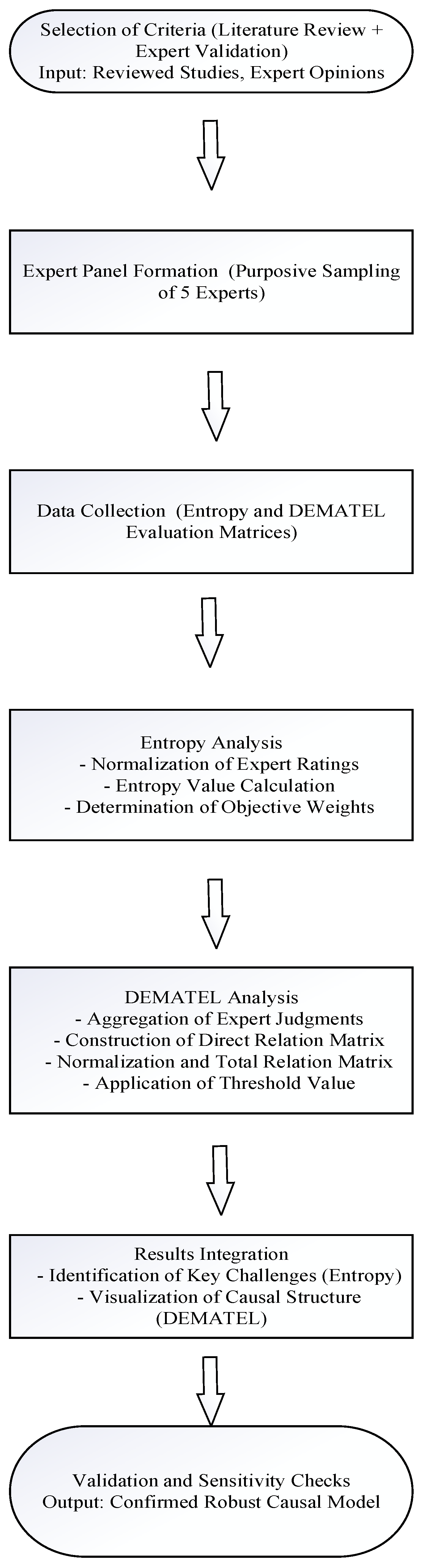
The general methodological steps are illustrated in
Figure 1 as the successive phases conducted for the entropy and DEMATEL analyses. As seen, the approach follows a comprehensive process—from the criteria-based expert selection to validation and sensitivity checks for robustness and reproducibility.
Table 4 shows the initial decision matrix used for entropy analysis to aggregate expert judgments on nine big data challenges criteria.
Table 4.
Initial decision matrix for entropy analysis.
Table 4.
Initial decision matrix for entropy analysis.
| DM | DPS | DINT | DMI | TECH-BD | LQWK | ORG-CULT | DQ-VOL | COMPLY-PR | ETHICS |
|---|
| DM 1 | 10.00 | 1.00 | 1.00 | 1.00 | 7.00 | 7.00 | 1.00 | 3.00 | 7.00 |
| DM 2 | 10.00 | 7.00 | 5.00 | 5.00 | 3.00 | 5.00 | 5.00 | 7.00 | 7.00 |
| DM 3 | 9.00 | 3.00 | 7.00 | 5.00 | 1.00 | 3.00 | 5.00 | 1.00 | 7.00 |
| DM 4 | 8.00 | 7.00 | 5.00 | 5.00 | 7.00 | 5.00 | 7.00 | 7.00 | 3.00 |
| DM 5 | 10.00 | 5.00 | 7.00 | 1.00 | 5.00 | 9.00 | 1.00 | 5.00 | 7.00 |
| TOTAL | 47.00 | 23.00 | 25.00 | 17.00 | 23.00 | 29.00 | 19.00 | 23.00 | 31.00 |
Table 5.
Sequential analytical steps of the entropy and DEMATEL methods.
Table 5.
Sequential analytical steps of the entropy and DEMATEL methods.
| Steps | Entropy Method | DEMATEL Method |
|---|
| Step 1 | Establishment of the decision matrix (D) | Establishment of the direct relation matrix (D)
, (i, j = 1, 2, …, s) |
| Step 2 | Normalization of the decision matrix
| Normalization of the decision matrix
|
| Step 3 | Calculation of entropy values for criteria
i = 1, 2, …, m ve j = 1, 2, …, n
1 | Formation of the total relation matrix
|
| Step 4 | Determination of the degree of divergence
dj = 1 − ej j = 1, 2, …, n | Creation of the cause–effect matrix
|
| Step 5 | Calculation of entropy-based criterion weights
| Derivation of the inner dependence matrix and the influence relationship diagram
,
|
| Step 6 | Adjustment for negative values (if applicable) | Determination of criterion weights
|
The entropy method determined the relative weights of criteria, and DEMATEL identified causal relationships among them. Such an integration of the two methods establishes a complete understanding contributing to more robust and valid research conclusions.
2.6. Synthesis of Analytical Phases
In this study, the entropy and DEMATEL methods were applied as a sequential two-stage hybrid. In the first stage, the entropy method assigns each criterion an objective weight that reflects the dispersion of the expert judgments. In the second stage, these weights are carried into the interpretation of the DEMATEL results, so that the prominence (D + R) and net cause–effect (D − R) values of each criterion are read together with its informational weight. This design links objective prioritization (entropy) with causal mapping (DEMATEL) within a single decision-oriented framework.
2.7. Methodological Robustness and Validation
Several stages of validation were applied in a systematic manner to secure the methodological validity and the reliable results. All calculations, for both entropy and DEMATEL were conducted in MS Excel and thus give credible results that can be repeated easily and reproduced transparently. Furthermore, the results from either of these analyses were reported back to the expert panel in order to improve the confidence of data and analytical validity. Plausibility and consistency of the results were validated by experts, stating that they agreed with professional insights and industry experience. Thus, this expert verification has further increased the methodological validity and practical significance of results.
4. Discussion
This study contributes to a multifaceted analysis of challenges in deploying big data in aviation, with an emphasis on real settings at the airport level, such as IGA. The use of entropy and DEMATEL methods facilitated finding out not only the key barriers, but also the cause-and-effect relationships among them. This methodological confluence contributes to the literature, as a substantial part of past studies in this field consider data-related issues in aviation independently or statically [
16,
24].
Data privacy and security has the highest entropy weight (w = 0.243) and also acts as a net influencer in DEMATEL (positive D–R). According to Hanif & Jaafar [
22], the aviation sector depends more and more these days on real-time interoperable data exchanges between disparate systems—from IoT-enabled aircraft parts, such as engines, wheels and brake systems to Platform-as-a-Service (PaaS)-based passenger profiling solutions. But every place that is connected is also a potential point of risk. The addition of best-in-class cybersecurity (such as zero-trust, multi-factor authentication (MFA), and real-time threat monitoring) might improve downstream analytics and service level.
Nevertheless, it also would be beneficial for the study to have reviewed extant cybersecurity frameworks and best practices at IGA or survey airports. A long-term perspective on applied cybersecurity would also lead to more actionable recommendations. Quantified evidence on the causal impact of data security is valuable, but practical aspects (incidence rates, types of breaches) remain abstract and do not lead to prescriptive recommendations. This could provide even more context on the hypothetical risks above possibly through threat model by case or post incident analysis.
Ethical considerations showed the highest net-influenced value (0.731), indicating that ethical issues tend to arise as consequences of upstream technical and managerial choices. Dynamic pricing using biometric recognition and predicting through human behavioral models can be offered with big data on one side. However, it comes along with fears of black box decisions and algorithmic decision-making [
2]. A key insight from this study is that ethical issues often emerge as downstream consequences of prior technical and managerial decisions. It reframes ethics not as a mere checklist of responsibilities, but as a consideration that permeates the entire data lifecycle.
Additional study could involve the design of responsible aviation-specific ethical data governance frameworks. The findings could be translated in more practical ways, by embedding them within, e.g., models of the social implications of AI, AI ethics auditing, and value-sensitive design (VSD) [
39]. Furthermore, through the consideration of passenger rights (for transport chains that cross national borders), transparency duties and informed consent ethical problems would be grounded in stakeholder experiences. A notable finding of the study is that, from upstream determinants perspective a new dimension of organizational reluctance and lack of skilled workforce has come into vogue. These findings are consistent with those found in the wider literature on digital transformation failure within aviation, where technological readiness exceeds organizational readiness [
3]. Experts at IGA emphasize that, though they and their colleagues already rely heavily on a data-driven approach for decision-making at the senior leadership level, there is room for more of it to occur during daily operations. This implies that there is room to develop institutional structures in order to boost adoption of analytical tools across teams.
The research, however, does not delve into the micro-dynamics of resistance such as issues on professional identity struggles, fear of being automated out, and a lack of cross-functional collaboration. We argue that data cultures are as much about the sociology of data use and interpretation as they are about the technology itself. The potential of qualitative components, such as ethnographic methods, is that (qualitative) future studies can inform and deepen rich psychological (inner) behavior and attitude patterns as seen in this study’s quantitative foundation.
A further important aspect is the identification of data integration (DINT) as an important and causal phenomenon. There are already systems in IGA with potential to enhance data discovery and integration, e.g., updating legacy systems or harmonizing the data model. Such are general challenges in training scalable AI and machine learning applications as model accuracy and generalization depends on quality of the data [
18].
What remains in its infancy is a technical blueprint on how to overcome integration roadblocks. For example, we could hypothesize that event-driven architectures (e.g., Kafka, MQTT) might be implemented as well as standardized APIs for aviation data exchange (i.e., AIDX). The details provided in this way render the results useful and legitimate, but not very substantial in the realization of how that happens.
5. Conclusions
The objective of this study is to explore the possible enhancements in big-data-based applications within aviation industry by focusing on airport-based implementations with IGA being taken as a case from which strategic priorities for stakeholder are derived. By the combination of the entropy and DEMATEL techniques, the study reveals a quantitatively verified and causally connected structure of big data difficulties among high-traffic airports.
The entropy results clearly show that data privacy and security (weight = 0.243) is the most important issue reported by experts. It is not just a technical issue, but one that is foundational and further exacerbates systemic problems. Moreover, its maximum net driving factor power (net effect = 0.437) in DEMATEL suggests being a primal cause of multiple systemic problems. A proactive approach like investing in better encryption methods, access controls and secure data transport protocols would reduce risks at every level of the data ecosystem from ethical lapses and non-compliance to reputational harm.
Although ethical considerations (weight = 0.181) had the second highest entropy weight, it was also the most impacted criterion in the DEMATEL model (net effect = 0.731). This imbalance suggests that ethical considerations in aviation big data—like passenger profiling, live behavior forecasts and surveillance-based analytics—are more a response than an antecedent. Our findings show that a clear and purposeful commitment to upgrade the data governance and security infrastructure is crucial in order not to violate these ethical principles: poorly anonymized data or unclear procedures could undermine stakeholder trust.
Strong net influencers of the system were also Strong organizational reluctance and Lack of Data-Driven Culture (0.169) and lack of qualified workforce and knowledge (0.129). This dual resistance—cultural and technological—is a major bottleneck, from both strategic design logic and operational implementation perspectives. This limitation could be overcome by improving data-informed decision support at levels below senior leadership and also encourage the dissemination of insights across operational teams. Targeted upskilling in data engineering, AI model validation and cross-platform integration would accelerate the process of turning insights into actionable plans.
Data integration challenges (0.129; net effect = 0.341) and data management issues (0.142; net effect = 0.315) were the underlying sources of technical interoperability issues identified in our analysis. At IGA data integration is limited at the moment as IoT sensors, ATC systems, passenger mobile apps and logistics platforms are largely isolated from one another. Considering legacy/limitations from old systems and developing a common data model would improve cross-system alignment to obtain richer operational insights.
Data quality and volume (0.099) and regulatory compliance (0.129) were also discovered to be interdependent concerns. We are striving to have consistent and complete data at IGA, which is why we need harmonized update cycles (frequency and triggering) as well as homogenous granularity in the available data for all systems. In addition, compliance with aviation data-related rules (e.g., GDPR, ICAO Annex 17) opens up a chance to integrate automated audit and traceability services within established infrastructures.
The combined entropy–DEMATEL model shows that the intervention strategies are tiered and sequenced to deal with root causes ahead of symptoms. Right away, airports should strengthen the resilience of cybersecurity and data integration in data transport through encryption and standardized data governance. In the medium term, investment in capability and reducing functional illiteracy (both on AI and over regulation) is crucial, while deploying ethical oversight institutions will help secure algorithmic accountability in the long term.
This evidence demonstrates that privacy and security are not merely operational imperatives, but are underlying causes that spawn a number of downstream problems: regulatory risk, ethical issues, and data integration headaches. Therefore, alternative solutions such as MFA and end-to-end encryption can be viewed as strategic levers for IGA (and the wider aviation industry) to strengthen data governance overall.
Moreover, lessons learned from the IGA case suggest that transdisciplinary cooperation is needed as well: data value chains and intervention points need to be co-created by technical, and legal and managerial stakeholders. The material application of entropy and DEMATEL in combination acts as a kind of design map for such coordination, yielding insights into not only what is the most important but also the causal relationships between factors. The empirical results point to a sequenced set of interventions rather than generic recommendations. Because data privacy and security has both the highest entropy weight (0.243) and the highest net influence value (0.437), it should be addressed first. Because ethical considerations is the most net-influenced criterion (0.731), ethical oversight is the most effective as a downstream measure that follows the strengthening of privacy and security controls. Finally, because data integration (0.341) and data management (0.315) are the strongest internal drivers, establishing an integration backbone should accompany the privacy and security measures within the same planning horizon.
5.1. Theoretical Contributions
The theoretical foundation for airport data governance adds in studies on the entropy coupled with DEMATEL to simultaneously reveal both the contribution and driving force of big data problems. The model increases comprehension beyond isolated factor analysis to a comprehensive examination of how the challenges interact in an aviation ecosystem, such as an airport. And furthermore, the operationalization of “data privacy and security” as a root cause reframes it from being purely technical to also becoming a strategic force that acts on ethical, regulatory and organizational planes.
5.2. Practical and Managerial Implications
The results offer practical recommendations to airport stakeholders and policymakers. Improving cyber and data integration architectures produces cumulative gains in compliance and ethics. IGA needs to focus on MFA, end-to-end encryption and the development of data platforms that can interoperate in order to be more resilient. And in the same way, nurturing a data-centric culture that includes ongoing employee education around data literacy and AI model explainability will embed analytics at every level of an operation. The framework presented in this paper can also be used as a portable decision support tool for airports across different scales and digital maturity levels to analyze and rank big data considerations.
5.3. Methodological Contributions
Methodologically, the application of entropy and DEMATEL one after another in this study guarantees that, on the one hand, weights can be assigned objectively while on the other hand power statistics are available to causality analysis. This two-pronged method is rigorous yet transparent and can serve as a replicable example to other high-density airport settings.
5.4. Limitations and Future Research Directions
The small number of experts (n = 5) also limits the generalizability of the results to other big data systems in IGA. While purposive sampling is appropriate for expert-based decision modeling, broadening the panel by including IT vendors, cybersecurity experts, regulatory stakeholders and data engineers may contribute to bringing a more composite systems perspective.
A second limitation from a methodological perspective is the cross-sectional character of the analysis. The threat vectors of the large data retail and banking systems are always on fast forward. Further, incorporation of time series methods or fuzzy cognitive maps (FCMs) might grant to the model a capability to keep track of temporal evolutions or predict future system status under certain intervention scenarios.
This work indicates several natural directions of future research, such as:
Contextual deepening: other airports/regions could use the same analytical framework employed in this study to compare results with local governance, infrastructure and regulatory settings.
Longitudinal recording: a longitudinal extension of the model capturing temporal trends posterior to certain action or technological upgrade would help quantify the effectiveness of such interventions.
Co-production with stakeholders: passengers, unions, and/or public interest groups may be involved in future evaluation activities to enhance the ethical and sociological aspects of evaluations particularly since AI and biometric systems are becoming more common across airport environments.
This study characterizes the primary applications of big data as being utilized within aviation and illuminates their interdependencies. The results could help support efforts to create safer and fairer systems for data in the field. The findings reported here are based on a mega-hub with very high digital maturity, which is likely to amplify the prominence of data privacy and security. For small- and medium-sized or less digitalized airports, the relative importance of the criteria may differ: data integration and organizational factors are likely to become more binding, whereas ethics-related concerns may play a smaller role where biometric and AI-based systems are less widespread. The framework is therefore transferable, but its specific weights and causal directions should be re-estimated for each airport according to its operational scale and digital maturity level. Post-2027 re-assessment: re-running the entropy–DEMATEL panel after the full build-out to test whether the identified causal structure persists under substantially higher data volumes.