Article

Evaluation Index System and Comprehensive Evaluation of the Innovation Capability of China’s Provincial Optoelectronic Information Industry

1
National Engineering Research Center for Fiber Optic Sensing Technology and Networks, Wuhan University of Technology, Wuhan 430070, China
2
School of National Safety and Emergency Management, Nanjing Tech University, Nanjing 211816, China
3
School of Safety Science and Emergency Management, Wuhan University of Technology, Wuhan 430070, China
4
School of Management, Wuhan University of Technology, Wuhan 430070, China
*
Author to whom correspondence should be addressed.
Systems 2026, 14(6), 665; https://doi.org/10.3390/systems14060665 (registering DOI)
Submission received: 25 April 2026 / Revised: 31 May 2026 / Accepted: 8 June 2026 / Published: 9 June 2026
(This article belongs to the Section Systems Engineering)

Abstract

The optoelectronic information industry is a strategic high-tech industry with wide applications. Compared with developed countries, China’s optoelectronic information industry presents a situation of “strong application and weak technology”. Evaluating the innovation capability of the optoelectronic information industry is the foundation for making scientific development plans. This study provides a methodology for evaluating the provincial innovation capability of the optoelectronic information industry to guide its high-quality development. This article applies multi-attribute utility theory to study the evaluation index system and comprehensive evaluation of the innovation capacity of China’s provincial optoelectronic information industry. Through extensive data collection and matching relationship analysis, an evaluation index system with both sequential decomposition and hierarchical interleaved structure was established, which includes four dimensions and 20 underlying indicators. To better reflect the gap in innovation capability across different provinces, a scientific piecewise non-zero nonlinear utility function model was established. According to the matching relationship between the subsystems and the underlying indicators of innovation capability, a weighted arithmetic mean comprehensive evaluation index model of innovation capability was developed. An empirical study of the optoelectronic information industry’s innovation capability in typical Chinese provinces was conducted using this comprehensive evaluation index model. The results show that Guangdong Province, Beijing Municipality, Jiangsu Province, Zhejiang Province, and Shandong Province ranked in the top five. The innovation capability of China’s optoelectronic information industry needs to be enhanced by strengthening the development of the investment mechanism, optimizing product development and promotion, improving the efficiency improvement mechanism, and solidifying the environmental support system.

1. Introduction

The 21st century is an era where optoelectronics and microelectronics technologies are deeply integrated. This integration not only continuously drives the iterative upgrading of information technology itself but also gives rise to a series of emerging industrial forms and economic growth points. Among them, the optoelectronic information industry has strong technological penetration, a wide application range, and a significant industrial driving effect. Therefore, the optoelectronic information industry has become has become a fundamental pillar of the modern information society and a key engine for economic transformation [1]. Its development has become an essential requirement for countries to enhance their competitive advantages.
Innovation is the key link in transforming scientific and technological innovation into productivity. It helps sustain and enhance productivity [2]. In the high-tech industry market, competitive success stems directly from continuous innovation [3]. The innovation capability of the optoelectronic information industry is not only directly related to the speed and quality of its own upgrading, but also to the initiative of each country in global high-tech competition.
Currently, innovation activity in the optoelectronic information industry is at a worldwide unprecedented high. Among these, China has placed the optoelectronic information industry at the forefront of its innovation-driven development strategy. A series of national and regional policies and plans, such as the “Action Plan for Stabilizing Growth in the Electronic Information Manufacturing Industry (2025–2026)” and the “Implementation Plan of East Lake High-tech Zone on Building a World-class Advanced Manufacturing Cluster for Optoelectronic Information”, have been successively introduced. These policies and plans provide a solid foundation for the expansion of China’s optoelectronic industry, propelling China’s optoelectronic information industry to rank among the top in the world in terms of scale. Although China excels at scaling and commercializing emerging technologies, it has not been as good at true innovation—creating something completely original from scratch [4]. Accurately measuring the innovation capacity of the optoelectronic information industry can help identify its current innovation status, provide forward-looking early warnings for industry security, further optimize the allocation of innovation resources, and promote high-quality industrial development.
There is currently considerable research on enterprise innovation, but relatively little research on industrial innovation. Scholars’ research on industrial innovation began in 1960. Cunningham introduced the concept of “industrial innovation” that laid the foundation for industrial innovation theory [5]. Freeman proposed the theory of industrial innovation [6]. Malerba was the first to systematically discuss industrial innovation system theory [7]. Currently, scholars think that industrial innovation is the product of the interaction between multiple elements, including actors, knowledge, technology, and institutions [7,8].
Identifying the factors that influence innovation capacity lays the foundation for establishing the index system for assessing innovation capacity. Regarding the factors influencing innovation in the high-tech industry, Hong et al. concluded that government subsidies have a negative impact on innovation efficiency in China’s high-tech industries, while private R&D funding and other funds have improved the innovation efficiency of high-tech industries [9]. Liu et al. further analyzed the variations in the innovation efficiency of the high-tech industry across various regions. They argued that differences in regional resource endowments, economic development levels, economic growth rates, and policy environments led to these variations [10]. Regarding the factors influencing industrial innovation, Chen et al. found that technological diversity, knowledge flow, and knowledge capabilities influence industrial innovation performance [11]. Regarding the influencing factors of regional innovation, Yang et al. pointed out that the four dimensions of innovation input, innovation output, innovation carrier, and innovation environment affect the provincial-level science and technology innovation ability [12]. Yan et al. summarized that four aspects influence regional cluster innovation capability: innovation input capability, environment support capability, self-development capability, and innovation output capability [13]. Pinto and Guerreiro argue that innovation, regional planning, and latent dimension influence regional innovation systems [14]. Regarding the factors influencing organizational innovation, Shahzad et al. concluded that organizational innovation performance is supported and influenced by organizational culture [15]. The findings of Zhang et al. [16] and Frank et al. [17] are relatively novel. Zhang et al. argue that technological accumulation plays a positive role in cross-industry innovation performance after firm’s official entry into the industry [16]. Frank et al. found that Open Innovation Breadth has different moderating effects on several innovation input–output relationships [17]. In addition, relevant organizations have also developed an evaluation system for innovation capability. The European Innovation Scoreboard 2025 assessed the research and innovation performance of EU Member States, other European countries, and global competitors. The European Innovation Scoreboard constructs a framework encompassing 32 evaluation indicators across 12 dimensions, including human resources, attractive research systems, digitalization, and finance and support [18]. The Organization for Economic Co-operation and Development (OECD) assesses innovation capabilities not only by considering R&D investment and patent volumes but also by focusing on digitalization processes and international cooperation initiatives [19]. The Regional Innovation Index of China 2025 evaluates China’s regional innovation capability based on five primary indicators: innovation environment, knowledge creation, knowledge acquisition, innovation performance, and enterprise innovation [20].
In the assessment of provincial-level optoelectronic information industry innovation capability, Yan et al. [13] systematically analyzed key elements within the innovation factor composition and their interrelationships. They also constructed an indicator system for regional cluster innovation capabilities and employed an analytic hierarchy process and factor analysis method to evaluate industrial innovation capability [17]. Using a combination of subjective and objective weighting methods, Yang et al. analyzed the science and technology innovation ability of 31 provinces and cities in mainland China from 2010 to 2020 [11]. Tu et al. employed factor analysis to measure the technological innovation capability of China’s high-tech industries [1]. Penner and Shaver adopted a raw count of the number of patents granted to measure innovation output [21]. Data Envelopment Analysis (DEA) is a is a useful method for evaluating efficiency and performance. Zabala-Iturriagagoitia et al. applied DEA to assess the performance of regional innovation systems based on information from EIS for 2002 and 2003 [22]. Chen et al. adopted the Three-Stage Chain Network Slacks-based Measure to evaluate the Green Innovation Efficiency of Chinese Industrial Enterprises [23]. Some scholars have conducted related research using variants of the DEA model (improved Slacks-Based Measure-DEA model [14], DEA-Malmquist index [24], two-stage network DEA [25], two-stage DEA model with shared-input [26], three-stage DEA [27]). These methods are essentially deterministic nonparametric methods. Measurement errors, data noise, and outliers can significantly distort the frontier, thus affecting the reliability of the results. Research on the assessment of innovation capability is relatively lacking.
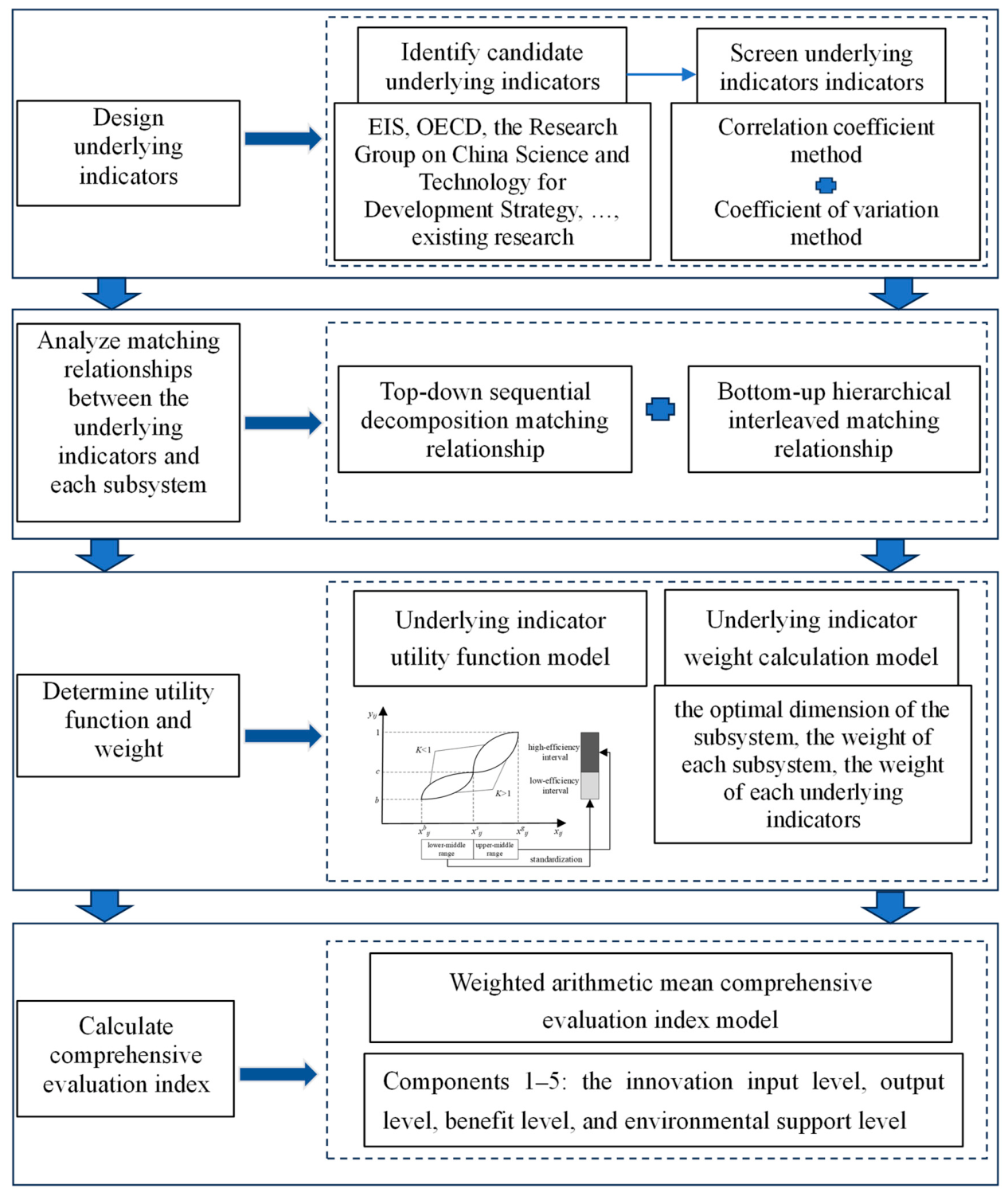
In recent years, scholars have conducted relevant research on the innovation of the high-tech industry [28,29,30]. Among them, extensive research has been conducted on the innovation efficiency and performance of high-tech industries [9,12,14,15,23,25,26,27,30], and DEA and its variants are commonly used methods for measuring high-tech industrial innovation efficiency and performance [14,22,23,24,25,26,27]. However, the innovation efficiency and innovation performance of the industry are different from the innovation capability of the industry. Innovation efficiency mainly focuses on the effective utilization rate of innovation resources, innovation performance primarily focuses on the achievement of innovation results, and innovation capability focuses on the internal reserves and foundation supporting innovation output. There is relatively little research on the evaluation index system or comprehensive evaluation of the innovation capability in the optoelectronic information industry. There are also still some gaps in the research on the evaluation index system and the comprehensive evaluation of the innovation capability of the optoelectronic information industry at the provincial level. Firstly, there is a disagreement on the dimensions (subsystems) of the evaluation index system. Both three-dimensional and four-dimensional index systems have their merits, and further research is needed to determine the optimal number of dimensions for the evaluation index system. Secondly, in most studies on evaluation index systems, the relationship between dimensions (subsystems) and underlying indicators is “sequential decomposition”, meaning that each underlying indicator belongs to only one dimension (subsystem) [31]. However, innovation in the optoelectronic information industry is a complex systems engineering. In the provincial optoelectronic information industry innovation capability assessment index system, each dimension (subsystem) encompasses multiple underlying indicators, and a single indicator may belong to multiple dimensions (subsystems) to varying degrees. For example, “research and experimental development (R&D) expenditure as a percentage of gross domestic expenditure (GDP)” is usually classified as an underlying indicator of the “science and technology” dimension (subsystem), while ignoring that “R&D expenditure as a percentage of GDP” may also have a certain relationship with the “economy” dimension (subsystem). Hence, the interleaved-matching relationship between underlying indicators and dimensions (subsystems) needs to be considered when conducting a comprehensive evaluation. Thirdly, research on measuring the innovation capability of the optoelectronic information industry did not establish a piecewise non-zero nonlinear utility function model during the evaluation process. If a piecewise non-zero nonlinear utility function model is not developed, there may be a situation where “using the utility function to convert the indicator value into a utility value may fail to fully reflect the score gaps between different provinces”. It is necessary to improve the general scoring function. Therefore, establishing an evaluation index system for the innovation capability of the optoelectronic information industry requires scientifically identifying the underlying indicators and analyzing the sequential decomposition and hierarchical interleaved-matching relationships between these underlying indicators and dimensions (subsystems) (see Figure 1). Moreover, it is meaningful to comprehensively consider the comparability of absolute and relative indicators, conduct segmented evaluations, and then establish a piecewise non-zero nonlinear utility function model.
To fill the existing study gaps, this article conducts research on the evaluation index system and comprehensive evaluation of the innovation capability of the provincial electronic information industry. Firstly, candidate underlying indicators for evaluating innovation capacity are identified based on research findings from authoritative institutions and scholars. The correlation coefficient method and the coefficient of variation method are then adopted to screen these candidate underlying indicators, and the final set of underlying indicators can be obtained. Secondly, the subsystems of the optoelectronic information industry’s innovation capability are determined. The interleaved-matching relationships between underlying indicators and subsystems are then analyzed to construct an evaluation index system. Thirdly, a piecewise non-zero nonlinear utility function is developed, and global principal component analysis (GPCA) is used to determine the weights of the indicators. Fourthly, the innovation capability of the optoelectronic information industry in China’s provinces is evaluated based on the proposed weighted arithmetic mean comprehensive evaluation index model. Regional differences in the innovation capacity of China’s optoelectronic information industry are then analyzed to provide a decision-making basis for the coordinated regional development of the optoelectronic information industry.
There are two marginal contributions in this study. Firstly, the study constructs an indicator system for evaluating the innovation capability of the provincial-level electronic information industry, which differs from traditional indicator systems. In traditional indicator systems, each underlying indicator belongs to only one dimension (subsystem). By analyzing the interleaved-matching relationships between underlying indicators and subsystems, the study constructs an indicator system in which a single indicator may belong to multiple dimensions to varying degrees. Secondly, the study scientifically evaluates the innovation capability of the provincial-level electronic information industry. A piecewise non-zero nonlinear utility function model is established, and global principal components analysis (GPCA) is employed to determine the indicator weight to evaluate the innovation capability. In addition, the study focuses on the innovation capability of China’s typical provincial optoelectronic information industry. Due to data availability, Taiwan, Hong Kong, Macau, Hainan, and Tibet are excluded from this study. The optoelectronic information industries in Yunnan, Gansu, Ningxia, Qinghai, Guizhou, Heilongjiang, and Shanxi have not yet been established. Therefore, these provinces are not considered in this study.

2. Materials and Methods

The article develops an index system for evaluating the innovation capability of the optoelectronic information industry and conducts a comprehensive assessment of its innovation capability. The flowchart is shown in Figure 1.

2.1. Designing Underlying Indicators

2.1.1. Identify Candidate Underlying Indicators

Based on the index systems proposed by authoritative institutions and scholars [9,10,11,13,14,16,17,18,19,20], this study selects candidate underlying indicators for evaluating the innovation capability of the optoelectronic information industry. These indicators include both absolute and relative indicators. When evaluating the innovation capacity of the optoelectronic information industry, the use of absolute indicators is favorable to regions with a large-scale optoelectronic information industry and unfavorable to those with a small-scale one. Due to diminishing returns to scale, using relative indicators for evaluation may result in regions with a large-scale optoelectronic information industry not performing better than regions with a small-scale industry. For example, although the “internal R&D expenditure” of the optoelectronic information industries in Yunnan and Gansu was relatively small compared to developed regions in 2000, their “operating revenue” was even smaller. Consequently, the relative indicator “ratio of internal R&D expenditure to operating revenue” in Yunnan and Gansu was higher than that of Beijing Municipality, Shanghai Municipality, and Guangdong (please see Table 1). In other words, the value of this relative indicator is higher in underdeveloped regions compared to developed regions. Therefore, the evaluation index system for the innovation capability of the optoelectronic information industry should incorporate both absolute and relative indicators. Furthermore, an unreasonable situation was found in the cross-provincial comparative analysis: Yunnan, Gansu, Ningxia, Qinghai, Guizhou, Heilongjiang, and Shanxi provinces have relatively small optoelectronic industries, with small absolute indicator values but relatively large relative indicator values, making it difficult to objectively reflect their true innovation capability. To ensure the scientific rigor, accuracy, and reliability of subsequent analysis results, these provinces will not be included in this study.

2.1.2. Screen Underlying Indicators

(a) Obtain data on candidate underlying indicator values
The rapid development of China’s optoelectronic information industry began in 2001, marked by the establishment of “Optics Valley of China”. Data on assessing the innovation capability of the optoelectronic information industry were obtained from the China Statistical Yearbook on High Technology Industry, China Statistical Yearbook, China Statistical Yearbook on Science and Technology, China Torch Statistical Yearbook, and the Almanac of China’s Finance and Banking from 2000 to 2023, as well as the statistical yearbooks and statistical bulletins of various provinces and the China Economic Information Network database. Specifically, the values of the indicators related to investment, output, and benefits in scientific and technological innovation were derived from statistical data on the optoelectronic information industry, while the values of indicators related to the innovation environment were based on provincial-level indicators and statistical data.
(b) Standardized candidate underlying indicators
The raw data of the candidate underlying indicator values are standardized into scores within the range (0, 1] to eliminate differences in direction, units, and magnitude among the original candidate underlying indicators. For positive indicators, the standardization formula is shown in Equation (1).
y i j = a 1 ( x i j x i j s x i j g x i j s ) K 1 + c , x i j x i j s y i j = a 2 ( x i j x i j b x i j s x i j b ) K 2 + b , x i j x i j s
where i = 1, 2, …, 48 and j is the number of samples in the evaluation set.
The output value and investment in the optoelectronic information industry in these provinces are relatively small, making their participation in regional innovation capability evaluations less meaningful. Hence, these provinces are also excluded. Consequently, a total of 20 typical provinces are included in the sample from 2000 to 2022. Thus n = 20 × 23 = 460, j = 1, 2, …, 460. 0 < b < c < 1. x i j s is the median.
(c) Underlying indicators screening model and screening criteria
① Correlation coefficient method
Using the correlation coefficient method to screen underlying indicators can accurately select those with high predictive power and independence, reduce information overlap among candidate underlying indicators, and ensure the simplicity of the index system. The steps are as follows.
Step 1: Set the correlation thresholds Q and q. Q > q. Their values should be determined based on the correlation coefficient matrix. During the underlying indicator screening process, the values of Q and q can be tested over multiple rounds and optimized based on representativeness and scientific rigor.
Step 2: Calculate the pairwise correlation coefficients among the candidate underlying indicators. If the correlation coefficients between an underlying indicator (A) and multiple other candidate underlying indicators exceed Q, then the underlying indicator A is considered a “multi-strong correlated underlying indicator”. In addition, the underlying indicator A is highly representative. Underlying indicator A can be retained, while the other underlying indicators are deleted. In this study, this criterion is referred to as Criterion 1: Retaining multi-strong correlation underlying indicator.
If the correlation coefficients between underlying indicator B and the other candidate underlying indicators fall within the range of [q, Q], then the underlying indicator B is considered a “multi-weak correlated underlying indicator”. Based on the principle of representativeness, underlying indicator B should be deleted, and the other underlying indicators should be retained. This study refers to this criterion as Criterion 2: Removal of weakly correlated indicators.
Step 3: Optimize the index system. Building on Screening Criterion 1 and Screening Criterion 2, a rationality analysis must also be conducted. Based on the frequency of use and comparability principles, the index system can be manually optimized.
② Coefficient of variation method
To avoid data redundancy, the coefficient of variation method can be employed to select more representative underlying indicators for evaluating the innovation capability of the optoelectronic information industry. Generally, the higher the coefficient of variation for an underlying indicator, the stronger its ability to distinguish between different evaluation subjects. On the one hand, an excessively high coefficient of variation for an indicator may lead to the indicator having too high a weight, thus weakening the role of the other indicators in the comprehensive evaluation. On the other hand, the optoelectronics information industry exhibits clear path dependence in its development path, and there should be no sudden leaps or declines. Hence, the coefficient of variation must fall within a reasonable range. This study defines this as [u, U]. The values of U and u should be determined based on the range of the coefficient of variation.

2.2. Matching Relationships Model

2.2.1. Top-Down Sequential Decomposition-Matching Relationship Model

The top-down sequential decomposition-matching relationship model breaks down the overall system into multiple subsystems and then further decomposes each subsystem into some underlying indicators to ensure the coordination and consistency of goals at all levels. The sequence decomposition-matching relationship emphasizes the one-to-one correspondence between the underlying indicator and the subsystem. This study employs a top-down sequential decomposition-matching relationship model. Drawing on the conceptual framework of innovation capacity in the optoelectronics industry and drawing upon the existing literature, the study categorizes the selected underlying indicators into different subsystems and then determines the matching relationships between each underlying indicator and each subsystem.

2.2.2. Bottom-Up Hierarchical Interleaved-Matching Relationship Model

The bottom-up hierarchical interleaved-matching relationship model categorizes underlying indicators and subsystems into different hierarchical levels to form a layered structure. The relationships between the underlying indicators and the subsystems are analyzed through an interleaved approach. Each subsystem in the evaluation index system for the innovation capability of the optoelectronic information industry encompasses multiple underlying indicators. An underlying indicator may simultaneously belong to several subsystems to varying degrees, and the strength of their affiliation also differs. Thus, to avoid multicollinearity issues, this study adopts the bottom-up hierarchical interleaved-matching relationship model. Orthogonal transformation is used to eliminate redundancy among underlying indicators and address major multicollinearity, thereby retaining the main information of the original data to the greatest extent possible while reducing dimensionality. In addition, a comprehensive evaluation method is employed to validate the matching relationships between the selected underlying indicators and each subsystem, further demonstrating the scientific validity and rationality of the index system.
Principal components analysis (PCA) is a commonly used feature extraction method. PCA simplifies data by leveraging the correlations among underlying indicators. It groups the directions with the largest variance contributions in the data into a new feature space, thereby amplifying distinctive features. This allows for a more comprehensive reflection of the information covered by the original variables using fewer indicators. This advantage has led to the widespread application of PCA in many fields, such as business model innovation [32], operational performance [33], and energy-efficient management [34]. However, traditional PCA cannot handle panel data containing time series data and is often used to analyze the correlation of variables at a single point in time. GPCA can be adopted to analyze panel data, capturing the global structure of the data over time and ensuring that the principal components are aligned at different time points. On the one hand, the data used in this study are spatiotemporally fused panel data. On the other hand, GPCA has significant advantages in handling multicollinearity. Therefore, this study uses GPCA to extract features for evaluating the innovation capability of the optoelectronic information industry.
To ensure the consistency and comparability of the panel data analysis, this article arranges p indicators from q regions in chronological order and then analyzes the time series data table. In addition, based on the analysis results, the matching relationships between the underlying indicators and subsystems are determined according to the following Criteria 3 and 4.
Criterion 3: If an underlying indicator has the largest loading on a principal component and the loading is greater than M, then the underlying indicator directly belongs to that principal component.
Criterion 4: If the largest loading of a certain underlying indicator on a certain principal component is less than M, the membership relationship of that underlying index cannot be adequately explained based solely on quantitative calculation results. Considering that the matching relationship between the subsystem and the underlying indicator is not limited to a single type, an expert method is used to adjust the membership relationship of the underlying indicator.

2.3. Underlying Indicator Utility Function Model and Underlying Indicator Weight Calculation Model

2.3.1. Piecewise Non-Zero Nonlinear Utility Function Model

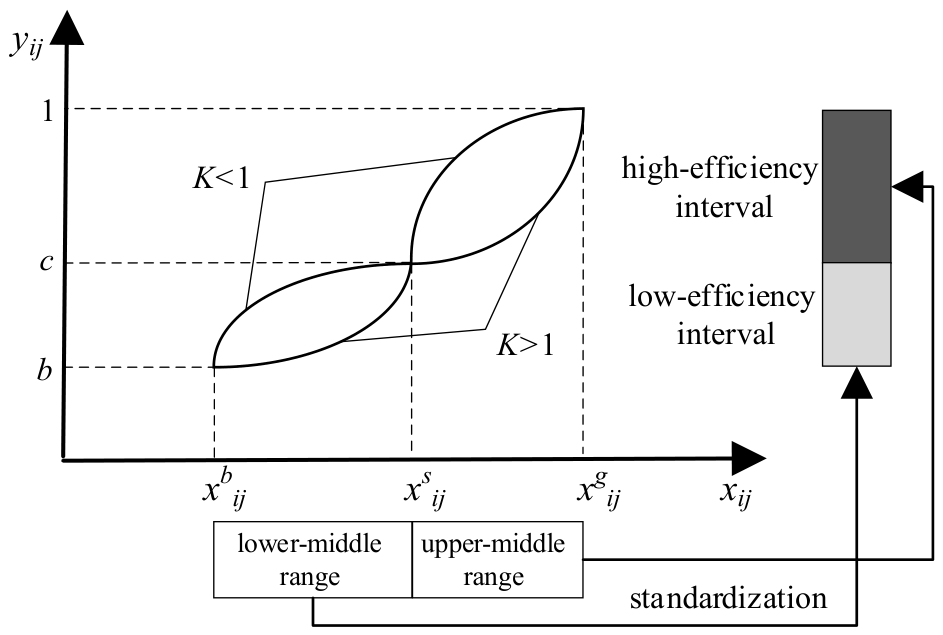
To facilitate scientific evaluation and decision-making, the utility values of underlying indicators for different evaluation objects should be discretized as much as possible to avoid bias in underlying indicator scoring. Based on the universal laws of increasing and decreasing returns to scale, and inspired by the logistic growth curve function, this article develops a piecewise utility function with varying concavity and convexity.
Taking a positive underlying indicator with a value range of [0, 1] as an example, its piecewise non-zero nonlinear utility function is shown in Equation (2), and its graph is presented in Figure 2.
The underlying indicator value with the highest utility is the optimal underlying indicator value x i j g , x i j b is the lowest underlying indicator value, and the minimum utility value can be set to a value close to 0. Utility values can also be set in intervals to expand the evaluation space. Generally, the underlying indicator value x i j s is set to the average or median of the indicator. Let c be the utility value of x i j s . In Equation (2), a1 and a2 are correction coefficients of the function a1 = 1 − c, a2 = cb. To ensure the concavity and convexity of the curve, K1 = 0.5 and K2 = 2.
This study establishes a piecewise non-zero nonlinear utility function based on the selected indicators to evaluate the innovation capacity of the optoelectronic information industry. Considering the innovative characteristics of the optoelectronic information industry, x i j s is set to the average or median of the indicator in this study. Take the median of the utility values, let c be 0.5. To ensure the utility value is not zero, b is set to 0.01. The specific utility function is shown in Equation (2) because the marginal utility of x i j s is relatively high. This implies that a small change in an underlying indicator value results in a significant change in its utility, which aligns with the law of increasing returns in the development of the optoelectronic information industry.
y i j = 0.5 x i j x i j s x i j g x i j s + 0.5 , x i j x i j s y i j = 0.49 ( x i j x i j b x i j s x i j b ) 2 + 0.01 , x i j x i j s

2.3.2. Underlying Indicator Weight Calculation Model

This article employs GPCA to determine the underlying indicator weights. Let α(k) be the cumulative contribution rate of the first k principal components. When the cumulative contribution rate α(k) ≥ 70%, these components can effectively capture most of the information contained in all the original variables. If the optimal dimension of the subsystem is k, then the weight of each subsystem can be obtained according to the ratio of the contribution rate αs of each principal component to α(k). The essence of the eigenvector is the completely hierarchical and interleaved correspondence between each underlying indicator and each principal component. Therefore, normalizing the eigenvector can obtain the weight w of the underlying indicator.

2.4. Weighted Arithmetic Mean Comprehensive Evaluation Index Model

Weighted averaging can account for the differences in importance of each data point. Hence, based on the matching relationships between the subsystem and the underlying indicator of innovation capability, a weighted arithmetic mean model is used to analyze the evaluation score of each subsystem (Equation (3)).
s j M = w 1 × y 1 j + w 2 × y 2 j + + w m × y m j = i = 1 m w i × y i j
where s j M is the evaluation score of each subsystem and w i indicates the weight of the underlying indicator i. The sum of the weights of all the underlying indicators is 1. m denotes the number of underlying indicators, y i j is the utility function value of the underlying indicator i in region j, and the original underlying indicator value is x i j .
The comprehensive innovation capability index (R) of the optoelectronic information industry can be obtained by multiplying the weight of each subsystem by its own evaluation score.

3. Results

3.1. Determine Underlying Indicators

Taking into account the requirements of technological innovation in the new era, this study reviewed the index systems proposed by authoritative institutions and scholars such as EIS, the OECD, the Research Group on China Science and Technology for Development Strategy, and the Chinese Society Association of Science and S&T Policy Research [10,11,16,17,18,19,20,22]. A candidate underlying indicator set for evaluating the innovation capability of the optoelectronic information industry, including 48 indicators such as R&D personnel and the proportion of R&D personnel, was constructed (Table 2). This indicator set includes both absolute and relative indicators.
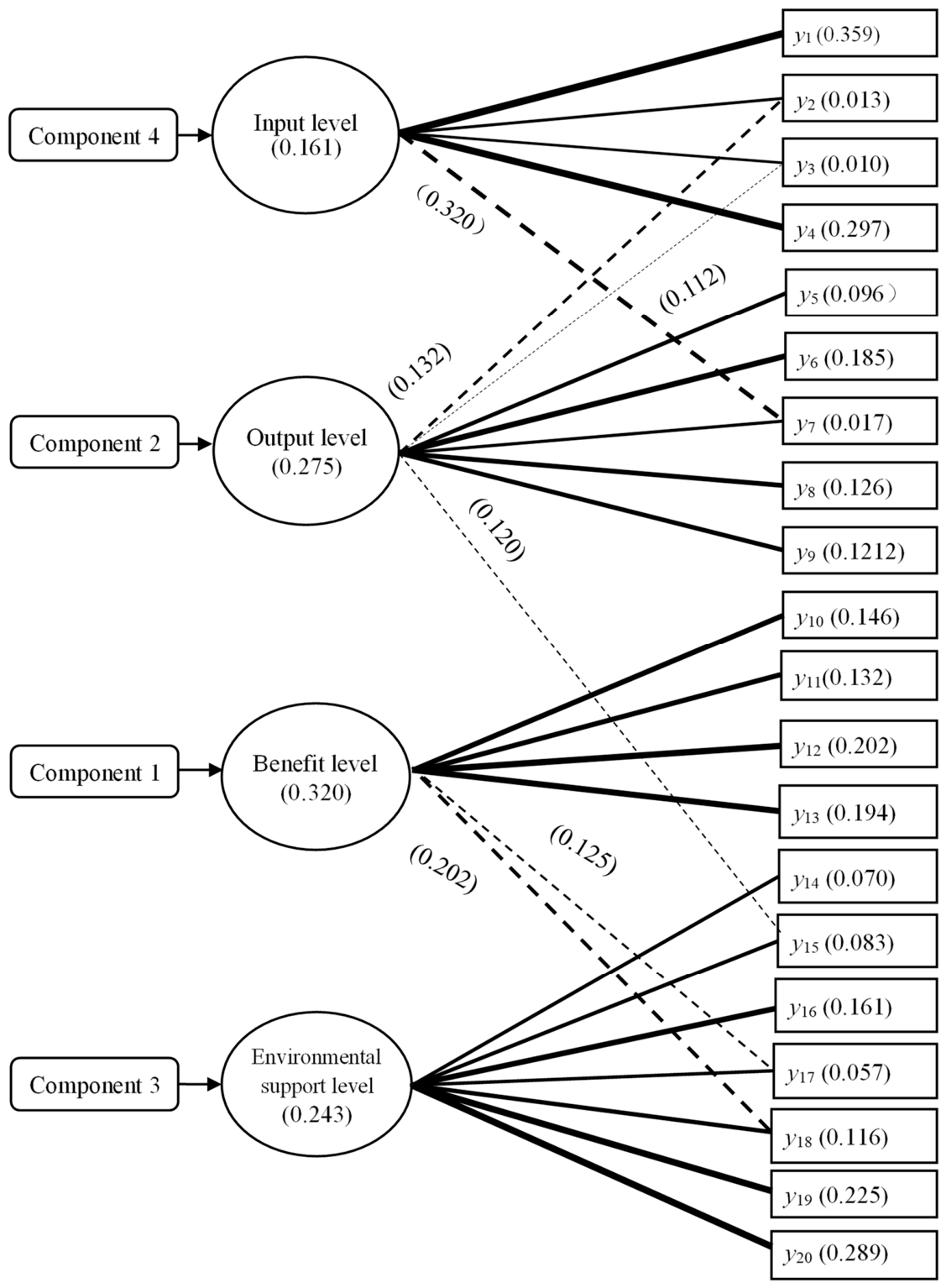
Panel data were collected for assessing the innovation capacity of the provincial optoelectronic information industry, and the data were standardized. Using the standardized panel data, a correlation coefficient matrix was calculated in IBM SPSS Statistics 26.0 (IBM Corp., Armonk, NY, USA). In total, 18 candidate underlying indicators were removed from the candidate underlying indicator set based on screening Criteria 1 and 2, and 10 candidate underlying indicators with coefficients of variation less than 0.3 or greater than 0.8 were deleted. Consequently, 20 underlying indicators were selected from the 48 candidate underlying indicators. These 20 underlying indicators belong to four subsystems (dimensions) (please see Figure 3). Solid lines indicate that, according to the principal component loading rule, the indicator primarily belongs to a single subsystem. Dotted lines indicate that, while the indicator primarily belongs to one subsystem, it is also related to another subsystem to some extent. The thickness of the line represents the strength of the relationship between the indicator and the subsystem. Blue lines indicate classifications adjusted using expert judgment, while black lines indicate classifications determined by factor loadings greater than the threshold.

3.2. Analyze the Matching Relationships Between the Underlying Indicators and Subsystems of the Innovation Capability of the Optoelectronic Information Industry

This study adopted a top-down sequential decomposition-matching relationship model to classify the 20 final selected underlying indicators into four subsystems (dimensions), namely the innovation input level, output level, benefit level, and environmental support level in the optoelectronic information industry. The matching relationship between the 20 underlying indicators and the four subsystems was determined (as shown by the solid line in Figure 3).
To analyze the bottom-up hierarchical interleaved-matching relationships, GPCA was performed on the panel data. The calculation results showed that the Kaiser–Meyer–Olkin value was 0.893, indicating that the GPCA results were basically effective and passed Bartlett’s test of sphericity. Underlying indicators with eigenvalues greater than 1 were extracted. When k = 4, the cumulative variance contribution rate reached 81.589%, which reflected the overall situation well. The factor loading matrix obtained by the varimax orthogonal rotation method is shown in Table 3.
Based on the matching criteria between the underlying indicators and the subsystems, let M = 0.6. The 20 underlying indicators were assigned to the four principal components according to the rotated composition matrix for the four principal components (Table 3). The classification criteria are Criteria 3 and 4. The results are shown in Table 3.
As shown in Figure 3 and Table 3, the evaluation index system for the innovation capability of the provincial optoelectronic information industry has dual attributes of sequential decomposition structure and hierarchical interleaved structure.
The underlying indicator matching structure diagram is shown in Figure 3. In Figure 3, the data in parentheses represent the weights of the subsystems and underlying indicators. The solid line denotes that each underlying indicator belongs to only one subsystem, while the dashed lines show that an indicator belongs to another subsystem. The thickness of the lines reflects the strength of the matching relationship between the underlying indicator and the subsystem.

3.3. Calculate the Innovation Capability of the Optoelectronic Information Industry in the Provinces

Based on the matching relationships between the multi-dimensional subsystems and underlying indicators (see Figure 3), the weighted arithmetic mean comprehensive index model is used to calculate the innovation capability of the optoelectronic information industry.
Component 1: The comprehensive evaluation value of the benefit level is as follows:
S1 = 0.146y10 + 0.132y11 + 0.202y12 + 0.194y13 + 0.125y17 + 0.202y18
Component 2: The comprehensive evaluation value of the output level is as follows:
S2 = 0.132y2 + 0.112y3 + 0.096y5 + 0.185y6 + 0.017y7 + 0.126y8 + 0.212y9 + 0.120y15
Component 3: The comprehensive evaluation value of the environmental support level is as follows:
S3 = 0.070y14 + 0.083y15 + 0.161y16 + 0.057y17 + 0.116y18 + 0.225y19 + 0.289y2
Component 4: The comprehensive evaluation value of the input level is as follows:
S4 = 0.359y1 + 0.013y2 + 0.010y3 + 0.297y4 + 0.320y7
The comprehensive innovation capability index of the optoelectronic information industry is as follows:
R = 0.320S1 + 0.275S2 + 0.243S3 + 0.161S4
Using Equations (4)–(8), the comprehensive evaluation values of the innovation capacity indices of the optoelectronic information industry in 20 typical Chinese provinces from 2000 to 2022 were calculated. The results are shown in Table 4 and Table 5.
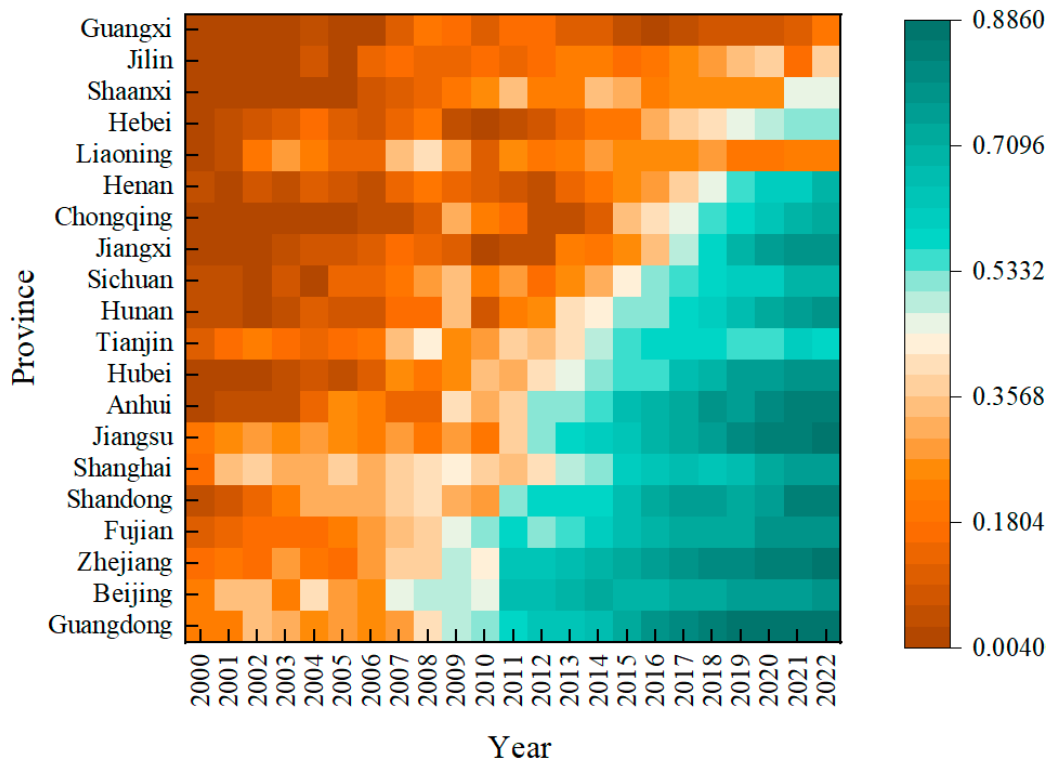
Based on Table 4 and Table 5, a contour map of the innovation capability of the optoelectronic information industry can be obtained, as shown in Figure 4.

4. Discussions

4.1. Analysis of the Effectiveness of the Evaluation Index System for the Innovation Capability of the Optoelectronic Information Industry

4.1.1. Evaluation Criteria for the Effectiveness of the Index System

The index system, determined through the process of “initial screening → correlation + coefficient of variation → GPCA”, possesses a high-quality dimensional structure and matching structure. However, due to regional differences, some indicators may become ineffective. The RST method (Relevance, Scientificity, Technical) is an approach for evaluating the effectiveness of indicators. The core idea of the RST method is to identify the indicator validity of indicators by analyzing the redundancy degree (RD) and sensitivity degree (SD) of the index system.
(a) RD of the index system
The RD of the evaluation index system is used to test the degree of information overlap among indicators. Let the correlation coefficient of the indicators be rij.
R D = i = 1 n j = 1 n r i j n n 2 n
As shown in Equation (9), the value of RD falls within the range [0, 1]. The smaller the RD value, the lower the redundancy of the indicator. The threshold for RD can be set according to actual requirements, and it is usually set to 0.5.
(b) SD of the index system
SD is the most common coefficient used to test the importance of an indicator or parameter. Indicators with higher SD should be given more attention, especially those that have a trend-reversing effect on the evaluated object. The SD of the evaluation result V to the indicator X is defined as follows.
S D i = Δ V ( x i ) / V Δ X / X i
The SD of the index system is as follows.
S D = 1 n i = 1 n S D i
The SD of an index system refers to the degree to which the evaluation result changes when the value of an indicator changes by a unit amount. A large value of the SD indicates a more significant impact of the indicator on the evaluation result, making it more appropriate for setting parameter conditions in scenario analysis or small-scale evaluations. Generally, SD ≤ 5 denotes that the indicator is universally applicable and can be used for large-scale evaluations. When SD ≤ 5, a 1% change in the indicator value should result in a systematic error of ≤5%.

4.1.2. Results of the Effectiveness of the Index System

The sum of the absolute values of the correlation coefficients of all indicators is 232.3, and the redundancy RD = 0.25 < 0.5. Thus, the RD does not exceed the threshold, which shows that the indicators after screening still maintain good evaluation performance in data processing and evaluation calculation.
When the data fluctuates by 1%, SD = 0.0325 < 5, indicating that the index system is not affected by abnormal fluctuations in a single indicator. This demonstrates that the indicators are highly reliable and can support the evaluation of the innovation capability of the optoelectronic information industry over a long period.
Thus, both RD and SD are below their respective thresholds, meeting the test criteria. Therefore, the index system constructed in this article is effective.

4.2. Analysis of the Innovation Capability of the Chinese Provincial Optoelectronic Information Industry

Figure 4 reveals that the optoelectronic information industry in Beijing Municipality and Guangdong started earlier and has been continuously improving. The optoelectronic information industry in Guangxi, Henan, Chongqing, and Jiangxi started later and began to show significant improvement after 2015. As of 2022, the optoelectronic information industry in seven regions (Guangdong, Beijing, Jiangsu, Zhejiang, Shandong, Hubei, and Sichuan) had achieved a relatively high level of development compared to other regions. Among them, Hubei, Shandong, and Sichuan, despite starting late, have shown a more rapid development.
The provinces were ranked based on the average comprehensive index of innovation capability from 2000 to 2022. The sample provinces were categorized into four levels: very high, relatively high, relatively low, and very low based on the average comprehensive index.
(a) Analysis of the innovation capability of the optoelectronic information industry in provinces with a very high index
As shown in Table 4, provinces with very high scores in the comprehensive innovation capability evaluation index include Guangdong Province, Beijing Municipality, Jiangsu Province, Zhejiang Province, and Shandong Province. Guangdong Province ranks first among the top five, and its innovation capability index has shown a steady upward trend from 2000 to 2022. This is because Guangdong Province is at the forefront of China’s reform and opening-up and serves as a major hub for the optoelectronic information industry. Guangdong Province possesses a complete optoelectronic information industry chain and has a large number of enterprises in integrated circuits. With its well-developed optoelectronic ecosystem, Guangdong Province has the potential to become the hinterland for the development of China’s optoelectronic information industry. Compared to other provinces, Beijing Municipality possesses unique advantages in policy support, technological innovation, industrial foundation, talent resources, and application scenarios for the optoelectronic information industry. Beijing Municipality boasts numerous high-level universities and research institutions that contribute to Beijing’s strong capability in fields such as optical communication and opto-mechatronics. Beijing issued regulations such as the “Regulation on the Construction of Beijing International Science and Technology Innovation Center” and the “Beijing Action Plan for Promoting the Transfer and Commercialization of Scientific and Technological Achievements (2025–2027)”, and established the Zhongguancun Optoelectronic Integration Industry Alliance. The innovation capability evaluation index of Shandong Province generally showed a fluctuating upward trend from 2000 to 2022. Although Jiangsu Province initially scored lower than Beijing, Guangdong, and Shandong in 2000, its development speed is rapid. By 2022, the innovation capability evaluation index of Jiangsu Province ranked second, demonstrating a good development momentum. This may be attributed to the establishment of multiple optoelectronic information industry innovation platforms in Jiangsu Province. Zhejiang Province ranked at the bottom of the first level in 2000, but its innovation capability evaluation index steadily increased from 2010 to 2022. In 2016, Zhejiang Province surpassed Beijing Municipality to rank third.
(b) Analysis of the innovation capability of the optoelectronic information industry in provinces with a relatively high index
Table 4 indicates that the second tier of the Chinese optoelectronic information industry in terms of innovation capacity comprises five regions: Hubei Province, Fujian Province, Anhui Province, Sichuan Province, and Shanghai Municipality. Among them, the innovation capacity comprehensive evaluation index of Hubei Province shows a fluctuating upward trend from 2000 to 2022. Hubei Province consistently ranked first in the second tier during the 2011–2019 period. This success is primarily attributed to Hubei seizing opportunities and increasing investment in the optoelectronic information industry at an early stage, building the Optics Valley Science and Technology Innovation Corridor, forming a collaborative innovation platform for the entire optoelectronic information industry chain, and further promoting Hubei Province to possess the strongest optoelectronic information industry in Central China. These efforts have promoted Hubei Province to possess the strongest optoelectronic information industry in Central China. Compared to the other three regions, Fujian and Anhui provinces started their optoelectronic industry relatively late. Since 2010, the comprehensive evaluation indices of Fujian and Anhui provinces have shown a steady upward trend. Anhui Province has developed particularly rapidly, rising to the top of the second tier since 2020. The optoelectronics industry in Shanghai Municipality started early. From 2000 to 2011, Shanghai Municipality consistently ranked first among the second tier in the development of the optoelectronic information industry. Shanghai Municipality boasts a comprehensive range of optoelectronics industry sections. However, its growth has slowed compared to other regions in the later years. This was mainly due to practical factors such as tightening land resource constraints and rising business costs, which led some optoelectronics manufacturing enterprises to relocate. The innovation capacity of Sichuan Province has shown a fluctuating upward trend. Its level of development improved significantly after 2010. By 2022, the innovation capacity of Sichuan Province had risen to 0.645.
(c) Analysis of the innovation capability of the optoelectronic information industry in provinces with a relatively low index
As can be seen, the regions with a relatively low index in the innovation capability of the optoelectronic information industry include Henan Province, Hunan Province, Liaoning Province, Shaanxi Province, and Tianjin Municipality. Overall, these five regions have relatively poor innovation capability in the optoelectronic information industry, with a fluctuating upward trend. Compared with the other four regions, Tianjin Municipality demonstrated a relatively higher level of innovation capability between 2000 and 2022. Relying on established industrial bases in integrated circuits, software and service outsourcing, and automotive electronics, the comprehensive innovation capability index of Liaoning Province shifted from rapid growth to steady progress from 2010 to 2020. The innovation capability development in Shaanxi has slowed down in the past five years. Hunan and Henan have relatively small industrial scales, but have experienced relatively rapid growth over the past five years.
(d) Analysis of the innovation capability of the optoelectronic information industry in provinces with a very low index
Regions with a very low level of innovation capability of the optoelectronic information industry are Guangxi Province, Hebei Province, Jilin Province, Jiangxi Province, and Chongqing Municipality. Although the Guangxi comprehensive innovation capacity index rose year by year from 2000 to 2022, its overall development level remains low. The insufficient output value, small scale, weak cluster effect, and talent shortage are the reasons for the relatively low level of innovation capability in Chongqing’s optoelectronic information industry. Jiangxi Province started optoelectronic information industry development relatively late and faces strong pressure from the Yangtze River Delta and Pearl River Delta, making it difficult to attract high-end resources and investment related to the optoelectronic information industry. Moreover, most companies in Jiangxi’s optoelectronic information industry lack scientific and technical cooperation with universities, and some companies are faced with a dilemma of being “unwilling to invest, unable to invest due to lack of funds, and incapable of investing”. The innovation capacity of Hebei Province’s optoelectronic information industry has shown a positive trend since 2017. This is mainly because, after the central government officially approved the establishment of the Xiongan New Area in Hebei in April 2017, a number of high-end and high-tech enterprises (such as Baidu, Alibaba, and Tencent) settled there. The highest level of innovation capability in Jilin Province’s optoelectronic information industry from 2000 to 2022 is no more than 0.4, indicating a relatively low level of development. The lack of an incomplete industrial chain, insufficient high-end talent, and insufficient patents are all detrimental to innovation in Jilin Province’s optoelectronic information industry. Compared to the other four provinces and municipalities, Chongqing got off to an earlier start. But the development of Chongqing in the optoelectronics industry stagnated until 2012. Chongqing’s comprehensive evaluation index only began to rise year by year after 2012. And Chongqing scored low in terms of the innovation environment supporting the development of the optoelectronic information industry. Low patent commercialization rate and insufficient funding support have resulted in a relatively low level of innovation capability in Chongqing’s optoelectronic information industry. Hebei and Guangxi showed weak innovation output capacity. Jiangxi performed poorly in terms of innovation investment and innovation efficiency. Jilin Province demonstrated low innovation efficiency in the development of the optoelectronic information industry.

4.3. Policy Suggestions

(a) Strengthen the investment mechanism to provide development momentum. Regarding investment mechanisms in the optoelectronic information industry, the proportion of R&D personnel, the proportion of enterprises with R&D activities, and the proportion of R&D expenditure to operating revenue are key factors for enhancing the innovation capacity of China’s optoelectronic information industry. For provinces with relatively low innovation capability index, tax incentives and fiscal subsidies should be utilized to increase R&D investment and ensure that the proportion of R&D expenditure to operating revenue remains stable and consistent, thereby incentivizing enterprises to increase their R&D spending. At the same time, policy incentives and financial support should be used to encourage enterprises to raise the proportion of R&D personnel. Enhancing the professionalism and diversity of R&D teams is important. It is necessary to give full play to the core role of high-tech talents in promoting the development of the optoelectronic information industry. Furthermore, attention should be paid to the structure and quality of R&D investment to ensure that funds effectively support research and development in key technologies and core areas. For provinces with a very high innovation capability index, the key to enhancing innovation capabilities lies in leveraging their resource advantages to focus on cutting-edge and high-end segments through forward-looking planning and global benchmarking. For high-cost regions such as Shanghai, with high land and business costs, it is recommended that they proactively shift to a development model focused on research and development. These regions can establish global or regional R&D centers, engineering technology centers, and innovation headquarters. It is feasible to support these regions in jointly building technology transfer bases or pilot-scale platforms with neighboring cities and provinces, thereby achieving efficient linkage between R&D and product manufacturing and forming a cross-regional division of labor and cooperation pattern of “local R&D and surrounding manufacturing”.
(b) Optimize product development and promotion to enhance innovative output capacity. In terms of the output mechanism of the optoelectronic information industry, the proportion of new product revenue to total operating revenue presents both an opportunity and a challenge for enhancing the independent innovation capability of the optoelectronic information industry. Meanwhile, increasing export revenue from new products plays a crucial role in achieving breakthroughs in the industry. To address the low proportion of new products to operating revenue and significant differences in export revenue between regions, proactive measures must be taken. Enterprises should be encouraged to develop new products. It is necessary to encourage enterprises to enhance market acceptance and the sales of new products through marketing and brand-building efforts, thereby increasing the proportion of new products to total revenue. Moreover, efforts are being made to actively expand into international markets by encouraging optoelectronic information enterprises to participate in international exhibitions and establish overseas sales channels. Simultaneously, product quality should be improved to meet international market demands, thereby increasing export revenue from new products. This will effectively enhance the innovative output capacity of the optoelectronic information industry and drive higher-quality development of the industry. For provinces with relatively low and very low indexes, the key to enhancing the innovation capabilities of the optoelectronic information industry lies in improving the technology transfer service system, cultivating a specialized team of technology transfer managers, and providing commission subsidies to service organizations that facilitate the commercialization of research outcomes in the optoelectronic information field.
(c) Improve the efficiency improvement mechanism to enhance profitability. For the efficiency system of the optoelectronic information industry, profit per capita is a factor with a dual nature: it is both an opportunity factor to promote the development of the optoelectronic information industry and an obstacle factor to its development. Improving the per capita profit level has a crucial impact on the overall development of the industry. The number of valid invention patents per 100 million yuan of R&D expenditure serves as an opportunity factor, highlighting the positive correlation between R&D investment and innovation capacity. Therefore, enterprises should strive to enhance per capita profit by optimizing production processes, improving labor productivity, and reducing costs. Simultaneously, the government can help enterprises improve their per capita profit levels by introducing policies such as tax incentives and reducing the burden on enterprises, thereby overcoming obstacles to the development of the optoelectronic information industry. With regard to the opportunity factor of the number of valid invention patents per 100 million yuan of R&D expenditure, further increasing R&D investment and encouraging enterprises to engage in scientific and technological innovation activities are necessary. Given the high R&D investment and long development cycles characteristic of the optoelectronic information industry, provinces such as Guangxi and Jilin are encouraged to develop diversified capital markets. The government can support enterprises’ R&D activities by providing R&D subsidies and establishing innovation funds, thereby promoting technological innovation and patent output.
(d) Solidify the environmental support system to foster a high-quality innovation ecosystem. The environmental support system can be strengthened by improving the proportion of local government expenditure on science and technology to total local government expenditure, increasing gross regional product, and raising the number of people with an associate degree or above per 10,000 population. It is necessary to establish a scientific and reasonable talent evaluation system that prioritizes competence and contributions. Establishing a performance-oriented talent incentive mechanism and setting up a talent development fund to support talent in scientific research and skills enhancement are particularly needed in provinces such as Jilin Province and Guangxi Province. To encourage long-term talent development, clear career development paths for talents in the optoelectronic information industry, including both technical and managerial advancement routes, should be provided. Policy support and resource allocation can also be leveraged to attract and cultivate leading scientific and technological talents, thereby driving the high-quality development of the industry. Of course, it also makes sense to develop talent recruitment plans for key positions.

5. Conclusions

In the current context of technological transformation, the innovation capability of the optoelectronic information industry has become a key factor influencing the quality of information technology and the development of new industrialization. Taking Chinese provinces as the research area, this article studies the evaluation index system and comprehensive evaluation of the innovation capability of the optoelectronic information industry. The following conclusions are drawn.
(a) A scientific and reasonable index system for evaluating the innovation capability of the optoelectronic information industry was established. The design and selection of reasonable underlying indicators play a crucial role in assessing the innovation capability of the optoelectronic information industry. Drawing on domestic and international research findings, a candidate underlying indicator set of 48 indicators, which comprehensively considered both absolute and relative indicators, was constructed. Based on the correlation coefficient method and the coefficient of variation method, 20 underlying indicators were finally selected. The analysis of matching relationships between the underlying indicators and subsystems is key to establishing a scientific index system. Employing GPCA, a four-dimensional index system comprising 20 underlying indicators was developed, which simultaneously possesses a sequential decomposition and hierarchical interleaved-matching relationship structure.
(b) A piecewise non-zero nonlinear utility function model was developed. The index system and its utility function are the cornerstone for scientifically evaluating the innovation capabilities of the optoelectronic information industry. If the value of an underlying indicator is zero, the entropy method cannot be used for weighting; a weighted geometric mean comprehensive evaluation might result in a “one-vote veto” effect. Hence, it is necessary to establish a relatively scientific, non-zero nonlinear utility function based on multi-attribute utility theory. Drawing on the universal laws of increasing and decreasing returns to scale and the logistic growth curve function, a piecewise utility function with varying concavity and convexity was developed. Through empirical research on the innovation capability of the optoelectronic information industry, the validity of the developed piecewise non-zero nonlinear utility function model has been verified.
(c) Enhancing the innovation capability of China’s optoelectronic information industry remains a long and arduous task. The results show that Guangdong Province, Beijing Municipality, Jiangsu Province, Zhejiang Province, and Shandong Province ranked in the top five in terms of comprehensive evaluation index scores, while Chongqing Municipality, Hebei Province, Jiangxi Province, Jilin Province, and Guangxi Province ranked in the bottom five. Guangdong Province (ranked first) had an average comprehensive index of only 0.507 points from 2000 to 2022, indicating that the innovation capability of China’s optoelectronic information industry urgently needs to be improved. To improve the innovation capacity of the optoelectronic information industry, it is necessary to strengthen the development of the investment mechanism, optimize product development and promotion, improve the efficiency improvement mechanism, and solidify the environmental support system.
The methods proposed in the article are scientific and can be applied to assess capability in other disciplines. Although the conclusions drawn are scientifically valid, this study has a limitation. Due to constraints on the availability of existing data, the study focuses on innovation capability from 2000 to 2022. Future research will expand data search channels to analyze the innovation capability of China’s provincial-level optoelectronic information industry after 2022. In August 2025, the Ministry of Industry and Information Technology and the State Administration for Market Regulation jointly rolled out the Action Plan for Stabilizing Growth of the Electronic Information Manufacturing Industry (2025–2026). This action plan emphasizes promoting the deep integration of industry, academia, and research led by enterprises, and strengthening talent and capital support. These measures will be conducive to promoting innovation in the optoelectronic information industry. The Outline of the 15th Five-Year Plan for National Economic and Social Development of the People’s Republic of China, released in March 2026, directly addresses the optoelectronic industry in several places, demonstrating that China attaches great importance to the optoelectronic industry. In the future, the innovation capability of China’s provincial-level optoelectronic information industry is likely to be further improved. Furthermore, this study was conducted in China, and future studies will be expanded to other countries around the world. Comparative analyses will also be conducted between China and similar international regions.


Author Contributions

Z.L.: Data curation, Investigation, Methodology, Software, Visualization, Writing—original draft, Writing—review and editing. L.F.: Conceptualization, Methodology, Software, Validation, Writing—original draft, Writing—review and editing, Supervision. C.W.: Methodology, Software, Validation, Writing—original draft, Writing—review and editing. K.Z.: Writing—review and editing. Q.Y.: Supervision, Writing—review and editing, Funding acquisition. All authors have read and agreed to the published version of the manuscript.

Funding

This research was supported by the National Natural Science Foundation of China (grant number 72374164) and the Key Soft Science Project of the Hubei Provincial Department of Science and Technology (grant number 2022EDA005).

Informed Consent Statement

This work did not use generative AI.

Data Availability Statement

Data will be made available on request.

Acknowledgments

We thank the four anonymous reviewers for their useful comments. The scientific results and conclusions, as well as any views or opinions expressed herein, are those of the authors.

Conflicts of Interest

The authors declare no conflicts of interest.

References

  1. Tu, W.; Zhang, L.; Sun, D.; Mao, W. Evaluating high-tech industries’ technological innovation capability and spatial pattern evolution characteristics: Evidence from China. J. Innov. Knowl. 2023, 8, 100287. [Google Scholar] [CrossRef]
  2. Bruno, E.; Castellano, R.; Punzo, G. Public funding and firm innovation: Evidence from Germany. Socio-Econ. Plan. Sci. 2026, 105, 102462. [Google Scholar] [CrossRef]
  3. Martín-de Castro, G. Knowledge management and innovation in knowledge-based and high-tech industrial markets: The role of openness and absorptive capacity. Ind. Mark. Manag. 2015, 47, 143–146. [Google Scholar] [CrossRef]
  4. Dreyer, J. China made waves with Deepseek, but its real ambition is AI-driven industrial innovation. Nature 2025, 638, 609–611. [Google Scholar] [CrossRef]
  5. Cunningham, N.J. Industrial innovation. Bus. Hist. 1960, 2, 97–100. [Google Scholar] [CrossRef]
  6. Freeman, C.; Soete, L. The Economics of Industrial Innovation, 1st ed.; Routledge: London, UK, 1997. [Google Scholar]
  7. Malerba, F. Sectoral systems of innovation and production. Res. Policy 2002, 31, 247–264. [Google Scholar] [CrossRef]
  8. Wang, J.; Zhao, J. Future industrial innovation: Era trends, system functions, and development paths of high-tech industrial parks in China. J. Asian Arch. Build. Eng. 2025, 1–13. [Google Scholar] [CrossRef]
  9. Hong, J.; Feng, B.; Wu, Y.; Wang, L. Do government grants promote innovation efficiency in China’s high-tech industries? Technovation 2016, 57, 4–13. [Google Scholar] [CrossRef]
  10. Liu, C.; Gao, X.; Ma, W.; Chen, X. Research on regional differences and influencing factors of green technology innovation efficiency of China’s high-tech industry. J. Comput. Appl. Math. 2020, 369, 112597. [Google Scholar] [CrossRef]
  11. Chen, C.J.; Lin, B.W.; Lin, J.Y.; Hsiao, Y.-C. Technological diversity, knowledge flow and capacity, and industrial innovation. Technol. Anal. Strateg. Manag. 2018, 30, 1365–1377. [Google Scholar] [CrossRef]
  12. Yang, Y.; Huang, Y.; Liu, Y.; Liu, B. Grey Clustering Analysis of Provincial Scientific and Technological Innovation Capability Mainland. J. Grey Syst. 2023, 35, 130–149. [Google Scholar]
  13. Yan, Y.; He, M.; Song, L. Evaluation of regional industrial cluster innovation capability based on particle swarm clustering algorithm and multi-objective optimization. Complex Intell. Syst. 2023, 9, 3547–3558. [Google Scholar] [CrossRef]
  14. Pinto, H.; Guerreiro, J. Innovation regional planning and latent dimensions: The case of the Algarve region. Ann. Reg. Sci. 2010, 44, 315–329. [Google Scholar] [CrossRef]
  15. Shahzad, F.; Xiu, G.Y.; Shahbaz, M. Organizational culture and innovation performance in Pakistan’s software industry. Technol. Soc. 2017, 51, 66–73. [Google Scholar] [CrossRef]
  16. Zhang, G.; Wang, X.; Duan, H.; Zheng, L.J. How do new entrants’ pre-entry technological backgrounds impact their cross-industry innovation performances? A retrospective study of the mobile phone vendors. Technovation 2021, 100, 102176. [Google Scholar] [CrossRef]
  17. Frank, A.G.; Benitez, G.B.; Ferreira Lima, M.; Bernardi, J.A.B. Effects of open innovation breadth on industrial innovation input–output relationships. Eur. J. Innov. Manag. 2022, 25, 975–996. [Google Scholar] [CrossRef]
  18. European Commission. European Innovation Scoreboard 2025—Methodology Report; European Union 2025; European Commission: Brussels, Belgium, 2025; Available online: https://research-and-innovation.ec.europa.eu/document/download/6340fb44-1dad-4a11-b5d7-a298ad5922a5_en (accessed on 13 April 2026).
  19. OECD. OECD Science, Technology and Industry Scoreboard 2017, The Digital Transformation; OECD Publishing: Paris, France, 2017. [Google Scholar] [CrossRef]
  20. The Research Group on China Science and Technology for Development Strategy. The Chinese Society Association of Science and S&T Policy Research. In Regional Innovation Index of China; Intellectual Property Publishing House Co., Ltd.: Beijing, China, 2025. [Google Scholar]
  21. Penner-Hahn, J.; Shaver, J.M. Does international research and development increase patent output? An analysis of Japanese pharmaceutical firms. Strateg. Manag. J. 2005, 26, 121–140. [Google Scholar] [CrossRef]
  22. Zabala-Iturriagagoitia, J.M.; Voigt, P.; Gutierrez-Gracia, A.; Jiménez-Sáez, F. Regional innovation systems: How to assess performance. Reg. Stud. 2007, 41, 661–672. [Google Scholar] [CrossRef]
  23. Chen, W.; Wang, X.; Peng, N.; Wei, X.; Lin, C. Evaluation of the Green Innovation Efficiency of Chinese Industrial Enterprises: Research Based on the Three-Stage Chain Network SBM Model. Math. Probl. Eng. 2020, 2020, 3143651. [Google Scholar] [CrossRef]
  24. Chen, S.; Huang, W. Innovation input-output and output-lagged input relationships of the next-generation information industry in China. Inf. Process. Manag. 2022, 59, 103066. [Google Scholar] [CrossRef]
  25. Wang, Y.; Pan, J.; Pei, R.; Yi, B.-W.; Yang, G.-L. Assessing the technological innovation efficiency of China’s high-tech industries with a two-stage network DEA approach. Socio-Econ. Plan. Sci. 2020, 71, 100810. [Google Scholar] [CrossRef]
  26. Wang, X.; Liu, Y.; Chen, L. Innovation efficiency evaluation based on a two-stage DEA model with shared-input: A case of patent-intensive industry in China. IEEE Trans. Eng. Manag. 2021, 70, 1808–1822. [Google Scholar] [CrossRef]
  27. Shi, J.C.; Mei, J.Y.; Zhu, L.; Wang, Y. Estimating the innovation efficiency of the artificial intelligence industry in China based on the three-stage DEA model. IEEE Trans. Eng. Manag. 2023, 71, 9217–9228. [Google Scholar] [CrossRef]
  28. Teng, X.; Zhang, X.; Li, Y.; Dong, Y. The impact of AI capability on responsible innovation in high-tech SMEs from the perspective of the knowledge-based view. J. Innov. Knowl. 2026, 11, 100875. [Google Scholar] [CrossRef]
  29. Bergougui, B.; Ghosh, S.; Doğan, B.; Samour, A.; Nepal, R. When does High-Tech research investment enable green energy Transition? Energy Convers. Manag. X 2026, 30, 101598. [Google Scholar] [CrossRef]
  30. Liu, Z.; Chen, X.; Chu, J.; Zhu, Q. Industrial development environment and innovation efficiency of high-tech industry: Analysis based on the framework of innovation systems. Technol. Anal. Strat. Manag. 2018, 30, 434–446. [Google Scholar] [CrossRef]
  31. Kumar, A.; Mangla, S.K.; Luthra, S.; Ishizaka, A. Evaluating the human resource related soft dimensions in green supply chain management implementation. Prod. Plan. Control 2019, 30, 699–715. [Google Scholar] [CrossRef]
  32. Jović Mihanović, M.; Aksentijević, S.; Tijan, E.; Lenart, G. Digital Transformation and Business Model Innovation: Enhancing Productivity in the Croatian Maritime Transport Sector. J. Mar. Sci. Eng. 2025, 13, 999. [Google Scholar] [CrossRef]
  33. He, W.; Zhang, T.; Chen, Y.; Wei, Z.; Wang, Z.; Zhang, R.; Ye, J.; Wang, Y. Brewing innovation with wampee: A multivariate approach to craft sour beer development. J. Food Sci. Technol. 2026, 1–14. [Google Scholar] [CrossRef]
  34. Yu, Q.; He, X.; Chen, Y.; Jiang, Z.; Tan, Y.; Liu, L.; Xie, B.; Wen, C. Multi-objective optimization for energy-efficient management of electric Tractors via hybrid energy storage systems and scenario recognition. Appl. Energy 2025, 391, 125898. [Google Scholar] [CrossRef]
Figure 1. The flowchart of the study.
Systems 14 00665 g001
Figure 2. Piecewise non-zero nonlinear utility function model for the positive underlying indicator.
Systems 14 00665 g002
Figure 3. Weights and matching relationship between the subsystems and underlying indicators.
Systems 14 00665 g003
Figure 4. Heatmap of the comprehensive innovation capability index of the optoelectronic information industry in the major Chinese provinces from 2000 to 2022.
Systems 14 00665 g004
Table 1. Case 1 of absolute and relative indicators.
Region TypeProvinceInternal R&D Expenditure (Hundred Million)Operating Revenue (Hundred Million)Proportion of Internal R&D Expenditure to Operating Revenue
Developed regionBeijing9.20877.821.05%
Shanghai8.73840.691.04%
Guangdong29.422411.601.22%
Underdeveloped regionYunnan0.134.053.21%
Gansu0.188.442.13%
Table 2. The candidate underlying indicator set for evaluating the innovation capability of the optoelectronic information industry.
Sequence NumbersUnderlying IndicatorsSequence NumbersUnderlying Indicators
1R&D personnel25Overall labor productivity
2Average number of employees26Total profit
3The proportion of R&D personnel27Operating margin
4Full-time equivalent of R&D Personnel28Profit per capita
5Intramural expenditure on R&D29Deposits in RMB and foreign currencies of financial institutions
6The proportion of R&D expenditure to operating revenue30Deposits in RMB and foreign currencies of financial institutions per capita
7Number of valid invention patents31Outstanding loans in RMB and foreign currencies of financial institutions
8Number of new product development projects32Outstanding loans in RMB and foreign currencies of financial institutions per capita
9Sales revenue of new products33Local government expenditure on science and technology
10The proportion of new product revenue to total operating revenue34Proportion of local government expenditure on science and technology to total local government expenditure
11Revenue35The proportion of local government expenditure on science and technology to gross regional product
12Number of enterprises36Gross regional product
13Number of companies with R&D activities37Gross regional product per capita
14Proportion of enterprises with R&D activities38Technology export value from the technology market
15Number of enterprises with R&D institutions39Technology export value from the technology market per 10,000 population
16Proportion of enterprises with R&D institutions40Number of people with an associate degree or above
17Number of R&D institutions41Number of people with an associate degree or above per 10,000 population
18New product export revenue42Number of students enrolled in higher education institutions
19The proportion of new product exports to operating revenue43Number of mobile phone subscribers at the end of the year
20Export revenue of new products per capita44Number of mobile phone subscribers per 10,000 population at year-end
21Number of valid invention patents per capita45Number of internet access ports
22Number of valid invention patents per 100 million yuan R&D expenditure46Number of internet access ports per 10,000 population
23Number of new product development projects per capita47Number of approved registered trademarks
24Labor productivity of new products48Number of approved registered trademarks per million population
Table 3. Rotated composition matrix.
Variables1234
y1: Proportion of R&D personnel (%)0.1230.083−0.0480.900
y2: Full-time equivalent of R&D personnel (man-year)0.1440.7610.5490.129
y3: Intramural expenditure on R&D (10,000 yuan)0.3180.7260.4900.207
y4: R&D expenditure as a percentage of operating revenue (%)0.1920.1310.2610.783
y5: Number of valid invention patents (piece)0.3650.6500.3950.288
y6: New product revenue as a percentage of total operating revenue (%) 0.1760.611−0.1630.288
y7: Proportion of enterprises with R&D activities (%)0.0640.1080.0550.806
y8: Number of R&D institutions (unit)0.0820.7260.5450.153
y9: New product export revenue (10,000 yuan)0.2430.8490.213−0.082
y10: Number of valid invention patents per capita (piece/person)0.7990.2060.3580.286
y11: Number of valid invention patents per 100 million yuan R&D expenditure (piece/100 million yuan)0.7280.1300.4090.250
y12: Overall labor productivity (10,000 yuan/person)0.8780.2830.125−0.033
y13: Profit per capita (10,000 yuan/person)0.8060.0370.2060.061
y14: Outstanding loans in RMB and foreign currencies of financial institutions (100 million yuan)0.5630.5010.5700.170
y15: Proportion of local government expenditure on science and technology in total local government expenditure (%)0.5520.6470.2100.028
y16: Gross regional product (100 million yuan)0.4090.4350.7540.118
y17: Technology export value from the technology market (10,000 yuan)0.7140.3360.1810.316
y18: Number of people with associate degree or above per 10,000 population (per 10,000 population)0.8810.3010.0350.081
y19: Number of students enrolled in higher education institutions (per 10,000 population)0.1590.1100.8900.037
y20: Number of mobile phone subscribers at the end of the year (per 10,000 households)0.3570.2920.8480.056
Note: The underlying indicators defined according to Criterion 3 are filled with a light orange background, while the underlying indicators defined according to Criterion 4 are filled with a green background.
Table 4. Evaluation results of the comprehensive index of innovation capability of the optoelectronic information industry in the major provinces of China (Top 10).
ProvincesThe Top Five Provinces for the Comprehensive IndexRanked 6th–10th Provinces
for the Comprehensive Index
YearsGuangdongBeijingJiangsuZhejiangShandongHubeiShanghaiFujianAnhuiSichuan
20000.1000.2130.1050.0660.1670.1670.1660.0800.0630.169
20010.1520.2620.1040.0460.1840.1530.1950.0950.0610.157
20020.1550.2850.1110.0590.1820.1170.2060.1040.1250.118
20030.1940.2710.1190.0940.1680.1230.2120.1340.1970.183
20040.2260.3010.1530.1420.1930.1960.2190.1320.0880.191
20050.2660.2700.1650.1410.1950.1920.2420.1420.1080.193
20060.2960.2850.1810.1710.2070.2290.2600.1540.1330.222
20070.3610.4220.2950.2130.2680.2390.2730.2050.1410.252
20080.4190.4360.3310.2560.2950.2180.2830.2300.1770.246
20090.4550.4460.3550.3440.2970.2800.3530.2690.2120.258
20100.5160.4540.3880.3070.3220.3040.3520.2630.2180.202
20110.5500.5370.4630.4650.3990.3740.3600.3720.2940.288
20120.5780.5590.5250.5080.4370.3910.3840.3990.3740.290
20130.5980.5840.5650.5370.4540.4370.3970.4200.4120.351
20140.6070.5990.5930.5580.4530.4710.4340.4590.4300.367
20150.6670.5980.6130.5850.5240.5090.4620.4910.4970.409
20160.7250.6150.6430.6200.5760.5330.4940.5250.5200.457
20170.7510.6320.6580.6480.6200.5760.5110.5690.5530.501
20180.7640.6540.6730.6790.6250.6050.5160.5820.6090.542
20190.7940.6830.6940.6980.6220.6340.5460.5850.6120.536
20200.8120.6950.7300.7160.6480.6370.5860.6250.6630.543
20210.8360.7180.7530.7340.7190.6800.6260.6470.7020.599
20220.8350.7420.7720.7510.7380.6780.6330.6550.7000.645
Average0.5070.4900.4340.4060.4040.3800.3790.3540.3430.336
Note: The ranking is based on the annual average index value of each province.
Table 5. Evaluation results of the comprehensive index of innovation capability of the optoelectronic information industry in the major provinces of China (ranked 11th–20th).
ProvincesRanked 11th–15th Provinces
for the Comprehensive Index
Ranked 16th–20th Provinces
for the Comprehensive Index
YearsTianjin ShaanxiHenanLiaoningHunanChongqingHebeiJiangxiJilinGuangxi
20000.1300.1860.200 0.1050.124 0.1920.084 0.1190.105 0.096
20010.1530.1730.145 0.1150.115 0.1830.066 0.1140.124 0.114
20020.1560.1670.166 0.1180.116 0.1860.076 0.1490.113 0.126
20030.1850.1850.205 0.1460.128 0.1510.090 0.1630.128 0.081
20040.230 0.187 0.225 0.098 0.123 0.158 0.080 0.092 0.116 0.073
20050.211 0.181 0.198 0.109 0.125 0.214 0.076 0.125 0.154 0.115
20060.214 0.206 0.209 0.132 0.118 0.198 0.084 0.112 0.143 0.096
20070.251 0.208 0.223 0.163 0.123 0.171 0.118 0.112 0.182 0.078
20080.289 0.242 0.253 0.196 0.125 0.193 0.161 0.081 0.188 0.062
20090.273 0.267 0.211 0.207 0.212 0.136 0.160 0.080 0.182 0.064
20100.269 0.209 0.196 0.225 0.159 0.136 0.163 0.098 0.139 0.081
20110.282 0.264 0.189 0.283 0.214 0.208 0.161 0.102 0.194 0.137
20120.308 0.265 0.199 0.349 0.234 0.145 0.179 0.120 0.208 0.150
20130.343 0.353 0.300 0.351 0.276 0.153 0.208 0.168 0.230 0.204
20140.366 0.393 0.330 0.378 0.299 0.201 0.254 0.193 0.240 0.216
20150.410 0.422 0.337 0.381 0.400 0.241 0.298 0.220 0.278 0.238
20160.468 0.433 0.348 0.394 0.405 0.282 0.343 0.265 0.316 0.252
20170.497 0.471 0.395 0.437 0.461 0.323 0.357 0.324 0.322 0.261
20180.500 0.485 0.438 0.484 0.488 0.396 0.398 0.383 0.336 0.269
20190.459 0.479 0.472 0.483 0.545 0.412 0.455 0.496 0.393 0.310
20200.486 0.501 0.516 0.498 0.585 0.453 0.493 0.575 0.386 0.300
20210.525 0.548 0.556 0.518 0.630 0.502 0.526 0.600 0.374 0.384
20220.523 0.557 0.605 0.520 0.664 0.559 0.556 0.635 0.3970.359
Average0.3270.3210.3010.2910.2900.2520.2340.2320.2280.177
Disclaimer/Publisher’s Note: The statements, opinions and data contained in all publications are solely those of the individual author(s) and contributor(s) and not of MDPI and/or the editor(s). MDPI and/or the editor(s) disclaim responsibility for any injury to people or property resulting from any ideas, methods, instructions or products referred to in the content.