1. Introduction
Modern supply chains operate under increasing pressure to deliver high service levels while maintaining strict cost efficiency. Firms must respond rapidly to customer needs, yet doing so typically requires additional inventory, capacity or transport resources, all of which contribute to higher operational costs. This inherent tension creates a structural trade-off between the level of service offered to customers and the cost required to sustain it, a challenge that lies at the core of supply chain management [
1,
2].
Inventory plays a particularly prominent role in this balance. While it provides the flexibility needed to absorb demand fluctuations and avoid lost sales, it also represents one of the most significant cost components in distribution systems. The challenge becomes even more pronounced in multi echelon networks, where decisions taken at one level propagate throughout the system, amplifying or mitigating variability in both costs and service performance. As Beamon [
3] notes, supply chain design and operation inherently involve managing conflicting performance dimensions, making trade-off analysis indispensable.
Because these objectives are naturally conflicting, the cost–service balance is fundamentally a multi objective decision problem. Classical work on multi objective optimisation [
4], together with later methodological advances such as the ε-constraint method [
5], provides formal tools for analysing and navigating such conflicts. These approaches allow decision-makers to explore the efficient frontier between competing objectives rather than collapsing them into a single aggregated measure. In the context of supply chains, this enables a more transparent evaluation of how improvements in service level require additional investment in inventory or distribution resources, and vice versa.
Uncertainty further complicates this trade-off. Demand variability, fluctuating lead times and operational disruptions can significantly reshape both cost structures and service outcomes. As Zimmermann [
6] and Sahinidis [
7] emphasise, uncertainty is intrinsic to real-world systems and must be explicitly incorporated into decision-making frameworks. When uncertainty is ignored, firms risk either over-investing in inventory—leading to excessive costs—or under-investing, resulting in service failures. Analytical approaches that integrate uncertainty with multi objective reasoning are therefore essential for realistic and robust planning.
In this study, demand uncertainty is represented through normally distributed parameters incorporated into safety-stock decisions, rather than through scenario-based or stochastic formulations. This enables the model to capture the effect of variability on service performance while maintaining computational tractability.
Building on this foundation, the present study develops a modelling framework that explicitly captures the trade-off between operational costs and customer service levels in a multi echelon distribution environment. The formulation integrates continuous-review (r,Q) replenishment policies, lead-time-dependent order arrivals, lost sales, safety stock and multi-level product flows within a unified mixed integer linear programming structure. By modelling these operational mechanisms jointly, the approach enables decision-makers to evaluate how different inventory policies perform across a range of operating conditions. The model supports the identification of solutions that balance cost efficiency and service performance, thereby offering a structured and analytically grounded way to navigate the fundamental cost–service tension in multi echelon supply chain operations.
This work aims to develop a tractable modelling framework for multi echelon distribution systems operating under continuous-review (r,Q) policies, integrating demand-driven safety-stock mechanisms and a formal multi objective cost–service analysis. The objective is to generate a meaningful Pareto frontier that supports managerial decision-making while addressing limitations in existing multi echelon models, (r,Q) formulations and multi objective optimisation approaches. Methodologically, this contribution is distinct from earlier work: while previous studies focused on periodic-review (s,S) policies or scenario-based evaluations, the present manuscript introduces a unified bi-objective model that jointly models replenishment decisions, product flows, safety stock, and lost sales within a continuous-review (r,Q) structure. This enables a rigorous characterisation of the cost–service trade-off.
This study makes contributions to the literature as follows:
Develops a comprehensive mixed integer linear programming formulation that integrates continuous-review (r,Q) replenishment policies, lead-time-dependent order arrivals, lost-sales behaviour, safety-stock decisions, service-level-related variables and multi echelon product flows within a unified optimisation framework;
Incorporates demand variability through normally distributed demand parameters and links safety stock to demand uncertainty via node-specific standard deviations, enabling a realistic representation of service-level performance in deterministic planning environments;
Formulates the inventory planning problem as a formal multi objective optimisation model with two explicit and conflicting objectives—minimising total operational cost and maximising service level—thereby providing a structured representation of the cost–service trade-off;
Applies the augmented ε-constraint method to generate a dense and non-dominated Pareto frontier, offering decision-makers a transparent and analytically rigorous characterisation of the trade-off space and supporting the selection of inventory policies aligned with strategic performance targets.
The remainder of this paper is organised as follows.
Section 2 includes a literature review.
Section 3 describes the problem.
Section 4 presents the mathematical model. In
Section 5, a case study is presented and solved. Finally, the conclusions are drawn in
Section 6.
2. Literature Review
The design and operation of multi echelon supply chains have long been recognised as key determinants of both cost efficiency and customer service performance [
1,
3]. Inventory, in particular, plays a dual role: it provides the responsiveness required to buffer uncertainty, yet simultaneously generates holding, ordering and obsolescence costs [
2]. This inherent tension creates a structural trade-off between operational costs and service levels, a theme explored across deterministic, stochastic and robust modelling approaches. Recent advances—including data-driven optimisation [
8], guaranteed-service models [
9], and safety-stock analytics [
10,
11]—further highlight the need for integrated frameworks capable of capturing the complexity of modern distribution networks. Against this backdrop, the present review summarises the main modelling traditions addressing this cost–service balance.
2.1. Cost–Service Trade-Offs in Multi Echelon Inventory Systems
Multi echelon systems have long been a central focus of supply chain research because they directly shape both responsiveness and cost efficiency. The inherent cost–service tension is particularly visible in these systems, where inventory simultaneously acts as a buffer against uncertainty and a major source of operational cost.
A substantial body of work has examined how inventory policies influence both operational costs and service performance across multiple echelons. Foundational contributions by Geoffrion and Graves [
12], Cohen and Lee [
13] and Lee and Billington [
14] established the basis for integrated production–distribution planning and emphasised the role of information sharing in mitigating the bullwhip effect [
15,
16]. Ganeshan et al. [
17] compared DRP and ROP systems in a four-echelon network, showing that DRP improves service levels and reduces cycle times by enhancing visibility. These studies collectively demonstrate that coordinated planning mechanisms can reduce total system costs while improving service reliability. Across these contributions, the central insight remains consistent: inventory decisions must be synchronised across echelons to balance responsiveness and cost efficiency.
Subsequent research explored alternative policies and network structures. Axsater [
18] developed an approximate optimisation method for determining reorder points in a two-echelon system under stochastic demand, while Çapar et al. [
19] proposed a decision rule for coordinating inventory and transport decisions. Monthatipkul and Yenradee [
20] and Yang and Lin [
21] examined multi-retailer systems, showing that integrated planning outperforms decentralised policies. These studies collectively reinforce the importance of coordination mechanisms that align inventory decisions across echelons.
Recent developments have also expanded the use of multi objective optimisation to explicitly capture the trade-off between cost efficiency and service performance in logistics systems. Chen and Li [
22] demonstrate this in the context of vehicle routing with soft and fuzzy time windows, showing how service-related objectives can be balanced against operational costs through a multi objective formulation. Similarly, Khalilzadeh et al. [
23] propose a bi-objective model for a multi-period inventory-based reverse logistics network, illustrating how inventory decisions interact with recovery flows and service considerations. However, relatively few studies combine multi echelon structures with multi objective formulations, particularly in the context of continuous-review (r,Q) inventory policies.
2.2. Deterministic Multi Echelon Inventory Systems and (r,Q) Policies
Substantial research has examined deterministic formulations of distribution systems, which have traditionally provided the structural backbone for analysing inventory behaviour. Abdul-Jalbar et al. [
24], Hsiao [
25], and Yoo et al. [
26] studied one-warehouse multi-retailer systems with constant demand, fixed ordering costs and no shortages. Mohamed [
27] and Wang et al. [
28] extended deterministic formulations to multi-period and multi-warehouse settings, incorporating production and distribution decisions. Although these models offer valuable analytical clarity, their simplifying assumptions limit their ability to capture the variability inherent in real-world supply chains.
More recent deterministic contributions include Cole and Bradshaw [
29], who examined network optimisation under uncertain but bounded conditions, and Vicente [
30] and Vicente et al. [
31], who proposed mixed integer linear programming models for multi echelon inventory planning. These works highlight the growing need for deterministic models that incorporate service-level considerations, even when uncertainty is not explicitly modelled and underscore the importance of capturing interactions between echelons, particularly under continuous-review (r,Q) policies.
This manuscript differs fundamentally from previous work [
30,
31]. Ref. [
30] develops a periodic-review (s,S) MILP without lost-sales, safety-stock modelling or multi objective optimisation, whereas the present study adopts a continuous-review (r,Q) policy, integrates safety stock linked to demand variability, and formulates the problem as a bi-objective MILP that generates a Pareto frontier. Ref. [
31] focuses on scenario-based uncertainty analysis and policy evaluation, while the current manuscript proposes a unified optimisation framework that jointly models replenishment, flows, safety stock and service level. These differences ensure that the present contribution is methodologically distinct and advances the literature in ways not addressed in earlier work.
2.3. Approaches to Modelling Uncertainty in Multi Echelon Inventory Systems
As supply chains operate under significant uncertainty, a substantial body of research has focused on modelling demand and lead-time variability to better understand its impact on both cost and service performance.
Probabilistic approaches model uncertain parameters as random variables with known distributions. Gupta and Maranas [
32], You and Grossmann [
33], Svoronos and Zipkin [
34], Ramaekers and Janssens [
35] and Yousuk and Luong [
36] applied such methods to demand and lead-time uncertainty, often using Poisson or normal distributions. These models are particularly relevant for analysing the cost–service trade-off, as safety stock becomes a key mechanism for guaranteeing service levels.
Robust optimisation, by contrast, avoids reliance on probability distributions and instead considers uncertainty sets [
7,
37,
38]. Movahed and Zhang [
39] applied robust optimisation to (s,S) policies under demand and lead-time uncertainty, while Torkul et al. [
40] proposed real-time inventory models to manage demand variability. Robust approaches are particularly valuable when decision-makers require solutions that remain feasible under worst-case conditions.
Scenario-based approaches offer an intermediate perspective by representing uncertainty through discrete realisations. Mobasheri et al. [
41] and Tsiakis et al. [
42] used scenario planning to design or operate supply chains under uncertain demand. These models are especially suited to evaluating the cost–service trade-off, as they allow decision-makers to assess performance across a range of plausible futures.
Unlike recent multi echelon studies that rely on fuzzy multi objective formulations, information-disclosure optimisation, or data-driven learning approaches [
43,
44,
45], the present work adopts a deterministic MILP framework in which demand variability is represented through normally distributed parameters and incorporated into safety-stock decisions. This approach is consistent with classical continuous-review (r,Q) models and allows the impact of uncertainty on service levels to be captured without increasing the dimensionality of the optimisation problem.
2.4. Research Gap: Integrating (r,Q) Policies, Uncertainty and Multi Objective Optimisation
Despite the breadth of existing research, opportunities remain to generalise inventory planning models by incorporating uncertainty in key parameters—such as demand and lead times—within multi echelon and multi-period systems. Many existing models address only specific configurations, rely on restrictive assumptions or fail to integrate cost–service trade-offs explicitly.
A significant portion of the literature relies either on purely deterministic formulations with limited treatment of demand variability or on stochastic and scenario-based approaches that substantially increase computational complexity. In contrast, continuous-review (r,Q) policies combined with safety-stock mechanisms offer a tractable way of representing uncertainty while preserving analytical clarity. However, few studies integrate these elements within a multi echelon mixed integer linear programming framework that simultaneously models lead-time-dependent order arrivals, lost-sales behaviour, safety stock, and multi-level product flows–features that are essential for capturing the operational dynamics of real distribution networks.
Furthermore, although multi objective optimisation has been increasingly applied to logistics problems, there remains a lack of models that explicitly characterise the cost–service trade-off in multi echelon settings using a formal Pareto-based approach. Existing contributions often focus on single-echelon systems, simplified network structures or aggregate service metrics, limiting their applicability to complex distribution environments.
The motivation for this study arises from the need to provide decision-makers with a modelling framework that is simultaneously realistic, computationally tractable and capable of supporting strategic inventory planning in multi echelon supply chains. In practice, managers require tools that capture the operational implications of (r,Q) policies, safety-stock decisions and lead-time dynamics, while also offering a transparent representation of the cost–service trade-off. This practical motivation reinforces the importance of developing an integrated formulation that overcomes the limitations identified in the existing literature.
Building on these gaps—namely the absence of unified models that combine multi echelon structures, continuous-review (r,Q) policies, demand-driven safety-stock mechanisms and explicit cost–service trade-off analysis—this study aims to develop a tractable framework that addresses this gap. The formulation embeds a continuous-review (r,Q) policy for both warehouses and retailers, enabling the explicit modelling of order timing, fixed replenishment quantities and service-level performance across multiple echelons. This approach provides a realistic yet computationally tractable representation of multi echelon inventory dynamics, supporting the identification of inventory policies that balance cost efficiency and service performance. By applying the augmented ε-constraint method, the study further constructs a dense and non-dominated Pareto frontier, providing decision-makers with a transparent view of the multi objective cost–service trade-off.
3. Problem Description
The system under study is a multi echelon distribution network composed of two operational levels: warehouses and retailers. Each echelon may contain multiple nodes, and material flows can occur between any pair of nodes belonging to adjacent levels. The entire network is supplied by a set of upstream supply nodes (e.g., central warehouses), which feed the warehouses, while retailers face external customer demand. The planning problem consists of determining replenishment decisions, inventory levels, and product flows across the network over a discrete and finite planning horizon.
Customer demand occurs at the retailer level and must be satisfied either through available inventory or through replenishment orders arriving from upstream nodes. When a retailer places an order, the system may fulfil it using shipments from one or more warehouses, and each shipment is subject to a predefined lead time. The model, therefore, needs to coordinate ordering decisions, transport flows, and inventory positions across all nodes, ensuring that the network operates efficiently while maintaining adequate service levels.
To represent the temporal dynamics of the system, the planning horizon is discretised into fixed-length periods. For each period, the model tracks inventory levels, incoming and outgoing flows, order placements and order arrivals. Initial inventories, storage capacities, lead times and cost parameters are assumed to be known. Demand at retailers may be uncertain, and the model incorporates safety stock to mitigate the risk of lost sales, which are allowed and penalised, reflecting the service-level implications of insufficient inventory.
The decision variables include shipment quantities between nodes, end-of-period inventories, lost sales, reorder points, fixed order quantities, safety stock levels and binary variables indicating order placement and arrival. These variables jointly determine the operational behaviour of the network, capturing both the timing and magnitude of replenishment activities.
The problem is characterised by two conflicting objectives. The first objective minimises the total operational cost of the distribution system, including fixed ordering costs, inventory holding costs, transport costs and penalties associated with lost sales. The second objective maximises the service level, defined as the proportion of demand satisfied without incurring lost sales. Together, these objectives formalise the fundamental trade-off between cost efficiency and customer service performance that underpins inventory planning in multi echelon supply chains.
The resulting formulation is a mixed integer linear programming model that integrates inventory control, distribution planning and service-level considerations within a unified framework. By explicitly modelling flows, lead times, safety stocks, and lost sales, the model provides a detailed representation of the operational dynamics of the network and supports the identification of inventory policies that balance cost and service performance under uncertainty.
4. Model Formulation
This section presents the mixed integer linear programming (MILP) model developed to support inventory planning in a multi echelon distribution network operating under continuous-review (r,Q) replenishment policies. The formulation captures ordering decisions, inventory dynamics, transport flows, safety-stock requirements and lost-sales behaviour across all nodes of the network.
The mathematical model provides a formal representation of the decision problem introduced earlier, translating the operational behaviour of the distribution network into a structured optimisation framework. The formulation captures, in a compact and tractable way, the interactions between replenishment decisions, inventory evolution, transport flows and service-level performance across the planning horizon. By defining the relevant sets, parameters and decision variables, the model establishes the foundations required to evaluate alternative inventory policies and quantify their impact on both operational costs and customer service.
The formulation adopts a discrete-time MILP structure, enabling the explicit modelling of order timing, shipment movements, inventory balances and lost sales. Two objective functions are considered: one minimising the total cost of operating the network, and another maximising the achieved service level. Together, they operationalise the central cost–service trade-off that motivates this study.
4.1. Assumptions
The model assumes deterministic lead times, fixed order quantities, and lost sales at the retailer level. Demand uncertainty is incorporated through safety-stock calculations, which depend on the standard deviation of demand and the desired service level. Inventory is reviewed continuously, and replenishment orders are triggered whenever the inventory position falls below the reorder point.
To improve clarity regarding the modelling assumptions, several aspects of the formulation are further detailed here. First, although the replenishment logic follows a continuous-review (r,Q) structure, the model is implemented in discrete time. Inventory positions and order-triggering conditions are therefore evaluated at discrete time steps, providing a tractable approximation of a continuous-review policy. This approach is common in MILP-based inventory models and preserves the qualitative behaviour of (r,Q) systems while allowing the integration of lead times, lost-sales and multi echelon flows.
Second, the arrival variables are defined at the node level, reflecting the assumption that each stock-holding node receives at most one replenishment per period under a fixed-quantity (r,Q) policy. The constraints governing order arrivals have been specified so that each order placed at time generates exactly one arrival after the corresponding lead time, without arc-level ambiguity.
Third, the standard deviation used in the safety-stock mechanism applies only to retailer-level demand. The formulation has been adjusted so that safety-stock constraints apply exclusively to retailers, while warehouse nodes either do not require safety stock or may assume a value of zero depending on the modelling assumptions.
Finally, no storage-capacity limits are imposed on warehouses or retailers in the present model. This modelling assumption is made explicit in the text, and capacity constraints can be incorporated in future extensions through standard upper-bound restrictions on .
These clarifications strengthen the internal consistency of the formulation and make explicit the assumptions underlying the discrete-time representation of the continuous-review (r,Q) policy.
4.2. Demand and Safety Stock Treatment
Demand at each retailer is assumed to follow a normal distribution with known mean and standard deviation. For each planning period, a deterministic demand realisation is generated and used as an input to the MILP, while the standard deviation is used to compute safety-stock levels according to the service-level target.
To account for demand uncertainty, the model assumes that retailer demand follows a normal distribution, with the corresponding means and standard deviations used both to generate deterministic demand realisations and to compute safety-stock levels. This modelling choice follows established practice in multi echelon inventory optimisation, as it preserves the tractability of the MILP formulation while still capturing the operational impact of variability through buffer stocks. A single sampled demand realisation is used for each instance, consistent with the deterministic structure of the model, while the standard deviations inform the safety-stock calculations rather than driving scenario-based stochastic optimisation. Although this approach provides a realistic and computationally efficient approximation for planning purposes, it does not capture the full distribution of stochastic outcomes. As such, the resulting Pareto frontier reflects system behaviour along a single representative demand trajectory, and its quantitative values may vary slightly across alternative samples. This limitation is acknowledged and also highlights a promising direction for future research involving repeated sampling, scenario-based extensions, or stochastic and robust optimisation frameworks.
4.3. Notation
The notation governing the system are presented as follows.
Sets and indices | periods, |
| upstream supply nodes, |
| warehouse nodes, |
| retailer nodes, |
| stock-holding nodes, |
Parameters | demand at retailer in period realisation of |
| lead time from central warehouse to warehouse |
| lead time from warehouse to retailer |
| initial inventory at node |
| sufficiently large constant for linking constraints |
| demand standard deviation at retailer r in period |
| fixed ordering cost at node |
| holding cost per unit at node |
| unit transport cost from central warehouse to warehouse |
| unit transport cost from warehouse to retailer |
| lost-sales penalty at retailer in period |
| maximum safety-stock factor |
| small positive constant |
| last period in |
Decision Variables | quantity shipped from central warehouse to warehouse in period |
| quantity shipped from warehouse to retailer in period |
| end-of-period inventory at node in period |
| lost sales at retailer in period |
| reorder point at node |
| fixed order quantity at node |
| safety stock at node in period |
| safety-stock factor at node |
| 1 if an order is placed at node in period |
| 1 if an order arrives at node in period |
4.4. MILP Formulation
The full mathematical formulation is provided as follows.
Subject to the following constraints:
Inventory balance—warehouses Inventory balance—retailers Reorder-point logic—warehouses Reorder-point logic—retailers The objective function (1) minimises costs, which include: fixed ordering costs at warehouses and retailers; holding costs at all stock-holding nodes; transport costs from upstream nodes to warehouses and from warehouses to retailers; and lost-sales penalties at retailers. The objective function (2) maximises the service level.
Apart from the objective functions, different constraints constitute the final inventory planning model. Constraint (3) defines the inventory balance at warehouse nodes, combining outgoing shipments to retailers with incoming replenishments from upstream nodes, shifted by the corresponding lead times. Constraint (4) fixes end-of-horizon inventory at its initial level, preventing end-effects from biassing the cost–service trade-off.
Constraint (5) defines the inventory balance at retailer nodes, explicitly accounting for demand fulfilment, lost-sales and replenishment flows from warehouses. Constraint (6) imposes terminal inventory equal to the initial level, ensuring cycle-neutral planning across the horizon.
Constraints (7)–(9) implement the safety-stock mechanism by enforcing a minimum inventory level at each retailer. Safety stock is modelled as a linear function of demand variability, with , where is a node-specific safety-stock factor bounded by . This structure allows the model to represent different service-level attitudes across nodes while preserving linearity.
The continuous-review (r,Q) policy can be formulated using the following constraints. Constraints (10)–(15) encode a continuous-review (r,Q) policy at warehouses. Constraints (10) and (12) activate an order when on-hand inventory falls below the reorder point, using a standard big-M linearisation. Constraint (11) links order placement to order arrival through the lead time, ensuring that each order placed at time generates exactly one arrival within the corresponding time window. Constraints (13)–(15) enforce fixed replenishment quantities and ensure that shipment quantities from the upstream node are consistent with order arrivals. Constraints (16)–(21) apply the same (r,Q) logic to retailers, with replenishment flows aggregated over all supplying warehouses. Together, these constraints guarantee consistency between order placement, order arrival and replenishment flows across all echelons.
Constraints (22)–(23) define the domain of continuous and binary variables.
The above model, formed by constraints (3) to (23) and objective functions (1) and (2), describes the proposed inventory policy model.
Multi objective solution approach
Multi objective optimisation problems can be addressed through several classical techniques, such as goal programming, weighted-sum formulations, or methods that explicitly construct the Pareto frontier [
4]. In this study, the augmented ε-constraint method introduced by Mavrotas [
5] is adopted, as it guarantees non-dominated solutions and facilitates the identification of feasible ranges for each objective.
Under this method, the first objective—here, the cost function
—is optimised directly, while the second objective—
service-level function
—is incorporated as a constraint. The augmented formulation is expressed by (24) and (25).
subject to:
where
is a small positive coefficient (typically between
and
),
is the parameter defining the service-level bound, and
is a surplus variable penalised in the objective to guarantee that only efficient solutions are retained.
Constructing the Pareto frontier requires first determining the feasible range of the service-level objective. This is achieved by solving two single-objective versions of the model: one minimising cost and the other maximising service level. These two extreme points define the minimum and maximum service levels attainable by the system. The interval between these bounds is then divided into a set of evenly spaced ε-levels. In this work, 99 values are obtained, corresponding to 100 uniform ε-increments, which provides a detailed yet computationally manageable approximation of the frontier. For each ε-value, the model is solved independently, producing a candidate solution. Any dominated solutions are subsequently discarded, leaving a dense and representative set of non-dominated points.
This procedure enables the systematic construction of a comprehensive Pareto frontier, offering decision-makers a broad portfolio of feasible configurations that differ in both economic and service-level performance. Such insight is particularly valuable for strategic planning in contexts where trade-off cost–service-level targets may evolve over time.
5. Case Study
This section presents a case study based on a real multi echelon distribution network from a supply chain company, designed to evaluate the effectiveness of the proposed decision-support framework for analysing the trade-off between total cost and service level. Rather than contrasting different modelling paradigms, the purpose of the case study is to demonstrate how the multi echelon inventory planning model and the associated Pareto frontier can be used to explore alternative operating policies and identify efficient solutions. The case study thus provides a practical illustration of how managers can configure continuous-review (r,Q) policies and safety-stock levels to balance cost efficiency and service performance.
The case study is based on a real multi echelon distribution network operating in the consumer-goods sector, although the numerical values have been adjusted to preserve confidentiality. To enhance transparency, the manuscript clarifies the operational context of the original system and explains the rationale for the parameter adjustments, which were designed to maintain the relative magnitudes, cost structures and demand patterns observed in practice. More specifically, the adjusted parameters include: (i) demand means and standard deviations, (ii) initial inventory levels at warehouses and retailers, and (iii) transport and holding-cost coefficients. These adjustments were performed proportionally, preserving the ratios between cost components, the relative scale of demand across retailers, and the operational relationships observed in the real system. This proportional transformation ensures that the anonymised dataset remains representative of the underlying dynamics, as the optimisation model depends primarily on structural relationships—such as demand variability, lead-time effects and cost trade-offs—rather than on the absolute numerical values themselves. The adjusted dataset, therefore, remains representative of the underlying operational dynamics, even if absolute values have been modified. In addition, a sensitivity analysis discussion has been incorporated to highlight how key parameters—such as holding costs, lost-sales penalties, lead times, and demand variability —may influence the position and shape of the Pareto frontier. While a full numerical sensitivity analysis is beyond the present scope, this discussion strengthens the empirical basis of the study and clarifies the interpretability of the findings.
The optimisation model was implemented in GAMS 50.0 and solved on a computer equipped with an Intel Core i7 processor (3.34 GHz) and 16 GB of RAM. The solution process was terminated either when an optimal solution (0% optimality gap) was reached or when a maximum computational time of 900 s was attained.
5.1. Data and Parameters
The supply chain network considered consists of one central warehouse, two regional warehouses and four retailers. A planning horizon of 15 periods is adopted to test the multi objective model described in
Section 4. The fixed ordering cost for both regional warehouses and retailers is set to 30€ per order. Holding costs amount to 0.20€ per unit per period at regional warehouses and 0.60€ per unit per period at retailers. Lead times between the central warehouse and regional warehouses, and between regional warehouses and retailers, are set to three periods. Lost sales are only allowed at retailers and are penalised at 0.20€ per unit.
To clarify the treatment of demand uncertainty in the case study, several modelling assumptions are made explicit here. First, although demand values are generated in GAMS by sampling from the normal distributions ; these sampled realisations are treated as deterministic inputs in the MILP. This corresponds to a deterministic model with one sampled trajectory rather than a stochastic or robust optimisation approach. Second, to avoid overstating the treatment of uncertainty, the model incorporates demand variability indirectly through safety stock computed from the standard deviation , meaning that uncertainty is captured parametrically rather than probabilistically. Third, demand is truncated at zero during sampling to ensure that no negative values are passed to the optimisation model. Fourth, the framework can naturally accommodate multiple demand replications or scenario sets if required, and this is identified as a promising direction for future work. Finally, all flow, inventory and lost-sales variables are modelled as continuous, consistent with standard practice in large-scale MILP inventory models.
Table 1,
Table 2 and
Table 3 summarise the transport costs, initial inventories and demand parameters used in the case study.
Additional computational details are as follows. Demand realisations were generated in GAMS using a fixed random seed (execseed = 1 × 10⁸·frac(jnow)), ensuring reproducibility of the sampled trajectories; demand values drawn from the normal distribution are rounded and truncated at zero before being passed to the optimisation model. The modelling parameters used in the optimisation are explicitly reported: the big-M constant used in the (r,Q) logic is 5000, the upper bound for the safety-stock factor is , and the augmented ε-constraint method uses 100 uniformly spaced ε-levels. The solver configuration in GAMS employs CPLEX with a 900 s time limit and 0% optimality tolerance (optCR = 0). The construction of the Pareto frontier follows an augmented ε-constraint procedure: 100 ε-levels were evaluated, generating 99 candidate solutions, from which the non-dominated points were retained.
5.2. Results
The results of the multi objective optimisation are presented in
Appendix A (
Table A1), which reports the payoff table of the Pareto frontier points.
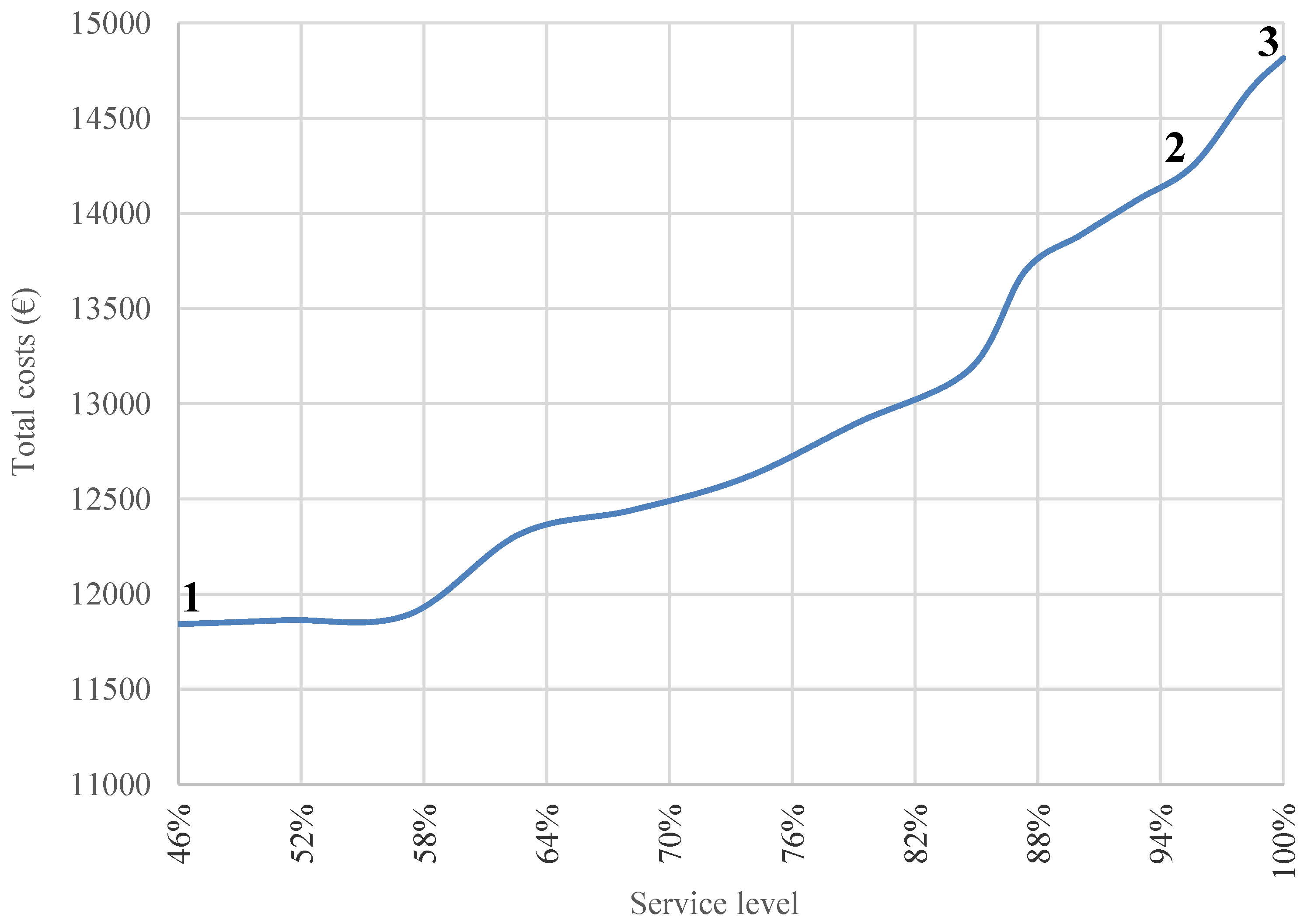
Figure 1 illustrates the Pareto frontier describing the trade-off between total cost and service level. As expected, higher service levels require increased investment in inventory and replenishment activities, while lower-cost solutions tolerate some degree of unmet demand. The frontier is globally convex and exhibits a clear cost–service turning point around a service level of 95–97%, beyond which marginal improvements in service level become increasingly expensive.
To provide further insight into the nature of this trade-off, three representative Pareto-efficient solutions, labelled 1–3, were selected for detailed analysis. Solution 1 corresponds to a service level of approximately 46%, Solution 2 to around 96%, and Solution 3 to 100%. These solutions represent distinct combinations of cost and service performance and illustrate the managerial implications of choosing different operating points along the frontier.
Table 4 reports the cost breakdown for each solution.
Solution 1 corresponds to a service level of approximately 46%, achieves a comparatively lower total cost of 11,839.2€, although at the expense of a more modest service level. Its cost structure is dominated by holding costs (10,042.1€), reflecting the inventory required to buffer demand across the planning horizon. Transport costs remain relatively low (949.8€), and ordering costs are moderate (420€). A lost-sales cost (427.3€) indicates occasional unmet demand, consistent with the lower service level associated with this solution.
Solution 2, operating at a service level of approximately 96%, aligns with the service-level standard commonly adopted in the company’s sector. It is consistent with service-level targets reported in industry surveys in retail and Fast-Moving Consumer Goods (FMCG) distribution. Its total cost (14,134.6€) is higher than that of Solution 1, but the improvement in service performance is substantial. Lost-sales costs are almost eliminated (38.5€), and the increase in holding and transport costs reflects the additional inventory and replenishment activity required to sustain this higher service level. This solution lies close to the cost–service turning point of the frontier, where the balance between cost and service becomes particularly attractive from a managerial perspective.
Solution 3 achieves full demand satisfaction (100% service level) at a total cost of 14,814.8€. The elimination of lost-sales costs demonstrates that this solution fully satisfies demand across all periods. However, this performance requires significantly higher holding costs (12,216.2€) and transport costs (2238.6€), alongside a slightly lower ordering cost (360€). The cost increase from Solution 2 to Solution 3 is disproportionately large relative to the marginal gain in service level, illustrating the steep region of the frontier beyond the turning point.
Together, these three solutions exemplify the fundamental trade-off captured by the Pareto frontier: Solution 1 minimises cost but tolerates substantial service degradation; Solution 2 achieves a sector-consistent service level at a moderate cost increase; and Solution 3 maximises service performance but incurs sharply rising operational expenditure. This comparison reinforces the value of the Pareto frontier as a decision-support tool, enabling managers to select the most appropriate balance between cost efficiency and service quality according to strategic priorities.
5.3. Discussion of the Results
The results clearly demonstrate the sensitivity of total cost to service-level requirements. As service levels increase, the system must rely on higher safety stocks, more frequent replenishment, and greater transport activity, all of which contribute to rising operational costs. Conversely, solutions that prioritise cost minimisation tend to operate with leaner inventories, increasing the likelihood of lost sales and reducing service performance.
In relative terms, moving from Solution 1 (46% service level) to Solution 2 (approximately 96%) increases total cost by around 19.4%. This moderate cost increase yields a dramatic improvement in service performance of more than 50 percentage points, illustrating that the mid-range of the frontier offers highly favourable cost–service trade-offs. By contrast, moving from Solution 2 (96%) to Solution 3 (100%) increases total cost by a further 4.8%, yet the service level improves by only four percentage points. This confirms that the upper end of the frontier is characterised by sharply diminishing returns, where each additional unit of service level requires disproportionately higher investment.
Solution 2 emerges as the most attractive operating point because it lies in the region of the Pareto frontier where marginal cost increases remain relatively low while service levels improve substantially. This point lies at the inflexion of the curve, where the trade-off between cost and service is most favourable, and aligns with service-level standards commonly adopted in practice.
The structure of the Pareto frontier reveals three distinct behavioural regions. First, at low service levels (below 60%), cost increases are minimal, as the system operates with lean inventories and tolerates unmet demand. Second, between approximately 60% and 96%, the frontier displays a relatively gentle slope, indicating a region of comparatively low marginal cost where substantial improvements in service level can be achieved with moderate increases in expenditure. This is precisely the region where Solution 2 is located, and its cost–service balance aligns with the service-level standards commonly adopted in the sector. Industry surveys indicate that retail and Fast-Moving Consumer Goods (FMCG) distribution networks typically operate with service-level targets between 95% and 98%, reflecting the sector’s emphasis on high product availability and minimal stockouts. This range is consistent with the 96% target used in the present case study. Third, beyond the 96% threshold, the frontier enters a region of diminishing returns, where further improvements require disproportionately large inventory investments.
This pattern is consistent with the operational characteristics of multi echelon systems, where the final increments of service level are the most expensive to secure due to compounding uncertainty across nodes and fixed lead times. The percentage-based comparison between the three solutions reinforces this interpretation: the system absorbs most of the service-level improvement between 46% and 96% at a relatively modest cost premium, whereas the final 4% of service level requires almost 5% additional cost.
From a managerial perspective, the choice among Pareto-efficient alternatives depends on strategic priorities. Firms emphasising cost efficiency may prefer solutions closer to the lower-service end of the frontier, whereas organisations competing on service differentiation or customer responsiveness may opt for higher-service solutions despite their higher cost. Solution 2 provides a balanced compromise for most operational contexts, but the final decision should reflect the organisation’s risk tolerance, competitive positioning and service-level commitments.
5.4. Sensitivity Analysis Discussion
A numerical sensitivity analysis was conducted to assess how variations in key controllable parameters influence the structure of the Pareto frontier and the robustness of the model’s managerial insights. This analysis quantifies how parameter perturbations affect both the preferred solution and the turning point of the cost–service trade-off. The turning point is identified using a slope-based criterion, corresponding to the first service-level interval where the marginal cost of service increases sharply, signalling the onset of diminishing returns.
Among the parameters typically considered in multi echelon inventory systems—holding costs, lost-sales penalties, lead times, demand variability, and safety-stock factors—only holding costs and lost-sales penalties are controllable cost parameters that the firm can meaningfully adjust. Lead times and demand variability are exogenous, determined respectively by supplier performance and market behaviour, while the safety-stock factor is a variable in the model and an endogenous outcome of the (r,Q) policy. The sensitivity analysis, therefore, focuses on the two parameters that the firm can legitimately vary.
Following this rationale, ±20% variations were applied to the holding costs and the lost-sales penalties.
Table 5 summarises the resulting turning-point service levels and associated costs. Two findings emerge. First, the preferred solution (Solution 2) remains unchanged across all scenarios. Although the turning point shifts under parameter perturbations, the preferred solution remains Solution 2 because the overall shape and structure of the Pareto frontier are preserved across all scenarios. Recomputing the frontier for each perturbed parameter set shows that the three representative solutions identified in the baseline case—low-service (Solution 1), compromise (Solution 2) and full-service (Solution 3)—retain the same relative performance patterns. Solution 1 continues to offer low cost but insufficient service performance, while Solution 3 consistently requires a disproportionately large cost increase for only marginal service improvement. In contrast, Solution 2 remains located in the region where the marginal cost of service is still moderate, and the service level is already high, thereby continuing to represent the most attractive cost–service compromise. This behaviour is consistent across all ±20% variations: although the frontier shifts vertically and the turning point moves to the 87–88% range, the compromise region of the frontier remains qualitatively unchanged. As a result, Solution 2 continues to dominate the balance between cost efficiency and service performance, confirming that the preferred operating point is structurally stable even when the underlying cost parameters are perturbed. Second, the turning point is sensitive to parameter changes. While it occurs at approximately 96% in the baseline scenario, it shifts to the 87–88% range under ±20% variations. This demonstrates that although the optimal compromise solution is stable, the service level at which diminishing returns begin is influenced by the underlying cost structure. Total costs vary in a predictable and economically interpretable manner, reflecting the expected impact of each parameter on the cost–service trade-off.
A qualitative discussion complements this sensitivity analysis by clarifying how variations in the controllable parameters reshape the cost–service trade-off and influence the structure of the Pareto frontier. Holding costs affect both the vertical position and the curvature of the frontier. Higher holding costs penalise safety-stock-intensive solutions, making high-service configurations disproportionately expensive and steepening the frontier. This behaviour is consistent with the numerical results, where the turning point shifts downward from 96% to 88% when holding costs increase, indicating that diminishing returns are reached earlier. Conversely, lower holding costs flatten the frontier by reducing the penalty associated with carrying additional stock. Although high-service configurations become more affordable, the turning point shifts to 87%, showing that the first sharp increase in marginal cost occurs earlier. This reflects the fact that the slope-based turning point captures the onset of marginal escalation rather than the attractiveness of high-service solutions.
Lost-sales penalties directly affect the trade-off between cost and service by altering the economic consequences of unmet demand. Higher penalties shift the frontier upward, making low-service configurations disproportionately expensive and reducing the appeal of cost-minimising policies. Lower penalties flatten the frontier and widen the range of economically viable low-service options. However, in contrast to holding costs, variations in the lost-sales penalties do not substantially alter the location of the turning point, which remains at 88% in both ±20% scenarios. This indicates that lost-sales penalties influence the absolute cost levels but have a more limited effect on the curvature of the frontier near the diminishing-returns region.
Lead times influence both safety-stock requirements and the responsiveness of the system. Longer lead times increase exposure to uncertainty, requiring additional buffer stock and steepening the frontier, while shorter lead times compress the frontier and reduce the marginal cost of service improvements. Although lead times were not varied in the numerical analysis, their qualitative impact is well established and remains relevant for managers evaluating supplier performance or considering nearshoring strategies.
Demand variability has a structural impact on the frontier. Increased variability widens the gap between low- and high-service solutions, as more safety stock is required to buffer uncertainty. Reduced variability narrows the frontier and makes high service levels more attainable. This parameter is particularly important for industries characterised by volatile demand patterns or promotional cycles.
Taken together, these sensitivity insights reinforce the interpretability of the results and clarify the conditions under which the preferred solution (Solution 2) remains attractive. They also highlight which operational parameters exert the strongest influence on the cost–service trade-off, thereby guiding future empirical validation and potential extensions of the model. Overall, the case study confirms that the proposed multi echelon MILP with continuous-review (r,Q) policies is capable of capturing the operational trade-offs faced by real distribution networks and provides a robust analytical basis for supporting inventory and service-level decisions. By quantifying the relative cost increases associated with different service-level targets and by constructing a detailed Pareto frontier, the model offers managers a transparent and defensible framework for selecting service-level policies aligned with both operational constraints and industry practice.
6. Conclusions
This section summarises the main insights obtained from applying the proposed model to a real multi echelon system. The case study demonstrates how the model supports decision-making by quantifying the trade-off between total cost and service level and by identifying efficient operating points along the Pareto frontier. The following subsections highlight the main remarks, discuss their managerial relevance, and outline limitations and avenues for future research.
6.1. Main Remarks and Insights
This study developed and evaluated an inventory planning model designed to support decision-making in multi echelon distribution systems. The model explicitly captures the trade-off between total operational cost and customer service level, enabling decision-makers to explore efficient replenishment policies along the Pareto frontier. The case study demonstrated that the model is capable of identifying a diverse set of non-dominated solutions, each reflecting a different balance between inventory investment, transport activity, ordering frequency and service performance.
The results show that higher service levels require disproportionately higher costs, primarily due to increased safety stock, more frequent replenishment and greater transport utilisation. Conversely, cost-minimising solutions tend to operate with leaner inventories, which increases the risk of lost sales and reduces service performance. The analysis also revealed a clear cost–service turning point around the sector-standard service level of approximately 96%, beyond which additional improvements in service level generate sharply diminishing returns. This inflexion point represents the most economically attractive region of the frontier and provides a robust basis for defining service-level targets.
Overall, the proposed approach offers a structured and quantitative means of evaluating inventory policies. By generating a detailed and interpretable Pareto frontier, the model enhances understanding of how replenishment decisions propagate through the network and shape overall performance, supporting both operational and strategic decision-making.
6.2. Managerial and Practical Implications
The findings of this research have several important implications for practitioners. First, the Pareto frontier offers a clear visual and analytical tool for assessing the consequences of prioritising cost efficiency versus service quality. Managers can use this information to select operating points that align with corporate objectives, customer expectations or budgetary constraints. The identification of the cost–service turning point offers a defensible benchmark for setting service-level targets that balance competitiveness with financial sustainability.
Second, the decomposition of total cost into ordering, holding, transport and lost-sales components provides valuable insight into the drivers of performance. The comparison between Solutions 1 and 2, for example, shows that most of the service-level improvement is achieved through higher inventory levels and increased transport activity, while lost-sales costs decrease sharply. This understanding can guide targeted interventions, such as revising replenishment frequencies, adjusting safety stock policies or redesigning transport routes. Such granular cost visibility also strengthens internal budgeting processes and supports negotiations with logistics partners.
Third, the model can be integrated into routine planning processes. Its ability to generate multiple efficient solutions allows managers to conduct scenario analysis, evaluate the impact of demand variability, and assess the robustness of replenishment decisions under different operating conditions. This flexibility is particularly valuable in environments characterised by uncertainty, seasonality or fluctuating customer expectations.
In summary, the proposed decision-support mechanism enhances managerial visibility over the cost–service trade-off and provides a rigorous foundation for more informed and balanced inventory decisions. It equips organisations with a structured analytical framework that complements existing planning tools and supports continuous improvement in supply chain performance.
6.3. Limitations and Future Work
While the proposed framework offers practical insights and generates a clear cost–service trade-off, the robustness of the results has not been tested under repeated sampling or alternative demand realisations. The quantitative values of the Pareto frontier should therefore be interpreted with caution, and further empirical validation is required to generalise the findings across different operating environments. The framework can naturally accommodate multiple demand replications or scenario sets, making this a promising direction for future research.
Despite its contributions, the study has several limitations that warrant future research. First, the model assumes a fixed order quantity policy, which, although common in practice, may not be optimal in environments with highly volatile demand or significant seasonality. Future work could explore alternative replenishment strategies, such as dynamic lot-sizing or hybrid policies.
Second, the case study focuses on a single product and a relatively small distribution network. Extending the model to multi-product, multi-supplier or larger-scale systems would provide further insight into its scalability and applicability in more complex settings.
Third, uncertainty was incorporated only through demand. Future research could integrate additional sources of uncertainty, such as supply disruptions, transport delays or stochastic lead times, potentially through stochastic programming or robust optimisation frameworks.
Fourth, the Pareto frontier reflects system behaviour under a single representative demand trajectory, and its quantitative values may vary under alternative realisations. Future research could therefore explore stochastic or robust optimisation extensions, repeated sampling procedures, or scenario-based formulations to assess the stability of the frontier and to better characterise the impact of uncertainty on cost–service trade-offs.
Finally, the model currently assumes deterministic cost parameters. Introducing cost uncertainty or price-sensitive demand could enhance its relevance in markets subject to volatility or promotional dynamics. Incorporating environmental or sustainability metrics—such as CO2 emissions or energy consumption—would also broaden the model’s applicability in contexts where environmental performance is a strategic priority.
Overall, these extensions would strengthen the model’s applicability and broaden its usefulness as a decision-support tool for modern supply chains. They also offer promising opportunities for advancing the integration of multi objective optimisation, uncertainty modelling, and practical supply chain decision-making.