A Systems Perspective on Circular Economy Transitions: Integrating Bibliometric Networks with Econometric Evidence of Investment Drivers



Abstract
1. Introduction
1.1. Context and Motivation
1.2. Novelty and Contribution of the Study
- From Theoretical Frameworks to Empirical Topology: Unlike existing studies that use MLP as a qualitative heuristic, this research converts the framework into an empirical topology. We utilize bibliometric network analysis not merely for literature mapping, but as a diagnostic tool to objectively identify the “Firm” as the central execution node (Micro-level). This ensures that our econometric model is anchored in the theoretical consensus of the scientific community, creating a Systemic Conceptual Alignment between macro-conceptual maps and micro-performance metrics.
- The “Institutional Readiness” Gateway: While the disparity between developed and emerging economies is a foundational axiom, our study contributes a specific comparative metric of policy-mix efficiency. We move beyond the general OECD vs. non-OECD labels, to suggest that the transition is governed by an “institutional readiness gateway.” We identify that, in the absence of a threshold of Government Effectiveness, even advanced voluntary instruments (VAs) remain structurally isolated, and are less associated with investment flows, a nuance often masked in aggregate European analyses.
- Quantifying the “Push–Pull” Signalling Effect: We introduce a functional classification that transcends simple policy impact studies. By synchronizing bibliometric clusters with econometric coefficients, we demonstrate that while “Push” mechanisms (taxes—TFs) penalize the linear model, “Pull” levers (market-based—TPOs) exert a distinct signalling effect on capital allocation (β = 0.53). This provides a rigorous evidence-based roadmap for the “policy mix” synchronization necessary for systemic transformation.
2. Literature Review
2.1. Circular Economy as a Socio-Technical Transition
2.2. Systems Theory and Complex Adaptive Systems (CASes)
- “Push” mechanisms, such as taxes and regulations (TFs, DRSes), which “push” agents towards CE by penalizing polluting behaviours;
- “Pull” mechanisms, such as subsidies or tradable permits (EBSPs, TPOs, VAs), which “pull” investments through market incentives and flexibility.
2.3. Multi-Level Perspective (MLP) in the Circular Transition
3. Materials and Methods
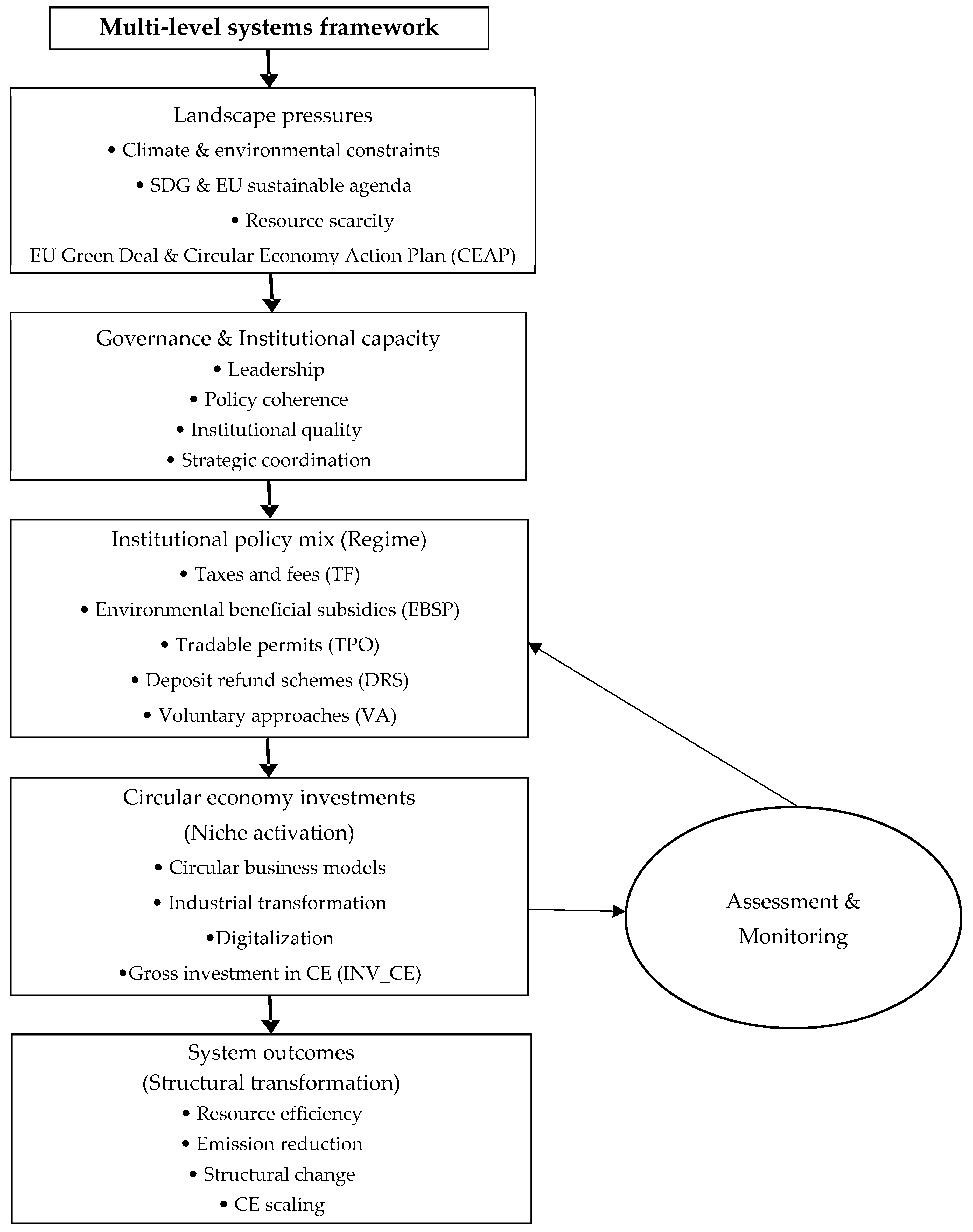
3.1. Methodology and Conceptual Framework: A Multi-Level Perspective (MLP) Approach
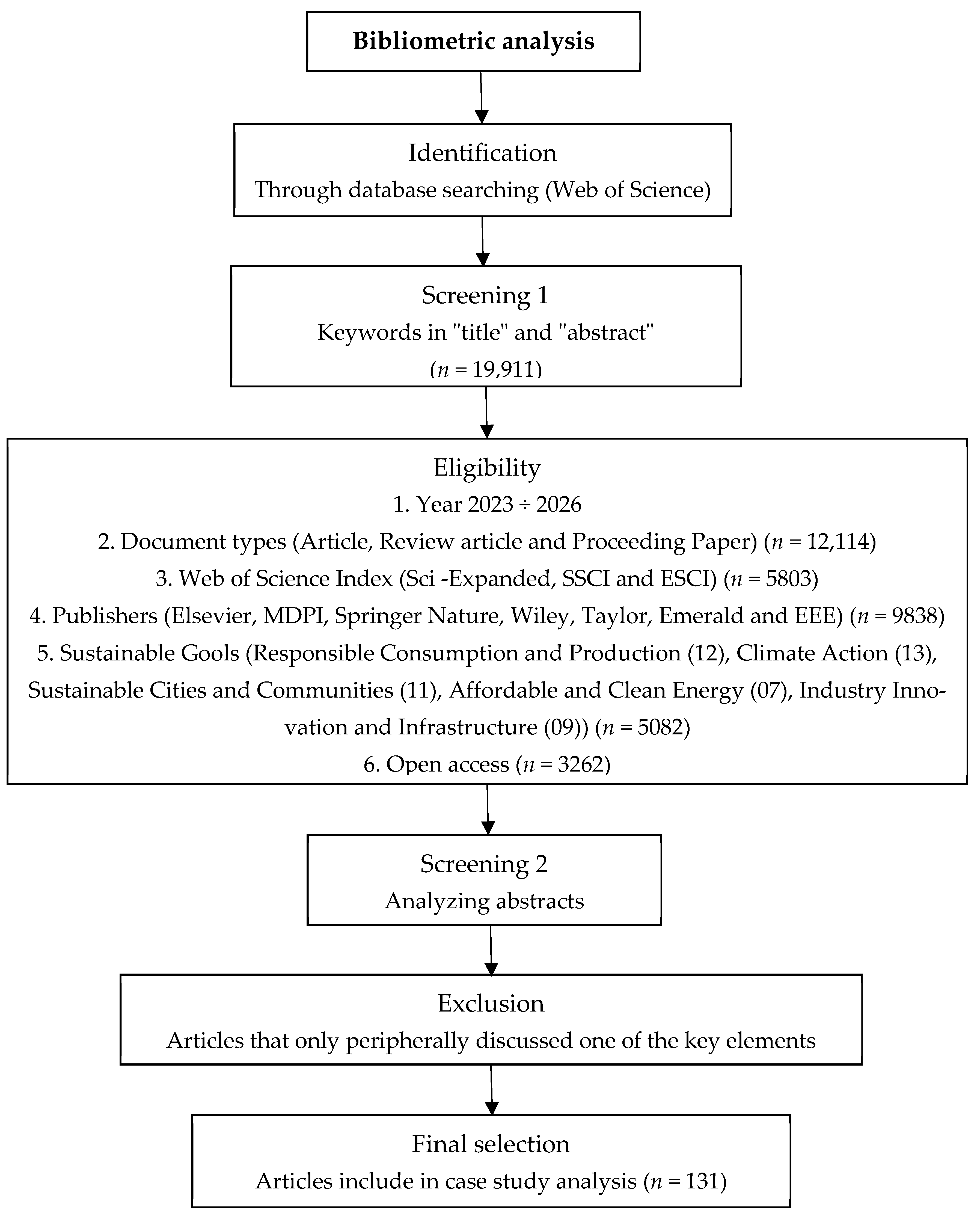
- Initial Identification: A keyword search in “title” and “abstract” (n = 19,911) was conducted for the period 2023–2025. This timeframe represents the current frontier of knowledge, capturing the most recent theoretical consensus and institutional priorities that inform the variables observed in our empirical analysis.
- Quality Screening: The sample was restricted to high-impact indexes (Sci-Expanded, SSCI, ESCI) and reputable academic publishers (e.g., Elsevier, Amsterdam, Netherlands; MDPI, Basel, Switzerland; Springer Nature, Berlin, Germany; Wiley, Hoboken, NJ, USA), resulting in n = 9495 documents.
- Thematic Alignment (SDGs): To align the corpus with the systemic nature of the circular economy (CE) transition, we applied a filter for specific Sustainable Development Goals (SDGs 07, 09, 11, 12, 13), narrowing the selection to n = 6140 papers.
- Final Eligibility and Inclusion: Following an “Open Access” filter (n = 161) and a manual abstract analysis to exclude peripheral studies, a final core corpus of n = 131 articles was selected. The bibliometric mapping and network visualization were performed using VOSviewer (v1.6.20, Nees Jan van Eck & Ludo Waltman, Leiden, The Netherlands). This “quality-over-quantity” approach prioritizes metadata integrity and ensures that the structural hubs identified in Section 4.1 are grounded in the most advanced scientific discourse.
- Landscape: Represented by macro-scale pressures, including global environmental constraints (SDGs) and the harmonized regulatory agenda of the European Green Deal. These pressures define the normative conditions associated with the reconfiguration of national systems.
- Regime: The institutional policy mix, acting as the stable regulatory environment. This study operationalizes the regime through five key instruments (PII, DRSes, TPOs, VAs), which serve as structural transmission channels for capital flows.
- Niche: The locus of innovation where circular business models emerge. We define the niche through aggregated firm-level investment outcomes (INV_CE), observing the alignment between microeconomic activity and macroeconomic policy frameworks.
3.2. Literature Selection and Eligibility Criteria
- Initial Identification and Filtering: We screened a broad set of publications (n = 12,215) published between 2023 and 2025, focusing on Articles, Reviews, and Proceedings indexed in SCI-Expanded, SSCI, and ESCI. The sample was narrowed to 9495 papers from high-impact publishers and further refined to include only those aligned with the Sustainable Development Goals (SDGs 07, 09, 11, 12, 13), resulting in 6140 publications.
- The Strategic Selection of Open Access (OA): A refined pool of 161 OA publications was selected for mapping. This criterion serves two critical methodological purposes:
- ○
- Data Granularity and Integrity: OA journals typically offer standardized, comprehensive metadata, essential for reducing “noise” in co-occurrence network analysis and ensuring the topological accuracy of the nodes.
- ○
- EU Policy Alignment: In the EU-27 context, research funded under major frameworks (e.g., Horizon Europe) is mandated to be Open Access. Thus, this sample captures the core innovations interacting with European public policy.
- ○
- Content Screening and Refinement: The 161 OA papers underwent a double-stage content analysis (Figure 2). Exclusion (n = 30) targeted works focusing exclusively on technical engineering or peripheral theory without addressing economic or institutional mechanisms.
- Final Selection (n = 131): The final sample includes studies that directly observe the interdependence between governance (macro), supply chains (meso), and firm behaviour (micro). A post hoc cross-check confirmed that the structural nodes identified (e.g., “Firm”, “Supply Chain”) are consistent with seminal literature, ensuring the 131-paper core represents a reliable structural mapping of the European policy nexus.
3.3. Econometric Data: A Systemic Mapping of the European Union
- The “Pull” Mechanism (Market Incentives): Comprising EBSPs, TPOs, and VAs, this mechanism is used to attract investment by offering financial rewards or commercial flexibility:
- ○
- Environmentally Beneficial Subsidies and Payments (EBSPs): Aimed at stimulating capital flows toward circular activities by providing non-refundable financial support.
- ○
- Tradable Permits and Offsets (TPOs): Create a market for emission or pollution rights, potentially encouraging firms to invest in clean technologies to optimize permit management.
- ○
- Voluntary Approaches (VAs): Represent private sector commitments that, while non-coercive, are associated with investment attraction through corporate social responsibility and competitive advantages.
- The “Push” Mechanism (Regulatory Constraints): Comprising TFs and DRSes, this mechanism acts through constraints that encourage firms toward the CE by internalizing environmental costs or imposing structural obligations:
- ○
- Taxes and Fees (TFs): Increase the relative cost of linear activities or resource extraction, suggesting a shift toward circular alternatives for maintaining profitability.
- ○
- Deposit Refund Schemes (DRSes): Represent a regulatory constraint that necessitates logistical reorganization and investment in collection infrastructure. Although the classification of Deposit Refund Schemes (DRSes) may seem ambiguous, from the perspective of this analysis, it is treated as a “push” mechanism (regulatory constraint). From a theoretical point of view, DRSes imposes an immediate opportunity cost (the deposit) and a structural obligation to implement reverse logistics. Even if it includes a “refund” component, this does not constitute a market incentive (like a subsidy), but a simple recovery of locked-up equity, thus forcing the firm to reorganize its processes to avoid losing the deposit. The interpretation of the negative coefficient (β = −0.382) must therefore be seen in the light of these compliance costs; the initial investment required for the collection infrastructure (required by DRSes) may temporarily limit the availability of capital for other types of circular investments, reflecting a “trade-off” between immediate compliance and long-term strategic investments.
3.4. Statistical Method and Model Challenges
3.4.1. Preliminary Comparative and Maturity Testing
- Systemic Maturity Comparison: The Mann–Whitney U test was utilized to observe disparities between OECD (n = 22) and non-OECD (n = 5) Member States. This test is highly resilient to unequal group sizes. To ensure maximum precision, Exact p-values were calculated to validate structural differences in investment performance (INV_CE).
- Operationalizing Institutional Readiness: A Spearman rank-order correlation analysis was performed to map investment outcomes against proxy indicators of governance (World Bank Government Effectiveness) and Eco-Innovation (Eurostat). This identifies potential structural decoupling between policy instruments and actual governance capacity.
3.4.2. Multiple Linear Regression Model
- Dependent Variable (Y): Investments in the circular economy (INV_CE).
- Independent Variables/Predictors (X): Environmental policy instruments, specifically the Policy Integration Index (PII) (derived through Principal Component Analysis (PCA) from EBSPs and TFs), along with DRSes, TPOs, and VAs.
- Control Variable: Country membership (binary variable: 1 = OECD country, 0 = non-OECD country), used to capture any residual effect of institutional membership not explained by the policy variables.
3.4.3. Robustness Framework and Diagnostic Protocol
- A.
- Multicollinearity Management and PCA
- B.
- Outlier Detection and Visual Diagnostics
- C.
- Sensitivity Analysis via Leave-One-Out
- D.
- Testing for Systemic Interactions
4. Results
4.1. Bibliometric Analysis: Structure, Foundations and Dynamics of the Knowledge System
4.1.1. Network Architecture and Centrality Indicators
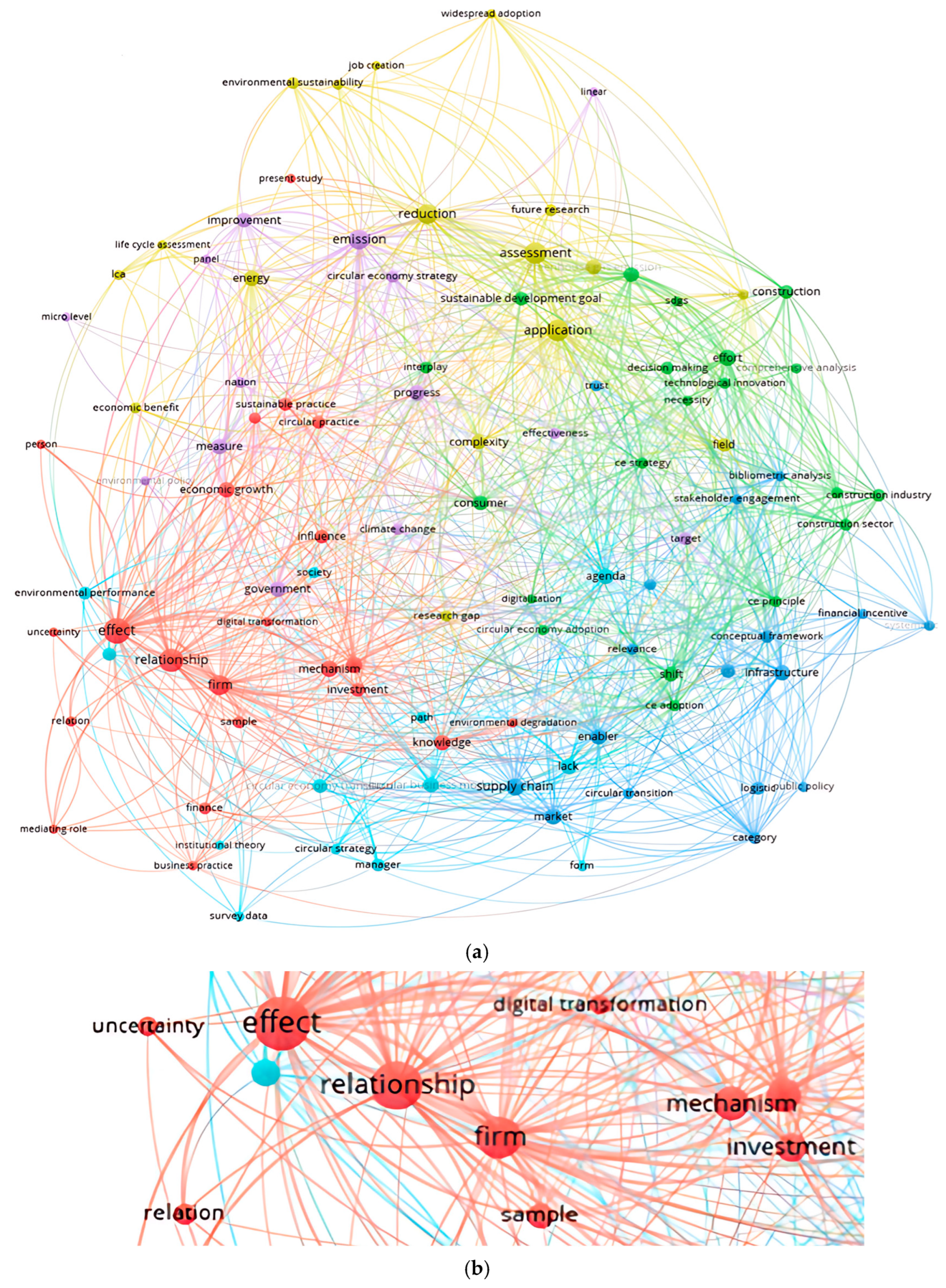
- Yellow/Purple Cluster (Macro-Strategy): Anchored by the “Circular Economy Strategy” node, which exhibits a high Betweenness Centrality (BC) of 0.82. This identifies the node as a strategic “hub” that aligns global SDG pressures with national policy frameworks.
- Blue Cluster (Meso-Infrastructure): Centered on “Supply Chain”, which presents the highest BC (0.89). This metric mathematically validates the supply chain’s role as a structural bridge between institutional logistics and operational environments.
- Red Cluster (Micro-Level Interdependencies): This cluster is central to our analysis. Although the “Firm” node has a lower absolute frequency (Degree: 215) than “Supply Chain”, its disproportionately high BC (0.78) identifies it as a critical mediator.
- MLP Pillar (Macro): Validated by the Circular Economy Strategy node (TLS: 450; BC: 0.82), confirming that systemic transition literature forms the core of the sample.
- Strategic Management Pillar (Micro): The Firm node (BC: 0.78) demonstrates its role as a binding bridge between theoretical concepts and practical results.
- Industrial Ecology Pillar (Meso): Anchored by the Supply Chain node (BC: 0.89), the main channel of structural association in the analysed literature.
4.1.2. Intellectual Foundations: Mapping the Theoretical Landscape
- The Socio-Technical Transitions (MLP) School: Acting as the “intellectual glue” of the system, this school provides the framework for observing the interplay between niche innovations and socio-technical regimes. It is primarily reflected in the Yellow and Purple Clusters, where global sustainability strategies define “Landscape” and “Regime” pressures.
- The Strategic Management (RBV) School: This pillar examines the association between internal resources and the sustainable positioning of agents. The structural prominence of the Red Cluster, specifically the high centrality (0.78) of the “Firm,” aligns with this school’s emphasis on firm-level agency as the mediator of the transition.
- The Industrial Ecology School: This foundation provides the methodological basis for resource metabolism. Its structural presence is most visible in the Blue and Green Clusters, where material flows and sectoral innovations (e.g., construction) intersect to define the operational infrastructure.
4.1.3. System Dynamics and Transition to Econometric Modelling
- The “Firm” and “Investment” nodes (Red Cluster): Their systematic association justifies the use of INV_CE as the dependent variable.
- The “Policy Framework” and “Strategy” nodes (Purple/Yellow Clusters): Substantiate the inclusion of regulatory and institutional independent variables.
- The “Supply Chain” and “Infrastructure” nodes (Blue Cluster): Provide the theoretical justification for meso-level transmission channels.
4.2. Econometric Analyses: Impact Dynamics and Systemic Perspective
4.2.1. Structural Disparities: OECD vs. Non-OECD
- A.
- General Perspective: OECD vs. non-OECD
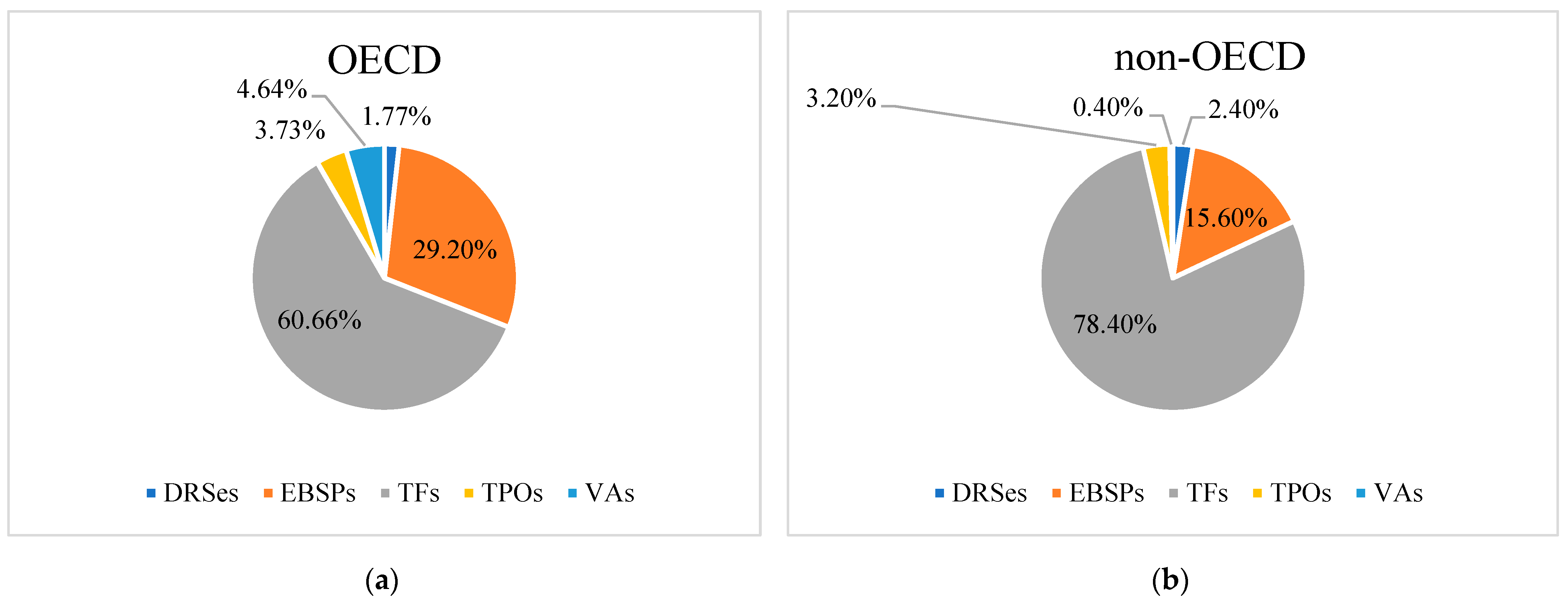
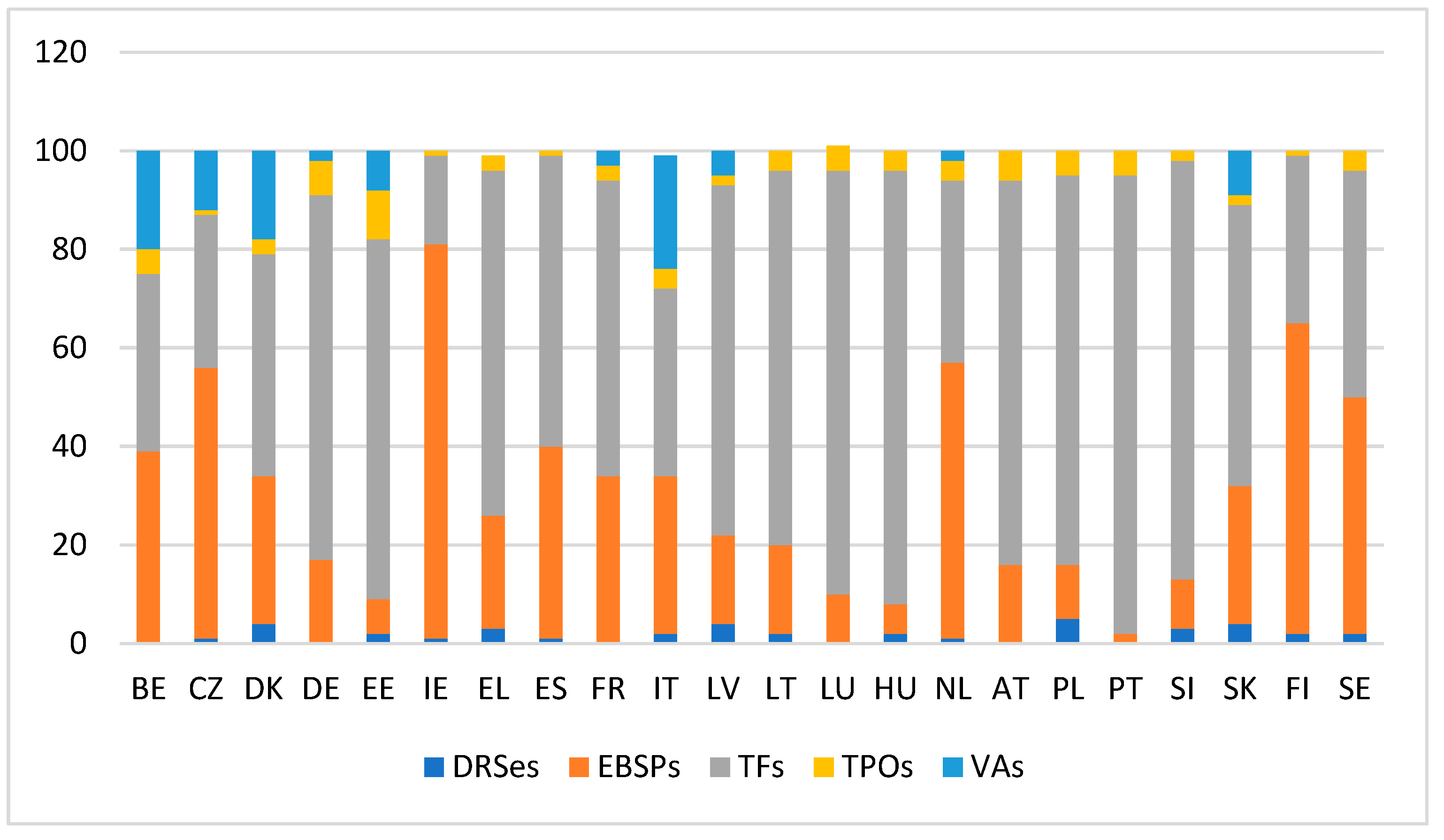
- OECD Group (Figure 4a): Displays a diversified “policy ecosystem”. Fiscal instruments (TFs—60.66%) are balanced by a significant volume of incentives (EBSPs—29.20%), providing firms with both constraints and resources.
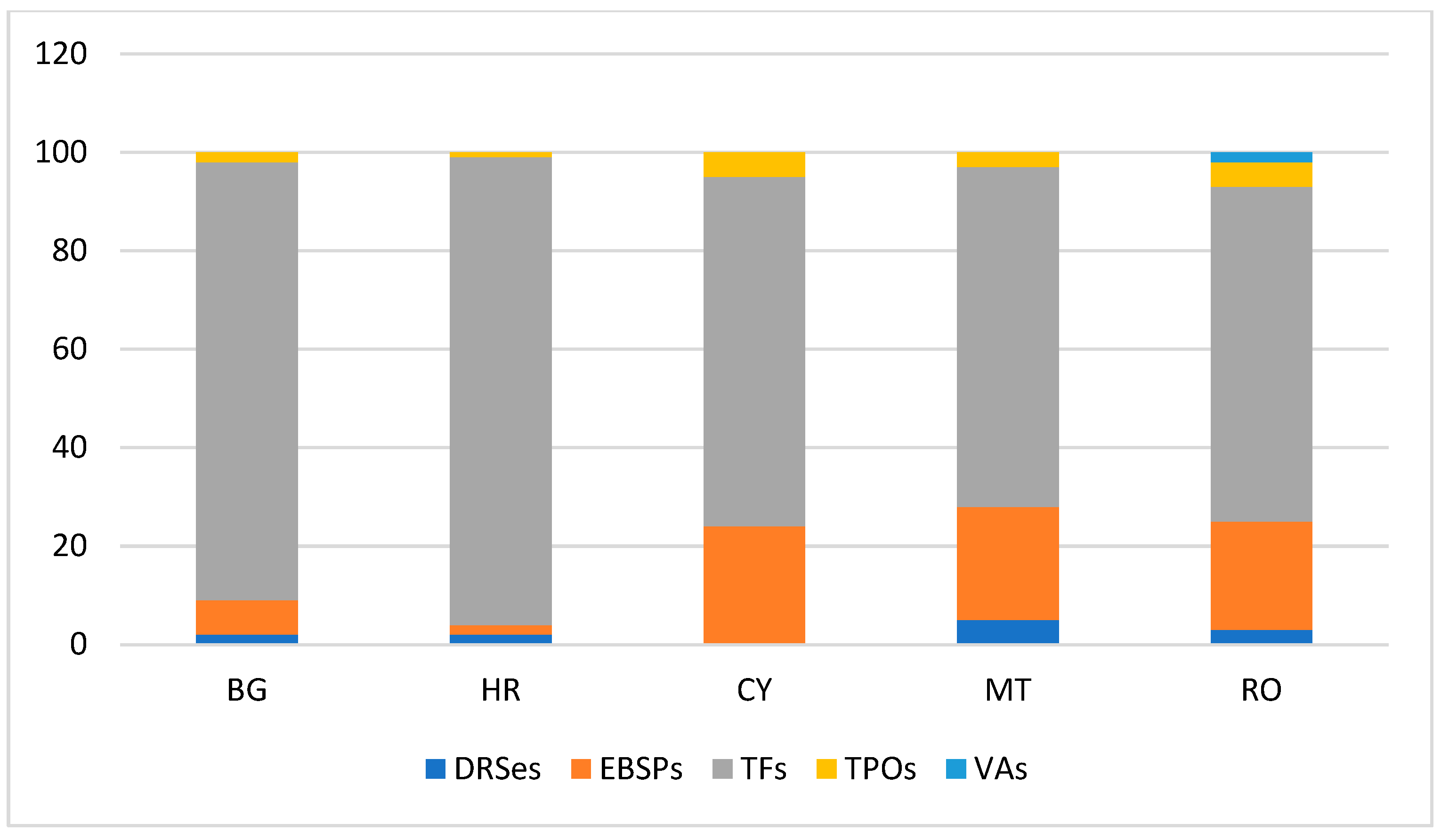
- Non-OECD Group (Figure 4b): The system is more rigid, with a clear dominance of taxes (TFs—78.40%) and a reduced presence of positive incentives (EBSPs—15.60%).
- Secondary Instruments: In both groups, circular-specific schemes like refund systems (DRSes) or tradable permits (TPOs) remain marginal, suggesting they are not yet central pillars of the EU circular transition.
- B.
- Strategic Diversity and the “Institutional Readiness” Gateway
- Fiscal Leaders: Portugal (93%), Hungary (88%), Slovenia (85%), and Austria (78%) rely heavily on taxes (TFs) to force the internalization of environmental costs.
- Incentive Leaders: Ireland (80%) and Finland (63%) adopt the opposite strategy, prioritizing subsidies (EBSPs) instead of penalties.
- Niche Policy: Instruments such as DRSs remain marginal, except in Poland (5%) or Denmark (4%), signalling that these circular schemes are not yet central pillars.
- Partnerships: Italy (23%) and Belgium (20%) stand out for their use of voluntary approaches (VAs), involving the private sector more than the rest of the countries in the sample.
- Tax Monopoly: TFs values are extremely high, ranging from 68% (Romania) to 95% (Croatia), with taxation being the main method of influencing economic behaviour.
- Absence of Rewards: Subsidies (EBSPs) are used much less (e.g., 2% in Croatia), indicating a strategy based on sanction rather than reward.
- Administrative Limitations: The virtually complete lack of voluntary approaches (VAs) suggests a limited administrative capacity to manage complex partnerships, preferring a single, easily monitored instrument: the tax.
- C.
- Analysis of Institutional Disparities within the EU Context
4.2.2. The Role of Institutional Readiness: A Spearman Correlation Analysis
- The data reveal the following systemic interconnections: Synergy between governance and innovation: the correlation between Government Effectiveness (GE) and Eco-Innovation Index (EII) (rs = 0.91, p < 0.001) reflects a structural convergence specific to the European model, where administrative efficiency and technological capacity are features that are found simultaneously in high-performing states. This relationship highlights that institutional maturity and innovation are mutually supporting pillars within the circular ecosystem.
- Aligning investment flows with institutional stability: The association between GE and INV_CE (rs = 0.48, p = 0.011) indicates a clear tendency for investments to concentrate in those European national frameworks characterized by stability and administrative rigor. This context suggests that a predictable institutional environment provides the necessary foundation for attracting circular capital.
- Policy mix integration as a systemic phenomenon: The new policy integration index (PII, extracted through PCA) shows balanced correlations with both governance (0.42) and voluntary instruments (VAs, 0.42). This configuration indicates that, in the community space, integrated regulations and market-based initiatives tend to operate in a regime of complementarity, reflecting a holistic approach to the green transition (rs = 0.41 for VAs × INV_CE).
4.2.3. Regression Model: A Systemic View of Investment Incentives in the CE
- A.
- Descriptive Analysis: Differences in Effort and Approach
- B.
- Ridge Regression Analysis: Policy Mix Configuration in the European Context
- C.
- Model Performance and Validation
4.2.4. Model Optimization and Diagnostic Validation
- A.
- Collinearity Resolution and PCA Aggregation
- B.
- Statistical Robustness of the Optimized Configuration
- The model reached a significance threshold of p = 0.033, meeting the standard criteria for statistical reliability. This suggests that the identified policy mix configuration shares a significant statistical association with circular investment levels (INV_CE).
- The R2 coefficient of 0.366 indicates that over a third of the variance in circular investment across the EU-27 is consistent with this specific policy configuration, highlighting the relevance of the chosen variables within the European circular ecosystem.
- C.
- Visual and Case-wise Diagnostic Validation
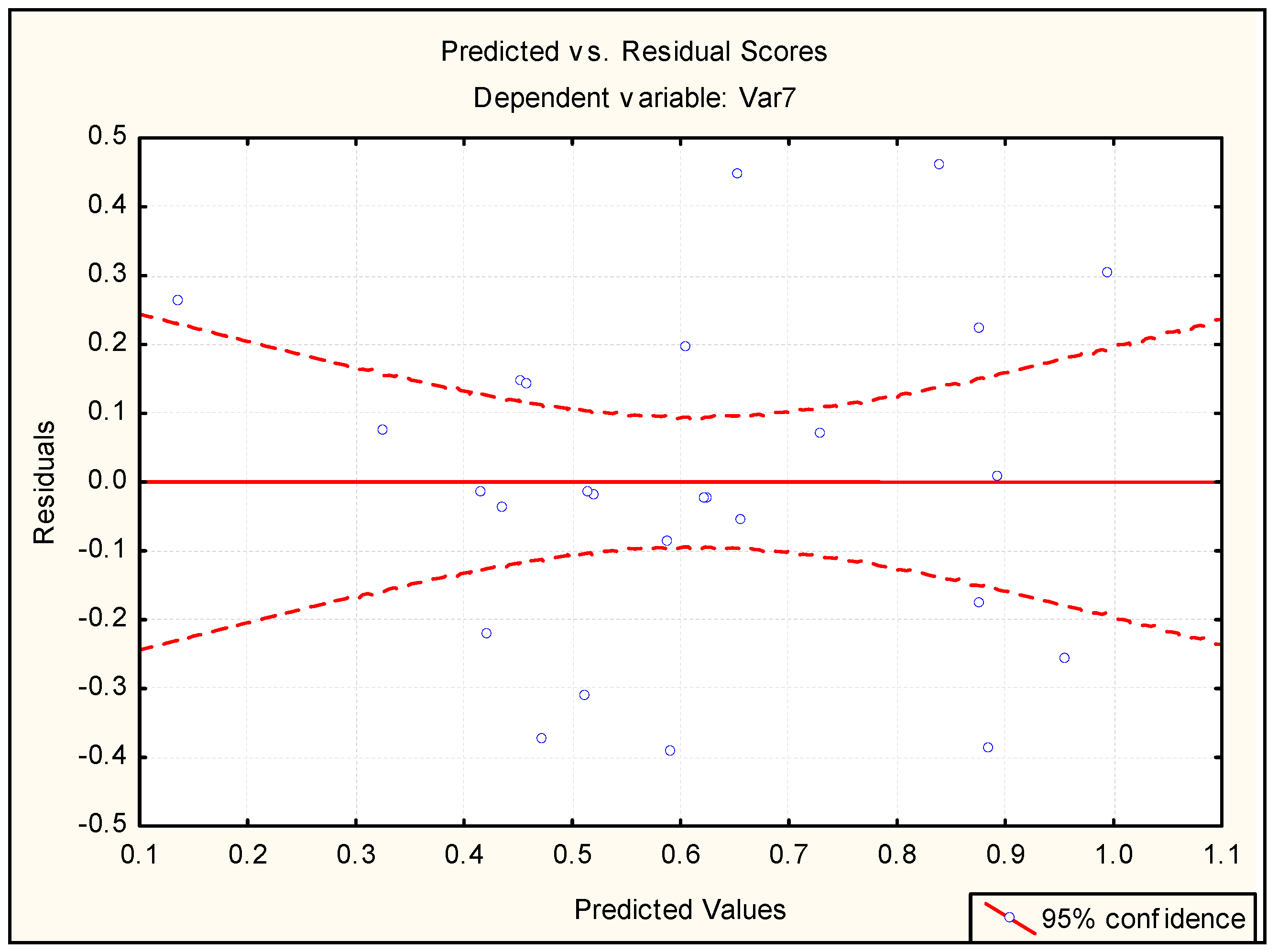
- Linearity and Independence: The stochastic dispersion of the points around the zero horizontal axis confirms that the relationship between the policy mix and investment is linear, and the model has correctly extracted the structural signal from the data.
- Homoscedasticity: The distribution of the points remains relatively constant across the spectrum of predicted values, without showing any “funnel” patterns (heteroscedasticity).
- Stability of Estimates: Most observations fall within the 95% confidence interval (delimited by the dotted red lines), demonstrating that the coefficient estimates are robust and not distorted by outliers.
4.2.5. Sensitivity Analysis and Structural Stability Validation (Leave-One-Out)
- A.
- Stability of Indicators within the Policy Nexus
- The coefficients associated with the policy instruments (DRSes, PII, TPOs, VAs) retain both their direction of association and their order of magnitude across all iterations. In particular, the DRSes instrument shows remarkable stability, maintaining its statistical significance (p < 0.05 or p < 0.01) in almost all configurations.
- The coefficient of determination (R2) remains relatively stable, hovering between 0.36–0.37. Notably, the exclusion of specific outliers—namely Cyprus (Model 4) and the combined exclusion of Cyprus and Malta (Model 7)—increases the R2 to 0.46. This improvement suggests that while the model captures a robust structural signal at the EU-27 level, these specific observations exert a disproportionate influence on the goodness-of-fit, reinforcing the overall stability of the model when these cases are addressed.
- The significance of the model (p = 0.033) remains consistently below the 0.05 threshold in the LOO process, confirming that the identified relationship is not dependent on the specific composition of the sample.
- B.
- Transmission Channels and Complementarity in the Policy Mix
- The fact that the p-level for all interactions varies between 0.24 and 0.91 demonstrates that each component of the policy nexus (regulations through DRSes, integrated effort through PII or market instruments through TPOs and VAs) functions as an independent transmission channel.
- The results suggest a layered policy architecture in the EU-27. Investments in the circular economy are correlated with the individual presence and strength of each instrument, which means that the policy mix provides stable support, not being vulnerable to the weakness of a single intervention mechanism.
- The results of the robustness analysis do not imply a causal directionality but rather attest to a stable co-evolution of circular capital flows and the institutional environment. This structural stability provides a solid empirical basis for supporting Hypothesis H3, confirming that an integrated policy mix is consistently found in countries with superior investment performance.
5. Discussion
5.1. System Architecture and Institutional Co-Evolution in the EU-27
- Alignment with H1: Co-occurrence analysis indicates that the “firm” is the hub of this ecosystem. In the European context, microeconomic decisions do not appear to occur in isolation but are correlated with the specific architecture of EU public policies.
- Model Performance: The Ridge regression model (R2 = 0.37, p = 0.033) indicates that the selected variables are associated with a significant part of the variance of circular capital flows at the EU level. This explanatory power provides a statistical basis for interpreting the interdependence between environmental policies and investment dynamics within the single market.
5.2. Policy Mix Dynamics: The Nexus Between Constraints and Incentives
- Complementarity over Hierarchy (H2): We analysed the relationship between “push” (regulatory constraints) and “pull” (market-based incentives) mechanisms. Although there are numerical variations between the coefficients, formal testing (Wald test) does not reveal a statistically significant hierarchy that would support the absolute superiority of one category over the other (p > 0.05). Consequently, the results suggest that the stability of the European system is associated not with a single isolated instrument but with the balanced coexistence and functional independence of DRSes, PII, TPOs, and VAs.
- Resilience of the Policy Nexus: The findings indicate that “pull” instruments do not replace “push” regulations but complement them. In the EU-27 context, these instruments may act as independent transmission channels, providing a multi-layered “safety net” for circular investments.
- Stability of DRSes: Within this link, the DRSes variable emerges as a constant pillar. Its statistical significance is maintained in almost all iterations of the sensitivity analysis (p < 0.05), supporting its role as a structural anchor in the European policy mix, regardless of fluctuations in other market-based incentives.
5.3. Institutional Congruence and the Maturity Gap
- Complementarity through Independence (H3): To formally address the moderating role of systemic maturity, we implemented a regression analysis including the interaction term VAs × Type (OECD/non-OECD). The results (Wald Stat = 1.006, p = 0.315) indicate that OECD membership does not act as a formal statistical moderator. Instead, the data suggest that policy instruments operate as independent vectors across the EU. This points toward the presence of a layered “safety net”; the individual presence of each instrument supports the link between investments, reflecting the resilience of the system, regardless of a country’s OECD status.
- Institutional Congruence and Absorptive Capacity: While the previously identified Spearman correlation (rs = 0.09) indicated an alignment between government effectiveness and voluntary approaches (VAs), the lack of a significant multiplicative effect in the regression model indicates institutional congruence rather than direct moderation. In the EU space, the association between complex policies (VAs, TPOs) and investment is a characteristic of economies that have reached a threshold of institutional readiness.
- Micro–Macro Gap: Although the model uses aggregated national data, it reflects the firm-centric systemic architecture identified in our bibliometric analysis. In the Complex Adaptive Systems (CASes) framework, national investment levels (INV_CE) can be interpreted as an emergent property of microeconomic decisions. The policy nexus (DRSes, PII, TPOs, VAs) is linked to independent transmission channels that guide firm-level behaviour, providing an interpretative link between theoretical firm centrality and aggregate investment performance.
- EU-limited Systemic Co-evolution: Overall, the data point toward a stable co-evolution between circular capital flows and the institutional framework of the European Union. This structural stability, supported by Leave-One-Out (LOO) analysis, indicates that high-performing circular investments tend to cluster where there is an integrated policy mix. These findings highlight the specific nature of the European governance model, as the identified nexuses are congruent with the regulatory harmony of the EU-27 and may not necessarily be extrapolated to other institutional landscapes.
5.4. The Nature of the Policy Mix: Additive Complementarity vs. Synergistic Interaction
- Maturation Stage (EU-27 Context): Studies reporting synergies are often based on analyses with an extended time window. Our cross-sectional analysis (2021–2023) captures a phase of “policy layering”, in which instruments are linked to institutional configurations that operate autonomously, prioritizing systemic coverage over cross-instrumental coordination.
- Institutional Specialization: Within the EU-27, instruments are channelled through distinct directives, which limits their complementarity to an “autonomous orchestration”. Thus, what in theory is conceptualized as a multiplicative synergy (A × B), in current administrative practice is reflected as an additive complementarity (A + B + C), where each instrument is associated with a specific market failure, acting as a non-redundant layer without requiring a direct interaction to produce effects.
- Additive Complementarity (A + B + C): The evidence data support an additive architecture, in which circular investments are associated with the simultaneous presence of several independent transmission channels. In this model, instruments such as TPOs, DRSes, and VAs function as non-redundant layers that cover various systemic gaps. The integration is horizontal, ensuring that all segments of the value chain are addressed.
- Absence of Multiplicative Synergy (A × B): The lack of statistical interactions indicates that the observed effectiveness of one instrument is not conditioned by the intensity of another. This configuration, specific to the European landscape, suggests that the systemic value lies in the diversity of the portfolio, which ensures resilience and broad coverage rather than in a synergy that would require a degree of administrative coordination that exceeds the current capacities of Member States.
6. Conclusions
- Empirical Findings: The study provides evidence of a strong association between integrated policy mixes (PII) and circular investments, alongside the identification of the “firm” as the central hub in CE knowledge and co-occurrence networks.
- Theoretical Deductions: Based on these associations, we deduce that the EU-27 transition operates as a complex adaptive system, where “structural coupling” and “policy gateways” facilitate the emergence of green capital. While these mechanisms are not directly observed, they provide a robust theoretical explanation for the patterns identified in the data.
- A.
- Empirical Evidence: Patterns of Policy Association
- B.
- Theoretical Interpretation: The Firm as a Systemic Mediator
- C.
- Systemic Hypotheses: Structural Coupling and Policy Gateways
- D.
- Policy Integration and Systemic Robustness
7. Limitations and Future Research
- Temporal Dynamics and Co-evolution: The analysis utilizes a cross-sectional window (2021–2023), a timeframe dictated by the recent availability of standardized CE indicators. Consequently, the current data structure precludes the establishment of long-term causal trajectories due to the time-lag effect inherent in environmental regimes. Investments (INV_CE) recorded in 2023 may reflect a delayed systemic response to regulations adopted in previous cycles. Potential endogeneity (the bidirectional feedback between policy and investment) remains a latent factor that future longitudinal studies should address using GMM or fixed-effects models as more data points emerge. Our model captures a “snapshot” of a moving target, where current investment patterns are co-evolving with legacy policies.
- Temporal Dynamics and Bidirectional Feedback: The analysis utilizes a cross-sectional window (2021–2023), which limits the ability to map long-term trajectories. The study should be viewed through the lens of co-evolution; there is a high probability that circular investment patterns and policy frameworks are mutually influencing one another (bidirectional feedback). Furthermore, the time-lag effect is inherent in environmental regimes, as policies often reach their peak impact only after several cycles. Consequently, the current results capture a “snapshot” of an evolving system. Future research should prioritize a longitudinal agenda using GMM (Generalized Method of Moments) or fixed-effects (FE) models, to better observe the temporal co-evolution between investment levels and the regulatory environment. To further mitigate these limitations, Section 5.4 discusses the policy–investment nexus as a dynamic equilibrium, framing our findings as a snapshot of a feedback loop between regulatory decisions and market responses.
- Sample Asymmetry and Institutional Heterogeneity: A structural imbalance exists between OECD (n = 22) and non-OECD (n = 5) Member States. While the Mann–Whitney U test confirmed significant disparities, the non-OECD group represents a census of a specific sub-population rather than a random sample. This nuances the universal generalization of findings and highlights the need for targeted research on emerging circular systems with different “institutional readiness” thresholds.
- Sample Asymmetry and Institutional Heterogeneity: The non-OECD group (n = 5) represents a census of a specific sub-population, not a random sample, which restricts the generalizability of these findings. It is critical to note that the identified “institutional readiness gateway” characterizes internal EU disparities and cannot be extrapolated to non-EU emerging economies. Structural differences between economies, such as Romania and island states, suggest that the “institutional readiness threshold” is not a uniform indicator. Future research should employ fuzzy-set Qualitative Comparative Analysis (fsQCA) to explore how specific combinations of institutional factors are associated with policy outcomes in countries with divergent profiles, thereby avoiding the trap of generalizations that ignore national specificities.
- The Tangible–Intangible Investment Gap: The focus on gross investments in tangible goods introduces a specific measurement boundary. By omitting intangible assets—such as R&D for circular design or digital optimization for reverse logistics, and organizational change, this study likely provides a conservative “lower bound” estimate of the total transition effort. From a systemic perspective, tangible and intangible components are complementary; future research should develop a Comprehensive Circular Investment Index (CCII) to integrate integrating physical, intellectual, and human capital pillars.
- Multicollinearity as Policy Integration: The high correlation between instruments (e.g., EBSPs and TFs) reflects the structural coupling of the EU legislative mix. While this reflects policy coherence, it limits the ability of classical OLS to isolate individual marginal effects. Future studies could employ Partial Least Squares Structural Equation Modelling (PLS-SEM) to better capture these complex, interconnected latent relationships within the system.
- The Micro–Macro Gap and Firm-Level Heterogeneity: Although bibliometric mapping identifies the “firm” as the central systemic node, the econometric analysis utilizes aggregated national investment data (INV_CE). This study cannot fully explain how firm characteristics (such as size, sector, or ownership) are associated with policy effectiveness. It is plausible that SMEs and large corporations exhibit different response patterns to voluntary approaches (VAs). Future research should utilize firm-level panel data (e.g., Eurostat’s Structural Business Statistics) to enable a multilevel analysis that captures how organizational heterogeneity correlates with strategic responses to public policy.
- Information Boundaries: While the bibliometric mapping provides a robust conceptual alignment with the theoretical consensus, it remains bounded by the indexed academic discourse. Relying on Web of Science metadata may potentially underrepresent “grey literature” and emerging industry-specific reports. This gap suggests a need for future qualitative research (e.g., multiple case studies) to explore the socio-technical factors and collaborative governance models that support associated with voluntary approaches (VAs).
8. Practical Implications
8.1. For Policy Makers: From Linear Penalties to Circular Alignment
- Synergistic Balance: Since TFs and EBSPs exhibit nearly identical statistical weights (β ≈ 0.49), the results support the adoption of a synchronized “Push–Pull” mix. In a systemic framework, taxes on waste could be strategically aligned to fund subsidies for green technologies, potentially creating a self-reinforcing feedback loop.
- Infrastructure Priority: The implementation of Deposit Refund Schemes (DRSes) should be viewed as a foundational infrastructure priority. Beyond collection, DRSes serves as a facilitator for the systemic reorganization of reverse logistics and supply chain transparency.
- Differentiated Regulatory Pathways: For emerging circular systems (non-OECD), where voluntary collaboration (VAs) appears structurally decoupled from performance, mandatory regulations and rigid reporting standards may act as necessary “gateways” before transitioning to sophisticated self-regulation mechanisms.
8.2. For Private Sector Managers: Strategic Integration and Resource Literacy
- Internal Governance Alignment: Circular investments appear most effective when integrated into the firm’s core governance mechanisms. Managers are encouraged to align organizational strategies with systemic policy signals to mitigate transition risks.
- Market Literacy: Firms should develop internal capabilities for managing Environmental Certificates (TPOs). As a strong statistical predictor associated with capital attraction in this study, proficiency in tradable permit markets represents a significant competitive advantage.
- Collaborative Ecosystems: The high density of the “supply chain” cluster in our analysis suggests that individual firm performance is deeply interdependent with the flow of know-how and shared logistics infrastructure within the broader business ecosystem.
8.3. For Technology Developers and Consultants: Bridging the “Data–Investment” Gap
Author Contributions
Funding
Data Availability Statement
Conflicts of Interest
Abbreviations
| CE | Circular Economy |
| INV_CE | Gross Investments in Tangible Goods in Circular Economy Activities |
| OECD | Organization for Economic Cooperation and Development |
| CAS | Complex Adaptive System |
| MLP | Multi-Level Perspective |
| LCA | Life Cycle Assessment |
| PCA | Principal Component Analysis |
| LOO | Leave-One-Out |
Appendix A

| Initial Regression Model (Before PCA) | Revised Regression Model (After PCA) | ||||
|---|---|---|---|---|---|
| Variable | Tolerance | VIF | Variable | Tolerance | VIF |
| Type | 0.808170 | 1.237363 | Type | 0.808289 | 1.2371813 |
| Country | 0.682667 | 1.464843 | Country | 0.688658 | 1.4520996 |
| DRSes | 0.032994 | 30.30878 | DRSes | 0.74446 | 1.3432555 |
| EBSPs | 0.000240 | 4171.173 | PII | 0.627674 | 1.5931837 |
| TFs | 0.000208 | 4805.084 | |||
| TPOs | 0.020809 | 48.05598 | TPOs | 0.711959 | 1.4045753 |
| VAs | 0.002031 | 492.3455 | VAs | 0.603478 | 1.6570612 |
| Factor 1 | Factor 2 |
|---|---|
| 0.97735 | −1.92760 |
| −1.09674 | 0.51692 |
| 1.50417 | −0.32449 |
| 0.53418 | −2.01624 |
| −0.48567 | −0.04166 |
| −0.71704 | −1.58569 |
| 2.45043 | 1.49868 |
| −0.23768 | 0.28025 |
| 0.43152 | 1.09489 |
| 0.28024 | 0.52000 |
| −1.36668 | 0.59909 |
| 0.75132 | −2.65361 |
| −0.23591 | 0.55293 |
| −0.38897 | −0.29464 |
| −0.50762 | 0.36242 |
| −0.94902 | 0.54646 |
| −1.09852 | 0.24424 |
| −0.21395 | 0.14884 |
| 1.38729 | 0.60525 |
| −0.60611 | 0.34273 |
| −0.75739 | −0.23217 |
| −1.31922 | 0.33626 |
| −0.21573 | −0.12383 |
| −0.92529 | 0.41505 |
| 0.19838 | −0.72181 |
| 1.63705 | 1.19984 |
| 0.96962 | 0.65788 |
| Active Variables | Eigenvalue | % Total Variance | Cumulative Eigenvalue | Cumulative % | Factor Loadings |
|---|---|---|---|---|---|
| 1 | 1.936836 | 96.84181 | 1.936836 | 96.8418 | 0.9840823 |
| 2 | 0.063164 | 3.15819 | 2 | 100 | 0.1777133 |
| Country | Obs. v. | Pred. v. | Res. | Std. P. v. | Std. R. | Std. Err. P. | Mahalanobis Dist. | Del. R. | Cook’s Dist. |
|---|---|---|---|---|---|---|---|---|---|
| BE | 1.30 | 1.10 | 0.20 | 1.86 | 0.97 | 0.12 | 8.15 | 0.31 | 0.10 |
| BG | 0.40 | 0.33 | 0.07 | −1.04 | 0.32 | 0.12 | 7.94 | 0.10 | 0.01 |
| CZ | 0.60 | 0.72 | −0.12 | 0.43 | −0.58 | 0.10 | 5.34 | −0.16 | 0.02 |
| DK | 0.80 | 0.79 | 0.01 | 0.70 | 0.03 | 0.12 | 8.33 | 0.01 | 0.00 |
| DE | 0.90 | 0.86 | 0.04 | 0.96 | 0.19 | 0.10 | 5.18 | 0.05 | 0.00 |
| EE | 0.70 | 1.00 | −0.30 | 1.48 | −1.44 | 0.15 | 11.78 | −0.59 | 0.49 |
| IE | 0.20 | 0.45 | −0.25 | −0.59 | −1.21 | 0.14 | 10.29 | −0.44 | 0.25 |
| EL | 0.10 | 0.02 | 0.08 | −2.23 | 0.40 | 0.15 | 13.11 | 0.18 | 0.05 |
| ES | 0.50 | 0.52 | −0.02 | −0.34 | −0.08 | 0.09 | 3.61 | −0.02 | 0.00 |
| FR | 0.80 | 0.71 | 0.09 | 0.39 | 0.44 | 0.07 | 2.02 | 0.10 | 0.00 |
| HR | 0.40 | 0.31 | 0.09 | −1.12 | 0.43 | 0.12 | 8.01 | 0.14 | 0.02 |
| IT | 0.50 | 0.54 | −0.04 | −0.25 | −0.20 | 0.16 | 14.87 | −0.11 | 0.02 |
| CY | 0.20 | 0.53 | −0.33 | −0.29 | −1.59 | 0.12 | 7.60 | −0.49 | 0.23 |
| LV | 0.60 | 0.53 | 0.07 | −0.29 | 0.34 | 0.09 | 3.62 | 0.09 | 0.00 |
| LT | 0.60 | 0.61 | −0.01 | 0.02 | −0.06 | 0.06 | 1.09 | −0.01 | 0.00 |
| LU | 1.30 | 1.26 | 0.04 | 2.47 | 0.19 | 0.14 | 10.85 | 0.07 | 0.01 |
| HU | 0.60 | 0.63 | −0.03 | 0.09 | −0.16 | 0.07 | 2.20 | −0.04 | 0.00 |
| MT | 0.40 | 0.20 | 0.20 | −1.54 | 0.96 | 0.12 | 8.15 | 0.31 | 0.10 |
| NL | 1.10 | 0.65 | 0.45 | 0.15 | 2.18 | 0.09 | 3.71 | 0.55 | 0.16 |
| AT | 1.10 | 0.80 | 0.30 | 0.72 | 1.46 | 0.09 | 3.85 | 0.37 | 0.07 |
| PL | 0.60 | 0.51 | 0.09 | −0.38 | 0.45 | 0.11 | 6.86 | 0.13 | 0.02 |
| PT | 0.70 | 0.78 | −0.08 | 0.67 | −0.41 | 0.11 | 6.42 | −0.12 | 0.01 |
| RO | 0.40 | 0.42 | −0.02 | −0.70 | −0.11 | 0.12 | 7.94 | −0.04 | 0.00 |
| SI | 0.20 | 0.51 | −0.31 | −0.39 | −1.47 | 0.10 | 4.49 | −0.39 | 0.09 |
| SK | 0.50 | 0.60 | −0.10 | −0.03 | −0.48 | 0.10 | 5.68 | −0.14 | 0.01 |
| FI | 0.40 | 0.44 | −0.04 | −0.63 | −0.19 | 0.11 | 6.21 | −0.06 | 0.00 |
| SE | 0.50 | 0.57 | −0.07 | −0.12 | −0.36 | 0.10 | 4.69 | −0.10 | 0.01 |
| Min | 0.10 | 0.02 | −0.33 | −2.23 | −1.59 | 0.06 | 1.09 | −0.59 | 0.00 |
| Max | 1.30 | 1.26 | 0.45 | 2.47 | 2.18 | 0.16 | 14.87 | 0.55 | 0.49 |
| Mean | 0.61 | 0.61 | 0.00 | 0.00 | 0.00 | 0.11 | 6.74 | −0.01 | 0.06 |
| Median | 0.60 | 0.57 | −0.01 | −0.12 | −0.06 | 0.11 | 6.42 | −0.01 | 0.01 |
| Country | Obs. v. | Pred. v. | Res. | Std. P. v. | Std. R. | Std. Err. P. | Mahalanobis Dist. | Del. R. | Cook’s Dist. |
|---|---|---|---|---|---|---|---|---|---|
| BE | 1.30 | 1.00 | 0.30 | 1.79 | 1.14 | 0.15 | 7.69 | 0.46 | 0.14 |
| BG | 0.40 | 0.33 | 0.07 | −1.29 | 0.27 | 0.16 | 7.94 | 0.11 | 0.01 |
| CZ | 0.60 | 0.63 | −0.03 | 0.09 | −0.10 | 0.13 | 4.96 | −0.03 | 0.00 |
| DK | 0.80 | 0.61 | 0.19 | 0.00 | 0.73 | 0.15 | 6.82 | 0.28 | 0.05 |
| DE | 0.90 | 0.89 | 0.01 | 1.33 | 0.02 | 0.13 | 5.13 | 0.01 | 0.00 |
| EE | 0.70 | 0.96 | −0.26 | 1.61 | −0.97 | 0.19 | 11.71 | −0.50 | 0.25 |
| IE | 0.20 | 0.42 | −0.22 | −0.86 | −0.83 | 0.17 | 10.25 | −0.39 | 0.13 |
| EL | 0.10 | 0.47 | −0.37 | −0.62 | −1.40 | 0.12 | 4.11 | −0.46 | 0.08 |
| ES | 0.50 | 0.52 | −0.02 | −0.40 | −0.08 | 0.11 | 3.61 | −0.03 | 0.00 |
| FR | 0.80 | 0.73 | 0.07 | 0.57 | 0.26 | 0.09 | 2.00 | 0.08 | 0.00 |
| HR | 0.40 | 0.33 | 0.07 | −1.30 | 0.28 | 0.16 | 8.00 | 0.11 | 0.01 |
| IT | 0.50 | 0.89 | −0.39 | 1.29 | −1.45 | 0.17 | 9.72 | −0.66 | 0.36 |
| CY | 0.20 | 0.59 | −0.39 | −0.07 | −1.47 | 0.15 | 7.43 | −0.58 | 0.22 |
| LV | 0.60 | 0.45 | 0.15 | −0.72 | 0.56 | 0.11 | 3.36 | 0.18 | 0.01 |
| LT | 0.60 | 0.62 | −0.02 | 0.07 | −0.09 | 0.07 | 1.09 | −0.02 | 0.00 |
| LU | 1.30 | 0.84 | 0.46 | 1.08 | 1.72 | 0.11 | 3.25 | 0.55 | 0.10 |
| HU | 0.60 | 0.66 | −0.06 | 0.23 | −0.21 | 0.09 | 2.17 | −0.06 | 0.00 |
| MT | 0.40 | 0.14 | 0.26 | −2.17 | 0.98 | 0.16 | 7.98 | 0.40 | 0.11 |
| NL | 1.10 | 0.65 | 0.45 | 0.21 | 1.68 | 0.11 | 3.71 | 0.55 | 0.11 |
| AT | 1.10 | 0.88 | 0.22 | 1.24 | 0.84 | 0.11 | 3.58 | 0.27 | 0.03 |
| PL | 0.60 | 0.46 | 0.14 | −0.69 | 0.53 | 0.15 | 6.75 | 0.20 | 0.02 |
| PT | 0.70 | 0.88 | −0.18 | 1.24 | −0.66 | 0.14 | 6.05 | −0.24 | 0.03 |
| RO | 0.40 | 0.42 | −0.02 | −0.88 | −0.06 | 0.16 | 7.94 | −0.02 | 0.00 |
| SI | 0.20 | 0.51 | −0.31 | −0.44 | −1.17 | 0.12 | 4.48 | −0.40 | 0.07 |
| SK | 0.50 | 0.51 | −0.01 | −0.43 | −0.05 | 0.13 | 5.36 | −0.02 | 0.00 |
| FI | 0.40 | 0.44 | −0.04 | −0.79 | −0.14 | 0.14 | 6.21 | −0.05 | 0.00 |
| SE | 0.50 | 0.59 | −0.09 | −0.09 | −0.33 | 0.12 | 4.68 | −0.11 | 0.01 |
| Min | 0.10 | 0.14 | −0.39 | −2.17 | −1.47 | 0.07 | 1.09 | −0.66 | 0.00 |
| Max | 1.30 | 1.00 | 0.46 | 1.79 | 1.72 | 0.19 | 11.71 | 0.55 | 0.36 |
| Mean | 0.61 | 0.61 | 0.00 | 0.00 | 0.00 | 0.13 | 5.78 | −0.01 | 0.06 |
| Median | 0.60 | 0.59 | −0.02 | −0.07 | −0.06 | 0.13 | 5.36 | −0.02 | 0.02 |
Appendix B
| Variable | Beta | Std. Err. of Beta | B | Std. Err. of B | t | p-Level |
|---|---|---|---|---|---|---|
| Intercept | 0.525633 | 0.139716 | 3.76216 | 0.001075 *** | ||
| DRSes | −0.347738 | 0.170120 | −0.070241 | 0.034363 | −2.04408 | 0.053098 |
| PII | −0.041592 | 0.187617 | −0.013249 | 0.059768 | −0.22168 | 0.826606 |
| TPOs | 0.302487 | 0.181397 | 0.045562 | 0.027323 | 1.66754 | 0.109580 |
| VAs | 0.270301 | 0.175429 | 0.012742 | 0.008270 | 1.54080 | 0.137628 |
| Variable | Beta | Std. Err. of Beta | B | Std. Err. of B | t | p-Level |
|---|---|---|---|---|---|---|
| Intercept | −0.798085 | 0.439522 | −1.81580 | 0.083707 | ||
| DRSes | 0.626324 | 0.269680 | 0.019685 | 0.008476 | 2.32247 | 0.030337 ** |
| PII | −0.075079 | 0.262935 | −0.000743 | 0.002601 | −0.28554 | 0.778028 |
| TPOs | −0.347894 | 0.181414 | −0.112622 | 0.058728 | −1.91768 | 0.068854 |
| VAs | 0.336392 | 0.170943 | 0.015825 | 0.008042 | 1.96786 | 0.062430 |
| Variable | Beta | Std. Err. of Beta | B | Std. Err. of B | t | p-Level |
|---|---|---|---|---|---|---|
| Intercept | −0.738133 | 0.417150 | −1.76947 | 0.091337 | ||
| DRSes | 0.639951 | 0.275932 | 0.018939 | 0.008166 | 2.31923 | 0.030545 ** |
| PII | −0.074950 | 0.269102 | −0.000695 | 0.002497 | −0.27852 | 0.783339 |
| TPOs | −0.372112 | 0.181481 | −0.122179 | 0.059587 | −2.05041 | 0.053013 |
| VAs | 0.330017 | 0.169392 | 0.015525 | 0.007969 | 1.94825 | 0.064875 |
| Variable | Beta | Std. Err. of Beta | B | Std. Err. of B | t | p-Level |
|---|---|---|---|---|---|---|
| Intercept | −0.719893 | 0.407053 | −1.76855 | 0.091494 | ||
| DRSes | 0.664230 | 0.277695 | 0.019052 | 0.007965 | 2.39194 | 0.026194 ** |
| PII | −0.094475 | 0.270607 | −0.000852 | 0.002442 | −0.34912 | 0.730475 |
| TPOs | −0.360280 | 0.183612 | −0.111083 | 0.056612 | −1.96218 | 0.063129 |
| VAs | 0.320758 | 0.170379 | 0.014714 | 0.007816 | 1.88262 | 0.073682 |
| Variable | Beta | Std. Err. Of Beta | B | Std. Err. of B | t | p-Level |
|---|---|---|---|---|---|---|
| Intercept | −0.733821 | 0.424180 | −1.72997 | 0.098307 | ||
| DRSes | 0.635401 | 0.279491 | 0.018794 | 0.008267 | 2.27342 | 0.033619 ** |
| PII | −0.073502 | 0.272261 | −0.000684 | 0.002533 | −0.26997 | 0.789819 |
| TPOs | −0.351602 | 0.185593 | −0.111156 | 0.058674 | −1.89449 | 0.072015 |
| VAs | 0.328140 | 0.172161 | 0.015437 | 0.008099 | 1.90601 | 0.070429 |
| Variable | Beta | Std. Err. Of Beta | B | Std. Err. of B | t | p-Level |
|---|---|---|---|---|---|---|
| Intercept | −0.857580 | 0.455570 | −1.88243 | 0.073708 | ||
| DRSes | 0.660862 | 0.277837 | 0.020692 | 0.008699 | 2.37860 | 0.026947 ** |
| PII | −0.094220 | 0.269052 | −0.000893 | 0.002550 | −0.35019 | 0.729683 |
| TPOs | −0.367980 | 0.185426 | −0.116336 | 0.058622 | −1.98452 | 0.060418 |
| VAs | 0.341645 | 0.171161 | 0.015992 | 0.008012 | 1.99605 | 0.059060 |
| Variable | Beta | Std. Err. of Beta | B | Std. Err. of B | t | p-Level |
|---|---|---|---|---|---|---|
| Intercept | 0.578588 | 0.552180 | 1.04783 | 0.307866 | ||
| DRSes | −0.433671 | 0.170604 | −0.094027 | 0.036990 | −2.54197 | 0.019895 ** |
| PII | −0.037855 | 0.368965 | −0.000580 | 0.005651 | −0.10260 | 0.919356 |
| TPOs | 0.020022 | 0.388599 | 0.000286 | 0.005550 | 0.05152 | 0.959446 |
| VAs | 0.335448 | 0.183803 | 0.048818 | 0.026749 | 1.82504 | 0.083759 |
Appendix C
| Variable | Degr. of Freedom | Wald Stat. | p-Level |
|---|---|---|---|
| Intercept | 1 | 15.77735 | 0.000071 *** |
| DRSes | 1 | 4.81512 | 0.028211 ** |
| PII | 1 | 0.07562 | 0.783322 |
| TPOs | 1 | 3.32825 | 0.068099 |
| VAs | 1 | 3.24543 | 0.071623 |
| DRSes × PII | 1 | 0.01018 | 0.919617 |
| Variable | Degr. of Freedom | Wald Stat. | p-Level |
|---|---|---|---|
| Intercept | 1 | 2.654461 | 0.103260 |
| DRSes | 1 | 0.019708 | 0.888356 |
| PII | 1 | 0.000625 | 0.980047 |
| TPOs | 1 | 3.515441 | 0.060799 |
| VAs | 1 | 2.727607 | 0.098627 |
| DRSes × TPOs | 1 | 1.059632 | 0.303299 |
| Variable | Degr. of Freedom | Wald Stat. | p-Level |
|---|---|---|---|
| Intercept | 1 | 15.16145 | 0.000099 *** |
| DRSes | 1 | 4.16058 | 0.041375 ** |
| PII | 1 | 0.10289 | 0.748384 |
| TPOs | 1 | 3.29251 | 0.069596 |
| VAs | 1 | 1.67895 | 0.195064 |
| DRSes × VAs | 1 | 0.02313 | 0.879131 |
| Variable | Degr. of Freedom | Wald Stat. | p-Level |
|---|---|---|---|
| Intercept | 1 | 15.71248 | 0.000074 *** |
| DRSes | 1 | 6.01347 | 0.014197 ** |
| PII | 1 | 0.84250 | 0.358684 |
| TPOs | 1 | 4.37948 | 0.036374 ** |
| VAs | 1 | 1.95763 | 0.161767 |
| PII × TPOs | 1 | 0.92808 | 0.335363 |
| Variable | Degr. of Freedom | Wald Stat. | p-Level |
|---|---|---|---|
| Intercept | 1 | 10.20698 | 0.001399 *** |
| DRSes | 1 | 3.29385 | 0.069540 |
| PII | 1 | 0.13040 | 0.718017 |
| TPOs | 1 | 3.94536 | 0.047001 ** |
| VAs | 1 | 0.06638 | 0.796677 |
| PII × VAs | 1 | 0.58253 | 0.445324 |
| Variable | Degr. of Freedom | Wald Stat. | p-Level |
|---|---|---|---|
| Intercept | 1 | 8.559940 | 0.003436 *** |
| DRSes | 1 | 6.021311 | 0.014134 |
| PII | 1 | 0.050832 | 0.821622 |
| TPOs | 1 | 4.749454 | 0.029308 ** |
| VAs | 1 | 3.270259 | 0.070546 |
| TPOs × VAs | 1 | 1.351751 | 0.244972 |
Appendix D
| Variable | Beta | Std. Err. of Beta | B | Std. Err. of B | t | p-Level |
|---|---|---|---|---|---|---|
| Intercept | 0.546779 | 0.188652 | 2.89834 | 0.008337 *** | ||
| DRSes | −0.349548 | 0.171752 | −0.070607 | 0.034693 | −2.03518 | 0.054056 |
| EBSPs | −0.042225 | 0.184886 | −0.000675 | 0.002957 | −0.22839 | 0.821456 |
| TPOs | 0.299966 | 0.185140 | 0.045182 | 0.027887 | 1.62021 | 0.119434 |
| VAs | 0.264417 | 0.166986 | 0.012464 | 0.007872 | 1.58347 | 0.127586 |
| Variable | Beta | Std. Err. of Beta | B | Std. Err. of B | t | p-Level |
|---|---|---|---|---|---|---|
| Intercept | 0.482857 | 0.205818 | 2.34604 | 0.028394 ** | ||
| DRSes | −0.345809 | 0.168625 | −0.069852 | 0.034061 | −2.05076 | 0.052389 |
| TFs | 0.041551 | 0.195225 | 0.000618 | 0.002905 | 0.21284 | 0.833413 |
| TPOs | 0.305255 | 0.177639 | 0.045979 | 0.026757 | 1.71840 | 0.099766 |
| VAs | 0.275830 | 0.188135 | 0.013002 | 0.008868 | 1.46613 | 0.156761 |
References
- EC. A New Circular Economy Action Plan for a Cleaner and More Competitive Europe, COM 98; European Commission (EC): Brussels, Belgium, 2020. Available online: https://eur-lex.europa.eu/legal-content/EN/TXT/?qid=1583933814386&uri=COM:2020:98:FIN (accessed on 5 May 2025).
- UNECE. Accelerating the Circular Economy Transition: Policy Options for Harnessing the Power of Trade and Economic Cooperation; United Nations Economic Commission for Europe (UNECE): Geneva, Switzerland, 2022; Available online: https://unece.org/trade/publications/policy-brief-accelerating-circular-economy-transitionpolicy-options-harnessing (accessed on 6 May 2025).
- UNECE. Institutional Arrangements for the Circular Economy; United Nations Economic Commission for Europe (UNECE): Geneva, Switzerland, 2023; Available online: https://unece.org/sites/default/files/2023-09/Circular%20Economy%20-%20Institutional%20Arrangements%20-%209.26.23%20-Circular%20STEP%20.pdf (accessed on 6 May 2025).
- Barrie, J.; Schroder, P. Circular economy and international trade: A systematic literature review. Circ. Econ. Sustain. 2022, 2, 447–471. [Google Scholar] [CrossRef]
- Mies, A.; Gold, S. Transforming the Manufacturing Sector Towards Circular Economy—A Configurational Approach. Bus. Stra. Environ. 2025, 34, 10439–10456. [Google Scholar] [CrossRef]
- Knight, H.H.; De Angelis, R.; Telg, N.; Morgan, R.E. Towards the Coopetitive Circular Business Model: Theoretical foundations, conceptual envisioning, and future research imperatives. Ind. Mark. Manag. 2025, 124, 20–39. [Google Scholar] [CrossRef]
- Acerbi, F.; Sassanelli, C.; Taisch, M. A conceptual data model promoting data- driven circular manufacturing. Oper. Manag. Res. 2022, 15, 838–857. [Google Scholar] [CrossRef]
- OECD; UNECE. Guidelines for Measuring Circular Economy, Part A: Conceptual Framework, Indicators and Measurement Framework. Conference of European Statisticians, Organisation for Economic Co-operation and Development and the United Nations Economic Commission for Europe. 2024. Available online: https://unece.org/sites/default/files/2024-02/ECECESSTAT20235_WEB.pdf (accessed on 7 May 2025).
- Taddei, E.; Sassanelli, C.; Rosa, P.; Terzi, S. Circular supply chains theoretical gaps and practical barriers: A model to support approaching firms in the era of industry 4.0. Comput. Ind. Eng. 2024, 190, 110049. [Google Scholar] [CrossRef]
- Stoenoiu, C.E.; Jäntschi, L. Circular Economy Similarities in a Group of Eastern European Countries: Orienting towards Sustainable Development. Sustainability 2024, 16, 1593. [Google Scholar] [CrossRef]
- Avrami, E.; Filatov, E.A.; Durmanov, A.S.; Shkalenko, A.V.; Kosov, M.E.; Ponkratov, V.V.; Pozdnyaev, A.S.; Nikolaeva, I.V. A new concept of consumer behaviour in the circular economy. Emerg. Sci. J. 2024, 8, 536–1553. [Google Scholar] [CrossRef]
- Braz, A.C.; Marotti de Mello, A. Circular economy supply network management: A complex adaptive system. Int. J. Prod. Econ. 2022, 243, 108317. [Google Scholar] [CrossRef]
- Li, S.; Sun, Q. Evolutionary game analysis of WEEE recycling tripartite stakeholders under variable subsidies and processing fees. Environ. Sci. Pollut. Res. 2023, 30, 11584–11599. [Google Scholar] [CrossRef]
- Gonella, J.D.S.L.; Godinho Filho, M.; Ganga, G.M.D.; Latan, H.; Jabbour, C.J.C. A behavioural perspective on circular economy awareness: The moderating role of social influence and psychological barriers. J. Clean. Prod. 2024, 441, 141062. [Google Scholar] [CrossRef]
- Karman, A.; Lipowski, M. Switching to sustainable products: The role of time, product, and customer characteristics. Psychol. Mark. 2024, 41, 1082–1099. [Google Scholar] [CrossRef]
- Bourdin, S.; Jacquet, N. Closing the loop at the local scale: Investigating the drivers of and barriers to the implementation of the circular economy in cities and regions. Ecol. Econ. 2025, 231, 108542. [Google Scholar] [CrossRef]
- Lit, F.C.; Huijben, J.C.; Cloodt, M.M.; Paredis, E. Business model innovation in circular start-ups: Overcoming barriers in the circular plastics economy. Int. Small. Bus. J. 2024, 42, 506–550. [Google Scholar] [CrossRef]
- Voukkali, I.; Papamichael, I.; Loizia, P.; Lekkas, D.F.; Rodríguez-Espinosa, T.; Navarro-Pedreño, J.; Zorpas, A.A. Waste metrics in the framework of circular economy. Waste Manag. Res. J. Sustain. Circ. Econ. 2023, 41, 1741–1753. [Google Scholar] [CrossRef]
- Forsterling, G.; Orth, R.; Gellert, B. Transition to a circular economy in Europe through new business models: Barriers, drivers, and policy making. Sustainability 2023, 15, 8212. [Google Scholar] [CrossRef]
- Corvellec, H.; Stowell, A.; Johansson, N. Critiques of the circular economy. J. Ind. Ecol. 2022, 26, 421–432. [Google Scholar] [CrossRef]
- Chembessi, C.; Beaurain, C.; Cloutier, G. Narrating the Interplay Between Circular Economy (CE) and Ecological Transition: A Social and Cultural Perspective from CE Experiments in Kamouraska (Quebec) and La Rochelle (France). J. Circ. Econ. 2023, 1, 102174. [Google Scholar] [CrossRef]
- Xiaofei, Y. Research on the action mechanism of circular economy development and green finance based on entropy method and big data. J. Enterp. Inf. Manag. 2022, 35, 988–1010. [Google Scholar] [CrossRef]
- Hartley, K.; Schülzchen, S.; Bakker, C.A.; Kirchherr, J. A policy framework for the circular economy: Lessons from the EU. J. Clean. Prod. 2023, 412, 137176. [Google Scholar] [CrossRef]
- Baldassarre, B.; Maury, T.; Mathieux, F.; Garbarino, E.; Antonopoulos, I.; Sala, S. Drivers and barriers to the circular economy transition: The case of recycled plastics in the automotive sector in the European Union. Procedia CIRP 2022, 105, 37–42. [Google Scholar] [CrossRef]
- Spina, D.; Borrello, M.; Selvaggi, R.; Chinnici, G.; Hamam, M.; Cembalo, L.; D’Amico, M. Transitioning towards a circular economy agri-food model: Strategies to move from goals to objectives in the olive oil sector. J. Clean. Prod. 2025, 520, 146130. [Google Scholar] [CrossRef]
- Munteanu, I.; Ionescu-Feleagă, L.; Ionescu, B.S. Financial Strategies for Sustainability: Examining the Circular Economy Perspective. Sustainability 2024, 16, 8942. [Google Scholar] [CrossRef]
- Piila, N.; Sarja, M.; Onkila, T.; Mäkelä, M. Organisational drivers and challenges in circular economy implementation: An issue life cycle approach. Organ. Environ. 2022, 35, 523–550. [Google Scholar] [CrossRef]
- Nandi, S.; Sarkis, J.; Hervani, A.A.; Helms, M.M. Redesigning Supply Chains using Blockchain-Enabled Circular Economy and COVID-19 Experiences. Sustain. Prod. Consum. 2021, 27, 10–22. [Google Scholar] [CrossRef] [PubMed]
- Yu, Z.; Khan, S.A.R.; Umar, M. Circular economy practices and industry 4.0 technologies: A strategic move of automobile industry. Bus. Strat. Environ. 2021, 31, 796–809. [Google Scholar] [CrossRef]
- Massari, G.F.; Giannoccaro, I. Circular Supply Chains as Complex Adaptive Systems: A simulation-based study. IFAC-PapersOnLine 2023, 56, 941–946. [Google Scholar] [CrossRef]
- Massari, G.F.; Nacchiero, R.; Giannoccaro, I. Circular supply chains as complex adaptive ecosystems: A simulation-based approach. J. Clean. Prod. 2024, 475, 143517. [Google Scholar] [CrossRef]
- Massari, G.F.; Giannoccaro, I.; Carbone, G. Team social network structure and resilience: A complex system approach. IEEE Trans. Eng. Manag. 2023, 70, 209–219. [Google Scholar] [CrossRef]
- Roci, M.; Salehi, N.; Amir, S.; Shoaib-ul-Hasan, S.; Asif, F.; Mihelič, A.; Rashid, A. Towards circular manufacturing systems implementation: A complex adaptive systems perspective using modelling and simulation as a quantitative analysis tool. Sustain. Prod. Consum. 2022, 31, 97–112. [Google Scholar] [CrossRef]
- Braz, A.; Marotti de Mello, A. Circular economy supply network transition phases management dynamics. Bus. Strat. Dev. 2023, 6, 259–274. [Google Scholar] [CrossRef]
- Echefaj, K.; Charkaoui, A.; Anass, C.; Ivanov, D. Design of resilient and viable sourcing strategies in intertwined circular supply networks. Ann. Oper. Res. 2024, 337, 459–498. [Google Scholar] [CrossRef]
- De Giovanni, P. Leveraging the circular economy with a closed-loop supply chain and a reverse omnichannel using blockchain technology and incentives. Int. J. Oper. Prod. Manag. 2022, 42, 959–994. [Google Scholar] [CrossRef]
- Fraccascia, L.; Giannoccaro, I.; Agarwal, A.; Hansen, E.G. Business models for the circular economy: Empirical advances and future directions. Bus. Strat. Environ. 2021, 30, 2741–2744. [Google Scholar] [CrossRef]
- Genç, O.; Kurt, A. Mimicking Nature to Design Eco-Industrial Parks: Exploring the Influence of Connectance on Industrial Network Optimization. J. Clean. Prod. 2024, 475, 143704. [Google Scholar] [CrossRef]
- Delgadillo, E.; Reyes, T.; Baumgartner, R.J. Towards territorial product-service systems: A framework linking resources, networks and value creation. Sustain. Prod. Consum. 2021, 28, 1297–1313. [Google Scholar] [CrossRef]
- Aarikka-Stenroos, L.; Chiaroni, D.; Kaipainen, J.; Urbinati, A. Companies’ circular business models enabled by supply chain collaborations: An empirical-based framework, synthesis, and research agenda. Ind. Mark. Manag. 2022, 105, 322–339. [Google Scholar] [CrossRef]
- Psarommatis, F.; May, G.; Azamfirei, V. Product reuse and repurpose in circular manufacturing: A critical review of key challenges, shortcomings and future directions. J. Remanufacturing 2025, 15, 273–310. [Google Scholar] [CrossRef]
- Güsser-Fachbach, I.; Lechner, G.; Ramos, T.B.; Reimann, M. Repair service convenience in a circular economy: The perspective of customers and repair companies. J. Clean. Prod. 2023, 415, 137763. [Google Scholar] [CrossRef]
- Apostolova, V.; Simeone, L.; Laursen, L.N. Service Design for Repair Practices in the Circular Economy: A Systematic Review Approach. World 2025, 6, 154. [Google Scholar] [CrossRef]
- van der Velden, M.; Maitre-Ekern, E.; Wanja, D.K. The Role of Independent Repair in a Circular and Regenerative Economy. Circ. Econ. Sustain. 2024, 4, 2981–3006. [Google Scholar] [CrossRef]
- Abujder Ochoa, W.A.; Torrico Arce, A.G.; Iarozinski Neto, A.; Munaro, M.R.; Calabokis, O.P.; Ballesteros-Ballesteros, V.A. Interlinking Urban Sustainability, Circular Economy and Complexity: A Systematic Literature Review. Sustainability 2025, 17, 7118. [Google Scholar] [CrossRef]
- Salehi, N.; Amir, S.; Roci, M.; Shoaib-ul-Hasan, S.; Asif, F.M.A.; Mihelič, A.; Sweet, S.; Rashid, A. Towards circular manufacturing systems implementation: An integrated analysis framework for circular supply chains. Sustain. Prod. Consum. 2024, 51, 169–198. [Google Scholar] [CrossRef]
- Yin, S.; Jia, F.; Chen, L.; Wang, Q. Circular economy practices and sustainable performance: A meta-analysis. Resour. Conserv. Recycl. 2023, 190, 106838. [Google Scholar] [CrossRef]
- Mallick, P.K.; Salling, K.B.; Pigosso, D.C.A.; McAloone, T.C. Closing the loop: Establishing reverse logistics for a circular economy, a systematic review. J. Environ. Manag. 2023, 328, 117017. [Google Scholar] [CrossRef] [PubMed]
- Olipp, N.; Schwarz, M.; Woschank, M. Integrating the Principles of Reverse Logistics into Circular Economy Strategies: A Mixed-Method Study of Small and Medium-Sized Enterprises. Sustainability 2025, 17, 7361. [Google Scholar] [CrossRef]
- Zhang, A.; Zhang, C.; Munir, H.; Seuring, S. Circular economy policies in China and Europe: A systematic literature review. Circ. Econ. Sustain. 2025, 5, 5581–5612. [Google Scholar] [CrossRef]
- Ūsas, J.; Balezentis, T.; Streimikiene, D. Development and integrated assessment of the circular economy in the European Union: The outranking approach. J. Enterp. Inf. Manag. 2025, 38, 243–260. [Google Scholar] [CrossRef]
- Gedvilaitė, D.; Lapinskienė, G.; Szarucki, M. Assessment of the development of the circular economy in the EU countries: Comparative analysis by multiple criteria methods. Emerg. Sci. J. 2024, 8, 574–591. [Google Scholar] [CrossRef]
- Castillo-Díaz, F.J.; Belmonte-Ureña, L.J.; Diánez-Martínez, F.; Camacho-Ferre, F. Challenges and perspectives of the circular economy in the European Union: A comparative analysis of the member states. Ecol. Econ. 2024, 224, 108294. [Google Scholar] [CrossRef]
- D’Adamo, I.; Favari, D.; Gastaldi, M.; Kirchherr, J. Towards circular economy indicators: Evidence from the European Union. Waste Manag. Res. 2024, 42, 670–680. [Google Scholar] [CrossRef]
- Fang, G.; Chen, G.; Yang, K.; Yin, W.; Tian, L. How does green fiscal expenditure promote green total factor energy efficiency? –Evidence from Chinese 254 cities. Appl. Energy 2024, 353, 122098. [Google Scholar] [CrossRef]
- Asghar, M.; Ben Cheikh, N.; Hunjra, A.I.; Khan, A. Assessing the impact of natural capital and innovation on sustainable development in developing countries. J. Clean. Prod. 2024, 460, 142576. [Google Scholar] [CrossRef]
- Asghar, M.; Leghari, S.; Ullah, S.; Nobanee, H. Balancing environmental sustainability: Socio-economic drivers and policy pathways in oil-importing nations. Energy Strat. Rev. 2024, 55, 101497. [Google Scholar] [CrossRef]
- Bartocci, A.; Notarpietro, A.; Pisani, M. Green” fiscal policy measures and nonstandard monetary policy in the euro area. Econ. Model. 2024, 136, 106743. [Google Scholar] [CrossRef]
- Bashir, M.F.; Rao, A.; Sharif, A.; Ghosh, S.; Pan, Y. How do fiscal policies, energy consumption and environmental stringency impact energy transition in the G7 economies: Policy implications for the COP28. J. Clean. Prod. 2024, 434, 140367. [Google Scholar] [CrossRef]
- Bashir, M.F.; Sharif, A.; Staniewski, M.W.; Ma, B.; Zhao, W. Environmental taxes, energy transition and sustainable environmental technologies: A comparative OECD region climate change analysis. J. Environ. Manag. 2024, 370, 122304. [Google Scholar] [CrossRef]
- Ali, M.; Kirikkaleli, D. Carbon taxes, resources efficiency, and environmental sustainability in a developed country. Int. J. Sustain. Dev. World Ecol. 2024, 31, 421–430. [Google Scholar] [CrossRef]
- OECD. Synergies and Trade-Offs in the Transition to a Resource-Efficient and Circular Economy; OECD Publishing: Paris, France, 2022. [Google Scholar] [CrossRef]
- Lau, C.K.; Patel, G.; Mahalik, M.K.; Sahoo, B.K.; Gozgor, G. Effectiveness of fiscal and monetary policies in promoting environmental quality: Evidence from five large emerging economies. Emerg. Mark. Financ. Trade 2024, 60, 203–215. [Google Scholar] [CrossRef]
- Ortiz-de-Montellano, C.G.-S.; Samani, P.; van der Meer, Y. How can the circular economy support the advancement of the Sustainable Development Goals (SDGs)? A comprehensive analysis. Sustain. Prod. Consum. 2023, 40, 352–362. [Google Scholar] [CrossRef]
- Fauzi, M.A.; Abidin, N.H.Z.; Omer, M.M.; Kineber, A.F.; Rahman, A.R.A. Role of sustainable development goals in advancing the circular economy: A state-of-the-art review on past, present and future directions. Waste Manag. Res. 2024, 42, 520–532. [Google Scholar] [CrossRef]
- Rip, A.; Kemp, R. (Eds.) Technological change. In Human Choice and Climate Change: Resources and Technology; Battelle Press: Columbus, OH, USA, 1998; Volume 2, pp. 327–399. Available online: https://www.researchgate.net/publication/254858123_Technological_Change_In_Rayner_S_Malone_EL_editors (accessed on 6 December 2025).
- Klein, H.J.; Wesson, M.J.; Hollenbeck, J.R.; Alge, B.J. Goal commitment and the goal-setting process: Conceptual clarification and empirical synthesis. J. Appl. Psychol. 1999, 84, 885–896. [Google Scholar] [CrossRef]
- Geels, F.W. Technological transitions as evolutionary reconfiguration processes: A multi-level perspective and a case-study. Res. Policy 2002, 31, 1257–1274. [Google Scholar] [CrossRef]
- Geels, F.W. Processes and patterns in transitions and system innovations: Refining the co-evolutionary multi-level perspective. Technol. Forecast. Soc. Change 2005, 72, 681–696. [Google Scholar] [CrossRef]
- Geels, F.W.; Schot, J. The Dynamics of Transitions: A Socio-Technical Perspective; Routledge: New York, NY, USA, 2010; Available online: https://www.researchgate.net/publication/273697987_The_Dynamics_of_Transitions_A_Socio-Technical_Perspective (accessed on 6 December 2025).
- Schot, J.; Geels, F.W. Strategic niche management and sustainable innovation journeys: Theory, findings, research agenda, and policy. Technol. Anal. Strat. Manag. 2008, 20, 537–554. [Google Scholar] [CrossRef]
- Geels, F.W.; Sovacool, B.K.; Schwanen, T.; Sorrell, S. The Socio-Technical Dynamics of Low-Carbon Transitions. Joule 2017, 1, 463–479. [Google Scholar] [CrossRef]
- Bocken, N.M.P.; Geradts, T.H.J. Barriers and drivers to sustainable business model innovation: Organization design and dynamic capabilities. Long Range Plan. 2020, 53, 101950. [Google Scholar] [CrossRef]
- Kühl, C.; Skipworth, H.D.; Bourlakis, M.; Aktas, M. The circularity of product-service systems: The role of macro-, meso- and micro-level contextual factors. Int. J. Oper. Prod. Manag. 2023, 43, 619–650. [Google Scholar] [CrossRef]
- Ahmadov, T.; Durst, S.; Gerstlberger, W.; Kraut, E. SMEs on the way to a circular economy: Insights from a multi-perspective review. Manag. Rev. Q. 2025, 75, 289–322. [Google Scholar] [CrossRef]
- Falah, N.; Falah, N.; Solis-Guzman, J.; Marrero Meléndez, M. Contribution of circular economy levels to sustainable development goals: Literature review based on natural language processing techniques. Sustain. Futur. 2025, 10, 101011. [Google Scholar] [CrossRef]
- Zhu, Z.; Liu, W.; Ye, S.; Batista, L. Packaging design for the circular economy: A systematic review. Sustain. Prod. Consum. 2022, 32, 817–832. [Google Scholar] [CrossRef]
- Maher, R.; Yarnold, J.; Pushpamali, N.N.C. Circular economy 4 business: A program and framework for small-to-medium enterprises (SMEs) with three case studies. J. Clean. Prod. 2023, 412, 137114. [Google Scholar] [CrossRef]
- Dröge, H.; Kirchherr, J.; Raggi, A.; Ramos, T.B. Towards a Circular Disruption: On the pivotal role of circular economy policy entrepreneurs. Bus. Strat. Environ. 2023, 32, 1142–1158. [Google Scholar] [CrossRef]
- Whiting, P.; Cullen, V.; Adkins, H.; Chatteur, F.A. New Retail Interior Design Education Paradigm for a Circular Economy. Sustainability 2023, 15, 1487. [Google Scholar] [CrossRef]
- Marquina, M.V.H.; Le Dain, M.A.; Joly, I.; Zwolinski, P. Exploring determinants of collaboration in circular supply chains: A social exchange theory perspective. Sustain. Prod. Consum. 2024, 50, 1–19. [Google Scholar] [CrossRef]
- Weiss, D.; Scherer, P. Mapping the territorial adaptation of technological innovation systems—Trajectories of the internal combustion engine. Sustainability 2022, 14, 113. [Google Scholar] [CrossRef]
- Bianchi, M.; Cordella, M. Does circular economy mitigate the extraction of natural resources? Empirical evidence based on analysis of 28 European economies over the past decade. Ecol. Econ. 2023, 203, 107607. [Google Scholar] [CrossRef]
- Bucci Ancapi, F.; Van den Berghe, K.; van Bueren, E. The circular built environment toolbox: A systematic literature review of policy instruments. J. Clean. Prod. 2022, 373, 133918. [Google Scholar] [CrossRef]
- ICLEI Europe; Ellen MacArthur Foundation. Circular Cities Declaration Report 2022. Available online: https://e-library.iclei.org/uploads/CCD-Report-2022.pdf (accessed on 8 May 2025).
- Eurostat Database. Available online: https://ec.europa.eu/eurostat/data/database (accessed on 16 August 2025).
- OECD PINE Database. Available online: https://oecd-main.shinyapps.io/pinedatabase/ (accessed on 18 August 2025).
- Vărzaru, A.A. Rethinking Resource Usage in the Age of AI: Insights from Europe’s Circular Transition. Systems 2025, 13, 1127. [Google Scholar] [CrossRef]
- Gunningham, N.; Grabosky, P.; Sinclair, D. Smart Regulation: Designing Environmental Policy; Clarendon Press: Oxford, UK, 1988. [Google Scholar] [CrossRef]
- Howlett, M.; del Rio, P. The parameters of policy portfolios: Verticality and horizontality in design spaces and their consequences for policy mix formulation. Environ. Plan. C Gov. Policy 2015, 33, 1233–1245. [Google Scholar] [CrossRef]
- Kern, F.; Kivimaa, P.; Martiskainen, M. Policy packaging or policy patching? The development of complex energy efficiency policy mixes. Energy Res. Soc. Sci. 2019, 23, 11–25. [Google Scholar] [CrossRef]


| No. | Abbrev. | Unit | Type | Sort |
|---|---|---|---|---|
| 1 | DRSes | % | Continuous | Independent |
| 2 | EBSPs | % | Continuous | Independent |
| 3 | TFs | % | Continuous | Independent |
| 4 | TPOs | % | Continuous | Independent |
| 5 | VAs | % | Continuous | Independent |
| 6 | Type | - | Multinomial | Independent |
| 7 | INV_CE | % | Continuous | Dependent |
| Node | Degree (Frequency) | Betweenness Centrality | Cluster |
|---|---|---|---|
| Circular Economy Strategy | 450 | 0.82 | Yellow/Purple |
| Effect | 310 | 0.45 | Red |
| Firm | 215 | 0.78 | Red |
| Supply Chain | 350 | 0.89 | Blue |
| No. | Functional Subsystem | Cluster | Key Concepts | Systemic Theory & Representative Authors | Systemic Explanation |
|---|---|---|---|---|---|
| 1 | Change Agent (Micro) | Red | Firm, Mechanism, Investment | RBV (Bocken, Ghisellini) | Analyses the adoption of practices based on internal resources and niche agency. |
| 2 | Infrastructure Base (Meso) | Blue | Supply Chain, Infrastructure | Socio-technical Systems (Stahel, Genovese) | Focuses on the interaction between material flows and technological networks. |
| 3 | Feedback Mechanism | Yellow | Assessment, LCA, SDGs | Control Theory (Tukker, Haas) | Monitoring outputs allows for the systemic adjustment of inputs for optimization. |
| 4 | Governance Framework (Macro) | Turquoise & Purple | Policy, Transition, Strategy | Transition Theory–MLP (Kirchherr, Geissdoerfer) | Explains how institutional regimes create the environment for systemic evolution. |
| Variable | Rank Sum | Statistics U | Z-Score | p-Level | Exactly p | |
|---|---|---|---|---|---|---|
| OECD | Non-OECD | |||||
| INV_CE | 347 | 31 | 16 | 2.43 | 0.0149 * | 0.0126 * |
| Variable | Spearman r (rs) | p-Level |
|---|---|---|
| GE × EII | 0.91 | 0.000000 |
| GE × PII | 0.42 | 0.028396 |
| GE × INV_CE | 0.48 | 0.011432 |
| EII × INV_CE | 0.44 | 0.021372 |
| PII × VA | 0.42 | 0.028012 |
| VAs × INV_CE | 0.41 | 0.032631 |
| INV_CE × GE | 0.48 | 0.011432 |
| Variable | Type | Mean | Median | Min | Max | Std. Dev. | Coef. Var. | Std. Err. |
|---|---|---|---|---|---|---|---|---|
| DRSes | OECD | 1.772727 | 2.000000 | 0.00000 | 5.00000 | 1.540928 | 86.9241 | 0.328527 |
| non-OECD | 2.400000 | 2.000000 | 0.00000 | 5.000000 | 1.816590 | 75.6913 | 0.812404 | |
| PII | OECD | 0.142228 | −0.019654 | −1.31922 | 2.45043 | 1.031327 | 725.1213 | 0.219880 |
| non-OECD | −0.625804 | −0.235906 | −1.36668 | −0.213953 | 0.561358 | −89.7019 | 0.251047 | |
| TPOs | OECD | 3.727273 | 4.000000 | 1.00000 | 10.00000 | 2.207818 | 59.2341 | 0.470708 |
| non-OECD | 3.200000 | 3.000000 | 1.00000 | 5.000000 | 1.788854 | 55.9017 | 0.800000 | |
| VAs | OECD | 4.636364 | 0.000000 | 0.00000 | 23.00000 | 7.273864 | 156.8873 | 1.550793 |
| non-OECD | 0.400000 | 0.000000 | 0.00000 | 2.000000 | 0.894427 | 223.6068 | 0.400000 | |
| INV_CE | OECD | 0.663636 | 0.600000 | 0.10000 | 1.30000 | 0.325935 | 49.1135 | 0.069490 |
| non-OECD | 0.360000 | 0.400000 | 0.20000 | 0.400000 | 0.089443 | 24.8452 | 0.040000 |
| Variable | Beta | Coefficient of B | t |
|---|---|---|---|
| Intercept | 0.524933 | 3.59686 | |
| DRSes | −0.382335 | −0.077230 | −2.16098 |
| PII | −0.055799 | −0.017775 | −0.27863 |
| TPOs | 0.317126 | 0.047767 | 1.65101 |
| VAs | 0.302778 | 0.014273 | 1.64530 |
| Variable | Multiple | Adjusted | Model | Residual | F | p * | |||||
|---|---|---|---|---|---|---|---|---|---|---|---|
| R | R2 | R2 | SS | df | MS | SS | df | MS | |||
| INV_CE | 0.6052 | 0.3663 | 0.2511 | 0.9664 | 4 | 0.2416 | 1.6721 | 22 | 0.0760 | 3.1789 | 0.033292 ** |
| Variable | Full Model (1) | W/o BG Model (2) | W/o HR Model (3) | W/o CY Model (4) | W/o MT Model (5) | W/o RO Model (6) | W/o CY & MT Model (7) |
|---|---|---|---|---|---|---|---|
| Intercept | 0.526 *** (0.140) | 0.540 *** (0.145) | 0.537 *** (0.151) | 0.569 *** (0.126) | 0.535 *** (0.141) | 0.516 *** (0.140) | 0.579 (0.552) |
| DRSes | −0.070 ** (0.034) | −0.072 ** (0.034) | −0.072 ** (0.034) | −0.086 *** (0.031) | −0.077 ** (0.037) | −0.069 * (0.035) | −0.094 *** (0.037) |
| PII | −0.013 (0.06) | −0.022 (0.060) | −0.021 (0.062) | −0.018 (0.051) | −0.017 (0.058) | −0.014 (0.057) | −0.001 (0.006)) |
| TPOs | 0.046 * (0.027) | 0.043 * (0.028) | 0.043 * (0.029) | 0.049 * (0.024) | 0.044 * (0.027) | 0.048 * (0.027) | 0.0003 (0.006)) |
| VAs | 0.013 * (0.008) | 0.013 * (0.008) | 0.013 * (0.008) | 0.011 * (0.007) | 0.014 * (0.008) | 0.014 * (0.008) | 0.049 * (0.027) |
| R2 | 0.37 | 0.36 | 0.36 | 0.46 | 0.36 | 0.37 | 0.46 |
| N | 27 | 26 | 26 | 26 | 26 | 26 | 25 |
| Interaction Term | Wald Stat. | p-Level | Result |
|---|---|---|---|
| DRSes × PII | 0.01 | 0.919 | Not Significant |
| DRSes × TPOs | 1.059 | 0.303 | Not Significant |
| DRSes × VAs | 0.023 | 0.879 | Not Significant |
| PII × TPOs | 0.928 | 0.335 | Not Significant |
| PII × VAs | 0.582 | 0.445 | Not Significant |
| TPOs × VAs | 1.351 | 0.244 | Not Significant |
Disclaimer/Publisher’s Note: The statements, opinions and data contained in all publications are solely those of the individual author(s) and contributor(s) and not of MDPI and/or the editor(s). MDPI and/or the editor(s) disclaim responsibility for any injury to people or property resulting from any ideas, methods, instructions or products referred to in the content. |
© 2026 by the authors. Licensee MDPI, Basel, Switzerland. This article is an open access article distributed under the terms and conditions of the Creative Commons Attribution (CC BY) license.
Share and Cite
Elena, S.C.; Mioara, Ş.F. A Systems Perspective on Circular Economy Transitions: Integrating Bibliometric Networks with Econometric Evidence of Investment Drivers. Systems 2026, 14, 663. https://doi.org/10.3390/systems14060663
Elena SC, Mioara ŞF. A Systems Perspective on Circular Economy Transitions: Integrating Bibliometric Networks with Econometric Evidence of Investment Drivers. Systems. 2026; 14(6):663. https://doi.org/10.3390/systems14060663
Chicago/Turabian StyleElena, Stoenoiu Carmen, and Şerban Florica Mioara. 2026. "A Systems Perspective on Circular Economy Transitions: Integrating Bibliometric Networks with Econometric Evidence of Investment Drivers" Systems 14, no. 6: 663. https://doi.org/10.3390/systems14060663
APA StyleElena, S. C., & Mioara, Ş. F. (2026). A Systems Perspective on Circular Economy Transitions: Integrating Bibliometric Networks with Econometric Evidence of Investment Drivers. Systems, 14(6), 663. https://doi.org/10.3390/systems14060663