
Development of a Survey Combining Lean, Quality, Safety and Culture in Manufacturing




Abstract
1. Introduction
1.1. Context
1.2. Literature on the Interrelation of Lean, Quality, Safety, and Organisational Culture
1.3. Research Objectives
2. Materials and Methods
2.1. Research Design
2.2. Data Collection
2.3. Analysis Approach
2.3.1. Exploratory Factor Analysis
2.3.2. Item Response Theory (IRT)
2.3.3. Thematic Analysis
2.3.4. Content Validity Check
3. Results
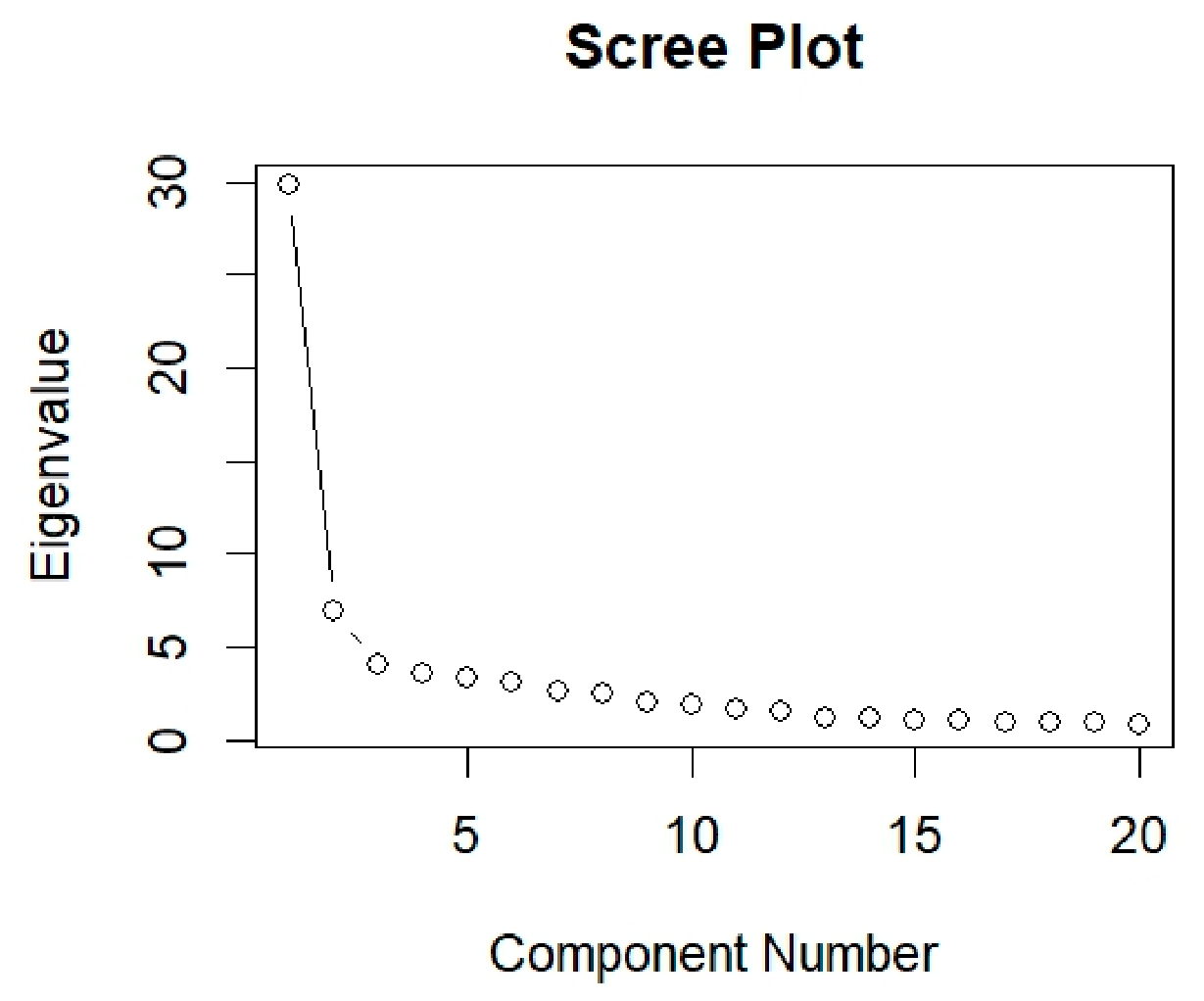
3.1. Factor Structure
- Integrated Quality and Workflow Management (α = 0.960).
- Safe and Collaborative Work Culture (α = 0.901).
- Supportive Leadership and Professional Growth (α = 0.852).
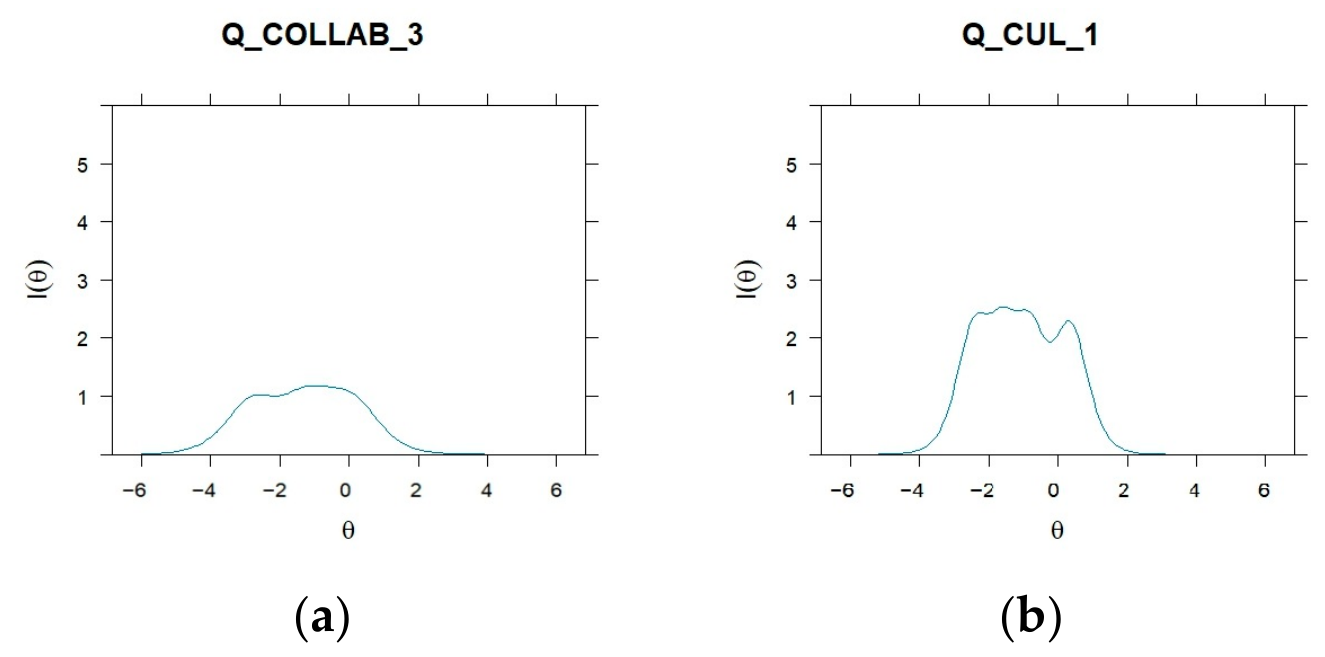
3.2. Item Response Theory
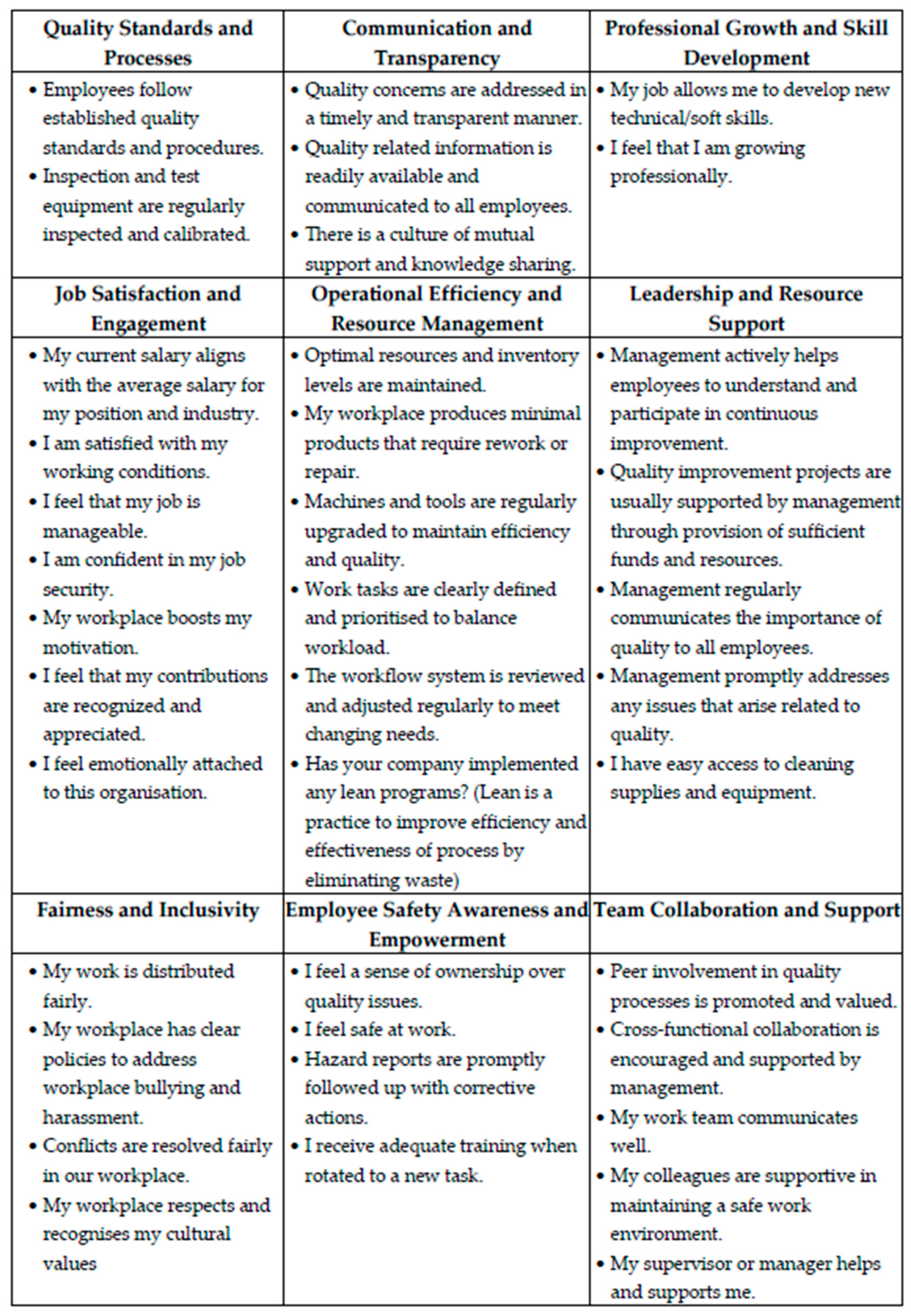
3.3. Thematic Structure
- (a)
- What can the company do to encourage you to share improvement ideas?
- (b)
- What do you wish management knew or considered before making changes or improvements in the workplace?
3.4. Shortened Instrument Structure
4. Discussion
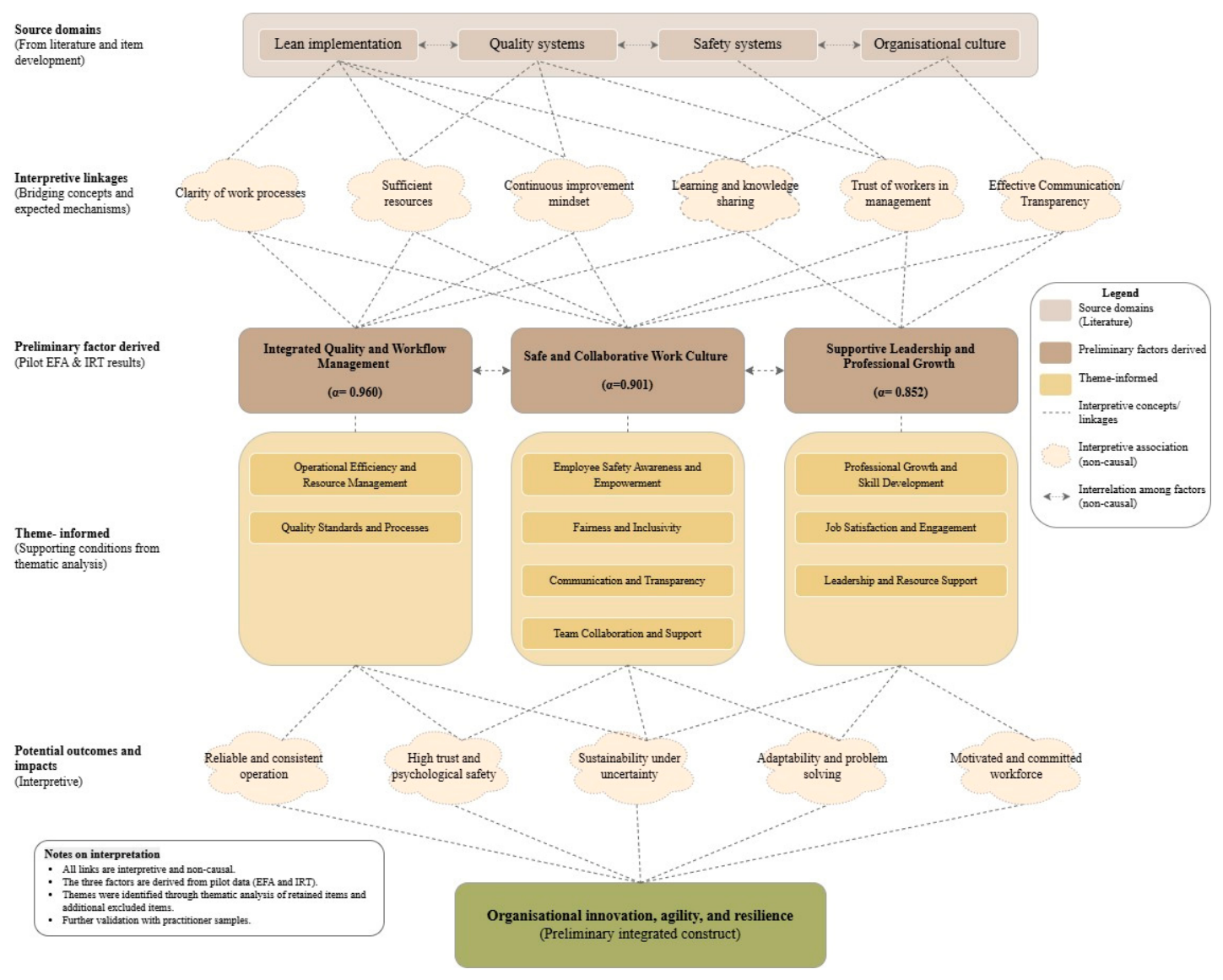
4.1. Preliminary Conceptual Framework
4.2. Hygiene Factor as Baseline Conditions
4.3. Limitations and Future Research
5. Conclusions
Author Contributions
Funding
Data Availability Statement
Acknowledgments
Conflicts of Interest
Appendix A. Overview of Statistical Item Selection
| Item | Short Name | Content | Correlation Matrix | Factor Analysis | IRT Parameter | IIC Plot | Remained |
| HS_ENV_1 | Felt safe | I felt safe at work. | Stay | Stay | Stay | Remove | - |
| HS_ENV_2 | No physical discomfort | I had never experienced physical discomfort or pain because of work. | Stay | Remove | - | - | - |
| HS_ENV_3 | Organised workplace | I felt that my workspace was well-organised. | Stay | Remove | - | - | - |
| HS_ENV_4 | Cleaning supplies availability | I had easy access to cleaning supplies and equipment. | Stay | Stay | Stay | Stay | Stay |
| HS_ENV_5 | Ergonomic training | I had received training on proper ergonomic practices. | Stay | Stay | Remove | - | - |
| HS_ENV_6 | Regular ergonomic checks | Ergonomic assessments (i.e., referring to the process of making the item easy for people who use it) were conducted regularly in my workplace. | Stay | Remove | - | - | - |
| HS_ENV_7 | Cleanliness inspections | Cleanliness inspections were regularly conducted in my workplace. | Stay | Remove | - | - | - |
| HS_ENV_8 | Hazards clearly marked | Hazards were clearly marked and communicated to all employees. | Stay | Remove | - | - | - |
| HS_ORG_1 | Safety priority by management | I felt that safety was a top priority for my management. | Stay | Remove | - | - | - |
| HS_ORG_2 | Colleagues support safety | My colleagues were supportive in maintaining a safe work environment. | Stay | Stay | Stay | Stay | Stay |
| HS_ORG_3 | Followed safety policies | Safety policies and procedures were consistently followed. | Stay | Stay | Stay | Remove | - |
| HS_ORG_4 | Safety concerns taken seriously | Management took safety concerns seriously. | Stay | Remove | - | - | - |
| HS_ORG_5 | Resources for safety | Resources were allocated for safety improvements in my workplace. | Stay | Stay | Remove | - | - |
| HS_TASK_1 | Reasonable working hour | I worked less than 10 h a day. | Stay | Stay | Remove | - | - |
| HS_TASK_2 | Skills for safe tasks | I felt I had the skills to perform my tasks safely. | Stay | Stay | Remove | - | - |
| HS_TASK_3 | Empowered to stop hazards | I felt empowered to stop work if I noticed a safety hazard (i.e., unsafe working conditions that could cause injury, illness, or death). | Stay | Remove | - | - | - |
| HS_TASK_4 | Health & safety training | I received health and safety training related to my job. | Stay | Stay | Stay | Remove | - |
| HS_TASK_5 | Trained for new tasks | I received adequate training when rotated to a new task. | Stay | Stay | Stay | Stay | Stay |
| HS_TASK_6 | Practised job rotation | Job rotation (i.e., working in different roles or departments) was practised in my workplace. | Stay | Stay | Remove | - | - |
| HS_TASK_7 | Job rotation satisfaction | Job rotation effectively improved my overall job satisfaction. | Stay | Stay | Remove | - | - |
| HS_TASK_8 | Employee safety input | Employee opinions were considered in safety initiatives. | Stay | Stay | Stay | Remove | - |
| HS_TASK_9 | Clear safety goals | Safety programme goals were clearly communicated to all employees. | Stay | Stay | Stay | Stay | Stay |
| L_5S_1 | Minimalistic workplace | My workplace prioritised keeping only essential items easily accessible. | Stay | Stay | Remove | - | - |
| L_5S_2 | Clear labels & signage | My workplace had clear labels and signage to help locate items and information quickly and reduce time spent searching for items. | Stay | Stay | Remove | - | - |
| L_5S_3 | Clean environment | I felt my work environment was clean and well-maintained. | Stay | Stay | Stay | Remove | - |
| L_5S_4 | Tidying effort | I regularly reviewed my workspace to remove unnecessary items. | Stay | Stay | Remove | - | - |
| L_5S_5 | Everything in place | I felt that my workspace was well-organised, with everything in its designated place. | Stay | Stay | Remove | - | - |
| L_5S_6 | SOP workspace | The standard procedures were in place for organising and maintaining the workspace. | Stay | Stay | Stay | Remove | - |
| L_5S_7 | Support well organised workplace | Management provided ongoing support to ensure workplaces were well-organised for workers. | Stay | Stay | Stay | Remove | - |
| L_CI_1 | Upgraded tools & machines | Machines and tools were regularly upgraded to maintain efficiency and quality. | Stay | Stay | Stay | Stay | Stay |
| L_CI_2 | Management supports continuous improvement | Management had a clear understanding of the continuous improvement system and actively helped other employees to better understand and participate. | Stay | Stay | Stay | Stay | Stay |
| L_CI_3 | Resources for improvement | Management provided necessary resources, such as budget, personnel, and time to promote continuous improvement activities. | Stay | Remove | - | - | - |
| L_CI_4 | Reward suggestions | Management had systems to collect, act on, and reward employee improvement ideas and suggestions. | Stay | Stay | Stay | Remove | - |
| L_CI_5 | Encouraged process ideas | I was encouraged to contribute ideas for process improvements. | Stay | Remove | - | - | - |
| L_KANBAN_1 | Visual workflow | My organisation used visual signs/signals to visualise workflow and manage tasks and inventory. | Stay | Stay | Stay | Remove | - |
| L_KANBAN_2 | Defined & prioritised tasks | Work tasks were clearly defined and prioritised, balancing workload. | Stay | Stay | Stay | Stay | Stay |
| L_KANBAN_3 | Workflow adjusted regularly | The workflow system was reviewed and adjusted regularly to meet changing needs. | Stay | Stay | Stay | Stay | Stay |
| L_Waste_1 | Skills utilised | I felt that my skills and talents were fully utilised in my role. | Stay | Remove | - | - | - |
| L_Waste_2 | Organised to reduce movement | My workplace was organised to minimise unnecessary movement by employees. | Stay | Stay | Remove | - | - |
| L_Waste_3 | Efficient workplace layout | My workplace layout minimised unnecessary movement of materials and information. | Stay | Stay | Remove | - | - |
| L_Waste_4 | Few rework | My workplace produced minimal products that required rework or repair (i.e., items that did not meet customer standards). | Stay | Stay | Remove | - | - |
| L_Waste_5 | Sufficient material inventory | The material inventory was always sufficient for the production. | Stay | Stay | Remove | - | - |
| L_Waste_6 | Smooth workflow | The workflow was a smooth and continuous operation (i.e., without significant interruptions or delays). | Stay | Stay | Stay | Stay | Stay |
| L_Waste_7 | Optimal inventory levels | Optimal resources and inventory levels (i.e., the right amount needed without excess stock) were maintained. | Stay | Stay | Remove | - | - |
| L_Waste_8 | Planning tools used | Planning tools (e.g., project management software, and scheduling techniques) were used to minimise unnecessary tasks. | Stay | Stay | Remove | - | - |
| L_Waste_9 | Few rejected products & defects | Rejected or reworked products (i.e., items that did not meet customer standards and needed to be fixed or discarded) were minimised. | Stay | Stay | Stay | Stay | Stay |
| OC_ENV_1 | Anti-bullying policies | My workplace had clear policies to address workplace bullying and harassment. | Stay | Stay | Stay | Stay | Stay |
| OC_ENV_2 | Coworker support | My coworkers or colleagues helped and supported me. | Stay | Stay | Remove | - | - |
| OC_ENV_3 | Supervisor support | My supervisor or manager helped and supported me. | Stay | Stay | Stay | Stay | Stay |
| OC_ENV_4 | Supervisor job assistance | My supervisor or manager was helpful in getting the job done. | Stay | Stay | Stay | Remove | - |
| OC_ENV_5 | Useful supervisor feedback | My supervisor or manager provided useful feedback on my job. | Stay | Stay | Stay | Remove | - |
| OC_ENV_6 | Cultural values respected | My workplace respected and recognised my cultural values. | Stay | Stay | Stay | Stay | Stay |
| OC_ENV_7 | Boosted motivation | My workplace boosted my motivation and career satisfaction. | Stay | Stay | Stay | Stay | Stay |
| OC_OPP_1 | Skills development | My job allowed me to develop new technical/soft skills. | Stay | Stay | Stay | Stay | Stay |
| OC_OPP_2 | Professional growth | I felt that I was growing professionally. | Stay | Stay | Stay | Stay | Stay |
| OC_OPP_3 | Respected & valued | I felt respected and valued at work. | Stay | Stay | Stay | Remove | - |
| OC_OPP_4 | Psychological safe | I felt safe to voice my concerns (psychological safety). | Stay | Stay | Stay | Remove | - |
| OC_PSY_1 | Reasonable workload | My workload was reasonable. | Stay | Stay | Remove | - | - |
| OC_PSY_2 | Well-being priority | My workplace prioritised the psychological well-being of staff. | Stay | Stay | Remove | - | - |
| OC_PSY_3 | Manageable job | I felt that my job was manageable. | Stay | Stay | Stay | Stay | Stay |
| OC_STR_1 | Stress management training | I had received training provided by my organisation on managing work-related stress. | Stay | Remove | - | - | - |
| OC_STR_2 | Comfortable with mental health discussions | I felt comfortable discussing mental health issues with my supervisor. | Stay | Remove | - | - | - |
| OC_STR_3 | Colleague support in stress | I felt supported by my colleagues during stressful times. | Stay | Stay | Remove | - | - |
| OC_WLB_1 | Relaxation time | I had enough time to relax after work. | Stay | Stay | Remove | - | - |
| OC_WLB_2 | Work-life balance | My workplace promoted a healthy work-life balance. | Stay | Stay | Stay | Remove | - |
| OC_WLB_3 | Workload fit with personal life | My workload did not interfere with my personal and/or family life. | Stay | Stay | Remove | - | - |
| Q_COLLAB_1 | Team communication | My work team communicated well. | Stay | Stay | Stay | Stay | Stay |
| Q_COLLAB_2 | Supported collaboration | Cross-functional collaboration was encouraged and supported by management. | Stay | Stay | Stay | Stay | Stay |
| Q_COLLAB_3 | Quality meetings held | Regular meetings and discussions were held to address quality issues. | Stay | Stay | Stay | Remove | - |
| Q_COLLAB_4 | Voluntary information sharing | Employees voluntarily shared useful information. | Stay | Stay | Remove | - | - |
| Q_COLLAB_5 | Mutual support culture | There was a culture of mutual support and knowledge sharing. | Stay | Stay | Stay | Stay | Stay |
| Q_CUL_1 | Ownership of quality | I felt a sense of ownership over quality issues and worked to improve them. | Stay | Stay | Stay | Stay | Stay |
| Q_CUL_2 | Followed quality standards | Employees followed established quality standards and procedures. | Stay | Stay | Stay | Stay | Stay |
| Q_CUL_3 | Equipment inspected regularly | Inspection and test equipment were periodically inspected and calibrated. | Stay | Stay | Stay | Stay | Stay |
| Q_CUL_4 | Open quality discussion | My organisation encouraged open discussions about quality issues at all levels. | Stay | Stay | Stay | Remove | - |
| Q_CUL_5 | Timely quality concern address | Quality concerns were addressed in a timely and transparent manner. | Stay | Stay | Stay | Stay | Stay |
| Q_CUL_6 | Accessible quality information | Quality-related information was readily available and communicated to all employees. | Stay | Stay | Stay | Stay | Stay |
| Q_CUL_7 | Peer involvement in quality | Peer involvement in quality processes was promoted and valued. | Stay | Stay | Stay | Stay | Stay |
| Q_LEAD_1 | Funds for quality projects | Quality improvement projects were usually supported by management through the provision of sufficient funds and resources. | Stay | Stay | Stay | Stay | Stay |
| Q_LEAD_2 | Quality training | Management provided induction training and quality-related training periodically to employees. | Stay | Stay | Stay | Remove | - |
| Q_LEAD_3 | Reward quality suggestions | Management recognised and rewarded employee contributions to quality improvements. | Stay | Stay | Stay | Remove | - |
| Q_LEAD_4 | Quality focus communicated | Management regularly communicated the importance of quality to all employees. | Stay | Stay | Stay | Stay | Stay |
| Q_LEAD_5 | Prompt issue resolution | Management promptly addressed any issues that arose related to quality. | Stay | Stay | Stay | Stay | Stay |
| Number of Question Reduced | 0 | 13 | 23 | 18 | - | ||
References
- Wang, Q.; Zhou, H.; Zhao, X. The role of supply chain diversification in mitigating the negative effects of supply chain disruptions in COVID-19. Int. J. Oper. Prod. Manag. 2024, 44, 99–132. [Google Scholar] [CrossRef]
- Kim, H.; Hur, D.; Oh, J. Resilience Through Integration: The Synergistic Role of National and Organizational Culture in Enhancing Market Responsiveness. Systems 2025, 13, 772. [Google Scholar] [CrossRef]
- Sirmon, D.G.; Lane, P.J. A model of cultural differences and international alliance performance. J. Int. Bus. Stud. 2004, 35, 306–319. [Google Scholar] [CrossRef]
- Alexopoulos, K.; Anagiannis, I.; Nikolakis, N.; Chryssolouris, G. A quantitative approach to resilience in manufacturing systems. Int. J. Prod. Res. 2022, 60, 7178–7193. [Google Scholar] [CrossRef]
- Burnard, K.; Bhamra, R. Organisational resilience: Development of a conceptual framework for organisational responses. Int. J. Prod. Res. 2011, 49, 5581–5599. [Google Scholar] [CrossRef]
- Pryce, J. The interplay of organisational resilience and organisational culture: A discussion paper. J. Resilient Econ. 2021, 1, 19–24. [Google Scholar] [CrossRef]
- Burnard, K.J.; Bhamra, R. Challenges for organisational resilience. Contin. Resil. Rev. 2019, 1, 17–25. [Google Scholar] [CrossRef]
- Chen, Y.-H.; Chen, C.-A.; Chien, C.-F. Logistics and supply chain management reorganisation via talent portfolio management to enhance human capital and resilience. Int. J. Logist. Res. Appl. 2024, 27, 2571–2594. [Google Scholar] [CrossRef]
- Shela, V.; Ramayah, T.; Hazlina, A.N. Human capital and organisational resilience in the context of manufacturing: A systematic literature review. J. Intellect. Cap. 2023, 24, 535–559. [Google Scholar] [CrossRef]
- De Sanctis, I.; Ordieres Meré, J.; Ciarapica, F.E. Resilience for lean organisational network. Int. J. Prod. Res. 2018, 56, 6917–6936. [Google Scholar] [CrossRef]
- Sydnes, M.; Gausdal, A.H.; Åssveen, I.D. Lean Production: One path to Organizational Resilience? Beta 2022, 36, 1–22. [Google Scholar] [CrossRef]
- Ropohl, G. Philosophy of Socio-Technical Systems. Soc. Philos. Technol. Q. Electron. J. 1999, 4, 186–194. [Google Scholar] [CrossRef]
- Lee, K.; Earl, A.; Taylor, M.; Zhang, Y.; Pons, D. Design of survey to evaluate the core industrial ecosystem of lean, health and safety, quality, and organisational culture. N. Z. J. Health Saf. Pract. 2024, 1. [Google Scholar] [CrossRef]
- Ganin, A.A.; Massaro, E.; Gutfraind, A.; Steen, N.; Keisler, J.M.; Kott, A.; Mangoubi, R. Operational resilience: Concepts, design and analysis. Sci. Rep. 2016, 6, 19540. [Google Scholar] [CrossRef]
- Sutcliffe, K.M. High reliability organizations (HROs). Best Pract. Res. Clin. Anaesthesiol. 2011, 25, 133–144. [Google Scholar] [CrossRef]
- Fauzi, M.W.; Immawan, T. Integrated Lean Management—Resilience Engineering Approach For Supply Chain Performance Improvement. Interdiscip. Soc. Stud. 2025, 4, 815–831. [Google Scholar] [CrossRef]
- Benkhati, I.; Belhadi, A.; Kamble, S.S.; Touriki, F.E. Linkages between smart, lean, and resilient manufacturing for sustainable development. Bus. Strategy Environ. 2023, 32, 3689–3704. [Google Scholar] [CrossRef]
- Kumarasamy, R.; Sankaranarayanan, B.; Ali, S.M.; Priyanka, R. Improving organizational performance: Leveraging the synergy between Industry 4.0 and Lean Six Sigma to build resilient manufacturing operations. OPSEARCH 2025. [Google Scholar] [CrossRef]
- Al Balushi, M. The impact of quality management systems on organizational resilience. Int. J. Qual. Reliab. Manag. 2025, 42, 1485–1506. [Google Scholar] [CrossRef]
- Ogbuagu, O.O.; Mbata, A.O.; Balogun, O.D.; Oladapo, O.; Ojo, O.O.; Muonde, M. Quality assurance in pharmaceutical manufacturing: Bridging the gap between regulations, supply chain, and innovations. Int. J. Multidiscip. Res. Growth Eval. 2023, 4, 823–831. [Google Scholar] [CrossRef]
- Fan, L.; Song, Z.; Mao, W.; Luo, T.; Wang, W.; Yang, K.; Cao, F. Change is safer: A dynamic safety stock model for inventory management of large manufacturing enterprise based on intermittent time series forecasting. J. Intell. Manuf. 2025, 36, 3983–4003. [Google Scholar] [CrossRef]
- Wang, S.; Zhang, J.; Wang, P.; Law, J.; Calinescu, R.; Mihaylova, L. A deep learning-enhanced Digital Twin framework for improving safety and reliability in human–robot collaborative manufacturing. Robot. Comput. Integr. Manuf. 2024, 85, 102608. [Google Scholar] [CrossRef]
- Del Giudice, M.E.; Sharafkhani, M.; Di Nardo, M.; Murino, T.; Leva, M.C. Exploring Safety of Machineries and Training: An Overview of Current Literature Applied to Manufacturing Environments. Processes 2024, 12, 684. [Google Scholar] [CrossRef]
- Morales, S.N.; Martínez, L.R.; Gómez, J.A.H.; López, R.R.; Torres-Argüelles, V. Predictors of organizational resilience by factorial analysis. Int. J. Eng. Bus. Manag. 2019, 11, 1847979019837046. [Google Scholar] [CrossRef]
- Akpan, E.E.; Johnny, E.; Sylva, W. Dynamic Capabilities and Organizational Resilience of Manufacturing Firms in Nigeria. Vis. J. Bus. Perspect. 2022, 26, 48–64. [Google Scholar] [CrossRef]
- Cierniak-Emerych, A.; Golej, R. Changes in safety of Working Conditions as a Result of Introducing 5S Practices. IBIMA Bus. Rev. 2020, 2020, 141027. [Google Scholar] [CrossRef]
- Díaz-Reza, J.R.; García-Alcaraz, J.L.; Sánchez-Ramírez, C.; Vargas, A.R. Assessing the impact of Lean manufacturing on the Social Sustainability through Structural Equation Modeling and System Dynamics. Jordan J. Mech. Ind. Eng. 2024, 18, 113–130. [Google Scholar] [CrossRef]
- Khalfallah, M.; Lakhal, L. The relationships between TQM, TPM, JIT and agile manufacturing: An empirical study in industrial companies. TQM J. 2021, 33, 1735–1752. [Google Scholar] [CrossRef]
- Albalushi, J.; Mishra, R.; Abebe, M. Supply Chain Resilience Meets Quality Management. Int. J. Prof. Bus. Rev. 2023, 8, e04165. [Google Scholar] [CrossRef]
- Agarwal, R.; Green, R.; Brown, P.J.; Tan, H.; Randhawa, K. Determinants of quality management practices: An empirical study of New Zealand manufacturing firms. Int. J. Prod. Econ. 2013, 142, 130–145. [Google Scholar] [CrossRef]
- Cadden, T.; Millar, K.; Treacy, R.; Humphreys, P. The mediating influence of organisational cultural practices in successful lean management implementation. Int. J. Prod. Econ. 2020, 229, 107744. [Google Scholar] [CrossRef]
- Ma, L.; Li, X.; Pan, Y. Global Industrial Chain Resilience Research: Theory and Measurement. Systems 2023, 11, 466. [Google Scholar] [CrossRef]
- Ammavasi, P.P.; Arumugam, K.; Sundram, A.M. Integrated Lean Safety Model to Develop Organizational Safety Culture. In Six Sigma and Quality Management; IntechOpen: London, UK, 2024. [Google Scholar] [CrossRef]
- Fenner, S.V.; Arellano, M.C.; von Dzengelevski, O.; Netland, T.H. Effect of lean implementation on team psychological safety and learning. Int. J. Oper. Prod. Manag. 2023, 43, 308–331. [Google Scholar] [CrossRef]
- Alfatonah, Z.; Wardani, Z.M.; Adriansyah, A.P.; Salaf, F.A.; Prastyo, Y. Implementation of Kaizen Culture in Occupational Health and Safety (OHS) at PT. Automotive Manufacturing Indonesia with the 5S Method. Rev. J. Multidiscip. Soc. Sci. 2025, 1, 548–556. [Google Scholar] [CrossRef]
- Sakthi, N.T.; Jeyapaul, R. An empirical investigation on association between human factors, ergonomics and lean manufacturing. Prod. Plan. Control 2021, 32, 1337–1351. [Google Scholar] [CrossRef]
- Kabiesz, P.; Tutak, M. Developing a Culture of Safety for Sustainable Development and Public Health in Manufacturing Companies—A Case Study. Sustainability 2024, 16, 7557. [Google Scholar] [CrossRef]
- Ssemuddu, J.B.; Kajjoba, D.; Olupot, P.W.; Kirabira, J.B.; Okure, M. Structural equation modeling of safety integration and production pressure effects on safety performance in cement manufacturing. Sci. Rep. 2026, 16, 5801. [Google Scholar] [CrossRef]
- Gu, X.; Jin, X.; Ni, J.; Koren, Y. Manufacturing System Design for Resilience. Procedia CIRP 2015, 36, 135–140. [Google Scholar] [CrossRef]
- Ranasinghe, U.; Jefferies, M.; Davis, P.; Pillay, M. Resilience Engineering Indicators and Safety Management: A Systematic Review. Saf. Health Work 2020, 11, 127–135. [Google Scholar] [CrossRef]
- Falegnami, A.; Tomassi, A.; Corbelli, G.; Romano, E. Resilience Analysis Grid–Rasch Rating Scale Model for Measuring Organizational Resilience Potential. Appl. Sci. 2025, 15, 1695. [Google Scholar] [CrossRef]
- Molenda, P.; Groneberg, H.; Schötz, S.; Döpper, F. Resilience Balanced Scorecard: Measuring Resilience of Manufacturing Companies at Multiple Levels. Procedia CIRP 2023, 120, 189–194. [Google Scholar] [CrossRef]
- Erthal, A.; Marques, L. National culture and organisational culture in lean organisations: A systematic review. Prod. Plan. Control 2018, 29, 668–687. [Google Scholar] [CrossRef]
- Denison, D.; Nieminen, L.; Kotrba, L. Diagnosing organizational cultures: A conceptual and empirical review of culture effectiveness surveys. Eur. J. Work Organ. Psychol. 2014, 23, 145–161. [Google Scholar] [CrossRef]
- Jones, T.; Baxter, M.; Khanduja, V. A quick guide to survey research. Ann. R. Coll. Surg. Engl. 2013, 95, 5–7. [Google Scholar] [CrossRef]
- Cammarota, A.; Siebenhüner, A.R.; Olungu, C.; Szturz, P.; Güven, D.C.; Puccini, A.; Silva, J.P.; Smyth, E.C.; Sclafani, F.; Van Laarhoven, H. Research training, barriers, and career development needs of early-career investigators in oncology: An EORTC survey-based study. ESMO Gastrointest. Oncol. 2025, 9, 100208. [Google Scholar] [CrossRef]
- Giomboni, J.R. Early career workers granted creative autonomy: Agency shifts intern debate towards industry expectations. J. Educ. Work 2024, 37, 292–308. [Google Scholar] [CrossRef]
- Finch, W.H. Introduction to Factor Analysis. In Exploratory Factor Analysis; SAGE Publications, Inc.: Thousand Oaks, CA, USA, 2020; pp. 1–12. [Google Scholar] [CrossRef]
- Olsson, U. On the Robustness of Factor Analysis against Crude Classification of the Observations. Multivar. Behav. Res. 1979, 14, 485–500. [Google Scholar] [CrossRef]
- Revelle, W. psych: Procedures for Psychological, Psychometric, and Personality Research [R Package], 2023, Northwestern University: Version 2.3.3. Available online: https://CRAN.R-project.org/package=psych (accessed on 22 February 2025).
- Tracy, L. Treating Factor Interpretations as Hypotheses. Soc. Behav. Personal. An. Int. J. 1990, 18, 309–325. [Google Scholar] [CrossRef]
- Chalmers, R.P. mirt: A Multidimensional Item Response Theory Package for the R Environment. J. Stat. Softw. 2012, 48, 1–29. [Google Scholar] [CrossRef]
- Kilic, A.F.; Uysal, İ. To what extent are item discrimination values realistic? A new index for two-dimensional structures. Int. J. Assess. Tools Educ. 2022, 9, 728–740. [Google Scholar] [CrossRef]
- Toland, M.D. Practical Guide to Conducting an Item Response Theory Analysis. J. Early Adolesc. 2014, 34, 120–151. [Google Scholar] [CrossRef]
- Braun, V.; Clarke, V. Using thematic analysis in psychology. Qual. Res. Psychol. 2006, 3, 77–101. [Google Scholar] [CrossRef]
- Bahry, F.D.S.; Masrom, M.; Masrek, M.N. Measuring validity and reliability of website credibility factors in influencing user engagement questionnaire. Int. J. Web Inf. Syst. 2021, 17, 18–28. [Google Scholar] [CrossRef]
- Tabachnick, B.G.; Fidell, L.S. Using Multivariate Statistics, 6th ed.; Pearson Education: Boston, MA, USA, 2013. [Google Scholar]
- Nunnally, D.; Clarence, J.; Burnstein, I.H. Psychometric Theory, 3rd ed.; McGraw-Hill: New York, NY, USA, 1994; Available online: https://lib.ugent.be/catalog/rug01:000331515 (accessed on 22 March 2025).
- Cho, E.; Kim, S. Cronbach’s Coefficient Alpha. Organ. Res. Methods 2015, 18, 207–230. [Google Scholar] [CrossRef]
- Raykov, T. Alpha if item deleted: A note on loss of criterion validity in scale development if maximizing coefficient alpha. Br. J. Math. Stat. Psychol. 2008, 61, 275–285. [Google Scholar] [CrossRef]
- Edelsbrunner, P.A.; Simonsmeier, B.A.; Schneider, M. The Cronbach’s Alpha of Domain-Specific Knowledge Tests Before and After Learning: A Meta-Analysis of Published Studies. Educ. Psychol. Rev. 2025, 37, 4. [Google Scholar] [CrossRef]
- Islam, M.S.; Ahmed, S. Work Standardization in Lean Manufacturing for Improvement of Production Line Performance in SME. Malays. J. Compos. Sci. Manuf. 2024, 13, 68–81. [Google Scholar] [CrossRef]
- Raza, M.; Khokhar, M.F.; Zubair, M.; Rubab, M. Impact of Transparent Communication in HR Governance: Fostering Employee Trust and Engagement. Bull. Bus. Econ. 2023, 12, 558–566. [Google Scholar] [CrossRef]
- Bahrain, K.; Nabiha, N.; Sakrani, R.; Najah, S.; Maidin, A. Communication Barriers in Work Environment: Understanding Impact and Challenges. Int. J. Acad. Res. Bus. Soc. Sci. 2023, 13, 1489–1503. [Google Scholar] [CrossRef]
- Natasya, N.S.; Awaluddin, R. The Effect of Quality of Work Life, Organizational Culture and Job Satisfaction on Employee Engagement. Bina Bangsa Int. J. Bus. Manag. 2021, 1, 158–165. [Google Scholar] [CrossRef]
- Sarumpaet, C.N.; Tajib, E. The Influence of Organizational Culture and Employee Engagement on Employee Performance Through Job Satisfaction of Employees at Pt Generasi Teknologi Buana. Indones. J. Econ. Manag. Sci. 2023, 1, 129–142. [Google Scholar] [CrossRef]
- Fidyah, D.N.; Setiawati, T. Influence of Organizational Culture and Employee Engagement on Employee Performance: Job Satisfaction as Intervening Variable. Rev. Integr. Bus. Econ. Res. 2019, 9, 64–82. Available online: https://sibresearch.org/uploads/3/4/0/9/34097180/riber_9-4_05_s19-194_64-81.pdf (accessed on 13 April 2025).
- Ayim Gyekye, S. Workers’ Perceptions of Workplace Safety and Job Satisfaction. Int. J. Occup. Saf. Ergon. 2005, 11, 291–302. [Google Scholar] [CrossRef] [PubMed]
- Shin, D.S.; Jeong, B.Y. Effects of working conditions and safety awareness on job satisfaction of truck drivers in Korea. Work 2023, 75, 129–134. [Google Scholar] [CrossRef] [PubMed]
- Della Torre, E.; Pelagatti, M.; Solari, L. Internal and external equity in compensation systems, organizational absenteeism and the role of explained inequalities. Hum. Relat. 2015, 68, 409–440. [Google Scholar] [CrossRef]
- Getnet, B.; Jebena, T.; Tsegaye, A. The effect of employees’ fairness perception on their satisfaction towards the performance appraisal practices. Int. J. Manag. Commer. Innov. 2014, 2, 174–210. [Google Scholar] [CrossRef]
- Walker, K.; Lee, M.C.C. Entrepreneurial Resources, Decision-Making Logic and Organisational Change Readiness: Enhancing SME Sustainability in New Zealand. Adm. Sci. 2025, 15, 188. [Google Scholar] [CrossRef]
- Albliwi, S.; Antony, J.; Abdul Halim Lim, S.; van der Wiele, T. Critical failure factors of Lean Six Sigma: A systematic literature review. Int. J. Qual. Reliab. Manag. 2014, 31, 1012–1030. [Google Scholar] [CrossRef]
- Arabi, S.; Bajjou, M.S.; Chafi, A.; El Hammoumi, M. Evaluation of critical success factors (CSFs) to lean implementation in Moroccan SMEs: A survey study. In 2022 2nd International Conference on Innovative Research in Applied Science, Engineering and Technology (IRASET); IEEE: New York, NY, USA, 2022; pp. 1–10. [Google Scholar] [CrossRef]
- Moeuf, A.; Tamayo, S.; Lamouri, S.; Pellerin, R.; Lelievre, A. Strengths and weaknesses of small and medium sized enterprises regarding the implementation of lean manufacturing. IFAC-PapersOnLine 2016, 49, 71–76. [Google Scholar] [CrossRef]
- Haas, E.J. The Role of Supervisory Support on Workers’ Health and Safety Performance. Health Commun. 2020, 35, 364–374. [Google Scholar] [CrossRef]
- Shikdar, A.A.; Sawaqed, N.M. Worker productivity, and occupational health and safety issues in selected industries. Comput. Ind. Eng. 2003, 45, 563–572. [Google Scholar] [CrossRef]
- Abu, F.; Gholami, H.; Mat Saman, M.Z.; Zakuan, N.; Streimikiene, D. The implementation of lean manufacturing in the furniture industry: A review and analysis on the motives, barriers, challenges, and the applications. J. Clean. Prod. 2019, 234, 660–680. [Google Scholar] [CrossRef]
- Sætre, A.S.; Edmondson, A.C.; Dregelid, O.; Zimmer, S.R. Psychological ownership for overcoming departmental barriers to innovation: A Study of innovation handoffs. J. Eng. Technol. Manag. 2024, 73, 101831. [Google Scholar] [CrossRef]
- Herzberg, F.; Mausner, B.; Snyderman, B. The Motivation to Work; John Wiley: New York, NY, USA, 1959; Available online: https://books.google.co.nz/books?hl=en&lr=&id=metNAQAAQBAJ&oi=fnd&pg=PR11&dq=Herzberg,+F.,+Mausner,+B.,+and+Snyderman,+B.,+The+motivation+to+work.+1959,+New+York:+John+Wiley.+citation&ots=GM1dtRmAza&sig=YOtBz1qkRhvOuySNdSDvbPpF6ms#v=onepage&q&f=false (accessed on 14 May 2025).
- Sprecher, S. Inequity Leads to Distress and a Reduction in Satisfaction: Evidence From a Priming Experiment. J. Fam. Issues 2018, 39, 230–244. [Google Scholar] [CrossRef]
- Marsudi, D.; Ahadiat, A.; Jimad, H. Analysis of the Effect of Motivation Factors and Hygiene Factors on Employee Performance with Job Satisfaction as a Mediation Factor. Int. J. Bus. Manag. Econ. 2022, 3, 401–418. [Google Scholar] [CrossRef]
- Nagalakshmi, M.V.N. Herzberg’s Two-Factor Theory and Its Application in Hybrid Work Model—Evidence from India. 15 July 2024. Available online: https://www.eelet.org.uk/index.php/journal/article/view/1727 (accessed on 10 April 2026).
- Nagpaul, T.; Leong, C.-H.; Toh, C.-S.; Bin Amir, A.; Chin, R.; Tan, S. Exploring Job Satisfaction and Intentions to Quit among Security Officers: The Role of Work Hygiene and Motivator Factors. Soc. Sci. 2022, 11, 497. [Google Scholar] [CrossRef]
- Marjerison, R.K.; Jun, J.Y.; Kim, J.M.; Kuan, G. Motivation, Urban Pressures, and the Limits of Satisfaction: Insights into Employee Retention in a Changing Workforce. Systems 2025, 13, 661. [Google Scholar] [CrossRef]
- Wang, Y. Quantifying Careless Responses in Student Evaluation of Teaching and Justifying Removal for Data Validity. Sage Open 2024, 14, 21582440241256947. [Google Scholar] [CrossRef]
- Lovett, B.J.; Spenceley, L.M.; Lewandowski, L.J. Response Validity in Psychoeducational Assessment: A Primer for School Psychologists. Contemp. Sch. Psychol. 2022, 26, 279–289. [Google Scholar] [CrossRef]
- Krosnick, J.A. The impact of ‘no opinion’ response options on data quality—Non-attitude reduction or an invitation to satisfice? Public Opin. Q. 2002, 3, 371–403. Available online: https://www.researchgate.net/publication/292129213_The_impact_of_no_opinion_response_options_on_data_quality_-_Non-attitude_reduction_or_an_invitation_to_satisfice (accessed on 8 March 2025).
- Frenkel, S.J.; Peetz, D. Globalization and Industrial Relations in East Asia: A Three-Country Comparison. Ind. Relat. A J. Econ. Soc. 1998, 37, 282–310. [Google Scholar] [CrossRef]



| Cronbach Alpha | 10-Factor | 7-Factor | 5-Factor | 4-Factor | 3-Factor |
|---|---|---|---|---|---|
| Version 1 | Version 2 | Version 3 | Version 4 | Version 5 | |
| Factor 1 | 0.9618 | 0.9639 | 0.9645 | 0.965 | 0.960 |
| Factor 2 | 0.9169 | 0.9470 | 0.9391 | 0.965 | 0.901 |
| Factor 3 | 0.9156 | 0.9023 | 0.9053 | 0.9038 | 0.852 |
| Factor 4 | 0.8748 | 0.8926 | 0.8949 | 0.7841 | - |
| Factor 5 | 0.8804 | 0.8068 | 0.6764 # | - | - |
| Factor 6 | 0.8934 | 0.8032 | - | - | - |
| Factor 7 | 0.6860 | 0.5722 # | - | - | - |
| Factor 8 | 0.8032 | - | - | - | - |
| Factor 9 | 0.6989 # | - | - | - | - |
| Factor 10 | 0.6542 # | - | - | - | - |
| Factor 1: Integrated Quality and Workflow Management | ||||
| Item | Context | F1 | F2 | F3 |
| L_CI_1 | Upgraded tools & machines | 0.801 | 0.211 | 0.382 |
| L_CI_2 | Management supports continuous improvement | 0.724 | 0.169 | 0.304 |
| L_KANBAN_2 | Defined & prioritised tasks | 0.629 | 0.316 | 0.104 |
| L_KANBAN_3 | Workflow adjusted regularly | 0.824 | 0.165 | 0.165 |
| L_Waste_6 | Smooth workflow | 0.731 | 0.346 | −0.003 |
| L_Waste_9 | Few rejected products & defects | 0.682 | 0.255 | 0.162 |
| Q_CUL_1 | Ownership of quality | 0.678 | 0.144 | 0.401 |
| Q_CUL_2 | Followed quality standards | 0.865 | 0.123 | 0.150 |
| Q_CUL_3 | Equipment inspected regularly | 0.750 | 0.173 | 0.130 |
| Q_CUL_5 | Timely quality concern address | 0.771 | 0.338 | 0.218 |
| Q_CUL_6 | Accessible quality information | 0.772 | 0.245 | 0.211 |
| Q_CUL_7 | Peer involvement in quality | 0.675 | 0.109 | 0.312 |
| Q_LEAD_1 | Funds for quality projects | 0.593 | 0.392 | 0.347 |
| Q_LEAD_4 | Quality focus communicated | 0.778 | 0.267 | 0.453 |
| Q_LEAD_5 | Prompt issue resolution | 0.770 | 0.330 | 0.084 |
| Factor 2: Safe and Collaborative Work Culture | ||||
| Item | Context | F1 | F2 | F3 |
| HS_ENV_4 | Cleaning supplies availability | 0.393 | 0.662 | 0.349 |
| HS_ORG_2 | Colleagues support safety | 0.297 | 0.824 | 0.150 |
| HS_TASK_9 | Clear safety goals | 0.189 | 0.696 | 0.077 |
| OC_ENV_1 | Anti-bullying policies | 0.293 | 0.644 | 0.296 |
| OC_ENV_6 | Cultural values respected | 0.217 | 0.684 | 0.338 |
| Q_COLLAB_1 | Team communication | 0.338 | 0.676 | 0.451 |
| Q_COLLAB_2 | Supported collaboration | 0.363 | 0.548 | 0.528 |
| Q_COLLAB_5 | Mutual support culture | 0.112 | 0.583 | 0.540 |
| Factor 3: Supportive Leadership and Professional Growth | ||||
| Item | Context | F1 | F2 | F3 |
| OC_ENV_3 | Supervisor support | 0.260 | 0.385 | 0.752 |
| OC_ENV_7 | Boosted motivation | 0.225 | 0.498 | 0.698 |
| OC_OPP_1 | Skills development | 0.248 | 0.186 | 0.723 |
| OC_OPP_2 | Professional growth | 0.244 | 0.212 | 0.828 |
| OC_PSY_3 | Manageable job | 0.215 | 0.469 | 0.470 |
| No | Context | New Context | Themes | Notes |
|---|---|---|---|---|
| 1 | Has your company implemented any lean programs? (Lean is a practice to improve efficiency and effectiveness of process by eliminating waste) | Has your company implemented any lean programs? (Lean is a practice to improve efficiency and effectiveness of process by eliminating waste) | Operational Efficiency and Resource Management | Remained |
| 2 | Optimal resources and inventory levels (i.e., the right amount needed without excess stock) are maintained. | Optimal resources and inventory levels are maintained (i.e., the right amount of materials and supplies to do your work without having extra stock). | Operational Efficiency and Resource Management | Further elaborate what is optimal resources and inventory level for clarity |
| 3 | My workplace produces minimal products that require rework or repair (i.e., items that do not meet quality standards). | My workplace is good at producing good quality products that rarely need rework or repair. | Operational Efficiency and Resource Management | Rephrased sentence for clarity |
| 4 | Management has a clear understanding of the continuous improvement system and actively helps employees to understand and participate. | Management actively helps employees to understand and participate in continuous improvement. | Leadership and Resource Support | Q3 and Q9 were merged as they both address management’s commitment to motivating employee engagement. |
| 5 | Machines and tools are regularly upgraded to maintain efficiency and quality. | Machines and tools are regularly upgraded to maintain efficiency and quality. | Operational Efficiency and Resource Management | Remained |
| 6 | Work tasks are clearly defined and prioritised to balance workload. | Work tasks are clearly defined. | Operational Efficiency and Resource Management | To reduce confusion, Q5 was rephrased to focus only on the definition of work tasks. |
| 7 | The workflow system is reviewed and adjusted regularly to meet changing needs. | The workflow system is reviewed and adjusted regularly to meet changing needs. | Operational Efficiency and Resource Management | Remained |
| 8 | My workplace uses quality-systems to ensure high standards and continuous improvement. | Category question | New question | |
| 9 | Quality improvement projects are usually supported by management through provision of sufficient funds and resources. | Management promptly addresses quality issues and/or supports quality improvement projects. | Leadership and Resource Support | Q8 and Q10 were merged as they share similar ideas about management’s commitment to addressing quality issues. |
| 10 | Management regularly communicates the importance of quality to all employees. | - | Leadership and Resource Support | Merged |
| 11 | Management promptly addresses any issues that arise related to quality. | - | Leadership and Resource Support | Merged |
| 12 | Employees follow established quality standards and procedures. | Employees follow established quality standards and procedures. | Quality Standards and Processes | Remained |
| 13 | Inspection and test equipment are regularly inspected and calibrated. | Inspection and testing equipment are regularly serviced and calibrated. | Quality Standards and Processes | Corrected “test” to “testing” and “inspected” to “serviced” for clarity. |
| 14 | Quality concerns are addressed in a timely and transparent manner. | Quality information is communicated clearly and promptly to all employees. | Communication and Transparency | Q13 and Q14 were merged as they share similar ideas about the communication and transparency of quality information. |
| 15 | Quality-related information is readily available and communicated to all employees. | - | Communication and Transparency | Merged |
| 16 | I feel a sense of ownership over quality issues and work to improve them. | I feel a sense of ownership over quality issues. | Employee Safety Awareness and Empowerment | This question was split to focus solely on employee ownership, as Q7 already addressed engagement in continuous improvement. |
| 17 | Peer involvement in quality processes is promoted and valued. | Collaboration among teams and peers is encouraged to improve quality processes. | Team Collaboration and Support | Q16 and Q17 were merged as they share similar ideas about collaboration. |
| 18 | Cross-functional collaboration is encouraged and supported by management. | - | Team Collaboration and Support | Merged |
| 19 | My work team communicates well. | My work team communicates well. | Team Collaboration and Support | Remained |
| 20 | There is a culture of mutual support and knowledge sharing. | My work team shares knowledge to support each other. | Communication and Transparency | Rephrased for clarity |
| 21 | I feel safe at work. | I feel safe at work. | Employee Safety Awareness and Empowerment | Remained |
| 22 | I have easy access to cleaning supplies and equipment. | - | Leadership and Resource Support | Q21 was removed as overlapped with Q1 and Q3. |
| 23 | Hazard reports are promptly followed up with corrective actions. * | - | Employee Safety Awareness and Empowerment | Removed |
| 24 | I receive adequate training when rotated to a new task. | I receive adequate training when rotated to a new task. | Employee Safety Awareness and Empowerment | Remained |
| 25 | My colleagues are supportive in maintaining a safe work environment. | My supervisor and colleagues provide support to help me work effectively and safely. | Team Collaboration and Support | Q24 and Q32 were merged as they both relate to support in the workplace. |
| 26 | My current salary aligns with the average salary for my position and industry. * | I am satisfied with my working conditions and/or salary. | Job Satisfaction and Engagement | Q25 and Q27 were merged as they both relate to employee satisfaction with working conditions. |
| 27 | My work is distributed fairly. * | - | Fairness and Inclusivity | Q26 was removed. |
| 28 | I am satisfied with my working conditions. * | - | Job Satisfaction and Engagement | Merged |
| 29 | I feel that my job is manageable. | I feel that my job is manageable. | Job Satisfaction and Engagement | Remained |
| 30 | I am confident in my job security. * | I am confident in my job security. | Job Satisfaction and Engagement | Remained |
| 31 | My workplace has clear policies to address workplace bullying and harassment. | My workplace has clear policies to handle bullying, harassment and resolve conflicts fairly. | Fairness and Inclusivity | Q30 and Q31 were merged as they share similar ideas about workplace equality policies. |
| 32 | Conflicts are resolved fairly in our workplace. * | - | Fairness and Inclusivity | Merged |
| 33 | My supervisor or manager helps and supports me. | - | Team Collaboration and Support | Merged |
| 34 | My workplace respects and recognises my cultural values. | My workplace respects and recognises my cultural values. | Fairness and Inclusivity | Remained |
| 35 | My workplace boosts my motivation and career satisfaction. | My workplace boosts my motivation. | Job Satisfaction and Engagement | Q34 originally combined motivation and career satisfaction, but since career satisfaction was assessed in Q29, it was split to focus only on motivation. |
| 36 | My job allows me to develop new technical/ soft skills. | My job allows me to develop new skills. | Professional Growth and Skill Development | Rephrased for clarity |
| 37 | I feel that I am growing professionally. | - | Professional Growth and Skill Development | Q36 was removed as it overlapped with Q35. |
| 38 | I feel that my contributions are recognized and appreciated. * | My contributions are recognised and appreciated. | Job Satisfaction and Engagement | Rephrased for clarity |
| 39 | I feel emotionally attached to this organisation. * | I feel emotionally attached to this organisation. | Job Satisfaction and Engagement | Remained |
| Demographic | |
| i | Which manufacturing industry does your company primarily operate in? |
| ii | What is your company size? |
| iii | What is your job category? |
| iv | What is your age? |
| v | How long have you been working with this company? |
| vi | What is your gender assigned at birth? |
| vii | Has your company implemented any lean programs? (Lean is a practice to improve efficiency and effectiveness of process by eliminating waste) |
| Core industrial ecosystem survey [On a scale of −3 strongly disagree to 3 strongly agree] | |
| 1 | Optimal resources and inventory levels are maintained (i.e., the right amount of materials and supplies to do your work without having extra stock). |
| 2 | My workplace is good at producing good quality products that rarely need rework or repair. |
| 3 | Management actively helps employees to understand and participate in continuous improvement. |
| 4 | Machines and tools are regularly upgraded to maintain efficiency and quality. |
| 5 | Work tasks are clearly defined. |
| 6 | The workflow system is reviewed and adjusted regularly to meet changing needs. |
| 7 | My workplace uses quality systems to ensure high standards and continuous improvement. |
| 8 | Management promptly addresses quality issues and/or supports quality improvement projects. |
| 9 | Employees follow established quality standards and procedures. |
| 10 | Inspection and testing equipment are regularly serviced and calibrated. |
| 11 | Quality information is communicated clearly and promptly to all employees. |
| 12 | I feel a sense of ownership over quality issues. |
| 13 | Collaboration among teams and peers is encouraged to improve quality processes. |
| 14 | I feel safe at work. |
| 15 | I receive adequate training when rotated to a new task. |
| 16 | My supervisor and colleagues provide support to help me work effectively and safely. |
| 17 | I am satisfied with my working conditions and/or salary. |
| 18 | I am confident in my job security. |
| 19 | My workplace has clear policies to handle bullying, harassment and resolve conflicts fairly. |
| 20 | My work team communicates well. |
| 21 | My work team shares knowledge to support each other. |
| 22 | My workplace boosts my motivation. |
| 23 | My workplace respects and recognises my cultural values. |
| 24 | My job allows me to develop new skills. |
| 25 | My contributions are recognised and appreciated. |
| 26 | I think my management does a great job communicating, listening to employees, and showing respect. |
| Open-ended questions | |
| 27 | What can the company do to encourage you to share improvement ideas? |
| 28 | What do you wish management knew or considered before making changes or improvements in the workplace? |
Disclaimer/Publisher’s Note: The statements, opinions and data contained in all publications are solely those of the individual author(s) and contributor(s) and not of MDPI and/or the editor(s). MDPI and/or the editor(s) disclaim responsibility for any injury to people or property resulting from any ideas, methods, instructions or products referred to in the content. |
© 2026 by the authors. Licensee MDPI, Basel, Switzerland. This article is an open access article distributed under the terms and conditions of the Creative Commons Attribution (CC BY) license.
Share and Cite
Lee, K.; Pons, D.; Taylor, M.; Earl, A.; Zhang, Y. Development of a Survey Combining Lean, Quality, Safety and Culture in Manufacturing. Systems 2026, 14, 666. https://doi.org/10.3390/systems14060666
Lee K, Pons D, Taylor M, Earl A, Zhang Y. Development of a Survey Combining Lean, Quality, Safety and Culture in Manufacturing. Systems. 2026; 14(6):666. https://doi.org/10.3390/systems14060666
Chicago/Turabian StyleLee, Kongting, Dirk Pons, Malcolm Taylor, Anna Earl, and Yilei Zhang. 2026. "Development of a Survey Combining Lean, Quality, Safety and Culture in Manufacturing" Systems 14, no. 6: 666. https://doi.org/10.3390/systems14060666
APA StyleLee, K., Pons, D., Taylor, M., Earl, A., & Zhang, Y. (2026). Development of a Survey Combining Lean, Quality, Safety and Culture in Manufacturing. Systems, 14(6), 666. https://doi.org/10.3390/systems14060666