1. Introduction
According to the Victoria Transport Policy Institute [
1], autonomous vehicles (AVs) are expected to be deployed on public roads in the near future. Since AVs are anticipated to increase road capacity by maintaining shorter headways, many studies suggest that they could serve as a potential solution to future traffic congestion [
2,
3,
4]. However, since the development and widespread adoption of AV technology will not happen overnight, researchers have proposed the establishment of AV-exclusive infrastructure, such as dedicated lanes, links, or zones, that restrict access to human-driven vehicles (HVs), to enhance the efficiency of AV operations in mixed traffic networks [
5,
6,
7,
8,
9,
10,
11].
While these strategies have successfully improved network-wide efficiency—primarily by minimizing total travel time—they often overlook the disparities between HV and AV users. This omission could marginalize certain socioeconomic groups, particularly HV users, by limiting their access to improved mobility. For instance, if AV-dedicated lanes or zones are implemented without expanding overall road capacity, they inevitably reduce the space available for HVs. This may worsen congestion on regular lanes, disproportionately disadvantaging HV users and raising concerns about social equity [
5,
11].
In fact, if AV-dedicated infrastructure fails to address equity concerns, it may face public resistance [
1]. Therefore, what is crucial is ensuring that new policies have a balanced impact across different user groups. Some may argue that prioritizing dedicated infrastructure for AVs is justified due to their higher capacity and technological superiority. However, it is important to recognize that AVs inherently improve roadway efficiency, and the magnitude of this improvement remains consistent, regardless of the type of lane (mixed or dedicated) they operate on. This holds under the assumption that both HVs and AVs maintain identical mean headways behind any preceding vehicle, a mild assumption adopted in almost all studies, except in [
12]. The same study demonstrated that the asymmetric capacity impact of AVs on HVs—often cited as evidence of AV superiority—can be quantified using the HV equivalent (HVE) coefficient. Importantly, the HVE coefficient remains constant under the same assumption, meaning this efficiency gain exists whether AVs operate on dedicated or mixed lanes. Thus, the justification for AV-exclusive infrastructure becomes questionable, especially when such policies fail to account for social equity.
The purpose of this study is to highlight the need for policymakers to incorporate equity considerations into AV-dedicated infrastructure planning to ensure future deployments do not unintentionally exacerbate transportation inequities. Our objective is modest. We incorporate equity considerations into the AV-dedicated infrastructure optimization model. Specifically, we leverage the AV/Toll (AVT) lane concept proposed in [
12] to optimize toll rates. To simplify, as was done in [
13], we also assume each AVT lane is an independent link and will use the term AVT link to avoid confusion. It is important to note that, compared to AV-exclusive links, AVT links function similarly but grant AVs the privilege of traveling toll-free while permitting HVs to use them for a charge. The toll is not intended to monetize access to AV-oriented technologies—which HVs cannot fully benefit from—but rather to regulate traffic composition. Since a higher proportion of AVs in mixed traffic enables greater link capacity, tolls serve as a management tool to discourage HVs from using these links when their presence would negatively impact system performance. One might question why AV-dedicated links are not adopted directly. This is because such links may suffer from underutilization at low AV penetration rates. In contrast, the AVT design helps retain a high AV share to preserve capacity benefits and reduce road space waste. This added flexibility gives operators greater control over traffic distribution and network performance. Moreover, from an equity standpoint, AVT links also offer a relatively more inclusive alternative to AV-exclusive infrastructure. Unlike AV-only links, which completely restrict HV access, AVT links provide HV users with an additional travel option. Note that the usage fee applies only when the toll-based path is more advantageous than non-toll alternatives. If the toll is too high to yield a lower total travel cost, HV users will rationally avoid the AVT link. Thus, the existence of an AVT facility does not worsen the equilibrium cost for HV users compared to the case of AV-dedicated links; instead, it expands their choice set. From a user equilibrium perspective, HVs are never worse off, and potentially better off, under an AVT scheme. Given these advantages, AVT links are adopted for modeling and experimental analysis.
Furthermore, it should be noted that although equity considerations have largely been ignored in HV-AV mixed traffic infrastructure planning [
5,
6], some researchers have attempted to incorporate equity or fairness into transportation management. To the best of our knowledge, ref. [
14] was among the first studies to address equity in general network design problems (NDPs), where a spatial equity measure was introduced to evaluate capacity improvement schemes based on the maximum ratio of origin–destination (OD) travel times before and after network improvements. Later, ref. [
15] extended this approach to multi-class tolling problems by incorporating both social and spatial equity constraints. Their bi-level programming models explicitly controlled the maximum relative increase in generalized OD travel costs across different user groups and OD pairs. This framework is particularly relevant to our study, as the deployment of AVT infrastructure raises similar equity concerns, as will be shown in the next section.
More recently, equity considerations in AV deployment have begun to come into focus in the literature. Pan et al. systematically reviewed equity integration in transportation scenario planning and pointed out that explicit equity-oriented analytical frameworks for AV-related planning remain underdeveloped [
16]. Similarly, Ho et al. showed that although transportation agencies increasingly acknowledge equity in their long-term planning documents, only a limited number explicitly incorporate equity into scenario analysis, mathematical modeling, or pricing policies [
17]. In addition, several recent studies have investigated equity-oriented infrastructure deployment for AV systems. At the operational level, Chen et al. demonstrated through micro-level, agent-based simulation that AV deployment may exacerbate accessibility inequities without proactive intervention [
18]. At the strategic level, Zhu et al. [
19], Lin et al. [
20] and our previous works [
5,
6] developed bi-level optimization models for the equitable deployment of AV corridors and dedicated lanes, respectively, demonstrating that planners’ equity preferences can significantly influence infrastructure design outcomes. Despite these advances, existing studies generally rely on deterministic equity constraints or fixed objective formulations. In practice, however, equity preferences are often inherently ambiguous, linguistic, and context-dependent, making it difficult for decision-makers to define explicit numerical equity thresholds in advance. More importantly, none of these studies explicitly addresses how both spatial equity and social equity can be flexibly incorporated into AV-dedicated infrastructure pricing under linguistic policy preferences.
Our study builds on the methods of [
14,
15], but takes a step further. Specifically, we introduce fuzzy utility theory into the AVT toll optimization problem, allowing equity objectives to be represented through linguistic preferences and approximate satisfaction levels [
21,
22]. Compared with conventional deterministic formulations, the proposed framework provides a more flexible and behaviorally realistic representation of policymaker preferences, while simultaneously balancing network efficiency, spatial equity, and social equity.
In summary, this study distinguishes itself from existing research in the following aspects, which also serve as our main contributions: (1) We explicitly incorporate equity considerations into the optimization of AV infrastructure deployment, and propose two new equity metrics to evaluate spatial equity and social equity under mixed HV-AV traffic conditions; (2) By integrating fuzzy utility theory, we develop an equitable AVT tolling model that simultaneously balances spatial equity, social equity, and network efficiency. The equity objectives are represented in linguistic or approximate terms, and the effectiveness and policy implications of the proposed framework are demonstrated through comparisons between a conventional efficiency-only benchmark and multiple efficiency–equity trade-off scenarios.
The remainder of this paper is organized as follows. After illustrating the equity issues through a case-study network example in the next section, we formally propose a mathematical programming model for the network toll design problem in
Section 3. This model, based on fuzzy programming, implicitly incorporates equity constraints into the generalized equilibrium OD travel cost for each user class. The model is demonstrated with an example in
Section 4, followed by conclusions and several policy insights in
Section 5.
2. An Illustrating Example for Spatial and Social Equity Issues
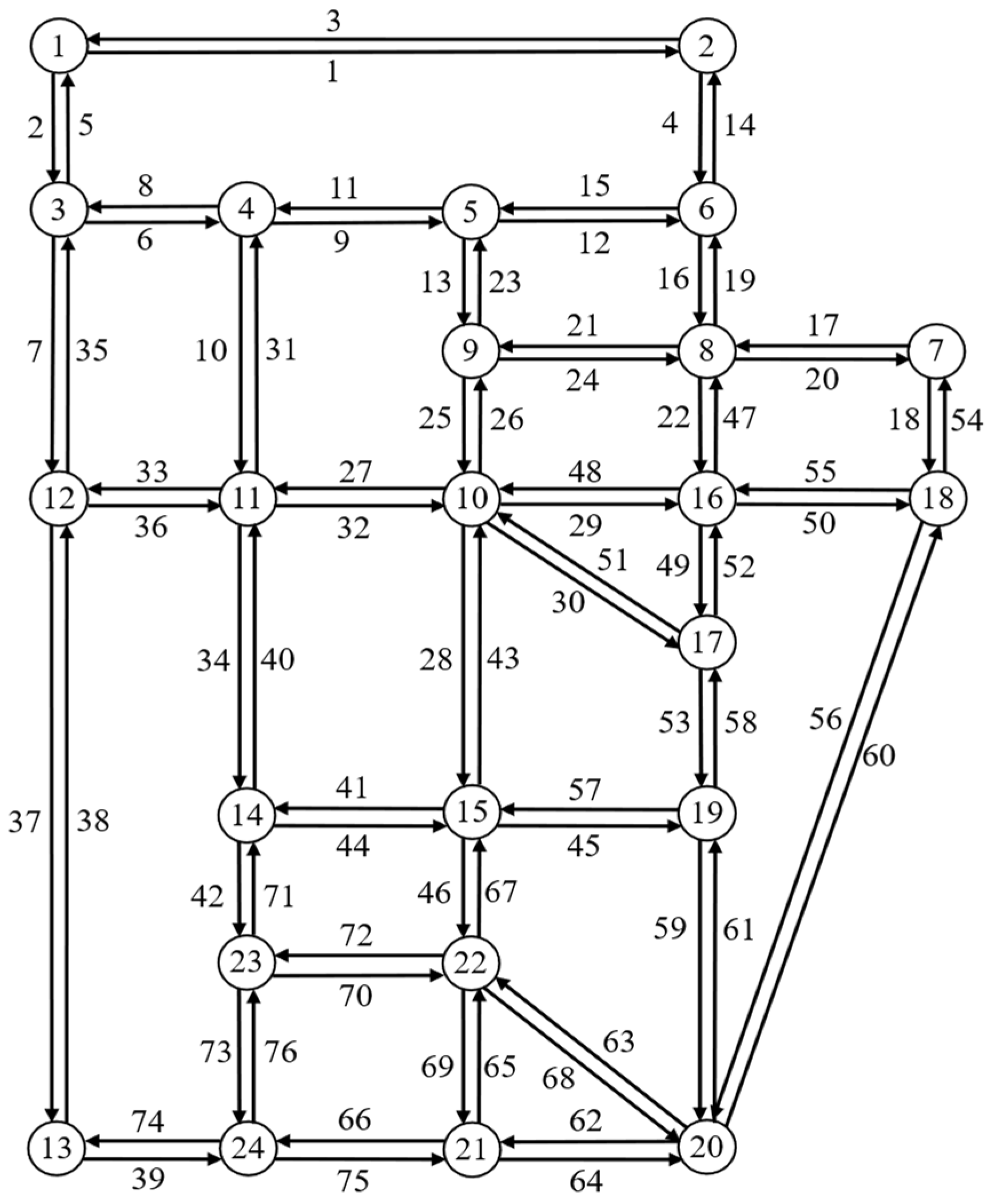
An example is presented in this section to demonstrate the existence of inequity issues in terms of equilibrium generalized OD travel costs when implementing an AVT scheme. The Sioux Falls network, as shown in
Figure 1, consisting of 24 nodes and 76 links, is used for this purpose.
The travel demand and detailed network inputs can be found online at
https://github.com/bstabler/TransportationNetworks (accessed on 1 June 2026). Suppose there are two user categories: HV users and AV users, both having identical travel demands per OD pair. The travel time function on each link follows the standard BPR function, with AV capacities set at twice those of HV users [
4,
5]. Using the HVE concept, this leads to,
where
and
are the free flow time and travel time function of link
, respectively;
and
are the flow of HV and AV on link
, respectively; and
is the capacity of link
with pure HV traffic.
Assuming user equilibrium travel behavior (a stochastic UE formulation would not change the qualitative results), the equilibrium travel costs without tolls can be readily obtained as
, where superscript
and subscript
denotes OD pair and user class, respectively. Without loss of generality, we adopt the second-order optimal toll scheme derived in [
13], setting tolls of 30.5, 29.7, 33.2, 34.1, 31.7, 36.4, 17.5, and 17.2 (in time units) on links 29, 30, 48, 49, 51, 52, 53, and 58, respectively. Consequently, the equilibrium generalized travel costs (inclusive of time and tolls) are denoted as
. Let
represents the relative level of equilibrium costs for OD pair
and user class
.
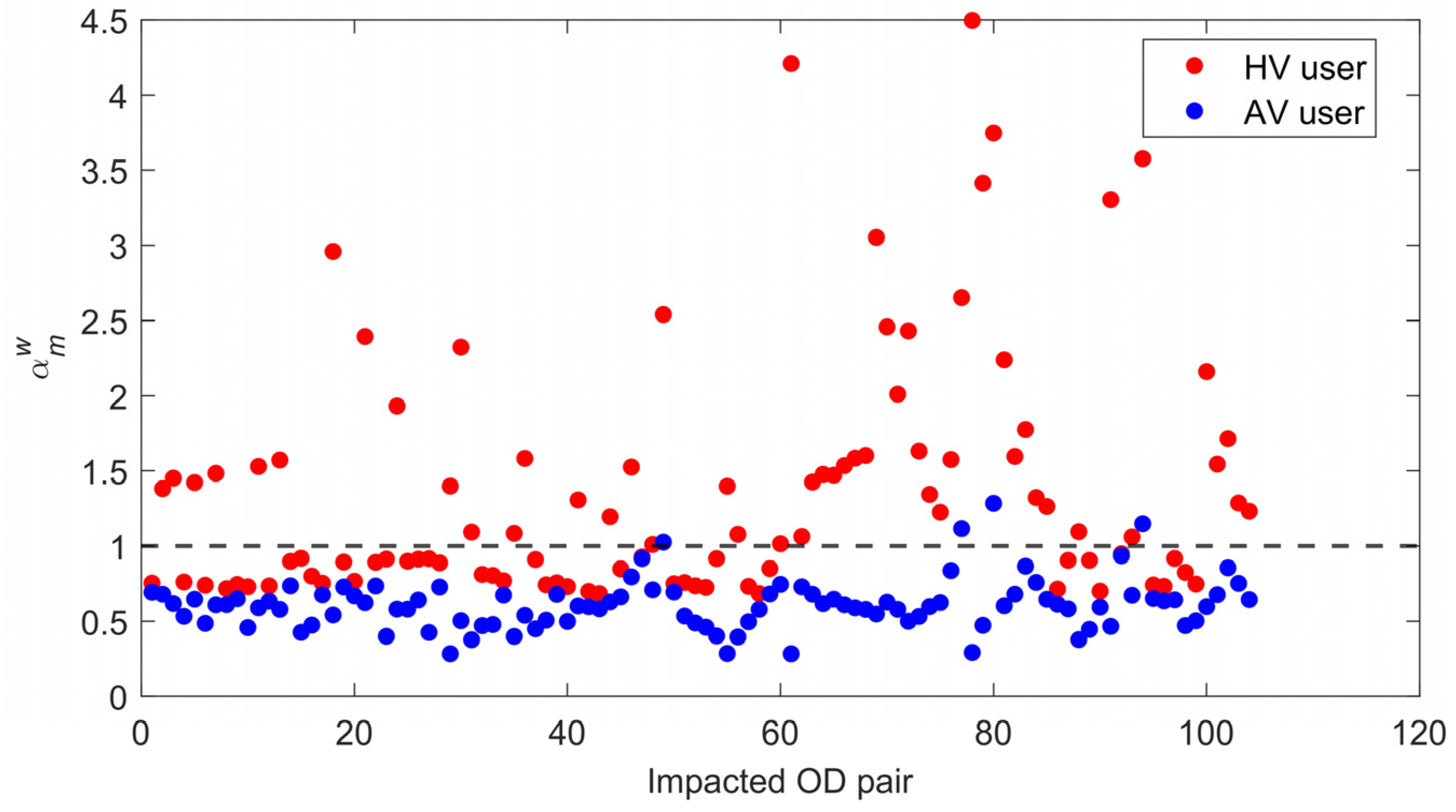
Figure 2 illustrates the distribution of
.
From
Figure 2, it is observed spatially that, after optimal toll implementation, approximately 40% of the impacted OD pairs experience increased equilibrium travel costs, with the highest increase reaching 4.49 (HV) and 1.28 (AV), despite a decrease in total travel time. From a vertical (social) perspective, around 70% of HV users incur higher equilibrium travel costs, whereas only 30% experience reductions, while for AV users, over 90% experienced decreased travel costs. This suggests that the benefits of the AVT scheme are predominantly captured by AV users, especially considering that HV users bear the toll burden exclusively. Based on this example, it is evident that while AVT schemes have the potential to alleviate network congestion, issues of social and spatial equity indeed exist. This diminishes the political feasibility of AVT scheme implementations and may provoke dissent from advocates of equity. Therefore, it is concluded that discussions on AVT scheme implementations must consider their differential impacts across demographic and geographic dimensions, thereby addressing resulting spatial and social equity concerns. In the next section, we develop models to optimize AVT toll rates considering spatial and social equity.
3. Model Formulations
3.1. Notations
For clarity, notations are summarized as follows, where uppercase letters represent sets/vectors, corresponding lowercase letters denote elements, and an asterisk indicates equilibrium states.
: network graph, where N and A are the set of nodes and links, respectively;
: set of travel modes, where 1 and 2 represent HV and AV, respectively;
: vector of tolls, in time units, where is the subset of AVT links;
: equilibrium travel cost for OD pair w and mode m under a toll scheme ;
: vector of path flows under a toll scheme ;
: vector of link flows under a toll scheme ;
: objective function for toll optimization;
: vector of link travel times;
: vector of travel demands;
: path-OD pair incidence matrix;
Δ: link-path incidence matrix.
: set of OD Pairs;
3.2. AVT Link Toll Design Model
The optimal toll design problem for AVT links is similar to road congestion pricing models. For a general overview, readers may refer to [
23]. These models are typically formulated as Stackelberg games, where policymakers act as leaders, setting tolls to minimize total travel time, while network users respond as followers by adjusting their route choices. In the context of AVT, however, the key distinction is that tolls apply only to HV users. This can be formulated as follows [
12,
13]:
Model 1: s.t.
where
is implicitly defined by
where
defines potential flow distribution patterns.
Equation (2) represents the objective function of the upper-level model, which solely optimizes the total travel time across the entire network. Equation (3) defines the maximum toll range for each link, and Equation (4) employs a variational inequality to model the multi-user equilibrium state under the tolling scheme . We call Equations (2)–(4) the efficiency-only model, or simply the baseline model.
Note that after implementing the optimal toll scheme, while the total travel time decreases, equilibrium travel costs for specific user groups and O-D pairs may fluctuate, impacting users positively or negatively, as shown previously. Therefore, equity becomes a pertinent and non-negligible issue. In the following subsection, we introduce specifications for assessing equity.
3.3. Equity Specifications
Equity is an integral component of broader sustainability considerations, requiring equitable distribution of both infrastructure access and transport externalities among different social groups. This ensures equitable participation in social and economic activities, thereby enhancing societal accessibility and sustainability. Various equity metrics have been proposed in previous studies, encompassing justice, rights, equal treatment, capabilities, opportunities, resources, wealth, primary goods, income, welfare, and utility [
24]. Despite efforts to integrate equity into decision-making models, consensus on the optimal approach for assessing equity remains elusive in certain contexts.
Initially proposed in [
14], the following spatial equity specification quantifies the maximum ratio of equilibrium travel times before and after the implementation of a link capacity improvement scheme.
where
and
are the equilibrium travel times between OD pair
after and before capacity enhancement, respectively.
This maximization measure exhibits good scalability and has been adopted in subsequent studies [
15,
16]; yet it overlooks disparities between different individuals. Moreover, an underexplored equity specification, particularly in mixed-autonomy environments, concerns fair access to transportation infrastructure by different types of travelers. AV and HV users are known to possess distinct socioeconomic characteristics, such as income levels and time valuations. Therefore, measures should be implemented to assess their concerns and reflect their perspectives, which constitutes a primary motivation behind this study.
In this study, we first refine the spatial equity measurement in [
14] to consider demographic impacts. Furthermore, in the spirit of [
14], we introduce the concept of social equity, a form of vertical equity (terminology used systematically in [
25]). Specifically, we propose the following spatial and social equity specifications:
Equations (6) and (7) can be interpreted as the disparity in impacts, specifically generalized travel cost, experienced by users of various OD pairs (Equation (6)) and modes (Equation (7)), resulting from an AVT toll scheme
. Additionally, to account for heterogeneity in population exposure, the travel demands associated with different OD pairs and user classes are adopted as weighting factors for these impacts (i.e.,
). This weighting scheme is based on the rationale that transportation equity should reflect not only the magnitude of cost changes experienced by each user group, but also the number of travelers affected by such changes. In other words, a cost increase experienced by a larger travel demand group represents a broader social impact and therefore should receive greater consideration in equity evaluation. Similar demand-based weighting principles have been adopted in transportation network performance evaluation studies [
26].
3.4. Incorporating Equity into the AVT Toll Design Model Using a Fuzzy Approach
Generally, Equations (6) and (7) can be specified either as an objective function or as a constraint inequality. For instance, if we consider
and
to gauge the extent of spatial equity and social equity in impact distribution, this can be expressed by
and
, where
and
are the aspiration levels or target values specified by policymakers. However, in practical implementation, the quantification of equity through α is often subject to a degree of uncertainty, related to factors such as city zoning and socioeconomic variability. Consequently, decision-makers may express their equity requirements with linguistic statements like “The disparity in benefit distribution should be kept within a certain range, or the ‘approximate’ maximum externality should not exceed a certain range”. Recognizing this, we formulate the following inequalities based on the fuzzy utility theory,
where the symbol
denotes the fuzziness of the state of being less than or equal to; that is,
(and
) is approximately less than or equal to
(and
).
Typically, a membership function is utilized to describe the achievement degree of a fuzzy constraint. The most common type is the linear (or trapezoidal) membership function [
21]. Additionally, the authors of [
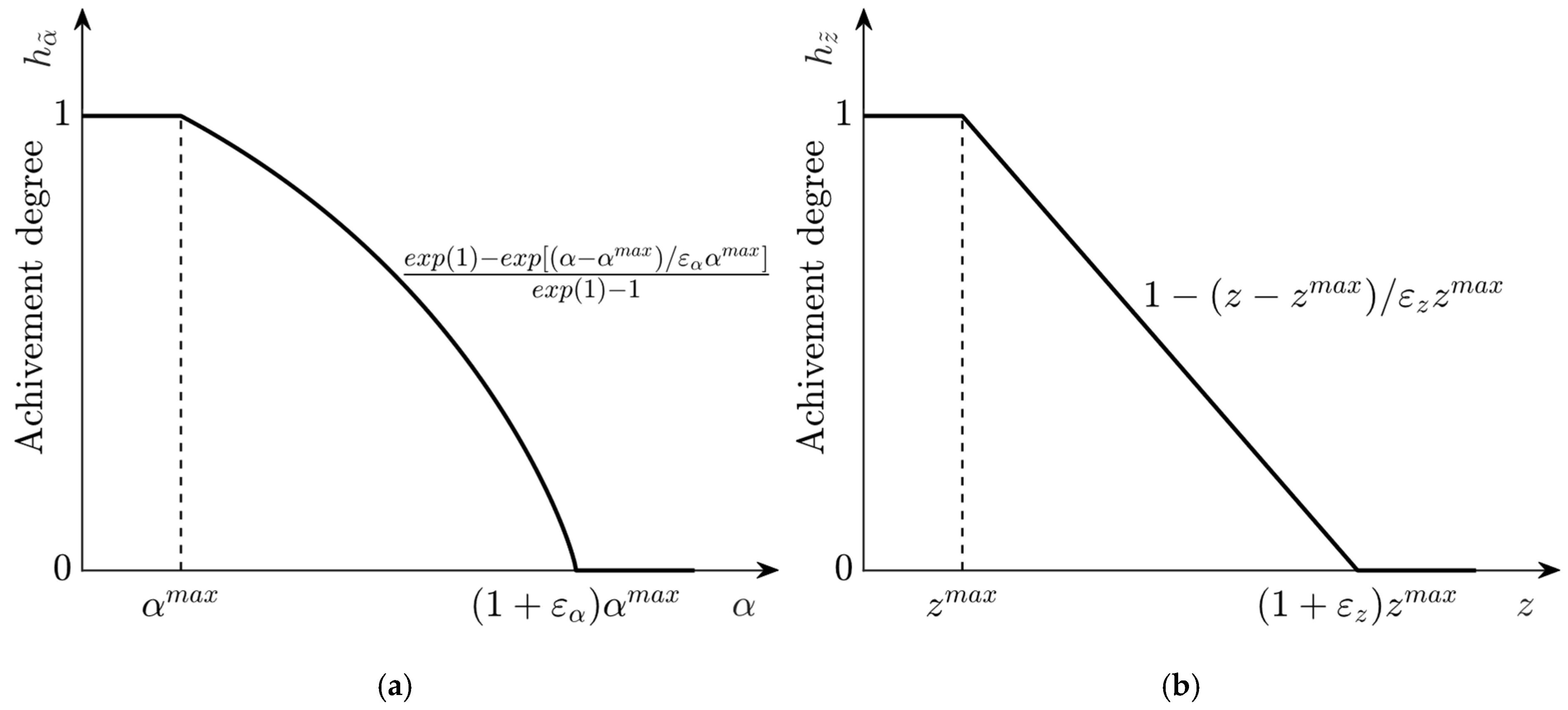
22] employ a nonlinear membership function to depict the relationship between different performance metrics and achievement degrees. It is important to note that our advocacy for equity does not negate existing efforts in efficiency (minimizing overall system travel time). Rather, our aim is to ensure fair distribution of benefits or externalities among different groups while enhancing efficiency. Therefore, in this paper, we simultaneously consider both aspects and define different types of membership functions for them. For both spatial and social equity, unlike the trapezoidal function, we opt for nonlinear functions to better capture the nonlinear changes in achievement degrees under varying degrees of target violation. Specifically, minor deviations from the target result in relatively small decreases in achievement degrees, while significant deviations lead to much larger decreases. When equity indicators meet certain requirements, the achievement degree is maximized at 1 and remains unchanged. As for network efficiency, a linear decreasing function is employed to indicate a consistent interest in efficiency optimization at all times.
Visually and mathematically (see
Figure 3 and Equations (10)–(12)),
Membership function for spatial and social equity Membership function for network efficiency where
,
and
denotes the specified tolerance limits for
,
and
, respectively. In essence, the upper bounds of the target values for
,
and
are
,
and
respectively, rather than
,
and
themselves.
,
and
denote the achievement degrees of these three goals.
Now, with Equations (10)–(12), we are in a position to develop an equitable AVT toll design model that integrates spatial and social equity metrics with network efficiency, expressed linguistically or approximately as follows:
Model 2: s.t.
where
,
and
, as detailed in Equations (10)–(12) and visually depicted in
Figure 3, are membership functions used to quantify fuzzy constraint achievement for spatial equity, social equity and network efficiency, respectively.
,
and
are their corresponding weights. Therefore, the model maximizes the weighted sum of the achievement degrees of these three goals rather than their absolute values. We call Equations (13)–(17) the fuzzy equitable AVT toll design model (FE-AVT Model), or simply Model 2.
3.5. Model Properties and Solution Algorithm
As previously discussed, the proposed FE-AVT model exhibits a bi-level structure and is inherently non-convex, primarily due to the nonlinear equilibrium constraints in Equation (4) and the piecewise definitions of system-level performance indicators, including efficiency and equity. Consequently, the problem belongs to the class of NP-hard optimization problems, which is consistent with the broader literature on transportation network design problems with equilibrium constraints. To address this, we develop a hybrid solution framework that integrates a genetic algorithm (GA) for upper-level toll optimization with an improved Smith route-swapping algorithm for lower-level multi-class traffic assignment. The implementation details of both levels are described below.
3.5.1. Upper-Level Genetic Algorithm
The GA is adopted due to its ability to handle non-convex, discontinuous, and mixed-variable optimization problems. Specifically, to improve computational tractability, although toll variables are continuous in theory, each toll value is discretized as an integer multiple of a minimum charging unit (0.1)—a common practice in toll optimization studies. This is because, in practice, travelers find it difficult to perceive small variations in toll rates, and most transportation agencies adjust tolls in discrete steps. Suppose that the network contains N AVT links requiring toll decisions, and the toll on each link ranges from 0 to . Then, each toll variable can take () charging levels. To facilitate genetic operations, each toll variable is encoded as a binary substring of length L, where L is the minimum number of binary digits required to represent all feasible charging levels, i.e., . Therefore, the entire chromosome consists of NL binary genes. During decoding, each binary substring is first converted into an integer charging level index, and the corresponding toll value is obtained by multiplying this index by 0.1. This encoding preserves the discreteness and feasibility of toll decisions while improving search efficiency. Specifically, we implemented GA using the built-in optimization toolbox in MATLAB R2024. The population size is set to 100, the maximum number of generations is set to 100, the crossover probability is set to 0.8, and the mutation probability is set to 0.05. Tournament selection and elitist preservation are adopted to maintain population diversity while preserving high-quality solutions. The GA terminates when the maximum number of generations is reached. To improve solution robustness and reproducibility, GA is independently executed 5 times under different random seeds, and the final reported toll vector corresponds to the best-performing solution among all runs.
3.5.2. Lower-Level Multi-Class Traffic Assignment
For the lower-level multi-class traffic assignment problem, considering the asymmetric impacts of HV and AV flows on link travel times, we develop an improved Smith route-swapping algorithm based on [
13]. The proposed algorithm ensures convergence to an equilibrium solution under a given toll vector through iterative path-flow updates and facilitates comparison with previous studies.
Specifically, let
n denote the iteration index, and
represent the route flow vector at iteration
n. The descent direction
is determined according to the generalized cost differences among available routes, as follows:
where the symbol
takes the value of the input if it is greater than zero and zero otherwise.
and
denote the route flow and generalized travel cost of route
k for OD pair
w and mode
m at iteration
n, respectively.
Moreover, to accelerate the algorithm’s convergence, step sizes are dynamically adjusted via a weighted self-regulated averaging (WSRA) method, as follows:
where
denotes the step size at iteration
n,
and
are two parameters.
Accordingly, the route flows at iteration
n + 1 are updated as:
The iterative process continues until the difference between two consecutive route flow solutions falls below a predefined convergence tolerance.
Note that, in Equations (19) and (20), if the norm descent direction at iteration n is larger than that at iteration n − 1, implying a tendency toward divergence, a larger value of is used to reduce the current step size. Conversely, when the algorithm is converging, Equation (20) tries to apply a larger step size in the current iteration to accelerate convergence by setting a smaller value . Therefore, the method maintains a more reasonable decreasing rate by adaptively adjusting the step size using inter-iteration information. Moreover, as the iterates approach equilibrium, the step sizes decrease more slowly by assigning higher weights to solutions near equilibrium, thereby avoiding slow convergence.
4. Numerical Study
To demonstrate the proposed methodology, numerical experiments were conducted on both the nine-node network and the Sioux Falls network.
4.1. Nine-Node Network
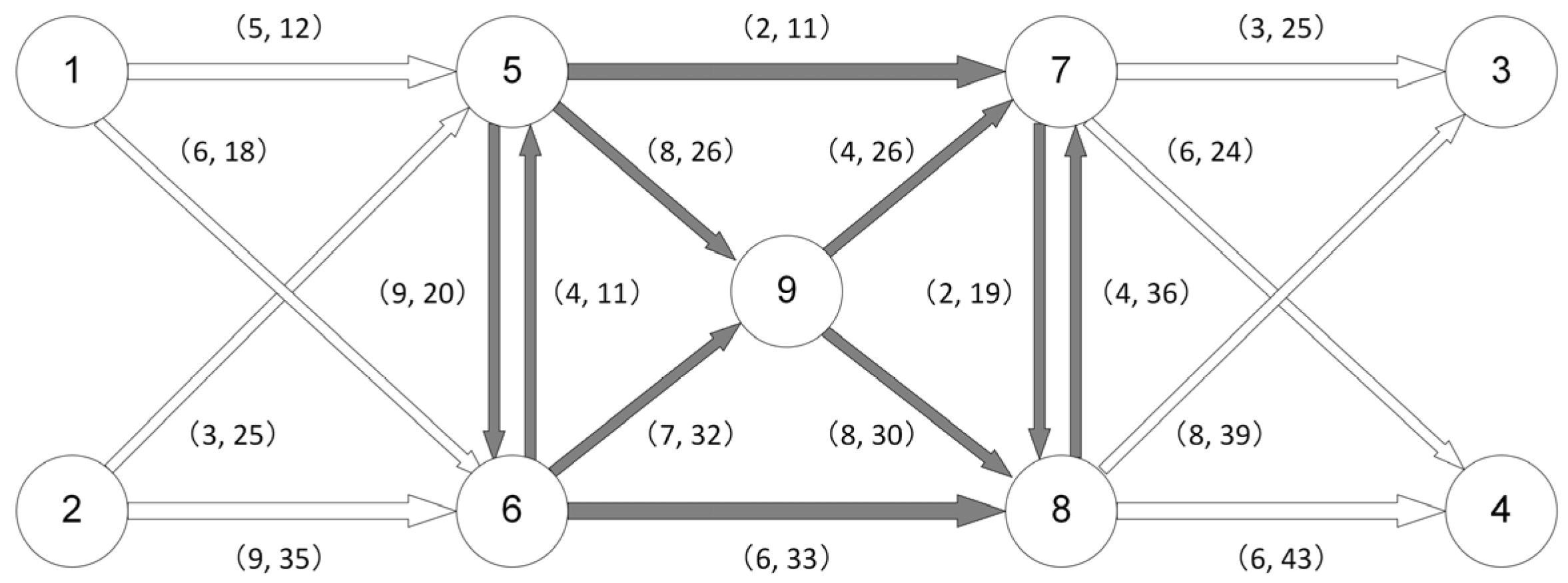
The first experiment uses the nine-node network shown in
Figure 4, which consists of 18 links, 4 OD pairs, and 96 feasible paths, to illustrate the behavioral mechanisms of the proposed model and facilitate direct interpretation of the tolling and equity effects.
The travel demands for the four OD pairs (1, 3), (1, 4), (2, 3), and (2, 4) are 10, 20, 30, and 40, respectively. It is assumed that the potential market shares for HVs and AVs are the same for all OD pairs, at 70% and 30%, respectively. Furthermore, we consider the values of time to be 1 for HV users and 0.8 for AV users. To calculate the travel time on each link, we use the following BPR-type function,
where
is shown as a link label in
Figure 4. The 10 links highlighted in dark are designated as AVT links. Therefore, the problem considered here belongs to the category of second-best pricing problems.
Note that, under the no-toll equilibrium condition (i.e., the status quo), the total network travel time is 2184.7, which serves as the upper bound of the efficiency objective. Moreover, to obtain the ideal efficiency benchmark, the baseline efficiency-only model (i.e., Model 1) is solved, yielding an optimal value of 2044.6. Accordingly, the efficiency aspiration level and tolerance limit in the fuzzy framework are calibrated based on these two benchmark solutions, i.e., , . For the equity objectives, these parameters are determined based on the equity outcomes obtained from the efficiency-only solution. Specifically, Model 1 yields social and spatial equity values of 0.239 and 0.059, respectively, which are used as reference upper-bound values. The aspiration levels were initially derived from the corresponding single-objective optimization solutions and subsequently refined through preliminary tests. A range of candidate values was tested to examine the resulting efficiency–equity trade-offs. The final aspiration levels were chosen such that they provide noticeable improvements in both social and spatial equity while avoiding excessive deterioration in network efficiency. Based on this criterion, the social and spatial equity aspiration levels were set to 0.20 and 0.05, respectively, corresponding to an approximately 20% tolerance level. Furthermore, the weights of network efficiency, spatial equity and social equity were set to 0.5, 0.25, and 0.25, respectively. By doing this, our aim is to improve network travel efficiency while ensuring that the benefits or externalities are fairly distributed among different groups demographically and geographically, with the impact being “approximately” no worse than the specified aspiration levels. Note that the above parameter settings serve as a baseline, and a subsequent sensitivity analysis will be conducted to evaluate their effects.
First, the optimal tolling solutions and corresponding equilibrium performance under different models are reported in
Table 1 and
Table 2. As shown in
Table 1, although the classical Model 1 achieves the minimum total network travel time, it also generates significant social and spatial inequities. In contrast, the proposed Model 2 slightly increases total travel time from 2044.6 to 2068.1, corresponding to only a 1.15% efficiency loss, while substantially improving equity performance. Specifically, social inequity decreases by (0.239 − 0.195)/0.239 = 18.4%, while spatial inequity decreases by (0.059 − 0.055)/0.059 = 6.7%.
Table 2 supports these findings, indicating that although AV users continue to benefit from the AVT tolling scheme, the generalized travel cost increases experienced by HV users are effectively mitigated, and the disparity across user groups is reduced.
Table 3 and
Table 4 present a sensitivity analysis of the model parameters
and
. It can be seen that as the values of
or
increase, the network travel cost gradually decreases, while the inequity within the network increases. This trend is anticipated because higher values of
or
indicate a greater tolerance of the decision-maker for social or spatial inequities within the network, thereby prioritizing improvements in network efficiency. Consequently, the resulting solutions more closely align with those of the classical Model 1. Moreover, as the values of
or
increase, different tolling schemes are applied. However, the equilibrium travel costs for HV users remain relatively stable, whereas those for AV users generally exhibit a decreasing trend. This confirms that the AVT tolling scheme primarily benefits the AV user group.
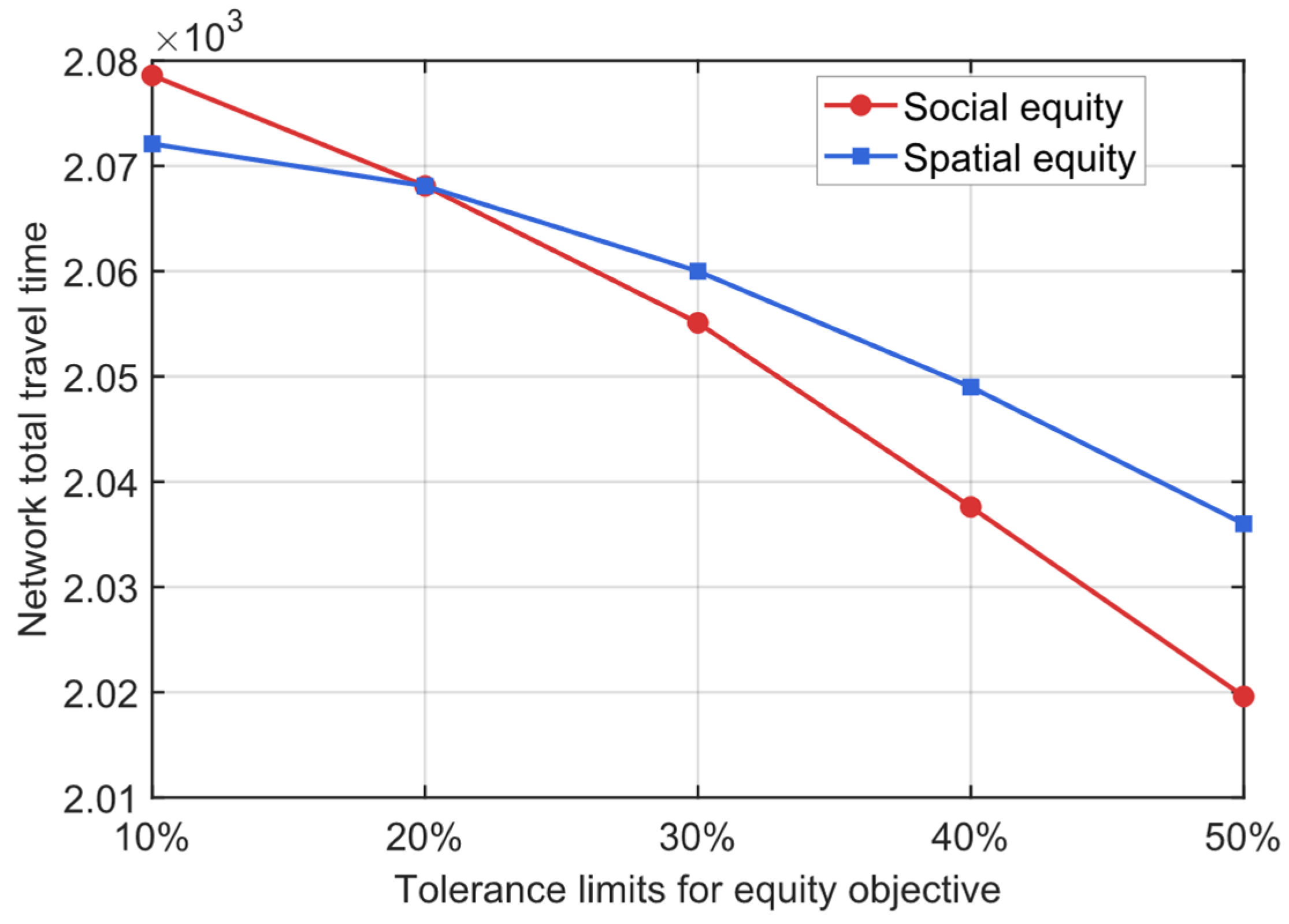
Furthermore,
Figure 5 illustrates the impact of the tolerance limits (i.e.,
and
) for the two equity objectives on network efficiency. It can be observed that, as
or
increases, the total travel time gradually decreases, indicating an improvement in network efficiency. This is because larger tolerances indicate greater acceptance of deviations from equity targets, which enables the model to find solutions closer to the system optimum. Interestingly, the efficiency improvement associated with increasing the tolerance level for the social equity objective is more significant than that associated with the spatial equity objective. This implies that balancing generalized travel costs between HV and AV users imposes a relatively stronger restriction on achieving the system-optimal traffic state.
4.2. Sioux Falls Network
To further evaluate the scalability of the proposed FE-AVT Model and the computational performance of the solution framework, additional experiments were conducted on the Sioux Falls network. As previously introduced in
Section 2, the same set of AVT links was adopted in the present experiment. Similarly, the aspiration levels for network efficiency, social equity, and spatial equity were determined by solving the corresponding single-objective optimization problems and refining through trial-and-error, yielding benchmark values of
,
, and
, respectively. The remaining model parameters were kept consistent with those used in the previous section.
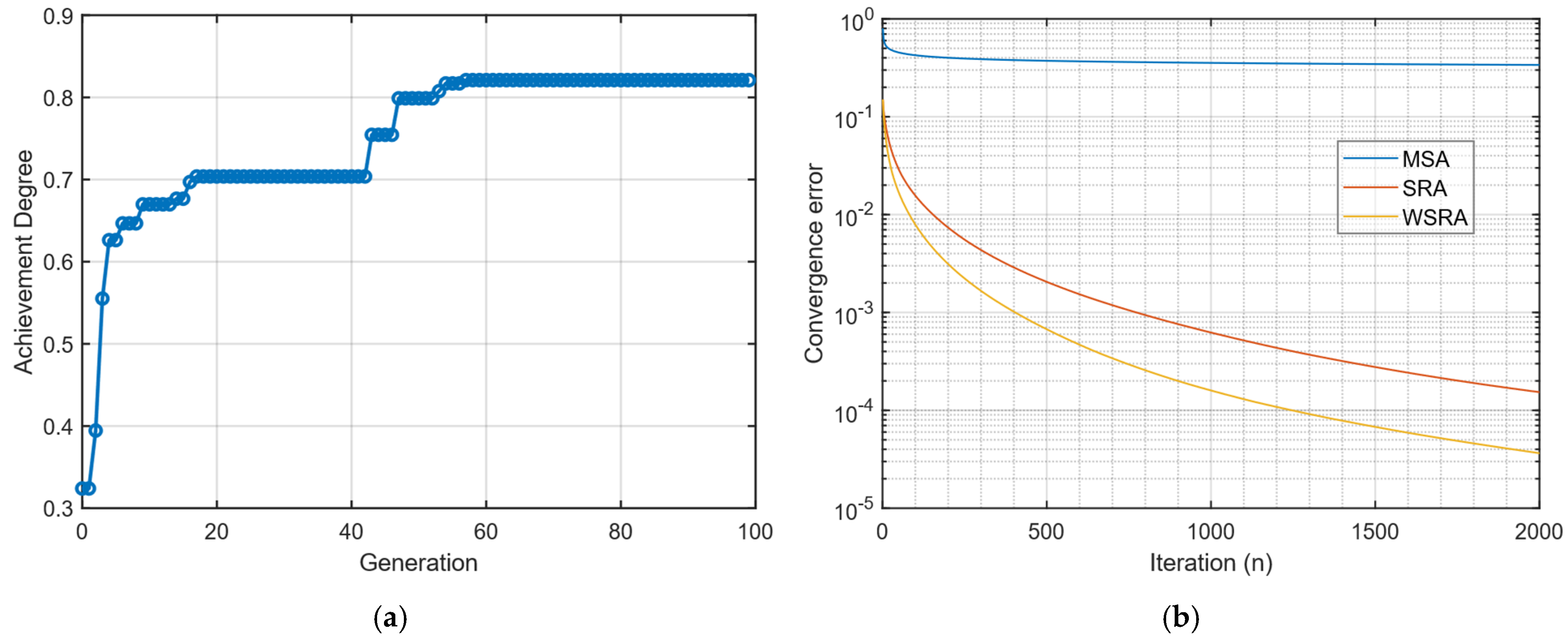
First,
Figure 6a,b present the convergence behaviors of the upper-level GA and the lower-level traffic assignment algorithm, respectively. As shown in
Figure 6a, the GA rapidly improves the fitness value during the early generations and gradually converges to a stable solution.
Figure 6b compares the proposed WSRA algorithm with the classical method of successive averages (MSA) and the original Smith route-swapping algorithm with the self-regulating averaging (SRA) method [
14]. Although all methods converge to the same equilibrium solution, WSRA achieves a noticeably faster convergence rate. These results indicate that the proposed solution framework has the potential to be applied to large-scale transportation networks.
The overall model outputs are summarized in
Table 5. Similar to the observations from the nine-node network, the proposed model continues to achieve noticeable improvements in both spatial and social equity compared with the efficiency-only baseline, while incurring only a relatively small efficiency loss.
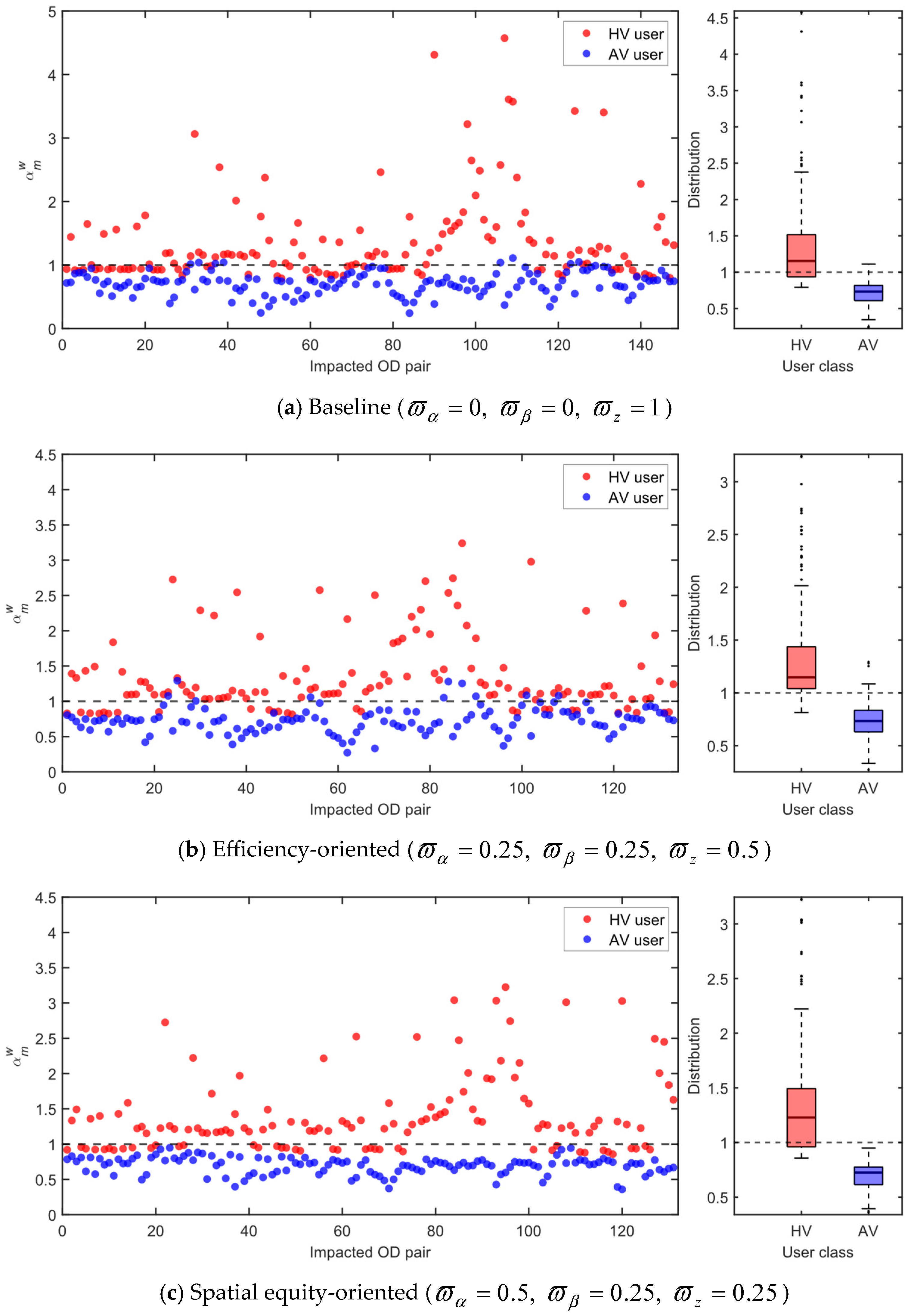
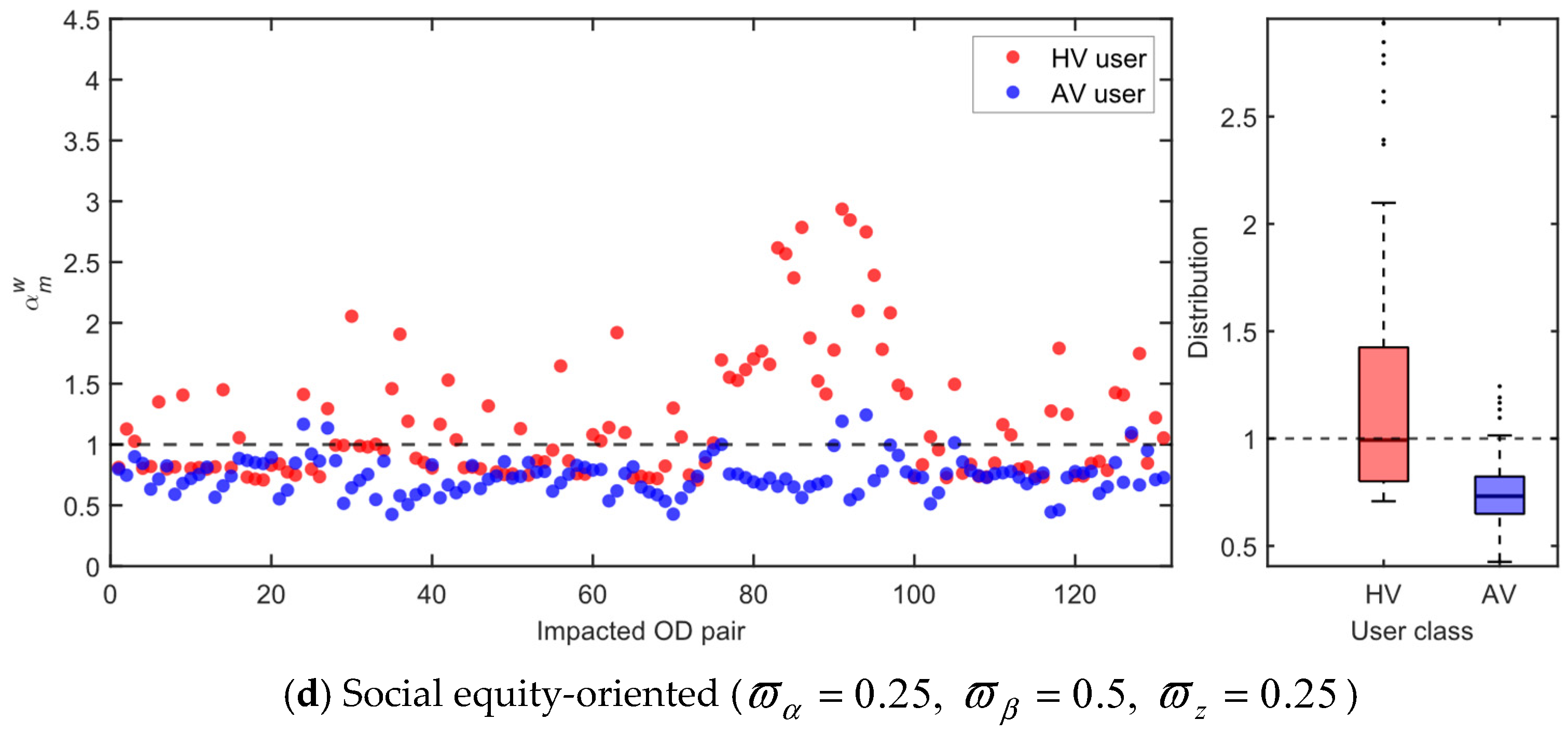
Furthermore, to examine the distributional impacts of the tolling schemes, the left subfigures in
Figure 7 present the relative changes in equilibrium generalized travel costs across all OD pairs and user classes under different policy preferences or weight scenarios, including the baseline scenario, and three scenarios emphasizing network efficiency, spatial equity and social equity, respectively. The corresponding boxplots shown in the right subfigures further illustrate the statistical distributions of these equilibrium cost changes.
As shown in
Figure 7a,b, compared with the baseline model, the proposed model noticeably reduces the dispersion of equilibrium cost changes, indicating a more balanced distribution of transportation impacts across the network. More specifically, the maximum equilibrium cost changes among the impacted OD pairs are reduced from 4.49 (HV users) and 1.28 (AV users) to 3.20 (HV users) and 1.24 (AV users), respectively. This reflects that, after incorporating demand-weighted equity considerations, the proposed model not only improves network efficiency but also effectively suppresses extreme inequitable outcomes experienced by highly impacted user groups.
From a social equity perspective, although most AV users continue to benefit from the AVT tolling scheme through reduced generalized travel costs, a noticeably larger proportion of HV users experience either reduced equilibrium travel costs or substantially smaller cost increases compared with the efficiency-only baseline. This indicates that the proposed framework can partially mitigate the negative externalities imposed on conventional HV users while preserving the efficiency advantages brought by AVT strategies.
These observations are also supported by the boxplots in
Figure 7. Compared with the efficiency-only baseline, the proposed model produces narrower interquartile ranges and fewer extreme outliers for both HV and AV users, suggesting lower dispersion of equilibrium travel costs. In particular, the reduction in the upper whiskers and extreme values demonstrates that the proposed model effectively alleviates severe inequitable impacts concentrated on a small number of OD pairs or user groups.
Figure 7c,d further illustrate scenarios in which spatial equity and social equity are assigned higher priority, respectively. As expected, greater emphasis on spatial equity further reduces disparities across OD pairs, leading to a more geographically balanced distribution of transportation impacts. In contrast, assigning higher weights to social equity more effectively mitigates the generalized cost differences between HV and AV users, thereby improving the balance of AVT benefits across user classes. Overall, these results confirm that the proposed FE-AVT model can flexibly accommodate different policy preferences while improving the overall equity distribution of the transportation system.




 ,
,