Article

Green M&A, Green Finance, and Corporate Market Value Enhancement: A Signaling Game-Theoretic and Empirical Analysis

1
School of Economics and Management, China University of Petroleum, Beijing 102200, China
2
School of Economics and Management, Beijing Jiaotong University, Beijing 100080, China
*
Author to whom correspondence should be addressed.
Systems 2026, 14(6), 641; https://doi.org/10.3390/systems14060641
Submission received: 27 April 2026 / Revised: 30 May 2026 / Accepted: 2 June 2026 / Published: 4 June 2026
(This article belongs to the Special Issue Complex Financial Systems: Dynamics, Risk, and Resilience)

Abstract

The low-carbon transition is reshaping firms’ strategic behavior and financial resource allocation, yet the mechanisms linking green mergers and acquisitions (green M&A), green credit, and market value remain insufficiently understood. Existing studies recognize the signaling role of environmental actions but often lack a formal game-theoretic framework to explain how green M&A conveys information to financial institutions and capital markets. This study fills this gap by developing a signaling game model between firms and financial institutions to analyze how green M&A affects market value directly and indirectly through credit resource flow. Using panel data of Chinese A-share listed companies from 2013 to 2023, we examine the observable implications derived from the model: the value effect of green M&A, its association with green credit allocation, and the mediating role of green credit. The results show that green M&A is associated with higher market value and greater green credit allocation, while green credit serves as a partial transmission channel. These effects are weakened by internal climate-risk exposure and climate-policy uncertainty, and strengthened by media attention. This study develops a unified theoretical–empirical framework for understanding the economic consequences and financial transmission mechanisms of green M&A, offering implications for corporate green transformation and green-finance resource allocation.

1. Introduction

Global efforts toward sustainable development, symbolized by the Paris Agreement and supported by an evolving network of regulatory frameworks, are reshaping corporate behavior and financial markets [1,2,3]. Escalating climate risks, stricter carbon-neutrality policies, and the rapid expansion of environmental, social, and governance (ESG) investing have collectively transformed how corporate value is assessed. This shift has increased the volatility and complexity of market valuations, challenging traditional approaches to long-term value creation and market-capitalization management [4,5]. In many economies, firms are increasingly evaluated not only by their current financial performance, but also by their ability to convert strategic assets into sustainable development capabilities. Against this background, emerging markets with active green-finance policies and rapidly evolving capital markets provide useful settings for examining how low-carbon transition signals are incorporated into corporate valuation.
As low-carbon transition pressures intensify, firms’ operating and valuation environments are being reshaped by green-finance regulation, carbon-constraint mechanisms, and ESG-oriented capital allocation. These changes have altered how markets interpret corporate value, while the gap between intrinsic value and market capitalization has become an important governance concern [6,7]. Under these conditions, traditional value-management tools, such as share repurchases, dividends, and conventional asset restructuring, may offer limited support for sustainable long-term value creation when used alone. Consequently, green mergers and acquisitions (green M&A) have emerged as a potential strategic pathway for firms to respond to low-carbon pressures, acquire environmental capabilities, and improve long-term value prospects by integrating environmentally efficient assets and capabilities. At the same time, credit resource allocation, especially green credit, has become an important channel through which the financial system influences firms’ environmental strategies. Understanding how green M&A and green credit jointly shape corporate market value is therefore important for explaining corporate valuation under the low-carbon transition and for improving green-finance resource allocation.
Although the literature on sustainability has increasingly recognized green M&A as a distinctive form of corporate environmental strategy, existing studies largely examine green M&A and green credit in isolation [8,9,10,11]. Less attention has been paid to the financial transmission mechanism linking corporate green restructuring, financial intermediary responses, and capital market valuation. In an ESG-oriented capital allocation environment, green M&A is not only a way for firms to acquire environmental capabilities, but also an observable signal of low-carbon transition. However, how this signal is interpreted by financial institutions and incorporated into green credit allocation and market valuation remains insufficiently understood. While prior studies acknowledge the signaling role of environmental actions [4,12], the strategic interaction among firms, financial institutions, and investors remains underexplored, particularly in economies characterized by financing frictions and resource misallocation. This raises three questions: (1) Is green M&A associated with higher corporate market value? (2) Does green M&A function as a signal affecting green credit allocation? (3) Does green credit serve as a transmission channel linking green M&A to market value?
To address these questions, we develop a signaling game model to examine how green M&A guide green credit allocation and enhance market value by conveying information about a firm’s environmental commitments. Building upon the model’s theoretical implications, we further employ firm-level panel data to examine the observable empirical implications regarding the direct valuation effect of green M&A, the signaling effect on credit resource flows, and the mediating role of green credit.
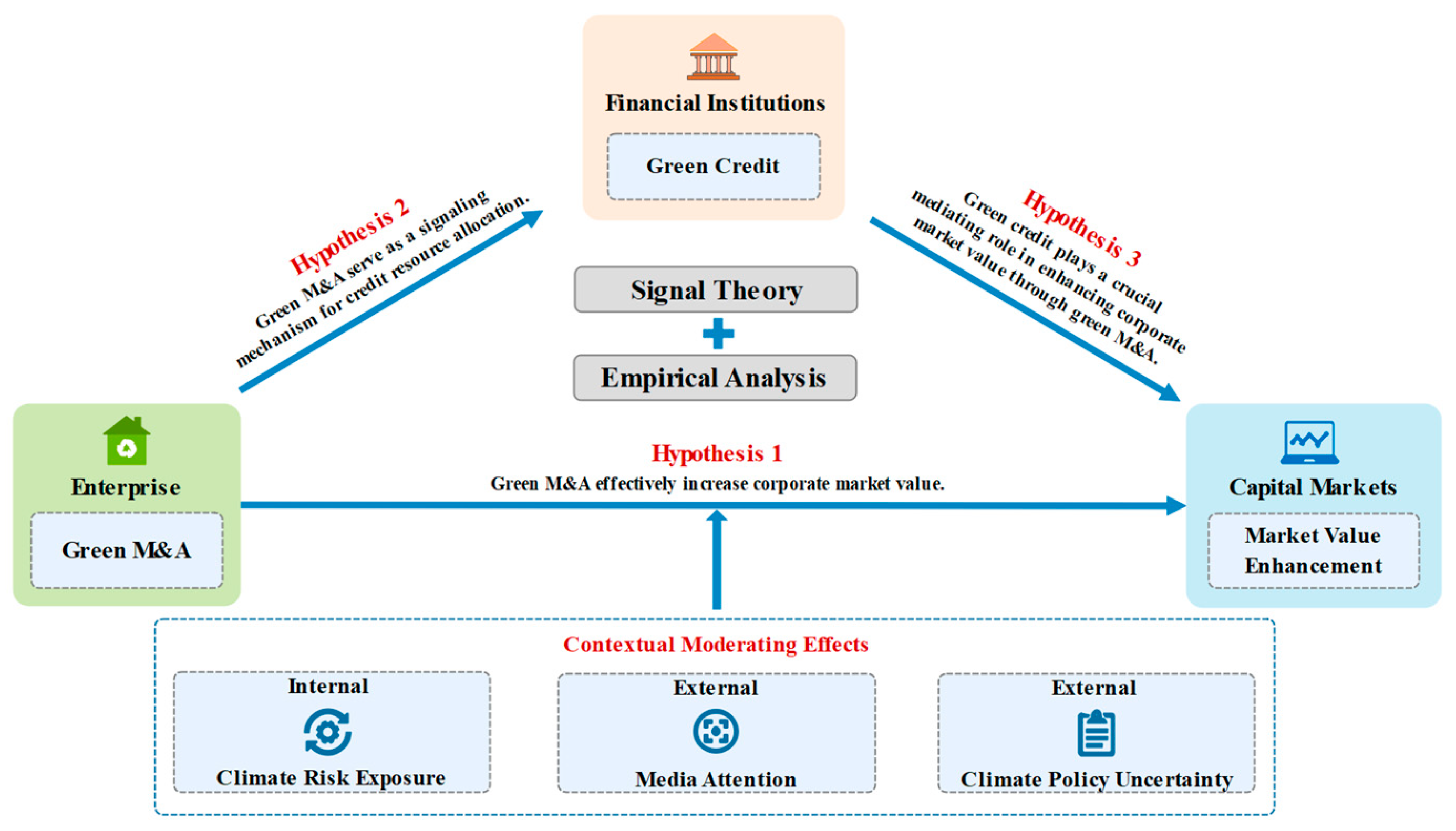
The conceptual framework for green M&A enhancing market value is shown in Figure 1. This study makes three primary contributions: First, it extends the green M&A literature beyond environmental and operational outcomes by focusing on market-value effects and financial transmission mechanisms, thereby clarifying how sustainable corporate restructuring may be reflected in firm valuation. Second, drawing on signaling theory, it develops a formal signaling game framework involving firms, financial institutions, and investors to explain how green M&A may function as a strategic environmental signal under information asymmetry and how such signals are related to credit allocation and valuation responses. Third, by linking the previously fragmented literature on green M&A and sustainable finance, this study identifies green credit as a partial transmission channel between environmental restructuring and market value, and further examines the boundary conditions under which this channel is strengthened or weakened. Evidence from China’s A-share market provides insights into sustainable corporate restructuring in an emerging-market context and contributes to the broader literature on green finance, ESG investing, and corporate value creation.
The remainder of the paper proceeds as follows: Section 2 reviews the relevant literature and identifies research gaps. Section 3 develops the signaling game model. Section 4 analyzes game equilibria and derives testable hypotheses. Section 5 presents the empirical strategy, data, and variable construction. Section 6 reports empirical results, robustness checks, and tests of signaling and mediating effects. Section 7 examines moderating effects and heterogeneity analyses. Section 8 concludes with theoretical implications, policy recommendations, and directions for future research.

2. Literature Review

This section synthesizes prior research along three interconnected strands: (1) the strategic and economic consequences of green M&A, (2) the role of green credit and financial resource allocation in shaping corporate environmental behavior, and (3) the use of game-theoretic and signaling frameworks to explain firms’ responses to sustainability pressures.

2.1. Green M&A

Research on green M&A has evolved from early conceptual and performance-oriented discussions [13,14] to more nuanced examinations of its strategic drivers and economic implications. Initial studies focused on identifying the “green” attributes of acquisition targets and assessing post-acquisition improvements in environmental performance or technological capacity [15,16]. As sustainability considerations became embedded in corporate strategy, scholars shifted attention toward the determinants of green M&A. Existing evidence points to three clusters of drivers: (1) Regulatory and institutional pressures, including environmental regulations, carbon-trading systems, and local policy enforcement, which generate compliance incentives and reshape firms’ cost–benefit trade-offs [17,18,19]. (2) Market-based motivations, such as rising green consumer preferences and intensifying low-carbon competition, which induce firms to acquire environmentally efficient technologies and assets [20,21]. (3) Firm-level strategic drivers, including governance quality, managerial environmental awareness, and long-term positioning [22,23]. More recently, studies have examined whether green M&A enhances environmental performance, innovation, or operational efficiency [24,25,26]. While these works underscore the multi-dimensional value of green M&A, its financial-market consequences remain insufficiently explored. Most studies implicitly assume that improved environmental performance translates into higher valuation [27,28], yet they rarely articulate how capital markets or financial intermediaries interpret green M&A under information asymmetry. This leaves an important theoretical gap regarding the financial transmission mechanisms, particularly via credit allocation, through which green M&A influences market value.

2.2. Green Credit and Financial Resource Allocation

Green credit has emerged as a central policy instrument for directing financial resources toward low-carbon and environmentally responsible activities [29]. Empirical studies generally show that green credit policies reduce financing costs, incentivize green technology innovation, and strengthen firms’ environmental management [12,30]. These effects operate through interest subsidies, differentiated risk weights, and preferential lending practices [31,32]. However, the efficiency of green credit allocation depends critically on how financial institutions assess firms’ environmental capabilities, particularly when information is incomplete or noisy [33,34]. While some studies highlight banks’ increasing reliance on ESG metrics or environmental disclosures [35,36,37], others point to limited screening capacity and potential greenwashing risks, suggesting that credit allocation may not fully reflect firms’ true environmental quality [38,39]. Existing research also tends to model green credit as an exogenous driver of corporate behavior, overlooking its endogenous nature within multi-actor strategic interactions among firms, financial institutions, and markets [40,41]. As a result, the micro-level decision processes and incentives underlying credit resource flow remain weakly theorized, particularly in the context of corporate restructuring activities such as green M&A.

2.3. Signaling Theory

Game-theoretic models provide a powerful lens to analyze strategic behavior under environmental regulation [42,43], yet their application remains uneven across topics. Early models typically adopted static, complete information settings to study government–firm interactions involving emission control, innovation choices, or compliance strategies [44,45,46]. Although these models yield intuitive predictions about optimal environmental behavior, they overlook how firms communicate environmental commitment to external stakeholders. With the rise of ESG-driven markets, scholars have increasingly applied signaling and dynamic game frameworks to examine corporate environmental disclosure, green innovation rivalry, and competition for reputation [47]. These studies acknowledge that firms use environmental actions to reduce information asymmetry with investors [48,49]. However, the theoretical integration of signaling and green M&A remains limited. Existing models rarely consider how firms use green M&A as a credible signal, how financial institutions interpret such signals when forming credit-allocation decisions, or how interactions among firms, financial institutions, and capital markets propagate environmental signals to market valuation.

2.4. Research Gaps

However, a review of the existing literature reveals the following key gaps: (1) prior studies seldom articulate a coherent financial-resource allocation mechanism through which green M&A affects market valuation, leaving the credit transmission channel theoretically fragmented; (2) although green M&A carries strong signaling content, existing studies lacks a formal incomplete-information framework to explain how financial institutions decode such signal; (3) current work treats financing outcomes, environmental actions, and valuation effects as isolated processes, resulting in an under-specified and empirically untested understanding of green signals dynamically propagate from corporate decisions to credit allocation and ultimately to market value.
To address these gaps, this study develops a signaling game model integrating firms, financial institutions, and investors, complemented by empirical analysis of Chinese A-share listed companies. This approach illuminates how green M&A shapes financial resource flows and market value, offering a new theoretical and empirical foundation for understanding sustainable corporate restructuring.

3. Signaling Game Model

This section develops a signaling game model to examine how firms, financial institutions, and investors interact under information asymmetry in green M&A activities. It outlines the problem setting, defines key parameters, and constructs the signaling framework for subsequent equilibrium analysis.

3.1. Problem Description

In the context of the green and low-carbon transition, green M&A have emerged as an important strategic tool for firms seeking sustainable development and long-term value enhancement [30]. However, the signals embedded in M&A announcements do not always reflect a firm’s true strategic intent. While some firms genuinely acquire green technologies to improve energy efficiency and optimize carbon structures, others may label conventional transactions as green initiatives to build reputation or capture policy benefits, a phenomenon often referred to as “greenwashing” [50].
This divergence between a firm’s true motivation and its externally released M&A signals creates a typical incomplete-information dynamic game [40]. Such information asymmetry makes it difficult for external stakeholders, particularly financial institutions and investors, to accurately assess the credibility of green commitments. As a result, misjudgment may lead to credit resource misallocation, distortions in market expectations, and deviations of market value from intrinsic value. The signaling game proceeds in three stages: (1) Signaling stage: Nature first determines whether the firm is a positive type, one genuinely committed to green and low-carbon transformation, or a negative type that engages in greenwashing. The firm observes its own type and chooses what signal to send to the market through its M&A actions. (2) Signal interpretation and response stage: Financial institutions and investors, who are disadvantaged by information asymmetry, cannot directly observe the firm’s true type. Instead, they form posterior beliefs based on the received signal and their prior expectations. Financial institutions then decide whether to extend preferential green credit, while investors adjust their valuation and investment strategies accordingly. (3) Equilibrium formation stage: If green signals are primarily sent by genuinely green-oriented firms, external stakeholders can reliably distinguish firm types, leading to a separating equilibrium. Conversely, if opportunistic firms frequently exaggerate or fabricate the green attributes of M&A activities, the signals lose credibility, making type differentiation impossible and resulting in a pooling (or confusion) equilibrium.

3.2. Parameter Description

From the perspective of corporate financing behavior, firms that genuinely pursue green transformation ( T L ) expect to obtain green credit at a preferential interest rate ( R L ), thereby reducing their financing costs. In contrast, firms lacking substantive green-transition efforts ( T H ) should normally face conventional loans at a higher interest rate ( R H ), which compensates financial institutions for the elevated transition and default risks associated with such firms [2]. Nevertheless, some T H firms may strategically engage in “greenwashing” by exaggerating the green attributes of their M&A activities in order to mimic T L firms and secure low-cost green credit at R L [51]. All firms initiating a financing request incur a basic preparation cost C 1 [42]. Importantly, when a T = T H firm chooses to imitate a T = T L firm by issuing a green M&A signal, it must additionally bear a signaling cost Δ C [52]. The total loan principal applied for is denoted as L .
Financial institutions, as credit suppliers, observe only the firm’s signal R and form a posterior belief P ( T | R ) about the firm’s true type. Based on this belief, they determine whether to approve the loan and whether to apply interest rate R L or R H . During the lending process—including review, approval, contract execution, and post-loan monitoring—financial institutions incur operational costs C 2 . For lending to be rational, expected interest income must cover these costs, implying the basic feasibility conditions L × R H > C 2 and L × R L > C 2 [53]. The difference L × ( R H R L ) represents the additional risk premium required to compensate for lending to high-risk T H firms.
After obtaining the loan principal L , firms invest it in project operations, generating expected operating profits V [54]. At loan maturity, T L firms exhibit a very low probability of default, while T H firms face a significantly higher default probability α [40]. Firms that repay on time gain credit reputation benefits E ; default, conversely, leads to credit losses D and requires firms to provide partial compensation S to financial institutions under existing default protocols [52]. In addition, signaling green attributes in M&A announcements affects investor behavior: Due to information asymmetry, investors tend to respond positively to green signals regardless of the firm’s actual type. This generates short-term market valuation gains F [53]. However, the long-term sustainability of these gains ultimately depends on whether the firm is genuinely engaged in green transformation and whether subsequent performance validates the initial signal.

3.3. Signal Model Construction

Building on the analytical framework above, the signaling game model is constructed as follows:
(1) Nature’s move: Nature N determines the firm’s type t T , where the type space is T = { T H , T L } . The prior probability that a firm is a genuine green-transformation type is P ( T L ) = θ , while the probability of being a non-transforming, high-risk type is P ( T H ) = 1 θ .
(2) Firm’s signaling strategy: After observing its own type, the firm chooses a signal from the signal set R { R H , R L } . Firms actively engaged in green transformation ( T L ) send the green signal R L to obtain preferential green loans at the lower interest rate R L . High-risk firms ( T H ) may also choose to send signal R L by greenwashing their M&A announcements, and they do so with probability σ .
(3) Belief updating by financial institutions and investors: Upon receiving the signal R , financial institutions and investors update their beliefs about the firm’s type using Bayes’ rule, forming posterior probabilities P ( T L | R ) and P ( T H | R ) . These posterior beliefs guide their subsequent lending decisions, credit pricing strategies, and valuation adjustments.
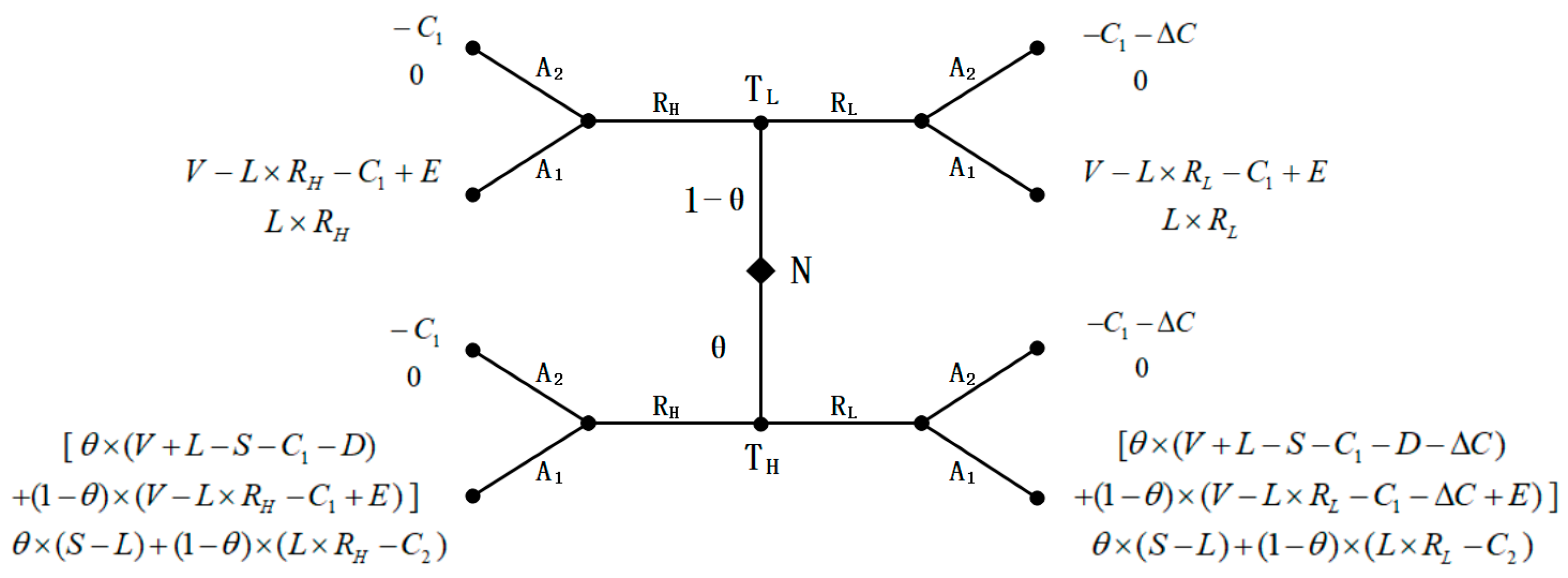
(4) Payoffs: The payoffs of the firm and financial institution are denoted as U 1 and U 2 , respectively, derived from the financing outcomes, operational returns, interest income, and default risks previously defined. The overall structure and information flow of the signaling game are illustrated in Figure 2.

4. Model Analysis

This section analyzes the signaling game model by deriving the equilibrium outcomes under different information conditions. It first examines the separating and mixed equilibria, and then develops the corresponding hypotheses based on the strategic behaviors of firms and financial institutions.
In the signaling game framework, a refined Bayesian equilibrium is achieved when the sender’s strategy R * ( T ) and the receiver’s strategy A * ( R ) are jointly consistent with the posterior belief P * ( T | R ) . Formally, such an equilibrium must satisfy two refinement conditions. (1) Receiver optimality. Given any posterior belief updated after observing a signal R , the receiver (financial institutions and investors) must choose an action that maximizes its expected payoff. (2) Sender optimality. Anticipating the receiver’s optimal response, each type of firm must select a signaling strategy R that maximizes its own expected payoff. These equilibrium requirements can be formally expressed as Formulas (1) and (2):
A * ( R ) arg max T ( T | R ) U 2 ( R , A , T )
R * ( T ) arg max ( R , A * ( R ) , T )

4.1. Separating Equilibrium

In the signaling game, two potential separating equilibria arise from the sender’s strategy profile: ( T H , T L ) ( R H , R L ) and ( T H , T L ) ( R L , R H ) . Because T L firms have a clear incentive to apply for green loans at the lower interest rate R L , the second configuration lacks practical economic relevance. Therefore, we focus on the first separating structure, where firms without substantive green transformation ( T H ) refrain from greenwashing and apply only for conventional loans at the higher rate R H , while genuinely green-transforming firms ( T L ) apply for green loans at R L . Under this configuration, the signaling game reaches a separating equilibrium in which the sender’s strategy is ( T H , T L ) ( R H , R L ) , and the receiver’s posterior beliefs become P * ( T H | R H ) = 1 and P * ( T H | R L ) = 0 .
(1)
Receiver’s optimal response
When observing signal R H , the financial institution computes the expected payoff from granting the loan ( A 1 ) and from rejecting the loan ( A 2 ) as
E 21 = T P ~ ( T | R H ) ( U 2 ( T , R H , A 1 ) = α ( S L ) + ( 1 α ) ( L R H C 2 )
E 22 = T P ~ ( T | R H ) ( U 2 ( T , R H , A 2 ) = 0
From Formulas (3) and (4), if S > L + ( 1 1 / α ) × ( L × R H C 2 ) , then E 21 > E 22 , meaning that extending the loan yields a higher expected return; hence the optimal action is A 1 . Conversely, if S < L + ( 1 1 / α ) × ( L × R H C 2 ) , the optimal strategy is not to extend the loan.
When observing signal R L , the financial institution’s expected payoff from actions A 1 and A 2 is
E 21 = T P ~ ( T | R L ) ( U 2 ( T , R L , A 1 ) = L R L C 2 > 0
E 22 = T P ~ ( T | R L ) ( U 2 ( T , R L , A 2 ) = 0
Since E 21 > E 22 , the optimal strategy upon receiving R L is also A 1 . Thus, the receiver’s equilibrium strategy is ( R H , R L ) ( A 1 , A 1 ) .
(2)
Sender’s incentive compatibility
Given the receiver’s strategy above, a T L firm has no incentive to send the high-interest signal R H . Therefore, we only need to compare the payoff of a T H firm on the equilibrium path with that off the equilibrium path. The payoff of a T H firm when sending R H (equilibrium path) is
U 1 ( T H , R H , A 1 ) = α ( V + L S C 1 D ) + ( 1 α ) ( V L R H C 1 + E )
The payoff of the same firm when deviating to R L (off-equilibrium path) is
U 1 ( T H , R L , A 1 ) = α ( V + L S C 1 D Δ C + F ) + ( 1 α ) ( V L R L C 1 + E + F )
From Formulas (7) and (8), a T H firm prefers the equilibrium strategy if Δ C F > ( 1 α ) × ( R H R L ) . When this condition holds, the expected gain from mimicking a T L firm is insufficient to offset the additional signaling cost.
Combining the receiver’s optimality condition and the sender’s incentive compatibility condition, a Separating Refined Bayesian Equilibrium exists when the following two conditions are simultaneously satisfied: S > L + ( 1 1 / α ) × ( L × R H C 2 ) and Δ C F > ( 1 α ) × ( R H R L ) . Under these conditions, the strategy profile ( T H , T L ) ( R H , R L ) , ( R H , R L ) ( A 1 , A 1 ) constitutes a stable separating equilibrium.

4.2. Mixed Equilibrium

In the mixed-strategy setting, the signal sender may adopt either ( T H , T L ) ( R H , R H ) or ( T H , T L ) ( R L , R L ) . Because T L firms have no incentive to send the high-interest signal R H , the analysis focuses exclusively on the second case, in which both T H and T L firms choose to send the signal R L . When T H firms send R L with probability σ = 1 , the signaling game converges to a pooling (confounding) equilibrium. In this state, financial institutions update their priors according to Bayes’ rule, yielding the posterior beliefs: P * ( T L | R L ) = θ and P * ( T H | R L ) = 1 θ .
(1)
Receiver’s optimal response
Upon observing the equilibrium-path signal R L , the financial institution computes the expected payoff of granting the loan ( A 1 ) and rejecting the loan ( A 2 ) as
E 21 = T P ~ ( T | R L ) ( U 2 ( T , R L , A 1 ) = θ ( L R L C 2 ) + ( 1 θ ) [ ( α ( S L ) + ( 1 α ) ( L R L C 2 ) ]
E 22 = T P ~ ( T | R L ) ( U 2 ( T , R L , A 2 ) = 0
From Formulas (9) and (10), E 21 > E 22 holds when either θ < 1 + ( L × R L C 2 ) / [ α × ( S L × ( 1 + R L ) + C 2 ) ] and S > L × ( 1 + R L ) C 2 , or simultaneously θ > 1 + ( L × R L C 2 ) / [ α × ( S L × ( 1 + R L ) + C 2 ) ] and S < L × ( 1 + R L ) C 2 . These conditions indicate that when (i) the default-compensation payment received by financial institutions exceeds the losses associated with corporate default, or (ii) the proportion θ of firms genuinely advancing green transformation is sufficiently large, issuing green loans yields a positive expected return. In such cases, the optimal action for financial institutions is to grant the loan.
When the financial institution observes signal R H , the expected payoffs from actions A 1 and A 2 are given by
E 21 = T P * ( T | R H ) ( U 2 ( T , R H , A 1 ) = θ ( S L ) + ( 1 θ ) ( L R H C 2 )
E 22 = T P * ( T | R H ) ( U 2 ( T , R H , A 2 ) = 0
According to these expressions, E 21 > E 22 requires S > L + ( 1 1 / α ) ( L R L C 2 ) .
(2)
Sender’s incentive compatibility
Given the receiver’s action profile ( R H , R L ) ( A 1 , A 1 ) , T L firms still have no incentive to deviate by sending signal R H . Therefore, the comparison focuses on the payoff of a T H firm on the equilibrium path versus that off the equilibrium path. The payoff for a T H firm on the equilibrium path (sending R L and receiving action A 1 ) is:
U 1 ( T H , R L , A 1 ) = α ( V + L S C 1 D Δ C + F ) + ( 1 α ) ( V L R L C 1 + E + F )
The payoff for deviating to R H when the receiver chooses A 2 is
U 1 ( T H , R H , A 2 ) = C 1
A T H firm prefers the equilibrium strategy when Δ C < V L R L + E + F + α ( L L R L S D E ) . If this condition holds, the T H firm earns a higher pay off by sending the pooling signal R L rather than deviating.
Combining the receiver’s optimality condition and the sender’s incentive compatibility condition, a Mixed Refined Bayesian Equilibrium exists when the following two conditions are simultaneously satisfied: S > L + ( 1 1 / α ) ( L R L C 2 ) and Δ C < V L R L + E + F + α ( L L R L S D E ) . Under these conditions, the strategy profile ( T H , T L ) ( R L , R L ) , ( R H , R L ) ( A 1 , A 1 ) constitutes a stable mixed equilibrium.

4.3. Hypothesis Development

The equilibrium analysis above provides the theoretical basis for deriving empirically testable hypotheses. The signaling game framework does not simply assume that green M&A conveys positive information; rather, it clarifies the conditions under which such information can become credible, be recognized by financial institutions, and be transmitted to capital market valuation. In particular, the model highlights the roles of signaling costs, imitation incentives, default risk, financing terms, compensation arrangements, and financial institutions’ belief updating in shaping the effectiveness of green M&A signals. Rather than serving as a full structural-estimation framework, these theoretical elements provide a mechanism-based foundation for translating the equilibrium implications into observable empirical predictions.
Specifically, the model implies three core empirical relationships. First, if green M&A serves as a credible signal of firms’ green transformation commitment, it should be reflected in capital market valuation. Second, if financial institutions recognize and respond to this signal, green M&A should affect green credit allocation. Third, if green credit reflects financial institutions’ recognition and resource-allocation response, it may transmit part of the value effect of green M&A. Accordingly, H1–H3 examine the valuation effect of green M&A, the green credit response, and the transmission role of green credit, respectively.
(1) Under the separating equilibrium, firms transmit financing signals that truthfully reflect their underlying transformation intentions. Specifically, T L firms actively engaged in green transition send R L signals to apply for low-interest green loans, while T H firms with weak transition incentives send R H signals and can only obtain conventional loans at higher interest rates. At this stage, the profits earned by T L firms undertaking green M&A and sending R L signals, denoted as E ( T L , R L , A 1 ) , and the profits earned by T H firms sending R H signals, denoted as E ( T H , R H , A 1 ) , yield a benefit differential Δ E , expressed as
E ( T L , R L , A 1 ) = V L × R L C 1 + E + F
E ( T H , R H , A 1 ) = α × ( V + L S C 1 D ) + ( 1 α ) × ( V L × R H C 1 + E )
Δ E = ( L × R H L × R L ) + F α × ( L S D + L × R H E )
In Equation (17), the first two components, the loan interest rate spread L × ( R H R L ) and the market-attention premium F , are both positive. The sign of the third component depends on firms’ default-related gains or losses and therefore requires separate discussion. In the extreme case of α = 0 , Δ E reduces to two positive components, ensuring Δ E > 0. When α = 1 , the benefits recovered through default include the loan principal and interest, while the costs include the compensation payment S , credit losses D , and foregone credit gains E . In practice, both S and D are sufficiently large to make default gains extremely small. Thus, even if the third term is negative, its magnitude remains limited, and the overall Δ E remains positive.
These results imply that firms actively engaging in green M&A achieve higher returns regardless of their default risk level. Green M&A enables access to low-interest green credit, reducing transformation financing costs and improving investment returns [55]. It also serves as a credible strategic signal that enhances market trust, stimulates positive investor expectations, and brings additional long-term value such as brand premiums [10,56]. Therefore, we propose the following hypothesis:
H1: 
Green M&A effectively increase corporate market value.
(2) When the conditions S > L + ( 1 1 / α ) × ( L × R H C 2 ) and Δ C > ( 1 α ) × L ( R H R L ) + F are simultaneously satisfied, the signaling game reaches a separating refined Bayesian equilibrium ( R H , R L ) ( A 1 , A 1 ) . This equilibrium has two implications. First, if the combined benefits from interest rate spreads L ( R H R L ) and market-attention gains F do not offset the cost of information embellishment Δ C , firms have no incentive to disguise their true transformation level. Second, if the compensation mechanism fully covers lenders’ losses from corporate default, financial institutions can profit under both strategies, implying a Pareto-improving outcome.
When conditions Δ C < V L R L + E + F + α ( L L R L S D E )   S > L + ( 1 1 / α ) ( L R L C 2 ) and S > L + ( 1 1 / α ) ( L R L C 2 ) are met, the game reaches a mixed refined Bayesian equilibrium ( R L , R L ) ( A 1 , A 1 ) . In this case, firms lacking substantive transformation incentives ( T H firms) may still engage in greenwashing to obtain low-cost credit. Financial institutions’ optimal responses then depend on the proportion θ of truly transforming companies. When θ is sufficiently high, a mixed equilibrium emerges.
In practice, lenders often recover losses through guarantees, collateral disposal, or restructuring [52]. At the same time, more firms use green M&A as a channel for strategic upgrading under low-carbon transition pressures [21]. These realities make both separating and mixed equilibria empirically plausible. Thus, green M&A functions as a credible signal that influences the allocation of credit resources. Accordingly, the following hypothesis is proposed:
H2: 
Green M&A serve as a signaling mechanism for credit resource allocation.
(3) Under both separating and mixed equilibria, T L firms have no incentive to send R H signals and will always choose R L signals to access lower-interest green credit. In the separating equilibrium, T H firms with weak transformation incentives must send R H signals and can only obtain conventional loans. This reflects their lack of substantive green actions and reliance on higher-cost credit for short-term support. In the mixed equilibrium, however, T H firms may choose to embellish information to obtain green credit. The profits and their differences between these two scenarios, when T H firms send R H under separation and R L under mixed, are given by
U 1 ( T H , R H , A 1 ) = α ( V + L S C 1 D ) + ( 1 α ) ( V L R H C 1 + E )
U 1 ( T H , R L , A 1 ) = α ( V + L S C 1 D Δ C + F ) + ( 1 α ) ( V L R L C 1 + E + F )
Δ U ( T H , R L , R H ) = α ( F Δ C ) + ( 1 α ) ( F + L R H L R L )
The results show that interest rate spreads L × ( R H R L ) and market-attention gains F are the key drivers of firms’ incentives to greenwash. These factors determine whether the equilibrium shifts from a separating equilibrium to a pooling equilibrium. In other words, credit resource allocation plays a central mediating role, influencing both firms’ financing decisions and market outcomes. Green credit provides low-cost funding for green investment, improving project returns and supporting long-term sustainable development [18]. Positive market responses to green investment further boost firm valuation [28,34]. Therefore, the following hypothesis is proposed:
H3: 
Green credit plays an important mediating role in enhancing corporate market value through green M&A.
The above hypotheses capture the core transmission chain implied by the signaling game framework, namely that green M&A signals may affect capital market valuation through financial institutions’ recognition and green credit allocation. However, the model also implies that this transmission process is conditional rather than automatic. The effectiveness of green M&A signals depends on the credibility of the signal source, the visibility of the signal during transmission, the stability of the external interpretive environment, as well as firm-level conditions related to signaling costs and default risk. Therefore, in addition to testing H1–H3, this study further conducts moderating-effect and heterogeneity analyses to examine the boundary conditions under which green M&A signals are strengthened or weakened.


5. Empirical Strategy

This section presents the empirical strategy used to test the theoretical predictions. It introduces the model specifications, variable construction, and data processing procedures, followed by descriptive statistics.

5.1. Empirical Model Construction

5.1.1. Baseline Model

To examine whether green M&A enhances corporate market value, the following baseline regression model is specified:
V a l u e i t = α 0 + α 1 M e r g e i t + α 2 C o n t r o l i t + α 3 Y e a r + α 4 I n d u s t r y + μ i t
Here, V a l u e i t denotes the market value of firm i in year t , M e r g e captures the green M&A activities, C o n t r o l indicates control variables, Y e a r and I n d u s t r y denote year and industry fixed effects respectively, and μ i t is the random disturbance term. To mitigate omitted variable bias, the model controls for firm size, financial status, and corporate governance characteristics. Firm fixed effects address unobservable, time-invariant heterogeneity, while year fixed effects absorb macroeconomic and policy shocks that may systematically affect corporate market value.

5.1.2. Signaling Effect Model

Green M&A not only improves corporate value but also serves as a credible signal of green transformation. By reducing information asymmetry, it may lower credit risk assessment costs for financial institutions and increase the likelihood of firms obtaining low-interest green credit. To test this signaling effect, the following model is estimated:
C r e d i t i t = α 0 + α 1 M e r g e i t + α 2 C o n t r o l i t + α 3 Y e a r + α 4 I n d u s t r y + μ i t
Here, C r e d i t i t measures the allocation of green credit resources.

5.1.3. Mediating Effect Model

Green M&A may indirectly enhance corporate market value by improving access to green credit. Green M&A signals transformation intentions, allowing firms to obtain lower-cost green financing, which in turn supports green investment and improves long-term profitability. A three-step mediation analysis is conducted: (1) total effect: estimate the impact of green M&A on market value using Model (21); (2) signaling effect: estimate the effect of green M&A on green credit using Model (22); (3) mediation test: add green credit to the baseline model:
V a l u e i t = α 0 + α 1 M e r g e i t + α 2 C r e d i t i t + α 3 C o n t r o l i t + α 4 Y e a r + α 5 I n d u s t r y + μ i t
A significant reduction in α 1 after including C r e d i t i t indicates the presence of a mediating effect.

5.2. Variable Description

5.2.1. Dependent Variable

Corporate Market Value: This study uses year-end total market capitalization as the primary dependent variable. Year-end market value captures the market’s comprehensive assessment of firm performance and capital operations, avoiding short-term volatility associated with quarterly or monthly indicators. Furthermore, it aligns with the annual reporting cycle of financial statements, enabling consistent matching with annual M&A and credit data. To ensure robustness, Tobin’s Q is introduced as an alternative dependent variable in subsequent analyses to re-examine the effects of green M&A and green credit on corporate market value.

5.2.2. Core Explanatory Variable

Green M&A: Following prior studies on green M&A [57], this study identifies green M&A events through dictionary-based textual screening and contextual verification. Specifically, we construct a green keyword dictionary based on the literature on green finance, green M&A, environmental disclosure, and corporate low-carbon transition, and use it to screen M&A announcements, transaction descriptions, the main businesses of acquiring and target firms, annual reports, and publicly available corporate information. A transaction is classified as green M&A only when the acquisition target, transaction purpose, target firm’s business scope, technology assets, or post-acquisition integration plan is substantively related to green transformation or environmental activities. Accordingly, green M&A is constructed as a dummy variable M e r g e that equals 1 if a firm conducts at least one green M&A transaction in a given year, and 0 otherwise. The detailed keyword categories and coding rules are reported in Appendix A.
To further capture the intensity of green M&A activities, this study constructs a continuous variable D e g r e e . This measure incorporates the number of green M&A announcements disclosed by a firm in a given year and the frequency of green-related keywords appearing in these announcements. The keyword frequency is log-transformed and combined with the announcement count to form a composite measure of green M&A intensity.

5.2.3. Mediating Variable

Green Credit: Green credit refers to loan funds used for environmental protection, energy conservation, clean production, renewable energy, green technological renovation, pollution treatment, carbon reduction, or other sustainability-oriented purposes. Drawing on prior studies on green credit and green finance [56], this study identifies green credit C r e d i t based on disclosed loan information, financing announcements, annual reports, and publicly available information from firms or financial institutions.
The identification of green credit follows the same green keyword dictionary and contextual verification procedure used for green M&A. A loan is classified as green credit only when the disclosed use of proceeds is substantively related to green projects or green investment activities. Loan records with only general references to corporate responsibility, ESG, or sustainability, but without a clear green use of proceeds, are not classified as green credit. To reduce scale differences and heteroscedasticity, the total amount of green credit is transformed using the natural logarithm.

5.2.4. Control Variables

Control variables are selected across three dimensions: firm characteristics, financial status, and corporate governance. Firstly, in terms of firm characteristics, firm size is measured by the number of employees to avoid multicollinearity between asset size and market value. Secondly, in terms of financial status, debt-to-asset ratio and return on equity (ROE) are included to capture capital structure and profitability, respectively [35,50]. Thirdly, in terms of corporate governance, variables include whether the firm is audited by a Big Four accounting firm, CEO duality, the proportion of independent directors, management shareholding ratio, and equity balance degree [58]. The inclusion of these control variables helps mitigate omitted variable bias and enhances the robustness and credibility of empirical findings.

5.3. Data Processing

This study uses Chinese A-share listed companies from 2013 to 2023 as the research sample. Financial and insurance firms, ST/*ST/PT firms, and observations with missing key variables are excluded. Continuous variables are winsorized at the 1st and 99th percentiles to mitigate the influence of outliers. The final sample consists of an unbalanced panel of 28,420 firm-year observations. Firm financial, governance, and market-value data are obtained primarily from the CSMAR and Wind databases. M&A-related information is manually collected from listed firms’ M&A announcements and major asset restructuring announcements. Green credit information is identified from loan disclosures, annual reports, financing announcements, and other publicly available corporate information.
Table 1 reports the descriptive statistics of the main variables. The mean value of the green M&A dummy variable is 0.08, indicating that approximately 8% of firm-year observations involve green M&A activities, which is broadly consistent with previous studies [59]. The mediating variable, green credit, has a mean value of 4.53 and a standard deviation of 5.77, suggesting substantial variation in firms’ access to green financial resources. The dependent variable exhibits a mean, median, and standard deviation of 22.92, 22.74, and 1.15, respectively, indicating moderate heterogeneity in corporate market value. The control variables also display considerable variation across firms in terms of size, financial conditions, and governance characteristics, providing sufficient cross-sectional variation for subsequent empirical analysis.

6. Empirical Results and Discussion

This section presents the empirical analysis of the impact of green M&A on corporate market value. The baseline regression results are reported in Section 6.1. Section 6.2 tests the robustness of these results using alternative measures, extended samples, and instrumental variable approaches. Section 6.3 further examines the signaling role of green M&A and the mediating effect of green credit in enhancing firm value.

6.1. Baseline Results

Table 2 reports the baseline regression results on the effect of green M&A on corporate market value. Three model specifications are estimated: Column (1) presents the regression without controls or fixed effects; Column (2) adds firm-level control variables; and Column (3) further incorporates year and industry fixed effects.
Across all specifications, green M&A consistently shows a positive and significant effect on corporate market value. In Column (1), the coefficient is positive and significant at the 1% level, indicating that green M&A enhances market value even without accounting for firm characteristics. After adding control variables in Column (2), the coefficient decreases to 0.1173 but remains significant at the 1% level, suggesting that part of the effect is associated with firm size, financial performance, and governance attributes, while the core impact persists. In Column (3), after controlling for year and industry fixed effects, the coefficient of green M&A is 0.0712 and remains statistically significant. Since the dependent variable is the logarithm of market value, this coefficient corresponds to an approximately 7.38% (e0.0712 − 1) higher market value. This result suggests that green M&A is associated with a moderate valuation premium.

6.2. Robustness Tests

6.2.1. Changing the Dependent Variable

To address potential measurement bias from using a single market capitalization indicator, the dependent variable was replaced from the natural logarithm of year-end total market capitalization to Tobin’s Q, capturing the impact of green M&A on firms’ asset replacement costs. In column (1) of Table 3, the estimated coefficient for green M&A is 0.0764, significant at the 1% level. The direction and significance are consistent with the baseline results, indicating that the value-enhancing effect of green M&A is robust to alternative measures of firm value.

6.2.2. Changing the Independent Variable

In the baseline model, green M&A is captured as a binary variable. To more precisely assess the effect of green M&A intensity, a continuous variable reflecting the degree of green M&A was employed. In column (2) of Table 3, the results show that the coefficient remains positive and significant at the 1% level, confirming the robustness of the main findings.

6.2.3. Lagged Independent Variables

Given the potential lag in resource integration and environmental benefits realization from green M&A, the explanatory variable is lagged by one period. In column (3) of Table 3, regression results show that the lagged green M&A coefficient remains significantly positive, consistent with the baseline results. This result suggests that the positive association between green M&A and corporate value continues into the following period.

6.2.4. Instrumental Variables Test

To further alleviate potential endogeneity concerns, this study employs an instrumental-variable approach. We construct a peer-based instrument using the lagged green M&A tendency of other firms in the same region and industry, excluding the focal firm. Specifically, for firm i, the instrument is calculated as the average green M&A tendency of other firms located in the same region and operating in the same industry in year t − 1. This variable captures the local industry-level green M&A atmosphere, peer demonstration effects, and information spillovers. Firms are more likely to conduct green M&A when peer firms in the same region and industry have previously engaged in similar transactions, as such peer activities may reduce information-search costs and generate imitation or learning effects. The leave-one-out and lagged construction helps reduce the mechanical correlation between the instrument and the focal firm’s current green M&A decision and contemporaneous market value.
Table 4 reports the IV estimation results. Column (1) shows that the instrument is significantly positively associated with green M&A, with a coefficient of 0.797 at the 1% level. The first-stage F-statistic is 15.52, exceeding the conventional threshold of 10. Since the model includes one endogenous variable and one excluded instrument, the specification is exactly identified, and the overidentification test is not applicable. Column (2) shows that the coefficient of green M&A remains positive and significant at the 1% level, indicating that the baseline result remains robust after using the peer-based instrument.

6.2.5. Propensity Score Matching (PSM) Test

To further reduce observable differences between firms with and without green M&A, this study conducts a propensity-score matching test. The propensity score is estimated using the same firm-level control variables as in the baseline regression, and firms are matched using nearest-neighbor matching within the common support region. The matched sample is then used to re-estimate the baseline model.
Table 5 reports the main balance diagnostics before and after matching. After matching, the Ps R2 decreases from 0.027 to nearly zero, and the likelihood-ratio test becomes statistically insignificant (p = 0.582). The mean standardized bias declines from 8.8% to 1.2%, and the median standardized bias declines from 5.7% to 0.7%. Rubin’s B also decreases from 40.8 to 4.5, well below the conventional threshold of 25. These results indicate that the matching procedure substantially improves covariate balance.
The regression results based on the matched sample show that the coefficient of green M&A remains positive and statistically significant. This suggests that the positive relationship between green M&A and corporate market value is not driven solely by observable differences between firms with and without green M&A.

6.3. Signal Transmission Test and Mediating Effects

Table 6 reports the pathway regression results. Columns (1) and (2) use the green M&A dummy variable M e r g e , while Columns (3) and (4) replace it with the continuous measure D e g r e e for robustness. The results show that green M&A significantly promotes green credit allocation, and both green M&A and green credit have positive and significant effects on market value. Similar results are obtained when using the continuous measure, providing preliminary evidence that green M&A serves as a positive signal to financial institutions and that green credit may act as a transmission channel linking green M&A to market value.
To formally test the mediating effect, this study conducts a bootstrap mediation analysis with 1000 replications. As reported in Table 7, the indirect effect of green M&A through green credit is 0.0172. The percentile 95% confidence interval [0.0052, 0.0275] and the bias-corrected 95% confidence interval [0.0052, 0.0257] both exclude zero, confirming the statistical significance of the indirect effect.
In terms of economic magnitude, the total effect is 0.0712, corresponding to an approximate 7.38% increase in market value. The direct effect is 0.0540 (approximately 5.55%), while the indirect effect through green credit is 0.0172 (approximately 1.73%). The mediation proportion reaches 24.12%, indicating that nearly one-quarter of the valuation effect associated with green M&A operates through the green-credit channel.
As a robustness check, we replace M e r g e with the continuous measure D e g r e e and repeat the bootstrap analysis. The indirect effect remains significantly positive at 0.0026, with both percentile and bias-corrected 95% confidence intervals excluding zero. The direct and total effects also remain positive, and the mediation proportion is 13.06%. In addition, the Sobel test produces consistent results. Overall, these findings confirm the robustness of the mediating role of green credit under alternative measurements of green M&A.

7. Moderating Effects and Heterogeneity Analyses

The preceding analysis confirms that green M&A enhances corporate market value by serving as a positive signal to financial institutions and facilitating green credit allocation. However, the signaling game framework suggests that the effectiveness of this mechanism depends on several boundary conditions that influence signal credibility and interpretation. Following the logic of information transmission, we examine these conditions from three dimensions: the signal source, the transmission process, and the external interpretive environment. Specifically, climate risk exposure reflects the characteristics of the signal source and may affect stakeholders’ assessment of the credibility of green M&A; media attention captures signal visibility and diffusion during the transmission process; and climate policy uncertainty reflects the stability of the institutional environment in which signals are interpreted. Accordingly, this section investigates how these factors moderate the relationship between green M&A and market value. Climate risk exposure is measured following [54], media attention is constructed based on report volume and readership following [60], and climate policy uncertainty is measured according to [61].
In addition, we conduct heterogeneity tests based on firms’ green capability and financial risk. Green capability is related to the signaling-cost and imitation-difficulty conditions in the model, as firms with stronger green capabilities are more likely to integrate green assets successfully and less likely to be perceived as opportunistic imitators. Financial risk corresponds to the default-risk considerations faced by financial institutions, which may affect their responses to green M&A signals. Together, these analyses provide additional evidence on the conditions under which green M&A signals are more likely to be recognized and rewarded by financial institutions and capital markets.

7.1. Moderating Effects

7.1.1. Climate Risk Exposure

A firm’s exposure to climate risk reflects its vulnerability to both physical climate shocks and transition-related challenges, which may influence the effectiveness of sustainability-oriented strategies. As shown in Column (1) of Table 8, the interaction between green M&A and climate risk exposure is significantly negative, indicating that climate risk weakens the positive relationship between green M&A and market value. This finding suggests that the valuation effect of green M&A varies across firms with different levels of climate risk exposure. One possible explanation is that higher climate risk increases uncertainty regarding firms’ future performance and the effectiveness of green transformation strategies, thereby reducing the market response to green M&A activities. Overall, the results are consistent with the view that climate risk may limit the effectiveness of green M&A as a positive market signal.

7.1.2. Media Attention

Media attention reflects the visibility of corporate activities in the public information environment and may affect how information is disseminated to external stakeholders. Column (2) of Table 8 shows that the interaction between green M&A and media attention is significantly positive, indicating that media attention strengthens the positive association between green M&A and market value. This finding is consistent with the argument that greater information visibility may facilitate the dissemination of green M&A-related information and reduce information asymmetry between firms and external stakeholders. As a result, the market may be more responsive to green M&A activities when firms receive higher levels of media attention.

7.1.3. Climate Policy Uncertainty

Climate policy uncertainty reflects instability in the institutional environment surrounding climate-related regulations and policy expectations. As reported in Column (3) of Table 8, the interaction between green M&A and climate policy uncertainty is significantly negative, suggesting that policy uncertainty weakens the positive relationship between green M&A and market value. A possible explanation is that greater uncertainty regarding future climate policies reduces the predictability of the economic benefits associated with green investments and increases the difficulty of evaluating the long-term value of green M&A activities. Consequently, the market response to green M&A may be weaker under a more uncertain policy environment.
Taken together, the moderating results indicate that the valuation effect of green M&A depends not only on the transaction itself but also on the informational and institutional context in which the transaction is evaluated. Factors that improve information visibility tend to strengthen the market response to green M&A, whereas factors that increase uncertainty tend to weaken it. These findings are consistent with the signaling framework developed in this study and provide further evidence that the effectiveness of green M&A signals varies across different market environments.

7.2. Heterogeneity Tests

To further explore the boundary conditions of the valuation effect of green M&A, we conduct heterogeneity analyses based on firms’ green capability and financial risk. The objective is to examine whether the market response to green M&A varies across firms with different internal characteristics. First, following prior studies that use green patent counts to capture firms’ green innovation capability [62], we divide the sample into a high-green-capability (HGC) group and a low-green-capability (LGC) group based on the sample median of green patent counts. As reported in Columns (1) and (2) of Table 9, green M&A is positively associated with market value in both groups, but the effect is substantially stronger among firms with higher green capability. The coefficient of green M&A is 0.1093 for the high-green-capability group and 0.0451 for the low-green-capability group, with a statistically significant between-group difference of 0.0591. This finding suggests that the valuation effect of green M&A is more pronounced among firms with stronger green innovation capabilities. One possible explanation is that firms with greater green capability possess complementary resources that facilitate the integration and utilization of green assets acquired through M&A.
Second, following studies that use the Altman Z-score to measure financial stability and default risk [63], we divide the sample into a high-financial-risk (HFR) group and a low-financial-risk (LFR) group based on the sample median of the Z-score. Since a higher Z-score indicates stronger financial stability and lower default risk, the low-financial-risk group consists of firms with above-median Z-scores. Columns (3) and (4) of Table 9 show that green M&A has a positive and significant association with market value in both groups. However, the coefficient is larger for firms with lower financial risk (0.0267) than for those with higher financial risk (0.0214), and the between-group difference is statistically significant at the 5% level. This result suggests that a more stable financial condition may strengthen the market valuation effect of green M&A.
The heterogeneity results indicate that the valuation effect of green M&A varies across firms with different levels of green capability and financial risk. These findings complement the moderating-effect analysis by showing that the effectiveness of green M&A depends not only on the external informational and institutional environment but also on firm-specific characteristics.

8. Conclusions and Policy Implications

This study investigates the relationship between green M&A, green credit, and corporate market value by combining a signaling game framework with firm-level empirical evidence. Drawing on the logic of information transmission under asymmetric information, we examine whether green M&A is associated with improved access to green credit and enhanced market valuation.
The empirical results show that green M&A is positively associated with corporate market value. This relationship remains robust across a range of alternative specifications, including different measures of market value and green M&A, lagged models, instrumental-variable estimations, and propensity-score matching. These findings suggest that the valuation effect of green M&A is not driven by specific model specifications or sample-selection concerns.
The mechanism analysis further shows that green M&A is positively associated with green credit allocation and that green credit partially mediates the relationship between green M&A and market value. These findings are consistent with the signaling framework developed in this study, suggesting that green M&A may facilitate access to financial resources and thereby contribute to corporate valuation. While the empirical results cannot directly observe information transmission or stakeholder interpretation, they provide evidence consistent with the view that financial institutions play an important role in linking firms’ environmental strategies with market outcomes.
The moderating and heterogeneity analyses further indicate that the valuation effect of green M&A varies across different informational, institutional, and firm-specific contexts. Climate risk exposure and climate policy uncertainty are associated with a weaker valuation effect of green M&A, whereas media attention is associated with a stronger effect. In addition, the positive relationship between green M&A and market value is more pronounced among firms with stronger green capabilities and lower financial risk. These findings suggest that the effectiveness of green M&A is contingent upon both external environments and internal firm characteristics.
Several implications emerge from these findings. For firms, the results suggest that the market benefits associated with green M&A may depend on firms’ ability to demonstrate substantive environmental capabilities and maintain sound financial conditions. For financial institutions, the findings highlight the potential relevance of environmental restructuring activities when evaluating firms’ long-term development prospects. For policymakers, the results underscore the importance of transparent information environments and stable policy frameworks in facilitating the functioning of sustainable finance mechanisms.
This study is subject to several limitations. First, although the signaling game framework provides a theoretical explanation for the observed relationships, the empirical analysis cannot directly observe the signal interpretation process of financial institutions and investors. Second, the analysis focuses on listed firms in China, and the generalizability of the findings to other institutional settings requires further investigation. Future research may employ survey data, experimental approaches, or cross-country comparisons to further examine how environmental signals are interpreted and incorporated into financial decision-making.

Author Contributions

Conceptualization, X.C. and C.M.; methodology, X.C.; software, X.C.; validation, X.C., C.M. and W.W.; formal analysis, X.C.; investigation, X.C.; resources, X.C.; data curation, X.C.; writing—original draft preparation, X.C.; writing—review and editing, X.C., C.M. and F.H.; visualization, X.C.; supervision, C.M.; project administration, C.M.; funding acquisition, C.M. All authors have read and agreed to the published version of the manuscript.

Funding

This research was funded by the Ministry of Education Social Science Fund Project, grant number 25YJA790047; the Beijing Municipal Social Sciences and Economics Project, grant number 22JJB016, and the Fundamental Research Funds for the Central Universities, grant number 2025YJS127.

Data Availability Statement

The data that support the findings of this study are available from the corresponding author upon reasonable request.

Acknowledgments

The authors would like to declare that no additional support was received for this study.

Conflicts of Interest

The authors declare no conflicts of interest.

Appendix A

Green Keyword Dictionary and Coding Procedure

This appendix describes the construction of the green keyword dictionary and the coding procedure used to identify the green attributes of M&A transactions and credit allocation. Following prior studies on green M&A, green finance, environmental disclosure, and corporate low-carbon transition, we first constructed a green keyword dictionary. The dictionary was then used to screen M&A announcements, transaction descriptions, target firms’ main businesses, annual reports, loan disclosures, and other publicly available corporate information.
Because M&A announcements are usually lengthy and contain extensive background information, we did not classify a transaction as green based solely on the appearance of isolated keywords. Instead, we combined keyword-based screening with contextual verification. A transaction was classified as green M&A only when the acquisition target, transaction purpose, target firm’s main business, or post-acquisition integration plan was substantively related to green transformation, environmental protection, energy saving, emission reduction, clean energy, circular economy, pollution control, carbon management, or green technology upgrading. Similarly, credit allocation was classified as green credit only when the disclosed use of loan proceeds was substantively related to green projects, environmental protection, energy-saving renovation, clean production, renewable energy, pollution treatment, carbon reduction, or other sustainability-oriented activities.
The green keyword dictionary includes the major categories below.
Table A1. Green keyword dictionary and coding criteria.
CategoryRepresentative Keywords
General green developmentgreen, green development, green civilization, green development concept, green development target, sustainable, ESG
Environmental protection and ecological governanceenvironmental protection, ecology, ecological environment, environmental governance, environmental management system, environmental protection special action, environmental emergency mechanism, environmental honor or award
Energy conservation and energy efficiencyenergy saving, conservation, low energy consumption, energy efficiency, energy consumption limit, water efficiency, reasonable use of resources
Emission reduction and low-carbon transitionlow-carbon, emission reduction, carbon neutrality, carbon peak, carbon asset, carbon management, carbon market, carbon trading, carbon cycle
Clean energy and renewable energynew energy, clean energy, green energy, renewable energy, solar energy, ocean energy, bioenergy, biomass energy, geothermal energy, clean coal
Pollution control and treatmentpollution, pollution treatment, desulfurization, denitrification, wastewater, waste gas, dust removal, pollutant discharge compliance, emission limit
Waste treatment and resource recyclingresource recycling, recycling, reuse, circular use, circular economy, garbage recycling, garbage treatment, solid waste utilization and disposal
Cleaner production and green technology upgradingclean production, green technological renovation, transformation and upgrading, green management system, green education and training
Environmental certification and regulatory complianceISO14001 certification, ISO9001 certification, “Three Simultaneities” system, key pollution monitoring unit, environmental compliance
Specific environmental treatment activitieswastewater reduction and treatment, waste gas reduction and treatment, dust and smoke treatment, noise treatment, light pollution treatment, radiation treatment, solid waste disposal
Coding rules for green M&A: For M&A transactions, the initial keyword search is used to identify potentially green-related records. These records are then manually checked in context. A transaction is classified as green M&A only when the green-related information is substantively connected to at least one of the following elements: the acquisition target, transaction purpose, target firm’s main business, technology assets, environmental assets, or post-acquisition integration plan. Keywords appearing only in general corporate slogans, broad ESG statements, risk disclosures, social responsibility descriptions, or unrelated background information are not sufficient for classification.
At the firm-year level, M e r g e equals 1 if a firm conducts at least one qualifying green M&A transaction in a given year, and 0 otherwise. To further measure the intensity of green M&A activities, D e g r e e is constructed by combining the number of green M&A announcements disclosed by a firm in a given year and the frequency of green-related keywords appearing in these announcements. Keyword frequency is log-transformed before being incorporated into the composite measure.
Coding rules for green credit: For credit allocation, the same green keyword dictionary is applied to disclosed loan information, financing announcements, annual reports, and publicly available information from firms or financial institutions. A loan is classified as green credit only when the disclosed use of proceeds is clearly related to green projects or green investment activities, such as environmental protection, energy-saving renovation, clean production, renewable energy, pollution treatment, carbon reduction, circular economy, or green technological upgrading. Loan records that only contain general references to corporate responsibility, ESG, sustainability, or environmental awareness, but do not specify a green use of proceeds, are not classified as green credit. The green credit variable is measured as the natural logarithm of the total amount of green credit identified at the firm-year level.

References

  1. Xu, J.; Li, L.; Zhang, B.; Hao, M.; Mei, F. Dual Carbon Goals’ Enhances Policy Integration: Analysing Recent Changes in China’s National Climate Policy. J. Asian Public Policy 2024, 18, 727–744. [Google Scholar] [CrossRef]
  2. Bai, R.; Lin, B. Green Finance and Green Innovation: Theoretical Analysis Based on Game Theory and Empirical Evidence from China. Int. Rev. Econ. Financ. 2024, 89, 760–774. [Google Scholar] [CrossRef]
  3. Siudak, D.; Świetlik, A. Unsupervised Learning Modeling of the Impact of Black Swan Events on Financial Network Reconfiguration: New Insights from the COVID-19 Outbreak and the Russia-Ukraine War. Phys. A Stat. Mech. Its Appl. 2025, 658, 130277. [Google Scholar] [CrossRef]
  4. Li, S.; Liu, C. Corporate Strategic Greenwashing under ESG Disclosure Uncertainty: Financing Incentives and Nonlinear Effects. J. Environ. Manag. 2025, 394, 127473. [Google Scholar] [CrossRef]
  5. Hong, Y.; Jiang, X.; Xu, H.; Yu, C. The Impacts of China’s Dual Carbon Policy on Green Innovation: Evidence from Chinese Heavy-Polluting Enterprises. J. Environ. Manag. 2024, 350, 119620. [Google Scholar] [CrossRef] [PubMed]
  6. Xu, S.X.; Guo, R.-Y.; Zhai, Y.; Feng, J.; Ning, Y. Toward a Positive Compensation Policy for Rail Transport via Mechanism Design: The Case of China Railway Express. Transp. Policy 2024, 146, 322–342. [Google Scholar] [CrossRef]
  7. Xie, Y. The Interactive Impact of Green Finance, ESG Performance, and Carbon Neutrality. J. Clean. Prod. 2024, 456, 142269. [Google Scholar] [CrossRef]
  8. He, F.; Duan, L.; Cao, Y.; Wen, S. Green Credit Policy and Corporate Climate Risk Exposure. Energy Econ. 2024, 133, 107509. [Google Scholar] [CrossRef]
  9. Tian, J.; Sun, S.; Cao, W.; Bu, D.; Xue, R. Make Every Dollar Count: The Impact of Green Credit Regulation on Corporate Green Investment Efficiency. Energy Econ. 2024, 130, 107307. [Google Scholar] [CrossRef]
  10. Ma, R.; Pan, X.; Suardi, S. Green M&A Dilemma: Unravelling the Impact on High Polluting Enterprises’ Performance. Financ. Res. Lett. 2024, 70, 106292. [Google Scholar]
  11. An, X.; Ding, Y.; Wang, Y. Green Credit and Bank Risk: Does Corporate Social Responsibility Matter? Financ. Res. Lett. 2023, 58, 104349. [Google Scholar] [CrossRef]
  12. Lin, B.; Pan, T. Financing Decision of Heavy Pollution Enterprises under Green Credit Policy: Based on the Perspective of Signal Transmission and Supply Chain Transmission. J. Clean. Prod. 2023, 412, 137454. [Google Scholar] [CrossRef]
  13. Algarni, M.A.; Ali, M.; Albort-Morant, G.; Leal-Rodriguez, A.L.; Latan, H.; Ali, I.; Ullah, S. Make Green, Live Clean! Linking Adaptive Capability and Environmental Behavior with Financial Performance through Corporate Sustainability Performance. J. Clean. Prod. 2022, 346, 131156. [Google Scholar] [CrossRef]
  14. Xie, X.; Han, Y.; Hoang, T.T. Can Green Process Innovation Improve Both Financial and Environmental Performance? The Roles of TMT Heterogeneity and Ownership. Technol. Forecast. Soc. Change 2022, 184, 122018. [Google Scholar] [CrossRef]
  15. Shu, C.; Zhao, M.; Liu, J.; Lindsay, W. Why Firms Go Green and How Green Impacts Financial and Innovation Performance Differently: An Awareness-Motivation-Capability Perspective. Asia Pac. J. Manag. 2020, 37, 795–821. [Google Scholar] [CrossRef]
  16. Yi, Z.; Liu, H.; Wang, Y.; Chen, J. How Does Green Finance Policy Affect Firms’ Pro-environmental Mergers and Acquisitions? Account. Financ. 2024, 64, 4723–4748. [Google Scholar]
  17. Chen, X.; Liang, X.; Wu, H. Cross-Border Mergers and Acquisitions and CSR Performance: Evidence from China. J. Bus. Ethics 2023, 183, 255–288. [Google Scholar] [CrossRef]
  18. Liu, D.; Xiong, Y.; Wang, L.; Yao, S. Corporate Carbon Risk and Green M&As. Res. Int. Bus. Financ. 2025, 75, 102714. [Google Scholar]
  19. Li, Q.; Cai, Y.; Qiao, Y.; Tan, H. Dual Environmental Regulation and Corporate Green Transformation: How Does Digital Leadership Affect Transformation Effectiveness? Financ. Res. Lett. 2025, 86, 108690. [Google Scholar] [CrossRef]
  20. Xiong, W.; Guo, X.; Sun, Y.; Ou, J.J. Green Standard and Green Development: Theory and Empirical Evidence. J. Clean. Prod. 2023, 414, 137768. [Google Scholar] [CrossRef]
  21. Yoshida, K.; Iino, Y.; Eba, F.; Xie, J.; Managi, S. Do Climate Change Risks and Corporate Governance Encourage Green M&A? J. Environ. Manag. 2025, 393, 127123. [Google Scholar] [CrossRef]
  22. Siedschlag, I.; Yan, W. Firms’ Green Investments: What Factors Matter? J. Clean. Prod. 2021, 310, 127554. [Google Scholar] [CrossRef]
  23. Ma, X.; Zhou, A.; Chi, C. ESG Performance and Green Total Factor Productivity. Financ. Res. Lett. 2025, 73, 106630. [Google Scholar] [CrossRef]
  24. Ye, F.; Ouyang, Y.; Li, Y. Digital Investment and Environmental Performance: The Mediating Roles of Production Efficiency and Green Innovation. Int. J. Prod. Econ. 2023, 259, 108822. [Google Scholar] [CrossRef]
  25. Zhang, F.; Li, S. Green Innovation, Executives’ Environmental Awareness, and Corporate Value Chain Upgrading. Financ. Res. Lett. 2025, 86, 108602. [Google Scholar] [CrossRef]
  26. Yang, T.; Sun, Z.; Du, M.; Du, Q.; Li, L.; Shuwaikh, F. The Impact of the Degree of Coupling Coordination between Green Finance and Environmental Regulations on Firms’ Innovation Performance: Evidence from China. Ann. Oper. Res. 2025, 347, 173–195. [Google Scholar] [CrossRef]
  27. Zhou, Y.; Huo, W.; Bo, L.; Chen, X. Impact and Mechanism Analysis of ESG Ratings on the Efficiency of Green Technology Innovation. Financ. Res. Lett. 2023, 58, 104591. [Google Scholar] [CrossRef]
  28. Wang, Y.; Wang, S.; Wang, X. Green Mergers and Acquisitions in Corporate Low-Carbon Transition: A Driving Mechanism Based on Dual External Pressures. Int. Rev. Econ. Financ. 2025, 98, 103865. [Google Scholar] [CrossRef]
  29. Su, T.; Meng, L.; Wang, K.; Wu, J. The Role of Green Credit in Carbon Neutrality: Evidence from the Breakthrough Technological Innovation of Renewable Energy Firms. Environ. Impact Assess. Rev. 2023, 101, 107135. [Google Scholar] [CrossRef]
  30. Hu, J.; Fang, Q.; Wu, H. Environmental Tax and Highly Polluting Firms’ Green Transformation: Evidence from Green Mergers and Acquisitions. Energy Econ. 2023, 127, 107046. [Google Scholar] [CrossRef]
  31. Gu, X.; Wang, Y.; Xing, X.; Deng, J. The Impact of Green Credit Policy on Heavily Polluting Enterprises’ Financial Risk: Evidence from China. Clean Technol. Environ. Policy 2025, 27, 2137–2155. [Google Scholar] [CrossRef]
  32. Qiu, Q.; Yu, J. Green Credit Policy and Default Risk of the Heavy Polluting Corporations. J. Clean. Prod. 2024, 455, 142291. [Google Scholar] [CrossRef]
  33. Li, L.; Qiu, L.; Xu, F.; Zheng, X. The Impact of Green Credit on Firms’ Green Investment Efficiency: Evidence from China. Pac.-Basin Financ. J. 2023, 79, 101995. [Google Scholar]
  34. Zhang, J.; Wu, M.; Chen, T.; Gao, B. Green Credit, Financing Constraints, and Corporate Investment: From the Perspectives of Scale and Efficiency. N. Am. J. Econ. Financ. 2024, 73, 102188. [Google Scholar] [CrossRef]
  35. Chen, S.L.; Wang, D.N.; Chen, H.W. The Impact of ESG Factors on Credit Ratings: An Empirical Study of European Banks. Int. Rev. Econ. Financ. 2025, 99, 104056. [Google Scholar] [CrossRef]
  36. Kuai, Y.; Wang, P.; Huang, G. Corporate ESG Performance and Credit Misallocation: Evidence from China. Res. Int. Bus. Financ. 2025, 73, 102621. [Google Scholar] [CrossRef]
  37. Lian, Y.; Ye, T.; Zhang, Y.; Zhang, L. How Does Corporate ESG Performance Affect Bond Credit Spreads: Empirical Evidence from China. Int. Rev. Econ. Financ. 2023, 85, 352–371. [Google Scholar] [CrossRef]
  38. Huang, Z.; Gao, N.; Jia, M. Green Credit and Its Obstacles: Evidence from China’s Green Credit Guidelines. J. Corp. Financ. 2023, 82, 102441. [Google Scholar] [CrossRef]
  39. Yin, S.; Lin, Z.; Li, P.; Peng, B. Does Environmental Credit Affect Bank Loans? Evidence from Chinese A-share Listed Firms. Int. J. Financ. Econ. 2025, 30, 1225–1248. [Google Scholar] [CrossRef]
  40. Li, S.; Chen, R.; Li, Z.; Chen, X. Can Blockchain Help Curb “Greenwashing” in Green Finance?—Based on Tripartite Evolutionary Game Theory. J. Clean. Prod. 2024, 435, 140447. [Google Scholar] [CrossRef]
  41. Zhang, W.; Luo, Q.; Zhang, Y.; Yu, A. Does Green Credit Policy Matter for Corporate Exploratory Innovation? Evidence from Chinese Enterprises. Econ. Anal. Policy 2023, 80, 820–834. [Google Scholar] [CrossRef]
  42. Zhang, L.; Song, Y.; Zhang, M.; Wu, W. Evolutionary Game Analysis of Strategic Interaction of Environmental Regulation among Local Governments. Environ. Dev. 2023, 45, 100793. [Google Scholar] [CrossRef]
  43. Cao, Y.; Ren, W.; Yue, L. Environmental Regulation and Carbon Emissions: New Mechanisms in Game Theory. Cities 2024, 149, 104945. [Google Scholar] [CrossRef]
  44. Sun, H.; Wang, K.; Du, X. Cooperative Emission Reduction Behaviour of Supply Chain Enterprises under Cap-and-Trade and Government Subsidies. Environ. Dev. Sustain. 2025, 27, 2549–2579. [Google Scholar] [CrossRef]
  45. Chen, W.; Hu, Z.H. Using Evolutionary Game Theory to Study Governments and Manufacturers’ Behavioral Strategies under Various Carbon Taxes and Subsidies. J. Clean. Prod. 2018, 201, 123–141. [Google Scholar] [CrossRef]
  46. Zhang, Z.; Shi, K.; Gao, Y.; Feng, Y. How Does Environmental Regulation Promote Green Technology Innovation in Enterprises? A Policy Simulation Approach with an Evolutionary Game. J. Environ. Plan. Manag. 2025, 68, 979–1008. [Google Scholar] [CrossRef]
  47. Li, B.; Zhang, S. Toward Suppliers’ Green Innovation: The Role of Buyers’ Environmental Information Disclosure. Corp. Soc. Responsib. Environ. Manag. 2025, 33, 1–17. [Google Scholar] [CrossRef]
  48. Fan, R.; Wang, Y.; Chen, F.; Du, K.; Wang, Y. How Do Government Policies Affect the Diffusion of Green Innovation among Peer Enterprises?-An Evolutionary-Game Model in Complex Networks. J. Clean. Prod. 2022, 364, 132711. [Google Scholar] [CrossRef]
  49. Cui, J.; Jo, H.; Na, H. Does Corporate Social Responsibility Affect Information Asymmetry? J. Bus. Ethics 2018, 148, 549–572. [Google Scholar] [CrossRef]
  50. Zhong, M.; Niu, Z.; Zhu, Y.; Li, R. Government Green Subsidies and Corporate ESG Greenwashing: Evidence from China. Econ. Anal. Policy 2025, 88, 1321–1346. [Google Scholar] [CrossRef]
  51. Dong, H.; Li, C.; Wang, X. Friendly Press, Fading Greens: The Effect of Media Connection on Firm Greenwashing. Glob. Financ. J. 2025, 68, 101179. [Google Scholar] [CrossRef]
  52. Wang, W.; Jia, J. Blockchain-Driven Tripartite Game Analysis of Agricultural Supply Chain Finance Strategy. Sustain. Futur. 2025, 10, 101253. [Google Scholar] [CrossRef]
  53. Liang, Y.; Zhang, Q. ESG Equity or Green Credit: Financing Strategies for Green Transformation in the Supply Chain under Consumption Subsidies. Int. J. Prod. Econ. 2025, 280, 109491. [Google Scholar] [CrossRef]
  54. Zhang, J. Mitigating Climate Risk in Supply Chains: Empirical Insights from the Bullwhip Effect in Chinese Enterprises. Econ. Anal. Policy 2025, 88, 888–902. [Google Scholar] [CrossRef]
  55. Suo, W.; Qiao, P. Patient Capital, Green Innovation Bubble, and Corporate ESG Performance. Financ. Res. Lett. 2025, 86, 108803. [Google Scholar] [CrossRef]
  56. Li, X.; Yong, H. The Impact of Green Finance on the Environmental Performance of Industrial Enterprises: The Moderating Role of Digital Transformation. Financ. Res. Lett. 2025, 86, 108870. [Google Scholar] [CrossRef]
  57. Zheng, Y.; Qiu, X.; Long, H.; Li, Y. The Impact of the Environmental Tax Reform on Green M&a Activities of Heavily Polluting Enterprises. Financ. Res. Lett. 2025, 86, 108853. [Google Scholar]
  58. Wang, B.; Gong, S. How Does Digital Transformation Drive Green Technology M&A under the Carbon Cap and Trade Policy? Technol. Soc. 2025, 81, 102868. [Google Scholar] [CrossRef]
  59. Li, Z.; Tang, X.; Xu, Z.; Mi, F. How Does the New Energy Demonstration City Pilot Affect Corporate Green M&A: Evidence of A-Share Listed Companies in China. Financ. Res. Lett. 2025, 86, 107909. [Google Scholar]
  60. Liu, L.; Ge, M.; Ding, Z. Impacts of Online Media and Investor Attention on Enterprise Green Innovation. Int. Rev. Econ. Financ. 2024, 96, 103569. [Google Scholar] [CrossRef]
  61. Baker, S.R.; Bloom, N.; Davis, S.J. Measuring Economic Policy Uncertainty. Q. J. Econ. 2016, 131, 1593–1636. [Google Scholar] [CrossRef]
  62. Block, J.; Lambrecht, D.; Willeke, T.; Cucculelli, M.; Meloni, D. Green Patents and Green Trademarks as Indicators of Green Innovation. Res. Policy 2025, 54, 105138. [Google Scholar] [CrossRef]
  63. Li, K.; Griffin, D.; Yue, H.; Zhao, L. How Does Culture Influence Corporate Risk-Taking? J. Corp. Financ. 2013, 23, 1–22. [Google Scholar] [CrossRef]
Figure 1. Conceptual framework for green M&A enhancing market value.
Systems 14 00641 g001
Figure 2. Green M&A signaling game model.
Systems 14 00641 g002
Table 1. Descriptive statistics.
VariableCountMeanStd. Dev.MinMedianMax
M e r g e 28,4200.080.270.000.001.00
C r e d i t 28,4204.535.770.000.0017.50
V a l u e 28,42022.921.1520.2722.7428.73
S i z e 28,4207.721.224.227.6311.18
L e v e l 28,4200.420.200.050.410.93
R o e 28,4200.060.13−0.960.070.41
I n d e p 28,42037.775.3728.5736.3660.00
B a l a n c e 28,4200.380.290.010.301.00
B i g f o u r 28,4200.060.240.000.001.00
D u a l 28,4200.300.460.000.001.00
I n s t 28,4200.420.250.000.430.92
M s h a r e 28,42014.0219.150.001.6970.05
Table 2. Baseline regression results.
(1)(2)(3)
V a l u e V a l u e V a l u e
M e r g e 0.1914 ***0.1173 ***0.0712 ***
(12.9808)(10.0368)(6.5870)
S i z e 0.9095 ***0.7770 ***
(97.4348)(72.2729)
L e v e l 1.3952 ***1.1246 ***
(32.1586)(26.0464)
R O E 0.9714 ***1.0304 ***
(25.8343)(29.6742)
I n d e p 0.0083 ***0.0019 *
(6.8708)(1.6833)
B a l a n c e 0.2608 ***0.0355
(9.4669)(1.2776)
B i g f o u r 0.5423 ***0.1984 ***
(14.7757)(5.2704)
D u a l −0.0471 ***−0.0345 ***
(−3.3946)(−2.5939)
I s h a r e 0.9453 ***1.4746 ***
(21.2896)(30.9993)
M s h a r e −0.0148 ***−0.0028 ***
(−28.5730)(−4.9790)
ControlsNoYesYes
Year/FirmNoNoYes
N28,42028,42028,420
Adjusted R20.00610.35030.3953
Significance at the 1% and 10% levels is denoted by *** and *, respectively. Test statistics are reported in parentheses.
Table 3. Robustness test.
(1)(2)(3)
T o b i n Q V a l u e V a l u e
M e r g e 0.0680 ***
(4.3167)
L _ M e r g e 0.0230 ***
(8.0304)
D e g r e e 0.0894 ***
(9.2093)
ControlsYesYesYes
Year/FirmYesYesYes
N28,42022,69528,420
Adjusted R20.06220.38030.3808
Significance at the 1% levels is denoted by ***. Test statistics are reported in parentheses.
Table 4. Instrumental variables test and PSM test.
(1)(2)(3)
M e r g e V a l u e V a l u e
G r o u p _ M e r g e 0.7970 ***
(3.9425)
M e r g e 0.1817 ***
(3.2382)
P S M _ M e r g e 0.0587 ***
(4.7119)
ControlsYesYesYes
Year/FirmYesYesYes
N28,42028,42011,326
Adjusted R20.01250.30480.5136
Significance at the 1% levels is denoted by ***. Test statistics are reported in parentheses.
Table 5. Balance diagnostics before and after matching.
SamplePs R2P > chi2Mean BiasMedian BiasRubin’s B
U n m a t c h e d 0.0270.0008.85.740.8
M a t c h e d 0.0000.5821.20.74.5
Table 6. Testing signal transmission and mediating effects.
(1)(2)(3)(4)
C r e d i t V a l u e C r e d i t V a l u e
M e r g e 0.6790 ***0.0530 ***
(103.2214)(4.0849)
C r e d i t 0.0267 ** 0.0276 ***
(2.5195) (2.9455)
D e g r e e 0.0871 ***0.0174 ***
(56.0713)(7.2417)
ControlsYesYesYesYes
Year/FirmYesYesYesYes
N28,42028,42028,42028,420
Adjusted R20.20880.39540.10370.3963
Significance at the 1% and 5% levels is denoted by *** and **, respectively. Test statistics are reported in parentheses.
Table 7. Bootstrap mediation test.
EffectEstimateBootstrap SEPercentile 95% CIBias-Corrected 95% CI
I n d i r e c t 0.01720.0053[0.0052, 0.0275][0.0052, 0.0257]
D i r e c t 0.05400.0105[0.0290, 0.0727][0.0290, 0.0727]
T o t a l 0.07120.0086[0.0565, 0.0927][0.0565, 0.0927]
Table 8. Moderating variable test.
(1)(2)(3)
V a l u e V a l u e V a l u e
M e r g e 0.0278 ***0.0115 **0.0400 ***
(7.9364)(2.2096)(5.6911)
M e r g e × R i s k −0.0870 **
(−2.5106)
R i s k −0.0732 ***
(−14.1465)
M e r g e × F o c u s 0.0432 ***
(2.6592)
F o c u s 0.0497 ***
(13.2136)
M e r g e × P o l i c y −0.0843 ***
(−2.9268)
P o l i c y −0.1163 ***
(−2.8424)
ControlsYesYesYes
Year/FirmYesYesYes
N28,42028,42028,420
Adjusted R20.26570.24550.2806
Significance at the 1% and 5% levels is denoted by *** and **, respectively. Test statistics are reported in parentheses.
Table 9. Heterogeneity tests.
HGCLGCHFRLFR
(1)(2)(3)(4)
V a l u e V a l u e V a l u e V a l u e
M e r g e 0.1093 ***0.0451 ***0.0214 ***0.0267 ***
(5.8741)(3.3643)(7.4571)(5.2373)
ControlsYesYesYesYes
Year/FirmYesYesYesYes
N13,09715,32315,78212,638
Adjusted R20.26570.24550.28060.2806
Difference0.0591 ***0.0128 **
Significance at the 1% and 5% levels is denoted by *** and **, respectively. Test statistics are reported in parentheses.
Disclaimer/Publisher’s Note: The statements, opinions and data contained in all publications are solely those of the individual author(s) and contributor(s) and not of MDPI and/or the editor(s). MDPI and/or the editor(s) disclaim responsibility for any injury to people or property resulting from any ideas, methods, instructions or products referred to in the content.