1. Introduction
The current economic landscape is undergoing rapid, significant transformations driven by advances in artificial intelligence, global geopolitical tensions, and shifting social and demographic dynamics. At the same time, public interest in sustainable development continues to grow, placing increasing pressure on organizations to align economic objectives with social and environmental responsibilities. As a result, corporate social responsibility (CSR) has become an important component of organizational strategies, reflecting the need to respond to the expectations of a wide range of stakeholders, including employees, communities, and society as a whole [
1].
CSR is reflected in both internal practices, such as diversity, equity, inclusion, and employee well-being, and in external initiatives related to environmental protection and community engagement. These dimensions are closely associated with the development of organizational reputation and human capital, shaping how organizations are perceived as employers [
2]. At the same time, CSR is increasingly integrated into employer branding strategies and is associated with organizational attractiveness and the ability to attract and retain talent in competitive labor markets [
3,
4].
From a systems-oriented perspective, CSR and human resource management (HRM) should not be understood as independent functional areas but as interconnected subsystems embedded within a broader organizational system. HR processes such as recruitment, selection, employee engagement, and retention are closely linked to CSR practices, organizational culture, and strategic positioning. In this sense, CSR can be interpreted as a value-integrating and signaling component within the HR system, shaping how organizations communicate their identity and align with the expectations of current and potential employees. These interdependencies suggest that employment-related attitudes are shaped by the interaction among organizational values, HR practices, and the external socio-economic environment, rather than by isolated factors.
The evolution of work, accelerated by digitalization and the expansion of remote work, has further transformed employees’ expectations regarding work–life balance, flexibility, and psychological safety [
5]. In this context, candidates evaluate potential employers using broader criteria that extend beyond financial compensation or career advancement opportunities. Organizational image, shaped by perceived CSR practices, transparency, and ethical conduct, is increasingly associated with individuals’ intentions to apply for a job [
6,
7].
In this context, the study’s main objective is to examine associations among CSR perception, personal values, attitudes toward social responsibility, and employment intentions. The research adopts a systemic perspective, treating these elements as interrelated components of a broader socio-organizational system. Accordingly, the study tests the following hypotheses: (H1) CSR perception is associated with employment intention; (H2) personal values and attitudes toward CSR are associated with this relationship; and (H3) organizational culture, social impact, and business ethics are associated with candidates’ preferences for socially responsible organizations.
Methodologically, the study is based on a cross-sectional survey conducted in Romania’s south-west region, using a stratified sample of 453 respondents. Data were analyzed using PLS-SEM techniques (SMART-PLS 3.0), complemented by factor analysis and ANOVA. The results indicate significant associations between CSR perception and employment intention, as well as a mediating role for personal values and attitudes. Additional analyses suggest moderate associations between organizational culture, social impact, business ethics, and preferences for socially responsible organizations.
In addition to the main model, the study examines how job-related factors (e.g., salary, organizational culture, social impact, and business ethics) shape candidates’ preferences. This complementary analysis offers further insight into how CSR-related dimensions are positioned relative to more traditional job attributes.
This study makes a distinct theoretical contribution by integrating perceptions of CSR, personal values, and attitudes toward social responsibility within a systems-oriented framework. Unlike prior studies that examine these factors in isolation, this research conceptualizes them as interdependent components of a broader socio-organizational system. This approach provides a more comprehensive understanding of employment-related decision-making by highlighting how cognitive, evaluative, and dispositional dimensions interact in shaping job-seeking intentions.
By focusing on the Romanian context, the study contributes to understanding how CSR is associated with employment preferences in emerging and transition economies, where socio-economic conditions and institutional frameworks may shape both organizational practices and individual expectations. The study focuses on a specific regional and socio-demographic context, which is taken into account when interpreting the scope and applicability of the findings.
The paper is structured into five sections: an Introduction that outlines the research context; a Literature Review; a Methodology Section; a presentation of the Results; and a discussion of the main Conclusions.
3. Materials and Methods
Our research investigates how individuals’ perceptions of an organization’s involvement in socially responsible actions are significantly associated with their attitudes and decisions during the employment process. The conceptual model is interpreted from a systems perspective, in which the constructs analyzed (CSR perception, personal values, attitudes, and employment intention) are treated as interrelated components of a broader socio-organizational system. The model captures associative relationships between these elements, reflecting how individual and organizational dimensions are embedded within a network of interactions rather than functioning independently.
Data were collected in Romania’s south-west region between June and September 2025. The research tool was a paper questionnaire distributed to 470 participants; 453 provided valid responses. The questionnaire was developed based on a review of relevant academic literature and tailored to the Romanian context. It consisted of four sections: socio-demographic characteristics, perception of organizational CSR practices, employment intentions and preferences, and personal values and social behavior.
The questionnaire items used in the analysis were selected from the full survey instrument and are presented in
Appendix A. The constructs in the SEM model were operationalized as follows: CSR perception was measured with item PCRS_1, which captures the perceived importance of organizational involvement in socially responsible actions; employment intention was measured with items IDJ, MJ, and DJS, reflecting respondents’ stated likelihood of applying to or choosing organizations based on CSR engagement; attitude toward CSR was operationalized with a multi-item scale (ACSR_a), capturing evaluative beliefs about the influence of CSR on job choice, organizational attractiveness, and reputation; and personal values and social behavior were measured with items RVP and IPCSR, reflecting value alignment and the perceived importance of CSR promotion.
The questionnaire was informed by prior literature on CSR perception, employer attractiveness, and value-based decision-making [
31,
32,
33,
34]. Items were adapted to the Romanian socio-economic context to ensure relevance and clarity while preserving their conceptual meaning.
The questionnaire was originally developed in Romanian and translated into English for reporting purposes. A pretesting phase was conducted with a small group of respondents (n = 20) to evaluate item clarity, wording, and comprehension. Based on this feedback, minor adjustments were made to improve consistency and eliminate ambiguities.
The sample was constructed using a stratification strategy based on key socio-demographic characteristics, including age, education level, and area of residence. Rather than applying proportional stratified sampling with predefined quotas, the study aimed to ensure diverse respondent profiles across these categories during data collection.
The questionnaire was distributed online via convenience sampling, targeting individuals in the south-west Oltenia region. As a result, although respondents from different socio-demographic groups were included, the final sample is not statistically representative of the regional population. The sample is predominantly composed of urban (81.67%) and highly educated individuals, with a relatively high proportion of students and young respondents (
Table 1).
The sample size of 453 respondents is consistent with commonly accepted thresholds for survey-based research and allows for statistical analysis within an acceptable margin of error under standard assumptions. However, given the non-probabilistic nature of the sampling approach, these parameters should be interpreted as indicative rather than as evidence of full statistical representativeness.
The exploratory study identified four latent variables: Attitude towards CSR, Employment Intention Depending on the Organization’s Social Responsibility, Perception of the Organization’s Socially Responsible Behavior, and Personal Values and Social Behavior, derived from observable variables collected through questionnaire items.
The first latent variable, Attitude toward CSR, reflects respondents’ general evaluative orientation toward CSR, including associations of CSR policies with personal employment decisions, perceived attractiveness of volunteer programs, interest in CSR-related information, appreciation of diversity and inclusion, perceptions of CSR’s impact on company reputation, and belief in CSR’s ability to attract talent.
The second latent variable, Employment Intention Depending on the Organization’s Social Responsibility, captures behavioral intention, reflecting respondents’ stated likelihood of applying to or remaining with an organization based on its CSR profile.
The construct Perception of the organization’s socially responsible behavior is operationalized using a single global indicator that reflects respondents’ overall evaluative judgment of the organization’s CSR practices. While multi-item measures are generally preferred in SEM, the use of a single-item construct is theoretically justified in this context, as CSR perception is treated as a broad, concrete, and directly observable evaluative construct rather than a multidimensional latent variable. Prior research suggests that single-item measures can be appropriate when the concept is clearly defined, unambiguous, and captures a holistic perception.
In this study, CSR perception is conceptually positioned as a global cognitive signal that individuals use to evaluate organizations, rather than as a construct requiring dimensional decomposition. This approach is consistent with the study’s systems-oriented perspective, in which CSR perception serves as an integrative input within a broader configuration of values, attitudes, and behavioral intentions. However, this operationalization may limit the assessment of internal consistency and should be interpreted with caution.
The fourth variable, Personal Values and Social Behavior, represents relatively stable individual characteristics related to ethical beliefs, value systems, and social responsibility orientation that influence how CSR is interpreted.
Most questions used a five-point Likert scale ranging from “very important/highly/probable” to “not important/low/unlikely,” allowing for detailed assessments of respondents’ attitudes and perceptions.
Data processing and analysis were performed using SMART-PLS software (version 3.0), developed by SmartPLS GmbH (Germany). SMART-PLS is an advanced statistical tool for Partial Least Squares Structural Equation Modeling (PLS-SEM), commonly used in economic, social, and management research. It enables the examination of complex relationships between latent and observed variables and is especially suitable for exploratory and predictive studies. Utilizing SMART-PLS 3.0 allowed for a thorough evaluation of the collected data and offered a detailed understanding of the relationships among the theoretical constructs included in the model.
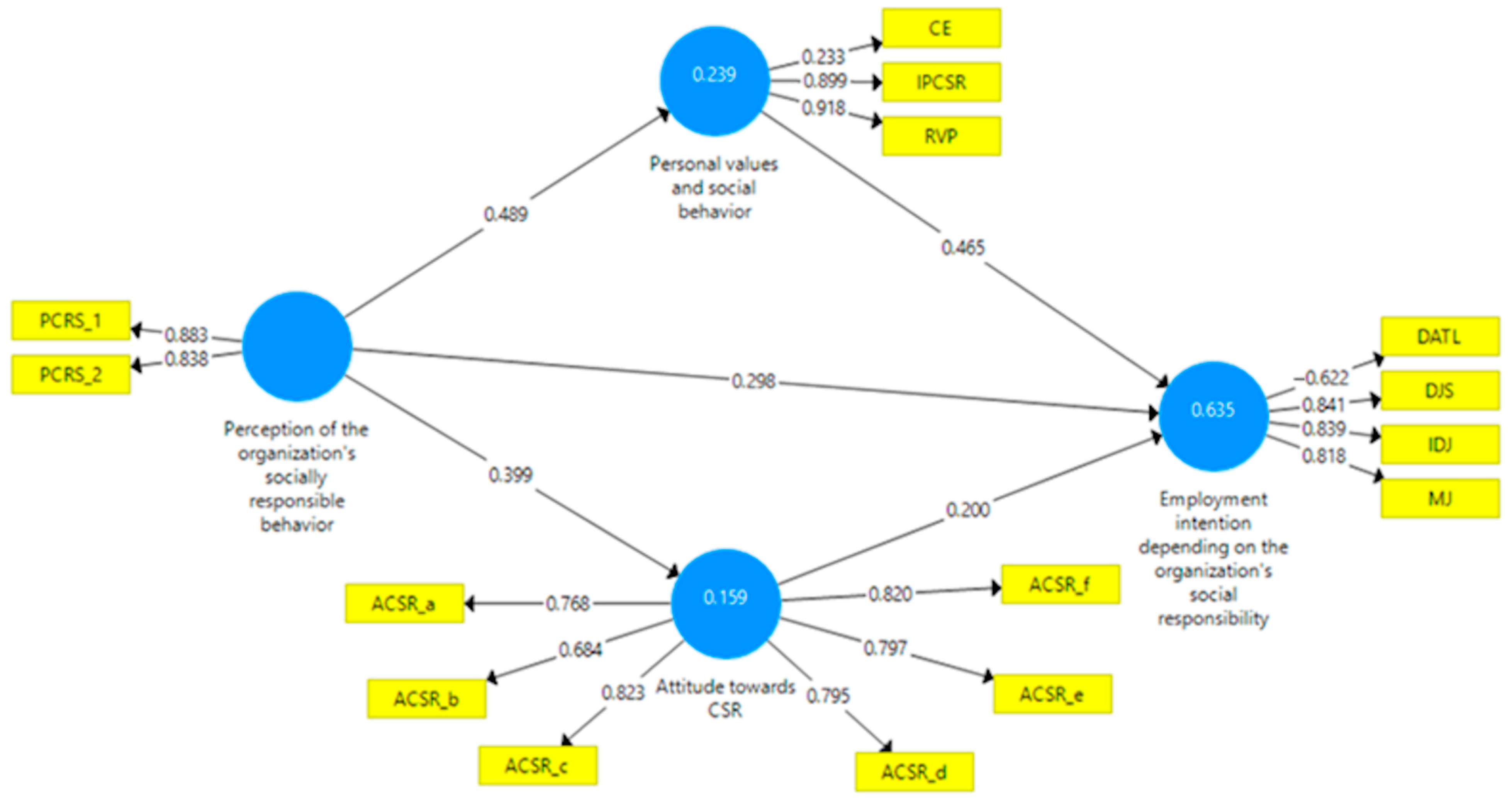
The initial model is illustrated in
Figure 1.
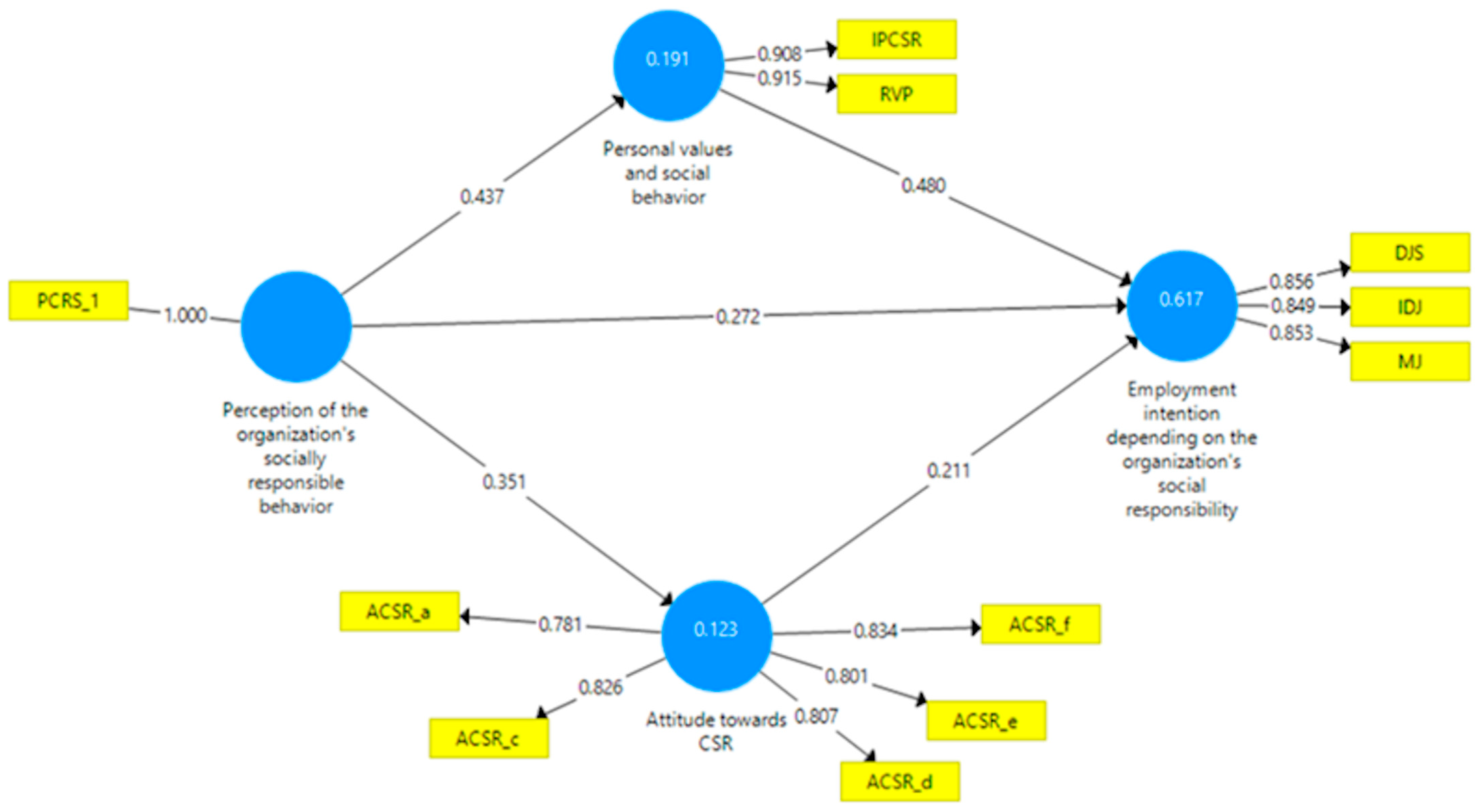
During the measurement model evaluation, indicator reliability was assessed based on outer loadings. Following standard PLS-SEM guidelines, indicators with loadings below the recommended threshold of 0.70 were considered for removal to improve construct reliability and convergent validity. The resulting structural equation model (SEM-PLS) revealed significant relationships among the analyzed constructs, providing valuable insights into the psychosocial dynamics underlying professional decision-making (
Figure 2).
The elimination of indicators was based primarily on statistical criteria, while care was taken to preserve the conceptual integrity of each construct. The final model retains only indicators that demonstrate adequate reliability and meaningfully contribute to the measurement of the latent variables. Although PCRS_2 exhibited an acceptable loading, it was removed to ensure a more parsimonious representation of the construct and to avoid redundancy with the retained global indicator. The use of a single-item measure for CSR perception reflects the intention to capture a global evaluative judgment rather than a multidimensional construct. Previous research has acknowledged that single-item measures can be acceptable for clearly defined and narrowly scoped constructs. However, this approach may limit the ability to assess internal consistency and should be interpreted with caution.
For transparency, the indicator loadings before and after model refinement are reported in
Appendix A.2 (
Table A1).
Reliability indicators showed high internal consistency across the study’s measures, with Cronbach’s Alpha and Composite Reliability values approaching or exceeding 0.8, indicating that the items reliably assessed the same constructs. Both
Attitude towards CSR and
Employment Intention Depending on the Organization’s Social Responsibility demonstrated strong reliability, suggesting that participants responded consistently to the related items. The Average Variance Extracted (AVE) values, all above 0.5, confirmed that the latent constructs captured most of the variance rather than statistical noise (
Table 2).
For the construct “Perception of the organization’s socially responsible behavior”, reliability indicators equal to 1.000 reflect the use of a single-item measure and do not indicate internal consistency in the traditional sense.
The discriminant validity analysis, conducted using the Fornell–Larcker criterion, confirmed that the constructs were both conceptually and empirically distinct. The diagonal values, representing the square roots of the average variance extracted (AVE), were higher than the corresponding correlations among constructs, indicating good construct differentiation. For example, the construct “Employment Intention Depending on the Organization’s Social Responsibility” had a diagonal value of 0.853, significantly higher than its correlations with other dimensions, confirming that it represents a distinct conceptual entity within the model (
Table 3).
Each construct exhibited a distinct statistical profile, contributing independently to understanding how perceptions of social responsibility are associated with employment decisions. The Variance Inflation Factor (VIF) values indicated acceptable levels of collinearity among the model’s indicators, with all values below the critical threshold of 3.5, suggesting that the relationships between variables were not hindered by severe multicollinearity (
Table 4).
Regarding model fit, the Standardized Root Mean Square Residual (SRMR) measured 0.059, indicating a strong fit between the theoretical model and the data. Usually, SRMR values below 0.08 suggest a satisfactory fit.
The model’s path coefficients and indirect effects were calculated using a bootstrapping method with 10,000 repetitions, a reliable technique that assesses the stability and significance of relationships among latent variables within the SEM-PLS framework.
To assess data distribution, normality tests were performed using both the Shapiro–Wilk and the Kolmogorov–Smirnov procedures. In addition, skewness and kurtosis values were calculated for all variables to evaluate potential deviations from normality. The results indicate that several variables deviate from normality (see
Table A1 in
Appendix A.3.); however, this does not affect the validity of the analysis, as PLS-SEM is a variance-based method that does not require strict normality assumptions. These tests are reported to provide additional transparency regarding the data structure.
4. Results and Discussion
Preliminary analyses indicated deviations from normality, as reflected in skewness and kurtosis; however, these do not affect the robustness of PLS-SEM estimates. The results from the PLS-SEM analysis using the bootstrap method provide a detailed perspective on the statistical relationships among participants’ perceptions of organizational social responsibility, their personal values, attitudes toward CSR, and their employment intentions. The findings indicate a strong, statistically significant association between perceived socially responsible behavior and employment intention (coefficient = 0.272, p < 0.001). This perception is also significantly associated with attitudes toward CSR (coefficient = 0.351) and with personal values and social behavior (coefficient = 0.437), suggesting that organizational social responsibility is closely linked to multiple attitudinal and value-based dimensions.
Furthermore, personal values and attitudes toward CSR are significantly associated with job application intentions, with personal values showing the strongest relationship (coefficient = 0.480) (
Table 5).
The strong association between personal values and employment intention suggests that value congruence plays a central role in shaping employment-related decisions. This finding indicates that individuals do not evaluate CSR solely as an external organizational attribute, but rather interpret it through their internal value systems. From a theoretical perspective, this reinforces the importance of value-based frameworks, such as person–organization fit and social identity theory, in explaining how CSR-related signals are translated into behavioral intentions.
The results indicate that respondents in the analyzed sample who report greater alignment between their personal values and CSR-related principles also tend to have stronger employment intentions toward socially responsible organizations. These findings should be interpreted with consideration of the distinct roles of the constructs: CSR perception represents a cognitive evaluation, attitudes reflect an evaluative orientation, personal values capture deeper dispositional tendencies, and employment intention reflects behavioral responses.
Regarding indirect relationships, the findings indicate that perceptions of social responsibility are associated with employment decisions through two statistically significant pathways: one involving personal values and social behavior (indirect coefficient = 0.210) and another involving attitudes toward CSR (indirect coefficient = 0.074) (
Table 6).
These results provide empirical support for the mediating role of personal values and attitudes toward CSR, confirming that the relationship between CSR perception and employment intention operates both directly and indirectly through these mechanisms, validating hypothesis H2.
The total effects further indicate that perceptions of socially responsible organizational behavior are strongly associated with employment intention (coefficient = 0.556), supporting hypothesis H1 in relational terms. Overall, the results suggest that, in a social context increasingly oriented toward ethical considerations, respondents in the analyzed sample who perceive organizations as socially responsible are more likely to express greater interest in working for them. This pattern is consistent with prior research and highlights the growing relevance of CSR-related perceptions in shaping employment-related attitudes [
33,
43].
The combined direct and indirect associations reveal a complex structure in which corporate social responsibility is linked not only to organizational attractiveness but also to respondents’ internal value systems and attitudes. Among all variables, personal values and social behavior exhibit the strongest overall association with employment intention, reinforcing the idea that respondents tend to evaluate employment opportunities through the lens of value congruence.
To complement the SEM analysis, an additional exploratory analysis was conducted to examine how specific job-related factors (FIJN variables) shape candidates’ preferences for socially responsible organizations. While the SEM model captures relationships among CSR perception, values, attitudes, and employment intention, this secondary analysis focuses on how organizational attributes, both CSR-related and functional, are associated with these preferences.
This approach allows for a broader interpretation of employment decision-making by integrating both value-based and job-related considerations within a systemic perspective.
The factor analysis examining the determinants of job application behavior in relation to respondents’ preference for socially responsible organizations (DJS) reveals several meaningful associations among the variables. The correlation matrix indicates moderate-to-strong positive relationships among decision-making factors (
Table 7).
The most notable correlations are between perceptions of organizational culture and the company’s social impact (r = 0.642) and between social impact and business ethics (r = 0.576). These findings suggest that respondents view dimensions related to organizational values and responsibility as closely interconnected. The correlations between DJS and organizational culture (0.399), social impact (0.412), and business ethics (0.326) are significant, indicating that a preference for socially responsible organizations is strongly associated with these attributes.
The Kaiser–Meyer–Olkin test (KMO = 0.798) indicates good sampling adequacy for factor analysis, and Bartlett’s test of sphericity shows that the correlation matrix differs significantly from an identity matrix (χ2 = 965.822, p < 0.001), confirming the method’s suitability. Regarding explained variance, the first factor extracted using the principal axis method initially accounts for 44.99% of the total variance and retains 36.89% after extraction, a reasonable outcome for studies involving psychosocial dimensions.
The communalities, which indicate the proportion of variance in each variable explained by the common factor, are highest for indicators of organizational culture (0.572), the company’s social impact (0.621), and business ethics (0.418), suggesting that these dimensions are strongly associated with the shared latent construct. The DJS variable has a lower communality (0.156), but it remains sufficient to justify its inclusion in the model (
Table 8).
The factor matrix shows high loadings for organizational culture (0.757), corporate social impact (0.788), and business ethics (0.647), indicating that these factors are central to respondents’ decision-making. Professional development (0.605), salary and benefits (0.496), and work schedule flexibility (0.452) also show meaningful loadings, though to a lesser extent. The DJS variable has a loading of 0.395, lower than those for organizational culture, social impact, and business ethics, suggesting weaker integration of this variable within the common factor structure.
The analysis confirms a shared underlying factor linking respondents’ preferences for socially responsible employers to specific organizational characteristics. This finding emphasizes that, beyond the material or functional aspects of job offers, organizational values, social impact, and ethical practices are strongly associated with job application preferences, underscoring the importance of corporate social responsibility in shaping employment-related attitudes.
To examine the relationship between key factors and respondents’ preference for socially responsible organizations, a univariate factorial analysis was performed. The ANOVA results indicate a statistically significant model (F(6, 446) = 21.578,
p < 0.001) with an R
2 of 0.225, suggesting that approximately 22.5% of the variance in preference for socially responsible organizations is associated with the model factors (
Table 9). While this level of explained variance is meaningful, it does not indicate a strong explanatory model; therefore, the results should be interpreted as moderate in strength.
When examining individual relationships, organizational culture (FIJN_d) is significantly associated with respondents’ preference for socially responsible employers (
p < 0.001), with a coefficient of 0.283 (
Table 10).
Similarly, corporate social impact (FIJN_e) is associated with this preference (p < 0.001) and has the highest coefficient among all factors (0.295). Business ethics (FIJN_f) is also significantly associated with respondents’ preferences (p = 0.034; B = 0.118). Together, these findings provide empirical support for hypothesis H3 when interpreted as statistical associations.
Conversely, salary and benefits (FIJN_a) and work schedule flexibility (FIJN_b) are not significantly associated with preferences for socially responsible organizations. Professional development opportunities (FIJN_c) show a statistically significant but weak and negative association with candidates’ preference for socially responsible organizations (p = 0.039; B = −0.143). This unexpected negative association may reflect a contextual or sample-specific effect in which respondents prioritize ethical alignment and organizational values over traditional career advancement considerations. One possible explanation is that, in the analyzed sample, CSR-related attributes are perceived as more indicative of long-term organizational quality and identity than professional development opportunities. Alternatively, this result may reflect a trade-off perception, where candidates associate highly CSR-oriented organizations with non-material benefits rather than career advancement. Given the relatively small effect size, this finding should be interpreted cautiously and may warrant further investigation in future research.
The negative coefficient associated with professional development opportunities suggests that, in this context, CSR-related attributes may outweigh traditional career advancement considerations. However, given the small effect size, this result should be interpreted with caution.
The analysis for hypothesis H3 is based on complementary statistical techniques, including factor analysis and ANOVA, rather than on the main SEM framework. The results of the exploratory analysis complement the SEM findings by showing that CSR-related dimensions (organizational culture, social impact, and business ethics) are more strongly associated with candidates’ preferences than traditional job attributes such as salary or flexibility. This supports the systemic interpretation of HR, in which multiple organizational subsystems interact to shape employment-related attitudes. This approach was adopted to explore the structure and relative importance of organizational attributes linked to respondents’ preferences. However, the dependent variable (DJS) shows low communality (0.156) and a moderate factor loading (0.395), indicating that the extracted factor accounts for only a limited amount of shared variance. Therefore, the results should be interpreted with caution, and support for H3 may be considered indicative rather than conclusive.
In summary, the empirical results provide moderate support for hypothesis H3, indicating that organizational culture, social impact, and business ethics are associated with respondents’ preferences for socially responsible organizations. CSR dimensions that reflect deeper aspects of organizational identity and behavior are closely related to professional preferences, especially when ecological initiatives serve as credible signals of an organization’s commitment to sustainability and reputation [
2]. However, organizational attractiveness does not fully account for the relationship between CSR communication and employment intention, suggesting the presence of additional mechanisms, such as value alignment between respondents and organizations [
20].
These elements, which reflect core aspects of organizational identity and ethical conduct, are associated with respondents’ career preferences, particularly in contexts where personal values play an increasingly important role. The findings indicate a strong, positive association between perceptions of corporate social responsibility and willingness to work for a company, aligning with established research on how organizational reputation relates to employee attraction [
7,
31,
43]. The overall coefficient (β = 0.556) falls within the range reported in previous studies (β = 0.45–0.60), indicating consistency and cross-contextual relevance of this relationship.
Recent research has highlighted the psychological processes underlying this relationship. Behrend et al. [
44] showed that perceived organizational justice is related to job preferences, while Klimkiewicz and Oltra [
45] emphasized the importance of perceived organizational support. The current study builds on these findings by showing that personal values are strongly associated with the relationship between CSR perception and job-seeking intention (β = 0.210). These results suggest that value congruence between individuals and organizations is closely linked to employment-related attitudes. Unlike models that focus solely on reputation, this study highlights a broader moral dimension, in which perceptions of corporate responsibility are associated with identification and alignment between personal and organizational values.
The findings also align with recent European research trends. Coelho et al. [
20] showed that environmentally focused recruitment messages are associated with higher organizational attractiveness, especially among candidates with strong environmental responsibility and pro-environmental behaviors. Furthermore, Andruszkiewicz et al. [
2] demonstrated that integrating internal CSR practices (such as well-being, equity, and inclusion) with external practices (such as community engagement and environmental protection) is associated with stronger employer branding. They also found differences across employee categories, suggesting that CSR preferences vary by occupational profile.
Therefore, this research offers a perspective that integrates personal values into a model explaining employment intention in relation to CSR perception. The observed relationships extend beyond simple reputation-based explanations and highlight the importance of ethical alignment between respondents in the analyzed sample and the organizations they represent, suggesting that responsible employers are closely associated with value-based identification processes among candidates.
From a systems perspective, these findings suggest that employment-related attitudes are shaped by the interactions among multiple organizational subsystems, including CSR practices, organizational culture, and HR processes. Rather than acting independently, these elements form a dynamic configuration in which value alignment, ethical signaling, and organizational context jointly shape individuals’ preferences. This systemic interpretation highlights that organizational attractiveness emerges from the coherence and consistency of these interconnected components.
By integrating these dimensions within a systems-oriented framework, the study moves beyond descriptive associations and highlights the underlying configuration through which CSR influences employment intentions. This perspective emphasizes that a single factor does not drive CSR impact, but rather the alignment and interaction between organizational signals and individual value systems.
While the results provide consistent evidence of associations between CSR perception, personal values, and employment intention, alternative explanations should also be considered. For instance, the observed relationships may be influenced by respondents’ general pro-social orientation, which could simultaneously affect both their perception of CSR and their employment preferences. In addition, the use of self-reported measures collected at a single point in time may introduce common-method bias, potentially inflating the strength of observed associations.
Moreover, the sample structure, characterized by a predominance of young, urban, and highly educated respondents, may partially explain the strong emphasis on value-based factors. This group is more likely to prioritize ethical and social considerations, which may not fully reflect broader labor market dynamics. Therefore, the results should be interpreted as context-dependent rather than universally generalizable.
The findings of this study should be interpreted within the specific regional and socioeconomic context of Southwest Romania. The sample characteristics, as well as the region’s institutional and labor market conditions, may influence the observed relationships. Therefore, the results should be understood as reflecting context-specific dynamics rather than as broadly generalizable labor-market patterns.
While CSR-related factors appear to be associated with employment preferences in this study, their relative importance may vary across national and organizational contexts. As such, the applicability of these findings beyond the studied region should be considered with caution.
5. Conclusions
5.1. Main Empirical Findings
The findings indicate that corporate social responsibility (CSR) is positively associated with job application intentions, both directly and indirectly through personal values and attitudes. The empirical analysis shows a statistically significant overall association (β = 0.556) between CSR perception and job application intention, as well as indirect associations through personal values (β = 0.480) and attitudes toward CSR. These results support the proposed hypotheses (H1–H3) when interpreted as relational patterns rather than causal effects.
Among the dimensions analyzed, social impact (β = 0.295), organizational culture (β = 0.283), and business ethics (β = 0.118) show stronger associations with job-seeking intentions than more traditional job-related factors. Professional development opportunities exhibit a statistically significant, but weak and negative, association (β = −0.143), suggesting a limited role in distinguishing preferences for socially responsible organizations. In contrast, salary, benefits, and flexibility do not show statistically significant associations in this context.
These results are consistent with prior research indicating that CSR is associated with organizational attractiveness and employment-related attitudes. In particular, personal values (β = 0.480) are an important component of the relationship between CSR perception and job application intention, highlighting the relevance of value congruence between individuals and organizations.
Overall, the study suggests that, in the context analyzed, employment intentions are associated with both CSR-related perceptions and value-based considerations. CSR may therefore be interpreted as an important element of organizational identity, linked to perceived attractiveness and alignment between individuals and organizations. However, these findings should be interpreted with the limitations of a cross-sectional design in mind and as associations rather than causal relationships.
These conclusions should also be considered in light of the sample’s specific profile, which consists mainly of young, urban, and highly educated individuals. As such, the findings primarily reflect this group’s preferences and may not capture the full diversity of the broader labor market.
5.2. Theoretical Implications
This study contributes to the literature by advancing a systems-oriented perspective on the relationship between CSR perception and employment-related attitudes. Specifically, it integrates CSR perception, personal values, and attitudes toward social responsibility into a unified analytical framework, demonstrating how these elements function as interdependent components rather than as isolated determinants. This represents a shift from linear, variable-centered approaches to a configurational understanding of employment decision-making.
The results are consistent with established theoretical perspectives, such as signaling theory and social identity theory, while suggesting that these mechanisms may operate within a more complex configuration of organizational and individual factors. CSR-related perceptions can be understood as part of a network of signals and meanings that individuals interpret in relation to their personal values and the perceived characteristics of organizations.
In this sense, the findings support the view that employment-related attitudes are associated with configurations of organizational attributes rather than with isolated variables. Organizational culture, social impact, and business ethics emerge as interrelated dimensions that jointly shape perceptions of organizational attractiveness. This aligns with systems-oriented perspectives in HRM, which emphasize interactions among multiple organizational elements.
The study also contributes by distinguishing between multiple analytical levels: cognitive (perception), evaluative (attitudes), dispositional (values), and behavioral (intention), thereby reducing conceptual overlap and offering a more structured interpretation of CSR-related employment preferences. Overall, the research provides a relational and context-sensitive perspective on CSR within HRM, emphasizing interdependencies rather than introducing a new theoretical paradigm.
Furthermore, the study contributes by explicitly distinguishing between multiple analytical levels, cognitive (perception), evaluative (attitudes), dispositional (values), and behavioral (intention), and by demonstrating how their interaction shapes employment-related outcomes. This multi-level integration extends the existing CSR and HRM literature by offering a more nuanced, system-based interpretation of how organizational signals are processed and translated into individual decisions.
5.3. Practical Implications
The findings highlight the strategic importance of aligning CSR practices with potential employees’ value systems. Organizations should not treat CSR solely as a reputational or communication tool, but as an integral component of employer branding and human resource strategy. In particular, the strong role of personal values suggests that recruitment strategies should emphasize authenticity and value congruence, rather than focusing exclusively on functional job attributes.
From a managerial perspective, the findings suggest that CSR-related factors influence how potential candidates evaluate organizations, particularly in terms of organizational culture, social impact, and ethical conduct. These elements may therefore be relevant to shaping employer attractiveness, especially among individuals who place greater importance on value alignment.
Organizations may benefit from integrating CSR-related themes into their employer branding and communication strategies, ensuring that these messages align with internal practices and organizational culture. Transparent, coherent communication about CSR activities may signal to potential employees and support their evaluation of the organization’s identity.
Recruitment and selection processes may also consider value alignment, particularly in contexts where candidates place importance on ethical and social dimensions. However, these implications should be interpreted with caution, as the present study does not directly assess causal effects or organizational outcomes such as performance or retention.
Overall, CSR-related practices can be viewed as part of a broader set of organizational attributes that may be associated with employment preferences. Their role should be understood in conjunction with other factors and within the specific context in which organizations operate.
5.4. Study Limitations
This study acknowledges the limitations of its cross-sectional design, which restricts causal inference and limits the exploration of contextual dynamics, such as the impact of post-2020 economic crises on CSR perceptions. Future research could employ longitudinal designs to assess the stability of the CSR–employment intention relationship over time.
Furthermore, the sample consists mainly of young, highly educated respondents, which may limit the generalizability of the findings. The predominance of urban, highly educated individuals in the sample further reduces the external validity of the results and their applicability to more diverse labor-market populations.
Another limitation of this study is its regional focus on south-west Romania, combined with the sample’s specific socio-demographic structure. These characteristics may influence the observed patterns and limit the extent to which the findings can be generalized to broader labor-market contexts or to populations with different socio-economic profiles.
Since all variables were collected via a single self-reported questionnaire at a single time point, the results may be affected by common-method bias. Therefore, the findings should be interpreted as associations rather than causal relationships. Additionally, some variables deviated from normality, which, although acceptable for PLS-SEM, may still influence the interpretation of statistical relationships. A mixed-method approach combining quantitative and qualitative techniques could provide a more comprehensive understanding of candidates’ perceptions and enhance external validity.
Another limitation concerns the use of a single-item measure of CSR perception, which may restrict the depth of construct representation and the assessment of measurement reliability. Future studies should consider using multi-item scales to better capture the multidimensional nature of CSR perception.
Finally, the use of a non-probabilistic, convenience-based sampling approach limits the study’s external validity. Although elements of stratification were considered, the lack of proportional allocation and the overrepresentation of urban and highly educated individuals limit the extent to which the findings can be generalized to the entire regional population.
5.5. Future Research Directions
Building on these results, several promising research directions emerge. One involves conducting longitudinal studies to track the development of CSR perceptions and job application intentions over time, while accounting for contextual factors such as post-2025 sustainability policies. Another focuses on analyzing intercultural and intergenerational differences, comparing how Generations Y and Z view corporate responsibility and organizational values.
Experimental research on digital CSR communication could clarify how online sustainability messages affect perceptions of organizational authenticity. Likewise, comparing reactions to CSR campaigns with those to campaigns perceived as greenwashing might reveal distinct effects on job application intentions and organizational credibility. Adding additional moderators, such as organizational trust or professional identity, would provide a more detailed understanding of the link between CSR and employment intentions.
Future research should examine these relationships across regional and national contexts, using more diverse and representative samples, to assess the robustness and transferability of the observed patterns. Comparative studies could further explore how institutional, cultural, and labor-market differences shape CSR’s role in employment-related decision-making.
Comparative analyses across occupational categories, such as white-collar and blue-collar workers, could reveal differences in how internal and external CSR dimensions are perceived. Finally, integrating artificial intelligence into digital CSR analysis could open new opportunities to assess how emerging technologies shape candidates’ perceptions and how organizations communicate their ethical commitments. A transdisciplinary approach that combines quantitative, qualitative, and digital methods could provide a broader view of the interplay among personal values, authenticity, and social signaling in employment decisions, helping to develop a coherent conceptual framework for CSR focused on sustainable human resource management.
Future research should explicitly examine the role of CSR authenticity and perceived greenwashing, as these aspects were not directly measured in the present study but may significantly shape the association between CSR and employment-related attitudes.
From a systems-oriented perspective, CSR should be understood as an integral component of a broader organizational configuration in which human resource practices, organizational culture, and external environmental factors interact. The results suggest that organizational attractiveness and employment intentions are associated with the coherence among these interconnected elements, underscoring the importance of adopting an integrated, systemic approach to HR strategy.




 ,
,