

AI-Enabled Super Apps as Complex Socio-Technical Ecosystems: A Systemic View of User Continuance

Abstract
1. Introduction
2. Theoretical Background
2.1. Super Apps and AI
2.2. AI System Capability from an Affordance Perspective
2.3. SOR Framework
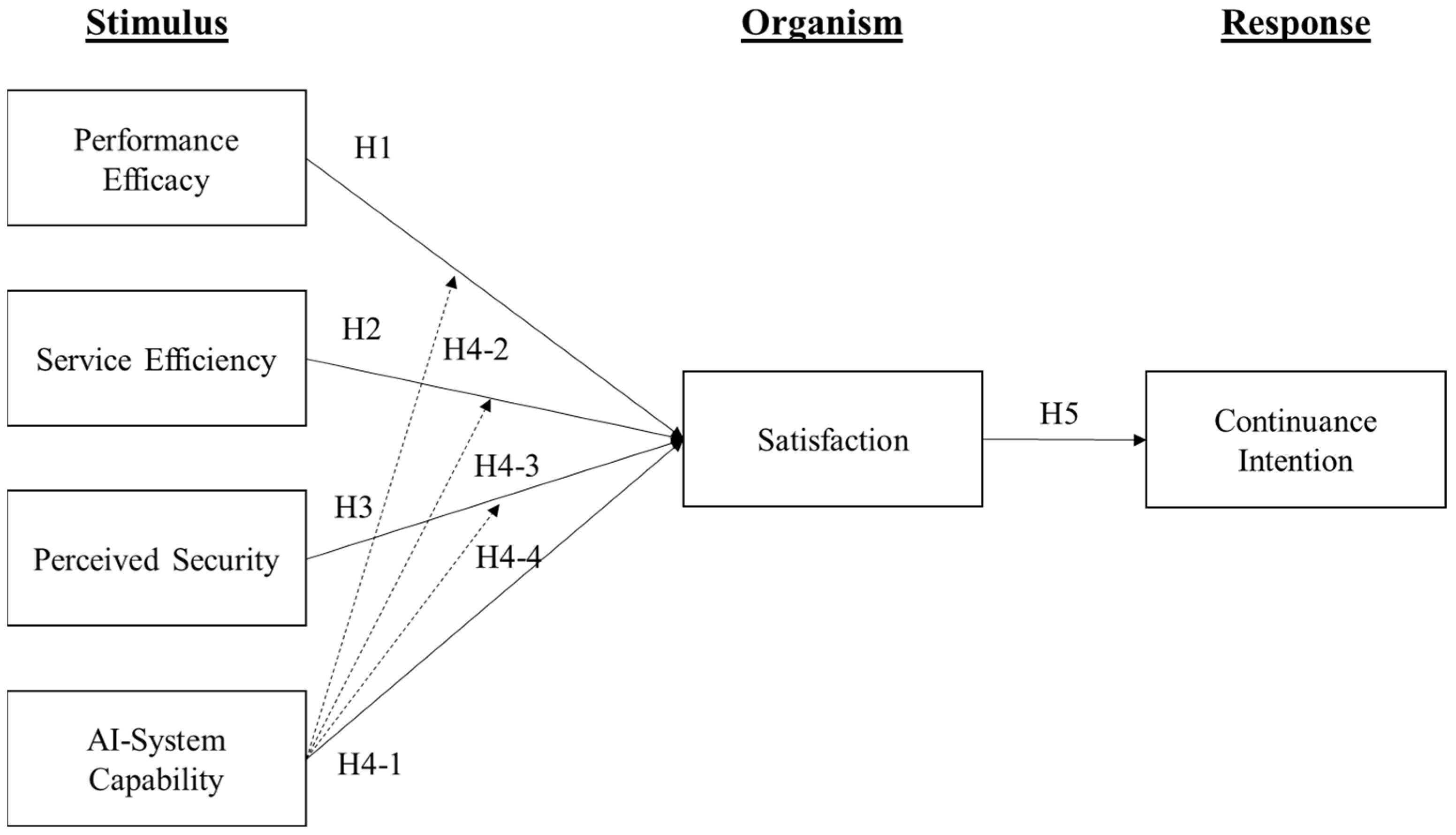
3. Research Model and Hypotheses
3.1. Performance Efficacy
3.2. Service Efficiency
3.3. Perceived Security
3.4. AI System Capability
3.5. Satisfaction
4. Methods
4.1. Instrument Development
4.2. Data Collection
4.3. Measurement Model Validation
5. Results
6. Discussion
6.1. Key Findings
6.2. Theoretical and Practical Implications
7. Conclusions
Author Contributions
Funding
Institutional Review Board Statement
Informed Consent Statement
Data Availability Statement
Conflicts of Interest
References
- Chen, Y.; Mao, Z.; Qiu, J.L. Super-Sticky WeChat and Chinese Society; Emerald Publishing Limited: Cambridge, MA, USA, 2018. [Google Scholar]
- Jia, L.; Nieborg, D.B.; Poell, T. On super apps and app stores: Digital media logics in China’s app economy. Media Cult. Soc. 2022, 44, 1437–1453. [Google Scholar] [CrossRef] [Scilit]
- Kim, B. South Korea’s Megacorp and super app: Kakao’s paths to market dominance. Media Cult. Soc. 2025, 47, 641–659. [Google Scholar] [CrossRef] [Scilit]
- Shanbhag, R.G. Navigating Fintech Innovations: Strategic Insights from the United States and India. Master’s Thesis, Massachusetts Institute of Technology, Cambridge, MA, USA, 2025. [Google Scholar]
- Fasnacht, D. Banking 4.0: Digital ecosystems and super-apps. In Theories of Change: Change Leadership Tools, Models and Applications for Investing in Sustainable Development; Springer: Berlin/Heidelberg, Germany, 2021; pp. 235–256. [Google Scholar]
- Research&Market. Super Apps Global Market Insights 2025, Analysis and Forecast to 2030, by Market Participants, Regions, Technology, Application, Product Type; Research and Markets: Dublin, Ireland, 2025. Available online: https://www.researchandmarkets.com/reports/6216163/super-apps-global-market-insights-analysis?srsltid=AfmBOooprLa9yWKjffHiPRkcc_-Eq0kUG4Aopu7W_odrjKmj2cGwLPs0 (accessed on 14 March 2026).
- Infosys AI-Powered Super Apps: Revolutionizing Customer, Employee, And Business Experiences. 2024. Available online: https://www.infosys.com/services/digital-experience/insights/documents/revolutionizing-customer-employee-business.pdf (accessed on 14 March 2026).
- KAKAO. Kakao Integrates AI: “Daily AI” Vision Unveiled at ‘if(kakao)25’. Available online: https://www.kakaocorp.com/page/detail/11713 (accessed on 14 March 2026).
- Salehi, S.; Miremadi, I.; Nejati, M.G.; Ghafouri, H. Fostering the adoption and use of super app technology. IEEE Trans. Eng. Manag. 2023, 71, 4761–4775. [Google Scholar] [CrossRef] [Scilit]
- Hasselwander, M.; Weiss, D. Consumer preferences for super app services: E-commerce, social media, and banking dominate. Eur. Res. Manag. Bus. Econ. 2025, 31, 100284. [Google Scholar] [CrossRef] [Scilit]
- Zhu, Y.-Q.; Fang, Y.-H.; Lim, S.-Y. Investigating drivers of service extension success for a super app. Comput. Hum. Behav. 2023, 149, 107928. [Google Scholar] [CrossRef] [Scilit]
- Hasselwander, M.; Weiss, D. Key factors influencing consumer adoption intentions of super apps in Germany. IEEE Access 2024, 12, 101985–101998. [Google Scholar] [CrossRef] [Scilit]
- Hasselwander, M. Digital platforms’ growth strategies and the rise of super apps. Heliyon 2024, 10, e25856. [Google Scholar] [CrossRef] [Scilit] [PubMed]
- Ismatullaev, U.V.U.; Kim, S.-H. Review of the factors affecting acceptance of AI-infused systems. Hum. Factors 2024, 66, 126–144. [Google Scholar] [CrossRef] [Scilit] [PubMed]
- Gupta, S.; Gupta-Rawal, S.; Shrivastava, P. Dynamic AI-Embedded Super App: A Design-Based Process Innovation for Customer Engagement and Value Creation. J. Prod. Innov. Manag. 2026, 43, 99–124. [Google Scholar] [CrossRef] [Scilit]
- Martina. The Future of Intelligent Super App Development with Generative AI; Martina: Puglia, Italy, 2025. [Google Scholar]
- Leonardi, P.M. When flexible routines meet flexible technologies: Affordance, constraint, and the imbrication of human and material agencies1. MIS Q. 2011, 35, 147–167. [Google Scholar] [CrossRef] [Scilit]
- Bayashot, Z.A. AI-Powered Personalization in SuperApps: International Case Studies on User Engagement. J. Softw. Eng. Appl. 2025, 18, 268–285. [Google Scholar] [CrossRef]
- Mehrabian, A.; Russell, J.A. An Approach to Environmental Psychology; MIT Press: Cambridge, MA, USA, 1974. [Google Scholar]
- Eroglu, S.A.; Machleit, K.A.; Davis, L.M. Empirical testing of a model of online store atmospherics and shopper responses. Psychol. Mark. 2003, 20, 139–150. [Google Scholar] [CrossRef] [Scilit]
- Cho, W.-C.; Lee, K.Y.; Yang, S.-B. What makes you feel attached to smartwatches? The stimulus–organism–response (S–O–R) perspectives. Inf. Technol. People 2019, 32, 319–343. [Google Scholar] [CrossRef] [Scilit]
- Tang, Y.; Son, H. How Perceived Value Drives Usage Intention of AI Digital Human Advisors in Digital Finance. Systems 2025, 13, 973. [Google Scholar] [CrossRef] [Scilit]
- Loureiro, S.; Ribeiro, L. The effect of atmosphere on emotions and online shopping intention: Age differentiation. In Proceedings of the Australian and New Zealand Marketing Academy Conference, Perth, Australia, 28–30 November 2011. [Google Scholar]
- Yang, H.; Lee, H. Smart city and remote services: The case of South Korea’s national pilot smart cities. Telemat. Inform. 2023, 79, 101957. [Google Scholar] [CrossRef] [Scilit]
- Robert, D.; John, R. Store atmosphere: An environmental psychology approach. J. Retail. 1982, 58, 34–57. [Google Scholar]
- Cronin, J.J., Jr.; Brady, M.K.; Hult, G.T.M. Assessing the effects of quality, value, and customer satisfaction on consumer behavioral intentions in service environments. J. Retail. 2000, 76, 193–218. [Google Scholar] [CrossRef] [Scilit]
- Zhu, L.; Li, H.; Wang, F.-K.; He, W.; Tian, Z. How online reviews affect purchase intention: A new model based on the stimulus-organism-response (S-O-R) framework. Aslib J. Inf. Manag. 2020, 72, 463–488. [Google Scholar] [CrossRef] [Scilit]
- Zhu, Q.; Bao, Q. She Wants Safety, He Wants Speed: A Mixed-Methods Study on Gender Differences in EV Consumer Behavior. Systems 2025, 13, 869. [Google Scholar] [CrossRef] [Scilit]
- Khoa, B.T.; Huynh, A.-V. How Digital Transformation Impacts on the Customer Loyalty in Fitness Services: The Mediating Role of Customer Experience. Bus. Perspect. Res. 2025; in press. [CrossRef] [Scilit]
- Vafaei-Zadeh, A.; Nikbin, D.; Wong, S.L.; Hanifah, H. Investigating factors influencing AI customer service adoption: An integrated model of stimulus–organism–response (SOR) and task-technology fit (TTF) theory. Asia Pac. J. Mark. Logist. 2025, 37, 1465–1502. [Google Scholar] [CrossRef] [Scilit]
- DeLone, W.H.; McLean, E.R. The DeLone and McLean model of information systems success: A ten-year update. J. Manag. Inf. Syst. 2003, 19, 9–30. [Google Scholar]
- Venkatesh, V.; Morris, M.G.; Davis, G.B.; Davis, F.D. User acceptance of information technology: Toward a unified view. MIS Q. 2003, 27, 425–478. [Google Scholar] [CrossRef] [Scilit]
- Gefen, D.; Karahanna, E.; Straub, D.W. Trust and tam in online shopping: An integrated model1. MIS Q. 2003, 27, 51–90. [Google Scholar] [CrossRef] [Scilit]
- Pavlou, P.A. Consumer acceptance of electronic commerce: Integrating trust and risk with the technology acceptance model. Int. J. Electron. Commer. 2003, 7, 101–134. [Google Scholar] [CrossRef] [Scilit]
- Shi, S.; Gong, Y.; Gursoy, D. Antecedents of trust and adoption intention toward artificially intelligent recommendation systems in travel planning: A heuristic–systematic model. J. Travel Res. 2021, 60, 1714–1734. [Google Scholar] [CrossRef] [Scilit]
- Luo, H.; Liu, X.; Lv, X.; Hu, Y.; Ahmad, A.J. Investors’ willingness to use robo-advisors: Extrapolating influencing factors based on the fiduciary duty of investment advisors. Int. Rev. Econ. Financ. 2024, 94, 103411. [Google Scholar] [CrossRef] [Scilit]
- Song, X.; Xu, B.; Zhao, Z. Can people experience romantic love for artificial intelligence? An empirical study of intelligent assistants. Inf. Manag. 2022, 59, 103595. [Google Scholar] [CrossRef] [Scilit]
- Ghazali, E.; Mutum, D.S.; Lun, N.K. Expectations and beyond: The nexus of AI instrumentality and brand credibility in voice assistant retention using extended expectation-confirmation model. J. Consum. Behav. 2024, 23, 655–675. [Google Scholar] [CrossRef] [Scilit]
- Furtado, N.G.; Furtado, J.V.; Filho, L.C.V.; Silva, R.C.D. The influence of technology payment adoption in satisfaction: A study with restaurant consumers. Int. J. Bus. Excell. 2020, 21, 209–230. [Google Scholar] [CrossRef] [Scilit]
- El-Said, O.; Al Hajri, S. Are customers happy with robot service? Investigating satisfaction with robot service restaurants during the COVID-19 pandemic. Heliyon 2022, 8, e08986. [Google Scholar] [CrossRef] [Scilit] [PubMed]
- Park, E.; Joon Kim, K. User acceptance of long-term evolution (LTE) services: An application of extended technology acceptance model. Program 2013, 47, 188–205. [Google Scholar] [CrossRef] [Scilit]
- Azhari, S.C.; Permatasari, A.; Angelus, M. Implementation of biometric technology in indonesian mobile banking: A TAM perspective on enhancing transaction security and enjoyment. In Proceedings of the 2025 International Conference on Inventive Computation Technologies (ICICT); IEEE: New York, NY, USA, 2025; pp. 152–158. [Google Scholar]
- Kuo, C.-S.; Kang, Y.; Yang, H.-L. Investigating the determinants of continuance intention on cloud ERP systems adoption. Adv. Mech. Eng. 2023, 15, 4. [Google Scholar] [CrossRef] [Scilit]
- Puspitasari, I.; Utami, F.; Raharjana, I.K. Determinants of Continuance Intention to Use Mutual Fund Investment Apps: The Changing of User Behavior During the Pandemic Crisis. In Proceedings of the 2022 9th International Conference on Behavioural and Social Computing (BESC); IEEE: New York, NY, USA, 2022; pp. 1–5. [Google Scholar]
- Zhang, Y. Impact of perceived privacy and security in the TAM model: The perceived trust as the mediated factors. Int. J. Inf. Manag. Data Insights 2024, 4, 100270. [Google Scholar] [CrossRef] [Scilit]
- Kwon, S.; Lee, H. Willingness to pay for smart car security. IEEE Access 2024, 12, 33867–33875. [Google Scholar] [CrossRef] [Scilit]
- Baek, I.; Kim, Y.; Do, S. Core digital transformation technologies and firm performance: Examining the moderating effect of innovation barriers. Asian J. Technol. Innov. 2025; in press. [CrossRef] [Scilit]
- Dwivedi, Y.K.; Kshetri, N.; Hughes, L.; Slade, E.L.; Jeyaraj, A.; Kar, A.K.; Baabdullah, A.M.; Koohang, A.; Raghavan, V.; Ahuja, M. Opinion Paper: “So what if ChatGPT wrote it?” Multidisciplinary perspectives on opportunities, challenges and implications of generative conversational AI for research, practice and policy. Int. J. Inf. Manag. 2023, 71, 102642. [Google Scholar] [CrossRef] [Scilit]
- Yuan, C.; Zhang, C.; Wang, S. Social anxiety as a moderator in consumer willingness to accept AI assistants based on utilitarian and hedonic values. J. Retail. Consum. Serv. 2022, 65, 102878. [Google Scholar] [CrossRef] [Scilit]
- Pasch, S.; Ha, S.-Y. Human–AI interaction and user satisfaction: Empirical evidence from online reviews of AI products. Int. J. Hum.–Comput. Interact. 2026, 42, 5570–5591. [Google Scholar] [CrossRef] [Scilit]
- Teepapal, T. AI-driven personalization: Unraveling consumer perceptions in social media engagement. Comput. Hum. Behav. 2025, 165, 108549. [Google Scholar] [CrossRef] [Scilit]
- Leschanowsky, A.; Rech, S.; Popp, B.; Bäckström, T. Evaluating privacy, security, and trust perceptions in conversational AI: A systematic review. Comput. Hum. Behav. 2024, 159, 108344. [Google Scholar] [CrossRef] [Scilit]
- Mao, Z.; Zou, Q.; Bu, T.; Dong, Y.; Yan, R. Understanding the role of service quality of government APPs in continuance intention: An expectation–confirmation perspective. Sage Open 2023, 13, 21582440231201218. [Google Scholar] [CrossRef] [Scilit]
- Mehrabioun, M. A multi-theoretical view on social media continuance intention: Combining theory of planned behavior, expectation-confirmation model and consumption values. Digit. Bus. 2024, 4, 100070. [Google Scholar] [CrossRef] [Scilit]
- Nguyen, G.-D.; Dao, T.-H.T. Factors influencing continuance intention to use mobile banking: An extended expectation-confirmation model with moderating role of trust. Humanit. Soc. Sci. Commun. 2024, 11, 276. [Google Scholar] [CrossRef] [Scilit]
- Han, S.; Yang, H. Understanding adoption of intelligent personal assistants: A parasocial relationship perspective. Ind. Manag. Data Syst. 2018, 118, 618–636. [Google Scholar] [CrossRef] [Scilit]
- Mikalef, P.; Gupta, M. Artificial intelligence capability: Conceptualization, measurement calibration, and empirical study on its impact on organizational creativity and firm performance. Inf. Manag. 2021, 58, 103434. [Google Scholar] [CrossRef] [Scilit]
- Huang, F.; Zou, B. English speaking with artificial intelligence (AI): The roles of enjoyment, willingness to communicate with AI, and innovativeness. Comput. Hum. Behav. 2024, 159, 108355. [Google Scholar] [CrossRef] [Scilit]
- Fang, Y.-H.; Liao, C.-H.; Li, C.-Y. Super app on demand: Exploring the impact of service synergy on willingness to use a new service. Electron. Commer. Res. Appl. 2024, 67, 101430. [Google Scholar] [CrossRef] [Scilit]
- Huang, M.-H.; Rust, R.T. Engaged to a robot? The role of AI in service. J. Serv. Res. 2021, 24, 30–41. [Google Scholar] [CrossRef] [Scilit]
- Song, P.; Phang, C.W. Promoting continuance through shaping members’ social identity in knowledge-based versus support/advocacy virtual communities. IEEE Trans. Eng. Manag. 2015, 63, 16–26. [Google Scholar] [CrossRef] [Scilit]
- Hair, J.F.; Black, W.C.; Babin, B.J.; Anderson, R.E. Multivariate Data Analysis; Cengage Learning: South Melbourne, Australia, 2019. [Google Scholar]
- Falk, R.F.; Miller, N.B. A Primer for Soft Modeling; University of Akron Press: Akron, OH, USA, 1992. [Google Scholar]
- Hair, J.F.; Risher, J.J.; Sarstedt, M.; Ringle, C.M. When to use and how to report the results of PLS-SEM. Eur. Bus. Rev. 2019, 31, 2–24. [Google Scholar] [CrossRef] [Scilit]
- Anderson, J.C.; Gerbing, D.W. Structural equation modeling in practice: A review and recommended two-step approach. Psychol. Bull. 1988, 103, 411–423. [Google Scholar] [CrossRef]
- Henseler, J.; Ringle, C.M.; Sarstedt, M. A new criterion for assessing discriminant validity in variance-based structural equation modeling. J. Acad. Mark. Sci. 2015, 43, 115–135. [Google Scholar] [CrossRef] [Scilit]
- Sheel, A.; Nath, V. Antecedents of blockchain technology adoption intentions in the supply chain. Int. J. Bus. Innov. Res. 2020, 21, 564–584. [Google Scholar] [CrossRef] [Scilit]
- Shajrawi, A.; Aburub, F. Impact of ERP usage on service differentiation: Role of mediating effect of organizational agility. Arab Gulf J. Sci. Res. 2023, 41, 359–375. [Google Scholar] [CrossRef] [Scilit]
- Chau, H.K.L.; Ngo, T.T.A.; Bui, C.T.; Tran, N.P.N. Human-AI interaction in E-Commerce: The impact of AI-powered customer service on user experience and decision-making. Comput. Hum. Behav. Rep. 2025, 19, 100725. [Google Scholar] [CrossRef] [Scilit]


| Construct | Item No. | Items | References |
|---|---|---|---|
| Performance efficacy | PE1 | Using the super app improves my efficiency in completing daily tasks. | [58] |
| PE2 | Using the super app enhances the convenience of managing various services. | ||
| PE3 | The super app helps me handle activities more effectively. | ||
| Service efficiency | SE1 | The super app includes many of the services, brands, or shops I prefer without requiring additional app downloads. | [11,59] |
| SE2 | The super app integrates diverse businesses and resources, and offers shared activities (e.g., promotions, events) within the platform ecosystem. | ||
| SE3 | The super app allows me to use consistent interfaces and mechanisms without needing to learn a new app. | ||
| Perceived security | PS1 | The super app can ensure the security of my personal information and data. | [53] |
| PS2 | It is safe to conduct various transactions or service processes through the super app. | ||
| PS3 | The super app operates reliably and is unlikely to become unavailable due to system failures. | ||
| AI System capability | ASC1 | The AI in the super app provides comprehensive information and support. | [53,57,60] |
| ASC2 | The AI in the super app provides information that is tailored to my personal needs. | ||
| ASC3 | The AI in the super app responds promptly to my requests. | ||
| ASC4 | The AI in the super app quickly resolves problems I encounter. | ||
| Satisfaction | SA1 | I am content with my experience using the super app. | [58] |
| SA2 | I am pleased with my experience using the super app. | ||
| SA3 | I am delighted with my experience using the super app. | ||
| SA4 | Overall, I am satisfied with the super app. | ||
| Continuance intention | CI1 | I intend to continue using the super app. | [58] |
| CI2 | I would keep using the super app if access is available. | ||
| CI3 | I will continue using the super app in the future. | ||
| CI4 | I plan to use the super app regularly in the coming days. |
| Respondents (n = 614) | ||
|---|---|---|
| Characteristics | Number | Percentage |
| Gender | ||
| Male | 250 | 40.7% |
| Female | 364 | 59.3% |
| Age | ||
| 20–29 | 57 | 9.3% |
| 30–39 | 153 | 24.9% |
| 40–49 | 185 | 30.1% |
| 50–59 | 156 | 25.4% |
| 60+ | 63 | 10.3% |
| Education | ||
| ~High school | 118 | 19.2% |
| University | 413 | 67.3% |
| Graduate school | 73 | 11.9% |
| Etc. | 10 | 1.6% |
| Monthly Income ($) | ||
| Less than 2000 | 135 | 22.0% |
| 2000~3500 | 228 | 37.1% |
| 3500~5000 | 140 | 22.8% |
| 5000+ | 111 | 18.1% |
| Occupation | ||
| Self-employer | 75 | 12.2% |
| Start-up/SME worker | 271 | 44.1% |
| Major company worker | 32 | 5.2% |
| Public service worker | 92 | 15.0% |
| NGO worker | 25 | 4.1% |
| Freelancer/Etc. | 119 | 19.4% |
| Group | ||
| Financial super app users | 306 | 49.8% |
| Non-Financial super app users | 308 | 50.2% |
| Construct | Items | Factor Loading | Std. Error | t-Value | AVE (>0.5) | Composite Reliability (>0.7) | Cronbach’s Alpha (>0.7) |
|---|---|---|---|---|---|---|---|
| Performance efficacy | PE1 | 0.927 | 0.007 | 127.755 | 0.852 | 0.945 | 0.913 |
| PE2 | 0.923 | 0.008 | 113.642 | ||||
| PE3 | 0.920 | 0.007 | 131.658 | ||||
| Service efficiency | SE1 | 0.881 | 0.018 | 48.241 | 0.785 | 0.916 | 0.863 |
| SE2 | 0.889 | 0.011 | 78.640 | ||||
| SE3 | 0.889 | 0.011 | 77.823 | ||||
| Perceived security | PS1 | 0.926 | 0.008 | 114.253 | 0.857 | 0.947 | 0.917 |
| PS2 | 0.941 | 0.005 | 176.006 | ||||
| PS3 | 0.911 | 0.009 | 101.218 | ||||
| AI System capability | ASC1 | 0.817 | 0.017 | 48.611 | 0.706 | 0.906 | 0.861 |
| ASC2 | 0.791 | 0.021 | 38.382 | ||||
| ASC3 | 0.852 | 0.014 | 62.735 | ||||
| ASC4 | 0.897 | 0.009 | 98.419 | ||||
| Satisfaction | SA1 | 0.933 | 0.006 | 146.752 | 0.857 | 0.960 | 0.944 |
| SA2 | 0.937 | 0.006 | 152.032 | ||||
| SA3 | 0.898 | 0.010 | 92.314 | ||||
| SA4 | 0.935 | 0.007 | 138.936 | ||||
| Continuance intention | CI1 | 0.933 | 0.007 | 134.059 | 0.840 | 0.954 | 0.936 |
| CI2 | 0.910 | 0.010 | 87.253 | ||||
| CI3 | 0.909 | 0.010 | 93.575 | ||||
| CI4 | 0.913 | 0.008 | 111.707 |
| PE | SE | PS | ASC | SA | CI | |
|---|---|---|---|---|---|---|
| PE | 0.923 | |||||
| SE | 0.737 | 0.886 | ||||
| PS | 0.471 | 0.495 | 0.926 | |||
| ASC | 0.681 | 0.625 | 0.426 | 0.840 | ||
| SA | 0.813 | 0.680 | 0.604 | 0.660 | 0.926 | |
| CI | 0.808 | 0.670 | 0.548 | 0.623 | 0.887 | 0.916 |
| PE | SE | PS | ASC | SA | CI | |
|---|---|---|---|---|---|---|
| PE1 | 0.927 | 0.680 | 0.419 | 0.634 | 0.751 | 0.740 |
| PE2 | 0.923 | 0.682 | 0.417 | 0.596 | 0.733 | 0.753 |
| PE3 | 0.920 | 0.679 | 0.469 | 0.655 | 0.766 | 0.744 |
| SE1 | 0.617 | 0.881 | 0.417 | 0.524 | 0.583 | 0.571 |
| SE2 | 0.670 | 0.889 | 0.393 | 0.551 | 0.603 | 0.596 |
| SE3 | 0.670 | 0.889 | 0.504 | 0.583 | 0.620 | 0.611 |
| PS1 | 0.360 | 0.407 | 0.926 | 0.350 | 0.514 | 0.441 |
| PS2 | 0.453 | 0.464 | 0.941 | 0.407 | 0.572 | 0.536 |
| PS3 | 0.487 | 0.498 | 0.911 | 0.421 | 0.586 | 0.537 |
| ASC1 | 0.599 | 0.529 | 0.423 | 0.817 | 0.577 | 0.562 |
| ASC2 | 0.526 | 0.472 | 0.227 | 0.791 | 0.490 | 0.465 |
| ASC3 | 0.562 | 0.537 | 0.335 | 0.852 | 0.533 | 0.501 |
| ASC4 | 0.598 | 0.556 | 0.425 | 0.897 | 0.609 | 0.556 |
| SA1 | 0.777 | 0.634 | 0.537 | 0.618 | 0.933 | 0.822 |
| SA2 | 0.783 | 0.629 | 0.518 | 0.625 | 0.937 | 0.830 |
| SA3 | 0.693 | 0.606 | 0.609 | 0.588 | 0.898 | 0.798 |
| SA4 | 0.755 | 0.648 | 0.576 | 0.615 | 0.935 | 0.833 |
| CI1 | 0.768 | 0.642 | 0.483 | 0.575 | 0.831 | 0.933 |
| CI2 | 0.753 | 0.609 | 0.531 | 0.602 | 0.822 | 0.910 |
| CI4 | 0.734 | 0.596 | 0.410 | 0.528 | 0.764 | 0.909 |
| CI4 | 0.706 | 0.607 | 0.578 | 0.575 | 0.829 | 0.913 |
| PE | SE | PS | ASC | SA | |
|---|---|---|---|---|---|
| SE | 0.829 | ||||
| PS | 0.511 | 0.553 | |||
| ASC | 0.766 | 0.723 | 0.470 | ||
| SA | 0.874 | 0.753 | 0.648 | 0.730 | |
| CI | 0.874 | 0.744 | 0.586 | 0.691 | 0.942 |
| Hypothesis | Financial Super App Users | Non-Financial Super App Users | ||||||
|---|---|---|---|---|---|---|---|---|
| Path Coefficient | S.E | t-Value | Supported | Path Coefficient | S.E | t-Value | Supported | |
| H1: PE → SA (+) | 0.577 | 0.054 | 10.672 | Yes | 0.520 | 0.056 | 9.265 | Yes |
| H2: SE → SA (+) | 0.075 | 0.053 | 1.410 | No | 0.038 | 0.055 | 0.693 | No |
| H3: PS → SA (+) | 0.206 | 0.037 | 5.512 | Yes | 0.308 | 0.042 | 7.247 | Yes |
| H4-1: ASC → SA (+) | 0.141 | 0.052 | 2.720 | Yes | 0.139 | 0.053 | 2.632 | Yes |
| H4-2: ASC × PE → SA (+) | 0.021 | 0.042 | 0.492 | No | −0.005 | 0.047 | 0.097 | No |
| H4-3 ASC × SE → SA (+) | 0.003 | 0.038 | 0.077 | No | −0.066 | 0.051 | 1.289 | No |
| H4-4: ASC × PS → SA (+) | −0.075 | 0.041 | 1.818 | Yes | 0.113 | 0.040 | 2.809 | Yes |
| H5: SA → CI (+) | 0.902 | 0.012 | 73.570 | Yes | 0.872 | 0.017 | 50.748 | Yes |
| Mediated Path | Original Sample | t-Value | Significance (p < 0.05) | 95% CIs (Bias-Corrected) | |
|---|---|---|---|---|---|
| Financial Super-App Users | PE → SA → CI | 0.521 | 10.468 | 0.000 | [0.435, 0.598] |
| SE → SA → CI | 0.067 | 1.410 | 0.079 | [−0.014, 0.143] | |
| PS → SA → CI | 0.186 | 5.557 | 0.000 | [0.133, 0.243] | |
| ASC → SA → CI | 0.127 | 2.713 | 0.003 | [0.062, 0.215] | |
| Non-Financial Super-App Users | PE → SA → CI | 0.453 | 8.756 | 0.000 | [0.368, 0.538] |
| SE → SA → CI | 0.033 | 0.694 | 0.244 | [−0.046, 0.111] | |
| PS → SA → CI | 0.268 | 7.081 | 0.000 | [0.206, 0.330] | |
| ASC → SA → CI | 0.121 | 2.661 | 0.004 | [0.050, 0.200] |
| Differences | Significance (p < 0.05) | Supported | |
|---|---|---|---|
| H1: PE → SA (+) | −0.057 | 0.231 | No |
| H2: SE → SA (+) | −0.037 | 0.316 | No |
| H3: PS → SA (+) | 0.102 | 0.038 | Yes |
| H4-1: ASC → SA (+) | −0.001 | 0.498 | No |
| H4-2: ASC × PE → SA (+) | −0.025 | 0.329 | No |
| H4-3 ASC × SE → SA (+) | −0.069 | 0.137 | No |
| H4-4: ASC × PS → SA (+) | 0.188 | 0.001 | Yes |
| H5: SA → CI (+) | −0.031 | 0.070 | No |
Disclaimer/Publisher’s Note: The statements, opinions and data contained in all publications are solely those of the individual author(s) and contributor(s) and not of MDPI and/or the editor(s). MDPI and/or the editor(s) disclaim responsibility for any injury to people or property resulting from any ideas, methods, instructions or products referred to in the content. |
© 2026 by the authors. Licensee MDPI, Basel, Switzerland. This article is an open access article distributed under the terms and conditions of the Creative Commons Attribution (CC BY) license.
Share and Cite
Yang, H.; Lee, H. AI-Enabled Super Apps as Complex Socio-Technical Ecosystems: A Systemic View of User Continuance. Systems 2026, 14, 586. https://doi.org/10.3390/systems14050586
Yang H, Lee H. AI-Enabled Super Apps as Complex Socio-Technical Ecosystems: A Systemic View of User Continuance. Systems. 2026; 14(5):586. https://doi.org/10.3390/systems14050586
Chicago/Turabian StyleYang, Heetae, and Hwansoo Lee. 2026. "AI-Enabled Super Apps as Complex Socio-Technical Ecosystems: A Systemic View of User Continuance" Systems 14, no. 5: 586. https://doi.org/10.3390/systems14050586
APA StyleYang, H., & Lee, H. (2026). AI-Enabled Super Apps as Complex Socio-Technical Ecosystems: A Systemic View of User Continuance. Systems, 14(5), 586. https://doi.org/10.3390/systems14050586