Article

Integrating AI and Big Data for Firm Resilience: The Mediating Roles of AI Capabilities and Supply Chain Agility


by
Thamir Hamad Alaskar
Business Administration Department, College of Business, Imam Mohammad Ibn Saud Islamic University (IMSIU), Riyadh 11564, Saudi Arabia
Systems 2026, 14(5), 554; https://doi.org/10.3390/systems14050554
Submission received: 23 March 2026 / Revised: 4 May 2026 / Accepted: 12 May 2026 / Published: 14 May 2026

Abstract

The integration of Artificial Intelligence (AI) and Big Data is increasingly associated with firms’ resilience in dynamic business environments. This study examines the relationships between AI–Big Data integration, AI capabilities, supply chain agility, and firm resilience, with particular attention paid to the mediating roles of AI capabilities and supply chain agility. Data were collected from 475 experts across firms in Saudi Arabia and analyzed using Partial Least Squares Structural Equation Modeling (PLS-SEM). The results indicate that AI–Big Data integration is positively associated with AI capabilities and supply chain agility, both of which, in turn, significantly contribute to firm resilience. In addition, AI capabilities show a direct positive relationship with supply chain agility. The findings further confirm the mediating roles of AI capabilities and supply chain agility in strengthening organizational resilience. This study contributes to the Dynamic Capabilities View (DCV) and Knowledge-Based View (KBV) by empirically examining how integrated AI–Big Data relates to capability development and firm outcomes. The results also provide implications for managers seeking to align AI and Big Data initiatives with supply chain capabilities to support resilience in dynamic environments.

1. Introduction

Artificial Intelligence (AI) is a dynamic interdisciplinary field that integrates computer science, data analysis, and cognitive simulation to enable machines to perform tasks that have traditionally required human intelligence, thereby offering innovative solutions to complex business challenges [1,2]. Currently, Artificial Intelligence (AI) and Big Data Analytics, as emerging technologies, contribute to enhancing how firms collect and share data in real time to innovate their supply chain frameworks and strengthen resilience, which ultimately leads to providing business continuity with more effective competitive advantages [3,4,5].
In addition, while AI technologies play a key role in the Industry 4.0 framework by enhancing the development of intelligent information systems throughout the supply chain [6], the integration of AI and big data presents a significant opportunity to enhance the quality of data used to train algorithms, and this synergy enables companies to effectively use their data resources to create meaningful business value [7]. However, despite AI’s growing importance in managerial contexts, there remains an opportunity for management scholars to deepen their exploration and insights into this area, thereby enhancing our understanding and application of AI in management over the coming years [8]. Likewise, there is growing potential for studies to utilize AI and big data to enhance and sustain resilience in supply chains [4,9]. This approach promises to improve efficiency in response to emerging challenges and uncertainties.
Moreover, big data analytics and AI are seen as emerging powerful technologies that can help firms navigate uncertainty and better predict supply and demand, even in the face of misinformation [10,11]. Embracing these advancements will strengthen organizational resilience and advance a more adaptive and informed approach to business challenges. Furthermore, Zamani et al. [4] emphasize the important role that emerging technologies, particularly AI and big data, play in empowering decision-makers to address complicated challenges effectively. They point out that big data tools facilitate operational transformation by delivering timely perceptions into the supply chain, while AI plays a key role in developing strategies to anticipate potential risks and impacts, thereby enhancing overall decision-making processes.
In addition, Bai et al. [12] highlight the increasing importance of supply chain agility (SCAG) in the digital era. They emphasize that businesses can unlock the full potential of digital technologies by effectively integrating them into their supply chains. By implementing this approach, they can facilitate real-time information sharing and collaboration among all supply chain partners. This proactive approach can improve efficiency and responsiveness, as highlighted by Kandarkar and Ravi [13] and Li et al. [14]. However, although there has been considerable research on supply chain agility in relation to various digital capabilities [15,16,17,18], there is an opportunity for further exploration as this topic is still in its initial stages [12]. Specifically, studies that integrate AI and big data with supply chain agility and firm resilience could provide meaningful insights and contribute to stronger frameworks in this area.
Moreover, while firm resilience plays a vital role in enabling companies to anticipate and recover from disruptions, thereby supporting sustained performance and competitiveness [19], many scholars stress the value of integrated AI tools as these technologies can significantly enhance predictive capabilities and lead to improved decision-making processes [4]. Although big data, encompassing both internal and external information and integrating seamlessly with AI, holds great promise in mitigating uncertainty and enabling firms to more accurately predict supply and demand [10,11], for many firms, realizing the full potential of this integration can be challenging. However, by addressing the deployment and integration obstacles related to their capabilities, firms can significantly enhance their supply chain resilience [4,20]. Nevertheless, focusing on capabilities that include AI presents an opportunity for growth and innovation in the supply chain landscape.
To our knowledge, there is a notable opportunity to further explore how integrated AI and big data can enhance SCAG and improve firm resilience. This study aims to build on existing studies in this area, drawing on initial work by Zamani et al. [4], Belhadi et al. [10], and Bai et al. [12], and to contribute to a deeper understanding of these critical concepts.
Also, while previous studies have primarily emphasized the direct effects of artificial intelligence (AI), big data, and firm performance [21], they consider digital technologies only as immediate drivers of organizational outcomes and fail to explore the deeper mechanisms through which value is truly created. To enhance our understanding, the current study adopts a capability-based perspective by integrating the Dynamic Capabilities View (DCV) and the Knowledge-Based View (KBV). From a DCV perspective, AI capabilities are conceptualized to provide a key perspective on how firms can sense environmental changes and reconfigure resources in response to disruptions, while from a KBV perspective, the integration of AI and Big Data significantly strengthens a firm’s capacity to generate and integrate knowledge. This enhancement is especially important in supply chain processes, where timely, accurate information improves operational efficiency and effectiveness. Consequently, this study advances prior research by offering deeper understandings rather than just confirming direct relationships.
This study provides insights into an important gap in the literature concerning the integration of AI with big data and its significant impact on SCAG, a key factor in strengthening firms’ resilience. Also, the objective of this research is to deepen our understanding of how AI capabilities, in conjunction with SCAG, contribute to a firm’s resilience. To explore this, this study is guided by two primary research questions: (RQ1) How does Supply Chain Agility (SCAG) facilitate the association between integrated AI and Big Data and firm resilience? (RQ2) In what ways do AI capabilities mediate this relationship? In addition, this study represents a significant advancement by first examining the specified variables in Saudi Arabia, which is considered a notable case in digital transformation and has strong performance on global indices [22,23]. Alaskar [24] emphasizes the need for Saudi Arabian firms to effectively identify and utilize knowledge to seize opportunities and address potential challenges, given the importance of careful evaluation decisions in adopting new technologies, especially within the framework of Vision 2030, which presents significant opportunities for advancement.
However, this study makes contributions by advancing the literature in three key areas. First, it explains the importance of AI capabilities and supply chain agility as key mediators that connect the integration of AI and Big Data to a firm’s resilience. Second, it emphasizes that the value of integrated AI and Big Data depends on a firm’s ability to apply AI capabilities rather than solely on technology adoption [7]. Lastly, it offers empirical evidence from an emerging-market context, generalizes the applicability of existing findings, and enriches the understanding of these dynamics.

2. Theoretical Background and Hypotheses Development

2.1. Theoretical Background

The Resource-Based View (RBV) theory provides meaningful insights into the strategic implications of unique and non-substitutable resources within firms, highlighting the vital role of capabilities in fostering sustainable competitive advantages and differentiated innovation outcomes [25]. This perspective led firms to focus on developing and leveraging their distinctive resources to enhance their long-term success [2,26,27]. In addition, the topic of integrating information technology as both a resource and a capability offers firms an opportunity to achieve sustainable competitive advantage, an area that has gained significant attention from researchers in recent years [28].
However, the distinctive features of AI in terms of its ability to enhance human cognitive skills and enable meaningful collaboration with humans in decision-making and problem-solving processes create exciting opportunities that challenge traditional theories and ultimately shape new sources of competitive advantage for organizations [29,30,31]. Yet scholars emphasize that the ability to respond swiftly to environmental changes greatly benefits from strong dynamic capabilities within firms [32]. Developing these capabilities can enhance a company’s resilience and adaptability in a rapidly changing market.
Al Mamun et al. [33] argue that an important consideration in competitiveness is that, while internal resources are vital, relying solely on them can overlook the advantages of shared supply chain capabilities with partners. By incorporating the Dynamic Capabilities View (DCV) as an extension of the Resource-Based View (RBV), firms can effectively address this challenge. This approach encourages the integration of both external and internal competencies, enabling firms to better navigate and adapt to quickly changing market conditions [34]. However, scholars emphasize that the ability to respond swiftly to environmental changes greatly benefits from strong dynamic capabilities within firms [32]. Developing these capabilities can enhance a company’s resilience and adaptability in a rapidly changing market.

2.1.1. AI–Big Data and Dynamic Capabilities View (DCV)

Dynamic capabilities have been effectively applied in supply chains to enhance our perception of customer needs and improve communication [35]. Aslam et al. [36] suggest that this approach broadens our perspective beyond individual firms, recognizing the importance of dynamic supply chain capabilities. Notably, they emphasize that supply chain agility is a key dynamic capability that empowers organizations to seize opportunities as they emerge, which is fundamental to thriving in unpredictable environments and for enabling more flexible responses.
While numerous studies have explored the impact of supply chain agility both in isolation and in combination on firm performance [36,37,38,39,40,41], there remains a significant opportunity to investigate the impact associated with integrated AI and Big Data. Addressing this gap could yield meaningful insights and advance supply chain management practices.
While supply chain agility is conceptualized as process-level dynamic capability that empowers firms to quickly sense and respond to shifts in demand by advancing flexibility and coordination across supply chain processes [38], firm resilience is a higher-order organizational capability that enables companies to address disruptions and recover to a stable state [3,19]. Building on the Dynamic Capabilities View [34], the supply chain agility is seen as a key facilitator of resilience by enhancing a firm’s ability to respond to environmental changes. However, the relationship between agility and resilience is complex and not strictly relative, as resilience can be enhanced by developing complementary capabilities, including redundancy and effective risk management [6].
Mukherjee et al. [42] highlight the growing adoption of the dynamic capability view (DCV) in supply chains, particularly in response to the increasing complexity of networks. This approach is central for evaluating and mitigating risks, enabling organizations to effectively leverage their resources and ensure business continuity in a rapidly changing environment. Moreover, they emphasize that DCV is particularly effective in enhancing supply chain agility, promoting sustainability amid disruptions and uncertainties [43].

2.1.2. AI–Big Data and the Knowledge-Based View (KBV)

Building on the foundation of the Resource-Based View (RBV), which effectively leverages unique resources such as knowledge management, the Knowledge-Based View (KBV) was developed by Fred Davis in the late 1980s to enhance our understanding by highlighting the role of knowledge as a strategic resource that drives advanced innovation outcomes and improves performance [44].
The Knowledge-Based View (KBV) of the firm builds upon the Resource-Based View (RBV) by emphasizing the unique and firm-specific knowledge that firms possess [45]. This perspective highlights that a company’s diverse knowledge resources play a central role in achieving and sustaining competitive advantage by advancing and utilizing these knowledge assets, as firms can create distinctions that are not easily replicated by competitors [45,46,47]. However, the KBV notably contributes to the fields of information systems and technological adoption research by encouraging organizations to harness their knowledge assets for greater success [44].
In addition, while the Knowledge-Based View (KBV) of the firm offers meaningful insights into the significant economic transformations that have unfolded over the past two decades as developed economies increasingly rely on the effective management of information, rather than the production of physical products [45]; Artificial Intelligence (AI) is significantly transforming Knowledge Management (KM) across industries and empowering organizations to fully harness their intellectual capital by enabling the effective creation, sharing, and application of knowledge [48,49]. AI is increasingly being integrated into knowledge development across multiple fields, presenting exciting opportunities for enhancement [50]. In business intelligence (BI), for instance, AI can provide deeper insights and improve decision-making [51], while in customer service, AI can enhance the user experience and streamline support processes [48]. Embracing these advancements can lead to significant improvements in efficiency and effectiveness across different domains.
However, big data analytics enhanced by artificial intelligence plays a vital role in advancing knowledge management [52]. Ferraris et al. [53] suggest that organizations can significantly enhance their decision-making capabilities by integrating Big Data Analytics with effective knowledge management practices. This combination enables firms to better understand and leverage the extensive data from diverse sources, ultimately leading to more informed, strategic decisions. As a result, these firms can enhance their competitive performance and make informed decisions for growth and success [52,54,55]. This perspective provides a theoretical basis for viewing knowledge as a strategic organizational resource.

2.2. Hypotheses Development

This study employs theories of the DCV and the KBV to analyze the relationships between AI–Big Data, Supply Chain Agility, AI capabilities, and their effects on firm resilience.

2.2.1. Integrating AI with Big Data (AI–Big Data)

Due to the advancements and revolutionization of big data technology, which allow for the rapid processing of extensive data in various formats, firms have strengthened their focus on AI as they seek to derive insights from this wealth of data [56]. According to Hossain et al. [57], the emergence of AI and big data analytics as transformative digital technologies has a significant impact on decision-making and performance across various industries. This shift is particularly evident in emerging economies, where these innovations play a central role in enhancing efficiency and strategic growth [57].
While AI is considered an important, innovative analytics tool that streamlines numerous tasks with remarkable efficiency [51], BDA enables firms to process vast amounts of data to uncover insights that support decision-making and innovation [58]. Research conducted by Adiguzel et al. [59] shows the positive influence of AI capabilities and big data on sustainability and organizational effectiveness. These findings suggest that embracing these technologies can significantly enhance operational practices and contribute to a more sustainable future.
Giachino et al. [60] emphasize the positive impact of integrating artificial intelligence (AI) with big data, as this combination allows organizations to harness insights from large datasets alongside AI’s robust data processing capabilities. By leveraging this integration, companies can enhance their adaptability and scalability, positioning themselves to respond effectively to evolving environments [61].
Furthermore, while AI capabilities represent a higher-order dynamic capability as viewed through the Dynamic Capabilities View (DCV) [62], which empowers organizations to effectively sense environmental changes and adapt their resources accordingly. Research indicates that both data and AI-related resources constitute key foundational inputs for developing organizational capabilities, evolving into higher-level capabilities through processes of integration and learning [7]. According to Mikalef and Gupta [7], the synergistic integration of AI and big data is instrumental in enhancing companies’ ability to derive business value from their data resources. Given the substantial training data requirements of AI systems, access to high-quality data becomes increasingly important, and by integrating AI and big data, organizations can effectively transform their raw data assets into intelligent systems that continuously learn and adapt [7]. This integration enables the embedding of AI into analytics systems, thereby increasing responsiveness to dynamic market changes [63].
Moreover, Rana et al. [64] define integrated AI with analytics as a blend of capabilities, including both machine learning and deep learning, which utilize data to produce diagnostic, descriptive, predictive, and prescriptive information. This highlights the potential for firms that integrate AI and big data to enhance their AI capabilities by creating the technical infrastructure for effective AI learning and adaptive intelligence, which are fundamental to developing strong AI capabilities.
In addition, Singh et al. [3] noted that integrating AI with big data enables accurate forecasting of demand based on growing data. As supply chains evolve, AI emerges as a transformative force, greatly enhancing resilience and performance [10]. Chen et al. [65] noted that while AI and Big Data Analytics (BDA) are innovative tools that effectively support a firm’s operations, their integration can provide firms with a competitive advantage. This is achieved by enhancing risk management and improving supply chain activities, including inventory control and demand forecasting [66].
Furthermore, Hossain et al. [57] highlight the transformative impact of AI and BDA on various industries in emerging economies. These technologies facilitate new product development, streamline processes, and strengthen relationships with suppliers and partners. The authors explain that AI and BDA enable businesses to innovate by creating cutting-edge products that meet the evolving needs of consumers, while also enhancing operational efficiency by simplifying complex processes [67].
Furthermore, Ma and Chang [68] discuss the impact of AI and big data analytics on supply chains, emphasizing the critical role of agility in this dynamic environment. They argue that, although AI is primarily aimed at improving decision-making and streamlining operations rather than enhancing data-processing capabilities [69], the integration of AI and big data can significantly enhance supply chain agility. This is achieved by improving prediction accuracy, enabling firms to navigate shifts in market demand more effectively through the analysis of complex market trends, historical data, and consumer behavior patterns [68]. Such agility enables firms to remain competitive in a marketplace where innovation and adaptability are key determinants of success.
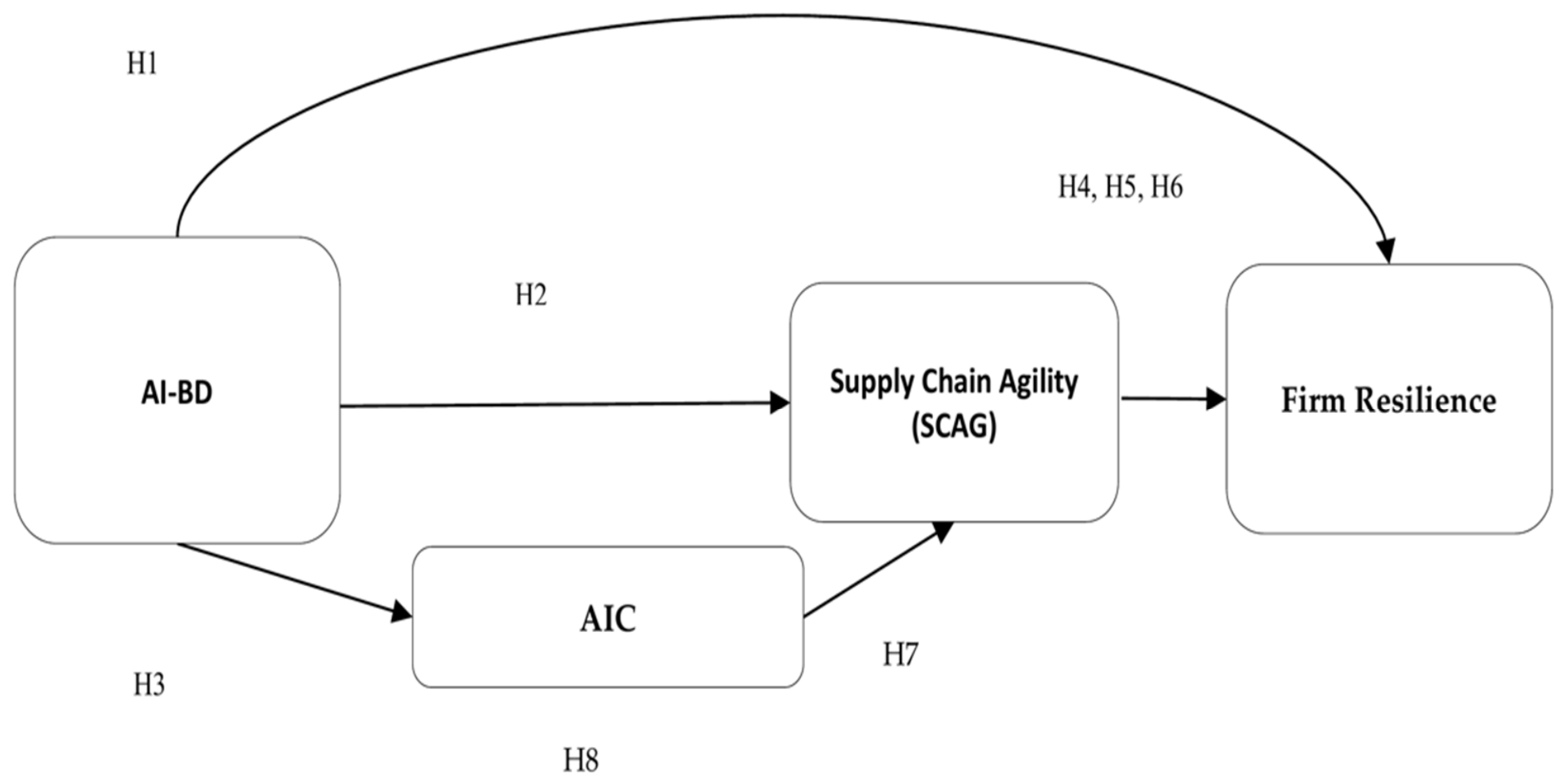
With the growing importance of integrating AI and big data for a firm’s success, the following hypotheses have been proposed:
H1. 
The integration of AI and Big Data is positively associated with Firm Resilience.
H2. 
The integration of AI and Big Data is positively associated with Supply Chain Agility.
H3. 
The integration of AI and Big Data is positively associated with AI Capabilities.

2.2.2. Supply Chain Agility (SCAG) and Firm Resilience (FR)

Supply Chain Agility strengthens supply chain effectiveness by enabling it to respond proactively to both internal and external changes [68]. By utilizing available resources, firms can advance adaptability and respond quickly to emerging challenges [70]. Furthermore, Richey et al. [71] highlight that agility encompasses a supply chain’s ability to implement instant adjustments in response to external factors, enabling continuous improvement and resilience. This concept emphasizes the importance of adaptability in navigating the complexities of the supply chain environment.
According to Alsmairat and Al-Shboul [72], supply chain agility is fundamentally rooted in integrated networks designed to respond to market dynamics. This responsiveness allows supply chains to exhibit a high degree of flexibility, enabling them to adapt their activities effectively to meet customer demands. As highlighted by Singh et al. [73] and Al-Shboul [74], this adaptability enables firms to ensure that customer needs are consistently met in a rapidly changing environment. Nevertheless, Al Mamun et al. [33] highlight the potential of big data analytics to enhance SCAG particularly in unstable environments, as noted in previous studies [38,75]. Their research indicates that big data analytics advances greater SCAG and adaptability, and also positively impacts Green Reverse-Supply Chain (GRSC) practices, thereby enhancing firm performance.
However, while previous studies have examined the relationship between big data analytics with SCAG [33,75] and supply chain agility with firm performance [42,76,77,78], there is an opportunity to further explore its connection with big data integrated with AI and with firm resilience. Ye et al. [79] show that firm resilience plays a vital role in helping organizations effectively navigate disruptions and contribute to sustained performance. However, understanding how a supply chain’s capabilities align with operational resources to adapt effectively to external change can enhance our understanding of firm resilience [42,80]. This relationship could provide insights for companies seeking to improve their resilience and overall performance in today’s dynamic business environment.
In addition, Mukherjee et al. [42] highlight the importance of resilience in supply chains as a key behavioral response that enables firms to adapt to fluctuating demand and manage disruptions effectively. They underscore that utilizing information capabilities, especially those related to AI, plays a vital role in enhancing SCAG, ultimately strengthening overall performance [68]. However, by integrating the predictive capabilities of AI with the strength of big Data, businesses can proactively identify shifts in supply and demand, make informed logistics decisions, and dynamically adjust their operations.
In addition, Ma and Chang [68] highlight the significant benefits of integrating Big Data within AI in the supply chain (SC) domain, as it enhances collaboration with suppliers and customers and also plays a critical role in building trust between firms and their suppliers by effectively reducing risks and promoting traceability. Ultimately, leveraging big data with AI in the supply chain can lead to more resilient and responsive business practices.
However, while combination of AI and Big Data offers significant opportunities for organizations by enhancing their ability to process complex information and generate predictive insights that lead to more effective decision-making [3,7,57], research by Dubey et al. [81] highlights that integrate AI with Big Data can advance a greater humanitarian SCAG and resilience within organizations, improving visibility and decision quality.
Expanding on the previous discussion, which shows that the integration of AI and Big Data systems improves firms’ dynamic capabilities to sense and respond to environmental changes. This integration also enhances SCAG by allowing for rapid resource reconfiguration. As supply chain agility (SCAG) plays a fundamental role in a firm’s success, the proposed hypotheses are as follows:
H4. 
Supply Chain Agility positively affects Firm Resilience.
H5. 
Supply Chain Agility (SCAG) mediates the association between Integrated AI–Big Data and Firm Resilience.
H6. 
Supply Chain Agility (SCAG) mediates the association between AI Capabilities and Firm Resilience.

2.2.3. Mediating Role of Artificial Intelligence Capabilities (AIC)

AI capabilities represent an advanced framework that integrates human skills and organizational strengths, drawing from the literature on information technology capabilities [2]. Mikalef and Gupta [7] describe AI capability as an organization’s potential to strategically select, integrate, and leverage its AI-specific resources, ultimately leading to developed performance [82]. This definition provides a meaningful perspective by extending the concept of AI beyond individual applications to the broader organizational capability for actual deployment across a firm, which supports the necessary resources for successful digital transformation [83]. However, this highlights the importance of developing and optimizing AI capabilities to drive successful outcomes in today’s competitive landscape.
Chen et al. [84] emphasize that the availability of adequate infrastructure can greatly enhance the successful implementation of AI in firms. These resources, including financial support, data, hardware, software, and technical assistance, play a key role in advancing a productive environment for AI integration [51,85,86,87,88]. By focusing on these key areas, firms can position themselves for more effective AI utilization.
In addition, Neiroukh et al. [2] argue that while there are significant benefits of integrating AI into businesses, particularly in enhancing decision-making for employees and in restructuring internal processes which can improve productivity, the diverse capabilities of AI empower companies to rapidly address the changes of market and sustain a competitive edge [7,27]. They further argue that while current research has effectively demonstrated the role of AI capabilities in enhancing decision-making processes, there is a promising opportunity to develop a more unified theoretical framework that tests topics related to AI systems and explores how AI capabilities can further enhance firms’ adaptability to market fluctuations [89]. This advancement could provide insights for businesses seeking to thrive in dynamic environments, and its adoption can lead to greater agility and long-term success.
Moreover, Ma and Chang [68] argue that while the important contributions of previous studies illustrate how AI–Big Data integration can enhance the supply chain and create new value [90,91], certain factors regarding capabilities such as the compatibility of IT systems and the availability of high-quality data are critical in determining the effectiveness of this integration [92]. By addressing these factors, organizations can maximize the benefits of AI and big data in their supply chains. In addition, Rashid et al. [93] highlighted the importance of developing key capabilities for effectively extending supply chain management by combining Big Data with Artificial Intelligence. Capabilities such as programming and data analytics play a key role in overcoming challenges and ensuring successful implementation, and advancing these capabilities can significantly enhance the effectiveness of the supply chain [93].
In addition, Al Mamun et al. [33] stated that while earlier studies have underscored the significant role of Big Data Analytics (BDA) tools in enhancing agility, there is an opportunity to further explore their impact on supply chain agility through various mediations. Additionally, understanding how these tools can help supply chains balance agility with adaptability remains an area for investigation [33]. However, while prior studies have successfully examined how AI can be integrated with big data to enhance decision-making and data analysis in supply chains [68,91], Mukherjee et al. [42] provide insight by identifying an important gap in the literature that presents opportunities for further exploration and development. They call for more research on how artificial intelligence capabilities can drive innovation and strengthen supply chain agility, which is key to adapting to changing market conditions. Addressing this gap could lead to insights that enhance overall supply chain performance.
In addition, while integrating AI and big data as strategic tools is vital for enhancing knowledge that informs effective decision-making [51], this approach serves as a powerful technological enabler, reinforcing the Knowledge-Based View (KBV) that emphasizes the importance of utilizing knowledge for adaptive action [51,94]. By utilizing advanced analytics and AI capabilities, firms can uncover patterns and enhance adaptability, resilience, and agility in their supply chains, as highlighted by numerous studies [33,81]. Furthermore, a study by Mikalef and Gupta [7] shows the significant mediating role of AI capability, confirming its influence on the relationship between technological resources and operational performance. This insight encourages firms to invest in AI capabilities to drive their success and competitiveness.
However, as previously discussed, AI capabilities play a critical role in mediating the integration of AI and Big Data by transforming their informational power into tangible agility outcomes, thereby improving coordination and proactive responsiveness, facilitated by adaptive decision-making within supply chain processes. Therefore, we hypothesize the following:
H7. 
AI Capabilities are positively associated with Supply Chain Agility (SCAG).
H8. 
The association between Integrated AI–Big Data and Supply Chain Agility (SCAG) is mediated by AI Capabilities.

2.3. Research Model

Figure 1 illustrates the framework that outlines the hypotheses. This visual demonstrates the relationships and interactions between key components to understand the underlying concepts.

3. Methods

To investigate the relationships among the variables, this study used a quantitative method, conducting a survey to collect data from the target population, providing insights and a deeper understanding of the interconnected variables. This approach is commonly employed in research investigating the effect of AI and big data on the generation of accurate knowledge [65,93,95]. As a result, comparing findings from these studies will produce more precise results. The following subsections provide a detailed description of the methodological approach.

3.1. Measurement Scale and Data Collection

The study used a survey to test the hypotheses outlined in the conceptual model. To enhance the clarity and relevance of our questionnaire, six experts with backgrounds in AI, big data, and supply chain management were engaged for a pre-test. Their understandings helped us refine specific items and ensure the suitability of the measures’ content. Artificial Intelligence Capabilities (AICs) are conceptualized as a multidimensional construct comprising infrastructure readiness, technical and human capabilities, and innovation orientation, consistent with prior studies [7,10,60,84]. From a theoretical perspective, AIC reflects firm-level capabilities aligned with the Dynamic Capabilities View (DCV) and Knowledge-Based View (KBV). All items are listed in the full list provided in Appendix A.
The questionnaire consists of closed-ended questions focused on the research variables and utilizes a Likert scale, allowing respondents to express their opinions at five points from strongly disagree to strongly agree.
This approach encourages higher response rates and enhances the significance of the results, enabling more effective data collection and analysis [93]. In 2025, an online survey was conducted among firms in Saudi Arabia, a country that offers opportunity to promote the use of digital tools, ranking second in the ICT Development Index [96], which underscores its dedication to improving digital infrastructure. This recognition lays a strong foundation for further advancements in the digital landscape, encouraging firms to adopt new technologies to drive growth and improve efficiency.
The study used a nonprobability sampling framework, specifically purposive sampling. This approach was designed to engage professionals in digital and supply chain management employed by Saudi Arabian firms. By using purposive sampling, the research effectively aimed to validate the proposed theoretical effect and gather relevant insights [97].
Based on the guidelines of Gefen et al. [98] and Hair et al. [99] for sample size, the study has 475 respondents, which meets the criteria for a sufficient sample size to test the study’s hypothesis, given the model’s multiple predictors. Survey participants received obvious information about the objectives, privacy data protection measures, and the option to withdraw at any time.
The respondents’ demographic profile indicates a diverse sample across sectors, organizational sizes, and job roles. The majority of respondents came from the telecommunications (21.05%) and banking (20.00%) sectors, followed by wholesale and retail, manufacturing, and healthcare, ensuring broad industry representation. Most participants worked in medium- to large-sized organizations: 41.68% in firms with 50–249 employees and 27.07% in organizations with more than 500 employees, reflecting strong engagement among established firms. The sample included a mix of technical and managerial roles, with data analysts (22.10%), business unit managers (18.52%), and project managers (17.47%) being the most represented, alongside system analysts and CIO-level respondents. Table 1 presents the respondents’ profile.

3.2. Data Analysis

The research hypotheses outlined in the model were tested using PLS-SEM. This approach provided insights into the relationships under investigation by generating detailed variance estimates through addressing the measurement models necessary for assessing instrument reliability, as well as the structural model required for robust hypothesis testing [99]. Moreover, SmartPLS is used to conduct PLS-SEM, as it facilitates hypothesis testing when the research goal is to clarify a theoretical framework from a predictive standpoint, thereby enhancing understanding of complex relationships in the data [99,100].

4. Result

4.1. Measurement Model

The evaluation of the measurement model focused on addressing internal consistency reliability, convergent validity, and discriminant validity. To verify internal consistency reliability, the study employed Cronbach’s alpha and composite reliability, as outlined by Chin [101]. Table 2 shows that all constructs achieve Cronbach’s Alpha, Rho A, and composite reliability values above 0.7 [101,102], indicating their reliability and reinforcing the instrument’s internal validity. Furthermore, to build a reliable measurement foundation for the model, it is important for the factor loadings and the average variance extracted (AVE) to exceed 0.5, as recommended by Hair et al. [102]. Encouragingly, the results show that all AVE factors achieved commendable scores, ranging from 0.597 to 0.731, as detailed in Table 2. This suggests a solid framework for further analysis and interpretation, as it demonstrates significant convergent validity, with the value exceeding 0.5 [103].
In addition, discriminant validity was evaluated using both the Fornell–Larcker criterion [103] and the Heterotrait–Monotrait (HTMT) ratio, yielding insightful findings. As shown in Table 3, the square roots of the average variance extracted (AVE) exceed the inter-construct correlations for the majority of constructs, which indicates a satisfactory level of discriminant validity [103]. However, a small overlap is observed between AI capabilities and supply chain agility, with the correlation slightly exceeding the square root of the AVE. This suggests a related conceptual relationship between these two constructs, a finding that aligns well with their complementary roles within the dynamic capabilities framework.
Moreover, to provide a more rigorous assessment, the HTMT ratio was also examined. The Heterotrait–Monotrait (HTMT) ratio was employed to evaluate discriminant validity, and the results were encouraging, as the values fell below the 0.90 threshold set by Franke and Sarstedt [104] and Henseler et al. [105]. This is effectively illustrated in Table 4, which strengthens the findings by confirming that the study successfully established discriminant validity among the latent constructs using the HTMT ratio. This provides a solid foundation for the reliability of research outcomes.
In addition, full-collinearity VIFs were analyzed to determine whether common method bias (CMB) posed a concern. In alignment with Kock and Lynn [106], who recognize that VIF values exceeding 3.3 may indicate the presence of common method variance (CMV) in the model, all VIF values were below 3.3, as illustrated in Table 5, and below 5.0, as advised by Hair et al. [107].
The results above provide acceptance values for evaluating the research hypotheses within the structural model. This analysis will be detailed in the Section 4.2.

4.2. Structural Model

Hypothesis testing was examined after confirming the adequacy and reliability of the measurement scales underlying the theoretical model. The structural model highlights the relationships between variables that represent outcomes shaped by predictors, allowing for deeper insight into how different factors interact and influence one another [107].
To strengthen our structural model evaluation, PLSpredict was examined. As shown in Table 6, the Q2 predict values for AIC (0.591), FR (0.447), and SCAG (0.494) exceed the 0.35 threshold, demonstrating strong predictive relevance in accordance with the criteria suggested by [107].
These Q2 values substantiate the model’s high predictive relevance and indicate the model effectively captures variance both within and beyond the sample, highlighting its strong predictive capacity for out-of-sample data. This strong performance enhances our confidence in the model’s ability to assist in real-world decision-making. Moreover, the results suggest that even small improvements in AI capabilities and supply chain agility can lead to substantial gains in a firm’s resilience. This insight emphasizes the strategic benefits of investing in AI capabilities and agile processes, particularly in today’s rapidly changing and uncertain environments.
Moreover, the RMSE and MAE values indicate acceptable error levels, and the results support our model’s predictive validity and reliability, consistent with the guidelines for PLSpredict [108].
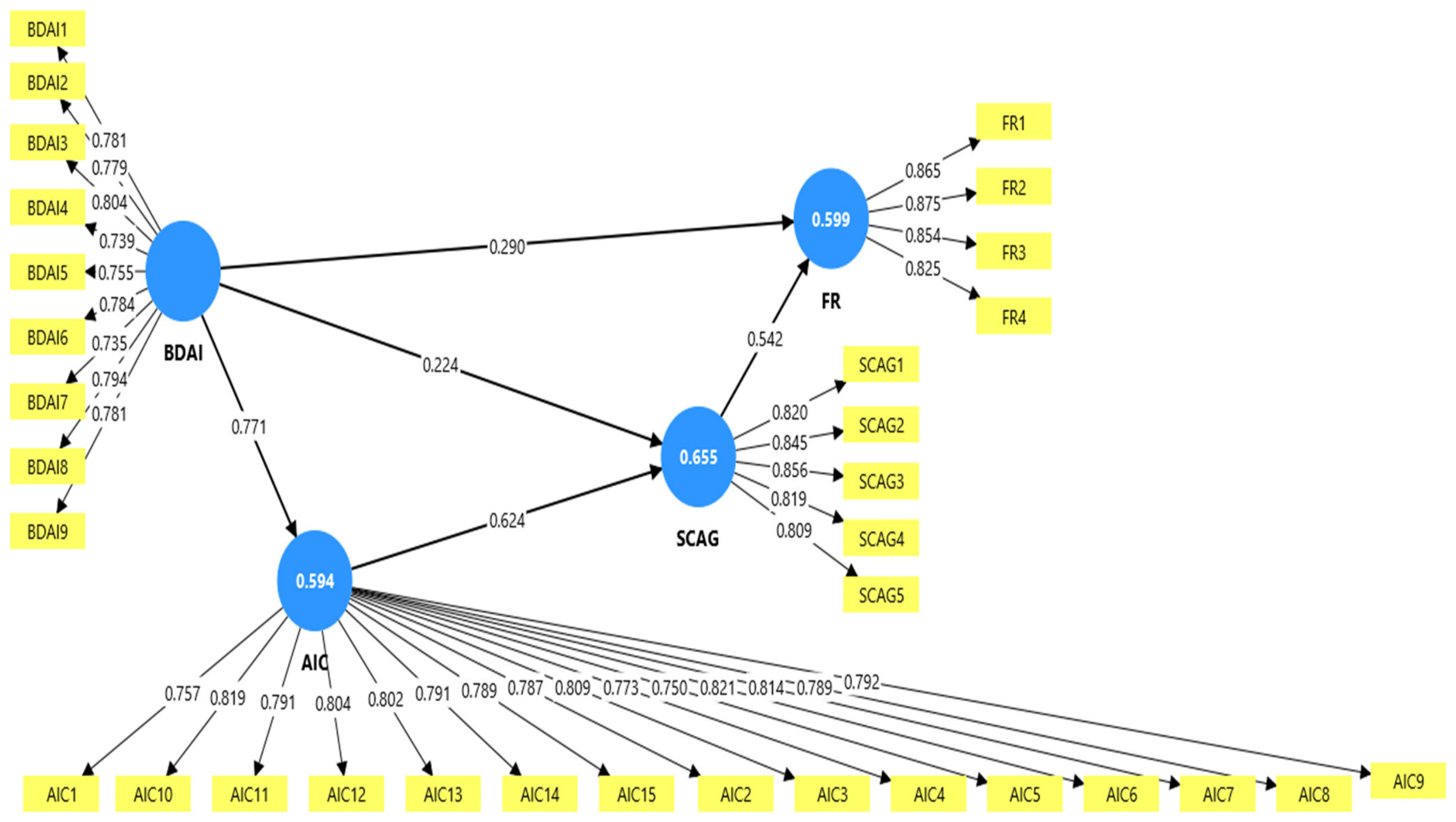
Moreover, the R2 values were analyzed to evaluate the effectiveness of joint productivity. The results indicated that the model explains significant predictive variance in the constructs, as illustrated in Table 7, which presents R2 values of 0.594, 0.655, and 0.599. These results exceed the minimum thresholds recommended by Falk and Miller [109] and Chin [101]; therefore, the model’s nomological validity is considered acceptable.
The R2 values indicate that the model effectively explains a significant portion of the variance in the main dependent variable, highlighting the key roles that AI capabilities and supply chain agility play in firm resilience and the effectiveness of the capability-based framework in identifying fundamental factors that enhance organizational adaptability. From a practical perspective, this highlights the potential for organizations to achieve meaningful improvements in resilience by enhancing AI capabilities and agility, further emphasizing their strategic significance in today’s dynamic business environment.
The effect size (f2) analysis provides insight into the relative importance of the structural relationships [99], as shown in Table 7. The results indicate that BDAI has a very strong effect on AIC (f2 = 1.463), while AIC (f2 = 0.459) and SCAG (f2 = 0.369) exert large effects on firm resilience, highlighting their role as key drivers of organizational adaptability. In contrast, the direct effect of BDAI on firm resilience is moderate (f2 = 0.105), and its effect on SCAG is small (f2 = 0.059), suggesting that its impact is primarily indirect through capability development.
In addition, the goodness-of-fit measure (GoF) proposed by Tenenhaus et al. [110] to evaluate the structural model was used to address overall quality through average R-squared to show how well the model explains variability in dependent variables [111]. Lane and Lum [112] provide benchmarks for effect sizes: 0.10 for small, 0.25 for medium, and 0.36 for significant effects. The results in Table 8 indicate strong acceptance, with a GoF rating of 0.637, indicating a high overall model fit and strong explanatory performance. However, while the Goodness-of-Fit (GoF) index has limitations for distinguishing between valid and invalid models in PLS-SEM, this study adopts a more approach, prioritizing R2, effect sizes (f2), and predictive relevance (Q2 predict) over GoF for model evaluation. This shift aligns with contemporary research practices and improves the assessment of explanatory and predictive performance of our findings [99,108].
The results in Table 9 indicate that AI integrated with Big Data (AI–Big Data) has a more substantial impact on AI Capabilities (H3) than on firm resilience (H1). This is shown by a path coefficient of 0.771, which is significant at p < 0.000. In contrast, the direct effect on firm resilience has a coefficient of 0.290, which is significant at p < 0.000. Additionally, the influence of SCAG on firm resilience (H4) is more substantial than the direct effect of AI–Big Data, with a path coefficient of 0.542, significant at p < 0.000.
Moreover, the mediating effect of SCAG in the relationship between AI–Big Data and firm resilience (H5) is statistically significant, with a path coefficient of 0.121 at p < 0.000. The serial mediating effect of AI capabilities and SCAG (H6) on firm resilience is also significant, with a coefficient of 0.339, p < 0.000.
Also, the direct effects of AI–Big Data on SCAG are primarily explained by AI capabilities (H8), as evidenced by a path coefficient of 0.481, significant at p < 0.000. Furthermore, the direct link between AI capabilities and SCAG (H7) is strongly supported, with a coefficient of 0.624 (p < 0.000). This demonstrates the vital role of AI capabilities in shaping SCAG. Collectively, these results provide empirical support for all proposed hypotheses. For additional details, refer to Figure 2.

5. Discussion

This study addresses how integrating AI and Big Data can enhance SCAG, drawing on the theories of the DCV and KBV. Also, this study aims to provide insights into how combining supply chain agility and AI capabilities can enhance a firm’s resilience. Also, the findings provide a deeper understanding of how AI–Big Data integration contributes to organizational outcomes and how organizations can effectively transform data into actionable insights, ultimately advancing the firm’s resilience.
In addition, the findings show that integrating AI and Big Data plays a key role in enhancing organizational capabilities rather than directly influencing them, as the development of these AI capabilities significantly enhances supply chain agility through improved responsiveness and flexibility in operational processes. This perspective aligns well with the dynamic capabilities framework, which emphasizes the importance of transforming resources into capabilities to achieve meaningful performance outcomes [62]. Importantly, these findings suggest that the benefits of integrating AI and Big Data extend to enhancing firm resilience, primarily through the mediation of agility. This indicates that resilience can be seen as a key outcome of improved responsiveness at the process level, rather than a direct consequence of technological adoption.
The strong positive correlation between AI–Big Data and Firm Resilience (β = 0.290, p < 0.001) indicates that firms that effectively integrate diverse data sources using AI are better positioned to respond to market changes. This result stresses the potential of integrating AI with Big Data to enhance firm resilience (H1), as it aligns with findings from Hossain et al. [57] and Giachino et al. [60], which suggest that this integration can substantially improve performance across industries. By using these tools, firms can better position themselves to adapt to evolving environments, as Gao et al. [61] emphasize.
From the perspective of the Dynamic Capabilities View (DCV), AI–Big Data enables a powerful dynamic capability that significantly improves a firm’s ability to effectively reconfigure its resources in real time [34]. Also, from the perspective of the Knowledge-Based View (KBV), integrated analytics systems play a critical role in transforming raw data into actionable knowledge [94]. This improves decision-making and strengthens the organization’s resilience in a rapidly changing environment [94].
The study’s findings highlight the beneficial impact of integrating AI with Big Data on a firm’s AI capabilities (H3) with a strong positive path (β = 0.771, p = 0.000). From a Dynamic Capabilities perspective [34], integrating AI and Big Data represents a higher-order capability that allows firms to reconfigure their assets. This result supports the claim that integration has enhanced the firm’s capabilities in a dynamic market, enabling it to adapt effectively to environmental changes by allocating resources accordingly [63]. Likewise, these findings are consistent with Mikalef et al. [83], who found that AI capability emerges from the synergistic use of data resources and advanced analytics and reflects the firm’s proactive approach to meeting the requirements of its existing AI capabilities, particularly in integration and learning processes. In addition, this finding is consistent with Rana et al. [64], who argue that integrating AI empowers firms to develop intelligent data-processing mechanisms that continuously learn and improve without explicit programming, which aligns with the conceptualization of AI capabilities in the present model.
The strong positive path between AI–Big Data and Supply Chain Agility (β = 0.624, p = 0.000) confirms that AI integration with Big Data enhances firms’ responsiveness to environmental volatility. This integration supports prior studies demonstrating its ability to facilitate accurate demand forecasting with increasing data volumes while also enhancing overall performance [3,10]. Furthermore, this finding aligns with research by Hossain et al. [57], which indicates that integrating AI and Big Data can foster new product development aligned with evolving consumer needs, streamline processes, and strengthen relationships with suppliers and partners. Furthermore, it confirms the study by Ma and Chang [68], which discusses how integrating AI and Big Data analytics positively impacts supply chains. Their findings suggest that this integration significantly enhances supply chain agility by improving prediction accuracy and effectively addressing market demand through analysis of complex market trends, historical data, and consumer behavior patterns.
However, the finding could be interpreted as the integration of AI and Big Data can be highly effective when approached thoughtfully, as its success is influenced by various contextual factors, such as environmental dynamism, which play a significant role in determining how capabilities translate into positive outcomes [81]. So, in dynamic environments, advancing agility can substantially enhance resilience, enabling organizations to adapt to rapid changes. Conversely, in a more stable context, focusing on efficiency and cost optimization can yield significant advantages.
The findings of the study provide evidence that enhancing supply chain agility can lead to positive results on a firm’s resilience (H4). This finding aligns with the studies by Alsmairat and Al-Shboul [72] and Ma and Chang [68], which highlight the importance of supply chain agility in improving a supply chain’s effectiveness in responding to both internal and external changes and in adapting to market dynamics.
Furthermore, the study confirms that supply chain agility serves as a mediator (H5, H6) in the relationship between AI–Big Data and firm resilience, and between AIC and firm resilience, with a significance level (p) of 0.000. This indicates that agility is the mechanism through which data-driven knowledge is converted into resilient performance. From a Dynamic Capability View (DCV), agility is a higher-order capability that enables firms to reconfigure their operational routines quickly. Conversely, from a Knowledge-Based View (KBV), this process can be understood as utilizing combined knowledge to transform data insights into actions that sustain firm performance during uncertain times. Overall, these insights underline the value of advancing SCAG to enhance resilience in a constantly changing market environment. The results extend and contribute to the studies by Al Mamun et al. [33] and Wamba et al. [75], which explore the effects of big data on SCAG and its relationship with firm performance. This research highlights that integrating AI with Big Data significantly enhances supply chain agility, thereby positively influencing firm performance, particularly in dynamic environments. This insight points to opportunities for firms looking to use these technologies to improve operational outcomes.
In addition, this study confirms significant links between AI capabilities and Supply Chain Agility (H7) (β = 0.624, p = 0.000), and the indirect path from AI–big data to supply chain agility via AICs (β = 0.481, p = 0.000) highlights AI capabilities’ role as an enabler for knowledge creation and decision enhancing. This finding reinforces the perspective of Chen et al. [84], highlighting that the presence of adequate infrastructure is vital for facilitating the successful implementation of AI in organizations and advancing a productive environment for AI integration [51,85,86,87,88]. Also, it supports the view that capabilities play a key role in overcoming challenges and ensuring successful implementation, thereby significantly enhancing the supply chain’s effectiveness [93].
Moreover, this finding is consistent with investigations by Neiroukh et al. [2], Mikalef & Gupta [7], and Hossain et al. [57], which emphasize the importance of AI capabilities in allowing companies to rapidly address market changes and maintain a competitive advantage by improving decision-making processes. Emphasizing these capabilities can lead to more effective strategies and improved outcomes in today’s dynamic business environment.
In addition, the finding demonstrates that AI capabilities are more influential than AI and Big Data integration alone. This suggests that focusing on capability development is fundamental for driving value creation. Building on previous studies, it emphasizes the importance of aligning technological investments with the enhancement of organizational capabilities to maximize benefits [7].
Furthermore, the study supports the insights of Ma and Chang [68] on the key role of capabilities, including the compatibility of IT systems and access to high-quality data. These elements are vital for enhancing supply chain efficiency and unlocking new value through integrated AI solutions. In addition, this study builds upon the important findings of Mikalef and Gupta [7], emphasizing that AI capabilities serve as a significant intermediary between technological resources and operational performance. This reinforces the potential for organizations to achieve better outcomes by focusing on these capabilities. From the perspective of DCV, AI capabilities serve as key facilities for reconfiguring and significantly improving a firm’s ability to align its resources with the demands of the environment. However, within the framework of Vision 2030, AI integration is the key pillar of Saudi Arabia’s National Strategy for Data and Artificial Intelligence (NSDAI). This strategy positions AI as a key driver of innovation and enhances organizational resilience, thereby enabling a more adaptive, forward-thinking future.
However, while the integration of AI and Big Data offers opportunities to enhance supply chain agility and resilience, it is important to address associated risks and limitations. Firstly, implementing these technologies requires a significant investment in digital infrastructure and skilled staff. By strategically planning for these financial commitments, firms can better position themselves to overcome any constraints, particularly those that may affect firms with limited resources or lower digital maturity [57,113].
Secondly, while enhanced data connectivity among supply chain partners can improve efficiency, it is important to proactively address the associated cybersecurity and data privacy risks. Firms should plan to adopt security measures that will better prepare them to mitigate these risks [4,90]. Thirdly, the success of AI-driven decision-making depends heavily on data quality, so firms can improve outcomes by investing in effective data governance and validation processes to maximize the value drawn from integrated AI and Big Data systems [29,49]. Fourthly, it is important to address algorithmic bias and ethical concerns proactively as firms can work to ensure that AI models are developed and tested with fairness, thereby advancing trust in AI-generated recommendations and reducing managerial risks [64,90]. Lastly, organizational barriers such as a culture that embraces change are critical. By investing in employee training, addressing leadership support, and aligning AI initiatives with business strategy, firms can enhance the effectiveness of their integration efforts. Viewing the integration of AI and Big Data as an organizational transformation process enables a holistic, sustainable approach rather than a purely technical implementation [7,48].
In summary, the benefits of AI and Big Data integration can be realized by focusing on adequate investment, strong governance, high data quality, ethical considerations, and organizational readiness.

6. Conclusions and Implications

6.1. Theoretical Implication

This study enhances both DCV and KBV theories by emphasizing the integration of AI and Big Data as core dynamic and knowledge-based capabilities that promote agility and resilience. By bridging these two theoretical frameworks, this study shows that knowledge, a key focus of the KBV, achieves its greatest value when it is effectively integrated into the dynamic processes highlighted by the DCV. This integration enables firms to adapt quickly to changing environments.
This study highlights the critical role of dynamic capabilities, such as AI capabilities and supply chain agility, in advancing accomplishment by enhancing a firm’s resilience. Its objective is to provide a detailed description of how integrating AI and Big Data as knowledge-based capabilities can generate significant value. By validating a research framework, the study contributes to the current literature on the positive effects of integrated AI and Big Data on supply chain agility and firm resilience, which advances future research in these areas. In addition, while the topic of AI and its integration offers opportunity to advance our theoretical understanding of its impact on firm performance [60], this research intends to positively add to the fields of information systems and supply chain by investigating how incorporating AI into Big Data can enhance supply chain agility.
In addition, this study emphasizes the vital role that intermediaries play in linking integrated AI and Big Data to supply chain agility and firm resilience. It posits that utilizing AI capabilities can significantly enhance SCAG, ultimately strengthening a firm’s resilience. Moreover, by examining these interconnected aspects alongside existing literature, the study offers constructive theoretical insights that contribute to a more comprehensive perception of their influence on a firm.

6.2. Practical Implication

This research has significant implications for practitioners aiming to strengthen firm resilience by utilizing their existing capabilities in integrated AI–Big Data to support agility in resource supply chains, ultimately leading to more adaptable operations.
The study shows that integrating AI with Big Data enables decision-makers to optimize existing resources and develop innovative metrics and indicators to enhance resilience and adapt to evolving market demands. Furthermore, while Rashid et al. [93] recognize the impact of AI integrated with Big Data in developing the supply chain, this study emphasizes their potential to strengthen supply chain agility by effectively analyzing and responding to dynamic business needs. Overall, integrating AI with Big Data while maintaining supply chain agility can enhance a firm’s resilience by leveraging advanced mathematical modeling to effectively address its needs and respond to dynamic competition and evolving industry demands. Therefore, practitioners are encouraged to implement agile supply chain practices within their firms actively. This proactive approach will help align and adapt supply chain resources and activities, ultimately improving performance and competitiveness in the marketplace.
Furthermore, while Mikalef and Gupta [7] highlight the important role of AI capabilities as an intermediary in the association between technological resources and operational performance, this study illustrates how strengthening AI capabilities can effectively intermediate the association between AI integrated with Big Data and SCAG, thereby improving firms’ resilience. In alignment with these findings, practitioners are encouraged to allocate resources and prioritize the acquisition of vital AI capabilities to enhance overall performance and adaptability. So, firms should prioritize the development of robust AI capabilities, including predictive analytics, data integration, and decision support systems, rather than focusing only on technology adoption. Also, practitioners at firms should focus on integrating AI into routine decisions, such as inventory management, logistics planning, and supplier selection, as integrating data across the supply chain enhances visibility and enables more informed decision-making.

6.3. Conclusions

This study offers an insightful investigation of how integrating AI and Big Data can improve SCAG and firm resilience in the Saudi Arabian context. This study represents the first academic effort grounded in the theories of the DCV and KBV, establishing a constructive link between integrating AI with Big Data and supply chain agility through AI capabilities. This integration has significant potential to improve a firm’s resilience, allowing it to be more adaptive and responsive.

7. Limitations and Future Research Directions

This study identifies key limitations and proposes avenues for future research. Initially, the framework was validated through a comprehensive survey conducted in a specific context. By applying these findings across various contexts, this study demonstrates significant improvements in operational efficiency, illustrating how firms can utilize integrated AI and Big Data to optimize their supply chains and enhance market resilience. Future studies can adopt this research paradigm across various developing countries and on an international scale, enabling exploration of diverse cultural backgrounds and enriching our understanding of the subject.
In addition, this study uses a non-probability sampling approach, which is often employed in exploratory research and theory testing. However, this method may limit the representativeness of the sample, and to enhance the findings and improve the generalizability beyond the study’s sample, future research should consider using probability-based sampling techniques, such as stratified or random sampling.
The study’s findings indicate that AI capabilities play a meaningful mediating role in the relationship between the integration of AI–Big Data and supply chain agility. To deepen our understanding of this relationship, it would be important to examine additional mediators or moderators. For instance, examining other technological factors, such as digital capabilities, or organizational factors, such as top management support, could significantly influence supply chain agility. This broader investigation could yield meaningful insights to optimize supply chain performance and enhance firm resilience.
Also, future research offers an opportunity to examine the impact of emerging digital technologies, including generative AI, blockchain, and digital platforms, on enhancing supply chain agility and resilience. Moreover, by exploring non-linear and contingency effects such as industry characteristics, firm size, and environmental uncertainty, a deeper understanding of the boundary conditions of the proposed model will be gained.
In the future, researchers could benefit from conducting a longitudinal study that engages multiple respondents within the same firm. This approach would strengthen the reliability and validity of the findings and would help to better understand how these dynamics, including AI capabilities, supply chain agility, and resilience, evolve in response to environmental conditions. Furthermore, employing qualitative methods could offer meaningful insights into the intricate factors that impact the integration of AI with big data. By exploring these dimensions, researchers can enhance supply chain agility and advance greater resilience within firms.

Funding

This work was supported and funded by the Deanship of Scientific Research at Imam Mohammad Ibn Saud Islamic University (IMSIU) (grant number IMSIU-DDRSP2604).

Institutional Review Board Statement

Not applicable.

Informed Consent Statement

The researcher provides the consent form to the participants in the data collection procedure. The participants gave their full consent, and the researchers collected the primary data.

Data Availability Statement

The data used to support the findings of this study are available from the corresponding author upon request.

Conflicts of Interest

The author declares no conflicts of interest.

Appendix A. Questionnaire Used in Survey

Construct/SourceItems
Integrated AI–Big Data
Developed: Dubey et al. [54]; Ma and Chang [68]; Bag et al. [51]; Giachino et al. [60]
Our organization has access to unstructured and structured data sets.
Our organization use and combines multiple data sources (internal and external data) for value analysis business environment.
We apply advanced analytical techniques for decision-making.
We use computing techniques (e.g., Hadoop) for processing of large data sets.
We use data visualization techniques, such as dashboards to interpret complex data.
Our management have approved budget for big data and artificial intelligence project.
We give Big Data and Artificial Intelligence training to our employees.
We appoint experts having long experience in integrated Big Data and Artificial Intelligence.
We have collaboration for implementing integrated big data and Artificial Intelligence projects.
Supply Chain Agility
Adapted: Blome et al. [40]
We are able to our services and/or products sufficiently fast to new customer requirements.
We are able to react sufficiently fast to new market developments.
We are able to react to significant increase and decrease in demand as fast as required by the market.
We are always able to adjust our product portfolio as fast as required by the market.
We are able to react adequately fast to supply-side changes, e.g., compensate for spontaneous supplier outages, delivery failure, market shortages.
Firm resilience
Developed: Ye et al. [79]
We are able to cope with the disruption.
We are able to adapt to the disruption easily.
We are able to provide a quick response to the disruption caused.
We are able to maintain high situational awareness at all times.
Artificial Intelligence Capabilities
Adapted: Giachino et al. [60]; Chen et al. [84]; Belhadi et al. [10]; Mikalef and Gupta [7]
We have the hardware equipment (computers, etc.) to apply AI.
We have the technical resources to apply AI
We have the software to apply AI.
We have access to the data needed to run AI.
We have arranged sufficient funding for AI projects Artificial intelligence skills (AIS).
We understand the range of applications of AI.
We can develop plans for the use of AI.
We have the skills to apply AI.
We have access to training in the use of AI.
We can use AI technologies.
We have a recognition of the importance of innovation.
We have a strategy for developing innovation efforts.
We can implement innovation programs.
We will introduce new products or technologies to improve business performance
We will take aggressive action to capitalize on growth opportunities.

References

  1. Choudhary, V.; Marchetti, A.; Shrestha, Y.R.; Puranam, P. Human-AI ensembles: When can they work? J. Manag. 2025, 51, 536–569. [Google Scholar] [CrossRef] [Scilit]
  2. Neiroukh, S.; Emeagwali, O.L.; Aljuhmani, H.Y. Artificial intelligence capability and organizational performance: Unraveling the mediating mechanisms of decision-making processes. Manag. Decis. 2025, 63, 3501–3532. [Google Scholar] [CrossRef] [Scilit]
  3. Singh, D.; Sharma, A.; Singh, R.K.; Rana, P.S. Augmenting supply chain resilience through AI and big data. Bus. Process Manag. J. 2025, 31, 631–657. [Google Scholar] [CrossRef] [Scilit]
  4. Zamani, E.D.; Smyth, C.; Gupta, S.; Dennehy, D. Artificial intelligence and big data analytics for supply chain resilience: A systematic literature review. Ann. Oper. Res. 2023, 327, 605–632. [Google Scholar] [CrossRef] [Scilit] [PubMed]
  5. Pandey, A.K.; Pratap, S.; Dwivedi, A.; Khan, S.A. Industry 4.0 and supply chain sustainability: Benchmarking enablers to build reliable supply chain. Benchmarking Int. J. 2025, 32, 433–458. [Google Scholar] [CrossRef] [Scilit]
  6. Ralston, P.; Blackhurst, J. Industry 4.0 and resilience in the supply chain: A driver of capability enhancement or capability loss? Int. J. Prod. Res. 2020, 58, 5006–5019. [Google Scholar] [CrossRef] [Scilit]
  7. Mikalef, P.; Gupta, M. Artificial intelligence capability: Conceptualization, measurement calibration, and empirical study on its impact on organizational creativity and firm performance. Inf. Manag. 2021, 58, 103434. [Google Scholar] [CrossRef] [Scilit]
  8. Ledro, C.; Nosella, A.; Vinelli, A. Artificial intelligence in customer relationship management: Literature review and future research directions. J. Bus. Ind. Mark. 2022, 37, 48–63. [Google Scholar] [CrossRef] [Scilit]
  9. Modgil, S.; Singh, R.K.; Hannibal, C. Artificial intelligence for supply chain resilience: Learning from COVID-19. Int. J. Logist. Manag. 2022, 33, 1246–1268. [Google Scholar] [CrossRef] [Scilit]
  10. Belhadi, A.; Mani, V.; Kamble, S.S.; Khan, S.A.R.; Verma, S. Artificial intelligence-driven innovation for enhancing supply chain resilience and performance under the effect of supply chain dynamism: An empirical investigation. Ann. Oper. Res. 2024, 333, 627–652. [Google Scholar] [CrossRef] [Scilit] [PubMed]
  11. Verma, S.; Gustafsson, A. Investigating the emerging COVID-19 research trends in the field of business and management: A bibliometric analysis approach. J. Bus. Res. 2020, 118, 253. [Google Scholar] [CrossRef] [Scilit] [PubMed]
  12. Bai, B.; Um, K.H.; Lee, H. Optimizing manufacturing efficiency: Exploring the impact of social media, supply chain agility, and knowledge transfer in a moderated mediation model. J. Manuf. Technol. Manag. 2025, 36, 671–692. [Google Scholar] [CrossRef] [Scilit]
  13. Kandarkar, P.C.; Ravi, V. Investigating the impact of smart manufacturing and interconnected emerging technologies in building smarter supply chains. J. Manuf. Technol. Manag. 2024, 35, 984–1009. [Google Scholar] [CrossRef] [Scilit]
  14. Li, Y.; Dai, J.; Cui, L. The impact of digital technologies on economic and environmental performance in the context of industry 4.0: A moderated mediation model. Int. J. Prod. Econ. 2020, 229, 107777. [Google Scholar] [CrossRef] [Scilit]
  15. Bai, B.; Um, K.H.; Lee, H. The strategic role of firm agility in the relationship between IT capability and firm performance under the COVID-19 outbreak. J. Bus. Ind. Mark. 2023, 38, 1041–1054. [Google Scholar] [CrossRef] [Scilit]
  16. Latan, H.; de Sousa Jabbour, A.B.L.; Sarkis, J.; Jabbour, C.J.C.; Ali, M. The nexus of supply chain performance and blockchain technology in the digitalization era: Insights from a fast-growing economy. J. Bus. Res. 2024, 172, 114398. [Google Scholar] [CrossRef] [Scilit]
  17. Chen, C.J. Developing a model for supply chain agility and innovativeness to enhance firms’ competitive advantage. Manag. Decis. 2018, 57, 1511–1534. [Google Scholar] [CrossRef] [Scilit]
  18. Cadden, T.; McIvor, R.; Cao, G.; Treacy, R.; Yang, Y.; Gupta, M.; Onofrei, G. Unlocking supply chain agility and supply chain performance through the development of intangible supply chain analytical capabilities. Int. J. Oper. Prod. Manag. 2022, 42, 1329–1355. [Google Scholar] [CrossRef] [Scilit]
  19. Hillmann, J.; Guenther, E. Organizational resilience: A valuable construct for management research? Int. J. Manag. Rev. 2021, 23, 7–44. [Google Scholar] [CrossRef] [Scilit]
  20. Cadden, T.; Dennehy, D.; Mäntymäki, M.; Treacy, R. Understanding the influential and mediating role of cultural enablers of AI integration to supply chain. Int. J. Prod. Res. 2021, 60, 4592–4620. [Google Scholar] [CrossRef] [Scilit]
  21. Dubey, R.; Gunasekaran, A.; Childe, S.J.; Bryde, D.J.; Giannakis, M.; Foropon, C.; Hazen, B.T. Big data analytics and artificial intelligence pathway to operational performance under the effects of entrepreneurial orientation and environmental dynamism: A study of manufacturing organisations. Int. J. Prod. Econ. 2020, 226, 107599. [Google Scholar] [CrossRef] [Scilit]
  22. Alaskar, T.H. Integrated AI and Business Analytics for Sustaining Data-Driven and Technological Innovation: The Mediating Role of Integration Capabilities and Digital Platform. Sustainability 2025, 17, 8749. [Google Scholar] [CrossRef] [Scilit]
  23. Ayadi, F.M.; Alaskar, T.H.; Aloulou, W.J.; Alsadi, A.K. From digital platform capabilities to firm performance: A mediation approach based on firm agility and network capabilities. Int. J. Cust. Relatsh. Mark. Manag. 2024, 15, 1–24. [Google Scholar] [CrossRef] [Scilit]
  24. Alaskar, T. The impact of organizational capabilities on business analytics use: The moderating role of environmental dynamism. Inf. Syst. e-Bus. Manag. 2024, 22, 1045–1067. [Google Scholar] [CrossRef] [Scilit]
  25. Barney, J. Firm resources and sustained competitive advantage. J. Manag. 1991, 17, 99–120. [Google Scholar] [CrossRef] [Scilit]
  26. Liu, L.; Long, J.; Liu, R.; Fan, Q.; Wan, W. Examining how and when digital platform capabilities drive technological innovation: A strategic information perspective. J. Enterp. Inf. Manag. 2023, 36, 553–582. [Google Scholar] [CrossRef] [Scilit]
  27. Hossain, M.A.; Agnihotri, R.; Rushan, M.R.I.; Rahman, M.S.; Sumi, S.F. Marketing analytics capability, artificial intelligence adoption, and firms’ competitive advantage: Evidence from the manufacturing industry. Ind. Mark. Manag. 2022, 106, 240–255. [Google Scholar] [CrossRef] [Scilit]
  28. Cenamor, J.; Parida, V.; Wincent, J. How entrepreneurial SMEs compete through digital platforms: The roles of digital platform capability, network capability and ambidexterity. J. Bus. Res. 2019, 100, 196–206. [Google Scholar] [CrossRef] [Scilit]
  29. Fosso Wamba, S.; Queiroz, M.M.; Pappas, I.O.; Sullivan, Y. Artificial intelligence capability and firm performance: A sustainable development perspective by the mediating role of data-driven culture. Inf. Syst. Front. 2024, 26, 2189–2203. [Google Scholar] [CrossRef] [Scilit]
  30. Murray, A.; Rhymer, J.E.N.; Sirmon, D.G. Humans and technology: Forms of conjoined agency in organizations. Acad. Manag. Rev. 2021, 46, 552–571. [Google Scholar] [CrossRef] [Scilit]
  31. Raisch, S.; Krakowski, S. Artificial intelligence and management: The automation-augmentation paradox. Acad. Manag. Rev. 2021, 46, 192–210. [Google Scholar] [CrossRef] [Scilit]
  32. Felin, T.; Powell, T.C. Designing organizations for dynamic capabilities. Calif. Manag. Rev. 2016, 58, 78–96. [Google Scholar] [CrossRef] [Scilit]
  33. Al Mamun, A.; Reza, M.N.H.; Yang, Q.; Aziz, N.A. Dynamic capabilities in action: The synergy of big data analytics, supply chain ambidexterity, green supply chain and firm performance. J. Enterp. Inf. Manag. 2025, 38, 636–659. [Google Scholar] [CrossRef] [Scilit]
  34. Teece, D.J. Business models and dynamic capabilities. Long Range Plan. 2018, 51, 40–49. [Google Scholar] [CrossRef] [Scilit]
  35. Handfield, R.B.; Cousins, P.D.; Lawson, B.; Petersen, K.J. How can supply management really improve performance? A knowledge-based model of alignment capabilities. J. Supply Chain Manag. 2015, 51, 3–17. [Google Scholar] [CrossRef] [Scilit]
  36. Aslam, H.; Blome, C.; Roscoe, S.; Azhar, T.M. Dynamic supply chain capabilities: How market sensing, supply chain agility and adaptability affect supply chain ambidexterity. Int. J. Oper. Prod. Manag. 2018, 38, 2266–2285. [Google Scholar] [CrossRef] [Scilit]
  37. Gligor, D.; Holcomb, M. The road to supply chain agility: An RBV perspective on the role of logistics capabilities. Int. J. Logist. Manag. 2014, 25, 160–179. [Google Scholar] [CrossRef] [Scilit]
  38. Dubey, R.; Altay, N.; Gunasekaran, A.; Blome, C.; Papadopoulos, T.; Childe, S.J. Supply chain agility, adaptability and alignment: Empirical evidence from the Indian auto components industry. Int. J. Oper. Prod. Manag. 2018, 38, 129–148. [Google Scholar] [CrossRef] [Scilit]
  39. Eckstein, D.; Goellner, M.; Blome, C.; Henke, M. The performance impact of supply chain agility and supply chain adaptability: The moderating effect of product complexity. Int. J. Prod. Res. 2015, 53, 3028–3046. [Google Scholar] [CrossRef] [Scilit]
  40. Blome, C.; Schoenherr, T.; Rexhausen, D. Antecedents and enablers of supply chain agility and its effect on performance: A dynamic capabilities perspective. Int. J. Prod. Res. 2013, 51, 1295–1318. [Google Scholar] [CrossRef] [Scilit]
  41. Lee, S.M.; Rha, J.S. Ambidextrous supply chain as a dynamic capability: Building a resilient supply chain. Manag. Decis. 2016, 54, 2–23. [Google Scholar] [CrossRef] [Scilit]
  42. Mukherjee, S.; Baral, M.M.; Nagariya, R.; Chittipaka, V.; Pal, S.K. Artificial intelligence-based supply chain resilience for improving firm performance in emerging markets. J. Glob. Oper. Strateg. Sourc. 2024, 17, 516–540. [Google Scholar] [CrossRef] [Scilit]
  43. Sundarakani, B.; Pereira, V.; Ishizaka, A. Robust facility location decisions for resilient sustainable supply chain performance in the face of disruptions. Int. J. Logist. Manag. 2021, 32, 357–385. [Google Scholar] [CrossRef] [Scilit]
  44. Cui, J. The explore of knowledge management dynamic capabilities, AI-driven knowledge sharing, knowledge-based organizational support, and organizational learning on job performance: Evidence from Chinese technological companies. arXiv 2025, arXiv:2501.02468. [Google Scholar]
  45. Curado, C.; Bontis, N. The knowledge-based view of the firm and its theoretical precursor. Int. J. Learn. Intellect. Cap. 2006, 3, 367–381. [Google Scholar] [CrossRef] [Scilit]
  46. Wiklund, J.; Shepherd, D. Knowledge-based resources, entrepreneurial orientation, and the performance of small and medium-sized businesses. Strateg. Manag. J. 2003, 24, 1307–1314. [Google Scholar] [CrossRef] [Scilit]
  47. Hoskisson, R.E.; Hitt, M.A.; Wan, W.P.; Yiu, D. Theory and research in strategic management: Swings of a pendulum. J. Manag. 1999, 25, 417–456. [Google Scholar] [CrossRef]
  48. Jarrahi, M.H.; Kenyon, S.; Brown, A.; Donahue, C.; Wicher, C. Artificial intelligence: A strategy to harness its power through organizational learning. J. Bus. Strategy 2023, 44, 126–135. [Google Scholar] [CrossRef] [Scilit]
  49. Duan, Y.; Edwards, J.S.; Dwivedi, Y.K. Artificial intelligence for decision making in the era of big data: Evolution, challenges and research agenda. Int. J. Inf. Manag. 2019, 48, 63–71. [Google Scholar] [CrossRef] [Scilit]
  50. Rezaei, M. Artificial intelligence in knowledge management: Identifying and addressing the key implementation challenges. Technol. Forecast. Soc. Change 2025, 217, 124183. [Google Scholar] [CrossRef] [Scilit]
  51. Bag, S.; Gupta, S.; Kumar, A.; Sivarajah, U. An integrated artificial intelligence framework for knowledge creation and B2B marketing rational decision making for improving firm performance. Ind. Mark. Manag. 2021, 92, 178–189. [Google Scholar] [CrossRef] [Scilit]
  52. Ladeira, W.J.; Santini, F.D.O.; Rasul, T.; Cheah, I.; Elhajjar, S.; Yasin, N.; Akhtar, S. Big data analytics and the use of artificial intelligence in the services industry: A meta-analysis. Serv. Ind. J. 2024, 44, 1117–1144. [Google Scholar] [CrossRef] [Scilit]
  53. Ferraris, A.; Mazzoleni, A.; Devalle, A.; Couturier, J. Big data analytics capabilities and knowledge management: Impact on firm performance. Manag. Decis. 2019, 57, 1923–1936. [Google Scholar] [CrossRef] [Scilit]
  54. Dubey, R.; Gunasekaran, A.; Childe, S.J.; Blome, C.; Papadopoulos, T. Big data and predictive analytics and manufacturing performance: Integrating institutional theory, resource-based view and big data culture. Br. J. Manag. 2019, 30, 341–361. [Google Scholar] [CrossRef] [Scilit]
  55. Bag, S.; Dhamija, P.; Singh, R.K.; Rahman, M.S.; Sreedharan, V.R. Big data analytics and artificial intelligence technologies based collaborative platform empowering absorptive capacity in health care supply chain: An empirical study. J. Bus. Res. 2023, 154, 113315. [Google Scholar] [CrossRef] [Scilit]
  56. Sestino, A.; De Mauro, A. Leveraging artificial intelligence in business: Implications, applications and methods. Technol. Anal. Strateg. Manag. 2022, 34, 16–29. [Google Scholar] [CrossRef] [Scilit]
  57. Hossain, M.K.; Srivastava, A.; Oliver, G.C.; Islam, M.E.; Jahan, N.A.; Karim, R.; Mahdi, T.H. Adoption of artificial intelligence and big data analytics: An organizational readiness perspective of the textile and garment industry in Bangladesh. Bus. Process Manag. J. 2024, 30, 2665–2683. [Google Scholar] [CrossRef] [Scilit]
  58. Lutfi, A.; Alrawad, M.; Alsyouf, A.; Almaiah, M.A.; Al-Khasawneh, A.; Al-Khasawneh, A.L.; Ibrahim, N. Drivers and impact of big data analytic adoption in the retail industry: A quantitative investigation applying structural equation modeling. J. Retail. Consum. Serv. 2023, 70, 103129. [Google Scholar] [CrossRef] [Scilit]
  59. Adiguzel, Z.; Sonmez Cakir, F.; Altay Morgul, U. Effectiveness in the furniture industry: Artificial intelligence, big data and sustainable design. Manag. Decis. 2026, 64, 1063–1086. [Google Scholar] [CrossRef] [Scilit]
  60. Giachino, C.; Cepel, M.; Truant, E.; Bargoni, A. Artificial intelligence-driven decision making and firm performance: A quantitative approach. Manag. Decis. 2025, 63, 3454–3476. [Google Scholar] [CrossRef] [Scilit]
  61. Gao, W.; Zhan, J.; Wang, L.; Luo, C.; Zheng, D.; Wen, X.; Dai, J. BigDataBench: A scalable and unified big data and AI benchmark suite. arXiv 2018, arXiv:1802.08254. [Google Scholar]
  62. Teece, D.J. Explicating dynamic capabilities: The nature and microfoundations of (sustainable) enterprise performance. Strateg. Manag. J. 2007, 28, 1319–1350. [Google Scholar] [CrossRef] [Scilit]
  63. Atienza-Barba, J.; Zorio-Grima, A. Artificial intelligence and organizational agility in digital transformation: A systematic review. J. Innov. Knowl. 2024, 9, 100378. [Google Scholar]
  64. Rana, N.P.; Chatterjee, S.; Dwivedi, Y.K.; Akter, S. Understanding Dark Side of Artificial Intelligence (AI) Integrated Business Analytics: Assessing Firm’s Operational Inefficiency and Competitiveness. Eur. J. Inf. Syst. 2022, 31, 364–387. [Google Scholar] [CrossRef] [Scilit]
  65. Chen, C.T.; Chen, S.C.; Khan, A.; Lim, M.K.; Tseng, M.L. Big data analytics-artificial intelligence and supply chain ambidexterity impacts on corporate image and green communication. Ind. Manag. Data Syst. 2024, 124, 2899–2918. [Google Scholar] [CrossRef] [Scilit]
  66. Gallo, H.; Khadem, A.; Alzubi, A. The relationship between big data analytic-artificial intelligence and environmental performance: A moderated mediated model of green supply chain collaboration and top management commitment. Discret. Dyn. Nat. Soc. 2023, 2023, 4980895. [Google Scholar] [CrossRef] [Scilit]
  67. Dal Forno, A.J.; Bataglini, W.V.; Steffens, F.; Ulson de Souza, A.A. Industry 4.0 in textile and apparel sector: A systematic literature review. Res. J. Text. Appar. 2023, 27, 95–117. [Google Scholar] [CrossRef] [Scilit]
  68. Ma, L.; Chang, R. How big data analytics and artificial intelligence facilitate digital supply chain transformation: The role of integration and agility. Manag. Decis. 2025, 63, 3557–3598. [Google Scholar] [CrossRef] [Scilit]
  69. Oppioli, M.; Sousa, M.J.; Sousa, M.; de Nuccio, E. The role of artificial intelligence for management decision: A structured literature review. Manag. Decis. 2025, 63, 3262–3280. [Google Scholar] [CrossRef] [Scilit]
  70. Li, X.; Chung, C.; Goldsby, T.J.; Holsapple, C.W. A unified model of supply chain agility: The work-design perspective. Int. J. Logist. Manag. 2008, 19, 408–435. [Google Scholar] [CrossRef] [Scilit]
  71. Richey, R.G.; Roath, A.S.; Adams, F.G.; Wieland, A. A responsiveness view of logistics and supply chain management. J. Bus. Logist. 2022, 43, 62–91. [Google Scholar] [CrossRef] [Scilit]
  72. Alsmairat, M.A.; Al-Shboul, M.D.A. Enabling supply chain efficacy through supply chain absorptive capacity and ambidexterity: Empirical study from the Middle East region—A moderated-mediation model. J. Manuf. Technol. Manag. 2023, 34, 917–936. [Google Scholar] [CrossRef] [Scilit]
  73. Singh, R.K.; Acharya, P.; Modgil, S. A template-based approach to measure supply chain flexibility: A case study of Indian soap manufacturing firm. Meas. Bus. Excell. 2020, 24, 161–181. [Google Scholar] [CrossRef] [Scilit]
  74. Al-Shboul, M.D.A. Infrastructure framework and manufacturing supply chain agility: The role of delivery dependability and time to market. Supply Chain Manag. Int. J. 2017, 22, 172–185. [Google Scholar] [CrossRef] [Scilit]
  75. Wamba, S.F.; Dubey, R.; Gunasekaran, A.; Akter, S. The performance effects of big data analytics and supply chain ambidexterity: The moderating effect of environmental dynamism. Int. J. Prod. Econ. 2020, 222, 107498. [Google Scholar] [CrossRef] [Scilit]
  76. Ilmudeen, A. Information technology governance and IT capability to realize firm performance: Enabling role of agility and innovative capability. Benchmarking Int. J. 2022, 29, 1137–1161. [Google Scholar] [CrossRef] [Scilit]
  77. Das, K.P.; Mukhopadhyay, S.; Suar, D. Enablers of workforce agility, firm performance, and corporate reputation. Asia Pac. Manag. Rev. 2023, 28, 33–44. [Google Scholar] [CrossRef] [Scilit]
  78. Roberts, N.; Grover, V. Investigating firm’s customer agility and firm performance: The importance of aligning sense and respond capabilities. J. Bus. Res. 2012, 65, 579–585. [Google Scholar] [CrossRef] [Scilit]
  79. Ye, F.; Ke, M.; Ouyang, Y.; Li, Y.; Li, L.; Zhan, Y.; Zhang, M. Impact of digital technology usage on firm resilience: A dynamic capability perspective. Supply Chain Manag. Int. J. 2024, 29, 162–175. [Google Scholar] [CrossRef] [Scilit]
  80. Kazancoglu, I.; Ozbiltekin-Pala, M.; Mangla, S.K.; Kazancoglu, Y.; Jabeen, F. Role of flexibility, agility and responsiveness for sustainable supply chain resilience during COVID-19. J. Clean. Prod. 2022, 362, 132431. [Google Scholar] [CrossRef] [Scilit]
  81. Dubey, R.; Bryde, D.J.; Dwivedi, Y.K.; Graham, G.; Foropon, C. Impact of artificial intelligence-driven big data analytics culture on agility and resilience in humanitarian supply chain: A practice-based view. Int. J. Prod. Econ. 2022, 250, 108618. [Google Scholar] [CrossRef] [Scilit]
  82. Krakowski, S.; Luger, J.; Raisch, S. Artificial intelligence and the changing sources of competitive advantage. Strateg. Manag. J. 2023, 44, 1425–1452. [Google Scholar] [CrossRef] [Scilit]
  83. Mikalef, P.; Islam, N.; Parida, V.; Singh, H.; Altwaijry, N. Artificial intelligence competencies for organizational performance: A B2B marketing capabilities perspective. J. Bus. Res. 2023, 164, 113998. [Google Scholar] [CrossRef] [Scilit]
  84. Chen, D.; Esperança, J.P.; Wang, S. The impact of artificial intelligence on firm performance: An application of the resource-based view to e-commerce firms. Front. Psychol. 2022, 13, 884830. [Google Scholar] [CrossRef] [Scilit]
  85. Łapińska, J.; Escher, I.; Gorka, J.; Sudolska, A.; Brzustewicz, P. Employees’ trust in artificial intelligence in companies: The case of energy and chemical industries in Poland. Energies 2021, 14, 1942. [Google Scholar] [CrossRef] [Scilit]
  86. Hwang, W.S.; Kim, H.S. Does the adoption of emerging technologies improve technical efficiency? Evidence from Korean manufacturing SMEs. Small Bus. Econ. 2022, 59, 627–643. [Google Scholar] [CrossRef] [Scilit]
  87. Zhang, H.; Song, M.; He, H. Achieving the success of sustainability development projects through big data analytics and artificial intelligence capability. Sustainability 2020, 12, 949. [Google Scholar] [CrossRef] [Scilit]
  88. Rahman, M.S.; Hossain, M.A.; Abdel Fattah, F.A.M. Does marketing analytics capability boost firms’ competitive marketing performance in data-rich business environment? J. Enterp. Inf. Manag. 2022, 35, 455–480. [Google Scholar] [CrossRef] [Scilit]
  89. Sullivan, Y.; Wamba, S.F. Artificial intelligence and adaptive response to market changes: A strategy to enhance firm performance and innovation. J. Bus. Res. 2024, 174, 114500. [Google Scholar] [CrossRef] [Scilit]
  90. Dwivedi, Y.K.; Hughes, L.; Ismagilova, E.; Aarts, G.; Coombs, C.; Crick, T.; Duan, Y.; Dwivedi, R.; Edwards, J.; Eirug, A.; et al. Artificial intelligence (AI): Multidisciplinary perspectives on emerging challenges, opportunities, and agenda for research, practice and policy. Int. J. Inf. Manag. 2021, 57, 101994. [Google Scholar] [CrossRef] [Scilit]
  91. Dubey, R.; Gunasekaran, A.; Childe, S.J.; Roubaud, D.; Wamba, S.F.; Giannakis, M.; Foropon, C. Big data analytics and organizational culture as complements to swift trust and collaborative performance in the humanitarian supply chain. Int. J. Prod. Econ. 2019, 210, 120–136. [Google Scholar] [CrossRef] [Scilit]
  92. Mariani, M.M.; Machado, I.; Magrelli, V.; Dwivedi, Y.K. Artificial intelligence in innovation research: A systematic review, conceptual framework, and future research directions. Technovation 2023, 122, 102623. [Google Scholar] [CrossRef] [Scilit]
  93. Rashid, A.; Baloch, N.; Rasheed, R.; Ngah, A.H. Big data analytics-artificial intelligence and sustainable performance through green supply chain practices in manufacturing firms of a developing country. J. Sci. Technol. Policy Manag. 2025, 16, 42–67. [Google Scholar] [CrossRef] [Scilit]
  94. Grant, R.M. Toward a knowledge-based theory of the firm. Strateg. Manag. J. 1996, 17, 109–122. [Google Scholar] [CrossRef] [Scilit]
  95. Benzidia, S.; Makaoui, N.; Bentahar, O. The impact of big data analytics and artificial intelligence on green supply chain process integration and hospital environmental performance. Technol. Forecast. Soc. Change 2021, 165, 120557. [Google Scholar] [CrossRef] [Scilit]
  96. Communications, Space & Technology Commission. For the Second Consecutive Time Saudi Arabia Ranks 2nd Among G20 Countries in the ITU’s ICT Development Index 2024, 15 July 2024. Available online: https://www.cst.gov.sa/en/media-center/news/For-The-Second-Consecutive-Time-Saudi-Arabia-Ranks-2nd-Among-G20-Countries-in-the-ITUs-ICT-Developme (accessed on 13 January 2026).
  97. Hulland, J.; Baumgartner, H.; Smith, K.M. Marketing survey research best practices: Evidence and recommendations from a review of JAMS articles. J. Acad. Mark. Sci. 2018, 46, 92–108. [Google Scholar] [CrossRef] [Scilit]
  98. Gefen, D.; Rigdon, E.E.; Straub, D. Editor’s comments: An update and extension to SEM guidelines for administrative and social science research. MIS Q. 2011, 35, iii–xiv. [Google Scholar] [CrossRef] [Scilit]
  99. Hair, J.F.; Risher, J.J.; Sarstedt, M.; Ringle, C.M. When to use and how to report the results of PLS-SEM. Eur. Bus. Rev. 2019, 31, 2–24. [Google Scholar] [CrossRef] [Scilit]
  100. Petter, S.; Straub, D.; Rai, A. Specifying formative constructs in information systems research. MIS Q. 2007, 31, 623–656. [Google Scholar] [CrossRef] [Scilit]
  101. Chin, W.W. The partial least squares approach to structural equation modeling. In Modern Methods for Business Research; Marcoulides, G.A., Ed.; Psychology Press: New York, NY, USA, 1998; pp. 295–336. [Google Scholar]
  102. Hair, J.F.; Ringle, C.M.; Sarstedt, M. Partial least squares structural equation modeling: Rigorous applications, better results and higher acceptance. Long Range Plan. 2013, 46, 1–12. [Google Scholar] [CrossRef] [Scilit]
  103. Fornell, C.; Larcker, D.F. Evaluating structural equation models with unobservable variables and measurement error. J. Mark. Res. 1981, 18, 39–50. [Google Scholar] [CrossRef] [Scilit]
  104. Franke, G.; Sarstedt, M. Heuristics versus statistics in discriminant validity testing: A comparison of four procedures. Internet Res. 2019, 29, 430–447. [Google Scholar] [CrossRef] [Scilit]
  105. Henseler, J.; Ringle, C.M.; Sarstedt, M. A new criterion for assessing discriminant validity in variance-based structural equation modeling. J. Acad. Mark. Sci. 2015, 43, 115–135. [Google Scholar] [CrossRef] [Scilit]
  106. Kock, N.; Lynn, G.S. Lateral collinearity and misleading results in variance-based SEM: An illustration and recommendations. J. Assoc. Inf. Syst. 2012, 13, 2. [Google Scholar] [CrossRef] [Scilit]
  107. Hair, J.F., Jr.; Hult, G.T.M.; Ringle, C.M.; Sarstedt, M. A Primer on Partial Least Squares Structural Equation Modeling (PLS-SEM); Sage Publications: Thousand Oaks, CA, USA, 2021. [Google Scholar]
  108. Shmueli, G.; Sarstedt, M.; Hair, J.F.; Cheah, J.H.; Ting, H.; Vaithilingam, S.; Ringle, C.M. Predictive model assessment in PLS-SEM: Guidelines for using PLSpredict. Eur. J. Mark. 2019, 53, 2322–2347. [Google Scholar] [CrossRef] [Scilit]
  109. Falk, R.F.; Miller, N.B. A Primer for Soft Modeling; University of Akron Press: Akron, OH, USA, 1992. [Google Scholar]
  110. Tenenhaus, M.; Vinzi, V.E.; Chatelin, Y.M.; Lauro, C. PLS path modeling. Comput. Stat. Data Anal. 2005, 48, 159–205. [Google Scholar] [CrossRef] [Scilit]
  111. Peng, D.X.; Lai, F. Using partial least squares in operations management research: A practical guideline and summary of past research. J. Oper. Manag. 2012, 30, 467–480. [Google Scholar] [CrossRef] [Scilit]
  112. Lane, M.S.; Lum, W.H. Examining client perceptions of partnership quality and the relationships between its dimensions in an IT outsourcing relationship. Australas. J. Inf. Syst. 2011, 17, 3–24. [Google Scholar] [CrossRef] [Scilit]
  113. Grover, V.; Chiang, R.H.L.; Liang, T.-P.; Zhang, D. Creating strategic business value from big data analytics: A research framework. J. Manag. Inf. Syst. 2018, 35, 388–423. [Google Scholar] [CrossRef] [Scilit]
Figure 1. Research model.
Systems 14 00554 g001
Figure 2. Fitted model.
Systems 14 00554 g002
Table 1. Characteristics of sample.
SectorNo.%EmployeesNo.%
Telecommunications10021.05%<505311.15%
50–24919841.68%
Wholesale and retail8117.05%250–4999219.36%
>50013227.78%
Manufacturing6714.10%Respondent’s position
CIO326.73%
Healthcare6012.63%Business unit manager8818.52%
Project Manager8317.47%
Insurance3407.15%Data Analyst10522.10%
System Analyst8016.84%
Banking9520.00%Programmer Analyst5812.21%
Other3808.00%Other296.10%
Table 2. Average Variance Extracted (AVE), Composite Reliability (rho_a), Cronbach’s alpha, and Composite Reliability (rho_c).
ConstructsItemsLoadingsAVEComposite Reliability (rho_a)Cronbach’s AlphaComposite Reliability (rho_c)
AI Capabilities (AICs)AIC10.7570.6280.9580.9580.962
AIC20.787
AIC30.809
AIC40.773
AIC50.750
AIC60.821
AIC70.814
AIC80.789
AIC90.792
AIC100.819
AIC110.791
AIC120.804
AIC130.802
AIC140.791
AIC150.789
AI–Big DataBDAI10.7810.5970.9160.9160.930
BDAI20.779
BDAI30.804
BDAI40.739
BDAI50.755
BDAI60.784
BDAI70.735
BDAI80.794
BDAI90.781
Supply Chain Agility (SCAG)SCAG10.8200.6890.8870.8870.917
SCAG20.845
SCAG30.856
SCAG40.819
SCAG50.809
Firm Resilience
(FR)
FR10.8650.7310.8780.8770.916
FR20.875
FR30.854
FR40.825
Table 3. Correlation matrix.
AI CapabilitiesAI–Big DataFirm ResilienceSupply Chain Agility
AI Capabilities0.793
AI–Big Data0.7710.773
Firm Resilience0.7610.6720.855
Supply Chain Agility0.7970.7050.7460.830
Table 4. HTMT Analysis.
AI CapabilitiesBDAIFirm Resilience
AI–Big Data0.823
Firm Resilience0.8300.749
Supply Chain Agility0.8650.7820.846
Table 5. Values of Full-Collinearity VIFs.
VIF
AI Capabilities -> Supply Chain Agility2.463
AI–Big Data -> AI Capabilities1.000
AI–Big Data -> Firm Resilience1.988
AI–Big Data -> Supply Chain Agility2.463
Supply Chain Agility -> Firm Resilience1.988
Table 6. Q2 predict, RMSE, and MAE values.
Q2 PredictRMSEMAE
AI Capabilities0.5910.6420.467
Firm Resilience0.4470.7460.579
Supply Chain Agility0.4940.7140.546
Table 7. f2 and global fit indexes.
Constructsf-Square
BDAI -> AIC1.463
AIC -> SCAG0.459
SCAG -> FR0.369
BDAI -> FR0.105
BDAI -> SCAG0.059
Table 8. R2 and global fit indexes.
R2Average Variance Extracted (AVE)
AI Capabilities (AIC)0.5940.628
AI–Big Data-0.596
Supply Chain Agility (SCAG)0.6550.689
Firm Resilience (FR)0.5990.731
Average0.6160.661
AVE × R20.407
GoF0.637
Table 9. Summary of hypothesis development results.
ConstructsHypothesisOriginal Sample (O)Standard DeviationT Statistics (|O/STDEV|)p Values
AI–Big Data -> Firm ResilienceH10.2900.0486.0480.000
AI–Big Data -> SCAGH20.6240.05711.0280.000
AI–Big Data -> AICH30.7710.02728.4640.000
SCAG -> Firm ResilienceH40.5420.04512.0260.000
BDAI -> SCAG -> Firm ResilienceH50.1210.0323.8410.000
AIC -> SCAG -> Firm ResilienceH60.3390.0487.0530.000
AIC -> SCAGH70.6240.05711.0280.000
AI–Big Data -> AIC -> SCAGH80.4810.04510.8070.000
Disclaimer/Publisher’s Note: The statements, opinions and data contained in all publications are solely those of the individual author(s) and contributor(s) and not of MDPI and/or the editor(s). MDPI and/or the editor(s) disclaim responsibility for any injury to people or property resulting from any ideas, methods, instructions or products referred to in the content.