Article

An Interpretable Socio-Technical Decision Support System for Bi-Objective Urban Distribution Center Location: Adaptive Optimization Supervised by a Large Language Model

1
College of Economics and Management, Nanjing Agricultural University, Nanjing 210095, China
2
China Center for Food Security Studies, Nanjing Agricultural University, Nanjing 210095, China
*
Author to whom correspondence should be addressed.
Systems 2026, 14(5), 529; https://doi.org/10.3390/systems14050529
Submission received: 8 April 2026 / Revised: 29 April 2026 / Accepted: 6 May 2026 / Published: 8 May 2026
(This article belongs to the Special Issue AI-Driven Simulation and Optimization for Systems)

Abstract

Urban e-commerce fulfillment involves multiple operational stages, including goods receipt, storage, picking, packaging, dispatching, and delivery to customers. This study focuses on one strategic component of this broader fulfillment process: the location–allocation design of urban distribution centers. We develop a socio-technical decision support system for bi-objective urban distribution center planning, in which ex ante location decisions determine which candidate facilities should be opened, whereas ex post allocation decisions assign demand points to the selected facilities under service-time constraints. The model jointly minimizes total logistics cost and population-weighted delivery time, seeking a synergistic balance between cost efficiency and service responsiveness rather than optimizing either objective in isolation. We further embed a large language model into NSGA-II as a bounded supervisory controller that periodically diagnoses search states, adjusts operators and probabilities, and records structured adaptation logs. Experiments on the ZDT benchmark suite and a real urban case demonstrate that this approach improves optimization performance while producing reviewable intervention records. The study contributes to systems research by organizing adaptive AI supervision and organizational oversight into an integrated urban logistics planning system.

1. Introduction

Global e-commerce growth has reshaped urban logistics systems. Global online retail sales exceeded USD 5.8 trillion in 2023 and are projected to continue rising, driving rapid growth in parcel volumes and fulfillment activities [1]. The global e-commerce logistics market was valued at USD 373 billion in 2023 and is forecast to reach USD 1.53 trillion by 2030, indicating strong compound growth [2]. At the city level, the expansion of next-day delivery, and especially the growing expectation of same-day delivery, has intensified last-mile traffic, increased pressure on warehousing capacity and labor, and heightened concerns about emissions and local externalities [3]. As noted in recent case studies on smart cities, these pressures necessitate a fundamental redesign of urban fulfillment strategies to ensure they are both sustainable and inclusive for densely populated areas [4]. These trends make the design of efficient, resilient, and low-carbon urban distribution systems an important logistics challenge.
Beyond physical flows, urban fulfillment is increasingly governed by logistics information systems (LIS) that coordinate orders, inventory visibility, transportation execution and real-time service promises across platforms, carriers and micro-fulfillment nodes. In such environments, facility location decisions are no longer a one-off engineering task, but an information-intensive planning process that depends on data integration, scenario evaluation and accountable reporting to multiple stakeholders. This shift is consistent with technology management research showing that digital technologies increasingly transform managerial tasks from isolated technical decisions into data-intensive, coordination-dependent, and governance-sensitive processes [5]. Recent information systems research emphasizes that algorithmic tools create value only when they are embedded into organizational routines and governance structures that enable traceability, explainability and human oversight, especially when AI systems mediate high-stakes decisions and public-facing service outcomes [6,7,8]. Recent research in technology and innovation management likewise suggests that AI technologies create organizational value not simply through computational power, but through how they are embedded into routines, governance structures, and managerial decision processes [9].
Accordingly, we position the urban distribution center (DC) location problem not only as a logistics optimization task, but also as a systems-design problem in which physical infrastructure, demand allocation, information inputs, algorithmic control, and organizational review must be jointly configured within a bounded planning architecture. In this setting, facility sites, demand nodes, transport conditions, data pipelines, supervisory AI, and review routines jointly shape whether analytical results can be interpreted and used in practice. This systems perspective shifts the focus from deriving an efficient solution in isolation to examining how optimization, validation, explanation, and review are coordinated under changing urban conditions. An effective planning system should therefore generate not only Pareto-efficient network configurations, but also traceable control decisions, reviewable solution summaries, and governance-ready artifacts that support communication and revision across stakeholders. This perspective is consistent with emerging work on user trust in AI-generated content and the need for platform-level accountability mechanisms when AI outputs shape decisions [10].
Distribution centers (DCs) are the operational backbone of urban distribution networks. Their number, size and spatial configuration strongly influence capital investment, land-use and operating costs, delivery lead times, and the environmental footprint of freight movements. Facility location decisions therefore involve fundamental trade-offs: increasing the number of DCs can shorten distances and improve service performance but raises fixed investment and operating costs, while peripheral siting may reduce land costs but lengthens delivery routes, increasing vehicle kilometers and associated externalities [11]. As urban contexts become more demand-dense and time-sensitive, these trade-offs become sharper and more difficult to resolve.
Classical deterministic location models (e.g., p-median, covering and set-partitioning formulations) provide a strong theoretical basis, but become restrictive when service-level objectives, time dependence and sustainability considerations are jointly incorporated [12]. Recent work has proposed multi-objective and low-carbon distribution models that integrate time-dependent demand, emission-related constraints and operational realism [13,14]. However, enriching the modeling scope increases computational complexity: DC location with demand allocation is combinatorial, non-convex and NP-hard, and the resulting objective landscape often contains many local optima [13,15].
Multi-objective evolutionary algorithms (MOEAs) are widely used for such complex logistics optimization problems. NSGA-II remains a methodological benchmark due to elitist non-dominated sorting and crowding-distance-based diversity maintenance [16,17]. Nonetheless, NSGA-II can struggle in large-scale or irregular Pareto landscapes, exhibiting slow convergence, diversity loss and sensitivity to operator probabilities and parameter settings [18]. In practice, fixed crossover and mutation rates may fail to maintain an effective exploration–exploitation balance across different phases of the evolutionary search, leading to premature convergence or inefficient search. However, decision makers typically interact with optimization outputs through dashboards, reports and meetings, where usability, transparency and perceived accountability shape whether an algorithm is adopted. Parameter-sensitive MOEAs can impose substantial trial-and-error burden, and black-box control policies can make it difficult to justify why the search emphasized exploration or exploitation at particular stages. These human-centered constraints motivate controllers that are not only adaptive but also explainable and auditable. In engineering planning settings, however, improved search performance alone is insufficient; managers also require bounded autonomy, traceable rationales and communicable outputs that can support implementation, coordination and accountability.
A growing literature therefore improves MOEAs through reference-vector guidance, hybridization with other heuristics, surrogate assistance and learning-based control [19,20]. In particular, reinforcement-learning-assisted evolutionary algorithms learn policies for operator selection and parameter control from population feedback [21,22,23]. More recently, large language models (LLMs) have been explored as reasoning agents that can interpret intermediate optimization states and propose high-level strategy adjustments, potentially offering a more interpretable control mechanism than black-box learned policies [24].
Despite these advances, the systematic use of LLMs as online controllers within MOEAs for logistics facility location—especially in dense urban contexts—remains limited. More importantly, existing studies still provide limited guidance on how optimization engines, AI-based control, validation rules, and human review should be organized as an integrated and governable planning system rather than as loosely connected analytical add-ons. Most learning-assisted approaches are implemented as reactive helpers rather than supervisory agents that continuously diagnose search dynamics and steer optimization accordingly. To address this gap, we propose a large-language-model-enhanced NSGA-II (LLM-NSGA-II) framework in which the large language model functions as an adaptive, interpretable controller. At a fixed adaptation interval, the controller monitors convergence and diversity indicators (e.g., Inverted Generational Distance (IGD) and Hypervolume (HV)) and dynamically adjusts genetic operators and probabilities, balancing exploration and exploitation throughout the search. This design also produces interpretable adaptation logs, supporting auditability and managerial trust when deploying AI-assisted optimization.
From a systems perspective, the proposed framework should therefore be understood not only as an algorithmic enhancement to NSGA-II, but also as a design pattern for adaptive and governable decision support. The optimization engine, LLM-based controller, validation module, fallback mechanism, audit-log structure, and human review process form an interdependent control loop rather than a set of isolated technical components. Data inputs and scenario assumptions shape the search state; the controller proposes bounded adjustments; validation rules constrain admissible actions; fallback rules preserve operational continuity; and planners interpret the resulting Pareto alternatives in light of organizational priorities and policy constraints. This human-in-the-loop arrangement is particularly important for urban logistics planning, where facility location decisions affect investment budgets, service accessibility, land-use feasibility, and public accountability. By making algorithmic adaptation observable, bounded, and reviewable, the framework connects computational optimization with adaptive governance and practical decision-making.
This study makes three contributions to research on systems design and AI-enabled decision support. First, at the conceptual level, it reframes urban DC location–allocation as a socio-technical planning system in which physical infrastructure, information inputs, optimization routines, governance constraints, and human oversight must be designed jointly rather than treated as separate layers. Second, at the methodological level, it develops an LLM-supervised adaptive optimization mechanism in which a large language model operates as a bounded supervisory controller that adjusts search behavior without taking over final decision authority. Third, at the system-design level, it shows how optimization, validation, fallback rules, audit logs, and human review can be assembled into a governance-ready DSS (decision support system) architecture that improves not only search performance but also organizational usability, traceability, and accountability in urban logistics planning.
These contributions are intended to clarify the systematic value of the study: the proposed DSS is not evaluated solely by whether it improves optimization metrics, but also by whether it structures adaptive search, governance constraints, and human interpretation into a coherent planning workflow. In this sense, algorithmic performance and organizational usability are treated as mutually dependent system outcomes.
Against this background, we address two research questions: (RQ1) Can an LLM-based supervisory controller improve the convergence–diversity balance of NSGA-II for a bi-objective urban DC location problem without manual retuning across search phases? (RQ2) Can the same controller provide interpretable and auditable control trails that reduce parameter trial-and-error and support accountable planning use through bounded governance mechanisms and reviewable decision records? We address these questions through benchmark tests and an urban case study, while reporting transparent controller logs as decision support artifacts.
The remainder of this paper is organized as follows. Section 2 reviews the relevant literature and identifies the systems-level research gap. Section 3 describes the materials and methods, including the problem formulation, the proposed LLM-enhanced NSGA-II framework, the governance-oriented DSS design, and the experimental design. Section 4 presents the benchmark and case-study results. Section 5 discusses the systems and practical implications of the findings, together with the study’s limitations and future research directions. Section 6 concludes.

2. Literature Review

This review synthesizes three streams of research—adaptive multi-objective optimization, AI-enabled decision support, and urban logistics facility location—to identify a systems-level gap: existing studies usually optimize search performance or improve decision support interfaces separately, but rarely design them as an integrated socio-technical planning system with bounded autonomy, auditability, and human oversight.

2.1. Improvements of NSGA-II and Related MOEAs

NSGA-II is widely used for bi-objective and many-objective optimization in engineering and logistics because it combines elitist selection with diversity maintenance. Nonetheless, researchers continue to report three recurrent limitations: (i) slow convergence in high-dimensional or rugged landscapes; (ii) loss of population diversity, particularly when the Pareto front is irregular or disconnected; and (iii) sensitivity to crossover/mutation settings and operator configurations [18,21]. These issues are amplified in large-scale, discrete logistics problems where feasible regions may be sparse and objectives conflict strongly.
Three complementary research directions address these limitations. First, NSGA-II’s modular design supports problem-specific customization and hybridization for constrained, dynamic and large-scale problems [18]. Second, adaptive operator control—such as time-varying crossover/mutation schedules and hybridization with local search—aims to accelerate convergence while maintaining diversity [21,22]. Third, AI-driven optimization frameworks explore how intelligent models can provide online meta-control of search behavior. Compared with reinforcement learning, which requires reward design and repeated interaction, LLMs can leverage pre-trained knowledge and in-context reasoning to produce interpretable, high-level control decisions that can be inspected by users [24].

2.2. Learning-Augmented and AI-Assisted Optimization

Learning-augmented MOEAs increasingly integrate machine learning and reinforcement learning (RL) to support adaptive operator selection, dynamic parameter tuning and meta-control of search strategies [25]. For instance, recent research has successfully applied deep reinforcement learning to dynamic routing in quick-commerce systems, demonstrating the capability of AI agents to handle real-time logistical complexity [26]. RL-assisted evolutionary algorithms can learn policies that map population states to operator choices, improving the exploration–exploitation balance online and reducing the need for manual tuning [22,23].
Surrogate modeling has also become a standard approach when objective evaluations are computationally expensive. Surrogate-assisted evolutionary algorithms (SAEAs) use statistical or machine learning models to approximate objective functions and guide the search, substantially reducing computational cost while maintaining solution quality [27,28]. These advances demonstrate the value of learning-based guidance in evolutionary optimization.
Recent progress in artificial intelligence has further prompted interest in using large language models (LLMs) for optimization and decision support. LLMs have been shown to plan, execute and evaluate complex workflows, highlighting their potential as goal-driven reasoning agents [29]. In optimization, LLMs have been used to interpret intermediate results and adjust operator selection to accelerate convergence in hybrid algorithms [30], and to support context-aware decision-making in logistics settings [31]. However, the systematic integration of LLMs as interpretable online controllers for multi-objective urban facility location remains underexplored, motivating the LLM-NSGA-II framework proposed here.
A parallel stream in information systems highlights large language models as components of decision support systems (DSS) that augment sensemaking, option generation and explanation in complex decision environments. Rather than replacing optimization engines, LLMs can act as an interaction and governance layer that translates quantitative outputs into human-understandable narratives, supports what-if queries, and documents why a system recommends certain configurations under changing objectives and constraints. Recent studies on ChatGPT-related behaviors and AI-enabled information-seeking illustrate how users form trust and usage habits around LLM interfaces, underscoring the importance of transparent system design and accountability when LLMs are deployed in organizational contexts [32,33]. In supply chain settings, the evidence further suggests that AI can reshape information sharing and trust among partners, implying that DSS designs should explicitly address inter-organizational governance and auditability [34].
Beyond optimization performance, recent IS research increasingly interrogates how generative AI systems shape information quality, trust and governance in organizational decision processes. LLMs can produce fluent but unreliable rationales, and model behavior may drift with updates, making auditability, bounded autonomy and traceable decision records central design requirements for DSS that embed LLM components. We therefore position the proposed controller not as a black-box optimizer, but as a constrained governance layer whose prompts, action space, validation rules and logs can be inspected and replayed (see Table A1 in Appendix A for the prompt template).

2.3. NSGA-II and Hybrids in Logistics Facility Location

Logistics facility location problems determine which distribution facilities to open and how to allocate demand under multiple conflicting objectives, such as minimizing total cost while improving service efficiency and reducing environmental impact. Given their combinatorial structure, NSGA-II is frequently adopted to generate diverse Pareto-efficient network configurations for strategic and tactical decision support. For instance, recent studies have applied NSGA-II to manage the trade-offs between technology adoption costs and environmental performance in circular supply chains [35].
To enhance convergence and scalability, prior studies propose hybrid NSGA-II variants that integrate complementary heuristics or learning mechanisms. For example, Fang et al. [36] combined NSGA-II with clustering and variable neighborhood search to improve convergence speed and Pareto front uniformity. Surrogate-assisted NSGA-II frameworks reduce computational cost when evaluations are simulation-based while maintaining solution quality [28]. Other hybrids incorporate Particle Swarm Optimization (PSO) or Differential Evolution (DE) components or adaptive parameter control to improve robustness in dynamic and data-intensive settings [18].
Overall, these studies indicate a clear trend towards learning-augmented and AI-integrated NSGA-II hybrids in logistics optimization, providing a strong foundation for the cognitive control mechanism developed in this work.
From an information systems and engineering management viewpoint, the value of facility location DSSs also depends on broader digital supply chain capabilities that enhance organizational performance, cross-functional coordination, and responsiveness under uncertainty [37]. The value of hybrid NSGA-II approaches therefore depends on their ability to interoperate with LIS modules and to provide explainable artifacts that support governance and stakeholder communication, especially when AI components influence planning narratives and organizational trust [6,10]. In this sense, the contribution of hybrid NSGA-II approaches should be evaluated not only by Pareto front quality, but also by how effectively they support managerial sensemaking, stakeholder communication, and governance in data-intensive planning environments.

2.4. Synthesis and Research Gap

The literature indicates that NSGA-II enhancements—particularly adaptive control, surrogate assistance, and learning-augmented hybrids—can improve convergence and Pareto front coverage for complex facility-location problems. However, existing studies typically address search performance, AI assistance, and decision support usability as separate concerns. Many approaches still rely on fixed operator schemes or problem-specific tuning, while AI-based modules are often implemented as reactive helpers rather than as bounded controllers embedded in a broader planning system. As a result, the literature remains weaker in explaining how optimization, AI supervision, validation rules, and human review can be jointly organized when analytical tools are deployed in real planning environments.
To address this gap, we develop an LLM-NSGA-II framework in which an LLM continuously interprets convergence and diversity indicators and dynamically configures operators and probabilities. More importantly, we conceptualize the controller as one subsystem within a socio-technical logistics DSS that also includes data inputs, optimization routines, validation mechanisms, audit logs, and stakeholder review. The contribution is therefore not only algorithmic but also architectural. Specifically, the study shows how adaptive optimization, bounded AI control, and governance mechanisms can be integrated into a planning system that supports both analytical performance and organizational use.

3. Materials and Methods

3.1. Problem Setting and Model Formulation

3.1.1. Problem Description

The mathematical formulation serves as the analytical core of the proposed DSS, translating planning objectives and operational constraints into a form that can be explored, compared, and reviewed across alternative urban logistics scenarios. The rapid growth of e-commerce in dense urban areas, such as Gulou District in Fuzhou, China, has intensified the need for efficient and sustainable distribution networks. The decision problem considered here is to select DC locations from a set of candidate sites and to allocate a set of spatially distributed demand points (e.g., streets or residential blocks) to the opened DCs.
The model captures two conflicting objectives. The first objective minimizes the total logistics cost, including fixed construction (or setup) costs driven by local land prices and variable transportation costs. To reflect low-carbon requirements, the unit transportation cost is treated as a generalized cost that can incorporate fuel consumption and (where applicable) an implicit carbon cost. The second objective minimizes population-weighted delivery time, representing service performance (i.e., faster delivery to larger demand areas).
Decision makers must determine (i) which candidate sites to open as DCs and (ii) how to assign each demand point to an opened DC, subject to coverage, operational feasibility and service-level constraints (e.g., maximum delivery time). This results in a multi-objective facility location problem with binary decisions and assignment constraints.

3.1.2. Model Assumptions

To construct a tractable strategic planning model while retaining essential urban logistics characteristics, we make the following assumptions:
(1)
Homogeneous capacity: all established DCs have identical processing capacity and service capability.
(2)
Demand proxy: the logistics demand intensity of each demand point is approximated by its population (or population density).
(3)
Standardized construction: DCs share a standardized design and area (e.g., 100 m2), so fixed-cost differences are primarily driven by site-specific land prices.
(4)
Nearest-allocation principle: each demand point is served by the opened DC with the minimum travel time, provided service is feasible within the coverage/time threshold.
(5)
Static strategic planning: average traffic conditions are used to compute travel times. Although urban traffic is dynamic, this approximation provides a stable baseline for long-term infrastructure planning.

3.1.3. Notation

The sets, parameters, and decision variables used in the model are defined in Table 1.

3.1.4. Mathematical Formulation

Based on the refined variables, the bi-objective optimization model is formulated as follows.
Objective 1: Minimizing Total Logistics Cost. The first objective ( Z 1 ) aggregates fixed setup costs and variable transportation costs. The transportation cost is calculated based on actual service allocation ( u ij ).
M i n i m i z e   Z 1 = i I c i × x i + i I j J A × d i j × u i j
Objective 2: Minimizing Population-Weighted Delivery Time. The second objective ( Z 2 ) optimizes service efficiency by minimizing the total weighted travel time for all actually served demand points.
M i n i m i z e   Z 2 = j J p j j J p j × i I t i j × u i j .
The objective functions are subject to the following constraints:
(1) Coverage Constraint: Every demand point j must be covered by at least one distribution center.
i I y i j 1 ,   j J .
(2) Service Dependency Constraint: A candidate site i can only provide coverage if it is selected for construction.
y i j x i ,   i I ,   j J .
(3) Single Service Allocation Constraint: Based on the nearest-service principle, each demand point j must be assigned to exactly one specific distribution center for actual fulfillment.
i I u i j = 1 , j J .
(4) Shortest-Time Service Relationship Constraint: A distribution center i can only be the actual provider ( u i j = 1 ) if it is already a valid covering facility ( y i j = 1 ).
u i j y i j ,   i I ,   j J .
(5) Shortest-Time Definition Constraint: If distribution center i is the designated provider for street j ( u i j = 1 ), its service time t i j must be less than or equal to the service time of any other established distribution center k to j.
t i j × u i j t k j + M × 1 y k j i , k I ,   j J .
where M is a sufficiently large constant (e.g.,   M = m a x t i j ).
(6) Time Threshold Constraint: The service time for any assigned delivery route must not exceed 15 min, ensuring the service level commitment.
t i j × u i j 15 .
(7) Binary Constraints:
x i , y i j , u i j 0 , 1 i I ,   j J .
The model formulated above is a variant of the Multi-Objective Capacitated Facility Location Problem, which is known to be NP-hard. The complexity arises from two main factors. First, combinatorial explosion: the problem involves selecting sites from I candidates and allocating J demand points, creating a discrete search space that grows exponentially. Second, a rugged fitness landscape: the discrete nature of facility location, combined with conflicting objectives (cost vs. time), creates a rugged fitness landscape with numerous local optima.
Traditional exact methods are computationally prohibitive for large-scale urban instances. Furthermore, standard evolutionary algorithms like NSGA-II often struggle to balance exploration and exploitation in such high-dimensional discrete spaces, leading to premature convergence. These challenges necessitate a cognitive optimization approach. The proposed LLM-NSGA-II framework addresses this by leveraging the reasoning capabilities of Large Language Models to dynamically adapt search operators, thereby navigating the complex landscape more effectively than static heuristic rules.

3.2. LLM-Enhanced NSGA-II Framework

3.2.1. Framework Architecture

The proposed framework adopts a closed-loop control system architecture, designed to fuse the computational efficiency of traditional heuristics with the reasoning capability of modern AI. The architecture is intended not only to improve search adaptivity but also to support accountable managerial use in engineering planning settings. As illustrated in Figure 1, the system consists of two coupled modules:
(1)
The evolutionary executor (optimization engine): building on the classical NSGA-II procedure, this module performs the computation-intensive evolutionary operations (selection, crossover and mutation) to search the feasible solution space defined in Section 3.
(2)
The cognitive controller (LLM-based meta-controller): a pre-trained large language model is used as a supervisory component that periodically monitors the search trajectory and reconfigures operator choices and parameter settings based on convergence and diversity indicators.
The interaction between these modules occurs at a fixed adaptation interval ( τ ), set to 20 generations in this study. This design ensures a mechanism that is responsive to state changes without incurring excessive computational overhead from frequent API calls. Taken together, these modules form a closed-loop socio-technical decision support system in which data inputs, optimization states, LLM-mediated control actions, and human-facing governance outputs are recursively linked.

3.2.2. State Perception and Metric Engineering

Because raw optimization states are not directly useful for bounded supervisory reasoning, we translate population-level search information into a compact and reviewable state representation that captures convergence quality, search momentum, and population dispersion. At generation g, we compute:
(1)
Convergence Indicators: Inverted Generational Distance (IGD): (i) Measures the proximity of the current solution set to the reference Pareto front. A lower IGD indicates better convergence. (ii) Hypervolume (HV): Quantifies the volume of the objective space dominated by the solution set. A higher HV indicates better coverage and convergence.
(2)
Evolutionary Momentum (Sliding Window Mechanism): Because instantaneous metric values across single generations can be highly noisy and misleading, we introduce a temporal sliding window mechanism to capture the true evolutionary trend. Specifically, this mechanism acts as a memory buffer that records the evaluation metrics over the most recent 2 τ generations. By comparing the moving average of the metric during the current window (the last τ generations) against the moving average of the preceding window, the controller effectively smooths out short-term fluctuations to reliably compute the evolutionary momentum:
Δ M e t r i c t = M e t r i c t M e t r i c t τ .
A significant improvement in or implies an active convergence phase, while values near zero suggests the algorithm has entered a stagnation phase or premature convergence.
(3)
Diversity Indicator: Average Pairwise Distance ( D a v g ): To explicitly monitor population dispersion, we calculate the mean Euclidean distance between all pairs of individuals in the objective space:
D a v g = 2 N N 1 i = 1 N 1 j = i + 1 N F i F j 2 .
where N is the population size and F represents the normalized objective values. A sharp decline in typically signals a loss of population diversity.

3.2.3. Cognitive Control Mechanism

A key feature of the framework is the controller’s prompt–reasoning–action cycle, through which operator settings are adjusted in response to the observed search state.
Robustness in technical deployment is addressed through three design choices. First, we constrain the controller’s action space to a bounded set of operator adjustments (e.g., probability ranges and operator selections) to prevent unstable swings driven by prompt variability. Second, we use periodic, metric-triggered adaptations rather than step-wise interventions, which reduces sensitivity to transient metric noise and supports repeatability. Third, we log every intervention with the triggering indicators, the chosen action and a concise rationale, enabling post hoc auditing and governance of algorithmic decisions. This log-centric design aligns with the broader IS emphasis on accountable AI practices and transparency when AI outputs shape decision-making and platform governance [7,8].
The controller prompt is designed to convert quantitative search diagnostics into a bounded reasoning task. Specifically, the prompt defines the controller’s role, summarizes the observed search state through the selected indicators, and asks the model to recommend a constrained exploration–exploitation adjustment rather than to generate unrestricted optimization advice. This design keeps the controller aligned with the system’s bounded-action logic and improves the interpretability of subsequent intervention records.
Based on its diagnosis of the current search state, the controller selects one admissible configuration from a predefined action space. To support diverse search behaviors without overwhelming the LLM with unnecessary combinatorial complexity, we deliberately selected a compact, functionally complementary set of standard genetic operators. The rationale for choosing these specific operators among many existing alternatives is to create a clear dichotomy between local exploitation (fine-tuning) and global exploration (disruption), matching the rugged landscape of the facility location problem. The selected operator pool includes:
(1)
Crossover Operators: Simulated Binary Crossover (SBX): This operator has a strong preservative bias, generating offspring that are spatially close to their parents. It is selected specifically for Exploitation, allowing the algorithm to efficiently fine-tune solutions when approaching the true Pareto front. Uniform Crossover: By evaluating each gene independently for exchange, this operator introduces significant structural disruption and breaks variable linkages. It is chosen for Exploration, serving as a primary mechanism to escape local optima in complex combinatorial spaces.
(2)
Mutation Operators: Polynomial Mutation (PM): This applies minor, localized perturbations to individual genes. It acts as a local search mechanism during convergence phases. Bit-flip Mutation: This forces macroscopic changes by completely resetting selected variables. It is explicitly included to inject global diversity when the LLM detects severe population stagnation.
(3)
Parameter Tuning: Dynamic adjustment of crossover probability and mutation probability.
Robustness and Heuristic Fallback: Acknowledging that external LLM APIs may experience latency or connection failures in real-world deployments, we incorporate a fail-safe mechanism. If the API call fails or returns an unparsable format, the system automatically reverts to a heuristic rule: If stagnation is detected ( I G D < 10 3 ), the system forces a high mutation rate ( p m = 0.3 ) and switches to Uniform Crossover. This ensures the algorithm’s continuity and robustness against technical disruptions.

3.2.4. Algorithmic Procedure

The complete step-by-step procedure of the proposed LLM-NSGA-II framework is summarized in Algorithm 1.
Algorithm 1 LLM-enhanced adaptive NSGA-II (LLM-NSGA-II)
1: Input: population size N; maximum generations G; adaptation interval τ.
2: Output: final non-dominated set P*.
3: Initialize: generate random population P0 and evaluate objectives f1 and f2.
4: For g = 1 to G do
5: Compute state indicators (HV, IGD, dispersion) and update sliding windows to obtain momentum.
6: Build a structured prompt from the state vector and query the LLM for a JSON decision (operators, pc, pm).
7: Validate JSON via schema/range checks; if validation fails or the API is unavailable, apply a deterministic fallback (force exploration) and log the trigger.
8: Generate offspring using the selected operators and probabilities; perform environmental selection (non-dominated sorting + crowding distance) on parents ∪ offspring.
9: End For
10: Return the non-dominated solutions from PG.

3.3. Interpretability, Governance, and DSS Integration

3.3.1. Human-Centered Interpretability and Governance

Facility location optimization is ultimately embedded in organizational planning processes rather than used in isolation. We therefore design the proposed framework not merely as an adaptive optimizer, but as a socio-technical DSS in which interpretability, bounded autonomy, validation, and human review are treated as core system properties. Within this architecture, the LLM controller does not make final planning decisions. Instead, it operates as a bounded supervisory component that can only select from a predefined action space of operators and parameter ranges, while every intervention is translated into a structured and reviewable system record. This design shifts the role of AI from autonomous decision maker to governable support mechanism, thereby improving organizational usability without relaxing accountability requirements.
Audit-log schema. To support traceability and post hoc review, each intervention is stored as a structured audit entry containing the run identifier, random seed, generation, triggering state indicators, selected operators and probabilities, concise rationale, validation outcome, fallback status, and expected exploration–exploitation effect. The purpose of this design is not only technical reproducibility, but also organizational replay: planners can inspect how and why the search trajectory changed, compare alternative runs, and relate algorithmic adaptations to the solution patterns eventually reviewed in planning discussions.
Governance and review workflow. In operational use, these logs support a lightweight governance workflow. Before a run, planners define scenario assumptions and admissible parameter bounds. During execution, the dashboard exposes controller actions and flags validation exceptions or fallback events. After execution, stakeholders review Pareto candidates together with the corresponding control trail and select a solution conditional on policy priorities, service targets, and feasibility constraints. The selected solution, together with inputs, seeds, and logs, can then be archived for future replay, audit, and cross-run comparison. In this sense, the proposed framework is designed not only to search efficiently, but also to preserve an accountable record of how analytical outputs were produced.

3.3.2. Algorithm–DSS Integration Design

To implement the method as a planning system rather than as a stand-alone optimizer, we organize the DSS into three connected layers. The data layer ingests demand points, candidate sites, GIS-based travel times, and cost parameters through an LIS interface and stores them in a structured model repository. The optimization and AI control layer transforms these inputs into candidate Pareto solutions while allowing the bounded LLM controller to diagnose search states, adapt operators, and record structured intervention logs. The interaction and governance layer exposes Pareto sets, scenario filters, validation outcomes, and concise explanations through a user-facing dashboard so that planners can compare strategic alternatives and inspect how the search process evolved. Because these layers are linked through continuous feedback, the system combines analytics, bounded AI supervision, and organizational oversight within a single planning architecture. The contribution therefore lies not only in improved search behavior, but also in showing how advanced optimization can be embedded into a reviewable and governable urban planning workflow. This design follows the IS logic that algorithmic performance and organizational adoption depend jointly on integration, interpretability and governance-ready artifacts [6,10,34].
In this architecture, the three layers do not operate independently. Data quality affects optimization behavior; optimization outputs trigger AI-control actions; and governance rules determine which actions are admissible, how they are validated, and how results are reviewed by stakeholders. The system is therefore designed to combine analytics, bounded AI supervision, and organizational oversight within a single planning framework. By structuring outputs into reviewable solution summaries and strategic alternatives, the layered architecture supports coordination among planning, operations, finance, and governance functions during infrastructure evaluation. In this respect, the layered architecture follows a broader engineering management logic in which analytics systems create value when they support managerial review, project coordination, and structured interpretation of digital activity [38].

3.3.3. Computational Complexity

The time complexity of the evolutionary search remains fundamentally driven by NSGA-II’s non-dominated sorting, which requires O M N 2 operations per generation (where M is the number of objectives and N is the population size). Over G total generations, the evolutionary computational cost scales as O G M N 2 .
Integrating the LLM controller does not alter this asymptotic complexity, as the API inference step is independent of N and M and can theoretically be denoted as an amortized O 1 cost per generation. However, this asymptotic notation masks the substantial absolute cost of AI inference. In practice, the constant time factor of an LLM API call is orders of magnitude larger than a standard heuristic iteration. To illustrate this disparity, we tracked the execution times during our experiments. A single standard NSGA-II generation required an average of [0.05 ± 0.01] seconds. In stark contrast, a single LLM API call–response cycle took an average of [1.85 ± 0.42] seconds.
Furthermore, it is well documented that contemporary large language models incur massive computational, energy, and water costs during inference. Therefore, the use of a periodic adaptation interval ( τ =   20 ) in our framework is not merely a heuristic tuning choice to maintain search momentum, but a critical system design necessity. By strictly limiting the frequency of LLM interventions, the proposed DSS balances the cognitive benefits of AI-supervised optimization with the imperative to constrain the resource and environmental footprint of the planning system.

3.4. Experimental Design

3.4.1. Cognitive Controller Configuration

The controller was implemented using the “gpt-3.5-turbo” model identifier, as available at the time of the experiments, via API. The purpose of the study is not to compare foundation models, but to examine whether a bounded supervisory design pattern can improve adaptive search and generate reviewable intervention records within a socio-technical DSS. Functionally similar LLMs could be substituted in future implementations, provided that the same bounded action space, validation rules, and logging procedures are retained. To promote stable reasoning for optimization control, the temperature parameter was set to 0.1. In the context of Large Language Models, ‘temperature’ is a standard hyperparameter that controls the stochasticity or randomness of the generated responses. A high temperature (e.g., >0.7) induces more creative and diverse outputs, whereas a low temperature (e.g., 0.1) forces the model to produce highly deterministic, focused, and reproducible responses. Given that the LLM in our framework functions as an algorithmic controller rather than a creative text generator, a near-zero temperature is essential to ensure consistent and reliable operator selection under identical search states.

3.4.2. Interaction Protocol

The adaptation interval ( τ ) is set to 20 generations. At each interval, the system aggregates performance metrics—specifically Hypervolume (HV), Inverted Generational Distance (IGD), and spacing—into a structured prompt (Table A1 in Appendix A). The LLM then returns a JSON-formatted decision vector adjusting the crossover probability ( p c ), mutation probability ( p m ), and operator selection.

3.4.3. Robustness Mechanism

To mitigate potential API latency or connectivity failures, a heuristic fallback mechanism is embedded in the system. If the LLM fails to respond or returns invalid JSON, the algorithm automatically reverts to an exploration-heavy strategy ( p m = 0.3 , Uniform Crossover) to prevent stagnation.
To ensure the reliability of the cognitive control, we monitored the connectivity status throughout the experiments. Across 30 independent runs for each test instance (totaling over 1800 adaptation steps), the LLM API maintained a successful response rate of 98.2% (approx. 5 fallback triggers per 300 calls). This high availability suggests that the performance gains reported in Section 5.3 are primarily attributed to the LLM’s reasoning capabilities rather than the heuristic fallback mechanism.

3.4.4. Parameter Settings

For a fair comparison, both the baseline NSGA-II and the LLM-NSGA-II utilize a population size ( N ) of 50 and a maximum generation count ( G ) of 200. Each experiment was repeated 30 independent times to ensure statistical significance. Reproducibility details are reported not only for technical replication, but also for auditability, replay, and organizational review of controller behavior across runs.
(1)
Prompt template and message schema (Table A1 in Appendix A), including version identifier and frozen wording used in the experiments.
(2)
JSON output schema, range checks and deterministic fallback rules, with flags recorded for schema_fail and fallback_trigger events.
(3)
Bounded action space specifying admissible operators and parameter ranges (pc, pm) so that the LLM cannot alter objectives or constraints.
(4)
Run configuration and seeds (run_id, seed, τ, N, G), plus the run-level audit log stream that enables replay and cross-run comparison.
(5)
Metric computation details: HV reference point, IGD reference front construction and any normalization settings used in plotting and tables.
The following empirical evaluation is designed to bridge methodological validation and practical system demonstration. The benchmark experiments provide a controlled technical test of the proposed LLM-NSGA-II mechanism by examining whether bounded LLM supervision improves convergence, diversity, and Pareto front coverage across standard multi-objective landscapes. In contrast, the Gulou District case study evaluates the framework as a decision support system embedded in a realistic urban logistics planning context. It illustrates how the resulting Pareto alternatives, site selection patterns, and controller records can support managerial interpretation, strategic comparison, and human-in-the-loop planning decisions. In this way, the empirical analysis connects algorithmic effectiveness with the broader socio-technical value of the proposed system.

4. Results

We evaluate the proposed framework in two complementary stages. First, benchmark experiments on the ZDT suite provide a controlled technical assessment of convergence, diversity, and Pareto front coverage relative to standard NSGA-II. Second, the Gulou District case study translates the method into a real urban logistics planning context, showing how Pareto solutions, site selection patterns, and controller logs can be interpreted as managerial decision support artifacts.

4.1. Benchmark Results

We used the ZDT benchmark suite (ZDT1–ZDT6) to test performance across diverse Pareto front shapes, including convex, non-convex, disconnected, multimodal and non-uniform landscapes.
Table 2 reports summary results comparing LLM-NSGA-II to standard NSGA-II on hypervolume (HV), inverted generational distance (IGD) and spacing. Overall, LLM-NSGA-II improves convergence (lower IGD) and/or coverage (higher HV) in most instances, with the largest gains observed on non-convex and disconnected fronts (e.g., ZDT2 and ZDT3). On the Boolean ZDT5 instance, spacing may deteriorate slightly, reflecting a trade-off in which exploration is prioritized to improve global convergence and dominated volume. In the present study, these performance gains matter not only because they improve search quality, but also because they enlarge the set of reviewable planning alternatives available to decision makers before case-specific interpretation begins.
(1) Convergence and diversity dynamics
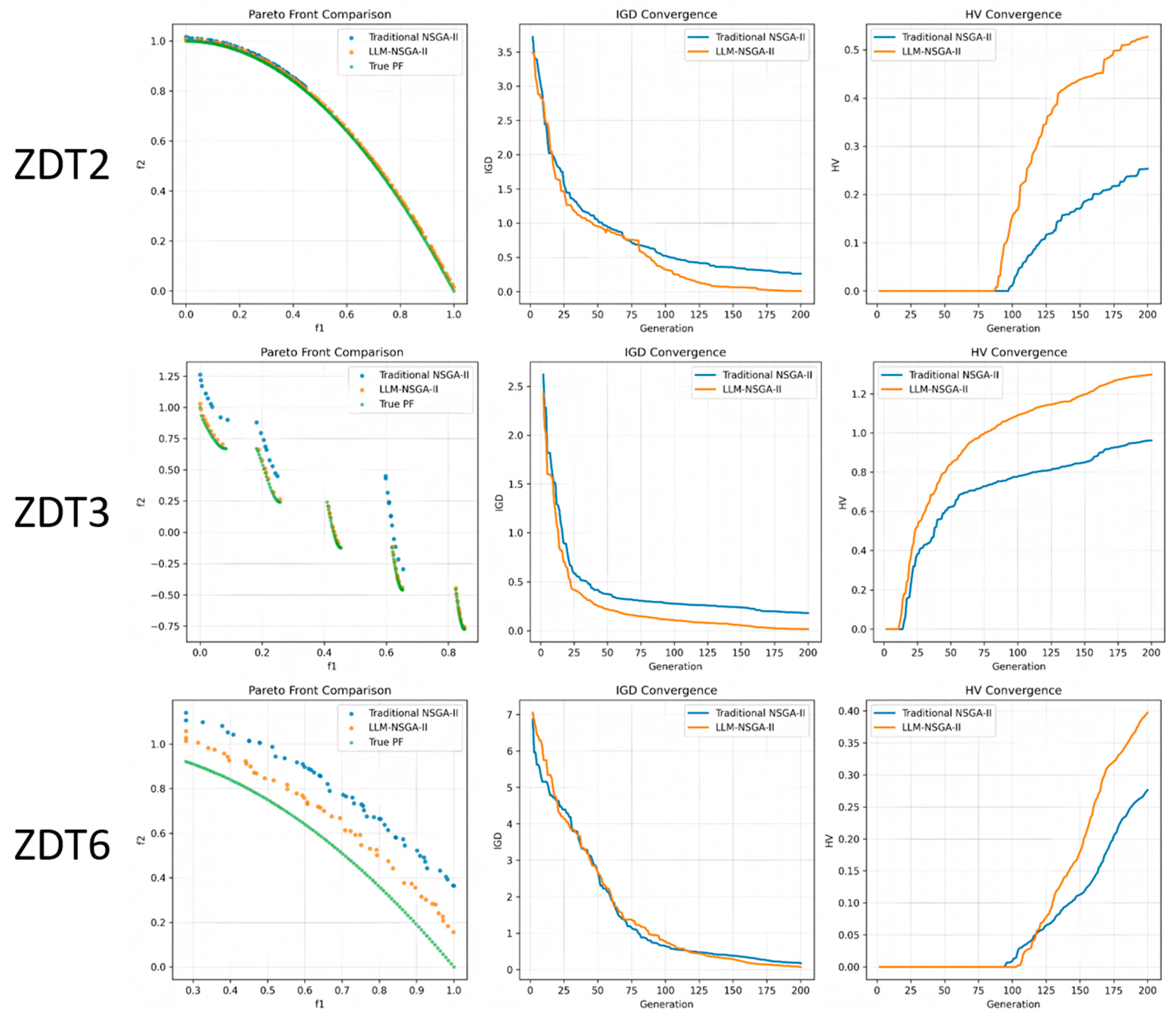
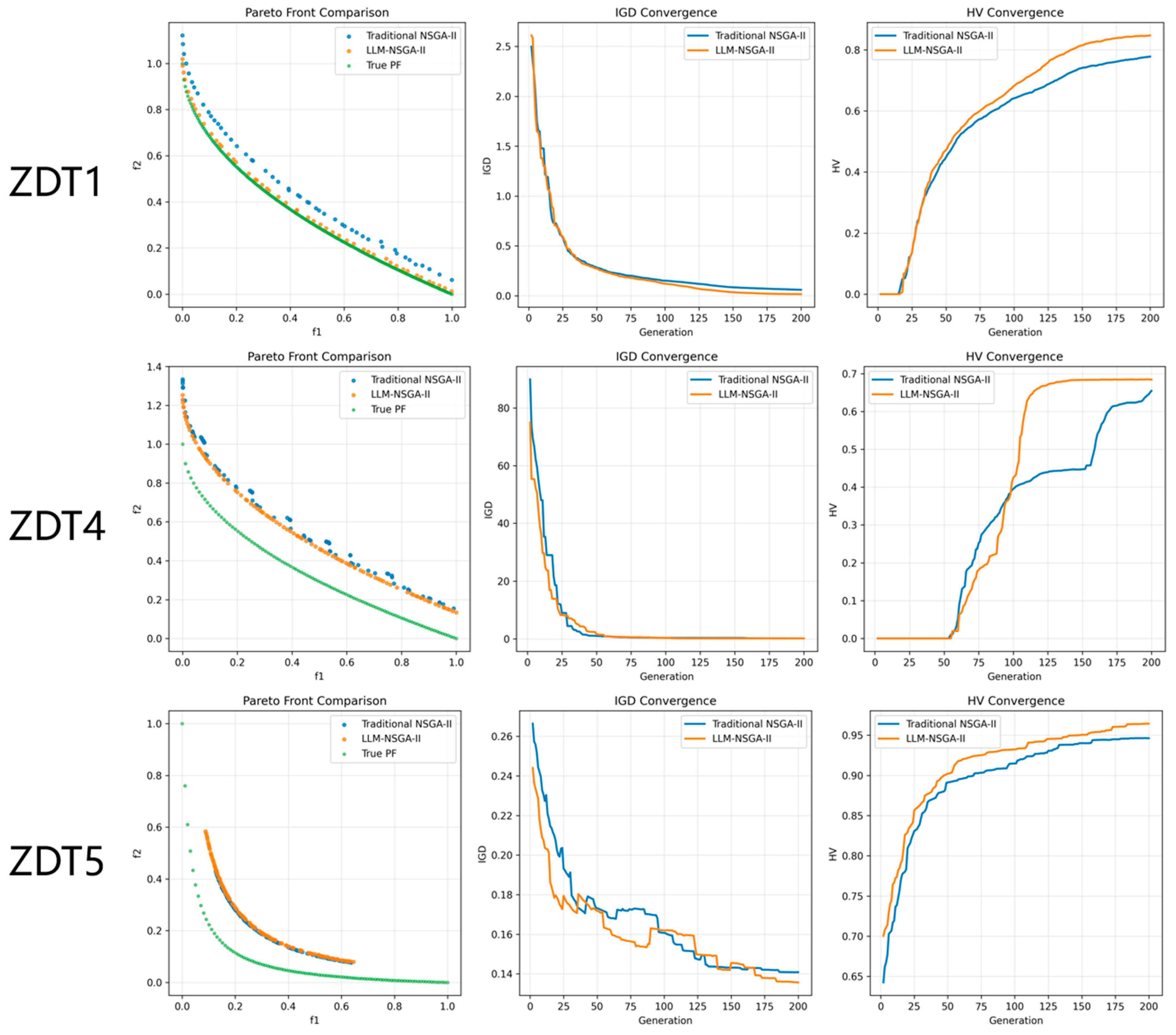
The convergence plots (refer to Figure 2 for representative instances ZDT2, ZDT3, and ZDT6; additional plots are provided in Figure A1 in Appendix A) reveal distinct behavioral differences between the two algorithms. Significant improvements are particularly evident in complex landscapes like ZDT2 and ZDT6, where the traditional NSGA-II often struggles with the “long tail” phenomenon due to entrapment in local optima. In contrast, the LLM-NSGA-II exhibits a sharp decline in IGD values within the first 50 generations, suggesting that the LLM successfully detects early stagnation and dynamically triggers exploration-heavy operators to escape local basins of attraction. Furthermore, in disjointed landscapes such as ZDT3, a clear behavioral difference is visually apparent: the traditional NSGA-II fails to find solutions in the central section of the Pareto front, whereas the LLM-enhanced algorithm covers these regions effectively. This occurs because the standard NSGA-II relies heavily on Simulated Binary Crossover (SBX) with fixed probabilities. SBX has a strong preservative bias, generating offspring closely clustered around the parents. In a highly discontinuous landscape like ZDT3, if the population converges into isolated local basins, SBX struggles to generate offspring that can ‘jump’ across the large dominated gaps. Conversely, in the LLM-NSGA-II framework, when the cognitive controller detects a severe drop in the Spacing metric (indicating population clustering in disconnected segments), it dynamically intervenes by triggering Uniform Crossover and elevated mutation rates. This structural disruption breaks variable linkages and forces macroscopic jumps, allowing the search to successfully bridge the disconnected feasible regions. Regarding the discrete ZDT5 problem, although the Spacing metric shows a slight regression (−9.05%), this represents an expected trade-off where the LLM’s aggressive mutation strategy prioritizes escaping local optima to improve overall convergence (HV and IGD) over the perfect uniformity of the solution set in purely Boolean spaces. While these benchmark results primarily establish the technical validity of the framework, they also matter for decision support because the adaptive search process is externalized into interpretable intervention records rather than remaining an opaque tuning mechanism.
(2) Interpretability of controller decisions.
One of the distinguishing features of the proposed LLM-NSGA-II framework is that controller interventions are rendered traceable and reviewable rather than remaining embedded in opaque parameter updates. Unlike “black-box” optimization methods that map states to actions via opaque weights, the LLM controller produces human-readable reasoning logs. These logs provide valuable insights into why specific operators were chosen at critical stages of the evolution, reduce reliance on opaque trial-and-error tuning, and make operator shifts easier to inspect, discuss and justify in planning and review meetings.
Table 3 presents a reconstructed decision trajectory based on the actual execution logs from the ZDT2 instance (a non-convex problem where traditional NSGA-II struggled, yielding a final IGD of 0.260). The logs reveal how the LLM dynamically adjusted the search strategy to escape local optima.
A pivotal adaptation in the ZDT2 run occurs at Decision Step 7, where the controller switches from SBX to uniform crossover. For non-convex landscapes, SBX can have limited ability to traverse regions that separate local basins from the global Pareto set. In this instance, the operator switch—followed by a return to SBX for late-stage refinement—coincides with a substantial reduction in IGD (final IGD: 0.008 for LLM-NSGA-II versus 0.260 for the baseline). More generally, the logged trajectory illustrates how the controller can diagnose stagnation and diversity loss from standard indicators and select exploration-oriented operators before reverting to exploitation-oriented search for fine-tuning.

4.2. Case Study: Gulou District, Fuzhou

To validate the model in a practical context, we applied the LLM-NSGA-II to the distribution center location problem in the Gulou District of Fuzhou, a region characterized by high population density and a complex traffic network. The study uses population density data from the Gulou District Statistical Yearbook to approximate logistics demand, while land construction costs are estimated based on government land transfer prices and commercial leasing market data. Travel times are calibrated using average travel time data from digital navigation platforms. Taken together, these outputs can be used not only as optimization results, but also as planning materials for comparing strategic configurations, prioritizing candidate locations, and communicating trade-offs across stakeholders.
From a DSS perspective, the Gulou case also illustrates several practical uses of the framework. First, planners can use the Pareto set as a scenario library to support multi-stakeholder negotiations (e.g., budget-constrained ‘lean’ solutions versus time-sensitive ‘premium’ solutions), with the controller’s logs serving as an auditable record of how the algorithm searched for trade-offs. Second, the method supports sensitivity analysis by re-running the DSS under alternative demand weights, travel time assumptions or service time constraints, enabling users to test whether recommended anchor sites remain stable across plausible operating conditions. Third, the decision summaries can be embedded into LIS workflows for site screening and project justification, supporting transparent communication across logistics, finance and governance units. These scenarios respond to the IS concern that trust, adoption and information sharing are shaped by explainability and accountability mechanisms [10,34].
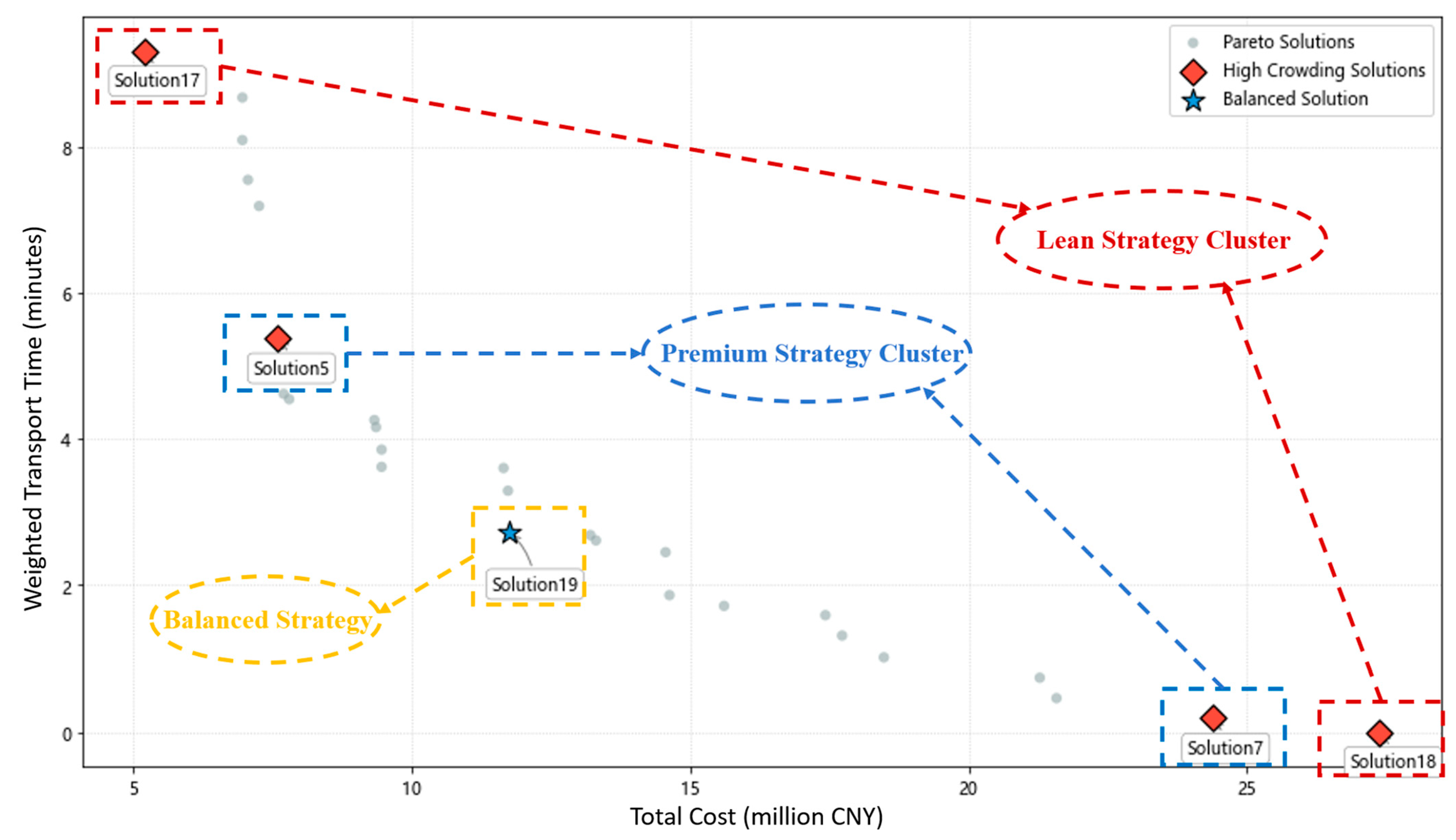
The algorithm generated a well-distributed Pareto front (see Figure 3), revealing a clear trade-off between Total Logistics Cost and Population-Weighted Delivery Time. The distribution of solutions offers three distinct strategic clusters for managerial decision-making. Rather than resulting from a mathematical clustering algorithm, this tripartite categorization reflects classic multi-criteria decision-making logic: it identifies the two extreme ends of the trade-off spectrum (cost minimization vs. time minimization) and the central compromise region (the ‘knee point’ of the Pareto curve).
At the lower-right spectrum of the Pareto front, we identify Lean Logistics Strategies (e.g., Solutions 5 and 17). These configurations prioritize minimizing capital expenditure by selecting fewer or peripheral sites. While cost-efficient, they result in longer delivery times, making them suitable for standard, non-urgent delivery services where cost control is paramount. Conversely, the upper-left region represents Premium Service Strategies (e.g., Solutions 7 and 18). By selecting high-cost locations in the district center, these configurations achieve minimal delivery times. This strategy is ideal for “instant retail” or fresh food logistics, where customer satisfaction and speed justify a significant increase in operational costs. Lying between these extremes is the Balanced Strategy (e.g., Solution 19), identified via the Ideal Point Method. This solution represents the “Knee Point” of the curve, offering a significant reduction in delivery time compared to the low-cost options while maintaining a moderate budget, representing the optimal strategic compromise for general-purpose logistics networks.
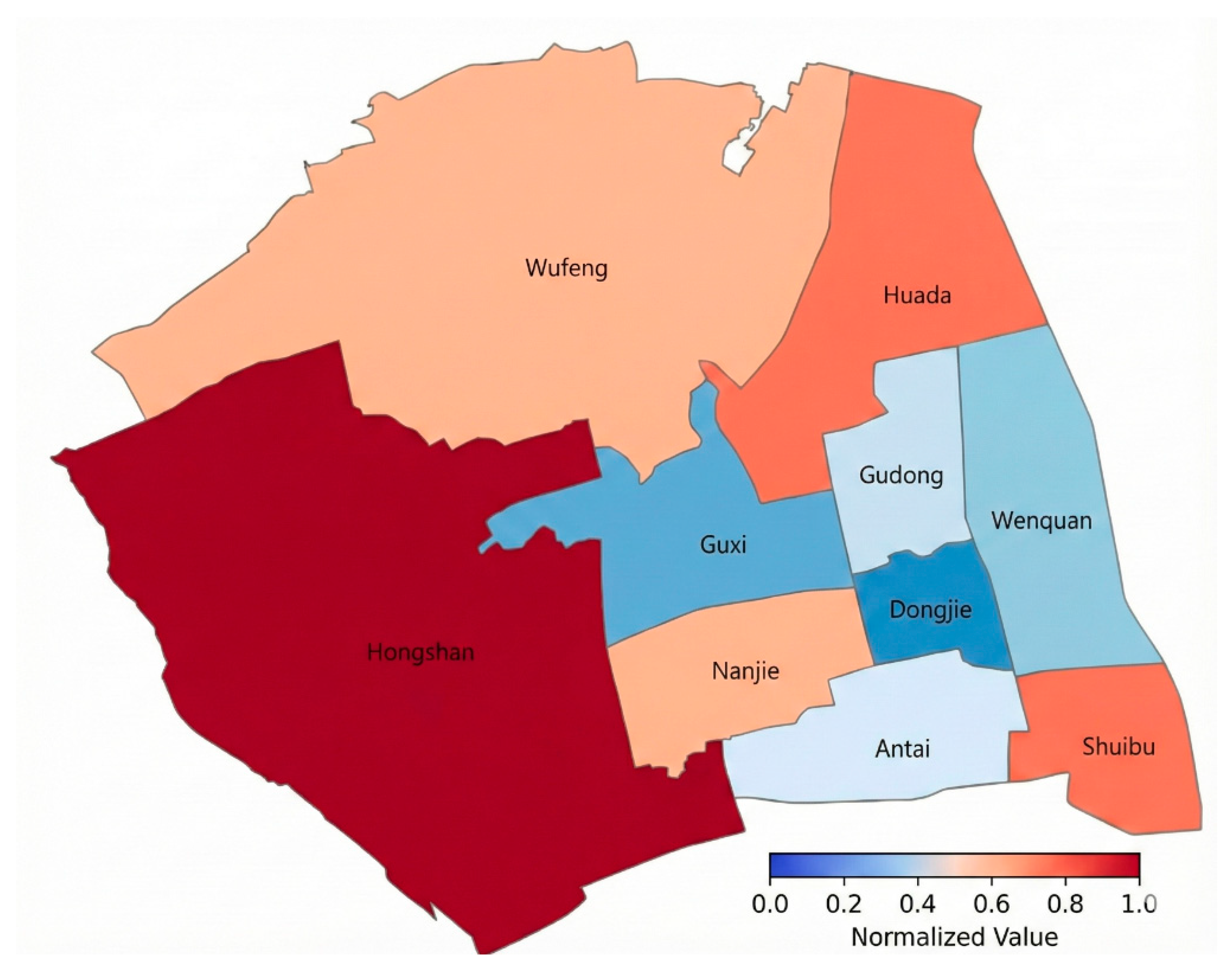
While the Pareto front provides quantitative trade-offs across entire network configurations, logistics managers also require spatially explicit guidance to determine site robustness (i.e., the consistency with which a specific candidate site is selected regardless of shifting strategic preferences between cost and time). To identify these high-consensus locations, we aggregated the selection frequency of each sub-district across the entire set of Pareto-optimal solutions and visualized the results in a normalized heatmap (see Figure 4).
The heatmap reveals a distinct “Core–Periphery” spatial pattern driven by the conflicting objectives of land cost and service coverage. The Hongshan sub-district emerges as a strategic anchor, exhibiting the highest selection frequency and appearing in nearly all optimal configurations regardless of the cost–service preference. Its geographic location on the western periphery allows it to offer an optimal balance of lower land costs and sufficient proximity to major demand clusters, representing a “low-regret” investment priority. In contrast, supplementary nodes like Huada and Shuibu appear with moderate frequencies, typically acting to fill coverage gaps in balanced or premium strategies. Notably, central sub-districts such as Dongjie and Guxi show low selection frequencies despite their theoretical advantage in travel distance; their selection is suppressed by prohibitively high land construction costs, making them viable only in extreme “Premium Service” scenarios where minimizing delivery time supersedes all budget constraints.
Overall, the results suggest that embedding an LLM as a constrained meta-controller can yield adaptive operator scheduling that is not only effective but also managerially interpretable. Rather than relying on fixed and opaque tuning rules, the controller maps observed convergence and diversity signals to bounded actions and externalizes its reasoning through structured logs. These records provide a traceable account of when and why the search emphasized exploration or exploitation, thereby improving post hoc auditability and making algorithmic behavior easier to justify in planning discussions.
More importantly, the Gulou case shows how optimization outputs can be converted into managerial artifacts rather than remaining as technical solution sets. The lean, balanced, and premium regions of the Pareto front can be interpreted as strategic planning templates for different service and investment priorities. The identification of Hongshan as a robust anchor node provides a low-regret investment candidate that remains attractive across multiple cost–service configurations. Rather than merely improving solution quality, the framework organizes the solution space into reviewable options that can support communication across planning, operations, finance, and governance functions. From an engineering management perspective, the value of the framework lies in its ability to translate Pareto-efficient solutions into concrete infrastructure choices while preserving a transparent record of how search strategies evolved. This reduces dependence on specialist tuning expertise and makes advanced optimization more usable in organizational settings where accountability, coordination, and explainability matter as much as numerical performance.

4.3. Artifact-Based Human-Centered Evaluation

These artifacts provide a transparent account of when and why exploration or exploitation was emphasized, reduce the trial-and-error burden of manual parameter tuning, and support communication of trade-offs to stakeholders. We therefore report standard optimization metrics and case study outputs together with representative control trail excerpts, bounded intervention records, and solution summaries to demonstrate not only computational performance but also auditability and decision support value. Future work can complement this artifact-based assessment with practitioner user studies, but the present study focuses on establishing a replicable, human-interpretable, and governance-ready optimization pipeline.

5. Discussion

5.1. Systems Implications for AI-Enabled Urban Planning

Urban facility planning should be understood not merely as a computational optimization task, but as a socio-technical system in which the location of physical infrastructure, demand allocation, information inputs, algorithmic control, and organizational review are tightly interdependent. From this perspective, the contribution of the present study lies not only in improving the convergence–diversity balance of multi-objective search, but also in demonstrating that optimization, bounded AI supervision, validation rules, fallback mechanisms, and human review can be designed as mutually connected subsystems within a usable planning architecture. This shifts the analytical focus from solution quality alone to the broader question of how advanced analytics become organizationally usable, reviewable, and governable.
A central implication is that bounded AI control may be more appropriate for urban planning than fully autonomous AI decision-making. Infrastructure and logistics choices involve trade-offs across cost, service, feasibility, accountability, and policy priorities; accordingly, the role of AI is better conceived as disciplined support for adaptive analysis rather than as a substitute for institutional judgment. In the proposed framework, the LLM diagnoses search states, recommends constrained operator adjustments, and externalizes its rationale through structured logs, while final solution selection remains subject to human review. Auditability, validation, and reviewability should therefore be treated as constitutive properties of AI-enabled planning systems rather than as secondary interface features. More broadly, the findings suggest that the value of generative AI in planning environments depends less on autonomous problem solving per se than on how effectively AI components are bounded, integrated, and made accountable within organizational workflows.

5.2. Practical Implications for Planning and DSS Design

The managerial implications of the proposed framework are particularly important because urban logistics planning is not only a technical optimization problem, but also a governance and coordination problem. In practice, logistics managers must justify why particular facility configurations are selected, communicate trade-offs to non-technical stakeholders, and revise plans when demand, budgets, or service expectations change. The LLM-assisted mechanism supports these tasks by reducing manual parameter trial-and-error, translating search adaptation into interpretable control records, and structuring Pareto solutions into planning alternatives that can be reviewed by managers, planners, and governance stakeholders.
Practical implications are most visible when the framework is viewed as a human-centered DSS rather than as a stand-alone optimization routine. First, by automating operator and parameter adjustments at a fixed interval, the framework can reduce the trial-and-error burden typically required to tune MOEAs, helping planners focus on interpreting cost–service trade-offs rather than calibrating search heuristics.
Second, the controller’s reasoning logs provide an auditable control trail that supports transparency and accountability: decision makers can inspect when and why the search shifted between exploration and exploitation, which can strengthen perceived trustworthiness when AI-assisted optimization informs high-stakes infrastructure choices.
Third, the framework has practical implications for how planning organizations implement AI-supported decision support systems. Its value does not lie only in producing better Pareto fronts, but also in structuring optimization outputs into forms that can be reviewed and used by non-specialist stakeholders. In the present case, the lean, balanced, and premium regions of the solution space can be interpreted as alternative planning templates, while robust nodes such as Hongshan can be treated as low-regret candidates for phased infrastructure investment. This helps to translate computational results into options that can support communication across planning, operations, finance, and governance functions.
More broadly, the findings suggest that AI-enabled planning tools should be embedded into routine workflows rather than used as stand-alone optimization modules. In practice, this means linking optimization outputs to dashboards, scenario filters, validation checks, and concise audit logs so that planners can understand not only what solutions are recommended, but also how the search process evolved. Such an arrangement can reduce dependence on specialist parameter-tuning expertise, improve cross-functional interpretability, and make advanced optimization more usable in organizational environments where accountability and coordination matter alongside solution quality [7,8,10].
For logistics managers, these outputs can be used in three concrete ways. First, the Pareto solution set can serve as a scenario library, allowing managers to compare low-cost, balanced, and premium service configurations without repeatedly retuning algorithmic parameters. Second, the controller logs can function as an explanation layer during planning review meetings, showing when the system emphasized exploration, when it shifted toward exploitation, and why specific operator changes were triggered. Third, the site-selection frequency results can support phased investment decisions by identifying robust candidate locations that remain attractive across different cost–service preferences. These functions make the framework useful not only for generating optimized solutions, but also for supporting explanation, negotiation, and staged implementation in logistics planning.

5.3. Limitations and Future Research

This study should be interpreted as a systems-oriented proof of concept rather than as a universally transferable urban planning solution. First, the empirical demonstration is based on a single urban case in Gulou District, Fuzhou. Although the case is useful for illustrating the feasibility of the proposed framework, urban logistics systems differ substantially in land-use structure, demand density, traffic conditions, and governance arrangements. The transferability of specific site recommendations should therefore be treated with caution, even though the system architecture and optimization logic are more broadly generalizable. Second, the strategic planning model relies on simplified assumptions, including static average travel conditions, standardized distribution center configurations, and population-based demand proxies. These assumptions are appropriate for an initial planning baseline, but they do not fully capture real-time congestion, temporal demand fluctuations, heterogeneous facility capacities, or richer operational constraints.
Third, the LLM controller is designed as a bounded supervisory component rather than a fully autonomous optimizer. This improves interpretability and operational robustness, but it also means that controller behavior depends on the predefined action space, prompt design, validation rules, and fallback mechanism specified by the system designer. In other words, the present study demonstrates the value of constrained AI-supported adaptation, but it does not establish that the current control configuration is universally optimal across all problem classes or organizational settings. In addition, while the artifact-based evaluation shows that logs, strategy clusters, and solution summaries can enhance transparency and reviewability, the study does not directly test how practitioners interact with these outputs in real planning processes.
Future research can extend the present work in several directions. One avenue is external validation across multiple cities and logistics contexts, so as to examine whether the proposed socio-technical DSS architecture remains effective under different spatial structures, service targets, and governance conditions. A second avenue is model enrichment, including dynamic traffic states, real-time demand information, heterogeneous facility capacities, carbon constraints, and tighter integration with GIS- and LIS-based operational data. A third avenue is human-centered evaluation through practitioner experiments or field-based user studies that assess whether audit logs, bounded AI recommendations, and structured solution summaries improve trust calibration, decision quality, and cross-functional coordination in actual planning settings. Together, these extensions would help move the framework from a replicable proof of concept toward a more deployable, organizationally validated, and context-sensitive AI-enabled planning system.

6. Conclusions

This study addressed the strategic challenge of urban distribution center location in data-intensive urban logistics settings by treating it as a systems design problem rather than as a stand-alone optimization exercise. We formulated a bi-objective location–allocation model that jointly minimizes total logistics cost and population-weighted delivery time, and we embedded this analytical core within a socio-technical DSS in which a large language model serves as a bounded supervisory controller for adaptive search.
The systematic value of the proposed framework lies in its integration of adaptive optimization, bounded AI supervision, validation rules, fallback mechanisms, audit trails, and human-in-the-loop review into a single decision support architecture. Rather than allowing the LLM to act as an autonomous decision maker, the framework assigns it a constrained supervisory role within a governed planning cycle. This design enables the system to adapt search behavior while preserving traceability, operational continuity, and final human authority. As a result, the framework contributes to adaptive governance in urban logistics by showing how AI-enabled optimization can be embedded in reviewable planning routines instead of being deployed as an opaque technical module.
The benchmark results indicate that the proposed framework improves convergence and/or Pareto front coverage relative to standard NSGA-II across several ZDT instances. The Gulou case further shows that the framework can generate diverse and decision-relevant planning outputs, including robust candidate locations, interpretable strategy clusters, and reviewable control records that support infrastructure evaluation across planning, operations, and governance perspectives. These results suggest that the contribution of the framework lies not only in adaptive optimization performance, but also in its ability to transform search behavior into bounded, auditable, and communicable planning artifacts. For managers, the practical value of this design lies in reducing the burden of manual algorithm tuning, making search behavior explainable through audit logs, and translating complex Pareto outputs into strategic alternatives that can support planning justification, cross-functional communication, and logistics governance.
More broadly, the study suggests that generative AI contributes most meaningfully to urban planning systems not when it replaces decision makers, but when it is embedded within bounded, traceable, and human-centered decision architectures. The proposed framework demonstrates how advanced optimization can be connected with adaptive governance: algorithmic search is dynamically adjusted, AI interventions are constrained and logged, fallback rules protect system continuity, and final planning choices remain subject to human interpretation and institutional priorities. In this sense, the study offers a systems-oriented design pattern for integrating optimization, AI supervision, validation, auditability, and human oversight within AI-enabled urban logistics planning.

Author Contributions

All authors contributed to the conceptualization and design of this study. J.H.: Writing—review and editing, Writing—original draft, Visualization, Validation, Software, Methodology, Investigation, Conceptualization. Q.C.: Writing—original draft, Validation, Software. All authors have read and agreed to the published version of the manuscript.

Funding

This work was partially supported by the Priority Academic Program Development of Jiangsu Higher Education Institutions (PAPD), and Philosophy and Social Science Laboratories of Jiangsu Higher Education Institutions—Intelligent Laboratory for Big Food Security Governance and Policy, Nanjing Agricultural University.

Data Availability Statement

The datasets generated and/or analyzed during the current study are not publicly available due to confidentiality and licensing constraints. To support reproducibility, the authors can provide (i) the experimental configuration files (including random seeds and parameter settings), (ii) run-level benchmark results (e.g., HV/IGD and dispersion statistics) in anonymized form, and (iii) the LLM controller prompt template and output schema (excluding any API keys or sensitive information), upon reasonable request.

Acknowledgments

The authors confirm that all individuals mentioned in the Acknowledgement have provided their consent to be acknowledged. During the preparation of this work, the authors used ChatGPT-4o solely for language editing, grammar correction, and improving the readability of the manuscript. No AI tools were involved in any core research processes. After using this tool, the authors reviewed and edited the content as needed and take full responsibility for the content of the publication.

Conflicts of Interest

The authors declare no conflicts of interest.

Appendix A

Table A1. LLM Controller Prompt Template and Output Schema.
ComponentPrompt ContentPurpose
System Role and ContextYou are an expert in Multi-Objective Evolutionary Algorithms (MOEAs). Your task is to act as a Cognitive Controller for the NSGA-II algorithm solving a bi-objective urban distribution center location problem. You must balance Exploration (searching new regions) and Exploitation (refining existing solutions) by dynamically adjusting genetic operators.Defines the LLM’s bounded supervisory role and clarifies that the model supports adaptive search rather than making final planning decisions.
Input State ObservationThe current evolutionary state is as follows:
Current Generation: <GEN>/<MAX_GEN>
Convergence Metric (IGD): (Lower is better) <IGD_VALUE>
Evolutionary Momentum (IGD Change): (Negative means converging; near 0 means stagnation) <IGD_MOMENTUM>
Diversity Metric (Spacing/Distance): <DIVERSITY_VALUE>
Hypervolume (HV): <HV_VALUE>
Provides a compact and structured representation of the current search state.
Decision Rules (Knowledge Base)Please analyze the state based on the following logic:
  • Stagnation Detection: If IGD improvement is negligible (momentum ≈ 0) and diversity is dropping, the population is trapped in a local optimum. Action: Switch to exploration-heavy operators (e.g., Uniform Crossover) and increase mutation probability.
  • Active Convergence: If IGD is decreasing rapidly, the current direction is correct. Action: Maintain balanced parameters or use exploitation operators (e.g., SBX) to accelerate convergence.
  • Diversity Loss: If the diversity metric is critically low, increase the mutation rate to inject random perturbations.
Guides the LLM to diagnose search dynamics through convergence, momentum, and diversity indicators.
Action SpaceYou must select parameters from the following predefined ranges:
Crossover Operator: [“sbx”, “uniform”, “de”]
Note: “sbx” is for local fine-tuning; “uniform” is for global exploration.
Mutation Operator: [“polynomial”, “bitflip”]
Crossover Probability (pc): Float between 0.6 and 1.0
Mutation Probability (pm): Float between 0.01 and 0.3
Constrains the controller’s autonomy and prevents unrestricted algorithmic modification.
Output Format RequirementYou MUST return the response in strict JSON format with a specific field “reasoning” explaining your diagnosisEnsures that the controller output can be parsed, validated, logged, and audited.
Table A2. Output Schema.
ComponentContent
Sample Output{
“reasoning”: “The algorithm has stagnated for the last 5 generations (IGD momentum is near 0). Diversity is also low. I will switch to Uniform Cross-over and increase mutation to 0.2 to escape the local optimum.”,
“action”: {
“crossover”: “uniform”,
“mutation”: “polynomial”,
“pc”: 0.9,
“pm”: 0.2
}
}
Figure A1. Convergence curves and Pareto fronts for ZDT 1–6.
Systems 14 00529 g0a1

References

  1. Statista. Global Retail E-Commerce Sales from 2022 to 2030 (in Billion U.S. Dollars). Available online: https://www.statista.com/statistics/379046/worldwide-retail-e-commerce-sales/ (accessed on 5 May 2026).
  2. Grand View Research. E-Commerce Logistics Market Size, Share & Trends Analysis Report, 2024–2030. Available online: https://www.grandviewresearch.com/industry-analysis/e-commerce-logistics-market (accessed on 5 May 2026).
  3. World Economic Forum. The Future of the Last-Mile Ecosystem; World Economic Forum: Geneva, Switzerland, 2020; Available online: https://www.weforum.org/reports/the-future-of-the-last-mile-ecosystem/ (accessed on 5 May 2026).
  4. Correia, D.; Vagos, C.; Marques, J.L.; Teixeira, L. Fulfilment of last-mile urban logistics for sustainable and inclusive smart cities: A case study conducted in Portugal. Int. J. Logist. Res. Appl. 2024, 27, 931–958. [Google Scholar] [CrossRef]
  5. Cetindamar Kozanoglu, D.; Phaal, R. Technology management in the age of digital technologies. IEEE Trans. Eng. Manag. 2023, 70, 2507–2515. [Google Scholar] [CrossRef]
  6. Liu, C.; Zowghi, D. Citizen involvement in digital transformation: A systematic review and a framework. Online Inf. Rev. 2023, 47, 644–660. [Google Scholar] [CrossRef]
  7. Tsang, S.J.; Zhou, L. Understanding public preference for misinformation interventions: Support for digital platform monitoring, media literacy education and legislation. Online Inf. Rev. 2025, 49, 791–807. [Google Scholar] [CrossRef]
  8. Zhang, F. Exploring the diffusion mechanism of generative AI disinformation in online platforms: An explanatory model. Online Inf. Rev. 2025, 49, 1265–1284. [Google Scholar] [CrossRef]
  9. Brem, A.; Giones, F.; Werle, M. The AI digital revolution in innovation: A conceptual framework of artificial intelligence technologies for the management of innovation. IEEE Trans. Eng. Manag. 2023, 70, 770–776. [Google Scholar] [CrossRef]
  10. Zhou, T.; Fang, X. Understanding user trust in AI-generated content: An elaboration likelihood model perspective. Online Inf. Rev. 2025, 50, 171–188. [Google Scholar] [CrossRef]
  11. Alumur, S.; Kara, B.Y. A new model for the hazardous waste location-routing problem. Comput. Oper. Res. 2007, 34, 1406–1423. [Google Scholar] [CrossRef]
  12. Farahani, R.Z.; Hekmatfar, M. (Eds.) Facility Location: Concepts, Models, Algorithms and Case Studies; Springer Science & Business Media: Berlin/Heidelberg, Germany, 2009. [Google Scholar] [CrossRef]
  13. Yan, L.; Grifoll, M.; Feng, H.; Zheng, P.; Zhou, C. Optimization of urban distribution centers: A multi-stage dynamic location approach. Sustainability 2022, 14, 4135. [Google Scholar] [CrossRef]
  14. Sun, J.; Li, X.; Wang, Z.; Chen, Z. Robust optimization of uncertain E-commerce closed-loop supply chain networks under carbon policies. Sci. Rep. 2025, 15, 34308. [Google Scholar] [CrossRef]
  15. Segi, S.; Kobayashi, K.; Matsushima, K. On the relation between urban road network and distribution center location strategy of Franchise retail firms. Ann. Reg. Sci. 2024, 73, 1435–1468. [Google Scholar] [CrossRef]
  16. Deb, K.; Pratap, A.; Agarwal, S.; Meyarivan, T.A.M.T. A fast and elitist multi-objective genetic algorithm: NSGA-II. IEEE Trans. Evol. Comput. 2002, 6, 182–197. [Google Scholar] [CrossRef]
  17. Qi, S.; Wang, R.; Zhang, T.; Huang, W.; Yu, F.; Wang, L. Enhancing evolutionary algorithms with pattern mining for sparse large-scale multi-objective optimization problems. IEEE/CAA J. Autom. Sin. 2024, 11, 1786–1801. [Google Scholar] [CrossRef]
  18. Ma, H.; Zhang, Y.; Sun, S.; Liu, T.; Shan, Y. A comprehensive survey on NSGA-II for multi-objective optimization and applications. Artif. Intell. Rev. 2023, 56, 15217–15270. [Google Scholar] [CrossRef]
  19. Cheng, R.; Jin, Y.; Olhofer, M.; Sendhoff, B. A reference vector guided evolutionary algorithm for many-objective optimization. IEEE Trans. Evol. Comput. 2016, 20, 773–791. [Google Scholar] [CrossRef]
  20. Farfán-Durán, J.F.; Heidari, A.; Dhaene, T.; Couckuyt, I.; Cea, L. Surrogate-assisted evolutionary algorithm for the calibration of distributed hydrological models based on two-dimensional shallow water equations. Water 2024, 16, 652. [Google Scholar] [CrossRef]
  21. Yang, Y.; Zhang, C.; Zhang, B.; Ning, J. A reinforcement learning assisted evolutionary algorithm for constrained multi-task optimization. Inf. Sci. 2024, 678, 120863. [Google Scholar] [CrossRef]
  22. Ming, F.; Gong, W.; Wang, L.; Jin, Y. Constrained multi-objective optimization with deep reinforcement learning assisted operator selection. IEEE/CAA J. Autom. Sin. 2024, 11, 919–931. [Google Scholar] [CrossRef]
  23. Song, Y.; Wu, Y.; Guo, Y.; Yan, R.; Suganthan, P.N.; Zhang, Y.; Feng, Q. Reinforcement learning-assisted evolutionary algorithm: A survey and research opportunities. Swarm Evol. Comput. 2024, 86, 101517. [Google Scholar] [CrossRef]
  24. Huang, S.; Yang, K.; Qi, S.; Wang, R. When large language model meets optimization. Swarm Evol. Comput. 2024, 90, 101663. [Google Scholar] [CrossRef]
  25. Zhang, W.; Xiao, G.; Gen, M.; Geng, H.; Wang, X.; Deng, M.; Zhang, G. Enhancing multi-objective evolutionary algorithms with machine learning for scheduling problems: Recent advances and survey. Front. Ind. Eng. 2024, 2, 1337174. [Google Scholar] [CrossRef]
  26. Mo, D.Y.; Tsang, Y.P.; Lam, H.Y.; Chung, K.T. Deep reinforcement learning-based approach for dynamic routing in quick-commerce e-fulfilment systems. Int. J. Logist. Res. Appl. 2025, 28, 1–24. [Google Scholar] [CrossRef]
  27. He, C.; Zhang, Y.; Gong, D.; Ji, X. A review of surrogate-assisted evolutionary algorithms for expensive optimization problems. Expert Syst. Appl. 2023, 217, 119495. [Google Scholar] [CrossRef]
  28. Aghaei pour, P.; Hakanen, J.; Miettinen, K. A surrogate-assisted a priori multi objective evolutionary algorithm for constrained multi objective optimization problems. J. Glob. Optim. 2024, 90, 459–485. [Google Scholar] [CrossRef]
  29. Boiko, D.A.; MacKnight, R.; Kline, B.; Gomes, G. Autonomous chemical research with large language models. Nature 2023, 624, 570–578. [Google Scholar] [CrossRef]
  30. Zhang, Z.; Zhao, H.; Zhao, W.; Bian, X.; Yun, X. LLM-Assisted Non-Dominated Sorting Genetic Algorithm for Solving Distributed Heterogeneous No-Wait Permutation Flowshop Scheduling. Appl. Sci. 2025, 15, 10131. [Google Scholar] [CrossRef]
  31. Nozari, H.; Rahmaty, M.; Foukolaei, P.Z.; Movahed, H.; Bayanati, M. Optimizing Cold Chain Logistics with Artificial Intelligence of Things (AIoT): A Model for Reducing Operational and Transportation Costs. Future Transp. 2025, 5, 1. [Google Scholar] [CrossRef]
  32. Mun, Y. A study of the impact of ChatGPT self-efficacy on the information seeking behaviors in ChatGPT: The mediating roles of ChatGPT characteristics and utility. Online Inf. Rev. 2024, 49, 373–394. [Google Scholar] [CrossRef]
  33. Kwok, M.L.J.; Kwong, R.; Ng, P.M.L.; Chan, J.K.Y.; Lau, M.M. I am proud of using ChatGPT: A moderated-mediating model of bandwagon effect on pride through habit formation. Online Inf. Rev. 2025, 49, 891–910. [Google Scholar] [CrossRef]
  34. Weisz, E.; Herold, D.M.; Ostern, N.K.; Payne, R.; Kummer, S. Artificial intelligence (AI) for supply chain collaboration: Implications on information sharing and trust. Online Inf. Rev. 2025, 49, 164–181. [Google Scholar] [CrossRef]
  35. Tiwari, G.; Dixit, V.; Kumar, R.R. Circular supply chain transformation: Leveraging evolving technologies for enhanced performance. Int. J. Logist. Res. Appl. 2025, 28, 1828–1860. [Google Scholar] [CrossRef]
  36. Fang, W.; Guan, Z.; Su, P.; Luo, D.; Ding, L.; Yue, L. Multi-Objective Material Logistics Planning with Discrete Split Deliveries Using a Hybrid NSGA-II Algorithm. Mathematics 2022, 10, 2871. [Google Scholar] [CrossRef]
  37. Khan, S.A.; Kusi-Sarpong, S.; Gupta, H.; Arhin, F.K.; Lawal, J.N.; Hassan, S.M. Critical factors of digital supply chains for organizational performance improvement. IEEE Trans. Eng. Manag. 2024, 71, 13727–13741. [Google Scholar] [CrossRef]
  38. Snider, C.; Gopsill, J.A.; Jones, S.L.; Emanuel, L.; Hicks, B.J. Engineering project health management: A computational approach for project management support through analytics of digital engineering activity. IEEE Trans. Eng. Manag. 2019, 66, 325–336. [Google Scholar] [CrossRef]
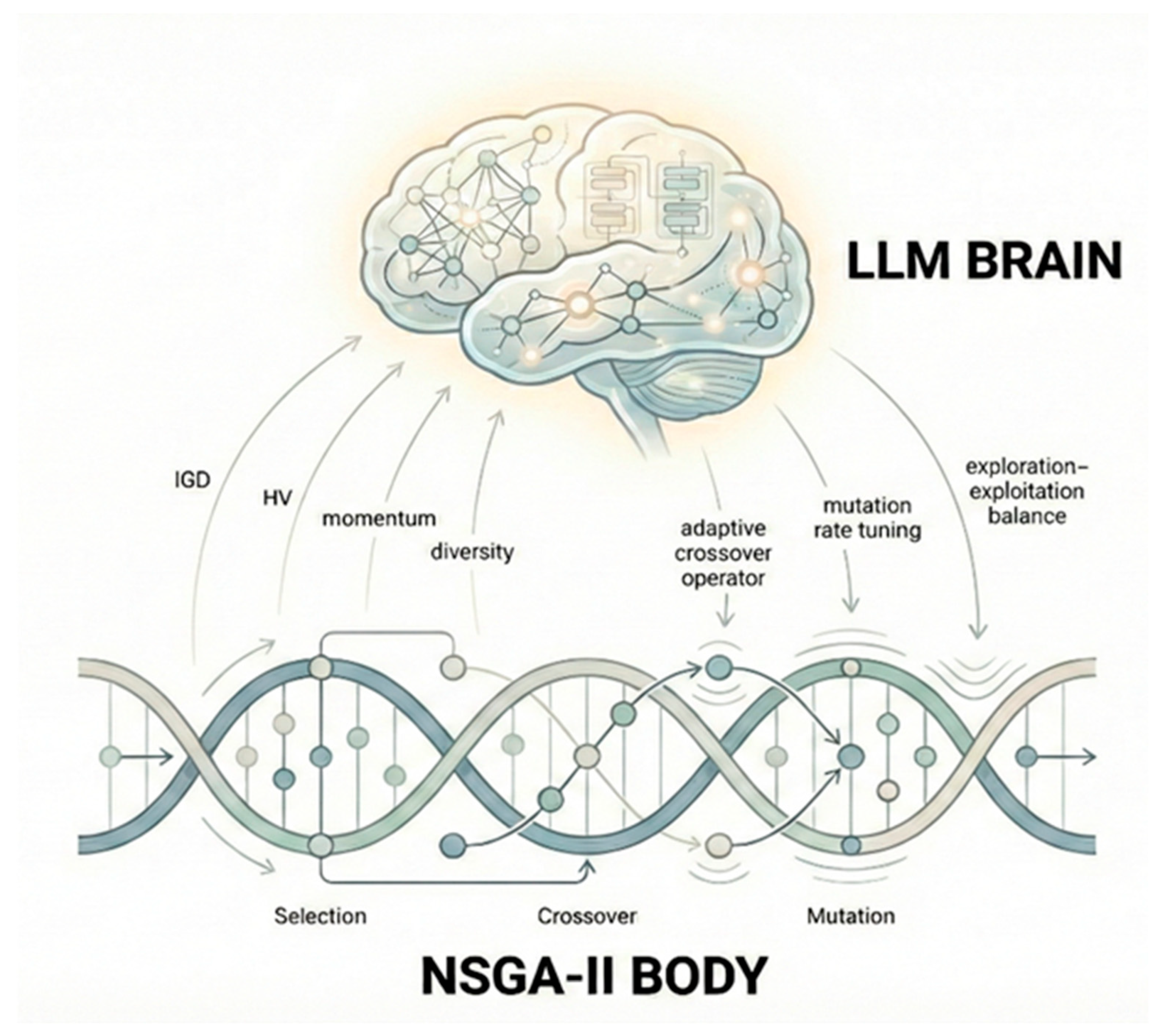
Figure 1. Architecture of the LLM-enhanced NSGA-II framework.
Systems 14 00529 g001
Figure 2. Convergence curves and Pareto fronts for representative ZDT.
Systems 14 00529 g002
Figure 3. Pareto optimal front for the case study in Gulou District.
Systems 14 00529 g003
Figure 4. Heatmap of candidate site selection frequencies.
Systems 14 00529 g004
Table 1. Nomenclature.
TypeSymbolDescription
SetsISet of candidate locations for distribution centers, indexed by i.
JSet of demand points (streets), indexed by j.
ParametersciFixed construction cost for establishing a DC at candidate site i.
dijTransport distance from candidate site i to demand point j.
tijTransport time from candidate site i to demand point j.
pjPopulation (demand volume) of demand point j.
AUnit transportation cost per distance unit (incorporating fuel consumption).
Decision VariablesxiBinary variable: 1 if a DC is established at candidate site i, 0 otherwise.
yijBinary variable: 1 if demand point j is covered by DC i, 0 otherwise.
uijBinary variable: 1 if demand point j is actually served by DC i, 0 otherwise.
Table 2. Performance comparison on the ZDT benchmark suite.
ProblemMetricStandard NSGA-ILLM-NSGA-IIImprovement
ZDT1
(Convex)
HV0.7781040.8474188.90%
IGD0.0594960.01585273.36%
Spacing0.0114990.00910020.86%
ZDT2
(Non-Convex)
HV0.2531230.526768108.10%
IGD0.2604290.00853096.72%
Spacing0.0044560.0041057.88%
ZDT3
(Discrete)
HV0.9616061.29766034.94%
IGD0.1809090.01590991.21%
Spacing0.0241830.0221458.43%
ZDT4
(Multimodal)
HV0.6547300.6845744.56%
IGD0.1401760.1267389.59%
Spacing0.0098740.00565642.72%
ZDT5
(Boolean)
HV0.9462260.9643161.91%
IGD0.1408410.1356633.68%
Spacing0.0021100.002301−9.05%
ZDT6
(Non-Uniform)
HV0.2764700.39715143.65%
IGD0.1793770.07591557.68%
Spacing0.0115950.00728637.16%
Table 3. Snapshot of LLM Decision Logs (ZDT2 Instance).
PhaseObserved StateLLM Decision
Phase 1: Stagnation Detection
(Decision Step 5)
Status: The population is clustering, but convergence metrics (IGD) are improving too slowly.Strategy: Keep SBX but significantly increase Polynomial Mutation rate (pm) to 0.3 to force a jump out of the local optimum.
Action Code: {“pc”: 0.9, “pm”: 0.3, “crossover”: “sbx”}
Phase 2: Aggressive Exploration
(Decision Step 7)
Status: Diversity (Spacing) is decreasing; the algorithm needs to explore unconnected regions of the search space.Strategy: Switch to Uniform Crossover to disrupt the linkage between variables and explore the global space more broadly.
Action Code: {“pc”: 0.8, “pm”: 0.2, “crossover”: “uniform”}
Phase 3: Final Convergence
(Decision Step 9–10)
Status: The IGD has dropped significantly. The population has successfully located the true Pareto front.Strategy: Revert to SBX for efficient local search and fine-tuning. Stabilize mutation at standard levels.
Action Code: {“pc”: 0.9, “pm”: 0.2, “crossover”: “sbx”}
Disclaimer/Publisher’s Note: The statements, opinions and data contained in all publications are solely those of the individual author(s) and contributor(s) and not of MDPI and/or the editor(s). MDPI and/or the editor(s) disclaim responsibility for any injury to people or property resulting from any ideas, methods, instructions or products referred to in the content.