Article

Tram or Bus? A Stated-Preference Analysis of Road User Mode Choice in Larissa, Greece

by
Athanasios Theofilatos
1,*,
Apostolos Ziakopoulos
2,
Apostolos Anagnostopoulos
3,
Georgios Georgiadis
3,
Ioannis Politis
3 and
Nikolaos Eliou
1
1
Department of Civil Engineering, University of Thessaly, Pedion Areos, GR-38334 Volos, Greece
2
Department of Transportation Planning and Engineering, National Technical University of Athens, 5 Heroon Polytechniou St., GR-15773 Athens, Greece
3
Transport Engineering Laboratory, Department of Civil Engineering, Aristotle University of Thessaloniki, Egnatia St., GR-54124 Thessaloniki, Greece
*
Author to whom correspondence should be addressed.
Systems 2026, 14(4), 446; https://doi.org/10.3390/systems14040446
Submission received: 20 January 2026 / Revised: 24 March 2026 / Accepted: 13 April 2026 / Published: 20 April 2026
(This article belongs to the Special Issue Sustainable Urban Transport Systems)

Abstract

Under growing urbanization and environmental challenges, sustainable urban mobility has become a critical priority for cities worldwide. Public Transport (PT) systems play a central role in reducing car dependency, lowering emissions, increasing network capacity, and promoting more equitable and efficient access to urban spaces for all users. Hence, the present paper aims to investigate PT preferences in the city of Larissa, Greece. Larissa is a medium-sized city currently serviced only by buses, and is currently focusing on the potential introduction of a new tram system to operate in parallel with existing bus services. To this end, a SP survey was designed and implemented, resulting in 972 observations that were collected for further statistical analysis. Survey results show a slight preference for trams over buses, with 54.63% selecting the tram and 45.37% favoring the buses. Moreover, a context-based segmentation pipeline was established using PCA, DBSCAN and t-SNE algorithms, aiding the visualization of existing clusters for transport choice approaches. Afterwards, a series of mixed logit models was applied, and statistically significant variables influencing mode choice were determined. The study also examines Value of Time (VoT) metrics and finds that respondents assign lower VoTs to trams than to buses, especially in out-of-vehicle segments of the journey, such as waiting and walking, and therefore consider trams as more pleasant and less burdensome. The findings also indicate that passengers place a high value on the quality of infrastructure related to access and waiting times, underlining the need to improve the overall user experience beyond the vehicle itself. In summary, the present research offers valuable insights into how the introduction of a tram system could possibly reshape PT usage patterns when compared with the legacy existing bus services.

1. Introduction

Cities around the world are growing rapidly. From 750 million people in 1950, the global urban population is projected to grow to 6.7 billion people in 2050 [1]. This growth represents an increase in the global urban population from 30% to 68% of the total population over the aforementioned period. Expanding urban areas, combined with increased car use, place immense pressure on existing transport infrastructure, which in turn leads to traffic congestion, local and wider air pollution, noise, road safety issues and other transport externalities.
Typically, cars and buses dominate motorized travel, but are associated with negative impacts, whilst metro systems are environmentally friendly yet so expensive as to be restricted only to the largest urban settlements [2]. To tackle these challenges, policymakers and practitioners are placing greater emphasis on promoting more sustainable transport modes, which not only reduce congestion and environmental impacts but also enhance the overall well-being of people in urban areas, regardless of whether they are Public Transport (PT) users or not. Therefore, the need for sustainable PT is becoming increasingly urgent as global urban populations continue to rise.
The introduction of new PT systems can exert a wide-ranging influence on society, shaping travel behavior, environmental outcomes, and economic growth. In this context, other transport modes such as trams and Light Rail Transit (LRT) are becoming essential in this shift to more sustainable practices and are poised to play a critical role in PT. These PT modes have been promoted as an effective solution toward sustainable transport in urban areas, as they are environmentally friendly and can be efficient alternatives to private cars and buses, thus helping to reduce traffic congestion during peak hours, reduce greenhouse gas and other pollutant emissions, and promote the development of walkable urban environments. In addition, tram networks can contribute to local economic development along their routes and improve quality of life as several studies highlight the positive economic and social impacts of trams in cities, especially densely populated urban areas [3,4].
Early studies [5,6] argue that rail-based systems are vital for addressing the challenges of car dependency in cities. Nevertheless, the construction of new PT systems worldwide often hinges on their anticipated impacts, particularly in increasing their overall usage [7]. The authors also argue that while this goal is important, it is unlikely to fully justify the construction of a new system; hence, it is essential to evaluate broader impacts. Recent simulation studies indicate that the introduction of new LRT systems is mostly effective when combined with parking policies, when accessibility and environmental benefits are considered [8].
Despite the traditional preference towards buses [9], the success of LRT networks in areas where there were implemented underscores their popularity, as rising passenger numbers highlight the appeal of modern trams, which have high capacity, are safe, efficient, and clean [10,11], connecting suburbs to city centers and key destinations, such as sports venues, retail centers, universities and companies. Decisions about new LRT systems are usually based on demand forecasts and the expected benefits of rail transit, but recent implementations have revealed that these forecasts are often inaccurate, highlighting the challenges in accurately predicting systemic impacts [12].
Understanding user preferences for LRT systems is essential for shaping effective and sustainable urban mobility strategies. As cities worldwide grapple with congestion, road safety, environmental issues, limited capacity, and shifting mobility needs, promoting efficient, accessible and affordable PT options has become a central policy goal. In this context, LRTs are often considered a sustainable and modern alternative to traditional bus services, offering potential benefits in terms of speed, reliability, environmental impact, and urban integration. However, public acceptance and mode choice behavior remain critical determinants of their success.
Despite growing global interest in LRT systems, there is still a considerable gap in the literature regarding how potential users perceive and evaluate LRT compared to conventional bus services, particularly in mid-sized European cities where such systems are either emerging or under consideration. Accounting for a completely new transit option, which is not otherwise present in the perception and mobility culture of road users, is always a very challenging task. In this regard, the present study designed and implemented a stated-preference (SP) survey in the city of Larissa, which is a modestly sized city (with a circa 163,000 population) in central Greece, currently served only by buses. This study offers valuable insights into how the introduction of a tram system could possibly reshape PT usage patterns when compared with the traditional existing bus services. To the best of the authors’ knowledge, while there is extensive research on PT preferences, international studies specifically comparing preferences between tram and bus modes are relatively scarce.
Additionally, this study is operationally relevant, given that local authorities in the city of Larissa are planning to enhance the city’s PT network by introducing new tram lines. This development aims to improve transit options and further inform the survey’s findings on user preferences and behavior regarding alternative modes of transport. The tramway of Strasbourg, consisting of six lines and 86 stations, is also considered by the Larissa authorities as a good example of a successful tram network operating in a city comparable in scale to that of Larissa, as the Strasbourg public transport network also includes 35 bus routes.
Tram systems vary significantly in scale and operation across cities worldwide. For example, Melbourne has the largest tram network in the world, with a track length of 250 km, including the largest mixed traffic tram track (167 km) [13,14]. Greece, in particular, has a long history with tram systems, as the first contract for urban rail lines in Athens was signed in 1880; however, tram services began to be phased out during the 1950s and 1960s. Other major Greek cities introduced the tram, such as the horse-drawn trams in Thessaloniki in 1893, the electric tram in Kalamata in 1910, among many more. When the last tram trip took place at midnight on 15 October 1960, the length of the tram network in Athens exceeded 50 km. Nevertheless, the modern tram system in Athens was reintroduced in 2004, just before the Summer Olympic Games, reflecting a growing need for the reintroduction of tram networks as part of a sustainable urban transport strategy.
It is important to highlight that, according to Dell’Olio [2], the international literature often conflates trams and LRT, leading to confusion in distinguishing between the two. It should be clarified that trams are traditional urban rail vehicles, operating in mixed traffic on city streets. Trams are also known as streetcars or trolleys and are rail-based transit modes that operate on tracks embedded in roadways, complementing the metro and bus networks in many cities worldwide [4]. In contrast, LRT is a higher-capacity rail system that can operate both at street level and on dedicated or segregated rights-of-way.
In this paper, the term “tram” refers to the specific transport system under study in the city of Larissa, while the paper’s references to light rail transit (LRT) or rail-based systems are retained when discussing findings from the broader literature. Hence, the present study is particularly focused on trams in comparison to buses with regard to user preferences. Therefore, we aim to address the gaps in public preferences and add to current knowledge by providing empirical evidence of preferences for trams over buses through the application of stated-preference (SP) methods. The rationale behind the current study also lies in the need to design PT systems that are complementary to each other rather than competitive. While the proposed tram line is a potential future development in the city of Larissa, Greece, its introduction raises important questions about how it will interact with existing bus services. By conducting an SP survey to compare buses and trams, this research aims to identify the factors that influence passengers’ mode choice and identify possible improvements to bus services that could mitigate a shift in users away from buses to trams. Instead, the goal is to encourage a modal shift from private cars to public transport overall, thereby enhancing network efficiency and sustainability.
After the Introduction section, the paper is structured as follows: Section 2 presents a review of the literature on PT preferences. Section 3 subsequently showcases the case study in Larissa, as well as the experimental design of the stated-preference survey. Section 4 demonstrates and discusses the findings and implications of the results of the discrete choice models, including the respective Value of Time (VoT). Finally, Section 5 presents the main conclusions of this research.

2. Literature Review

There is a growing body of contemporary literature focused on identifying and understanding the factors that affect the shift toward sustainable urban mobility [15,16]. Among these factors, the integration and coordination of PT modes play a crucial role in shaping user preferences and improving overall system efficiency. The integration of micromobility with PT is also crucial nowadays as it can complement and connect to existing PT services and be a strong competitor to private cars [17,18,19]. The benefits of intermodal cooperation are well-documented; for instance, Jiao and Chen [20] highlight that effective coordination between bus and light rail services, along with seamless transfers, can be critical towards boosting PT ridership.
Comparing tram and bus services remains a complex task due to differences in service qualities and urban contexts, making direct mode preference analysis challenging [21], which is only exacerbated if one of the two modes is being newly introduced to the system, and thus, unknown to potential users. Rail-based PT infrastructure is often developed in higher-density environments to serve increased latent PT demand. On the other hand, bus-based public networks usually do not provide the same quality service (frequency and travel time) as rail services. The choice between trams and buses often involves trade-offs related to both infrastructure-related factors and operational characteristics [22,23].
Previous publications have identified that many key service attributes, as well as demographic characteristics and trip information (travel time, trip purpose, and residential location), influence the PT ridership [24,25,26]. Factors such as accessibility, travel speed, pricing, and information quality can enhance service attractiveness and foster sustained growth in PT use [27,28]. The importance of right-of-way design and service quality in attracting PT users is highlighted in many studies. More specifically, Herijanto et al. [29] highlighted recently that case-specific infrastructure characteristics of trams existing on the network, such as dedicated lanes that can increase the operating speeds, can significantly increase the modal share compared to mixed-traffic bus services. Furthermore, the COVID-19 pandemic has emerged as another significant contributory factor, as highlighted by recent studies in the field [30,31], with post-pandemic changes in travel habits continuing to remain a challenge [30,32].
To further illustrate existing research on mode choice, Scherer and Weidmann [21] used cluster analysis to compare bus and rail transport in Zurich and Berne, Switzerland. The authors concluded that when buses and trams offer similar services (such as travel speed and frequency), there is no significant difference in passenger preference between the two modes. However, they noted that the demand potential, shaped by local population and employment density, plays a critical role in shaping ridership patterns across PT modes. The importance of the built environment is highlighted by De Gruyter et al. [33]. More specifically, their study showed that tram commuting is most strongly influenced by urban form and land-use characteristics, while bus commuting seems to be least affected. It is worth emphasizing that trams offer a relatively cleaner travel environment than buses in terms of both particle concentration and chemical composition [34].
The implementation of environmentally friendly transport systems has emerged as a widely adopted strategy to address the growing demand for urban green spaces [35]. The infrastructure and operational requirements for transitioning to clean vehicle technologies, such as electric trams and hybrid buses, have been the focus of increasing research in recent years [36]. On that point, Sikorski et al. [37] examined the public perception of developing green tramways. Their findings suggest that incorporating green infrastructure into tram systems can enhance social acceptance and influence passenger preferences in urban transport choices. Similar conclusions were drawn by Zilka et al. [38], who explored both the environmental benefits and social acceptability of green tram infrastructure for both environmental and social aspects. The significance of improving the waiting environment at bus and tram stops to mitigate the perceived disutility of out-of-vehicle time is evident, as engagement in activities during waiting periods differs by age and escalates with waiting duration. This finding indicates that amenities such as benches, real-time information systems, and enhanced stop design are crucial in elevating user experience and promoting PT utilization [39].
The comparison of tramway and bus system costs is a subject that many studies are exploring to evaluate transit investments [40,41]. At the same time, the broader impacts of PT systems on housing markets have also attracted scholarly attention. In a recent study, Garcia-Lopez and Gomez-Hernandez [42] revealed that while the tramway system positively affects rental price growth in Medellin, Colombia, the bus rapid transit (BRT) system imposes a negative effect on housing prices. Another study by Creemers et al. [43] utilized a stated-preference survey to examine the potential introduction of a new light rail system in Flanders, Belgium, focusing on medium- to long-distance trips ranging from 10 to 40 km. The authors suggest that light rail choice is primarily influenced by cost and in-vehicle travel time, with waiting time and access–egress time having a comparatively smaller effect. Moreover, seat availability was also found to be a significant influencing factor.
Understanding user preferences for new PT alternatives is critical to organize and provide better transport policies and decisions for the corresponding investments. Gonzalez et al. [44] revealed that, as the introduction of tram services primarily substitutes bus use, rather than reducing private car travel, the importance of capturing real behavioral shifts is critical. In the same study, the authors conclude that the models that use only ex-ante or ex-post data tend to underestimate the value of travel time savings. The combination of revealed- and stated-preference data from before and after the tram’s introduction, and applying a panel approach, yields more accurate and policy-relevant results.
Succinctly, the previously mentioned studies were used as a basis for exploring and understanding the various dimensions influencing user preferences between tram and bus transport modes. These dimensions include infrastructural and operational characteristics, environmental considerations, urban context, cost implications, and broader socio-economic impacts. Such multidimensionality renders hands-on investigations on each particular study area essential, as key differences even in one of the aforementioned aspects can lead to very different adoption results between cases.

3. Data and Methods

The following section presents a detailed overview of the case study area and the design and methodology employed in the SP survey, setting the stage for the discrete choice modeling analysis that follows.

3.1. The Case of Larissa, Greece

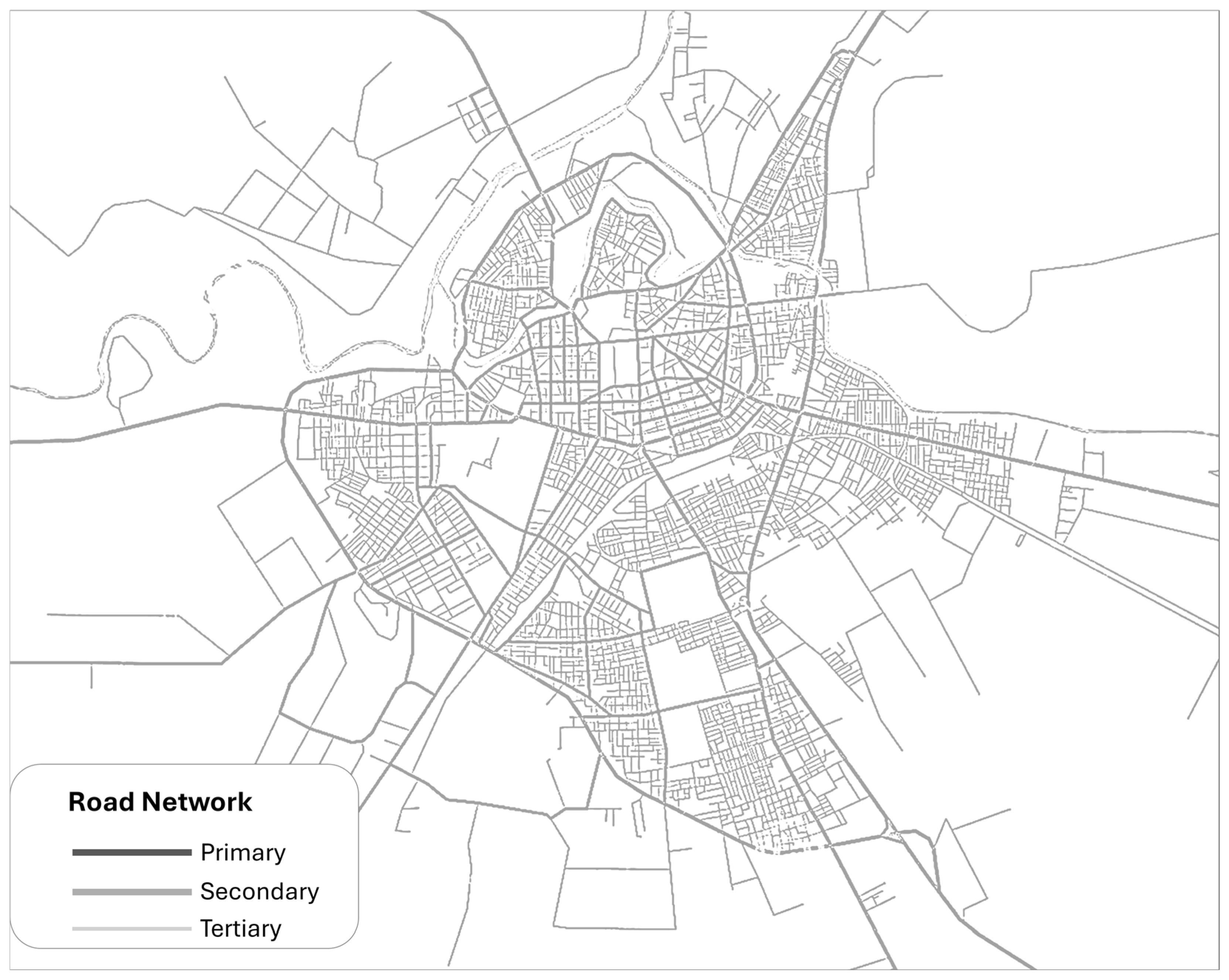
Larissa, the capital of the Thessaly region in central Greece (Figure 1), is located in the fertile Thessalian Plain near the Pineios River, strategically positioned between Athens and Thessaloniki. With a population of around 163,000, it is the fifth-largest city in Greece, covering an area of 88 square kilometers. A key agricultural and commercial hub, Larissa boasts a rich history dating back to ancient times and serves as a modern urban center with well-developed infrastructure. The city of Larissa, which seeks to increase the number of vehicles passing through by tourists and visitors, is projected to have an increase in cars circulating by the year 2044 due to urbanization and a constantly rising population. Conversely, parking spaces, similar to most Greek cities, are insufficient, and any increase in parking spaces in the coming years will not be rapid enough to mitigate the problem.
Therefore, local and regional authorities have contemplated reducing car use and/or promoting decentralization. However, it appears very unlikely that decentralization will occur in the near future, even if substantial incentives are introduced for both public and private entities to relocate their operations to suburban areas. As a result, a more plausible scenario for the city of Larissa is the integration of an additional PT mode, namely trams, in order to supplement the existing public transit system. It is speculated that this new tram line development would not only offer benefits to a significant portion of the population but also create competitive pressure on urban bus services, encouraging them to expand their coverage and operating hours in response to the dominance of private vehicles and taxis, which currently represent their primary competition. However, the goal for trams and buses should be their cooperation to enhance PT services without competing with each other [45]. Another goal would be for the tram to act as a catalyst for modal shift among car users, reducing the overall number of vehicles. Moreover, PT upgrades are planned by the authorities to take place in the near future, including measures such as bus priority systems and the implementation of dedicated bus lanes to improve speed, reliability, and overall service efficiency.

3.2. Stated-Preference Survey Design

The stated-preference (SP) survey was designed using an orthogonal framework developed within the R Studio version 2023.6.1.524 [46], using the package support CEs [47]. As a next step, the SP design was followed by applying the orthogonal design based on the number of alternatives, as well as the number of attributes, along with respective potential values for each attribute. The present study selected four attributes: (i) cost of travel, (ii) in-vehicle (travel) time, (iii) waiting time and (iv) walking time (the last two jointly comprising out-of-vehicle time).
A consultation with local authorities (municipality of Larissa) and local bus operators was conducted to select possible values for these attributes. Additionally, historical and current data were sought from local bus operators, such as fare structures and timetables, so as to acquire broader insights into the local transit system of Larissa. As for the tram services, a similar approach was followed, as it was assumed that it would constitute the main alternative PT mode, with a few of the previous bus lines in the city, covering roughly the same areas and connecting with the city center. However, the tram is compared with enhanced bus services that are planned to be introduced in the city in the near future. The goal of the SP survey is to investigate whether a new PT mode with better service features would encourage more people to switch to PT. In this case, the tram would be an investment that could produce benefits, and the existing fleet of buses would be reorganized to serve as feeders to the tram. Additionally, this would extend the service area of PT by connecting more destinations and offering better service frequencies.
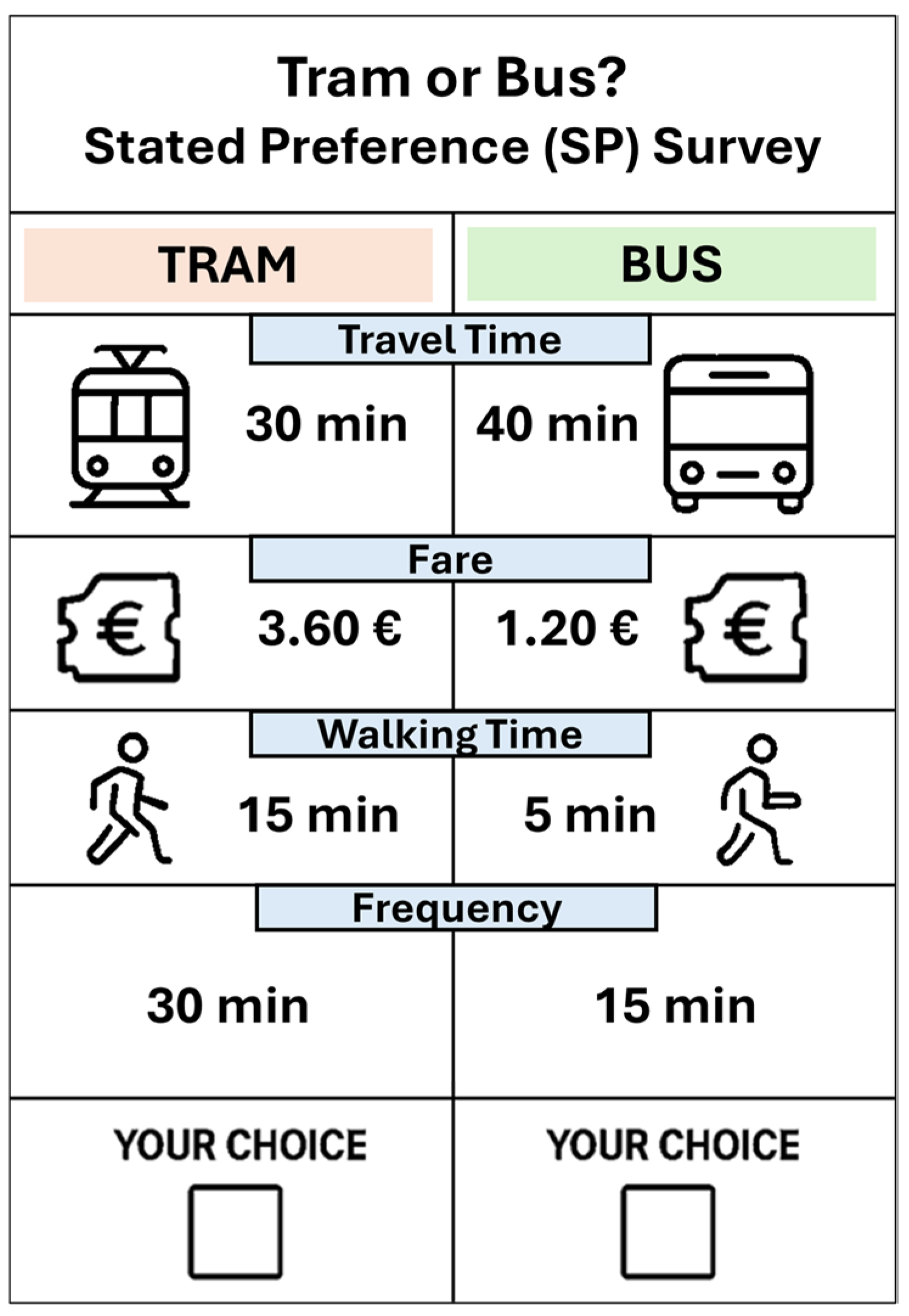
The survey primarily targeted PT users and pedestrians, as interviewing car users via a roadside survey (RSS) was not feasible. Figure 2 presents an example of a show card used in the surveys (one of the many scenarios).
The current survey was carried out during Spring 2024 via in-person interviews of residents in the city of Larissa in various locations, including the city center. The hypothetical question at the beginning of the SP experiment was as follows: “If a new tram service is provided and connects the city center with the suburban residential areas in Larissa, would you choose tram or bus for your daily commuting?”
To ensure that participants were well-prepared for the choice tasks, a detailed briefing was provided, in which the attributes and how they would be presented during the decision-making process were explained. More specifically, before proceeding to complete the survey, it was confirmed that the respondents were informed about the study’s purpose and the duration of the survey (approximately 15 min) and then provided their consent; in case of no consent, the survey would be terminated for this participant. It was also stated that participant data was anonymized and handled confidentially. It is noted that no incentives were given for participation (e.g., monetary rewards, gift cards, etc.). Respondents were then provided with a detailed briefing regarding the stated-preference experiment and purpose of the study regarding the new tram service and how it compares with the bus. This briefing included explanations of the attributes and how they would be presented during the choice task. It is noted that ethics approval was secured by the relevant Ethics Subcommittee at the Hosting Institute before the launch of the survey.
Table 1 illustrates the attributes and their corresponding levels in the choice tasks for the alternatives (tram and upgraded bus services). The respondents’ groups (blocks) and the number of scenarios were determined following an orthogonal design, resulting in a final design containing 972 rows, divided into 16 blocks, each containing nine tasks (choice situations) for each respondent. The survey sample consisted of 108 respondents, who were divided into respective blocks. As stated earlier, each respondent participated in nine choice situations, resulting in a total of 108 × 9 = 972 observations (choice situations) in the dataset for the SP analysis.
Other questions of the survey included current trip characteristics, satisfaction with current PT services and demographic characteristics. Table 2 and Table 3 show the characteristics of the sample and descriptive characteristics of responses to other questions in the survey questionnaire. In Table 2, the sample demographic data are compared with the demographic profile of the wider Thessaly region, based on the official statistics from the most recent census conducted in 2021.

3.3. Choice Cluster Visualization Pipeline

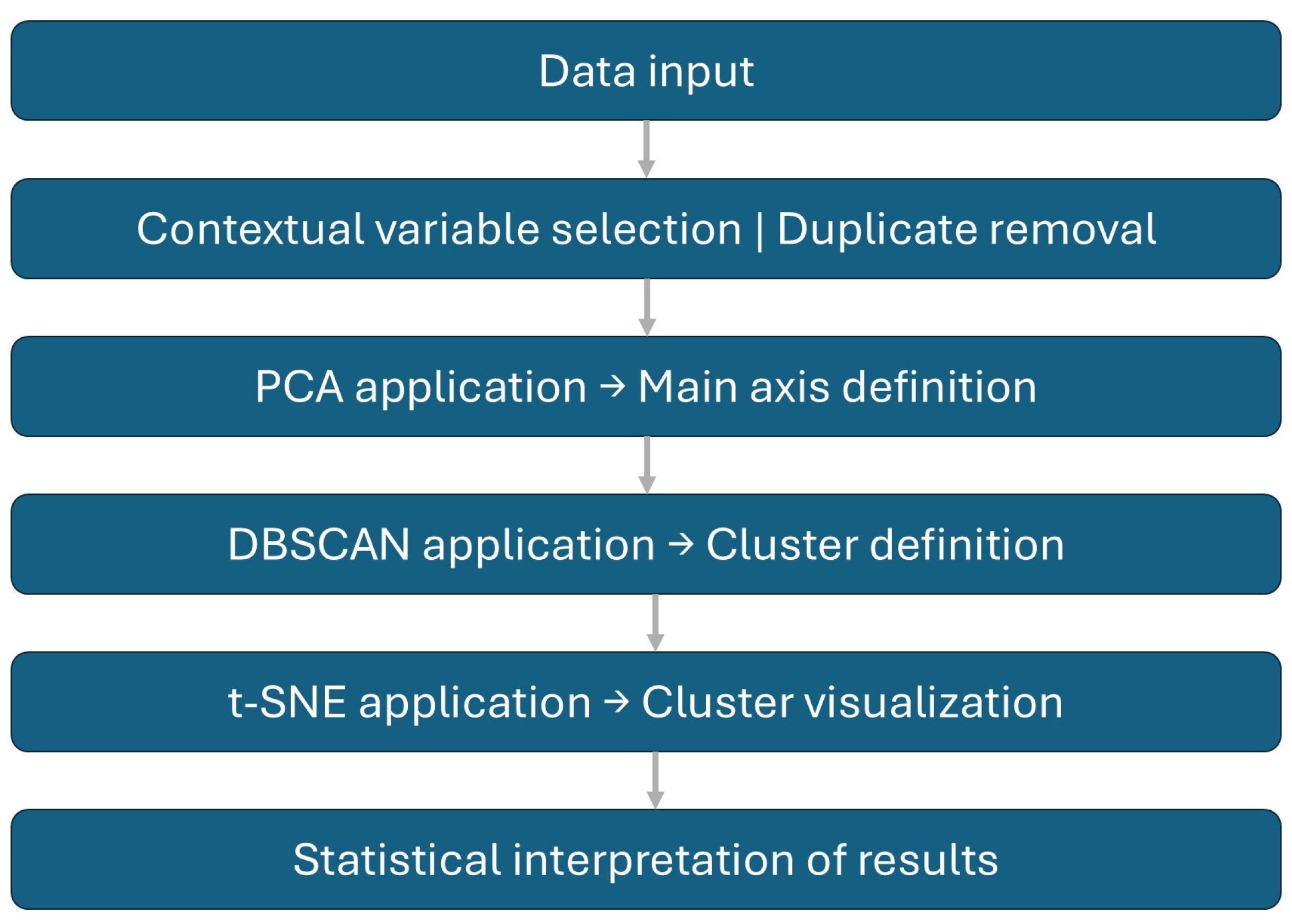
In order to detect critical patterns and to obtain key insights before the modeling exercise, a visualization pipeline was assembled for the formulation of mode choice clusters. Specifically, the Principal Component Analysis (PCA), Density-Based Spatial Clustering of Applications with Noise (DBSCAN) and t-Distributed Stochastic Neighbor Embedding (t-SNE) algorithms were employed in sequence. The aim of this post-descriptive analysis was to detect contextual patterns in the data, and specifically, to provide insights into whether specific different transport condition contexts lead to different mode choices.
The pipeline comprised the following steps in sequence: (i) selection of key contextual variables, (ii) data manipulation (removal of duplicate contexts, one-hot encoding, scaling), (iii) PCA application, (iv) DBSCAN clustering, (v) t-SNE 2-dimensional visualization, and (vi) interpretation of findings.
The concept of the pipeline is also showcased in Figure 3 below:
PCA is a statistical method belonging to the family of factor analysis techniques. It is primarily used for dimensionality reduction by transforming the original dataset, which contains a larger number of variables, to a composite set of values that retains most of the original information. PCA is frequently applied to cluster-related questions into broader underlying factors, or components. These components are continuous variables that reflect the common structure and overall tendency of the grouped items [48,49].
DBSCAN belongs to the category of unsupervised machine learning algorithms. Contrary to more traditional distance-based algorithms, DBSCAN does not explicitly utilize Euclidean distances. Rather, DBSCAN identifies clusters of observations based on the density of their components across parameter space. The observations that are densely arranged are formed into common clusters, while the observations that are scarcely distributed are classified as outsiders. Therefore, DBSCAN can internally handle outlier data and noise-prone observations. While DBSCAN does not demand prior definition of cluster numbers, it requires the definition of minimum point density and neighborhood size to operate.
The implemented PCA and DBSCAN algorithms have been well-established in the literature, and their mathematical background will not be replicated here for brevity. For interested readers, in-depth descriptions of PCA can be found in Abdi & Williams [50], and for DBSCAN in Khan et al. [51] and Schubert et al. [52].
The last algorithm, t-Distributed Stochastic Neighbor Embedding (t-SNE), merits further elaboration. The t-SNE algorithm is also one of the techniques used for dimensionality reduction and visualization. The algorithm focuses on retaining the proximity of observations before and after the dimensionality reduction, namely, preserving the local structure of the data. Instead of projections, Distributed Stochastic Neighbor Embedding transforms the pairwise distances between observations into probabilistic distributions that account for neighborhood similarities [53]. Specifically, the t-SNE variant of the technique is capable of creating a singular data map revealing implicit structures at multiple scales [54], which is particularly useful for multiparametric data of misaligned or differing origins.
For the theoretical background of t-SNE, following Van der Maaten & Hinton [54], the pairwise distance transformation can be expressed as
  p i | j = e x p x i x j 2 2 σ i 2 k i e x p x i x j 2 2 σ i 2
where { x n } is a set of high-dimensional objects, σ i is the neighborhood size and p i | j is the calculated probabilistic distribution. When transformed into a low-dimensional space, a conditional probability q i | j can be calculated using y n as the set of low-dimensional counterparts:
q i | j = e x p y i y j 2 k i e x p y i y j 2
The algorithm is then optimized using the Kullback–Leibler divergence as a cost function:
C   =   i K L ( P i | Q i = i j p i | j l o g p i | j q i | j
This cost function is the underlying mechanism through which datapoints remain close by within the embedding. To summarize, PCA is used as the initial step in order to compress the datapoints along its main axes. DBSCAN is then used to identify dense concentrations that describe typical travel conditions. Finally, t-SNE provides a faithful rendition of the cluster structures, showcasing which specific conditions lead to the corresponding choices. Therefore, throughout the above process, the contextual emphasis of the data is promoted while respecting the numerical nature of the data.

3.4. Fixed and Random Parameters (Mixed Logit) Models

As unobserved heterogeneity is a common issue in stated-preference studies, and to analyze participant preferences towards these two PT modes (tram/bus), a series of fixed and random parameters logit (mixed) models were applied. In the random parameters approach, parameters may vary across observations, as they follow a distribution, such as normal, uniform, etc. Therefore, heterogeneity in the data that is not directly recorded in the dataset, and thus is unobserved, can be addressed. The statistical significance of random effects is then assessed to justify whether their adoption is warranted or whether fixed effects models would be sufficient. Following Washington et al. [55], a random-parameter model has, for observation n, outcome probabilities defined as P n m ( i ) :
P n m i = x P n i f β φ d β
where P n i is the probability of observation n having discrete outcome i, f(β|φ) is the density function of β with φ referring to a vector of parameters of that density function (mean and variance). Thus,
P n m i = x e x p [ β i Χ i n ] Σ I e x p [ β i Χ i n ] f β φ d β
where I denotes all possible outcomes for observation n, while i ∈ Ι. The Log-Likelihood is
L L = n = 1 N i = 1 I δ i n L N [ P n m i ]
where N is the total number of observations, I is the total number of outcomes, and δin is defined as being equal to 1 if the observed discrete outcome for observation n is i and zero otherwise. In the present case, when the dependent variable takes only two values (0 or 1), a binary logistic regression model can be used to model the variable of interest. In the binary logistic regression, if the utility function is U,
U = β 0 + Σ β j x j
then the probability P is
P = e x p U e x p U + 1
where β0 is the model constant, βj are the values of the coefficients, and xj are the values of the independent variables (j = 1, 2, …, n is the set of independent variables).
To estimate the beta parameters of the utility function for each mode (tram/bus), the maximum likelihood estimation (MLE) method was applied. To assess the significance of each variable, t-tests were conducted. The overall goodness-of-fit of the model can be assessed using the McFadden R-squared, which is based on the likelihood ratios of the full model (LLf) and the empty model (LL0). R-squared values higher than 0.2 to 0.3 indicate a reasonable model fit, as suggested by McFadden [56]. Halton draws were utilized in this study, which are derived from a technique developed by Halton [57] to produce a systematic non-random series of numbers. Halton draws (samples) are significantly more efficient than purely random draws, achieving accurate probability approximations with considerably fewer draws [55]. In the present study, given that the models are complex, 1000 Halton draws were utilized. All analyses in this paper were conducted using the mlogit package [58] in the R Studio software [46].

4. Results

4.1. Clustering Pipeline Results

Initially, the process outlined in Figure 3 was executed within R-Studio [46]. The initial set of raw data consisted, in total, of 972 repeated-measure observations, as outlined in Section 3.2. After the initial preprocessing, data scaling, one-hot encoding, and duplicate removal, a final total of 935 observations were retained, indicating that the majority of traveling conditions were unique, and duplicates were rare.
The contextual variables selected for the PCA-supported dimensionality reduction comprise the cost, travel time, frequency, and walking time alternatives, as well as the parameters of reliability, comfort, safety, cleanness and ticket type for the two public transport alternatives, amounting to a data frame of 14 features in total. PCA was conducted on the scaled and curated data and produced a dataset with considerable dimensionality reduction, which comprised 10 features in total.
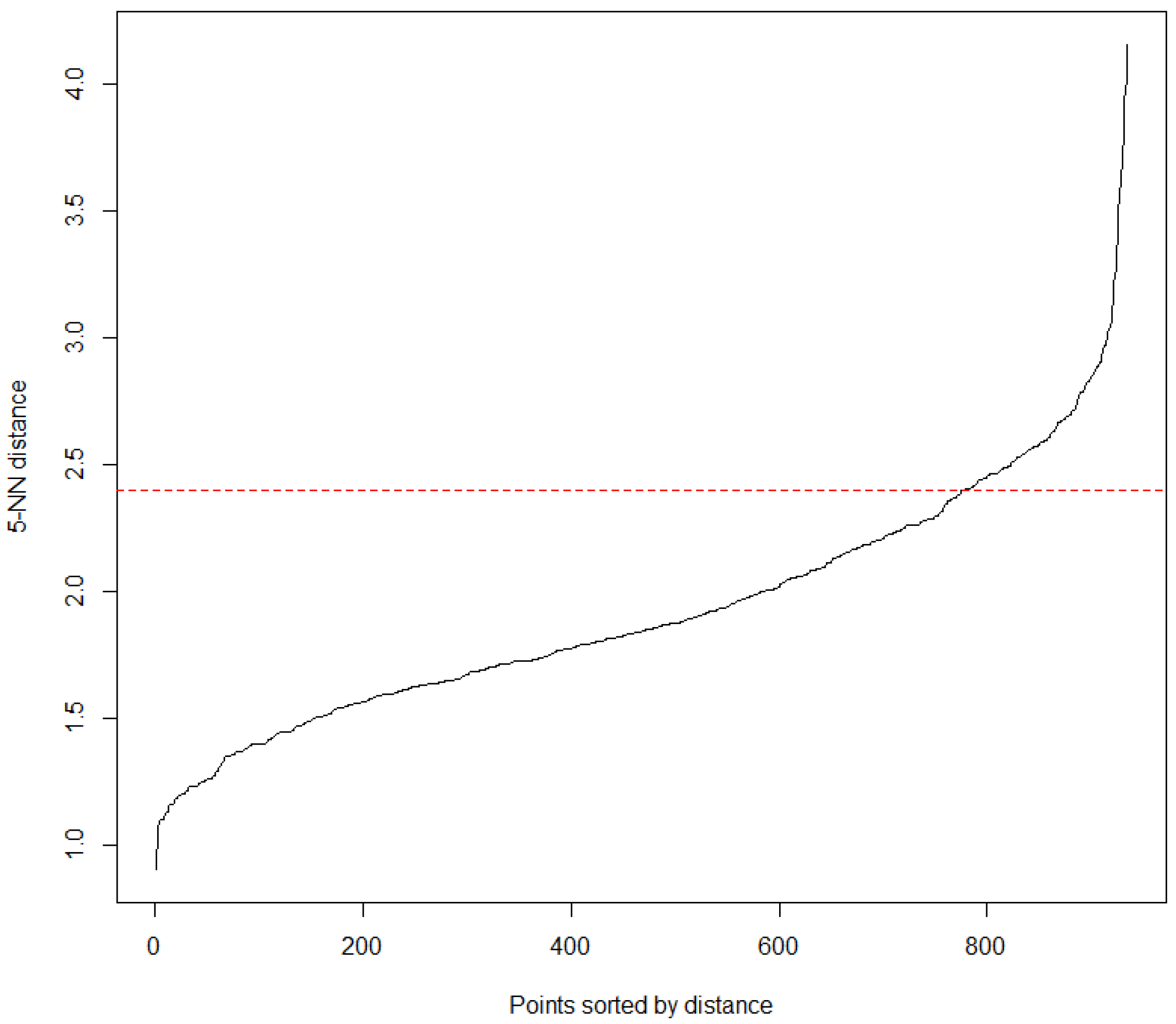
DBSCAN was then applied to the PCA-reduced components. After a trial period of comparison of the outputs of various minimum point density and neighborhood size configurations and using the k-NN distance plot of Figure 4 as a reference, the clustering results were obtained for a minimum point density of five core points and a neighborhood size of 2.4.
The selection of these parameters was a combination of empirical guidance, which dictates the selection of a neighborhood size closely before the sharp increase in gradient, and data-driven results. The final clustering was obtained through DBSCAN, which yielded 4 clusters in total. The summary of mean and standard deviation values per cluster profile is provided in Table 4 and Table 5.
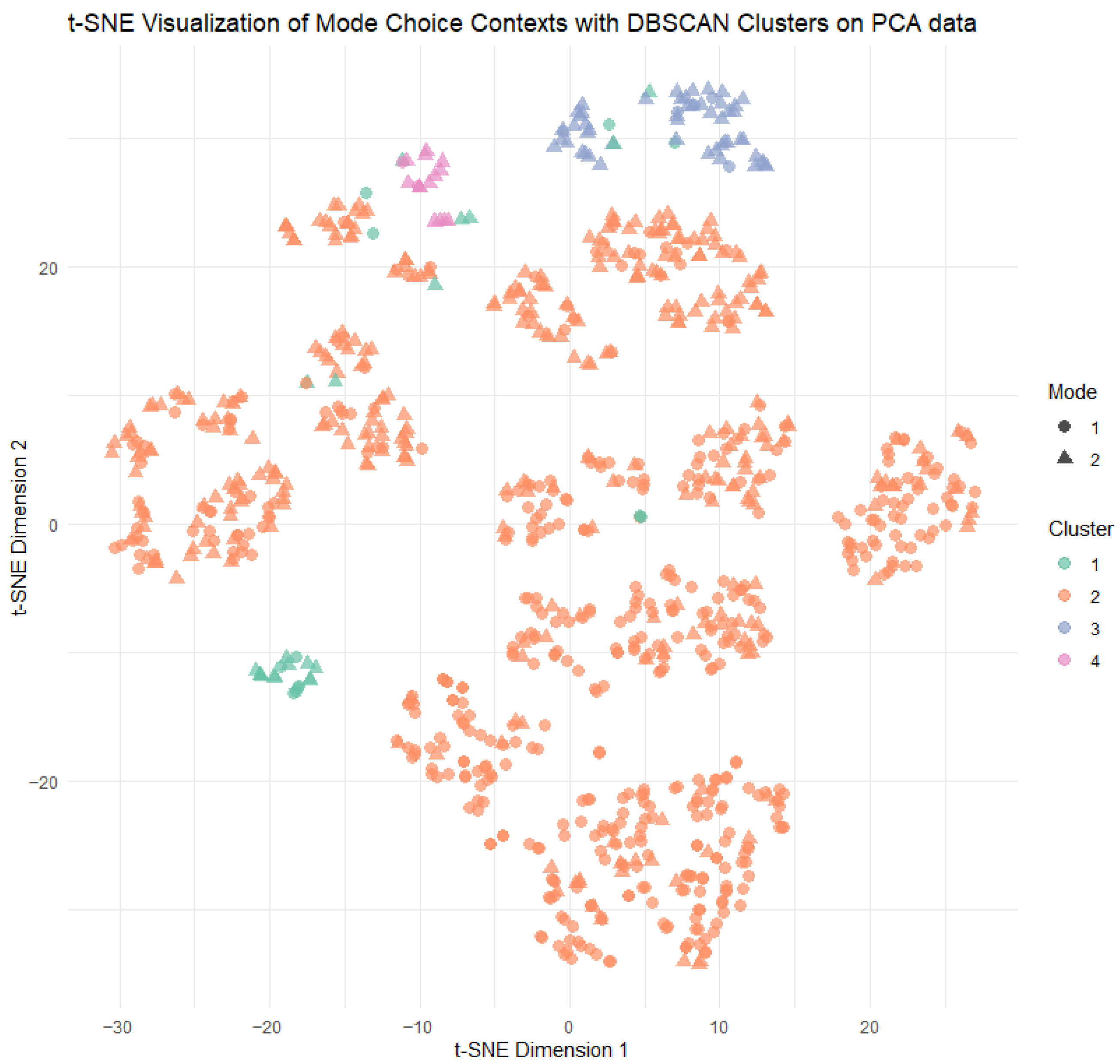
Finally, the t-SNE algorithm was applied to visualize the cluster distribution across the feature space. Results appear in Figure 5.
Based on the values of Table 4 and Table 5 and t-SNE mapping of Figure 5, an in-depth interpretation can be obtained for the choice processes of the participants in the context of Larissa.
  • Cluster 1 contains observations considering that the present PT options have low reliability and comfort with comparatively high standard deviations, denoting perceived inconsistencies. Safety and cleanness are perceived as moderate. Preferred cost and walking time are moderate as well, while this cluster comprises conditions that are described by regular tickets and daily usage. Regarding mode usage, t-SNE shows a mixed output, but tram is favored overall within this cluster. It is thus likely that the presently perceived low comfort pushes members of this cluster towards a tram preference.
  • Cluster 2 contains observations considering that the present PT options have moderate-high reliability and comfort, with low sd. indicating consistency in their perception. Likewise, safety and cleanness are perceived as above average. Preferred cost and walking time are towards the lower range, while this cluster comprises conditions that are described by regular tickets as well. Mode use frequency is quite mixed. Visually, t-SNE shows a preference towards bus usage overall. Therefore, this cluster expresses users who prioritize costs and perceive existing services as reliable and comfortable, denoting their overall preference towards buses.
  • Cluster 3 contains observations considering that the present PT options have moderate-high reliability, comfort, safety, and cleanness with notable robustness. Preferred cost and walking time are modest but varying, while this cluster comprises conditions that are described by regular ticket daily users. Visually, t-SNE depicts this cluster as considerably tram-oriented. It is probable that the members of this cluster are placing their preference towards a future tram service that they believe is going to be even more comfortable and that will fit their present travel arrangements.
  • Cluster 4 contains observations considering that the present PT might have the highest reliability, comfort, safety and cleanness with the highest perceived robustness, while this cluster comprises conditions that are described by regular ticket daily users. This cluster comprises users who experience the best overall service but are willing to walk more and to pay slightly higher costs. They mostly favor trams as depicted by t-SNE.

4.2. Logit Modeling Estimation Results

This section presents the estimated parameters of the fixed and random parameter logit models. A total of four choice models were estimated based on the SP survey experiment. The models’ results are presented in this section, while the implications of these findings are discussed later in the paper. To achieve the aims of the study, a series of binary logistic models was developed, numbered as follows:
  • Fixed effects with generic coefficients;
  • Fixed effects with mode-specific coefficients;
  • Random parameter (mixed logit) with generic coefficients;
  • Random parameter (mixed logit) with mode-specific coefficients.
Table 6 illustrates the fixed effects model (Model 1) and shows the parameter estimates as well as the respective standard errors and p-values for the analysis of the best fitting fixed effects model with generic coefficients, i.e., the same coefficients for all alternatives. The model generally showed a good fit based on the related model metrics. The value of the Log-Likelihood at zero (LL0) was found to be −669.57, while the value of the Log-Likelihood of the converged model (LLf) was estimated to be −486.73, leading to a McFadden R-squared value of 0.274, while the AIC value was 983.45. The utility function for this model is specified for the tram, as the bus has been selected as the reference category. The model summary indicates that the signs for most of the beta coefficients of the attributes in the SP experiment were significant and aligned with the prior hypotheses (passengers preferring the bus). As expected, all beta coefficients show negative signs, indicating that the cost of the ticket, travel time, waiting time, and walking time reduce the probability of selecting the tram.
As a next step, the Value of Time (VoT) for Tram is calculated by dividing the mean value of the beta coefficient of travel time by the cost of a tram ticket, and as such, a generalized estimate of VoT can be provided across the sample, considering the distribution of preferences. It should be noted that the Value of Time estimates are derived from the ratio of the means of time and cost coefficients under the assumed normal parameter distributions, but also when fixed effects models are examined. While this approach is commonly adopted in empirical applications, alternative specifications (e.g., lognormal distributions or simulation-based derivation of VoT distributions) could provide further insights and constitute a promising direction for future research.
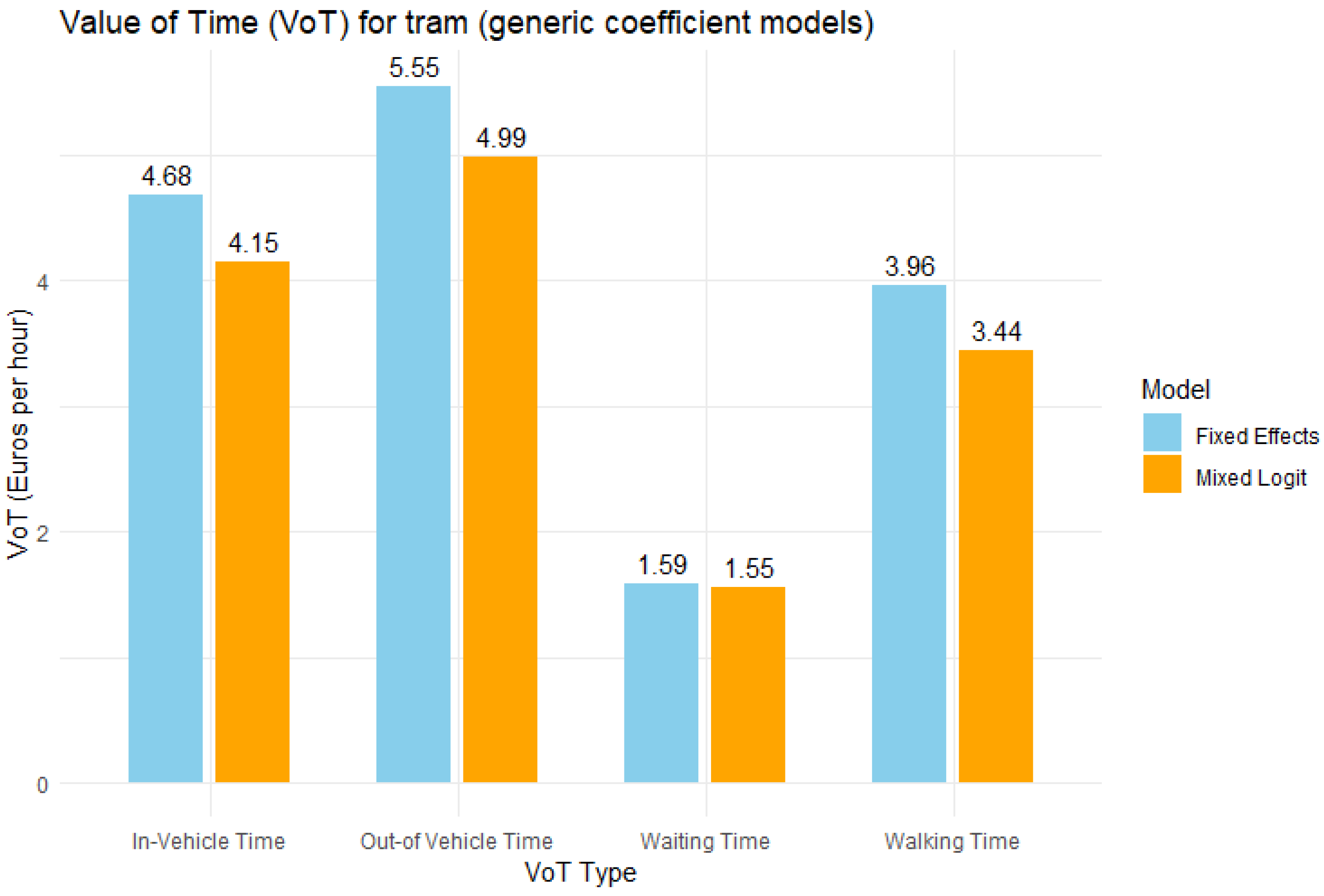
Hence, VoTTram = (−0.069)/(−0.889) = 0.078 euros per minute of travel time, or 4.683 euros per hour. Similarly, the VoT for walking time and waiting time can be estimated and were found to be VoTWalk = 3.958 euros per hour and VoTWait = 1.594 euros per hour, respectively. This leads to a total out-of-vehicle Value of Time (OoV VoT) for the tram equal to 5.552 euros per hour. These results indicate that future tram users are willing to pay more to decrease walking time than to reduce waiting time. This difference could be attributed to factors such as physical effort and the inconvenience of walking longer distances compared to waiting at the PT stop.
As for the next fixed effects model with different utility functions and mode-specific coefficients (Model 2), the value of the Log-Likelihood at zero (LL0) was found to be −884.38, while the value of the Log-Likelihood of the converged model (LLf) was estimated to be only marginally better than Model 1 (−485.46). The respective McFadden R-squared value was 0.275, while the AIC value was 988.92, and, therefore, the fixed effects models showed similar goodness of fit overall. The summary results of Model 2 are illustrated in Table 7 below.
Similarly, all the beta coefficients have negative signs, indicating that higher values of cost, travel time and walking time result in lower probability in selecting each mode. However, a few notable differences are identified. For instance, in the best-fitting model, the constant term for tram was found to be non-significant. The same applies to the waiting time for the tram, which appears not to influence tram choice. Firstly, the non-significance of the constant term for the tram may indicate that respondents’ preferences for choosing the tram are not influenced by inherent biases, but instead, their choices might depend more on specific attributes or situational factors.
Secondly, the non-significance of waiting time suggests that tram users may not perceive tram waiting time as a critical factor influencing their choice. It can reflect a high level of confidence in tram time schedules or also an expectation that the tram stops would be more accessible and convenient for waiting compared to the existing bus stops. This could be attributed to the fact that tram services are generally perceived as reliable, reducing the impact of waiting time on decision-making. In contrast, buses might be perceived as less predictable, making waiting time more important in bus-related decisions. However, this finding should be interpreted with care, as the tram service is not yet developed in the city of Larissa.
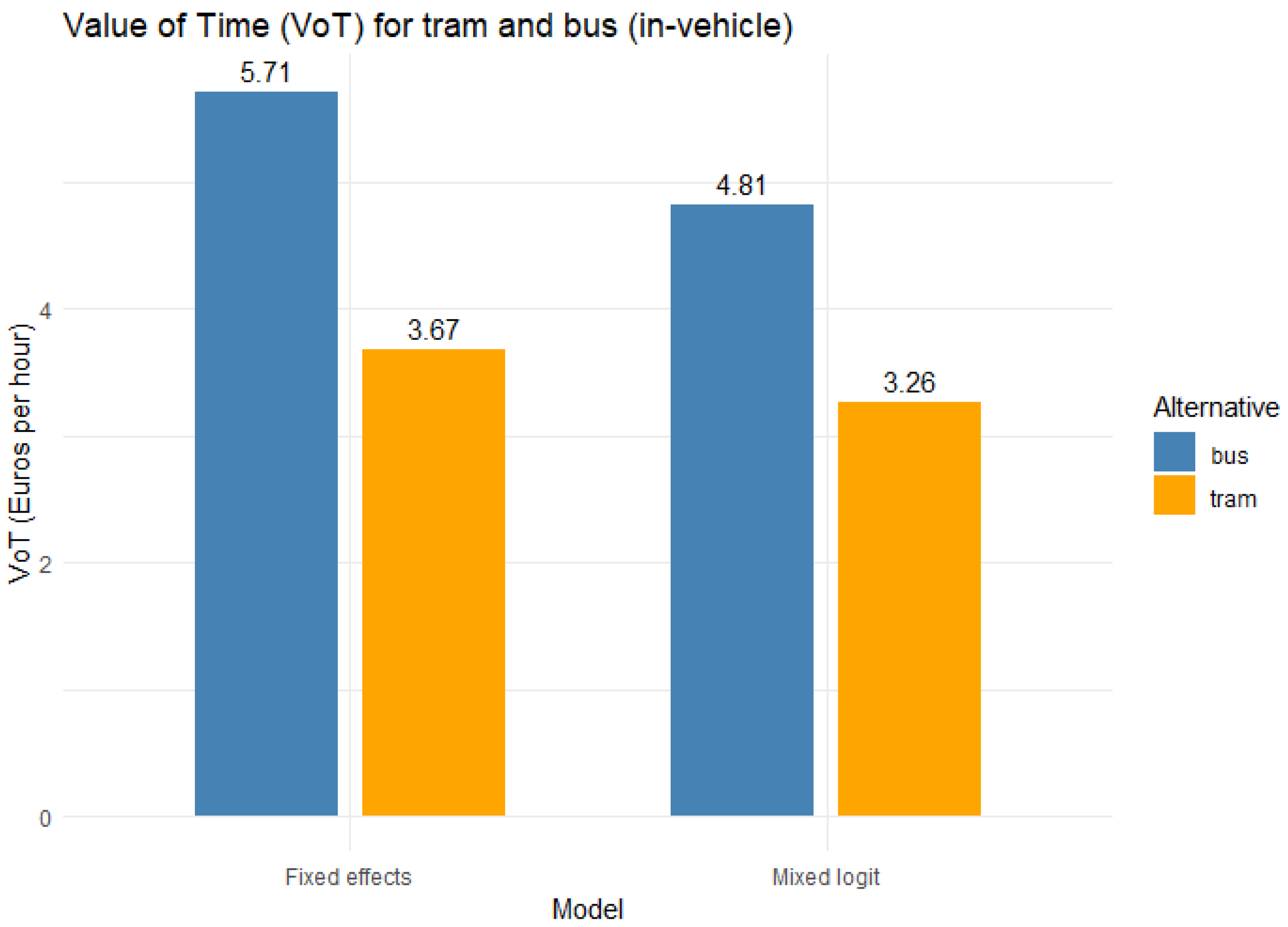
Following the previous procedure, the respective categories of VoT can be calculated for Model 2. For trams, the VoT when travel time and ticket cost were considered, was found to be 3.67 euros per hour, while for buses, it was found to be 5.71 euros per hour. The rest of the VoT estimations for Model 2 are illustrated in the related figures, which are placed at the end of the present Section of the paper.
The next two models discussed are the random parameters (mixed) logit models for mode choice. Starting from the model with generic coefficients (Table 8), the next table presents the parameter estimates of the beta coefficients, along with the standard deviations of the random parameters and their respective standard errors and p-values for the best-fitting model. For the parameter estimation of the model, the number of Halton draws for estimating the panel effect coefficients is set to 1000. Moreover, the random parameters were assumed to follow the normal distribution. The value of the Log-Likelihood of the best converged model (LLf) was estimated to be −424.34, and the respective McFadden R-squared was found to be 0.366, while the AIC value was 868.68. This delivers significantly better results due to the integration of random parameters for the constant term and tram-related attributes in the model, as potential unobserved heterogeneity in mode choices is captured through this model specification.
It is also indicated that all the beta coefficients of the standard deviations of the random parameters were found to be significant, showing that it is meaningful to consider these variables as random and thus adopt mixed-effects models over fixed effects models. As for the VoTTram, it was found to be 4.15 euros per hour. In addition, the respective VoTs for waiting time and walking time for the tram were estimated to be 1.55 euros per hour and 3.43 euros per hour, with a total out-of-vehicle VoT of 4.98 euros per hour.
The final model that was estimated in the analysis was the mixed logit model with mode-specific coefficients (Table 9). As in the previous mixed logit model, 1000 Halton draws were used, and a normal distribution was selected for the random parameters. Results indicated a good fit; however, this fit was relatively lower than the mixed logit model with generic coefficients, as the value of the Log-Likelihood of the converged model (LLf) was estimated to be −467.94, while the McFadden R-square was 0.300. In this case, the Value of travel Time for the bus was also found to be higher than the tram (4.81 euros per hour and 3.261 euros per hour).
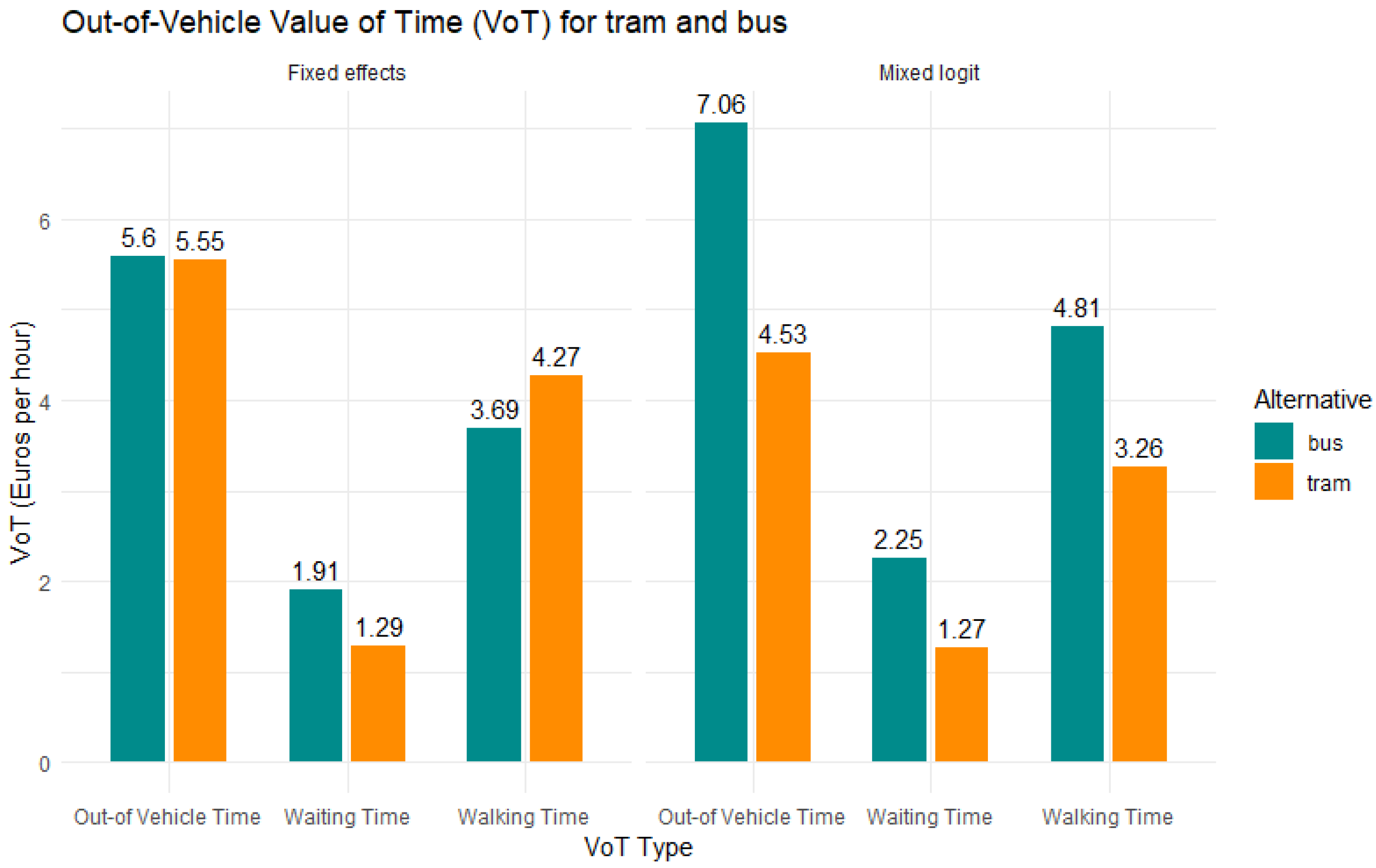
The next figures (Figure 6, Figure 7 and Figure 8) show the VoT values for all models, including the total out-of-vehicle (OoV) VoT. For comparison purposes between the two transport modes, total OoV VoT was also calculated for non-significant variables.
Hence, Model 3 (Mixed logit model with generic coefficients) is determined as the best-fitting model. Model 3 yields consistent and sensible results, as well as similarities with the fixed effect model featuring mode-specific coefficients (Model 2).

4.3. Discussion and Policy Implications

The survey results reveal a slight preference for trams over buses, with a distribution of 54.63% in favor of trams and 45.37% for buses. This possibly shows that the local population does not overwhelmingly support either of the two PT options. The tram supporters, which are a slim majority, might perceive the new tram as a more attractive or convenient transportation option compared to the existing bus service in the city of Larissa, but in most models it was shown that they do not have an a priori preference for the tram mode, as the constant terms for trams were not found to be statistically significant in the models. This finding might reflect the public enthusiasm for modern infrastructure or dissatisfaction with the current bus system.
On the other hand, the sizeable minority probably shows skepticism towards new PT services, which seem to stem from current services that do not meet their expectations or needs (Table 2), an opinion which may carry to new and future PT options. Additionally, some individuals may lack real-world experience with rail-based PT, which limits their understanding of the advantages that trams can provide over buses. However, this could still imply that existing bus routes may experience a ridership reduction of up to 50%.
Furthermore, the results in Table 2 are important and highlight a relatively high level of overall satisfaction with buses, which might still be considered as having margins of improvement for full-scale operations. This finding might explain why there is a stronger acceptance of trams over buses. These variables were considered in all models; however, there was no statistically significant variance between the responses given, and thus no statistically significant results were obtained.
The Value of Time (VoT) metrics suggest that respondents assign lower values to trams compared to buses across all stages of their journeys. This could be attributed to the fact that buses may be less reliable than trams, leading passengers to value time more since delays can have greater consequences. On the other hand, if trams are perceived as comfortable and frequent, users may not feel the need to rush as much. Another explanation could be the fact that tram systems and routes are protected by the vehicular traffic, and so they can achieve more efficient and reliable services. Notably, the difference is most pronounced during out-of-vehicle stages, where the VoT exceeds 3 euros. These findings align with the results in Table 2, highlighting that respondents prioritize aspects of their trips spent outside of a vehicle, such as waiting and walking. In another related study in the field [59], travel time emerged as the most significant determinant of mode choice; however, that study encompassed not only public transportation but also cycling and walking, which may account for this discrepancy.
Moreover, the relatively high disutility associated with out-of-vehicle time highlights the importance of minimizing access, waiting, and transfer times in the design of tram systems. This can be achieved through appropriate stop spacing, improved pedestrian infrastructure to enhance accessibility, and also high-quality waiting environments. Such measures can significantly enhance the overall attractiveness of the system and should be considered in planning and design processes. The outputs of the present study thus outline a clear need for improvements in the associated infrastructure (such as walkable routes, amenities at PT stops, and optimal placement of those stops) as well as enhancements to services (including increased service frequency to reduce wait times).
Our estimated VoT values, particularly for the tram alternative, might be considered relatively low when compared to findings reported in the literature regarding public transport VoT estimates. However, relatively low VoT estimates are not uncommon for public transport [60]. Furthermore, variations in values of travel time in Europe are expected and could be attributed to differences in socio-economic conditions (i.e., GDP per capita) and the type of data [61]. In the present case, several factors may explain the comparatively lower VoT values. First, local income levels and broader economic conditions are likely to influence individuals’ willingness to pay for travel time savings. Secondly, the SP nature of the experiment may lead respondents to adopt more conservative trade-offs compared to real-world observed behavior, thus potentially leading to lower VoT values.
It is also noted that, as the tram system is not yet implemented in the city of Larissa, the current analysis relies on SP data, since it is a widely used approach for assessing hypothetical future transport services. In this context, respondents’ choices may partly reflect perceptions associated with new transport modes, including a degree of optimism towards improved service attributes, which may also contribute to the observed slight preference for trams. However, such effects are inherent to SP studies and should be considered when interpreting the results.
On another note, by conducting a more detailed analysis of the preferences between potential options of PT users, an assessment of whether trams could play a pivotal role in shifting individuals from car usage to PT is enabled. Within the context of PT development, it is a fundamental need that PT systems are designed to operate in a complementary manner, rather than in competition with one another, to ensure an integrated PT network. In that regard, the aim of policymakers should be to promote a shift from private car use to PT, thereby improving network efficiency, accessibility, and sustainability of PT. Gaining insight into these dynamics is crucial for optimizing service planning, maximizing resource utilization, and achieving an integrated and sustainable transport system that serves the needs of both passengers and operators and serves as a competitive alternative to cars.
The current study shows that the evidence presented does not necessarily warrant investment in a new tram line unless there is a clear demand for trams among current PT and car users. While some urban rail systems produce benefits and outweigh the investment costs, there is contradictory evidence regarding the effectiveness and potential success of urban rail systems and trams. For more information, the reader can refer to several related studies such as [3,62,63,64].
However, the results of our analysis point towards a pressing need to improve existing PT services, particularly by focusing on the out-of-vehicle components of PT journeys. To further substantiate this claim, it would be helpful to explore whether similarly sized cities in Europe have successfully implemented tram systems or opted for upgrades to their bus services instead. In that case, it would be beneficial to authorities if successful case studies of tramlines were closely examined (e.g., Strasbourg and Paris). For instance, the tramway line opened on the Marechaux boulevards in Paris in December 2006 was considered highly successful, as it not only attracted the users of the bus line that it replaced, but also drew, surprisingly, a significant number of subway passengers [3].
It is also essential to acknowledge, however, that LRT systems and trams are not a panacea, especially with respect to road safety, since previous studies have highlighted road safety concerns associated with trams, as they are large and heavy vehicles which often have to operate within complex urban traffic environments [14]. For that reason, although the present analysis did not consider perceived safety-related attributes in the SP survey, public authorities should consider road safety impacts when planning and evaluating new PT schemes, as correctly stated in a related study by Naznin et al. [14].
Another possible alternative for the city of Larissa could be a new Bus Rapid Transit (BRT) line. However, including a BRT line in the present SP analysis was not possible due to a complete lack of related information. In addition, the high demands of such a system mean that if it fails to attract the city’s commuting population, it could become a costly and ineffective investment, as stated by an overview BRT study [65]. In order to fully understand the success of the PT system (tram line), there is a need to develop separate Revealed Preference (RP) studies to understand travel behavior under existing conditions. Examining current bus use, private cars, and other transport modes could provide valuable insights into origin–destination (OD) patterns, trip characteristics, and passenger behavior.
Finally, the Value of Time estimates reported in this study are based on the ratio of the mean time and cost coefficients under normally distributed random parameters (in the mixed logit models). Future research could explore alternative distributional assumptions (e.g., lognormal specifications) and simulation-based approaches to examine the implied VoT distributions in greater analytical detail.
Overall, the present study contributes to both theoretical understanding and practical planning, supporting more informed investment decisions, demand forecasting, and user-centered system design. Moreover, the findings can inform broader discussions on transport sustainability, mode shift incentives, and the social acceptability of new transit technologies in comparable urban contexts.


5. Conclusions

This study investigated PT preferences in Larissa, Greece, focusing on the potential introduction of a tram system. Using a stated-preference survey, a composite clustering and visualization pipeline, as well as advanced discrete choice models, the results suggest that while respondents do not express a strong inherent bias for trams over buses, they are responsive to key service attributes such as cost, travel time, and access conditions. Overall, a theoretical future tram line was strongly preferred under most unique travel conditions and in over half the majority of the presented scenarios compared to the bus.
Beyond the modeling results, the findings hold important policy implications. They indicate that tram systems, given that they are designed with attention to minimizing access and waiting times, could serve as an effective and publicly accepted alternative to the existing bus network. The integration of such a system is particularly relevant for Larissa, a representative medium-level city facing growing car traffic, constrained parking infrastructure and network capacity. Moreover, the calculated Values of Time (VoTs) provide quantifiable inputs for evaluating user trade-offs, reinforcing the importance of user-centered planning. The use of mixed logit models proved especially valuable in capturing diverse user preferences, offering a more nuanced basis for transport decision-making.
The present study does not come without limitations. First, a limitation of this study relates to sample representativeness, as certain population groups, particularly higher-income individuals and those with only primary education) are underrepresented.
While the quantitative results of our analysis are probably influenced by the local socio-economic conditions in the city of Larissa and the Greek context, some qualitative insights (i.e., the relationship between lower income levels and lower VoT estimates, responses to PT service attributes, etc.) may be transferable to other medium-sized cities with similar characteristics. However, further research is required to assess the extent of such transferability across different contexts. Future studies could expand upon the study findings by considering more mode alternatives and attributes, including car users and micromobility users, as well as perceived safety factors.
Furthermore, to justify such large-scale economic investments, future work is suggested to incorporate interviews, roadside surveys (RSSs) and revealed preference (RP) surveys so as to complement current SP analyses. Future research could extend the framework to explicitly include BRT scenarios, offering a more comprehensive assessment of multimodal transport choices.
Despite the fact that the present study focuses on bus and tram modes, emerging mobility services such as micromobility, shared mobility and Mobility as a Service (MaaS) are increasingly relevant in urban transportation systems. These services can complement tram networks by improving first- and last-mile connectivity and facilitating seamless multimodal trips. In particular, integrated ticketing and MaaS platforms may enhance coordination between modes and increase overall system attractiveness. In addition, the integration of such systems in the transport networks would redistribute modal splits by reducing the usage of public cars. In turn, as passenger workloads would smooth out, the overall efficiency and sustainability of the urban transport system would improve in terms of required energy consumption and emissions per passenger-kilometer. Shared mobility and MaaS systems would also improve accessibility and convenience options for passengers, leading to rearrangements in terms of user preferences. Therefore, including shared mobility and MaaS systems in future research would provide further insights into tram operations within evolving urban mobility environments.
Overall, the current study findings provide useful insights into road user preferences and support the notion that investment in modern, fixed-rail transit could deliver not only functional improvements in service delivery but also broader environmental and societal benefits without being competitive to existing bus networks. The study further contributes practical evidence for cities of similar scale seeking to enhance their PT systems through data-informed, context-sensitive approaches.

Author Contributions

Conceptualization, A.T., A.A. and G.G.; methodology, A.T., A.A. and A.Z.; software, A.T. and A.Z.; formal analysis, A.T. and A.Z.; investigation, A.T., A.A., G.G. and A.Z.; data curation, A.A.; writing—original draft preparation, A.T., A.A., G.G. and A.Z.; writing—review and editing, A.T., A.Z., G.G., I.P. and N.E. All authors have read and agreed to the published version of the manuscript.

Funding

This research received no external funding.

Data Availability Statement

The data that support the findings of this study are available from the corresponding author upon reasonable request.

Conflicts of Interest

The authors declare no conflicts of interest.

References

  1. Statista. Change in Urbanization Worldwide, by Region 1950–2050; Statista: Hamburg, Germany, 2018; Available online: https://www.statista.com/statistics/672054/change-in-urbanization-worldwide-by-region (accessed on 29 December 2025).
  2. Dell’Olio, L.; Ibeas, A.; Dominguez, A.; Gonzalez, F. Passenger Preference Analysis: Light Rail Transit or Bus Versus Car. Transport 2012, 27, 276–285. [Google Scholar] [CrossRef]
  3. Prud’homme, R.; Koning, M.; Kopp, P. Substituting a tramway to a bus line in Paris: Costs and benefits. Transp. Policy 2011, 18, 563–572. [Google Scholar] [CrossRef]
  4. Yang, L.; Bi, S.; Zhao, Y.; Liang, Y.; Wang, R. Time-dependent associations between accessibility to tram stops, proximity to tram tracks, and property prices: From construction to operation. Res. Transp. Bus. Manag. 2025, 59, 101286. [Google Scholar] [CrossRef]
  5. Vuchic, V.R. Point of View: Urban Rail Transit Systems. Recognizing The Value of Rail Transit. TR News 1991, No. 156, September–October 1991. Available online: https://onlinepubs.trb.org/Onlinepubs/trnews/trnews156-005.pdf (accessed on 29 December 2025).
  6. Newman, P. Public transit: The key to better cities. Siemens Rev. 1995, 62, 42–46. [Google Scholar]
  7. Mackett, R.L.; Edwards, M. The impact of new urban public transport systems: Will the expectations be met? Transp. Res. Part A Policy Pract. 1998, 32, 231–245. [Google Scholar] [CrossRef]
  8. Van Der Waerden, P.; Cheng, Y.; Liao, F. Evaluating the mobility and environmental effects of light-rail transit developments using a multi-state supernetwork approach. Case Stud. Transp. Policy 2024, 15, 101149. [Google Scholar] [CrossRef]
  9. Hensher, D.A. A bus-based transitway or light rail? Continuing the saga on choice versus blind commitment. Res. Transp. Econ. 2007, 18, 353–378. [Google Scholar] [CrossRef]
  10. Kim, S.; Ulfarsson, G.F.; Hennessy, J.T. Analysis of light rail rider travel behavior: Impacts of individual, built environment, and crime characteristics on transit access. Transp. Res. Part A Policy Pract. 2007, 41, 511–522. [Google Scholar] [CrossRef]
  11. Martinelli, D.R. A Systematic Review of Busways. J. Transp. Eng. 1996, 122, 192–199. [Google Scholar] [CrossRef]
  12. Scherer, M. Is Light Rail More Attractive to users than bus Transit?: Arguments Based on Cognition and Rational Choice. Transp. Res. Rec. J. Transp. Res. Board 2010, 2144, 11–19. [Google Scholar] [CrossRef]
  13. Currie, G.; Shalaby, A. Success and challenges in modernizing streetcar systems. Transp. Res. Rec. J. Transp. Res. Board 2007, 2006, 31–39. [Google Scholar] [CrossRef]
  14. Naznin, F.; Currie, G.; Logan, D. Exploring road design factors influencing tram road safety—Melbourne tram driver focus groups. Accid. Anal. Prev. 2017, 110, 52–61. [Google Scholar] [CrossRef] [PubMed]
  15. Aravind, A.; Mishra, S.; Meservy, M. Nudging towards sustainable urban mobility: Exploring behavioral interventions for promoting public transit. Transp. Res. Part D Transp. Environ. 2024, 129, 104130. [Google Scholar] [CrossRef]
  16. Jelti, F.; Allouhi, A.; Aoul, K.A.T. Transition Paths towards a Sustainable Transportation System: A Literature Review. Sustainability 2023, 15, 15457. [Google Scholar] [CrossRef]
  17. Oeschger, G.; Carroll, P.; Caulfield, B. Micromobility and public transport integration: The current state of knowledge. Transp. Res. Part D Transp. Environ. 2020, 89, 102628. [Google Scholar] [CrossRef]
  18. Oeschger, G.; Caulfield, B.; Carroll, P. Investigating the role of micromobility for first- and last-mile connections to public transport. J. Cycl. Micromobil. Res. 2023, 1, 100001. [Google Scholar] [CrossRef]
  19. Oeschger, G.; Caulfield, B.; Carroll, P. Measuring the integration of micromobility and public transport—The development of a new network analysis tool. Case Stud. Transp. Policy 2025, 21, 101545. [Google Scholar] [CrossRef]
  20. Jiao, J.; Chen, Y. Is the relationship between bus and light rail transit a competition substitution or a congestion substitution? An empirical study in Seattle. Public Transp. 2022, 15, 575–594. [Google Scholar] [CrossRef]
  21. Scherer, M.; Weidmann, U. Differences in travel behavior and demand potential of Tram-and Bus-Based neighborhoods. Transp. Res. Rec. J. Transp. Res. Board 2011, 2217, 1–10. [Google Scholar] [CrossRef]
  22. Varela, J.M.L.; Börjesson, M.; Daly, A. Public transport: One mode or several? Transp. Res. Part A Policy Pract. 2018, 113, 137–156. [Google Scholar] [CrossRef]
  23. Marra, A.D.; Corman, F. Determining an efficient and precise choice set for public transport based on tracking data. Transp. Res. Part A Policy Pract. 2020, 142, 168–186. [Google Scholar] [CrossRef]
  24. Luan, X.; Cheng, L.; Song, Y.; Zhao, J. Better understanding the choice of travel mode by urban residents: New insights from the catchment areas of rail transit stations. Sustain. Cities Soc. 2019, 53, 101968. [Google Scholar] [CrossRef]
  25. Lieu, S.J.; Akar, G. Understanding rail users’ mode choice behavior for first and last mile travel. J. Transp. Geogr. 2025, 125, 104214. [Google Scholar] [CrossRef]
  26. Sivasubramaniyam, R.D.; Charlton, S.G.; Sargisson, R.J. Mode choice and mode commitment in commuters. Travel Behav. Soc. 2019, 19, 20–32. [Google Scholar] [CrossRef]
  27. Benenson, I.; Martens, K.; Rofé, Y.; Kwartler, A. Public transport versus private car GIS-based estimation of accessibility applied to the Tel Aviv metropolitan area. Ann. Reg. Sci. 2010, 47, 499–515. [Google Scholar] [CrossRef]
  28. Schütze, C.; Schmidt, N.; Liimatainen, H.; Siefer, T. How to achieve a continuous increase in public transport Ridership?—A case study of Braunschweig and Tampere. Sustainability 2020, 12, 8063. [Google Scholar] [CrossRef]
  29. Herijanto, W.; Widyastuti, H.; Kartika, A.A.G.; Buana, C. Comparison of tram and bus demand using multinomial logit model for West—Central route in Surabaya. AIP Conf. Proc. 2024, 3145, 130001. [Google Scholar] [CrossRef]
  30. Karatsoli, M.; Nathanail, E.; Basbas, S.; Cats, O. Crowdedness information and travel decisions of pedestrians and public transport users in the COVID-19 era: A stated preference analysis. Cities 2024, 149, 104973. [Google Scholar] [CrossRef]
  31. Campisi, T.; Georgiadis, G.; Basbas, S.; Rashid, M.A.A. The post-pandemic public transport crisis: A statistical analysis of travel habits in Sicily, Italy. Transp. Res. Procedia 2023, 69, 576–583. [Google Scholar] [CrossRef]
  32. Tsavdari, D.; Klimi, V.; Georgiadis, G.; Fountas, G.; Basbas, S. The Anticipated Use of Public Transport in the Post-Pandemic Era: Insights from an Academic Community in Thessaloniki, Greece. Soc. Sci. 2022, 11, 400. [Google Scholar] [CrossRef]
  33. De Gruyter, C.; Saghapour, T.; Ma, L.; Dodson, J. How does the built environment affect transit use by train, tram and bus? J. Transp. Land Use 2020, 13, 625–650. [Google Scholar] [CrossRef]
  34. Moreno, T.; Reche, C.; Rivas, I.; Minguillón, M.C.; Martins, V.; Vargas, C.; Buonanno, G.; Parga, J.; Pandolfi, M.; Brines, M.; et al. Urban air quality comparison for bus, tram, subway and pedestrian commutes in Barcelona. Environ. Res. 2015, 142, 495–510. [Google Scholar] [CrossRef]
  35. Elassy, M.; Al-Hattab, M.; Takruri, M.; Badawi, S. Intelligent transportation systems for sustainable smart cities. Transp. Eng. 2024, 16, 100252. [Google Scholar] [CrossRef]
  36. Backhaus, W. Eco-driving for Clean Vehicles: Optimizing Energy Use for Trams and e-buses. Energy Environ. 2016, 1, 47–58. [Google Scholar] [CrossRef]
  37. Sikorski, P.; Wińska-Krysiak, M.; Chormański, J.; Krauze, K.; Kubacka, K.; Sikorska, D. Low-maintenance green tram tracks as a socially acceptable solution to greening a city. Urban For. Urban Green. 2018, 35, 148–164. [Google Scholar] [CrossRef]
  38. Zilka, M.; Stieberova, B.; Scholz, P. Sustainability evaluation of the use of cargo-trams for mixed municipal waste transport in Prague. Waste Manag. 2021, 126, 97–105. [Google Scholar] [CrossRef] [PubMed]
  39. Ohmori, N.; Omatsu, T.; Matsumoto, S.; Okamura, K.; Harata, N. Passengers’ waiting behavior at bus and tram stops. Traffic Transp. Stud. 2008, 520–531. [Google Scholar] [CrossRef]
  40. Khong, T.D.; Tong, Y.D.; Bui, L.T.H. Cost-Benefit analysis and model preference of public transportation in Can Tho City, Vietnam. Sustainability 2023, 15, 7247. [Google Scholar] [CrossRef]
  41. Grunicke, C.; Schlüter, J.; Jokinen, J.-P. Evaluation methods and governance practices of new flexible passenger transport projects. Res. Transp. Bus. Manag. 2020, 38, 100575. [Google Scholar] [CrossRef]
  42. Garcia-López, M.-À.; Gómez-Hernández, L.Y. Housing prices, buses and trams in Medellín (Colombia). Res. Transp. Econ. 2024, 106, 101464. [Google Scholar] [CrossRef]
  43. Creemers, L.; Cools, M.; Tormans, H.; Lateur, P.-J.; Janssens, D.; Wets, G. Identifying the determinants of light rail mode choice for Medium- and Long-Distance trips. Transp. Res. Rec. J. Transp. Res. Board 2012, 2275, 30–38. [Google Scholar] [CrossRef]
  44. González, R.M.; Marrero, Á.S.; Marrero, G.A. How the values of travel time change when a panel data around a new tram implementation is used. Eur. J. Transp. Infrastruct. Res. 2016, 16, 554–572. [Google Scholar] [CrossRef]
  45. Georgiadis, G.; Papaioannou, P.; Politis, I. Rail and road public transport: Cooperation or coexistence? Transp. Res. Interdiscip. Perspect. 2020, 5, 100122. [Google Scholar] [CrossRef]
  46. R Studio Team. R Studio: Integrated Development Environment for R; R Studio, PBC: Boston, MA, USA, 2023. [Google Scholar]
  47. Aizaki, H. Basic functions for supporting an implementation of choice experiments INR. J. Stat. Softw. 2012, 50, 1–24. [Google Scholar] [CrossRef]
  48. Labarere, J.; Francois, P.; Auquier, P.; Robert, C.; Fourny, M. Development of a French inpatient satisfaction questionnaire. Int. J. Qual. Health Care 2001, 13, 99–108. [Google Scholar] [CrossRef][Green Version]
  49. Van Ginkel, J.R.; Kroonenberg, P.M.; Kiers, H.A. Missing data in principal component analysis of questionnaire data: A comparison of methods. J. Stat. Comput. Simul. 2014, 84, 2298–2315. [Google Scholar] [CrossRef]
  50. Abdi, H.; Williams, L.J. Principal component analysis. Wiley Interdiscip. Rev. Comput. Stat. 2010, 2, 433–459. [Google Scholar] [CrossRef]
  51. Khan, K.; Rehman, S.U.; Aziz, K.; Fong, S.; Sarasvady, S. DBSCAN: Past, present and future. In Proceedings of the Fifth International Conference on the Applications of Digital Information and Web Technologies 2014, (ICADIWT 2014), Chennai, India, 17–19 February 2014; IEEE: Piscataway, NJ, USA, 2014; pp. 232–238. [Google Scholar]
  52. Schubert, E.; Sander, J.; Ester, M.; Kriegel, H.P.; Xu, X. DBSCAN revisited, revisited: Why and how you should (still) use DBSCAN. ACM Trans. Database Syst. (TODS) 2017, 42, 1–21. [Google Scholar] [CrossRef]
  53. Hinton, G.E.; Roweis, S. Stochastic neighbor embedding. Adv. Neural Inf. Process. Syst. 2003, 857–864. Available online: https://www.cs.toronto.edu/~fritz/absps/sne.pdf (accessed on 2 May 2024).
  54. Van der Maaten, L.; Hinton, G. Visualizing data using t-SNE. J. Mach. Learn. Res. 2008, 9, 2579–2605. [Google Scholar]
  55. Washington, S.P.; Karlaftis, M.G.; Mannering, F. Statistical and Econometric Methods for Transportation Data Analysis; CRC Press: Boca Raton, FL, USA, 2003. [Google Scholar] [CrossRef]
  56. McFadden, D. Quantitative Methods for Analyzing Travel Behaviour of Individuals: Some Recent Developments; EliScholar—A Digital Platform for Scholarly Publishing at Yale: New Haven, CT, USA, 1977; Available online: https://elischolar.library.yale.edu/cowles-discussion-paper-series/707 (accessed on 11 September 2024).
  57. Halton, J.H. On the efficiency of certain quasi-random sequences of points in evaluating multi-dimensional integrals. Numer. Math. 1960, 2, 84–90. [Google Scholar] [CrossRef]
  58. Croissant, Y. Estimation of Random Utility Models in R: The mlogit Package. J. Stat. Softw. 2020, 95, 1–41. [Google Scholar] [CrossRef]
  59. Esztergár-Kiss, D.; Shulha, Y.; Aba, A.; Tettamanti, T. Promoting sustainable mode choice for commuting supported by persuasive strategies. Sustain. Cities Soc. 2021, 74, 103264. [Google Scholar] [CrossRef]
  60. Wardman, M. Public transport values of time. Transp. Policy 2004, 11, 363–377. [Google Scholar] [CrossRef]
  61. Wardman, M.; Chintakayala, V.P.K.; de Jong, G. Values of travel time in Europe: Review and meta-analysis. Transp. Res. Part A 2016, 94, 93–111. [Google Scholar] [CrossRef]
  62. Cervero, R.; Guerra, E. To T or not to T: A ballpark assessment of the costs and benefits of urban rail transportation. Public Work. Manag. Policy 2011, 16, 111–128. [Google Scholar] [CrossRef]
  63. Litman, T.; Victoria Transport Policy Institute. Evaluating Public Transit Benefits and Costs; Victoria Transport Policy Institute: Victoria, BC, Canada, 2025; Available online: https://www.vtpi.org/tranben.pdf (accessed on 9 April 2024).
  64. Zimny-Schmitt, D.; Goetz, A.R. An investigation of the performance of urban rail transit systems on the corridor level: A comparative analysis in the American west. J. Transp. Geogr. 2020, 88, 102848. [Google Scholar] [CrossRef]
  65. Nikitas, A.; Karlsson, M. A Worldwide State-of-the-Art Analysis for bus Rapid Transit: Looking for the success Formula. J. Public Transp. 2015, 18, 1–33. [Google Scholar] [CrossRef]
Figure 1. Map of the city of Larissa.
Systems 14 00446 g001
Figure 2. Example of a stated-preference (SP) survey showing cards presented to interviewees.
Systems 14 00446 g002
Figure 3. The 3-algorithm clustering pipeline visualizing mode choice based on different transport condition contexts.
Systems 14 00446 g003
Figure 4. The 5-NN plot of the PCA-reduced dataset.
Systems 14 00446 g004
Figure 5. t-SNE visualization of mode choice contexts with DBSCAN clusters on PCA data.
Systems 14 00446 g005
Figure 6. VoT in euros per hour in models with mode-specific coefficients (Models 2 and 4).
Systems 14 00446 g006
Figure 7. OoV VoT in euros per hour in models with mode-specific coefficients (Models 2 and 4).
Systems 14 00446 g007
Figure 8. In- and OoV VoT in euros per hour for tram, in generic coefficient models (Models 1 and 3).
Systems 14 00446 g008
Table 1. Attributes and their corresponding levels in the choice tasks.
AttributeLevels
Travel time (in minutes)20, 25, 30, 40
Cost (in euros)1.20, 1.80, 2.50, 3.60
Waiting time (in minutes)15, 20, 30
Walking time (in minutes)5, 10, 15
Table 2. List of variables related to attitudes and behavior and demographic characteristics.
Variables Related to Attitudes/Perceptions Towards Existing PT System in LarissaCount%
“To what extent do you agree with the following statements?”
[Reliability]: The PT system is punctual and consistent
Strongly disagree21.9%
Disagree00.0%
Neutral2825.9%
Agree6257.4%
Strongly agree1614.8%
[Safety]: I feel safe when using PT00.0%
Strongly disagree43.7%
Disagree2422.2%
Neutral5752.8%
Agree2321.3%
Strongly agree00.0%
[Comfort]: The seating and ride quality of PT are comfortable
Strongly disagree32.8%
Disagree32.8%
Neutral2422.2%
Agree5752.8%
Strongly agree2119.4%
[Cleanliness]: PT vehicles are clean and well-maintained
Strongly disagree00.0%
Disagree65.6%
Neutral2422.2%
Agree5450.0%
Strongly agree2422.2%
Table 3. Distribution of demographic characteristics.
VariableCount (Survey)% (Survey)% (Thessaly Region)
Gender
Male5450.0%49.2%
Female5248.1%50.8%
Other/Prefer not to answer21.9%-
Age
18–353936.1%33.0%
35–553229.6%28.1%
>553330.6%38.9%
Prefer not to answer43.7%-
Annual Income (in euros)
<€90003330.5%-
€9.001–€15.0003027.8%-
€15.001–€25.0004238.9%-
€25.001–€35.00032.8%-
Prefer not to answer00.0%-
Education level
Primary school32.8%22.8%
Secondary/high school2321.3%37.9%
University8275.9%23.5%
Other--15.8%
Occupation
Public employee3734.3%-
Private employee2119.4%-
Freelancer1614.8%-
Student2018.5%-
Unemployed10.9%-
Retired1312.0%-
Table 4. Cluster profile statistics (first set of features).
ClusterCost 1 (Mean)Cost 1 (Sd)Cost 2 (Mean)Cost 2 (Sd)Time 1 (Mean)Time 1 (Sd)Time 2 (Mean)Time 2 (Sd)Walking Time 1 (Mean)Walking Time 1 (Sd)Walking Time 2 (Mean)Walking Time 2 (Sd)
12.621.021.910.8731.417.9527.508.1311.723.738.914.53
22.160.842.380.8728.577.2828.957.499.653.9510.464.02
33.600.001.200.0025.824.0632.916.3615.000.005.000.00
43.600.001.200.0040.000.0020.000.0015.000.005.000.00
Table 5. Cluster profile statistics (second set of features).
ClusterReliability (Mean)Reliability (Sd)Comfort (Mean)Comfort (Sd)Safety (Mean)Safety (Sd)Cleanness (Mean)Cleanness (Sd)Most Common TicketMost Common Frequency 1Most Common Frequency 2
12.281.572.411.723.001.273.590.76regular ticketdailydaily
23.900.653.900.783.950.733.940.79regular ticketdailynever
33.750.553.750.873.930.693.840.83regular ticketdailydaily
44.000.373.940.774.060.574.000.52regular ticketdailydaily
Table 6. Model 1 summary: Fixed effects model with generic coefficients.
VariableEstimateStd. Err.t-Testp-Value 1
constant term_bus - - - -
constant term_tram0.1620.0802.0320.042 *
cost−0.8890.065−13.634<0.001 ***
time−0.0690.007−9.8600.001 **
waiting time−0.0240.007−3.221<0.001 ***
walking time−0.0590.011−5.160<0.001 ***
R-squared0.274
AIC983.45
1 Note: *** is significant at 99%, ** at 95% and * at 90% level.
Table 7. Model 2 summary: Fixed effects model with mode-specific coefficients.
VariableEstimateStd. Err.t-Testp-Value 1
constant term_bus - - - -
constant term_tram−0.4740.900−0.5260.598 n.s.
cost_tram−0.9270.096−9.631<0.001 ***
time_tram−0.0570.011−5.123<0.001 ***
waiting time_tram−0.0200.015−1.3540.176
walking time_tram−0.0660.023−2.9000.004 **
cost_bus−0.8650.095−9.071<0.001 ***
time_bus−0.0820.012−7.115<0.001 ***
waiting time_bus−0.0280.015−1.8660.062 *
walking time_bus−0.0530.022−2.4380.015 **
R-squared0.275
AIC988.92
1 Note: *** is significant at 99%, ** at 95% and * at 90% level, while n.s. denotes non-significance.
Table 8. Model 3 summary: Mixed logit model with generic coefficients.
VariableEstimateStd. Err.t-Testp-Value 1
constant term_bus - - - -
constant term_tram−0.1910.159−1.2040.228 n.s.
cost−2.0420.297−6.868<0.001 ***
time−0.1410.022−6.558<0.001 ***
waiting time−0.0530.014−3.834<0.001 ***
walking time−0.1170.025−4.682<0.001 ***
st.dev of constant term (Tram)1.3450.2964.547<0.001 ***
st.dev of cost1.4040.2455.738<0.001 ***
st.dev of time0.1320.0245.431<0.001 ***
st.dev of waiting time0.0800.0243.2720.001 ***
st.dev of walking time0.1000.0492.0390.041 **
R-squared0.366
AIC868.68
1 Note: *** is significant at 99%, ** at 95% and * at 90% level, while n.s. denotes non-significance.
Table 9. Model 4 summary: Mixed logit model with mode-specific coefficients.
VariableEstimateStd. Err.t-Testp-Value 1
constant term_bus - - - -
constant term_tram−0.8211.067−0.7690.441 n.s.
cost_tram−1.1090.128−8.692<0.001 ***
time_tram−0.0680.013−5.289<0.001 ***
waiting time_tram−0.0240.018−1.3150.189 n.s.
walking time_tram−0.0600.027−2.2300.026 **
st.dev of cost_tram0.2580.0922.8090.005 ***
cost_bus−1.0060.120−8.391<0.001 ***
time_bus−0.0940.014−6.785<0.001 ***
waiting time_bus−0.0380.018−2.1380.032 **
walking time_bus−0.0810.026−3.0620.002 ***
st.dev of cost_bus0.4040.0725.638<0.001 ***
R-squared0.300
AIC957.88
1 Note: *** is significant at 99%, ** at 95%, while n.s. denotes non-significance.
Disclaimer/Publisher’s Note: The statements, opinions and data contained in all publications are solely those of the individual author(s) and contributor(s) and not of MDPI and/or the editor(s). MDPI and/or the editor(s) disclaim responsibility for any injury to people or property resulting from any ideas, methods, instructions or products referred to in the content.