1. Introduction
Systems theory and systems thinking are gaining increasing importance in tourism research. As an alternative to traditional reductionist approaches, general system theory emphasizes the relationships between components and the concept of open systems [
1]. For example, Gunn [
2] defines tourism as “a system consisting of interconnected and interdependent main components.” Similarly, Baggio [
3] notes that the reductionist approach, which seeks to break down the tourism system into fixed elements, falls short in explaining many phenomena. Albakri & Wood-Harper [
4] emphasize that the lack of systemic thinking reduces the impact of sustainability-related research in practice. These findings point to the need for analysis at the level of interconnected systems rather than individual parts in tourism research.
CAS are dynamic and open systems composed of interacting agents whose local interactions generate emergent system-level outcomes that cannot be reduced to individual components [
5,
6,
7]. Unlike General Systems Theory, which emphasizes stability and structural relationships, CAS focuses on adaptation, non-linearity, and continuous transformation driven by feedback and environmental interactions. Core properties of CAS include non-linearity, self-organization, emergence, and adaptive capacity, with systems typically operating at the “edge of chaos,” where stability and flexibility coexist [
8]. Tourism destinations can be conceptualized within this framework as dynamic and complex socio-ecological systems shaped by multi-stakeholder interactions and external shocks. As noted by Hartman [
9], destinations exist in a state of constant transformation and must develop adaptive capacity in response to disruptions such as pandemics, climate change, economic crises, and overtourism. From a CAS perspective, these pressures do not merely create instability but trigger continuous processes of system reconfiguration and renewal. Accordingly, destination governance should be understood not as a fixed institutional arrangement but as an adaptive coordination mechanism that evolves in response to changing conditions [
2,
3]. Building on this perspective, the present study conceptualizes destination management as a dynamic decision-making system in which alternative governance models are evaluated based on multiple interacting criteria. In this context, the integration of AHP and QFD provides an operational mechanism to capture system complexity by translating stakeholder needs and systemic requirements into structured decision outputs, consistent with the adaptive and multi-criteria nature of CAS.
Furthermore, the literature emphasizes the importance of coordinated efforts among multiple actors in destination management, such as the public sector, private sector, and local communities [
10,
11,
12,
13,
14,
15,
16]. This multi-actor approach has expanded in the digital era to include tourists themselves as co-creators of value through real-time platform interactions [
17]. In this context, the study conducted for Rize also showed that a hybrid governance model centered on PPCP provides the most balanced framework for multi-stakeholder issues such as coordination, quality, and strategic planning [
18,
19,
20,
21,
22]. In summary, systemic perspectives reveal the need to develop holistic solutions that take into account stakeholder relationships in destinations.
In the context of Turkey, Rize province, despite its unique natural and cultural resources, faces significant challenges such as inadequate infrastructure, unplanned development, and a lack of coordination among tourism stakeholders [
23]. These issues weaken the destination’s competitive strength, clearly highlighting the need for sustainable development. There are limited studies in the regional literature that address Rize with a systematic approach. However, a current master’s thesis on Rize proposes a PPCP-based hybrid model for infrastructure, quality, and planning issues, demonstrating that this model offers a flexible governance structure that combines public, private sector, and community participation. These results emphasize the importance of a planned, multi-stakeholder, and strategic management structure specific to Rize.
The remainder of this article will examine sustainable destination management through a system-based framework and discuss theoretical and practical contributions using the example of Rize. The systemic perspective allows us to conceptualize destinations as complex wholes, integrating the themes of innovation, digitalization, and multi-actor governance. Thus, both the conceptual gap in the literature will be filled, and a sustainable, adaptive destination management model for Rize will be presented. This perspective, directly aligning with the themes of innovation and systems thinking in this Special Issue, will provide innovative contributions at both the theoretical and practical levels.
This paper is structured as follows. Following the introduction,
Section 2 presents the theoretical framework, grounding the study in systems theory, CAS, and destination governance literature.
Section 3 outlines the research methodology, including the mixed-method design and the integration of AHP and QFD techniques.
Section 4 reports the empirical findings derived from both qualitative and quantitative analyses.
Section 5 discusses the results in relation to existing literature and theoretical implications, while
Section 6 concludes with key contributions, limitations, and directions for future research.
2. Theoretical Framework
Tourism destinations are dynamic and complex structures consisting of numerous subsystems that interact with each other, such as accommodation, transportation, infrastructure, marketing, local people, and the natural environment. According to General Systems Theory (GST), every organization should be viewed as a holistic structure formed by interconnected subsystems, and the interaction between these parts determines the overall performance of the whole [
24]. In accordance with the “holism” principle of system theory, destination components should be considered not as individual elements, but in the context of their interactions, feedback, and synergy.
However, the current literature now defines destinations as CAS rather than static structures [
9]. Some recent studies now treat destinations not merely as geographical areas, but as multi-layered “Service Ecosystems” [
25]. Line & Runyan [
26] propose a model emphasizing stakeholder diversity to manage this complexity; they highlight that this model enhances the system’s adaptive capacity. This perspective acknowledges that the destination is in a state of continuous learning, adaptation, and transformation. Authors such as Baggio [
3] and Farrell and Twining-Ward [
2] have called for a stronger integration of systems thinking into planning frameworks, noting that traditional reductionist approaches fall short in explaining the network of nonlinear and unpredictable relationships. The Viable Systems Approach (vSa) presented by Iandolo et al. [
27] characterizes the destination as an “intelligent organism” that optimizes the viability of resources, emphasizing the vitality of synchronization between subsystems [
27,
28].
The behavior of the destination system is shaped through feedback loops. While improved service quality has a “reinforcing” effect that increases tourist satisfaction, excessive tourist influx or inadequate infrastructure can create environmental pressures that have a “balancing” effect, limiting growth in the long term [
29]. Within the framework of general systems theory, tourism destinations naturally face a tendency toward structural decay and loss of efficiency [
30]. In destination management, following the principle that “the chain is only as strong as its weakest link,” any disruption in a critical subsystem—such as infrastructure deficiency—triggers a systemic disorder that compromises the entire operation, regardless of the marketing subsystem’s strength. The system’s capacity to maintain internal stability and functional balance against this irregularity is only possible through the integration of regulatory information and strategic interventions from the external environment.
Mavrofides et al. [
31] argue that system-focused interventions increase community resilience, thereby fostering long-term structural stability. Furthermore, Gerber et al. [
32] highlight the role of systems thinking in building adaptive capacity against external shocks, such as climate change. Successful destination management must therefore focus on enhancing the system’s intrinsic ability to self-regulate and evolve in response to these external variables.
DMO and Hybrid Governance as a Coordination Subsystem
The DMO model proposed in this current study takes system theory from being an abstract concept to an operational level. The DMO is positioned as the “governance and coordination subsystem” of the destination system. Recent studies show that there is a reciprocal and dynamic coordination relationship between the Tourism Economy System and the Tourism Governance System [
10,
33]. The literature discusses that the development of the governance system generally lags behind the economic system, but that the “coupled coordination” between these two systems is essential for sustainable growth [
34]. The developed current model makes the dependencies between subsystems measurable and establishes synergy within the system in an institutional structure. Bichler and Lösch [
35] state that the success of collaborative governance (CG) is possible through coordination based on trust between actors, face-to-face dialogue, and shared understanding.
As emphasized in the complex systems literature, an adaptive governance approach that can adapt to changing conditions should be adopted instead of a rigid and uniform approach. Roxas et al. [
36] argue that the focus of governance should shift from just the geographical area to “value chain synchronization.” In this context, the proposed hybrid (public–private) model combines the regulatory power of the public sector with the innovative capabilities of the private sector, ensuring both the stability and flexibility (adaptation) of the system. Chen et al. [
37] confirm that such hybrid partnerships in centralized structures increase the system’s resilience to changes in the external environment.
Modern systems science views governance not as an administrative structure but as a “coordination mechanism” that serves the system’s purpose [
38,
39]. The integration of AHP and QFD, used to incorporate the principles of systems theory into practical decision-making processes, constitutes the methodological originality of the study. The AHP technique objectifies subjective judgments by revealing, based on expert opinions and quantitative data, which components (subsystems) of the destination system create bottlenecks [
40]. Yang [
40] has proven that AHP is one of the most reliable tools, especially for evaluating complex service performances.
The QFD matrix, on the other hand, transforms these hierarchical priorities into system analyses. The alignment of stakeholder requirements (system inputs) with governance models (system processes) embodies the principle that “the whole is greater than the sum of its parts” at the governance level. Such quantitative and dynamic models are known to play a critical role in establishing the delicate balance between economic growth and environmental protection [
41,
42]. Therefore, this methodological framework provides a comprehensive, transparent, and scientific perspective on the management of complex destinations by extending systems theory to the tourism context.
The theoretical architecture of this study is based on a three-tiered hierarchy that addresses the complexity of the destination and its management requirements from a holistic perspective. In this hierarchical structure, CAS is adopted as the overarching paradigm; this paradigm accepts that the destination is not a static structure but rather an ecosystem that is constantly evolving through non-linear interactions. The Living System Approach (vSa) is used as the management-level projection and interpretation of this complexity. vSa provides the theoretical rationale for how synchronization between subsystems must be achieved for the system to gain ‘viability’. The ultimate operational tool that will translate this theoretical framework into practice is the PPCP hybrid model. Thus, a consistent and permeable theoretical framework has been established, extending from an abstract system paradigm to a strategic management approach (vSa) to a concrete application mechanism, PPCP.
Digital Co-Creation and the Extended Stakeholder Ecosystem. Recent literature emphasizes that tourists have evolved from passive consumers to active co-creators of destination value [
14,
16]. Through social media and digital platforms, visitors generate real-time feedback loops that influence destination image, service quality expectations, and market positioning. While the proposed PPCP model structurally prioritizes public, private, and community actors, its open-system design (consistent with CAS principles) allows for the integration of tourist-generated data as external environmental inputs. In this framework, the ‘Community’ (C) component functions as an interface that aggregates both local resident and visitor community inputs, transforming digital traces into actionable governance intelligence. This adaptation aligns with Baggio [
3] and Farrell & Twining-Ward [
2]’s call for dynamic, learning-based destination management systems capable of responding to non-linear stakeholder interactions.
3. Methodology
3.1. Research Design
This research is structured with the aim of developing a system-based solution to the problem of sustainable destination management in the province of Rize. Within the framework of Bertalanffy’s General Systems Theory [
24], tourism destinations are open, dynamic, multi-subsystem, and multi-stakeholder complex structures. These structures are shaped by internal and environmental interactions, and irregularities arising in stakeholder relationships can reduce system performance. In this context, the fragmentation, role ambiguity, insufficient participation, and communication breakdowns observed in the multi-actor structure of the Rize destination exacerbate systemic instability, thereby deepening coordination and planning challenges [
23].
The research aims to identify these structural inefficiencies and signs of systemic decay, develop interventions that will restore dynamic equilibrium, and determine the most appropriate management model to preserve overall system integrity. To achieve this goal, the Sequential Exploratory Mixed Methods design was chosen [
43]. This method allows for in-depth analysis of system problems through qualitative data, followed by generalizing these findings using quantitative techniques and transforming them into concrete recommendations with decision support models.
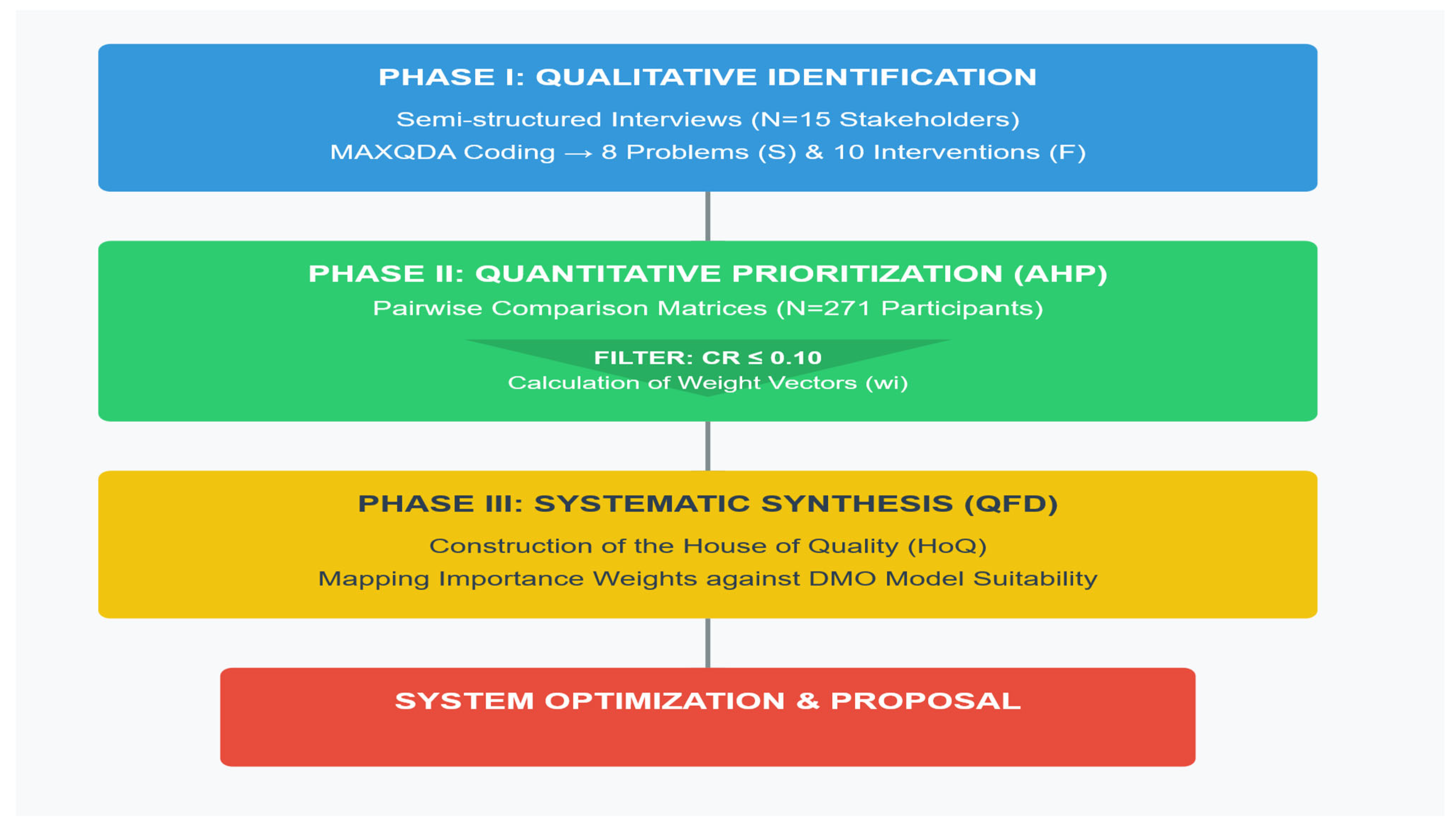
The research process was conducted through a five-component methodological framework consistent with systems theory:
Theoretical Foundation: Establishing a conceptual framework consistent with systems theory.
Qualitative Phase: Defining system problems and solution proposals through semi-structured interviews.
AHP Phase: Quantitative prioritization of the relative importance and feasibility levels of system bottlenecks (critical problem areas) (System Hierarchy).
QFD Stage: Determining the most resilient and homeostatic model by matching systemic requirements with different DMO models (System Optimization).
Holistic Integration: Synthesis of system outputs in theoretical and managerial contexts.
The overall research design and the sequential integration of these methodological components are illustrated in
Figure 1.
In line with the theoretical foundations and the decision-oriented nature of the study, the research is guided by the following questions:
RQ1: What are the primary systemic bottlenecks and structural deficiencies affecting the sustainable development of the Rize tourism destination from a multi-stakeholder perspective?
RQ2: How do stakeholders prioritize these systemic problems and proposed intervention strategies in terms of relative importance and feasibility within a structured decision-making framework?
RQ3: Which destination management model provides the highest level of alignment with the identified systemic requirements when evaluated through an integrated AHP–QFD decision support approach?
RQ4: How does the integration of AHP and QFD contribute to the operationalization of governance decisions in tourism destinations conceptualized as complex adaptive systems?
3.2. Study Region
Rize has demonstrated a significant increase in tourism demand over the last two decades. While the total number of visitors was approximately 475,000 in 2007, it exceeded 1.3 million by 2022, indicating a rapid growth trajectory [
44]. This upward trend is further supported by short-term increases in visitor numbers and record-breaking tourism flows in recent years. For instance, 2022 witnessed 1,267,487 total visitors (89.4% domestic, 10.6% international), representing a 204% increase from 2021’s 415,709 visitors following the COVID-19 downturn. However, despite this quantitative growth, the average length of stay remains relatively low at approximately 1.8 to 2.1 nights, and accommodation facilities operated at modest occupancy rates of 37% to 38% in 2022 [
44]. This suggests that the destination has not yet fully transitioned into a high-retention tourism market.
In addition, the tourism demand is largely dominated by domestic visitors, with international tourist arrivals remaining limited. This indicates that Rize possesses a substantial but underutilized tourism potential. The region’s rich natural assets, including highland landscapes, national parks, waterfalls, and cultural heritage elements, provide a strong foundation for sustainable tourism development, particularly in nature-based and eco-tourism segments.
From the supply perspective, Rize’s tourism infrastructure remains limited and fragmented [
45,
46]. As of 2022, the province had only 4427 certified beds across tourism-licensed accommodation establishments (2091 rooms), supplemented by an additional 543 beds (268 rooms) in investment-licensed facilities. This yields a total of merely 4970 formal beds. This certified capacity stands in stark contrast to demand volumes. In 2022 alone, licensed facilities recorded 256,823 arrivals and 498,331 overnight stays, with municipal-licensed establishments contributing an additional 116,853 arrivals and 245,204 overnight stays. The resulting demand-supply imbalance, evidenced by high visitor-to-bed ratios and low occupancy rates concentrated in peak summer months, directly illuminates the structural deficiencies referenced in problem code S8 (Insufficient Accommodation Capacity).
The supply structure is further characterized by market concentration and seasonality. Domestic visitors dominate at approximately 90% of total arrivals, with international tourism remaining underdeveloped (10.6% in 2022, down from 13.1% in 2019). Tourism activity is heavily concentrated in the summer months, creating intense pressure on limited infrastructure during peak periods while leaving facilities underutilized for the remainder of the year. This seasonal compression exacerbates infrastructure deficiencies (S5) and service quality challenges (S2), as the system lacks the adaptive capacity to manage demand fluctuations.
Selected as the research region, Rize represents a complex tourism destination system within the framework of System Theory, consisting of numerous open, dynamic, and interacting subsystems. The fundamental strategic rationale for choosing the region as a case study is the absolute need for scientific intervention to restore balance to the system as a whole, given the managerial disorder and lack of coordination among stakeholders brought about by the rapid and uncontrolled growth process experienced over the last decade [
23]. This broad spectrum, ranging from urban activities along the coastline to the sensitive ecosystem of mountain tourism, from the potential of agro-tourism (tea industry) to elements of cultural heritage, clearly illustrates the fragmented structure of the destination and the necessity for these fragments to be brought together under a holistic governance framework.
The multi-stakeholder structure, which is indispensable for the AHP and QFD techniques forming the methodological basis of the study, is abundantly present in Rize at the level of central government, local authorities, heterogeneous private sector components, and civil society organizations. This allows the collected data to represent all layers of the system, while ensuring that the results achieved serve as a transferable guide for other developing destinations with similar structures. Consequently, Rize, with its position at the critical threshold between economic development pressure and sustainability, as evidenced by its post-pandemic demand surge against constrained certified supply, serves as an ideal scientific laboratory for measuring the performance of various DMO models. This case allows for determining the most efficient governance configuration by mitigating systemic fragmentation and enhancing coordination efficiency.
3.3. Qualitative Phase
3.3.1. Data Collection Process
Qualitative data collection was conducted using a semi-structured interview form developed in line with the literature. Interviews were conducted face-to-face with 15 strategic participants selected to represent key stakeholder groups in Rize province, including the public sector, private sector, NGOs, and academia. The following criteria were considered in determining the participants:
Having at least 2 years of experience in the tourism sector;
Being actively working in Rize;
Being influential in sectoral decision-making processes due to the institution and position they represent;
Being qualified to contribute to the research questions with knowledge and expertise.
The interviews were conducted in the participants’ work environments, lasted an average of 15–30 min, and were audio-recorded with permission. Informed consent was obtained from all participants. Data saturation was considered to have been reached when themes began to repeat.
To ensure the reliability and methodological rigor of the qualitative findings, several core criteria were strictly followed throughout the research process. First, theoretical saturation was established by continuing the data collection until the 15th interview, at which point the stakeholder narratives yielded no new systemic codes or structural relationships. To enhance dependability, the coding process integrated both inductive and deductive approaches, with the final codebook being cross-verified by researchers to ensure that the categorization of variables remained internally consistent with the systems theory framework. Furthermore, methodological triangulation was employed by cross-referencing the emerging themes with existing regional literature and the results of the quantitative survey, thereby ensuring confirmability and minimizing potential researcher bias. This multi-layered verification strategy ensures that the identified systemic bottlenecks and intervention areas are grounded in a robust, transparent, and replicable empirical foundation.
3.3.2. Data Analysis
The qualitative data obtained were subjected to content analysis using MAXQDA 2022 software. Both deductive (pre-determined themes) and inductive (new codes from the data) approaches were used in the analysis. The codes were visualized using a code cloud, word cloud, and relationship map, and linked to the conceptual framework. As a result, 8 fundamental systemic problem areas (S1–S8) and 10 improvement activities (F1–F10) were identified; these were renamed as systemic needs (Whats) for subsequent stages.
3.4. AHP Phase: Hierarchical Prioritization of System Elements
The sample used in the AHP phase was created through sample expansion to validate the system requirements defined in the qualitative phase with a broader stakeholder group. A total of 271 participants, consisting of representatives from the public sector, private sector, NGOs, academia, and local communities, as detailed in
Table 1, were involved. This numerical strength is a significant advantage in terms of tourism management studies conducted at the regional level and increases statistical reliability in stakeholder-based system analyses.
The sample of 271 people used in this study is extremely robust in terms of both structural diversity and methodological validity for decision analysis on a multi-stakeholder issue such as sustainable destination management. Participants consist of representatives from key sub-sectors of the tourism system, including food and beverage businesses, travel agencies, the accommodation sector, tour guides, academia, and the public sector; in this respect, it reflects the multi-actor structure required by system theory in the field. While 52% of the sample had a bachelor’s degree or higher, more than 70% had 6 years or more of sectoral experience. In addition, approximately half of the participants have received formal education related to tourism, and a balanced representation in terms of age and gender distribution has been ensured [
47]. Thanks to these structural characteristics, a strong and reliable data set has been obtained in terms of both analytical adequacy and field experience for the application of expert judgment-based methods such as AHP and QFD.
AHP was used to identify critical bottlenecks in the system. In systems managing multi-criteria structures, AHP has the power to mathematically transform actor judgments in a consistent manner and analyze decision areas in layers [
48,
49].
The application consisted of three sub-phases: (1) Relative importance of problems, (2) Relative importance of activities, (3) Feasibility levels of activities.
Pairwise comparison matrices were created for each phase; data were collected using Saaty’s 1–9 scale. The Consistency Ratio (CR) was calculated for each matrix, and only forms meeting the CR ≤ 0.10 threshold were included in the analysis (n = 247, 241, 224).
Excel VBA macro codes developed for the calculations (see
Table A1 for an example) were used not only for speed advantage but also to minimize calculation errors and ensure analytical objectivity. Group decisions were combined using the geometric mean method in line with the standard approach in the AHP literature [
50].
3.5. QFD Phase
3.5.1. Conceptual Adaptation
In the third phase of the research, the goal was to determine the DMO model that could most effectively meet the system requirements. For this purpose, the QFD technique was preferred [
51]. In the tourism context, the term “customer needs” in the classical QFD structure has been conceptually adapted in this study as stakeholder requirements or systemic needs. This adaptation establishes the link between the multi-actor structure required by systems theory and production-oriented approaches.
3.5.2. Matrix Setup and Calculation
System requirements (WHAT) are placed in rows, and the four DMO models are placed in columns:
M1: Public sector leadership.
M2: Private sector-led.
M3: Public–private partnership (PPCP).
M4: Community-based.
Activity–model relationship data were obtained from a Likert scale survey collected in the second phase; the applicability of each model for each activity was scored on a scale of 1–5. Average scores were converted to a 9–3–1 scale to create the House of Quality matrix. These relationship scores were multiplied by the NE weights from AHP to calculate the Total Technical Importance (TI) for each model:
As a result of the TI calculations, the PPCP model was determined to be the alternative with the highest level of meeting the system’s holistic needs. This model’s inherent resilience—specifically its potential to sustainably maintain governance stability—was found to be superior to that of the other evaluated models.
3.6. Systemic Conclusion: Optimal Model and Theoretical Integration
This multi-stage methodological structure meets the holistic analysis cycle required by system theory. The internal bottlenecks of the system were identified through AHP, while the optimal model for ensuring long-term stability and coordinated intervention was selected through QFD. This process formed a logical chain in which each step supported the other, reflecting a functional flow of information and decision-making consistent with the “input–transformation–output” framework in systems theory.
The transformation of Likert scale mean scores (
) obtained from the stakeholders into the 9–3–1 relationship values used in the House of Quality was conducted according to specific thresholds to emphasize strong relationships.
Table 2 defines the conversion criteria used to ensure the objectivity and reproducibility of the QFD matrix.
3.7. Validity and Reliability
This study was conducted in full compliance with research ethics and methodological rigor principles. The necessary approvals were obtained from the Recep Tayyip Erdoğan University Non-Interventional Research Ethics Committee before the research process began; during the fieldwork phase, all participants were provided with detailed information about the purpose of the research and data confidentiality, and “informed consent” forms were obtained. A multi-layered verification strategy was followed to ensure the methodological reliability of the study and the validity of the findings. First, to measure the rationality of participant judgments in the AHP phase, the CR proposed by Saaty was meticulously applied. Only matrices with CR ≤ 0.10 were included in the analysis, mathematically validating the internal consistency of the system’s decision-making mechanism. Second, the “methodological triangulation” strategy, based on data source diversity, was adopted in the research. Literature review, qualitative interviews, and quantitative survey data were cross-checked with each other to minimize potential biases that could arise from a one-sided perspective. To ensure construct validity, the problem (P1–P8) and activity (A1–A10) codes derived from the interviews were structured and repeatedly verified against both the existing system literature and expert opinions in the field. To maintain analytical objectivity during the analysis process, Excel VBA (Visual Basic for Applications)-supported automation tools were used in the calculation stages to completely eliminate human error. This approach ensured that complex matrix operations were performed accurately and reproducibly. Finally, the structural consistency of the study was maintained within the holistic logic offered by System Theory. Each stage, from qualitative discovery to quantitative prioritization and final model synthesis, was built on a theoretical spiral that accepted the outputs of the previous population as inputs. This methodological integrity proves that the research offers a reliable and transferable model not only for Rize but also for similar complex destination management problems.
4. Findings
This section presents the empirical data derived from the multi-stage analysis of the Rize tourism ecosystem, following a structured transition from qualitative diagnosis to quantitative prioritization (AHP) and systematic synthesis (QFD). The research design is conceptualized as a trajectory moving from the identification of structural decay to the selection of a governance configuration capable of restoring functional stability.
The qualitative research phase served as a diagnostic stage to identify the core “entropic” drivers within the Rize tourism system. Through a rigorous content analysis of fifteen semi-structured interviews via MAXQDA 2022, eight fundamental problem areas (S1–S8) and ten strategic improvement activities (F1–F10) were identified.
Rather than viewing these elements in isolation, the analytical process utilized relationship mapping to uncover the interconnected nature of the destination’s challenges. The analysis revealed that the identified problems function as reinforcing feedback loops; for instance, Lack of Coordination (S4) and Infrastructure Deficiencies (S5) emerged as the primary sources of systemic disorder that directly exacerbate Low Service Quality (S2) and the vulnerabilities of a Short Tourism Season (S3). Stakeholders emphasized that without synchronized governance, fragmented efforts in marketing or infrastructure remain insufficient to overcome the destination’s structural thresholds.
These qualitative findings (summarized in
Table 2 and
Table 3) provided the empirical grounding for the subsequent MCDM stages, transforming stakeholder narratives into the “systemic needs” (Whats) and “technical responses” (Hows) required for the management model. By revealing the main stress points of the system, this phase has reduced administrative uncertainty and provided the necessary “regulatory information” to guide long-term strategic interventions.
Building on the identified systemic problems presented in
Table 3, the qualitative analysis further enabled the derivation of a set of targeted improvement activities. These activities were not generated as independent solutions, but rather as context-specific intervention mechanisms directly linked to the underlying structural deficiencies of the destination system. In line with systems theory, each activity is conceptualized as a corrective or adaptive response designed to mitigate specific dysfunctions and restore systemic balance. The resulting set of improvement activities, which constitute the operational inputs for subsequent AHP and QFD analyses, is presented in
Table 4.
Problem importance level analysis (AHP): The initial quantitative analysis conducted using the AHP revealed the relative weights of the identified issues (see
Table 5). According to the findings, lack of coordination, inadequate infrastructure, and a short tourism season emerged as the three most significant issues. In particular, lack of coordination received the highest weight, indicating that stakeholders perceive this as the most critical challenge in destination management. Infrastructure deficiencies and seasonal concentration closely followed, rounding out the top three. The concentration of stakeholders’ concerns around these three issues indicates that they represent the most structurally significant weaknesses in the destination; these problems cause cascading disruptions across subsystems and erode coordination among actors. Therefore, the AHP results provide managers with a scientifically grounded basis for prioritizing interventions: by directing limited resources toward these high-priority problem areas, decision-makers can achieve the greatest gains in overall system performance and operational coordination. Beyond simple prioritization, the AHP weightings in this study have been interpreted as indicators of each issue’s capacity to destabilize the broader target system. Drawing on systems theory, a higher weight reflects not only perceived importance but also the degree of uncertainty and disorder that a specific issue introduces into stakeholder relationships and coordination processes. In this sense, the calculated eigenvectors serve as a quantitative map of the target’s most critical points of vulnerability (in other words, the areas where the likelihood of systemic spread of unresolved functional dysfunctions is highest). This operationalization links the AHP output directly to the systemic diagnostic framework established in the theoretical section, enabling the priority structure to be interpreted as an evidence-based profile of where coordinated intervention is most urgently needed.
Activity importance level analysis (AHP): The hierarchical weights of the 10 strategic activities recommended for the sustainable development of the Rize tourism system are presented in
Table 6. The findings reveal that stakeholders consider activity F5-Promotion and Marketing Towards New Markets (0.1326) to be the most critical area of intervention for the future of the system. This proves that the risks created by market dependency in the destination (S6) are perceived as the most pressing strategic threat by stakeholders. F9-Quality Standards and Certification (0.0950), ranked second, and F1-Legal Regulations and Oversight (0.0933), ranked third, reflect demands to strengthen the system’s institutional infrastructure. In particular, the high weight of activity F1 demonstrates a direct ‘problem-solution’ match with illegal construction (S1), the second biggest problem in the system. On the other hand, establishing a multi-stakeholder governance structure (F7), ranked fifth with a weight of 0.0712, indicates that structural reforms and market expansion strategies are seen as more urgent than coordination-focused approaches. Consequently, these priorities obtained through AHP scientifically confirm that the actions that will provide maximum order increase in the system are focused on market diversification and quality control. These strategic moves will serve as fundamental mechanisms for establishing long-term adaptive stability by increasing the destination system’s resilience against external environmental fluctuations.
A careful examination of the AHP results reveals an apparent paradox: while S6 (Lack of Market Diversity) ranks relatively low among systemic problems (0.1014), F5 emerges as the highest-priority improvement activity (0.1326). This divergence is not inconsistent but rather reflects the CAS nature of destination management. S6 represents a current-state symptom with latent risk potential, whereas F5 constitutes a proactive intervention strategy. From a systems theory perspective, stakeholders perceive market diversification as a high-leverage intervention that prevents future systemic entropy despite current acceptable performance. This finding aligns with the Viable Systems Approach (vSa) principle that sustainable governance requires anticipatory synchronization between subsystems [
27,
28]. The high feasibility score of F5 (0.1302) further confirms that stakeholders recognize this as an actionable ‘quick win’ that simultaneously builds long-term adaptive capacity [
9].
Feasibility analysis of activities (AHP): In the third analysis, the feasibility level of each improvement activity was evaluated based on stakeholder opinions. The normalized weights presented in
Table 7 show which activities can be more easily implemented under regional conditions. According to the results, stakeholder education and awareness programs, along with promotion/marketing activities, were identified as the activities with the highest feasibility scores. This indicates that such initiatives aimed at developing human resource capacity and generating demand can be implemented at relatively low cost and in the short term. On the other hand, activities such as infrastructure investments or establishing multi-stakeholder institutional structures, although high in importance, scored lower in feasibility due to their longer-term nature and the intensive resources required for their implementation. Therefore, the analyses reveal that importance and feasibility dimensions do not always coincide. This finding indicates that a balance must be struck between short-term gains and long-term strategic investments in the process of improving the system. From a systems theory perspective, some critical activities are of high importance but low feasibility; these are “investments” necessary for the long-term health of the system, while activities with high feasibility can be considered “quick fixes” that maintain the system’s short-term viability. It is recommended that managers prioritize activities yielding immediate results while simultaneously laying the foundation for complex but essential structural reforms. This approach allows the destination to advance without compromising its functional stability. Consequently, as operational inconsistencies are gradually mitigated through these feasible, incremental steps, the necessary institutional capacity and stakeholder alignment for large-scale interventions can be established over time.
QFD analysis and DMO model comparison: In the fourth stage of the research, the potential effectiveness of four different Destination Management Organization (DMO) models in solving prioritized problems and implementing activities was examined using the QFD method. The Quality House matrix created for this purpose matched the critical issues defined as system requirements and their importance weights on one side with the DMO model alternatives evaluated as technical responses on the other side. Each improvement activity or problem was scored according to the degree to which it could be addressed by the relevant DMO model; the total technical importance (TI) scores of the models were calculated by multiplying these relationship scores by the importance weights of the problems. The technical importance ratings obtained as a result of the QFD analysis quantitatively reveal the extent to which each model fits the Rize tourism system and can provide solutions. The findings show that the PPCP model achieved the highest technical importance score among all models. This score reveals that the PPCP model’s capacity to solve the identified priority problems is much stronger than that of other models. Indeed, the PPCP model has been able to offer the most balanced and effective framework against multi-stakeholder and complex problems, such as a lack of coordination, low service quality, and short tourism season. In comparison, the private sector-led model, which ranked second, received a relatively low total score (TI ≈ 0.27) and reflected its relative superiority in areas requiring commercial/competitive advantages, such as market diversity and accommodation capacity. The community-based model ranked third with a total technical importance score of ≈0.21, demonstrating that it could be more effective than other models, particularly in terms of local community participation and education. The public sector-led model, which received the lowest score (TI ≈ 0.18), has certain advantages in areas such as infrastructure development and legal oversight but is insufficient on its own for a comprehensive solution. These results reveal that each model can offer strong or moderate contributions in different problem areas, but no single model can meet all needs on its own. The PPCP model, which received the highest score, has reached the leading position in the overall table because it can respond to multiple critical needs of the system by combining the resources and competencies of the public and private sectors. However, another important finding from the QFD analysis is that the superiority of PPCP is not absolute and that other models have complementary roles. Indeed, in the quality house matrix, it was observed that the community-based approach has a relative advantage in issues related to social cohesion/participation, while public leadership has a relative advantage in issues requiring infrastructure and regulation. This situation indicates that a hybrid structure may be the most strategic management model for the complex structure of the Rize tourism system. In other words, a governance model that adopts the PPCP model as the main coordination framework but integrates the strengths of other models in specific areas of activity could offer the most comprehensive solution to the system’s requirements. Thanks to this approach, the specific contributions of each model can be brought together to achieve improvement in all dimensions of the destination; just as the sub-components of a system work in harmony, a holistic success can be achieved in Rize tourism through the synergy of the public sector, private sector, and society.
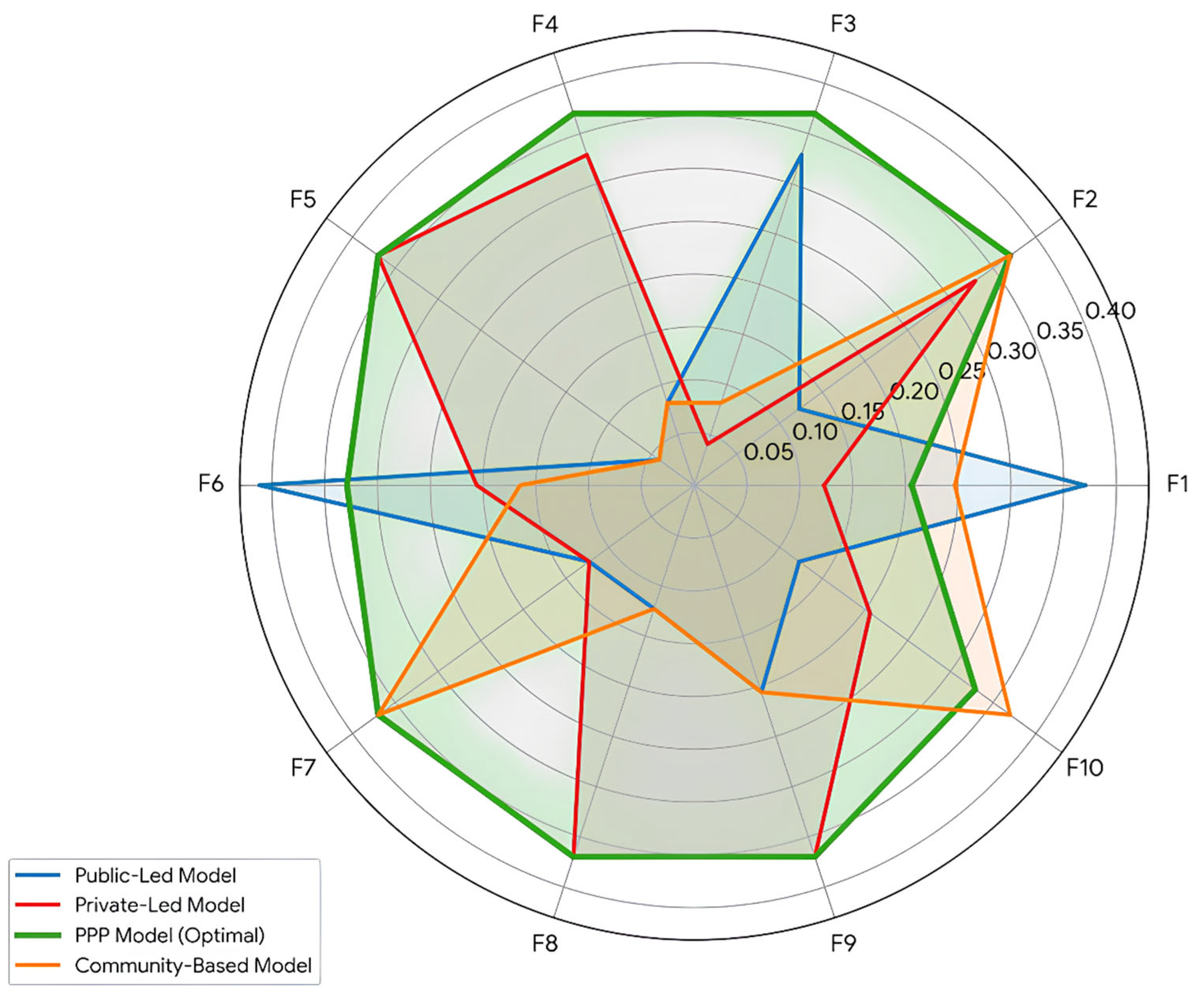
Figure 2 illustrates the comparative performance of four different DMO models across ten strategic intervention areas (F1–F10), based on normalized evaluation scores derived from the QFD analysis. The radar chart visually depicts each model’s functional reach and its stabilizing influence, specifically its ability to maintain a balanced governance structure across the destination’s diverse requirements.
The PPCP Model, represented by the green border, exhibits the broadest scope among other models, encompassing fundamental systemic areas such as F7 (DMO Coordination), F3 (Sustainable Planning), and F5 (Market Diversification). With a technical importance score of 0.332, the PPCP model acts as the primary regulator for the Rize tourism system. The model’s dominance, particularly in the coordination (F7) and certification (F9) processes, reinforces its role as a synergy-focused interface that combines the legal authority of the public sector with the operational flexibility of the private sector.
In contrast, the Public Sector Leadership Model demonstrates high expertise in the areas of F6 (Infrastructure) and F1 (Legal Regulation) but remains limited in terms of marketing and social participation. The Private Sector-Led Model excels in the areas of F5 (Promotion) and F8 (Accommodation) but appears to lack the systemic power to fill governance gaps (F4, F7). The Community-Based Model, while providing the necessary social legitimacy (F10, F2), does not fully meet the technical and financial infrastructure capacity required for high-level destination management. In other words, the radar chart confirms that the PPCP configuration is the most ideal option for the Rize tourism system. This model serves as a primary stabilizing mechanism for the destination by simultaneously addressing critical issues such as infrastructure bottlenecks, lack of coordination, and market dependency.
Overall, these findings demonstrate that the mixed methodology successfully translates theoretical principles into practical outcomes, ensuring a structured reduction in coordination gaps, a clear hierarchy of strategic needs, and a stabilized management framework for the destination. First, the integrated use of qualitative and quantitative stages has made it possible to identify the most critical disruption tendencies within the Rize tourism system. Critical challenges in coordination, infrastructure, and seasonality were identified as the primary factors undermining the destination’s structural stability. Implementing targeted measures in these areas will serve to rehabilitate the system by significantly reducing fragmentation and operational inefficiencies. Secondly, the systemic priority determination process conducted with AHP analyses has quantitatively revealed which interventions are more strategic within the complex tourism system. This has enabled decision-makers to focus on the problems and activities that will contribute most to achieving the targeted order. This type of focus provides rapid improvements by directing energy and resources to critical points in the system, while also creating the potential for in-depth improvement in the long term. Finally, the model selection phase supported by QFD represents a managerial commitment to achieving long-term functional stability within the destination. By prioritizing a structure that balances diverse stakeholder interests, this approach ensures the system can maintain its internal consistency while effectively adapting to external shifts. The PPCP-centered hybrid DMO model incorporates the feedback mechanisms and multiple inputs necessary for the destination, as an open system, to adapt to environmental changes and multi-actor dynamics. The participation of the public, private sector, and society in this model enables a kind of dynamic equilibrium to be established between the subsystems. According to systems theory, open systems can maintain their internal structure in balance and adapt to change using the information and resources they receive from their environment. The PPCP-based governance structure proposed specifically for Rize will also create a flexible and resilient tourism system in response to changing conditions by providing a platform where all stakeholders can work in harmony towards common goals. In this way, the destination will be able to maintain and develop its internal stability and achieve a self-regulating structure against opportunities and threats from the external environment. In summary, the findings demonstrate that applying a system-focused integrated approach to tourism destination management is extremely effective in resolving chaotic problems and establishing sustainable balance. Through this integrated methodology, the Rize tourism system has been steered toward a development trajectory that mitigates operational inefficiencies, establishes clear strategic priorities, and fosters a resilient, self-regulating balance through the collective efforts of its stakeholders.
4.1. Quality House
Correlation (Roof): The table below (
Table 8) shows the correlations between four different destination management models. A “strong positive relationship” (


) indicates a high level of synergy between models, a “positive relationship” (

) indicates a moderate level of complementarity, a “negative relationship” (

) indicates that the combined application of models may create conflict, and “no relationship” (

) indicates no significant interaction. In this context, public leadership and community-based models have a strong positive relationship with each other. Similarly, the private sector leadership model shows a strong positive relationship with the community-based model and a positive relationship with the PPCP model. In contrast, there is a negative relationship between the public leadership model and the private sector leadership model, and these two approaches are seen as alternative/competitive. It is assessed that there may be partially negative relationships between the PPCP model and other pure (single sector-focused) models (especially in structures where the public or private sector alone is dominant and the implementation of PPCP may be difficult), but there is a neutral relationship (no significant positive or negative effect) with the community-based model. In summary, while some governance models can have a complementary effect when combined (e.g., public-community or private sector-community cooperation), others can be conflicting (e.g., public vs. private sector leadership).
4.2. House of Quality Matrix
The following Quality House matrix illustrates the relationships between customer demands (tourism problem areas) and the technical requirements (governance model alternatives) expected to address these problems in the context of sustainable tourism destination management in Rize province (see
Table A2). On the left side, the main problem areas (WHAT’s) identified in the Rize tourism destination and their importance weights are given. The upper section contains the four different governance models evaluated (HOWs: Public Sector Leadership, Private Sector Leadership, PPCP, and Community-Based). Each cell presents the level of impact of the relevant model in solving the relevant problem using symbols and scores. Here,

indicates a strong relationship,

indicates a medium-level relationship, and

indicates a weak relationship. The normalized scores next to them reflect each model’s relative contribution to solving the relevant problem (e.g., 0.370 ≈ 37% contribution). At the bottom of the matrix, the total technical importance scores calculated for each model are given; these values show the total performance of the model in question (correlated with problem weights) against all problems.
Bold numbers indicate the importance weights of the problems obtained using AHP. The symbol and value in each cell indicate the effect of the relevant model in solving that problem (

: strong,

: medium,

: weak relationship). The total technical importance score of each model and its ranking are given in the bottom row.
4.3. Interpretation of Cell Values (WHAT–HOW Relationships)
S1—Illegal Construction and Lack of Control (Weight 0.1118): The public leadership model appears to be the most effective approach in solving this problem (

0.370). This contribution share of approximately 37% indicates that public leadership is critically important in preventing illegal construction and strengthening control mechanisms. The community-based model also has a moderate impact on S1 (

0.247). It can be estimated that raising awareness among the local population and fighting illegal construction through civil initiatives could contribute around 24.7%. The contribution of the PPCP model is moderate at 20.6% (

0.206); in other words, while public–private partnerships have a certain role to play in solving this problem, they are not sufficient on their own. In contrast, the private sector-led model is weak in addressing problem S1 (

0.123, ≈12%). Since supervision and control of illegal construction largely depend on public authorities, a private sector-led structure would have limited impact in this area.
S2—Low Service Quality (Weight 0.1095): The private sector-led model and the PPCP model have the highest impact on improving service quality (

0.370 for both). With a share of approximately 37%, it is understood that both a private sector-led structure and public–private partnerships can offer strong solutions in areas such as raising standards and staff training in tourism businesses. The contribution of the public-led model in this area is moderate (

0.206); that is, while public leadership alone is somewhat effective in improving service quality, this effect is limited. The community-based model also remains at a moderate level (

0.206). This indicates that the local community or NGOs can contribute to service quality improvements (e.g., awareness, hospitality training, etc.) to a certain extent, but the main determinants are businesses (the private sector) and regulatory-supervisory mechanisms of PPCP.
S3—Short Tourism Season (Weight 0.1072): The PPCP model is the strongest solution to the problem of the tourism season being limited to the summer months only (

0.370). This ~37% impact indicates that joint planning and investment initiatives by the public and private sectors could provide the most balanced framework for extending the season. The private sector-led model also provides a medium-to-high contribution (

0.329, ≈33%). In particular, initiatives by tour operators and the accommodation sector (e.g., year-round tourism packages, off-season promotions) can play an important role in extending the season. In contrast, the impact of public-led and community-based models in solving this problem on their own remains weak (

0.082 and

0.082). Contributions of only 8% show that extending the season through local government or community initiatives alone is not sufficiently effective and that a more market-oriented and partnership-based approach is needed.
S4—Lack of Coordination (Weight 0.1096): Insufficient communication and coordination among tourism stakeholders can be most effectively addressed by the PPCP model and the community-based model (both

0.370). Strong relationships of approximately 37% indicate that public–private partnerships and community-based approaches play complementary roles in resolving this multi-stakeholder issue. While the PPCP model can increase coordination by bringing together public, private, and other stakeholders on a common platform, the community-based model contributes to addressing communication gaps by ensuring the participation of local communities and civil society in the process. However, models led by the public and private sectors are weak in S4 (

0.123 and

0.123). It is understood that coordination between stakeholders is limited in structures where only public institutions or only the private sector take the initiative. Therefore, it is seen that the most effective solution for S4 is
multi-stakeholder governance structures.
S5—Infrastructure Deficiencies (Weight 0.1147): The public-led model has the largest share in solving infrastructure problems (poor transportation routes, inadequate electricity and internet, etc.) (

0.412). This high rate of 41.2% demonstrates that public authority leadership is critical, especially in areas such as infrastructure development and improvement. The investment power and planning authority of the government and local administrations are decisive factors in resolving infrastructure problems. The PPCP model also has a significant impact in S5 (

0.329~33%). This shows that infrastructure investments carried out in public–private partnerships (e.g., build-operate-transfer projects) are a powerful solution. The contribution of the private sector-led model is moderate at 20.6% (

0.206); that is, although the private sector plays a certain role in infrastructure investments on its own (especially in developing its own infrastructure for tourism facilities), it is not sufficient for comprehensive regional infrastructure. The impact of the community-based model on infrastructure remains weak (

0.165 ≈ 16.5%). Local community initiatives (e.g., improvements through collective effort) are insufficient to solve this problem on their own, and public leadership is needed.
S6—Lack of Market Diversity (Weight 0.1014): Private sector-led and PPCP models lead the way (both

0.370) in addressing the problem of target market narrowing and tourism remaining dependent on a specific segment (e.g., a single nationality/group). These strong ~37% correlations indicate that private sector entrepreneurship and public–private partnerships together can offer the most effective solutions in marketing and product diversification. In particular, a private sector-focused DMO or PPCP structure will provide flexibility and innovation in targeting new markets, destination marketing, and product development strategies. The contribution of the public-led model in this area is negligible (

0.041 ≈ 4%). Marketing activities by public institutions alone are ineffective due to limited budgets and dynamism. Similarly, the community-based model is also weak (

0.041); it is difficult to increase market diversity with local community initiatives. Consequently, the most effective approaches to solving problem S6 are private sector leadership (e.g., tour operators, agencies, hotel marketing departments) and public–private partnerships (e.g., destination marketing organizations).
S7—Lack of Education and Awareness (Weight 0.1026): The PPCP model and community-based model together offer the highest impact (

0.370 and

0.370) in addressing the problem of low tourism awareness and environmental awareness. Both account for ~37% of the share, pointing to the importance of multi-stakeholder approaches in sustainable tourism awareness and education programs. The community-based approach, in particular, can spread education/awareness activities to the grassroots by ensuring the participation and ownership of the local community. The PPCP model, on the other hand, can implement large-scale education campaigns and certification programs through the collaboration of the public sector, private sector, and NGOs. The private sector-led model can also make a significant contribution to solving this problem (

0.329~33%). Private sector initiatives, such as tourism businesses training their own staff and promoting environmentally conscious practices, play an important role in raising awareness. In contrast, the public sector-led model alone has a weak impact (

0.123~12%). Although public institutions can launch framework programs in the field of education and awareness, public initiatives alone are not considered sufficient to solve this problem. The best results are achieved through direct community participation and stakeholder collaboration.
S8—Insufficient Accommodation Capacity (Weight 0.1037): The private sector-led model and the PPCP model offer equally strong solutions to the problem of not being able to provide sufficient accommodation for tourists (

0.370 and

0.370). Each contributing ~37%, this shows that both private sector investments and public–private partnership projects are critical in developing new accommodation facilities and increasing capacity. Under private sector leadership, the initiatives of investors and tourism entrepreneurs to open hotels, guesthouses, etc., can directly increase capacity. The PPCP model, on the other hand, can facilitate large-scale accommodation investments with public support (e.g., private investment in exchange for land allocation, incentives, infrastructure support). The public-led model has a weak contribution to solving this problem (

0.123~12%). Since the public sector remains in a regulatory and supportive role rather than directly operating accommodation facilities, capacity expansion under its leadership may be limited. The community-based model is also weak (

0.123). Efforts by local communities or cooperatives to create accommodation capacity using their own resources (e.g., homestays or small guesthouses) can only be effective on a limited scale. Therefore, the most effective solutions for the S8 problem are to achieve large-scale capacity increases through private sector investment and public–private partnerships.
Evaluation of Technical Priorities (Overall Performance of Models)
The technical importance scores given in the bottom row of the Quality House matrix quantitatively reveal the overall success of each governance model across all problem areas. These values were obtained by multiplying the contribution of the relevant model to solving each problem by the importance weight of that problem and then summing them. The Public–Private Partnership (PPCP) model ranks first with a total score of 0.332—meaning that PPCP is the model with the highest overall performance in addressing the issues examined. This result shows that the PPCP model offers the most balanced and effective framework, particularly for complex issues requiring multiple stakeholders to act together (e.g., S4 coordination deficiency, S2 service quality, S3 short season, S7 education deficiency, etc.). The Private Sector Leadership model ranks second with 0.273 points. This model has increased its total score by performing strongly in areas requiring competitive advantage and investment, such as S6 market diversification and S8 accommodation capacity. The Community-Based model ranks third with a score of 0.211; its significant contribution to social issues such as S4 stakeholder coordination and S7 awareness has supported its total score. The Public Leadership model ranks fourth with 0.183 points. Although this model has a high impact in specific areas such as S1 illegal construction and S5 infrastructure, its relatively low contribution to other issues has limited its total score.
Overall, these findings indicate that no single model is the absolute solution and that each model has strengths in different types of problems. The most strategic approach for sustainable tourism management in Rize is proposed as a hybrid structure based on the PPCP model, integrating the strengths of other models in areas where needed. For example, while the PPCP model provides a framework for general coordination and planning, public, private sector, or community-focused initiatives can be implemented in specific projects (infrastructure, promotion, education, etc.). Thus, by bringing together the best contributions of each model, the fundamental problems of Rize tourism can be solved in a holistic and sustainable manner.
5. Discussion
The results of our study reveal that the Rize destination exhibits a multi-level and multi-stakeholder dynamic structure. This situation demonstrates the appropriateness of explaining tourism destinations using CAS and Viable Systems Approach (vSa) approaches, beyond classical systems theory. Baggio [
3] defines tourism destinations as “dynamically evolving complex systems,” emphasizing that numerous intertwined factors, feedback loops, and unpredictable interactions are fundamental characteristics of these systems. From the CAS perspective, the concepts of feedback, self-organization, and threshold within the system shed light on the evolution of the destination. For example, feedback loops in the system significantly influence overall behavior; moreover, when a certain threshold is crossed, new structures emerge and the system reorganizes itself (self-organization). Within this framework, the vSa approach treats the destination as a managerial whole. Iandolo et al. [
27] proposed enhancing cultural value and the livability of a tourism region through the integration of resources using a vSa-based analysis. Therefore, our findings demonstrate how multi-actor, multi-centered, and dynamic system models can be used to understand tourism destinations.
Our findings establish a meaningful connection with the results of current studies in the literature. For example, resilience and safety have been prioritized for the sustainability of tourism after the pandemic; the importance of positioning governance as stakeholder value chain-centered rather than destination-centered has been emphasized [
52,
53,
54]. This suggestion aligns with themes in our data that highlight the importance of multi-stakeholder collaboration. Hartman [
55] has highlighted the concept of adaptive tourism regions, pointing out that destinations need to develop adaptive capacity to respond to crises. Similarly, some studies have examined how multi-layered actors cope with uncertainty through adaptive co-governance processes, as in the case of Macau, China; for example, Wana et al. [
56] showed that multi-level, flexible institutions responded to pandemic uncertainties through a learning-by-doing approach. Furthermore, recent studies emphasize the role of inclusive decision-making mechanisms and environmental factors in sustainable destination strategies [
57]. In this context, the findings of our study are similar to the themes of institutional collaboration and adaptation, offering outputs that are parallel and complementary to the literature.
The AHP and QFD methods used in this research are not merely technical tools in complex multi-criteria decision processes; they are building blocks that enable strategic decisions to be made within a rational framework. AHP prioritizes criteria by structuring them in hierarchical levels and combining expert judgments through pairwise comparisons. QFD, on the other hand, uses matrices to optimize the transformation of stakeholder needs and tourist expectations into strategic action items. For example, Ref. [
58] integrated AHP and QFD in tourism product design, enabling policymakers to systematically analyze different tourist needs and determine strategic priorities. These methods serve information synthesis in the CAS/vSa context; they integrate numerous data and opinions, directing resources to critical areas and laying the groundwork for the creation of coherent strategies. Therefore, AHP and QFD strengthen the methodological legitimacy of our work as a rational decision-making mechanism that supports our findings.
The relatively narrow range of weights for the identified problems (S1–S8) reflects a genuine and holistic perception among the 271 diverse stakeholders. From a systems theory perspective, this near-equal distribution suggests that stakeholders view the Rize destination as a highly interconnected system where functional failures are deeply intertwined. As the system operates on the principle of holism, a failure in one subsystem (such as infrastructure) is perceived to be as critical as a failure in coordination (S4) or quality (S2) because they collectively trigger systemic disorder. Furthermore, the convergence of weights is a natural outcome of aggregating the perspectives of a heterogeneous group (public, private, and community) through the geometric mean, representing a broad consensus on the multifaceted nature of the destination’s challenges. Despite the narrow numerical gap, the internal consistency of the matrices CR ≤ 0.10) ensures that the resulting hierarchy remains a statistically valid guide for prioritizing interventions.
5.1. Governance and Implementation Implications
The findings reveal that, specifically for the Rize destination, adopting hybrid governance approaches rather than a single model is necessary to establish a sustainable and systemically balanced governance structure. In this context, it is thought that models integrating the complementary strengths of different actors can produce more effective and flexible solutions in complex systems. Firstly, the PPCP model brings together the resources and capabilities of the public and private sectors, providing significant advantages, particularly in capital-intensive areas such as infrastructure investments and service delivery. Such partnerships can contribute to the development of the destination by leveraging the investment capacity of the private sector when public resources are limited. However, as frequently emphasized in the literature, there is a risk of conflict between public interest and private interests in PPCP models. The dominance of the private sector in decision-making processes in long-term projects may limit the public sector’s capacity to determine strategic direction. This situation may cause profit maximization-oriented goals to take precedence over the socio-economic interests of society. Therefore, it is crucial for the public sector to actively maintain its regulatory, supervisory, and guiding roles to ensure the sustainability of PPCP models.
In this context, participatory reforms are proposed to make PPCP structures more inclusive and socially legitimate. PPCP models are participatory governance structures that aim to involve the state, the private sector, and local communities as equal stakeholders in decision-making and implementation processes. This approach ensures that community-based information is incorporated into the process and that tourism policies are aligned with local needs. However, a common problem encountered in practice is that community participation remains formal and is limited to consultation in decision-making processes. For truly effective PPCP, the instrumentalization of participation should be avoided, and the representation level of the local community, its weight in decision-making mechanisms, and its capacity to generate knowledge should be institutionally guaranteed. Models where power sharing is not structured in an open and fair manner may, despite their goal of inclusivity, be reduced to elite representation or symbolic participation in reality.
In addition, polycentric governance approaches are coming to the fore, especially in multi-scale and multi-level areas such as destination management. Polycentric governance refers to a structure in which there are multiple decision-making centers at the local, regional, and national levels, and these centers work in coordination with each other. This model ensures that the roles and responsibilities of different stakeholders are distributed evenly across horizontal and vertical planes. The literature indicates that polycentric structures produce more flexible responses to changing conditions and increase effectiveness in making decisions specific to local contexts. Particularly in times of crisis, polycentric systems have a higher adaptive capacity compared to the slow response of centralized structures. However, it should also be borne in mind that multi-centered structures can give rise to coordination difficulties and that role ambiguity can disrupt decision-making processes.
Some critical points should also be considered in the implementation of governance models. The first of these is the instrumentalization of community participation. Although participation is often emphasized, the involvement of local communities in the process can remain symbolic, and their influence on decision-making can be limited. This undermines the democratic legitimacy of governance processes and erodes the confidence of local actors in the system. Second, the dominance of the private sector can lead to an imbalance in the governance system. In models such as PPCP, the financial and operational power of the private sector can, over time, weaken public oversight and relegate sustainability goals to the background. Thirdly, the decline of the state’s role poses a critical risk in terms of sustainable governance. The state should not only be an investor or intermediary institution; it should also be positioned as a policy developer, regulator, and enforcer. It is essential that this role be effectively maintained for sustainable tourism practices.
Integrating the Tourist as Co-Creator. The PPCP model’s responsiveness to digital-age tourism dynamics requires explicit acknowledgment. While our empirical analysis focused on resident and industry stakeholders due to their structural salience in Rize’s governance context, the model’s systemic openness inherently accommodates tourist co-creation. The QFD matrix’s ‘Whats’ (systemic needs) were derived from stakeholder perceptions of tourist expectations—market diversification (F5) and quality standards (F9) implicitly reflect anticipated visitor preferences. However, future iterations of this framework could benefit from direct incorporation of tourist-derived data streams (social media sentiment, review platforms, mobility analytics) as formal inputs into the AHP-QFD decision architecture. This would transform the PPCP into a PPCPT (Public–Private–Community–Platform–Tourist) configuration, where ‘Platform’ denotes the digital infrastructure mediating visitor co-creation.”
5.2. Theoretical Implication
This study goes beyond the traditional and sector-focused approaches that dominate tourism governance, highlighting the theoretical importance of treating destinations as CAS. The fundamental concepts of systems theory have functioned in this research not only as explanatory metaphors but also as the constituent elements of an analytical framework. Thus, systems theory has been concretized as a contemporary paradigm to explain the dynamic, multi-actor, and multi-layered nature of tourism destinations.
First, this study has ensured the integration of the Complex Systems Approach, which is still used to a limited extent in tourism research, into destination management; it has revealed that this approach provides a conceptual framework in processes such as problem definition, solution proposal, and governance model design. While tourism destinations are often treated in the literature as “organizational structures to be managed,” this study evaluates destinations as open systems with the capacity for “evolutionary learning,” capable of adapting to environmental and social shocks and reestablishing equilibrium through their internal dynamics. This perspective transcends the linear and deterministic nature of classical destination management theories, enabling the construction of more agile and adaptable theoretical frameworks.
Secondly, the study approached the destination system as a whole composed of subsystems (public, private, community, environment, etc.) in line with the Viable Systems Approach (vSa) and emphasized the need to manage elements such as feedback, information flow, and balancing interventions for the “viability” of the system. Within this framework, the idea that sustainability is not possible without ensuring both the internal consistency (internal balance) of the system and harmony with the external environment (environmental balance) is discussed theoretically. This approach, integrated into the theory of sustainable tourism governance, argues that governance should not only involve decision-making but also include systemic learning and adaptation processes.
Thirdly, the study positions decision support methods such as AHP and QFD not only as applied tools but also as rational decision-making strategies in complex systems. In this context, AHP serves as an analytical filtering function in identifying and prioritizing bottlenecks in the system, while QFD enables strategy development within systemic integrity by establishing an interactive bridge between system requirements and solution scenarios. This methodological framework offers a unique model for integrating multi-criteria decision-making approaches in the literature into strategic governance design. Thus, the study bridges the gap between method and theory, demonstrating how analytical tools can be made functional in a manner consistent with systems theory.
The hybrid and polycentric governance models highlighted in the study offer important conceptual contributions to tourism governance theory. A system design in which public, private, and community actors function together rather than in individual models reveals that governance is not only a structural but also a functional and relational phenomenon. This approach allows concepts such as “inter-actor interaction,” “power sharing,” and “collective learning” in tourism governance to be redefined within a more systemic context.
6. Conclusions
This study was designed to understand and address the fundamental structural reasons behind the failure to realize the sustainable tourism potential of Rize, one of Turkey’s developing destinations. The Rize example is not only a spatial development problem; it is also a typical example of a multi-stakeholder, multi-layered, and dynamic socio-ecological system failing to achieve sustainability due to coordination, capacity, and governance deficiencies. This situation necessitates new approaches not only at the application level but also at the theoretical and methodological levels. In this context, the starting point of the study is that classical planning and management approaches are insufficient in complex destination systems such as Rize, and that these systems require more refined, flexible, and holistic management models.
Based on the CAS approach (a contemporary interpretation of systems theory), this research conceptualizes the Rize destination as a living ecosystem characterized by intricate internal interactions, a multi-layered structure, and an inherent capacity for environmental adaptation. The central challenge identified is the system’s progressive loss of efficiency and sustainability, driven by a natural tendency toward structural disorder and functional decay over time. Consequently, the primary objective of this study is to scientifically determine a governance configuration capable of mitigating these disruptive tendencies and enabling the system to restore its dynamic stability and self-regulating capacity.
The most fundamental conclusion reached by the study is that, in order for sustainable destination management to be successful, hybrid and polycentric governance structures are needed, beyond classic single-actor or sector-focused models. The PPCP model, which came to the fore in the research, is not only a tool that combines resources but also acts as a catalyst that increases the overall resilience of the system. However, the success of this model depends not only on technical cooperation between the public and private sectors but also on increasing the legitimacy and participation level of the local community. Therefore, the study’s final recommendation is a flexible and reflexive governance model shaped around a “PPCP“ axis, which does not instrumentalize participation and internalizes control mechanisms.
More importantly, this study does not merely offer destination-specific recommendations; it also proposes a methodological model that will provide decision support for complex systems in the field of tourism governance. The AHP-QFD integration is a strategic planning tool that allows for the objective and comparable analysis of multiple decision points in complex systems. In this respect, the study offers a powerful framework that can be used methodologically by both policymakers and academics to solve multi-actor governance problems.
Finally, the study underscores that sustainable destination governance requires institutionalized learning mechanisms. The PPCP model’s long-term viability depends on embedding ex ante, in itinere, and ex post evaluation systems that translate strategic priorities into measurable outcomes. This results-oriented approach ensures that governance configurations evolve in response to performance data rather than political cycles, aligning with the adaptive capacity principles central to CAS theory.
Building on these findings, the study also provides a structured response to the research questions guiding the decision problem of destination governance. The results addressing RQ1 reveal that lack of coordination, infrastructure deficiencies, and seasonality constitute the primary systemic bottlenecks shaping the structural instability of the Rize tourism system. In relation to RQ2, the AHP-based prioritization indicates that although interventions such as market diversification and quality standards are considered highly critical, their feasibility varies, underscoring the need to balance short-term actionable strategies with long-term structural investments. With respect to RQ3, the QFD analysis demonstrates that the PPCP model provides the highest level of alignment with the identified systemic requirements, outperforming alternative governance configurations in managing multi-stakeholder complexity. Finally, addressing RQ4, the integrated use of AHP and QFD offers a practical mechanism for translating systemic needs into governance decisions, thereby operationalizing the principles of CAS within a structured decision-making framework.
Limitations of the Research and Recommendations for Future Studies
Although this study’s conceptual and methodological framework rests on current systems theory interpretations, several limitations warrant acknowledgment. These boundaries enable a more accurate assessment of the findings’ contextual validity and external generalizability. First, AHP and QFD methods remain susceptible to judgment bias despite their power for multi-criteria decision-making. Pairwise comparisons in AHP may vary with participants’ cognitive consistency and expertise levels. The study maintains methodological rigor through consistency ratios, yet such structural limitations require recognition.
Second, single-case analysis in Rize province constrains findings to local contextual dynamics. Direct generalization to other destinations remains limited. Rize’s distinctive socio-cultural fabric, stakeholder configurations, and natural capital endowment necessitate model revalidation when transferred elsewhere. Third, qualitative-phase interviews with fifteen strategic stakeholders achieved saturation, yet certain subgroups lacked sufficient representation. Seasonal workers, marginalized communities, and ecotourism cooperatives remain underrepresented. This gap potentially obscures micro-level governance dynamics. Fourth, findings reflect the political, economic, and environmental conditions of 2024. Tourism systems’ inherent volatility demands regular monitoring and updating to sustain the model’s temporal flexibility.
A notable limitation of the current study is the exclusion of tourists as direct participants in the AHP-QFD prioritization process. Industry and community stakeholders provided proxy visitor assessments, but the absence of primary tourist data restricts full co-creation dynamic representation. This methodological trade-off prioritized governance actor coordination over experience co-production. Future research should integrate multi-stakeholder AHP approaches weighting both supply-side and demand-side preferences, potentially through conjoint analysis or social media mining techniques.
Future studies should empirically test the proposed three-phase evaluation framework. Particular attention should be given to how real-time feedback systems prevent systemic entropy in rapidly evolving destinations. Longitudinal research tracking AHP weight evolution across governance cycles would illuminate adaptive destination management’s temporal dynamics.
Increasing methodological diversity merits priority in future research. Comparative analyses employing Delphi methods or Fuzzy AHP should complement numerical techniques like standard AHP and QFD. Such diversification enhances decision support systems’ reliability and flexibility.
Comparative case studies across metropolitan centers, rural and island destinations, and post-crisis reconstruction regions would test the governance model’s broader applicability. Longitudinal studies examining systems’ temporal evolution remain indispensable for measuring adaptation capacity and governance intervention effects. Community-based feedback mechanisms within PPCP models warrant detailed sociological field research, ethnographic observation, and participatory evaluation. Qualitative policy analysis examining proposed governance models’ public policy impacts would enable multidimensional theoretical and practical assessment.
The sample structure of the study warrants special attention. Approximately sixty-five percent of participants are directly employed in tourism sectors, raising legitimate sectoral bias concerns. This distribution aligns with the CAS framework’s emphasis on adaptive actors, meaning those whose economic viability most closely links to system performance. The remaining thirty-five percent of non-tourism stakeholders, including academics, public officials, and community members, ensured environmental openness, a prerequisite for sustainable systems. While potentially limiting generalizability to perspectives entirely detached from tourism, this structure enhances ecological validity for management model selection since destination management organizations primarily coordinate tourism-dependent actors. Stratified subgroup analysis in future research could explicitly test perception bias.







 ) indicates that the combined application of models may create conflict, and “no relationship” (
 ) indicates no significant interaction. In this context, public leadership and community-based models have a strong positive relationship with each other. Similarly, the private sector leadership model shows a strong positive relationship with the community-based model and a positive relationship with the PPCP model. In contrast, there is a negative relationship between the public leadership model and the private sector leadership model, and these two approaches are seen as alternative/competitive. It is assessed that there may be partially negative relationships between the PPCP model and other pure (single sector-focused) models (especially in structures where the public or private sector alone is dominant and the implementation of PPCP may be difficult), but there is a neutral relationship (no significant positive or negative effect) with the community-based model. In summary, while some governance models can have a complementary effect when combined (e.g., public-community or private sector-community cooperation), others can be conflicting (e.g., public vs. private sector leadership).
 indicates a strong relationship,
  indicates a medium-level relationship, and
  indicates a weak relationship. The normalized scores next to them reflect each model’s relative contribution to solving the relevant problem (e.g., 0.370 ≈ 37% contribution). At the bottom of the matrix, the total technical importance scores calculated for each model are given; these values show the total performance of the model in question (correlated with problem weights) against all problems.