1. Introduction
Short food supply chains (SFSCs) have gained increasing attention as alternatives to conventional agri-food systems, offering benefits such as proximity, trust, and territorial identity while supporting smallholder livelihoods and rural development [
1,
2]. Despite these benefits, SFSCs continue to face structural constraints, including fragmented governance, logistical inefficiencies, regulatory pressures, and limited coordination capacity, particularly among small-scale producers [
3,
4].
In this context, traditional artisan dairy products are often associated with SFSCs, communities, geography, and cultural heritage. Small farms utilise short supply chains to market dairy products and maintain consumer relationships [
5,
6]. Nevertheless, shortening dairy supply chains presents both challenges and opportunities. For example, in Mexico, which serves as the focus of this work, over 40 artisan cheese varieties are produced from raw milk using local knowledge, demonstrating the potential for geographical indication schemes [
7,
8,
9]. These products also experience marginalisation due to weak regulations, limited market access, and insufficient technical support [
10,
11]. Furthermore, recent reviews have reported microbiological non-compliance and pathogen detection in artisan Mexican cheeses, highlighting tensions between cultural value and food safety governance [
12]. Consequently, Mexican artisan cheeses retain significant cultural value but are constrained by structural factors that affect their long-term viability.
SFSC initiatives involving micro and small producers often operate under informal governance structures, fragmented decision-making, and ad hoc logistics arrangements, limiting their capacity to scale up while maintaining quality and reliability [
3,
6]. While reducing intermediaries may improve margins, evidence from dairy SFSCs suggests that long-term viability depends on strengthened coordination mechanisms, quality control routines, and learning processes [
5,
13]. In Mexico, farmers’ markets and other direct-sale initiatives have demonstrated resilience through collaborative coordination and adoption of digital communication tools; however, they continue to face logistical constraints and governance challenges [
14,
15]. These findings indicate that organisational configuration is a central determinant of performance in artisan dairy short chains.
Despite this growing body of work, a research gap remains in understanding how artisan dairy SFSC organisational structures shape market performance and favour the diffusion of cheese among consumers while delivering cultural value, economic feasibility, and food safety. The existing literature primarily focuses on microbiological risks or consumer perceptions in isolation, offering limited insights into the systemic mechanisms connecting these dimensions.
The Viable System Model (VSM), rooted in management cybernetics, offers a framework for investigating the interactions between operational, coordination, control, intelligence, and policy functions that sustain organisational viability [
16,
17]. Applications within the food and agribusiness sectors demonstrate the VSM’s value in diagnosing weaknesses across supply chains [
18,
19]. VSM-based diagnoses can reveal the underlying organisational structural causes of inefficiency and vulnerability.
Building on these insights, this study investigates the functioning of traditional artisan dairy SFSC through the VSM lens, focusing on
queso Tenate in central Mexico.
Queso Tenate is produced by small-scale producers in local territories, operating through locally embedded governance and trust-based market relations. Although this configuration benefits local communities, it exhibits vulnerabilities in food safety, quality consistency, and operational efficiency, similar to other artisan Mexican cheeses [
12].
Accordingly, this study investigates the organisational capacity of artisan dairy SFSCs to achieve performance requirements through the following research question: How does the organisational structure of the queso Tenate SFSC influence its ability to ensure food safety and quality consistency, deliver cheese effectively to the market, promote consumption and sustained adoption, and maintain long-term viability?
Guided by the VSM, this study advances the following working hypothesis: The performance of artisan dairy SFSCs is rooted in the structural configuration of operational, coordination, control, monitoring, intelligence, and policy functions, rather than solely in product characteristics. In this sense, performance refers to the requirements (or expectations) for certain outcomes, which are assessed (as satisfactory or not) by those who receive (or observe) them under certain circumstances [
20]. This study links performance to its production by examining organisational structures [
21,
22].
The main contributions of this study are threefold. First, it extends the SFSC and artisan food literature by providing a systemic diagnosis of artisan dairy supply chains in emerging economies, a context generally underrepresented in VSM applications. Second, it demonstrates the link between VSM, organisational structure, and quality outcomes, as well as market delivery, within SFSCs. Third, it proposes improvements to enhance producer livelihoods and food system sustainability while preserving the artisan identity of queso Tenate. The study offers insights for policymakers and practitioners interested in supporting viable, culturally embedded dairy systems.
The remainder of this manuscript is organised into five sections.
Section 2 presents the theoretical background of the SFSC and VSM utilised in this study.
Section 3 details the case study methodology.
Section 4 presents the results of a case study on the SFSC of
queso Tenate in central Mexico, described using the VSM.
Section 5 discusses the main findings, implications, limitations, and future work. Finally,
Section 6 presents concluding remarks and the main contributions, linking them to the research aim and question.
2. Background
SFSCs in dairy and cheese production are increasingly promoted as mechanisms for rural development, smallholder resilience, and the valorisation of traditional products. Characterised by geographical proximity, limited intermediation, and direct producer–consumer relationships, SFSCs are often associated with trust, territorial identity, and local value creation [
1,
2,
23].
SFSCs operate through diverse governance arrangements ranging from informal producer groups to formal cooperatives and hybrid partnerships [
15,
24]. Although these configurations enable flexibility and relational coordination, they also generate organisational complexity. Producers frequently perform multiple roles across sourcing, processing, logistics, and sales, and coordination relies on varying degrees of formalisation and digital communication [
25,
26].
Although SFSCs contribute to sustainability and local economic development, they face recurring constraints related to infrastructure, regulatory compliance, logistics, and scaling capacity [
3,
27]. Small shipment volumes, dispersed production sites, and cold-chain requirements increase coordination demands, particularly in low- and middle-income contexts [
4]. As a result, these organisational and logistical challenges raise questions about how dairy SFSCs maintain food safety, delivery reliability, and long-term viability.
2.1. Structural Challenges in Dairy SFSC
In dairy and cheese production, SFSCs often support artisan methods and culturally embedded products, contributing to rural livelihoods and local economic resilience [
5,
28]. Furthermore, in emerging economies, these chains are frequently linked to smallholder viability and social sustainability [
15,
29].
Despite these advantages, recurring structural challenges are documented across diverse contexts. A primary challenge relates to governance and coordination constraints. Dairy SFSCs commonly operate through informal arrangements, fragmented decision-making, and overlapping roles, whereby producers simultaneously manage sourcing, processing, logistics, and sales [
3,
13]. Studies across Latin America, Africa, and Asia report limited organisational differentiation, person-dependent management structures, and weak coordination mechanisms, restricting scaling and stability [
29,
30,
31].
A second challenge stems from logistical and infrastructural limitations. Dairy products necessitate temperature control, timely distribution, and a reliable supply of inputs. Small shipment volumes, dispersed production sites, high distribution costs, and minimum freight commitments create coordination challenges, particularly in low- and middle-income settings [
3,
4]. Limited cold-chain infrastructure, restricted access to processing facilities, and barriers to market entry further constrain SFSC performance [
30,
31].
A third challenge relates to food safety and quality governance. Research on artisan cheeses across multiple regions has identified microbiological non-compliance, variability in raw milk quality, and inconsistent hygiene standards [
11,
12]. Although shorter supply chains reduce intermediation, they do not necessarily guarantee systematic monitoring or regulatory compliance [
32,
33]. Limited laboratory access, certification processes, and formalised control routines complicate quality assurance in small-scale dairy systems.
Across contexts, these governance, logistical, and quality-related challenges primarily converge on organisational configuration rather than solely on product characteristics. The capacity of dairy SFSCs to maintain safety, ensure delivery reliability, and sustain long-term viability depends on the structure and alignment of operational, coordination, and regulatory functions [
27,
34].
Within this broader context, Mexico presents a particularly relevant case. Artisan dairy production represents a significant cultural and economic activity, with over 40 traditional cheese varieties produced using raw milk and local knowledge [
7,
8,
9]. Mexican dairy chains are largely dominated by small-scale producers operating with limited infrastructure and weak integration into formal distribution systems [
31]. Research has reported microbiological noncompliance and quality variability among artisan cheeses [
11,
12]. Farmers’ markets and direct-sale initiatives demonstrate collaborative coordination, often supported by digital tools [
14,
15]. Nevertheless, logistical constraints, food safety governance challenges, and limited organisational formalisation continue to constrain viability.
2.2. Systemic and Viability Approaches in Food Supply Chains
The structural challenges identified in dairy SFSCs have prompted increasing use of systemic approaches in agri-food research. System Dynamics modelling has been applied to dairy and cheese supply chains to examine feedback loops, demand amplification, disruption responses, and sustainability trade-offs [
35,
36,
37]. These models emphasise risk mitigation, inventory dynamics, and resilience under uncertainty. Similarly, optimisation frameworks address sustainable network design, perishability constraints, and multi-objective trade-offs in dairy distribution systems [
38].
Beyond modelling approaches, the concept of the “viable supply chain” [
39] explicitly must rely on cybernetic principles and Ashby’s law of requisite variety to conceptualise supply chains capable of redesigning their structures in response to disruption [
20,
40]. This perspective integrates agility, resilience, and sustainability within adaptive network architectures. However, such frameworks primarily operate at an aggregated or industrial level and rarely examine small-scale, territorially embedded systems.
Explicit applications of the VSM in agri-food contexts remain limited. A VSM-based intervention in Mexican farmers’ markets demonstrated its value as a participatory diagnostic tool for mapping, monitoring, and coordinating functions among producers and consumers [
19]. Applications in broader agricultural supply chains have revealed coordination deficits, weak autonomy, and identity fragmentation [
41]. However, the VSM has not been systematically operationalised to examine artisan dairy SFSCs in emerging economies.
More broadly, research on SFSCs in developing regions emphasises governance, resilience, inclusion, and sustainability dimensions [
27,
42,
43]. Although these studies employ systems-thinking language, they frequently rely on bespoke indicator frameworks or descriptive typologies rather than structured organisational architectures capable of integrating operational, coordination, control, adaptation, and policy functions within a coherent viability framework.
Consequently, while systemic and resilience-oriented approaches are increasingly prevalent in food supply chain research, the empirical integration of cybernetic organisational models—particularly the VSM—into dairy and cheese SFSC analysis remains limited. Therefore, the organisational architecture through which operational, regulatory, and adaptive functions interact within small-scale dairy systems has received insufficient attention.
While governance and value chain frameworks in food systems research examine coordination, institutional arrangements, and power relations, the VSM contributes a distinct analytical diagnostic by focusing on the internal regulatory architecture of organisations. Rather than describing who coordinates or how transactions are structured, the VSM distinguishes between operational execution (System 1), coordination stabilisation (System 2), internal regulation (System 3 and 3*), adaptive intelligence (System 4), and normative identity (System 5). This functional differentiation enables a systematic examination of how these domains interact to support viability. In this sense, the VSM complements food governance analysis by clarifying how organisational structure conditions the capacity to maintain safety, delivery reliability, and adaptive coherence. This analysis draws on both recent empirical research and foundational cybernetic theory, which provides the conceptual basis for the VSM and remains central to understanding organisational viability.
2.3. Synthesis and Research Gaps
Despite growing interest in sustainability, resilience, and governance within SFSCs, three limitations remain evident in the literature.
First, studies of dairy and cheese SFSCs frequently focus on isolated dimensions, such as microbiological safety, consumer perception, logistics optimisation, or economic performance [
5,
12,
38]. While these approaches provide valuable insights, they do not systematically examine how organisational functions are structured and aligned within small-scale supply chains to support long-term viability.
Second, systemic approaches applied to food supply chains—such as System Dynamics or optimisation modelling—typically analyse behavioural patterns, risk propagation, or network design [
35,
39,
44]. These methods model flows and performance outcomes but rarely address organisational architecture as an explicit object of analysis. Consequently, the interplay between operational execution, coordination routines, regulatory control, adaptive intelligence, and identity formation remains largely underexplored within SFSCs.
Third, while the VSM has been utilised in specific agricultural and food systems and participatory contexts [
19,
41], its operationalisation within artisan dairy SFSC—particularly in emerging economies—has not been systematically developed. These contexts present acute viability challenges, requiring small-scale producers to simultaneously ensure food safety, maintain quality consistency, reliably deliver to markets, and sustain long-term viability. However, the structural conditions to achieve this have not been sufficiently examined through a cybernetic organisational lens.
Accordingly, there is a need for research that applies the VSM as a structured diagnostic framework to map and diagnose the organisational functions underpinning viability in dairy SFSCs. By operationalising the VSM within an artisan cheese enterprise in an emerging economy, this study addresses this gap and examines how systemic configuration shapes food safety, market delivery, and organisational sustainability.
3. Methodology
3.1. Research Design
This study employs a single-case exploratory design to operationalise the VSM within an artisan dairy SFSC in Mexico [
45,
46,
47]. The case serves an instrumental purpose [
48]: it illustrates how the VSM can be applied as a diagnostic framework to examine organisational structure, governance functions, and viability conditions within a territorially embedded SFSC.
A women-led organic dairy family business located in Tizayuca, Hidalgo, Mexico, was selected as the focal system. The company produces and commercialises milk and various cheeses, including queso Tenate, through short supply chains that serve local customers in Mexico City and specialised gourmet networks. Importantly, the enterprise performs internal sourcing coordination, production, quality control, inventory management, transport, and retail and sales interactions.
Therefore, the unit of analysis is the enterprise, considered as a viable organisational system operating within an SFSC, rather than a fragmented inter-organisational network. The system boundary encompasses upstream suppliers, production processes, distribution activities, and retail and sales interactions to the extent that the enterprise structurally governs them.
This case was selected as a revelatory instance [
47]. It is revelatory insofar as the enterprise performs the full spectrum of supply chain functions—sourcing, processing, distribution, and retail interaction—within a single organisational boundary. This organisational integration makes it particularly suitable for examining all primary VSM functions (Systems 1–5) within a bounded, observable system. The case is not claimed to be statistically representative of all dairy SFSCs; rather, it provides an analytically rich context for examining organisational viability in small-scale, culturally embedded production systems [
49].
3.2. Data Collection
Data were collected in October 2025 at the enterprise’s production facility in Tizayuca. The primary instrument was a semi-structured interview grounded in the VSM architecture. The interview, conducted by a single researcher, lasted three hours and was conducted in Spanish. Audio recordings were obtained with informed consent and in accordance with institutional ethical policies, including confidentiality and data protection protocols aligned with Mexico’s federal laws (the Federal Law on the Protection of Personal Data Held by Private Parties and the General Health Law). Participation was voluntary, and the interviewees were informed of their right to withdraw if they considered it necessary, in accordance with institutional informed consent policies.
Four organisational members participated together:
Two operational staff members, responsible for production, logistics, order fulfilment, and sales.
One administrative staff member, responsible for procurement, order registration, and the maintenance of financial records.
The owner (manager), responsible for strategic direction, product development, and key administrative and operational decisions.
Responses were role-specific but were discussed collectively, facilitating immediate clarification and internal cross-validation. However, the group interview format may have influenced the expression of individual perspectives, particularly where hierarchical relationships were present. This limitation was mitigated through follow-up clarification exchanges and contrasting with observational data. Moreover, to enhance construct validity and contextual understanding, two additional activities were undertaken:
A two-hour guided observation of the cheese production process was conducted to verify the operational descriptions.
A field visit was conducted to Mercado El 100 in Colonia Roma, Mexico City, to observe retail practices, logistical conditions, and producer–consumer interactions. Mercado El 100 (i.e., Market The 100) is a group of approximately 50 organic and ecological food producers, all of whom produce or process products in Mexico City and the surrounding areas.
Follow-up conversations at the production facilities and Mercado El 100 were conducted to clarify ambiguities, and summary descriptions were cross-checked with participants to ensure interpretive accuracy.
3.3. Operationalisation of the Viable System Model
The VSM [
16,
50] was operationalised as a structured diagnostic architecture rather than a metaphorical lens. The interview guide translated each systemic function into a set of targeted questions, considering:
System 1 (Operations): Encompasses core activities, including sourcing, production, distribution, order handling, and inventory management.
System 2 (Coordination): Mechanisms for synchronising interdependent activities and preventing oscillations or conflicts.
System 3 (Control): Involves internal governance, resource allocation, quality control, and cohesion.
System 3* (Audit): Verification and monitoring mechanisms ensuring alignment between plans and outcomes.
System 4 (Intelligence): Environmental scanning, innovation, regulatory adaptation, and market sensing.
System 5 (Policy): Identity, values, strategic priorities, and long-term purpose.
Communication channels: Include communication flows, resource negotiations, operational command transmission, and accountability mechanisms.
The five systems interact to articulate mechanisms of cohesion and adaptation, which regulate internal systemic and external environmental variety to maintain viability [
16,
50]. The recursive principle of the model was acknowledged; however, given the organisational integration of this SFSC, the primary analysis focused on the enterprise level rather than on nested interorganisational recursion. Although upstream suppliers and retail markets could, in principle, be studied as viable systems in their own right, the present study focuses on the focal enterprise as the object of study and, hence, the primary regulatory unit. Future work may extend the recursive application of the VSM to examine how inter-organisational viability shapes overall supply chain coherence.
The operationalisation presented here can serve as a guideline for applying the VSM in small-scale food systems and similar contexts. Practitioners may begin by identifying core operational activities (System 1), examining coordination across these activities (System 2), how resources and performance are monitored and audited (Systems 3 and 3*), how external requirements and changes are identified and interpreted (System 4), and how organisational identity and priorities are signified and communicated (System 5). This mapping allows managers to diagnose functional imbalances, identify areas of regulatory concentration, and reflect on how the structure supports or constrains performance. The VSM can be used as a diagnostic tool to support organisational learning and structural improvement. Additional work on the VSM and the Viplan method in SFSC and other domains can help in this regard [
16,
17,
18,
19].
3.4. Data Analysis
Data analysis employed a deductive approach, guided structurally by the VSM framework. The VSM of the
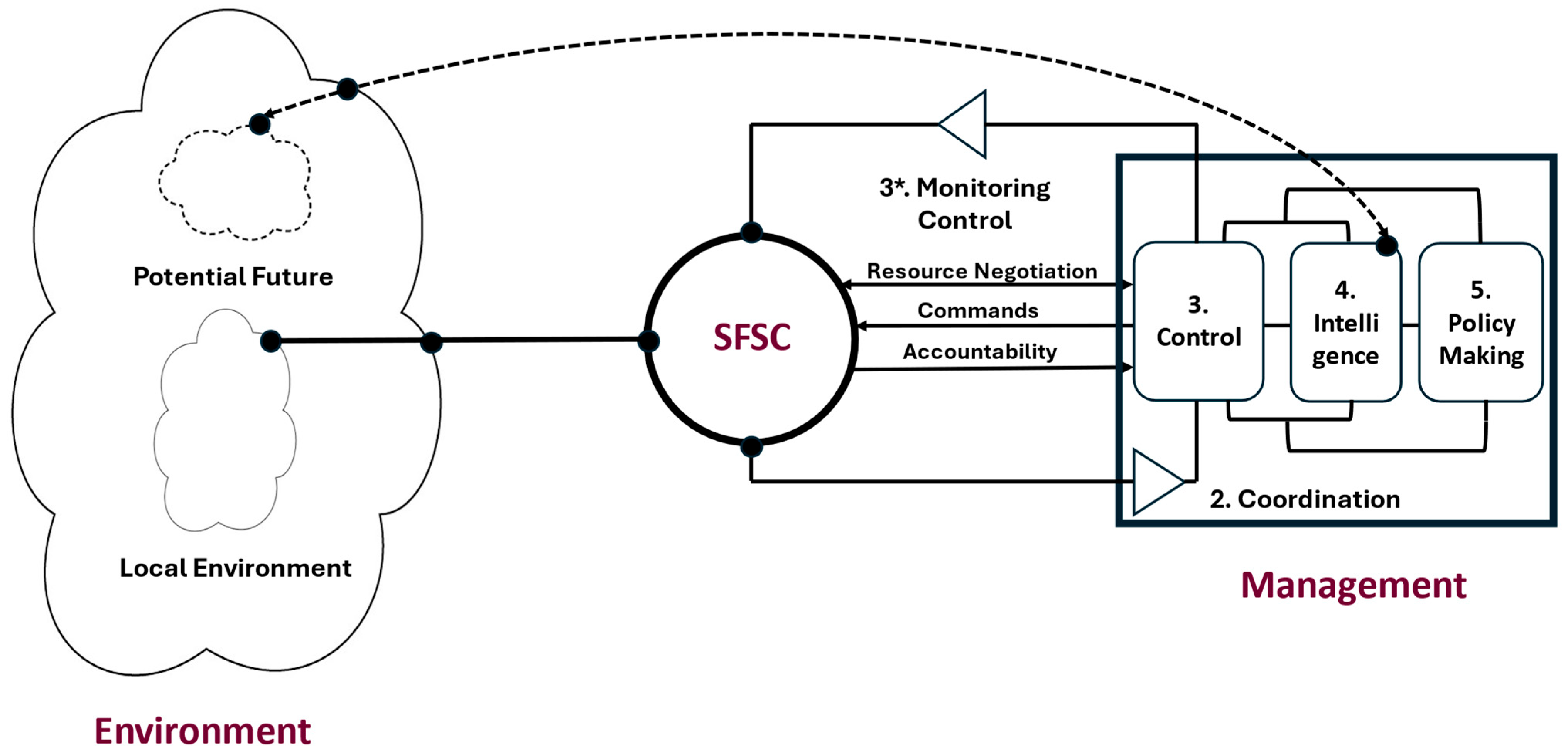
queso Tenate SFSC, the system in focus in
Figure 1, includes Systems 1–5 and the communication channels linking the operational, coordination, control, intelligence, and policy functions. The diagram illustrates how information, control signals, and resource decisions circulate within the organisation. The five systemic functions and communication channels are described in subsequent sections.
Audio recordings were transcribed and responses allocated to systemic categories (Systems 1–5 and communication channels). Given the alignment of the interview structure with the VSM, no additional thematic coding was undertaken. No access was granted to internal documents—such as production records, quality control logs, or financial data—as these were considered confidential by enterprise management. Consequently, the analysis relies on participant accounts and observational data. Responses were synthesised into a VSM structural table identifying:
Operational units and activity flows (System 1),
Coordination mechanisms (System 2),
Governance and control practices (System 3),
Monitoring processes (System 3*),
Adaptive and strategic mechanisms (System 4),
Identity and policy coherence (System 5).
This study employs a theory-informed deductive design consistent with the diagnostic applications of the VSM. Although the interview protocol was structured according to Systems 1–5 and vertical channels, the mapping of empirical statements to systemic categories required interpretive judgement. When statements related to multiple systemic functions—for example, when operational practices also implied coordination or control—they were analysed according to their primary regulatory role within the organisation. In cases where multiple interpretations were possible, preference was given to the explanation most consistent with observed practices and corroborated across data sources. Ambiguous statements were revisited through follow-up clarification with participants to ensure that categorisation reflected organisational practice rather than theoretical imposition.
Accordingly, the VSM functioned as an analytical scaffold rather than a rigid coding template. Although no independent coders were employed, the researcher acted as the primary instrument of analysis, and interpretive consistency was strengthened through multiple strategies. These included collective interview dynamics, cross-checking of summaries with participants, follow-up clarification exchanges, and contrasting with observational data from production and retail contexts. In this study, contrasting (commonly referred to as triangulation in qualitative research) refers to the systematic comparison of different sources of evidence to verify that they consistently describe the same organisational practices [
47,
51].
These procedures aimed to ensure that interpretations reflected organisational practices rather than individual perspectives or theoretical expectations. The analysis is therefore diagnostic in nature, focusing on how VSM functional distinctions illuminate organisational structure rather than testing the model’s validity.
For instance, discussions regarding WhatsApp-based communication were initially mapped to System 2 (Coordination); however, when these communications involved resource approval or strategic interpretation, they were studied under Systems 3 and 4, respectively.
A simplified VSM diagram was subsequently developed to visualise systemic relationships and functional coherence. The purpose of the examination was diagnostic: to identify structural strengths, functional gaps, and potential viability constraints in relation to the research question. The collected data were contrasted across multiple sources to ensure consistency of interpretation and to mitigate reliance on participant accounts. This included:
Cross-validation during the collective interview,
Follow-up clarification exchanges,
Direct observation of production processes,
Observations of retail and market interactions.
This multi-source validation strengthened internal consistency and helped the researcher verify their interpretations with participants. The researcher (the same as the interviewer) was the primary instrument of analysis, and ensuring that interpretations accurately reflected the participants’ realities was essential.
While the study does not quantify performance outcomes, it examines how organisational structure plausibly influences them through observed routines and regulatory arrangements. As such, the analysis prioritises interpretive depth over statistical generalisation, consistent with diagnostic applications of the VSM in organisational settings. In line with cybernetic theory, performance is understood as emerging from the structural organisation of activities, roles, and regulatory mechanisms rather than solely from observable output metrics [
20,
21,
40,
52]. This idea is commonly referred to as
structural determination [
53]. Accordingly, the analysis focuses on the structural conditions that generate and maintain performance requirements.
3.5. Methodological Scope and Ethical Considerations
This study considers validity, reliability, and transferability [
49,
54,
55,
56]. Construct validity was ensured by directly operationalising the VSM into interview questions. Internal validity was supported by cross-checks and participant verification. Reliability was ensured by explicitly documenting system boundaries, VSM functional mapping procedures, and diagnostic criteria.
As an exploratory case study, this research illustrates how VSM can be used to diagnose structural conditions influencing food safety, quality consistency, market delivery, and long-term viability in dairy SFSCs in emerging economies. Nevertheless, generalisation of the results is not claimed; instead, the transferability of the VSM as an analytical tool for studying SFSCs is proposed.
All procedures complied with institutional ethical standards. Participants provided informed consent and were assured of confidentiality and voluntary participation.
4. Results
This section presents the empirical findings, organised according to the five systemic functions of the VSM. The results correspond to summarised descriptions of activities, coordination mechanisms, control practices, monitoring routines, adaptive processes, and identity elements reported during interviews and observations.
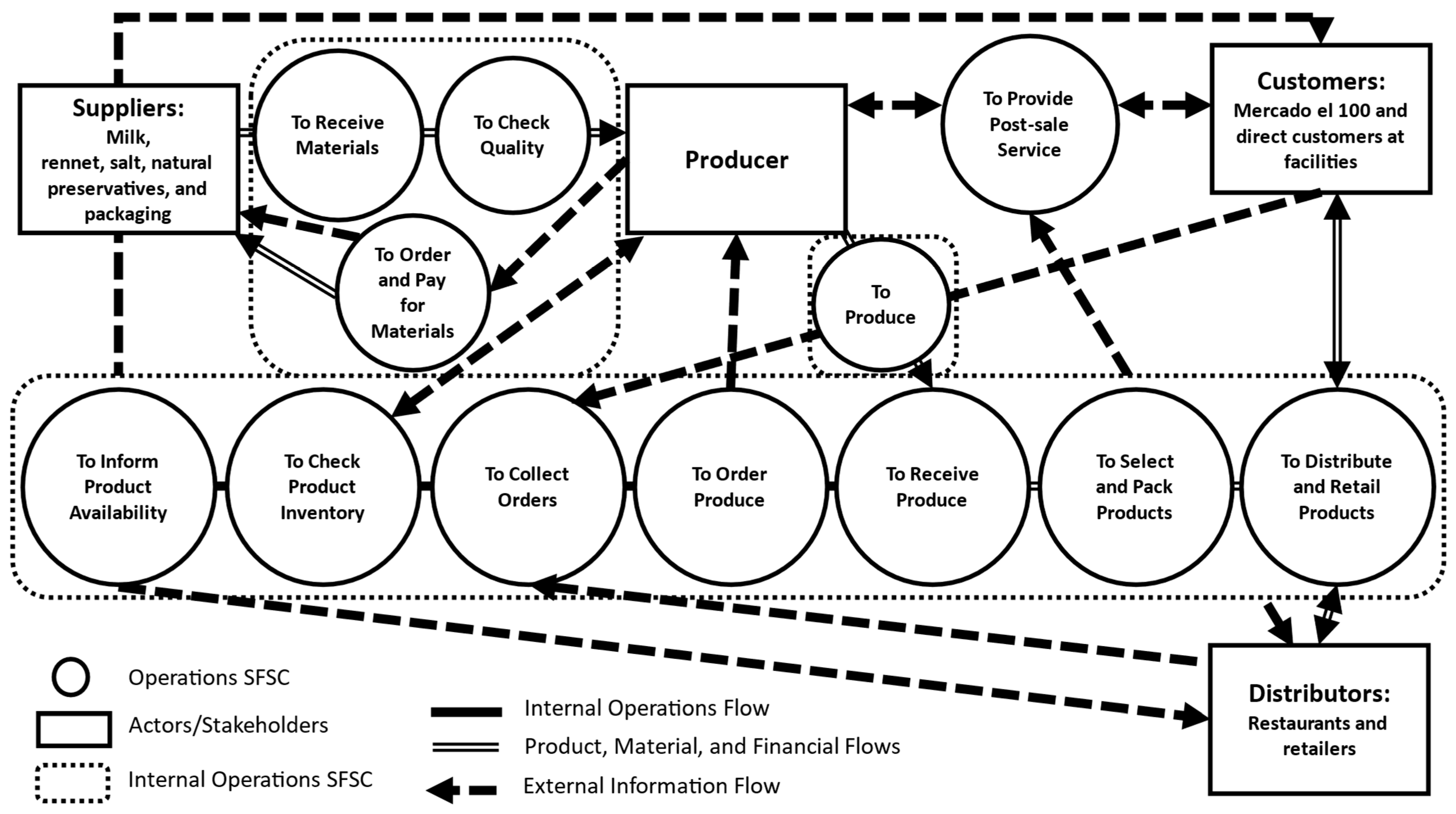
Figure 2 illustrates a
queso Tenate SFSC map of activities, information flows, and actors/stakeholders for the dairy enterprise studied in this work. These activities encompass internal sourcing, production, and distribution of products and materials.
However,
Figure 2 illustrates not only the forward flow of products, materials, and money, but also the associated flows of information, coordination signals, and feedback between producers, intermediaries, and consumers. These bidirectional interactions are essential for maintaining coordination and regulatory adjustment within the system.
4.1. System 1—Operations
The enterprise integrates sourcing, production, packaging, storage, distribution, and direct sales within a single organisational structure. Milk is primarily sourced from an associated cattle ranch and supplemented with goat milk from an external supplier. Upon arrival at the production facility, milk undergoes quality testing, including measurements of acidity, fat, solids, protein, and temperature. Milk meeting internal standards proceeds to processing.
This integration of sourcing, production, and planning is reflected in participants’ descriptions of daily operations. As one participant noted, “we organise production based on the orders we already have, but we also prepare a little extra in case demand increases.”
Production encompasses queso Tenate and other dairy products, including Oaxaca, Morral, Panela, Manchego, Botanero, yoghurt, kefir, milk, and Requesón. The processing stages involve monitoring temperature and timing according to product specifications. Finished products are vacuum-packed and stored under refrigeration. Samples are retained in cold storage for shelf-life monitoring.
Distribution occurs through specialty stores in Mexico City, supplemented by weekly direct sales at Mercado El 100, occasional on-site plant sales, and supply to selected retailers, restaurants, and hotels. Approximately 90% of sales are realised within Mexico City markets.
Demand is assessed using historical sales patterns, seasonal variations, and confirmed pre-orders received via WhatsApp and social media. Retail stores typically place weekly or biweekly orders, and direct first-tier consumers submit weekly pre-orders for Sunday market collection. Production planning is based on reviewing remaining stock and confirmed demand. Small additional quantities (typically 2–5 units) are produced to accommodate fluctuations in demand.
Inventory records are manually maintained in notebooks and subsequently digitised by administrative staff. In situations of limited stock, priority is given to major clients. Delivery delays of two to five days may occur due to product maturation requirements or input availability. Minor inputs, such as salt, are sourced locally when possible; however, larger packaging or ingredient orders may require up to 1.5 weeks for replenishment.
Operational issues reported by participants encompass occasional milk shortages, discrepancies in milk acidity or quantity upon arrival, packaging shortages (e.g., glass bottles), delays in replenishing inputs, urgent last-minute input purchases, seasonal demand fluctuations, and increased working hours during peak periods. Instances of package swelling during sales were also noted, potentially indicating product instability.
4.2. System 2—Coordination
Coordination activities primarily utilise digital messaging and direct verbal communication. The enterprise employs multiple WhatsApp groups for internal management, production coordination, client communication, restaurant orders, and general order management. Phone calls and in-person discussions during daily production supplement these digital channels.
Coordination relies heavily on these informal communication channels. As one participant explained, “we use WhatsApp groups to coordinate everything—orders, production, and any changes during the day.”
Production and delivery adhere to pre-established temporal routines. Orders for the Sunday market at Mercado El 100 are typically confirmed by midweek, whereas retail distributors submit weekly or biweekly requests. Any shortages, delays, or production issues are communicated immediately via WhatsApp or telephone. Adjustments may include delayed delivery, product substitution, or replacement in subsequent deliveries.
Orders are received through various channels, including WhatsApp, Instagram, and direct messages from retail clients. Production planning is based on orders transmitted via these communication channels. Occasionally, orders received through social media require additional confirmation before they are included in the production lists. Customer complaints are also addressed through digital messaging, often accompanied by photographic evidence.
Coordination between sourcing, production, packaging, and distribution is maintained through continuous communication during working hours. Decisions regarding adjustments are typically confirmed verbally among the involved parties.
4.3. System 3—Control
Control functions are distributed among defined, yet flexible, roles within the enterprise. Two production staff members are responsible for daily production processing, packaging, quality control, logistics preparation, and market sales. Task allocation between them varies according to daily needs; for instance, one may receive and test milk, whereas the other prepares packaging or manages ongoing processing activities. Working hours typically range from 6 to 8 h per day, Monday through Sunday.
Only one administrative staff member manages procurement, order registration, invoicing, and financial records. Financial documentation is maintained continuously and reviewed biweekly with external accountants. The purchase of inputs and materials requires managerial budget approval prior to execution.
The owner-manager is responsible for strategic direction, product development, brand management, pricing, market participation, discount policies, and oversight of production and quality standards. The manager also directly participates in market sales and client interactions. Furthermore, family members support milk production activities and maintain institutional and public relations.
Decision-making and control responsibilities are therefore highly centralised. As the owner-manager indicated, “most decisions about production and priorities depend on what I see is needed at the moment.”
Quality control measures encompass milk testing upon reception, adherence to hygiene standards throughout production, vacuum packaging procedures, and maintenance of the cold chain during production, processing, storage, transport, and retail/distribution. During market sales, products are visually inspected and monitored. Customers provide feedback directly in person or through digital messaging platforms.
Resource allocation decisions are based on milk availability, milk composition (e.g., protein content, which influences cheese selection), product demand, and financial considerations. In situations with limited supply, production priorities are adjusted based on available inputs and confirmed orders.
Formal meetings are held monthly to review operational planning and quarterly to discuss product innovation. Annual planning activities are organised around four key areas: production and quality, marketing and image, commercial strategy, and finance and administration. Production manuals and logs are maintained to document procedures and outputs.
Reported control-related issues encompassed the concentration of planning responsibilities with the manager, administrative and financial management with the administrator, and production tasks with the two producers. Clients frequently operate under delayed payment or payment-on-delivery arrangements. Participants described decision-making as primarily focused on short-term operational needs, with longer-term planning activities conducted periodically.
4.4. System 3*—Audit
Monitoring and verification activities are conducted through routine reviews of production, inventory, and financial records. Production data are recorded manually in notebooks during daily operations. These records include quantities produced, input usage, and batch-related notes. Subsequently, administrative staff digitise selected information for accounting and documentation purposes.
Weekly reviews of production notebooks verify quantities and reconcile stock levels. Financial records are reviewed biweekly in consultation with external accountants. Sales records are compared with production data to verify consistency.
Monitoring activities are primarily based on routine verification and retrospective review. As one participant noted, “we check what was produced and sold, and if there is a problem, we adjust in the next batch.”
Quality verification commences at milk reception, where acidity, fat content, solids, protein levels, and temperature are measured. Any discrepancies in milk quality or quantity are recorded at this stage. Throughout production, adherence to hygiene standards and temperature controls is observed. Finished product samples are retained in cold storage for shelf-life monitoring.
At the retail level, product condition is visually inspected during market sales. Customer complaints, received in person or via digital messaging platforms, are frequently accompanied by photographic evidence. Upon reporting quality issues, replacement products are provided in subsequent deliveries.
Reported audit-related issues encompassed discrepancies in milk quality upon receipt, mismatches between inventory records and physical stock, and unrecorded or unfulfilled orders. Sales accumulation data were not consistently available to production staff. Production notebooks primarily served as operational records rather than analytical tools.
4.5. System 4—Intelligence
Adaptive and forward-looking activities encompass product innovation, brand development, market sensing, and engagement with certification processes. New product variations are periodically developed, such as seasonal kefir flavours and curated Christmas product baskets. The enterprise collaborates with chefs and maintains relationships with specialty retailers to introduce or test these products.
Market information is gathered through direct consumer interaction at Mercado El 100, feedback from digital platforms, and observation of consumption trends associated with artisan and “slow life” movements [
57]. Social media platforms are utilised to monitor customer responses and manage pre-orders.
Adaptive activities are strongly influenced by direct interaction with consumers. As one participant explained, “new ideas come from what customers ask for and what we observe when we sell at the market.”
Annual planning activities are structured around production and quality, marketing and brand image, commercial strategy, and finance and administration. Monthly planning meetings are held, and specific “kick-off” and “kick-in” sessions are organised to initiate or review projects. A maximum daily production limit per product–for example, 33 units–has been defined for certain items. A portion of profits is allocated to long-term brand transition activities.
External influences reported by participants encompassed organic certification procedures subject to periodic external reviews, e-commerce logistics constraints related to the sensitivity of delivery timing, transportation costs for goat milk, including minimum monthly volume agreements, and the utilisation of digital platforms for sales and communication. Strategic decisions prioritised e-commerce channels over expansion into additional physical retail locations.
Reported intelligence-related issues encompass delivery risks associated with products lacking preservatives, shipping delays impacting product stability, freight cost structures necessitating minimum goat milk volume commitments, a concentration of strategic planning responsibilities within the owner-manager, and financial reinvestment requirements linked to brand transition processes.
4.6. System 5—Policy and Identity
Participants described a set of shared values guiding organisational activities, encompassing honesty, trust, quality, patience, continuous improvement, a health orientation, and transparency. Transparency practices included the use of QR codes to provide information regarding product origin and production processes.
These values are consistently reflected in participants’ narratives about their work. As one participant stated, “we want people to trust what we produce, so we focus on being transparent and maintaining quality.”
The stated organisational purpose includes producing natural and artisan dairy products, preserving traditional methods, maintaining product consistency, and educating consumers about food authenticity. Emphasis is placed on cultivating direct relationships with consumers and fostering trust through sustained interactions in the market.
Short-term decisions are primarily influenced by sales performance, milk availability, and operational constraints. Long-term orientation encompasses brand transition initiatives and educational objectives centred on artisan identity and consumer awareness. A portion of profits is allocated to brand development activities, and personal financial resources have also supported transition processes.
Reported policy-related issues include the prevalence of short-term operational priorities in daily decision-making and the concentration of long-term strategic direction within owner-managers.
4.7. Vertical Channels
Information flows between production, administration, and management via digital messaging, phone communication, and in-person exchanges. Operational signals, such as order confirmations, input availability, and client feedback, are transmitted to managerial and administrative roles during daily activities.
Purchasing decisions follow a vertical approval process: production needs are communicated to the manager, budget approval is obtained, and procurement is executed by the administrator. Supplier negotiations and minimum volume agreements are handled at the managerial level.
The manager communicates strategic decisions concerning product development, brand transitions, and market channels to production and administrative staff during meetings or daily coordination. Periodic reviews facilitate the sharing of sales and financial information across roles.
4.8. Final Remarks on the Results
The preceding sections detail the enterprises’ activities and communication flows across the five systemic functions of the VSM: operational processes, coordination mechanisms, control routines, monitoring activities, adaptive practices, policy elements, and vertical information channels. Although product flows follow mostly a forward distribution path, the system operates through continuous feedback mechanisms, including customer communication, order adjustments, and quality-related responses. These feedback processes contribute to coordination and regulatory adjustment across the supply chain.
The following section interprets these findings in relation to food safety, quality consistency, market delivery, and organisational viability.
5. Discussion
This section interprets the empirical findings through the lens of the VSM and situates them in relation to the research problem, research aim, and working hypothesis introduced previously. Rather than treating the VSM as a rigid template to which the case must conform, the discussion uses it as a structured framework to examine how systemic functions are enacted in practice.
5.1. Findings: VSM Diagnosis and Structural Implications
The VSM diagnosis shows that the
queso Tenate SFSC achieves viability through robust operations, relational coordination, and a value-driven identity. The VSM representation (
Figure 1) further helps visualise the concentration of regulatory and adaptive functions, as well as the relatively weak differentiation between coordination (System 2) and control (Systems 3 and 3*) mechanisms. Several systemic functions are enacted implicitly rather than structurally, resulting in a person-dependent system. The diagnosis identifies functional imbalances and highlights structural implications for reinforcing systemic coherence while preserving the products’ artisan character. These structural implications arise from the interpretive application of the VSM framework to observed organisational practices [
17,
50].
Table 1 provides a structured synthesis of the diagnostic findings by linking each VSM function to the corresponding organisational practices and identified structural issues. This mapping makes explicit how viability functions are configured and where imbalances emerge within the system. The following subsections examine each function in detail, elaborating on how these structural conditions shape coordination, control, adaptation, and overall organisational viability.
5.1.1. System 1—Operational Core and Quality Practices
The operational core of queso Tenate SFSC under analysis incorporates embedded quality routines and flexible production practices. The nested operations—milk testing upon reception, temperature control during processing, vacuum packaging, and cold-chain management—provide structured mechanisms for maintaining product quality standards. Production planning is demand-driven and adjusted to seasonal variations.
Nevertheless, operational differentiation remains limited. Core tasks—that is, sourcing, processing, packaging, logistics, and sales—are concentrated among a small number of actors who perform overlapping roles. The variety generated by fluctuating demand, input variability, and maturation constraints is primarily attenuated through extended working hours and rapid adjustment, rather than through structural redundancy. Consequently, operational viability is sustained through actor commitment and tacit coordination, rather than through formally differentiated subsystems.
5.1.2. System 2—Coordination and Signal Integration
Coordination within the
queso Tenate SFSC is characterised by high relational density and rapid information exchange. Digital messaging platforms and direct communication facilitate continuous synchronisation between production, administration, and market-facing activities. This arrangement enables the system to respond quickly to fluctuations in demand, input shortages, and client feedback [
58].
From a cybernetic perspective, System 2 functions are present but loosely structured. Coordination relies on dispersed communication channels rather than consolidated signal integration, limiting the presence of formal oscillation-dampening mechanisms typically associated with System 2 within the VSM. Order transmission, production adjustments, and complaint handling are mediated through multiple messaging streams, requiring active attention and memory to prevent omissions. The system absorbs variability through interpersonal responsiveness rather than standardised coordination protocols.
This configuration offers flexibility at the current scale but places a burden on the synchronisation capacity of key actors. Market-driven variety is handled through immediate interpersonal exchanges rather than formal buffering or consolidated information systems.
5.1.3. System 3 and 3*—Control, Audit, and Regulatory Capacity
Internal regulation within the queso Tenate SFSC is structured through managerial oversight, quality standards, and periodic financial and operational reviews. Production manuals, milk-testing procedures, and financial consultations serve as formal reference points for maintaining internal coherence. These elements reflect the presence of System 3’s functions in resource allocation and operational stability.
Audit mechanisms (System 3*) rely on the routine verification of production records, financial reviews, shelf-life monitoring, and customer feedback. Deviations in milk quality, inventory discrepancies, and product complaints are detected through these monitoring processes. However, audit activity is closely integrated with daily operations rather than being structurally separated as an independent process. Audit verification primarily relies on retrospective reviews and customer-triggered feedback (e.g., quality control) rather than anticipatory variance detection of potential issues (e.g., quality assurance).
Regulatory capacity, that is, the ability to monitor performance and correct deviations, is primarily concentrated in managerial supervision and record-based verification. Although performance information is available, it is not consistently translated into explicit indicators to guide distributed decision-making. Monitoring, control, and operational adjustments are largely driven by direct managerial intervention rather than formalised feedback procedures. As a result, the system maintains stability primarily through centralised attention and relational accountability.
In cybernetic terms, this concentration of regulatory capacity reflects a limited distribution of variety-handling mechanisms within the system, which may constrain its ability to respond to increasing environmental complexity, as suggested by Ashby’s law of requisite variety [
20].
5.1.4. System 4—Intelligence and Adaptation
Adaptive functions within the queso Tenate SFSC are oriented toward product innovation, brand development, market sensing, and certification processes. The enterprise directly engages consumers, monitors artisan consumption trends, and allocates resources to brand transition initiatives. Annual and periodic planning cycles provide structured opportunities for forward-looking reflections.
In systemic terms, System 4 functions are active but highly concentrated. The owner-manager is largely responsible for the strategic interpretation of environmental signals, including consumer preferences, logistics constraints, certification requirements, and cost structures. Operational staff participate in execution, but adaptive interpretation and strategic prioritisation remain centralised.
The coupling between adaptive intelligence and operational regulation is therefore mediated through individual judgement rather than distributed analytical routines. Environmental variety, including changes in market demand, logistics costs, and regulatory requirements, is primarily interpreted and managed by the owner-manager. Adaptive capacity exists contingent upon the cognitive and temporal availability of a limited number of actors.
5.1.5. System 5—Policy Making and Identity
The normative orientation clearly articulates the queso Tenate SFSC under study through commitments to honesty, transparency, artisan quality, and consumer trust. Identity is linked to territorial embeddedness, natural production practices, and long-term brand development. These elements provide a coherent framework for decision-making and reinforce relational accountability between producers and consumers.
From a VSM perspective, System 5 is present and influential, defining the purpose, identity, and strategic boundaries; nonetheless, policy articulation remains largely implicit and personalised. Trade-offs between short-term operational demands and long-term strategic ambitions are resolved through managerial discretion rather than codified principles. Consequently, the enterprise’s coherence depends on the sustained alignment between managerial judgement and shared values.
Across Systems 1–5, regulatory and adaptive functions are enacted but concentrated in one person, as expected in microbusinesses. Operational stability, coordination, monitoring, and strategic orientation are sustained through attentional capacity and commitment. Viability is achieved through relational cohesion and tacit regulation rather than distributed structural redundancy. The system demonstrates functional coherence, although this coherence is strongly person-dependent.
The systemic diagnosis presented here is based on observed organisational practices and reported routines within the focal enterprise. It reflects the structural configuration evident at the time of study, rather than longitudinal performance measurement. Therefore, this study identifies patterns of regulatory concentration and coordination structures as interpretive features of organisational design, rather than statistically verified causal determinants of performance.
5.2. Discussion in Relation to the Research Problem and Research Aim
This study investigates the following question: How does the organisational structure of the queso Tenate SFSC influence its capacity to ensure food safety and quality consistency, deliver products effectively to market, promote consumption and sustained adoption, and maintain long-term viability? The systemic diagnosis presented above clarifies how these performance dimensions are structurally mediated.
5.2.1. Food Safety and Quality Consistency
Food safety and quality consistency stem from the interplay between operational routines (System 1), regulatory oversight (System 3), and monitoring mechanisms (System 3*). Embedded quality practices provide structured safeguards at the operational level. These are reinforced by managerial supervision and periodic record verification.
However, the integration between monitoring and operational adjustment relies largely on centralised interpretation rather than distributed performance indicators. Deviations are typically detected through retrospective review or customer feedback, rather than through anticipatory variance management. As a result, food safety is maintained through the coherence of routines and managerial attention, rather than through formally differentiated regulatory subsystems. The findings suggest that food safety performance is not solely determined by technical production practices, but by the structural alignment between operations and control [
20,
21,
40,
52].
This study does not assess food safety through microbiological or physicochemical measurements of cheese products [
10,
12]. While such testing is conducted within the enterprise, the focus of this analysis is on how these practices are organisationally structured and integrated into decision-making processes [
59]. In this sense, food safety is conceptualised as a regulatory and control capacity arising from the interaction between operational routines, monitoring mechanisms, and managerial oversight. The emphasis is therefore placed on the system’s ability to articulate, coordinate, and act upon food safety practices, rather than on independently measured safety outcomes. Consequently, the findings relate to the organisational conditions that enable food safety, rather than to the verification of safety performance itself. From a cybernetic perspective, this regulatory and control capacity enables the system to maintain stability under varying food safety conditions.
5.2.2. Market Delivery and Diffusion of Queso Tenate
Effective delivery to urban markets depends on the alignment of coordination mechanisms (System 2), operational capacity (System 1), and adaptive interpretation (System 4). Rapid digital communication enables timely order adjustments and short-cycle feedback between market signals and operational planning. This responsiveness supports the reliability of the current scale [
19]. Nevertheless, product diffusion is linked to organisational conditions that plausibly support consumption and sustained adoption, rather than to independently measured market growth indicators.
Accordingly, coordination signals are dispersed across multiple channels and primarily integrated through individual attention. Delivery performance is therefore stabilised through interpersonal synchronisation rather than consolidated signal management. Market diffusion and sustained consumption are influenced by the interaction between adaptive initiatives—such as brand development and product innovation—and operational constraints. These include production limits, product quality, and logistical requirements. Delivery reliability, as a result, reflects the structural alignment between coordination density and regulatory capacity.
5.2.3. Long-Term Viability
In this study, viability is understood in the cybernetic sense proposed by Stafford Beer (see [
16]): the capacity of an organisational system to maintain identity and operational coherence while adapting to environmental disturbances. The study interprets viability not simply as short-term survival or profitability but as the structural ability to coordinate operations, regulate internal processes, and respond to external change.
The queso Tenate SFSC demonstrates functional coherence across these domains, underpinned by a strong normative identity and active market engagement. Nevertheless, regulatory and adaptive functions are concentrated within a limited number of individuals. Nonetheless, this concentration does not preclude viability at the current scale. Rather, viability is sustained through relational cohesion, tacit coordination, and managerial integration of multiple systemic roles. Despite this, structural redundancy and distributed regulatory capacity remain limited. Consequently, long-term viability depends on the continued alignment between managerial interpretation, operational execution, and shared identity.
This alignment becomes particularly relevant under environmental disturbances, such as input shortages, regulatory changes, or demand fluctuations—conditions already observed in the case, including milk variability, freight cost pressures, and seasonal demand shifts. The system’s viability, therefore, rests on its capacity to absorb these disturbances through coordinated regulatory adjustments.
5.2.4. Response to the Research Question and Working Hypothesis
The VSM diagnosis suggests that the organisational structure plausibly shapes each of the performance dimensions specified in the research question. Although the study does not compare alternative structural configurations, the diagnostic mapping shows that the performance dimensions are not independent outcomes. Conversely, performance dimensions are structurally determined by the configuration and interplay among operations, coordination, regulatory monitoring-control, adaptive intelligence, and policy functions [
40,
53]. This finding aligns with previous work on the VSM and management cybernetics within organisational systems [
21].
In this case, performance emerges from how cohesion and adaptation mechanisms are executed and integrated within the organisational structure. Seminal work in cybernetics, particularly by Norbert Wiener [
22,
40], supports this perspective by indicating that “the structure of a system is an index of its performance”.
Accordingly, each performance dimension identified in the research question, namely, food safety and quality consistency, market delivery, product consumption and adoption, and long-term viability, can be interpreted as structurally mediated. From a cybernetic standpoint, performance is not treated as an external outcome detached from organisational structure but as a property generated through the configuration and interaction of systemic functions [
20,
21,
40,
52].
Therefore, the present study does not seek to empirically correlate structural variables with performance indicators but to diagnose how the observed configuration of viability functions enables or constrains the production of performance requirements within the system.
This interpretation grounds performance dimensions in the operational domain, where resources, activities, and roles are integrated to deliver results and meet expectations. Consequently, the findings support the working hypothesis that artisan dairy SFSC performance is linked to viability functions, rather than solely by product attributes. Furthermore, this case demonstrates that such viability can be sustained through relational and tacit regulatory mechanisms, even when formal differentiation remains limited.
5.3. Theoretical and Managerial Implications
5.3.1. Theoretical Implications: The VSM as a Conversational Framework for SFSC Viability
This study contributes to the literature on SFSCs by moving beyond descriptive characteristics, such as proximity, trust, and embeddedness, to examine the organisational architecture that sustains these qualities. Previous research has primarily emphasised relational governance, sustainability outcomes, and consumer perceptions [
2,
23]. In contrast, this study demonstrates that these outcomes are structurally mediated through the interaction between operational, coordination, regulatory, adaptive, and policy functions. This interpretation is consistent with cybernetic theory, where organisational structure is understood as the primary determinant of system behaviour and performance [
20,
40].
While governance, institutional, and resilience-based approaches have provided valuable insights into SFSCs, they typically emphasise coordination structures, actor relationships, or system responses to disruption (see, for instance [
1,
27,
39]). These perspectives often analyse performance in terms of network configurations, institutional arrangements, or adaptive outcomes. However, they pay less attention to the internal regulatory architecture through which these outcomes are produced. Conversely, the VSM offers a functionally differentiated framework that explicitly examines how operational, coordination, control, adaptive, and policy functions interact to sustain organisational viability. This enables a structural diagnosis of how performance requirements—such as food safety, delivery reliability, and adaptability—are generated and maintained within the SFSC system. In this sense, the VSM complements rather than replaces these approaches by providing a structural lens that links organisational configuration to system-level outcomes.
By operationalising the VSM within an artisan dairy SFSC, this study extends cybernetic viability theory into a context rarely examined through this lens. Existing systemic approaches in agri-food research, such as System Dynamics and optimisation modelling, primarily focus on behavioural dynamics, risk propagation, or network design [
37,
39]. In contrast, the VSM facilitates an explicit examination of organisational differentiation, regulatory distribution, and the structural coupling between adaptation and control. The findings illustrate how viability in small-scale dairy systems can be achieved through tacit and relational mechanisms, even when structural redundancy remains limited—that is, when no (free) extra resources are available.
A central theoretical contribution of this study is the articulation of person-dependent viability as a structural configuration within small-scale SFSCs. This concept extends beyond managerial centralisation or founder-driven leadership. It refers to a condition in which key viability functions—coordination (System 2), regulatory control (Systems 3 and 3*), and adaptive intelligence (System 4)—are enacted through the attentional and interpretive capacity of one or a small number of individuals, rather than through formally differentiated subsystems. Person-dependent viability may generate relational resilience—grounded in trust, commitment, and tacit coordination—while simultaneously limiting structural resilience as environmental variety increases.
This configuration is typically associated with conditions such as limited resource availability, small organisational scale, and the concentration of experiential knowledge within a small number of actors. However, as environmental variety increases—through market expansion, regulatory demands, or operational complexity—such systems may reach critical thresholds at which individual cognitive and attentional capacity becomes insufficient to absorb the variety. Under these conditions, viability increasingly depends on the progressive differentiation and redistribution of coordination, control, and adaptive functions across organisational roles.
This idea suggests an evolutionary pathway in which micro-enterprises initially sustain viability through relational integration but require increasing structural differentiation as complexity grows. The specific conditions under which such transitions occur, and the thresholds at which person-dependent configurations become constrained, remain important areas for future research.
From a food systems perspective, this structural articulation has implications that extend beyond the focal enterprise. Organisational coherence influences not only internal performance but also the stability of local supply relationships, producer–consumer trust, and the retention of territorial value [
60]. When regulatory capacity is concentrated and coordination remains largely informal, smallholder viability may depend heavily on the continuity of key individuals. Conversely, strengthening distributed coordination and adaptive routines may enhance resilience at the territorial level.
In cybernetic terms, resilience can be understood as the behavioural expression of viability under environmental disturbance [
16,
20]. Whereas viability concerns the structural configuration of regulatory functions that maintain organisational identity, resilience refers to the system’s capacity to absorb and respond to perturbations through those regulatory mechanisms. The VSM thus provides a structural lens for linking organisational viability to broader debates on rural resilience and sustainability [
61].
Unlike prior VSM applications that have focused on large-scale supply chains or organisational transformation processes, this study applies the model at the micro-scale within a culturally embedded production system with limited formal structural differentiation. The theoretical refinement lies not in extending the VSM itself, but in clarifying how its viability functions may be enacted through concentrated regulatory cognition rather than through formally differentiated subsystems. This scale-sensitive articulation contributes to viability theory by specifying how systemic balance can be maintained in minimally differentiated organisations.
In VSM terms, functional balance across Systems 1–5 may be maintained not through formal structural redundancy, but through relational integration and concentrated regulatory cognition. This configuration maintains coherence at a given scale while remaining sensitive to actor turnover and environmental complexity. By distinguishing between structural differentiation and the person-dependent enactment of systemic functions, this study refines viability theory within the context of small-scale, culturally embedded production systems. This distinction suggests that viability in micro-enterprises may be achieved through cognitive and relational integration prior to structural differentiation.
5.3.2. Managerial Implications: The VSM as a Practical Diagnostic Tool
From a managerial perspective, the findings highlight that performance challenges in artisan dairy SFSCs are not merely operational issues, but a result of systemic configuration tensions that have not been properly addressed. Food safety inconsistencies, delivery delays, and coordination errors are symptoms of underlying inadequacies in the structure of regulatory and coordination functions, rather than isolated failures of production techniques. The diagnostic sequence outlined in
Section 3.3 provides a practical entry point for managers seeking to apply the VSM in similar small-scale supply chain contexts.
The VSM offers managers a structured language for reflecting on organisational balance and the distribution of regulatory responsibilities. Instead of relying on bureaucratic control mechanisms, managers can examine how signals are consolidated, how monitoring informs decision-making, and how adaptive intelligence is distributed across roles. Lightweight structural adjustments could enhance regulatory capacity. These include consolidating communication channels into a unified order management process (System 2), formalising variance detection and review routines (Systems 3 and 3*), and clarifying decision thresholds for resource allocation, production prioritisation, and delivery adjustments (System 3). In addition, strengthening the distribution of adaptive intelligence functions (System 4), for instance, through shared market monitoring, structured customer feedback analysis, or collaborative planning practices, may reduce the concentration of strategic interpretation in a single actor. These adjustments correspond directly to the functional imbalances identified in the VSM diagnosis and illustrate how systemic analysis can inform context-sensitive organisational improvements.
For policymakers and support organisations in emerging economies, the study suggests that strengthening SFSC viability requires more than infrastructure investment or certification schemes. Enhancing organisational learning, coordination routines, and distributed regulatory capacity may be equally important in sustaining food safety and market reliability within culturally embedded dairy systems.
5.4. Limitations
This study acknowledges conceptual, methodological, and empirical limitations that should be considered when interpreting its findings.
First, the study relies on the VSM as its primary theoretical lens. Although the VSM provides a structured framework for examining organisational viability [
17,
50], its application necessitates interpretive judgement when mapping empirical practices onto systemic functions. The VSM foregrounds organisational differentiation, regulatory balance, and functional coherence. However, alternative perspectives, such as institutional theory, transaction cost economics, or network governance frameworks, may instead emphasise power asymmetries, market structures, or broader institutional constraints. Consequently, the findings represent a cybernetic interpretation of the case rather than an exhaustive theoretical account. Given the study’s theory-informed, deductive design, the findings necessarily reflect the VSM’s interpretive lens; alternative theoretical frameworks might foreground different explanatory dimensions of the case.
Second, the study employs an exploratory single-case design, which enables in-depth examination of organisational processes and supports transferability [
47,
49]. However, the results are not generalisable to other dairy SFSCs. Variations in scale, governance form, regulatory environment, or cultural context may produce different systemic configurations.
Third, data collection primarily utilised semi-structured interviews and direct observations within family-led enterprises. Although cross-checking and field visits enhanced internal consistency, the study remained reliant on participant accounts and available documentation. The lack of longitudinal performance data, such as delivery reliability metrics, defect rates, or financial time series, limited the quantitative corroboration of the systemic diagnosis.
No access to internal records—including production records, quality control logs, and financial data—was granted due to confidentiality restrictions. The analysis therefore relied on participant accounts and observational data. To address this limitation, practices were systematically compared across multiple sources, including interviews, follow-up exchanges, and direct observation of activities, to ensure consistency and support diagnosis.
In addition, the use of a collective interview format may have introduced response bias associated with group dynamics or hierarchical influence. This limitation was addressed through follow-up clarification exchanges and the systematic contrasting of multiple data sources to ensure consistency of interpretations across interviews, observations, and follow-up exchanges.
Finally, the system boundary was defined at the enterprise level. Although upstream suppliers and retail clients were considered during recurrent interactions, the recursive potential of the VSM across multiple organisational levels was not fully exploited. As a result, this study focuses on internal organisational configuration rather than multi-level systemic viability across the broader supply chain.
These limitations suggest that the findings should be interpreted as methodically illustrative rather than universally prescriptive. The primary contribution lies in demonstrating how the VSM can be operationalised to examine organisational viability in artisan dairy SFSCs.
5.5. Future Research
Building on the exploratory and single-case nature of this study, several avenues for future research are suggested.
First, comparative multi-case studies are needed to examine how viability functions are configured across different dairy and cheese SFSCs. Analysing cases that vary in scale, governance form, market orientation, or degree of formalisation would enable the refinement of the concept of person-dependent viability and clarify the conditions under which relational regulation transitions into structurally distributed regulation. Such comparisons would strengthen analytical generalisation and contribute to the development of a typology of organisational viability in artisan food systems.
Second, longitudinal research would enable the examination of how systemic functions evolve. Viability is a dynamic property, particularly in environments characterised by regulatory change, market volatility, or generational transition. Tracking an SFSC through growth phases, certification processes, supply disruptions, or leadership succession would provide insights into how regulatory capacity and adaptive intelligence are redistributed as complexity increases.
Third, future studies could integrate quantitative performance indicators into VSM-based diagnoses. Metrics such as defect rates, delivery reliability, inventory turnover, and financial stability could complement qualitative diagnoses and facilitate systematic comparisons between structural configurations and performance outcomes. Combining VSM mapping with System Dynamics simulation or Network Analysis may provide further insights into how coordination mechanisms influence behavioural patterns under stress scenarios.
Fourth, the recursive nature of the VSM invites multi-level application. Future research could examine supplier networks, distribution intermediaries, or cooperative structures as viable systems and explore how inter-organisational coherence influences overall supply chain viability. Such examinations would extend the focus from enterprise-level configurations to supply chain-level systemic integration.
Finally, action research approaches could explore the VSM as a participatory intervention tool. Engaging managers and producers in structured viability diagnostics may reveal how reflexive use of the model influences organisational learning, governance practices, and adaptive decision-making. This would contribute to debates surrounding the VSM’s role, not only as an analytical framework but also as a reflexive instrument for organisational development. For instance, other systems thinking approaches—e.g., Critical Systems Heuristics [
62]—might be explored to introduce softer aspects, such as power imbalances, and to make other concerns explicit that are not identified when using the VSM.
These directions would advance understanding of organisational viability in artisan dairy SFSCs and strengthen the empirical foundation of cybernetic approaches to food systems research.
6. Conclusions
This study examined how the organisational structure of a queso Tenate SFSC in central Mexico influences its capacity to ensure food safety and quality consistency, deliver products to urban markets, promote sustained adoption, and maintain long-term viability. Guided by the VSM, this study examined the interactions among operational, coordination, regulatory, adaptive, and policy functions within an artisan dairy enterprise.
The findings suggest that performance patterns are mediated by the structure and connectivity of organisational functions. In line with cybernetic theory, performance is understood as an emergent property of organisational structure rather than solely as an externally measured outcome. Food safety and quality consistency depend on the coherence between operational routines and regulatory oversight, while market delivery reliability emerges from the alignment between coordination mechanisms and production capacity. Long-term viability is sustained through the interaction between adaptive intelligence and normative identity. Taken together, these findings reinforce that outcomes are shaped not only by product characteristics or traditional know-how, but by the configuration and integration of systemic functions.
This case demonstrates that viability can be achieved through relational and tacit mechanisms, even when formal organisational differentiation is limited. Regulatory and adaptive functions might be concentrated among a small number of actors, with stability maintained through interpersonal coordination and shared values. This configuration facilitates functional coherence at the current scale while remaining responsive to increasing complexity or environmental disruption.
This study contributes to SFSC research by shifting the analytical focus from the descriptive characteristics of proximity and embeddedness to the organisational architecture underpinning viability. It extends the application of the VSM to artisan dairy systems in an emerging economy and illustrates how cybernetic diagnosis can clarify the structural conditions linking food safety, delivery reliability, and sustainability.
Although exploratory and analytically illustrative, the findings suggest that strengthening organisational viability in artisan dairy SFSCs requires attention to the distribution of regulatory capacity and adaptive intelligence, rather than solely to infrastructure or certification mechanisms. Balanced alignment across operational and governance functions remains central to sustaining culturally embedded dairy production systems.




 ,
,