Article

Sustainability-Driven Digital Transformation and Customer Experience in Emerging Markets: The Interplay of Business Model Innovation and Value Co-Creation

1
Department of Management, Business and Marketing, Birmingham City University, Birmingham B4 7BD, UK
2
Department of Management Sciences, Hyderabad Campus, Shaheed Zulfikar Ali Bhutto Institute of Science and Technology (SZABIST) University, Hyderabad Campus, Hyderabad 71000, Pakistan
3
Department of Marketing, University of Tabuk, Tabuk 71491, Saudi Arabia
*
Author to whom correspondence should be addressed.
Systems 2026, 14(4), 390; https://doi.org/10.3390/systems14040390
Submission received: 30 January 2026 / Revised: 25 March 2026 / Accepted: 27 March 2026 / Published: 3 April 2026

Abstract

Service industries are fast turning digital, and they are disrupting the manner in which firms organize and relate to their customers. Nevertheless, mechanisms that allow digital capabilities to be converted to better customer experience remain poorly understood, especially in the emerging economies. This paper presents the dual-mediation model to investigate the effects of Digital Supply Chain Integration (DSCI) and capabilities of digital customer engagement (DCEC) on Customer Experience Outcomes (CXO) based on Sustainable Business Model Innovation (SBMI) and Customer Value Co-Creation (CVC) with references to Dynamic Capabilities Theory and Service-Dominant Logic. The data were collected by a cross-sectional survey of 360 managers of the banking, telecom, healthcare, and hospitality organizations in Pakistan and analyzed with the help of Partial Least Squares Structural Equation Modeling (PLS-SEM). The findings indicate that the customer experience is enhanced well beyond what is feasible alone by means of Sustainable Business Model Innovation due to the Digital Supply Chain Integration, whereas customer experience is enhanced by the Digital Customer Engagement Capabilities through Customer Value Co-Creation. The results also show that the mechanisms of co-creation have the largest impact on the outcome of customer experience. The research is an addition to the body of literature on digital transformation because it illustrates how digital integration, innovation that is focused on sustainability, and relational co-creation can collectively convert digital capabilities into experiential value. The results also provide practical factors that should be considered by service companies when embarking on digital transformation programs to align the programs with sustainability and customer engagement mechanisms.

1. Introduction

The connection between Digital Supply Chain Integration (DSCI), Digital Customer Engagement Capabilities (DCEC), and Customer Experience Outcomes (CXOs) has been understudied, particularly within a service-based and emerging economy context, even after the current explosion in academic research on the topic. The existing literature has largely centered on the manufacturing industries or prosperous economies, with much emphasis on efficiency, automation, and operational performance, while paying limited attention to experience creation mechanisms [1,2,3,4]. Recent studies further indicate that digital transformation has increasingly shifted focus towards value co-creation and customer-centric outcomes, yet experiential mechanisms remain insufficiently explored [5]. Nonetheless, the digital transformation of the service industry works differently; the value is generated by intangible processes and constant contact with customers, which demand relational and adaptive abilities that surpass automation of processes [6,7].
The most recent research recognizes that customer-centric and sustainable innovation processes are essential to achieve the experiential advantages of digitalization [8,9,10]. For instance, recent evidence suggests that business model innovation significantly shapes customer perceptions and value creation, particularly in emerging economic contexts [11]. However, existing frameworks fail to adequately explain the operationalization of digital capabilities through Sustainable Business Model Innovation (SBMI) and Customer Value Co-Creation (CVC) to influence Customer Experience Outcomes. The existing body of empirical research considers digital integration and customer engagement independently [10,11], but both play a role in achieving sustainable, experience-driven results [12,13]. As a result, no empirically validated, combined model of the relationship between DSCI and DCEC and SBMI, CVC, and CXOs in service ecosystems exists. Table 1 presents the definitions of the key constructs used in this study, including DSCI, DCEC, SBMI, CVC, and CXO. These definitions establish a clear conceptual foundation for understanding how digital capabilities and customer involvement influence customer experience outcomes.
Moreover, the customer experience literature has expanded into digital, omnichannel, and AI-based contexts, but the majority of papers remain focused on examining the quality of the interface, its usability, or its customer journey mapping, instead of focusing on the strategic and organizational capabilities that support these experiences [14]. Recent research highlights that customer experience in digital environments is increasingly shaped by integrated omnichannel journeys and interaction designs across touch points [15]. On the same note, research on Sustainable Business Model Innovation has remained conceptual and geographically tilted towards Western economies and provides little empirical understanding of emerging markets’ services, where resource constraints, institutional voids, and digital maturity gaps significantly influence transformation pathways [16,17,18].
This contextual omission is especially relevant in the case of developing economies like Pakistan, where service industries are under pressure to incorporate sustainability into the digital transformation, as well as improve customer experience. Therefore, the current research aims to examine the joint impact of DSCI and DCEC on CXOs, mediated by SBMI and CVC, as an extension of the Dynamic Capabilities Theory (DCT) and Service-Dominant Logic (SDL) through the lens of an emerging service economy perspective. This study helps integrate organizational reconfiguration with value creation in relationships, focusing on a single concept of customer-centric digital sustainability [19,20,21]. Our study addresses these research gaps through the following two research questions:
RQ1: 
How far does Digital Supply Chain Integration affect the outcome of customer experience with a sustainable business model, innovation in the emerging service industries?
RQ2: 
What are the effects of Digital Customer Engagement Capabilities in creating customer value through co-creation processes that improve Customer Experience Outcomes in the emerging service industries?
Our analysis is based on two complementary frameworks: Dynamic Capabilities Theory (DCT) and Service-Dominant Logic (SDL). DCT describes how firms perceive the opportunity and capture it through the organizational mechanisms of reconfiguration and transform their operations, whereas SDL concentrates on how firms and customers jointly create value in the form of interactions. By incorporating these lenses, it is possible to adopt a dual-level perspective on digital transformation, highlighting the interconnection between technological integration (DSCI) and relational engagement (DCEC) that contribute to sustainable, experience-based value creation.
This paper contributes by advancing the understanding of how sustainability-driven digital transformation can be strategically operationalized to enhance customer experience in emerging service economies. It develops and empirically validates a dual-mediation framework demonstrating how Digital Supply Chain Integration and Digital Customer Engagement Capabilities translate into superior Customer Experience Outcomes through Sustainable Business Model Innovation and Customer Value Co-Creation. By integrating Dynamic Capabilities Theory and Service-Dominant Logic within a unified empirical model, the study bridges the gap between technological capability development and relational value creation. Furthermore, it extends digital transformation literature beyond efficiency and automation perspectives by highlighting sustainability-oriented innovation and participatory co-creation as critical pathways through which digital capabilities generate experiential and competitive advantages in resource-constrained contexts.
The rest of the paper is organized as follows. Section 2 presents theoretical background and hypotheses development. Section 3 presents the methodology. Section 4 and Section 5 report the empirical findings, while Section 6 discusses theoretical and practical implications. Finally, the study concludes with limitations and directions for future research.

2. Literature Review

2.1. Dynamic Capabilities Theory (DCT)

Dynamic Capabilities Theory (DCT) was developed primarily by David Teece, along with Gary Pisano and Amy Shuen. [19]. According to DCT, sustainable competitive advantage is derived from a firm’s capacity to create, integrate, and reconfigure internal and external sources in rapidly evolving environments [22]. The concept of Digital Supply Chain Integration represents this principle as a higher-order dynamic capability that promotes the real-time information flow, cross-functional collaboration, and network agility. These skills help companies to sense market changes, embrace the new digital opportunities, and change the routine operations to encourage sustainability-based innovation [23,24]. Recent empirical evidence suggests that digital transformation enhances value co-creation efficiency through improved integration and coordination mechanisms, reinforcing the role of dynamic capabilities in digitally enabled ecosystems [5].
The existing empirical data attest that more developed DSCI-based organizations are characterized by better innovation performance and environmental flexibility since they can reorganize processes to incorporate both social and environmental objectives into business models [3,25]. However, prior studies have primarily emphasized operational and efficiency outcomes, with limited focus on how these capabilities translate into experiential value. As a result, DSCI is a strategic precondition to Sustainable Business Model Innovation (SBMI) that allows firms to incorporate sustainability principles into the value creation and capture systems and enhance responsiveness and resilience at the same time [3,26,27].

2.2. Service-Dominant Logic (SDL)

In contrast, SDL focuses on the fact that value does not exist as something created solely by firms, but rather emerges through co-creation processes in interaction with the customers and other participants of the ecosystem [20,28]. In this context, Digital Customer Engagement Capabilities (DCEC) are relationship-facilitating capabilities that enable firms to develop sustained, interactive, and personalized engagement through digital interfaces [20,29]. This interaction enables the customers to be involved in designing, customizing, and service co-creation, which eventually results in Customer Value Co-Creation (CVC) and enriched experiential results [30,31]. Recent studies also confirm that customer participation mechanisms significantly enhance co-creation processes and experiential value in service-oriented settings [32].
The combination of DCT and SDL provides a complex perspective of the digital transformation. While DCT describes how companies may transform digital and operational resources to make them more sustainable and oriented to sustainability-based innovation, SDL explains how the transformations become visible to customers. However, prior research has rarely integrated these perspectives within a single empirical framework. Together, these perspectives suggest that Customer Experience Outcomes are not merely shaped by interface quality or isolated service encounters, but by the alignment of organizational capabilities and relational engagement mechanisms within digitally enabled service ecosystems. This theoretical combination connects the organizational and relational aspects of digital sustainability, implying that companies generate better customer experiences when they align integration (DSCI) and interactive value creation (DCEC) [4].

2.3. Customer Experience Outcomes

Customer experience has become a core construct of service and marketing research, indicative of how customers rate all their interactions with a firm across various touch points and over time [11,33]. In digitally mediated environments, customer experience is increasingly shaped by integrated omnichannel journeys and interaction design across multiple touchpoints [15]. Customer experience has become a holistic and multidimensional construct, reflecting cognitive, emotional, and relational responses of customers to their interaction with a company through various channels and phases of customer experience [11,33]. The digital service setting is becoming a place where the customer experience is more influenced by the technological capacities of firms, mechanisms of digital engagement, and processes of joint value creation. According to past research, digital integration, interactive service platforms, and participatory engagement can have a major bearing on how customers perceive convenience, personalization, and quality of services, which eventually determines the overall service experience impacts of a service encounter. As such, customer experience is not just the outcome of frontline service relationships but also the outcome of organizational productivity that facilitates digitally enabled service provision. Unlike traditional satisfaction measures, customer experience elicits cognitive, emotional, behavioral, and relational reactions that arise during the customer experience. It combines images of efficiency, personalization, trust, transparency, and emotional connection to create a whole experience evaluation.
The current body of work views customer experience in a multidimensional manner, including functional value (reliability and performance), emotional value (affective reactions and connection), and relational value (trust and long-term relationship) [11]. These dimensions are becoming increasingly influenced by integrated information systems, real-time communication systems, and data-driven personalization technologies in digitally mediated environments. As a result, the creation of experience is not confined to front-stage service interactions but is determined by back-end integration, the process of innovation, and collaborative mechanisms.
Although customer experience is often directly gauged based on customers, in terms of organization and strategic management research, there is a tendency to gauge the results of customer experience based on managerial gauging, in a study that focuses on the capabilities of a firm and strategic practices. Managers in charge of processes of digital transformation and customer management have aggregated information on customer feedback, interactions of services, and experiential performance measurements in various touchpoints. Thus, the perception of Customer Experience Outcomes by managers is a valuable proxy variable to estimate the effect of organizational capabilities on better customer experiences within firms.
Nonetheless, a lot of the available literature focuses on interface design, usability, coordination of the omnichannel, and customer journey mapping. Although these factors are relevant, they mainly deal with surface-level determinants of experience. There remains a lack of studies examining how deeper organizational capabilities, such as digital integration and sustainability-based innovation, systematically influence experiential outcomes, especially in emerging service economies, where institutional barriers and digital gaps in maturity exist.
This research contributes to previous studies on the topic of customer experience by defining Customer Experience Outcomes (CXO) based on the strategic alignment of digital and sustainability capabilities instead of just interaction-related considerations. The conceptual framework of CXO is based on Dynamic Capabilities Theory and Service-Dominant Logic, where two interconnected transformation processes, Sustainable Business Model Innovation (SBMI) and Customer Value Co-Creation (CVC), are the pinnacle of reorganizing an organization and establishing a connection with the customer, respectively. The capability-based view changes the focus from interface-level explanations to systemic sources of experiential value in digital service ecosystems.

2.4. Hypotheses Development

2.4.1. Digital Supply Chain Integration and Sustainable Business Model Innovation

Firms with greater Digital Supply Chain Integration (DSCI) can more effectively identify sustainability opportunities and redesign processes [33]. This kind of integration helps organizations to be agile and innovative, as it helps firms to identify new opportunities and reorganize operations to exploit them quickly. Taking the view of dynamic capabilities, DSCI entails a sensing and seizing capacity that enables firms to integrate environmental and social objectives into the value propositions [34]. Empirical evidence shows that companies implementing digital integration technologies, including data analytics, Internet of Things (IoT), and platform-based systems, have a larger chance to build sustainable business models that create a balance between financial, environmental, and social results [35]. Recent research further suggests that digital transformation enhances coordination and integration capabilities, which in turn facilitate innovation and value creation processes within organizations [5]. However, the mechanism through which DSCI translates into sustainability-driven innovation remains insufficiently emphasized in prior studies. Therefore, DSCI brings about Sustainable Business Model Innovation (SBMI) through the technological and informational basis in maintaining the adaptability and innovation of business continuously.
H1. 
Digital Supply Chain Integration positively influences Sustainable Business Model Innovation.

2.4.2. Digital Customer Engagement Capabilities and Customer Value Co-Creation

Digital Customer Engagement Capabilities (DCEC) is the ability of a firm to engage with customers on the digital front, by means of digital touch points (mobile apps, chatbots, and social media). The Service-Dominant Logic indicates that the creation of value is a mutual process between the firms and customers and does not just happen in the firm [31]. High-quality engagement capabilities create customer involvement, individualization, and emotion-relatedness, which are the essential elements of Customer Value Co-Creation (CVC). Empirical results have indicated that interactive and personalized online interactions increase the level of trust, satisfaction, and the willingness of customers to share their ideas and feedback, leading to an increased intensity of co-creation [36,37,38]. In addition, customer participation has been identified as a key driver of value co-creation in service-oriented firms, particularly in digitally enabled environments [32]. However, the direct linkage between digital engagement capabilities and structured co-creation processes remains underexplored. Consequently, companies investing in DCEC have been in a better position to establish relational value with the customer by sharing digital experiences.
H2. 
Digital Customer Engagement Capabilities positively influence Customer Value Co-Creation.

2.4.3. Sustainable Business Model Innovation and Customer Experience

Sustainable Business Model Innovation (SBMI) is a business design approach that incorporates environmental and social concerns without losing customer-focused and competitiveness [16,35]. Sustainable innovative firms are likely to provide products and services satisfying the ethics of customers, increasing their satisfaction, trust, and attachment. By instilling sustainability concepts into products and services, companies will be able to create experiences that create functional and moral value, which will promote stronger loyalty and referrals [38,39]. Recent empirical evidence also indicates that business model innovation plays a significant role in shaping customer perceptions and enhancing experiential value [11]. Nonetheless, prior research has primarily focused on performance outcomes, with limited attention to experiential consequences. Thus, sustainability-oriented innovation is not only a contributor to the organizational performance, but also the high results of customer experience.
H3. 
Sustainable Business Model Innovation positively influences Customer Experience Outcomes.

2.4.4. Customer Value Co-Creation and Customer Experience Outcomes

Customer Value Co-Creation (CVC) focuses on the customer participating in service design, customization, and consumption. Customers feel that they have more control, relevance, and emotional engagement with the service experience when they are engaged in co-creation activities [14,31]. The studies conducted in the context of digital services indicate that co-created interactions promote positive emotions, the sense of fairness, and overall experiential perception [29,37]. Recent studies further confirm that higher levels of customer participation significantly enhance experiential outcomes in service contexts [32]. However, the extent to which co-creation systematically enhances overall experience outcomes requires further empirical validation. Therefore, the greater the co-creation, the more meaningful and engaging.
H4. 
Customer Value Co-Creation positively influences Customer Experience Outcomes.

2.4.5. Digital Supply Chain Integration and Customer Experience Outcomes

Digital Supply Chain Integration will improve customer experience by boosting service reliability, customer personalization, and responsiveness. Integrated digital systems will help firms to provide quicker delivery, ensure the same level of service quality, and maintain real-time communication on customer touch points [12,40]. However, direct effects of DSCI on customer experience may be limited without supporting innovation and value-creation mechanisms. Such transparency in operations enhances confidence and value for the customers. Thus, DSCI constitutes a facilitating infrastructure in terms of providing smooth and exceptional experiences.
H5. 
Digital Supply Chain Integration positively influences Customer Experience Outcomes.

2.4.6. Digital Customer Engagement Capabilities and Customer Experience

The companies having high levels of DCEC can offer interactive, personalized, and emotional customer experiences. These abilities enable instant modification to the needs of customers, which reinforces fulfillment and relationship connections [12,41]. Earlier research indicates that the quality of the digital engagements is an essential indicator of customer delight and loyalty [41]. However, engagement alone may not fully translate into experience outcomes without active customer participation in value creation. Therefore, the ability to engage directly influences customer perceptions and overall experience quality.
H6. 
Digital Customer Engagement Capabilities positively influence Customer Experience Outcomes.

2.4.7. Mediating Mechanisms: Sustainable Business Model Innovation and Customer Value Co-Creation

SBMI is likely to mediate the connection between DSCI and Customer Experience since digital integration alone may not necessarily translate into experiential outcomes unless it results in new and sustained means of creating and delivering value. In DCT terms, DSCI offers the customer the infrastructure and dynamism needed by SBMI, which in effect leads to customer-centric value creation [18]. There is empirical evidence that digitalized companies with sustainability-oriented innovation increase customer trust and experience with their products by ethical disclosures, environmentally efficient services, and innovative value propositions [36,42,43]. This indicates that SBMI acts as a critical transformation mechanism linking digital capabilities to experiential outcomes. Therefore, SBMI performs the role of a strategic connection between technological integration and experiential differentiation.
H7. 
Sustainable Business Model Innovation mediates the relationship between Digital Supply Chain Integration and Customer Experience Outcomes.
Customer Value Co-Creation (CVC) is likely to mediate the relationship between DCEC and Customer Experience Outcomes, since digital interactions do not necessarily lead to experiential value, unless the customer is involved in value co-creation. SDL stated that the only way that firms can co-create value is through establishing interactive mediums and empowering customers as partners [44,45,46]. Customers will give feedback via digital solutions, co-create, and contribute experiences to improve customer perceptions of quality of service [28]. Thus, co-creation represents the key mechanism through which engagement capabilities translate into meaningful customer experiences.
H8. 
Customer Value Co-Creation mediates the relationship between Digital Customer Engagement Capabilities and Customer Experience Outcomes.
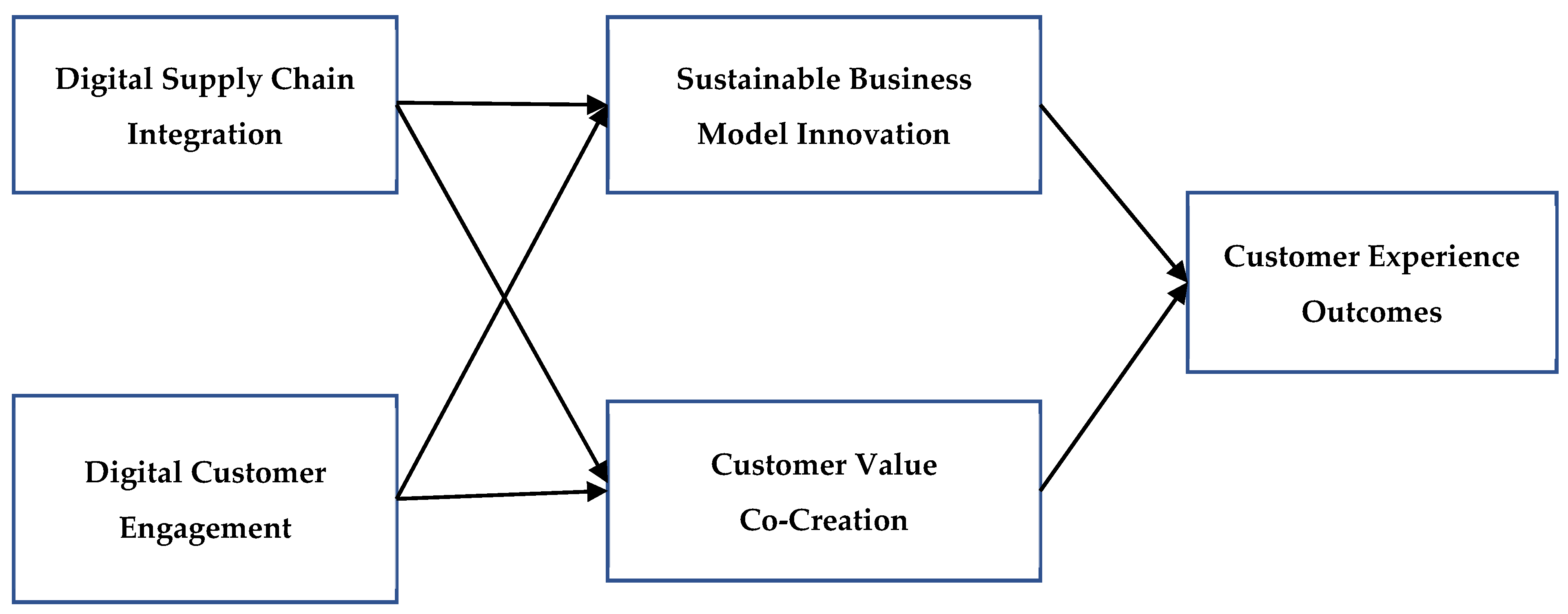
The proposed hypotheses are integrated into a comprehensive conceptual framework that illustrates the relationships among digital customer engagement and digital supply chain integration, and their influence on customer experience outcomes through relevant mediating mechanisms. Figure 1 presents this framework, providing a visual representation of the direct and mediating relationships examined in this study.

3. Methodology

3.1. Research Design

The proposed study used a quantitative and cross-sectional survey research to empirically evaluate the proposed dual-mediation model within the Pakistani service industry. The research design was deductive because it aimed to test the theoretically derived hypotheses based on the Dynamic Capabilities Theory and Service-Dominant Logic. To operationalize the latent constructs, Digital Supply Chain Integration (DSCI), Digital Customer Engagement Capabilities (DCEC), Sustainable Business Model Innovation (SBMI), Customer Value Co-Creation (CVC), and Customer Experience Outcomes (CXO), a structured questionnaire was created based on the already tested multi-item measurement scales. Measurement properties of the constructs were measured, and structural relationships among the constructs were also measured using Partial Least Squares Structural Equation Modeling (PLS-SEM) of the survey responses. A stratified random sampling technique was used to ensure balanced representation across sectors and firm sizes. Based on model complexity and the number of latent constructs, a minimum sample of 350 respondents was targeted, meeting Kline’s [47] and Hair et al.’s [48] criteria for robust structural equation modeling.

3.2. Measurement Instrument and Operationalization

The conceptualization of all constructs in this study was based on reflective latent variables and was measured using multi-item Likert-type measures, which were modified based on known studies to achieve content validity. All the items were quantified using a five-point scale (1 = strongly disagree) to 5 (strongly agree).
Digital Supply Chain Integration (DSCI) was assessed through the approach of adopting the items modified in Zhang et al. [10] that involved the degree of digital integration between firms and external suppliers in real-time data exchange, data visibility, and coordinated digital systems. Examples were: “Our firm shares real-time service demand and delivery data with key stakeholders” and “Our service processes are digitally integrated with partner (suppliers and partners) systems.”
Digital Customer Engagement Capabilities (DCEC) was measured using scales adapted from Rasool et al. [49] with references to the capabilities of the firm to communicate with customers by using digital channels, including mobile applications, social media, and CRM systems. Examples were: “Our digital platforms support two-way interaction with customers” and “Our employees use digital tools to manage customer relationships effectively”.
Sustainability Business Model Innovation (SBMI) was measured using the scale developed by Clauss [50], and it encompassed the redesign of value creation, delivery, and capture mechanisms by the firm to include the aim of environmental and social sustainability. Sample items were: “Our business model integrates social or environmental goals with profitability” and “Our firm invests in technologies that support sustainable operations”.
Customer Value Co-Creation (CVC) was measured using items adapted from Hollebeek [27], and they assessed the extent to which customers are actively involved in the development of services, the customer feedback and customized experience. The following were examples: “We actively involve customers in improving our service processes” and “Our service design incorporates suggestions gathered from customers”.
The measurement of Customer Experience Outcomes (CXO) was based on the EXQ scale created by Klaus and Maklan [51] that included cognitive, emotional, and relational appraisals of service engagement by customers. In the present study, CXO was assessed from the perspective of managerial respondents as perceived Customer Experience Outcomes. This approach is appropriate in studies examining firm-level capabilities, where managers evaluate aggregated customer feedback, service interactions, and experiential performance indicators across multiple customer touchpoints. The sample items were: “Our customers consistently report positive experiences with our services,” and “Customers are likely to continue using our services.” The measurement items used for all constructs in this study are provided in Appendix A.

3.3. Ethical Considerations

Ethical standards of research were observed in the process of data collection and analysis in this study. The respondents were involved in a voluntary fashion, and they were made aware of the purpose of the research and the confidentiality of their responses. Personal and company names were not gathered, and the respondents were anonymized. Ethical approval was obtained from the relevant academic review committee before data collection. The data were gathered according to the ethical guidelines of social science research. In addition, the research subjects gave informed consent electronically before filling out the questionnaire. The respondents were informed that the information provided by them would be kept strictly confidential and would only be used for academic purposes.

3.4. Data Analysis Procedure

The data obtained was processed using Partial Least Squares Structural Equation Modeling (PLS-SEM) in SmartPLS 4.1.0.9. The reason for PLS-SEM was its applicability to complex predictive models with many latent constructs and mediation effects, especially in exploratory and emerging-economy settings [48].
The analysis was done in two phases, i.e., the measurement model was initially tested in order to determine reliability and validity. Cronbach’s alpha and Composite Reliability (CR) were used to test internal consistency reliability. Factor loadings and Average Variance Extracted (AVE) were used to assess convergent validity; loadings had to be higher than 0.70, and AVE had to be higher than 0.50. The Fornell–Larcker criterion and the Heterotrait Monotrait (HTMT) ratio were used to test the discriminant validity.
The relationship hypotheses were tested using the structural model. Bootstrapping was done with 5000 resamples to determine the path coefficients (β values) used to test the statistical significance of the regression. To check the explanatory power, the coefficient of determination (R2) was investigated. The substantive effect of exogenous constructs on endogenous variables was computed as effect sizes (f2). The mediation effects were measured using indirect path coefficients and level of significance.
These PLS-SEM processes directly gave the values in Tables 3–7, including measurement reliability statistics, discriminant validity matrices, structural path coefficients, effect sizes, and predictive relevance (Q2) through the PLS Predict procedure.

3.5. Common Method Bias

Common method bias is known as the situation “When the estimates of the relationships between two or more constructs are biased because they are measured with the same method” [49]. As the current research study was based on self-reported survey data, which was obtained through single respondents, the possibility of common method bias (CMB) was adequately considered. Several procedures and statistical solutions were adopted. Procedurally, clear wording of items, spacing out of scales in the questionnaire to prevent response patterning, and assurance of the respondent that his or her responses were confidential, were to minimize social desirability bias. The one-factor test of Harman indicated statistically that the single factor could not contribute to more than 42.27% of the total variance, which indicated that CMB was not a key issue [50].

4. Results

4.1. Demographic Profile of the Respondents

Demographic factors of the respondents provide useful information regarding the makeup of the sample and the representativeness of the study population. A total of 350 valid responses were collected from employees across various service sectors, including banking, healthcare, telecommunication, and hospitality. Table 2 shows the demographic composition.
Gender wise, the sample was composed of 214 males (61.1%) and 136 females (38.9%), which shows that male participants were in the majority. In terms of age, most of the respondents fell within the 35–44 years category (41.7%), 25–34 years (32.0%), 45–54 years (20.6%), and 55 years and above (5.7%). The distribution indicates that the majority of the respondents were in the early to mid-career stages, which are usually characterized by increased activity in digital transformation efforts and customer-facing roles. In terms of education, a good percentage of the respondents had a Master’s degree or higher (70.9%), 28.0% had a Bachelor’s degree, and only a small fraction (1.1) had an Intermediate or Further Education (FE) qualification. The educational qualification is high as the service industries being examined are knowledge-based, with higher qualifications needed to be a manager in most cases. Looking at the job positions, the majority of the participants worked in the middle management (57.1%) and senior management (33.8%), and in the junior management or supervisory (9.1%) positions. This signifies that the respondents were highly empowered in terms of decision-making and strategic participation and, therefore, were in a good position to offer informed insights into customer experience practices and digital transformation. Distribution in the industry depicted a balanced distribution between the four industries (banking, 28.3%, telecom, 26.6%, hospitality, 24.2%, and healthcare, 20.9%). This diversity will boost the strength of the findings as it covers sectoral differences in digital adoption and sustainability-based initiatives. When it comes to work experience, the highest percentage of respondents indicated 11–15 years of professional experience (34.3%), 5–10 years of work experience (26.9), and over 20 years of work experience (13.7). This distribution indicates that the sample was mostly a group of experienced professionals who had a lot of exposure to the process of organizational change and customer management strategies.
Table 2. Demographic profile of the respondents.
FrequencyPercentage
Gender
Male21461.1
Female13638.9
Age Group
25–34 years11232.0
35–44 years14641.7
45–54 years7220.6
55 years and above205.7
Education
Intermediate/FE 41.1
Bachelor’s degree9828.0
Master’s and above degree24870.9
Job Position
Junior management/Supervisory329.1
Middle management20057.1
Senior management11833.8
Industry/Sector
Banking9928.3
Healthcare7320.9
Telecom9326.6
Hospitality8524.2
Work Experience
5–10 years9426.9
11–15 years12034.3
16–20 years 8825.1
More than 20 years4813.7

4.2. Measurement Model

The measurement model was found to be reliable and valid, as both Cronbach’s Alpha and Composite reliability were high and above the accepted validity of 0.70, which is sufficiently high as indicated in research literature, which implies strong internal consistency (Table 3). The ones that have low factor loadings were dropped from the model. Moreover, the AVE of every construct is more than the threshold of 0.50, which is appropriate convergent validity [7,48].
Discriminant validity was measured using both Fornell–Larcker [51] and Heterotrait–Monotrait ratio (HTMT) [52]. The results of the Fornell–Larcker criterion show that all the diagonal values are greater than their correlation value for that construct, validating discriminant validity (Table 4). The results of HTMT also demonstrate that all the values are below the recommended cut-off of 0.85, which in turn indicates the discriminant validity in the measurement model (Table 5). The thorough review of this kind makes the measurement model valid and reliable and preconditions the analysis of the structural model.
Multicollinearity refers to “a high correlation between two or more independent variables” [53]. Variance inflation factor (VIF) is measured to identify the extent of collinearity in PLS-SEM. Usually, there are two rules: when the value of VIF is 5 or higher, it is possible that there is a problem of collinearity. In fact, there are no values of 5 or higher in the measurement items. However, the values of VIF used in this research were less than 3. Thus, there is no problem of collinearity in the measured items, and all the PLS algorithms have produced the desired results [48].
Constructs in this paper were outlined as reflective measurement models, and these models are in line with the previous literature, where indicators are expressions of their latent construct. Item purification was conducted before final model estimation. Factors whose indicators have a factor loading less than the recommended value of 0.70 would be considered to be dropped in order to enhance construct reliability and convergent validity. Items that failed to satisfy this requirement or had issues with cross-loading were cut one at a time. The items that have been retained in Table 3 are those that met the criteria of reliability and validity [25,48].
The results of the measurement model are shown in Table 3. The labels of the indicators CVC1-CVC6 reflect the personal survey questions that gauge Customer Value Co-Creation, whereas the labels SBMI1-SBMI5 refer to the questions that gauge Sustainable Business Model Innovation. In the same manner, DSCI1-DSCI5 are items of Digital Supply Chain Integration, DCEC1-DCEC5 are items of Digital Customer Engagement Capabilities, and the items of Customer Experience Outcomes are CXO1-CXO6. That is, each indicator is related to a certain questionnaire item based on the previous scales that were already valid.
The measurement model demonstrates strong reliability and validity. Convergent validity was established, as all factor loadings exceeded 0.70, Composite reliability values were above 0.70, and AVE values exceeded 0.50. No multicollinearity issues were identified since all of the VIFs were less than 3. These findings suggest that the constructs were assessed with reasonably acceptable precision and consistency.
Table 3. Measurement model.
ConstructItemFactor LoadingVariance Inflation FactorCronbach AlphaComposite ReliabilityAverage Variance Extracted
Customer Value Co-CreationCVC1 0.81 1.94 0.870.87 0.67
CVC3 0.85 2.34
CVC4 0.82 2.135
CVC5 0.77 1.77
CVC6 0.83 2.17
Customer Experience OutcomesCXO1 0.84 2.43 0.91 0.91 0.69
CXO2 0.83 2.39
CXO3 0.82 2.24
CXO4 0.83 2.38
CXO5 0.84 2.48
CXO6 0.82 2.21
Digital Customer EngagementDCE2 0.832 2.13 0.89 0.89 0.69
DCE3 0.84 2.33
DCE4 0.80 1.92
DCE5 0.83 2.27
DCE6 0.84 2.30
Digital Supply Chain IntegrationDSC1 0.85 2.15 0.85 0.85 0.69
DSCI2 0.82 1.82
DSCI3 0.84 2.00
DSCI6 0.81 1.82
Sustainable Business Model InnovationSBMI1 0.81 2.06 0.90 0.90 0.66
SBMI2 0.80 2.09
SBMI3 0.85 2.33
SBMI4 0.79 2.06
SBMI5 0.81 2.18
SBMI6 0.81 2.14
Table 4. Fornell–Larcker criterion.
CVC CXO DCE DSCI SBMI
CVC 0.81
CXO 0.69 0.83
DCE 0.66 0.60 0.83
DSCI 0.66 0.560.37 0.83
SBMI 0.42 0.45 0.40 0.36 0.81
Table 5. Heterotrait–Monotrait ratio (HTMT).
CVC CXO DCE DSCI SBMI
CVC
CXO 0.77
DCE 0.74 0.66
DSCI 0.76 0.63 0.43
SBMI 0.46 0.49 0.44 0.41

4.3. Structural Model

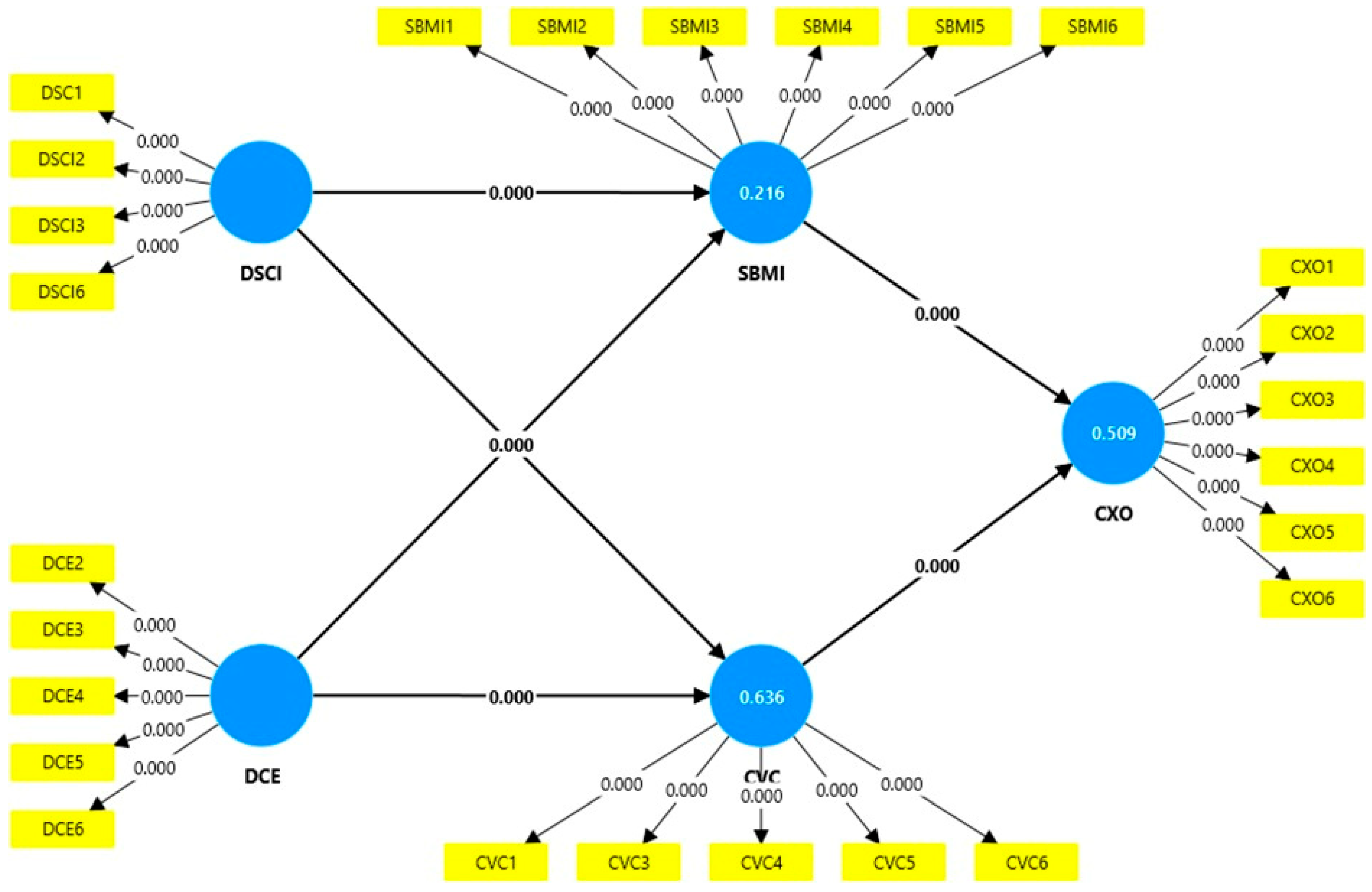
The findings of the current study provide robust empirical evidence of the proposed conceptual framework and how Digital Supply Chain Integration (DSCI) and Digital Customer Engagement Capabilities (DCEC) influence Customer Experience Outcomes (CXO) through the intermediation of Sustainable Business Model Innovation (SBMI) and Customer Value Co-Creation (CVC). The excellent explanatory power of the model (R2 for CVC = 0.636; CXO = 0.509) confirms that the combined view of technological, organizational, and relational capabilities gives a comprehensive account of customer experience improvement in digital service ecosystems.
Effect size (f2) can be defined as “the change in the R2 when a specified exogenous construct was omitted from the model, which could be used to evaluate whether the omitted construct had a substantial impact on the endogenous variable” [48]. It is suggested to consider values of 0.02 as small, 0.15 as medium, and 0.35 as a large effect size [54]. The results of this study show that Customer Value Co-Creation (CVC) has a very large effect on Customer Experience Outcomes (CXO) (f2 = 0.620), indicating a significant influence on customer perceptions. The fact that this effect is significantly larger (far exceeding the 0.35 threshold) means that the experiential results of digital service ecosystems are conditioned by the action of relational and participatory processes and not structural innovation only. This shows that the intensity of customer interaction, dialogue, and perceived involvement are prevalent to experiential drivers.
On the same note, Digital Customer Engagement Capabilities (DCEC) (f2 = 0.537) and Digital Supply Chain Integration (DSCI) (f2 = 0.549) showcase significant influences on CVC. On the other hand, DCEC—SBMI (f2 = 0.105) represents a small-to-medium effect, whereas DSCI—SBMI (f2 = 0.067) and SBMI—CXO (f2 = 0.065) indicate small effects. The more modest effect size of SBMI-CXO indicates that sustainability-directed innovation plays a role, and its contribution to customer experience is more of an indirect and enabling factor. Although sustainable redesign tends to enhance organizational credibility and long-term positioning, it may not be reflected in immediate terms in the form of emotionally salient or interaction-based experiential gains to the customer. This distinction between structural innovation and relational engagement makes it clear that the foundation of legitimacy is created by sustainability transformation, but the experiential value is brought directly through the co-creation process. Overall, these findings highlight that while sustainability transformation builds a foundation of legitimacy, customer experience is primarily driven by co-creation processes, emphasizing the importance of interaction, dialogue, and customer involvement in digital service environments.

4.3.1. Direct Relationships

As shown in Figure 2, The findings indicate that DSCI has a strong and significant positive impact on SBMI (β = 0.247, p < 0.001) and CVC (β = 0.483, p < 0.001), which lends credence to the fact that digitally integrated supply chains facilitate real-time data sharing, cross-functional visibility, and collaborative innovation among ecosystem partners. These results are consistent with other previous research that considers DSCI as a digital integration capability enabling agility, innovation, and transformation that is sustainability-oriented [3,23,24]. Enabling the free flow of information, DSCI enhances the firm’s ability to identify emerging sustainability opportunities and reconfigure business processes accordingly [43].
The sizeable correlation between DCEC and CVC (β = 0.478, p < 0.001) also supports the Service-Dominant Logic hypothesis according to which customer engagement is a key antecedent of co-creation behavior [20,29,55]. Customers who are digitally empowered are more involved in the process of service customization, feedback, and co-creation of experiences. This relational process develops trust, more interaction between customers and the firm, and perceived enhancement of the experiential value. Similarly, the DCEC- SBMI result (β = 0.311, p < 0.001) indicates that the capabilities of the customers to engage not only affect the interactions but also provide the market intelligence to be utilized in the development of an innovative and sustainable service model. It underscores the reality that customer insights can be generated using digital engagement tools such as CRM systems, AI-driven analytics, and interactive applications to facilitate the creation of sustainability-based innovation [45,56].
In addition, as shown in Table 6, the strongest relationship was found between CVC—CXO (β = 0.608, p < 0.001), which is the strongest determinant of customer experience, with the co-creation of value processes playing the most prominent role in determining customer experience. The strength of this coefficient supports the previous interpretation of the effect size, indicating that the outcomes of the experience are very sensitive to the perceived participation and collaboration. Customers seem to have a stronger appreciation of being part of a process of service development and less appreciation of structural innovation practices. Lastly, SBMI—CXO (β = 0.196, p < 0.001) shows that sustainable innovation has a positive, but weak effect on customer experience. This result is statistically significant, but the lower value of this path indicates that sustainability innovation improves experiential perceptions by forming trust, being transparent, and signaling ethics as opposed to by immediate emotional involvement.

4.3.2. Mediation Effects

As indicated in Table 6, The mediation analysis indicates that CVC and SBMI play distinct yet complementary roles. DCE—CVC—CXO (β = 0.291, t = 9.437, p < 0.001) and DSCI—CVC—CXO (β = 0.294, t = 10.261, p < 0.001) were also both strong and significant. These indirect effects are so significant that they prove the validity of the claim that digital transformation initiatives are most likely to be transformed into experiential results by relying on the relational activation mechanisms [33].
Conversely, the mediation through SBMI—DCEC—SBMI—CXO (β = 0.061, t = 3.33, p = 0.001) and DSCI—SBMI—CXO (β = 0.049, t = 2.94, p = 0.003) had a weaker strength. This suggests that sustainability-oriented business model innovation is an indirect contributor by strengthening legitimacy and long-term differentiation rather than directly intensifying customer experiences [4].
Table 6. Path coefficients.
Pathβ (Beta Values)T Statisticsp ValuesDecisionf2
Direct Effects
CVC → CXO0.60815.1860.000Supported0.620
DCE → CVC0.47813.7280.000Supported0.537
DCE → SBMI0.3116.0300.000Supported0.105
DSCI → CVC0.48314.2370.000Supported0.549
DSCI → SBMI0.2474.4150.000Supported0.067
SBMI → CXO0.1964.2350.000Supported0.065
Indirect Effects
DCE → CVC → CXO0.2919.437 0.000Supported
DSCI → CVC → CXO0.29410.261 0.000Supported
DCE → SBMI → CXO0.0613.330 0.001Supported
DSCI → SBMI → CXO0.0492.943 0.003Supported
Note: CVC = Customer Value Co-Creation; CXO = Customer Experience Outcomes; DCE = Digital Customer Engagement; DSCI = Digital Supply Chain Integration; SBMI = Sustainable Business Model Innovation.

4.4. PLS Predict Analysis

The PLS Predict method was used to assess the PLS model’s predictive power, which is particularly adept at gauging the out-of-sample predictive relevance of reflective measurement and structural models within the realm of Partial Least Squares Structural Equation Modeling (PLS-SEM). The outcomes detailed in Table 7 illustrate that the Q2 predict values for all the items pertinent to the PLS model are higher than 0, ensuring the model’s predictive relevance for a dependent construct [48]. The Q2 values of 0.422, 0.251, and 0.138 are all positive. Customer Experience Outcomes are found to be the most relevant variables in prediction, and this fact proves that the model can be effective in predicting experiential outcomes. The average of Q2 of SBMI (0.138) indicates that, though the concept of sustainability-oriented innovation is significantly predicted by digital capabilities, its predictive power is relatively weak. This observation is consistent with previous findings of effect sizes, which revealed that SBMI is an enabling structural process, not the domineering experiential force.
In practice, companies that want to have a greater impact in the experiential dimension ought to focus on mobilizing customer engagement, and sustainability innovation should be seen as a platform on which, not a replacement of relational value generation.
Table 7. Model fitness (PLS Predict).
SSOSSEQ2 (=1 − SSE/SSO)
CVC1585.000916.4940.422
CXO1902.0001235.0800.351
SBMI1902.0001639.7310.138

5. Discussion

The research results provide solid empirical insights into the relationship between the power of digital transformation, i.e., Digital Supply Chain Integration (DSCI) and Digital Customer Engagement Capabilities (DCEC), and Customer Experience Outcomes (CXO) in service sectors of emerging markets. The findings affirm that digital integration and engagement are extremely useful to customer experience, and both are partly mediated by Sustainable Business Model Innovation (SBMI) and Customer Value Co-Creation (CVC). Notably, the findings reveal a differential strength of two mediating mechanisms. Customer Value Co-Creation (CVC) has a significantly stronger experiential impact than Sustainable Business Model Innovation (SBMI), indicating that relational engagement has a more direct influence on customer perceptions than structural sustainability transformation. These findings contribute to the theoretical advancement of digital transformation by integrating the complementary perspectives of Dynamic Capabilities Theory (DCT) and Service-Dominant Logic (SDL).
First, the positive correlation between DSCI and SBMI suggests that digital integration is a higher-level dynamic capability enabling companies to feel and take new opportunities on the basis of information transparency, data-driven decision-making, and collaboration in an ecosystem. This result confirms previous literature that underscores the fact that digital connectivity will improve the capacity of the firm to be sustainable in its innovation by integrating environmental and social goals into its operations [45,57]. Moreover, recent studies emphasize that digital transformation strengthens coordination and integration mechanisms, which facilitate innovation and value creation within organizations [5]. Digital integration does not seem to be just a way to improve operational agility but rather an enabling infrastructure that provides long-term sustainability-focused redesign.
In this regard, digital integration supports real-time resource reconfiguration and adaptive responses, which are essential aspects of dynamic capabilities, to enable firms to create innovative business models that effectively manage efficiency, resilience, and sustainability in the service context.
Second, the research establishes a significant relationship between the concepts of DCEC and CVC, which confirms the assumption by SDL that value is co-created and not delivered. Firms that invest in digital engagement platforms, including AI-based personalization of services, interactive communication tools, and omnichannel feedback systems, enable customers to participate in service shaping [38,39]. Consistent with the recent evidence, customer participation plays a critical role in enhancing co-creation processes and experiential value in digitally enabled service environments [32]. Such an interactive dynamic would boost relational trust, emotional connection, and perceived value, which eventually improves the overall customer experience. The significant effect size between CVC and CXO indicates that customers are more receptive to the availability of participation and dialogue opportunities than to invisible efforts by the internal organization design to redesign its operations through less noticeable efforts that are realized during service encounters. This highlights the primacy of relational engagement in shaping customer experience within digitally mediated service ecosystems.
Third, the two mediators, SBMI and CVC, play distinct yet complementary roles in translating digital capabilities into better customer experiences. SBMI is an organizational innovation channel, where the firms aim at balancing their sustainability with their customer-oriented strategies, whereas CVC is a relationship channel where customers contribute to the experience co-creation. However, the relatively weaker effect of SBMI on CXO suggests that sustainability-oriented innovation only adds value to customer experience primarily through indirect mechanisms such as legitimacy building, ethical positioning, and long-term trust development rather than immediate experiential engagement. This finding aligns with recent evidence suggesting that business model innovation influences customer perceptions, but often through gradual and perception-based mechanisms [11]. In emerging market contexts, customers may prioritize responsiveness, personalization, and interaction quality over less visible structural sustainability initiatives when forming experiential judgments.
Collectively, these findings highlight the distinction between technological capability development and experiential value creation. Digital transformation alone is insufficient to generate superior customer experiences unless it is complemented by both organizational innovation and active customer engagement mechanisms. These results indicate that the effectiveness of digital transformation depends not only on technological advancement but also on the alignment between integration capabilities, sustainability-oriented innovation, and co-creation processes.

5.1. Theoretical Contributions

Various theoretical contributions of the present study are important to the literature on digital transformation, customer experience, and innovation based on sustainability in developing service economies.
First, it built its foundation on Dynamic Capabilities Theory (DCT) with a clear demonstration in an empirical way that Digital Supply Chain Integration (DSCI) is a digital integration capability that enables firms to constantly monitor the changes in the environment, capture digital opportunities, and alter operational habits according to the sustainability goals. The significant relationships between DSCI and Sustainable Business Model Innovation (SBMI) and Customer Value Co-Creation (CVC) suggest that digital infrastructure alone is insufficient unless translated into innovation and relational activation. Importantly, the findings refine DCT by differentiating between structural reconfiguration (SBMI) and relational activation (CVC). While both are capability-driven outcomes, their experiential impact differs substantially, indicating that not all dynamic capability pathways contribute equally to customer experience [19]. This nuance responds to the call to contextualize DCT within digitally intensive service ecosystems.
Second, the paper is an empirical contribution to Service-Dominant Logic (SDL) by demonstrating a direct positive relationship between Digital Customer Engagement Capabilities (DCEC) and Customer Value Co-Creation (CVC) and a positive indirect relationship between Digital Customer Engagement Capabilities (DCEC) and Customer Experience Outcomes (CXO). This exceptionally large effect size of CVC on CXO provides magnitude-based evidence for SDL’s central premises, i.e., experiential value is predominantly co-created rather than structurally delivered. This strengthens SDL by demonstrating not only statistical significance but also practical governance of relational processes [58]. The integration of DCT and SDL therefore clarifies complementary roles. DCT explains how firms build and configure digital engagement capabilities, whereas SDL explains how those capabilities become experientially meaningful through interaction.
Third, the sustainability is embedded in the nexus of the digital transformation-customer experience, which is also a theoretical progression in DCT and SDL. Rather than positioning sustainability merely as an operational adaptation mechanism, this study shows that sustainability-oriented innovation plays a foundational yet secondary experiential role. Its comparatively smaller direct impact on CXO suggests that sustainability strengthens legitimacy and trust but requires relational activation to fully translate into experiential value. This layered interpretation provides a deeper theoretical perspective than prior work that treated innovation effects as homogenous.
Lastly, by focusing on an emerging economy context such as Pakistan, the study extends both DCT and SDL beyond a Western-centric context. The findings indicate that in institutional settings characterized by resource constraints and digital maturity gaps, relational engagement mechanisms may compensate for structural limitations, thereby strengthening experiential outcomes.

5.2. Practical Implications

The results of this research have important managerial implications for service organizations that seek to pursue a digital transformation and sustainability-oriented strategy, especially in emerging economies. First, managers ought to see that Digital Supply Chain Integration (DSCI) is not only a strategic facilitator of innovation and collaboration, but also an improvement of operations. Integrating partners, suppliers, and customers with data-driven platforms, such as ERP systems, AI analytics, and blockchain-based networks, firms can become more responsive, transparent, and ecosystem-level coordinated. The results indicate that infrastructure investment alone does not guarantee experiential improvement unless coupled with relational engagement mechanisms.
Second, Sustainable Business Model Innovation (SBMI) is an extremely crucial factor in converting digital transformation to significant experiential outputs. Its impact is comparatively modest relative to co-creation mechanisms. It means that sustainability must be placed at the heart of digital strategies as opposed to a sideshow activity. Companies that incorporate sustainability into their digital infrastructure stand a higher chance of realizing sustainable differentiation and customer loyalty.
Third, the high impact of Customer Value Co-Creation (CVC) on Customer Experience Outcomes (CXO) proves that interactive engagement and participatory innovation are the key influences on customer experience excellence. Firms seeking immediate experiential gains should prioritize digital engagement tools that facilitate dialogue, personalization, and feedback integration as these mechanisms generate the strongest experiential returns.
Moreover, the findings indicate that Digital Customer Engagement Capabilities (DCEC) are an important mediator between technological integration and customer experience. Rather than investing broadly across all digital technologies, managers should focus on those that enhance interactive and co-creative capabilities.
These implications can also be illustrated through sector-specific examples within service industries. For instance, a bank implementing real-time digital integration across its service platforms can allow customers to seamlessly access services through mobile banking applications, online platforms, and branch networks, thereby improving overall service experience. Similarly, telecommunication firms can utilize digital engagement platforms to collect continuous customer feedback and co-create personalized service plans. In healthcare services, digital interaction tools may enable patients to participate in appointment scheduling, treatment feedback, and service evaluation processes. These examples demonstrate how digital capabilities combined with customer engagement and co-creation mechanisms can enhance Customer Experience Outcomes across different service sectors.
Lastly, the research forms actionable recommendations to service companies in emerging markets such as Pakistan, where institutional support and digital maturity might be minimal. The results indicate that structural constraints can be offset by organizations through combining relational and digital capabilities on a synergistic basis. With the emphasis on customer engagement, transparency, and innovation that is driven by sustainability, companies will be able to develop resilient and adaptive business models that generate economic and social value. In these conditions, the integration of technological advancement and human-focused co-creation is the determining factor in the development of sustainable competitive advantage.

5.3. Limitations and Future Research

This study is vital in offering both theoretical and empirical evidence on the processes whereby digital transformation capabilities improve customer experience. It has several limitations that present several research possibilities that can be pursued in the future. The results rest on the data gathered in the service companies in Pakistan, which is a developing economy with institutional voids and infrastructural issues. Although this context offers a good insight into how capability is built with limited resources, the external validity of the findings to other economies may be limited. The future research might hence broaden the analysis to cross-country or even regional comparisons between the emerging markets and the developed markets to determine whether institutional maturity, the regulatory frameworks, and digital preparedness moderate the relationships observed.
The cross-sectional nature of this research has one more limitation in that it measures organizational processes and perceptions at one time. Longitudinal research would offer deeper insights into how digital and sustainability capabilities evolve and how their experiential effects strengthen or weaken over time.
In addition, the article is dedicated to the service sector, in which interaction and co-creation between a customer and the service is the core of value creation. Though this specialization improves theoretical specificity, it can be disadvantageous in terms of the generalizability to the manufacturing or hybrid industries that are gradually moving towards the models of servitization and platforms. Further research might employ the framework to sample the different industries, including education, IT, and logistics, to examine the differences in the intensity of co-creation, sustainability priorities, and digital maturity.
Also, future research may conduct a study on moderating factors that affect the strength of the identified relationships. The possible boundary conditions that determine the way digital and relational capabilities are translated into innovation and experience outcomes are organizational culture, leadership support, digital orientation, and institutional pressures. Exploring these moderators would be beneficial for a better insight into the situational contingencies of digital transformation success.
Moreover, future research may further strengthen these findings by collecting customer experience data directly from customers to complement managerial assessments and provide a multi-source evaluation of experiential outcomes.
Last, although the given study follows the quantitative methodology PLS-SEM, a qualitative and mixed-method design can be used to uncover deeper contextual processes underlying sustainability-driven co-creation. Considering rapid technological advancements, such as artificial intelligence, blockchain, and immersive digital platforms, future studies should explore how these technologies reshape the balance between structural innovation and relational engagement in experience formation.


6. Conclusions

The research contributes to the current knowledge in digital transformation across the service sector by formulating and empirically substantiating a comprehensive model of interaction between Digital Supply Chain Integration and digital customer engagement functionality through Sustainable Business Model Innovation and the co-creation of customer value to improve Customer Experience Outcomes. The model is rooted in Dynamic Capabilities Theory and Service-Dominant Logic and illustrates that technological integration and customer engagement enable organizations to reconfigure and pursue sustainability-oriented innovation and relational collaboration and experience, respectively. The results indicate that in the emerging service economies, digital transformation can be considered as a holistic system of capability, where innovation and co-creation act as mediating processes that transform digital potential into customer-centric performance. This study is relevant both to the digital transformation and service management literature, as it explains why dynamic and relational capabilities can together help firms attain sustainable competitive advantage and high-quality customer experiences in the fast-changing, dynamic digital landscape. The findings also demonstrate several operational priorities that companies making a digital transformation have from a managerial perspective. To begin with, the mechanisms allowing customers to engage in the process of service development and customer feedback should accompany investments in digital infrastructure, such as integrated supply chains and data platforms. Second, business model innovation that enhances sustainability needs not to be seen as an independent project but as a part of other digital transformation efforts to develop credibility and trust in the long term. Third, to enhance their customer experience, companies need to consider using digital engagement tools that enable interaction, personalization, and co-creation, as these tools produce the most influential experience based on empirical findings. Essentially, those organizations that integrate the digital sphere, innovation by focusing on sustainability and customer engagement, are more inclined to translate technological change into a meaningful experiential value.

Author Contributions

Conceptualization, A.A.J.; Methodology, S.S.; Software, A.A.J.; Validation, A.A.J. and A.H.B.; Formal analysis, A.A.J.; Investigation, A.H.B.; Data curation, A.H.B.; Writing—original draft, S.S. and A.H.B.; Writing review and editing, A.M.; Supervision, A.M.; Project administration, A.M. All authors have read and agreed to the published version of the manuscript.

Funding

This research received no external funding.

Institutional Review Board Statement

In the gathering of data, ethical standards were strictly applied. Respondents volunteered to participate, were informed of the objective of the research and their anonymity and confidentiality were maintained. No personal data was gathered, and participants had the option of dropping out of the survey. All information was safely stored and used based on academic research purposes.

Informed Consent Statement

Informed consent was obtained from all participants involved in the study.

Data Availability Statement

The data presented in this study are available on reasonable request from the corresponding author. The data is not publicly available due to privacy and ethical restrictions.

Conflicts of Interest

The authors declare no conflict of interest.

Appendix A. Measurement Items of the Constructs Used in This Study

Digital Supply Chain Integration
ReferenceQuestions12345
[10]DSCI1. Our firm shares real-time service demand and delivery data with key stakeholders.
DSCI2. We exchange forecasts and capacity information with our main suppliers and partners.
DSCI3. Our service processes are digitally integrated with partner (suppliers and partners) systems.
DSCI4. We use digital platforms for end-to-end coordination across our service chain.
DSCI5. Our partners (suppliers and partners) and we collaboratively plan service schedules using shared systems.
DSCI6. Digital communication enables us to respond quickly to
key stakeholders’ needs.
Digital Customer Engagement Capabilities
ReferenceQuestions12345
[49]DCEC1. We use customer data to personalize services and communication
DCEC2. Our digital platforms support two-way interaction with customers.
DCEC3. We analyze customer feedback from multiple channels to improve service quality.
DCEC4. We integrate insights from social media and customer analytics into decision-making.
DCEC5. Our employees use digital tools to manage customer relationships effectively.
DCEC6. We continuously adapt our services based on customer digital engagement data.
Sustainable Business Model Innovation
ReferenceQuestions12345
[50]SBMI1. We redesign our service processes to reduce environmental impact and waste.
SBMI2. Our business model integrates social or environmental goals with profitability.
SBMI3. We collaborate with key stakeholders to develop sustainability-oriented service offerings.
SBMI4. Our firm invests in technologies that support sustainable operations.
SBMI5. We regularly assess and modify our business model to ensure long-term sustainability.
SBMI 6. Our innovation activities contribute to both business growth and societal well-being.
Customer Value Co-Creation (CVC)
ReferenceQuestions12345
[27]CVC1. We actively involve customers in improving our service processes.
CVC2. Customers share ideas that we use to co-develop or refine services.
CVC3. Our digital channels enable customers to customize or tailor their service.
CVC4. We learn from customers during interactions and quickly act on their input.
CVC5. Customers collaborate with our staff to solve problems effectively.
CVC6. Our service design incorporates suggestions gathered from customers.
Customer Experience Outcomes (Perceived) (CXO)
ReferenceQuestions12345
[51]CXO1. Our customers consistently report positive experiences with our services.
CXO2. Customers find our service interactions convenient and enjoyable.
CXO3. Our firm delivers a consistent experience across all contact points.
CXO4. Customers feel valued and understood when interacting with us.
CXO5. Customers are likely to continue using our services.
CXO6. Customers would recommend our services to others.

References

  1. Liu, K.P.; Chiu, W. Supply Chain 4.0: The Impact of Supply Chain Digitalization and Integration on Firm Performance. Asian J. Bus. Ethics 2021, 10, 371–389. [Google Scholar] [CrossRef] [Scilit]
  2. Schniederjans, D.G.; Curado, C.; Khalajhedayati, M. Supply Chain Digitisation Trends: An Integration of Knowledge Management. Int. J. Prod. Econ. 2020, 220, 107439. [Google Scholar] [CrossRef] [Scilit]
  3. Wang, T.; Shen, Y. Unlocking the Potential of Supply Chain Digitalization for Enhancing Enterprise Green Transformation Performance: Evidence from China. Humanit. Soc. Sci. Commun. 2025, 12, 1339. [Google Scholar] [CrossRef] [Scilit]
  4. Oubrahim, I.; Sefiani, N.; Happonen, A. The Influence of Digital Transformation and Supply Chain Integration on Overall Sustainable Supply Chain Performance: An Empirical Analysis from Manufacturing Companies in Morocco. Energies 2023, 16, 1004. [Google Scholar] [CrossRef] [Scilit]
  5. Zhang, Z.; Chen, M. How Digital Transformation Enhances Quality Chain Value Co-Creation Efficiency in Manufacturing: Evidence from Beijing. Sustainability 2025, 17, 5486. [Google Scholar] [CrossRef] [Scilit]
  6. Barrett, M.; Davidson, E.; Prabhu, J.; Vargo, S.L. Service Innovation in the Digital Age. MIS Q. 2015, 39, 135–154. [Google Scholar] [CrossRef] [Scilit]
  7. Chen, X.; Jaffari, A.A.; Muzaffar, A.; Rahman, N. Integrating explainable AI and corporate social responsibility for sustainable practices. Technol. Forecast. Soc. Change 2026, 223, 124444. [Google Scholar] [CrossRef] [Scilit]
  8. Lankauskienė, R.; Bandyopadhyay, P.K.; Roy, S. Evolution of Customer-Centric Innovations in Modern Ecosystems: Servitization Approach. Sustainability 2025, 17, 4754. [Google Scholar] [CrossRef] [Scilit]
  9. Kokub, S. The Role of Digital Servitization in Driving Sustainability: A Systematic Literature Review; University of Vaasa: Vaasa, Finland, 2025. [Google Scholar]
  10. Burton, J.; Raddats, C.; Story, V.; West, S.; Zolkiewski, J. Moving Beyond Manufacturing: Building a Research Agenda for Servitizing Service Firms and Ecosystems. In Smart Services Summit; West, S., Meierhofer, J., Mangla, U., Eds.; Progress in IS; Springer International Publishing: Cham, Switzerland, 2022; pp. 149–158. ISBN 978-3-030-97041-3. [Google Scholar]
  11. Tulcanaza-Prieto, A.B.; Cortez-Ordoñez, A.; Rivera, J.; Lee, C.W. Exploring Customer Perceptions of Business Model Innovation in Family Economic Groups: Evidence from Ecuador. Sustainability 2025, 17, 8793. [Google Scholar] [CrossRef] [Scilit]
  12. Amitrano, C.C.; Russo Spena, T.; Bifulco, F. Digital Engagement and Customer Experience. In Digital Transformation in the Cultural Heritage Sector; Russo Spena, T., Bifulco, F., Eds.; Contributions to Management Science; Springer International Publishing: Cham, Switzerland, 2021; pp. 119–136. ISBN 978-3-030-63375-2. [Google Scholar]
  13. Bag, S.; Srivastava, G.; Bashir, M.M.A.; Kumari, S.; Giannakis, M.; Chowdhury, A.H. Journey of Customers in This Digital Era: Understanding the Role of Artificial Intelligence Technologies in User Engagement and Conversion. Benchmarking Int. J. 2022, 29, 2074–2098. [Google Scholar] [CrossRef] [Scilit]
  14. Lemon, K.N.; Verhoef, P.C. Understanding Customer Experience Throughout the Customer Journey. J. Mark. 2016, 80, 69–96. [Google Scholar] [CrossRef] [Scilit]
  15. Gao, W.; Jiang, N. Enhancing Omnichannel Customer Experience: From a Customer Journey Design Perspective. J. Theor. Appl. Electron. Commer. Res. 2025, 20, 277. [Google Scholar] [CrossRef] [Scilit]
  16. Centobelli, P.; Cerchione, R.; Cricelli, L.; Strazzullo, S. Innovation in the Supply Chain and Big Data: A Critical Review of the Literature. Eur. J. Innov. Manag. 2022, 25, 479–497. [Google Scholar] [CrossRef] [Scilit]
  17. Geissdoerfer, M.; Vladimirova, D.; Evans, S. Sustainable Business Model Innovation: A Review. J. Clean. Prod. 2018, 198, 401–416. [Google Scholar] [CrossRef] [Scilit]
  18. Molina-Castillo, F.-J.; Sinkovics, N.; Sinkovics, R.R. Sustainable Business Model Innovation: Review, Analysis and Impact on Society. Sustainability 2021, 13, 8906. [Google Scholar] [CrossRef] [Scilit]
  19. Teece, D.J. Explicating Dynamic Capabilities: The Nature and Microfoundations of (Sustainable) Enterprise Performance. Strateg. Manag. J. 2007, 28, 1319–1350. [Google Scholar] [CrossRef] [Scilit]
  20. Vargo, S.L.; Lusch, R.F. Service-Dominant Logic: Continuing the Evolution. J. Acad. Mark. Sci. 2008, 36, 1–10. [Google Scholar] [CrossRef] [Scilit]
  21. Nambisan, S.; Wright, M.; Feldman, M. The Digital Transformation of Innovation and Entrepreneurship: Progress, Challenges and Key Themes. Res. Policy 2019, 48, 103773. [Google Scholar] [CrossRef] [Scilit]
  22. Mousavi, S.; Bossink, B.; van Vliet, M. Dynamic Capabilities and Organizational Routines for Managing Innovation towards Sustainability. J. Clean. Prod. 2018, 203, 224–239. [Google Scholar] [CrossRef] [Scilit]
  23. Dubey, D.K.; Varshney, Y.; Awasthi, R.K.; Pratap, M.; Yadav, S.K.; Kumar, M. Digital Transformation and Its Environmental Implications in Supply Chain Management. J. Big Data Anal. Bus. Intell. 2025, 2, 11–20. [Google Scholar]
  24. Tortorella, G.; Fogliatto, F.S.; Gao, S.; Chan, T.-K. Contributions of Industry 4.0 to Supply Chain Resilience. Int. J. Logist. Manag. 2022, 33, 547–566. [Google Scholar] [CrossRef] [Scilit]
  25. Jaffari, A.A. Influence of Employer Branding on Employer of Choice and Organisation Performance: A Study of Service Sector Employees’ Perception in Pakistan. Doctoral Dissertation, University of the West of Scotland, Paisley, UK, 2021. [Google Scholar]
  26. Chen, M.; Tan, X.; Zhu, J.; Dong, R.K. Can Supply Chain Digital Innovation Policy Improve the Sustainable Development Performance of Manufacturing Companies? Humanit. Soc. Sci. Commun. 2025, 12, 307. [Google Scholar] [CrossRef] [Scilit]
  27. García Alcaraz, J.L.; Díaz Reza, J.R.; Arredondo Soto, K.C.; Hernández Escobedo, G.; Happonen, A.; Vidal, R.P.I.; Jiménez Macías, E. Effect of Green Supply Chain Management Practices on Environmental Performance: Case of Mexican Manufacturing Companies. Mathematics 2022, 10, 1877. [Google Scholar] [CrossRef] [Scilit]
  28. Jaakkola, E.; Alexander, M. The Role of Customer Engagement Behavior in Value Co-Creation: A Service System Perspective. J. Serv. Res. 2014, 17, 247–261. [Google Scholar] [CrossRef] [Scilit]
  29. Hollebeek, L.D. Developing Business Customer Engagement through Social Media Engagement-Platforms: An Integrative SD Logic/RBV-Informed Model. Ind. Mark. Manag. 2019, 81, 89–98. [Google Scholar] [CrossRef] [Scilit]
  30. Dam, N.A.K.; Le Dinh, T.; Menvielle, W. Customer Co-Creation through the Lens of Service-Dominant Logic: A Literature Review. In Proceedings of the AMCIS 2020, Salt Lake City, UT, USA, 15–17 August 2020. [Google Scholar]
  31. Lee, H.-Y.; Grinevich, V.; Chipulu, M. How Can Value Co-Creation Be Integrated into a Customer Experience Evaluation? Eur. Manag. J. 2023, 41, 521–533. [Google Scholar] [CrossRef] [Scilit]
  32. Xu, H.; Chen, Y.; Xu, P. Driving Mechanism of Customer Participation in Service-Oriented Enterprises: A Perspective of Value Co-Creation. Sustainability 2024, 16, 3310. [Google Scholar] [CrossRef] [Scilit]
  33. Le, T.T.; Nhu, Q.P.V.; Behl, A. Role of Digital Supply Chain in Promoting Sustainable Supply Chain Performance: The Mediating of Supply Chain Integration and Information Sharing. Int. J. Logist. Manag. 2025, 36, 1439–1462. [Google Scholar] [CrossRef] [Scilit]
  34. Xue, R.; Ong, T.S.; Di Vaio, A. Environmentally Sustainable Development: The Role of Supply Chain Digitalization in Firms’ Green Productivity. Sustain. Dev. 2025, 33, 7807–7825. [Google Scholar] [CrossRef] [Scilit]
  35. Bocken, N. Business Models for Sustainability. In Oxford Research Encyclopedia of Environmental Science; Oxford University Press: Oxford, UK, 2023. [Google Scholar]
  36. Kang, M.; Shin, D.-H.; Gong, T. The Role of Personalization, Engagement, and Trust in Online Communities. Inf. Technol. People 2016, 29, 580–596. [Google Scholar] [CrossRef] [Scilit]
  37. Shen, H.; Wu, L.; Yi, S.; Xue, L. The Effect of Online Interaction and Trust on Consumers’ Value Co-Creation Behavior in the Online Travel Community. J. Travel Tour. Mark. 2020, 37, 418–428. [Google Scholar] [CrossRef] [Scilit]
  38. Ball, D.; Coelho, P.S.; Vilares, M.J. Service Personalization and Loyalty. J. Serv. Mark. 2006, 20, 391–403. [Google Scholar] [CrossRef] [Scilit]
  39. Rane, N.; Choudhary, S.; Rane, J. Hyper-Personalization for Enhancing Customer Loyalty and Satisfaction in Customer Relationship Management (CRM) Systems. SSRN Electron. J. 2023. [Google Scholar] [CrossRef] [Scilit]
  40. Chatterjee, S.; Rana, N.P.; Dwivedi, Y.K. How Does Business Analytics Contribute to Organisational Performance and Business Value? A Resource-Based View. Inf. Technol. People 2024, 37, 874–894. [Google Scholar] [CrossRef] [Scilit]
  41. Bolton, R.N.; McColl-Kennedy, J.R.; Cheung, L.; Gallan, A.; Orsingher, C.; Witell, L.; Zaki, M. Customer Experience Challenges: Bringing Together Digital, Physical and Social Realms. J. Serv. Manag. 2018, 29, 776–808. [Google Scholar] [CrossRef] [Scilit]
  42. Jalil, F.; Yang, J.; Al-Okaily, M.; Rehman, S.U. E-Commerce for a Sustainable Future: Integrating Trust, Green Supply Chain Management and Online Shopping Satisfaction. Asia Pac. J. Mark. Logist. 2024, 36, 2354–2370. [Google Scholar] [CrossRef] [Scilit]
  43. Qiao, J.; Li, S.; Xiong, S.; Li, N. How Does the Digital Capability Advantage Affect Green Supply Chain Innovation? An Inter-Organizational Learning Perspective. Sustainability 2023, 15, 11583. [Google Scholar] [CrossRef] [Scilit]
  44. Ahmad, F.; Mustafa, K.; Hamid, S.A.R.; Khawaja, K.F.; Zada, S.; Jamil, S.; Qaisar, M.N.; Vega-Muñoz, A.; Contreras-Barraza, N.; Anwer, N. Online Customer Experience Leads to Loyalty via Customer Engagement: Moderating Role of Value Co-Creation. Front. Psychol. 2022, 13, 897851. [Google Scholar] [CrossRef] [Scilit]
  45. Gao, L.; Li, G.; Tsai, F.; Gao, C.; Zhu, M.; Qu, X. The Impact of Artificial Intelligence Stimuli on Customer Engagement and Value Co-Creation: The Moderating Role of Customer Ability Readiness. J. Res. Interact. Mark. 2023, 17, 317–333. [Google Scholar] [CrossRef] [Scilit]
  46. Alexander, M.; Jaakkola, E. Customer Engagement Behaviours and Value Co-Creation. In Customer Engagement; Routledge: Oxford, UK, 2015; pp. 3–20. [Google Scholar]
  47. Kline, T.J. Sample Issues, Methodological Implications, and Best Practices. Can. J. Behav. Sci./Rev. Can. Sci. Comport. 2017, 49, 71. [Google Scholar] [CrossRef] [Scilit]
  48. Hair, J.F.; Sarstedt, M.; Ringle, C.M.; Gudergan, S.P. Advanced Issues in Partial Least Squares Structural Equation Modeling; SAGE Publications: Thousand Oaks, CA, USA, 2017. [Google Scholar]
  49. Jordan, P.J.; Troth, A.C. Common Method Bias in Applied Settings: The Dilemma of Researching in Organizations. Aust. J. Manag. 2020, 45, 3–14. [Google Scholar] [CrossRef] [Scilit]
  50. Podsakoff, P.M.; Organ, D.W. Self-Reports in Organizational Research: Problems and Prospects. J. Manag. 1986, 12, 531–544. [Google Scholar] [CrossRef] [Scilit]
  51. Fornell, C.; Larcker, D.F. Evaluating Structural Equation Models with Unobservable Variables and Measurement Error. J. Mark. Res. 1981, 18, 39–50. [Google Scholar] [CrossRef] [Scilit]
  52. Henseler, J.; Ringle, C.M.; Sarstedt, M. A New Criterion for Assessing Discriminant Validity in Variance-Based Structural Equation Modeling. J. Acad. Mark. Sci. 2015, 43, 115–135. [Google Scholar] [CrossRef] [Scilit]
  53. Risher, J.; Hair, J.F., Jr. The Robustness of PLS across Disciplines. Acad. Bus. J. 2017, 1, 47–55. [Google Scholar]
  54. Cohen, J. Statistical Power Analysis for the Behavior Science: Lawrance Eribaum Association; University of Toronto: Toronto, ON, Canada, 1988. [Google Scholar]
  55. Fan, W.; Shao, B.; Dong, X. Effect of E-Service Quality on Customer Engagement Behavior in Community e-Commerce. Front. Psychol. 2022, 13, 965998. [Google Scholar] [CrossRef] [Scilit]
  56. Saleem, A.; Zaheer, A.; Lakho, A.; Siddiqui, M. Harnessing AI for Enhanced CRM: Insights into Customer Satisfaction, Loyalty and Retention. Bull. Manag. Rev. 2024, 1, 375–406. [Google Scholar]
  57. Cheng, C.; Wang, L.; Xie, H.; Yan, L. Mapping Digital Innovation: A Bibliometric Analysis and Systematic Literature Review. Technol. Forecast. Soc. Change 2023, 194, 122706. [Google Scholar] [CrossRef] [Scilit]
  58. Ndhlovu, T.; Maree, T. The Central Role of Consumer–Brand Engagement in Product and Service Brand Contexts. J. Mark. Anal. 2024, 12, 944–961. [Google Scholar] [CrossRef] [Scilit]
Figure 1. Conceptual framework.
Systems 14 00390 g001
Figure 2. Structural model results with standardized path coefficients and significant relationships.
Systems 14 00390 g002
Table 1. Definition of key terms.
AbbreviationFull TermDefinition
DSCIDigital Supply Chain IntegrationThe firm’s capability to digitally integrate suppliers, partners, and internal operations to enable real-time coordination, transparency, and agility.
DCECDigital Customer Engagement CapabilitiesThe firm’s capability to interact with customers through digital platforms to foster ongoing, interactive relationships.
SBMISustainable Business Model InnovationThe redesign of business models to incorporate environmental and social sustainability into value creation and delivery mechanisms.
CVCCustomer Value Co-Creation. The active participation of customers in shaping, customizing, and enhancing service offerings.
CXOCustomer Experience OutcomesCustomers’ overall cognitive, emotional, and relational evaluations of their service offerings
Disclaimer/Publisher’s Note: The statements, opinions and data contained in all publications are solely those of the individual author(s) and contributor(s) and not of MDPI and/or the editor(s). MDPI and/or the editor(s) disclaim responsibility for any injury to people or property resulting from any ideas, methods, instructions or products referred to in the content.