Core Ontology Usability: From a Formalized Knowledge Base to the Development of a System of Systems Domain Understanding


Abstract
1. Introduction
1.1. Research Problem
1.2. Ontology Usability
1.3. Contributions
- A formal representation of a core ontology for missions and capabilities in SoS in an ontology language, and subsequent testing of the constraints defined in the core ontology.
- Insights into how a formalized ontology can be queried to support the categorization and characterization of different kinds of decisions inherent in an SoS.
- A proposed mapping of the core ontology into a domain ontology, to understand the contextual usability of the ontology in a real-world SoS.
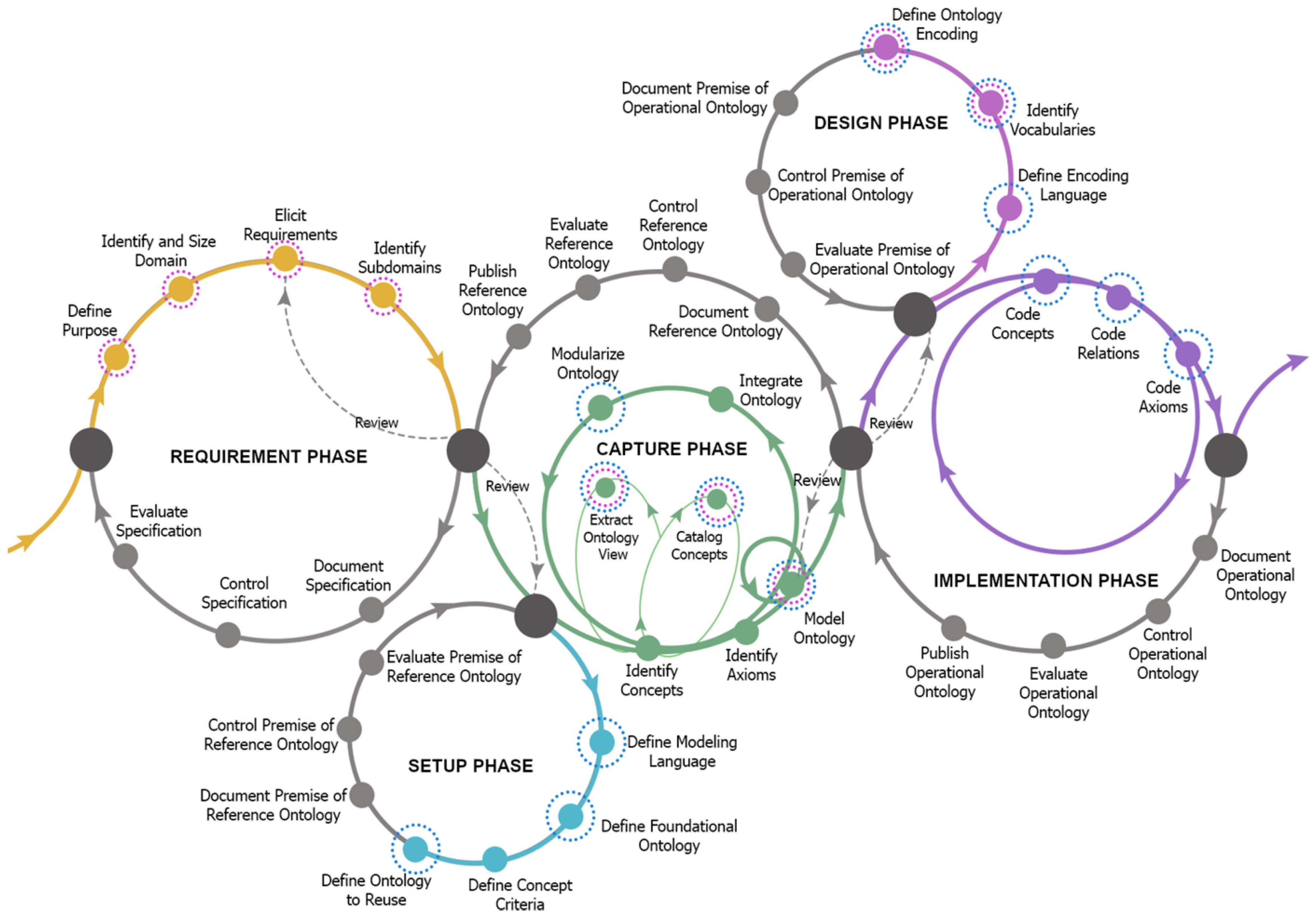
2. Methodology
- Requirement phase: describes the what, why and what-for of the ontology.
- Setup phase: defines questions and criteria that will guide the ontology development, and therefore, the choice of modeling-related frameworks.
- Capture phase: identifies ontology concepts and axioms by answering the setup phase questions, and by using expert knowledge to implement desired constraints for the domain.
- Design phase: makes technology-based implementation decisions, covering the codification and presentation of the ontology in a machine-readable tool.
- Implementation phase: implements the ontology in a formal language, followed by verification and validation of its implementation.
3. Requirements Phase
- (a)
- Purpose definitionWe focus on developing an ontology to provide an explanatory model of the SoS domain, hinged on two aspects, mission and capability, and aimed at supporting SoS thinking principles. The designated users of this ontology include the scientific community, and SoS practitioners interested in knowledge representation and alignment, and learning the complexity of SoS.
- (b)
- Identifying and sizing of the domainThis ontology is a core ontology for mission and capability in SoS, i.e., a minimal list of concepts and relationships to describe the SoS domain in an application-agnostic manner. Through analyses of the scenarios of the domain-specific SoS case studies, we extracted the knowledge of the SoS domain embedded in the scenarios.
- (c)
- Requirements elicitationThe activities in this step involve the identification and negotiation of requirements. It highlights how the ontology team defines the functional and non-functional requirements for the ontology.Functional requirements are defined through three high-level exploratory questions, which are translated into more specific competence questions (CQ). These exploratory questions are:
- What does an SoS require?
- How does an SoS operate?
- What does an SoS realize?
Requirements are explained in terms of capabilities, operations in terms of capability configurations, and realizations in terms of missions implemented by the SoS.Non-functional requirements are grouped in three categories: quality, design, and intended use:- Quality requirements focus on different usability aspects of the ontology.
- Design requirements focus on simplicity, availability, and subsequently the definition of design decisions, including: the choice of an open-access, user-friendly ontology language, a popular ontology editing tool, and the reuse of existing concepts.
- Intended use requirements focus on the very purpose of the ontology, i.e., scientific alignment. In this, we checked how the ontology aligns with existing foundation ontologies and ontology foundries.
- (d)
- Identification of subdomainsFrom the pre-defined exploratory questions, three subdomains stand out: requirements, operation, and realization. Understanding these subdomains offers an opportunity to incorporate modularity in the ontology by explicitly extending the core ontology with existing ontologies of these subdomains.
4. Setup Phase
- (a)
- SoS requirements: how the independent systems contribute their capabilities in SoS.
- -
- Which systems does the SoS contain?
- -
- Which capabilities are provided by these systems?
- (b)
- SoS operation: the formation of constellations, the creation of mission threads, and the creation of capability configurations. These show variations and possibilities in the SoS.
- -
- Which constellations are possible in this SoS?
- -
- Which mission threads are addressed by which constellations?
- -
- Which capability configuration options are possible in an SoS?
- (c)
- SoS realization: identification of specific missions in the SoS.
- -
- Which missions are part of this SoS?
5. Capture Phase
- The identification of 13 main concepts for the core ontology, with some subclasses and attributes. The knowledge sources for the core ontology concepts include: engineering handbooks, standards, manuals, frameworks, and research studies. The catalogue of concepts was adapted from ISO/IEC/IEEE 21839 [16], ISO/IEC/IEEE 15288:2015 [17], Object Management Group (OMG) Unified Architecture Framework Modeling Language [18], United States Department of Defense (US-DoD) architectural framework [19], and Mission Engineering Guide [20]. This is followed by the definition of axioms and modeling of the ontology in a technology-independent representation.
- Preliminary efforts were made to demonstrate the views of the ontology. Three views were identified: capability, mission, and configuration views [21]. The capability view highlighted how capabilities are generated and interfaced, therefore, covering attributes such as capability definition and CS identification. The mission view highlights mission decomposition and mission thread execution, where the attributes include mission context and constraints. The configuration view highlights constellation, measures, and capability configuration operations, where the attributes included capability tradeoffs, standards, and frameworks [21]. These three views, i.e., capability, mission, and configuration views, highlighted different abstraction levels corresponding to SoS requirements, planning, and implementation, respectively.
- Ontology revision. The ontology was further revised. The revision aimed at further minimizing the concepts to reflect the core of SoS. This resulted in the reduction of concepts from 13 to 9. This reduction was a result of continuous improvement and an exploratory study, which implemented a survey and an interview-based evaluation study [21]. This study employed the Formal Ontology Content Alignment (FOCA) methodology that evaluated the goal-question-metric, i.e., a correlation of the objective of knowledge representation, the knowledge representation roles, and the quality criteria of the respective goals. The focus was on checking the adequacy and relevance of the core ontology with specific emphasis on coherence, i.e., consistency, conciseness, and completeness. The evaluation employed a convenience sampling of practitioners in diverse fields, ranging from software architecting and model-based engineering, to defense-related operations research.
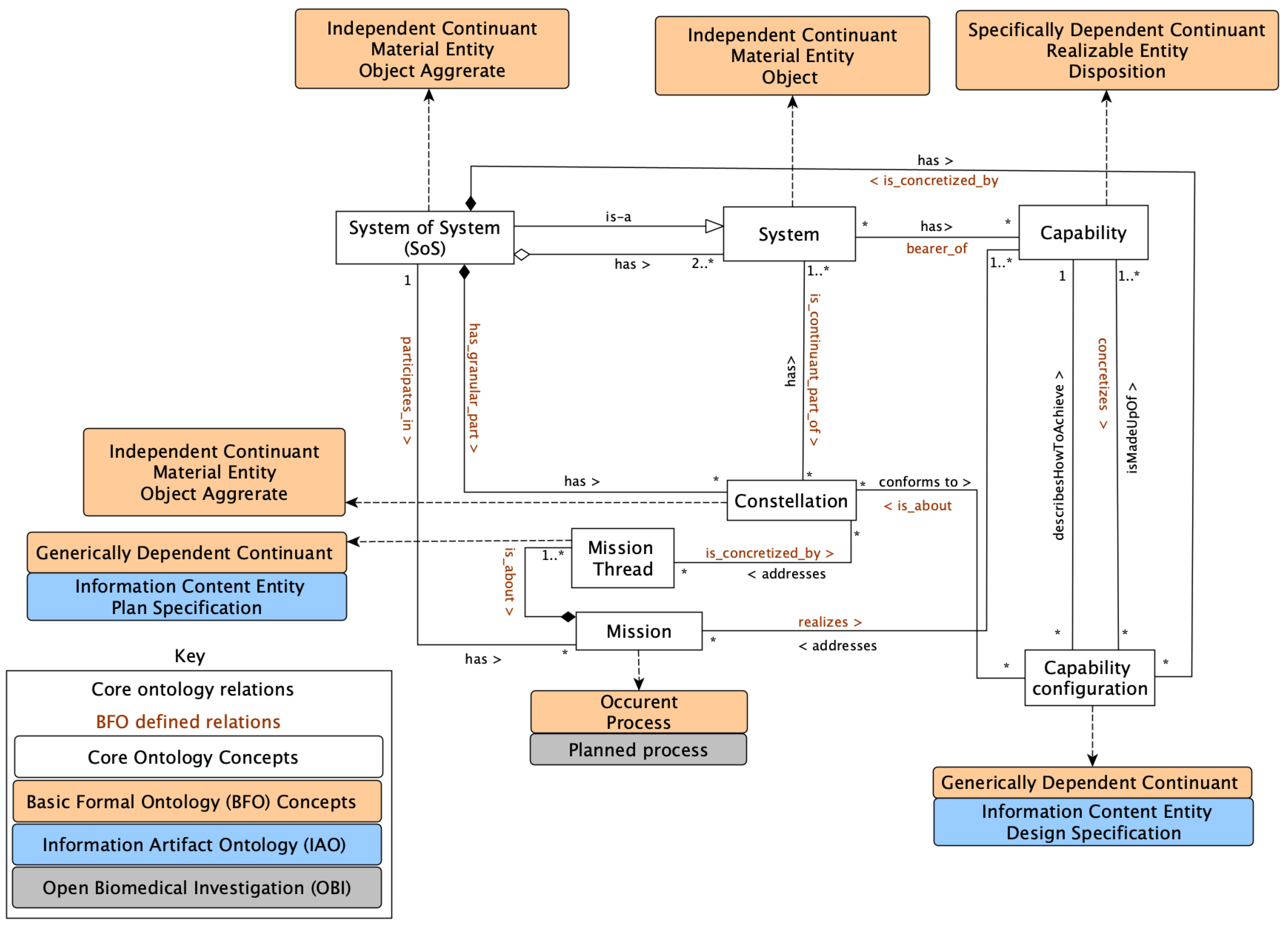
- Ontology benchmarking: This modified version of the ontology was benchmarked against a foundation ontology. The focus of the mapping is to employ analogy and identify what kind of entities are contained in the reference ontology. The Basic Formal Ontology (BFO), as discussed by Arp et al. [22], was employed to show the kind of entities represented by the ontology concepts [15]. The core ontology is therefore a mix of different kinds of BFO entities: object, object aggregate, disposition, planned process, design specification, and plan specifications. This mapping tells the ontology user what is expected of each concept of the ontology. It also highlights how the ontology relates to entities from other ontologies and foundries.
6. Design Phase
- Choice of encoding language: The requirements of an ontology language are highlighted as characterized by “well-defined syntax and semantics, efficient reasoning support, sufficient expressive power, and convenience of expression” [23]. We opted for Web Ontology Language (OWL), which is highly popular in the ontology community. OWL reasonably fulfills the language requirements by building on the Resource Description Framework (RDF) data model and Resource Description Framework Schema (RDFS) hierarchy support. Since OWL is based on mathematical logic, it also supports the application of reasoning engines. We explore and use OWL in Protégé, an ontology editing tool [24].
- Definition of ontology encoding: choice of presentation rules is based on standard encoding techniques.
7. Implementation Phase
7.1. Encoding
7.2. Verification
7.2.1. Functional Requirements
7.2.2. Non-Functional Requirements
- Logical consistency: this focuses on the identification of contradictions. It is achieved through a consistent and coherent check using a Web Ontology Language - Description Logic (OWL-DL) reasoner. We chose the HermiT reasoner. The choice of HermiT is based on it being the default reasoner for Protégé, its support of a wide range of optimizations and queries, and description graphs. The performed test focused on the global ontology coherence, consistency, and satisfiability. The HermiT reasoner resulted in a consistent and coherent outcome with no unsatisfied classes or properties.
- Inferencing: Ontology reasoners are especially useful for making inferences, i.e., reasoning to create connections that were not explicitly stated in the ontology. In this ontology, the reasoner did not create any inference. We attribute this to the compactness of the ontology.
- Ontology design patterns (ODPs) check: “ODPs are reusable modeling solutions that encode modeling best practices” [26]. They are agreed-upon ways of framing classes, properties, and individuals. ODP was proposed as a solution to facilitate the semantic web by offsetting the gap between the ontology development process and tools, and the application of domain expertise. ODPs are therefore prescribed best practices for ontology engineering. From the core ontology, we will consider two kinds of ODPs: logical and content ODPs [27], i.e., context-independent formal expressions, and context-dependent conceptual expressions, respectively.
- (a)
- Transformation and partition patternThe transformation pattern checks the whole-part relationships, whereas the partition pattern defines mutually exclusive entities. For the transformation, the structural check is whether the transitivity, reflexivity, and symmetry relationship observed to convey the required constraints. This is a logical pattern to convey the right structural make-up of the ontology.
- –
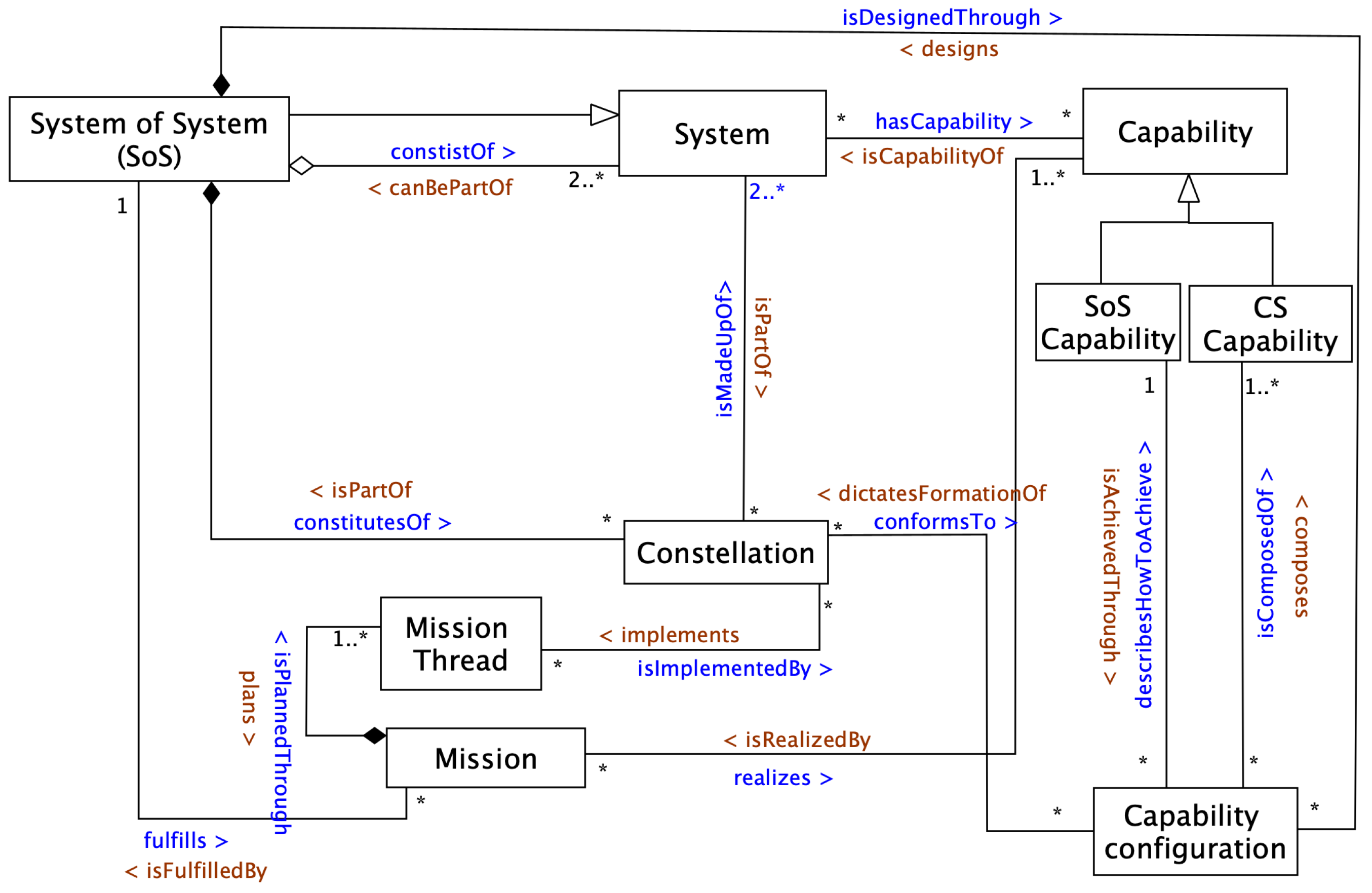
- For the loop connecting the SoS and System concepts, the core ontology defines the constistsOf relationship as irreflexive.
- –
- Value partition pattern defines mutual exclusivity, i.e., whether subclasses are defined as mutually exclusive. The core ontology includes only two subclasses, CSCapability and SoSCapability, which are defined as disjoint. However, these do not necessarily form the union of the superclass; this is a conscious choice to balance the need for the core ontology to evolve to include other forms of capabilities as knowledge evolves.
- (b)
- Role patternThe role pattern focuses on identifying the contextual nature of classes. It includes content OPDs that address the following questions: Does the ontology include roles? How are they modeled? This is to exemplify temporal behavior, which can be assumed by classes. Whether roles are classes, individuals, or properties has implications on the ontology expressiveness, simplicity, and questions that can be answered [28,29].
- –
- In SoS, this is particularly important as classes such as constellation and mission thread are temporal constructions. In the context of this core ontology, the notion of roles is not explicitly stated, but it is implied. In this ontology, it can be applied in a combination by, e.g., defining capabilities as classes, individuals, or properties. It all depends on how one wants to balance their ontology. When it is defined as a class, it adds openness to the use of attributes and further characterization. When it is defined as properties, it is much simpler, but less expressive.
- –
- Time-indexed role patterns explicitly say which classes are time-dependent. In alignment with the purpose of this ontology, entities in the operational part of the ontology present the most time-dependent nature. This means the relationships between system, constellation, and mission thread concepts. In its current state, there is no specific means to identify these as time-dependent.
7.3. Validation
7.3.1. Heuristic Considerations
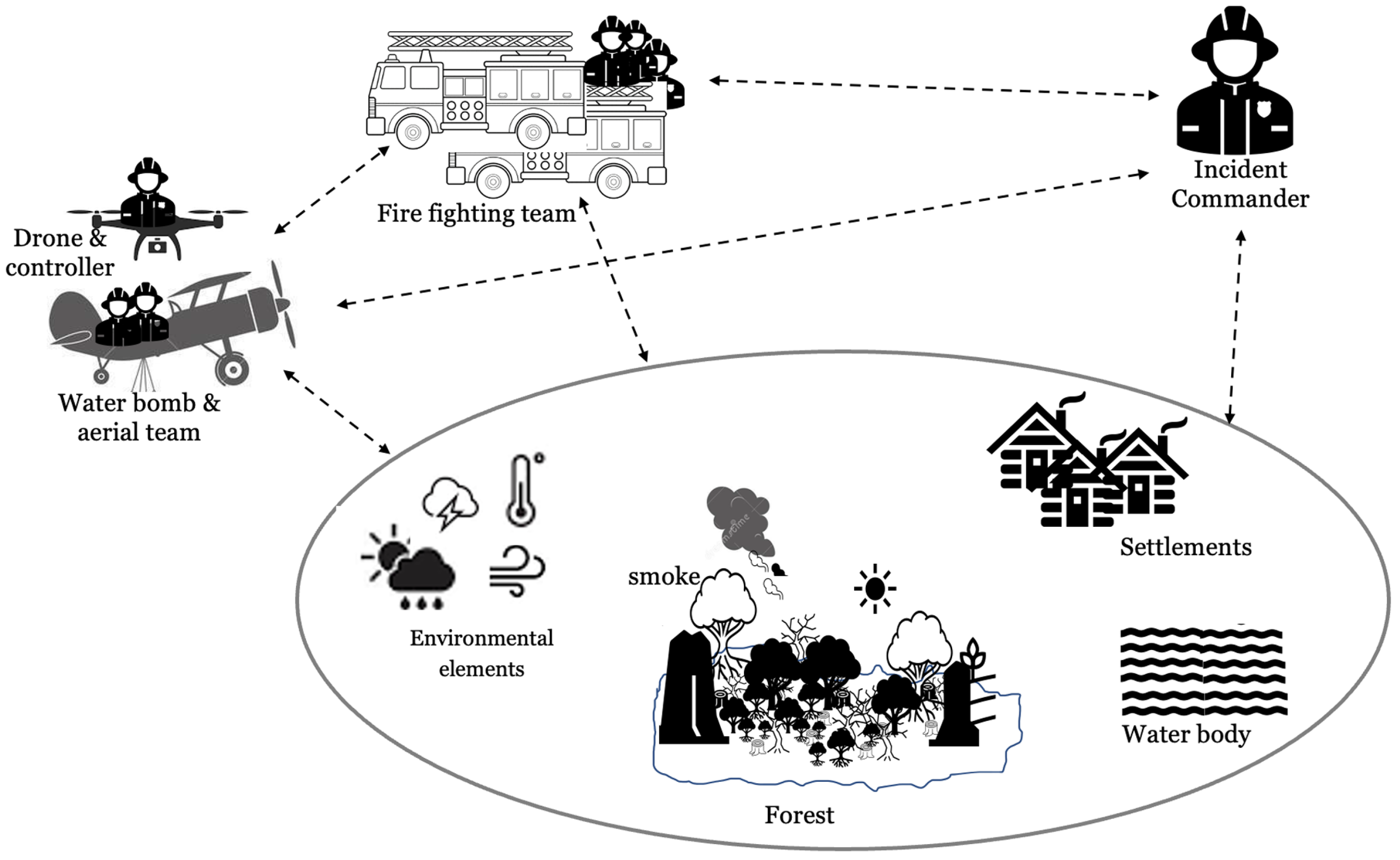
7.3.2. Wildfire Management SoS
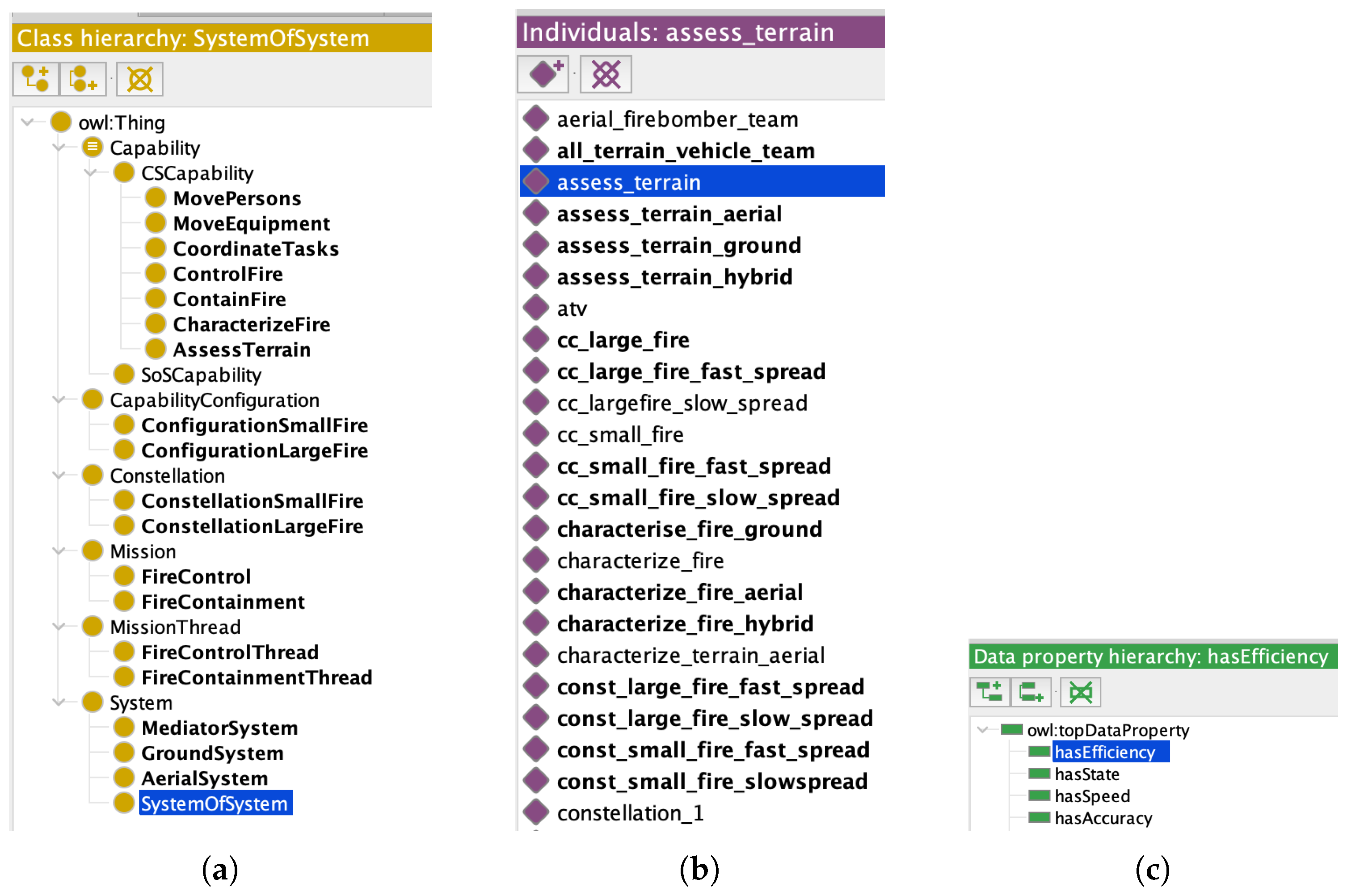
- Why do we need an SoS? From the ontology, we can view an SoS as originating from two main aspects: the availability of systems, and the need for missions that are SoS-worthy. The why then describes the instance of SoS Capability achievable from these systems, and the necessary classes of missions to be accomplished. Figure 6 shows two classes of mission and their corresponding instances.
- Who participates in this SoS? This describes the stakeholders, highlighting their ownership of the different classes of systems involved in the SoS. In this ontology, stakeholder is not explicitly stated as a concept. Stakeholders can be implied from how one describes CS capability. In our example, CS capability is described according to their action, but they could be classified in many different ways, e.g., according to their ownerships, e.g., control_action_municipal_council efficiencies, whichever option demonstrates what is more important for the respective SoS, i.e., stakeholders’ involvement can be embedded in their respective systems.
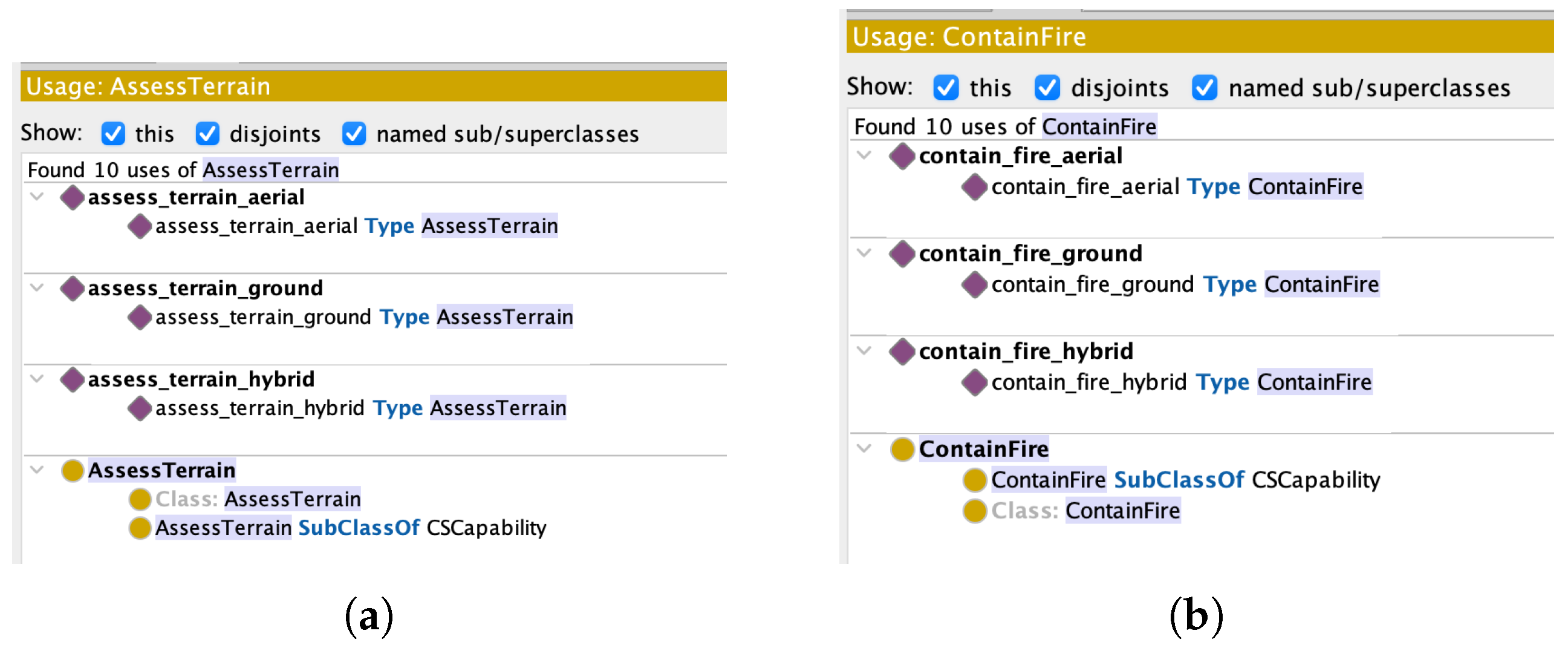
- What is the SoS working with? This describes the classes of capabilities needed for the SoS, and their respective instances as seen in Figure 7.
- When? This describes the time or sequence-related nature of the SoS, showing the step-by-step mission thread. In the ontology, one is able to specify mission threads, their instances, and their corresponding constellations, as seen in Figure 8. However, the ontology does not yet support sequential or parallel activities.
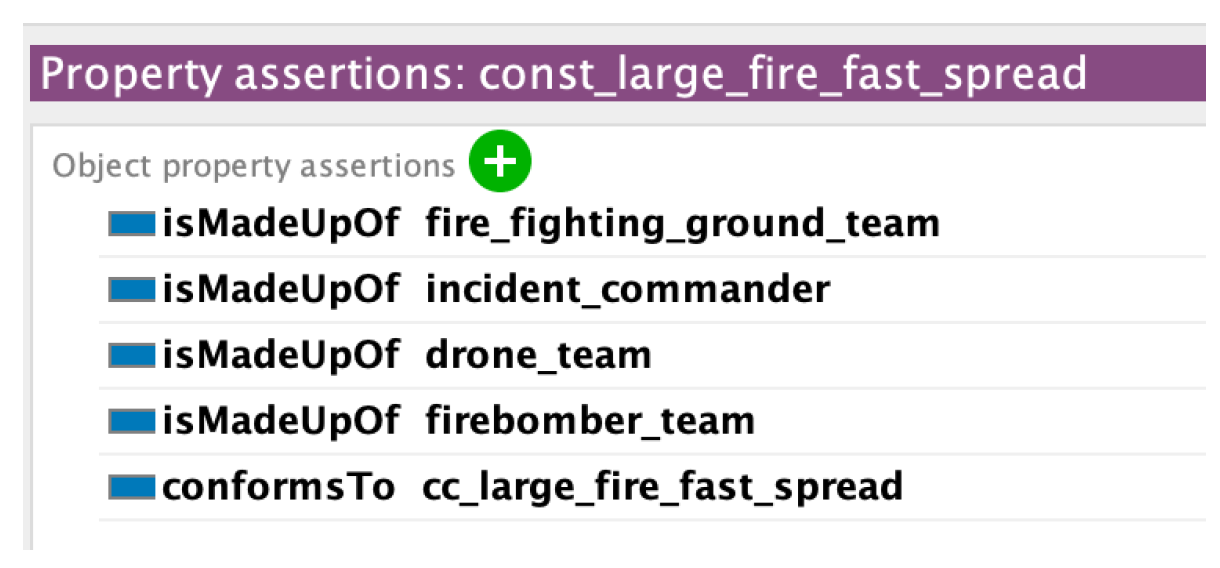
- How? This describes the operation-related nature of the SoS, linking an SoS with a capability configuration design template, and how it conforms to the constellations’ actual implementation options. Figure 9 shows a sample definition of what makes up a constellation const_large_fire_fast_spread and its conformance to a specific capability configuration cc_large_fire_fast_spread.
- Where? This describes the formation and adaptability of constellations. From the core ontology perspective, this is related to the context of the mission, and forms a baseline defining capability configurations.
- Constellation is the implementor in the SoS; its adaptability must be taken in consideration in the capability configuration design plan.
- The feasibility of these configurations is observed in the context of the mission.
- Constellations originate from systems; therefore, the reliability of systems as they participate in the SoS must be measured.
- This reliability can be measured through the performance of the capabilities of these systems in the SoS.
- Missions can be traceable on the basis of the constellations assigned and the overall relational performance of these constellations.
7.3.3. Ontology Metrics
- Relationship richness, 0.48: “the ratio of the number of non-inheritance (NI) relationships to the total number of relationships” [31]. It depicts the diversity of relationships, where the more diverse the relationships, the better the information. Since the aim of the core ontology is to bring out deep knowledge, a higher ratio would have been preferred.
- Axiom class ratio, 11.89: “the average amount of axioms per class”. This ratio speaks of the level of detail that describes the concepts of the ontology, and it also suggests the expressiveness of the ontology.
7.3.4. Ontology Traceability
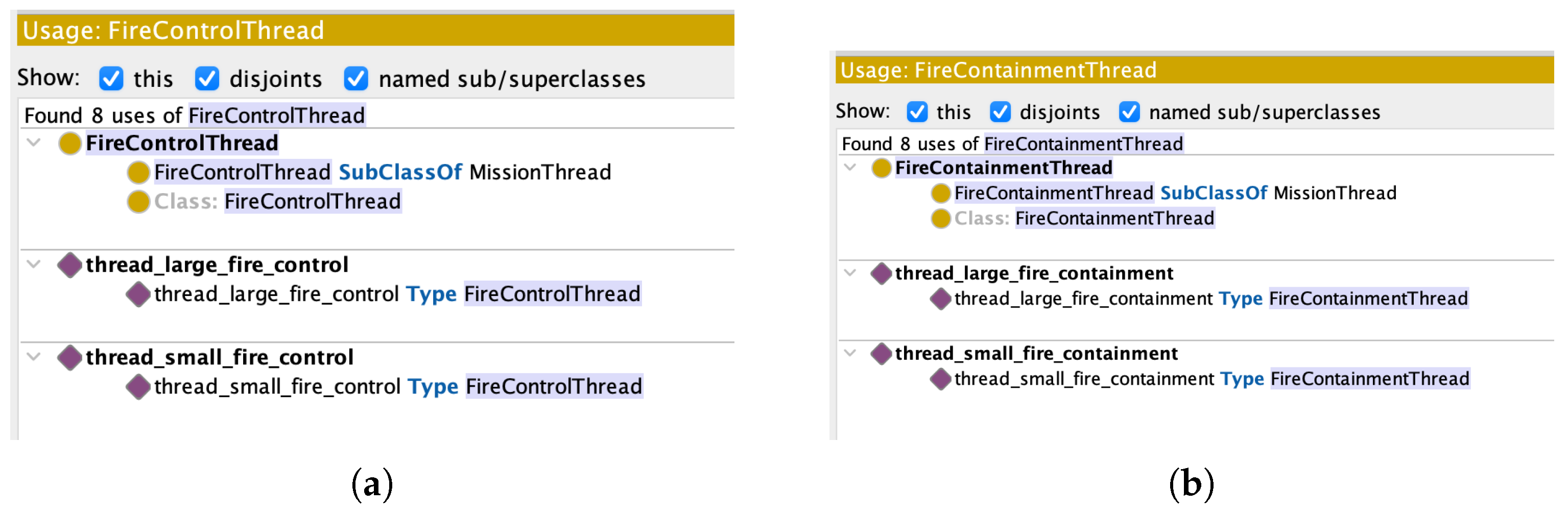
- What does the SoS require? fire containment and fire control capabilities
- How does it operate? creation of fire containment and fire control capability configurations
- What does it realize? fire containment and fire control mission threads
8. Discussion
8.1. OWL-DL
8.2. Inferencing
8.3. Usability
8.4. SABIOx Methodology
8.5. SoS Thinking Principles
- (a)
- Adapting to an ecosystem as opposed to starting from scratch: The core ontology re-uses an existing knowledge base in terms of the selection of terminologies, and seeks alignment to established knowledge foundations.
- (b)
- Seek balance rather than optimization, and focus on an outcome space rather than a specific solution: The core ontology approach to SoS has demonstrably shown us what is possible and probable. I has shown us:
- The capability configuration provides an outcome space of possibilities
- The constellation aggregation varies the SoS boundaries to the chosen outcome probability
- An SoS is partly tangible and intangible, therefore, it involves the coordination and adaptation of design specification with plan specifications
- Regardless of what exists first, either the mission or the systems, one can always tailor the SoS to a satisfactory outcome according to the context and the acceptable tradeoffs
- (c)
- Adaptive thinking of interventions or influence as opposed to control or design: The core ontology adapts one’s thinking to how different constituents of an SoS can be of use, be it in a top-down or bottom-up approach; it shows that adaptive thinking can develop SoS-like uses whenever capabilities align.
9. Conclusions
Author Contributions
Funding
Data Availability Statement
Conflicts of Interest
References
- Boardman, J.; Sauser, B. System of Systems, the meaning of. In Proceedings of the 2006 IEEE/SMC International Conference on System of Systems Engineering, Los Angeles, CA, USA, 24–26 April 2006. [Google Scholar]
- Dahmann, J. System of systems pain points. INCOSE Int. Symp. 2014, 24, 108–121. [Google Scholar] [CrossRef]
- Behl, D.V.; Ferreira, S. Systems thinking: An analysis of key factors and relationships. Procedia Comput. Sci. 2014, 36, 104–109. [Google Scholar] [CrossRef]
- Baek, Y.M.; Song, J.; Shin, Y.J.; Park, S.; Bae, D.H. A meta-model for representing system-of-systems ontologies. In Proceedings of the 6th International Workshop on Software Engineering for Systems-of-Systems, Gothenburg, Sweden, 29 May 2018; pp. 1–7. [Google Scholar]
- Langford, G.; Langford, T. The making of a system of systems: Ontology reveals the true nature of emergence. In Proceedings of the 2017 12th System of Systems Engineering Conference (SoSE); IEEE: New York, NY, USA, 2017; pp. 1–5. [Google Scholar]
- Maier, M.W. Architecting principles for systems-of-systems. Syst. Eng. J. Int. Counc. Syst. Eng. 1998, 1, 267–284. [Google Scholar] [CrossRef]
- INCOSE. Systems Engineering Vision 2035; International Council on Systems Engineering: San Diego, CA, USA, 2022. [Google Scholar]
- Guizzardi, G.; Ferreira Pires, L.; Van Sinderen, M. An ontology-based approach for evaluating the domain appropriateness and comprehensibility appropriateness of modeling languages. In Model Driven Engineering Languages and Systems; Springer: Berlin/Heidelberg, Germany, 2005; pp. 691–705. [Google Scholar]
- ISO 9241-11:2018; Ergonomics of Human-System Interaction—Part 11: Usability: Definitions and Concepts. ISO/IEC: Geneva, Switzerland, 2018.
- Ma, X.; Fu, L.; West, P.; Fox, P. Ontology usability scale: Context-aware metrics for the effectiveness, efficiency and satisfaction of ontology uses. Data Sci. J. 2018, 17, 10. [Google Scholar] [CrossRef]
- Russ, T.; Valente, A.; MacGregor, R.; Swartout, W. Practical experiences in trading off ontology usability and reusability. In Proceedings of the Knowledge Acquisition Workshop KAW99, Wadern, Germany, 26–29 May 1999. [Google Scholar]
- Dole, P. Semiology—A study of signs. India Int. Cent. Q. 1991, 18, 31–57. [Google Scholar]
- Aguiar, C.Z.; Souza, V.E.S. SABiOx: The extended systematic approach for building ontologies. In Proceedings of the 17th Seminar on Ontology Research in Brazil (ONTOBRAS 2024) and 8th Doctoral and Masters Consortium on Ontologies (WTDO 2024), Vitoria, Brazil, 7–10 October 2024. [Google Scholar]
- de Aguiar, C.Z.; Souza, V.E.S. A Guide to SABiOx, the Extended Systematic Approach for Building Ontologies. A Manual for the application of SABIOx. Developed in the Ontology and Conceptual Modeling Research Group—NEMO Ontology & Conceptual Modeling Research Group—NEMO Federal University of Espirito Santo, Brazil, 2024. Available online: https://nemo.inf.ufes.br/wp-content/uploads/sabiox-guide2024-09.pdf (accessed on 9 March 2026).
- Martin, J.; Axelsson, J.; Carlson. Mapping a System of Systems Core Ontology to a Foundational Ontology. In Proceedings of the 14th International Conference on Model-Based Software and Systems Engineering, Marbella, Spain, 7–9 March 2026; pp. 202–213. [Google Scholar]
- ISO/IEC/IEEE 21839:2019; Systems and Software Engineering, System of Systems (SoS) Considerations in Life Cycle Stages of a System. International Organization for Standardization: Geneva, Switzerland, 2019.
- ISO/IEC/IEEE 15288:2023; Systems and Software Engineering—System Life Cycle Processes. International Organization for Standardization: Geneva, Switzerland, 2023.
- Unified Architecture Framework Modeling Language (UAFML), Version 1.2; Object Management Group (OMG): Milford, MA, USA, 2022.
- The DoDAF Architecture Framework, Version 2.02; Department of Defense Office of the Assistant Secretary of Defense (OASD): Washington, DC, USA, 2010.
- Department of Defense Mission Engineering Guide, Version 2.0; Department of Defense: Washington, DC, USA, 2023.
- Martin, J. Towards Mission and Capability Modelling for Systems of Systems; Malardalen University: Västerås, Sweden, 2024. [Google Scholar]
- Arp, R.; Smith, B.; Spear, A.D. Building Ontologies with Basic Formal Ontology; MIT Press: Cambridge, MA, USA, 2015. [Google Scholar]
- Antoniou, G.; Harmelen, F.v. Web ontology language: Owl. In Handbook on Ontologies; Springer: Berlin/Heidelberg, Germany, 2009; pp. 91–110. [Google Scholar]
- Horridge, M.; Knublauch, H.; Rector, A.; Stevens, R.; Wroe, C. A Practical Guide to Building OWL Ontologies Using the Protégé-OWL Plugin and CO-ODE Tools Edition 1.0; University of Manchester: Manchester, UK, 2004. [Google Scholar]
- Fahad, M.; Qadir, M.A.; Noshairwan, M.W. Ontological Errors Inconsistency, Incompleteness and Redundancy. In Proceedings of the ICEIS, Barcelona, Spain, 12–16 June 2008; pp. 253–285. [Google Scholar]
- Presutti, V.; Blomqvist, E.; Daga, E.; Gangemi, A. Pattern-based ontology design. In Ontology Engineering in a Networked World; Springer: Berlin/Heidelberg, Germany, 2011; pp. 35–64. [Google Scholar]
- Gangemi, A.; Presutti, V. Ontology design patterns. In Handbook on Ontologies; Springer: Berlin/Heidelberg, Germany, 2009; pp. 221–243. [Google Scholar]
- Blomqvist, E. Ontology patterns: Typology and experiences from design pattern development. In Proceedings of the Swedish AI Society Workshop, Uppsala, Sweden, 20–21 May 2010; pp. 55–64. [Google Scholar]
- Blomqvist, E.; Gangemi, A.; Presutti, V. Experiments on pattern-based ontology design. In Proceedings of the Fifth International Conference on Knowledge Capture, Redondo Beach, CA, USA, 1–4 September 2009; pp. 41–48. [Google Scholar]
- Franco, M.; Vivo, J.M.; Quesada-Martínez, M.; Duque-Ramos, A.; Fernández-Breis, J.T. Evaluation of ontology structural metrics based on public repository data. Briefings Bioinform. 2020, 21, 473–485. [Google Scholar] [CrossRef]
- Poppe, M.; Lichtwark, M. OntoMetrics. 2016. Available online: https://ontometrics.informatik.uni-rostock.de/ (accessed on 8 January 2026).
- McEver, J.; Sheard, S.; Cook, S.; Honour, E.; Hybertson, D.; Krupa, J.; McKinney, D.; Ondrus, P.; Ryan, A.; Scheurer, R.; et al. A Complexity Primer for Systems Engineers; International Council on Systems Engineering: San Diego, CA, USA, 2015. [Google Scholar]





| Codification Item/Protégé Symbol | Operational Ontology |
|---|---|
| Language | Web Ontology Language (OWL) with Description Logic (DL) |
Core class name  | Follow the pattern Pascal Case, with no space: SystemOfSystems, System, Capability, CapabilityConfiguration, Constellation, Mission, MissionThread |
| Domain class name | Follow the pattern Pascal Case: AssessTerrain, ControlFire |
Object property name  | Follow Camel Case pattern: e.g., isMadeUpOf |
Data property name  | Follow Camel Case pattern: e.g., accuracyLow |
Instance name  | Follow Snake Case pattern: e.g., move_equipment |
| Class description | Classes are described using the comment property of RDFS |
| Specialization relationships | Defined using the subClassOf property of Resource Description Framework Schema (RDFS) |
| Exploratory Question | Corresponding Concepts |
|---|---|
| What are the SoS requirements? | This is extended from the concepts system and capability where a system provides a capability disposition towards a certain activity. |
| How does the SoS operate? | This is extended from the linkage between capability configuration plan, aggregation of constellations, the mission planned process, and mission thread step-by-step plan specification. |
| What does the SoS realize? | This is extended from how CS capabilities are orchestrated into capability configurations to realize missions. |
| Wildfire Crisis Management SoS | Considerations |
|---|---|
| Fire detection constellation (object aggregate) → object states: active vs. passive, incentive towards active participation in the SoS | the effectiveness of the constellation |
| Firefighting system (object) → how a ground firefighting team versus an aerial firefighting team interface with the rest of the systems in the SoS | interfaces, boundaries, active vs. passive CS in SoS |
| Capability (disposition) → how the capability contributions may create different tradeoffs: example moving people and equipment using a firetruck (slow) versus moving equipment with an All Terrain Vehicle (fast) | belonging, performance of the capability in a specific constellation, e.g., in accuracy |
| Fire detection mission (planned process) → performance measure that determines milestones towards completeness | milestones, timefactor, performance |
| Fire detection step-by-step procedure (plan specification) → the coordination plan for the mission context | feasibility, tradeoffs |
| Capability configuration, a template of possibilities (design specification) → a list of diverse combinations and outcomes towards the SoS emergent behavior | context, interoperability, reusability |
| CQ | DL Query & Outcome |
|---|---|
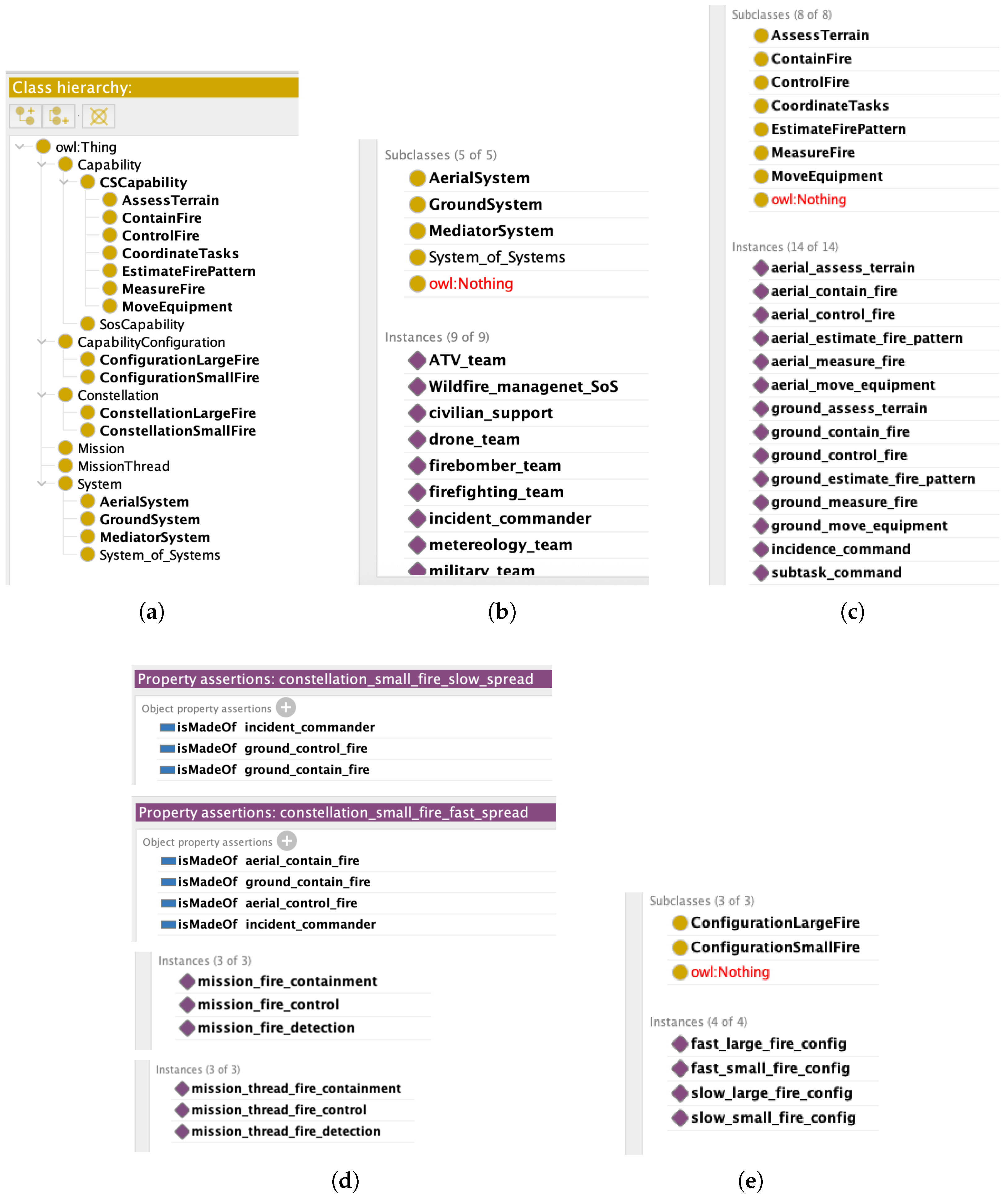
| Which systems does the SoS contain? | System lists all classes and instances of systems available, this is as seen in Figure 10a,b |
| Which capabilities are provided by these systems? | CSCapability lists all classes and instances of CS capabilities available, this is as seen in Figure 10c |
| Which constellations are possible in this SoS? | Constellation lists all preset constellations, ConstellationSmallFire displays all possible instances of small fire as seen in Figure 10d |
| Which mission threads are addressed by which constellations? Which missions are part of this SoS? | Mission and MissionThread lists all preset mission and mission thread instances respectively, as seen in Figure 10d |
| Which capability configuration options are possible in an SoS? | CapabilityConfiguration lists possible configurations classes and instances as seen in Figure 10e |
Disclaimer/Publisher’s Note: The statements, opinions and data contained in all publications are solely those of the individual author(s) and contributor(s) and not of MDPI and/or the editor(s). MDPI and/or the editor(s) disclaim responsibility for any injury to people or property resulting from any ideas, methods, instructions or products referred to in the content. |
© 2026 by the authors. Licensee MDPI, Basel, Switzerland. This article is an open access article distributed under the terms and conditions of the Creative Commons Attribution (CC BY) license.
Share and Cite
Martin, J.; Axelsson, J.; Carlson, J. Core Ontology Usability: From a Formalized Knowledge Base to the Development of a System of Systems Domain Understanding. Systems 2026, 14, 325. https://doi.org/10.3390/systems14030325
Martin J, Axelsson J, Carlson J. Core Ontology Usability: From a Formalized Knowledge Base to the Development of a System of Systems Domain Understanding. Systems. 2026; 14(3):325. https://doi.org/10.3390/systems14030325
Chicago/Turabian StyleMartin, Joyce, Jakob Axelsson, and Jan Carlson. 2026. "Core Ontology Usability: From a Formalized Knowledge Base to the Development of a System of Systems Domain Understanding" Systems 14, no. 3: 325. https://doi.org/10.3390/systems14030325
APA StyleMartin, J., Axelsson, J., & Carlson, J. (2026). Core Ontology Usability: From a Formalized Knowledge Base to the Development of a System of Systems Domain Understanding. Systems, 14(3), 325. https://doi.org/10.3390/systems14030325