1. Introduction
Small and medium-sized enterprises (SMEs) are under pressure to digitalize core functions while maintaining strong governance standards such as transparency, accountability, internal control, and timely evidence-based decisions [
1]. Digital transformation (DT) has become central to this shift and, in this study, refers to the planned adoption and integration of digital technologies, data, and redesigned processes to improve coordination, decision quality, and value creation in SMEs [
2,
3]. DT strengthens governance by improving data quality, internal control, and transparency across core operations [
4,
5]. Integrated digital systems reduce information gaps, standardize workflows, and limit opportunities for misreporting, which directly improves oversight and accountability [
6]. Stronger digital infrastructures also enhance control activities and risk assessment, making governance routines more reliable and consistent with regulatory expectations [
5]. DT also improves compliance and disclosure quality, as analytics, automation, and real-time monitoring reduces errors and support accurate reporting [
7,
8]. In digitalized environments, governance processes benefit from higher traceability, continuous audit readiness, and tighter alignment between operational activities and governance standards [
7,
8]. These effects make DGP a direct outcome of DT, expressed through improvements in transparency, accountability, and the effective use of digital tools in decision and control processes [
9,
10,
11]. Based on this established linkage, governance performance (DGP) in this study describes how well a firm maintains accountability, transparency, internal control, and the effective use of digital tools in daily operations [
12,
13]. Many SMEs adopt digital tools but lack the capabilities needed to use them effectively, which leads to fragmented data, uneven workflows, and governance gaps [
14]. Evidence from European firms shows that AI related gains appear only when organizations also invest in software, data, and workforce training [
15], and effective AI use depends on prior digital maturity and strong data practices [
16]. These patterns suggest that SMEs function as linked socio-technical systems where weaknesses in one component can affect governance across the whole firm. At the same time, SMEs that report similar levels of digitalization often show very different governance outcomes. Some achieve stronger transparency and control, while others still face reporting gaps, weak oversight, and fragmented processes. This uneven pattern indicates that digital tools alone are not enough, and that internal capabilities are likely to shape how digital transformation affects governance.
Building on this evidence, two capabilities help explain how DT improves governance, namely AI and big data analytical capability (AIBDAC) and process integration capability (PIC), which prior studies link to better control, transparency, and performance [
5,
17,
18,
19]. AIBDAC reflects a firm’s ability to use data pipelines, analytical models, and AI-driven tools to generate insights, detect patterns, and support decisions [
17,
20]. Process integration capability (PIC) captures the extent to which activities, data, and control points are linked across functions to reduce errors, improve visibility, and embed compliance into operations [
21,
22]. Together, DT provides the digital foundation, AIBDAC turns data into insights, and PIC connects processes and controls, forming a capability chain that enables DT to strengthen governance rather than create new silos or inconsistencies.
The Technology–Organization–Environment (TOE) framework explains how SMEs build these capabilities through technological, organizational, and environmental conditions [
23,
24]. Resource-Based View (RBV) and Dynamic Capabilities Theory (DCT) complement this view by showing how digital resources become valuable and reconfigurable capabilities, and recent work confirms that digital dynamic capabilities help SMEs sense and integrate new technologies, including AI [
25]. In this study, the TOE framework positions DT as the core technology dimension, with strategic readiness, digital innovation capability, and top management support as organizational enablers and firm size as the contextual environment. RBV supports treating AIBDAC and PIC as capability bundles through which DT and these enablers translate into governance performance outcomes.
Despite growing interest in DT and governance, prior studies rarely explain why governance outcomes remain uneven among SMEs that appear to be digitalizing at similar rates. Most works assess technologies or governance indicators separately and do not examine how analytics capability and process integration convert digital inputs into governance outcomes [
26,
27,
28]. Very few studies explore how these capability pathways differ by firm size [
29,
30,
31]. As a result, it is still unclear when and for which SMEs digital transformation leads to stronger governance performance. The study does not assume that digital transformation always improves governance but treats the relationship as something that must be explained through internal capabilities and contextual conditions [
29,
31].
Based on this gap, the study addresses one overarching question and two sub-questions:
RQ1: How does digital transformation influence digital governance performance in SMEs?
RQ1a: Do AI and big data analytical capability and process integration capability mediate this relationship?
RQ1b: Do these relationships differ across SME size groups?
This study uses survey data from SMEs in Saudi Arabia and applies PLS SEM to test the direct, mediated, and moderated effects. The findings show that DT improves governance performance and that AIBDAC and PIC act as key mechanisms that strengthen this influence.
The rest of the article is structured as follows:
Section 2 reviews the literature and develops the hypotheses.
Section 3 explains the methodology.
Section 4 presents the empirical analysis.
Section 5 discusses the results.
Section 6 outlines implications.
Section 7 provides recommendations.
Section 8 states limitations and future directions.
Section 9 concludes the study.
2. Literature Review
2.1. Digital Transformation in SMEs
Digital transformation in small and medium-sized enterprises refers to the planned adoption and integration of digital technologies, data, and redesigned processes to create value and improve decision quality across core functions [
2,
3]. In this study, DT is measured through three dimensions: the use of technologies such as big data and analytics to redesign processes, the integration of digital tools to support operational change, and the shift of routine activities toward digital platforms (DT1–DT3). These items reflect how SMEs build digital capability through affordable, modular tools, including cloud systems, mobile platforms, social technologies, and AI-enabled analytics rather than large enterprise suites. These dimensions reflect how earlier studies conceptualize DT as a set of technology-driven changes that enable improved coordination, information quality, and workflow redesign in SMEs [
19,
32]. Prior work treats these dimensions as core indicators of DT capability formation, and the same logic is used here to define the DT construct.
DT is more than adopting tools or digitizing isolated processes. It is a continuous socio-structural change that connects technologies, workflows, and decision routines to create new value and sustained competitive advantage [
32]. This multilevel view highlights how changes in digital technologies, information flows, and control routines interact to reshape business models and performance outcomes. In line with this perspective, we treat DT in SMEs as a transformation that links technology use with deeper shifts in structures and routines so that digital investments contribute not only to governance quality but also to the firm’s broader competitive position.
Recent studies describe DT in SMEs as an organizational capability that improves coordination, information quality, and decision speed, while addressing financing and process frictions linked to digital operations and supply chain connectivity [
19]. Within SMEs, these capabilities are shaped by constraints such as limited budgets, gaps in digital skills, weak data governance, and uneven cybersecurity practices [
33,
34]. These constraints often slow the adoption of advanced tools and widen capability differences between firms, contributing to a digital divide within the SME sector [
35]. As a result, SMEs with similar levels of visible digital adoption may still differ sharply in how effectively DT supports governance processes.
DT improves governance only when supported by strong analytics and integrated processes. Research shows that real time data, internal controls, and integrated process flows enhance forecasting, compliance, and transparency in digital environments [
5,
36]. Studies further indicate that value is created through two main channels: advanced AI and big data analytics that generate governance relevant insights, and the integration of digital technologies into processes to improve value chain efficiency and sustainability [
37,
38]. In this study, these channels are captured through AI and big data analytical capability (AIBDAC) and process integration capability (PIC). Together, they represent the central mechanisms through which DT can strengthen digital governance performance in SMEs.
In the Saudi context, DT in SMEs aligns with national goals under Vision 2030, which emphasise entrepreneurship, e-commerce, FinTech, and Industry 4.0. Studies on Saudi SMEs show that performance improves when firms are aware of DT demands and prepared to upgrade processes, data practices, and digital skills [
39]. Digital platforms and intermediaries further reduce financing and adoption costs, supporting the broader strategy for SME development [
40,
41]. Evidence from international studies also shows that AI- and IoT-driven process changes play a major role in improving performance, reinforcing the need for integrated transformation rather than isolated tool adoption [
42].
Given this background, DT serves as the upstream capability in this study. It shapes the development of AIBDAC and PIC, which form the pathways through which DT can influence digital governance performance in SMEs. These two capabilities operationalise the mechanisms highlighted in prior research and form the basis of the mediation effects examined in the framework. In this study, DT reflects the overall scope of digital change in SMEs. It is treated as the main technical driver and remains distinct from readiness, innovation routines, and leadership support. Within the TOE framework, DT represents the technology dimension that shapes how SMEs adopt and embed digital tools. Through the RBV lens, DT provides the foundational digital resources from which higher order capabilities such as AIBDAC and PIC emerge.
2.2. Digital Governance Performance (DGP)
Digital governance performance in SMEs refers to how well a firm maintains accountability, transparency, internal control, and the effective use of digital tools in its operations [
43,
44]. In this study, the term governance performance is used for consistency, and it reflects how digital systems support monitoring, reporting, and control routines. DGP is treated as an outcome of DT, shaped by how firms organise data, integrate workflows, and embed digital tools into daily processes. This aligns with the view that governance quality depends on reliable information flows and enforceable control mechanisms, both of which strengthen when digital systems are used effectively [
12,
13]. This definition reflects how prior studies frame governance performance in digital contexts, where the reliability of data, the clarity of structures, and the enforcement of controls determine governance outcomes. These properties form the core dimensions used to operationalize DGP in this study.
For SMEs in developing and emerging settings, strong governance systems remain essential due to higher monitoring costs, limited financing options, and concentrated ownership structures [
44,
45]. When digital tools are embedded into these systems, firms gain more consistent reporting, stronger audit trails, and better internal coordination. These benefits help SMEs reduce agency risks, support transparency, and strengthen compliance in resource-constrained environments [
46,
47].
Recent research highlights that digital tools improve governance through precise, traceable, and auditable data records. Integrated platforms reduce manual errors, improve visibility, and support automated reporting [
48,
49]. Evidence from sectoral programs also shows that digital systems combined with automated controls enhance compliance and monitoring, which form core elements of governance performance [
50]. These findings reinforce that digital governance improves not only through technology adoption but also through the capabilities that drive analytics and connected processes, which form the focus of this study.
Based on these insights, DGP is measured across six dimensions: managerial support for digitalization, employee digital skills, effective use of digital technologies, readiness to apply digital tools, the development of digital solutions, and the capacity to build digital networks (DGP1–DGP6). These dimensions capture how SMEs translate DT, data-driven processes, and integrated workflows into governance outcomes.
This study follows the view that DT operates across technological, organizational, and managerial layers. Governance improves when digital tools, structured processes, and managerial routines reinforce each other. Our measurement of DGP reflects this multilevel logic by capturing how digital resources and operational capabilities combine to support transparent and accountable governance practices within SMEs. Within the TOE logic, DGP sits within the organizational and managerial layers that reflect how firms utilize digital resources [
12,
13,
50]. From an RBV perspective, DGP represents the performance outcome generated when analytics and process capabilities are effectively combined with digital tools.
2.3. AI and Big Data Analytical Capability (AIBDAC)
AI and big data analytical capability (AIBDAC) refers to the tools, data assets, and analytical routines that allow SMEs to convert raw data into insights and decision-support [
20]. Prior work frames AIBDAC as a dynamic capability that strengthens a firm’s ability to sense patterns, interpret information, and respond to changing conditions [
51]. In the context of DT, AIBDAC emerges as a pathway capability developed through improved data infrastructure, integrated information flows, and the use of AI-enabled analytics. As SMEs advance in DT, they build stronger pipelines and analytical routines that support real-time monitoring and evidence-based decisions [
19]. These characteristics align with prior work that treats analytics capability as a core dimension of digital maturity [
17,
19,
52]. Earlier studies identify the same elements as essential components of analytical capability formation, supporting their use as measurement indicators for AIBDAC.
AIBDAC contributes directly to digital governance performance because governance depends on timely, accurate, and explainable information. Analytics supports anomaly detection, automated reconciliations, and fraud-related alerts that strengthen oversight and compliance [
17]. In SMEs, analytics also improves forecasting and resource allocation, which enhances managerial decisions and supports transparency and accountability in digital environments [
18]. These effects align AIBDAC with the governance outcomes examined in this study.
The measurement of AIBDAC in this study is based on established dimensions of data-driven capabilities. The items reflect a firm’s ability to integrate internal and external data sources, identify hidden patterns, apply analytics across functional areas, embed AI-based decision support into routines, and use analytical intelligence to reduce inefficiencies (AIBDAC1–AIBDAC5). These elements capture how SMEs build analytical maturity as part of their DT journey.
Within the conceptual framework, AIBDAC functions as a capability mechanism through which DT affects governance performance. This aligns with empirical studies showing that analytics mediates the effect of digital investments on organisational outcomes [
18,
52]. By clarifying AIBDAC’s position in the capability pathway, this section supports the proposed direct effect of AIBDAC on DGP (H2) and its mediating role between DT and DGP (H4a). Within the TOE framework, AIBDAC reflects a technology-organizational capability that allows SMEs to use data for structured decision-making. RBV further supports this role by framing analytics as a strategic capability that converts digital resources into governance outcomes.
2.4. Process Integration Capability
Process integration capability (PIC) refers to how well a firm connects activities, data, and control points across functions to support coordinated and error-free operations. Drawing on organizational information-processing theory, integration reduces coordination costs and limits error propagation as interdependence and uncertainty rise [
21]. In the context of DT, PIC develops as SMEs adopt shared digital platforms, strengthen data flows, and redesign workflows to improve coordination. These DT-driven changes create the internal structures needed for reliable and connected operations. This reflects the broader literature, which consistently identifies integration capability as a core dimension of digital transformation outcomes, serving as a critical enabler of coordination and control.
In SMEs, PIC is realised through shared systems and unified databases that link purchasing, production, logistics, sales, and finance. Such integration standardizes workflows and improves real-time visibility, allowing controls to be embedded directly into daily operations rather than applied through later checks [
22]. Digital platforms and ERP systems help unify master data, reduce reconciliation delays, and maintain common rules for access control, approvals, and change management. Research on supply-chain integration further shows that internal integration, combined with partner information sharing, improves operational and business performance [
53].
These attributes link PIC directly to digital governance performance because integrated processes reduce errors, improve data reliability, and support consistent oversight. This supports the logic behind the direct effect of PIC on governance performance (H3) and its mediating role between DT and governance performance (H4b). In the TOE framework, PIC functions as an organizational capability that supports the adoption and scaling of digital processes. The RBV perspective positions PIC as a capability bundle through which DT resources are reconfigured into governance performance outcomes.
2.5. Strategic Readiness (SR) and Organizational Readiness
Strategic and organizational readiness refers to the extent to which SMEs have aligned strategies, resources, skills, and cultural conditions needed to support DT. Key technological elements include legacy systems, data quality, cybersecurity, and interoperability. Key cultural elements include a shared digital vision, openness to learning, and willingness to experiment. Readiness research based on Weiner’s theory explains that organizational readiness reflects both commitment to change and collective efficacy, shaped by available resources and contextual factors [
54]. This is especially relevant for SMEs that often face resource constraints and tightly interdependent staff [
55]. These characteristics reflect the way prior studies describe readiness as a multi-level construct that shapes a firm’s ability to adopt and benefit from digital transformation. As such, the measurement of readiness in this study follows established conceptualizations of organizational and strategic preparedness.
Recent work in DT highlights structured readiness frameworks such as organizational DT readiness (ODTR), which outline diagnostic elements for identifying gaps in the digital foundation needed for scaling AI, big data, and system integration [
52,
56]. Empirical and policy studies show that SMEs with higher digital maturity gain more resilience and performance benefits from DT, demonstrating that readiness is not a preliminary formality but a performance enabler [
54,
57]. Within the overall framework logic, readiness shapes how effectively SMEs translate digital transformation into analytical and integration capabilities, making it a foundational antecedent for both AIBDAC and PIC.
Within the framework, strategic readiness functions as an enabling condition that shapes how SMEs build analytical and integration capabilities. Its position reflects its role as an antecedent that strengthens the formation and impact of AIBDAC and PIC. Within the TOE framework, readiness is positioned as an organizational antecedent that shapes technology adoption. From an RBV standpoint, readiness reflects the firm’s ability to convert available resources into actionable digital capabilities.
2.6. Top Management Support in SMEs
Top management support (TMS) is a critical enabler of DT and governance performance. Leaders set digital priorities, allocate scarce resources, and shape the organization’s posture toward experimentation with analytics, AI, and process redesign [
58]. Upper Echelons Theory holds that executives’ values, expertise, and cognitive styles influence strategic actions, and recent findings show that digitally skilled CEOs drive higher IT investments and reduce information asymmetry, especially in smaller and non-state firms [
59]. Prior studies consistently treat TMS as a core determinant of digital capability formation, emphasizing its role in establishing digital priorities, mobilizing resources, and supporting coordinated change. These insights guide the operational definition of TMS used in this study [
58,
59,
60,
61,
62].
The resource-based view helps frame leadership commitment as a strategic resource that supports digital orchestration and digital capability building [
60]. Studies from emerging digital economies show that leaders strengthen governance by shaping digital culture, encouraging analytics upskilling initiatives, and embedding digital routines that reinforce transparency, compliance, and control structures [
61,
62,
63]. In this framework, TMS acts as an organizational driver that enables SMEs to build the analytical and integration capabilities necessary for improved governance outcomes. In the TOE framework, TMS represents the organizational driver that influences technology adoption and capability building. RBV positions leadership support as a strategic resource that shapes the development and deployment of digital capabilities that ultimately affect governance performance.
3. Conceptual Framework and Hypothesis Development
3.1. Theoretical Foundations Underpinning the Framework
This section brings together the constructs reviewed earlier to explain the theoretical logic supporting the hypotheses, which is standard in literature-based hypothesis development and separate from the methods used in this study.
The preceding sections define the core constructs used in this framework and their roles in digital transformation and governance performance. This section integrates these constructs by showing how the Technology–Organization–Environment (TOE) framework, the Resource-Based View (RBV), Dynamic Capabilities Theory (DCT), and institutional perspectives collectively explain the structure of the conceptual framework.
TOE provides the basis for positioning DT as the technology dimension while strategic readiness, digital innovation capability, and top management support function as organizational enablers. Firm size represents an environmental condition that shapes adoption depth and the ability to institutionalize digital processes [
70,
71]. The TOE perspective supports modelling DT as the upstream technological driver whose effects depend on organizational and contextual conditions. As highlighted in prior research, DT creates the technical preconditions for analytics, integration, and improved governance routines [
72].
RBV shifts attention from technology adoption to capability formation and explains why AIBDAC and PIC sit between DT and governance performance. These capabilities combine tangible assets and intangible know-how in ways that generate value, remain difficult to imitate, and cannot be substituted by simple tool adoption [
73,
74]. This logic supports their placement as mediators that convert digital resources into improved information quality, coordination, and oversight.
Dynamic Capabilities Theory highlights how firms develop and renew capabilities over time through sensing, seizing, and reconfiguring activities. These micro-foundations explain how SMEs strengthen analytical routines, redesign processes, and embed AI into workflows as DT advances [
75]. Prior work also notes that capability building depends on organizational readiness and leadership commitment, both of which influence the speed and depth of capability development [
54]. This supports the placement of readiness and TMS as upstream antecedents in the framework.
Institutional theory provides the outer evaluative layer for governance performance. Governance routines are shaped by coercive, normative, and mimetic pressures that influence expectations surrounding transparency, control, auditability, and compliance [
76,
77]. Firm size conditions this exposure, making governance pathways stronger or weaker depending on visibility to regulators, lenders, and industry networks.
Together, these lenses provide a coherent explanation for how DT influences digital governance performance. DT forms the technical foundation; strategic readiness, digital innovation capability, and top management support act as organizational enablers; AIBDAC and PIC form the capability pathways that translate DT into governance outcomes; and firm size shapes how these relationships vary across SME groups. This synthesis provides the theoretical justification for the hypotheses developed in the next section.
3.2. Hypothesis Development
The preceding subsections outline how each construct operates within DT and governance performance.
Section 3.1 integrates these perspectives and clarifies the role of DT, AIBDAC, PIC, DIC, SR, TMS, and firm size within the overall theoretical model. Based on that integrated view, the following hypotheses are developed.
Each antecedent in the model contributes in a different way. DT acts as the main driver because it reshapes systems, workflows, and data use in ways that directly influence DGP. SR and DIC explain whether the firm is prepared to turn DT into stable routines, while TMS provides the leadership and resources needed to support these efforts. AIBDAC and PIC work as downstream mechanisms. They add extra gains by improving information quality and linking processes, but they do not replace the direct effect of DT. This helps explain why DT shows a strong direct link with DGP, while the indirect effects through AIBDAC and PIC appear smaller but still meaningful.
3.2.1. DT, AIBDAC, PIC, and DGP
DT equips SMEs with the ability to integrate advanced technologies into their business processes, driving improvements in governance and performance. Recent studies show that DT enhances transparency, monitoring, and reporting functions that directly strengthen governance structures [
78]. DT also drives business model reconfiguration and decision-making efficiency, thereby providing governance benefits through agility and responsiveness [
79]. Further, DT develops organizational capabilities that improve accountability and oversight, aligning with the goals of digital governance [
80].
AIBDAC has emerged as a central enabler of governance performance. Robust data governance practices are essential for high-quality analytics that strengthen governance decision-making [
81]. Firms with strong AIBDAC demonstrate better managerial control and forecasting ability, which underpin effective governance processes [
82]. Big-data analytics is also linked to improved audit quality and disclosure reliability, essential dimensions of governance credibility [
83]. Moreover, sustainability reporting enhanced through analytics improves transparency and accountability to stakeholders [
84].
PIC plays a parallel role in governance by aligning operations with internal control systems. Research indicates that digitally integrated processes drive efficiency and regulatory compliance, which are core governance objectives [
85]. Integrated systems also support standardized data flows and compliance routines that ensure accountability (Information, 2025). In SMEs, well-structured integration fosters decision reliability and effective oversight [
86].
The mediating role of AIBDAC and PIC between DT and governance performance has gained clear traction in recent work that shows that DT’s effects materialize through capability building rather than technology adoption alone [
26]. Empirical evidence indicates that stronger big-data/analytics capabilities improve financial and market outcomes, consistent with a pathway where DT enhances AIBDAC that, in turn, supports governance-relevant decisions [
27]. DT also triggers process reconfiguration, with supply-chain/internal workflow integration acting as a mediator between DT and performance—evidence that directly supports the PIC channel [
28]. Additionally, SME-focused research finds that digitalization strengthens coordination and control across the chain, reinforcing governance performance via integrated processes [
87]. These points explain how DT, AIBDAC, and PIC link to governance performance and support the following direct and mediating hypotheses:
H1. DT has a direct positive impact on DGP.
H2. AIBDAC has a direct positive impact on DGP.
H3. PIC has a direct positive impact on DGP.
H4a. DT has a positive impact on DGP through AIBDAC.
H4b. DT has a positive impact on DGP through PIC.
3.2.2. Digital Innovation Capability (DIC), AIBDAC, PIC, and DGP
DIC reflects an SME’s capacity to turn digital ideas into improved products, services, and internal processes. It depends on structured innovation routines, digital technology expertise, and strong data handling. Recent work shows DIC enables firms to build and scale digital initiatives in a disciplined way that enhances decision clarity and operational control [
88].
DIC links closely with DGP because digital innovation tends to improve transparency, traceability, and accountability. Studies find that firms with stronger digital innovation systems demonstrate better reporting accuracy and governance quality, including improvements in governance-related ESG indicators [
78].
One route through which DIC supports governance is the development of AIBDAC. Digital innovation produces more data streams and pushes SMEs to improve data quality, analytics routines, and insight generation. Evidence shows that analytics capability enhances decision reliability, supports monitoring, and improves organizational control, all of which feed into governance structures [
51]. Analytics also strengthens auditability and reduces reporting risk, improving governance oversight [
89].
DIC also shapes governance through PIC. Digital innovation often requires linking internal workflows, connecting processes, and reducing operational silos. This integration creates more consistent data flows, clearer responsibility, and better compliance. Studies show that integrated digital processes improve control, reduce errors, and enhance accountability in SMEs, which directly supports governance outcomes [
85].
Overall, recent research suggests that DIC influences governance performance mainly through these capability-building pathways. By strengthening AIBDAC and PIC, digital innovation improves transparency, evidence-based decisions, and internal control structures. This supports the proposed mediation effects. These arguments explain how DIC feeds into analytics and integration capabilities and why this study expects its effects on governance performance to operate through AIBDAC and PIC.
H5a. DIC has a positive impact on DGP through AIBDAC.
H5b. DIC has a positive impact on DGP through PIC.
3.2.3. Strategic Readiness (SR), AIBDAC, PIC, and DGP
SR reflects how prepared an SME is to plan, align, and govern digital initiatives. It goes beyond simply owning digital tools. It covers having clear priorities, internal alignment, and decision rules that guide digital investments. Recent evidence shows that readiness is not only technical. Strategic enablers, such as leadership direction and business alignment, shape whether digital initiatives deliver real benefits [
90,
91].
In SMEs, readiness is increasingly treated as a measurable, multi-dimension capability. For example, recent work proposes readiness models that capture behaviours and organizational conditions that help firms convert digital efforts into outcomes. This supports the view that SR sets the “rules of the game” for control, accountability, and performance [
92].
SR is also a strong precursor of AIBDAC. When SMEs are strategically ready, they invest earlier in data governance, data quality routines, and analytics roles. These foundations are necessary for credible analytics and better governance decisions. Data governance and quality management research highlights how governance practices underpin reliable analytics and decision oversight [
92].
Empirical work on MSMEs also shows that analytics capability strengthens performance outcomes, especially when paired with supportive organizational conditions. This supports the logic that SR helps build AIBDAC, which then improves governance-relevant monitoring and decision quality [
92].
SR also supports PIC. Strategic alignment reduces fragmented digital spending and pushes firms toward standardized workflows and connected systems. Evidence from SMEs shows that digital business process integration improves operational outcomes by reducing errors and improving workflow efficiency, which is closely tied to governance control and accountability [
85].
Related SME research also stresses that IT strategic planning and alignment improve decision-making and operational efficiency, which supports the SR → PIC pathway [
93]. This discussion clarifies how SR supports capability building and why its influence on governance performance is examined through AIBDAC and PIC.
H6a. SR has a positive impact on DGP through AIBDAC.
H6b. SR has a positive impact on DGP through PIC.
3.2.4. TMS, AIBDAC, PIC, and DGP
TMS matters because it determines priorities, funding, and follow-through. In SMEs, that support often determines whether data and digital projects become routine work or remain side efforts. Evidence from recent analytics adoption research shows that TMS is a key driver of big data predictive analytics adoption and related outcomes [
94]. In the SME context, a large-scale study on BDA adoption also positions TMS as a direct organizational antecedent that positively influences BDA adoption decisions [
95].
This supports the TMS → AIBDAC logic. When top managers sponsor analytics, SMEs are more likely to invest in data infrastructure, hire or train analytics talent, and formalize data routines. These actions strengthen AIBDAC and improve the quality of monitoring and decision control, which are core ingredients of governance performance.
TMS also supports PIC by reducing fragmented digital investments and pushing departments toward shared workflows. Evidence from SME research shows that digital business process integration improves operational discipline and performance through integrated processes and structured flows [
85]. That kind of integration strengthens governance because responsibilities become clearer, process deviations become visible, and reporting becomes more consistent.
Finally, TMS can also influence DGP directly because leaders set internal control expectations and enforce accountability. Recent empirical evidence shows that digitalization is associated with stronger internal control effectiveness, which is a governance-relevant mechanism linked to better oversight and risk control [
96]. In practice, TMS helps ensure that such controls are actually designed, used, and maintained. These points show how TMS shapes both capability development and governance routines, which justifies testing its indirect and direct effects on governance performance.
H7a. TMS has a positive impact on DGP through AIBDAC.
H7b. TMS has a positive impact on DGP through PIC.
H8. TMS has a direct positive impact on DGP.
3.2.5. The Moderating Role of Firm Size in Shaping Direct and Mediated Effects on DGP
Firm size is a practical boundary condition in SME digitalization. It reflects resource slack, managerial depth, and process formalization. These factors shape how quickly firms turn DT, TMS, AIBDAC, and PIC into stronger governance routines. Larger SMEs usually have stronger IT budgets and clearer role structures. This helps them convert DT into standardized controls, traceable records, and consistent reporting. Evidence from manufacturing shows that DT outcomes differ by firm size, with larger firms gaining more from transformation-related investments and configurations [
31]. Within SMEs, size differences also influence digital adoption and the ability to scale transformation efforts [
30]. A recent meta-analytic review also highlights firm size as a key moderator that can strengthen or weaken DT effects across outcomes [
29].
TMS is more actionable in larger SMEs because support can be translated into funded roadmaps, data roles, and compliance training. Work on AI adoption shows that the drivers and constraints of advanced digital tools vary by firm size, with larger firms better able to overcome adoption barriers through resources and structure [
97]. This supports a stronger TMS-to-DGP link as size increases.
AIBDAC depends on data pipelines, skilled analysts, and governance-ready metrics. Larger SMEs are better positioned to institutionalize these elements, making analytics more likely to improve monitoring and decision transparency. In SMEs, big data and analytics value creation depends on building organization-wide capabilities through knowledge integration mechanisms [
98]. Firm size should therefore amplify AIBDAC’s governance payoff.
PIC typically requires ERP-like coordination, process redesign, and disciplined data quality. Evidence from ERP research shows that firm size moderates how antecedents translate into integration and performance outcomes [
99]. This logic extends to PIC’s contribution to DGP.
These points explain why firm size is treated as a boundary condition in this study and support testing its moderating effects on the links between the model’s core antecedents and governance performance. Although the primary focus is on moderation of direct paths to DGP, capability-based pathways may also vary across groups. Since DT operates partly through AIBDAC and PIC, indirect effects may differ between small and larger SMEs. This possibility is examined in the multi-group assessment.
Based on the above arguments, the study hypothesizes the following:
H9a. Firm Size positively moderates the relationship between DT and DGP.
H9b. Firm Size positively moderates the relationship between TMS and DGP.
H9c. Firm Size positively moderates the relationship between AIBDAC and DGP.
H9d. Firm Size positively moderates the relationship between PIC and DGP.
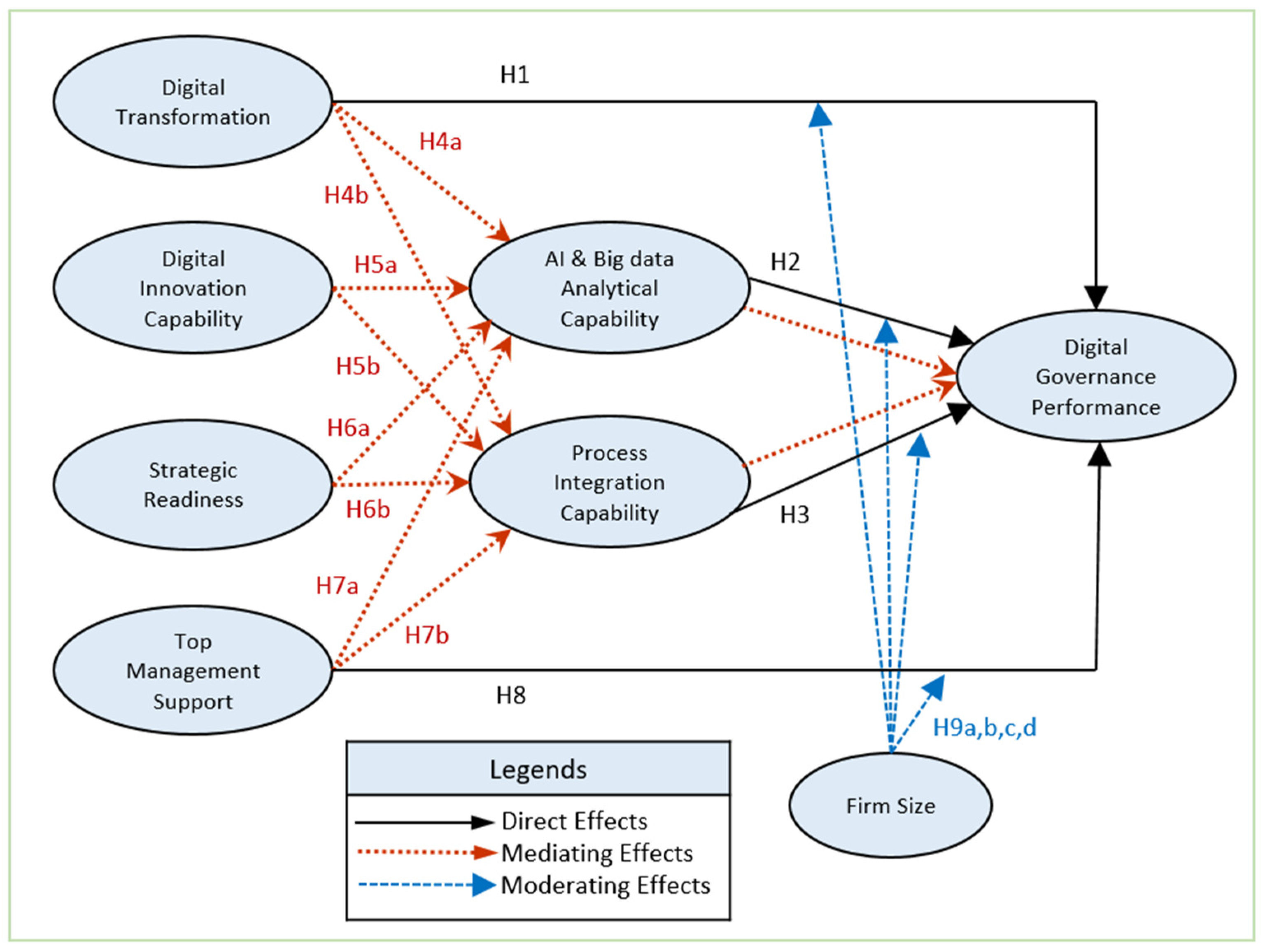
Figure 1 summarises the proposed conceptual framework by showing DT as the enabling condition; AIBDAC and PIC as capability pathways; DIC, SR, and TMS as organizational antecedents; and firm size as the moderating context.
4. Materials and Methods
This study adopts a quantitative, cross-sectional survey design to test the hypotheses developed in
Section 3.2. The objective is explanatory, focusing on how DT and related capabilities influence DGP in SMEs. Data were collected through a structured questionnaire and analysed using Partial Least Squares Structural Equation Modelling (PLS-SEM) in SmartPLS 4.1.1.7, with SPSS 23.0 used for preliminary screening and common method bias checks. The analysis followed a two-stage sequence: validating the measurement model and then assessing the structural model, including mediating and moderating effects, as reported in
Section 5.
4.1. Research Approach and Design
This study follows a quantitative, theory-driven, deductive design. The theoretical relationships were developed in
Section 3 by linking the constructs with the TOE framework, the Resource-Based View, Dynamic Capabilities Theory, and institutional perspectives.
Section 3.2 then translated this theoretical logic into testable hypotheses.
The methodological approach focuses on how those hypotheses are examined. The research design covers the development of the measurement instrument, the data collection process, and the analytical steps used to test the direct, mediating, and moderating relationships. The deductive logic is central: expected relationships originate from established research, and the empirical analysis evaluates whether these expectations hold in SME settings.
The sequence of methods aligns with standard quantitative research practice. The literature defines the constructs and the theoretical links between them. The instrument operationalizes these constructs. Survey data provide empirical evidence for model testing. PLS-SEM is used because it can analyse complex models, assess mediation and moderation, and does not require normality of data [
100].
Section 4.2 presents the measurement instrument,
Section 4.3 describes data collection, and
Section 5 reports the results based on this design.
4.2. Instrument Development
This study used a structured survey to collect data for testing the proposed model. The questionnaire included two parts. The first part captured basic demographic details of respondents. The second part contained 36 items that measured the core constructs related to digital capabilities and governance in SMEs. All respondents were screened to ensure they were involved in digital or technology-related roles within their firms. This ensured that respondents had direct exposure to DT activities, AI and big data use, process integration initiatives, or governance-relevant decision-making and reporting. In other words, only staff who could reliably assess the constructs in the model were invited to complete the survey.
The measurement items were adapted from established sources. DT (3 items) was adapted from [
64], while three items for DIC were taken from [
101]. Five items measuring AIBDAC were adapted from [
66]. DGP in SMEs was assessed using six items from [
65]. TMS (5 items) was adapted from [
69]. SR (5 items) was developed by drawing on themes discussed by [
68]. Finally, four items for PIC were adapted from [
67]. All constructs were measured on a 5-point Likert scale. Measurement items of the study are listed in
Appendix A.
The constructs and items were therefore chosen to match the hypotheses in
Section 3.2, so that each survey scale corresponds directly to a latent variable in the structural model.
4.3. Data Collection & Sample
Data for this study were collected primarily from SMEs across Saudi Arabia. The focus was on employees and managers working in digital, operational, or administrative roles who understand their firm’s digital processes. To reach this group, the study used a mix of cluster sampling and purposive sampling.
Cluster sampling was applied first to ensure national coverage. The sampling frame followed the five major regions of Saudi Arabia. Firms in key cities within these regions were approached because these areas host most SME activity and show higher levels of digital adoption. Within these clusters, purposive sampling was used to select respondents who were directly involved in DT activities, AI and big data practices, or process integration. This was necessary because the study required insights from people with relevant experience, not the general workforce. Organizations were included if they reported some level of digital activity, such as ERP usage, digital platforms, or initial AI and analytics projects, and if they had staff in roles connected to digital operations, analytics, or governance. Firms without any meaningful digital activity, or where suitable respondents could not be identified, were not retained. This ensured that both the organizational context and the individual respondents were aligned with the study’s focus on DT, AIBDAC, PIC, and governance performance.
An online questionnaire was shared through professional networks, SME associations, LinkedIn groups, and organizational contacts. Participation was voluntary. A total of 414 responses were received, and after removing incomplete entries, 396 valid cases were retained for analysis. Regarding sample size, following [
102], a minimum of 384 responses is recommended for large populations. Consistent with [
103], this threshold was adopted as the initial target. The final sample exceeded this requirement and met SEM guidelines of at least 15 cases per construct.
Although the study targeted SMEs, the sample includes firms across four size categories. The first two groups, 1 to 5 employees (45 firms) and 6 to 49 employees (148 firms), account for 193 of the 396 valid cases, which is 48% of the total sample and represents the core micro and small enterprise segment. Firms with 50 to 249 employees (159 firms) fall within the medium-sized SME category in the Saudi context, while 44 firms with more than 250 employees were retained because they participated through the same sampling channels and met the study’s criteria regarding digital transformation activities. Including these firms ensured broader representation of organizations engaged in digital transformation activities and supported the firm-size multi-group analysis conducted in this study.
Several procedural steps were taken to reduce the risk of method bias. The survey assured respondents of anonymity and confidentiality, and no identifying information was collected. Predictor and outcome items were mixed in the questionnaire to avoid pattern responses. Items used different stems and were spread across multiple sections to reduce priming. Respondents were reminded that there were no right or wrong answers, which helps minimize evaluation apprehension. These steps reduce the likelihood of single-source or consistency artefacts.
Ethical approval was obtained before data collection. Respondents were briefed on the purpose of the study and assured that their participation would remain anonymous and confidential.
Table 2 presents demographic information of the sample.
Section 4 describes the planned data screening, measurement validation, and structural model assessment steps used to verify and test the proposed relationships.
5. Empirical Analysis
For data analysis, SmartPLS 4 and SPSS 23 were used, applying the PLS-SEM approach. Partial Least Squares Structural Equation Modelling is well suited for exploratory work, complex models, and studies with small to medium sample sizes [
104,
105]. Unlike Covariance-Based SEM, which focuses on model fit and theory testing, PLS-SEM aims to maximize the explained variance of dependent variables and improve predictive accuracy [
106]. This makes it useful when models include many indicators or when the data are not normally distributed.
PLS-SEM also fits the theory-driven structure of this model. The study examines how DT shapes DGP through capability-building mechanisms, which makes variance explanation more relevant than global model fit. PLS-SEM is well suited to capability-based frameworks, complex mediation, and models that include both direct and indirect pathways [
106]. It also accommodates moderator analysis with smaller group sizes, which is necessary for the firm-size comparisons in this study.
A major strength of PLS-SEM is that it does not require multivariate normality and can handle mediating and moderating effects efficiently [
107]. In this study, SPSS 23 was first used to clean the data, address missing values, check common method bias, and assess linearity. SmartPLS 4 was then used to test the hypotheses and examine the structural paths.
PLS-SEM was selected instead of CB-SEM because it manages complex relationships more effectively and supports prediction-focused analysis. The data analysis followed two steps: evaluating the measurement model and then assessing the structural model.
Before presenting the results, it is helpful to clarify the analytical structure. DGP is the single dependent variable in this study, and all other constructs operate as predictors or mediators as defined in the hypotheses. AIBDAC and PIC represent the two core DT mechanisms examined, while DT, DIC, SR, and TMS serve as strategic and managerial enablers. This structure aligns directly with the study title, which focuses on DT and its capability pathways leading to governance performance.
5.1. Assessment of Common Method Bias and Multicollinearity
Common Method Bias (CMB) can arise when data for both independent and dependent variables come from the same source, such as a survey, which may introduce systematic error [
108]. To check for this issue, Harman’s single-factor test was used. The results showed that the first factor accounted for 40.66% of the total variance, which is below the 50% threshold, suggesting that CMB is unlikely. A full collinearity test was conducted using the procedure recommended by [
105]. This diagnostic assesses common method bias by examining whether any construct produces a full collinearity VIF above the threshold of 3.3. All constructs in this model had VIF values below this threshold, indicating that common method bias is unlikely to have distorted the results.
5.2. Measurement Model Analysis
To evaluate the measurement model, reliability and convergent validity were assessed following the guidelines of [
106]. Internal consistency was examined using Cronbach’s alpha, with a minimum acceptable value of 0.60, while composite reliability was evaluated using the 0.70 threshold. Indicator reliability was checked by assessing outer loadings, which should be 0.70 or higher. As presented in
Table 3, all constructs met these criteria. Cronbach’s alpha values for AIBDAC, DGP, DIC, DT, PIC, SR, and TMS were well above the minimum requirement, and composite reliability values also exceeded the recommended level, confirming strong internal consistency.
Indicator reliability was supported, as all loadings were greater than 0.70, demonstrating that each item meaningfully contributed to its corresponding construct. Convergent validity was assessed using the Average Variance Extracted (AVE), with a threshold of 0.50. The AVE values for all constructs ranged from 0.731 to 0.819, showing that more than half of the variance of each construct is captured by its indicators. These results confirm that the measurement scales demonstrate adequate reliability and convergent validity, meeting the standards recommended for PLS-SEM.
To assess discriminant validity, the study applied two standard tests: the Heterotrait–Monotrait (HTMT) ratio and the Fornell–Larcker criterion. As shown in
Table 4, all HTMT values were below the recommended threshold of 0.90, indicating that each construct is distinct from the others [
109]. The Fornell–Larcker results in
Table 5 also supported discriminant validity. For every construct, the square root of its AVE, displayed on the diagonal, was greater than the corresponding inter-construct correlations in the same row and column. This pattern confirms that each construct shares more variance with its own indicators than with other constructs. Taken together, both HTMT and Fornell–Larcker tests provide strong evidence of discriminant validity, confirming that the constructs in this study are conceptually and statistically distinct.
5.3. Structural (Inner) Model Explanatory and Predictive Assessment
Following the assessment of the measurement model, the structural model was evaluated using R
2, effect size (f
2), inner VIF, and predictive relevance (Q
2), consistent with the PLS-SEM guidelines [
100]. As shown in
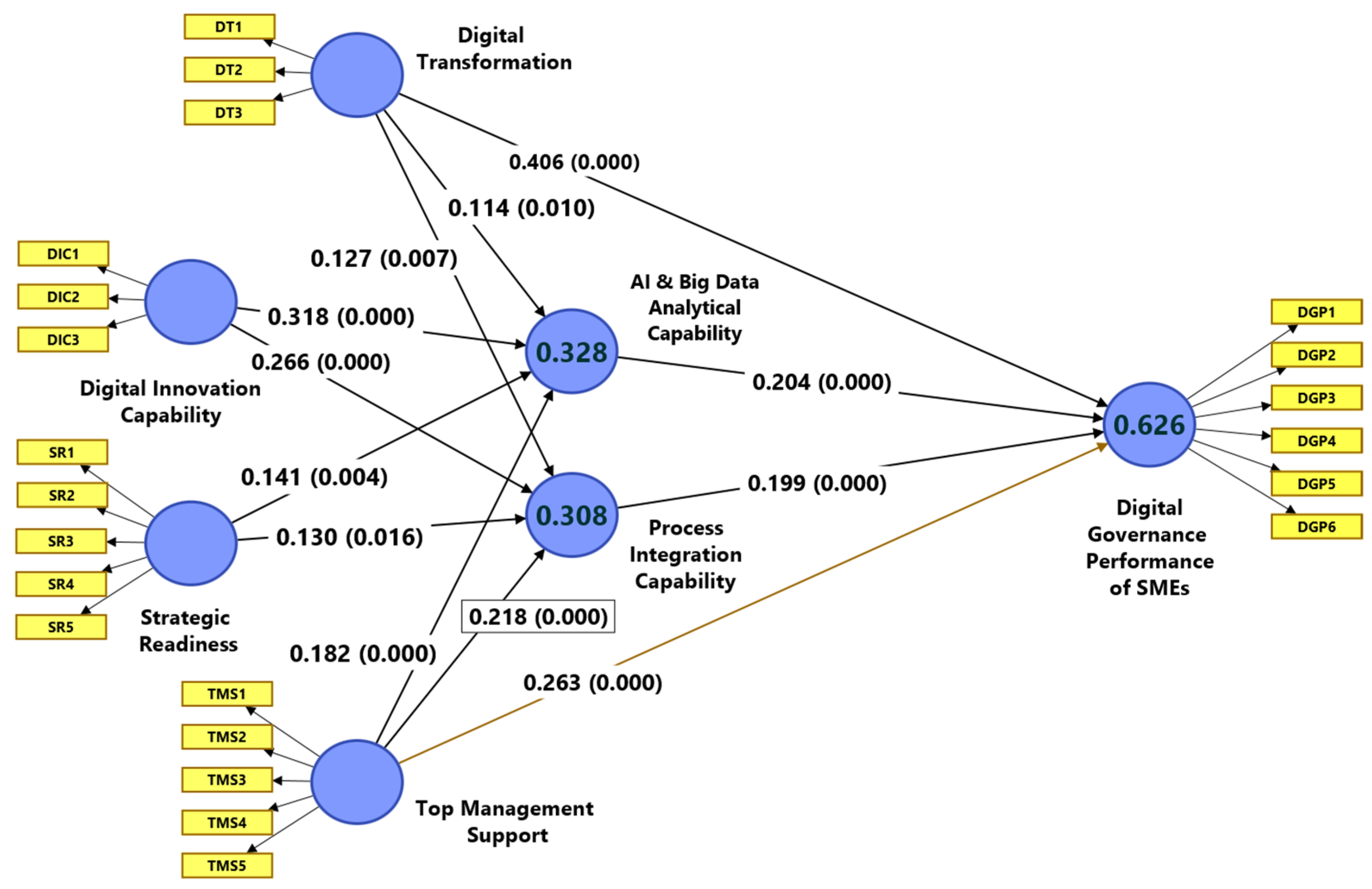
Table 6, the R
2 values were 0.328 for AIBDAC, 0.626 for DGP, and 0.308 for PIC, indicating weak to moderate explanatory power. The adjusted R
2 values were similar, suggesting stable model estimates.
The f
2 results show that the exogenous variables exert small to medium effects. For example, DIC and TMS had small effects on AIBDAC, while DT showed a medium effect on DGP (f
2 = 0.350). Other relationships demonstrated weak contributions, aligning with the benchmarks of 0.02, 0.15, and 0.35 for weak, medium, and strong effects [
100]. Some effect sizes are small, which is expected in capability-based models where multiple organizational factors jointly influence outcomes. The strong direct effect of DT on governance performance means that indirect mechanisms such as AIBDAC and PIC add incremental, rather than dominant, explanatory power.
Collinearity was examined using inner VIF values, all of which ranged between 1.25 and 1.45, well below the recommended threshold of 3.3 [
105]. This confirms that multicollinearity is not a concern in the structural model.
Predictive relevance (Q2) was assessed using the blindfolding procedure. All Q2 values were above zero, with DGP showing the highest predictive relevance (Q2 = 0.611). This indicates that the exogenous constructs meaningfully predict the endogenous variables.
Overall, the structural model demonstrates acceptable explanatory power, meaningful effect sizes, low collinearity, and strong predictive relevance.
5.4. Structural Model Analysis
The structural model results presented in this section directly address the hypotheses developed in
Section 3.2. A bootstrapping procedure with 10,000 resamples was applied in SmartPLS 4 to examine all hypothesised relationships. In line with established guidelines [
106], path coefficients were assessed using t-values and
p-values to confirm statistical significance. The direct, indirect, and mediation results are presented in
Table 7.
The findings provide strong support for the proposed direct effects. H1 was supported, showing that DT has a positive and significant effect on DGP (β = 0.406, t = 8.876, p < 0.001). H2 was also confirmed, indicating that AIBDAC positively influences DGP (β = 0.204, t = 5.319, p < 0.001). Likewise, H3 was supported, with PIC showing a significant positive impact on DGP (β = 0.199, t = 5.031, p < 0.001). TMS exhibited a strong direct effect on DGP, supporting H8 (β = 0.263, t = 6.870, p < 0.001).
The mediation analysis revealed a mix of partial and full mediation patterns. For DT, both indirect paths were significant. DT → AIBDAC → DGP (H4a: β = 0.023, t = 2.174, p = 0.030) and DT → PIC → DGP (H4b: β = 0.025, t = 2.319, p = 0.020) demonstrated partial mediation, as DT also retained a significant direct effect on DGP. For DIC, both mediating pathways showed full mediation. DIC → AIBDAC → DGP (H5a: β = 0.065, t = 3.667, p < 0.001) and DIC → PIC → DGP (H5b: β = 0.053, t = 3.376, p = 0.001) were significant, while the direct effect was negligible, confirming full mediation.
SR also exhibited full mediation through both mechanisms. SR → AIBDAC → DGP (H6a: β = 0.029, t = 2.321, p = 0.020) and SR → PIC → DGP (H6b: β = 0.026, t = 1.966, p = 0.049) were significant, indicating that SR influences governance performance entirely through these two capabilities. A mixed pattern was observed for TMS. Both indirect paths, TMS → AIBDAC → DGP (H7a: β = 0.037, t = 3.111, p = 0.002) and TMS → PIC → DGP (H7b: β = 0.043, t = 3.424, p = 0.001), were significant, while TMS also maintained a strong direct effect on DGP, confirming partial mediation.
Together, these results highlight the central role of AIBDAC and PIC in shaping DGP within SMEs. DT, AIBDAC, PIC, and TMS directly strengthen governance outcomes, while DIC and SR exert their influence indirectly through these two mediating capabilities. Overall, the findings reinforce the importance of digital, analytical, and integration capabilities as key channels through which broader strategic and managerial drivers translate into improved governance performance.
Figure 2 visualizes the tested structural model by displaying the significant direct and indirect paths that explain how DT capabilities drive governance performance, consistent with the theoretical model and study title.
5.5. Assessing Group Heterogeneity by Firm Size
Firm size can shape how digital capabilities translate into governance outcomes, so it is important to check whether the two size groups behave differently. This section first tests measurement invariance to ensure that the constructs operate consistently across groups. Once this is confirmed, the multi-group analysis examines whether the structural paths differ between small and medium-large firms, covering both direct and mediated effects. Firm size was treated as a contextual factor that may shape how SMEs convert digital capabilities into governance outcomes. The analysis checks whether small firms and medium or large firms rely on the same capability pathways or follow different patterns. This helps explain why similar digital investments produce uneven governance results across SMEs.
5.5.1. Establishing Measurement Invariance
To assess measurement invariance across firm-size groups, the measurement invariance of composite models (MICOM) procedure was applied. The MICOM approach evaluates configural invariance, compositional invariance, and equality of composite means and variances across groups.
The first step assesses configural invariance, which requires identical indicators, consistent data treatment, and the same algorithm settings across groups. These conditions were satisfied for both firm-size groups, confirming that the measurement models were specified identically for small firms and medium or large firms.
The second step examines compositional invariance using a permutation test.
Table 8 reports the correlations between composite scores across the two groups. For most constructs, the permutation
p-values exceed the 0.05 threshold, indicating that the correlations do not differ significantly from one. Two constructs, SR (
p = 0.046) and TMS (
p = 0.037), show permutation
p-values slightly below the 0.05 threshold. However, the original correlations for these constructs remain equal or very close to 1.000 and fall within the corresponding permutation confidence interval. Following the MICOM guidelines, these results indicate that compositional invariance can still be considered established across the firm-size groups.
The third step evaluates equality of composite means and variances.
Appendix B.1 presents the permutation results for mean and variance differences between the groups. The results indicate that two constructs, AIBDAC (
p = 0.015) and PIC (
p = 0.042), show significant differences in composite means across the firm-size groups. The remaining constructs do not exhibit significant mean differences. For composite variances, all permutation
p-values exceed 0.05, indicating no significant variance differences between the two groups.
Because configural invariance and compositional invariance are supported and only limited differences in composite means are observed, the MICOM procedure establishes partial measurement invariance between the firm-size groups. According to established PLS-SEM guidelines, partial measurement invariance is sufficient to proceed with multi-group analysis. This allows the structural relationships to be compared between small firms and medium or large firms with confidence. This outcome confirms that the constructs are interpreted similarly across the firm-size groups, ensuring that any observed differences in structural relationships reflect substantive group differences rather than measurement inconsistencies.
5.5.2. Multi-Group Analysis by Firm Size
Our dataset includes firms of different sizes, which can shape how the constructs relate to each other. Ignoring such heterogeneity in PLS-SEM may compromise validity [
106]. These differences can be examined through moderator analysis or multi-group analysis [
110]. For this purpose, the sample was divided into two groups based on firm size: Small_Firms (employees < 50) and Medium_&Large_Firms (employees ≥ 50). The Small_Firms group contained 193 cases, while the Medium&_Large_Firms group included 203 cases.
Both groups met the required sample size. With four paths pointing to the most complex endogenous construct, Hair’s rule indicates a minimum of 40 cases [
106]. The G*Power (version 3.1.9.7) range of 85–130 cases was also exceeded by both groups, ensuring adequate power for MGA. Sample size was therefore not a constraint.
Moderation effects were assessed following [
111], using two conditions: (1) the path is significant in one group but not the other, or (2) the paths are significant in both groups but differ in sign. These criteria supported a reliable evaluation of group differences.
Table 9 presents the MGA results across the two firm-size groups.
Appendix B.2 provides the permutation-based MGA statistics for the structural path comparisons across the firm-size groups. Because the permutation procedure estimates group-specific coefficients under repeated resampling, the path coefficients reported in
Appendix B.2 may differ slightly from the bootstrapped estimates shown in
Table 9, although the overall interpretation remains unchanged.
As indicated by the results in
Table 9, differences in significance patterns across the firm-size groups were observed in three of the twelve hypothesized paths.
The effect of DIC on DGP through PIC differs between the two firm-size groups. Medium and large firms show a weaker indirect effect (β = 0.039,
p = 0.084), which is not significant, while small firms report a stronger and significant effect (β = 0.066,
p = 0.004). This pattern suggests a potential moderation effect across firm-size groups. For small firms, improvements in DIC translate more clearly into process integration, which then enhances DGP. Larger firms, with more established structures and resources, may rely less on this specific pathway, leading to a weaker and non-significant effect. However, the permutation comparison reported in
Appendix B.2 indicates that the difference between the two groups is not statistically significant and should therefore be interpreted with caution.
A difference also appears in the indirect influence of SR on DGP through PIC. Medium and large firms show a significant effect (β = 0.043,
p = 0.024), while the effect in small firms is weak and not significant (β = 0.009,
p = 0.617). This pattern suggests a firm-size related moderation effect. In medium and large firms, stronger SR leads to better process integration, which in turn improves governance outcomes. Small firms may lack the structure, manpower, or maturity needed to translate SR into integrated processes. However, the permutation comparison reported in
Appendix B.2 indicates that the difference between the two groups is not statistically significant, suggesting that the observed variation should be interpreted with caution.
The indirect pathway from TMS to DGP through AIBDAC also varies by firm size. Medium and large firms show a significant effect (β = 0.041,
p = 0.025), while small firms report a similar effect size but with a marginal
p-value (β = 0.031,
p = 0.060). This pattern suggests a potential moderation effect. In larger firms, support from top management more effectively enhances AIBDAC, which then strengthens governance performance. Small firms may face resource constraints that limit how well managerial support can be converted into advanced analytical capabilities. However, the permutation comparison reported in
Appendix B.2 indicates that the difference between the two groups is not statistically significant, suggesting that the observed variation should be interpreted cautiously.
Overall, the MGA results suggest that firm size may influence several indirect relationships in the model. Three mediation pathways display different significance patterns across the two groups, indicating that small and medium or large firms may rely on different capability mechanisms when translating digital resources into governance outcomes. However, the permutation comparison reported in
Appendix B.2 indicates that the differences between groups are not statistically significant, suggesting that these variations should be considered as indicative rather than conclusive.
6. Discussion
This study examined how DT shapes digital governance performance in SMEs and how this effect strengthens when firms build strong analytics and process-based capabilities. By focusing on AIBDAC and PIC, the study shows how digital efforts move beyond tool adoption and turn into real governance gains, consistent with recent DT–governance evidence. It also views SMEs as linked systems where digital tools, people, data, and routines interact. The results address the core research question by showing how digital transformation shapes governance performance through analytics and process capabilities.
The strong direct effect of DT on DGP shows that many governance gains come from digitizing workflows and improving data visibility. These digital changes strengthen transparency, control, and reporting quality without depending fully on analytics or deep process integration. AIBDAC and PIC add extra value by improving information accuracy and linking workflows, but their contribution is incremental. This aligns the theoretical setup with the empirical pattern and explains why the indirect effects remain smaller than the direct DT effect.
The direct effect of DT on DGP confirms that digital change is now central to good governance. Firms that adopt digital tools and automate key tasks improve transparency, data quality, and the speed of decisions. These results match recent work showing that DT reduces gaps in information and supports better control [
78]. The partial mediation found in the framework shows that DT helps governance both on its own and through AIBDAC and PIC. From a systems view, DT strengthens the technical side of the firm, while the two mediators link this side to daily work and control routines.
AIBDAC proved to be a clear driver of DGP, as stronger analytics practices improve monitoring, reporting accuracy, and the quality of decisions. This aligns with studies showing that analytics improves oversight and decision quality under fast change [
82,
112]. AIBDAC also mediated the effects of DT, DIC, SR, and TMS, consistent with earlier work linking analytics maturity with governance-relevant outcomes [
83]. In system terms, AIBDAC improves the flow of information, which helps key parts of the firm coordinate and act on clear signals.
PIC also showed a strong direct link with DGP because integrated workflows reduce errors, strengthen consistency, and support reliable control routines across units. When processes link well across units, firms cut errors, reduce delays, and apply control tasks in the same way everywhere. This is supported by evidence that integrated processes strengthen consistency and control structures in SMEs [
85]. PIC also fully mediated the effects of DIC and SR, consistent with research showing that innovation and readiness only improve governance when they translate into aligned workflows [
93]. This reflects how the structure of a system shapes what firms can achieve.
TMS influenced DGP both directly and indirectly, since leadership support accelerates digital initiatives, aligns priorities, and helps embed data and process routines across the firm. These results are consistent with recent studies showing that TMS drives analytics adoption and process improvements linked to governance [
94,
96]. The indirect effects through AIBDAC and PIC show that leaders help shape the setting in which new capabilities grow. In a systems sense, leaders act as a force that aligns the subparts of the firm and helps reduce friction during digital change.
DIC and SR were fully mediated by AIBDAC and PIC, indicating that innovation and readiness improve governance only when they lead to stronger analytics and integrated workflows. This suggests that firms benefit from innovation and readiness only when these traits lead to measurable improvements in analytics capability or process integration. This is consistent with recent work showing that readiness and innovation matter most when translated into routinized capabilities [
92]. These results point to a layered view of capability building, where high-level traits matter only when they shape day-to-day systems inside the firm.
The group comparisons show that firm size shapes how SMEs translate digital efforts into governance outcomes, with smaller firms benefiting more from innovation-driven process changes, while larger SMEs gain more from readiness and leadership support. For small firms, the DIC → PIC → DGP link was stronger, which is consistent with evidence that smaller firms move faster and translate ideas into process change more quickly [
30]. In contrast, medium_large firms showed stronger paths for SR → PIC → DGP and TMS → AIBDAC → DGP, matching prior work showing that more formal structures amplify readiness and leadership effects [
31,
97]. These findings show that size creates different system setups, which change how digital and capability paths shape governance. These findings also show that firm size shapes the mediated pathways more than the direct ones, consistent with the moderated mediation logic described earlier.
Overall, the findings show that governance improvements arise from both direct digital enhancements and the capabilities that help SMEs use those enhancements effectively. DT delivers immediate gains, while AIBDAC and PIC add extra value by improving information quality and linking workflows. SR, digital innovation, and TMS influence how these capabilities develop over time. Firm size explains why SMEs differ, since some can convert capabilities more effectively into oversight and control. These points bring together the theory and evidence and explain the mixed patterns found in earlier studies.
7. Implications of the Research
These implications build directly on the relationships tested in the revised framework and address the research gap noted in the introduction, reflecting the capability-based logic outlined in
Section 2 and
Section 3. Prior work did not clearly explain how analytics capability and process integration translate DT into governance outcomes in SMEs. The findings show that while AIBDAC and PIC help strengthen information quality and link processes, most of the governance benefit still comes directly from DT itself. These clarifications guide the theoretical and practical implications presented below. These implications mirror the capability pathways defined in
Section 3, where DT acts as the foundational resource and AIBDAC and PIC operate as the mechanisms that translate digital change into governance outcomes.
The results refine RBV and DCT perspectives by showing that DT produces immediate governance gains through digitised workflows, clearer data visibility, and automated controls. AIBDAC and PIC extend these gains by improving information accuracy and internal coordination. They add value by strengthening governance routines rather than replacing the direct contribution of DT. This places DT as the core driver, with capability building acting as an enhancing layer.
The findings also connect well with multilevel views of DT, which describe transformation as socio-structural change that creates sustained value when supported by firm capabilities [
32]. They align with dynamic capability research in SMEs that views DT as a sensing, seizing, and reconfiguring process through which governance-relevant capabilities develop [
82]. Within this view, AIBDAC and PIC appear as specific capabilities that help translate digital change into stronger governance.
The full mediation effects of DIC and SR deepen the understanding of organizational readiness within the TOE framework. While readiness and innovation capacity matter, they shape governance only when they result in usable analytical or process capabilities. This highlights that softer organizational qualities influence outcomes through structured routines rather than acting alone.
The significant role of TMS further strengthens leadership perspectives within DCT. The combined direct and indirect effects suggest that leadership not only guides strategy but also supports capability building by investing in analytics, integration, and data-driven routines. This links strategic direction with operational capability formation inside SMEs.
The MGA results add an important dimension by showing that firm size shapes how capability pathways lead to governance outcomes. The differences observed in mediated pathways show that small and medium-large firms do not convert digital capabilities into governance in the same way. Resource depth, managerial layers, and structural complexity influence how the system components interact. This adds nuance to TOE and RBV interpretations by highlighting that capability development is not uniform across SME types.
The findings reinforce the central insight developed in the revised framework that digital tools alone do not ensure governance quality; their impact depends on the capabilities and organizational conditions that accompany them.
The study offers several practical insights. SMEs should recognise that DT itself produces the strongest governance improvements. Clearer data flows, automated controls, and digitised tasks help long before advanced capabilities are built. AIBDAC and PIC then provide extra gains by improving information quality and process alignment. Firms can therefore strengthen DT basics first and build analytics and integration capabilities over time. Leadership support remains essential, since managers enable capability development by providing resources, promoting data-driven work, and backing transformation efforts. Policymakers and SME programs can support this by offering training that raises analytics and integration maturity. Finally, differences across firm size show that capability-building strategies must be tailored. Small firms may gain more from improving PIC, while medium-large firms benefit more from strengthening AIBDAC through readiness and leadership support. A single approach will not suit all SME structures.
8. Recommendations
Based on the study’s findings, several practical recommendations can guide organizations seeking to strengthen digital governance through capability development. These recommendations follow from the capability pathways identified in the empirical results and align with the refined structure of the framework:
Prioritize capability building alongside DT investments: Organizations should match digital initiatives with structured development of AIBDAC and PIC. Technology works effectively only when supported by capabilities that link different parts of the system.
Make data analytics a core governance function: Firms should formalize analytics teams, dashboards, and real-time reporting to improve oversight and ensure that information flows across the organization remain consistent.
Integrate processes across departments: Governments and industry bodies should promote integrated workflows that reduce disconnected operations and support more coherent governance practices.
Strengthen leadership involvement in digital initiatives: Top management must sponsor digital projects, allocate resources, and guide capability development that aligns technological and organizational subsystems.
Establish formal structures for innovation and readiness: Organizations should adopt simple frameworks for innovation planning, readiness assessment, and ongoing capability development to support system-wide improvement.
Provide targeted support for smaller firms: Small enterprises should focus on strengthening process integration first, as it creates stable internal links that improve governance in resource-limited settings.
Enable medium and large firms to advance analytics: Larger firms should prioritize AIBDAC because their scale and structures allow greater benefits from data-driven governance tools.
Encourage continuous training and workforce upskilling: Firms should invest in training that improves data literacy, digital skills, and process-management capabilities across all units of the organization.
Adopt hybrid governance models: Organizations should combine automated governance tools with human oversight to ensure reliable decisions while benefiting from analytics.
Promote cross-regional learning: International bodies such as the OECD or World Bank can support knowledge-sharing platforms where SMEs exchange practical approaches to DT, analytics, and integrated processes.
Support digital infrastructure development globally: Policymakers should expand access to cloud services, AI tools, and secure digital infrastructure so firms in emerging economies can develop stronger governance systems.
Implement scalable digital strategies: Organizations should design modular DT and capability-building approaches that can be scaled according to size, sector, and available resources, ensuring system alignment across different contexts.
9. Limitations and Future Research
This study has several limitations that offer opportunities for future research. First, the data was collected from SMEs in Saudi Arabia, which may limit the generalisability of the results to firms operating in different regulatory, cultural, or technological environments. Future studies should examine the model across countries or regions to validate the findings in broader contexts. Second, the study used cross-sectional data, which restricts the ability to capture how DT, capabilities, and governance performance evolve over time. Longitudinal designs would help identify causal dynamics and capability development pathways. Third, the model focused on two mediators, AIBDAC and PIC. Although both proved essential, future research could test additional mediators such as digital culture, knowledge management capability, or IT governance maturity to offer a fuller picture of how DT translates into performance. The study did not include ERP usage, AI and big-data usage stage, or integration maturity as control variables. Future research can incorporate these factors as robustness checks to confirm that the main relationships are not driven by basic adoption differences.
Moderating factors were limited to firm size. Future studies could explore moderators such as environmental turbulence, regulatory pressure, technology readiness, leadership style, or organizational agility, which may influence how DT and capabilities shape governance outcomes. Finally, expanding the model to include sector-specific variables or comparing SMEs with large enterprises could provide deeper insights into how organizational context shapes digital governance pathways.
10. Conclusions
This study examined how DT influences digital governance performance in SMEs and how this influence operates through capability pathways. The results show that DT delivers the strongest governance gains by improving data visibility, automating routine tasks, and strengthening control processes. AIBDAC and PIC extend these gains by improving information quality and linking workflows, but their contribution is incremental. This reflects the revised framework, which treats DT as the primary driver and positions AIBDAC and PIC as complementary mechanisms that refine and strengthen DT’s impact.
The findings also confirm that DIC and SR shape governance performance only when they translate into usable analytics and integrated processes. This supports the capability-based reasoning used in the revised literature review and aligns with TOE and RBV perspectives, which describe how organizational conditions enable digital resources to become actionable capabilities.
Firm size further explains why SMEs with similar levels of digitalization achieve different governance outcomes. Small firms gain more from process integration, while medium-large firms benefit more from analytics maturity and stronger leadership support. These differences match the moderated pathways tested in the framework and reinforce that capability development is not uniform across SME types.
This study addresses a clear gap in the literature by explaining why governance outcomes remain uneven despite widespread digital adoption. By identifying analytics and process integration as capability pathways and by showing how these pathways vary by firm size, the study offers a more complete explanation of how DT turns into governance performance.
Overall, the findings present SMEs as interconnected socio-technical systems where digital tools, processes, leadership, and readiness interact to shape governance outcomes. For practice, the results suggest a staged approach: strengthen core digital foundations first, then develop analytics and integration capabilities, and support these with leadership commitment. These insights help SMEs and policymakers build governance systems that promote transparency, accountability, and reliable decision-making.
Author Contributions
Conceptualization, S.B.A. and I.H.-u.-R.; methodology, I.H.-u.-R.; software, I.H.-u.-R.; validation, S.B.A., I.H.-u.-R. and M.A.A.; formal analysis, I.H.-u.-R.; investigation, D.M.I.B.; resources, S.B.A.; data curation, K.W.A.A.; writing—original draft preparation, I.H.-u.-R. and K.W.A.A.; writing—review and editing, S.B.A. and M.A.A.; visualization, D.M.I.B.; supervision, S.B.A. and I.H.-u.-R.; project administration, S.B.A. and I.H.-u.-R.; funding acquisition, S.B.A. All authors have read and agreed to the published version of the manuscript.
Funding
This research was funded by Deanship of Research and Graduate Studies at the University of Tabuk, Saudi Arabia, grant number “S-2024-0077”, through the project titled “Community Research Track”, and The APC was funded by “S-2024-0077”.
Institutional Review Board Statement
The study was reviewed and approved by the Local Research Ethics Committee of University of Tabuk (Approval Number: UT-791-476-2025).
Informed Consent Statement
Informed consent was obtained from all subjects involved in the study. Participation was voluntary, and respondents could withdraw at any time without consequences.
Data Availability Statement
The original contributions presented in this study are included in the article. Further inquiries can be directed to the corresponding author.
Acknowledgments
1. The authors extend their appreciation to the Deanship of Research and Graduate Studies at the University of Tabuk, Saudi Arabia, for providing administrative and technical support to this research. 2. During the preparation of this study, the authors used ChatGPT 5.4 for the purposes of improving the language and enhancing the readability of the manuscript. The authors have reviewed and edited the output and take full responsibility for the content of this publication.
Conflicts of Interest
The authors declare no conflicts of interest.
Abbreviations
The following abbreviations are used in this manuscript:
| DT | Digital Transformation |
| DGP | Digital Governance Performance |
| AIBDAC | AI and Big Data Analytical Capability |
| PIC | Process Integration Capability |
| DIC | Digital Innovation Capability |
| SR | Strategic Readiness |
| TMS | Top Management Support |
| RBV | Resource-Based View |
| DCT | Dynamic Capabilities Theory |
| TOE | Technology–Organization–Environment Framework |
| VRIN | Valuable, Rare, Inimitable, Non-substitutable |
| PLS-SEM | Partial Least Squares Structural Equation Modelling |
| CB-SEM | Covariance-Based Structural Equation Modelling |
| HTMT | Heterotrait–Monotrait Ratio |
| AVE | Average Variance Extracted |
| VIF | Variance Inflation Factor |
| MAE | Mean Absolute Error |
| RMSE | Root Mean Square Error |
| CMB | Common Method Bias |
| ERP | Enterprise Resource Planning |
| API | Application Programming Interface |
| ICT | Information and Communication Technology |
| KYC/AML | Know Your Customer/Anti-Money Laundering |
| ESG | Environmental, Social, and Governance |
| ODTR | Organizational Digital Transformation Readiness |
| MSMEs | Micro, Small, and Medium Enterprises |
Appendix A
Table A1.
Measurement Items.
Table A1.
Measurement Items.
| Constructs | Sources |
|---|
Digital Transformation (DT)
DT1: Our business is driving new business processes built on technologies such as big data, analytics, cloud, mobile and social media platform.
DT2: Our business is integrating digital technologies such as social media, big data, analytics, cloud and mobile technologies to drive change.
DT3: Our business is shifting business operations toward making use of digital technologies such as big data, analytics, cloud, mobile and social media platform. | Adapted from [64] |
Digital Innovation Capability (DIC)
DIC1: Digital innovation capability enables the generation of new ideas in the company.
DIC2: Digital innovation capability drives the development of novel solutions.
DIC3: Digital innovation capability supports the creation of new products and services. | Adapted from [101] |
AI & Big Data Analytical Capability (AIBDAC)
AIBDAC1: We use AI-enabled big data analytics applications that incorporate information from both internal and external sources.
AIBDAC2: AI and big data analytics are used to extract knowledge about hidden patterns, correlations, market trends, and client preferences.
AIBDAC3: AI-driven big data analytical intelligence is considered an essential tool in our supply chain department.
AIBDAC4: AI and big data analytical intelligence are employed in decision-making across all major functional areas.
AIBDAC5: With a strong understanding of AI and big data analytical intelligence, we use these capabilities to drive change, reduce inefficiencies, and respond quickly to resource fluctuations. | Adapted from [66] |
Digital Governance Performance (DGP) in SMEs
DGP1: Our business ensures that managers effectively support digitalization efforts.
DGP2: Our business demonstrates strong digital skills and abilities among employees.
DGP3: Our business effectively utilizes new digital technologies in operations.
DGP4: Our business shows readiness and capability to apply digital tools in daily activities.
DGP5: Our business successfully develops and applies new digital solutions.
DGP6: Our business builds effective digital networks and collaborations in its operating environment. | Adapted from [65] |
Top Management Support (TMS)
TMS1: Top management actively attends meetings related to digital transformation and governance initiatives.
TMS2: Top management is involved in defining digital information and reporting requirements for our business.
TMS3: Top management reviews and considers recommendations from external consultants or advisors on digital transformation.
TMS4: Top management actively participates in decision-making related to digital transformation and governance practices.
TMS5: Top management monitors the progress of digital transformation and governance initiatives in our business. | Adapted from [69] |
Strategic Readiness (SR)
SR1: Our business has a clear digital strategy that includes goals, actions, and measures for digital transformation.
SR2: Our business allocates sufficient investments and resources to support digital transformation initiatives.
SR3: Our management demonstrates competence and willingness to engage in digital operations and technologies.
SR4: Our business culture encourages digital change, continuous improvement, and effective information sharing through digital tools.
SR5: Our business leverages digital technologies and customer/supply chain data to improve services, sales, and decision-making. | The measurement items were prepared drawing on the themes presented by [68] |
Process Integration Capability (PIC)
PIC1: Our business shares key operational information (e.g., inventory, orders) with partners through digital technologies.
PIC2: Our business uses digital platforms to jointly plan and coordinate with partners (e.g., procurement, demand forecasts).
PIC3: Our business integrates partners into new product/service development and introduction using digital tools.
PIC4: Our business leverages digital technologies to coordinate service and support activities with partners. | Adapted from [67] |
Appendix B
Appendix B.1
Table A2.
MICOM Step-3 Results: Composite Means and Variances—Groups Small vs. Medium & Large.
Table A2.
MICOM Step-3 Results: Composite Means and Variances—Groups Small vs. Medium & Large.
| | Mean | Variance |
|---|
| Constructs | Original Difference | Permutation Mean Difference | 2.50% | 97.50% | Permutation p-Values | Original Difference | Permutation Mean | 2.50% | 97.50% | Permutation p-Values |
|---|
| AIBDAC | −0.267 | 0.005 | −0.196 | 0.217 | 0.015 | 0.112 | 0.000 | −0.187 | 0.191 | 0.263 |
| DGP | −0.195 | 0.005 | −0.188 | 0.207 | 0.059 | 0.095 | 0.004 | −0.200 | 0.220 | 0.353 |
| DIC | −0.054 | 0.005 | −0.205 | 0.204 | 0.601 | 0.107 | 0.002 | −0.282 | 0.258 | 0.447 |
| DT | −0.116 | 0.004 | −0.198 | 0.207 | 0.255 | 0.223 | 0.001 | −0.455 | 0.469 | 0.343 |
| PIC | −0.214 | 0.003 | −0.197 | 0.207 | 0.042 | 0.174 | 0.001 | −0.302 | 0.329 | 0.303 |
| SR | −0.149 | 0.002 | −0.197 | 0.187 | 0.138 | 0.041 | 0.003 | −0.275 | 0.288 | 0.794 |
| TMS | −0.110 | 0.003 | −0.212 | 0.212 | 0.302 | 0.088 | 0.001 | −0.274 | 0.261 | 0.560 |
Appendix B.2
Table A3.
Permutation Multi-Group Analysis Results for Structural Path Differences Across Firm-Size Groups (Small Firms vs. Medium & Large Firms).
Table A3.
Permutation Multi-Group Analysis Results for Structural Path Differences Across Firm-Size Groups (Small Firms vs. Medium & Large Firms).
| Hyp# | Path | Original (Small_Firms) | Original
(Medium_&_Large_Firms) | Original Difference | Permutation Mean Difference | 2.50% | 97.50% | Permutation p Value |
|---|
| H1 | DT -> DGP | 0.360 | 0.459 | −0.099 | −0.001 | −0.185 | 0.174 | 0.311 |
| H2 | AIBDAC -> DGP | 0.191 | 0.211 | −0.020 | 0.001 | −0.163 | 0.161 | 0.804 |
| H3 | PIC -> DGP | 0.193 | 0.207 | −0.014 | 0.000 | −0.171 | 0.165 | 0.848 |
| H4a | DT -> AIBDAC -> DGP | 0.026 | 0.018 | 0.008 | 0.000 | −0.042 | 0.045 | 0.736 |
| H4b | DT -> PIC -> DGP | 0.028 | 0.022 | 0.006 | 0.000 | −0.044 | 0.042 | 0.769 |
| H5a | DIC -> AIBDAC -> DGP | 0.060 | 0.071 | −0.011 | −0.001 | −0.071 | 0.069 | 0.765 |
| H5b | DIC -> PIC -> DGP | 0.066 | 0.039 | 0.027 | 0.000 | −0.061 | 0.064 | 0.399 |
| H6a | SR -> AIBDAC -> DGP | 0.026 | 0.030 | −0.004 | 0.001 | −0.047 | 0.049 | 0.884 |
| H6b | SR -> PIC -> DGP | 0.009 | 0.043 | −0.034 | 0.001 | −0.051 | 0.055 | 0.210 |
| H7a | TMS -> AIBDAC -> DGP | 0.031 | 0.041 | −0.009 | 0.001 | −0.049 | 0.051 | 0.718 |
| H7b | TMS -> PIC -> DGP | 0.034 | 0.058 | −0.024 | 0.000 | −0.052 | 0.050 | 0.383 |
| H8 | TMS -> DGP | 0.343 | 0.185 | 0.158 | 0.000 | −0.157 | 0.150 | 0.039 |
References
- Seppänen, S.; Ukko, J.; Saunila, M. Understanding Determinants of Digital Transformation and Digitizing Management Functions in Incumbent SMEs. Digit. Bus. 2025, 5, 100106. [Google Scholar] [CrossRef]
- Kahveci, E. Digital Transformation in SMEs: Enablers, Interconnections, and a Framework for Sustainable Competitive Advantage. Adm. Sci. 2025, 15, 107. [Google Scholar] [CrossRef]
- Hidayat-ur-Rehman, I.; Alsolamy, M. A SEM-ANN Analysis to Examine Sustainable Performance in SMEs: The Moderating Role of Transformational Leadership. J. Open Innov. Technol. Mark. Complex. 2023, 9, 100166. [Google Scholar] [CrossRef]
- Fang, Q.; Yu, N.; Xu, H. Governance Effects of Digital Transformation: From the Perspective of Accounting Quality. China J. Account. Stud. 2023, 11, 77–107. [Google Scholar] [CrossRef]
- Wang, C.; Wang, D.; Deng, X.; Wang, S. Research on the Impact of Enterprise Digital Transformation on Internal Control. Sustainability 2023, 15, 8392. [Google Scholar] [CrossRef]
- Li, Z.; Xie, B.; Chen, X.; Fu, Q. Corporate Digital Transformation, Governance Shifts and Executive Pay-Performance Sensitivity. Int. Rev. Financ. Anal. 2024, 92, 103060. [Google Scholar] [CrossRef]
- Siswanti, I.; Riyadh, H.A.; Nawangsari, L.C.; Mohd Yusoff, Y.; Wibowo, M.W. The Impact of Digital Transformation for Sustainable Business: The Meditating Role of Corporate Governance and Financial Performance. Cogent Bus. Manag. 2024, 11, 2316954. [Google Scholar] [CrossRef]
- Yang, Q.; Jin, S. Exploring the Impact of Digital Transformation on Manufacturing Environment, Social Responsibility, and Corporate Governance Performance: The Moderating Role of Top Management Teams. Sustainability 2024, 16, 4342. [Google Scholar] [CrossRef]
- Tran, N.P.; Le, Q.T.T.; Vo, A.T.; Vo, D.H. Digital Transformation and Corporate Restructuring: Does Corporate Governance Matter? J. Strateg. Manag. 2024. ahead of print. [Google Scholar] [CrossRef]
- Shenkoya, T.O. Digital Transformation: An Investigative Study of the Performance of Digitalization in Governance. Int. J. Organ. Anal. 2025, 33, 2122–2136. [Google Scholar] [CrossRef]
- Sun, Z.; Wang, W.; Wang, W.; Sun, X. How Does Digital Transformation Affect Corporate Social Responsibility Performance? From the Dual Perspective of Internal Drive and External Governance. Corp. Soc. Responsib. Environ. Manag. 2024, 31, 1156–1176. [Google Scholar] [CrossRef]
- Johnston, M. Good Governance: Rule of Law, Transparency, and Accountability; UNESCO International Institute of Educational Planning (IIEP): Paris, France, 2006; Available online: https://etico.iiep.unesco.org/sites/default/files/2017-09/unpan010193.pdf (accessed on 27 December 2025).
- Siti-Nabiha, A.K.; Scapens, R.W. Stability and Change: An Institutionalist Study of Management Accounting Change. Account. Audit. Account. J. 2005, 18, 44–73. [Google Scholar] [CrossRef]
- Hokmabadi, H.; Rezvani, S.M.H.S.; de Matos, C.A. Business Resilience for Small and Medium Enterprises and Startups by Digital Transformation and the Role of Marketing Capabilities—A Systematic Review. Systems 2024, 12, 220. [Google Scholar] [CrossRef]
- Aldasoro, I.; Gambacorta, L.; Pal, R.; Revoltella, D.; Weiss, C.; Wolfski, M. AI Adoption, Productivity and Employment: Evidence from European Firms; Bank for International Settlements: Basel, Switzerland, 2026; Available online: https://www.bis.org/publ/work1325.pdf (accessed on 30 January 2026).
- OECD. AI Adoption by Small and Medium-Sized Enterprises; OECD Publishing: Paris, France, 2025. [Google Scholar] [CrossRef]
- Akter, S.; Wamba, S.F.; Gunasekaran, A.; Dubey, R.; Childe, S.J. How to Improve Firm Performance Using Big Data Analytics Capability and Business Strategy Alignment? Int. J. Prod. Econ. 2016, 182, 113–131. [Google Scholar] [CrossRef]
- Ghasemaghaei, M. Does Data Analytics Use Improve Firm Decision Making Quality? The Role of Knowledge Sharing and Data Analytics Competency. Decis. Support Syst. 2019, 120, 14–24. [Google Scholar] [CrossRef]
- Valaskova, K.; Nagy, M.; Juracka, D. Digital Transformation and Financial Performance: An Empirical Analysis of Strategic Alignment in the Digital Age. J. Enterp. Communities 2025, 19, 1178–1205. [Google Scholar] [CrossRef]
- Pathak, S.; Krishnaswamy, V.; Sharma, M. A Dynamic Capability Perspective on the Impact of Big Data Analytics and Enterprise Architecture on Innovation: An Empirical Study. J. Enterp. Inf. Manag. 2025, 38, 532–563. [Google Scholar] [CrossRef]
- Tushman, M.L.; Nadler, D.A. Information Processing as an Integrating Concept in Organizational Design. Acad. Manag. Rev. 1978, 3, 613–624. [Google Scholar] [CrossRef]
- Tarigan, Z.J.H.; Siagian, H.; Jie, F. Impact of Enhanced Enterprise Resource Planning (Erp) on Firm Performance through Green Supply Chain Management. Sustainability 2021, 13, 4358. [Google Scholar] [CrossRef]
- Baker, J.; Baker, J. The Technology–Organization–Environment Framework. Integr. Ser. Inf. Syst. 2012, 1, 231–245. [Google Scholar] [CrossRef]
- N’Dri, A.B.; Su, Z. Towards a Successful Learning Process of Companies from Developing Countries Involved in Offshore Outsourcing: Proposal for an Integrative Analytical Framework. Crit. Perspect. Int. Bus. 2023, 19, 355–398. [Google Scholar] [CrossRef]
- Rahman, S.A.; Taghizadeh, N.S.; Tipu, S.A.A.; Far, S.M. Leveraging Dynamic Capabilities for Digital Transformation: Exploring the Moderating Role of Cost in Environmental Performance of SMEs. J. Open Innov. Technol. Mark. Complex. 2025, 11, 100523. [Google Scholar] [CrossRef]
- Orero-Blat, M.; Palacios-Marqués, D.; Leal-Rodríguez, A.L.; Ferraris, A. Beyond Digital Transformation: A Multi-Mixed Methods Study on Big Data Analytics Capabilities and Innovation in Enhancing Organizational Performance. Rev. Manag. Sci. 2025, 19, 649–685. [Google Scholar] [CrossRef]
- Atlas, F.; Yitong, Y.; Khan, K.U. The Financial and Market Impact of Big Data Analytics and Big Data Talent Analytics Capability: A Knowledge Management Perspective. Humanit. Soc. Sci. Commun. 2025, 12, 919. [Google Scholar] [CrossRef]
- Jing, H.; Fan, Y. Digital Transformation, Supply Chain Integration and Supply Chain Performance: Evidence From Chinese Manufacturing Listed Firms. SAGE Open 2024, 14, 21582440241281616. [Google Scholar] [CrossRef]
- Bindeeba, D.S.; Tukamushaba, E.K.; Bakashaba, R. Digital Levers for Sustainability: A Meta-Analytic Review of Digital Transformation’s Influence on ESG Performance. Cogent Bus. Manag. 2025, 12, 2564919. [Google Scholar] [CrossRef]
- Clemente-Almendros, J.A.; Nicoara-Popescu, D.; Pastor-Sanz, I. Digital Transformation in SMEs: Understanding Its Determinants and Size Heterogeneity. Technol. Soc. 2024, 77, 102483. [Google Scholar] [CrossRef]
- Wu, C.H.; Chou, C.W.; Chien, C.F.; Lin, Y.S. Digital Transformation in Manufacturing Industries: Effects of Firm Size, Product Innovation, and Production Type. Technol. Forecast. Soc. Change 2024, 207, 123624. [Google Scholar] [CrossRef]
- Saeedikiya, M.; Salunke, S.; Kowalkiewicz, M. The Nexus of Digital Transformation and Innovation: A Multilevel Framework and Research Agenda. J. Innov. Knowl. 2025, 10, 100640. [Google Scholar] [CrossRef]
- Almeida, F. Causes of Failure of Open Innovation Practices in Small- and Medium-Sized Enterprises. Adm. Sci. 2024, 14, 50. [Google Scholar] [CrossRef]
- Rodrigues, M.; Moreira, L. Data-Driven Transformation: A Structured Approach to Digitalisation in Industrial Processes. Int. J. Adv. Manuf. Technol. 2025, 141, 3431–3444. [Google Scholar] [CrossRef]
- Muhammad, S.S.; Dey, B.L.; Kamal, M.M.; Samuel, L.; Alzeiby, E.A. Digital Transformation or Digital Divide? Smes’ Use of AI during Global Crisis. Technol. Forecast. Soc. Change 2025, 217, 124184. [Google Scholar] [CrossRef]
- Cen, T.; Lin, S. Digital Transformation and Corporate Innovation in SMEs. Systems 2025, 13, 551. [Google Scholar] [CrossRef]
- Ladeira, W.J.; de Oliveira Santinia, F.; Rasul, T.; Cheah, I.; Elhajjar, S.; Yasin, N.; Akhtar, S. Big Data Analytics and the Use of Artificial Intelligence in the Services Industry: A Meta-Analysis. Serv. Ind. J. 2024, 44, 1117–1144. [Google Scholar] [CrossRef]
- Kgakatsi, M.; Galeboe, O.P.; Molelekwa, K.K.; Thango, B.A. The Impact of Big Data on SME Performance: A Systematic Review. Businesses 2024, 4, 632–695. [Google Scholar] [CrossRef]
- Tripathi, A.; Singh, A. SMEs Awareness and Preparation for Digital Transformation: Exploring Business Opportunities for Entrepreneurs in Saudi Arabia’s Ha’il Region. Sustainability 2024, 16, 3831. [Google Scholar] [CrossRef]
- Aldaarmi, A.A. Fintech Service Quality of Saudi Banks: Digital Transformation and Awareness in Satisfaction, Re-Use Intentions, and the Sustainable Performance of Firms. Sustainability 2024, 16, 2261. [Google Scholar] [CrossRef]
- Hidayat-ur-Rehman, I.; Alam, M.N.; Alsolamy, M.; Hamed, S.; Alharbi, H.; Mohammed, T.; Alanazi, B.; Bhuiyan, A.B. Examining Investor Interaction with Digital Robo-Advisory Systems: Green Value and Interface Quality in a Socio-Technical Context. Systems 2025, 13, 787. [Google Scholar] [CrossRef]
- Almeida, F.; Okon, E. Assessing the Impact of High-Performance Computing on Digital Transformation: Benefits, Challenges, and Size-Dependent Differences. J. Supercomput. 2025, 81, 795. [Google Scholar] [CrossRef]
- Rodríguez Bolívar, M.P.; del Carmen Caba Pérez, M.; López-Hernández, A.M. Online Budget Transparency in OECD Member Countries and Administrative Culture. Adm. Soc. 2015, 47, 943–982. [Google Scholar] [CrossRef]
- Beck, T.; Demirguc-Kunt, A. Small and Medium-Size Enterprises: Access to Finance as a Growth Constraint. J. Bank. Financ. 2006, 30, 2931–2943. [Google Scholar] [CrossRef]
- Hossain, M.N.; Hidayat-ur-Rehman, I.; Bhuiyan, A.B.; Salleh, H.M. Evaluating the Influence of IT Governance, Fintech Adoption, and Financial Literacy on Sustainable Performance. Stud. Econ. Financ. 2025. ahead of print. [Google Scholar] [CrossRef]
- Essel, R.; Addo, E. SMEs Corporate Governance Mechanisms and Business Performance: Evidence of an Emerging Economy. J. Gov. Integr. 2021, 5, 155–169. [Google Scholar] [CrossRef]
- Muneeb, F.M.; Karbassi Yazdi, A.; Hanne, T.; Mironko, A. Small and Medium-Sized Enterprises in Emerging Markets and Foreign Direct Investment: An Integrated Multi-Criteria Decision-Making Approach. Appl. Econ. 2025, 57, 3327–3344. [Google Scholar] [CrossRef]
- White, S.K. What Is COBIT? A Framework for Alignment and Governance; CIO: Needham, MA, USA, 2023; Available online: https://www.cio.com/article/228151/what-is-cobit-a-framework-for-alignment-and-governance.html (accessed on 31 January 2026).
- Zebua, W. The Role of Digital Transformation in Accounting Systems for the Transparency and Accountability of Msme Financial Statements. Interdiscip. Soc. Stud. 2025, 4, 590–598. [Google Scholar] [CrossRef]
- Mikalef, P.; Pappas, I.O.; Krogstie, J.; Giannakos, M. Big Data Analytics Capabilities: A Systematic Literature Review and Research Agenda. Inf. Syst. E-Bus. Manag. 2018, 16, 547–578. [Google Scholar] [CrossRef]
- Gao, J.; Sarwar, Z. How Do Firms Create Business Value and Dynamic Capabilities by Leveraging Big Data Analytics Management Capability? Inf. Technol. Manag. 2024, 25, 283–304. [Google Scholar] [CrossRef]
- Sagala, G.H.; Őri, D. Toward SMEs Digital Transformation Success: A Systematic Literature Review. Inf. Syst. E-Bus. Manag. 2024, 22, 667–719. [Google Scholar] [CrossRef]
- Flynn, B.B.; Huo, B.; Zhao, X. The Impact of Supply Chain Integration on Performance: A Contingency and Configuration Approach. J. Oper. Manag. 2010, 28, 58–71. [Google Scholar] [CrossRef]
- Weiner, B.J. A Theory of Organizational Readiness for Change. In Handbook on Implementation Science; Edward Elgar Publishing Ltd.: Cheltenham, UK, 2020; pp. 215–232. [Google Scholar] [CrossRef]
- Ahmad, S. Managing Resource Dependencies to Overcome Internationalisation Constraints: A Perspective of Low-Power Firms. Ph.D. Thesis, Adam Smith Business School, Glasgow, UK, 2019. [Google Scholar] [CrossRef]
- Öztaş, M.; Vural, M. The Relationship Between Strategic Management Approach and Innovation in Fitness Centre Managers. Akdeniz Spor Bilim. Derg. 2025, 8, 50–60. [Google Scholar] [CrossRef]
- Michelotto, F.; Joia, L.A. Organizational Digital Transformation Readiness: An Exploratory Investigation. J. Theor. Appl. Electron. Commer. Res. 2024, 19, 3283–3304. [Google Scholar] [CrossRef]
- Chen, Y. Digital Transformation in China: The Role of Top Management Team. Ph.D. Thesis, Queen’s University Belfast, Belfast, UK, 2025. [Google Scholar]
- Hambrick, D.C. Upper Echelons Theory. In The Palgrave Encyclopedia of Strategic Management; Palgrave Macmillan: London, UK, 2016; pp. 1–5. [Google Scholar] [CrossRef]
- Giustiziero, G.; Kretschmer, T.; Somaya, D.; Wu, B. Hyperspecialization and Hyperscaling: A Resource-Based Theory of the Digital Firm. Strateg. Manag. J. 2023, 44, 1391–1424. [Google Scholar] [CrossRef]
- Hambrick, D.C.; Mason, P.A. Upper Echelons: The Organization as a Reflection of Its Top Managers. Acad. Manag. Rev. 1984, 9, 193. [Google Scholar] [CrossRef]
- Luo, Y.; Cui, R.; Ma, J.; Jin, Y.; Li, M.; Lin, S. Impact of CEO’s Scientific Research Background on the Enterprise Digital Level. Humanit. Soc. Sci. Commun. 2024, 11, 832. [Google Scholar] [CrossRef]
- Zhang, K.; Bu, C. Top Managers with Information Technology Backgrounds and Digital Transformation: Evidence from Small and Medium Companies. Econ. Model. 2024, 132, 106629. [Google Scholar] [CrossRef]
- Nwankpa, J.K.; Roumani, Y. IT Capability and Digital Transformation: A Firm Performance Perspective. In Proceedings of the 2016 International Conference on Information Systems, ICIS 2016, Dublin, Ireland, 11–14 December 2016. [Google Scholar]
- Saunila, M.; Ukko, J.; Nasiri, M.; Garengo, P. The Role of Digital Governance in the Integration of Performance Measurement Systems Uses and Industry 4.0 Maturity. Int. J. Comput. Integr. Manuf. 2024, 37, 809–822. [Google Scholar] [CrossRef]
- Bag, S. From Resources to Sustainability: A Practice-Based View of Net Zero Economy Implementation in Small and Medium Business-to-Business Firms. Benchmarking 2024, 31, 1876–1894. [Google Scholar] [CrossRef]
- Liu, H.; Huang, Q.; Wei, S.; Huang, L. The Impacts of IT Capability on Internet-Enabled Supply and Demand Process Integration, and Firm Performance in Manufacturing and Services. Int. J. Logist. Manag. 2015, 26, 172–194. [Google Scholar] [CrossRef]
- Holopainen, M.; Ukko, J.; Saunila, M. Managing the Strategic Readiness of Industrial Companies for Digital Operations. Digit. Bus. 2022, 2, 100039. [Google Scholar] [CrossRef]
- Thong, J.Y.L.; Yap, C.S.; Raman, K.S. Top Management Support, External Expertise and Information Systems Implementation in Small Businesses. Inf. Syst. Res. 1996, 7, 248–267. [Google Scholar] [CrossRef]
- Arpaci, I.; Yardimci, Y.C.; Ozkan, S.; Turetken, O. Organizational Adoption of Information Technologies: A Literature Review. Int. J. eBus. eGov. Stud. 2012, 4, 37–50. [Google Scholar]
- Oliveira, T.; Martins, M.F. Information Technology Adoption Models at Firm Level: Review of Literature. In Proceedings of the 4th European Conference on Information Management and Evaluation, ECIME 2010, Lisbon, Portugal, 9–10 September 2010; Volume 14, pp. 312–322. [Google Scholar]
- Vial, G. Understanding Digital Transformation: A Review and a Research Agenda. J. Strateg. Inf. Systems 2019, 28, 118–144. [Google Scholar] [CrossRef]
- Gupta, G.; Tan, K.T.L.; Ee, Y.S.; Phang, C.S.C. Resource-Based View of Information Systems: Sustainable and Transient Competitive Advantage Perspectives. Australas. J. Inf. Syst. 2018, 22, 1–10. [Google Scholar] [CrossRef]
- Mailani, D.; Hulu, M.Z.T.; Simamora, M.R.; Kesuma, S.A. Resource-Based View Theory to Achieve a Sustainable Competitive Advantage of the Firm: Systematic Literature Review. Int. J. Entrep. Sustain. Stud. 2024, 4, 1–15. [Google Scholar] [CrossRef]
- Kowalski, M.; Bernardes, R.C.; Gomes, L.; Borini, F.M. Microfoundations of Dynamic Capabilities for Digital Transformation. Eur. J. Innov. Manag. 2025, 28, 3717–3746. [Google Scholar] [CrossRef]
- Golyagina, A. Importing a Management Accounting Concept into the Russian Language: A Case of Resistance from Russian Academics. J. Account. Emerg. Econ. 2021, 11, 449–476. [Google Scholar] [CrossRef]
- Scott, W.R. Institutions and Organizations: Ideas, Interests, and Identities; SAGE Publications: London, UK, 2013. [Google Scholar]
- Chen, D.; Wang, S. Digital Transformation, Innovation Capabilities, and Servitization as Drivers of ESG Performance in Manufacturing SMEs. Sci. Rep. 2024, 14, 24516. [Google Scholar] [CrossRef]
- Merín-Rodrigáñez, J.; Dasí, À.; Alegre, J. Digital Transformation and Firm Performance in Innovative SMEs: The Mediating Role of Business Model Innovation. Technovation 2024, 134, 103027. [Google Scholar] [CrossRef]
- Kim, J.; Jin, W. Impact of Digital Capabilities on Entrepreneurial Performance in SMEs. J. Innov. Knowl. 2024, 9, 100609. [Google Scholar] [CrossRef]
- Bernardo, B.M.V.; Mamede, H.S.; Barroso, J.M.P.; dos Santos, V.M.P.D. Data Governance & Quality Management—Innovation and Breakthroughs across Different Fields. J. Innov. Knowl. 2024, 9, 100598. [Google Scholar] [CrossRef]
- Fattah, I.A.; Prabowo, H.; Tjhin, V.U.; Rahim, R.K. The Interplay between Business Analytics Capabilities and Decision-Making Performance in Indonesia’s Public Sector. Digit. Bus. 2025, 5, 100132. [Google Scholar] [CrossRef]
- Al Lawati, H.; Sanad, Z.; Al Farsi, M. Unveiling the Influence of Big Data Disclosure on Audit Quality: Evidence from Omani Financial Firms. Adm. Sci. 2024, 14, 216. [Google Scholar] [CrossRef]
- Hussien, L.F.; Alshaketheep, K.; Al-Ahmed, H.; Shajrawi, A.; Alghizzawi, M.; Zraqat, O.; Deeb, A. The Impact of Big Data Analytics on the Sustainability Reports Quality. Discov. Sustain. 2025, 6, 776. [Google Scholar] [CrossRef]
- Bindeeba, D.S.; Atuhaire, S.; Bakashaba, R.; Tukamushaba, E.K. Digital Business Process Integration and Sustainability among Smes: The Mediating Role of Operational Efficiency and the Moderating Role of Credit Access. J. Sustain. Bus. 2025, 10, 11. [Google Scholar] [CrossRef]
- Brás, J.C.; Pereira, R.F.; Melo, M.; Bianchi, I.S.; Ribeiro, R. Balancing Business, IT, and Human Capital: RPA Integration and Governance Dynamics. Information 2025, 16, 793. [Google Scholar] [CrossRef]
- Kroh, J.; Globocnik, D.; Schultz, C.; Holdhof, F.; Salomo, S. Micro-Foundations of Digital Innovation Capability—A Mixed Method Approach to Develop and Validate a Multi-Dimensional Measurement Instrument. Technol. Forecast. Soc. Change 2024, 198, 122942. [Google Scholar] [CrossRef]
- Shi, W.; Zhang, Z. Exploring the Role of Digital Governance: The Effect of Audit Digitalization on Firms’ Internal Control Weaknesses in China. Int. J. Account. Inf. Syst. 2025, 56, 100756. [Google Scholar] [CrossRef]
- Yang, J.; Amrollahi, A.; Marrone, M. Harnessing the Potential of Artificial Intelligence: Affordances, Constraints, and Strategic Implications for Professional Services. J. Strateg. Inf. Syst. 2024, 33, 101864. [Google Scholar] [CrossRef]
- Rego, F.; Rodrigues, J.; Ruivo, P. Evaluating Enablers for Digital Transformation Readiness and Resulting Benefits. Procedia Comput. Sci. 2024, 239, 307–313. [Google Scholar] [CrossRef]
- Silva, R.P.; Mamede, H.S.; Santos, V. A New Proposed Model to Assess the Digital Organizational Readiness to Maximize the Results of the Digital Transformation in SMEs. J. Innov. Knowl. 2025, 10, 100644. [Google Scholar] [CrossRef]
- Molete, O.B.; Mokhele, S.E.; Ntombela, S.D.; Thango, B.A. The Impact of IT Strategic Planning Process on SME Performance: A Systematic Review. Businesses 2025, 5, 2. [Google Scholar] [CrossRef]
- Shafique, M.N.; Yeo, S.F.; Tan, C.L. Roles of Top Management Support and Compatibility in Big Data Predictive Analytics for Supply Chain Collaboration and Supply Chain Performance. Technol. Forecast. Soc. Change 2024, 199, 123074. [Google Scholar] [CrossRef]
- Babalghaith, R.; Aljarallah, A. Factors Affecting Big Data Analytics Adoption in Small and Medium Enterprises. Inf. Syst. Front. 2024, 26, 2165–2187. [Google Scholar] [CrossRef]
- Li, X.; Zhao, F.; Zhao, Z. Corporate Digital Transformation, Internal Control and Total Factor Productivity. PLoS ONE 2024, 19, e0298633. [Google Scholar] [CrossRef]
- Yang, J.; Blount, Y.; Amrollahi, A. Artificial Intelligence Adoption in a Professional Service Industry: A Multiple Case Study. Technol. Forecast. Soc. Change 2024, 201, 123251. [Google Scholar] [CrossRef]
- Cadden, T.; Weerawardena, J.; Cao, G.; Duan, Y.; McIvor, R. Examining the Role of Big Data and Marketing Analytics in SMEs Innovation and Competitive Advantage: A Knowledge Integration Perspective. J. Bus. Res. 2023, 168, 114225. [Google Scholar] [CrossRef]
- Nour, M.A. The Impact of ERP Systems on Organizational Performance: The Role of Antecedents and Moderators. Int. J. Enterp. Inf. Syst. 2023, 19, 1–29. [Google Scholar] [CrossRef]
- Hair, J.F.; Singh, S.; Kaur, R.; Dana, L.P. A Primer on Partial Least Squares Structural Equation Modeling (PLS-SEM), 3rd ed.; SAGE Publications: Thousand Oaks, CA, USA, 2022; pp. 1–352. [Google Scholar]
- Nasiri, M.; Saunila, M.; Ukko, J.; Rantala, T.; Rantanen, H. Shaping Digital Innovation Via Digital-Related Capabilities. Inf. Syst. Front. 2023, 25, 1063–1080. [Google Scholar] [CrossRef]
- Krejcie, R.V.; Morgan, D.W. Sample Size Determination Table. Educ. Psychol. Meas. 1970, 30, 607–610. [Google Scholar] [CrossRef]
- Thompson, S. Sampling; John Wiley & Sons, Inc.: Hoboken, NJ, USA, 2012. [Google Scholar]
- Hair, J.F.; Risher, J.J.; Sarstedt, M.; Ringle, C.M. When to Use and How to Report the Results of PLS-SEM. Eur. Bus. Rev. 2019, 31, 2–24. [Google Scholar] [CrossRef]
- Kock, N. Common Method Bias in PLS-SEM: A Full Collinearity Assessment Approach. Int. J. e-Collab. 2015, 11, 1–10. [Google Scholar] [CrossRef]
- Hair, J.F., Jr.; Hult, G.T.M.; Ringle, C.; Sarstedt, M. A Primer on Partial Least Squares Structural Equation Modeling (PLS-SEM), 2nd ed.; Sage Publications: Los Angeles, CA, USA, 2017. [Google Scholar]
- Sarstedt, M.; Hair, J.F.; Cheah, J.H.; Becker, J.M.; Ringle, C.M. How to Specify, Estimate, and Validate Higher-Order Constructs in PLS-SEM. Australas. Mark. J. 2019, 27, 197–211. [Google Scholar] [CrossRef]
- Podsakoff, P.M.; MacKenzie, S.B.; Lee, J.-Y.; Podsakoff, N.P. Common Method Biases in Behavioral Research: A Critical Review of the Literature and Recommended Remedies. J. Appl. Psychol. 2003, 88, 879–903. [Google Scholar] [CrossRef] [PubMed]
- Henseler, J.; Ringle, C.M.; Sarstedt, M. A New Criterion for Assessing Discriminant Validity in Variance-Based Structural Equation Modeling. J. Acad. Mark. Sci. 2015, 43, 115–135. [Google Scholar] [CrossRef]
- Rigdon, E.E.; Ringle, C.M.; Sarstedt, M. Structural Modeling of Heterogeneous Data with Partial Least Squares. Rev. Mark. Res. 2010, 7, 255–296. [Google Scholar] [CrossRef]
- Hair, J.F., Jr.; Black, W.C.; Babin, B.J.; Anderson, R.E. Multivariate Data Analysis, 7th ed.; Prentice Hall: Englewood Cliffs, NJ, USA, 2010. [Google Scholar]
- Cao, Y. Using AI and Big Data Analytics to Support Entrepreneurial Decisions in the Digital Economy. Sci. Rep. 2025, 15, 36933. [Google Scholar] [CrossRef] [PubMed]
- Saeedikiya, M.; Salunke, S.; Kowalkiewicz, M. Toward a Dynamic Capability Perspective of Digital Transformation in SMEs: A Study of the Mobility Sector. J. Clean. Prod. 2024, 439, 140718. [Google Scholar] [CrossRef]
| Disclaimer/Publisher’s Note: The statements, opinions and data contained in all publications are solely those of the individual author(s) and contributor(s) and not of MDPI and/or the editor(s). MDPI and/or the editor(s) disclaim responsibility for any injury to people or property resulting from any ideas, methods, instructions or products referred to in the content. |




 ,
,