1. Introduction
Anxiety regarding the potential of artificial intelligence has been a central theme in recent technological discourse, with numerous studies focusing on the negative sentiments arising from the displacement of human labor. Arntz et al. (2016) explored the specific risks to employment, concluding that while certain tasks within various roles are highly susceptible to automation, significantly fewer jobs would be replaced in their entirety by AI [
1]. This nuanced perspective contrasts with the more concerning outlook presented by Brynjolfsson and McAfee (2014), who discussed the transformative influence of digital technologies and posited that AI advancements could lead to significant labor market polarization, ultimately fostering economic and societal disruptions [
2].
Complementing these perspectives, Chui et al. (2018) explored the pervasive impact of AI and automation across multiple industries, emphasizing the breadth of concern regarding future employment stability [
3]. These studies collectively frame AI as a major replacer of human jobs, suggesting that the psychological response to AI is often rooted in the tension between task-level efficiency and the perceived threat of total role elimination. Fear of displacement can undermine the positive perceptions of AI’s utility.
Knowing whether students and faculty perceive AI as capable of augmentation or displacement in the workforce is essential for understanding if the academic community shares a unified vision or if there is a fundamental disagreement between those who deliver education and train, and those preparing to enter the workforce. Students tend to be worried about the impact of AI.
In the U.S., 62% of Gen Z are worried about job displacement due to AI, according to a recent survey [
4]. The survey included roughly 10,000 Gen Z students, or those born after 1997, and found that, among other things, high school and college students from all 50 states believe AI will shrink their job prospects. In particular, 11 percent of the students surveyed responded that they are “extremely worried” AI could eliminate jobs they are interested in, while 13 percent of Gen Z are “very worried” and 38 percent are “somewhat worried” about job displacement, according to the findings.
In this study, we focus on descriptive, inferential, and correlational statistical analyses to provide a nuanced and comprehensive understanding of faculty and students’ perceptions of the impact of AI on the workforce. Specifically, this study is guided by the following four research questions.
RQ1. Is there a significant difference in the way students and faculty perceive the impact of AI on jobs?
RQ2. Do gender and age affect perceptions of AI’s impact on jobs among students and faculty?
RQ3. Is there a significant difference between students and faculty in the level of preparedness for AI transformations?
RQ4. Do perceptions of AI’s impact on jobs differ between students and faculty after controlling for demographic characteristics and preparedness for AI transformations?
2. Literature Review
2.1. Replacement vs. Augmentation as the Central Tension in AI’s Impact on the Labor Market (RQ1)
The integration of artificial intelligence (AI) into the labor market has generated an extensive academic and societal debate regarding whether these technologies will function primarily as instruments that augment human labor or as mechanisms that replace it. This debate is marked by competing interpretations of disruption: one strand emphasizes that AI reshapes tasks within occupations and reconfigures roles, while another highlights the risk of substitution and displacement—particularly for routine and standardized work—raising concerns about unemployment, polarization, and economic inequality. Taken together, these perspectives frame AI as a catalyst of labor transformation, the perceived consequences of which depend on how individuals interpret the balance between task-level efficiency and the threat of role elimination. In this context, fear of displacement can undermine the perceived usefulness of AI, whereas augmentation narratives foreground productivity gains and evolution of roles.
From the standpoint of augmentation, AI is increasingly conceptualized as a complementary technology that enhances human labor rather than substituting it outright. Empirical evidence across sectors suggests that AI contributes to higher productivity, reduces human error, and enables workers to redirect their efforts toward more strategic and value-added activities [
5,
6]. In education, AI-driven tools can automate routine and administrative tasks, allowing instructors to focus more intensively on personalized student engagement, pedagogical innovation, and lesson planning—suggesting a reconfiguration of professional roles in which educators evolve alongside technology rather than being displaced [
7,
8]. A similar pattern emerges in creative industries, where professionals integrate generative AI tools into their workflows to amplify output and efficiency while preserving human agency in the final product [
9]. However, the literature consistently notes that realizing this augmentative potential depends on sustained investments in training and upskilling, ensuring that employees possess the competencies required to collaborate effectively with advanced systems [
10].
Despite these optimistic perspectives, substantial concerns persist regarding AI’s role in job displacement [
11]. A central form of anxiety stems from AI’s capacity to automate repetitive, routine, and standardized tasks, which disproportionately threatens vulnerable segments of the workforce [
12]. Moreover, the rapid advancement of generative AI—capable of performing tasks that are both cognitive and creative—challenges long-standing assumptions that certain professions are immune to automation, intensifying uncertainty about the future configuration of work [
13]. Consequently, the replacement–augmentation tension is not merely economic but also psychological: perceived risk of displacement can shape attitudes toward AI even among individuals who acknowledge its utility [
14].
2.2. Divergent Perceptions Among Students and Faculty: Evaluative Polarization and Functional Convergence (RQ1)
These competing narratives are particularly evident in the differing perceptions held by students and faculty, which mirror broader anxieties about employment stability and the future of work [
15]. Recent studies suggest that faculty often view AI as an augmentative tool for administrative relief and research support, prioritizing its capacity to handle data-heavy tasks and optimize workflows [
16]. Conversely, the literature documents a more pronounced “displacement anxiety” among students, who may view generative AI as a direct competitor for entry-level cognitive labor [
17]. Students’ perceptions are also described as being shaped by media portrayals of job loss and shrinking opportunities, while faculty discourse in university settings has tended to focus more on academic integrity and assessment-related concerns [
18].
At the same time, the literature implies an important nuance: polarization may be stronger at the evaluative level than at the cognitive level. That is, students and faculty can differ substantially in overall optimism or concern, yet still converge in their functional definition of AI as a “work tool” or “digital colleague” [
19]. This combination—agreement regarding functional reality but disagreement regarding implications—supports the logic of RQ1 by motivating a comparative analysis of student and faculty perceptions of AI’s impact on jobs, while recognizing that perceived “replacement” may reflect affective insecurity rather than a fundamentally different understanding of what AI does.
Knowing whether student and faculty perceptions frame AI as capable of augmentation or displacement is essential for assessing whether the academic community shares a unified vision or whether there is a fundamental disagreement between those who deliver education and those preparing to enter the workforce. This issue is particularly salient because students—positioned at the threshold of labor market entry—may interpret the same technological label as a direct threat to early-career opportunities, whereas faculty—embedded in more stable professional roles—may interpret it as role reconfiguration and task optimization.
2.3. Demographic Moderators: Gender and Age (RQ2)
The literature adds further nuance to these divergent perceptions by highlighting the moderating roles of gender and age, consistent with technology acceptance research where these variables are frequently treated as moderators [
20]. Research indicates that women are disproportionately represented in occupations with high AI exposure, which can render them simultaneously more vulnerable to job displacement and more likely to experience productivity gains associated with AI adoption. This line of work suggests that female students and faculty may approach AI with heightened concern regarding job security, especially where vulnerability in the labor market is salient [
21].
Age also appears in the literature as a potential source of variation in attitudes toward AI. Younger individuals—particularly students—are often described as more adaptable to technological change due to higher levels of digital familiarity and a stronger willingness to acquire new skills [
22]. Conversely, older professionals may perceive AI as a threat to established roles because of reskilling demands and continuous adaptation [
23,
24]. However, findings remain mixed, and several studies suggest that demographic effects can weaken once readiness-related mechanisms (skills, confidence, and institutional support) are accounted for [
25]. In this study, gender and age are, therefore, treated as potential moderators to be tested empirically (RQ2), without assuming that they are primary determinants of AI-related optimism or anxiety.
2.4. Preparedness for AI Adoption: Personal Readiness and Organizational Readiness as Key Mechanisms (RQ3–RQ4)
Beyond individual perceptions, a substantial body of research documents AI’s dual role in replacing and augmenting jobs across sectors [
26,
27]. Automation has displaced routine tasks in areas such as manufacturing and customer service, while AI has also created new roles and enhanced existing ones in knowledge-intensive sectors (e.g., healthcare and education) by managing data-intensive processes and supporting complex decision-making [
28,
29,
30]. This complementarity has contributed to rising demand for AI-related and AI-complementary skills—digital literacy, collaboration, and problem-solving—which are increasingly linked to improved labor market outcomes [
31,
32,
33].
Importantly, the literature consistently converges on the idea that the transition toward an AI-augmented labor market is contingent upon preparedness [
34,
35,
36]. Ethical AI development, equitable access to training, and comprehensive reskilling programs are repeatedly identified as essential for mitigating adverse effects and ensuring that benefits are broadly shared [
37,
38,
39]. Educational institutions are called upon to adapt curricula to emphasize not only technical competencies but also critical thinking, ethical reasoning, and distinctly human skills that remain difficult to automate [
40,
41]. From a governance and policy perspective, transparent institutional strategies, adequate infrastructure, and inclusive upskilling initiatives are viewed as central to strengthening workforce resilience [
42,
43,
44].
In this study, preparedness is conceptualized at two levels. Personal readiness reflects an individual’s perceived competence and confidence to navigate AI-driven changes (self-efficacy), while organizational readiness reflects the perceived availability of institutional resources, infrastructure, and support (facilitating conditions). These dimensions align directly with the study’s theoretical grounding: Social Cognitive Theory emphasizes self-efficacy as a central driver of adaptation, while UTAUT highlights facilitating conditions as a core determinant of technology-related attitudes and use. This framing supports RQ3 by motivating a comparison of student and faculty preparedness and supports RQ4 by suggesting that once preparedness is controlled, demographic variables may lose explanatory power.
2.5. Research Gap and Study Positioning
Despite the growing volume of research on artificial intelligence, the literature remains fragmented into two distinct directions: on the one hand, studies describing job replacement anxiety, and on the other hand, analyses of technology acceptance, rarely integrated into a common framework. Furthermore, much of the work conducted in university settings focuses predominantly on academic integrity and the use of AI in assessment, while dimensions of professional preparation and anxiety regarding labor market entry remain relatively underexplored.
This study contributes to closing this gap through a systematic comparison of student and faculty perceptions of AI as a mechanism for augmentation versus replacement, and by providing an empirical assessment of the roles of personal readiness (self-efficacy) and organizational readiness (facilitating conditions) in shaping attitudes toward AI beyond demographic effects. In doing so, this study shifts attention away from a saturated integrity-centered discourse toward the more urgent and under-researched area of professional preparedness and labor market anxiety. It also offers a practical diagnostic lens for universities by highlighting that stakeholders may differ not only in attitudes but also in their perceptions of institutional preparedness—an “institutional visibility gap” that can influence whether AI is experienced as a threat or as an opportunity.
3. Theoretical Framework
This study utilizes the Unified Theory of Acceptance and Use of Technology (UTAUT) and Social Cognitive Theory (SCT) to explain how individual and organizational factors shape attitudes toward artificial intelligence.
Originally developed by Venkatesh et al. (2003), the Unified Theory of Acceptance and Use of Technology (UTAUT) serves as a comprehensive framework for understanding technology adoption [
45]. It remains a foundational model in Information Systems research, frequently employed to analyze the integration of software systems, mobile applications, and digital educational platforms [
46,
47,
48].
The theory posits that user intention and continuous system use are predicted by several core constructs. Performance Expectancy refers to the degree to which an individual believes that using generative AI (GenAI) will enhance their job performance or productivity [
48]. This is complemented by effort expectancy, which pertains to the perceived ease of use and how intuitive the system is to operate [
49]. Social Influence signifies the extent to which an individual perceives that important individuals, such as peers or mentors, believe they should adopt the new system [
45]. Finally, facilitating conditions denote confidence that a necessary organizational and technical infrastructure exists to support ongoing use [
50].
UTAUT was chosen for this study because it positions gender and age as built-in moderators that traditionally influence how expectations translate into perception or intention. Within this model, organization preparedness directly aligns with the concept of “facilitating conditions,” representing the organizational and technical infrastructure required to support AI adoption [
51]. Meanwhile, personal preparedness corresponds to “effort expectancy,” reflecting how manageable an individual perceives the technological transition to be.
The UTAUT framework can be integrated with Social Cognitive Theory (SCT), which emphasizes the psychological mechanisms behind technology adoption. While UTAUT focuses on the structural and environmental drivers of intention, SCT introduces the concept of Triadic Reciprocal Determinism, positing that personal factors, environmental influences, and actual behaviors exist in a continuous, reciprocal relationship. A central pillar of SCT is self-efficacy, which, in this study, is operationalized as personal preparedness. This construct explains why an individual’s internal belief in their capability to navigate AI transformations directly dictates their positive or negative outlook. When mapped alongside UTAUT’s facilitating conditions—represented in this study as organization preparedness—a complete picture emerges: a positive attitude toward AI is not merely a product of demographic traits like age or gender, but rather a synergy between an individual’s self-efficacy and the supportive infrastructure provided by their organization.
To clarify the integration between the Unified Theory of Acceptance and Use of Technology (UTAUT) and Social Cognitive Theory (SCT),
Table 1 summarizes the conceptual correspondence between the theoretical constructs and the empirical variables used in this study.
The variable personal preparedness captures two closely related theoretical dimensions. From the perspective of Social Cognitive Theory, it reflects self-efficacy, defined as the belief that one possesses the skills required to successfully adapt to technological change. At the same time, within the UTAUT framework, personal preparedness aligns with effort expectancy, as it reflects the perceived ease with which individuals believe they can learn to interact with AI tools and integrate them into their professional activities.
Similarly, organizational preparedness corresponds to facilitating conditions in UTAUT, representing the availability of institutional resources, infrastructure, and support for AI adoption.
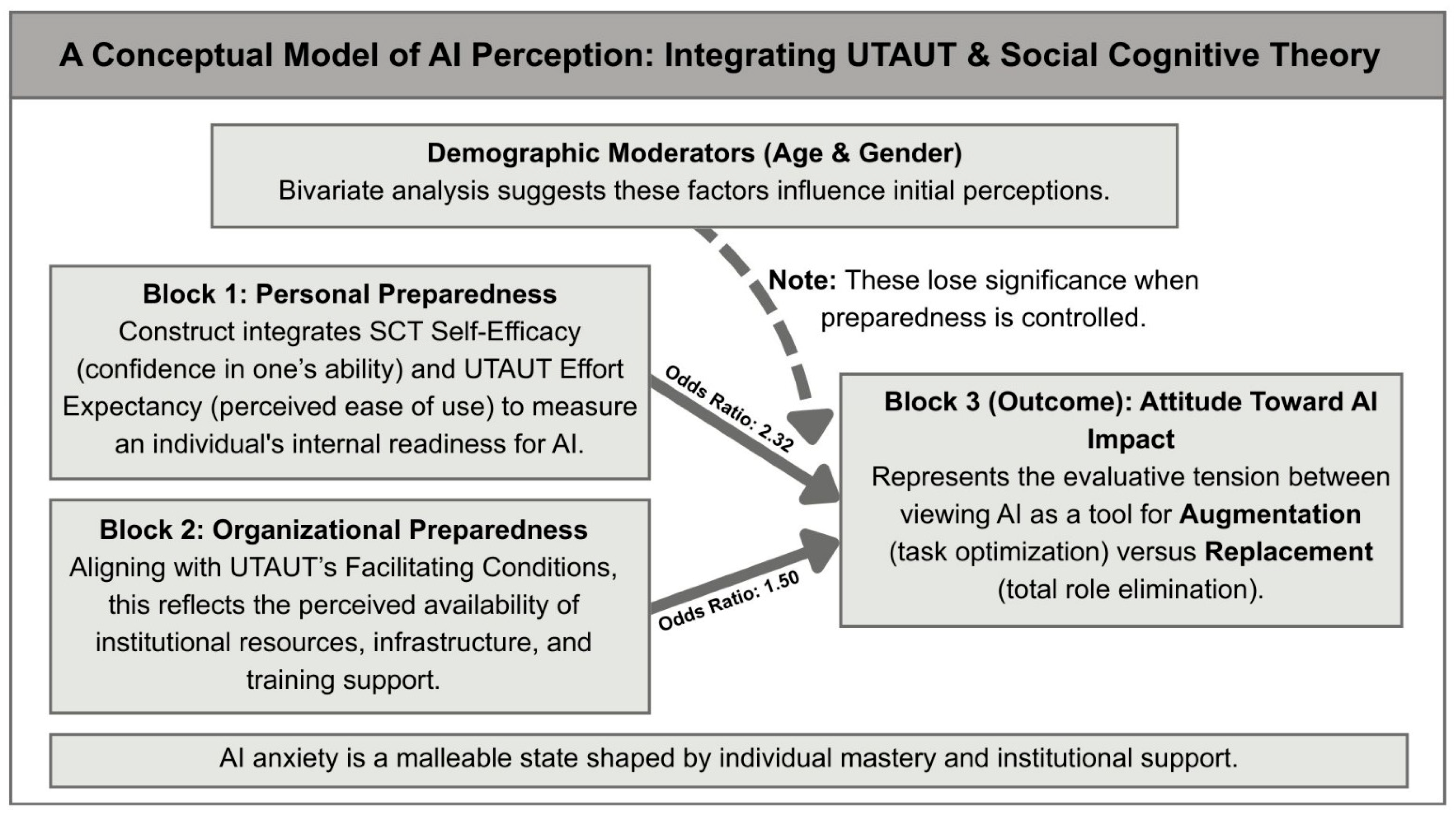
The conceptual model presented in
Figure 1 illustrates how the integration of the Unified Theory of Acceptance and Use of Technology (UTAUT) and Social Cognitive Theory (SCT) informs the analytical framework of this study. Within this perspective, attitudes toward the impact of artificial intelligence on jobs are expected to be shaped primarily by individual-level readiness (self-efficacy/personal preparedness) and organizational-level readiness (facilitating conditions/organizational preparedness).
Demographic characteristics such as age and gender are included as potential moderators, consistent with the original UTAUT model. However, drawing on Social Cognitive Theory, this study assumes that attitudes toward technological change are not fixed demographic traits but are largely influenced by perceived competence and environmental support. Consequently, once personal and organizational preparedness are taken into account, the explanatory role of demographic variables may diminish.
This theoretical integration provides the basis for the empirical analysis conducted in the following sections and directly informs the research questions examined in this study.
4. Methods and Materials
4.1. Instrumentation
The questionnaire for this study was designed to capture both the cognitive and attitudinal dimensions of perceptions regarding the impact of artificial intelligence on the labor market, with an emphasis on the dynamics between the replacement and augmentation of human labor. Items were formulated using Likert scales to allow for the assessment of the degree of agreement and the intensity of respondent perceptions. This methodological approach facilitates the application of advanced statistical techniques and the systematic comparison of results across different categories of respondents.
Prior to the statistical analysis, the data underwent a rigorous cleaning and validation process, including consistency checks and the removal of incomplete or non-compliant observations. The analysis was focused on testing the relationships between the central variables of the conceptual model, with a particular interest in the roles of facilitating conditions and self-efficacy in shaping attitudes toward artificial intelligence. To this end, appropriate statistical methods were utilized to identify significant relationships and evaluate the model’s explanatory power.
4.2. Sample
To address the research questions, a cross-sectional survey was administered to members of the Romanian higher education community. The final analytical sample consisted of 271 respondents, including 197 university students and 74 faculty members/researchers (see
Table 2).
The sample included participants affiliated with both public and private universities across several Romanian counties. The majority of respondents were located in Constanța (n = 237), followed by Buzău (n = 13), Brăila (n = 5), Tulcea (n = 5), Galați (n = 2), and other counties (n = 9). While the sampling strategy was non-probabilistic and based on voluntary participation, it was considered appropriate for exploratory and comparative analysis within the academic environment.
The survey instrument was administered online and distributed via institutional communication channels and academic networks. Participation was voluntary and anonymous. Data were collected within the framework of a broader research project examining workforce perceptions of AI-driven transformation. From an initial pool of 357 respondents, 86 individuals employed outside the higher education system (e.g., private companies, public administration, and SMEs) were excluded in order to maintain an analytical focus on academic stakeholders and ensure conceptual coherence in the comparison between students and faculty members. Additionally, responses with substantial missing data for key study variables were removed during the data-cleaning process. The resulting dataset included 271 complete cases suitable for inferential analysis.
The study employed a non-probability convenience sampling strategy, selecting participants who were accessible and willing to complete the survey. Although convenience sampling does not ensure statistical representativeness of the entire Romanian higher education population, it enables the identification of meaningful attitudinal patterns within the academic environment. Consequently, the findings should be interpreted with caution in terms of national generalization.
4.3. Ethical Approval and Informed Consent
The survey instrument used in this study forms part of the broader research project entitled “Future of Work Compass 2030: An Analysis on Workforce Perception on AI-Driven Transformation”, which received ethical approval from the Bioethics Committee of Ovidius University of Constanța (registration no. UOC831/29.10.2025).
The present article represents a focused analytical component of that project and includes only the subset of respondents affiliated with higher education institutions (students and faculty/researchers), as well as questionnaire items relevant to perceptions of AI-related labor market replacement versus augmentation.
Participation was voluntary and anonymous. Prior to completing the questionnaire, respondents received an information sheet outlining the study’s objectives, data handling procedures, and exclusive scientific use of the collected data. Electronic informed consent was obtained from all participants before survey submission.
Due to GDPR-related constraints and the need to protect participant confidentiality—particularly for faculty members affiliated with identifiable institutions—the raw dataset is not publicly available. However, an anonymized version of the dataset may be obtained from the corresponding author upon reasonable request for academic purposes.
Generative artificial intelligence tools were not used to generate empirical data, conduct statistical analyses, or fabricate research content. Any digital tools employed during manuscript preparation were limited to language refinement and did not influence the study design, data collection, analysis, or interpretation.
4.4. Data Preparation
Due to the low frequency of responses in the “very negative” category, perceived AI impact was recoded into a dichotomous variable in order to ensure adequate cell sizes and improve the statistical stability of the logistic regression model.
Specifically, a value of 1 represents a positive attitude toward AI (combining “somewhat positive” and “very positive”), while a value of 0 represents a neutral or negative outlook (combining “neutral,” “somewhat negative,” and “very negative”).
Similar category consolidation was applied to variables measuring the perceived role of AI, personal preparedness, and organizational preparedness. This approach is commonly used in survey-based research when sparse categories may otherwise lead to unstable parameter estimates in regression analyses.
Missing data were handled using pairwise deletion, which excludes a case only when the specific variable required for a particular statistical test is missing. This method was selected in order to preserve the maximum number of available observations across different analyses.
However, pairwise deletion may result in slightly different sample sizes across statistical tests, and it assumes that missing values are approximately random. The proportion of missing data in the dataset was relatively small and, therefore, unlikely to substantially bias the main findings.
4.5. Data Analysis
The statistical analysis was conducted using the Statistical Package for the Social Sciences (SPSS), version 28.0.1.1 (IBM, New York, NY, USA). Both descriptive and inferential statistical methods were applied.
Chi-square tests and Fisher’s exact test were used to address RQ1 and RQ3 by identifying differences between students and faculty regarding attitudes toward AI and levels of preparedness for AI-driven transformations.
Chi-square analysis was also used to address RQ2, examining whether attitudes toward AI differed according to gender and age.
Finally, binary logistic regression was employed to address RQ4, assessing the extent to which demographic characteristics, personal preparedness, and organizational preparedness explain positive perceptions of AI.
5. Results
RQ1. Is there a significant difference in the way students and faculty perceive the impact of AI on jobs?
Table 3 presents the distribution of attitudes toward AI among students and faculty. The results indicate clear differences between the two groups. A positive view of AI is reported by 77.0% of faculty members, compared to 49.2% of students. Conversely, 50.8% of students express neutral or negative attitudes, compared to 23.0% of faculty.
The chi-square test confirms that the relationship between respondent role and AI attitudes is statistically significant (χ2(1) = 16.93, p < 0.001). The effect size is moderate (Cramer’s V = 0.25), indicating a meaningful association between being a student or faculty member and holding a positive or cautious view of AI.
Table 4 examines the perceived functional role of AI in the labor market. In contrast to the previous analysis, the difference between students and faculty is not statistically significant (χ
2(1) = 0.21,
p = 0.649). A large majority of respondents in both groups define AI primarily as a work tool or digital colleague (84.3% of students and 86.5% of faculty), while a smaller proportion describe AI mainly as a displacer of jobs (15.7% of students and 13.5% of faculty).
RQ2. Do gender and age affect perceptions of AI’s impact on jobs among students and faculty?
Among students (
Table 5), the relationship between gender and attitudes toward AI is marginally significant (χ
2(1) = 3.49,
p = 0.062). Male students show a higher proportion of positive attitudes (57.3%) compared to female students (43.8%).
For faculty members (
Table 6), due to small, expected cell counts, the association between gender and AI attitudes was evaluated using Fisher’s exact test. The result indicated no statistically significant relationship (Fisher’s exact test:
p = 0.327). Both female and male faculty members reported predominantly positive attitudes toward AI.
Age-related differences in student attitudes are presented in
Table 7. Fisher’s exact test indicates no statistically significant association between age group and AI attitudes (
p = 0.326), although students aged 25 or older display a slightly higher proportion of positive responses.
Similarly,
Table 8 shows no statistically significant association between age and faculty attitudes toward AI (Fisher’s exact test:
p = 0.544).
RQ3. Is there a significant difference between students and faculty in the level of preparedness for AI transformations?
Table 9 presents differences in personal preparedness for AI transformations between students and faculty. The chi-square test indicates no statistically significant difference between the two groups (χ
2(2) = 3.02,
p = 0.221). The majority of the respondents in both groups report being “partially prepared” (60.4% of students and 71.6% of faculty).
Table 10 examines perceived organizational preparedness for AI adoption. In this case, a statistically significant difference is observed between students and faculty (χ
2(2) = 9.66,
p < 0.01). Students are more likely than faculty to view their university as very well prepared (25.8% vs. 9.5%).
It should be noted that 23.4% of students reported being unaware of their institution’s AI readiness; these responses were excluded from the analysis presented in
Table 10.
RQ4. Do perceptions of AI’s impact on jobs differ between students and faculty after controlling for demographic characteristics and preparedness for AI transformations?
Binary logistic regression models were estimated separately for students and faculty in order to identify predictors of a positive attitude toward AI. The dependent variable was coded as a dichotomous outcome (0 = negative or neutral view; 1 = positive view). Independent variables included age, gender, personal preparedness, and perceived organizational preparedness.
For students (
Table 11), the model indicates that preparedness variables are significant predictors of positive attitudes toward AI. Personal preparedness is statistically significant (B = 1.02,
p = 0.004), with an odds ratio of 2.76, indicating that higher levels of personal readiness substantially increase the likelihood of a positive perception towards AI. Organizational preparedness is also significant (B = 0.76,
p = 0.007), with an odds ratio of 2.14. The model explains a moderate proportion of variance (Nagelkerke R
2 = 0.20).
For faculty members (
Table 12), the regression model shows limited explanatory power (Nagelkerke R
2 = 0.04). Although the coefficient for personal preparedness is positive (Exp(B) = 2.13), the result does not reach statistical significance (
p = 0.176).
Overall, the results indicate that perceived preparedness—both personal and organizational—is more strongly associated with positive AI attitudes than demographic variables.
6. Discussion
By using both the UTAUT and SCT theoretical frameworks, this study moves beyond descriptive statistics to provide a predictive model. It suggests that for students and faculty alike, the perception of AI’s impact on the labor market is mitigated when high self-efficacy (SCT) meets robust facilitating conditions (UTAUT). This theoretical intersection explains the regression results where preparedness factors effectively nullify the influence of traditional demographic moderators, proving that psychological and organizational readiness are the key catalysts for technological optimism. For faculty, the direction of effects is consistent, but estimates are less stable, likely due to the smaller subsample and reduced variance in attitudes.
Beyond confirming established patterns regarding the polarization of AI perceptions, the results of this study offer an important clarification: the differences between students and faculty are primarily explained not by age or gender, but by the perceived level of readiness at both the personal and institutional levels. This finding supports the integration of the Unified Theory of Acceptance and Use of Technology (UTAUT) with Social Cognitive Theory (SCT) in analyzing replacement versus augmentation anxiety.
The study’s findings support the well-defined concept in the recent literature that the impact of artificial intelligence on the labor market is perceived simultaneously through the lenses of augmentation and replacement; however, the emotional intensity and the interpretation of consequences vary by occupational position and career stage.
Regarding the first research question, the significant differences between students and faculty in general attitudes toward AI confirm a polarization of perceptions: students manifest more pronounced concern, while faculty members tend to adopt a more optimistic perspective. This finding aligns with the tension highlighted in the literature between labor replacement anxiety and hopes for increased productivity, where the fear of “displacement” can diminish the perceived usefulness of the technology [
2,
3]. At the same time, these results can be interpreted alongside the argument made by Arntz et al. (2016), which posits that automation affects tasks rather than entire occupations [
1]. Faculty members, familiar with this nuance, may interpret AI as a tool that optimizes activities rather than a complete substitute for professional roles, whereas students, as early-career entrants, feel the pressure of competition in the entry-level segment more acutely.
A particularly significant result is that, although general attitudes differ, no significant differences were observed between students and faculty in how the functional role of AI is defined—a finding that implicitly addresses RQ1 from a complementary perspective. Both groups recognize AI as a “work tool” or “digital colleague” rather than a major displacer of jobs, suggesting a convergence at the cognitive level but a divergence at the evaluative level. This combination of agreement regarding “functional reality” and disagreement regarding “implications” is consistent with the literature, showing that disruptive technologies simultaneously produce expectations of efficiency and expectations of risk; the balance between the two is shaped by an individual’s position relative to the labor market and professional stability [
12,
14].
For faculty members, the idea of replacement can be integrated into a narrative of role reconfiguration and the automation of routine activities, aligning with the perspective of augmentation in education [
8]. For students, however, the same label may be interpreted as a direct threat to accessing their first professional opportunities. This interpretation accords with the literature on entry-level anxiety and competition for standardized cognitive tasks.
Regarding RQ2, demographic effects appear to be selective. The finding that gender influences student attitudes, but not those of faculty members, suggests that perceived vulnerabilities are more pronounced during the transition stage into the labor market. This pattern may be interpreted through the lens of findings regarding differentiated exposure to vulnerable occupations and the risks of inequality associated with technological transformations, including the gender distribution of labor in the face of automation [
21]. The absence of significant differences among faculty members may indicate that professional status, expertise, and institutional experience mitigate demographic influences. This is consistent with the idea that contextual and competency-related factors can “replace” the role of traditional moderators in technology acceptance models. Similarly, the lack of an age effect on faculty perceptions may be interpreted as evidence that the professional environment and domain-specific cognitive capital create a relatively unified perspective on AI despite generational differences—a point also discussed in scholarship highlighting the role of adaptability and the requirement for continuous upskilling [
25,
37].
The results related to RQ3 outline one of the study’s most significant contributions: students and faculty members report comparable levels of personal readiness yet hold significantly different perceptions of organizational readiness. This discrepancy may be interpreted as an “institutional visibility gap,” wherein students either lack access to information regarding strategies and infrastructure or are insufficiently integrated into digital transformation processes. From a UTAUT perspective, this difference is directly linked to “facilitating conditions”—the perception of the existence of resources and support necessary for technology adoption—whereas personal readiness aligns more closely with dimensions associated with self-efficacy and the management of technological transitions. The convergence between personal readiness and the role of self-efficacy is further supported by Social Cognitive Theory (SCT), in which the belief in one’s own ability to act effectively within a new technological context becomes a primary determinant of evaluations and behaviors.
Beyond its theoretical interpretation, this institutional visibility gap carries significant practical implications. The fact that nearly a quarter of students report being unaware of their institution’s AI preparedness suggests potential shortcomings in communication, transparency, or participatory engagement. Universities may be developing AI strategies at the governance level without adequately translating these initiatives into visible, student-facing actions. To address this gap, institutions should implement structured communication mechanisms, integrate AI-related developments into curricular and extracurricular activities, and involve students more directly in digital transformation initiatives. Enhancing transparency regarding AI policies and infrastructure may not only reduce uncertainty but also strengthen perceived facilitating conditions, thereby mitigating replacement anxiety.
The fourth research question is elucidated by the logistic regression model: when demographic variables and occupational status are controlled, the primary predictors of positive attitudes are personal readiness and organizational readiness, while gender and age are not statistically significant. This result is essential to the technology acceptance literature, as it suggests that optimism or anxiety regarding AI is not an inherent trait of specific demographic categories but a malleable state shaped by competencies and institutional conditions. In alignment with research emphasizing the importance of AI-complementary skills and reskilling programs [
32,
34], this study indicates that the “antidote” to fear of replacement is not simple familiarity with the technology, but rather the combination of self-efficacy and a credible organizational infrastructure. This finding is also consistent with recent research emphasizing the role of institutional competence development and governance structures in managing technological and sustainability transitions. Studies conducted in the context of Romanian public institutions highlight that organizational capacity building, professional competencies, and institutional governance frameworks significantly influence how employees perceive and adapt to structural transformations [
52,
53]. In this sense, preparedness for AI should not be understood solely as an individual attribute but also as a reflection of broader institutional environments that shape confidence in technological change. Furthermore, given that the perception of AI as a threat is associated in the recent literature with broader social effects, including the erosion of trust in institutions [
13], these results hold relevance beyond the individual level: universities can function as key actors in reducing anxiety and maintaining social cohesion through transparent policies and substantive support for adaptation.
Although the model demonstrates meaningful predictive capacity, the Nagelkerke R2 value of 0.20 indicates that a substantial proportion of variance in AI-related attitudes remains unexplained. This is not unexpected, given the inherently multidimensional nature of technological perceptions. Attitudes toward AI are shaped not only by institutional facilitating conditions and self-efficacy but also by additional psychological, disciplinary, and contextual variables not captured in the present model. These may include academic field of study, prior exposure to AI tools, media framing of AI-related risks, socioeconomic expectations, perceived labor market competitiveness, personality traits such as openness to innovation, and broader macroeconomic uncertainty. The unexplained variance, therefore, reflects the complexity of AI-related attitudinal formation rather than an indication of model inadequacy. Future research could incorporate multi-level and interdisciplinary predictors to more comprehensively capture the cognitive and structural determinants of optimism and anxiety toward AI.
The results of this study, which identify personal preparedness (self-efficacy) as the primary predictor of an optimistic outlook on AI, align with the OECD’s (2025) thesis that confidence in one’s own skills is the primary driver of adaptability in the face of rapid technological shifts [
42]. However, the positive perceptions held by our academic respondents contrast sharply with the current reality of the Romanian labor market. The 2025 Digital Decade report indicates that AI adoption among Romanian enterprises remains extremely low at 3.1%, significantly below the EU average of 13.5%. The contrast between high self-reported preparedness and the low AI adoption rate in Romanian enterprises suggests the presence of an “applicability gap”: although students and faculty perceive themselves as capable of adapting to AI-driven transformations, the broader economic environment does not yet provide sufficient organizational structures to absorb and utilize these competencies. This tension may indicate a transitional misalignment between academic skill formation and enterprise-level implementation. Respondents may be expressing anticipatory optimism, evaluating future integration scenarios rather than current labor market realities. At the same time, perceived preparedness may reflect confidence in one’s adaptive capacity rather than possession of immediately market-aligned AI expertise. Rather than undermining the results, this divergence highlights Romania’s intermediate stage in AI diffusion. Within this context, universities assume a pivotal bridging role, aligning competence development with enterprise uptake and ensuring that individual readiness evolves in parallel with structural labor market transformation.
Furthermore, the stagnation in the number of IT specialists in Romania, coupled with difficulties in talent retention, poses a significant risk to the country’s ability to turn technological challenges into opportunities for growth.
Beyond their theoretical implications, these findings carry important institutional and curricular relevance for higher education systems. Similar dynamics have been observed in other sectors undergoing rapid digital transformation. For example, recent studies examining the digitalization of financial services show that technological change can significantly reshape user perceptions, expectations, and behavioral responses to digital systems [
54]. These findings support the broader argument that attitudes toward emerging technologies are strongly mediated by perceived usefulness, institutional trust, and familiarity with digital tools. The results indicate that positive attitudes toward AI are strongly associated with personal self-efficacy and perceived organizational preparedness rather than demographic characteristics. This suggests that universities can actively shape technological optimism by strengthening both dimensions simultaneously.
From a policy perspective, institutions should move beyond reactive debates centered on academic integrity and instead adopt proactive strategies aimed at structured AI integration. This includes transparent communication regarding institutional AI strategies, investment in digital infrastructure, and faculty development programs that enhance confidence in AI-assisted pedagogical practices.
Curriculum design should also reflect the dual augmentation–replacement tension identified in this study. AI-related competencies should not be confined to technical programs but embedded across disciplines, including humanities, social sciences, and business education. Emphasis should be placed on digital literacy, adaptive problem-solving, interdisciplinary collaboration, and ethical reasoning—competencies that complement rather than compete with AI systems. By aligning institutional facilitating conditions with individual self-efficacy, universities can mitigate replacement anxiety and foster a transition toward an AI-augmented professional identity.
7. Limitations and Directions for Future Research
Several limitations should be considered when interpreting the findings. First, the sample shows a geographic concentration, as most respondents were affiliated with universities located in Constanța, with smaller numbers from other Romanian counties. While this reflects the institutional networks through which the survey was disseminated and the voluntary nature of participation, it may limit the extent to which the results capture the diversity of perceptions across the broader Romanian higher education system.
Second, the dataset includes a relatively small faculty subsample (n = 74) compared to the number of student respondents. This imbalance may reduce statistical power for faculty-specific analyses and may contribute to the limited variance explained by the faculty regression model.
Third, the study relies on a non-probability convenience sampling strategy, which does not allow the results to be interpreted as statistically representative of the entire Romanian higher education sector. Therefore, findings should be understood as indicative of attitudinal patterns within the sampled academic community rather than nationally generalizable estimates. Additionally, the study is based on self-reported measures and a cross-sectional design, which may involve perceptual bias and does not allow causal inference or assessment of how attitudes evolve over time.
Future research could address these limitations by employing probabilistic sampling strategies, expanding geographic coverage across Romanian universities, and ensuring more balanced representation between students and faculty. Longitudinal designs and mixed-method approaches (e.g., interviews or focus groups) should clarify how replacement versus augmentation narratives develop over time. Finally, incorporating objective indicators of AI readiness—such as AI training participation, verified usage measures, or standardized digital competence assessments—would strengthen the measurement of preparedness beyond perceptions alone.
8. Conclusions
This study shows that perceptions of AI in Romanian higher education reflect a tension between acknowledging technological disruption and evaluating its consequences. While students report significantly higher levels of concern regarding AI-driven job replacement, faculty members hold more optimistic attitudes. Importantly, despite this evaluative polarization, both groups largely converge in their functional understanding of AI as a work tool/digital colleague and a major driver of labor-market transformation, rather than primarily a job displacer.
The findings further demonstrate that demographic factors such as gender and age become less relevant once personal preparedness (self-efficacy/effort expectancy) and perceived organizational preparedness (facilitating conditions) are taken into account. This represents a key contribution of the study: AI-related anxiety is not an inherent demographic trait but a malleable state shaped by perceived competence and institutional support. In practical terms, universities can reduce replacement anxiety by strengthening AI-related training, investing in infrastructure, and communicating institutional strategies transparently to key stakeholders.
Universities must move beyond a focus on academic integrity to embrace a strategic role in mitigating students’ anxiety regarding the threat of AI to their employment prospects. By functioning as hubs for continuous upskilling, these institutions can bridge the “visibility gap” in digital infrastructure. If the AI revolution is a high-speed train, the university must act as the ticketing office, providing the credentials and “facilitating conditions” necessary to ensure no student is left at the platform.
Ultimately, the goal of AI integration is not to automate humanity, but to delegate repetitive tasks, thereby liberating human agency for uniquely human activities like empathetic leadership and ethical reasoning. By aligning individual confidence with robust institutional support, higher education can ensure that the AI revolution does not replace the professional but provides the essential space for human excellence to flourish.