Article

Digital Economy, Green Technology Innovation and Urban Carbon Emissions: Evidence from Chinese Cities


1
School of Administration, Northeastern University, Shenyang 110167, China
2
School of Economics, Northeastern University at Qinhuangdao, Qinhuangdao 066004, China
3
Business School, Harbin Institute of Technology, Harbin 150006, China
*
Author to whom correspondence should be addressed.
Systems 2026, 14(3), 291; https://doi.org/10.3390/systems14030291
Submission received: 21 January 2026 / Revised: 25 February 2026 / Accepted: 6 March 2026 / Published: 9 March 2026

Abstract

Based on 2011–2022 panel data covering 278 Chinese cities, a panel fixed-effects model, a mediating effect model, and a threshold regression model are used to conduct an empirical analysis of the influence of the digital economy (DE) on urban carbon emission performance from the quantitative and efficiency perspectives. The key findings include the following: (1) An inverted U-relationship is observed between the DE development and urban per capita carbon emissions (PCE), while the nexus between the DE and carbon emission efficiency (CEE) follows a U-shaped pattern. (2) The DE yields a stronger carbon reduction effect once green technology innovation attains elevated levels; conversely, under conditions of nascent green innovation, its principal impact manifests through improvements in CEE. Only when green technology innovation surpasses a critical threshold does the DE begin to reduce carbon emissions. (3) Heterogeneity analysis indicates that, in optimization and upgrading agglomerations, carbon emissions are reduced by DE at a later time point. In growth and expansion agglomerations, the impact of DE on CEE is more evident. Moreover, policy priorities should include fostering innovation-driven digitalization, expanding green technology diffusion, and optimizing regional mechanisms for coordinated low-carbon growth.

1. Introduction

Mitigating climate change and committing to low-carbon development are essential for fostering sustainable and high-quality global economic growth [1]. China, the largest carbon emitter globally, is heavily reliant on fossil fuels, resulting in a substantial rise in greenhouse gas emissions [2,3]. This warming has led to various adverse effects on human life and socioeconomic development. China has exhibited significant reliance on high-carbon fossil fuels and comparatively low energy efficiency [4]. Ongoing industrialization and urbanization are exerting further pressure on the nation in terms of carbon reduction and energy demand [5,6]. To alleviate detrimental environmental effects, China plans to reach peak emissions prior to 2030 and carbon neutrality by 2060. Cities significantly contribute to carbon emissions, meaning that the identification of effective strategies for reducing urban carbon emissions is urgently needed [7,8].
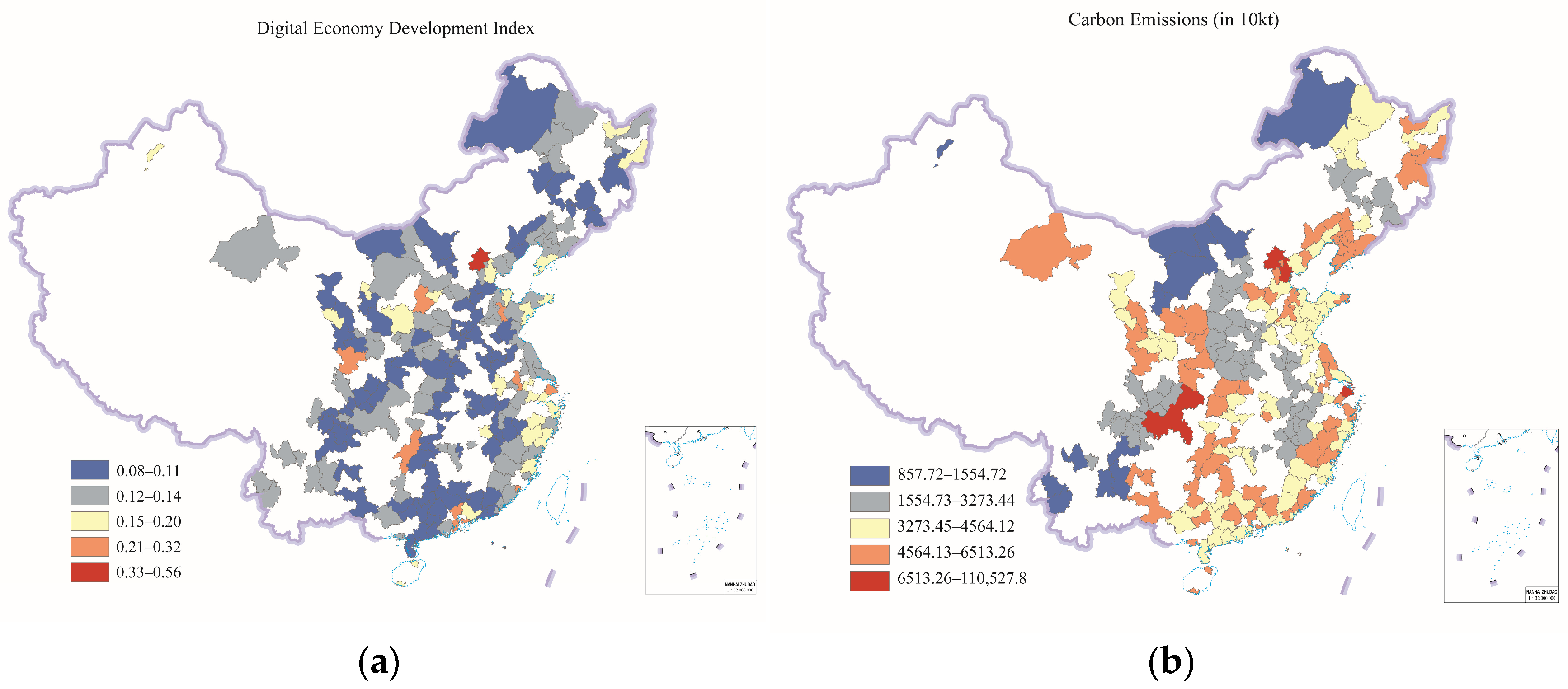
The ongoing development of modern information technologies, including blockchain, big data, and artificial intelligence, and their integration across various sectors of society position the digital economy (hereafter referred to as DE) as a significant catalyst for global economic growth [9,10]. At the same time, the emerging digital development model offers new avenues for decreasing urban emissions [11,12]. Figure 1 illustrates the 2021 digital economy development index and corresponding carbon emission levels for a range of Chinese cities. The emission pattern demonstrates elevated levels in eastern regions and diminished levels in western parts [13,14]. The observed east–west disparity is closely related to the uneven distribution of economic activity and industrial structure, as eastern cities typically concentrate energy intensive manufacturing and dense production networks along with higher levels of digital infrastructure and market connectivity. By contrast, many western cities have relatively lower industrial agglomeration and weaker digital foundations, which is often associated with lower emissions despite comparatively slower digital economy development.
Research focusing on factors influencing carbon reduction has increased significantly. The factors taken into account are the level of openness, trade composition, the industrial framework, energy consumption, the rate of urbanization, financial advancement, and integration of the region [15,16,17]. A significant amount of research has investigated green technology innovation’s effect on environmental issues [18,19]. Innovation in green technologies has the potential to drastically cut carbon emissions, particularly in China’s eastern and central areas. The mechanisms underlying this effect include the quality of institutions, the modernization of industrial structures, and the optimization of energy-use regimes [20,21]. However, innovation in green technologies has varying and inconsistent effects on carbon emissions [22,23]. It does not always yield a positive effect.
Recent studies have investigated the influence of DE on urban innovation and sustainable growth. Digital transformation effectively promotes high-quality urban growth, creating positive incentives for inclusive growth, enhanced innovation capacity, industrial upgrading, and improved workers’ rights [24,25,26]. The effect is notably more significant in cities exhibiting lower degrees of digitalization, where the DE substantially contributes to economic growth [27]. The digitalization of industries and digital industrialization have markedly enhanced the efficiency of growth in Chinese cities while also exerting positive spatial spillover effects on adjacent cities [28,29,30]. As an important dimension of urban growth efficiency, innovation efficiency directly impacts sustainable urban development. The DE not only promotes technological innovation but also improves innovation efficiency [31].
Studies have demonstrated that the DE possesses the capacity to reduce regional carbon intensity and improve urban environmental conditions [32]. This involves increasing energy efficiency and advancing industrial processes [33,34]. Digital transformation facilitates technological advancement, and the establishment of a comprehensive digital industrial chain can decrease carbon emissions by minimizing transportation costs [35]. Numerous scholars have explored how DE advancement nonlinearly influences carbon emissions, indicating that its influence varies across developmental stages [36,37]. Furthermore, the impact demonstrates significant regional and resource endowment variability [38,39].
Current studies have highlighted the environmental benefits of the digital economy (DE), investigated the determinants of urban carbon emissions, and examined the relationship between DE development and carbon outcomes. The dominant explanations in this literature generally emphasize industrial upgrading and improvements in energy efficiency. However, the existing research still leaves several limitations insufficiently addressed. First, although industrial restructuring and energy efficiency are frequently discussed as key channels, technological innovation, especially green technology innovation that directly targets cleaner production and energy substitution, is not adequately integrated into the DE and carbon emissions linkage, and its role remains underspecified. Second, while prior studies have established that green technology innovation or broader technological progress can mitigate environmental pressures and support low-carbon transitions, there is still a lack of clear evidence on how green technology innovation is connected to carbon emissions within the context of digital transformation. Third, the empirical assessment of carbon performance is often based on a single outcome perspective. Many studies focus either on emission levels such as total carbon emissions or on emission efficiency, which may provide only a partial view of environmental performance and can lead to incomplete interpretations of the digitalization and emissions relationship.
As major sources of carbon emissions, cities are also key arenas where digitalization strategies intersect with environmentally oriented technological innovation. Taking cities as the unit of analysis, this study develops an integrative framework that simultaneously examines carbon emission quantity and carbon emission efficiency within a unified analytical structure. Rather than treating total emissions and emission efficiency as separate research streams, this study incorporates both dimensions to provide a more comprehensive assessment of urban carbon performance. Furthermore, beyond testing direct and mediating effects, the study explicitly models nonlinear and threshold dynamics, highlighting that the environmental consequences of digital transformation depend on the evolving level of green technology innovation. By jointly analyzing mechanism transmission and threshold effects within a single framework, this research moves beyond linear interpretations and provides a more structured explanation of how digitalization reshapes urban carbon outcomes. In doing so, it advances the theoretical understanding of the conditional and stage-dependent nature of digital-driven low-carbon transformation. The contributions are outlined as follows:
The study constructs an integrated analytical framework that links digital transformation, green technology innovation, and carbon emission performance from both the emission reduction and efficiency improvement perspectives, thereby extending the theoretical understanding of the DE-carbon relationship.
It empirically identifies green technology innovation as a key mechanism through which the DE affects carbon outcomes, clarifying how digital transformation can simultaneously enhance energy efficiency and reduce carbon intensity.
The study reveals nonlinear and threshold effects in the impact of the DE on carbon performance, demonstrating that the environmental benefits of digitalization emerge only after surpassing critical levels of technological and innovation development.
By examining China’s nineteen national-level urban agglomerations as the heterogeneity unit, and grouping them by development stage and strategic orientation, this study identifies pronounced cross-agglomeration differences in the DE’s effects on carbon performance and derives policy-relevant insights for coordinated digital and low-carbon development across regions.
The subsequent sections are structured as follows: Section 2 outlines the theoretical assumptions and analyzes the mechanisms involved. Section 3 describes the data sources and empirical methodology. Section 4 presents the estimation results and accompanying discussion. Section 5 concludes and offers various policy recommendations.

2. Theoretical Assumptions and Mechanism Analysis

2.1. The Impact of the DE on Urban Carbon Emission Performance

The DE integrates data and information as production elements with the real economy by leveraging new technologies like blockchain and big data, significantly contributing to urban carbon reduction. Digitalization may exert ambivalent effects on urban carbon emission performance, yielding both beneficial and detrimental outcomes.
The advancement of industries related to DE has the potential to change conventional development models, enhance market structures, and broaden resource allocation parameters [40]. This transition supports a movement away from a labor-intensive and heavy industry-centric industrial framework toward one defined by high technological content and environmental sustainability [41]. Specifically, during the industrial digitalization stage, it facilitates digital technology integration with energy-intensive sectors, thereby significantly improving energy efficiency and contributing to emission reduction within industries [42]. At advanced stages of digital transformation, consistent production output and the extensive integration of digital technologies in industries facilitate economies of scale, leading to decreased pollution control costs and improved carbon emission efficiency [43]. Additionally, digital technologies’ real-time data gathering, monitoring, transmission, and evaluation of energy consumption patterns optimize energy allocation strategies and mitigate carbon emissions [44].
However, the DE is characterized not only by its carbon reduction effects but also by specific green blind spots and potential negative externalities that may produce negative environmental effects. Characterized by substantial energy consumption, the DE represents an energy-intensive sector. The initial phases of development involving extensive digital technology utilization lead to increased electricity consumption, which adversely affects the environment [45]. For instance, the establishment and administration of numerous data centers, cloud computing facilities, and digital infrastructure drive a substantial increase in power demand, thus increasing energy consumption and carbon emissions. Enterprises may initially reconfigure production equipment during the digital transformation process, resulting in increased resource input and energy consumption, which leads to discernible ecological pollution and decreased emission efficiency [46]. These initial phases of energy consumption and equipment upgrades, while essential for digital economic growth, may have short-term negative impacts on the environment.
Moreover, the magnitude and the turning point of this nonlinear relationship may differ across cities of different sizes and resource endowments, as these characteristics shape energy demand, industrial structure, and the capacity to adopt and utilize digital technologies. This motivates further heterogeneity analyses in subsequent sections.
Hypothesis 1 (H1).
The relationship between the development of DE and urban carbon emission performance has nonlinear characteristics.

2.2. The Mechanism of the Impact of the DE on Carbon Emissions

The DE enhances the advancement and execution of green technologies through advanced data processing and analysis tools and by facilitating green finance, promoting information sharing and collaboration, and advancing smart applications, all of which impact urban environmental quality.
The DE provides advanced data processing capabilities and analytical tools, facilitating accurate decision-making and enhancing resource management. Big data analysis and AI can identify critical issues and potential opportunities in environmental technologies, thus promoting innovation and the intelligent application of new technologies. Additionally, digital technologies enable the instantaneous monitoring and management of resource utilization [47]. Companies can enhance their investment decisions in green technologies by analyzing environmental data, market demand, and technological advancements [48].
Digital transformation supports the funding of green technology research, development, and promotion. The innovation and extensive adoption of green finance products have been augmented, with fintech tools enhancing the efficiency of green project finance and investment. The analysis of big data augments the scientific and precise aspects of investment decisions in green finance, enabling investors to make informed choices [49]. The DE has diversified financing channels, providing increased funding opportunities for green technology innovation [50].
Online platforms and networks enable the sharing of information and collaboration, thus expediting the commercialization of green technologies. Such interactions can also be understood within an innovation ecosystem perspective, in which technological development is embedded in networked relationships among firms, institutions, and entrepreneurial actors rather than driven by isolated entities [51]. The DE facilitates collaborative innovation and knowledge exchange among businesses, research institutions, and universities, thus accelerating the application of green technologies [52]. E-commerce and online markets facilitate the commercialization of green technologies, allowing companies to rapidly introduce green technology products to the market and improving their acceptance and application. Social media also enhance the societal demand for green technologies via digital platforms.
These channels are interrelated rather than isolated. Data analytics and platform networks can reduce information asymmetry and improve matching efficiency, thereby strengthening green finance in supporting green R&D, while substitution may occur at the margin as the relative importance of each channel varies across cities and stages of digitalization.
However, the interplay between the DE and green technology innovation is intricate and defies characterization as a straightforward linear correlation. During the initial phases of digitalization, obstacles, including technological transition periods, inadequate infrastructure, uncertain investment returns, and restricted market demand, may hinder green technology innovation. As the DE expands and costs decline, companies and research institutions are increasingly equipped to utilize digital technologies for research and advancement in green technology, thus improving innovation efficiency [53].
Hypothesis 2 (H2).
Green technology innovation serves as a pivotal mechanism through which the DE affects urban carbon emission performance.
Hypothesis 3 (H3).
The relationship between the DE and green technology innovation is nonlinear.

2.3. The Threshold Characteristics of Green Technology Innovation

Green technology innovation is significantly influenced by the DE. It also has specific threshold characteristics with respect to its carbon-reduction effects. Dynamic advances in green innovation act as the intermediary mechanism connecting digitalization to urban carbon emission outcomes, which is not fixed over time. A recursive and mutually reinforcing dynamic among technology development, innovation processes, and institutional environments challenges a purely linear interpretation of innovation trajectories [54]. At lower levels of green technology innovation, technological immaturity, high costs, and limited market acceptance are prominent challenges. Innovation activities frequently emphasize enhancing output per unit of energy consumption, which is often associated with challenges such as subpar product quality and diminished value. In this phase, the increase in carbon emissions due to heightened production may exceed the energy savings realized by efficiency improvements, leading to a pronounced carbon rebound effect that intensifies environmental pollution to some degree [55,56].
The impact of green technology innovation on mitigating carbon emissions becomes markedly more significant when a critical level of technological maturity, broader application, and reduced costs is achieved. Currently, the deployment of green technologies on a larger scale can increase productivity, foster interfirm collaboration, and promote energy system integration. As a result, the beneficial impacts of green technology innovation prevail, yielding positive externalities while facilitating emission reduction and improving efficiency [57]. As green technology innovation progresses and existing emission reduction measures are fully utilized, the marginal returns of such innovation may decrease, making additional reductions in carbon emissions increasingly difficult [58].
Hypothesis 4 (H4).
The DE’s impact on urban carbon emissions is subject to a threshold effect determined by the degree of green technology innovation.
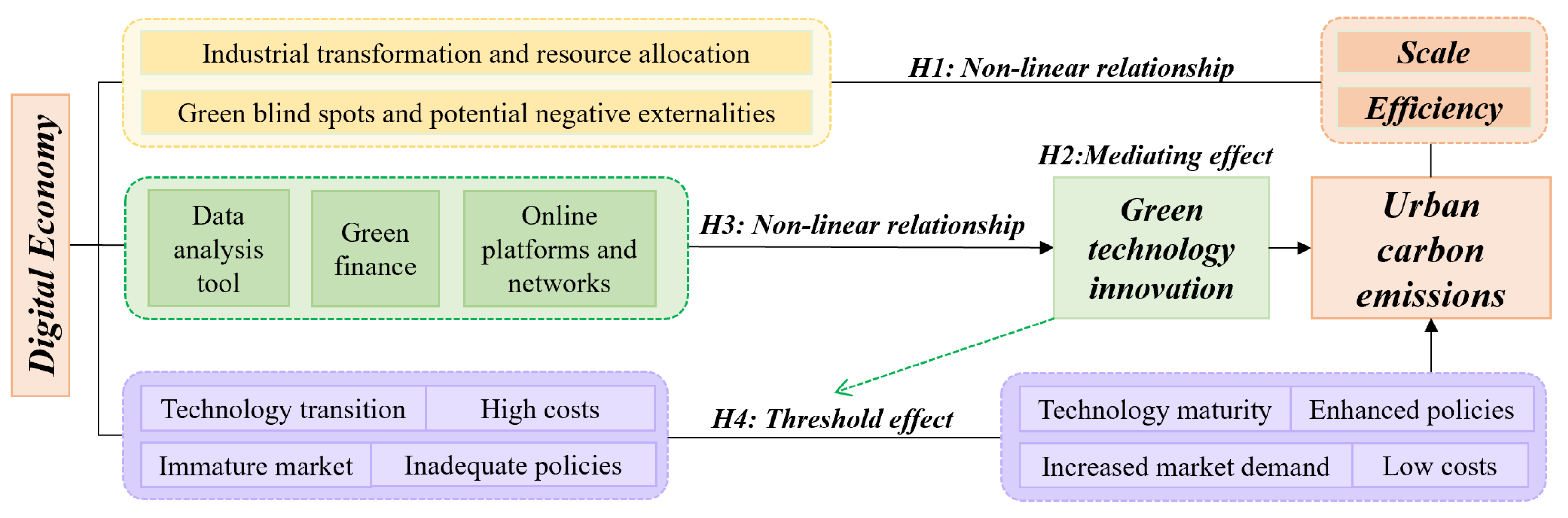
Based on the above discussion, Figure 2 presents the theoretical framework.

3. Methodology and Data

3.1. Methods and Model Setting

3.1.1. Entropy Weight Method

The core principle of the entropy weight method is to establish objective weights derived from the variability of indicators. In this method, positive and negative indicators are employed to assess information entropy, allowing the weights to be determined. A comprehensive index score is ultimately calculated. The entropy-weighting approach was applied to construct a composite index of DE in this study. The detailed steps are provided in Appendix A.

3.1.2. Baseline Regression Model

The STIRPAT model is a foundational framework for evaluating environmental impacts and analyzing the influences of population, the economy, and technology on environmental change. It is expressed as follows:
I = a P b A c T d e ,
Here, I, P, A, and T represent the indicators of environmental impact, the population dimension, the economic dimension, and the technological dimension, respectively. A is the model coefficient; b, c, and d are the weight coefficients for each indicator; and e denotes the error term. Taking logarithms of both sides of the equation yields the following specification:
ln I = ln a + b ln P + C ln A + d ln T + ln e ,
Drawing on the theoretical analysis and the STIRPAT framework, we adopt a two-way fixed-effects specification as our baseline regression model. The variables associated with environmental change, population dynamics, economic growth, and technological advancement are subjected to logarithmic transformation. The baseline model specification is formulated as follows:
Y i t = β 0 + β 1 D i g e i t + β 2 S d i g e i t + k = 3 n β k C o n t r o l s i t + μ i + σ t + ε i t ,
Yit refers to the emission volume and efficiency of city i in year t. Digeit represents the level of digitalization. To examine the nonlinear impact of DE, the squared term of Digeit is incorporated, and it is denoted as Sdigeit. Controlsit refers to control variables. μi, σt, and εit represent the individual fixed effects, time fixed effects, and random error term, respectively.

3.1.3. Mediating Mechanism Test

A mediation analysis is conducted to assess how DE influences urban carbon emissions, in accordance with the theoretical framework. A “two-step method” [59] is first adopted due to the traditional stepwise method’s susceptibility to overuse and endogenous bias in testing mediating effects. The emphasis is on establishing the credibility of causal identification between the primary explanatory and outcome variables, as well as between the primary explanatory variable and the mediator, to accurately delineate the impact mechanism. Therefore, Equation (4) is used to conduct the mediating effect test:
I n n o v i t = θ 0 + θ 1 D i g e i t + θ 2 S d i g e i t + k = 3 n θ k C o n t r o l s i t + μ i + σ t + ε i t ,
Y i t = β 0 + β 1 D i g e i t + β 2 S d i g e i t + β 3 I n n o v i t + k = 4 n β k C o n t r o l s i t + μ i + σ t + ε i t ,
In addition, in this paper, the “causal steps approach” is employed to construct a mediating effect model for analysis, as shown in Equation (5) [60]. The mediating variable Innovit quantifies the degree of green technology innovation. Other variables are defined and measured in accordance with the specifications of Equation (3).

3.1.4. Threshold Effect Model

This study employs a panel threshold regression model to examine the varying impacts of the DE (Dige) on urban carbon emission performance (Yit), contingent upon the level of green technology innovation (Innovit). Consequently, the following models are established:
Y i t = α 0 + α 1 D i g e i t I ( I n n o v i t γ ) + α 2 S d i g e i t I ( I n n o v i t γ ) +   α 3 D i g e i t I ( I n n o v i t > γ ) + α 4 S d i g e i t I ( I n n o v i t > γ ) + k = 5 n α k C o n t r o l s i t + μ i t + σ i t + ε i t ,
Y i t = δ 0 + δ 1 D i g e i t I ( I n n o v i t γ 1 ) + δ 2 S d i g e i t I ( I n n o v i t γ 1 ) +   δ 3 D i g e i t I ( γ 1 < I n n o v i t γ 2 ) + δ 4 S d i g e i t I ( γ 1 < I n n o v i t γ 2 ) +   δ 5 D i g e i t I ( I n n o v i t > γ 2 ) + δ 6 S d i g e i t I ( I n n o v i t > γ 2 ) + k = 7 n δ k C o n t r o l s i t + μ i t + σ i t + ε i t ,
Equations (6) and (7) represent the single-threshold and double-threshold models, respectively, where the threshold variable is green technology innovation. I(·) is an indicator function that returns 1 when the bracketed condition is met and 0 otherwise. γ, γ1, and γ2 represent the corresponding threshold values.

3.2. Variables and Data

3.2.1. Dependent Variables

This research evaluates urban carbon emission performance by analyzing per capita carbon emissions (PCE) and carbon emission efficiency (CEE). Logarithmic transformation was applied to both variables during the calculation process.
PCE (Lnpce) is calculated by dividing a city’s total carbon emissions by its population. Total carbon emissions comprise on-site fuel combustion (e.g., natural gas and liquefied petroleum gas) and the emissions linked to electricity and heat use [61]. Emissions at the city level are calculated by converting energy consumption into carbon emissions by applying specific carbon emission coefficients for various energy types and then aggregating the results.
CEE (Lncee) is defined as the ratio of a city’s actual GDP to its total carbon emissions. This index expresses the economic value generated for each unit of carbon emitted resulting from a city’s economic activities [13]. A greater value indicates that the city generates increased economic output while maintaining lower carbon emissions, reflecting a superior level of sustainable development.

3.2.2. Explanatory Variable

The digital economy development index (Dige) is selected as the core explanatory variable. The indicator system is constructed to reflect the digital economy at the city level from three complementary dimensions, namely connectivity foundations, digital industrial supply, and the breadth of digitalized financial services [62]. Specifically, broadband and mobile subscriptions capture the accessibility and capacity of digital connectivity, which constitutes the basic condition for digital economic activities. Telecommunications service volume and ICT-related employment proxy the scale and vitality of the digital industry, reflecting the production and provision capability of digital services. The China Digital Inclusive Finance Index measures the diffusion of digital financial services and thus represents the application breadth of digitalization in economic transactions. Table 1 presents the rules for constructing the indicators, all of which are positive.

3.2.3. Mediating Variable and Threshold Variable

Based on relevant research, the number of green patent applications is used to represent the degree of green technology innovation in thousands [63]. This variable (Innov) is used as both a mediating variable and a threshold variable in subsequent analyses. Green patents typically cover innovations in environmental technologies including renewable energy deployment and energy efficiency innovations. A higher number indicates more active innovation and a higher level of environmental technology.

3.2.4. Control Variables

Estimation bias due to omitted variable bias and external interference is addressed by incorporating control variables, as supported by the relevant literature. The logarithm of population density per unit area is used to denote population density (Lnpd). The logarithm of per capita GDP indicates the degree of economic development (Lnpgdp). The logarithm of the ratio of scientific and technological expenditures to general government fiscal expenditures serves as an indicator of the level of technological support (Lntech). The city-level rate of comprehensive utilization of general industrial solid waste reflects the strength of environmental regulation (Envir). The ratio of the urban resident population to the total resident population serves as an indicator of the level of urbanization (Urban).
The logarithms of per capita energy consumption (Lnpec) and energy efficiency (Lnef) are also employed in the robustness tests. Per capita energy consumption is calculated by dividing a city’s total energy use by its population, whereas energy efficiency is defined as the ratio of GDP to total energy consumption.

3.2.5. Data Sources and Descriptive Statistics

A total of 278 cities are examined at the prefecture level and above from 2011 to 2022, yielding a total of 3336 samples, to ensure data availability and continuity while addressing administrative adjustments and missing data. Green patent data are derived from the CPRD (Green Patent Database) provided by the China Research Data Service Platform. The China digital inclusive finance index is obtained from the Peking University Digital Inclusive Finance Index. Other economic and social indicators are mainly drawn from the China Energy Statistical Yearbook, the China City Statistical Yearbook, and relevant provincial yearbooks. Descriptive statistics for all variables are reported in Table 2. Missing values are addressed through linear interpolation, which is appropriate for short gaps in annual panel data and helps preserve within-city time-series continuity without introducing excessive smoothing.

4. Estimation Results

4.1. Baseline Regression Results

The baseline regression estimates are reported in Table 3. Initially, the model incorporates only Dige while accounting for other influencing factors and fixed effects, as presented in columns (1) and (3). No statistically significant effect of Dige can be found on either Lnpce or Lncee. The squared term of Dige is added to the model to test for nonlinearity. In column (2), Dige shows a positive coefficient, while Sdige exhibits a negative one, with both coefficients achieving significance at the 1% level. This finding indicates a significant inverted U-shaped relationship between DE and PCE. In column (4), the linear term of Dige is negative, but the quadratic term is positive, with both terms passing the 1% significance test. These results reveal a pronounced U-shaped association between DE and CEE. These findings support Hypothesis 1.
The examination of the control variables indicates that a rise in per capita GDP (Lnpgdp) is linked to a rise in PCE (Lnpce) alongside an improvement in CEE (Lncee). Rapid economic growth typically induces heightened energy demand, thereby exacerbating carbon emissions driven by greater housing and transportation requirements. Economic growth facilitates technological advancements that optimize industrial structures and promote energy transitions, thus improving CEE. Conversely, a higher population density (Lnpd) generally leads to a decrease in both Lnpce and Lncee. An increased population density centralizes urban resources and may decrease PCE; nonetheless, it also exacerbates infrastructure pressure and raises energy requirements, which could lead to urban sprawl and diminish CEE. Furthermore, reinforcing environmental regulations (Envir) and increasing investment in technology (Lntech) can promote the advancement and deployment of energy-efficient and environmentally sustainable technologies. Additionally, the insignificant Urban coefficient may reflect offsetting effects of urbanization on per capita emissions and limited within-city variation after controlling for city and year fixed effects.

4.2. Robustness Tests

4.2.1. Substituting the Dependent Variables

In the baseline regression, PCE (Lnpce) and CEE (Lncee) serve as dependent variables for regression estimation. Additionally, per capita energy consumption (Lnpec) and energy efficiency (Lnef) are computed as alternative dependent variables. The former one refers to total energy consumption divided by population, whereas the latter one is defined as total energy consumption relative to the actual GDP of each city. Logarithmic transformation of both variables is performed. Columns 1 and 2 in Table 4 report the regression estimates, which align with the baseline findings. This suggests that a nonlinear relationship persists, even when the dependent variables are substituted.

4.2.2. Exclusion of Certain Samples

Owing to the marked disparities in administrative status and economic development between centrally administered municipalities and other prefecture-level cities, we remove these municipalities from the sample and repeat the above analysis. Columns 3 and 4 report results in line with the baseline regression. The results demonstrate robustness despite the exclusion of the municipalities.

4.2.3. Handling of Outliers

Two-sided 5% winsorization of the variables is employed to attenuate the effect of outliers and extreme observations on the estimates. Columns 5 and 6 show that Dige’s coefficient continues to be significant at the 1% level, and Sdige’s coefficient at the 5% level, and their signs align with those from the baseline specification.

4.2.4. Instrumental Variable (IV) Method

To mitigate endogeneity, we adopt the one-period-lagged DE index (L.Dige) and its squared term (L.Sdige) as instruments within a two-stage least squares (2SLS) framework. First-stage diagnostics confirm that both instruments are strongly correlated with the endogenous regressors and satisfy relevance conditions. The 2SLS estimates, reported in Columns 7 and 8, align closely with the baseline regression findings. However, given the persistence of digital transformation, a lagged DE variable may still be related to current emissions through gradual structural adjustments. Therefore, we present the IV results as supplementary evidence aimed at alleviating contemporaneous endogeneity concerns, while our main inferences are drawn from the fixed-effects estimates.

4.3. Mediating Effect Analysis

Future research should deepen the investigation into how DE shapes urban emission outcomes and clarify the mediating function of Innov. To this end, a two-stage procedure is employed to assess the effect of the principal explanatory variables on Innov. Column (1) of Table 5 presents the regression results for the effect of Dige and Sdige on the level of Innov. The coefficient of Dige is significantly negative, whereas the coefficient of Sdige is positive, indicating a positive U-shaped effect. The analysis supports Hypothesis 3. The nexus between green technology innovation and urban carbon emissions has been extensively examined by prior research and rational analysis. By reorganizing industrial structures and optimizing energy consumption, green technology innovation mitigates carbon emissions [64,65]. When the level of innovation rises to a certain threshold, it will significantly facilitate emission reduction [66,67].
In the subsequent analysis, the conventional mediating effect model is employed. Columns 2 and 4 in Table 5 present the aforementioned benchmark regression estimates. Column (3) presents the results following the inclusion of the mediating variable, whereas column (5) shows the findings on the impact of the DE on CEE after the introduction of Innov. The coefficient of Dige and its squared term in column (3) remain significant. This suggests that Innov partially mediates the nonlinear nexus between DE and PCE. The estimation results in column (5) align with those in column (4), indicating that Innov mediates the nonlinear nexus between DE and CEE. The analysis supports Hypothesis 2.
The DE’s effect on Innov can be decomposed into four principal dimensions: the direct effect of Dige, the direct effect of Sdige, the indirect effect of Dige, and the indirect effect of Sdige. The existence and significance of these effects are evaluated through the bootstrap method to obtain confidence intervals for all parameters. Table 6 shows that all effects achieve statistical significance, thus confirming Innov’s role as an intermediary mechanism.

4.4. Threshold Effect Analysis

The analysis indicates that Innov plays a role in emission reduction; however, its implementation has threshold characteristics. To evaluate the threshold effect of Innov, a panel threshold regression approach is applied. A bootstrap simulation comprising 500 iterations is conducted prior to the threshold regression to assess the presence of multiple thresholds. Table 7 presents the F-value for the threshold variable test along with the associated p-value. The test results reveal that DE exerts a dual-threshold effect on both dependent variables. This result supports Hypothesis 4.
In Table 8, the estimated thresholds for Innov with respect to Lnpce are 0.667 and 3.091, which correspond to 667 and 3091 green patent applications, respectively, and separate low, medium, and high green innovation regimes. The coefficients of Dige and Sdige are predominantly significant across the three intervals. The observed inverted U-shape is consistent with the previous findings. The thresholds for Innov with respect to Lncee are 0.015 (corresponding to 15 green patent applications) and 0.667. The DE exerts a significant effect on CEE only when the level of Innov falls between these two thresholds. If the level is less than 0.015 or more than 0.667, the coefficients of Dige and Sdige are not significant.
In conclusion, the influence of DE growth on carbon emission performance varies in magnitude across different phases of innovation, although the overall trend remains consistent. Under conditions of low green technology innovation, DE exerts its principal influence on CEE. Its effectiveness in driving carbon reduction, however, depends on green technology innovation surpassing a critical threshold.

4.5. Heterogeneity Analysis of Urban Agglomerations

This study selects urban agglomerations for heterogeneity analysis. China’s 19 major national urban agglomerations can be classified into three types according to their economic development levels and national strategic objectives: optimization and upgrading, growth and expansion, and cultivation and development. The first-tier urban agglomerations (ua1) are well established and categorized as the “optimization and upgrading” type, indicating their significant economic relevance. The second-tier agglomerations (ua2) are emerging and necessitate additional growth and expansion, indicating areas of relative potential. The third-tier urban agglomerations (ua3), primarily situated in the northeast and central-western regions, remain in an incomplete state and require additional cultivation and development. This classification follows the official typology of national urban agglomerations articulated in the Outline of the Fourteenth Five-Year Plan (2021–2025) for National Economic and Social Development and the Long-Range Objectives Through 2035 of the People’s Republic of China. Appendix B provides the classification and city composition of the urban agglomerations.
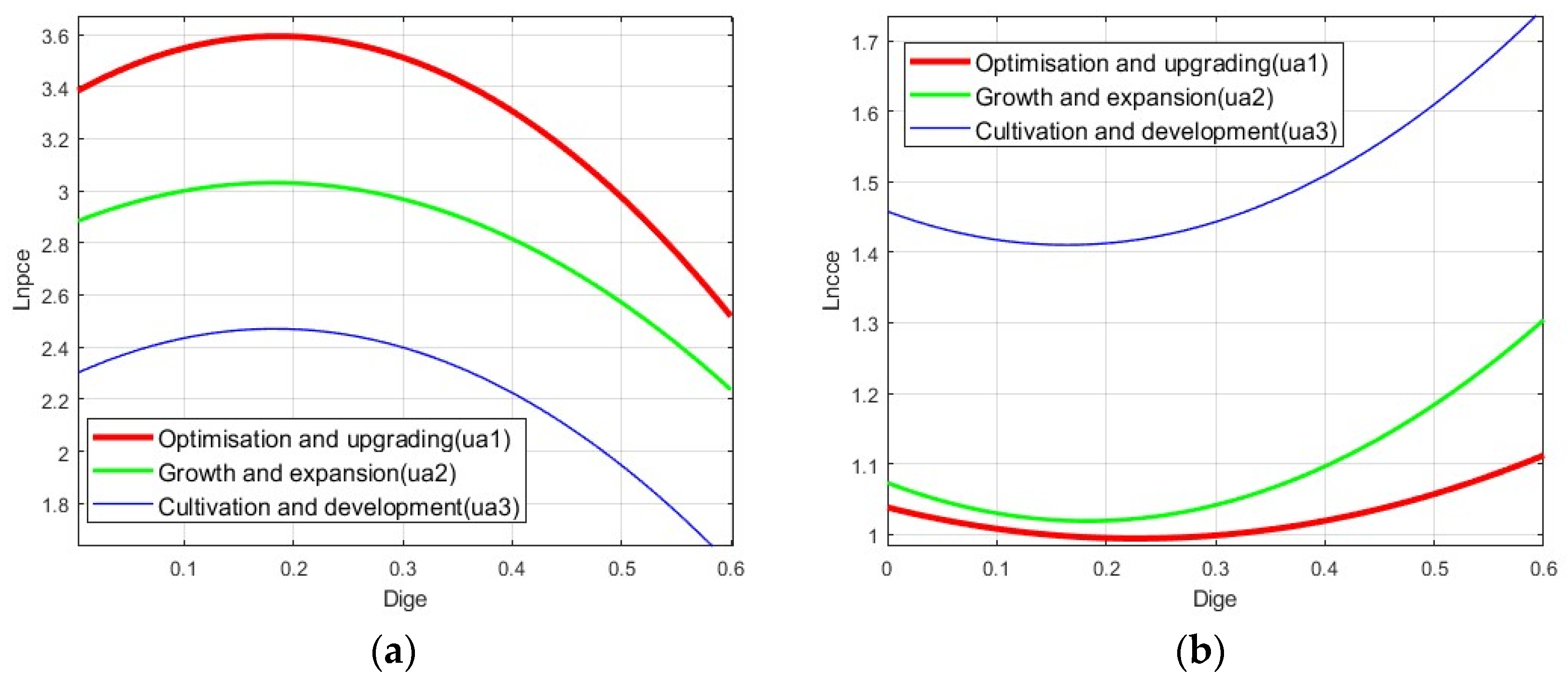
Urban agglomerations across the three categories exhibit distinct stages of economic development and marked heterogeneity in DE advancement, green technology adoption, and energy consumption structures. The results of heterogeneity analysis are detailed in Table 9, while Figure 3 depicts the carbon emission performance of different types of urban agglomerations.
The relationship between DE and PCE in urban agglomerations exhibits an inverted U-shape. The coefficients of both Dige and Sdige are statistically significant. The inflection point for ua1 is notably significant, as emission reduction becomes apparent when the DE index surpasses 0.186. The inflection points for ua2 and ua3 are 0.183 and 0.178, respectively. The role of DE in shaping CEE differs significantly across urban agglomerations. The impact of the DE in ua1 and ua3 is negligible. In ua2, there exists a significant positive U-shaped relationship. When the Dige falls below 0.182, CEE initially declines but later increases. This result may be attributed to the ongoing rapid industrialization of the cities in these agglomerations, characterized by significant dependence on manufacturing, which enhances the visibility of digitalization’s effect on CEE.

5. Discussion

The results highlight the complex role of DE in shaping urban carbon emission performance. Notably, the inverted U-shaped nexus between DE development and PCE suggests that there is an initial increase in carbon emissions as digital technologies permeate industrial applications. Most likely, the reason is the high energy consumption associated with the early stages of digital infrastructure development. However, with the maturation of digital technologies and their applications becoming more energy efficient, carbon emissions begin to decrease, indicating that there exists a tipping point where the positive effects of digital innovation outweigh its initial negative impacts. The inflection points for different urban agglomerations further suggest that urban areas at advanced development stages reach this inflection point later, whereas emerging urban agglomerations take less time to experience the positive impact of digitalization. This difference is closely related to heterogeneous digital economy development models across stages. More advanced agglomerations typically concentrate data-intensive infrastructure and higher-end digital services and pursue deeper industrial digital upgrading, which tends to prolong the initial energy-demanding phase and delay the turning point. By contrast, emerging agglomerations more often benefit earlier from the diffusion of mature digital applications and management-driven efficiency gains, bringing the inflection point forward.
The U-shaped relationship between the DE and CEE presents a different dynamic. The impact is initially negative, which aligns with the hypothesis that early digitalization often involves significant resource and energy consumption. However, with the advancement of green technology innovation and digital technologies, the relationship becomes positive, indicating that advanced digital solutions can improve CEE. This pattern is consistent with a mechanism in which the digital economy strengthens carbon emission efficiency by fostering green technology innovation. As digital technologies improve information processing, resource allocation, and innovation diffusion, they facilitate the development and adoption of green technologies, which in turn enhances energy efficiency and supports emission reduction. Moreover, in emerging urban agglomerations, the feedback effects of CEE are more pronounced, emphasizing the role of digitalization in improving the efficiency of emission reduction during rapid industrialization.
These findings not only provide empirical evidence but also extend theoretical understanding of the mechanisms linking digitalization, innovation, and carbon performance. By integrating the DE and green technology innovation into a unified framework, this study reveals how digital transformation can evolve from an energy-intensive process to a key enabler of low-carbon growth. The identification of nonlinear patterns and threshold effects contributes to refining existing theories of technological transition and environmental efficiency. Furthermore, the differentiated impacts across urban agglomeration types highlight the spatial and developmental heterogeneity of digital transformation, suggesting that regional context plays a crucial role in determining its environmental outcomes. In particular, policy environments can act as a key boundary condition by shaping both the trajectory of digitalization and its emission implications. Stronger environmental regulation, clearer carbon targets, and supportive digital and green innovation policies tend to steer digital development toward efficiency-enhancing and cleaner applications, whereas weaker enforcement or growth-oriented incentives may encourage more energy-intensive digital expansion and delay emission-reduction benefits. While this research draws on data from Chinese cities, the institutional and energy context is distinctive, including a relatively coal-dominated energy mix and a strong role of the state in shaping digital and low-carbon transitions. Accordingly, the estimated magnitudes and turning-point patterns are conditioned by this institutional and energy setting. Nevertheless, the findings may be particularly informative for large developing economies that exhibit comparable structural features, including energy-intensive industrial systems and state-coordinated digital transformation strategies. At the same time, the mechanism emphasized in this study, namely that digital transformation can shift from an energy-intensive phase to an efficiency-enhancing phase partly through green technology innovation, offers broader insights for developing economies pursuing digitalization alongside decarbonization. The policy framework proposed here could therefore provide a reference for economies aiming to balance digital growth with emission reduction and energy-efficiency objectives, while recognizing that the specific effects may vary with local energy structures and institutional arrangements.

6. Conclusions and Policy Implications

6.1. Main Findings

Using panel data for 278 Chinese cities from 2011 to 2022, this study examines how the DE development influences urban carbon emission performance in terms of both volume and efficiency, with green technology innovation serving as the mediating mechanism. The primary conclusions are outlined below:
The results reveal a pronounced inverted U-shaped relationship between the level of DE and PCE. Emissions rise at early stages of the DE growth before declining as digitalization deepens. Conversely, a U-shaped pattern emerges between the DE and CEE, whereby digital expansion initially impairs efficiency but ultimately enhances it as digital maturity is reached.
Green technology innovation serves as a crucial mediating factor through which DE influences urban carbon emission performance. The DE has a dual-threshold effect in facilitating low-carbon urban development. At lower levels of green innovation, DE predominantly affects CEE. The impact of DE on carbon reduction is contingent upon the advancement of green technology innovation to a specific threshold. Furthermore, an increase in green technology innovation reflects an enhanced influence of DE on carbon mitigation.
The influence of the DE on urban carbon emission performance varies considerably among various types of urban agglomerations. In optimization and upgrading urban agglomerations, the point at which digitalization leads to a reduction in PCE is delayed. Meanwhile, the interaction between CEE and DE becomes increasingly evident in expanding urban agglomerations.

6.2. Policy Implications

In light of the nonlinear and threshold patterns identified in this study, policy implications should be formulated in a stage-sensitive and condition-specific manner rather than relying on uniform prescriptions. The empirical results indicate that the environmental effects of digitalization depend on the level of green technology innovation and the developmental stage of urban agglomerations. Therefore, policy design should account for transitional dynamics, structural heterogeneity, and the need to move from energy-intensive digital expansion toward efficiency-enhancing integration. Based on these findings, the following targeted recommendations are proposed:
The advancement of digitalization should be strategically accelerated, with sustained and well-coordinated policy support across sectors and regions to help the DE move beyond its initial energy-intensive stage and achieve systemic gains in energy efficiency and carbon productivity. During industrial transformation, the application of green digital technologies should be reinforced through fiscal incentives, pilot demonstration programs, and technology standards, with particular emphasis on low-carbon sectors such as intelligent manufacturing and clean energy systems. The government should implement policy measures that encourage enterprises’ investment in green technology research and accelerate the integration of digital technologies into sustainable production and energy management systems.
Investment in green technology innovation should be increased to enhance the positive environmental effects of the DE. The incentive mechanisms for green patent research and development should be improved to facilitate the deep integration of digital technologies with low-carbon technologies and to raise the overall quality of green innovation. Considering the threshold characteristics identified in this study, policy support for green innovation should be tailored to the level of technological advancement, ensuring that innovation capacity can cross the critical threshold required to generate significant carbon reduction effects. In addition, R&D funding should be expanded to provide sustained financial and technical support for the low-carbon transition and to strengthen the long-term innovation capacity of enterprises.
Diversified and region-specific policies should be aligned with the developmental stages and strategic orientations of urban agglomerations. For mature clusters categorized as “optimization and upgrading” or “growth and expansion,” policy efforts should emphasize the deep integration of the DE with green technologies, supported by cross-regional coordination in data management, industrial upgrading, and energy planning to enhance eco-efficiency. For emerging agglomerations in the “cultivation and development” stage, emphasis should be placed on enhancing digital infrastructure, strengthening local innovation systems, and enhancing energy efficiency through technology adoption. At the national level, the government should establish a multi-level coordination mechanism to align regional digitalization strategies with low-carbon transition goals and to promote low-carbon technological innovation within the digital sector.

6.3. Research Limitations and Future Prospects

Research limitations should be acknowledged when interpreting the results. Given the observational nature of the data, the estimated relationships should be interpreted with appropriate caution, particularly when drawing strong causal inferences. First, green technology innovation is proxied by green patent applications, which may not fully capture patent quality or conversion efficiency and may also imperfectly reflect the timing and extent of technology diffusion and deployment, especially given that innovation activity tends to be more concentrated in economically advanced cities. Second, the digital economy is measured by a composite index aggregating digital infrastructure, digital industry development, and digital finance. While this composite measure is widely used to reflect overall digital development, it may mask heterogeneous environmental effects across components.
Future research can address these limitations and further extend our analysis. In particular, future studies could more explicitly examine potential bidirectional dynamics between environmental performance and digital investment decisions. First, future studies could incorporate patent quality-related measures such as granted patents or citations to better capture effective green innovation, and decompose the digital economy index to examine the potentially heterogeneous effects of digital infrastructure, digital industry development, and digital finance. Second, expanding the sample to more recent years and cross-country settings would help assess the robustness and generalizability of the findings under different policy regimes and energy structures. Third, incorporating firm-level or sectoral data could provide richer evidence on the micro-level channels through which digitalization and green innovation affect energy efficiency and carbon outcomes. Finally, comparative analyses between developing and developed economies may further clarify how institutional quality, policy design, and technological maturity shape the digital economy’s low-carbon effects. Additionally, this study focuses on territorial emissions at the city level and thus may not fully capture potential emission leakage through interregional production shifting or embodied carbon in trade. Future work could extend the analysis using consumption-based emission accounts or input–output-based embodied carbon measures to assess whether digitalization reduces emissions locally while reallocating carbon-intensive activities across regions. Future research could also incorporate spatial spillover analyses to examine cross-city and cross-regional transmission channels, such as technology diffusion, industrial relocation, and policy spillovers, and to evaluate the net carbon effects of digitalization from a broader spatial perspective.

Author Contributions

Methodology, R.W. and S.S.; software, R.W. and S.S.; validation, R.W.; data curation, J.H.; writing—original draft preparation, R.W. and J.H.; writing—review and editing, R.W., S.S. and X.W.; visualization, R.W.; supervision, X.W.; project administration, R.W.; funding acquisition, X.W. All authors have read and agreed to the published version of the manuscript.

Funding

This research was supported by the Fundamental Research Funds for the Central Universities (Grant No. N2423011) and the Major Program of National Fund of Philosophy and Social Science of China (Grant No. 23&ZD040).

Institutional Review Board Statement

Not applicable.

Informed Consent Statement

Not applicable.

Data Availability Statement

Data available on request from the authors.

Acknowledgments

The authors have reviewed and edited the output and take full responsibility for the content of this publication.

Conflicts of Interest

The authors declare no conflicts of interest.

Appendix A

The steps of entropy weight method are outlined as follows.
The data are standardized to mitigate the effects of varying units across variables. A standard approach involves applying Equation (A1) to direct indicators and Equation (A2) to inverse indicators. Here, i = 1, 2, …, m denotes years, and j = 1, 2, …, n represents the number of indicators.
z i j = x i j x min x max x min ,
z i j = x max x i j x max x min ,
Step two entails computing the information entropy for each evaluation metric. The formula for calculating the entropy of the i-th indicator is expressed as:
E j = 1 ln m j = 1 m p i j ln p i j ,
p i j = z i j i = 1 m z i j ,
The third step is to determine the weights of each evaluation indicator. The entropy of the i-th indicator is substituted into Equation (A5) to solve for the weight of that indicator.
W j = 1 E j N i = 1 n E j ,
Ultimately, the composite evaluation index for the subsystem is computed to obtain the overall evaluation indicator for the DE.
D i g e i = j = 1 n W j z i j

Appendix B

Table A1. List and classification of urban agglomerations.
TypeThe Included Urban Agglomerations
Optimization and upgrading
(denoted as ua1)
(1) Beijing–Tianjin–Hebei; (2) Yangtze River Delta;
(3) Pearl River Delta; (4) Chengdu–Chongqing; (5) Middle Yangtze River.
Growth and expansion
(denoted as ua2)
(1) Shandong Peninsula; (2) Guangdong–Fujian–Zhejiang coastal; (3) Central Plains; (4) Guanzhong Plain; (5) Beibu Gulf.
Cultivation and development
(denoted as ua3)
(1) Harbin–Changchun; (2) Central and Southern Liaoning; (3) Central Shanxi; (4) Central Guizhou; (5) Central Yunnan; (6) Hohhot–Baotou–Ordos–Yulin; (7) Lanzhou–Xining; (8) Ningxia Yellow River; (9) Northern Tianshan.

References

  1. Guan, D.; Peters, G.P.; Weber, C.L.; Hubacek, K. Journey to world top emitter: An analysis of the driving forces of China’s recent CO2 emissions surge. Geophys. Res. Lett. 2009, 36, 1–5. [Google Scholar] [CrossRef]
  2. Green, F.; Stern, N. China’s changing economy: Implications for its carbon dioxide emissions. Clim. Policy 2017, 17, 423–442. [Google Scholar] [CrossRef]
  3. Mi, Z.; Zheng, J.; Meng, J.; Ou, J.; Hubacek, K.; Liu, Z.; Coffman, D.M.; Stern, N.; Liang, S.; Wei, Y.M. Economic development and converging household carbon footprints in China. Nat. Sustain. 2020, 3, 529–537. [Google Scholar] [CrossRef]
  4. Qiao, H.; Chen, S.; Dong, X.; Dong, K. Has China’s coal consumption actually reached its peak? National and regional analysis considering cross-sectional dependence and heterogeneity. Energy Econ. 2019, 84, 104509. [Google Scholar] [CrossRef]
  5. Khan, K.; Su, C.W.; Tao, R.; Hao, L.N. Urbanization and carbon emission: Causality evidence from the new industrialized economies. Environ. Dev. Sustain. 2020, 22, 7193–7213. [Google Scholar] [CrossRef]
  6. Ma, X.; Yang, J.; Sun, D. Fine allocation of sectoral carbon emissions at block scale and contribution of functional zones. Ecol. Inform. 2023, 78, 102293. [Google Scholar] [CrossRef]
  7. Xu, J.J.; Wang, J.C.; Li, R.; Yang, X.J. Spatio-temporal effects of urbanization on CO2 emissions: Evidences from 268 Chinese cities. Energy Policy 2023, 177, 113569. [Google Scholar] [CrossRef]
  8. Song, C.; Yang, J.; Wu, F.; Xiao, X.; Xia, J.; Li, X. Response characteristics and influencing factors of carbon emissions and land surface temperature in Guangdong Province, China. Urban Clim. 2022, 46, 101330. [Google Scholar] [CrossRef]
  9. Guo, X.C.; Li, M.M.; Wang, Y.L.; Mardani, A. Does digital transformation improve the firm’s performance? From the perspective of digitalization paradox and managerial myopia. J. Bus. Res. 2023, 163, 113868. [Google Scholar] [CrossRef]
  10. Tan, L.S.; Yang, Z.D.; Irfan, M.; Ding, C.J.; Hu, M.J.; Hu, J. Toward low-carbon sustainable development: Exploring the impact of digital economy development and industrial restructuring. Bus. Strateg. Environ. 2024, 33, 2159–2172. [Google Scholar] [CrossRef]
  11. Hu, J. Synergistic effect of pollution reduction and carbon emission mitigation in the digital economy. J. Environ. Manag. 2023, 337, 117755. [Google Scholar] [CrossRef]
  12. Xue, H.; Cai, M.; Liu, B.; Di, K.; Hu, J. Sustainable development through digital innovation: Unveiling the impact of big data comprehensive experimental zones on energy utilization efficiency. Sustain. Dev. 2025, 33, 177–189. [Google Scholar] [CrossRef]
  13. Fang, G.; Gao, Z.; Tian, L.; Fu, M. What drives urban carbon emission efficiency?—Spatial analysis based on nighttime light data. Appl. Energy 2022, 312, 118772. [Google Scholar] [CrossRef]
  14. Zhang, F.; Deng, X.; Phillips, F.; Fang, C.; Wang, C. Impacts of industrial structure and technical progress on carbon emission intensity: Evidence from 281 cities in China. Technol. Forecast. Soc. Change 2020, 154, 119949. [Google Scholar] [CrossRef]
  15. Ren, S.M.; Li, L.Q.; Han, Y.Q.; Hao, Y.; Wu, H.T. The emerging driving force of inclusive green growth: Does digital economy agglomeration work? Bus. Strategy Environ. 2022, 31, 1656–1678. [Google Scholar] [CrossRef]
  16. Zhang, L.; Chen, X.; Xu, Z. Can development zones reduce energy consumption and carbon emissions of enterprises? Evidence from China. J. Asian Econ. 2024, 95, 101845. [Google Scholar] [CrossRef]
  17. Wu, R.; Ma, T.; Schröder, E. The contribution of trade to production-Based carbon dioxide emissions. Struct. Change Econ. Dyn. 2022, 60, 391–406. [Google Scholar] [CrossRef]
  18. Habiba, U.; Xinbang, C.; Anwar, A. Do green technology innovations, financial development, and renewable energy use help to curb carbon emissions? Renew. Energy 2022, 193, 1082–1093. [Google Scholar] [CrossRef]
  19. Zhao, J.; Li, A.; Roh, T.; Su, M. Escaping regulation or embracing innovation? Substantive green innovation’s role in moderating environmental policy and outward foreign direct investment. Energy 2025, 316, 134547. [Google Scholar] [CrossRef]
  20. Gao, P.F.; Wang, Y.D.; Zou, Y.; Su, X.F.; Che, X.H.; Yang, X.D. Green technology innovation and carbon emissions nexus in China: Does industrial structure upgrading matter? Front. Psychol. 2022, 139, 51172. [Google Scholar] [CrossRef] [PubMed]
  21. Shan, S.; Genç, S.Y.; Kamran, H.W.; Dinca, G. Role of green technology innovation and renewable energy in carbon neutrality: A sustainable investigation from Turkey. J. Environ. Manag. 2021, 294, 113004. [Google Scholar] [CrossRef] [PubMed]
  22. Du, K.; Li, P.; Yan, Z. Do green technology innovations contribute to carbon dioxide emission reduction? Empirical evidence from patent data. Technol. Forecast. Soc. Change 2019, 146, 297–303. [Google Scholar] [CrossRef]
  23. Lu, X.; Lu, Z. How does green technology innovation affect urban carbon emissions? Evidence from Chinese cities. Energy Build. 2024, 325, 115025. [Google Scholar] [CrossRef]
  24. Lu, Y.; Hu, J.J. Spatial Impact of Digital Economy on the Upgrading of Industrial Structure: Evidence From Chinese Cities. Sage Open 2024, 14, 21582440241233940. [Google Scholar] [CrossRef]
  25. Lu, J.; Xiao, Q.L.; Wang, T.X. Does the digital economy generate a gender dividend for female employment? Evidence from China. Telecomm. Policy 2023, 47, 102545. [Google Scholar] [CrossRef]
  26. Liu, Y.; Tian, G.; Zhang, X. Digital economy and China’s path to common prosperity. Digit. Econ. Sustain. Dev. 2024, 2, 8. [Google Scholar] [CrossRef]
  27. Wang, Q.J.; Li, W.Z.; Gong, Z.Y.; Fu, J.Y. The Coupling and Coordination Between Digital Economy and Green Economy: Evidence from China. Emerg. Mark. Financ. Trade 2024, 61, 562–578. [Google Scholar] [CrossRef]
  28. Chen, D.; Huang, Y.; Tan, N.; Hong, T.; Ma, T. Cross-regional economic impact of carbon emission regulations: A quantitative spatial equilibrium model for China. Struct. Change Econ. Dyn. 2024, 69, 438–462. [Google Scholar] [CrossRef]
  29. Hu, M.; Chen, P.; Chen, G.; Li, Z. Spatio-temporal influencing effects and mechanisms of the digital economy on eco-urbanization in the Yangtze River Delta region. Environ. Technol. Innov. 2025, 37, 103979. [Google Scholar] [CrossRef]
  30. Varlamova, J.; Kadochnikova, E. Modeling the Spatial Effects of Digital Data Economy on Regional Economic Growth: SAR, SEM and SAC Models. Mathematics 2023, 11, 3516. [Google Scholar] [CrossRef]
  31. Song, C.; Liu, Q.; Song, J.; Ma, W. Impact path of digital economy on carbon emission efficiency: Mediating effect based on technological innovation. J. Environ. Manag. 2024, 358, 120940. [Google Scholar] [CrossRef]
  32. Xia, H.; Tang, Y. Does digital economy affect the quantity and efficiency of carbon emissions: Evidence from dynamic spatial Durbin model analysis. Environ. Dev. Sustain. 2024, 27, 23997–24017. [Google Scholar] [CrossRef]
  33. Lee, C.C.; Wang, F.H. How does digital inclusive finance affect carbon intensity? Econ. Anal. Policy 2022, 75, 174–190. [Google Scholar] [CrossRef]
  34. Yi, M.; Liu, Y.F.; Sheng, M.S.; Wen, L. Effects of digital economy on carbon emission reduction: New evidence from China. Energy Policy 2022, 171, 113271. [Google Scholar] [CrossRef]
  35. Akimoto, K.; Sano, F.; Oda, J. Impacts of ride and car-sharing associated with fully autonomous cars on global energy consumptions and carbon dioxide emissions. Technol. Forecast. Soc. Change 2022, 174, 121311. [Google Scholar] [CrossRef]
  36. Bai, L.; Guo, T.R.; Xu, W.; Liu, Y.B.; Kuang, M.; Jiang, L. Effects of digital economy on carbon emission intensity in Chinese cities: A life-cycle theory and the application of non-linear spatial panel smooth transition threshold model. Energy Policy 2023, 183, 113792. [Google Scholar] [CrossRef]
  37. Cheng, Y.; Zhang, Y.; Wang, J.J.; Jiang, J.X. The impact of the urban digital economy on China’s carbon intensity: Spatial spillover and mediating effect. Resour. Conserv. Recycl. 2023, 189, 106762. [Google Scholar] [CrossRef]
  38. Hao, X.L.; Li, Y.H.; Ren, S.Y.; Wu, H.T.; Hao, Y. The role of digitalization on green economic growth: Does industrial structure optimization and green innovation matter? J. Environ. Manag. 2023, 325, 116504. [Google Scholar] [CrossRef] [PubMed]
  39. Yang, Z.; Gao, W.J.; Han, Q.; Qi, L.Y.; Cui, Y.J.; Chen, Y.Q. Digitalization and carbon emissions: How does digital city construction affect china’s carbon emission reduction? Sustain. Cities Soc. 2022, 87, 104201. [Google Scholar] [CrossRef]
  40. Lv, K.; Zheng, H.; Ge, L. Digital empowerment to reduce air pollution: The impact of urban network infrastructure construction on PM2.5. J. Asian Econ. 2025, 98, 101930. [Google Scholar] [CrossRef]
  41. Ren, S.; Hao, Y.; Xu, L.; Wu, H.; Ba, N. Digitalization and energy: How does internet development affect China’s energy consumption? Energy Econ. 2021, 98, 105220. [Google Scholar] [CrossRef]
  42. Taneja, S.; Mandys, F. The effect of disaggregated information and communication technologies on industrial energy demand. Renew. Sustain. Energy Rev. 2022, 164, 112518. [Google Scholar] [CrossRef]
  43. Zhang, Y.J.; Du, M.F. Greening through digitalisation? Evidence from cities in China. Reg. Stud. 2023, 59, 2215824. [Google Scholar] [CrossRef]
  44. Gurney, K.R.; Mendoza, D.L.; Zhou, Y.Y.; Fischer, M.L.; Miller, C.C.; Geethakumar, S.; Du Can, S.D. High Resolution Fossil Fuel Combustion CO2 Emission Fluxes for the United States. Environ. Sci. Technol. 2009, 43, 5535–5541. [Google Scholar] [CrossRef]
  45. Wang, J.D.; Dong, X.C.; Dong, K.Y. How digital industries affect China’s carbon emissions? Analysis of the direct and indirect structural effects. Technol. Soc. 2022, 68, 101911. [Google Scholar] [CrossRef]
  46. Tang, K.J.; Yang, G.Y. Does digital infrastructure cut carbon emissions in Chinese cities? Sustain. Prod. Consum. 2023, 35, 431–443. [Google Scholar] [CrossRef]
  47. Lezoche, M.; Hernandez, J.E.; Díaz, M.; Panetto, H.; Kacprzyk, J. Agri-food 4.0: A survey of the supply chains and technologies for the future agriculture. Comput. Ind. 2020, 117, 103187. [Google Scholar] [CrossRef]
  48. Del Giudice, M.; Chierici, R.; Mazzucchelli, A.; Fiano, F. Supply chain management in the era of circular economy: The moderating effect of big data. Int. J. Logist. Manag. 2021, 32, 337–356. [Google Scholar] [CrossRef]
  49. Bonsu, M.O.; Wang, Y.; Nartey, P.R.D.; Amala, M.N. Does the integration of Fintech and green finance enhance sustainability performance in the banking sector? Information technology governance as moderator. Bus. Strateg. Environ. 2025, 34, 9954–9977. [Google Scholar] [CrossRef]
  50. Luo, S. Digital Finance Development and the Digital Transformation of Enterprises: Based on the Perspective of Financing Constraint and Innovation Drive. J. Math. 2022, 2022, 1607020. [Google Scholar] [CrossRef]
  51. Neumeyer, X.; Santos, S.C. Sustainable business models, venture typologies, and entrepreneurial ecosystems: A social network perspective. J. Clean. Prod. 2018, 172, 4565–4579. [Google Scholar] [CrossRef]
  52. Clifton, N.; Füzi, A.; Loudon, G. Coworking in the digital economy: Context, motivations, and outcomes. Futures 2022, 135, 102439. [Google Scholar] [CrossRef]
  53. Wang, P.; Cen, C. Does digital economy development promote innovation efficiency? A spatial econometric approach for Chinese regions. Technol. Anal. Strateg. Manag. 2024, 36, 931–945. [Google Scholar] [CrossRef]
  54. Neumeyer, X.; Santos, S.C.; Liguori, E.; Walsh, S.T.; Mahto, R.V. The ever-evolving relationship between technology, innovation, and entrepreneurship: Current state and future research needs. Technol. Forecast. Soc. Change 2025, 215, 124059. [Google Scholar] [CrossRef]
  55. Herring, H.; Roy, R. Technological innovation, energy efficient design and the rebound effect. Technovation 2007, 27, 194–203. [Google Scholar] [CrossRef]
  56. Bye, B.; Fæhn, T.; Rosnes, O. Residential energy efficiency policies: Costs, emissions and rebound effects. Energy 2018, 143, 191–201. [Google Scholar] [CrossRef]
  57. Li, L.; Li, G.; Ozturk, I.; Ullah, S. Green innovation and environmental sustainability: Do clean energy investment and education matter? Energy Environ. 2023, 34, 2705–2720. [Google Scholar] [CrossRef]
  58. Luo, S.Y.; Yimamu, N.; Li, Y.R.; Wu, H.T.; Irfan, M.; Hao, Y. Digitalization and sustainable development: How could digital economy development improve green innovation in China? Bus. Strateg. Environ. 2023, 32, 1847–1871. [Google Scholar] [CrossRef]
  59. Jiang, T. Mediating Effects and Moderating Effects in Causal Inference. China Ind. Econ. 2022, 5, 100–120. [Google Scholar] [CrossRef]
  60. Hansen, B.E. Sample splitting and threshold estimation. Econometrica 2000, 68, 575–603. [Google Scholar] [CrossRef]
  61. Gadalla, M.A.; Olujic, Z.; Jansens, P.J.; Jobson, M.; Smith, R. Reducing CO2 emissions and energy consumption of heat-integrated distillation systems. Environ. Sci. Technol. 2005, 39, 6860–6870. [Google Scholar] [CrossRef] [PubMed]
  62. Zhao, T.; Zhang, Z.; Liang, S. Digital Economy, Entrepreneurship, and High-Quality Economic Development: Empirical Evidence from Urban China. J. Manag. World 2020, 36, 65–76. [Google Scholar] [CrossRef]
  63. Fei, J.; Pu, Z.; Tavera, C. The power of patent transfer: The impact of green technology acquisition on non-residential CO2 emissions under the intervention of government actions. J. Asian Econ. 2024, 94, 101787. [Google Scholar] [CrossRef]
  64. Guo, L.; Tan, W.; Xu, Y.; Tang, Q. Curbing regional carbon emissions through green technology innovation: An empirical analysis in China. Environ. Dev. Sustain. 2024, 27, 9477–9500. [Google Scholar] [CrossRef]
  65. Lin, B.Q.; Ma, R.Y. Green technology innovations, urban innovation environment and CO2 emission reduction in China: Fresh evidence from a partially linear functional-coefficient panel model. Technol. Forecast. Soc. Change 2022, 176, 121434. [Google Scholar] [CrossRef]
  66. Chen, H.; Yi, J.; Chen, A.; Peng, D.; Yang, J. Green technology innovation and CO2 emission in China: Evidence from a spatial-temporal analysis and a nonlinear spatial durbin model. Energy Policy 2023, 172, 113338. [Google Scholar] [CrossRef]
  67. Hou, J.; Bai, W.T.; Sha, D.C. Does the Digital Economy Successfully Facilitate Carbon Emission Reduction in China? Green Technology Innovation Perspective. Sci. Technol. Soc. 2023, 28, 535–560. [Google Scholar] [CrossRef]
Figure 1. Digital economy development and total carbon emissions in China in 2021: (a) Digital economy development index (calculated by authors); (b) Carbon emissions (in kt) in Chinese cities.
Systems 14 00291 g001
Figure 2. Theoretical framework.
Systems 14 00291 g002
Figure 3. Carbon emission performance of different types of urban agglomerations: (a) Relationship between digital economy and emission per capita; (b) Relationship between digital economy and emission efficiency.
Systems 14 00291 g003
Table 1. Measurement of Digital Economy Development Indicators.
Criterion LevelIndicator LevelIndicator Description
Digital
infrastructure
High-speed internet infrastructureNumber of broadband internet
users per 10,000 people
Mobile internet infrastructureNumber of mobile phone users per 10,000 people
Digital industry developmentTelecommunications scaleTotal volume of
telecommunication services
Software and IT industry scaleNumber of employees in information transmission, computer services, and software sector
Digital financeInclusive developmentChina digital inclusive
finance index
Table 2. Descriptive statistics.
VariablesExplanationMeanStd. Dev.MinMax
LnpceThe log of per capita carbon emissions2.1720.6960.6243.988
LnceeThe log of carbon emission efficiency3.6220.3732.6264.718
DigeDigital economy development0.0920.0520.0100.561
SdigeThe square of Dige0.0110.0190.0000.315
LnpdThe log of population density5.7540.9320.6837.882
InnovThe number of green patent applications0.2880.7440.0015.150
LnpgdpThe log of per capita GDP10.760.5609.45512.066
LntechThe log of technological support−4.4620.906−6.586−2.471
EnvirEnvironmental regulation15.6611.01413.41418.243
UrbanUrbanization0.5640.1470.2780.952
Table 3. Results of the baseline regression.
Variables(1) Lnpce(2) Lnpce(3) Lncee(4) Lncee
Dige0.2091.907 ***0.020−0.541 ***
(0.150)(0.347)(0.062)(0.161)
Sdige −4.851 *** 1.604 ***
(0.877) (0.406)
Lnpd−0.037 *−0.038 *−0.019 **−0.019 **
(0.021)(0.021)(0.009)(0.009)
Lnpgdp0.060 **0.047 *0.179 ***0.184 ***
(0.027)(0.027)(0.013)(0.013)
Lntech−0.013 **−0.011 **0.008 ***0.008 **
(0.006)(0.005)(0.003)(0.003)
Envir−0.054 ***−0.058 ***0.018 *0.020 *
(0.020)(0.020)(0.010)(0.010)
Urban0.189*0.1420.0130.029
(0.112)(0.109)(0.038)(0.038)
Constant2.304 ***2.467 ***1.512 ***1.458 ***
(0.282)(0.277)(0.177)(0.177)
Year FEYesYesYesYes
City FEYesYesYesYes
Observations3336333633363336
R-squared0.4300.4400.6280.631
Number of cities278278278278
Note: Robust standard errors in parentheses, *** p < 0.01, ** p < 0.05, * p < 0.1.
Table 4. Results of the robustness tests.
Substitute VariablesExclude Certain SamplesHandle the OutliersIV Estimations
Variables(1) Lnpec(2) Lnef(3) Lnpce(4) Lncee(5) Lnpce(6) Lncee(7) Lnpce(8) Lncee
Dige4.407 ***−9.560 ***1.914 ***−0.619 ***2.900 ***−0.770 ***3.585 ***−1.478 ***
(0.977)(2.161)(0.372)(0.161)(0.543)(0.275)(0.547)(0.280)
Sdige−12.263 ***27.379 ***−4.868 ***1.854 ***−9.876 ***2.365 **−8.654 ***3.872 ***
(2.176)(4.836)(0.955)(0.403)(2.049)(1.176)(1.247)(0.659)
Control VariablesYesYesYesYesYesYesYesYes
Constant0.2345.240 ***2.478 ***1.423 ***2.394 ***1.308 ***4.466 ***1.093 ***
(0.722)(1.661)(0.279)(0.176)(0.384)(0.206)(0.289)(0.144)
Year FEYesYesYesYesYesYesYesYes
City FEYesYesYesYesYesYesYesYes
Observations33363336328832883336333630583058
R-squared0.6520.4790.4400.6300.4140.6030.9840.986
Number of cities278278274274278278278278
Note: Robust standard errors in parentheses, *** p < 0.01, ** p < 0.05, * p < 0.1.
Table 5. The mediating effect of Innov.
Variables(1) Innov(2) Lnpce(3) Lnpce(4) Lncee(5) Lncee
Innov −0.041 *** 0.019 ***
(0.011) (0.003)
Dige−11.557 ***1.907 ***1.434 ***−0.541 ***−0.327 **
(3.029)(0.347)(0.309)(0.161)(0.149)
Sdige37.365 ***−4.851 ***−3.321 ***1.604 ***0.912 **
(9.591)(0.877)(0.848)(0.406)(0.365)
Control VariablesYesYesYesYesYes
Constant0.6102.467 ***2.492 ***1.458 ***1.446 ***
(0.912)(0.277)(0.273)(0.177)(0.174)
Year FEYesYesYesYesYes
City FEYesYesYesYesYes
Observations33363336333633363336
R-squared0.2710.4400.4490.6310.636
Number of cities278278278278278
Note: Robust standard errors in parentheses, *** p < 0.01, ** p < 0.05, * p < 0.1.
Table 6. Decomposition and significance testing of the mediating effect.
Dependent VariableEffectCoef.Std.Errp-ValueZ-ValueNormal-Based
[95% Conf. Interval]
LnpceDirect_effect_Dige1.434 ***0.2730.0005.25[0.899, 1.969]
Direct_effect_Sdige−3.321 ***0.7580.000−4.38[−4.808, −1.835]
Indirect_effect_Dige0.473 ***0.0990.0004.79[0.280, 0.667]
Indirect_effect_Sdige−1.530 ***0.3130.000−4.89[−2.144, −0.917]
LnceeDirect_effect_Dige−0.327 **0.1300.012−2.51[−0.582, −0.072]
Direct_effect_Sdige0.912 ***0.3410.0082.67[0.243, 1.581]
Indirect_effect_Dige−0.214 ***0.0410.000−5.24[−0.294, −0.134]
Indirect_effect_Sdige0.692 ***0.1310.0005.29[0.435, 0.949]
Note: Bootstrap = 500, *** p < 0.01, ** p < 0.05, * p < 0.1.
Table 7. Results of the threshold effect significance test.
VariablesThresholdF-Valuep-Value1%5%10%
LnpceSingle43.05 ***0.00435.00723.13019.557
Double27.37 *0.09267.62046.86125.563
Triple6.560.84646.63027.60322.194
LnceeSingle44.16 ***0.00030.55420.74918.255
Double20.69 *0.07434.57523.45818.668
Triple15.400.43034.74527.99224.549
Note: Bootstrap = 500, *** p < 0.01, ** p < 0.05, * p < 0.1.
Table 8. Regression results for the panel threshold model.
Variables(1) Lnpce(2) LnceeVariables(1) Lnpce(2) Lncee
Dige.I (Innov ≤ γ1)0.935 ***−0.212γ10.6670.015
(0.330)(0.196)γ23.0910.667
Dige.I (γ1 < Innov ≤ γ2)0.787 **−0.429 ***Control
Variables
YesYes
(0.354)(0.161)
Dige.I (Innov > γ2)0.909−0.117Constant2.475 ***1.446 ***
(0.585)(0.169) (0.273)(0.173)
Sdige.I (Innov ≤ γ1)−1.611 *0.761Year FEYesYes
(0.910)(0.863)City FEYesYes
Sdige.I (γ1 < Innov ≤ γ2)−2.438 **1.132 ***Observations33363336
(0.954)(0.408)R-squared0.4530.638
Sdige.I (Innov > γ2)−5.075 **0.567Number of
city
278278
(2.292)(0.413)
Note: Robust standard errors in parentheses, *** p < 0.01, ** p < 0.05, * p < 0.1.
Table 9. Results of the heterogeneity test for urban agglomerations.
LnpceLncee
Variables(1) ua1(2) ua2(3) ua3(4) ua1(5) ua2(6) ua3
Dige2.403 ***1.669 ***2.019 ***−0.415−0.605 **−0.633
(0.695)(0.396)(0.735)(0.296)(0.274)(0.478)
Sdige−6.452 ***−4.551 ***−5.666 ***0.9311.663 **1.989 *
(1.721)(1.237)(1.776)(0.845)(0.777)(1.032)
Control VariablesYesYesYesYesYesYes
Constant3.329 ***3.040 ***2.145 **1.006 ***1.024 ***1.628 **
(0.488)(0.778)(0.980)(0.282)(0.384)(0.671)
Year FEYesYesYesYesYesYes
City FEYesYesYesYesYesYes
Observations11168405161116840516
R-squared0.4780.4960.5210.6290.6730.595
Number of cities937043937043
Note: Robust standard errors in parentheses, *** p < 0.01, ** p < 0.05, * p < 0.1.
Disclaimer/Publisher’s Note: The statements, opinions and data contained in all publications are solely those of the individual author(s) and contributor(s) and not of MDPI and/or the editor(s). MDPI and/or the editor(s) disclaim responsibility for any injury to people or property resulting from any ideas, methods, instructions or products referred to in the content.