

Mapping Influencing Factors and Interactions in the Sustainable Development of the University Practice Education Community: A Social Network Analysis

Abstract
1. Introduction
2. Literature Review
2.1. Influencing Factors of the Sustainable Development of UPEC
2.2. Methods for Analyzing the Influencing Factors of the Sustainable Development of UPEC
2.3. Application of SNA in the Field of Sustainable Development in Higher Education
2.4. Research Gap
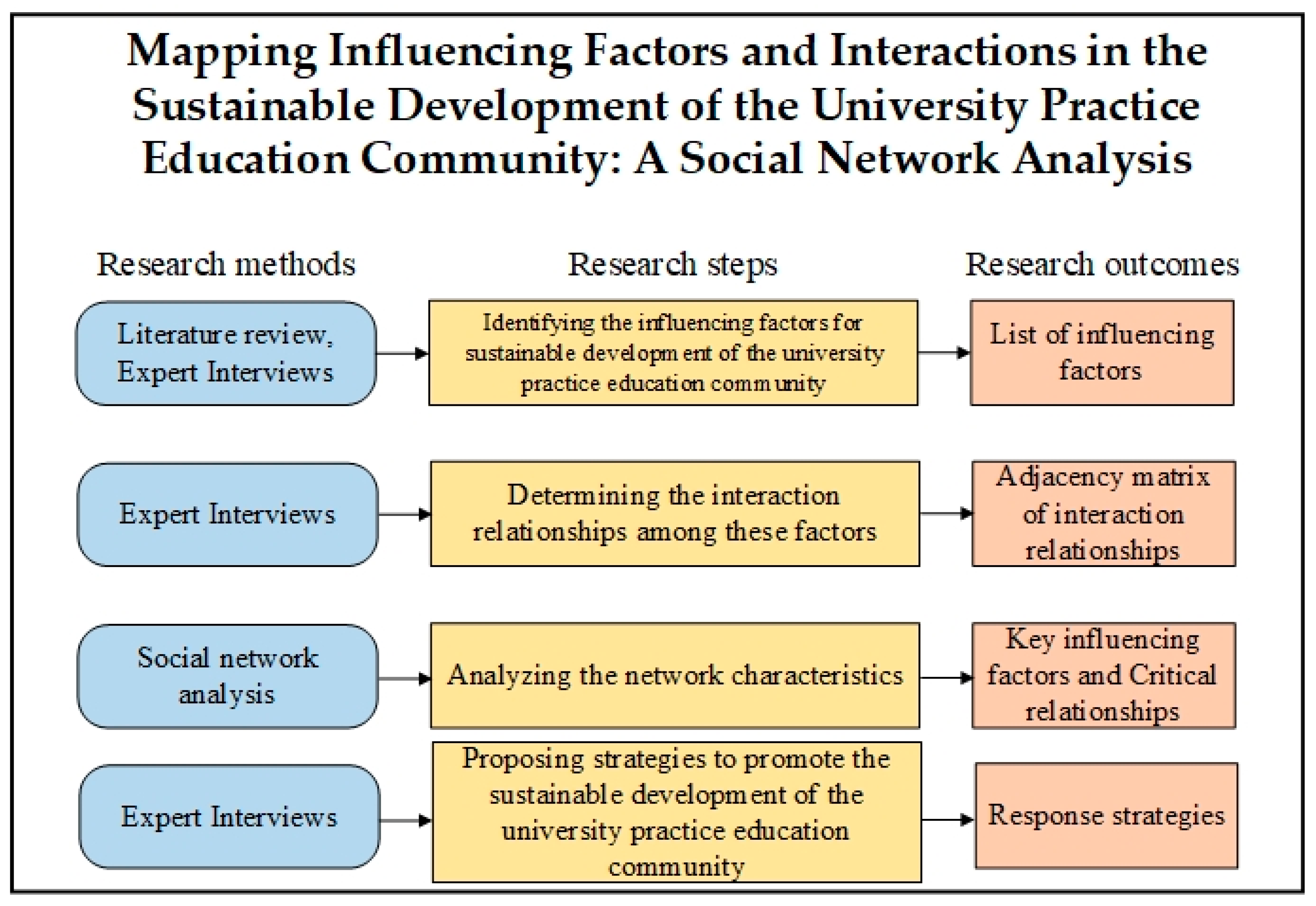
3. Research Methodology
4. Results
4.1. Identification Results of Influencing Factors for the Sustainable Development of UPEC
4.2. Results of the Interactions Among Influencing Factors
4.3. Results of Key Influencing Factors and Key Factor Relationships
4.3.1. Results of Key Influencing Factors
- (1)
- Results of Node Centrality Analysis
- (2)
- Results of Key Influencing Factors
4.3.2. Results of Key Factor Relationships
5. Discussion and Strategies
5.1. Discussion of Key Influencing Factors
5.2. Discussion of Key Relationships Among Influencing Factors
5.3. Response Strategies
- (1)
- Foster a Positive Social Environment and Strengthen Policy and Institutional Support (F20, F15, F16 → F15). This strategy aims to convert external legitimacy into stable policy and institutional supply, so that UPEC can move from episodic attention to sustained support. In the short term, universities should collaborate with industry associations, media, communities, and other stakeholders to conduct regular social needs assessments, communicate program outcomes, and organize outreach activities to strengthen recognition and attention [71]. In the medium term, participatory channels for public engagement should be institutionalized so that societal demands and suggestions can be fed back into institutional decision routines and gradually translated into policy innovation and resource mobilization [58]. Over the long term, the key is to maintain a stable linkage between social support and policy guarantees, reflected in the continuity and predictability of institutional arrangements. The main actors include universities as conveners, external stakeholders as co-participants, and relevant authorities as institutional supporters; the enabling condition is a workable interface that allows social signals to enter policy processes. Progress can be monitored through the regularity of needs assessments/outreach, the responsiveness of public engagement channels, and the stability of policy and institutional support over time.
- (2)
- Enhance Policy Adaptability and Strengthen the Effectiveness of Public Opinion Guidance (F2, F20, F19 → F20). This strategy targets network resilience under policy volatility by strengthening the capacity to sense, interpret, and respond to policy changes while maintaining transparent communication with society. In the short term, UPEC should establish routine policy scanning and rapid response arrangements by organizing cross-departmental teams to track national and local policy trends and conduct timely alignment analysis [70]. In the medium term, project layouts and resource allocation should be adjusted in a disciplined way when policy conditions shift, preventing delays and coordination failures that may trigger reputational loss. In the long term, adaptability should become an institutional capability rather than ad hoc reactions, supported by stable cooperation mechanisms and agreed coordination procedures. Operationally, universities lead with internal coordination teams and communication units, while policy liaison functions connect with external authorities; the key resource is the organizational capacity for coordinated adjustment and consistent messaging. Monitoring can focus on response timeliness to major policy shifts, consistency of public communication, and the trajectory of public attention and sentiment as a governance feedback input [71].
- (3)
- Improve Resource Integration Mechanisms and Activate Multi-Stakeholder Collaboration (F5, F7, F1, F20 → F7). This strategy aims to reduce resource fragmentation by enabling coordinated matching, sharing, and co-production of practice resources across partners. In the short term, an integrated online–offline platform for resource cataloguing, matching, and sharing should be built to open multi-level channels for resource circulation and to support day-to-day collaborative governance [58]. In the medium term, universities should routinize resource exchange and joint activity mechanisms with enterprises, local governments, social organizations, and alumni to stabilize partnership pipelines and improve utilization efficiency. In the long term, resource integration should evolve into a sustainable ecosystem in which high-quality contributors are retained and cooperation costs are reduced through standardized coordination routines. The core actors include universities as platform builders and coordinators, enterprises and social organizations as resource providers and co-producers, and local governments as facilitators; a necessary enabling condition is an agreed rule set for contribution and access that prevents free-riding and duplication. Progress can be tracked through the diversity and stability of resource providers, the continuity of matched practice opportunities, and signals of improved allocation efficiency (e.g., reduced repeated construction and higher utilization).
- (4)
- Establish Robust Communication and Feedback Loops to Improve Internal Governance Effectiveness (F5, F14, F10, F20 → F14, F14 → F10). This strategy focuses on strengthening internal learning routines so that feedback translates into timely improvement and sustained student engagement. In the short term, universities should build multi-channel and institutionalized communication arrangements—such as council meetings, joint evaluation teams, and digital feedback platforms—to collect, process, and respond to inputs from stakeholders in a timely manner [54,63]. In the medium term, third-party evaluation and anonymous feedback mechanisms can be introduced to increase rigor and transparency in problem identification, remediation, and decision routines [64]. In the long term, the goal is a closed-loop system covering processes, participants, and stages, enabling self-diagnosis and continuous optimization that stimulates student initiative and innovation capacity. The main actors are universities (as system integrators), stakeholder representatives (as feedback contributors), and evaluation teams (as quality assurance), and the enabling condition is a clear responsibility chain for who receives feedback, who decides, and who implements changes. Monitoring can rely on feedback response and resolution rates, the visibility of improvement actions, and stable trends in student participation enthusiasm [63].
- (5)
- Deepen Enterprise Participation and Government Support to Drive Collaborative Governance Innovation (F17, F18, F2, F15). This strategy aims to stabilize co-production capacity by aligning incentives, responsibilities, and resource support across enterprises, universities, and government authorities. In the short term, the roles and contribution boundaries of enterprise participation should be clarified and supported by benefit-sharing and incentive principles that reduce uncertainty and encourage deeper engagement [64,68]. In the medium term, enterprises can be encouraged to participate more substantively in curriculum development, project implementation, and talent evaluation, while local governments provide coordinated support through fiscal assistance, resource allocation, and innovation platform construction [70]. In the long term, the focus is to institutionalize co-governance routines—regular joint decision cycles, joint innovation and brand building, and stable supervision arrangements—so that participation is not limited to project-by-project cooperation. Operationally, enterprises and universities co-lead practice delivery, governments provide institutional and resource backing, and the enabling condition is a formalized cooperation mechanism that locks in obligations and contributions. Progress can be monitored through the depth and continuity of enterprise participation, the stability of government support measures, and the regularity of joint governance actions.
- (6)
- Strengthen Multi-Stakeholder Collaboration and Dynamic Digital Governance (holistically linking key factors). This strategy integrates the overall package into a system-level closed loop by enabling data-informed coordination, risk awareness, and iterative governance adjustment. In the short term, governance scope, data boundaries, and minimum monitoring items should be clearly defined so that digital tools support coordination rather than adding administrative burden. In the medium term, a joint governance platform can be developed to track project progress, resource allocation, and risk alerts in a timely manner, supporting cross-sector coordination and faster decision cycles [71]. In the long term, the aim is to embed dynamic governance routines—regular cross-sector interaction, collaborative decision-making, and iterative refinement of mechanisms—so that UPEC can adapt and improve continuously. Key actors include universities as conveners, cross-sector councils or co-governance committees as coordination vehicles, and partner stakeholders as data contributors and decision participants; enabling conditions include basic data governance rules, agreed coordination authority, and stable cooperation mechanisms that ensure interoperability. Monitoring can focus on the timeliness and completeness of shared information, the continuity of joint decision routines, and observable improvements in governance responsiveness over time.
6. Conclusions
Author Contributions
Funding
Institutional Review Board Statement
Informed Consent Statement
Data Availability Statement
Conflicts of Interest
References
- Ferguson, T.; Roofe, C.G. SDG 4 in higher education: Challenges and opportunities. Int. J. Sustain. High. Educ. 2020, 21, 959–975. [Google Scholar] [CrossRef]
- Zhu, Y. New National Initiatives of Modernizing Education in China. ECNU Rev. Educ. 2019, 2, 353–362. [Google Scholar] [CrossRef]
- Laksov, K.B.; Mann, S.; Dahlgren, L.O. Developing a community of practice around teaching: A case study. High. Educ. Res. Dev. 2008, 27, 121–132. [Google Scholar] [CrossRef]
- Ankrah, S.; AL-Tabbaa, O. Universities–industry collaboration: A systematic review. Scand. J. Manag. 2015, 31, 387–408. [Google Scholar] [CrossRef]
- Awasthy, R.; Flint, S.; Sankarnarayana, R.; Jones, R.L. A framework to improve university–industry collaboration. J. Ind.-Univ. Collab. 2020, 2, 49–62. [Google Scholar] [CrossRef]
- Rossoni, A.L.; de Vasconcellos, E.P.G.; de Castilho Rossoni, R.L. Barriers and facilitators of university-industry collaboration for research, development and innovation: A systematic review. Manag. Rev. Q. 2024, 74, 1841–1877. [Google Scholar] [CrossRef]
- Sjöö, K.; Hellström, T. University–industry collaboration: A literature review and synthesis. Ind. High. Educ. 2019, 33, 275–285. [Google Scholar] [CrossRef]
- Atta-Owusu, K.; Fitjar, R.D.; Rodríguez-Pose, A. What drives university-industry collaboration? Research excellence or firm collaboration strategy? Technol. Forecast. Soc. Change 2021, 173, 121084. [Google Scholar] [CrossRef]
- Stephens, J.C.; Hernandez, M.E.; Román, M.; Graham, A.C.; Scholz, R.W. Higher education as a change agent for sustainability in different cultures and contexts. Int. J. Sustain. High. Educ. 2008, 9, 317–338. [Google Scholar] [CrossRef]
- Su, X.; Bangkheow, P.; Pongpattanayothin, C.; Thaweethawornsawat, S. Development strategies for sustainable teacher leadership in Chinese higher education. Int. Educ. Stud. 2025, 18, 102. [Google Scholar] [CrossRef]
- UNESCO. Education for Sustainable Development: A Roadmap; United Nations Educational, Scientific and Cultural Organization: Paris, France, 2023; Available online: https://unesdoc.unesco.org/ark:/48223/pf0000374802 (accessed on 15 February 2026).
- Grunwald, G.; Kara, A.; Spillan, J.E. Gender influence on business students’ expectations for sustainability transformations in higher education. Int. J. Sustain. High. Educ. 2025, 27, 497–519. [Google Scholar] [CrossRef]
- Zhu, R.; Zhao, H.; Yun, Y.; Zhao, Y.; Wang, W.; Wang, L.; Hou, W.; Wang, F. Research on health information avoidance behavior and influencing factors of cancer patients—An empirical analysis based on structural equation modeling. BMC Public Health 2024, 24, 3617. [Google Scholar] [CrossRef]
- Dávila Díaz, M.E.; Olarte Ortiz, M.N.; Zamudio Misari, H. Socioformation and empathy for life: Training proposal towards Sustainable Development Goals. RGSA 2025, 19, e010935. [Google Scholar] [CrossRef]
- Mercieca, B. What is a community of practice? In Communities of Practice: Facilitating Social Learning in Higher Education; Springer: Berlin/Heidelberg, Germany, 2016; pp. 3–25. [Google Scholar]
- Mokski, E.; Leal Filho, W.; Sehnem, S.; Andrade Guerra, J.B.S.O.d. Education for sustainable development in higher education institutions: An approach for effective interdisciplinarity. Int. J. Sustain. High. Educ. 2022, 24, 96–117. [Google Scholar] [CrossRef]
- Vallez, M.; Lopezosa, C.; Pedraza-Jiménez, R. A study of the Web visibility of the SDGs and the 2030 Agenda on university websites. Int. J. Sustain. High. Educ. 2022, 23, 41–59. [Google Scholar] [CrossRef]
- Luo, X.; Jie, Y.; Zou, Y.; Liu, X.; Ma, W.; Deng, Y. Becoming a researcher: Chinese PhD students’ research career intentions. Behav. Sci. 2025, 15, 123. [Google Scholar] [CrossRef]
- Li, B.R.; Kang, C. Research on the contribution of higher education to the sustainable development of the economy in China. Sustainability 2025, 17, 1024. [Google Scholar] [CrossRef]
- Mahmud, S.N.D. Systems structure of education for sustainable development in higher education institution. Creat. Educ. 2017, 8, 1379–1400. [Google Scholar] [CrossRef][Green Version]
- Inpin, W.; Juwitasari, R.; Dania, M.; Miyake, Y.; Maki, T.; Takeuchi, Y. Actor-Network in Disaster Education: Mainstreaming the Role of Higher Education in Climate Resilience for Sustainable Development in Northern Thai School. J. Soc. Stud. Educ. Res. 2023, 14, 328–356. [Google Scholar]
- Kamaroellah, R.A.; Anwar, M.K. The role of technological media, knowledge sharing, and organizational culture in promoting sustainable development in the workplace. Stud. Media Commun. 2025, 13, 410–420. [Google Scholar] [CrossRef]
- Andrea, P.T.; Kidindima, J.M. Factors influencing social networks usage among university students: A case of Mzumbe University, Morogoro, Tanzania. Asian J. Adv. Res. Rep. 2025, 19, 52–63. [Google Scholar] [CrossRef]
- Dauletkaliyeva, Z.; Bolatova, Z.; Yerdessov, N.; Nukeshtayeva, K.; Zhamantayev, O. Health literacy and influencing factors in university students across educational fields in Kazakhstan. Sci. Rep. 2025, 15, 3197. [Google Scholar] [CrossRef]
- Sehar, A.; Orangzab, O.; Akbar, M.; Poulová, P.; Vasudevan, A.; Huang, T. Understanding the drivers of a pro-environmental attitude in higher education institutions. Front. Environ. Sci. 2025, 12, 1458698. [Google Scholar] [CrossRef]
- Zhong, F.; Ma, X.; Jiang, X.; Mao, Y.; Lyu, X. Sustainable development education’s pathways and influencing factors. Int. J. Sustain. High. Educ. 2024, 27, 74–93. [Google Scholar] [CrossRef]
- Xie, B.; Li, P.; Wang, Y.; Luo, F.; Wu, L. A fuzzy-Bayesian network approach based assessment of CoP system in forging higher education social responsibility. Systems 2024, 12, 540. [Google Scholar] [CrossRef]
- Liu, Y.; Alias, B.S.; Hamid, A.H.A. Exploring teacher organizational commitment for promoting sustainable development in higher education. J. Ecohumanism 2025, 4. [Google Scholar] [CrossRef]
- Kara, E.; Ceyhan, A.A. Psychological resilience, stress, coping styles, mindfulness and social support in student athletes: An explanatory sequential mixed research design. Int. J. Sport Psychol. 2025, 56, 136–178. [Google Scholar]
- Yüksel, A.O.; Somyürek, S. The use of social network analysis in educational sciences studies. J. Educ. Technol. Online Learn. 2023, 5, 110–130. [Google Scholar] [CrossRef]
- Steinert, Y.; Fontes, K.; Mortaz-Hejri, S.; Quaiattini, A.; Yousefi Nooraie, R. Social network analysis in undergraduate and postgraduate medical education. Acad. Med. 2024, 99, 452–465. [Google Scholar] [CrossRef] [PubMed]
- Chaudhuri, R.; Chatterjee, S.; Vrontis, D.; Begalli, D. Sustainability in education through collaborative learning using social media: An exploratory study with moderating role of “knowledge creator” and “knowledge seeker”. Int. J. Sustain. High. Educ. 2023, 26, 1008–1033. [Google Scholar] [CrossRef]
- Sun, Y.; Liang, L. A social network analysis of academic collaboration in translation studies. Perspectives 2023, 31, 48–66. [Google Scholar] [CrossRef]
- Zhang, J.; Cao, A. The Psychological Mechanisms of Education for Sustainable Development: Environmental Attitudes, Self-Efficacy, and Social Norms as Mediators of Pro-Environmental Behavior Among University Students. Sustainability 2025, 17, 933. [Google Scholar] [CrossRef]
- Díaz Guerra, D.D.; Pérez Gamboa, A.J.; Gómez Cano, C.A. Social network analysis in virtual educational environments. Awari 2023, 9, 74–92. [Google Scholar] [CrossRef]
- Kolleck, N. Uncovering influence through Social Network Analysis: The role of schools in Education for Sustainable Development. J. Educ. Policy 2016, 31, 308–329. [Google Scholar] [CrossRef]
- Dalampira, E.S.; Nastis, S.A. Mapping sustainable development goals: A network analysis framework. Sustain. Dev. 2020, 28, 46–55. [Google Scholar] [CrossRef]
- Courtney, M.; Foster, K. Social network analysis as a driver of continuous improvement. J. Sch. Adm. Res. Dev. 2023, 8, 109–116. [Google Scholar] [CrossRef]
- Filenta, P.; Kydros, D. The Application of Social Network Analysis to Economic and Regional Development: Tertiary Educational Attainment by Sex and NUTS 2 Regions. Stud. Bus. Econ. 2023, 18, 124–139. [Google Scholar] [CrossRef]
- Alonso-Cañadas, J.; Saraite-Sariene, L.; Galán-Valdivieso, F.; Caba-Pérez, M.d.C. Green Tweets or Not? The Sustainable Commitment of Higher Education Institutions. SAGE Open 2023, 13, 21582440231220097. [Google Scholar] [CrossRef]
- Saqr, M.; Alamro, A. The role of social network analysis as a learning analytics tool in online problem-based learning. BMC Med. Educ. 2019, 19, 160. [Google Scholar] [CrossRef]
- Hölbling, S.; Kirchengast, G.; Danzer, J. Unmasking mobility patterns: International travel behavior and emissions of scientists in a higher research institution. Int. J. Sustain. High. Educ. 2023, 24, 355–371. [Google Scholar] [CrossRef]
- Yang, S.; Xiang, P.; Wang, Y.; Zhang, X.; Qian, Y. Emphasizing cross-regional matters: Interpreting the critical risks of cross-regional mega infrastructure projects from an interactional perspective. Eng. Constr. Archit. Manag. 2025. [Google Scholar] [CrossRef]
- Chen, Z.; Zhao, Y.; Zhou, X.; Hao, S.; Li, J. Identifying the risk factors and their interactions of human–robot collaboration implementation during engineering project construction: Evidence from China. Eng. Constr. Archit. Manag. 2022, 30, 3073–3094. [Google Scholar] [CrossRef]
- Sun, G.; Zeng, H. Assessing Critical Risk Factors to Sustainable Housing in Urban Areas: Based on the NK-SNA Model. Sustainability 2025, 17, 6918. [Google Scholar] [CrossRef]
- Yang, S.; Xiang, P.; Zhao, X.; Wang, Y.; Hu, M.; Qian, Y. Identifying key influencing factors of cross-regional railway infrastructure interconnection: A fuzzy integrated MCDM framework. Humanit. Soc. Sci. Commun. 2025, 12, 169. [Google Scholar] [CrossRef]
- Yuan, L.; Chen, D.; Li, S.; Wang, G.; Li, Y.; Li, B.; Chen, M. Coupled analysis of risk factor for tailing pond dam failure accident based on N–K model and SNA. Sustainability 2024, 16, 8686. [Google Scholar] [CrossRef]
- Emerson, K.; Nabatchi, T.; Balogh, S. An integrative framework for collaborative governance. J. Public Adm. Res. Theory 2012, 22, 1–29. [Google Scholar] [CrossRef]
- Ansell, C.; Gash, A. Collaborative platforms as a governance strategy. J. Public Adm. Res. Theory 2018, 28, 16–32. [Google Scholar] [CrossRef]
- Lim, C.K.; Haufiku, M.S.; Tan, K.L.; Farid Ahmed, M.; Ng, T.F. Systematic Review of Education Sustainable Development in Higher Education Institutions. Sustainability 2022, 14, 13241. [Google Scholar] [CrossRef]
- Bryson, J.M.; Crosby, B.C.; Stone, M.M. Designing and implementing cross-sector collaborations: Needed and challenging. Public Adm. Rev. 2015, 75, 647–663. [Google Scholar] [CrossRef]
- Tijssen, R. Research Cooperation Between Universities and Local Firms: Comparing University Ecosystems in China and the USA. J. Knowl. Econ. 2025. [Google Scholar] [CrossRef]
- Lee, Y.S. The Sustainability of University-Industry Research Collaboration: An Empirical Assessment. J. Technol. Transf. 2000, 25, 111–133. [Google Scholar] [CrossRef]
- Bozeman, B.; Boardman, C. Research Collaboration and Team Science: A State-of-the-Art Review and Agenda; Springer: Berlin/Heidelberg, Germany, 2014. [Google Scholar] [CrossRef]
- Piperopoulos, P.; Wu, J.; Wang, C. Outward FDI, location choices and innovation performance of emerging market enterprises. Res. Policy 2018, 47, 232–240. [Google Scholar] [CrossRef]
- Kezar, A.; Holcombe, E.M. Shared leadership in higher education: Important lessons from research and practice. Leadersh. Exch. 2017, 15, 6–9. [Google Scholar]
- Perkmann, M.; Tartari, V.; McKelvey, M.; Autio, E.; Broström, A.; D’Este, P.; Fini, R.; Geuna, A.; Grimaldi, R.; Hughes, A.; et al. Academic engagement and commercialisation: A review of the literature on university–industry relations. Res. Policy 2013, 42, 423–442. [Google Scholar] [CrossRef]
- Heaton, S.; Siegel, D.S.; Teece, D.J. Universities and innovation ecosystems: A dynamic capabilities perspective. Ind. Corp. Change 2019, 28, 921–939. [Google Scholar] [CrossRef]
- D’Este, P.; Patel, P. University–industry linkages in the UK: What are the factors underlying the variety of interactions with industry? Res. Policy 2007, 36, 1295–1313. [Google Scholar] [CrossRef]
- Cesaroni, F. Technological outsourcing and product diversification: Do markets for technology affect firms’ strategies? Res. Policy 2004, 33, 1547–1564. [Google Scholar] [CrossRef]
- Groulx, M.; Nowak, N.; Levy, K.; Booth, A. Community needs and interests in university–community partnerships for sustainable development. Int. J. Sustain. High. Educ 2022, 22, 274–290. [Google Scholar] [CrossRef]
- Thomas, A.; Paul, J. Knowledge transfer and innovation through university-industry partnership: An integrated theoretical view. Knowl. Manag. Res. Pract. 2019, 17, 436–448. [Google Scholar] [CrossRef]
- O’Meara, K.; Jaeger, A.J. Preparing future faculty for community engagement: Barriers, facilitators, models, and recommendations. In Building the Field of Higher Education Engagement; Taylor & Francis: Oxfordshire, UK, 2023; pp. 111–131. [Google Scholar]
- Ding, R.; You, Z. Education Partnership Assistance to Promote the Balanced and Sustainable Development of Higher Education: Lessons from China. Sustainability 2022, 14, 8366. [Google Scholar] [CrossRef]
- Shi, X.; Wu, Y.; Fu, D. Does University-Industry collaboration improve innovation efficiency? Evidence from Chinese Firms. Economic Modelling 2020, 86, 39–53. [Google Scholar] [CrossRef]
- Sibhensana, B.; Maistry, S. Conceptualising Public-Private Partnerships For Social Innovation Through Community Engagement in Higher Education Institutions. S. Afr. J. High. Educ. 2023, 37, 185–205. [Google Scholar] [CrossRef]
- Zhong, Z.; Zong, J. Universities as cities of flows: Decoding cross-regional university partnerships for sustainable development in China. Int. J. Comp. Educ. Dev. 2024, 26, 208–225. [Google Scholar] [CrossRef]
- Prokop, D. University entrepreneurial ecosystems and spinoff companies: Configurations, developments and outcomes. Technovation 2021, 107, 102286. [Google Scholar] [CrossRef]
- Su, D.; Zhou, D.; Liu, C.; Kong, L. Government-driven university-industry linkages in an emerging country: The case of China. J. Sci. Technol. Policy Manag. 2015, 6, 263–282. [Google Scholar] [CrossRef]
- Zhimin, G.; Zhongpeng, C.; Jin, T. Empirical Study of the Role of Government Support and Success Factors in Industry-University-Institute Cooperation. Chin. Educ. Soc. 2016, 49, 166–181. [Google Scholar] [CrossRef]
- Wang, Y.; Hu, D.; Li, W.; Li, Y.; Li, Q. Collaboration strategies and effects on university research: Evidence from Chinese universities. Scientometrics 2015, 103, 725–749. [Google Scholar] [CrossRef]

| Indicator | Formula | Explanation |
|---|---|---|
| Degree Centrality | Measures the number of direct links a node has. A higher degree centrality indicates that the node is more active or important in terms of direct connections within the network. | |
| where is the degree centrality of node is the number of direct connections (edges) for node . | ||
| Closeness Centrality | Reflects how close a node is to all other nodes in the network. A node with high closeness centrality can quickly interact with all others and may serve as an efficient information spreader within the network. | |
| where is the closeness centrality of node the total number of nodes in the network, and the shortest path length between node and node . | ||
| Node-Betweenness Centrality | Indicates the extent to which a node lies on the shortest paths between other nodes. A node with high betweenness centrality may play a bridging or controlling role, facilitating or blocking information flows within the network. | |
| where is the betweenness centrality of node is the total number of shortest paths from node s to node t, and the number of shortest paths from s to t passing through node . | ||
| Edge-Betweenness Centrality | Measures the importance of an edge (connection) in the shortest paths of the network. An edge with high edge-betweenness centrality is a key pathway for information or resource flow, and its removal may greatly disrupt network connectivity. | |
| where is the betweenness centrality of edge is the total number of shortest paths from node s to node t, and the number of shortest paths from s to t passing through edge . |
| Demographic Characteristic | Category | Frequency | Percentage |
|---|---|---|---|
| Gender | Male | 14 | 70% |
| Female | 6 | 30% | |
| Work Unit | Government departments | 6 | 30% |
| Universities | 8 | 40% | |
| Enterprises | 4 | 20% | |
| General public | 2 | 10% | |
| Education Level | Bachelor | 5 | 25% |
| Master | 10 | 50% | |
| Doctorate | 2 | 10% | |
| Other | 3 | 15% | |
| UPEC Work Experience | <5 years | 6 | 30% |
| 5–10 years | 5 | 25% | |
| 11–20 years | 6 | 30% | |
| >20 years | 3 | 15% | |
| Title | Junior Title | 7 | 35% |
| Intermediate Title | 5 | 25% | |
| Senior Title | 5 | 25% | |
| Other | 3 | 15% |
| No. | Category | Influencing Factor | Explanation |
|---|---|---|---|
| F1 | Collaborative Governance | Willingness for Multi-Stakeholder Collaboration |
|
| F2 | Collaborative Governance | Stability of Cooperation Mechanisms |
|
| F3 | Collaborative Governance | Foundation of Interorganizational Trust |
|
| F4 | Collaborative Governance | Clarity of Roles and Responsibilities |
|
| F5 | Collaborative Governance | Effectiveness of Communication and Coordination Mechanisms |
|
| F6 | Resource Assurance | Level of Shared Resources on Practice Platforms |
|
| F7 | Resource Assurance | Capacity for Integration of Internal and External Resources |
|
| F8 | Resource Assurance | Financial Support for Practice Projects |
|
| F9 | Resource Assurance | Stability of Supervising Teacher Teams |
|
| F10 | Resource Assurance | Student Participation Enthusiasm |
|
| F11 | Institutional Support | Completeness of Incentive and Restraint Mechanisms |
|
| F12 | Institutional Support | Strength of Institutional Implementation |
|
| F13 | Institutional Support | Mechanism for Collaborative Education Evaluation |
|
| F14 | Institutional Support | Effectiveness of Feedback and Improvement Mechanisms |
|
| F15 | Institutional Support | Degree of Policy and Institutional Support |
|
| F16 | External Environment | Level of Societal Support |
|
| F17 | External Environment | Enthusiasm of Industry and Enterprise Participation |
|
| F18 | External Environment | Support from Local Government |
|
| F19 | External Environment | Adaptability to Changes in the External Policy Environment |
|
| F20 | External Environment | Influence of Public Opinion |
|
| Rank | Factor Code | Degree Centrality | Factor Code | Closeness Centrality | Factor Code | Node-Betweenness Centrality |
|---|---|---|---|---|---|---|
| 1 | F2 | 19 | F2 | 95.000 | F15 | 26.180 |
| 2 | F1 | 18 | F17 | 95.000 | F20 | 17.667 |
| 3 | F15 | 18 | F1 | 90.476 | F14 | 13.982 |
| 4 | F17 | 18 | F5 | 86.364 | F17 | 13.585 |
| 5 | F5 | 17 | F18 | 86.364 | F5 | 13.514 |
| Influencing Factor Relationship | Betweenness Centrality Value |
|---|---|
| F19 → F20 | 13.778 |
| F16 → F15 | 13.509 |
| F20 → F7 | 9.179 |
| F20 → F14 | 8.312 |
| F14 → F10 | 8.201 |
Disclaimer/Publisher’s Note: The statements, opinions and data contained in all publications are solely those of the individual author(s) and contributor(s) and not of MDPI and/or the editor(s). MDPI and/or the editor(s) disclaim responsibility for any injury to people or property resulting from any ideas, methods, instructions or products referred to in the content. |
© 2026 by the authors. Licensee MDPI, Basel, Switzerland. This article is an open access article distributed under the terms and conditions of the Creative Commons Attribution (CC BY) license.
Share and Cite
Wu, F.; Yang, S. Mapping Influencing Factors and Interactions in the Sustainable Development of the University Practice Education Community: A Social Network Analysis. Systems 2026, 14, 252. https://doi.org/10.3390/systems14030252
Wu F, Yang S. Mapping Influencing Factors and Interactions in the Sustainable Development of the University Practice Education Community: A Social Network Analysis. Systems. 2026; 14(3):252. https://doi.org/10.3390/systems14030252
Chicago/Turabian StyleWu, Fang, and Simai Yang. 2026. "Mapping Influencing Factors and Interactions in the Sustainable Development of the University Practice Education Community: A Social Network Analysis" Systems 14, no. 3: 252. https://doi.org/10.3390/systems14030252
APA StyleWu, F., & Yang, S. (2026). Mapping Influencing Factors and Interactions in the Sustainable Development of the University Practice Education Community: A Social Network Analysis. Systems, 14(3), 252. https://doi.org/10.3390/systems14030252

