Assessment of Organisational Innovation: An Analytical Framework for Higher Education Institutions


Abstract
1. Introduction
Theoretical Background
- H1: Organisational innovation positively influences competency development.
- H2: Competency development positively influences institutional competitiveness.
- H3: Organisational innovation positively influences institutional competitiveness.
2. Materials and Methods
2.1. Objective and Research Question
2.2. Research Design and Phases
2.3. Participants
2.4. Instruments and Data Collection
- Innovation indicator matrices, constructed from official data from the INE, CRUE Spanish Universities, the European Innovation Scoreboard and the Science, Technology and Innovation Information System (SICTI), following the guidelines of the OECD Science, Technology and Innovation [11].
- A semi-structured interview guide, validated by expert judgement from a panel of five specialists in university management, educational innovation and knowledge transfer policies. The experts included three vice-rectors for innovation from public universities, a director of strategic planning from a private university and a senior researcher in innovation systems, all with more than 10 years of experience in the field.
- Content validation was performed by calculating the content validity index (CVI) for each item, with values above 0.850 for relevance and consistency, and a Kendall’s coefficient of concordance (W) of 0.890, indicating a high degree of agreement among judges. Following validation, the wording of two questions was adjusted to improve clarity. The interviews were conducted via videoconference, with an average duration of 45 min.
- Organisational Innovation (OI) assessment questionnaire, which underwent a rigorous process of content validation and psychometric analysis. Internal consistency was assessed using Cronbach’s coefficient (values between 0.800 and 0.900) and Composite Reliability (CR > 0.850), while convergent validity was confirmed through Average Extracted Variance (AVE > 0.500). In addition, discriminant validity was verified by applying the Fornell–Larcker (1981) criterion.
2.5. Analysis Procedure
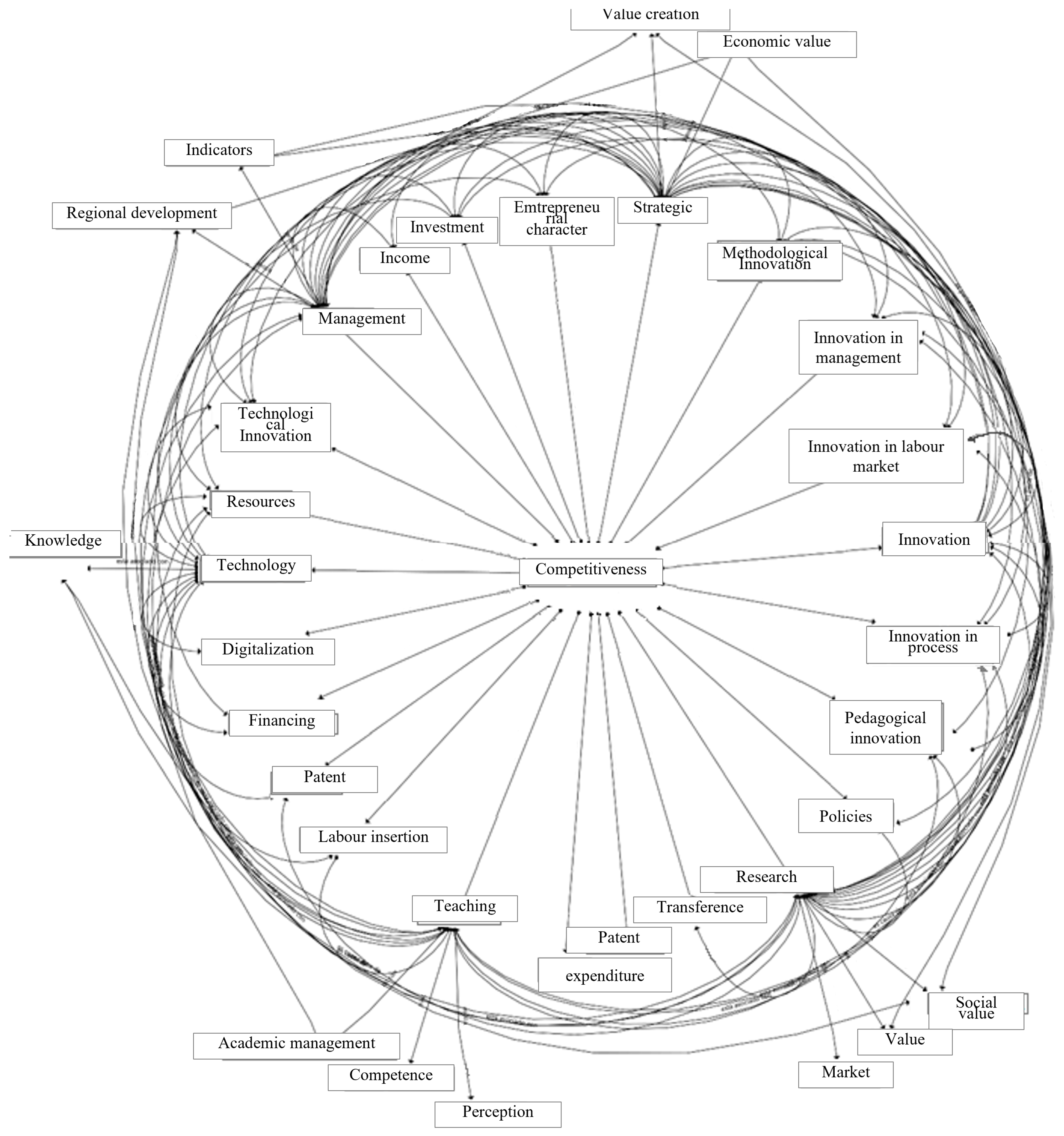
- In the qualitative phase, the interviews were transcribed and processed in ATLAS.ti 9, applying open, axial and selective coding. From this process, semantic networks and co-occurrence diagrams were constructed, which facilitated the identification of emerging categories and the exploration of relationships between concepts.
- The interviews were fully transcribed and analysed independently, ensuring fidelity to the original discourse and consistency in the analytical process. The analysis was conducted following a process of open coding, axial coding and code co-occurrence analysis.
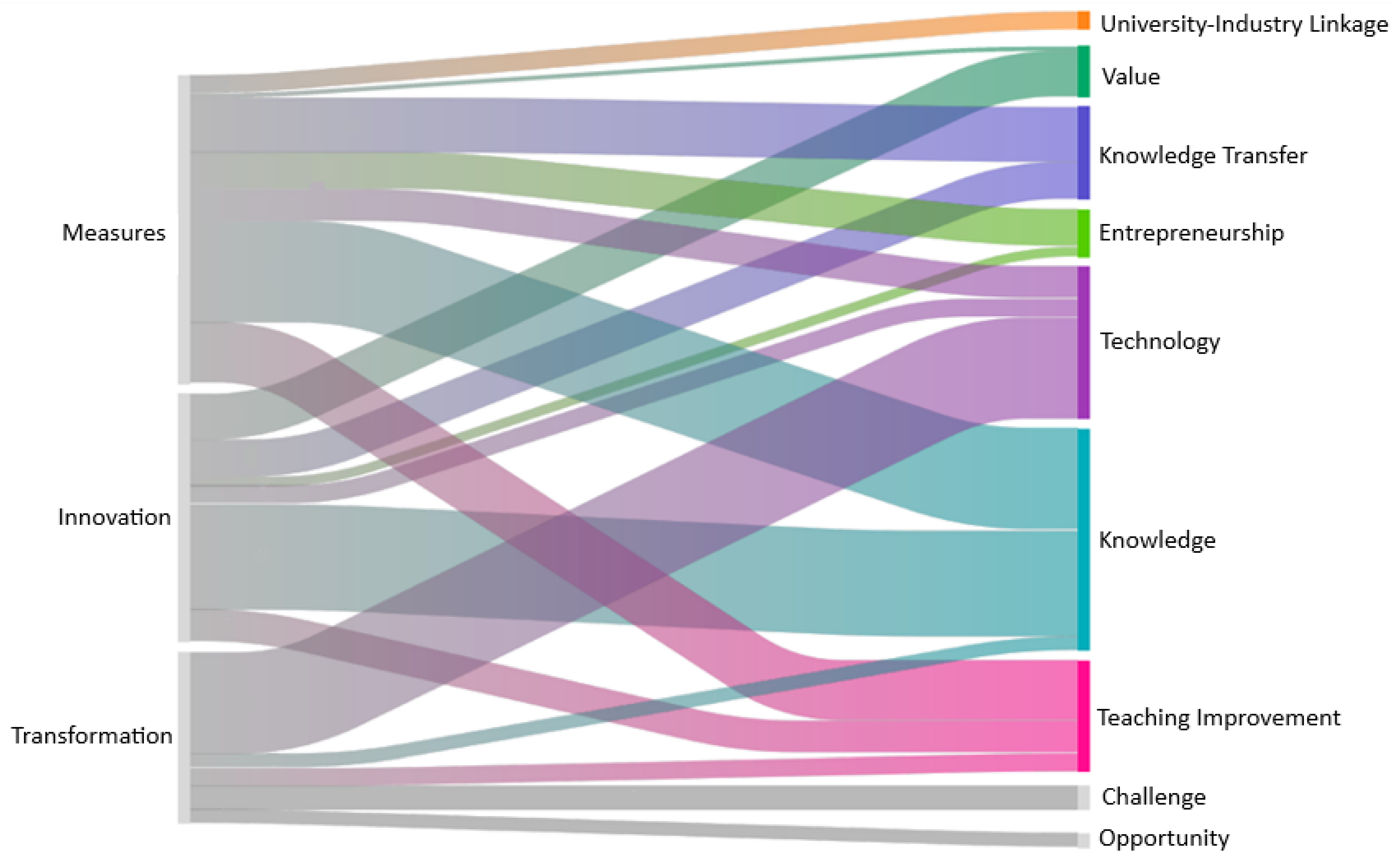
- In the initial phase of open coding, relevant units of meaning were identified directly from the text, generating initial codes that reflected the emerging concepts in the participants’ discourse. Subsequently, through axial coding, the initial codes were grouped and reorganised into categories and subcategories, establishing relationships between conditions, actions and outcomes. Finally, a code co-occurrence analysis was carried out in order to identify the frequency and intensity of relationships between the emerging concepts. For this purpose, the ATLAS.ti table explorer was used to generate co-occurrence matrices and to visualise the relationships between codes through graphical representations, such as co-occurrence networks and flow diagrams. These tools facilitated the identification of dominant factors in the discourse and strengthened the interpretative validity of the findings.
- In the quantitative phase, descriptive statistics were calculated, and exploratory factor analysis (EFA) was performed in SPSS v.27 to examine the underlying structure of the data and ensure the relevance of the items. Subsequently, confirmatory factor analysis (CFA) and structural equation modelling (SEM) were performed in AMOS v.27 to test the theoretical model and verify the hypotheses.
3. Results
3.1. Open Coding
3.2. Results of Axial Coding
3.3. Results of the Qualitative Phase
3.4. Results of the Quantitative Phase
3.5. Validation of the Instrument
4. Discussion
5. Conclusions
Author Contributions
Funding
Data Availability Statement
Conflicts of Interest
Abbreviations
| Cronbach’s alpha | |
| AMOS | Analysis of Moment Structures |
| AVE | Average Variance Extracted |
| CFA | Confirmatory Factor Analysis |
| CFI | Comparative Fit Index |
| CR | Composite Reliability |
| CRUE | Conference of Rectors of Spanish Universities |
| CVI | Content Validity Index |
| df | Degrees of freedom |
| EFA | Exploratory Factor Analysis |
| EHU | University of the Basque Country |
| INE | National Statistics Institute of Spain |
| OI | Organisational Innovation |
| OECD | Organisation for Economic Co-operation and Development |
| p-value | Probability value |
| R&D | Research and Development |
| RIS3 | Research and Innovation Strategies for Smart Specialisation |
| RMSEA | Root Mean Square Error of Approximation |
| SEM | Structural Equation Modelling |
| SICTI | Science, Technology and Innovation Information System |
| SPSS | Statistical Package for the Social Sciences |
| SRMR | Standardised Root Mean Square Residual |
| TLI | Tucker–Lewis Index |
| WEF | World Economic Forum |
| W | Kendall’s Coefficient of Concordance |
References
- De Jong, J.; Den Hartog, D. Measuring innovative work behaviour. Creat. Innov. Manag. 2010, 19, 23–36. [Google Scholar] [CrossRef]
- Schaeffer, P.R.; Fischer, B.; Queiroz, S. Beyond education: The role of research universities in innovation ecosystems. Foresight STI Gov. 2018, 12, 50–61. [Google Scholar] [CrossRef]
- Villa, A.; Escotet, M.A.; Goñi, J.J. Modelo de Innovación de la Educación Superior; Ediciones Mensajero: Bilbao, Spain, 2007. [Google Scholar]
- Alavi, M.; Leidner, D.E. Review: Knowledge management and knowledge management systems: Conceptual foundations and research issues. MIS Q. 2001, 25, 107–136. [Google Scholar] [CrossRef]
- OECD; Eurostat. Oslo Manual: Guidelines for Collecting and Interpreting Innovation Data, 3rd ed.; OECD Publishing: Paris, France, 2005. [Google Scholar]
- Hui, Y.K.; Kwok, L.F.; Ip, H.H.S. Employability: Smart learning in extracurricular activities for developing college graduates’ competencies. Australas. J. Educ. Technol. 2021, 37, 171–188. [Google Scholar] [CrossRef]
- Reis, D.P.; Nawaggi, P.; Fraenzel, A.; Dolkart, C. Leveraging innovative technology and health data to enhance access to emergency care and referral services in Kenya. Oxf. Open Digit. Health 2025, 3, oqaf019. [Google Scholar] [CrossRef]
- Texeira-Quirós, J.; Justino, M.D.R.; Godinho, M.; Ribeiro, P.; Nunes, A.D.T. Effects of innovation, total quality management, and internationalization on organizational performance of higher education institutions. Front. Psychol. 2022, 13, 869638. [Google Scholar] [CrossRef]
- Ghani, N.A.; Poh-Chuin, T.; Ho, T.C.F.; Choo, L.S.; Kelana, B.W.Y.; Adam, S.; Ramliy, M.K. Bibliometric analysis of global research trends on higher education internationalization using Scopus database: Towards sustainability of higher education institutions. Sustainability 2022, 14, 8810. [Google Scholar] [CrossRef]
- Lunag, M.N.; Posadas, C.L.; Lamadrid, R.L.; Ducas, A.G.; Teehankee, A.; De Guzmna, M.K.B.; Moncada, C.B.; Clemente, M.C.B. Building sustainable research and innovation ecosystem in Philippine higher education institutions. Educ. Res. Policy Pract. 2024, 23, 63–88. [Google Scholar] [CrossRef]
- OECD. OECD Science, Technology and Innovation Outlook 2021: Times of Crisis and Opportunity; OECD Publishing: Paris, France, 2021. [Google Scholar]
- Fernández-Cruz, F.J.; Rodríguez-Legendre, F. The innovation competence profile of teachers in higher education institutions. Innov. Educ. Teach. Int. 2022, 59, 634–645. [Google Scholar] [CrossRef]
- Gorzelany, J.; Gorzelany-Dziadkowiec, M.; Luty, L.; Firlej, K.; Gaisch, M.; Dudziak, O.; Scott, C. Finding links between organisation’s culture and innovation. PLoS ONE 2021, 16, e0257962. [Google Scholar] [CrossRef]
- Nusair, N.; Abaneh, R.; Bae, Y. The impact of transformational leadership style on innovation as perceived by public employees in Jordan. Int. J. Commer. Manag. 2012, 22, 182–201. [Google Scholar] [CrossRef]
- Vallance, P.; Blažek, J.; Edwards, J.; Květoň, V. Smart specialisation in regions with less-developed research and innovation systems: A changing role for universities? Environ. Plan. C 2018, 36, 219–238. [Google Scholar] [CrossRef]
- Ausín, V.; Abella, V.; Delgado, V.; Hortigüela, D. Project-based learning through ICT: An experience of teaching innovation from university classrooms. Form. Univ. 2016, 9, 31–38. [Google Scholar] [CrossRef]
- Makumbe, W.; Washaya, Y.Y. Organisational culture and innovation: Testing the Schein model at a private university in Zimbabwe. Cogent Bus. Manag. 2022, 9, 2150120. [Google Scholar] [CrossRef]
- Zhang, W.; Zeng, X.; Liang, H.; Xue, Y.; Cao, X. Understanding how organizational culture affects innovation performance: A management context perspective. Sustainability 2023, 15, 6644. [Google Scholar] [CrossRef]
- Casani, F.; Pérez-Esparrells, C.; Rodríguez, J. Nuevas estrategias económicas en las universidades desde la perspectiva de la rendición de cuentas social. Rev. Calid. Educ. 2010, 33, 255–273. [Google Scholar] [CrossRef]
- Domínguez-Escrig, E.; Mallén-Broch, F.F.; Chiva, R.; Lapiedra, R. Effects of emotional healing on organisational learning and radical innovation: A leadership-based approach. J. Organ. Chang. Manag. 2022, 35, 224–239. [Google Scholar] [CrossRef]
- Etzkowitz, H.; Leydesdorff, L. The dynamics of innovation: From national systems and “Mode 2” to a Triple Helix of university–industry–government relations. Res. Policy 2000, 29, 109–123. [Google Scholar] [CrossRef]
- Errasti, N.; Bezanilla, M.J.; García-Olalla, A.; Auzmendi, E.; Paños, J. Factors and maturity level of entrepreneurial universities in Spain. Int. J. Innov. Sci. 2018, 10, 71–91. [Google Scholar] [CrossRef]
- Hailu, A.T. The role of university–industry linkages in promoting technology transfer: Implementation of triple helix model relations. J. Innov. Entrep. 2024, 13, 25. [Google Scholar] [CrossRef]
- Nunnally, J.C.; Bernstein, I.H. Psychometric Theory, 3rd ed.; McGraw-Hill: New York, NY, USA, 1994. [Google Scholar]
- Farinha, L.; Ferreira, J.J. Triangulation of the Triple Helix: A Conceptual Framework. In Proceedings of the Triple Helix 10th International Conference 2012, Bandung, Indonesia, 8–10 August 2012; pp. 1–25. [Google Scholar] [CrossRef]
- Peña-Lang, M.B. Análisis de la Competitividad del Sistema Regional de Innovación a Través de la Interacción de la Universidad y el Mercado Laboral. Doctoral Thesis, Universidad de Deusto, Bilbao, Spain, 2022. Available online: https://hdl.handle.net/20.500.14454/893 (accessed on 12 February 2026).
- Martínez-Costa, M.; Jimenez-Jimenez, D.; Castro-del-Rosario, Y. The performance implications of the UNE 166.000 standardised innovation management system. Eur. J. Innov. Manag. 2019, 22, 281–301. [Google Scholar] [CrossRef]
- Ramírez, Y.; Tejada, Á. Digital transparency and public accountability in Spanish universities in online media. J. Intellect. Cap. 2019, 20, 701–732. [Google Scholar] [CrossRef]
- Huggins, R.; Prokop, D.; Thompson, P. Universities and open innovation: The determinants of network centrality. J. Technol. Transf. 2020, 45, 718–757. [Google Scholar] [CrossRef]
- Afonso, A.; Morgado, L.; Noguera, I.; Sepúlveda-Parrini, P.; Hernandez-Leo, D.; Alkhasawneh, S.N.; Spilker, M.J.; Carvalho, I.C. Flexible learning by design: Enhancing faculty digital competence and engagement through the FLeD project. Educ. Sci. 2025, 15, 934. [Google Scholar] [CrossRef]
- Ruesch, J.M.; Sarvary, M.A. Structure and flexibility: Systemic and explicit assignment extensions foster an inclusive learning environment. Front. Educ. 2024, 9, 1324506. [Google Scholar] [CrossRef]
- Van-Dijl, D.; Baggen, Y.; Palavouzi, G. Unfolding educational innovation processes and teacher motivation in universities: A multiple-case study. Int. J. Educ. Dev. 2025, 1–16. [Google Scholar] [CrossRef]
- Villa, A. Aprendizaje basado en competencias: Desarrollo e implantación en el ámbito universitario. Rev. Doc. Univ. 2020, 18, 19–46. [Google Scholar] [CrossRef]
- Hair, J.K.; Black, W.C.; Babin, B.J.; Anderson, R.E. Multivariate Data Analysis, 7th ed.; Pearson: Londo, UK, 2010. [Google Scholar]
- Schwab, K.; Zahidi, S. The Global Competitiveness Report Special Edition 2020: How Countries Are Performing on the Road to Recovery; World Economic Forum: Cologny, Switzerland, 2020. [Google Scholar]
- Ruvio, A.A.; Shoham, A.; Vigoda-Gadot, E.; Schwabsky, N. Organizational innovativeness: Construct development and crosscultural validation. J. Prod. Innov. Manag. 2014, 31, 1004–1022. [Google Scholar] [CrossRef]
- Schwab, K.; Zahidi, S. The Future of Jobs; World Economic Forum: Cologny, Switzerland, 2020. [Google Scholar]
- Fornell, C.; Larcker, D.F. Structural equation models with unobservable variables and measurement error: Algebra and statistics. J. Mark. Res. 1981, 18, 382–388. [Google Scholar] [CrossRef]
- Müller, C.; Mildenberger, T.; Steingruber, D. Learning effectiveness of a flexible learning study programme in a blended learning design: Why are some courses more effective than others? Int. J. Educ. Technol. High. Educ. 2023, 20, 10. [Google Scholar] [CrossRef]
- Jing, L.C. How does university-industry collaboration drive the green innovation? Sage Open 2024, 14, 21582440241274500. [Google Scholar] [CrossRef]
- Olmos-Peñuela, J.; García-Granero, A.; Castro-Martínez, E.; D’Este, P. Strengthening SMEs’ innovation culture through collaborations with public research organizations. Do all firms benefit equally? Eur. Plan. Stud. 2017, 25, 2001–2020. [Google Scholar] [CrossRef]



| Study Objective | Associated Hypothesis | Expected Outcomes |
|---|---|---|
| To analyse the influence of organisational innovation on competence development | H1: Organisational innovation has a positive influence on competence development | A positive relationship is expected between organisational innovation practices and the development of key competences. |
| To examine the relationship between competence development and institutional competitiveness | H2: Competence development has a positive influence on institutional competitiveness | Higher levels of competence development are expected to be associated with greater institutional competitiveness, understood as positioning capacity, graduate employability, and value generation within the surrounding environment. |
| To evaluate the direct effect of organisational innovation on institutional competitiveness | H3: Organisational innovation has a positive influence on institutional competitiveness | Higher levels of competence development are expected to be associated with greater institutional competitiveness, understood as positioning capacity, graduate employability, and value generation within the surrounding environment. |
| Code Group | Emerging Codes (Examples) | Discourse Content |
|---|---|---|
| Organisational innovation | Methodological innovation, management innovation, process innovation | Organisational and pedagogical changes |
| Digital transformation | Digitalisation, educational technology, digital systems | Strategic use of technologies |
| Institutional resources | Lack of resources, insufficient funding, infrastructure | Structural constraints |
| Teaching staff | Teaching engagement, resistance to change, staff training | Key role of teaching staff |
| University governance | Leadership, strategic planning, decision-making | Institutional management and direction |
| Knowledge transfer | Transfer, external collaboration, joint projects | Relationship with the environment |
| University–industry relationship | Business linkages, professional placements | Employability and cooperation |
| Innovation ecosystem | Networks, alliances, regional environment | Territorial articulation |
| Competency development | Active learning, autonomy, professional competencies | Educational impact |
| Institutional competitiveness | Positioning, rankings, reputation | Institutional comparison |
| Innovation evaluation | Indicators, technological output | Performance measurement |
| Responsibility and ethics | Values, social responsibility | Normative and ethical framework |
| Territorial development | Regional impact, social commitment | Social role of the university |
| Entrepreneurship | Entrepreneurial culture, applied innovation | Value creation |
| Axial Category | Integrated Codes | Analytical Role |
|---|---|---|
| Organisational innovation | Methodological innovation, management innovation, process innovation | Core of organisational change |
| University governance | Institutional leadership, strategic planning, decision-making | Guiding framework for innovation |
| Resources and capabilities | Lack of resources, funding, infrastructure | Structural conditions |
| Digital transformation | Digitalisation, educational technology, digital systems | Enabling factor |
| Linkage with the environment | Knowledge transfer, university–industry relationship, innovation ecosystem | External connector |
| Competency development | Teaching improvement, active learning, autonomy | Educational impact |
| Institutional responsibility | Social responsibility, ethics, organisational values | Normative and cultural framework |
| Code | Frequency |
|---|---|
| Teaching staff | 9 |
| Lack of resources | 5 |
| Digitisation | 4 |
| Lack of relationships with companies | 3 |
| Lack of an innovation ecosystem | 2 |
| Responsibility and ethics | 2 |
| Reference Scale | N° Items | Factor | N° Factor | Items Included |
|---|---|---|---|---|
| Schwab and Zahidi [37] The Fute of Jobs | 10 | Problem solving, use and development of technology | 5 | Analytical thinking and innovation; Complex problem solving; Critical thinking and analysis; Creativity, originality and initiative; Reasoning, problem solving and ideation. |
| 2 | Use, monitoring and control of technology; Technology design and programming. | |||
| Self-management | 2 | Active learning and learning strategies; Resilience, stress tolerance and flexibility. | ||
| Teamwork | 1 | Leadership and social influence. | ||
| Ruvio et al. [36] Organisational innovativeness | 21 | Creativity | 5 | Creativity is encouraged; Ingenuity in problem solving; Development of new services; Respect for creativity within the organisation; Use of original approaches to problem solving. |
| Creativity | 4 | Seeking new answers; Immediate availability of support for new ideas; Receptiveness to change; Seeking new ways to approach problems. | ||
| Future orientation | 4 | Setting realistic goals; Sharing a vision for the future; Clearly communicating future direction; Realistic strategic vision for departments. | ||
| Risk-Taking | 4 | Assessing risks to obtain benefits; Promoting innovative strategies; Willingness to take risks; Rejecting a “safe” approach. |
| Factor | Skewness | Kurtosis | Factor Loading | AVE |
|---|---|---|---|---|
| Problem solving | 0.622 | |||
| Analytical thinking and innovation | −0.841 | 0.327 | 0.722 | |
| Complex problem solving | −0.904 | 0.607 | 0.818 | |
| Reasoning, problem solving and ideation | −0.865 | 0.298 | 0.821 | |
| Use and development of technology | 0.679 | |||
| Use, monitoring and control of technology | −0.698 | 0.214 | 0.888 | |
| Technology design and programming | −0.558 | −0.307 | 0.754 | |
| Self-management | 0.564 | |||
| Active learning and learning strategies | −0.901 | 0.427 | 0.830 | |
| Resilience, stress tolerance and flexibility | −0.830 | 0.002 | 0.663 | |
| Creativity | 0.650 | |||
| Creativity was encouraged | −0.115 | −0.771 | 0.765 | |
| Most teachers teach their classes creatively | −0.176 | −0.580 | 0.771 | |
| The creativity of students is respected | −0.005 | −0.667 | 0.829 | |
| The university promotes innovation | −0.206 | −0.813 | 0.855 | |
| Openness | 0.695 | |||
| University is prone to change | −0.031 | −0.830 | 0.828 | |
| New ideas proposed by students are accepted | −0.106 | −0.739 | 0.839 | |
| Orientation and proactiveness | 0.655 | |||
| Specific objectives, orientation or suggestions are established regarding each student’s future career | 0.208 | −0.876 | 0.831 | |
| Effective measures are taken to ensure that all students have information about the different opportunities for their future employment | 0.268 | −0.854 | 0.920 | |
| Students are given orientation on their future entry into the labour market | 0.251 | −0.743 | 0.908 | |
| New opportunities are offered to students | −0.342 | −0.383 | 0.648 |
| Factor | Corrected Item-Total Correlation | Cronbach’s Alpha If Item Is Removed | Cronbach’s Alpha () | Composite Reliability (CR) |
|---|---|---|---|---|
| Problem solving | 0.829 | 0.831 | ||
| Analytical thinking and innovation | 0.647 | 0.803 | ||
| Complex problem solving | 0.712 | 0.738 | ||
| Reasoning, problem solving and ideation | 0.701 | 0.747 | ||
| Use and development of technology | 0.802 | 0.807 | ||
| Use, monitoring and control of technology | 0.635 | 0.688 | ||
| Technology design and programming | 0.693 | 0.682 | ||
| Self-management | 0.719 | 0.722 | ||
| Active learning and learning strategies | 0.602 | 0.691 | ||
| Resilience, stress tolerance and flexibility | 0.565 | 0.685 | ||
| Creativity | 0.882 | 0.881 | ||
| Creativity was encouraged | 0.719 | 0.857 | ||
| Most teachers teach their classes creatively | 0.729 | 0.854 | ||
| The creativity of students is respected | 0.773 | 0.837 | ||
| The university promotes innovation | 0.753 | −0.813 | ||
| Openness | 0.820 | 0.823 | ||
| University is prone to change | 0.689 | 0.801 | ||
| New ideas proposed by students are accepted | 0.713 | 0.792 | ||
| Orientation and proactiveness | 0.900 | 0.902 | ||
| Specific objectives, orientation or suggestions are established regarding each student’s future career | 0.772 | 0.859 | ||
| Effective measures are taken to ensure that all students have information about the different opportunities for their future employment | 0.847 | 0.830 | ||
| Students are given orientation on their future entry into the labour market | 0.844 | 0.832 | ||
| New opportunities are offered to students | 0.603 | 0.917 |
| Relationship | (Standardised Estimate) | Est./S.E. | p-Value | Result |
|---|---|---|---|---|
| Creativity → Problem solving | 0.415 ** | 2.554 | 0.011 | Significant |
| Creativity → Use and development of technology | 0.388 ** | 2.102 | 0.036 | Significant |
| Creativity → Self-management | 0.656 *** | 4.089 | 0.000 | Highly significant |
| Openness → Problem solving | −0.227 | −1.452 | 0.147 | Not significant |
| Openness → Use and development of technology | −0.272 | −1.512 | 0.130 | Not significant |
| Openness → Self-management | −0.409 ** | −2.526 | 0.012 | Significant (negative) |
| Orientation and proactiveness → Problem solving | −0.169 ** | −2.071 | 0.038 | Significant (negative) |
| Orientation and proactiveness → Use and development of technology | 0.025 | 0.291 | 0.771 | Not significant |
| Orientation and proactiveness → Self-management | −0.196 ** | −2.172 | 0.030 | Significant (negative) |
| Model | gl | p-Value | Invariant | |
|---|---|---|---|---|
| No restrictions | 373.88 | 245 | ||
| Fully restricted | 363.11 | 236 | ||
| Number of groups | 2 | |||
| Difference | 10.77 | 9 | 0.292 | Yes |
| Moderating Variable | Model | gl | p-Value | Invariant | |
|---|---|---|---|---|---|
| Level of education of father/guardian | No restrictions | 347.41 | 236 | ||
| Fully restricted | 370.78 | 245 | |||
| Number of groups | 2 | ||||
| Difference | 23.37 | 9 | 0.005 | No | |
| Level of education of mother/guardian | No restrictions | 363.01 | 236 | ||
| Fully restricted | 378.06 | 245 | |||
| Number of groups | 2 | ||||
| Difference | 15.05 | 9 | 0.090 | No |
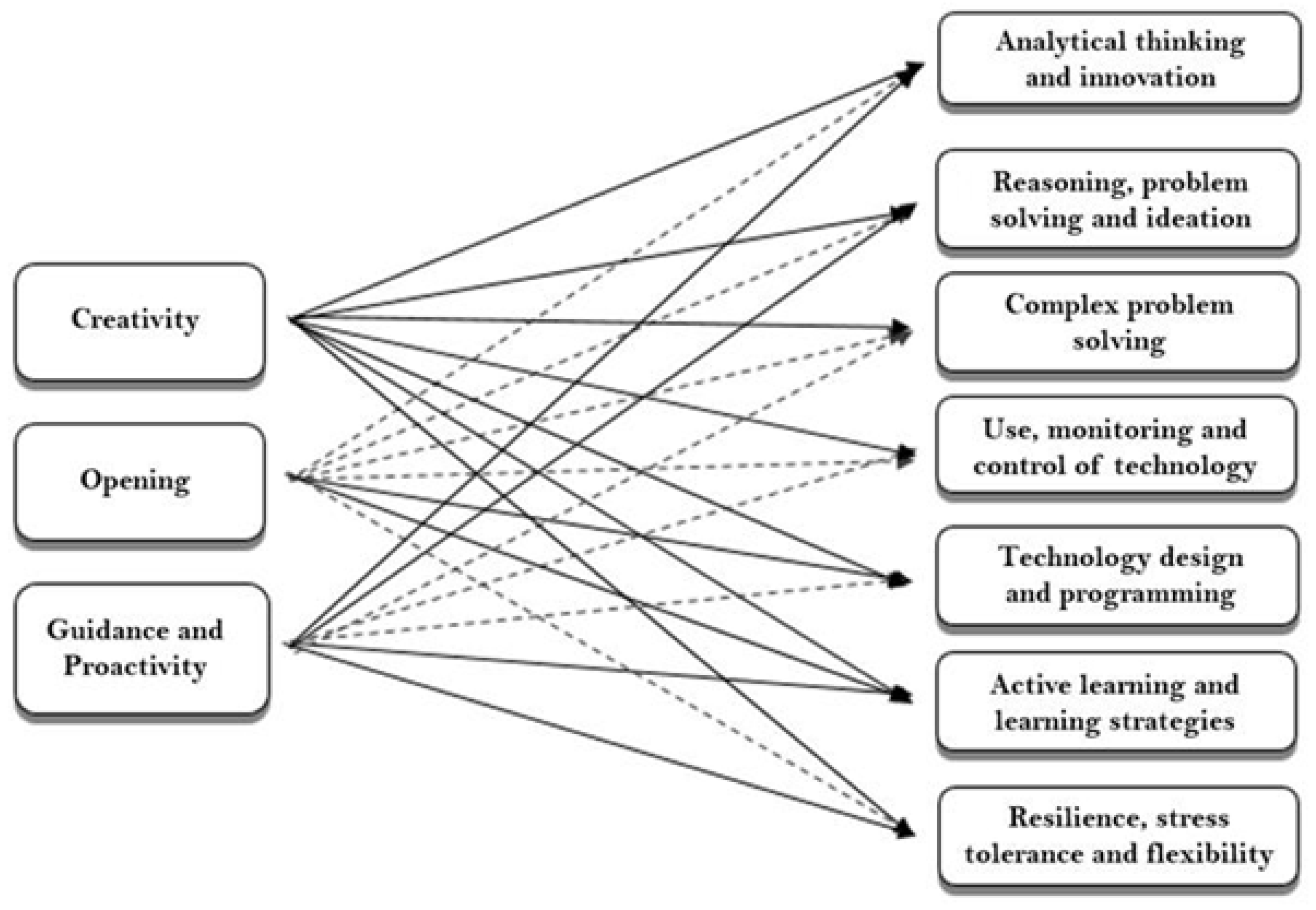
| Model Variables | Estimate () | p-Value |
|---|---|---|
| Creativity → Analytical thinking and innovation | 0.392 *** | 0.008 |
| Creativity → Reasoning, problem solving and ideation | 0.297 * | 0.051 |
| Creativity → Complex problem solving | 0.327 ** | 0.028 |
| Creativity → Use, monitoring and control of technology | 0.266 * | 0.098 |
| Creativity → Technology design and programming | 0.482 *** | 0.004 |
| Creativity → Active learning and learning strategies | 0.576 *** | 0.000 |
| Creativity → Resilience, stress tolerance and flexibility | 0.362 ** | 0.012 |
| Openness → Analytical thinking and innovation | −0.190 | 0.184 |
| Openness → Reasoning, problem solving and ideation | −0.134 | 0.364 |
| Openness → Complex problem solving | −0.222 | 0.121 |
| Openness → Use, monitoring and control of technology | −0.175 | 0.258 |
| Opening → Technology design and programming | −0.366 ** | 0.024 |
| Opening → Active learning and learning strategies | −0.379 *** | 0.007 |
| Openness → Resilience, stress tolerance and flexibility | −0.181 | 0.218 |
| Orientation and proactiveness → Analytical thinking and innovation | −0.164 * | 0.057 |
| Orientation and proactiveness → Reasoning, problem solving and ideation | −0.137 * | 0.056 |
| Orientation and proactiveness → Complex problem solving | −0.156 ** | 0.028 |
| Orientation and proactiveness → Use, monitoring and control of technology | −0.112 | 0.148 |
| Orientation and proactiveness → Technology design and programming | 0.038 | 0.633 |
| Orientation and proactiveness → Active learning and learning strategies | −0.129 * | 0.092 |
| Orientation and proactiveness → Resilience, stress tolerance and flexibility | −0.206 *** | 0.006 |
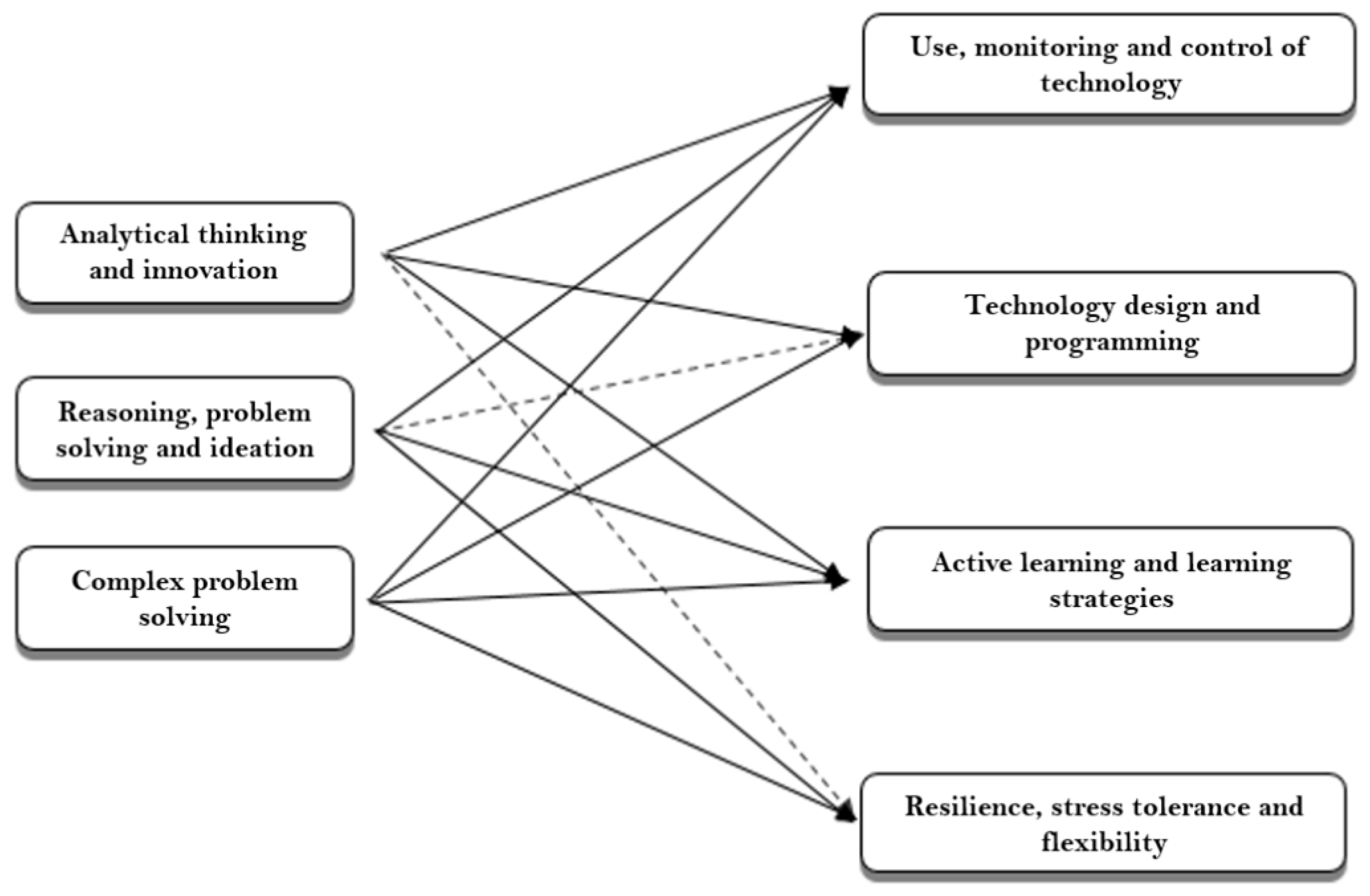
| Model Relationship | Estimate () | p-Value |
|---|---|---|
| Analytical thinking and innovation → Use, monitoring and control of technology | 0.228 * | 0.000 |
| Analytical thinking and innovation → Design and programming of technology | 0.219 * | 0.000 |
| Analytical thinking and innovation → Active learning and learning strategies | 0.237 * | 0.000 |
| Analytical thinking and innovation → Resilience, stress tolerance and flexibility | 0.023 | 0.755 |
| Reasoning, problem solving and ideation → Use, monitoring and control of technology | 0.282 * | 0.000 |
| Reasoning, problem solving and ideation → Technology design and programming | 0.086 | 0.219 |
| Reasoning, problem solving and ideation → Active learning and learning strategies | 0.289 * | 0.000 |
| Reasoning, problem solving and ideation → Resilience, stress tolerance and flexibility | 0.452 * | 0.000 |
| Complex problem solving → Use, monitoring and control of technology | 0.203 * | 0.003 |
| Complex problem solving → Design and programming of technology | 0.292 * | 0.000 |
| Complex problem solving → Active learning and learning strategies | 0.355 * | 0.000 |
| Complex problem solving → Resilience, stress tolerance and flexibility | 0.206 * | 0.003 |
Disclaimer/Publisher’s Note: The statements, opinions and data contained in all publications are solely those of the individual author(s) and contributor(s) and not of MDPI and/or the editor(s). MDPI and/or the editor(s) disclaim responsibility for any injury to people or property resulting from any ideas, methods, instructions or products referred to in the content. |
© 2026 by the authors. Licensee MDPI, Basel, Switzerland. This article is an open access article distributed under the terms and conditions of the Creative Commons Attribution (CC BY) license.
Share and Cite
Peña-Lang, M.B.; Villa, A. Assessment of Organisational Innovation: An Analytical Framework for Higher Education Institutions. Systems 2026, 14, 214. https://doi.org/10.3390/systems14020214
Peña-Lang MB, Villa A. Assessment of Organisational Innovation: An Analytical Framework for Higher Education Institutions. Systems. 2026; 14(2):214. https://doi.org/10.3390/systems14020214
Chicago/Turabian StylePeña-Lang, María Begoña, and Aurelio Villa. 2026. "Assessment of Organisational Innovation: An Analytical Framework for Higher Education Institutions" Systems 14, no. 2: 214. https://doi.org/10.3390/systems14020214
APA StylePeña-Lang, M. B., & Villa, A. (2026). Assessment of Organisational Innovation: An Analytical Framework for Higher Education Institutions. Systems, 14(2), 214. https://doi.org/10.3390/systems14020214