Evolutionary Analysis of Multi-Agent Interactions in the Digital Green Transformation of the Building Materials Industry

Abstract
1. Introduction
2. Literature Review
2.1. Research Trends of Digital Green Transformation in the Building Materials Industry
2.1.1. Technology-Empowerment-Oriented Research
2.1.2. Transformation Path-Oriented Research
2.1.3. Multi-Subject Collaboration-Oriented Research
2.2. Research on the Evolutionary Game of Digital and Green Transformation in the Building Materials Industry
2.2.1. Two-Party Evolutionary Game Research
2.2.2. Tripartite Evolutionary Game Research
2.3. Research on the Diversified Participants in the Digital and Green Transformation of the Building Materials Industry
2.3.1. Government: Leading Subject of Policy Guidance and Institutional Supply
2.3.2. Building Materials Enterprises: Core Implementer of Transformation Practices
2.3.3. Universities: Core Supply Subject of Knowledge Innovation and Talent Support
2.3.4. Consumers: Market-Driving Subject of Transformation Demand Feedback
3. Methodology
3.1. Model Assumptions
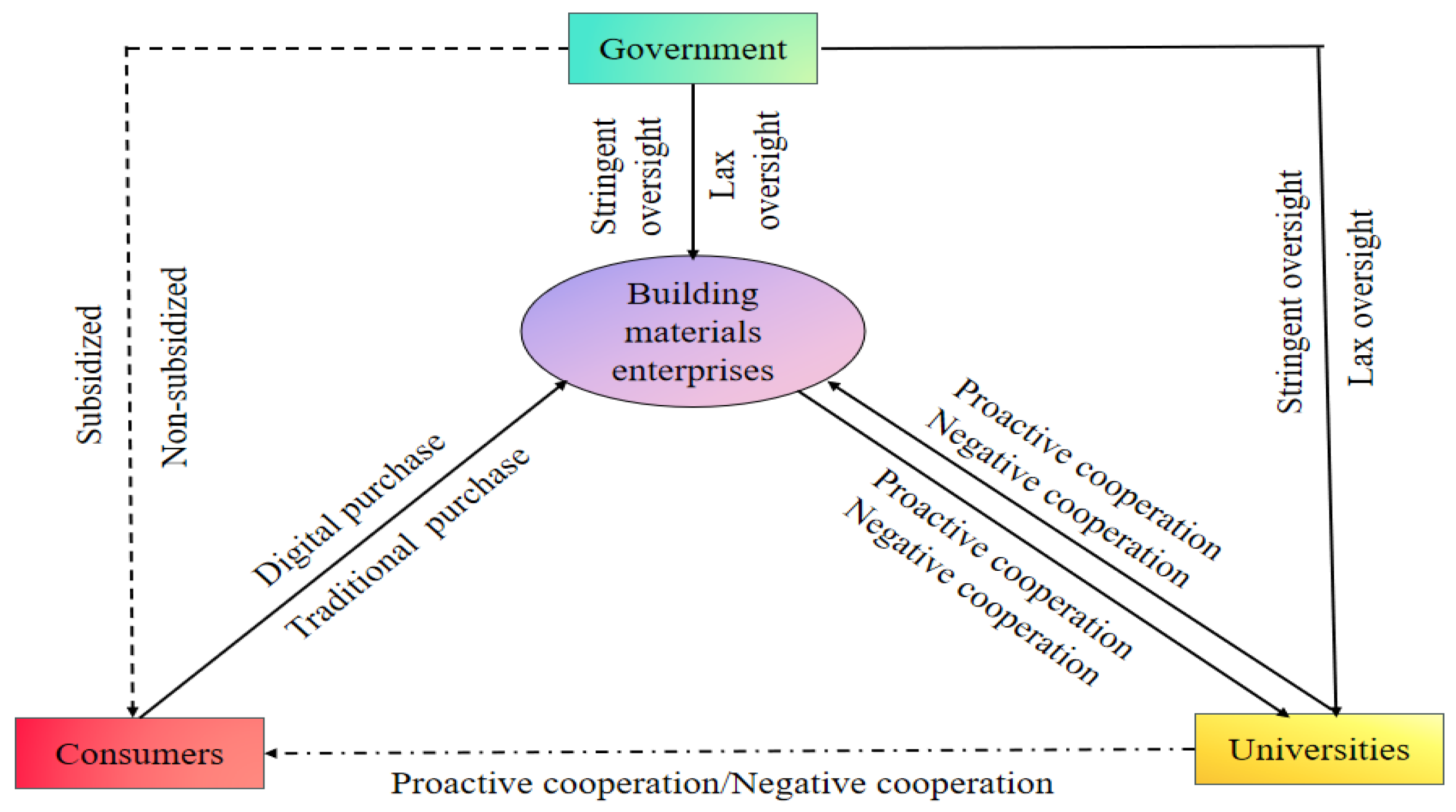
3.1.1. Game Stakeholders
3.1.2. Strategic Choices of Stakeholders
3.1.3. Basic Assumptions
3.2. Model Establishment
3.3. Model Solution
4. Asymptotic Stability Analysis of the Strategies of Four-Party Game Entities
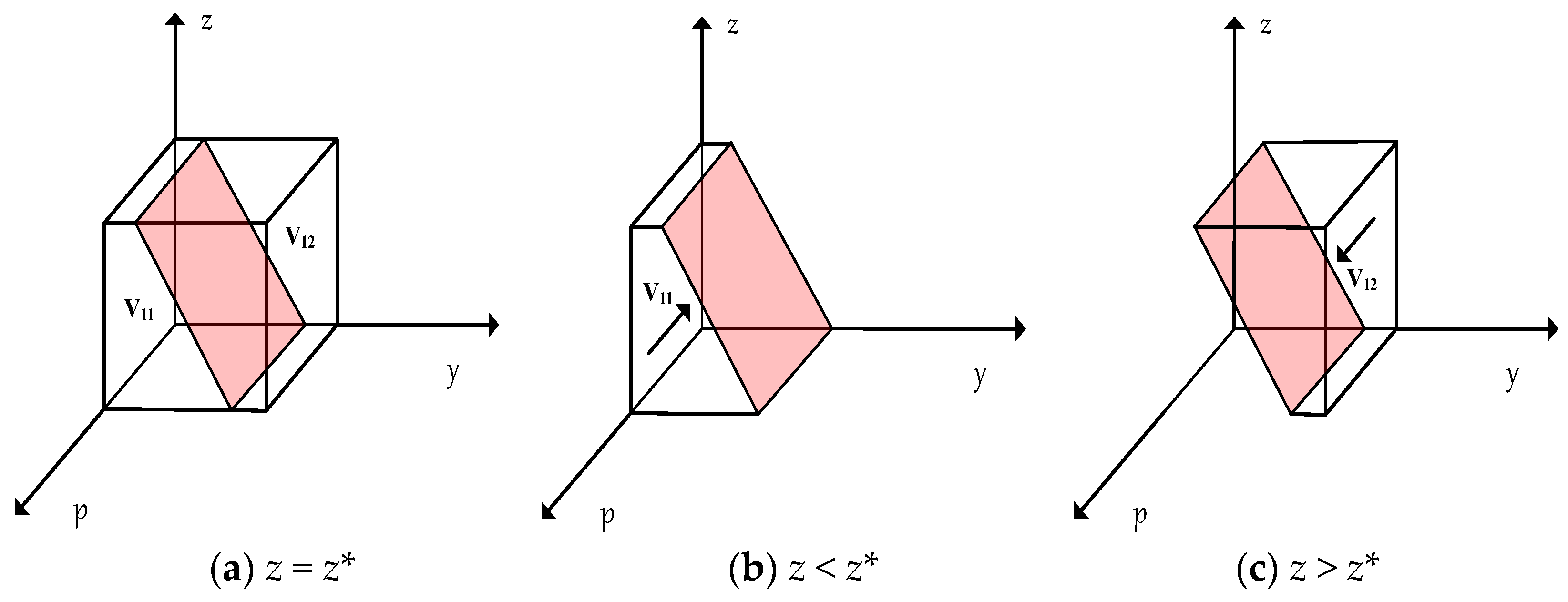
4.1. The Asymptotic Stability Analysis of the Government’s Strategic Behaviors
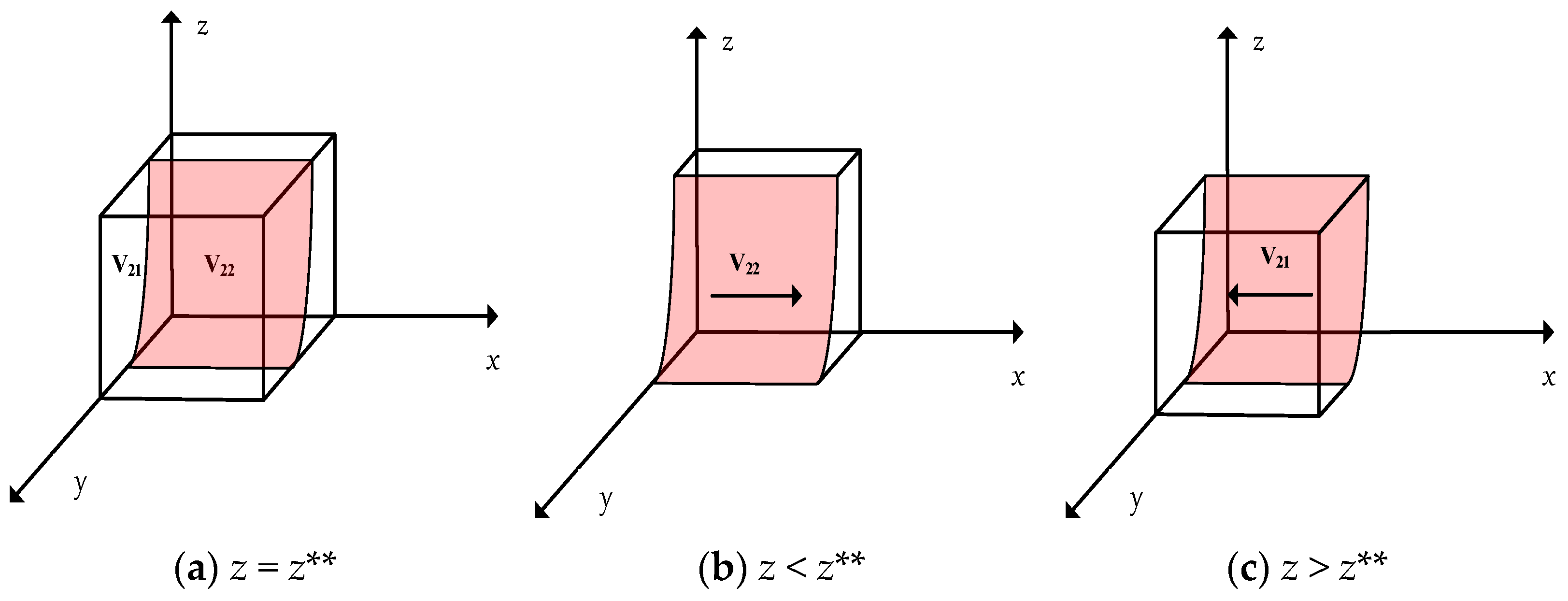
4.2. Analysis of the Gradual Stability of the Strategic Behaviors of BMEs
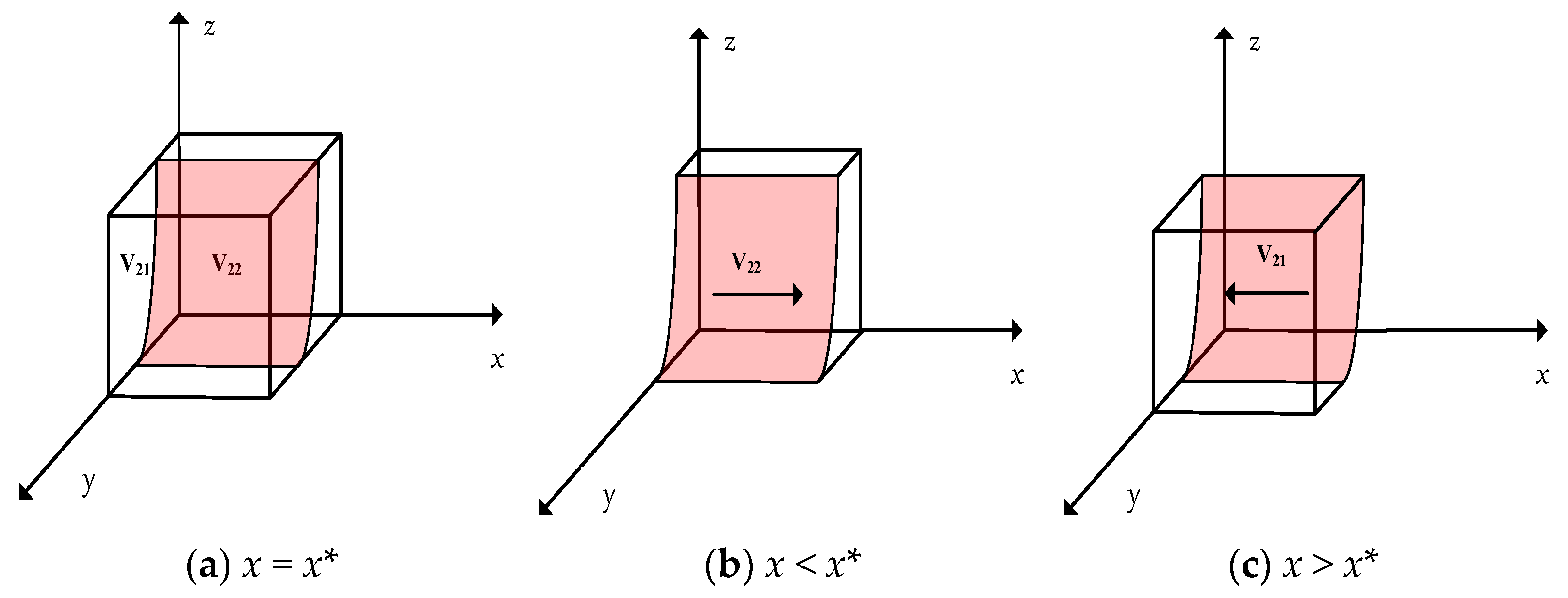
4.3. A Progressive Stability Analysis of Strategic Behaviors in Higher Education Institutions
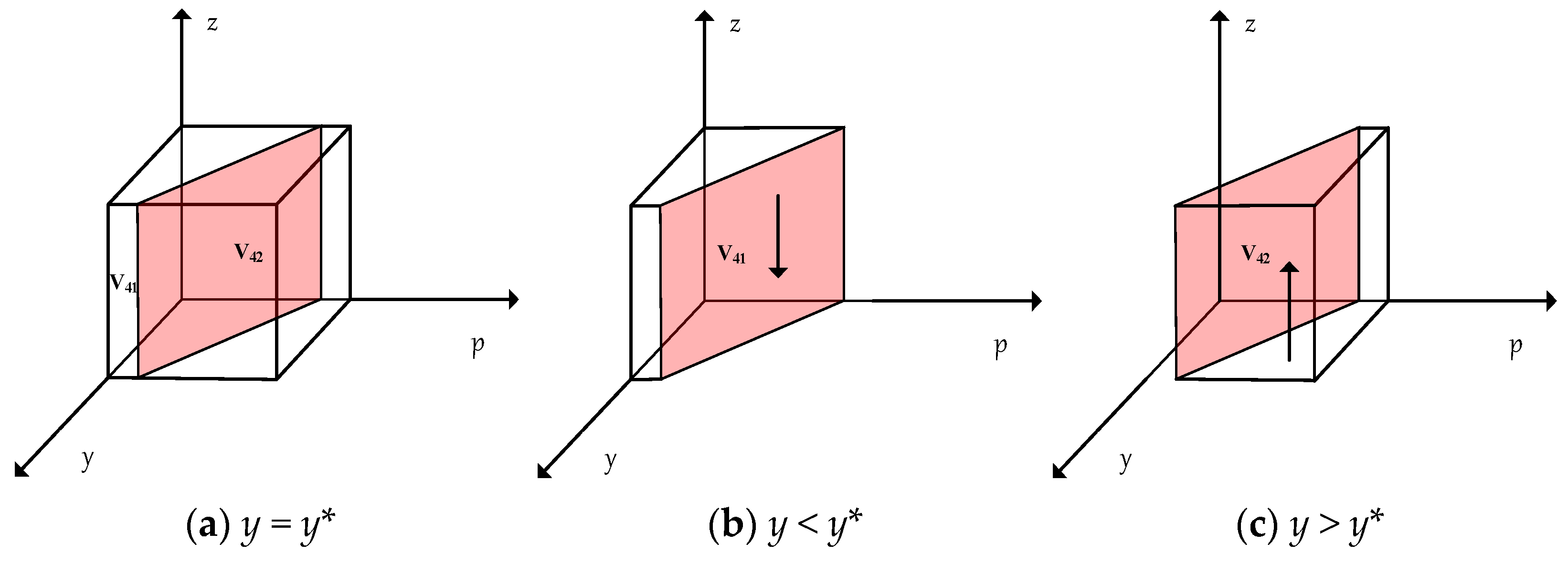
4.4. A Progressive Stability Analysis of Consumer Strategic Behavior
5. Stability Analysis of Strategy Combinations in the Four-Party Game
- (1)
- Stability analysis of strategy combinations under lenient government regulation.
- (2)
- Analysis of the stability of strategy combinations under strict government regulation.
6. Numerical Simulation Analysis
6.1. Initial Simulation Parameter Settings
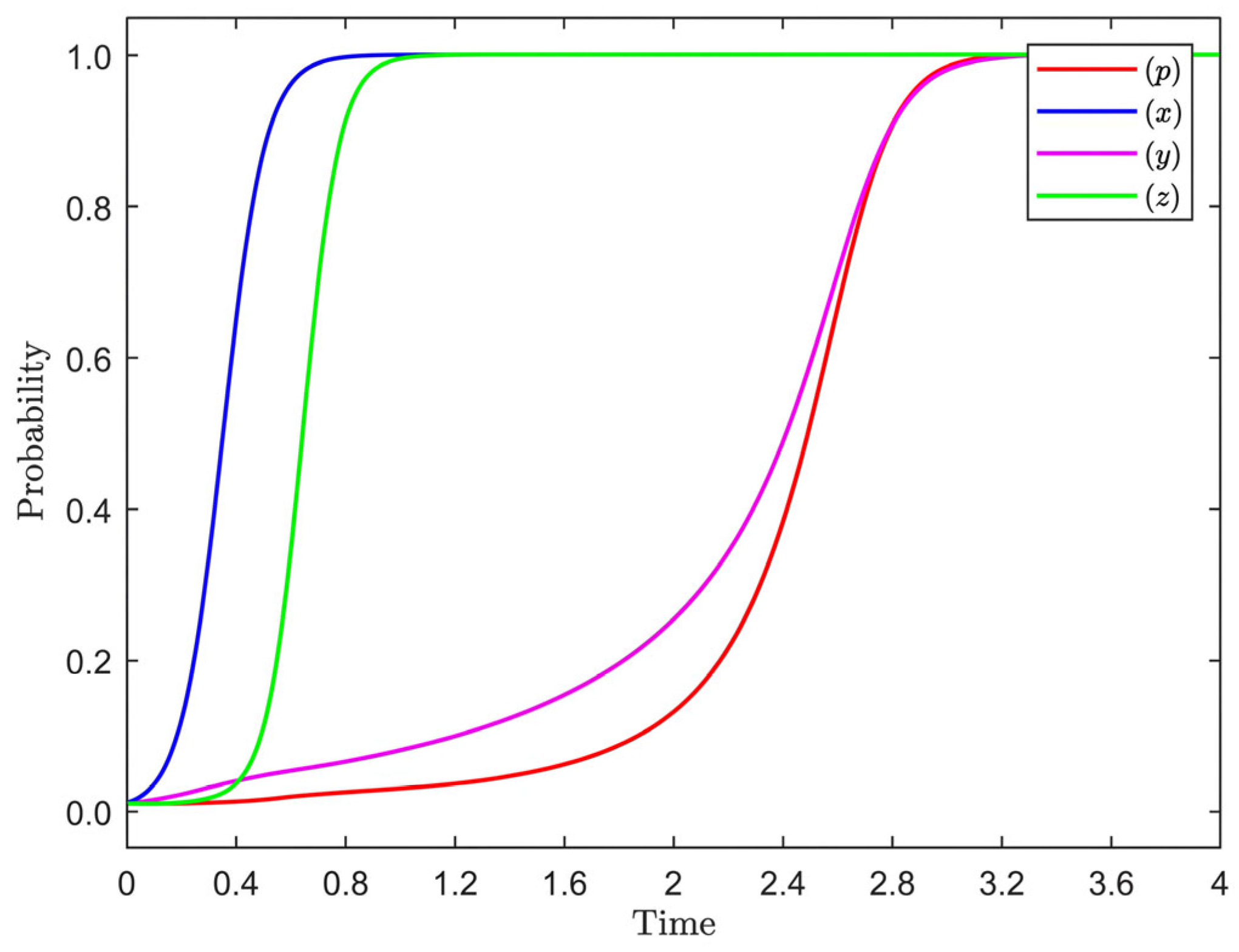
6.2. Effects of Parameter Changes on BMEs’ DG Transformation Path
- (1)
- Effect of initial strategy choice on system evolution path.
- (2)
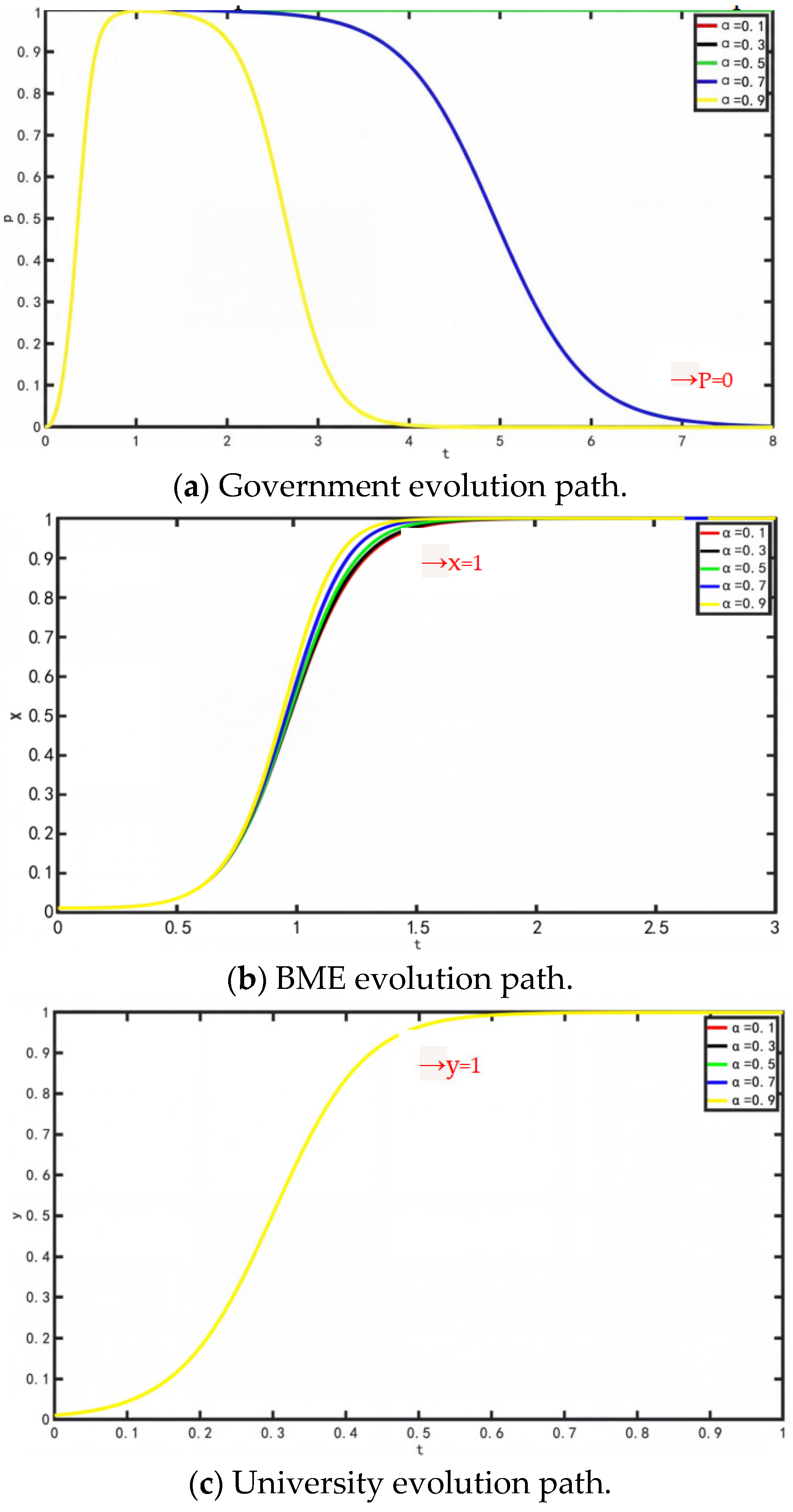
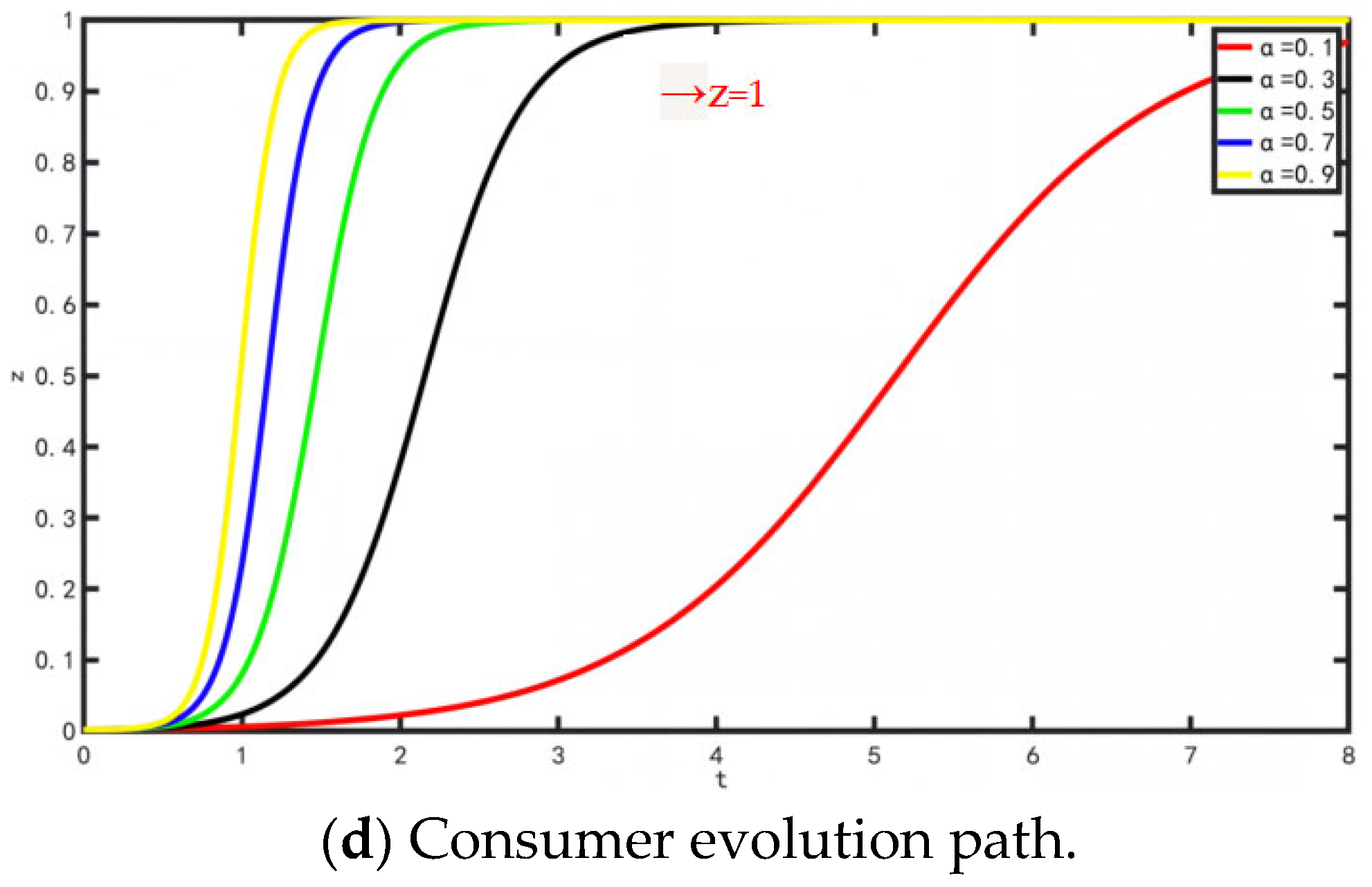
- Effect of α on the quadruple evolutionary path.
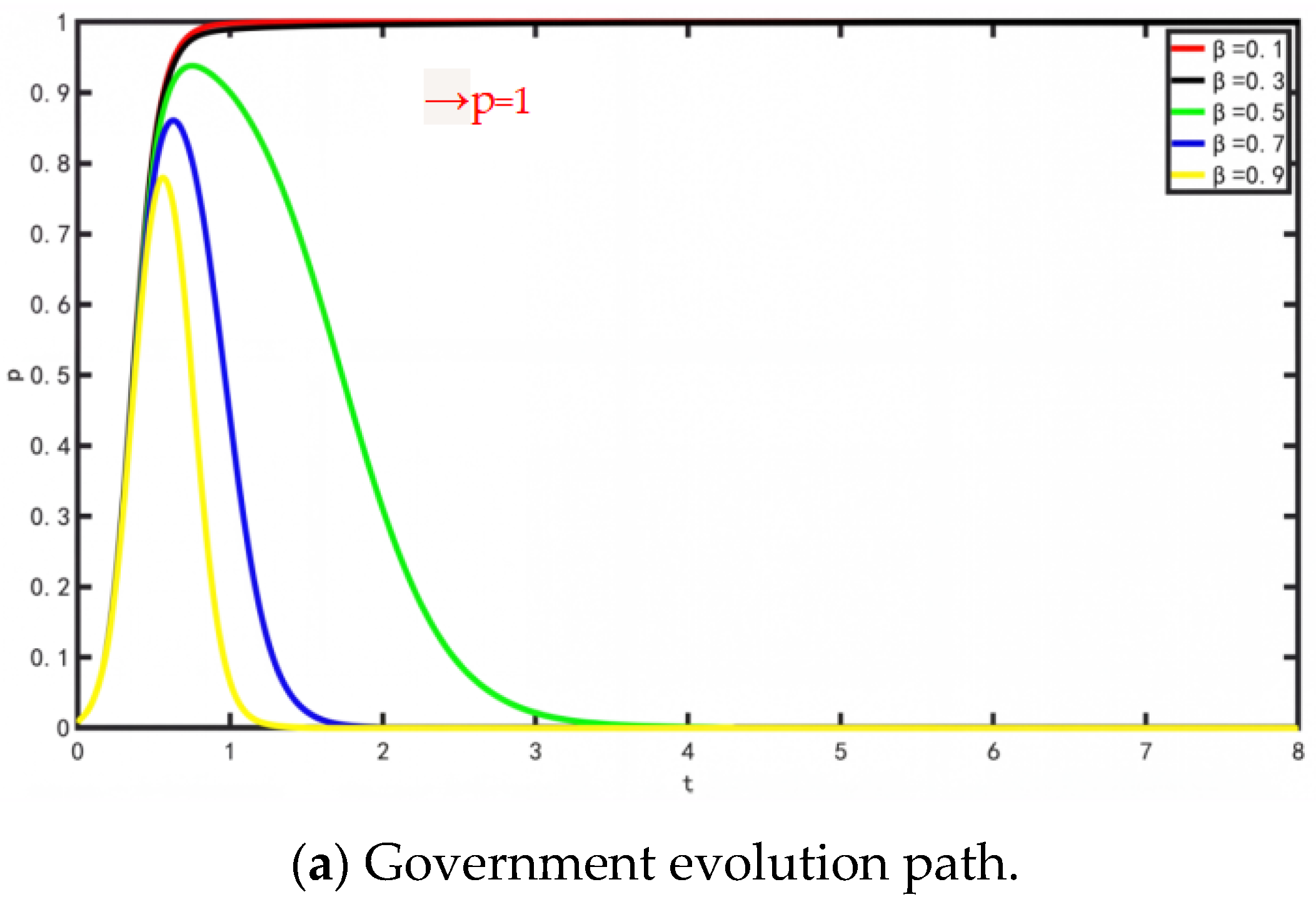
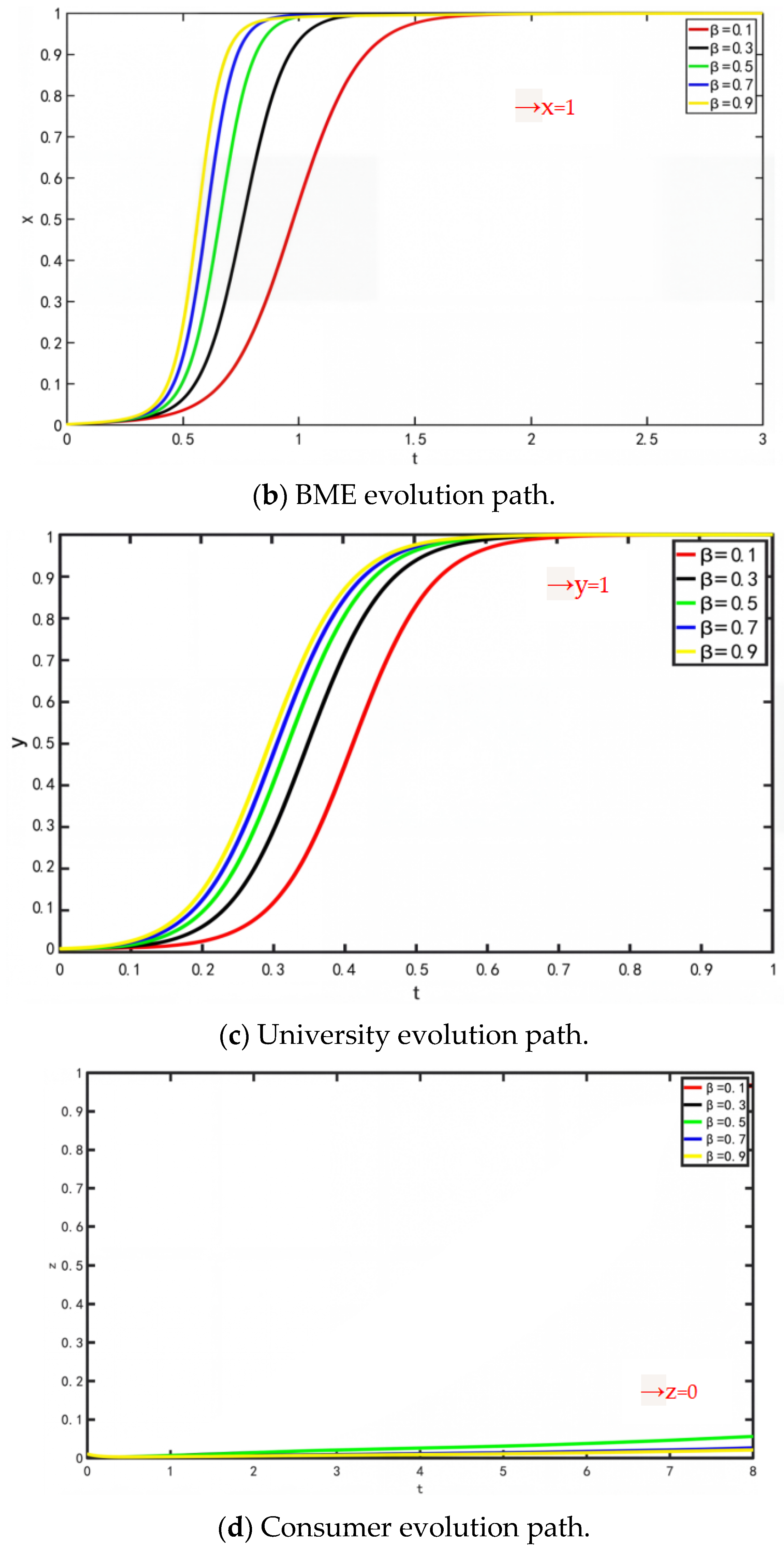
- (3)
- Effect of β on the quadruple evolutionary path.
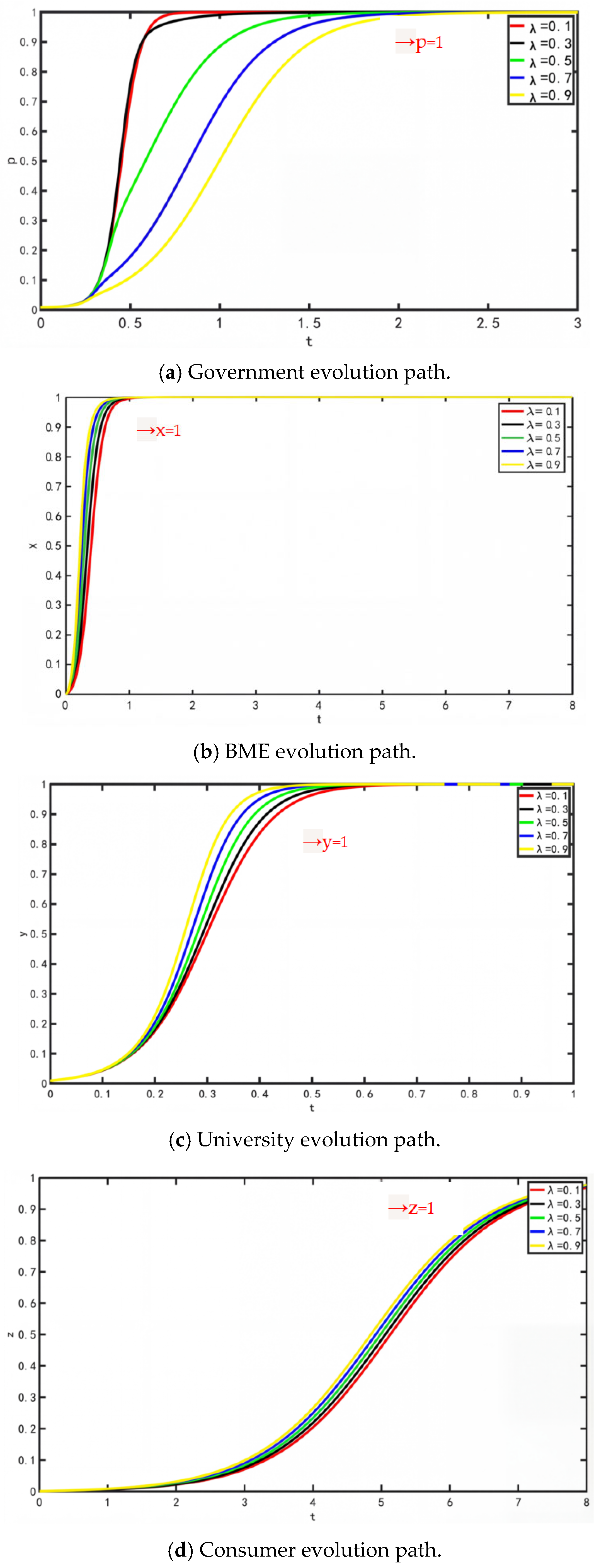
- (4)
- Effect of λ on the quadruple evolutionary path.
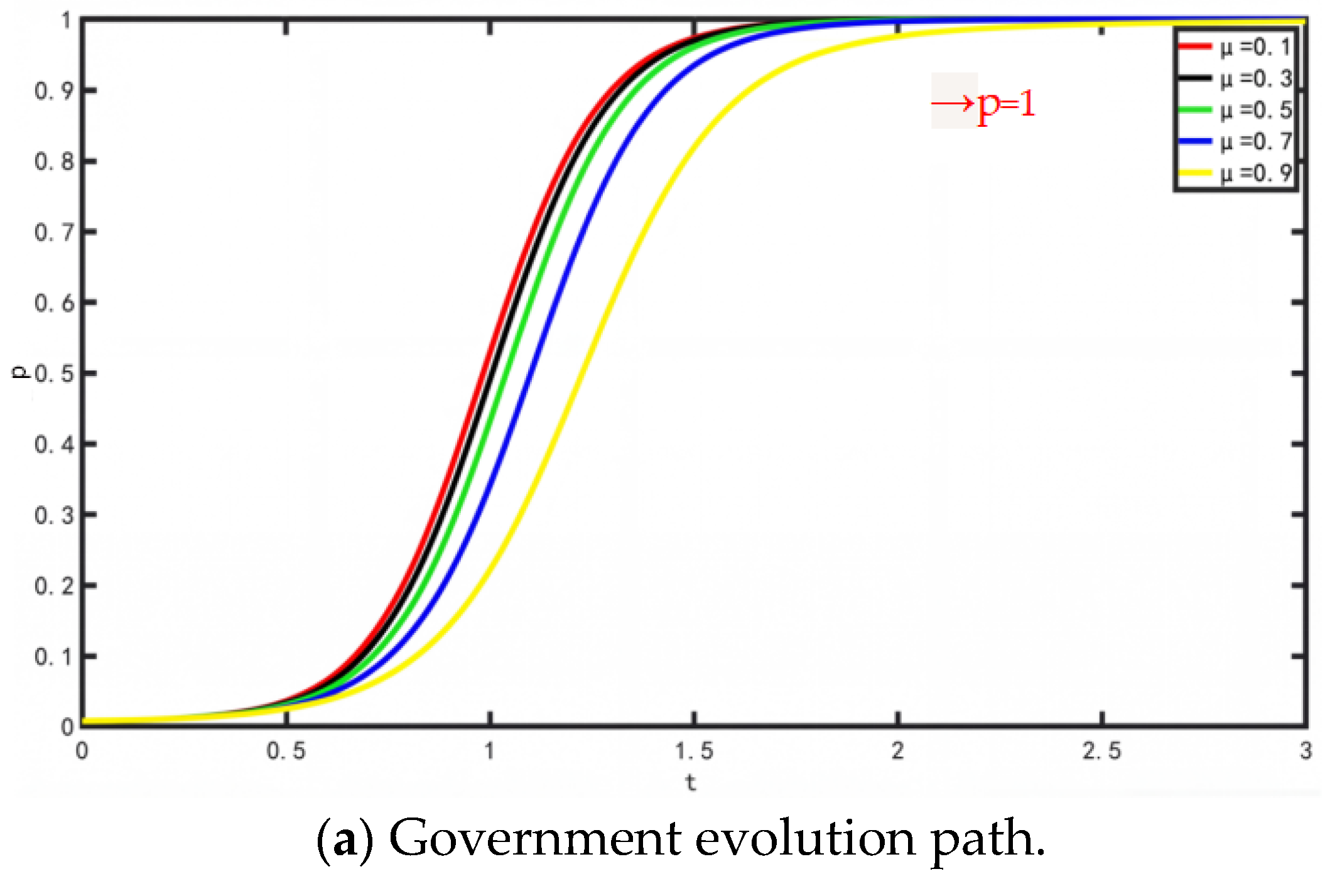
- (5)
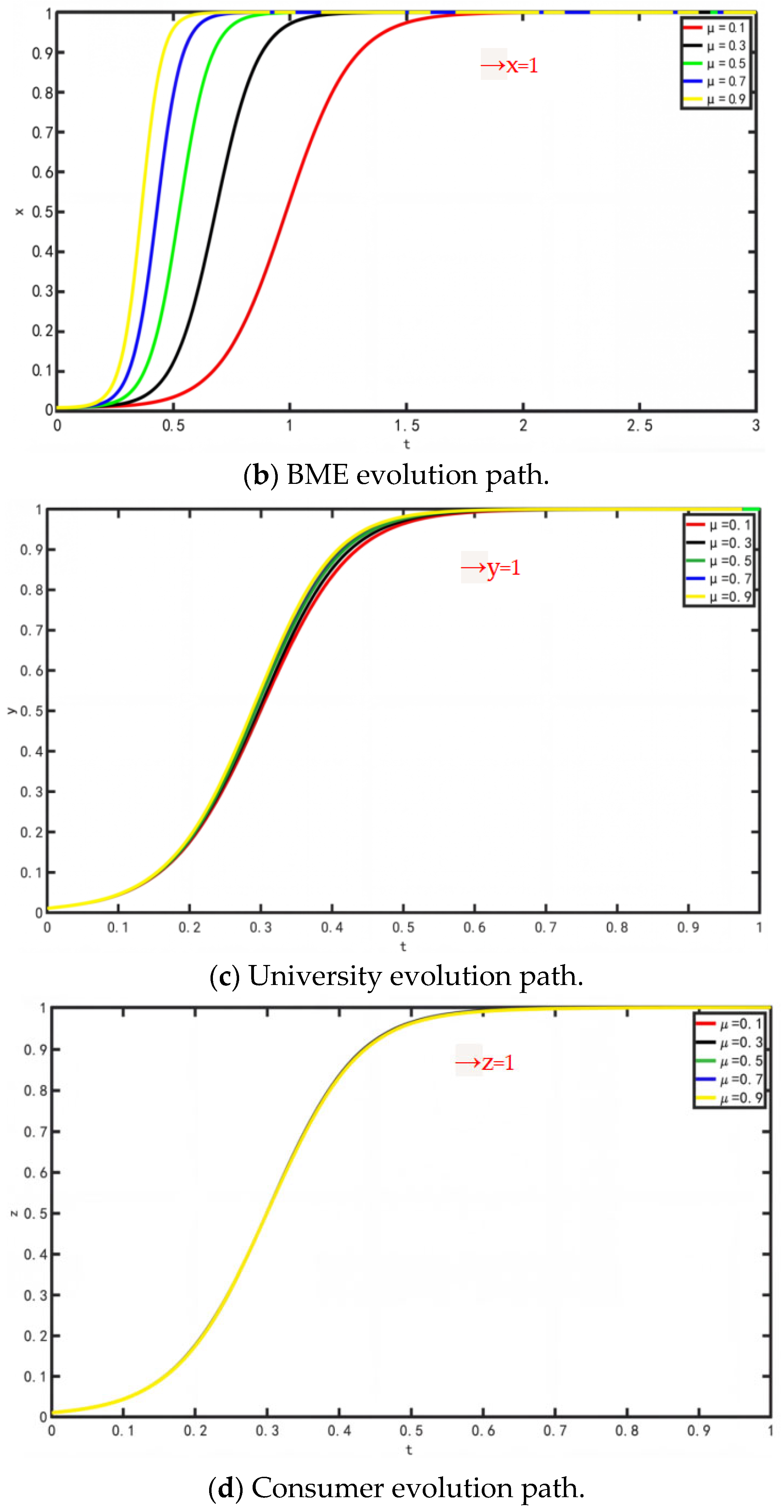
- Effect of μ on the quadruple evolutionary path.
- (6)
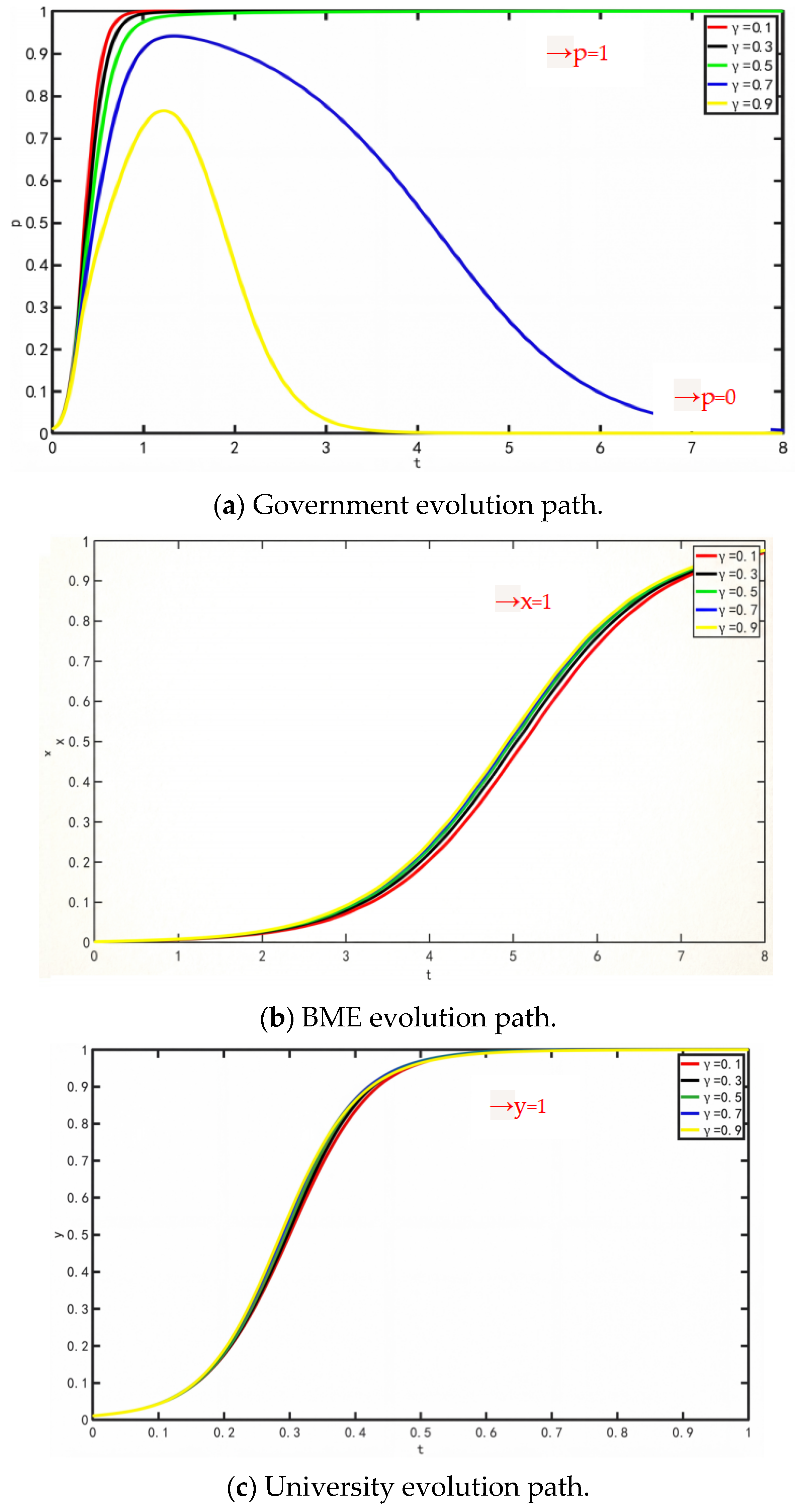
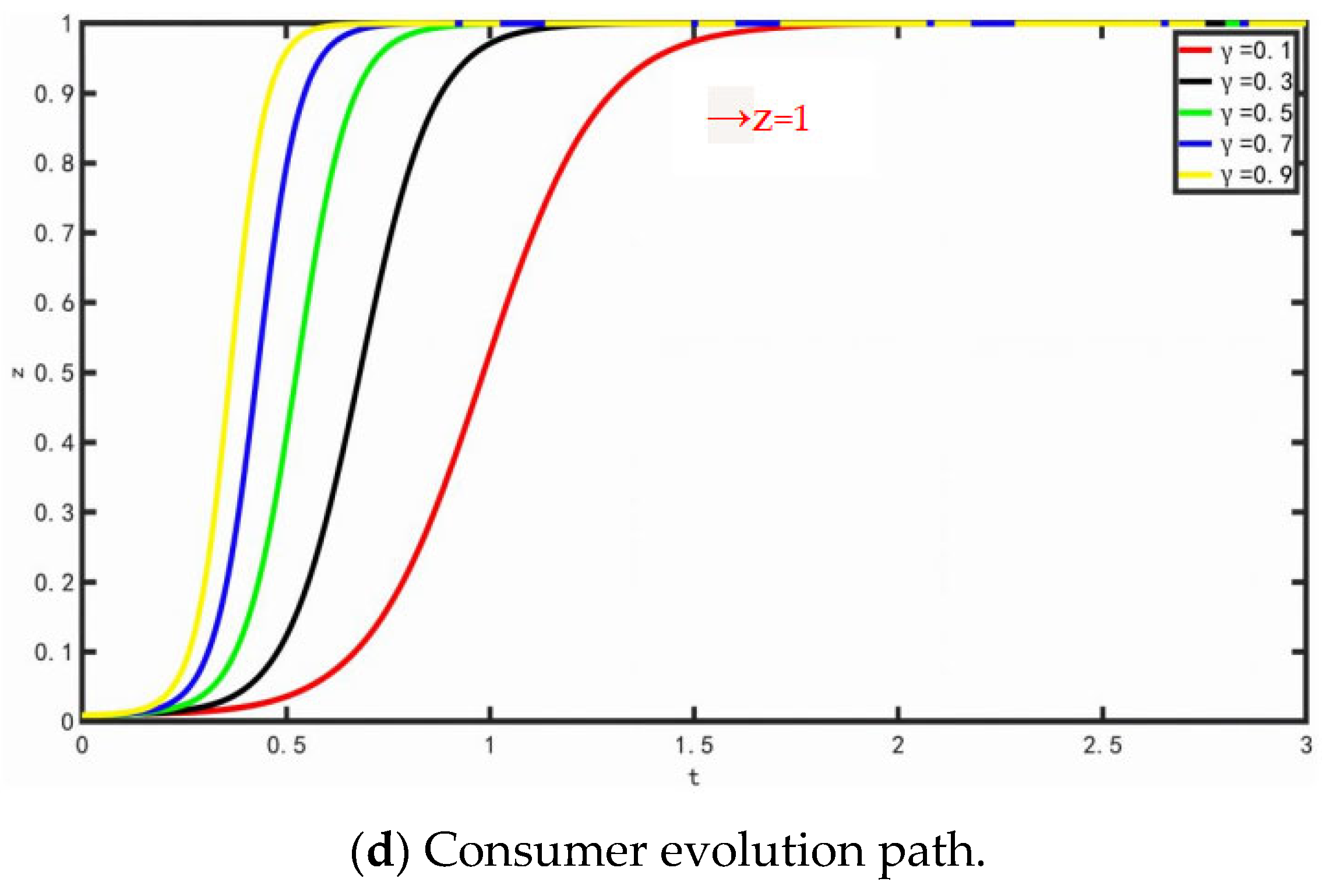
- Effect of γ on the quadruple evolutionary path.
7. Conclusions and Future Directions
7.1. Conclusions
7.2. Implications
7.2.1. Theoretical Implications
7.2.2. Practical Implications
7.3. Limitations and Future Directions
Author Contributions
Funding
Institutional Review Board Statement
Informed Consent Statement
Data Availability Statement
Conflicts of Interest
Abbreviations
| DG | Digital green |
| BME | Building materials enterprises |
Appendix A. Proof of the Stability of Evolutionary Stable Strategy (ESS)
- First row (partial derivatives of government’s strategy evolution p with respect to each variable).
- 2.
- Second row (partial derivatives of enterprise’s strategy evolution x with respect to each variable).
- 3.
- Third row (partial derivatives of university’s strategy evolution y with respect to each variable).
- 4.
- Fourth row (partial derivatives of consumer’s strategy evolution z with respect to each variable).
References
- Mikulėnas, M.; Šeduikytė, L. Circularity and Decarbonization Synergies in the Construction Sector: Implications for Zero-Carbon Energy Policy. Energies 2025, 18, 1164. [Google Scholar] [CrossRef]
- Chen, X.; Zhao, Y. Paths and effects of digital technology driving low-carbon transformation of high-energy-consuming enterprises. Sci. Res. Manag. 2023, 44, 78–86. [Google Scholar]
- Hu, M.; Li, T.; Wang, F. Research on the mechanism of digital platforms empowering green collaborative innovation in the building materials industry chain. China Build. Mater. Sci. Technol. 2023, 32, 89–95. [Google Scholar]
- Vergallo, R.; D’Alò, T.; Mainetti, L.; Paiano, R.; Matino, S. Evaluating sustainable digitalization: A carbon-aware framework for enhancing eco-friendly business process reengineering. Sustainability 2024, 16, 7789. [Google Scholar] [CrossRef]
- Peng, J.; Zou, Y.; Zhang, H.; Zeng, L.; Wang, Y.; Li, X. Pricing decision-making considering ambiguity tolerance in consumers: Evidence from recycled building material enterprises. Systems 2025, 13, 98. [Google Scholar] [CrossRef]
- Uusitalo, P.; Peltokorpi, A.; Seppänen, O.; Alhava, O. Towards systemic transformation in the construction industry: A complex adaptive systems perspective. Constr. Innov. 2024, 24, 341–368. [Google Scholar] [CrossRef]
- Virmani, N.; Agarwal, R.; Sharma, D.; Lahri, V.; Galgotia, D.; Alofaysan, H. Enabling Green Hydrogen Integration in the Automotive Sector: Business Strategies for Net-Zero Goals. Bus. Strategy Environ. 2025. [Google Scholar] [CrossRef]
- Setyadi, A.; Pawirosumarto, S.; Damaris, A. Rethinking Sustainable Operations: A Multi-Level Integration of Circularity, Localization, and Digital Resilience in Manufacturing Systems. Sustainability 2025, 17, 6929. [Google Scholar] [CrossRef]
- Sreenu, N. The role of digital finance and financing barriers in green innovation: A Study of India. Econ. Chang. Restruct. 2025, 58, 82. [Google Scholar] [CrossRef]
- Abbas, J.; Najam, H. Role of environmental decentralization, green human capital, and digital finance in firm green technological innovation for a sustainable society. Environ. Dev. Sustain. 2025, 27, 19763–19777. [Google Scholar] [CrossRef]
- Hidayat-ur-Rehman, I.; Hossain, M.N. The impacts of Fintech adoption, green finance and competitiveness on banks’ sustainable performance: Digital transformation as moderator. Asia-Pac. J. Bus. Adm. 2025, 17, 987–1020. [Google Scholar] [CrossRef]
- Chen, P.; Sun, P.; Li, Z. A Ride on the Wave of “Digital” and an Advance Towards “Green”: The Spatial and Temporal Impacts of the Integration of Digital and Green Finance on the Pollution and Carbon Reduction Performance in China. Sustainability 2025, 17, 2584. [Google Scholar] [CrossRef]
- Barbieri, E.; Capoani, L. Renewable Energy, Resilience, Digitalization, and Industrial Policies in Seaborne Transport. Energies 2025, 18, 1089. [Google Scholar] [CrossRef]
- Koul, P. Green manufacturing in the age of smart technology: A comprehensive review of sustainable practices and digital innovations. J. Mater. Manuf. 2025, 4, 1–20. [Google Scholar]
- Alquraish, M. Digital Transformation, Supply Chain Resilience, and Sustainability: A Comprehensive Review with Implications for Saudi Arabian Manufacturing. Sustainability 2025, 17, 4495. [Google Scholar] [CrossRef]
- Zhang, P.; Liu, J.; Guo, L.; Wang, X. Research on the Measurement and Enhancement Pathways of the Coupled and Coordinated Development of Digitalization and Greening in the Energy Industry. Sustainability 2025, 17, 6104. [Google Scholar] [CrossRef]
- Asif, M.; Yang, L.; Hashim, M. The role of digital transformation, corporate culture, and leadership in enhancing corporate sustainable performance in the manufacturing sector of China. Sustainability 2024, 16, 2651. [Google Scholar] [CrossRef]
- Azman, M.A.; Chuweni, N.N.; Muhamad Halil, F.; Ku Azir, K.M.A.; Juhari, F.N.; Lee, B.L.; Skitmore, M. Market competition and construction firm productivity: The role of market regulation in a developing economy. Eng. Constr. Archit. Manag. 2025. [Google Scholar] [CrossRef]
- Akin, I.; Akin, M. Promoting sustainable practices through green investments in the United Kingdom real estate industry. Sustain. Dev. 2025, 33, 1526–1544. [Google Scholar] [CrossRef]
- Jesus, L.D.S.; Souza, J.C.D.; Galdamez, E.V.C.; Barbosa, D.H.; Leal, G.C.L.; Cotrim, S.L. Perspectives of Brazilian construction industries about ESG: A cross-case study: Environmental, social and governance SG. Lat. Am. J. Manag. Sustain. Dev. 2024, 6, 247–264. [Google Scholar] [CrossRef]
- Clarke, J.; Littlewood, J.R.; Karani, G. Developing tools to enable the UK construction industry to adopt the active building concept for net zero carbon buildings. Buildings 2023, 13, 304. [Google Scholar] [CrossRef]
- AlJaber, A.; Martinez-Vazquez, P.; Baniotopoulos, C. Barriers and enablers to the adoption of circular economy concept in the building sector: A systematic literature review. Buildings 2023, 13, 2778. [Google Scholar] [CrossRef]
- Bormon, J.C.; Saikat, M.H.; Shoag, M.; Akter, E. Green and low-carbon construction materials for climate-adaptive civil structures. Saudi J. Civ. Eng. (SJCE) 2025, 9, 219–226. [Google Scholar] [CrossRef]
- Xia, W.F.; Alwie, A.B.; Taasim, S.I.B.; Jin, W.T.; Naning, F.H.B. Digital transformation and green innovation synergy: Double drivers for global value chain upgrading in China’s construction machinery industry. J. Ecohumanism 2024, 3, 1530–1548. [Google Scholar] [CrossRef]
- Wang, L.S.; Fan, S.L.; Li, Y.P.; Bian, D.; Fan, X.D.; Wang, X. Analysis of the implementation effectiveness and experience of Baoding Municipal Government’s procurement policy supporting green building materials. Constr. Sci. Technol. 2025, 14, 24–27. [Google Scholar]
- Magaletti, N.; Notarnicola, V.; Di Molfetta, M.; Leogrande, A. Decarbonizing the building sector: The integrated role of environmental, social, and governance indicators. Buildings 2025, 15, 3601. [Google Scholar] [CrossRef]
- Shanbhag, S.S.; Dixit, M.K. Integrating evolving energy economy scenarios in dynamic life cycle assessment of buildings. Environ. Impact Assess. Rev. 2025, 112, 107772. [Google Scholar] [CrossRef]
- Napiontek, J.; Fishman, T.; Pichler, P.P.; Heintz, J.; Weisz, H. live (a) little: GHG emissions from residential building materials for all 400 counties and cities of Germany until 2050. Resour. Conserv. Recycl. 2025, 215, 108117. [Google Scholar] [CrossRef]
- Zhao, Y.; Ma, Y.; Zhong, F. Sustaining Green Building Incentives: A Tripartite Evolutionary Game Analysis and the Synergistic “Technology–Reputation–Policy” Pathway. Buildings 2025, 15, 1537. [Google Scholar] [CrossRef]
- Barbhuiya, S.; Qureshi, T.; Das, B.B. Advancing sustainable pavements: A review of low-carbon construction materials and practices. Discov. Concr. Cem. 2025, 1, 19. [Google Scholar] [CrossRef]
- Yin, S.; Zhao, Y. An agent-based evolutionary system model of the transformation from building material industry (BMI) to green intelligent BMI under supply chain management. Humanit. Soc. Sci. Commun. 2024, 11, 468. [Google Scholar] [CrossRef]
- Fishman, T.; Mastrucci, A.; Peled, Y.; Saxe, S.; van Ruijven, B. RASMI: Global ranges of building material intensities differentiated by region, structure, and function. Sci. Data 2024, 11, 418. [Google Scholar] [CrossRef] [PubMed]
- Zhu, Y.; Hu, Y.; Zhu, Y. Can China’s energy policies achieve the “dual carbon” goal? A multi-dimensional analysis based on policy text tools. Environ. Dev. Sustain. 2024, 1–40. [Google Scholar] [CrossRef]
- Bashir, M.T.; Khan, A.B.; Khan, M.M.H.; Rasheed, K.; Saad, S.; Farid, F. Evaluating the implementation of green building materials in the construction sector of developing nations. J. Hum. Earth Future 2024, 5, 528–542. [Google Scholar] [CrossRef]
- Martinez-Rocamora, A.; Diaz-Cuevas, P.; Camarillo-Naranjo, J.; Gálvez-Ruiz, D.; González-Vallejo, P. Identification of residential building typologies by applying clustering techniques to cadastral data. J. Build. Eng. 2024, 86, 108912. [Google Scholar] [CrossRef]
- Bezerra, R.R.R.; Martins, V.W.B.; Macedo, A.N. Validation of challenges for implementing ESG in the construction industry considering the context of an emerging economy country. Appl. Sci. 2024, 14, 6024. [Google Scholar] [CrossRef]
- Liu, C.; Li, W.; Chang, L.; Ji, Q. How to govern greenwashing behaviors in green finance products: A tripartite evolutionary game approach. Financ. Innov. 2024, 10, 34. [Google Scholar] [CrossRef]
- Alger, I. Evolutionarily stable preferences. Philos. Trans. R. Soc. B 2023, 378, 20210505. [Google Scholar] [CrossRef]
- Mahe, R.; Ye, Z.; Qi, M.; Cai, W.; Wen, Y.; Xiao, J.; Liu, Y.; Zhu, S.; Zhao, J. Application progress and prospect of game theory on aquaculture: From the perspectives of breeding, rearing, and marketing. Rev. Fish. Sci. Aquac. 2024, 32, 505–525. [Google Scholar] [CrossRef]
- Munalula, I.M.; Wen, R.K. Life Cycle Assessment of Public Garden Buildings in China: A Case Study of Toilets in the Dongtou National Tourism Demonstration Zone. J. Green Econ. Low-Carbon Dev. 2025, 4, 51–62. [Google Scholar] [CrossRef]
- Wang, L.; Zhang, J.; Lei, X.; Yang, B. Effect and mechanism of China’s prefabricated building policies to promote patent output with carbon-neutrality as a target. J. Green Build. 2024, 19, 1–28. [Google Scholar] [CrossRef]
- Kusi, E.; Boateng, I.; Danso, H. Energy consumption and carbon emission of conventional and green buildings using building information modelling (BIM). Int. J. Build. Pathol. Adapt. 2025, 43, 826–854. [Google Scholar] [CrossRef]
- Nwaogbe, G.; Urhoghide, O.; Ekpenyong, E.; Emmanuel, A. Green construction practices: Aligning environmental sustainability with project efficiency. Int. J. Sci. Res. Arch. 2025, 14, 189–201. [Google Scholar] [CrossRef]
- Chiwaridzo, O.T. Unleashing tomorrow’s energy for sustainable development: Pioneering green building technologies and green tourism supply chain management in Zimbabwe’s tourism sector. Energy Sustain. Dev. 2024, 78, 101382. [Google Scholar] [CrossRef]
- Ministry of Industry and Information Technology (MIIT); Ministry of Natural Resources (MNR); Ministry of Ecology and Environment (MEE); Ministry of Housing and Urban-Rural Development (MOHURD); Ministry of Water Resources (MWR); Ministry of Agriculture and Rural Affairs (MARA). Work Plan for Stabilizing Growth in the Building Materials Industry (2025—2026) (Official Document No.: MIIT Joint MNR [2025] 185); The State Council the People’s Republic of China: Beijing, China, 2025.
- Stephen, S.; Aigbavboa, C. Enhancing Academia–Industry Partnerships for Sustainable Building: A Change Framework for Research and Innovation Integration in Sub-Saharan Africa. Sustainability 2025, 17, 3863. [Google Scholar] [CrossRef]
- Ho, S.P.; Wen, S.C.; Hsu, W.C.; Bambo, I.M.A. Raising the demand for residential green buildings: A general consumer behavior model, the evidence, and the strategies. Build. Environ. 2024, 252, 111267. [Google Scholar] [CrossRef]
- Vagtholm, R.; Matteo, A.; Vand, B.; Tupenaite, L. Evolution and Current State of Building Materials, Construction Methods, and Building Regulations in the U.K.: Implications for Sustainable Building Practices. Buildings 2023, 13, 1480. [Google Scholar] [CrossRef]
- Myint, N.N.; Shafique, M. Embodied carbon emissions of buildings: Taking a step towards net zero buildings. Case Stud. Constr. Mater. 2024, 20, e03024. [Google Scholar] [CrossRef]
- Wang, X.; Zhan, S.; Liu, L.; Zhang, P. Research on the Green and Low-Carbon Development Path of Digital Intelligence Empowering Enterprises in Manufacturing Industry. Sustainability 2025, 17, 2734. [Google Scholar] [CrossRef]
- Amarasinghe, I.; Hong, Y.; Stewart, R.A. Visualising a framework for enhancing material circularity in building construction projects: Drivers, barriers, and strategies. Build. Environ. 2024, 253, 111359. [Google Scholar] [CrossRef]
- Guo, B.; Liu, X.; Liao, S.; Hu, J. Research on Employee Innovation Ability in Human–Machine Collaborative Work Scenarios—Based on the Grounded Theory Construct of Chinese Innovative Enterprises. Behav. Sci. 2025, 15, 836. [Google Scholar] [CrossRef]
- Dong, T.; Yin, S.; Zhang, N. The Interaction Mechanism and Dynamic Evolution of Digital Green Innovation in the Integrated Green Building Supply Chain. Systems 2023, 11, 122. [Google Scholar] [CrossRef]
- Kara, S.; Martins, N.C. Learning Nash Equilibria in Large Populations with Constrained Strategy Switching. IEEE Control Syst. Lett. 2024, 8, 1265–1270. [Google Scholar] [CrossRef]
- Braack, M.; Henning, C.; Ziesmer, J. Pure strategy Nash equilibria for bargaining models of collective choice. Int. J. Game Theory 2024, 53, 373–421. [Google Scholar] [CrossRef]
- Li, M.; Han, C.; Shao, Z.; Meng, L. Exploring the evolutionary mechanism of the cross-regional cooperation of construction waste recycling enterprises: A perspective of complex network evolutionary game. J. Clean. Prod. 2024, 434, 139972. [Google Scholar] [CrossRef]
- Audretsch, D.; Belitski, M.; Fiedler, A. The knowledge spillover theory of entrepreneurship and innovation: Taking stock and new directions. J. Technol. Transf. 2025, 1–24. [Google Scholar] [CrossRef]
- Dong, T.; Yin, S.; Zhang, N. New energy-driven construction industry: Digital green innovation investment project selection of photovoltaic building materials enterprises using an integrated fuzzy decision approach. Systems 2022, 11, 11. [Google Scholar] [CrossRef]
- Eghbali, M.A.; Rasti-Barzoki, M.; Safarzadeh, S. An evolutionary game-theoretic approach for analysis of green innovation and environmental performance of tech firms under stakeholders’ policies based on system dynamics. Clean Technol. Environ. Policy 2024, 26, 3107–3125. [Google Scholar] [CrossRef]
- Bredenoord, J. Bamboo as a sustainable building material for innovative, low-cost housing construction. Sustainability 2024, 16, 2347. [Google Scholar] [CrossRef]
- Ramabodu, M. Assessment of Fee Variability among Built Environment Professionals in South Africa: A Comparative Analysis. Buildings 2023, 13, 2951. [Google Scholar] [CrossRef]
- Navaratnam, S.; Satheeskumar, A.; Zhang, G.; Nguyen, K.; Venkatesan, S.; Poologanathan, K. The challenges confronting the growth of sustainable prefabricated building construction in Australia: Construction industry views. J. Build. Eng. 2022, 48, 103935. [Google Scholar] [CrossRef]
- Qian, Y.; Yu, X.A.; Shen, Z.; Song, M. Complexity analysis and control of game behavior of subjects in green building materials supply chain considering technology subsidies. Expert Syst. Appl. 2023, 214, 119052. [Google Scholar] [CrossRef]
- Gu, Q.; Zhang, W.C. Practice and challenges of financial support for the green transformation of the non-ferrous metal industry: A case study of Chifeng Region. Contemp. Financ. 2025, 8, 124–125. [Google Scholar]
- Weniger, A.; Del Rosario, P.; Backes, J.G.; Traverso, M. Consumer behavior and sustainability in the construction industry—Relevance of sustainability-related criteria in purchasing decision. Buildings 2023, 13, 638. [Google Scholar] [CrossRef]
- Masukujjaman, M.; Wang, C.K.; Alam, S.S.; Lin, C.Y.; Ho, Y.H.; Siddik, A.B. Green home buying intention of Malaysian millennials: An extension of theory of planned behaviour. Buildings 2022, 13, 9. [Google Scholar] [CrossRef]
- Gudei, S.C.D.; Gurgu, E. The role of iot and big data analytics in driving sustainable management transformation. Ann. Dunarea De Jos Univ. Galati. Fascicle I. Econ. Appl. Inform. 2024, 30, 36–45. [Google Scholar]



| Participants | Strategies | Symbols | Interpretations |
|---|---|---|---|
| Government | Strict regulation | G1 | Establish subsidy and penalty policies, set up special funds, strictly enforce environmental protection standards and compliance reviews, including mandatory penalties for violations. |
| Lenient regulation | G2 | Only collecting normal taxes, without actively providing subsidies or strict supervision, may result in loss of public trust (Z) due to insufficient policy support, and no exemption for punishing violations. | |
| Building materials enterprises (BMEs) | Active DG transformation | E1 | Carry out in-depth industry–universities–research cooperation, invest in technological innovation, green production and full-process digital transformation, and strictly abide by contractual agreements and environmental protection regulations. |
| Passive DG transformation | E2 | Only meeting the basic compliance requirements of the industry, without conducting large-scale research and development, without participating in in-depth cooperation, adhering to the contractual stipulations, without data fraud or illegal disclosure of technology, the core is “low investment and adhering to the bottom line”—a passive form of compliance. | |
| Universities | Active DG transformation | Q1 | Carry out research and talent cultivation based on the needs of the enterprise, establish a platform for industry–universities–research cooperation, participate in the formulation of industry standards, and adhere to academic integrity and contractual agreements. |
| Passive DG transformation | Q2 | Only apply mature technologies to provide services, do not engage in cutting-edge research and development, do not participate in standard setting, adhere to academic integrity, do not tamper with data or divert research funds, strictly fulfill contractual obligations. The core principle is “light on research and development, heavy on compliance”—a conservative approach to cooperation. | |
| Consumers | DG purchase | S1 | By choosing digitalized environmentally friendly building materials based on green preferences, one can enjoy government consumption subsidies. The decision-making process is influenced by the product’s compliance and technical credibility. |
| Traditional purchase | S2 | Prefers traditional building materials, attaches importance to cost-effectiveness, has low acceptance of DG products, and does not involve irrational resistance behavior. |
| (a) | |||
| Variable | Significance | Variable | Significance |
| G1 | The special R & D fund for DG transformation development established by the government when universities and BMEs actively pursue DG transformation | O1 | The spillover benefits for BMEs resulting from the DG knowledge input of universities |
| α | The subsidy level provided by the government for the DG transformation of BMEs | F | The contractual compensation for changes in cooperation terms due to the mismatch in the transformation pace of BMEs and the university, as well as the deviation in technology adaptation, falls within the scope of legal agreements |
| β | The subsidy extent of the government for the DG transformation of universities | W1 | The new regulatory costs for the government due to the “passive DG transformation” of BMEs |
| U | The transition adaptation regulatory requirements levied by the government on universities and BMEs in the case of their passive DG transformation | C3 | The cost of universities taking an active DG transformation |
| λ | The intensity of the government’s punishment for the passive DG transformation of universities | C4 | The cost of universities taking a passive DG transformation |
| μ | The intensity of the government’s punishment for the passive DG transformation of BMEs | K1 | The value-added benefits brought to BMEs by the “active DG transformation” of universities |
| γ | The government’s subsidy intensity for consumers’ DG purchasing behavior | K2 | The social benefits brought to the government by the “active DG transformation” of universities |
| G2 | The government’s special DG consumption subsidy fund for consumers | K3 | The trust benefits gained by universities from the “active DG transformation” |
| G3 | The regulatory costs of the government when BMEs and universities actively carry out DG transformation | W2 | The compensation for cooperative adjustments due to insufficient technical adaptation due to the “passive DG transformation” |
| T | The normal tax revenue during the period of the government’s “lenient regulation” | W3 | The new regulatory costs for the government due to the “passive DG transformation” of universities |
| Z | The loss of government credibility during “lenient regulation” | W4 | The loss of consumer experience of universities due to the “passive DG transformation” |
| C1 | The cost of DG transformation for BMEs actively engaged in DG transformation | O2 | The spillover benefits for universities resulting from the knowledge input of BMEs |
| L1 | The market benefits obtained by BMEs through active DG transformation | θ | Consumers’ preferences for DG products |
| C2 | The DG costs of BMEs during their passive DG transformation | R1 | The psychological utility benefits of consumers’ DG purchasing behavior |
| H | The social benefits brought to the government by the proactive DG transformation of BMEs | J | The social benefits brought to the government by consumers’ DG purchasing behavior |
| M | The DG transformation service fee paid by BMEs to universities | C5 | The costs of consumers’ traditional purchasing |
| L2 | The market gains obtained by BMEs from passive DG transformation | R2 | The benefits of consumers’ traditional purchasing |
| (b) | |||
| Parameter Group | Included Variables | Core Theoretical/Empirical Basis | |
| Policy Tools | α , β, γ, G1, G2, U, λ, μ | Rooted in industrial policy theory and Chinese practice: G1 is set with reference to the CNY 1 billion-level transformation funds for the building materials industry in Zhejiang, Anhui, and other provinces; α and β draw on local subsidy standards (e.g., Inner Mongolia’s 20% equipment subsidy for smart factories, Wenjiang District’s 20% subsidy for university DG consulting services); U, λ, and μ are determined based on fine ranges specified in the Data Security Law of the People’s Republic of China and Environmental Protection Law. | |
| Transformation Costs | C1, C2, C3, C4, M, C5 | Aligned with innovation cost theory: Based on industry survey data, active transformation involves investments in digital equipment and R&D (C1 > C3), while passive transformation only incurs basic compliance costs (C2 < C4); M is set according to the general level of industry–universities–research cooperation service fees. | |
| Benefits | L1, L2, K1, K2, R1, R2 | Guided by market revenue theory: L1 and L2 reflect the premium of green products (surveys show active transformation enterprises achieve 10–30% revenue growth); K1 and K2 correspond to the enterprise value-added and social positive externalities brought by university technological empowerment; R1 and R2 reference empirical research on consumer green product utility evaluation. | |
| Implicit Costs/Benefits | Z , W1, W2, W3, W4, O1, O2, θ | Derived from behavioral economics and knowledge spillover theory: Z represents government credibility loss (based on the policy implementation effect evaluation framework); W1–W4 are implicit costs of default/passive behaviors; O1 and O2 refer to non-contractual knowledge spillover in industry–universities–research cooperation; θ reflects consumers’ green preferences (cited from green consumption behavior empirical studies). | |
| Universities Actively Pursue Digital and Green Transformation Q1 (y) | Universities Carry Out Passive Digital and Green Transformation Q2 (1 − y) | ||||
|---|---|---|---|---|---|
| Consumer DG Purchase S1 (z) | Traditional Consumer Purchasing S2 (1 − z) | Consumer DG Purchase S1 (z) | Traditional Consumer Purchasing S2 (1 − z) | ||
| The government strictly supervises G1 (p) | BMEs actively embrace digital and green transformation E1 (x) | (G1, E1, Q1, S1) | (G1, E1, Q1, S2) | (G1, E1, Q2, S1) | (G1, E1, Q2, S2) |
| BMEs exhibit a passive attitude towards digital and green transformation E2 (1 − x) | (G1, E2, Q1, S1) | (G1, E2, Q1, S2) | (G1, E2, Q2, S1) | (G1, E2, Q2, S2) | |
| The government exercises lax supervision G2 (1 − p) | BMEs actively embrace digital and green transformation E1 (x) | (G2, E1, Q1, S1) | (G2, E1, Q1, S2) | (G2, E1, Q2, S1) | (G2, E1, Q2, S2) |
| BMEs exhibit a passive attitude towards digital and green transformation E2 (1 − x) | (G2, E2, Q1, S1) | (G2, E2, Q1, S2) | (G2, E2, Q2, S1) | (G2, E2, Q2, S2) | |
| Strategy Combination | Government Revenue | Building Materials Enterprise Revenue | University Revenue | Consumer Revenue |
|---|---|---|---|---|
| (G1, E1, Q1, S1) | K2 + J + H − βG1 − γG − G3 | L1 + K1 + O1 − F − C1 − M | βG1 + F + M + K3 − C3 | γG + R1 − C5 − θ |
| (G1, E1, Q2, S1) | λU + J + H − γG − G3 − W3 − W4 | L1 + F +O1 − F − C1 − M | F + M + O2 − λU − W2 − C4 − F | γG2 + R1 − C5 − θ − W4 |
| (G1, E1, Q1, S) | K2 + H − βG1 − G3 | L1 + K1 + O1 − F − C1 − M | βG1 + F + M + K3 − C3 | R2 − C5 |
| (G1, E1, Q, S) | λU + H − G3 − W3 − W4 | L1 + F +O1 − F − C1 − M | F + M + O2 − λU − W2 − C4 − F | R2 − C5 |
| (G1, E, Q1, S1) | μU + J − αG1 − γG − W1 | αG1 + L2 − C2 − μU | −C3 | γG + R1 − C5 − θ |
| (G1, E, Q1, S) | μU − αG1 − W1 | αG1 + L2 − C2 − μU | −C3 | R2 − C5 |
| (G1, E, Q, S1) | μU + J − αG1 − γG − W1 | αG1 + L2 − C2 − μU | −C4 | γG + R1 − C5 − θ |
| (G1, E, Q, S) | μU − αG1 − W1 | αG1 + L2 − C2 − μU | −C4 | R2 − C5 |
| (G, E1, Q1, S1) | K2 + J+T − Z | L1 + K1 + O1 − F − C1 − M | K3 + F + M − C3 | R1 − C5 − θ |
| (G, E1, Q1, S 2) | K2 + T − Z | L1 + K1 + O1 − F − C1 − M | K3 + F + M − C3 | R2 − C5 |
| (G, E1, Q2, S1) | J + T − Z | L1 + F + O1 − F − C1 − M | O2 + F + M − W2 − C4 − F | R1 − C5 − θ − W4 |
| (G, E1, Q2, S2) | T − Z | L1 + F + O1 − F − C1 − M | O2 + F + M − W2 − C4 − F | R2 − C5 |
| (G, E2, Q1, S1) | J + T − Z | L2 − C2 | −C3 | R1 − C5 − θ |
| (G, E2, Q1, S2) | T − Z | L2 − C2 | −C3 | R2 − C5 |
| (G, E2, Q2, S1) | J + T − Z | L2 − C2 | −C4 | R1 − C5 − θ |
| (G, E2, Q2, S2) | T − Z | L2 − C2 | −C4 | R2 − C5 |
| Subject | Expected Payoff |
|---|---|
| Government | U11 = xyz(K2 + J + H − βG1 − γG − G3) + x(1 − y)z(λU + J + H − γG − G3 − W3 − W4) + xy(1 − z)(K2 + H − βG1 − G3) + x(1 − y)(1 − z)(λU + H − G3 − W3 − W4) +(1 − x)yz(μU + J − αG1 − γG − W1) +(1 − x)y(1 − z)(μU − αG1 − W1) + (1 − x)(1 − y)z(μU + J − αG1 − γG − W1) + (1 − x)(1 − y)(1 − z)(μU − αG1 − W1) |
| U12 = xyz(K2 + J + T − Z) + x(1 − y)z(J + T − Z) + xy(1 − z)(K2 + T − Z) + x(1 − y)(1 − z)(T − Z) + (1 − x)yz(J + T − Z) + (1 − x)y(1 − z)(T − Z) + (1 − x)(1 − y)z(J + T − Z) + (1 − x)(1 − y)(1 − z)(T − Z) | |
| U1 = pU11 + (1 − p)U12 | |
| BMEs | U21 = pyz(L1 + K1 + O1 − F − C1 − M) + p(1 − y)z(L1 + F + O1 − F − C1 − M) + py(1 − z)(L1 + K1 + O1 − F − C1 − M) + p(1 − y)(1 − z)(L1 + F + O1 − F − C1 − M) + (1 − p)yz(L1 + K1 + O1 − F − C1 − M) + (1 − p)y(1 − z)(L1 + K1 + O1 − F − C1 − M) + (1 − p)(1 − y)z(L1 + F + O1 − F − C1 − M) + (1 − p)(1 − y)(1 − z)(L1 + F + O1 − F − C1 − M) |
| U22 = pyz(αG1 + L2 − C2 − μU) + p(1 − y)z(αG1 + L2 − C2 − μU) + py(1 − z)(αG1 + L2 − C2 − μU) + p(1 − y)(1 − z)(αG1 + L2 − C2 − μU) + (1 − p)yz(L2 − C2) + (1 − p)y(1 − z)(L2 − C2) + (1 − p)(1 − y)z(L2 − C2) + (1 − p)(1 − y)(1 − z)(L2 − C2) | |
| U2 = xU21 + (1 − x)U22 | |
| Universities | U31 = pxz(βG1 + F + M + K3 − C3) + p(1 − x)z( − C3) + px(1 − z)(βG1 + F + M + K3 − C3) + p(1 − x)(1 − z)(−C3) + (1 − p)xz(K3 + F + M − C3) + (1 − p)x(1 − z)(K3 + F + M − C3) + (1 − p)(1 − x)z(−C3) + (1 − p)(1 − x)(1 − z)(−C3) |
| U32 = pxz(F + M + O2 − λU − W2 − C4 − F) + p(1 − x)z(−C4) + px(1 − z)(−C4) + p(1 − x)(1 − z)(−C4) + (1 − p)xz(O2 + F + M − W2 − C4 − F) + (1 − p)x(1 − z)(O2 + F + M − W2 − C4 − F) + (1 − p)(1 − x)z(−C4) + (1 − p)(1 − x)(1 − z) (−C4) | |
| U3 = yU31 + (1 − y)U32 | |
| Consumers | U41 = pxy(γG + R1 − C5 − θ) + p(1 − x)y(γG + R1 − C5 − θ) + px(1 − y)(γG + R1 − C5 − θ − W4) + p(1 − x)(1 − y)(γG + R1 − C5 − θ) + (1 − p)x(1 − y)(R1 − C5 − θ − W4) + (1 − p)(1 − x)y(R1 − C5 − θ) + (1 − p)(1 − x)(1 − y)(R1 − C5 − θ) |
| U42 = pxy(R2 − C5) + p(1 − x)y(R2 − C5) + px(1 − y)(R2 − C5) + p(1 − x)(1 − y)(R2 − C5) + (1 − p)xy(R2 − C5) + (1 − p)x(1 − y)(R2 − C5) + (1 − p)(1 − x)y(R2 − C5) + (1 − p)(1 − x)(1 − y)(R2 − C5) | |
| U4 = zU41 + (1 − z)U42 |
| Game Participants | Core Conclusions of Replicator Dynamics | Evolutionarily Stable Strategy (ESS) | Key Influencing Factors | Evolutionary Characteristics |
|---|---|---|---|---|
| Government | Strategy choice depends on consumers’ DG purchase probability z, which tends to lenient regulation when z > z∗ and strict regulation when z < z∗ | z = 1 (lenient regulation) or z = 0 (strict regulation) | Consumers’ DG purchase probability (z) | Dynamically adjusts with consumer behavior, no fixed initial strategy, and ultimately converges to a single regulatory model |
| Building Materials Enterprises (BMEs) | Strategy choice is negatively correlated with consumers’ DG purchase probability z, selecting active transformation when z > z∗∗ and passive transformation when z < z∗∗ | z = 0 (active DG transformation) or z = 1 (passive DG transformation) | Consumers’ DG purchase probability (z) | Sensitive to market feedback; the stronger consumers’ green demand, the higher enterprises’ willingness to adopt active transformation |
| Universities | Strategy choice is positively correlated with enterprises’ active transformation probability x, selecting passive transformation when x > x∗ and active transformation when x < x∗ | x = 1 (active DG transformation) or x = 0 (passive DG transformation) | Enterprises’ active transformation probability (x) | Relies on feedback from enterprises’ transformation behavior; the higher enterprises’ active participation, the stronger universities’ willingness to engage in collaborative innovation |
| Consumers | Strategy choice is positively correlated with universities’ active transformation probability y, selectin DG purchase when y > y∗ and traditional purchase when y < y∗ | y = 0 (DG purchase) or y = 1 (traditional purchase) | Universities’ active transformation probability (y) | Influenced by universities’ technological empowerment and product promotion; the more sufficient universities’ active transformation, the stronger consumers’ willingness to make green purchases |
| Equilibrium Point | Eigenvalue | Sign | Stability | |||
|---|---|---|---|---|---|---|
| λ1 | λ2 | λ3 | λ4 | |||
| (1, 0, 0, 0) | C4 − C3 | T − Z + αG1 | R2 − R1 − γG2 + θ | C2 − C1 + K1 + L1 − L2 − M + O1 − F − αG1 | − + x + | Unstable |
| (1, 0, 0, 1) | C4 − C3 | R2 − R1 − γG2 + θ | G2 + T − Z + αG1 | C2 − C1 + K1 + L1 − L2 − M + O1 − F − αG1 | − x + + | Unstable |
| (1, 0, 1, 0) | C3 − C4 | T − Z + αG1 | γG2 + R1 − R2 − θ | C2 − C1 + K1 + L1 − L2 − M + O1 − F − αG1 | + + x + | Unstable |
| (1, 0, 1, 1) | C3 − C4 | R2 − R1 − γG2 + θ | γG2 + T − Z + αG1 | C2 − C1 + K1 + L1 − L2 − M + O1 − F − αG1 | − x + + | Unstable |
| (1, 1, 0, 0) | γG2 + R1 − R2 − W4 − θ | T − G3 − μU − W1 − W3 − λU − Z | C4 − C3 + F − K3 − O2 + W2 + λU − βG1 | C1 − C2 − L1 + L2 + M + W1 − O1 + αG1 | − − − − | ESS |
| (1, 1, 0, 1) | R2 − R1 − G2 + W4 + θ | γG2 + G3 + T − Z − λU − μU | C4 − C3 + F + K3 − O2 + W2 + λU + βG1 | C1 − C2 − F − L1 + L2 + M + W1 − O1 + F + αG1 | + + − − | Unstable |
| (1, 1, 1, 0) | γG2 + R1 − R2 − θ | G3 + T − Z + βG1 | C3 − C4 − F − K3 + O2 − W2 − λU − βG1 | C1 − C2 − K1 − L1 + L2 + M − O1 + F + αG1 | x + + − | Unstable |
| (1, 1, 1, 1) | R2 − R1 − γG2 + θ | G2 + G3 + T − Z + βG1 | C3 − C4 − F − K3 + O2 − W2 − λU − βG1 | C1 − C2 − K1 − L1 + L2 + M − O1 + F + αG1 | x + + − | Unstable |
| Equilibrium Point | Eigenvalue | Sign | Stability | |||
|---|---|---|---|---|---|---|
| λ1 | λ2 | λ3 | λ4 | |||
| (0, 0, 0, 0) | C4 − C3 | R1 − R2 − θ | Z − T − αG1 | C2 − C1 + K1 + L1 − L2 − M + O1 − F | − − − + | Unstable |
| (0, 0, 0, 1) | C4 − C3 | R2 − R1 + θ | Z − T − γG2 − αG1 | C2 − C1 + K1 + L1 − L2 − M + O1 − F | − + − + | Unstable |
| (0, 0, 1, 0) | C3 − C4 | R1 − R2 − θ | Z − T − αG1 | C2 − C1 + K1 + L1 − L2 − M + O1 − F | − + + − | Unstable |
| (0, 0, 1, 1) | C3 − C4 | R2 − R1 + θ | Z − T − γG2 − αG1 | C2 − C1 + K1 + L1 − L2 − M + O1 − F | + + − + | Unstable |
| (0, 1, 0, 0) | R1 − R2 − W4 − θ | Z − T − W3 − W4 − G3 + λU | C4 − C3 + F + K3 − O2 + W2 | C1 − C2 − F − L1 + L2 + M+W1 − O1 + F | − x + − | Unstable |
| (0, 1, 0, 1) | R2 − R1 + W4 + θ | Z − G3 − T − W3 − W4 − γG2 + λU | C4 − C3 + F + K3 − O2 + W2 | C1 − C2 − F − L1 + L2 + M+W1 − O1 + F | + x + − | Unstable |
| (0, 1, 1, 0) | R1 − R2 − θ | Z − T − G3 − βG1 | C3 − C4 − F − K3 + O2 − W2 | C1 − C2 − K1 − L1 + L2 + M − O1 + F | − − − − | ESS |
| (0, 1, 1, 1) | R2 − R1 + θ | Z − T − G3 − βG1 | C3 − C4 − F − K3 + O2 − W2 | C1 − C2 − K1 − L1 + L2 + M − O1 + F | + − − − | Unstable |
| Parameter | λ | μ | γ | G2 | G3 | T | Z | H | L1 | M | L2 | O1 |
|---|---|---|---|---|---|---|---|---|---|---|---|---|
| Assignment | 0.5 | 0.5 | 0.3 | 2 | 5 | 10 | 8 | 1 | 4 | 2 | 3 | 2 |
| Parameter | C3 | C4 | K1 | K2 | K3 | W1 | W2 | W3 | W4 | O2 | J | C5 |
| Assignment | 6 | 4 | 3 | 2 | 1 | 2 | 4 | 3 | 2 | 3 | 2 | 4 |
Disclaimer/Publisher’s Note: The statements, opinions and data contained in all publications are solely those of the individual author(s) and contributor(s) and not of MDPI and/or the editor(s). MDPI and/or the editor(s) disclaim responsibility for any injury to people or property resulting from any ideas, methods, instructions or products referred to in the content. |
© 2026 by the authors. Licensee MDPI, Basel, Switzerland. This article is an open access article distributed under the terms and conditions of the Creative Commons Attribution (CC BY) license.
Share and Cite
Ma, Y.; Wei, Z. Evolutionary Analysis of Multi-Agent Interactions in the Digital Green Transformation of the Building Materials Industry. Systems 2026, 14, 161. https://doi.org/10.3390/systems14020161
Ma Y, Wei Z. Evolutionary Analysis of Multi-Agent Interactions in the Digital Green Transformation of the Building Materials Industry. Systems. 2026; 14(2):161. https://doi.org/10.3390/systems14020161
Chicago/Turabian StyleMa, Yonghong, and Zihui Wei. 2026. "Evolutionary Analysis of Multi-Agent Interactions in the Digital Green Transformation of the Building Materials Industry" Systems 14, no. 2: 161. https://doi.org/10.3390/systems14020161
APA StyleMa, Y., & Wei, Z. (2026). Evolutionary Analysis of Multi-Agent Interactions in the Digital Green Transformation of the Building Materials Industry. Systems, 14(2), 161. https://doi.org/10.3390/systems14020161