
Article

Country-Level Vulnerability in Maritime Bulk Commodity Supply Chains: An Integrated Framework for Identification, Monitoring, and Extrapolation

1
School of Maritime Economics and Management, Dalian Maritime University, Dalian 116026, China
2
School of Finance, Dongbei University of Finance and Economics, Dalian 116025, China
*
Author to whom correspondence should be addressed.
Systems 2026, 14(2), 120; https://doi.org/10.3390/systems14020120
Submission received: 11 December 2025 / Revised: 14 January 2026 / Accepted: 21 January 2026 / Published: 23 January 2026
(This article belongs to the Section Supply Chain Management)

Abstract

Against deglobalization and intensifying geopolitical conflicts, maritime bulk commodity supply chain vulnerability and resilience governance are strategic priorities for 75% of countries. To tackle rising global uncertainty, this study proposes the country-level risk identification, monitoring, and extrapolation (RIME) framework for such supply chains, which aligns with the theoretical demand for macro, end-to-end risk integration beyond the traditional firm-level focus. Based on the “supplier country–shipping route–importing country” spatiotemporal linkage, we construct the first standardized country-level vulnerability index. It overcomes the limitations of existing static and localized assessments by integrating spatiotemporal, multi-source risks across the full physical chain, thereby enabling dynamic, macro-level monitoring and supporting systematic diagnostics and trend tracking of national supply chain security. We also develop an emergent risk simulation technique to quantify the direction and intensity of compound disturbances as well as the system’s dynamic responses. Empirical validation with China’s iron ore imports shows that the index effectively captures risk evolution, while the simulations confirm that sudden disruptions amplify systemic risk. This framework fills national strategic security theoretical gaps and provides governments with dynamic monitoring, quantitative assessment, and policy forecasting tools.

1. Introduction

Over 90% of global strategic bulk commodity trade is transported by sea [1]. Maritime shipping, as a core logistics channel, not only carries the physical flow of goods but also is deeply intertwined with multiple complex attributes such as industrial chain linkages, financial fluctuations, and geopolitical struggles. In recent years, with the intensification of deglobalization and geopolitical conflicts, global key maritime supply chains for bulk commodities have been frequently exposed to low-probability but high-impact shocks. They are undergoing a profound paradigm shift from a resource allocation logic focused on efficiency toward a strategic logic centered on security and resilience. Currently, more than 150 countries have implemented policies or strategies targeting the security of their maritime supply chains for bulk commodity imports [2], elevating the governance of vulnerability and resilience in country-level physical maritime supply chains for bulk commodities to a global strategic imperative.
In the field of country-level maritime bulk commodity supply chain risk management, the existing research still has critical gaps in theoretical adaptability and methodological rigor. The core issue lies in that the current studies generally adhere to the firm-level supply chain risk governance paradigm, focusing overly on micro physical dimensions such as port operations, navigational accessibility, and logistics corridor security [3]. This paradigm not only fails to capture macro-structural risks across the entire chain of supplier countries, shipping routes, and importing countries but also lacks the perspective to integrate cross-scale risk factors and their coupling mechanisms. As a result, it is severely misaligned with national macro governance goals including economic security, food and energy security, and policy coordination, and cannot provide effective support for strategic supply chain security governance at the national level. Specifically, the deficiencies are mainly reflected in the following three aspects:
Limitations in Risk Factor Identification: The existing research primarily focuses on micro-operational risks such as port disruptions, extreme weather events, and emergencies including pandemics and pirate attacks [4,5]. It severely overlooks the macro-structural risks across the entire chain encompassing supplier countries, shipping routes, and importing countries, failing to adequately address the in-depth structural factors affecting supply chain security such as supply source layout, policy differences between nations, and geopolitics [6]. Additionally, supply source-related risks, such as the concentration of key bulk commodity suppliers, supply stability, and availability of alternative sources, are systematically marginalized and not integrated into the core framework of risk identification. Furthermore, there is an insufficient understanding of the cross-scale spatiotemporal coupling mechanisms among risk factors of different types and scales, such as how risks from supplier countries transmit to importing countries via shipping routes. The internal logic of risk transmission remains unclear.
Shortcomings in Vulnerability Assessment: Current vulnerability assessments predominantly rely on qualitative methods like the Delphi method, fuzzy logic, or single-dimensional quantitative tools such as topological indicators in complex network analysis, including node degrees and clustering coefficients [7,8,9]. These approaches fail to effectively integrate macro-structural risks such as supply source dependence and national strategic layout with micro-operational risks, resulting in an assessment framework lacking multi-dimensional compatibility. In terms of risk simulation, most studies focus on independent scenarios such as single port or route disruptions and natural disasters like typhoons [10], while insufficiently simulating and assessing compound, cross-domain risks such as pandemics combined with supply chain structural flaws, geopolitical conflicts coupled with key channel dependence, and climate change alongside fluctuations in supplier country production capacity. This makes it difficult to reflect the complex reality of overlapping risks. Moreover, assessment indicators primarily center on operational efficiency metrics such as logistics disruption duration and transportation volume changes, lacking key measurements like supply source dependence, full-chain disturbance resistance, and stability of national strategic resource supply, which are unable to meet the core security needs of bulk commodity supply chains.
Insufficiencies in Practical Support: Due to the neglect of macro-structural risks and cross-scale risk coupling mechanisms, the existing research suffers from significant blind spots in understanding the dependence on national critical supply sources and the full-chain risk transmission paths. It fails to provide a comprehensive risk map for country-level supply chain security governance. Furthermore, most studies serve the operational optimization of enterprises or industries, such as improving port logistics efficiency and avoiding risks in single routes. They are unable to address the core demands of country-level strategic supply chain security, including ensuring the supply of key materials, diversifying supply sources, and responding to geopolitical risks. The research lacks the capacity to provide governance solutions from a macro strategic perspective, resulting in weak support for country-level strategic decision-making.
To address the aforementioned gaps, this study extends the firm-level risk management paradigm to the national level, thereby enabling scientific assessment of maritime import security and filling critical gaps in maritime bulk commodity supply chain governance. The research focuses on three theory-aligned objectives: identifying multi-source physical supply chain risks, quantifying dynamic vulnerability indicators, and modeling emergency impact evolution. Accordingly, it designs the country-level Risk Identification–Monitoring–Extrapolation (RIME) framework for maritime bulk commodity physical systems, which is commodity-agnostic and offers a universal methodology. To validate the framework, this study manually compiles and integrates multi-source data (2010–2023), including supplier countries’ macroeconomic fundamentals, shipping route security dynamics, and bilateral diplomatic sentiments, and conducts an empirical test using China’s iron ore imports as a case study. The results show that the RIME framework robustly captures dynamic risk evolution, simultaneously characterizes global supply chain risk exposures and China-specific vulnerabilities, and successfully reveals emergency-induced shock transmission pathways and evolutionary laws.
This study makes distinct theoretical and practical contributions by directly addressing the critical gaps of the existing research in country-level maritime bulk commodity supply chain risk management, providing targeted solutions for the deficiencies in risk factor identification, vulnerability assessment, and practical support for macro governance.
First, this study constructs a macro-oriented full-chain risk identification framework. Unlike the fragmented identification of individual port or route risks in previous studies, this framework systematically covers the end-to-end risk factors across the “supplier country–shipping route–importing country” chain, integrating both micro-operational risks and macro structural factors. Specifically, it prioritizes supply source-related risks into the core identification system, addressing their long-term marginalization. Furthermore, this study clarifies the cross-scale spatiotemporal coupling mechanism of different risk factors, revealing how micro-level disruptions amplify through macro chains and how supply source risks transmit to importing countries via shipping routes, thus filling the gap in the internal logic of risk transmission in the existing research.
Second, this study develops a multi-dimensional and integrated vulnerability assessment system. It breaks through the reliance on single qualitative methods or simple topological indicators in traditional research, integrating macro structural risk factors with micro-operational risk indicators to enhance the compatibility and comprehensiveness of the assessment framework. In terms of scenario simulation, this study focuses on compound cross-domain risk scenarios that are insufficiently covered in the existing research, replacing the single independent risk simulation mode. By quantifying the aggregated shock effects of multiple risk sources under compound disturbance scenarios, this system can accurately predict the transmission pathways of risk shocks. Additionally, it supplements key national strategic indicators to make up for the deficiency that traditional assessment overemphasizes operational efficiency metrics and cannot meet country-level security needs.
Third, this study establishes a link between micro-operational data and national macro-strategic objectives. It develops a dynamic country-level maritime bulk commodity supply chain risk monitoring and early warning tool, which realizes real-time tracking and quantitative evaluation of systemic risks through cross-scale indicators with dynamic weighting. This tool not only provides a comprehensive risk map for country-level supply chain security governance, clarifying the degree of dependence on critical supply sources and full-chain risk transmission paths, but also supports scenario simulation and policy simulation for national strategic decision-making. Unlike the existing research that focuses on enterprise- or industry-level operational optimization, this study transforms risk management from a firm-oriented tool to a macro governance support system, effectively addressing the misalignment between traditional research and national macro governance goals and providing strong practical support for country-level strategic supply chain security governance.
The paper proceeds as follows: Section 2 reviews the literature; Section 3 details the RIME framework and model, including risk identification, index construction, and the risk extrapolation model; Section 4 presents a case study to demonstrate the proposed framework; and Section 5 concludes the paper.

2. Literature Review

The existing research on maritime supply chain risks primarily focuses on the operational efficiency of port nodes and the security of specific transport segments, such as shipping lanes. Such research focuses on sustaining the logistical viability of enterprises [11], manifested in two research strands: identifying determinants of system resilience or volatility, and evaluating the associated risk exposure levels. Meanwhile, data-driven and intelligent analytic methods in the field of supply chain management have advanced rapidly in recent years, providing a technical foundation for developing risk monitoring-oriented research frameworks [12].

2.1. Risk Factor Identification in Maritime Supply Chains

Early research on the risk sources in the maritime supply chain was dedicated to identifying specific obstacles that affected the efficiency of port logistics nodes. Natural disasters are widely regarded as one of the main external threats disrupting port operations. Extreme weather conditions such as strong winds, storms, and heavy fog often lead to temporary port closures or operational halts [13,14,15]. In addition to natural factors, human and organizational factors such as labor shortages, strikes, and the failure of key equipment are also key risk sources causing port congestion or operational disruptions [16]. At the empirical level, Verschuur et al. (2020) quantified the operational impacts of 27 disaster events on 74 ports worldwide using AIS vessel tracking data, demonstrating the spatial distribution characteristics and impact intensity of port disruption risks on a global scale [17]. Building on this, Verschuur et al. (2022) further employed trade network-based modeling approaches to examine the criticality of ports in global supply chains, revealing how disruptions at key nodes can propagate through international trade networks and thereby reshape the global pattern of maritime risk exposure [18]. Wendler-Bosco and Nicholson (2020) further pointed out that port disruption events not only affect local nodes but also may have a chain reaction through the supply chain network, causing an amplification effect on the overall logistics system [19]. In addition to port nodes, Chang et al. (2014) focused on security risks in maritime channels, pointing out that sudden security incidents such as pirate attacks and terrorist attacks might cause significant disruptions to maritime shipping links [20]. Shepard and Pratson (2020) analyzed the direct impact of piracy on the volume of oil tanker transportation in the Strait of Hormuz [21].
Recognizing the complexity of risks, subsequent research adopts a multi-dimensional and compound risk identification perspective to explore the systemic risks faced by the maritime supply chain. For instance, Wan et al. (2018) summarized the key factors affecting the security of the maritime supply chain from five dimensions: society, natural environment, management, infrastructure, and technology [22]. In response to the typical systemic threat of climate change, Becker et al. (2018) prospectively evaluated its multi-level impact paths on port infrastructure and the broader supply chain network, and proposed strategies to enhance climate resilience [23]. When dealing with complex global crises such as the COVID-19 pandemic, research has revealed how the epidemic has caused multi-dimensional disturbances to the supply chain through multiple channels such as restricted port operations, difficulties in crew rotation disruptions, and differences in pandemic prevention policies among countries [24,25]. Hosseini and Ivanov (2022) further empirically analyzed the systemic challenges it poses to the business continuity of shipping companies [26]. With global geopolitical tensions intensifying, recent studies have increasingly focused on the substantive impacts of major conflicts on maritime networks. For example, Xiao et al. (2024) and Liu et al. (2025) examine liquefied natural gas (LNG) shipping networks and quantitatively assess how events such as the Russia–Ukraine conflict affect trade flows, network structure, and community evolution [27,28]. However, despite the growing number of case-based studies, quantitative research that systematically investigates how geopolitical conflicts—as a key source of risk—shape maritime resilience and, in turn, influence international trade remains relatively scarce [29].
The current research on supply chain risk factor identification remains profoundly constrained by a firm-centric, operations-oriented micro perspective. Even when some studies address macro events, their unit of analysis is still a specific commodity logistics network, and they have not systematically translated geopolitical risk itself into a generalizable risk variable that can be integrated into country-level supply chain security assessment. The fundamental limitation lies in narrowly equating supply chain risk with logistics disruption risk, thereby systematically neglecting the macro geopolitical and economic structures that underpin national resource security. This is manifested in three main ways. First, the research boundary is fragmented: existing frameworks typically stop at the handling efficiency of overseas ports or the navigational security of international sea lanes, but fail to extend upstream to incorporate strategic determinants of whether resources can “leave the shore”, such as the geopolitical stability of producer countries, sovereign credit risk, and resource nationalism policies. Second, the risk dimensions are overly singular: most studies exclude key political economy factors that shape—and often dominate—cross-border bulk commodity trade flows, including fluctuations in bilateral diplomatic relations and strategic economic dependence. As a result, prevailing risk inventories cannot address the core concern of national governance: to what extent is a country’s vulnerability arising from import dependence on a critical resource structurally embedded in supplier countries’ domestic political–economic changes and the evolving strategic game of bilateral relations? This analytical separation between macro-strategic risks and micro-operational risks leaves existing research able to offer only fragmented “snapshots” of risk, rather than supporting an end-to-end, full-chain systemic assessment spanning the supplier country–shipping corridor–importing country linkage.
To address these gaps, this study constructs the RIME framework’s risk identification module, which for the first time integrates macro-structural factors (e.g., geopolitical risk, bilateral diplomatic sentiment, and strategic dependence) and micro-operational risks into a unified system, achieving end-to-end risk characterization covering the entire “supplier country–shipping corridor–importing country” chain.

2.2. Vulnerability Assessment of Maritime Supply Chains

Supply chain vulnerability, as an important indicator for measuring the degree of risk exposure, has received extensive attention in the field of maritime bulk commodities in recent years [30,31]. The academic community has proposed a variety of qualitative methods or combined qualitative–quantitative methods on how to effectively assess the vulnerability of the maritime supply chain. In terms of qualitative assessment, Vilko et al. (2019) evaluated the risk management capabilities of maritime supply chains using the Delphi method and proposed that enhancing risk visibility and controllability is of great significance for optimizing decision-making [32]. Jiang et al. (2021) introduced fuzzy logic and utility theory to construct a port vulnerability assessment framework, emphasizing the key position of nodes in the overall system [33]. In terms of combined qualitative–quantitative assessment, the complex network analysis method abstracts the maritime transportation system as a topological structure with ports as nodes and maritime routes as edges, and dominates in the research of maritime supply chain vulnerability [34,35,36]. Mou et al. (2020) constructed a crude oil transportation network named “Maritime Silk Road” using AIS data, and evaluated the resilience of the maritime crude oil transportation network from both qualitative and quantitative perspectives with the aid of complex network indicators and resilience models [37]. Wen et al. (2022) quantitatively explored the system vulnerability from the perspective of network science by combining entropy and multi-scale factors, and, taking the Asia–Europe maritime transport network as an example, analyzed the influence of each port on the transport network [38]. Liang et al. (2025), based on AIS data, constructed a multi-scale maritime network to assess the degree of dependence of the Taiwan Strait, a key maritime chokepoint, on various ports and economies [39]. Hu et al. (2026) likewise employ a complex network approach to evaluate and explore the optimization of shipping network resilience in the Maritime Silk Road region [40].
Based on the above research, scholars simulated the impact on the operational stability of the maritime system by evaluating the changes in complex network indicators such as node degree, clustering coefficient, and average shortest path before and after the “removal” of ports or key channels. For instance, Peng et al. (2018) studied three attack strategies for different structures of maritime transportation networks, random attack, degree-based attack, and betweenness-based attack, and found that the bulk cargo transportation network was the most robust [41]. Calatayud et al. (2017) constructed multiple regional complex networks and simulated disruptions at seven strategic ports in the Americas [42]. The results showed that the structural role of ports/countries in the network determined the extent to which disruptions affected international transportation. Wu et al. (2019) constructed a network model using the route data of the world’s top 100 shipping companies to simulate the interruption scenarios of major waterways, and pointed out that the dependence of East Asia and Europe on the Suez Canal and the Strait of Malacca both exceeded 50% [43]. Ma et al. (2025) simulated the evolving risks and severe consequences of maritime accidents caused by typhoons through random and intentional attacks [44]. At the same time, new progress has been made in the dynamic simulation of cascading failures. Xu et al. (2026) develop a new framework to simulate dynamic flow redistribution and cascading risk diffusion in the Global Container Shipping Network (GCSN) triggered by port disruptions, thereby enhancing our understanding of the micro-level mechanisms of risk propagation [45]. Beyond the network structure perspective, some studies have begun to characterize the dynamic instability of dry bulk shipping systems using time series analysis and financial risk spillover approaches. For example, Yang et al. (2021) employ a VaR-based method to identify risk spillover effects in the dry bulk shipping market, revealing how shocks are transmitted across sub-markets within the shipping system [46].
At present, research on maritime supply chain vulnerability relies predominantly on complex network theory, abstracting the system into a static “port–route” topological structure. This approach evaluates structural vulnerability by simulating the removal of nodes/edges and examining changes in the network metrics (e.g., connectivity and efficiency), sometimes combined with multi-indicator assessments. However, this “structural vulnerability”-centered methodology is in profound tension with the requirements of country-level “dynamic resilience governance”. Its limitations do not stem from technical flaws in the method itself, but rather from a mismatch between its underlying assumptions and governance needs. First, it is ahistorical and lacks an evolutionary perspective. The typical “remove-and-recompute” simulation is built on a static network snapshot and cannot capture the progressive development, path dependence, and post-shock adaptive behaviors and structural feedback observed in real-world risk events—for example, how a prolonged port closure can trigger a reconfiguration of global trade flows and give rise to new critical nodes and dependencies. As a result, it is ill-suited for the dynamic simulation of compound, cross-domain risks. Second, it is decontextualized and offers limited policy relevance. Its “attack” scenarios are often purely theoretical and detached from real historical emergencies that follow specific spatiotemporal trajectories and intensity profiles (e.g., a diplomatic crisis or sustained piracy activity in a particular sea area), making the findings difficult to translate into forward-looking policy contingencies targeted at concrete threats. Finally, it cannot provide a continuous strategic monitoring dashboard. Its outputs are model-specific calculations at particular time points and lack a standardized, regularly updatable macro index that can intuitively reflect risk trends. Consequently, it is difficult to embed such approaches into routine national monitoring and early warning systems. Against this backdrop, our study develops the physical supply chain vulnerability index with dynamic weighting mechanisms and a risk extrapolation module calibrated by historical events, effectively addressing the static and decontextualized limitations of existing methods and providing a continuous, policy-relevant monitoring and simulation tool that aligns with national-level dynamic resilience governance needs.

3. Methods

3.1. Fundamental Structure of the RIME Framework

Ensuring the security of maritime bulk commodity physical supply chains fundamentally means guaranteeing the stable and secure transportation of sufficient quantities of bulk commodities from supplying countries to importing countries. We define the spatiotemporal chain of the maritime bulk commodity physical supply chain as follows: physical origin–supplier country m a r i t i m e   t r a n s p o r t destination–importing country. This chain spans multiple nations, maritime zones, and key passages, exposing the supply chain to risks from both supplier countries and maritime transport disruptions. In response, we have developed a country-level resilience management framework for maritime bulk commodity physical supply chains—the RIME framework: risk identification → risk monitoring → risk extrapolation. It consists of two main modules: risk monitoring and risk extrapolation, facilitating scientific dynamic monitoring and risk projection to aid decision-making. The RIME framework is illustrated in Figure 1.
Risk Identification: Identifying key risk sources is a prerequisite for monitoring and simulating the vulnerabilities of maritime bulk commodity physical supply chains. Based on the supplier country–shipping route–importing country spatiotemporal link, this study has constructed a “macro-strategy + micro-dynamics” risk indicator system. This system clearly defines that macro-level risks of the supplier country, such as geopolitical risk [47], sovereign credit risk [48], resource risks (in terms of reserves/extraction/policy), and diplomatic risks between the supplier and importing countries (based on trade conflict theory, [49]), determine whether the commodity can “leave the supplier country”. On the other hand, micro-level maritime risks, such as maritime accidents, piracy attacks, terrorism, and war conflicts [50], determine whether the commodity can “arrive safely”. Together, these factors influence the national strategic goal of “ensuring the safe arrival of sufficient commodities”. By vertically integrating country-level parameters with firm-level indicators and horizontally covering the entire “supplier country–shipping route–importing country” chain, this system uses the spatiotemporal link as a bridge to achieve the organic integration of a cross-scale risk matrix, laying the logical foundation for RIME index monitoring and risk simulation.
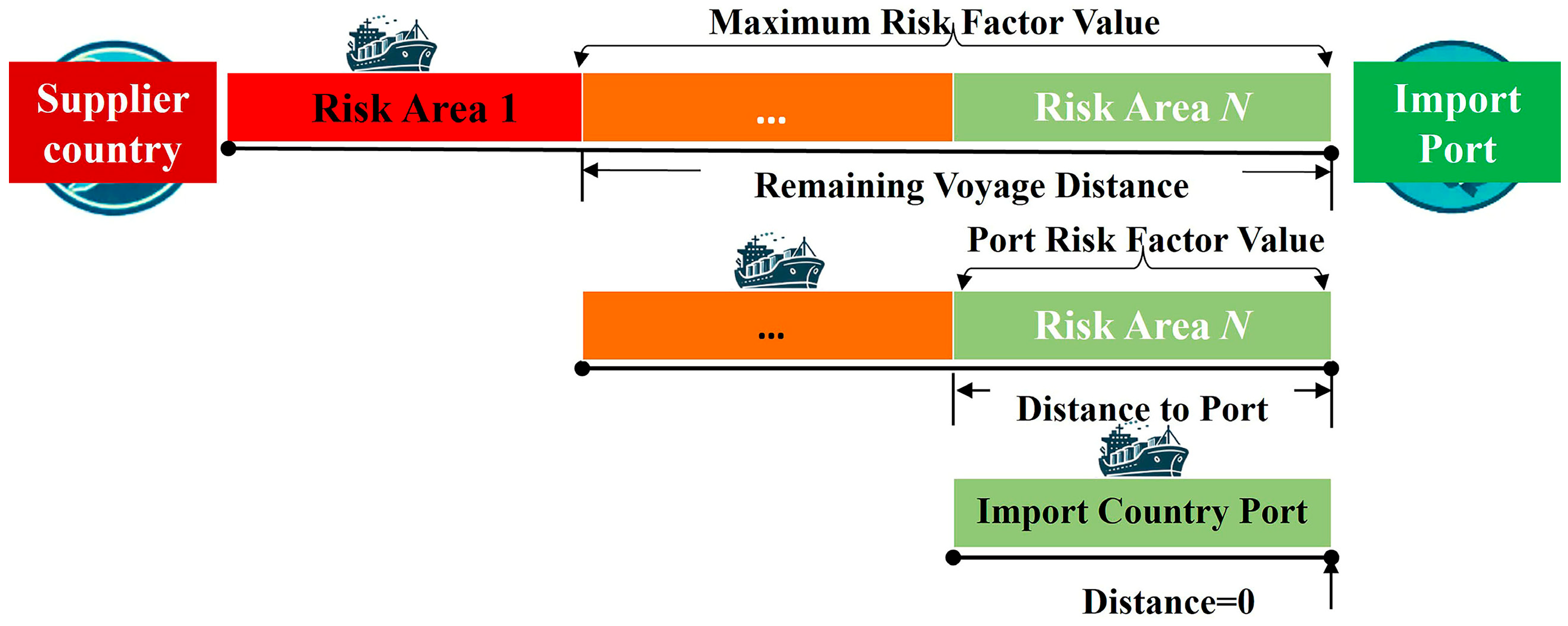
Risk monitoring: Index-based assessment and monitoring form the RIME framework’s core module. This study develops a vulnerability index to systematically measure maritime bulk commodity supply chain risks, aiming to dynamically quantify risk propagation mechanisms and address traditional qualitative/quantitative static assessment limitations in representing spatiotemporally coupled risks [51]. Given such risks’ inherent spatiotemporal extensibility and multi-scale interactions, the index captures both macro national strategic security risks and micro route operational dynamics for full-chain early warning. Building on the positive correlation theory between voyage duration and risk exposure [52], the index synthesizes two paradigms: supplier country risk indexing [53] and maritime risk assessment [54]. It aggregates sovereign credit, resource, and diplomatic risks at the supplier country level. For maritime segments, it quantifies accident rates and piracy frequencies based on the “distance shortening risk attenuation” dynamic mapping mechanism (see Figure 2), assigning dynamic weights to route segment distances and cargo density. A comprehensive variance-minimization weighting method merges the supplier country and maritime risks to create the index. This approach extends the spatiotemporal applicability of the framework proposed by Li et al. in 2015 [54], reveals risk transmission along the “supplier country–shipping route–importing country” link, and provides a quantitative tool for maritime supply chain security dynamics under geopolitical competition.
Risk extrapolation: Risk extrapolation is another core RIME module, designed to overcome traditional static scenario analysis limitations and offer dynamic decision support for emergent risks. This study proposes a dynamic risk simulation model for systematic supply chain risk analysis. First, a baseline scenario integrates time series analysis and machine learning to generate dynamic forecast references for supplier country and maritime risk indicators, laying a scientific baseline for vulnerability assessment. Second, a dual-dimensional emergent event classification system is established: supplier country risks (e.g., geopolitical conflicts, diplomatic crises affecting transport order) and maritime risks (e.g., accidents, piracy threatening route safety) cover all disruption sources. Based on a historical emergency database, a threshold-driven mechanism identifies disturbances; indicators exceeding predefined thresholds are auto-flagged. Standardized shock intensities come from analogous events’ mean disturbance rates or uniform random numbers via cumulative distribution function inverse mapping. Finally, disturbances (simulated shocks) integrate with non-disturbances (retaining baselines) to update comprehensive risk indicators, generating scenario-based vulnerability indices for single or linked dual-scenarios.

3.2. Risk Identification

This study constructs specific risk indicators for measuring the vulnerability of the maritime bulk commodity physical supply chain, as shown in Table 1. For supplier country risk measurement, we use two indicators, GPR and TPR, to capture geopolitical risk. Sovereign credit ratings reflect the government debt repayment capacity and economic stability, serving to measure sovereign credit risk. Resource risk is measured by three indicators: reserves, reserve-to-production ratio, and export share, indicating whether the supplier country can provide a stable supply of bulk commodities. It should be noted that natural hazard risks in bulk commodity-producing regions are often regarded as one of the major sources of supply chain disruption [55]. However, extreme weather data in existing databases (e.g., EM-DAT) are compiled at the national level and cannot be precisely matched to the geographic scales of mining areas or ports, nor can they accurately capture the direct impacts of climate-related physical risks on local extraction activities. In practice, frequent or severe natural hazards (e.g., floods, droughts, and major earthquakes) often directly damage production facilities in mining areas, cause extraction interruptions, and affect long-term output, which at the macro level may manifest as a systematic decline or sharp fluctuations in the reserve-to-production ratio. Therefore, under practical constraints in data availability and measurement precision, this study uses the reserve-to-production ratio as an indirect proxy from the perspective of resource sustainability, as it to some extent embeds information on the structural vulnerability of producing regions to natural shocks. Four indicators, including bilateral trade volume, export value/GDP, import value/GDP, and foreign direct investment, are used to measure the dependencies between the supplier and importing countries. Additionally, based on trade conflict theory, the diplomatic relationship between the supplier and importing countries dynamically affects trade flows through cooperation–friction dynamics [56]. To address this, we innovatively construct a news text-based diplomatic sentiment index to measure the diplomatic risks between supplier and importing countries in a continuous and standardized manner. This index overcomes the limitations of traditional approaches that rely on qualitative descriptions or event counts and provides a more precise and dynamic observational dimension of political relations for assessing country-level supply chain risks.
Regarding maritime risk indicators, risks that could affect maritime transport services include maritime accidents, pirate attacks, terrorism, armed conflicts, extreme weather conditions, and port congestion [5,63,64]. This study incorporates maritime accidents, pirate attacks, terrorism, and armed conflicts into the maritime bulk commodity supply chain risk indicator system. After careful evaluation, this study does not include extreme sea state/weather conditions and port congestion as core indicators, mainly for two reasons. First, in terms of data availability and framework compatibility, publicly accessible data that satisfy the long-horizon (2000–2023) and cross-country comparability requirements of this study are scarce. For example, in the Clarksons database, the indicator most relevant to iron ore shipping, i.e., the “share of Capesize bulk carrier capacity in port”, is only available from 2016 onward, and is largely reported as regional or global aggregates that cannot be disaggregated to the country–port level. Second, regarding risk transmission pathways and indicator substitutability, the most direct and material impacts of extreme weather (e.g., storms) on maritime supply chains typically manifest as navigational safety accidents or service disruptions, which are already systematically captured by our core indicator of “maritime accidents”. Port congestion, in turn, is often a consequential state or secondary manifestation triggered by other primary risks already included in this study (e.g., maritime safety incidents, terrorist activities, or regional conflicts); treating it as an independent risk indicator may therefore lead to double counting of the same underlying risk sources.

3.3. Risk Monitoring

Let P S V I i , t and C P S V I t , respectively, represent maritime bulk commodity physical supply chain vulnerability indices of supplier country i at time t and the composite vulnerability index. C P S V I t is computed as a simple weighted average of P S V I i , t across all supplier countries i . The construction process is as follows:
First, we quantify the supplier country risk. By employing the Herfindahl–Hirschman Index (HHI) [53], we quantify the geographical concentration of supply risk to construct the supply risk index C R i , t for supplier country i , which systematically characterizes the level of risk exposure that the importing country faces within the supply chain network, as follows:
C R i , t = p i , t 2 P A , t 2 × l A , i , t L A , r , t × a = 1 m x i , a , t × 1 + e t s
where l A , i , t is the amount of bulk commodities imported by the importing country from supplier country i at time t ; L A , r , t is the total volume of maritime commodities imported by the importing country at time t ; p i , t is the production volume of supplier country i at time t ; P A , t is the global production volume at time t ; x i , a , t is the value of the a -th risk factor for supplier country i at time t ; 1 + e t s is the emergency event adjustment factor, calculated based on the three-month rolling volatility of import volumes, which reflects the stability of supply.
The supplier country risk index is designed following the classic risk measurement model of “risk probability × potential loss scale”. In this model, a = 1 m x i , a , t represents the probability of a supply disruption from the supplier country. The expression p i , t 2 P A , t 2 × l A , i , t L A , r , t quantifies the structural loss scale that a supply disruption could potentially cause. The HHI component p i , t 2 P A , t 2 reflects the vulnerability associated with the concentration of supply sources, while l A i L A r measures the economic impact of the disruption on the importing country. The term p i , t 2 P A , t 2 × l A , i , t L A , r , t × a = 1 m x i , a , t reflects the risk magnification effect, indicating that when a supplier country has high instability and significant global market influence, and is a critical source for the importing country, the risk is amplified through structural channels [65]. The final term 1 + k t s adjusts the influence of short-term shocks on the risk value in real time.
Second, we quantify the maritime risk. Drawing on the route-based maritime risk index quantification logic developed by Li et al. in 2015 [54], we construct the maritime risk index T R R i , t for supplier country i to the importing country as follows:
T R R i , t = j k B u l k D i , j , k , t × V i , j , t × max o R k 1 n b = 1 n y j , b , o , t
where B u l k D i , j , k , t is the maritime distance from the k th key risk area on shipping route j of supplier country i to the importing country; V i , j , t is the average import volume of the commodity at time t on shipping route j from supplier country i (calculated by dividing the total amount of bulk commodities imported via this route by the shipping distance); N is the total number of risk zones along the maritime route, where each zone k 1,2 , 3 , , N ; R k is defined as the ordered collection of remaining route segments from zone k to the port of the importing country, representing all critical zones that must be passed after leaving zone k . Zone o lies on the mandatory path from zone k to the importing port, with o k . y j , b , o , t as the value of the b -th risk indicator at the o -th key risk zone on the j -th shipping route at time t . The expression max o R k 1 n b = 1 n y j , b , o , t represents the maximum risk indicator value in the remaining critical risk zones along the j -th route after the vessel leaves the k -th risk zone at time t . This value is used as the risk indicator value for the k -th critical risk zone at time t along the j -th route. The core principle behind this design is the “Weakest Link” principle in maritime supply chains [66], which suggests that maritime risks are non-compensatory, meaning that the safety conditions in low-risk areas cannot offset the fatal threats posed by high-risk areas. The use of a maximum value calculation effectively captures this bottleneck risk, preventing critical threats from being diluted through averaging. The above risk indicators are standardized based on the min–max scaling method.
In the third step, we construct the composite index. This study aims to build a robust country-level strategic monitoring index, aiming not to capture all transient fluctuations but to identify long-term risk patterns threatening supply chain security. To integrate supplier country and maritime risks across spatiotemporal dimensions, it introduces a weighted optimization model based on comprehensive variance minimization, strengthening their collaborative trends to clarify core structural risks. The model minimizes weighted comprehensive variance, adaptively extracts optimal weights from data to overcome subjective weighting randomness, and reduces indicator statistical volatility for efficient multi-source risk coupling and collaborative identification. The specific model is as follows:
min ω i 1 , ω i 2 σ 2 = V a r ω i 1 C R i , t + ω i 2 T R R i , t
s . t . ω i 1 + ω i 2 = 1 0 ω i 1 , ω i 2 1
The optimal weight vector ω i 1 , ω i 2 T for the two risk indicators is obtained, and the maritime bulk commodity physical supply chain vulnerability index P S V I i , t for supplier country i at time t is then given by the following:
P S V I i , t = ω i 1 C R i , t + ω i 2 T R R i , t
where C R i , t and T R R i , t represent the supplier country risk index and maritime risk index, respectively. The adoption of a weighted approach to integrate these two major risk dimensions is grounded in its ability to capture two key mechanisms. First is the additivity of risk contributions, whereby an increase in risk along any dimension directly elevates the overall systemic vulnerability—this aligns with macro-level principles of risk aggregation and supports decision-makers in identifying primary sources of exposure. Second is the conditional mitigation through strategic resilience actions, reflecting real-world governance logic in which elevated risks on the supply side (e.g., geopolitical instability in supplier countries) can be partially offset by enhancing maritime operational security, such as through route diversification, increased vessel redundancy, or improved navigation safety measures. This does not imply full substitutability between risk domains, but rather captures the extent to which proactive national interventions can modulate systemic vulnerability under non-extreme conditions. Thus, the weighted structure reflects not a purely compensatory assumption, but a policy-sensitive representation of adaptive risk management in complex physical supply systems.
Finally, we validate the index via three approaches. First, the extreme event method verifies its “rationality” by checking if historical index peaks align with major supply chain disruptions [47]. Second, the price correlation method tests “sensitivity”, using impulse response functions to analyze its dynamic link with prices and reveal early warnings for market fluctuations [67]. Third, the correlated indices method confirms “accuracy” by comparing it with existing supply chain resilience/stress indices to assess explanatory power and verify its effectiveness in capturing vulnerability.

3.4. Risk Extrapolation

Based on the above module functional design, we construct a specific risk extrapolation model to enable dynamic risk simulation under complex disturbance scenarios. The process is as follows:
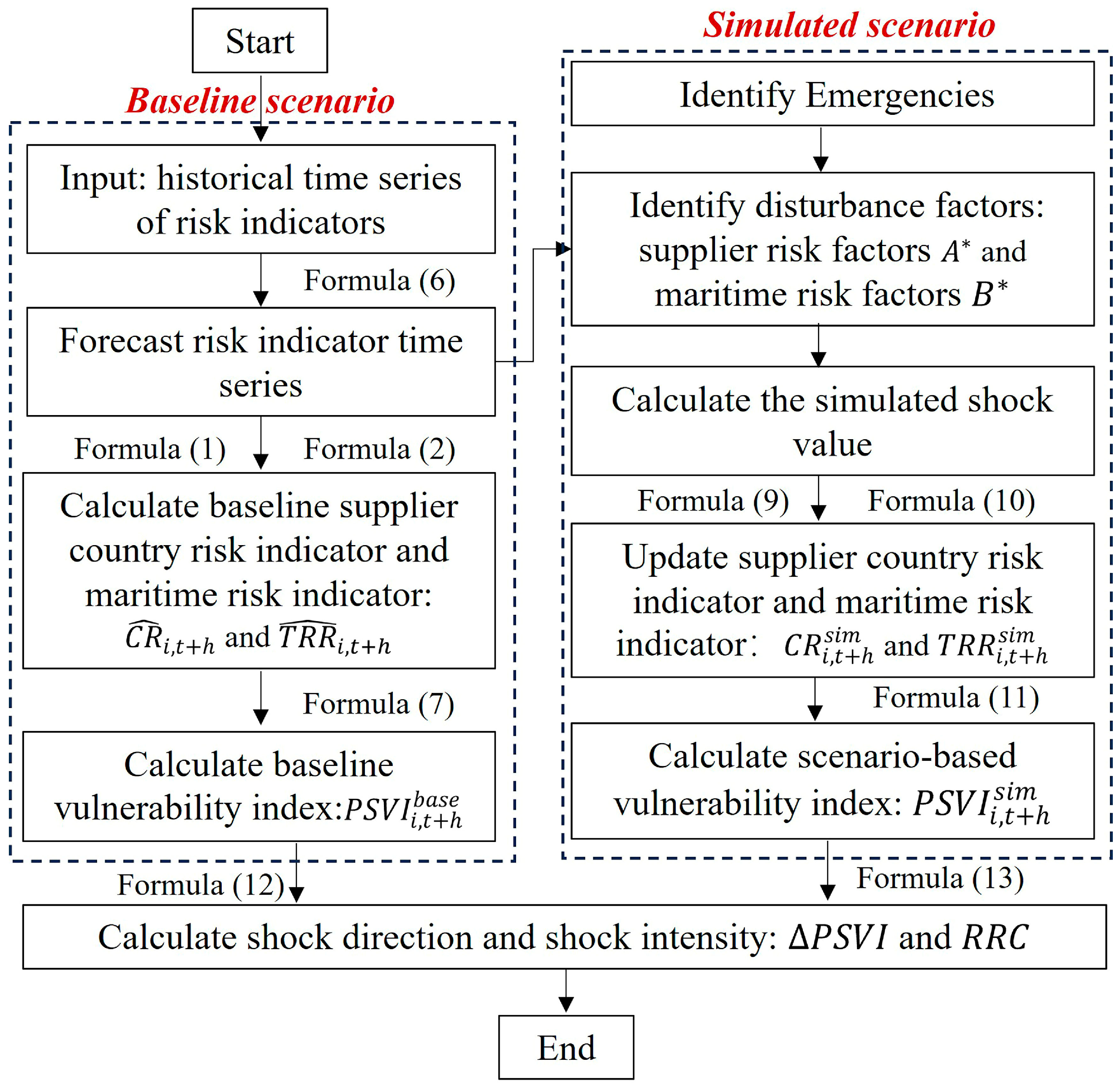
Step 1: Construct a baseline scenario for the prediction period [ t + 1 : t + h ] , which serves as a reference for changes in the vulnerability index under other scenarios. Time series or machine learning methods are optimally selected and integrated to obtain baseline values for the risk indicator forecast vector with a certain confidence level or accuracy, as outlined below:
x ^ i , a , t + 1 : t + h y ^ j , b , o , t + 1 : t + h T = F i , a x a , 1 : t F j , b , o y b , o , 1 : t T ,                 h = 1,2 ,
Here, x ^ i , a , t + 1 : t + h y ^ j , b , o , t + 1 : t + h T represents the risk indicator time series forecast vector, where F i , a and F j , b , o are the forecast model families for supplier country risk and maritime risk indicators, respectively. These are estimated and optimized based on the vector x a , 1 : t y j , b , o , 1 : t T .
Based on Equations (3)–(5), the baseline vulnerability index P S V I i , t + h b a s e for supplier country i in the period [ t + 1 : t + h ] is calculated as follows:
P S V I i , t + h b a s e = W A v g ω i 1 , ω i 2 , C R ^ i , t + h , T R R ^ i , t + h
Here, W A v g · corresponds to the composite function of the supply chain risk indicator in Equation (5).
Step 2: Identify emergencies and their impact intensity. From the dual perspectives of supplier country risk and maritime risk, we categorize emergencies in the maritime bulk commodity physical supply chain into seven types: geopolitical conflicts, diplomatic events, public health incidents, natural disasters, maritime accidents, piracy, and navigational obstacles. Among these, supplier country emergencies = {geopolitical conflicts, diplomatic events, public health incidents, and natural disasters} primarily originate at the supplier country level, affecting port operations and international transportation order [68,69], while maritime emergencies = {maritime accidents, piracy, and navigational obstacles} are typical risk factors in the maritime segment [70]. This classification logic is clear and encompasses the two major sources of risk in supply chain disruptions: supplier country risk and maritime risk. Meanwhile, by retrospectively analyzing historical emergencies in the maritime bulk commodity physical supply chain, disturbance and non-disturbance factors are selected according to the following rules.
Define the set of supplier country risk driving indicators A = a = 1,2 , , m , and select the main fluctuating indicators during historical emergencies to identify disturbance factors. Its subset is denoted as A * A . Let the threshold for the risk factor indicator a be γ a . For a specific type of supplier country emergency occurring during the time period [ t : t + h ] , if 1 h τ = 0 h 1 x i , a , t + τ + 1 x i , a , t + τ 1 γ a , a is considered a disturbance factor; otherwise, it is a non-disturbance factor. Similarly, for the maritime risk driving indicator set denoted as b = 1,2 , , n , let the threshold for the risk factor indicator b be γ b . If 1 h τ = 0 h 1 y j , b , o , t + τ + 1 y j , b , o , t + τ 1 γ b , then b is considered a disturbance factor; otherwise, it is a non-disturbance factor. The subset of maritime risk disturbance factors is denoted as B * B . For each risk indicator a and b , we use its full-sample historical monthly data to compute the monthly absolute rate of change over the entire time series, thereby obtaining the indicator’s empirical distribution of historical fluctuations. The values of γ a and γ b are then defined as high-quantile values (e.g., the 90th percentile) selected from the corresponding empirical distributions. This means that the threshold represents a relatively rare level of large-magnitude fluctuation observed in the indicator’s historical record.
Determine the simulated shock values of a specific type of disturbance factor for emergencies during the time period [ t + 1 : t + h ] . For the supplier country risk emergency disruptive factor A * , we summarize historical shock events of the same type and extract the time series rate of change in the disruptive factor a for each event occurring over the period [ 1 : h ] . This is calculated as x i , a , t + 1 x i , a , t 1 , x i , a , t + 2 x i , a , t 1 , , x i , a , t + h x i , a , t 1 . We then average the time series rate of change in the disruptive factor a for these similar historical emergencies, which gives the simulated shock change rate for the disruptive factor of a certain type of historical emergency: x i , a , t + 1 x i , a , t 1 ^ , x i , a , t + 2 x i , a , t 1 ^ , , x i , a , t + h x i , a , t 1 ^ . In contrast, for the selected maritime risk disruptive factor B * , we define the cumulative distribution function F y of the number of risk events y occurring in the o -th key risk zone of the j -th shipping route, and generate the number of simulations as follows:
y j , b , o , t + h s i m = F 1 u ,               u ~ U α , 1
Here, F 1 · represents the inverse function of the cumulative distribution function, which statistically describes the probability distribution of historical event occurrences. A random number is generated from U α , 1 , and then the simulated value is obtained by mapping this random number through the inverse cumulative distribution function. α is determined based on the overall distributional characteristics of historical maritime risk event frequencies.
For non-disruptive factors a A \ A * and b B \ B * , we retain the baseline forecast results from Step 1: x ^ i ,   a , t + h a A * and y ^ j , b , o , t + h b B * .
Step 3: Update the constructed supplier country risk indicator and maritime risk indicator. By considering both disruptive and non-disruptive factors, the simulated supplier country risk indicator C R i , t + h s i m is obtained according to Equation (1):
C R i , t + h s i m = C R x ^ i , a , t + h a A \ A * x i , a , t x i , a , t + h x i , a , t 1 ^ a A *
The simulated maritime risk indicator T R R i , t + h s i m is as follows:
T R R i , t + h s i m = T R R y ^ j , b , o , t + h b B \ B * y j , b , o , t y j , b , o , t + h y j , b , o t 1 ^ b B *
Here, C R · and T R R · correspond to the composite functions of the supplier country risk indicator and the maritime risk indicator, respectively, as defined in Equations (1) and (2).
Additionally, to measure the differentiated impact of individual risk events and cascading risk events on supply chain risk, we set up single risk scenarios and linked risk scenarios. The scenario-based vulnerability index P S V I i , t + h s i m is given by the following:
P S V I i , t + h s i m = W A v g ω i 1 , ω i 2 , C R i , t + h s i m , T R R ^ i , t + h s i n g l e   s u p p l i e r   c o u n t r y   r i s k W A v g ω i 1 , ω i 2 , C R ^ i , t + h , T R R i , t + h s i m s i n g l e   m a r i t i m e   r i s k W A v g ω i 1 , ω i 2 , C R i , t + h s i m , T R R i , t + h s i m C a s c a d i n g   r i s k
Finally, we construct two indicators, i.e., shock direction ( P S V I ) and shock intensity (RRC), to quantify the impacts of emergencies, as detailed below:
P S V I = P S V I i , t + h s i m P S V I i , t + h b a s e
R R C = P S V I i , t + h s i m P S V I i , t + h b a s e P S V I i , t + h b a s e × 100 %
By introducing standardized shock indicators that combine dynamic baseline forecasting with historical scenario calibration, this study addresses the temporal limitations of static scenario analysis and the subjectivity inherent in parameter-based perturbation methods. This approach enables, for the first time, a quantifiable and cross-comparable assessment of shock intensities across different emergencies.
Figure 3 presents the flowchart of the risk extrapolation algorithm.

3.5. Methodological Advantages and Framework Applicability

The RIME framework developed in this study, together with its core modules including the risk identification system, the PSVI, and the risk extrapolation model, achieves a systematic methodological advance over existing research paradigms. Its key advantages and applicability can be summarized as follows. First, it establishes an end-to-end, multi-dimensional, and dynamic risk identification system. We develop a country-level risk taxonomy that spans the full supplier country–shipping corridor–importing country chain. Through integrating resource risk, sovereign credit risk, geopolitical risk, bilateral dependence, and maritime security risk, the system provides comprehensive coverage across the resources, politics, economy, and transport dimensions. More importantly, it achieves a methodological innovation: grounded in trade conflict theory, we construct an original diplomatic sentiment index to dynamically quantify how interstate relations affect trade flows. At the same time, from a national strategic perspective, the framework intentionally focuses on core indicators with systemic disruption potential, ensuring both measurement precision and policy relevance. Second, it provides a spatiotemporally coupled, objectively weighted, and closed-loop validated dynamic monitoring tool. The proposed PSVI integrates supplier country concentration risk (an improved measure based on the Herfindahl–Hirschman Index (HHI)) with multi-node route-level maritime risks (via a regional path dependence model), thereby establishing a quantitative framework that couples supply and transport dimensions. The index adopts an adaptive and objective weighting scheme based on a comprehensive minimum-variance model, mitigating arbitrariness and enabling the efficient integration of multi-source risks. In addition, by developing a three-dimensional dynamic validity framework comprising extreme event back-testing, impulse response analysis of market prices, and benchmarking against existing indices, this study achieves a closed-loop validation of supply chain vulnerability measurement and provides a standardized tool that combines theoretical rigor with practical responsiveness for monitoring and early warning. Finally, it proposes a forward-looking extrapolation model calibrated by historical events and supporting multi-scenario comparison. The model is built around a coherent architecture of dynamic baseline forecasting, threshold-based disturbance detection, historical shock calibration, and scenario-based output, addressing the limitations of conventional approaches in time series continuity and parameter subjectivity. Its threshold-driven mechanism and standardized shock intensity generation method establish a comparable scale of shock intensity across heterogeneous emergencies, enabling risk management to move from reactive response to proactive, quantifiable, and comparable foresight, and directly supporting strategic decisions such as route optimization and reserve regulation.
In summary, the RIME framework constitutes a general analytical paradigm with broad applicability. Its identification–monitoring–extrapolation logic and the methodological innovations outlined above can be readily transferred to assess national maritime supply chain risks for other critical bulk commodities, such as oil, natural gas, and grains. The framework offers a solid and operational methodological toolkit to enable dynamic diagnosis, stress testing, and forward-looking governance of supply chain risks at the national level.

4. A Case Study of China’s Maritime Iron Ore Import Supply Chain

To empirically test the applicability and explanatory power of the RIME framework (Risk Identification–Monitoring–Extrapolation) developed in Chapter 3 for national strategic resource supply chains, this chapter selects China’s maritime iron ore import supply chain as the case study, given that China is the world’s largest iron ore importer. Iron ore is a critical bulk commodity underpinning the national economy; its imports rely heavily on maritime transport and exhibit typical characteristics such as high origin concentration, long-haul routes, and the interweaving of geopolitical and market risks. These features make it an ideal case for validating the country-level dynamic monitoring of supply chain vulnerability and the proposed risk extrapolation model.
With strong collaboration and support from the Price Monitoring Center of the National Development and Reform Commission (NDRC), the empirical analysis focuses on four major supplier countries—Australia, Brazil, India, and South Africa—which together account for more than 80% of China’s total iron ore imports. The main maritime routes corresponding to these countries are listed in Table 2. Notably, more than 80% of the imported iron ore is transported via the C3 and C5 routes [71]. We have constructed the monthly PSVI for iron ore imports, covering the period from January 2000 to December 2023.

4.1. Data

4.1.1. Data Sources

Risk indicators are listed in Table 1. Geopolitical risk indices for Australia, Brazil, India, and South Africa are from https://www.matteoiacoviello.com/gpr.htm (accessed on 23 January 2025); the global trade policy uncertainty index is from https://www.matteoiacoviello.com/tpu.htm (accessed on 23 January 2025). Sovereign credit ratings and outlooks are obtained from Standard & Poor’s (S&P) and quantified as per Gande and Parsley [72]. Iron ore reserves, reserve-to-production ratios, export shares, bilateral trade data, the ratio of export value to China to GDP, the ratio of import value to China to GDP, and foreign direct investment data are from the Wind database. The data on maritime accidents and pirate attacks are sourced from the IMO Global Integrated Shipping Information System (GISIS). A total of 9161 records is retrieved from the module of marine casualties and incidents, and 7119 records from the module of piracy and armed robbery. The original reports are searched by using the combination of ship name and event date to complete the missing position coordinates and event locations for all the records. Data on terrorist activities and armed conflicts are sourced from the War and Terrorism Database published by the Joint War Committee (JWC) of the London Insurance Market.
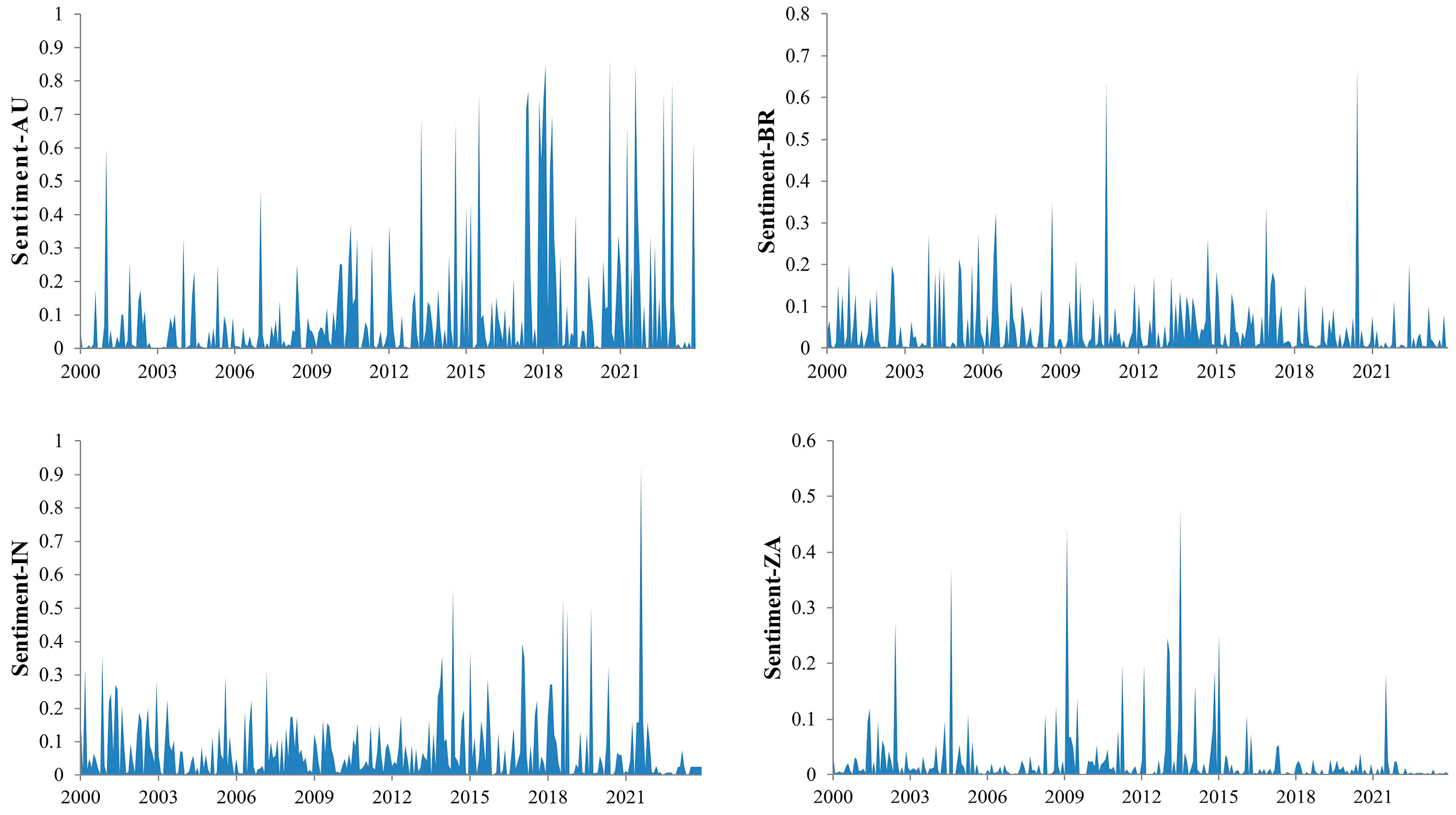
Based on 840,000 news headlines from People’s Daily covering January 2000 to December 2023, we have built diplomatic sentiment indices between China and the four suppliers using the sentiment_bert_chinese model, denoted as Sentiment_AU, Sentiment_BR, Sentiment_IN, and Sentiment_ZA. Negative sentiment probability is computed by summing “DISGUST”, “FEAR”, “SADNESS”, and “ANGER” outputs; positive sentiment is computed by summing “HAPPINESS”, “LIKE”, and “SURPRISE”. The sum of positive, neutral, and negative sentiment probabilities equals 1. Given the significant impact of negative sentiment on the supply chain, we use the “NEGATIVE” probability as the diplomatic sentiment index. The diplomatic sentiment indices for the four major supplier countries are shown in Figure 4.
Figure 4 shows that China’s diplomatic relations with Australia are markedly weaker than those with the other three major trading partners and remain persistently tense. By contrast, China’s diplomatic relations with Brazil and India are generally stable, yet they still face structural challenges: despite deep economic and trade ties, frictions persist between China and Brazil on key trade issues; China–India relations are mainly constrained by border disputes, which hampers deeper bilateral cooperation. China’s diplomatic relations with South Africa are the most positive; as South Africa’s largest trading partner, China has continued to deepen friendly and cooperative ties with South Africa. These observations indicate that the diplomatic sentiment index constructed in this study can effectively reflect the real state of bilateral relations, demonstrating strong real-world consistency and explanatory power.

4.1.2. Data Preprocessing and Standardization

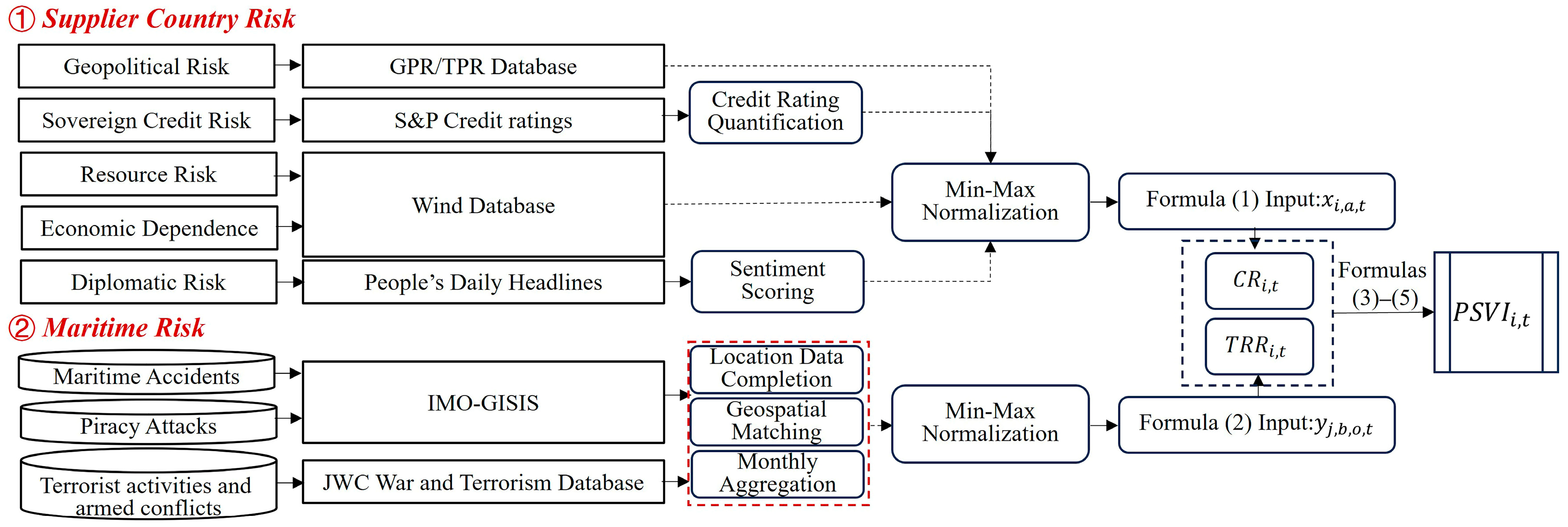
To clearly present a complete, transparent, and reproducible logic from raw data to the construction of the PSVI, the overall data processing procedure of this study is illustrated in Figure 5. The process follows a phased integration principle aimed at systematically quantifying country-level supply chain vulnerability, and its key operational steps are as follows:
First, according to the definitions in Table 1, multi-source heterogeneous data were categorized by risk attributes into two dimensions, i.e., supplier country risks and maritime risks, and were preprocessed for frequency and format standardization. For annual indicators (e.g., reserves, reserve-to-production ratio, export share, export value/GDP, import value/GDP, and foreign direct investment), we applied a forward-fill method to convert them into continuous monthly time series. For event-type data (e.g., maritime accidents and piracy attacks), processing included three critical steps: (1) filtering records involving bulk carriers, (2) manually cross-checking and completing missing geographic coordinates by referencing vessel names, event dates, and IMO numbers, and (3) spatially matching the completed event locations with key maritime regions defined in Table 2, and calculating the monthly frequency of events in each region to generate monthly risk exposure indicators. “Terrorist activities and armed conflicts” were treated as binary dummy variables, directly indicating whether such events occurred in key regions on a monthly basis.
Second, to eliminate dimensional effects and ensure comparability, and considering that different indicators have different directional impacts on supply chain vulnerability, we conducted directional consistency processing based on the risk attributes of each indicator (i.e., whether a higher value implies greater risk). For positive indicators of supplier country risks x i , a , t and maritime risks y j , b , o , t (where higher values indicate higher risk, e.g., geopolitical risk index, accident frequency), the standardization formula is X X m i n ) / ( X m a x X m i n . For negative indicators (where lower values indicate higher risk, e.g., sovereign credit rating), the standardization formula is X m a x X ) / ( X m a x X m i n . Here, X represents the raw value of an indicator, and X m a x and X m i n denote its maximum and minimum values during the study period, respectively. After this processing, all standardized indicator values fall within the [0, 1] interval, where larger values uniformly represent higher risks. This ensures logical consistency and comparability for subsequent multi-indicator weighted aggregation.
Finally, based on these standardized indicators, we computed the supplier country risk index ( C R i , t ) and the maritime risk index ( T R R i , t ) using Equations (1) and (2) in the main text. Subsequently, we synthesized the physical supply chain vulnerability index ( P S V I i , t ) at the national level using the minimum-variance weighting model defined in Equations (3)–(5).
The data sources used in this study—Wind, IMO, and Standard & Poor’s—are authoritative databases widely recognized in the field and exhibit strong internal consistency. Through this process, we systematically addressed data heterogeneity arising from publication frequency differences and record incompleteness (e.g., missing coordinates), thereby ensuring the consistency and accuracy of the analytical dataset and providing a reliable foundation for subsequent index construction.

4.2. Construction of the Vulnerability Index

4.2.1. PSVI

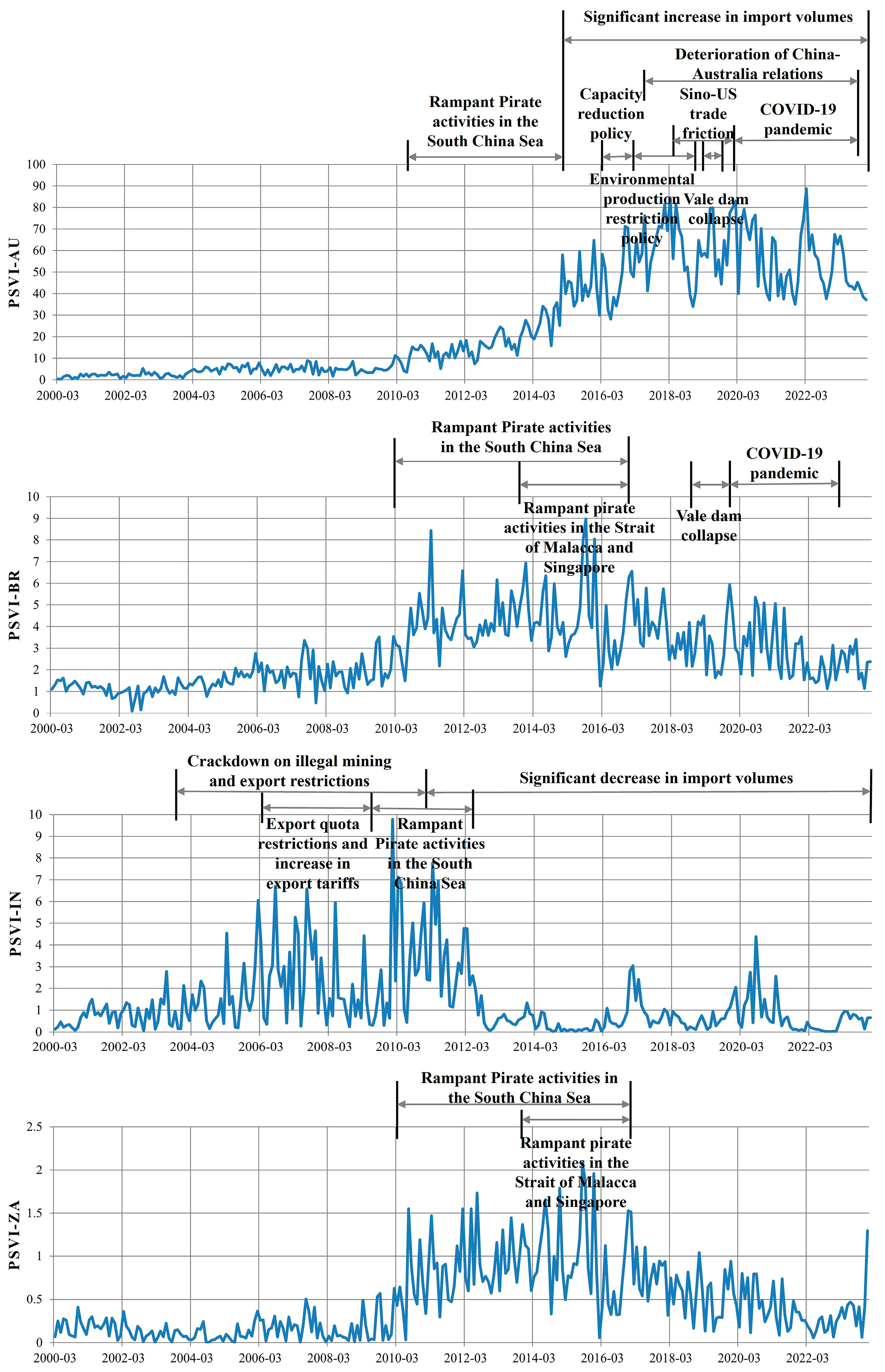
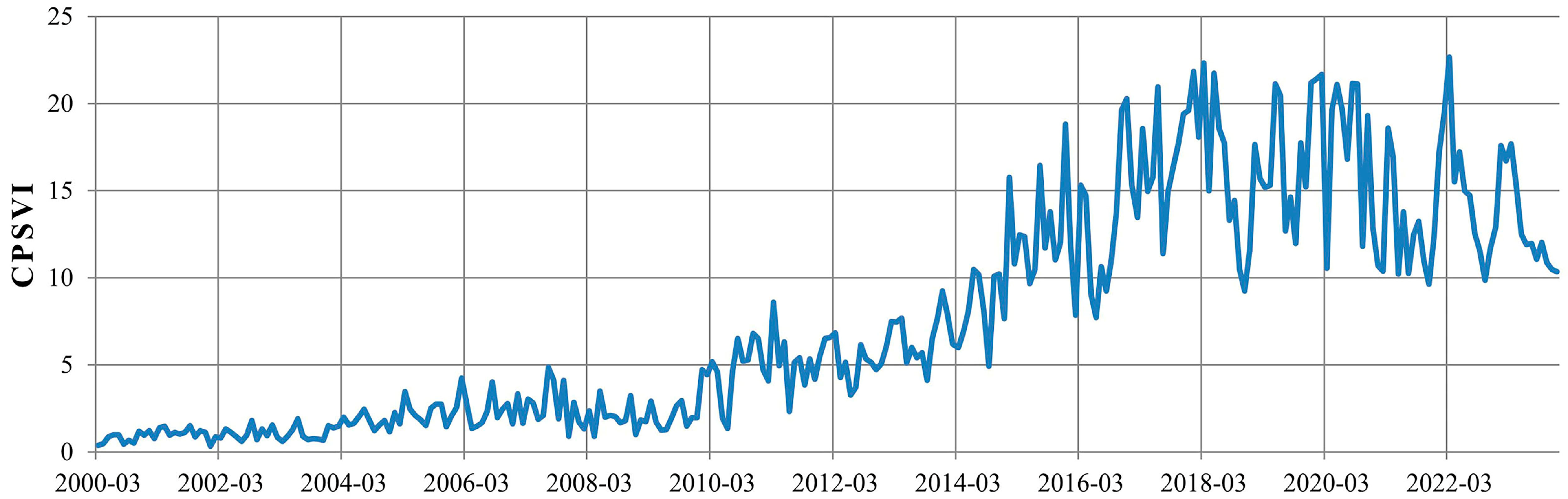
The monthly PSVIs for China’s iron ore imports from Australia, Brazil, India, and South Africa, namely PSVI-AU, PSVI-BR, PSVI-IN, and PSVI-ZA, are shown in Figure 6. Since these indices already account for import volume shares, the CPSVI is calculated using a simple arithmetic average to avoid repeated weighting. The result is presented in Figure 7.
Figure 6 shows that the country-specific vulnerability indices are characterized by distinct jumps that capture the most significant risks in overseas supply chains. Taking PSVI-AU as an example, it increases continuously starting from 2010, driven by frequent pirate attacks in the South China Sea. After China’s reliance on Australian iron ore surpasses 60% in 2015, the index rises further. The outbreak of COVID-19 in 2020 directly led to rising maritime transport costs, vessel scheduling difficulties, port congestion, and a decline in operational efficiency, all of which intensify supply chain bottlenecks and logistical constraints in iron ore imports. As a result, the index fluctuates sharply and peaks in March 2022. The peak values of the indices for Brazil, India, and South Africa also coincide with major emergencies.
Figure 7 shows that the CPSVI exhibits a clear pattern of fluctuations, with a significant upward trend after the intensification of deglobalization in 2015, peaking in 2022 and then beginning to decline. PSVI-AU dominates this fluctuation, being highly consistent with the trend of CPSVI and remaining substantially higher than those of other countries.

4.2.2. Analysis of Largest Spikes

The methodology for identifying extreme index spikes assumes that abrupt CPSVI jumps reflect major physical supply chain shocks in maritime iron ore trade over the past two decades. Specifically, we use residuals from a regression of monthly CPSVI on its three lags to measure shock intensity [40]. Table 3 lists major maritime supply chain shocks since 2000, which demonstrates the model’s ability to capture historically significant risk events.
Notably, the largest shocks align with well-documented disruptions: the COVID-19 pandemic outbreak, production capacity cuts due to environmental regulations, Australia’s supply expansion, Brazil’s Vale dam collapse, and Sino–U.S. trade frictions. These findings validate the reasonableness of historical CPSVI spikes in capturing systemic risks, with the pandemic-induced shock representing the most severe supply chain disruption in the dataset.

4.2.3. Analysis of the Index–Price Linkage

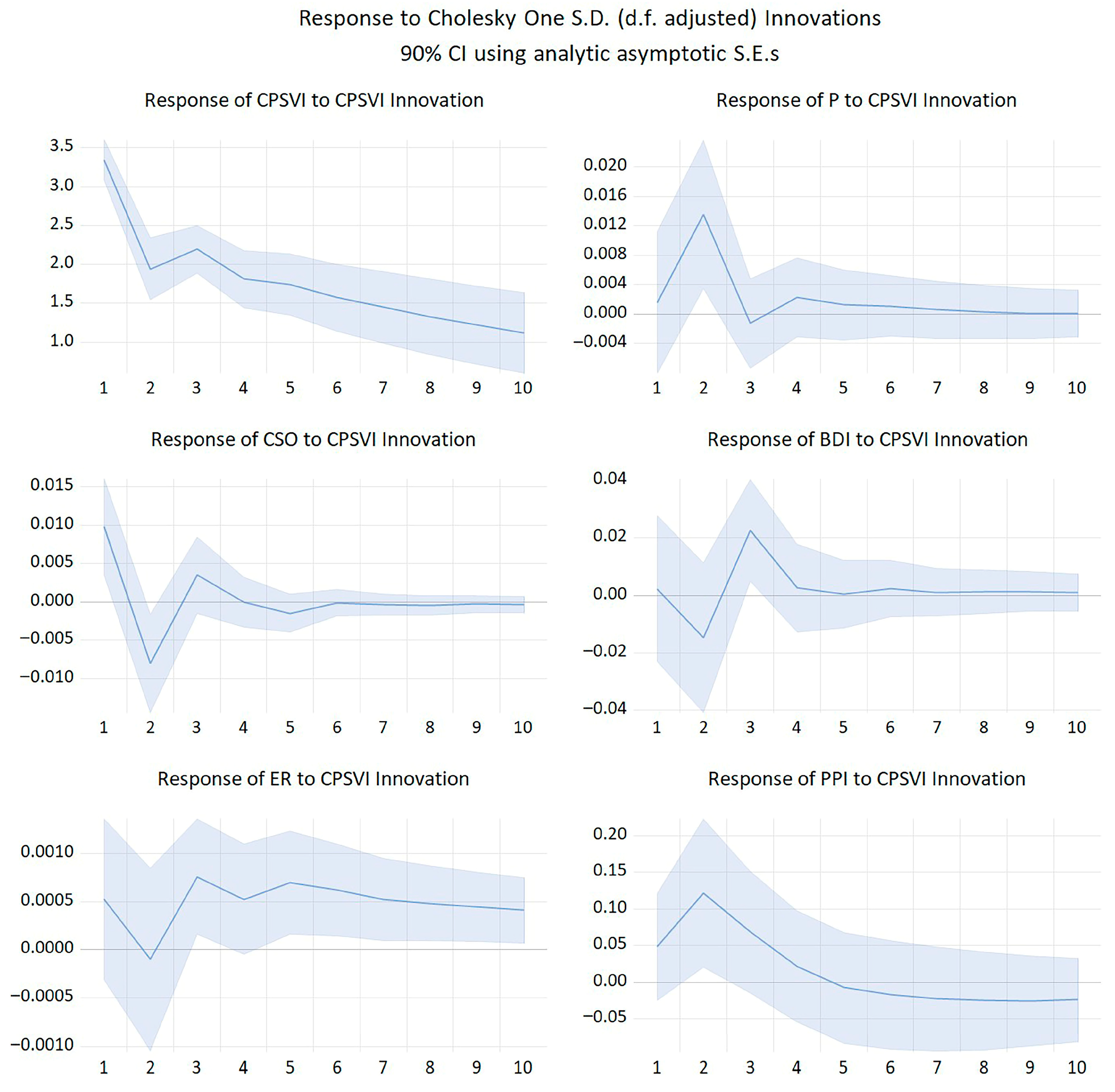
Dynamic Impact of CPSVI on China’s Imported Iron Ore Prices (P). As theorized by Yang and Wang [73], the key determinants of China’s imported iron ore price (P) are categorized into four dimensions: supply, demand, cost, and macroeconomic environment. Within the CPSVI framework, the supply dimension is operationalized through iron ore import volume. For the remaining factors, we use crude steel output (CSO) to proxy demand, the Baltic Dry Index (BDI) to measure transportation costs, and a composite of the USD/CNY exchange rate (ER) and Producer Price Index (PPI) to characterize macroeconomic conditions. All data are sourced from the Wind database.
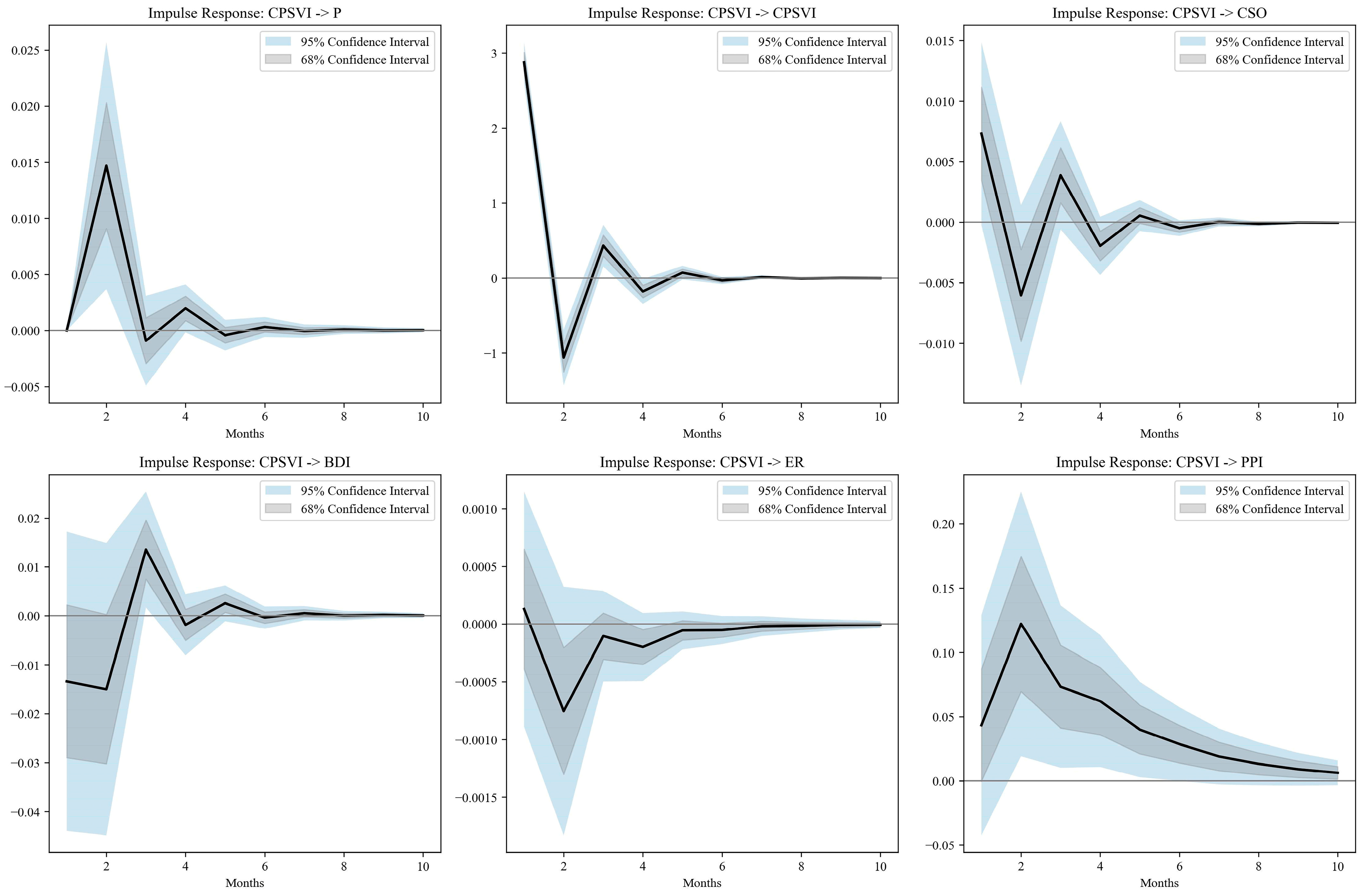
Using the impulse response function, we model the dynamic linkages between the CPSVI and imported iron ore prices. This approach enables us to track how supply chain vulnerability shocks propagate through the demand–cost–macroeconomic nexus, shedding light on price formation mechanisms under systemic risks.
The solid line in Figure 8 depicts the median impulse response of a two-standard-deviation shock to the CPSVI. The results show a significant positive impulse response of CPSVI on imported iron ore prices: a 1.4% price increase occurs two months after the shock, evidencing that heightened physical supply chain risks drive upward price pressures. CPSVI serves as an early indicator of imported iron ore prices, with its changes predicting market pressure two months in advance. Iron ore prices, however, exhibit notable stickiness, which is a characteristic influenced by long-term procurement contracts, inventory management strategies, and global market pricing mechanisms [74,75]. This structural rigidity delays price reactions to short-term supply chain fluctuations, attenuating the immediate impact of supply chain vulnerability on market prices despite the significant medium-term effect.
Heterogeneous Impact of Country-Specific Supply Risks and Maritime Risk Indicators on Prices: To further identify the differential contributions of country-specific risks in the composite vulnerability index, we construct an AR(1) model to examine the predictive ability of supplier country risks and maritime risks for imported iron ore prices in four countries: Australia, Brazil, India, and South Africa. The optimal lag order is determined using the Akaike Information Criterion (AIC).
Table 4 shows that the supplier country risks of Australia and Brazil have a significant impact on imported iron ore prices, with their impacts being positively significant at lags of one period and two periods, respectively. In contrast, the scale of iron ore exports from India and South Africa accounts for a smaller proportion in China’s import structure, and the volatility in their risks is less likely to significantly affect market prices.
Maritime risks typically have a short-term shock nature. In the maritime risk regressions, control variables are not introduced to preserve their original shock effects as much as possible. Considering that China has substantial large-scale import shipments and higher risk exposure levels from Australia and Brazil during the periods from November 2007 to June 2015 and from September 2017 to December 2023, these two time windows are selected for analysis. The results in Table 5 show that the maritime risks from Australia and Brazil have a positive and significant impact on the imported iron ore prices with a one-period lag, while the risk indicators for India and South Africa are not significant, indicating that the price transmission mechanism of maritime risks relies on a stable and large-scale transportation system. During the full sample period, the maritime risk variable is not significant, further confirming that its impact has a phased characteristic. In contrast, the supplier country risks exhibit a stable and significant effect throughout the full sample, suggesting that, as a medium- to long-term structural factor, they have a more sustained and widespread explanatory power for iron ore prices. Thus, there are significant differences in the impact mechanisms and time dimensions between the persistence of supply-side shocks and short-term disturbances in the transportation process.

4.2.4. Comparison with the Global Supply Chain Pressure Index

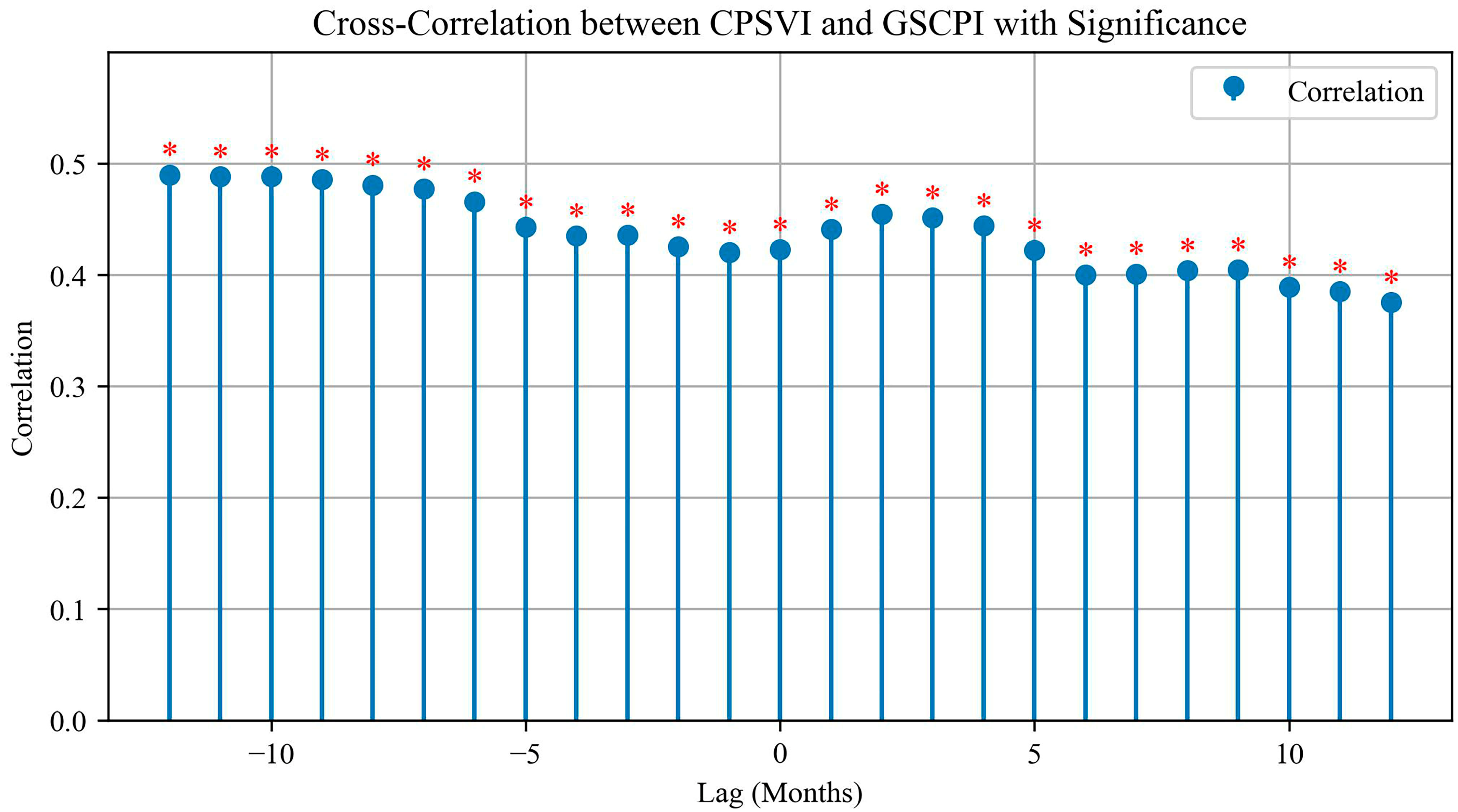
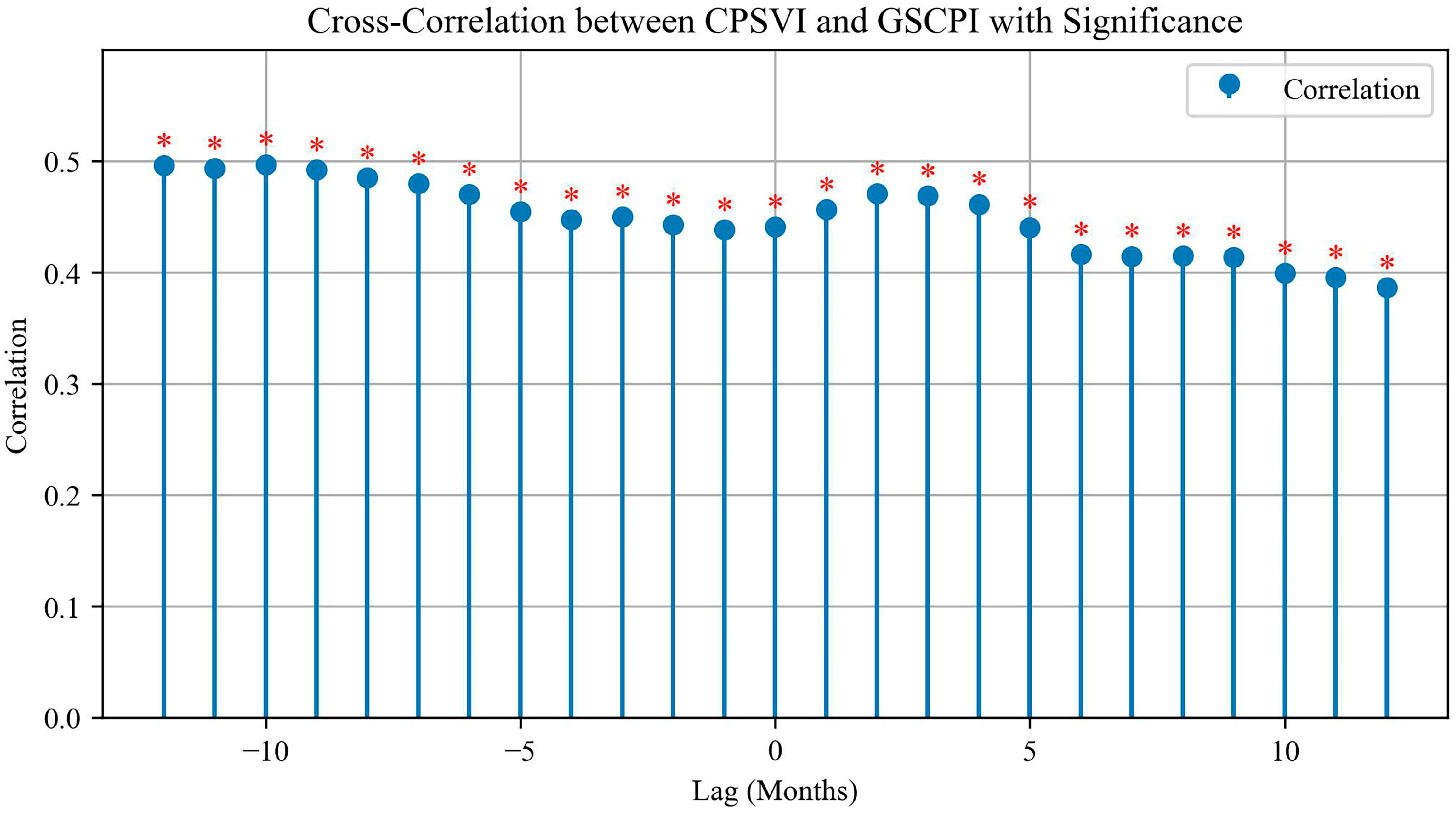
This study compares the CPSVI with the Federal Reserve Bank of New York’s Global Supply Chain Pressure Index (GSCPI [76]), employing cross-correlation analysis and Granger causality tests to examine their dynamic interrelationships.
The cross-correlation analysis results in Figure 9 indicate a significant positive correlation between the CPSVI and GSCPI, with a correlation coefficient close to 0.5, suggesting a high degree of consistency in their fluctuation trends. Furthermore, the Granger causality test results presented in Table 6 show that GSCPI is a Granger cause of CPSVI, confirming CPSVI’s effectiveness in capturing global stress events and validating its capability to reflect the dynamics of global supply chain pressures. Importantly, the finding that CPSVI is not a Granger cause of GSCPI highlights its granular structural advantage in capturing country-specific risk heterogeneity and commodity-level supply chain characteristics. In contrast to GSCPI’s macro-aggregated perspective, CPSVI independently identifies and quantifies the unique and disaggregated sources of vulnerability within China’s iron ore import supply chain—with iron ore as a critical strategic resource. This makes CPSVI possess more explanatory power in depicting micro-structural risks in specific supply chains and particularly well-suited for the targeted monitoring and governance of key strategic resources.

4.2.5. Robustness Tests

To ensure the methodological robustness of the indices constructed in this study (PSVI and CPSVI), this section conducts sensitivity tests for two critical components: the indicator normalization method and the index-weighting scheme. We follow the same triple-validation framework used in the baseline analysis to evaluate the alternative indices constructed under different methodological choices. All detailed validation procedures and results are reported in Appendix A.
(1) Sensitivity to the normalization method
To examine the sensitivity of the index to alternative normalization methods, we reprocessed all indicators using a 5th–95th percentile winsorized min–max normalization and constructed a benchmark (comparison) index series. This approach, like the classical min–max normalization adopted in the main text, is a linear rescaling technique; it caps extreme observations at both tails (5% on each side) before computing the scaling range, thereby effectively mitigating the undue influence of potential outliers on the standardized results. The results show that the new indices are extremely highly correlated with the original (min–max normalized) indices, with Pearson correlation coefficients of 0.9957 for PSVI-AU, 0.9950 for PSVI-BR, 0.9999 for PSVI-IN, 0.9999 for PSVI-ZA, and 0.9956 for CPSVI. More importantly, the triple-validation conclusions based on the new indices are fully consistent with the baseline analysis:
  • the historical peaks successfully capture all major supply chain shocks, including the COVID-19 pandemic and the Brazil tailings dam collapse, with event rankings highly consistent with the benchmark results (see Table A1);
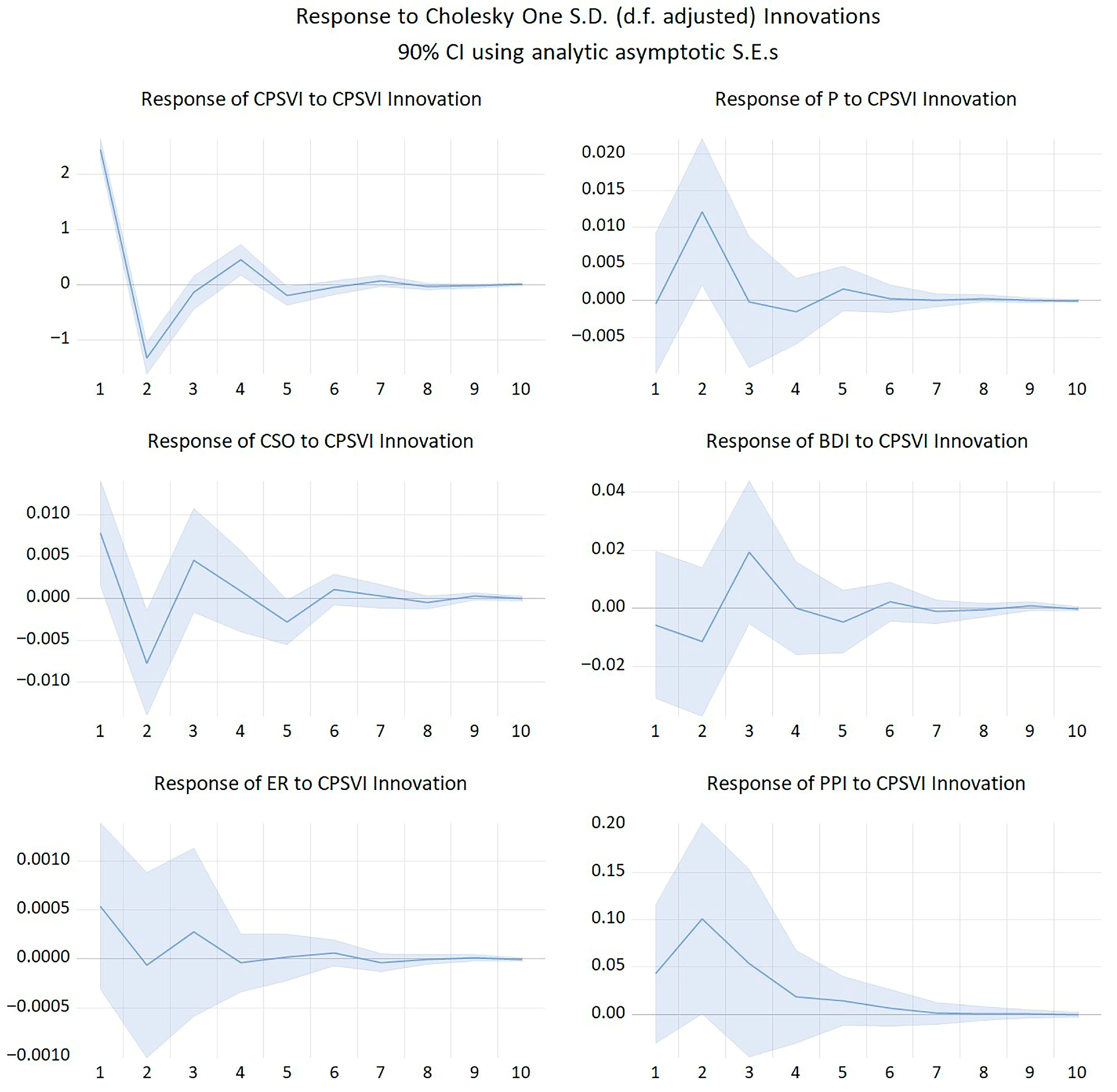
  • the impulse response of China’s iron ore import price (P) to the new index remains significantly positive and the lead–lag relationship is unchanged (see Figure A1);
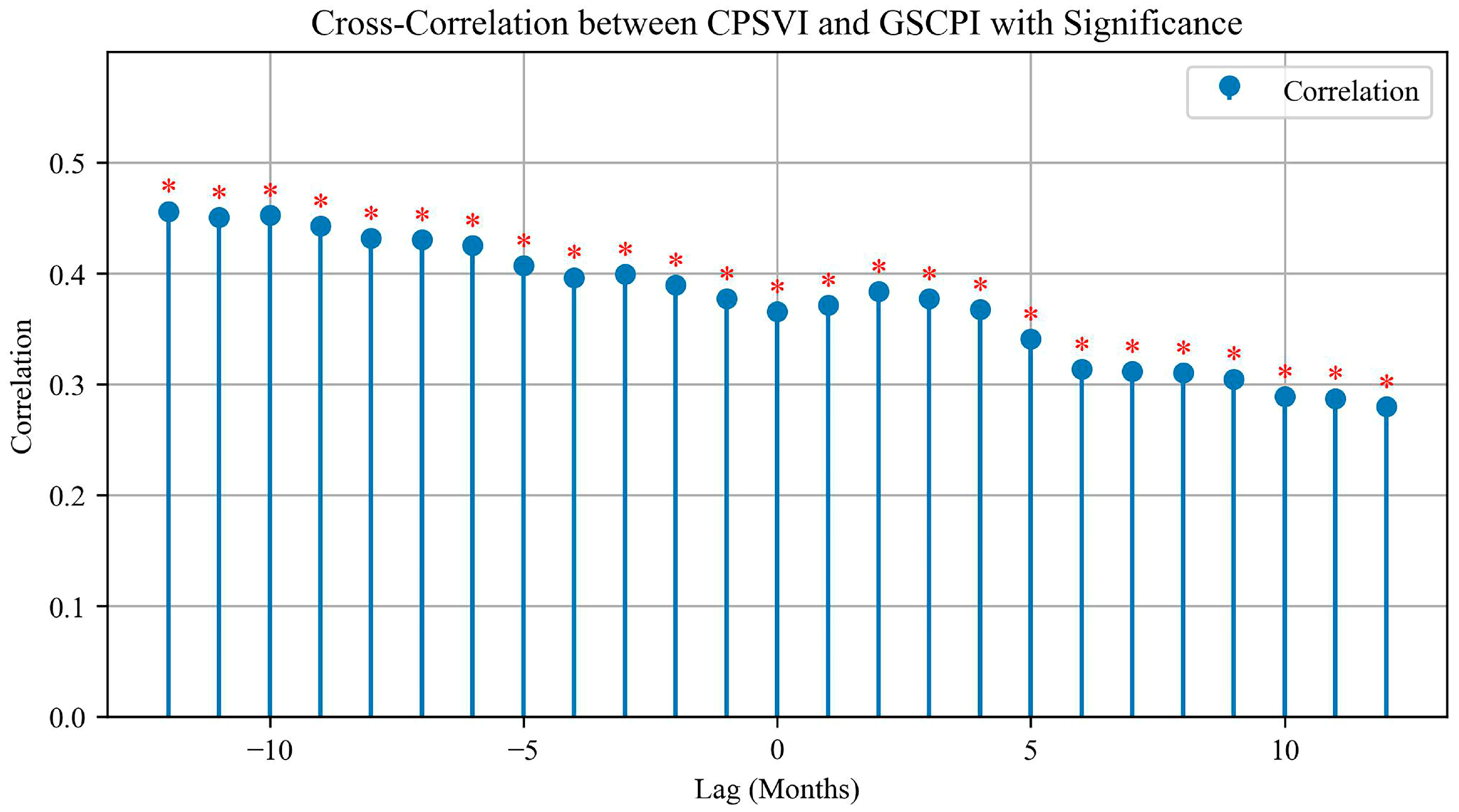
  • the association with the Global Supply Chain Pressure Index (GSCPI) remains statistically significant.
These findings indicate that the core measurement results are highly robust to the choice of normalization method (see Figure A2).
(2) Sensitivity to the weighting scheme
To test how alternative weighting logics affect the index, we applied another objective weighting approach, i.e., the entropy-weight method, to re-estimate the composite weights and construct a new index series. The new indices exhibit good correlations with the original (minimum-variance weighted) indices, with correlation coefficients of 0.9752 for PSVI-AU, 0.9041 for PSVI-BR, 0.9775 for PSVI-IN, 0.9999 for PSVI-ZA, and 0.9782 for CPSVI. The triple-validation results based on the new indices show that:
  • the revised index effectively identifies the most important historical shocks, including the COVID-19 pandemic and the Brazil tailings dam collapse, and their rankings are consistent with the baseline results; however, the “China–U.S. trade friction”, ranked fifth in the baseline analysis, is not flagged by the entropy-weighted index as among the most prominent shocks, reflecting subtle differences in emphasis on the underlying risk structure induced by different weighting logics (see Table A2).
  • In terms of the price–quantity linkage, the new index continues to exert a significantly positive effect on the iron ore price (P), and the core transmission mechanism remains unchanged (see Figure A3).
  • Regarding the relationship with the GSCPI, the correlation coefficient declines relative to the baseline result, but statistical significance remains (see Figure A4).
Overall, these results suggest that while changing the weighting method may lead to minor variations in the index’s sensitivity to non-core events and in the strength of its association with macro supply chain pressure, the key patterns of risk evolution, major systemic shocks, and the fundamental market transmission mechanism revealed by the PSVI remain highly robust, demonstrating that the main conclusions do not hinge on any single weighting specification.

4.3. Risk Extrapolation Results

We assume that the deterioration of Sino–Australia relations, the Vale dam disaster in Brazil, and pirate attacks (in the South China Sea and the Strait of Malacca) occur in December 2023. Based on the aforementioned risk extrapolation model, we analyze the short- and medium-term shock impacts of individual and combined events on the PSVI within 6 months (from January 2024 to June 2024; h = 6 ). The ARIMA model is used to forecast the values of the a -th risk indicator of the supplier country. Considering that the maritime risk indicator data are discrete and contain a large number of zero values, a Random Forest (RF) model is used for forecasting [77]. Based on the distribution characteristics of the average absolute change rate of all risk indicators during historical emergencies, the disturbance factor thresholds for the three events are set as follows: for the deterioration of Sino–Australia relations γ a = 50 % ; for the Vale dam disaster in Brazil γ a = 20 % ; and for pirate attack events γ b = 50 % . The results for the disturbance factors of the three events are shown in Table 7.
For supplier country emergencies, the time series change rates of disturbance factors for similar historical emergencies are further averaged to obtain the simulated shock change rates for the disturbance factors of similar historical emergencies, as shown in Table 8. For maritime emergencies, α is set to 0.5, corresponding to the 50th percentile of the historical attack frequency sample. This value automatically filters out the majority of zero-event samples, focusing on medium- to high-intensity scenarios with significant threats. The simulated number of pirate attacks is obtained by generating random numbers from the uniform distribution U 0.5 , 1 and using the inverse mapping of the cumulative distribution function.

4.3.1. Single Event Shocks

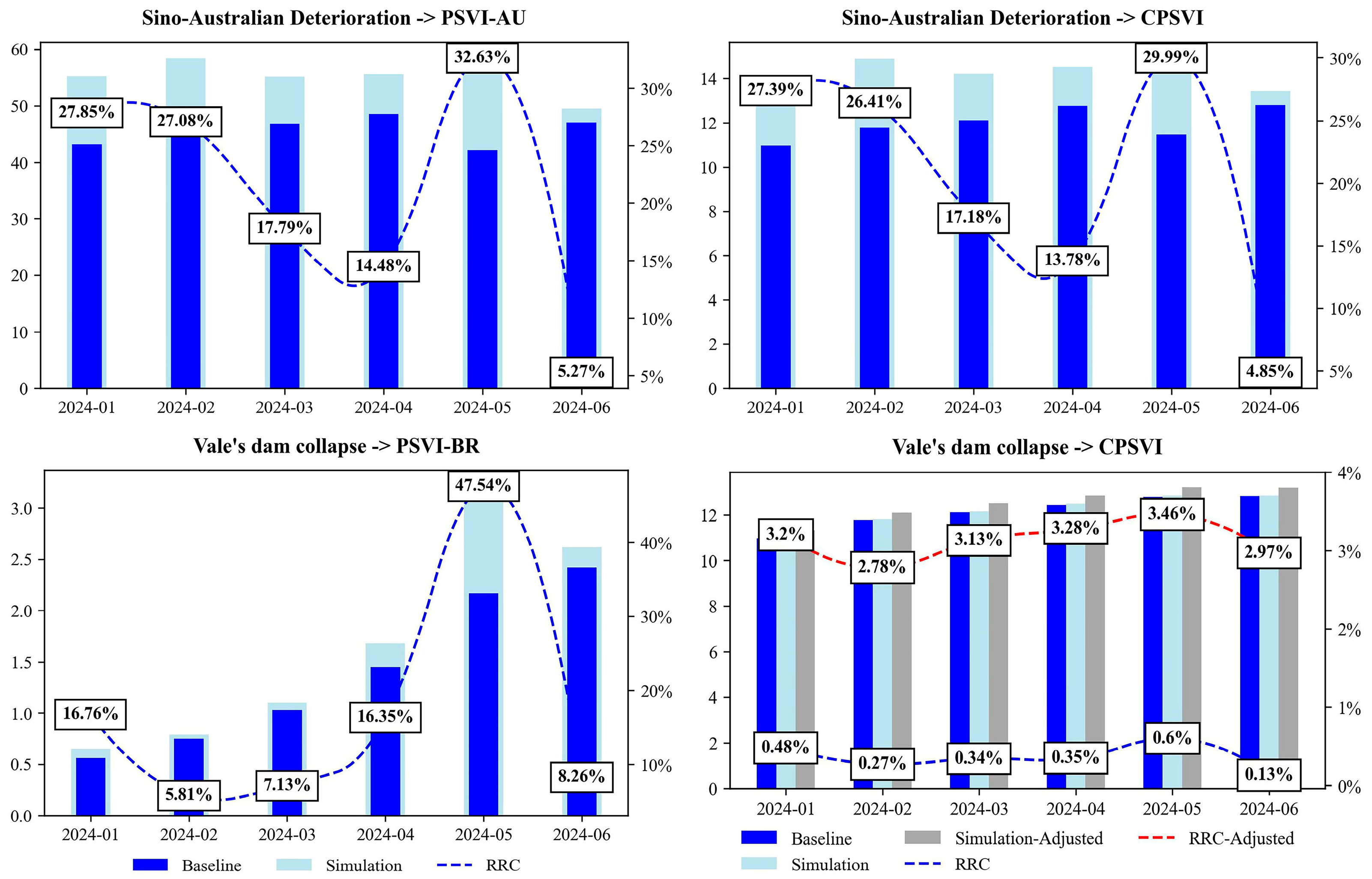
Figure 10 demonstrates the effects of deteriorating Sino–Australia relations and Brazil’s Vale dam collapse on the PSVI. The results show that strains in bilateral relations significantly elevate PSVI-AU, subsequently driving up the CPSVI. Notably, the CPSVI increase is moderated compared to the surge in Australia’s standalone vulnerability index. The Vale dam collapse also raises PSVI-BR, though its CPSVI impact is markedly smaller than Australia’s, which is consistent with Australia’s dominant role in shaping CPSVI trajectories, as previously observed.
The dam collapse caused China’s iron ore import share from Australia to peak at over 70% in June 2019, which is a historical high, triggering a supply source substitution elasticity mechanism that highlights Chinese importers’ emergency procurement capabilities. However, this adjustment amplified the CPSVI’s risk response coefficient (RRC) from a baseline of 0.5% to approximately 3%, evidencing substantial shock intensification through structural dependency dynamics.
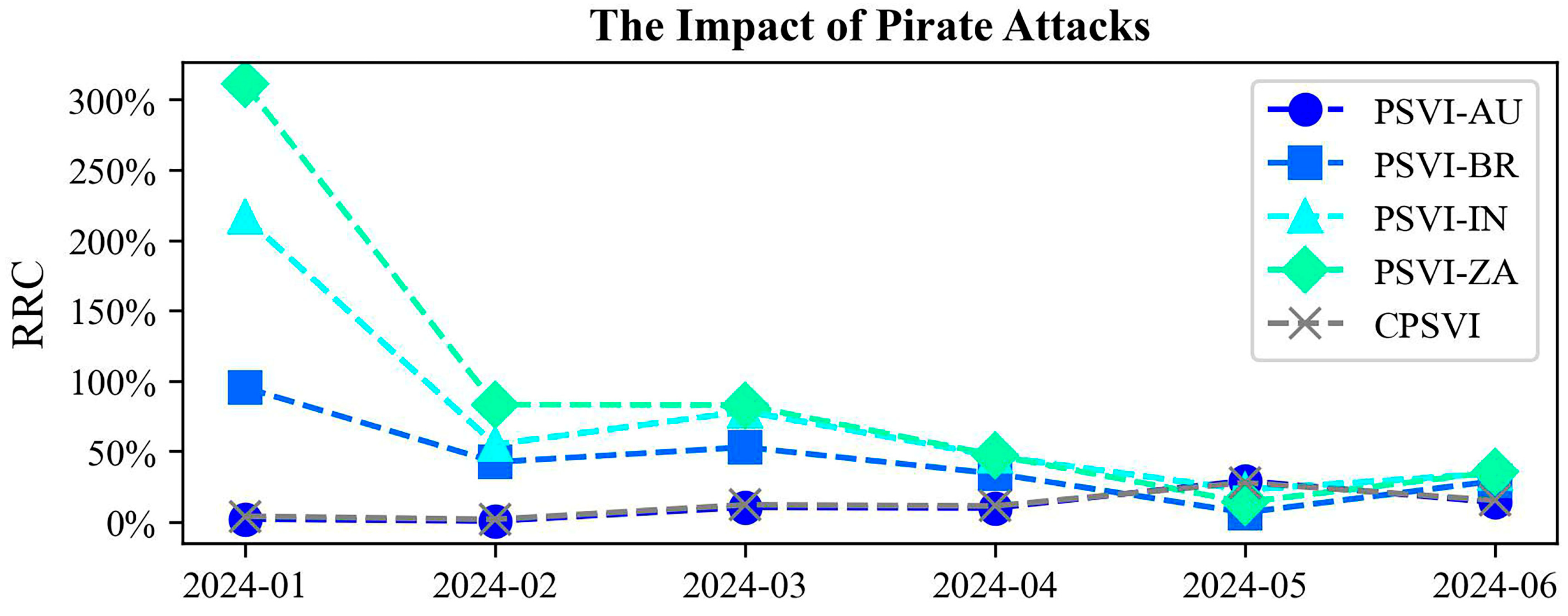
Figure 11 illustrates the effects of pirate attacks in the South China Sea and Strait of Malacca on the PSVI. The results show that piracy risk exerts the most pronounced effect on PSVI-ZA, followed by PSVI-IN and PSVI-BR, with PSVI-AU demonstrating the lowest vulnerability to such disruptions. Notably, PSVI-AU and the CPSVI exhibit nearly identical trends, with the former’s increase only marginally moderated compared to the CPSVI trajectory.

4.3.2. Combined Event Shocks

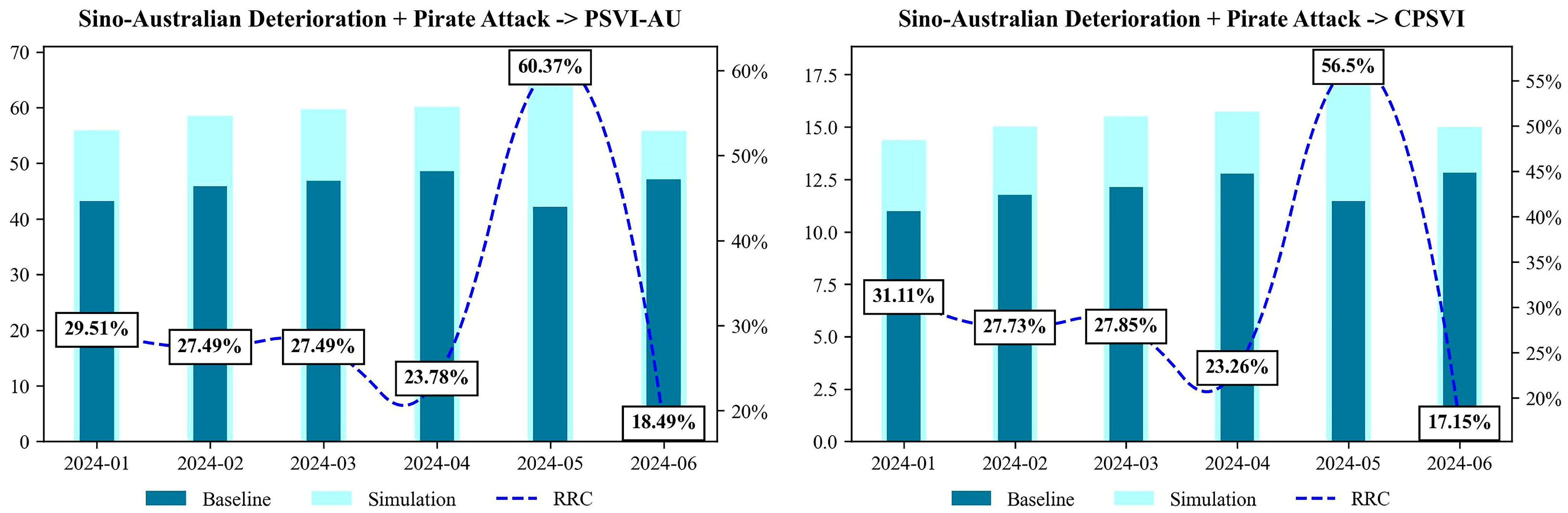
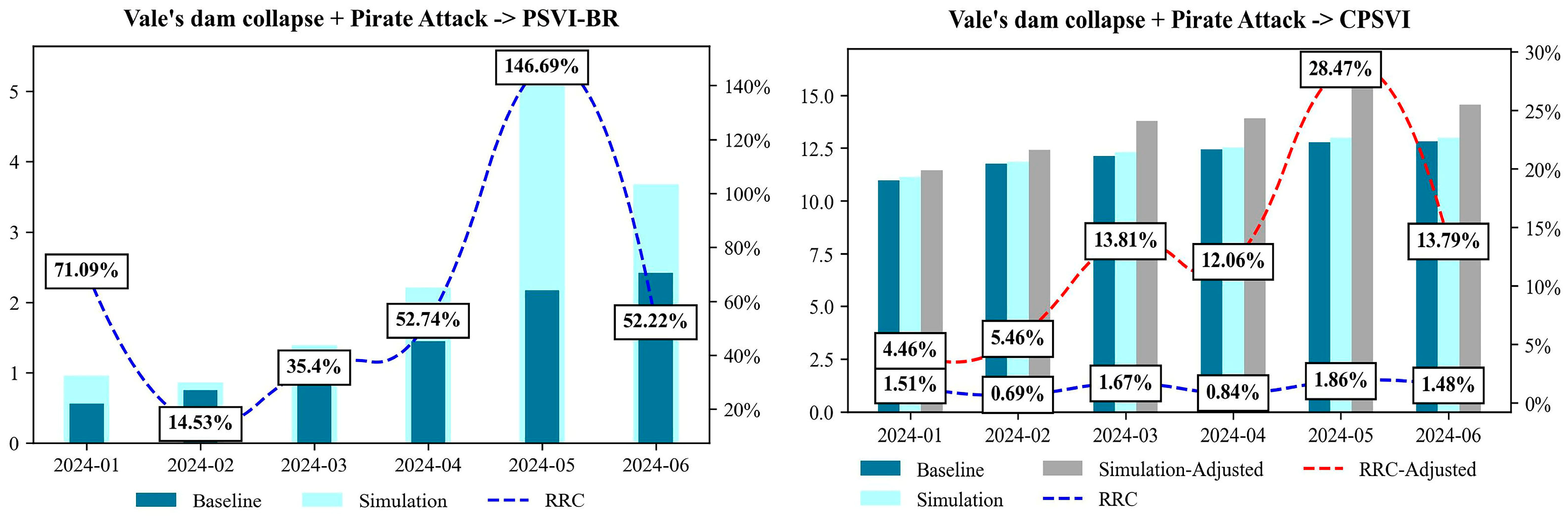
The simulation results of two compound emergencies on the PSVI are presented in Figure 12 and Figure 13. Figure 12 depicts the risk dynamics from the coupling of deteriorating Sino–Australia relations and South China Sea pirate attacks, while Figure 13 illustrates relative changes under the scenario combining the Vale dam collapse with pirate activity in the South China Sea and Strait of Malacca. Compared to single-risk events, both PSVI-AU and PSVI-BR exhibit significant surges under compound risk scenarios.
Notably, Figure 13 highlights that the supply chain substitution effect triggered by the dam collapse exacerbates Australia’s supply concentration (evidenced by a sharp 22% increase in Australian’s import share). When combined with escalated pirate risks in the South China Sea and Strait of Malacca, this generates a risk transmission multiplier effect, causing the CPSVI to increase by an additional 1–25% relative to single-risk baselines. These findings reveal that China’s maritime iron ore supply chain, characterized by high dependency on specific nations and shipping corridors, is vulnerable to interconnected risk events, which can rapidly escalate into systemic risks and trigger cross-border cascading failures, significantly eroding the overall supply chain resilience.

5. Discussion

The RIME framework developed in this study extends the firm-level risk governance paradigm to the level of national strategy, providing a systematic methodology for characterizing end-to-end risks in maritime bulk commodity supply chains. The core of the framework lies in establishing a two-dimensional indicator system, i.e., supplier country risk and maritime risk, thereby integrating macro-strategic risks such as geopolitics and diplomatic relations with micro-operational risks such as piracy and accidents into the same spatiotemporal chain of supplier country–shipping route–importing country. Building on this foundation, the PSVI developed in this study quantitatively fuses these multi-dimensional risks through a dynamic weighting mechanism, enabling the continuous monitoring of supply chain vulnerability. In addition, the embedded risk extrapolation module, calibrated using historical events, allows the dynamic simulation of shock pathways under emergencies and the evolutionary process of multi-risk coupling. Empirical evidence based on China’s iron ore import supply chain further demonstrates that the proposed framework and its core output (PSVI) can serve as an effective tool for macro-level monitoring and forward-looking simulation at the national scale. The results show that PSVI successfully captures systemic risk peaks associated with major historical shocks, such as the COVID-19 pandemic and the Vale dam collapse in Brazil. This confirms the effectiveness and sensitivity of an index-based approach that dynamically integrates macro- and micro-level risk indicators in detecting systemic stress within complex supply chain systems. More importantly, the results reveal the central role of structural dependence in risk transmission. As the dominant supplier, vulnerability fluctuations driven by country-level risks in Australia exhibit the strongest explanatory power for overall CPSVI movements as well as import market price fluctuations. This finding provides critical empirical support for the full-chain risk transmission mechanism along the supplier country–shipping route–importing country nexus, demonstrating that country-level vulnerability arises not only from disruptions at operational nodes but is more fundamentally rooted in the dependencies embedded within geo-economic structures. Scenario simulations further indicate that substitution-oriented procurement strategies, while intended to mitigate the risks associated with disruptions in a single supplier country, may inadvertently intensify dependence on another key source, thereby triggering larger systemic vulnerability surges under compound disturbance scenarios. This underscores the necessity of moving beyond localized and static perspectives in risk management and adopting a systemic and dynamic framework for forward-looking assessment, thereby reinforcing, at the theoretical level, the value of the integrated identification–monitoring–extrapolation paradigm developed in this study. Overall, these findings advance a core proposition that goes beyond traditional firm-level risk management: within the context of national strategic resource security, risk is no longer merely an isolated or static operational disruption, but rather a dynamic system property embedded in the geo-economic structure of the supplier country–shipping route–importing country chain. Such risk evolves over time and is transmitted through mechanisms of structural dependence. Accordingly, the empirical results of this study strengthen the theoretical foundation for elevating the risk management perspective from firm-level operations to country-level strategic governance, from the dual dimensions of dynamic risk quantification and structure-dependent transmission mechanisms.
The findings provide key insights for the multi-level governance of maritime supply chain resilience. At the national strategic level, the case demonstrates that seemingly operational strategies such as multi-source procurement may generate secondary dependencies and amplify systemic risks under a highly concentrated supply structure. Therefore, national governance should balance efficiency and security by placing structural dependence and geopolitics at the center of strategic considerations. Specifically, first, governments can build an integrated decision support platform that combines monitoring–simulation–response based on a RIME-type dynamic monitoring framework. Second, given the sensitivity to risks from key suppliers such as Australia and Brazil, the resilience of the supply structure can be strengthened through a dual-track strategy of “developing overseas resource bases + optimizing strategic reserve adjustment”. Third, for critical sea lanes such as the Strait of Malacca, security assurance can be enhanced through deeper multilateral security cooperation and rule-making. Fourth, scenario-based supply chain stress-testing mechanisms can be institutionalized to promote a shift in governance toward proactive immunity-building. At the industry and firm levels, the structural risk-transmission mechanisms revealed in this study provide an important basis for long-term strategic planning. Multinational traders, shipping companies, and downstream manufacturers should internalize a country-level systemic risk perspective in business decision-making: in negotiating long-term procurement agreements, assessments of macro risks—such as the political stability of supplier countries and the security of critical sea lanes—should be incorporated into contract design; in configuring supply chain networks, firms should balance operational efficiency with strategic security and avoid excessive concentration on a single geographic corridor; and in risk management systems, firms may draw on the monitoring logic of PSVI to build enterprise-level early warning systems by incorporating macro risk indicators into routine decision frameworks. This requires the industry to shift from pursuing short-term cost optimality toward building supply chain systems with strategic depth and adaptive capacity.
Despite these methodological and practical advances, several limitations remain, which also point to directions for future research. First, in terms of risk identification, the indicator system in this study relies primarily on publicly available macro statistics and event report databases. Due to data constraints, certain high-frequency and dynamic micro-operational risks, such as real-time port congestion conditions and extreme weather events that may simultaneously affect production areas, port nodes, and maritime routes, are not sufficiently captured, which may reduce the PSVI’s precision in detecting short-term, localized disturbances. Future research could integrate finer-grained multi-source data, such as real-time vessel AIS trajectories, port IoT operational data, and high-resolution meteorological and sea state datasets, to build a more dynamic and comprehensive risk data pipeline, thereby improving the timeliness and spatial resolution of risk identification. Second, methodologically, the PSVI adopts a weighted additive model to ensure parsimony and interpretability, which may simplify the complex nonlinear interactions among different risk dimensions. Future studies may explore incorporating machine learning or other nonlinear modeling techniques to more finely characterize and validate the nonlinear relationships and cascading effects across risk dimensions. It could also further compare the performance of different methods in terms of historical event fitting, the stability of trend extrapolation, and explanatory power for economic indicators. Third, the present study does not explicitly model the potential mitigating effects of technological and institutional capacities on vulnerability. As highlighted by recent frontier research [78], digital transformation, such as digital public services, port automation and intelligent logistics, and Industry 4.0/5.0 capabilities, can substantially reshape risk exposure and recovery trajectories by enhancing supply chain transparency, agility, and coordination. Similarly, high-quality governance and regulatory effectiveness may also strengthen systemic resilience. Building on this foundation, future research could incorporate national digital competitiveness and more granular governance indicators as moderating or mediating variables within the RIME framework, thereby examining whether countries or corridors equipped with advanced digital infrastructure and well-functioning institutions exhibit lower baseline vulnerability, faster shock recovery, and stronger capacity to absorb compound disruptions. Finally, regarding empirical validation and generalization, the current analysis focuses mainly on China’s iron ore import supply chain. Although this case is strategically representative, reliance on a single case may to some extent limit a full validation of the framework’s general applicability. An important direction for future work is to extend the framework horizontally to other strategic bulk commodities with different logistics characteristics and geopolitical attributes—such as oil, natural gas, and grains—and to conduct cross-country comparative studies under different institutional settings and development stages (e.g., resource importers versus exporters) in order to calibrate key model parameters and enhance its adaptability across commodities and regions.

6. Conclusions

Under the backdrop of rising deglobalization and escalating geopolitical conflicts, the vulnerability and resilience governance of maritime bulk commodity physical supply chains have become a core concern for national strategic security. To address this, this study proposes a universal framework for risk identification, monitoring, and extrapolation (RIME) tailored to the country level for maritime bulk commodity physical supply chains. The framework integrates a dual-dimensional risk system focusing on both the supplier country and the maritime risks, achieving a paradigm shift from firm-level risk governance to national strategic security governance. The physical supply chain vulnerability index (PSVI) constructed in this study enables the dynamic quantification of risks and the depiction of transmission paths, while the embedded risk extrapolation module supports the dynamic simulation of shock pathways and impact intensities under single or combined emergency events, providing methodological tools for systemic risk assessment.
To validate the effectiveness of the framework, this study applies it to the typical case of China’s iron ore import supply chain. The results show that the PSVI robustly characterizes the dynamic evolution of systemic risks, while simultaneously reflecting both global supply chain pressures and the unique risk structure of China’s import system. Risk extrapolation further reveals that when addressing disruptions from a single supplier country, employing a multi-source substitution strategy may trigger risk diffusion due to the complex interconnections within the supply chain network, leading to a significant increase in overall system vulnerability (with simulation increases of up to 25%). This finding indicates that localized risk management must be considered within the context of an overall system assessment, providing important decision-making insights for national bulk commodity supply chain risk management.
The RIME framework proposed in this study is highly versatile and transferable. Its “Identification–Monitoring–Extrapolation” logical structure and methodology can be extended to the risk governance of other key bulk commodity supply chains, such as oil, gas, and grains. By integrating macro risk consolidation, dynamic modeling, and policy support, this study offers a new management paradigm with both theoretical depth and practical value, setting a new methodological benchmark for enhancing national strategic supply chain resilience in the context of geopolitical turmoil.

Author Contributions

Conceptualization, L.G. and F.Y.; methodology, L.G., F.Y. and C.S.; software, L.G.; validation, L.G.; formal analysis, L.G.; resources, F.Y. and C.S.; data curation, L.G.; writing—original draft preparation, L.G.; writing—review and editing, L.G., F.Y., C.S. and M.Y.; visualization, L.G.; supervision, F.Y. and M.Y.; project administration, F.Y., C.S. and M.Y. All authors have read and agreed to the published version of the manuscript.

Funding

This research was funded by the National Key R&D Program of China, grant number 2023YFC3305105, the Humanities and Social Science Fund of the Ministry of Education of China, grant number 24YJAZH192, and the Entrusted Project by the Dalian Area of China (Liaoning) Pilot Free Trade Zone (Dalian Bonded Zone): An Empirical Study on Shipping Center Construction and Hinterland Economic Development. The APC was funded by the Entrusted Project by the Dalian Area of China (Liaoning) Pilot Free Trade Zone (Dalian Bonded Zone): An Empirical Study on Shipping Center Construction and Hinterland Economic Development.

Data Availability Statement

The raw data supporting the conclusions of this article will be made available by the authors on request.

Conflicts of Interest

The authors declare no conflicts of interest.

Appendix A

This appendix reports the detailed procedures and results of the robustness tests for the indices constructed in this study (PSVI and CPSVI). The robustness assessment follows the same triple-validation framework used in the main text and focuses on two key methodological choices: (i) indicator normalization and (ii) index-weighting schemes. Tables and figures are provided to facilitate replication and to document the sensitivity of the main findings.

Appendix A.1

Normalization robustness (winsorized min–max normalization): We reconstruct PSVI and CPSVI using a 5th–95th percentile winsorized min–max normalization, which mitigates the influence of extreme observations by capping values at both tails (5% on each side) before computing the scaling range. Table A1 summarizes the event identification performance and key statistics under this alternative normalization. Figure A1 presents the corresponding impulse response results for China’s iron ore import price (P), and Figure A2 reports the association with the Global Supply Chain Pressure Index (GSCPI).
Figure A1. The impact of increased physical supply chain risks of imported iron ore. Note: The blue solid line shows the impulse responses to a one-standard-deviation Cholesky shock in the CPSVI. The shaded area represents the 90% confidence interval.
Systems 14 00120 g0a1
Table A1. Major maritime physical supply chain shocks since 2000.
MonthRankCPSVIShockEvent
January 20151216.636.61Completion of Australia’s expansion plan
July 20151516.896.05
December 2015421.208.68
February 201696.557.34Capacity reduction and environmental production restrictions
November 2016210.629.60
July 2017711.028.05
April 20181024.227.12Sino–U.S. trade friction
January 2019620.218.22Vale dam collapse in Brazil
May 20191123.327.02
October 20191320.046.43
December 2019823.898.02
March 2020121.9410.11Outbreak of the COVID-19 pan-demic
October 2020511.708.68
March 2021320.539.21
January 20221418.136.19
Figure A2. Correlation coefficients for different lags. Note: * indicates significance at the 1% level.
Systems 14 00120 g0a2

Appendix A.2

Weighting robustness (entropy-weight method): We further reconstruct PSVI and CPSVI by replacing the baseline minimum-variance weighting with the entropy-weight method. Table A2 reports the event identification results and the comparison with the baseline ranking. Figure A3 illustrates the price transmission results under entropy weighting, and Figure A4 reports the relationship with the GSCPI.
Table A2. Major maritime physical supply chain shocks since 2000.
MonthRankCPSVIShockEvent
December 2015217.387.90Completion of Australia’s expansion plan
February 201655.155.83Capacity reduction and environmental production restrictions
November 2016316.557.78
December 2016617.805.72
February 2017139.464.92
July 2017127.405.07
January 20191113.325.15Vale dam collapse in Brazil
May 20191514.914.88
December 2019715.485.60
February 2020919.145.39Outbreak of the COVID-19 pan-demic
March 202016.699.99
October 2020107.585.24
November 2020816.315.57
December 2020148.784.90
March 2021414.216.68
Figure A3. The impact of increased physical supply chain risks of imported iron ore. Note: The blue solid line shows the impulse responses to a one-standard-deviation Cholesky shock in the CPSVI. The shaded area represents the 90% confidence interval.
Systems 14 00120 g0a3
Figure A4. Correlation coefficients for different lags. Note: * indicates significance at the 1% level.
Systems 14 00120 g0a4

References

  1. Clarkson, P.L.C. Clarkson PLC Annual Report 2024; Clarkson PLC: London, UK, 2024; Available online: https://www.clarksons.com/media/iabfo121/clarkson_plc_annual_report_2024.pdf (accessed on 10 December 2025).
  2. World Economic Forum. Global Risks Report 2023; World Economic Forum: Geneva, Switzerland, 2023; Available online: https://www.weforum.org/publications/global-risks-report-2023/ (accessed on 10 December 2025).
  3. Li, D.Y.H.; Jiao, J.B.; Wang, S.Y.; Zhou, G.H. Supply chain resilience from the maritime transportation perspective: A bibliometric analysis and research directions. Fundam. Res. 2025, 5, 437–449. [Google Scholar] [CrossRef]
  4. Cabalu, H. Vulnerability of natural gas supply in the Asian gas market. Econ. Anal. Policy 2009, 39, 255–270. [Google Scholar] [CrossRef]
  5. Li, B.D.; Lu, J.; Li, J. Investigation of accident severity in sea lanes from an emergency response perspective based on data mining technology. Ocean Eng. 2021, 239, 109920. [Google Scholar] [CrossRef]
  6. Liu, J.G.; Gu, B.M.; Chen, J.H. Enablers for maritime supply chain resilience during pandemic: An integrated MCDM approach. Transp. Res. Part A Policy Pract. 2023, 175, 103777. [Google Scholar] [CrossRef]
  7. Gu, B.M.; Liu, J.G. A systematic review of resilience in the maritime transport. Int. J. Logist. Res. Appl. 2022, 28, 257–278. [Google Scholar] [CrossRef]
  8. Liu, J.G.; Wu, J.J.; Gong, Y. Maritime supply chain resilience: From concept to practice. Comput. Ind. Eng. 2023, 182, 109366. [Google Scholar] [CrossRef]
  9. Zarghami, S.A.; Dumrak, J. Unearthing vulnerability of supply provision in logistics networks to the black swan events: Applications of entropy theory and network analysis. Reliab. Eng. Syst. Saf. 2021, 215, 107798. [Google Scholar] [CrossRef]
  10. Ducruet, C. The polarization of global container flows by interoceanic canals: Geographic coverage and network vulnerability. Marit. Policy Manag. 2015, 43, 242–260. [Google Scholar] [CrossRef]
  11. Zeng, F.; Chan, H.K.; Pawar, K. The effects of inter- and intraorganizational factors on the adoption of electronic booking systems in the maritime supply chain. Int. J. Prod. Econ. 2021, 236, 108119. [Google Scholar] [CrossRef]
  12. Tatarczak, A. Mapping the landscape of artificial intelligence in supply chain management: A bibliometric analysis. Mod. Manag. Rev. 2024, 29, 43–57. [Google Scholar] [CrossRef]
  13. Zhang, Y.; Lam, J.S.L. Estimating the economic losses of port disruption due to extreme wind events. Ocean Coast. Manag. 2015, 116, 300–310. [Google Scholar] [CrossRef]
  14. Lam, J.S.L.; Lassa, J.A. Risk assessment framework for exposure of cargo and ports to natural hazards and climate extremes. Marit. Policy Manag. 2017, 44, 1–15. [Google Scholar] [CrossRef]
  15. Lee, C.Y.; Song, D.P. Ocean container transport in global supply chains: Overview and research opportunities. Transp. Res. Part B Methodol. 2017, 95, 442–474. [Google Scholar] [CrossRef]
  16. Lam, J.S.L.; Su, S.L. Disruption risks and mitigation strategies: An analysis of Asian ports. Marit. Policy Manag. 2015, 42, 415–435. [Google Scholar] [CrossRef]
  17. Verschuur, J.; Koks, E.E.; Hall, J.W. Port disruptions due to natural disasters: Insights into port and logistics resilience. Transp. Res. Part D Transp. Environ. 2020, 85, 102393. [Google Scholar] [CrossRef]
  18. Verschuur, J.; Koks, E.E.; Hall, J.W. Ports’ criticality in international trade and global supply-chains. Nat. Commun. 2022, 13, 4351. [Google Scholar] [CrossRef]
  19. Wendler-Bosco, V.; Nicholson, C. Port disruption impact on the maritime supply chain: A literature review. Sustain. Resilient Infrastruct. 2020, 5, 378–394. [Google Scholar] [CrossRef]
  20. Chang, C.H.; Xu, J.J.; Song, D.P. An analysis of safety and security risks in container shipping operations: A case study of Taiwan. Saf. Sci. 2014, 63, 168–178. [Google Scholar] [CrossRef]
  21. Shepard, J.U.; Pratson, L.F. Maritime piracy in the Strait of Hormuz and implications of energy export security. Energy Policy 2020, 140, 111379. [Google Scholar] [CrossRef]
  22. Wan, C.; Yang, Z.; Zhang, D.; Yan, X.P.; Fan, S.Q. Resilience in transportation systems: A systematic review and future directions. Transp. Rev. 2018, 38, 479–498. [Google Scholar] [CrossRef]
  23. Becker, A.; Ng, A.K.Y.; McEvoy, D.; Mullett, J. Implications of climate change for shipping: Ports and supply chains. WIREs Clim. Change 2018, 9, e508. [Google Scholar] [CrossRef]
  24. Narasimha, P.T.; Jena, P.R.; Majhi, R. Impact of COVID-19 on the Indian seaport transportation and maritime supply chain. Transp. Policy 2021, 110, 191–203. [Google Scholar] [CrossRef] [PubMed]
  25. Notteboom, T.; Pallis, T.; Rodrigue, J.P. Disruptions and resilience in global container shipping and ports: The COVID-19 pandemic versus the 2008–2009 financial crisis. Marit. Econ. Logist. 2021, 23, 179–210. [Google Scholar] [CrossRef]
  26. Hosseini, S.; Ivanov, D. A multi-layer Bayesian network method for supply chain disruption modelling in the wake of the COVID-19 pandemic. Int. J. Prod. Res. 2022, 60, 5258–5276. [Google Scholar] [CrossRef]
  27. Xiao, R.; Xiao, T.; Zhao, P.; Zhang, M.; Ma, T.; Qiu, S. Structure and resilience changes of global liquefied natural gas shipping network during the Russia–Ukraine conflict. Ocean Coast. Manag. 2024, 252, 107102. [Google Scholar] [CrossRef]
  28. Liu, M.; Liu, Y.; Wong, C.W.Y.; Lai, K.-H.; Tu, E. The impacts of geopolitics on global Liquefied Natural Gas (LNG) shipping network: Evidence from two geopolitical events. Ocean Coast. Manag. 2025, 267, 107706. [Google Scholar] [CrossRef]
  29. Liu, Y.; Fu, X.; Wang, K.; Zheng, S.; Xiao, Y. Bibliometric analysis and literature review on maritime transport resilience and its associated impacts on trade. Marit. Policy Manag. 2025, 52, 440–477. [Google Scholar] [CrossRef]
  30. Liu, H.L.; Tian, Z.H.; Huang, A.Q.; Yang, Z.L. Analysis of vulnerabilities in maritime supply chains. Reliab. Eng. Syst. Saf. 2018, 169, 475–484. [Google Scholar] [CrossRef]
  31. Islam, S.; Goerlandt, F. Exploring vulnerability and resilience of shipping for coastal communities during disruptions: Findings from a case study of Vancouver Island in Canada. Int. J. Logist. Manag. 2021, 32, 1434–1460. [Google Scholar] [CrossRef]
  32. Vilko, J.; Ritala, P.; Hallikas, J. Risk management abilities in multimodal maritime supply chains: Visibility and control perspectives. Accid. Anal. Prev. 2019, 123, 469–481. [Google Scholar] [CrossRef]
  33. Jiang, M.Z.; Lu, J.; Qu, Z.H.; Yang, Z.L. Port vulnerability assessment from a supply chain perspective. Ocean Coast. Manag. 2021, 213, 105851. [Google Scholar] [CrossRef]
  34. Cao, Y.; Iulia, M.; Majumdar, A.; Feng, Y.; Xin, X.; Wang, X. Investigation of the risk influential factors of maritime accidents: A novel topology and robustness analytical framework. Reliab. Eng. Syst. Saf. 2025, 254, 110636. [Google Scholar] [CrossRef]
  35. Qiao, Q.; Zhen, R.; Dong, H.; Wang, S.W.; Fang, Q.L. Identification of key risk ships in risk-based ship complex network. Ocean Eng. 2025, 327, 120969. [Google Scholar] [CrossRef]
  36. Wang, N.X.; Wu, M.; Yuen, K.F. Assessment of port resilience using Bayesian network: A study of strategies to enhance readiness and response capacities. Reliab. Eng. Syst. Saf. 2023, 237, 109394. [Google Scholar] [CrossRef]
  37. Mou, N.X.; Sun, S.Y.; Yang, T.F.; Wang, D.P. Assessment of the resilience of a complex network for crude oil transportation on the Maritime Silk Road. IEEE Access 2020, 8, 181311–181325. [Google Scholar] [CrossRef]
  38. Wen, T.; Gao, Q.Y.; Chen, Y.W.; Cheong, K.H. Exploring the vulnerability of transportation networks by entropy: A case study of Asia-Europe maritime transportation network. Reliab. Eng. Syst. Saf. 2022, 226, 108578. [Google Scholar] [CrossRef]
  39. Liang, M.; Cai, Y.; Chen, T.; Wang, H.; Meng, Q. Data-driven impact analysis of chokepoint on multi-scale maritime networks: A case study of the Taiwan Strait. Transp. Res. Part E Logist. Transp. Rev. 2025, 200, 104179. [Google Scholar] [CrossRef]
  40. Hu, W.; Shi, J.; Pang, C.; Chen, J.; Wan, Z.; Wang, Z. Assessment and optimization of shipping network resilience in the maritime silk road regions. J. Transp. Geogr. 2025, 130, 104454. [Google Scholar] [CrossRef]
  41. Peng, P.; Cheng, S.; Chen, J.; Liao, M.; Wu, L.; Liu, X.; Lu, F. A fine-grained perspective on the robustness of global cargo ship transportation networks. J. Geogr. Sci. 2018, 28, 881–889. [Google Scholar] [CrossRef]
  42. Calatayud, A.; Mangan, J.; Palacin, R. Vulnerability of international freight flows to shipping network disruptions: A multiplex network perspective. Transp. Res. Part E Logist. Transp. Rev. 2017, 108, 195–208. [Google Scholar] [CrossRef]
  43. Wu, D.; Wang, N.; Yu, A.Q.; Wu, N. Vulnerability analysis of global container shipping liner network based on main channel disruption. Marit. Policy Manag. 2019, 46, 394–409. [Google Scholar] [CrossRef]
  44. Ma, L.; Ma, X.; Chen, L.; Zhang, R.W.; Zhang, J.Q. A methodology to quantify risk evolution in typhoon-induced maritime accidents based on directed-weighted CN and improved RM. Ocean Eng. 2025, 319, 120303. [Google Scholar] [CrossRef]
  45. Xu, Y.; Peng, P.; Claramunt, C.; Xie, W.; Lu, F. Modeling cascading risk diffusion in global container shipping network under dynamic flow reassignment. Reliab. Eng. Syst. Saf. 2026, 265, 111530. [Google Scholar] [CrossRef]
  46. Yang, J.; Zhang, X.; Ge, Y.E. Measuring risk spillover effects on dry bulk shipping market: A value-at-risk approach. Marit. Policy Manag. 2021, 49, 558–576. [Google Scholar] [CrossRef]
  47. Caldara, D.; Iacoviello, M. Measuring geopolitical risk. Am. Econ. Rev. 2022, 112, 1194–1225. [Google Scholar] [CrossRef]
  48. Mora, N. Sovereign credit ratings: Guilty beyond reasonable doubt. J. Bank. Financ. 2006, 30, 2041–2062. [Google Scholar] [CrossRef]
  49. Davis, C.L. Business as usual? Economic responses to political tensions. Am. J. Polit. Sci. 2011, 55, 628–646. [Google Scholar] [CrossRef]
  50. Liu, D.; Cheng, L. MAKG: A maritime accident knowledge graph for intelligent accident analysis and management. Ocean Eng. 2024, 312, 119280. [Google Scholar] [CrossRef]
  51. Ho, W.; Zheng, T.; Yildiz, H.; Talluri, S. Supply chain risk management: A literature review. Int. J. Prod. Res. 2015, 53, 5031–5069. [Google Scholar] [CrossRef]
  52. Biresselioglu, M.E.; Demir, M.H.; Kandemir, C. Modeling Turkey future LNG supply security strategy. Energy Policy 2012, 46, 146–152. [Google Scholar] [CrossRef]
  53. Erdmann, L.; Graedel, T.E. Criticality of non-fuel minerals: A review of major approaches and analyses. Environ. Sci. Technol. 2011, 45, 7620–7630. [Google Scholar] [CrossRef]
  54. Li, J.P.; Sun, X.L.; Wang, F.; Wu, D.S. Risk integration and optimization of oil-importing maritime system: A multi-objective programming approach. Ann. Oper. Res. 2015, 234, 57–76. [Google Scholar] [CrossRef]
  55. Unal, E.O.; Kocaman, S.; Gokceoglu, C. Impact assessment of geohazards triggered by 6 February 2023 Kahramanmaras earthquakes (Mw 7.7 and Mw 7.6) on the natural gas pipelines. Eng. Geol. 2024, 334, 107508. [Google Scholar] [CrossRef]
  56. Long, A.G.; Leeds, B.A. Trading for security: Military alliances and economic agreements. J. Peace Res. 2006, 43, 433–451. [Google Scholar] [CrossRef]
  57. Caldara, D.; Iacoviello, M.; Molligo, P. The economic effects of trade policy uncertainty. J. Monet. Econ. 2020, 109, 38–59. [Google Scholar] [CrossRef]
  58. Duan, F.; Ji, Q.; Liu, B.Y.; Fan, Y. Energy investment risk assessment for nations along China’s Belt & Road Initiative. J. Clean. Prod. 2018, 170, 535–547. [Google Scholar] [CrossRef]
  59. Huang, J.; Liu, J.; Zhang, H.; Guo, Y. Sustainable risk analysis of China’s overseas investment in iron ore. Resour. Policy 2020, 68, 101771. [Google Scholar] [CrossRef]
  60. Kolstad, I.; Wiig, A. What determines Chinese outward FDI? J. World Bus. 2012, 47, 26–34. [Google Scholar] [CrossRef]
  61. Zhang, Y.; Zhai, Y.; Jiang, S.X. Quantitative analysis of maritime piracy at global and regional scales to improve maritime security. Ocean Coast. Manag. 2024, 248, 106968. [Google Scholar] [CrossRef]
  62. Chen, J.H.; Fang, Q.; Li, C.G.; Xu, X.F.; Mao, Y.F.; Yu, F. Impact of the Russia–Ukraine conflict on the resilience of global shipping supply chains. Reg. Stud. Mar. Sci. 2025, 91, 104502. [Google Scholar] [CrossRef]
  63. Vilko, J.P.P.; Hallikas, J.M. Risk assessment in multimodal supply chains. Int. J. Prod. Econ. 2012, 140, 586–595. [Google Scholar] [CrossRef]
  64. Lam, J.S.L.; Bai, X.W. A quality function deployment approach to improve maritime supply chain resilience. Transp. Res. Part E Logist. Transp. Rev. 2016, 92, 16–27. [Google Scholar] [CrossRef]
  65. Graedel, T.E.; Barr, R.; Chandler, C.; Chase, T. Methodology of metal criticality determination. Environ. Sci. Technol. 2012, 46, 1063–1070. [Google Scholar] [CrossRef]
  66. Jażdżewska-Gutta, M.; Borkowski, P. As strong as the weakest link: Transport and supply chain security. Transp. Rev. 2022, 42, 762–783. [Google Scholar] [CrossRef]
  67. Yang, C.; Niu, Z.; Gao, W. The time-varying effects of trade policy uncertainty and geopolitical risks shocks on the commodity market prices: Evidence from the TVP-VAR-SV approach. Resour. Policy 2022, 76, 102600. [Google Scholar] [CrossRef]
  68. López, C.; Morales-Contreras, M.F.; Langella, I.M.; Alonso-Monge, J. Modeling supply chain disruptions due to geopolitical reasons: A systematic literature review. Transp. Res. Part E Logist. Transp. Rev. 2025, 202, 104290. [Google Scholar] [CrossRef]
  69. United Nations Conference on Trade and Development. Review of Maritime Transport 2023; UNCTAD: Geneva, Switzerland, 2023; Available online: https://unctad.org/webflyer/review-maritime-transport-2023 (accessed on 10 December 2025).
  70. Chen, S.; Meng, B.; Qiu, B.C.; Kuang, H.B. Dynamic effects of maritime risk on macroeconomic and global maritime economic activity. Transp. Policy 2025, 167, 246–263. [Google Scholar] [CrossRef]
  71. Sui, C.; Zhao, Y.; Sun, X.Q.; Kuang, H.B. Cross-market impacts of shipping and commodities: Evidence from iron ore and its shipping routes. Syst. Eng. Theory Pract. 2022, 42, 713–723. [Google Scholar]
  72. Gande, A.; Parsley, D. News spillovers in the sovereign debt market. J. Financ. Econ. 2005, 72, 691–734. [Google Scholar] [CrossRef]
  73. Yang, L.X.; Wang, J. A hybrid ECM-SVR model for iron ore price forecasting in China. Syst. Eng. Theory Pract. 2016, 36, 1769–1777. [Google Scholar]
  74. Secomandi, N. Optimal commodity trading with a capacitated storage asset. Manag. Sci. 2010, 56, 449–467. [Google Scholar] [CrossRef]
  75. Warell, L. The effect of a change in pricing regime on iron ore prices. Resour. Policy 2014, 41, 16–22. [Google Scholar] [CrossRef]
  76. Federal Reserve Bank of New York. Global Supply Chain Pressure Index; Federal Reserve Bank of New York: New York, NY, USA, 2022; Available online: https://www.newyorkfed.org/research/policy/gscpi (accessed on 10 December 2025).
  77. Schonlau, M.; Zou, R.Y. The random forest algorithm for statistical learning. Stata J. 2020, 20, 3–29. [Google Scholar] [CrossRef]
  78. Fonseca, L.; Domingues, J.P.; Lima, V.; Dima, A.M.; Busu, M. Digital futures, sustainable outcomes: Mapping the impact of digital transformation on EU SDG progress. Sustain. Dev. 2025. epub ahead of print. [Google Scholar] [CrossRef]
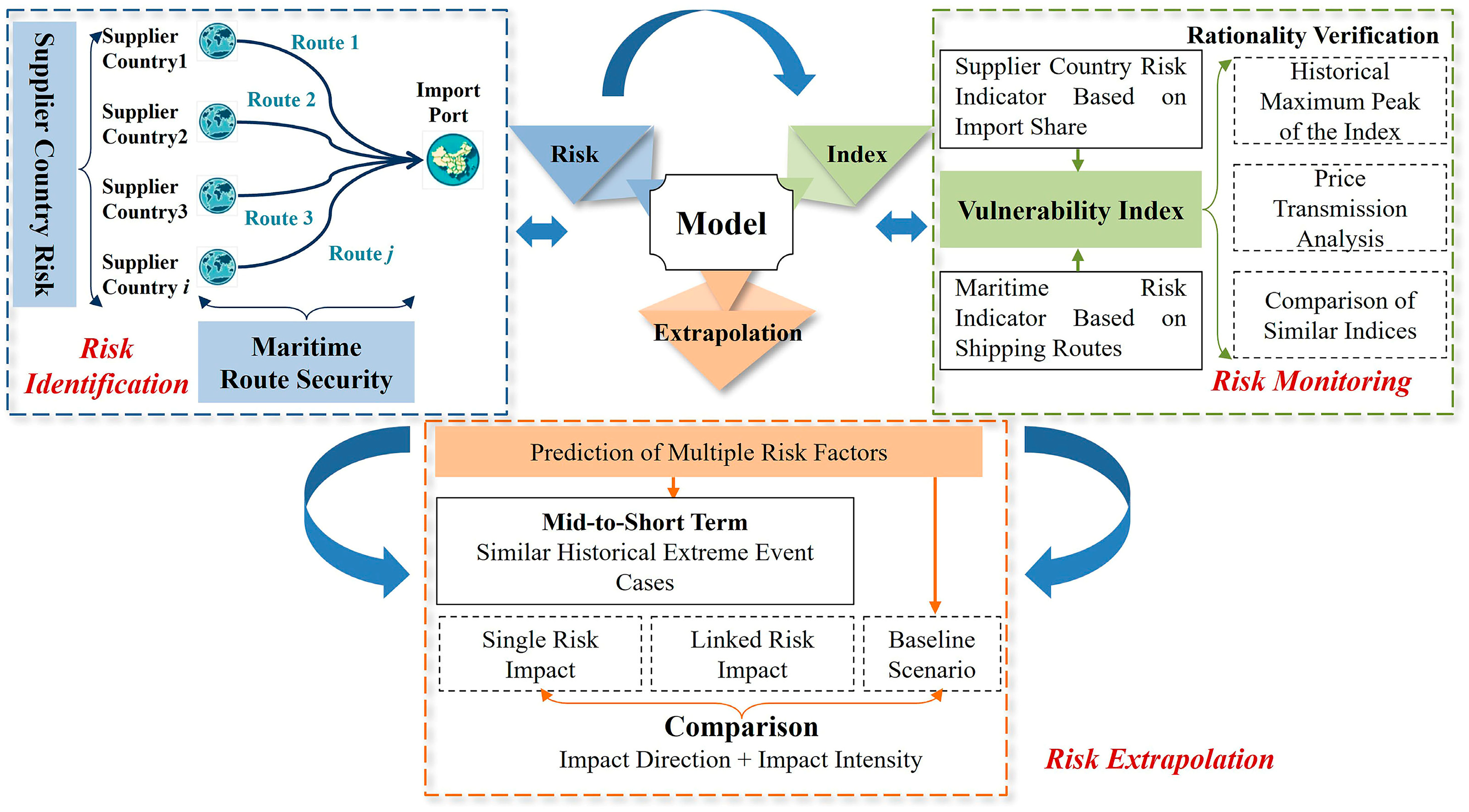
Figure 1. Risk Identification, Monitoring, and Extrapolation (RIME) framework for maritime bulk commodity physical supply chains.
Systems 14 00120 g001
Figure 2. Dynamic mapping mechanism based on the “shorter voyage–lower risk”.
Systems 14 00120 g002
Figure 3. Flowchart of the risk extrapolation algorithm.
Systems 14 00120 g003
Figure 4. Diplomatic sentiment index.
Systems 14 00120 g004
Figure 5. Data flow diagram.
Systems 14 00120 g005
Figure 6. PSVI for iron ore from major supplier countries.
Systems 14 00120 g006
Figure 7. CPSVI for iron ore.
Systems 14 00120 g007
Figure 8. The impact of increased physical supply chain risks of imported iron ore. Note: The black solid line represents the median impulse response of the specified variable to a two-standard-deviation shock in the CPSVI. The dark and light shaded areas represent the 68% and 95% confidence intervals, respectively.
Systems 14 00120 g008
Figure 9. Correlation coefficients for different lags. Note: * indicates significance at the 1% level.
Systems 14 00120 g009
Figure 10. Simulation results of the deterioration of Sino–Australia relations and the Vale dam collapse.
Systems 14 00120 g010
Figure 11. Simulation results of pirate attacks.
Systems 14 00120 g011
Figure 12. Extrapolation under combined shocks from deteriorating Sino–Australia relations and South China Sea piracy.
Systems 14 00120 g012
Figure 13. Extrapolation under combined shocks from Vale dam collapse and piracy in the South China Sea and the Strait of Malacca.
Systems 14 00120 g013
Table 1. Risk indicators for the physical supply chain of maritime bulk commodities.
RiskDriverIndicatorIndicator DescriptionReference
Supplier Country RiskGeopolitical RiskGeopolitical Risk Index (GPR)A monthly index based on the proportion of articles reporting adverse geopolitical events in the supplier country’s major newspapers[47]
Trade Policy Uncertainty Index (TPR)A monthly index based on the proportion of articles discussing trade policy uncertainty in the supplier country’s major newspapers[57]
Sovereign Credit RiskSovereign Credit RatingSovereign credit ratings and outlooks published by Standard & Poor’s[48]
Resource RiskReservesTotal proven reserves of the commodity in the supplier country[58]
Reserve-to-Production RatioThe ratio of proven reserves to annual production[59]
Export ShareRatio of export volume to total production of the commodity[60]
Foreign DependenceBilateral TradeTotal trade value of the commodity between the supplier and importing countries[58]
Export Value/GDPThe ratio of the export value from the supplier country to the GDP of the importing country[59]
Import Value/GDPThe ratio of the export value from the supplier country to the GDP of the importing country
Foreign Direct InvestmentDirect investment from the supplier country to the importing country
Diplomatic RiskDiplomatic Sentiment IndexA monthly index based on the sentiment of headlines from major newspapers in the supplier and importing countries[56]
Maritime RiskMaritime AccidentsNumber of maritime accidents in key areas along the shipping routes [50]
Piracy AttacksNumber of piracy attacks in key areas along the shipping routes [61]
Terrorist Activities and Armed ConflictsWhether terrorist activities and armed conflicts occur in key areas along the shipping routes [62]
Table 2. Maritime transport routes for China’s imported iron ore.
PortRouteDistance
Hedland Port, Australia to Qingdao, China (C5)Hedland Port–Indian Ocean–Lombok Strait–Makassar Strait–Celebes Sea–Sulu Sea–South China Sea–East China Sea–Yellow Sea–Qingdao3613.1 nm
Tubarao Port, Brazil to Qingdao, China (C3)Tubarao Port–Atlantic Ocean–Cape of Good Hope–Indian Ocean–Strait of Malacca–South China Sea–East China Sea–Yellow Sea–Qingdao11,427.4 nm
Paradip Port, India to Huanghua, ChinaParadip Port–Bay of Bengal–Myanmar Sea–Strait of Malacca–South China Sea–Taiwan Strait–East China Sea–Yellow Sea–Huanghua Port4394.6 nm
Saldanha Bay, South Africa to Tianjin, ChinaSaldanha Bay–Cape of Good Hope–Indian Ocean–Strait of Malacca–South China Sea–East China Sea–Yellow Sea–Tianjin8583.2 nm
Note: Shipping distances are obtained from Shipxy (https://www.shipxy.com/ (accessed on 15 December 2024)).
Table 3. Major maritime physical supply chain shocks since 2000.
MonthRankCPSVIShockEvent
January 2015515.787.01Completion of Australia’s expansion plan
July 20151316.465.84
December 2015718.826.80
February 2016177.845.38Capacity reduction and environmental production restrictions
November 2016419.647.64
July 2017811.386.59
April 20181614.995.67Sino–U.S. trade friction
January 2019617.666.94Vale dam collapse in Brazil
May 20191121.126.07
July 20191012.696.25
October 20192017.765.23
December 2019921.206.46
March 2020110.5510.34Outbreak of the COVID-19 pandemic
October 2020211.817.80
March 2021318.607.69
May 20211910.225.24
January 20221217.245.93
February 20221819.475.31
March 20221522.675.73
January 20231417.585.77
Table 4. Explanatory power of supplier country risks by country on prices.
Full   Sample :   P t
(1)(2)(3)(4)
P t 1 0.236 ***
(3.60)
0.213 ***
(3.26)
0.236 ***
(3.60)
0.241 ***
(3.66)
C R t 1 A U 0.220 ***
(3.00)
C R t 2 A U −0.186 ***
(−2.53)
C R t 1 B R −0.014
(−0.25)
C R t 2 B R 0.115 **
(2.05)
C R t 1 I N 0.091
(1.18)
C R t 1 Z A −0.030
(−0.38)
CSO0.224 **
(2.29)
0.217 **
(2.22)
0.196 *
(1.97)
0.202 **
(2.02)
BDI0.012
(1.19)
0.001
(0.12)
0.005
(0.50)
0.002
(0.22)
ER−1.020
(−1.44)
−1.362 **
(−1.99)
−1.213 *
(−1.77)
−1.185 *
(−1.71)
PPI−0.003 **
(−1.98)
−0.003 **
(−2.02)
−0.002
(−1.57)
−0.002
(−1.50)
R 2 0.1520.1540.1190.114
Note: ***, **, and * indicate significance at the 1%, 5%, and 10% levels, respectively.
Table 5. Explanatory power of country-specific maritime risks on prices.
Full   Sample :   P t Specific   Time   Window :   P t
(1)(2)(3)(4)(1)(2)
November 2007–June 2015September 2017–December 2023
P t 1 0.280 ***
(4.29)
0.273 ***
(4.18)
0.264 ***
(4.00)
0.274 ***
(4.20)
0.329 ***
(3.28)
0.201 *
(1.86)
T R R t 1 A U 0.043
(1.34)
0.138 *
(1.73)
T R R t 1 B R 0.008
(0.25)
0.153 **
(2.34)
T R R t 1 I N 0.031
(0.93)
−0.007
(−0.22)
T R R t 1 Z A
R 2 0.0820.0750.0790.0750.1260.110
Note: ***, **, and * indicate significance at the 1%, 5%, and 10% levels, respectively.
Table 6. Granger causality test between the CPSVI and GSCPI.
Hypothesis A: CPSVI Is Not a Granger Cause of GSCPIHypothesis B: GSCPI Is Not a Granger Cause of CPSVI
F χ 2 F χ 2
0.575
(0.7505)
3.448
(0.7509)
2.956 ***
(0.0082)
17.738 ***
(0.0069)
Note: *** indicate significance at the 1%.
Table 7. Disturbance factors of historical emergencies.
Historical EventTime WindowDisturbance FactorAverage Change Rate
Deterioration of Sino–Australia RelationsDecember 2017–November 2023Geopolitical Risk Index58%
Diplomatic Sentiment Index65.03%
Vale Dam Disaster in BrazilJanuary 2019–June 2019Production to Square Ratio21.85%
Reserve-to-Extraction Ratio22.38%
Import Proportion22.94%
Pirate AttacksJanuary 2010–December 2020South China Sea Pirate Attacks73.02%
January 2014–December 2015Strait of Malacca Pirate Attacks67.17%
Table 8. Simulated shock change rates of disturbance factors for supplier country emergencies.
Historical EventRepresentative EventTime WindowDisturbance FactorSimulated Shock Change Rate
Deterioration of Sino–Australia RelationsAustralia passing the “Foreign Interference Law” and publicly accusing China of political interference for the first timeJune 2018–December 2018Geopolitical Risk Index[62.83%, 62.37%, 48.50%, 45.81%, 108.55%, 26.97%]
Australia pushing for a COVID-19 origin investigation, China launching trade countermeasures (barley, beef, coal, wine)April 2020–October 2020Diplomatic Sentiment Index[86.68%, 79.32%, 69.46%, 53.87%, 122.44%, 34.22%]
Australia unilaterally tearing up the “Belt and Road” agreementApril 2021–October 2021
Vale Dam Disaster in BrazilJanuary 2019–July 2019Production to Square Ratio[21.85%, 21.85%, 21.85%, 21.85%, 21.85%, 21.85%]
Reserve-to-Extraction Ratio[22.38%, 22.38%, 22.38%, 22.38%, 22.38%, 22.38%]
Import Proportion[29.94%, 4.54%, 5.46%, −28.51%, −51.48%, 5.81%]
Disclaimer/Publisher’s Note: The statements, opinions and data contained in all publications are solely those of the individual author(s) and contributor(s) and not of MDPI and/or the editor(s). MDPI and/or the editor(s) disclaim responsibility for any injury to people or property resulting from any ideas, methods, instructions or products referred to in the content.