Digital Transformation, Strategic Alignment Capability, and Sustainable Competitive Advantage: The Case of the UAE

Abstract
1. Introduction
RQ1: What is the impact of strategic orientations on firms’ sustainable competitive advantage?
RQ2: What is the mediation impact of integrated strategic capabilities on firms’ sustainable competitive advantage?RQ3: What is the moderation–mediation effect of digital transformation in the relationship between strategic orientations and sustainable competitive advantage through integrated strategic capabilities?
2. Theoretical Framework
2.1. Dynamic Capability Theory as a Foundation
2.2. Strategic Orientations and Sustainable Competitive Advantage
2.3. Strategic Orientations and Integrated Strategic Capabilities
2.4. Integrated Strategic Capabilities and Sustainable Competitive Advantage
2.5. The Mediating Effect of Integrated Strategic Capabilities
2.6. The Moderating Role of Digital Transformation
3. Methodology
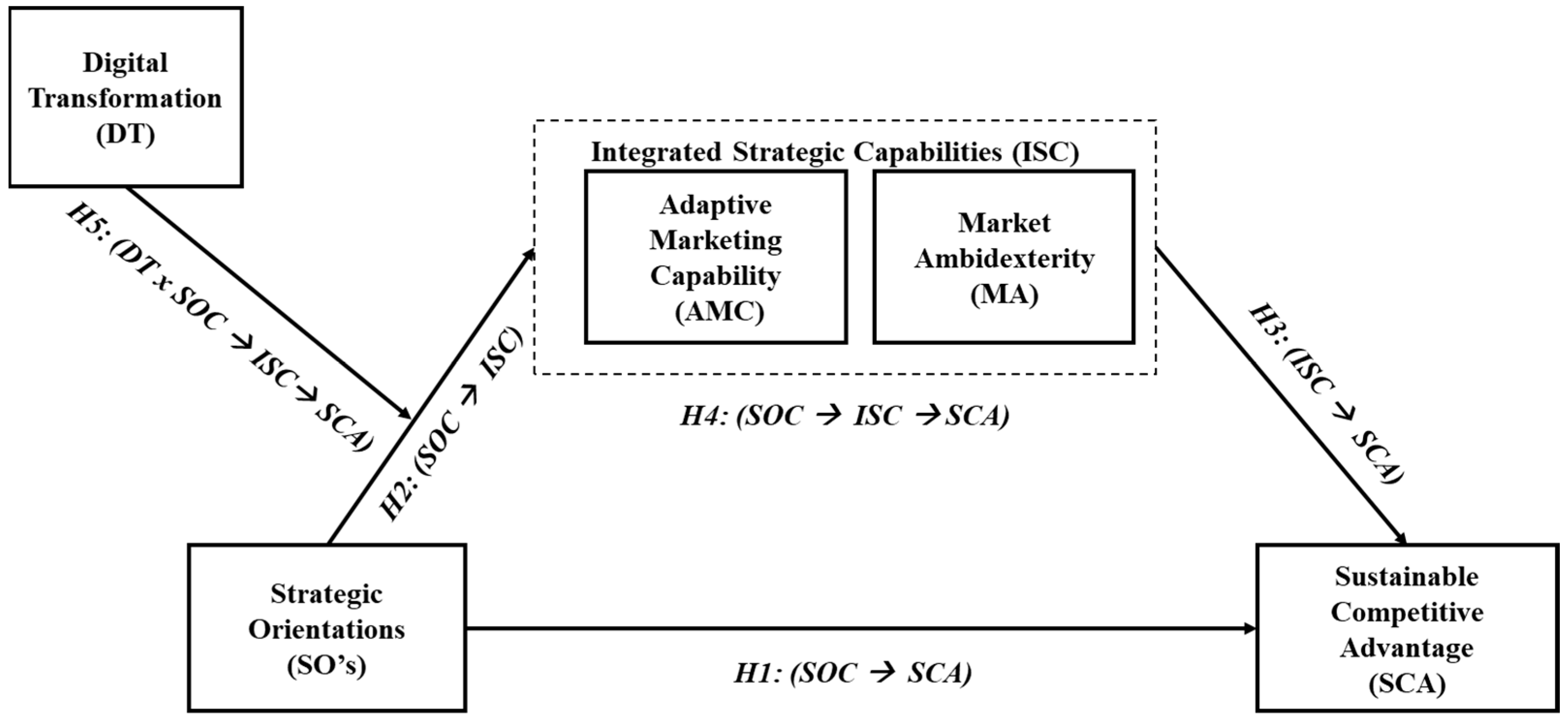
- Strategic orientations (SO’s): Independent variable;
- Sustainable competitive advantage (SCA): Dependent variable;
- Adaptive marketing capability (AMC): First mediator;
- Market ambidexterity (MA): Second mediator;
- Digital transformation: Moderator.
- Step 1: Online survey developed using seven-point Likert scale;
- Step 2: Convivence sampling method was adopted as random sampling was found difficult to be performed practically;
- Step 3: Online survey distributed to respondents;
- Step 4: Responses were cleaned up from speeders for higher data accuracy;
- Step 5: Data analysis was carried out.
4. Results and Discussion
4.1. Validity and Reliability
4.2. Multicollinearity Assessments
4.3. Convergent Validity
4.4. Discriminant Validity
4.5. Confirmatory Analysis
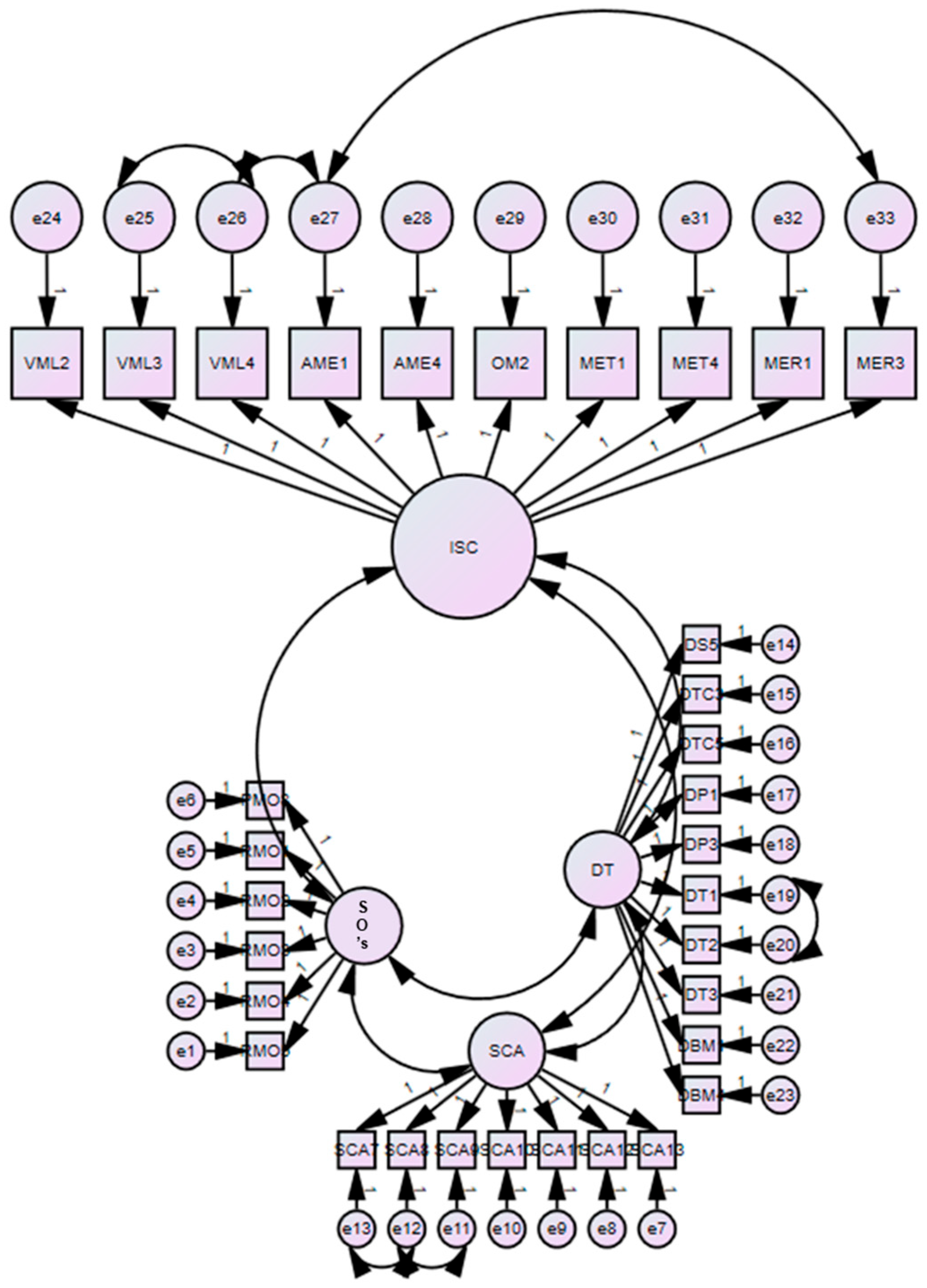
Measurement Model
5. Conclusions
6. Practical Implications
7. Limitations of the Study and Future Research
Author Contributions
Funding
Data Availability Statement
Conflicts of Interest
Appendix A

| Construct | Dimension | Item | Code |
|---|---|---|---|
| Adaptive Marketing Capability (AMC) | Vigilant Market Learning |
|
|
| Adaptive Marketing Capability (AMC) | Adaptive Market Experimentation |
|
|
| Adaptive Marketing Capability (AMC) | Open Marketing |
|
|
| Market Ambidexterity Capability (MA) | Market Exploitation |
|
|
| Market Ambidexterity Capability (MA) | Market Exploration |
|
|
| Sustainable Competitive Advantage (SCA) | Differentiation and Cost Leadership |
|
|
| Strategic Orientations (SO’s) | Proactive Market Orientation (PMO) |
|
|
| Strategic Orientations (SO’s) | Responsive Market Orientation (RMO) |
|
|
| Strategic Orinetations (SO’s) | Innovation Orientations (IO) |
|
|
| Digital Transformation (DT) | Digital Strategy |
|
|
| Digital Transformation (DT) | Digital Culture |
|
|
| Digital Transformation (DT) | Digital Process |
|
|
| Digital Transformation (DT) | Digital Technologies |
|
|
| Digital Transformation (DT) | Digital Business Models |
|
|
References
- Srikanth, K.; Ungureanu, T. Organizational adaptation in dynamic environments: Disentangling the effects of how much to explore versus where to explore. Strateg. Manag. J. 2025, 46, 19–48. [Google Scholar] [CrossRef]
- Waseel, A.H.; Zhang, J.; Shehzad, M.U.; Hussain Sarki, I.; Kamran, M.W. Navigating the innovation frontier: Ambidextrous strategies, knowledge creation, and organizational agility in the pursuit of competitive excellence. Bus. Process Manag. J. 2024, 30, 2127–2160. [Google Scholar] [CrossRef]
- Bukht, R.; Heeks, R. Defining, Conceptualising and Measuring the Digital Economy. Development Informatics Working Paper No 68. 2017. Available online: https://ssrn.com/abstract=3431732 (accessed on 1 January 2026).
- Li, L.; Ye, F.; Zhan, Y.; Kumar, A.; Schiavone, F.; Li, Y. Unraveling the performance puzzle of digitalization: Evidence from manufacturing firms. J. Bus. Res. 2022, 149, 54–64. [Google Scholar] [CrossRef]
- Guo, X.; Li, M.; Wang, Y.; Mardani, A. Does digital transformation improve the firm’s performance? From the perspective of digitalization paradox and managerial myopia. J. Bus. Res. 2023, 163, 113868. [Google Scholar] [CrossRef]
- Du, X.; Jiang, K. Promoting enterprise productivity: The role of digital transformation. Borsa Istanb. Rev. 2022, 22, 1165–1181. [Google Scholar] [CrossRef]
- Chen, W.; Srinivasan, S. Going digital: Implications for firm value and performance. Rev. Account. Stud. 2024, 29, 1619–1665. [Google Scholar] [CrossRef]
- Bai, H.; Huang, L.; Wang, Z. Supply chain financing, digital financial inclusion and enterprise innovation: Evidence from China. Int. Rev. Financ. Anal. 2024, 91, 103044. [Google Scholar] [CrossRef]
- Wang, X.; Zhong, M. Can digital economy reduce carbon emission intensity? Empirical evidence from China’s smart city pilot policies. Environ. Sci. Pollut. Res. 2023, 30, 51749–51769. [Google Scholar] [CrossRef] [PubMed]
- Teece, D.J.; Pisano, G.; Shuen, A. Dynamic capabilities and strategic management. Strateg. Manag. J. 1997, 18, 509–533. [Google Scholar] [CrossRef]
- Elazhary, M.; Popovič, A.; Henrique de Souza Bermejo, P.; Oliveira, T. How information technology governance influences organizational agility: The role of market turbulence. Inf. Syst. Manag. 2023, 40, 148–168. [Google Scholar] [CrossRef]
- Akgün, A.E.; Polat, V. Strategic orientations, marketing capabilities and innovativeness: An adaptive approach. J. Bus. Ind. Mark. 2022, 37, 918–931. [Google Scholar] [CrossRef]
- Narver, J.C.; Slater, S.F. The effect of a market orientation on business profitability. J. Mark. 1990, 54, 20–35. [Google Scholar] [CrossRef]
- Jahanshahi, A.A.; Sonmez Cakir, F.; Adiguzel, Z.; Karaaslan, N. Strategic orientation and innovation culture: Catalysts for success in the dynamic Turkish IT industry. J. Bus. Ind. Mark. 2025, 40, 1046–1064. [Google Scholar] [CrossRef]
- Jaworski, B.J.; Kohli, A.K. Market orientation: Antecedents and consequences. J. Mark. 1993, 57, 53–70. [Google Scholar] [CrossRef]
- Day, G.S. Closing the marketing capabilities gap. J. Mark. 2011, 75, 183–195. [Google Scholar] [CrossRef]
- Moorman, C.; Day, G.S. Organizing for marketing excellence. J. Mark. 2016, 80, 6–35. [Google Scholar] [CrossRef]
- Mu, J. Marketing capability, organizational adaptation and new product development performance. Ind. Mark. Manag. 2015, 49, 151–166. [Google Scholar] [CrossRef]
- Mu, J.; Bao, Y.; Sekhon, T.; Qi, J.; Love, E. Outside-in marketing capability and firm performance. Ind. Mark. Manag. 2018, 75, 37–54. [Google Scholar] [CrossRef]
- Ali, S.; Wu, W.; Ali, S. Adaptive marketing capability and product innovations: The role of market ambidexterity and transformational leadership (evidence from Pakistani manufacturing industry. Eur. J. Innov. Manag. 2022, 25, 1056–1091. [Google Scholar] [CrossRef]
- Clauss, T.; Kraus, S.; Kallinger, F.L.; Bican, P.M.; Brem, A.; Kailer, N. Organizational ambidexterity and competitive advantage: The role of strategic agility in the exploration-exploitation paradox. J. Innov. Knowl. 2021, 6, 203–213. [Google Scholar] [CrossRef]
- Weiss, L.; Kanbach, D.K. Toward an integrated framework of corporate venturing for organizational ambidexterity as a dynamic capability. Manag. Rev. Q. 2022, 72, 1129–1170. [Google Scholar] [CrossRef]
- Khan, M.T.; Ullah, S. Balancing innovation: The role of paradoxical leadership and ambidexterity in fostering team creativity. Int. J. Innov. Sci. 2025. [Google Scholar] [CrossRef]
- Ellström, D.; Holtström, J.; Berg, E.; Josefsson, C. Dynamic capabilities for digital transformation. J. Strategy Manag. 2022, 15, 272–286. [Google Scholar] [CrossRef]
- Uren, V.; Edwards, J.S. Technology readiness and the organizational journey towards AI adoption: An empirical study. Int. J. Inf. Manag. 2023, 68, 102588. [Google Scholar] [CrossRef]
- Akkiraju, R.; Sinha, V.; Xu, A.; Mahmud, J.; Gundecha, P.; Liu, Z.; Liu, X.; Schumacher, J. Characterizing machine learning processes: A maturity framework. In International Conference on Business Process Management; Springer International Publishing: Cham, Switzerland, 2020; pp. 17–31. [Google Scholar]
- Ellefsen, A.P.T.; Oleśków-Szłapka, J.; Pawłowski, G.; Toboła, A. Striving for excellence in AI implementation: AI maturity model framework and preliminary research results. LogForum 2019, 15, 363–376. [Google Scholar] [CrossRef]
- Pumplun, L.; Fecho, M.; Wahl, N.; Peters, F.; Buxmann, P. Adoption of machine learning systems for medical diagnostics in clinics: Qualitative interview study. J. Med. Internet Res. 2021, 23, e29301. [Google Scholar] [CrossRef]
- Neumann, O.; Guirguis, K.; Steiner, R. Exploring artificial intelligence adoption in public organizations: A comparative case study. Public Manag. Rev. 2024, 26, 114–141. [Google Scholar] [CrossRef]
- Zhang, W.; Zuo, N.; He, W.; Li, S.; Yu, L. Factors influencing the use of artificial intelligence in government: Evidence from China. Technol. Soc. 2021, 66, 101675. [Google Scholar] [CrossRef]
- Peteraf, M.; Di Stefano, G.; Verona, G. The elephant in the room of dynamic capabilities: Bringing two diverging conversations together. Strateg. Manag. J. 2013, 34, 1389–1410. [Google Scholar] [CrossRef]
- Warner, K.S.; Wäger, M. Building dynamic capabilities for digital transformation: An ongoing process of strategic renewal. Long Range Plan. 2019, 52, 326–349. [Google Scholar] [CrossRef]
- Hinterhuber, A.; Vescovi, T.; Checchinato, F. Managing Digital Transformation. In Understanding the Strategic Process; Routledge: Abingdon, UK; New York, NY, USA, 2021. [Google Scholar]
- McGrath, R.G. The End of Competitive Advantage: How to Keep Your Strategy Moving as Fast as Your Business; Harvard Business Review Press: Brighton, MA, USA, 2013. [Google Scholar]
- Ed-Dafali, S.; Al-Azad, M.S.; Mohiuddin, M.; Reza, M.N.H. Strategic orientations, organizational ambidexterity, and sustainable competitive advantage: Mediating role of industry 4.0 readiness in emerging markets. J. Clean. Prod. 2023, 401, 136765. [Google Scholar] [CrossRef]
- Hunt, S.D.; Madhavaram, S. Adaptive marketing capabilities, dynamic capabilities, and renewal competences: The “outside vs. inside” and “static vs. dynamic” controversies in strategy. Ind. Mark. Manag. 2020, 89, 129–139. [Google Scholar] [CrossRef]
- Farzaneh, M.; Wilden, R.; Afshari, L.; Mehralian, G. Dynamic capabilities and innovation ambidexterity: The roles of intellectual capital and innovation orientation. J. Bus. Res. 2022, 148, 47–59. [Google Scholar] [CrossRef]
- March, J.G. Exploration and exploitation in organizational learning. Organ. Sci. 1991, 2, 71–87. [Google Scholar] [CrossRef]
- Tian, H.; Dogbe, C.S.K.; Pomegbe, W.W.K.; Sarsah, S.A.; Otoo, C.O.A. Organizational learning ambidexterity and openness, as determinants of SMEs’ innovation performance. Eur. J. Innov. Manag. 2021, 24, 414–438. [Google Scholar] [CrossRef]
- Tallon, P.P.; Pinsonneault, A. Competing perspectives on the link between strategic information technology alignment and organizational agility: Insights from a mediation model. MIS Q. 2011, 35, 463–486. [Google Scholar] [CrossRef]
- Autio, E.; Nambisan, S.; Thomas, L.D.; Wright, M. Digital affordances, spatial affordances, and the genesis of entrepreneurial ecosystems. Strateg. Entrep. J. 2018, 12, 72–95. [Google Scholar] [CrossRef]
- Vial, G. Understanding digital transformation: A review and a research agenda. In Managing Digital Transformation; Elsevier: Amsterdam, The Netherland, 2021; pp. 13–66. [Google Scholar]
- Liu, J.; Yang, W.; Liu, W. Adaptive capacity configurations for the digital transformation: A fuzzy-set analysis of Chinese manufacturing firms. J. Organ. Change Manag. 2021, 34, 1222–1241. [Google Scholar] [CrossRef]
- Tushman, M.L.; O’Reilly, C.A., III. Ambidextrous organizations: Managing evolutionary and revolutionary change. Calif. Manag. Rev. 1996, 38, 8–29. [Google Scholar] [CrossRef]
- Ghantous, N.; Alnawas, I. The differential and synergistic effects of market orientation and entrepreneurial orientation on hotel ambidexterity. J. Retail. Consum. Serv. 2020, 55, 102072. [Google Scholar] [CrossRef]
- Ganzaroli, A.; De Noni, I.; Orsi, L.; Belussi, F. The combined effect of technological relatedness and knowledge utilization on explorative and exploitative invention performance post-M & A. Eur. J. Innov. Manag. 2016, 19, 167–188. [Google Scholar] [CrossRef]
- Teece, D.J. Business models and dynamic capabilities. Long Range Plan. 2018, 51, 40–49. [Google Scholar] [CrossRef]
- Al Jabri, M.A.S.; Lahrech, A. The Role of Strategic Orientations in the Relationship Between Adaptive Marketing Capabilities and Ambidexterity in Digital Services Firms: The Case of a Highly Competitive Digital Economy. Systems 2025, 13, 358. [Google Scholar] [CrossRef]
- Schneider, M.H.; Kanbach, D.K.; Kraus, S.; Dabić, M. Transform me if you can: Leveraging dynamic capabilities to manage digital transformation. IEEE Trans. Eng. Manag. 2023, 71, 9094–9108. [Google Scholar] [CrossRef]
- Baden-Fuller, C.; Teece, D.J. Market sensing, dynamic capability, and competitive dynamics. Ind. Mark. Manag. 2020, 89, 105–106. [Google Scholar] [CrossRef]
- Satar, A.; Al Musadieq, M.; Hutahayan, B. Enhancing sustainable competitive advantage: The role of dynamic capability and organizational agility in technology and knowledge management: Indonesian stock exchange evidence. Int. J. Oper. Quant. Manag. 2023, 29, 431–457. [Google Scholar]
- Pitelis, C.N.; Teece, D.J.; Yang, H. Dynamic capabilities and MNE global strategy: A systematic literature review-based novel conceptual framework. J. Manag. Stud. 2024, 61, 3295–3326. [Google Scholar] [CrossRef]
- Vettorello, M.; Eisenbart, B.; Ranscombe, C. Paradoxical tension: Balancing contextual ambidexterity. In Proceedings of the Design Society: DESIGN Conference; Cambridge University Press: Cambridge, UK, 2020; Volume 1, pp. 1385–1394. [Google Scholar]
- Wijayanti, R.W.; Rokhim, R.; Anas, E.P.; Aruan, D.T. Dynamic Managerial Capabilities in Marketing: A Systematic Review and Research Agenda. J. Logist. Inform. Serv. Sci. 2024, 11, 366–387. [Google Scholar]
- Yousefi, N.; Ahmady, R.; Mehralian, G. Intellectual resource and new product performance: Mediating role of innovation capability. Int. J. Learn. Intellect. Cap. 2022, 19, 154–168. [Google Scholar] [CrossRef]
- Davcik, N.S.; Cardinali, S.; Sharma, P.; Cedrola, E. Exploring the role of international R&D activities in the impact of technological and marketing capabilities on SMEs’ performance. J. Bus. Res. 2021, 128, 650–660. [Google Scholar] [CrossRef]
- Pfajfar, G.; Mitręga, M.; Shoham, A. International dynamic marketing capabilities: Developments and a research agenda. Int. Mark. Rev. 2024, 41, 1–41. [Google Scholar] [CrossRef]
- Saeedikiya, M.; Salunke, S.; Kowalkiewicz, M. Toward a dynamic capability perspective of digital transformation in SMEs: A study of the mobility sector. J. Clean. Prod. 2024, 439, 140718. [Google Scholar] [CrossRef]
- Jasim, B.H. Strategic Management for Sustainable Competitive Advantage: Integrating RBV, Dynamic Capabilities, Digital Transformation, and ESG. South Asian Res. J. Bus Manag. 2025, 7, 420–423. [Google Scholar] [CrossRef]
- Noble, C.H.; Sinha, R.K.; Kumar, A. Market orientation and alternative strategic orientations: A longitudinal assessment of performance implications. J. Mark. 2002, 66, 25–39. [Google Scholar] [CrossRef]
- Wales, W.J.; Kraus, S.; Filser, M.; Stöckmann, C.; Covin, J.G. The status quo of research on entrepreneurial orientation: Conversational landmarks and theoretical scaffolding. J. Bus. Res. 2021, 128, 564–577. [Google Scholar] [CrossRef]
- Khedhaouria, A.; Nakara, W.A.; Gharbi, S.; Bahri, C. The relationship between organizational culture and small-firm performance: Entrepreneurial orientation as mediator. Eur. Manag. Rev. 2020, 17, 515–528. [Google Scholar] [CrossRef]
- Zhou, K.Z.; Yim, C.K.; Tse, D.K. The effects of strategic orientations on technology-and market-based breakthrough innovations. J. Mark. 2005, 69, 42–60. [Google Scholar] [CrossRef]
- Sahi, G.K.; Gupta, M.C.; Cheng, T.C.E. The effects of strategic orientation on operational ambidexterity: A study of indian SMEs in the industry 4.0 era. Int. J. Prod. Econ. 2020, 220, 107395. [Google Scholar] [CrossRef]
- Porter, M.E. Competitive Advantage: Creating and Sustaining Superior Performance; Simon and Schuster: New York, NY, USA, 2008. [Google Scholar]
- Morgan, N.A.; Vorhies, D.W.; Mason, C.H. Market orientation, marketing capabilities, and firm performance. Strateg. Manag. J. 2009, 30, 909–920. [Google Scholar] [CrossRef]
- Hult, G.T.M.; Snow, C.C.; Kandemir, D. The role of entrepreneurship in building cultural competitiveness in different organizational types. J. Manag. 2003, 29, 401–426. [Google Scholar]
- Khizar, H.M.U.; Iqbal, M.J. Linking sustainability orientation in SMEs strategic approach for sustainable firm performance: An integrative framework. Paradigms 2020, S1, 165–170. [Google Scholar]
- van Lieshout, J.W.; Nijhof, A.H.; Naarding, G.J.; Blomme, R.J. Connecting strategic orientation, innovation strategy, and corporate sustainability: A model for sustainable development through stakeholder engagement. Bus. Strategy Environ. 2021, 30, 4068–4080. [Google Scholar] [CrossRef]
- Ingram, T.; Bratnicka-Myśliwiec, K.; Kraśnicka, T.; Steinerowska-Streb, I. Entrepreneurial orientation as a determinant of sustainable performance in Polish family and non-family organizations. Sustainability 2022, 14, 16393. [Google Scholar] [CrossRef]
- Al Shawabkeh, K.M. The Impact of Strategic Orientations on Sustainable Performance: The Moderating Role of Business Intelligence at Jordanian Commercial Banks. J. Intell. Stud. Bus. 2024, 14, 13–30. [Google Scholar] [CrossRef]
- Barney, J.B. Gaining and Sustaining Competitive Advantage; Prentice Hall: Hoboken, NJ, USA, 1997. [Google Scholar]
- Kiyabo, K.; Isaga, N. Entrepreneurial orientation, competitive advantage, and SMEs’ performance: Application of firm growth and personal wealth measures. J. Innov. Entrep. 2020, 9, 12. [Google Scholar] [CrossRef]
- Cake, D.A.; Agrawal, V.; Gresham, G.; Johansen, D.; Di Benedetto, A. Strategic orientations, marketing capabilities and radical innovation launch success. J. Bus. Ind. Mark. 2020, 35, 1527–1537. [Google Scholar] [CrossRef]
- Hassen, Y.; Singh, A. The effect of market orientation on the performance of small and medium enterprises in case of Amhara Region, Ethiopia. J. New Bus. Ventur. 2020, 1, 92–109. [Google Scholar] [CrossRef]
- O’Reilly, C.A., III; Tushman, M.L. Organizational ambidexterity: Past, present, and future. Acad. Manag. Perspect. 2013, 27, 324–338. [Google Scholar] [CrossRef]
- Gupta, A.K.; Smith, K.G.; Shalley, C.E. The interplay between exploration and exploitation. Acad. Manag. J. 2006, 49, 693–706. [Google Scholar] [CrossRef]
- Junni, P.; Sarala, R.M.; Taras, V.A.S.; Tarba, S.Y. Organizational ambidexterity and performance: A meta-analysis. Acad. Manag. Perspect. 2013, 27, 299–312. [Google Scholar] [CrossRef]
- Nasution, H.; Muafi, M.; El-Qadri, Z.M.; Suprihanto, J. Impact of digital business transformation on organizational ambidexterity and performance in indonesian insurance firms. Intang. Cap. 2025, 21, 1–20. [Google Scholar] [CrossRef]
- He, Z.L.; Wong, P.K. Exploration vs. exploitation: An empirical test of the ambidexterity hypothesis. Organ. Sci. 2004, 15, 481–494. [Google Scholar] [CrossRef]
- Gibson, C.B.; Birkinshaw, J. The antecedents, consequences, and mediating role of organizational ambidexterity. Acad. Manag. J. 2004, 47, 209–226. [Google Scholar] [CrossRef]
- Raisch, S.; Birkinshaw, J. Organizational ambidexterity: Antecedents, outcomes, and moderators. J. Manag. 2008, 34, 375–409. [Google Scholar] [CrossRef]
- Chughtai, M.S.; Syed, F.; Naseer, S.; Chinchilla, N. Role of adaptive leadership in learning organizations to boost organizational innovations with change self-efficacy. Curr. Psychol. 2024, 43, 27262–27281. [Google Scholar] [CrossRef]
- Marin Idarraga, D.A.; Hurtado González, J.M.; Cabello Medina, C.; Sabidussi, A. Ambidexterity and innovation: A systematic and meta-analytic approach to mediating effects on performance. Technol. Anal. Strateg. Manag. 2025, 37, 4596–4613. [Google Scholar] [CrossRef]
- Kirova, V. The wind of change: A dynamic managerial capabilities perspective on the role of marketing managers as strategic change agents. J. Bus. Res. 2023, 160, 113817. [Google Scholar] [CrossRef]
- Alves, A.D.A.S.M.; Carvalho, F.M.P.D.O. How Dynamic Managerial Capabilities, Entrepreneurial Orientation, and Operational Capabilities Impact Microenterprises’ Global Performance. Sustainability 2022, 15, 14. [Google Scholar] [CrossRef]
- Chebbi, H.; Ben Selma, M.; Bouzinab, K.; Papadopoulos, A.; Labouze, A.; Desmarteau, R. Accelerated internationalization of SMEs and microfoundations of dynamic capabilities: Towards an integrated conceptual framework. Rev. Int. Bus. Strategy 2023, 33, 35–54. [Google Scholar] [CrossRef]
- Ardabili, F.S.; Verbenko, G.; Cajnko, P. The effects of organanizational agility on organizational performance: The mediating role of ambidexterity. J. Innov. Sustain. RISUS 2025, 16, 114–123. [Google Scholar] [CrossRef]
- Day, G.S.; Schoemaker, P.J. Adapting to fast-changing markets and technologies. Calif. Manag. Rev. 2016, 58, 59–77. [Google Scholar] [CrossRef]
- Ansari, A.; Mela, C.F.; Neslin, S.A. Customer channel migration. J. Mark. Res. 2008, 45, 60–76. [Google Scholar] [CrossRef]
- Rukani, S.D.; Ratnasari, S.D. Mediation of dynamic innovation capability on digital transformation and employee collaborative innovation on employee performance. Indones. Interdiscip. J. Sharia Econ. (IIJSE) 2024, 7, 3677–3692. [Google Scholar]
- ütfihak Alpkan, L.; Şanal, M.; üksel Ayden, Y. Market orientation, ambidexterity and performance outcomes. Procedia-Soc. Behav. Sci. 2012, 41, 461–468. [Google Scholar] [CrossRef][Green Version]
- Belhadi, A.; Kamble, S.; Gunasekaran, A.; Mani, V. Analyzing the mediating role of organizational ambidexterity and digital business transformation on industry 4.0 capabilities and sustainable supply chain performance. Supply Chain Manag. Int. J. 2022, 27, 696–711. [Google Scholar] [CrossRef]
- Dogbe, C.S.K.; Bamfo, B.A.; Pomegbe, W.W.K. Market orientation and new product success relationship: The role of innovation capability, absorptive capacity, green brand positioning. Int. J. Innov. Manag. 2021, 25, 2150033. [Google Scholar] [CrossRef]
- Supriyanto, A.; Said, L.R.; Firdaus, M.R.; Asma, R.; Redawati, R. A systematic literature review on dynamic capabilities in marketing. Access J. Access Sci. Bus. Innov. Digit. Econ. 2024, 5, 478–492. [Google Scholar] [CrossRef]
- Volberda, H.W.; Khanagha, S.; Baden-Fuller, C.; Mihalache, O.R.; Birkinshaw, J. Strategizing in a digital world: Overcoming cognitive barriers, reconfiguring routines and introducing new organizational forms. Long Range Plan. 2021, 54, 102110. [Google Scholar] [CrossRef]
- Davies, P.; Bustinza, O.F.; Parry, G.; Jovanovic, M. Unpacking the relationship between digital capabilities, services capabilities, and firm financial performance: A moderated mediation model. Ind. Mark. Manag. 2023, 115, 1–10. [Google Scholar] [CrossRef]
- Abker, A.Y.; Musa, A.G. The impact of strategic orientations on service innovation: The moderating effect of technological capabilities. Probl. Perspect. Manag. 2024, 22, 83. [Google Scholar] [CrossRef]
- Saleh, R.H.; Durugbo, C.M.; Almahamid, S.M. What makes innovation ambidexterity manageable: A systematic review, multi-level model and future challenges. Rev. Manag. Sci. 2023, 17, 3013–3056. [Google Scholar] [CrossRef]
- Putra, A.H.P.K.; Rivera, K.M.; Pramukti, A. Optimizing marketing management strategies through it innovation: Big data integration for better consumer understanding. Gold. Ratio Mapp. Idea Lit. Format 2023, 3, 71–91. [Google Scholar] [CrossRef]
- Matarazzo, M.; Penco, L.; Profumo, G.; Quaglia, R. Digital transformation and customer value creation in Made in Italy SMEs: A dynamic capabilities perspective. J. Bus. Res. 2021, 123, 642–656. [Google Scholar] [CrossRef]
- Martins, A. Dynamic capabilities and SME performance in the COVID-19 era: The moderating effect of digitalization. Asia-Pac. J. Bus. Adm. 2023, 15, 188–202. [Google Scholar] [CrossRef]
- Zhu, X.; Ge, S.; Wang, N. Digital transformation: A systematic literature review. Comput. Ind. Eng. 2021, 162, 107774. [Google Scholar] [CrossRef]
- Gurbaxani, V.; Dunkle, D. Gearing up for successful digital transformation. MIS Q. Exec. 2019, 18, 6. [Google Scholar] [CrossRef]
- Fornell, C.; Larcker, D.F. Evaluating structural equation models with unobservable variables and measurement error. J. Mark. Res. 1981, 18, 39–50. [Google Scholar] [CrossRef]
- Anderson, J.C.; Gerbing, D.W. Structural equation modeling in practice: A review and recommended two-step approach. Psychol. Bull. 1988, 103, 411. [Google Scholar] [CrossRef]
- Narver, J.C.; Slater, S.F.; MacLachlan, D.L. Responsive and proactive market orientation and new-product success. J. Prod. Innov. Manag. 2004, 21, 334–347. [Google Scholar] [CrossRef]
- Weerawardena, J. The role of marketing capability in innovation-based competitive strategy. J. Strateg. Mark. 2003, 11, 15–35. [Google Scholar] [CrossRef]
- Kim, N.; Atuahene-Gima, K. Using exploratory and exploitative market learning for new product development. J. Prod. Innov. Manag. 2010, 27, 519–536. [Google Scholar] [CrossRef]
- Marx, C.; de Paula, D.; Uebernickel, F. Dynamic Capabilities & Digital Transformation: A Quantitative Study on How to Gain a Competitive Advantage in the Digital Age. 2021. Available online: https://aisel.aisnet.org/ecis2021_rp/58 (accessed on 1 January 2026).
- Valdez-de-Leon, O. A digital maturity model for telecommunications service providers. Technol. Innov. Manag. Rev. 2016, 6, 19–32. [Google Scholar] [CrossRef]
- Hair, J.F.; Ringle, C.M.; Sarstedt, M. PLS-SEM: Indeed a silver bullet. J. Mark. Theory Pract. 2011, 19, 139–152. [Google Scholar] [CrossRef]
- Efron, B.; Tibshirani, R.J. An Introduction to the Bootstrap; Chapman and Hall/CRC: New York, NY, USA, 1994. [Google Scholar]
- Hayes, A.F. Mediation, moderation, and conditional process analysis. Introd. Mediat. Moderat. Cond. Process Anal. A Regres. Based Approach 2013, 1, 12–20. [Google Scholar]
- Hair, J.F., Jr.; Sarstedt, M.; Matthews, L.M.; Ringle, C.M. Identifying and treating unobserved heterogeneity with FIMIX-PLS: Part I–method. Eur. Bus. Rev. 2016, 28, 63–76. [Google Scholar] [CrossRef]
- Henseler, J.; Ringle, C.M.; Sarstedt, M. A new criterion for assessing discriminant validity in variance-based structural equation modeling. J. Acad. Mark. Sci. 2015, 43, 115–135. [Google Scholar] [CrossRef]
- Straub, D.; Boudreau, M.C.; Gefen, D. Validation guidelines for IS positivist research. Commun. Assoc. Inf. Syst. 2004, 13, 24. [Google Scholar] [CrossRef]
- Cheung, G.W.; Rensvold, R.B. Evaluating goodness-of-fit indexes for testing measurement invariance. Struct. Equ. Model. 2002, 9, 233–255. [Google Scholar] [CrossRef]
- Hu, L.T.; Bentler, P.M. Cutoff criteria for fit indexes in covariance structure analysis: Conventional criteria versus new alternatives. Struct. Equ. Model. A Multidiscip. J. 1999, 6, 1–55. [Google Scholar] [CrossRef]
- Hayes, A.F. Beyond Baron and Kenny: Statistical mediation analysis in the new millennium. Commun. Monogr. 2009, 76, 408–420. [Google Scholar] [CrossRef]
- Ritter, T.; Pedersen, C.L. Digitization capability and the digitalization of business models in business-to-business firms: Past, present, and future. Ind. Mark. Manag. 2020, 86, 180–190. [Google Scholar] [CrossRef]
- Yasin, N.; Khansari, Z.; Tirmizi, K. Exploring the challenges for entrepreneurship business incubator hubs in the United Arab Emirates. Int. J. Glob. Small Bus. 2021, 12, 190–212. [Google Scholar] [CrossRef]
- Al Jabri, M.A.; Shaloh, S.; Shakhoor, N.; Haddoud, M.Y.; Obeidat, B.Y. The impact of dynamic capabilities on enterprise agility: The intervening roles of digital transformation and IT alignment. J. Open Innov. Technol. Mark. Complex. 2024, 10, 100266. [Google Scholar] [CrossRef]
- Hajiheydari, N.; Kargar Shouraki, M.; Vares, H.; Mohammadian, A. Digital sustainable business model innovation: Applying dynamic capabilities approach (DSBMI-DC). Foresight 2023, 25, 420–447. [Google Scholar] [CrossRef]
- Prasetyo, I.; Rusdiyanto, R.; Asyik, N.F.; Aliyyah, N.; Haidar, R.L.; Syamlan, A.F. The role of ambidexterity in mediating entrepreneurial orientation and business performance in SMES. Financ. Credit Act. Probl. Theory Pract. 2025, 2, 282. [Google Scholar]
- Wilden, R.; Leiblein, M.J.; Lin, N. Exploring performance heterogeneity: Integrative insights from strategic management and marketing. J. Retail. Consum. Serv. 2024, 79, 103834. [Google Scholar] [CrossRef]
- Reimann, C.K.; Carvalho, F.M.P.D.O.; Duarte, M.P. Adaptive marketing capabilities, market orientation, and international performance: The moderation effect of competitive intensity. J. Bus. Ind. Mark. 2022, 37, 2533–2543. [Google Scholar] [CrossRef]
- Putra, R.E.; Chandra, A.R.; Neswardi, S.; Chandra, B.; Nurhayati, N. Digital Leadership in the Framework of Upper Echelon Theory, Impact on SMEs Competitive Advantage: The Role of Innovative Performance. APMBA (Asia Pac. Manag. Bus. Appl.) 2024, 13, 87–108. [Google Scholar] [CrossRef]
- O’reilly, C.A., III; Tushman, M.L. Ambidexterity as a dynamic capability: Resolving the innovator’s dilemma. Res. Organ. Behav. 2008, 28, 185–206. [Google Scholar] [CrossRef]
- Stoenoiu, C.E.; Jäntschi, L. Connecting the Computer Skills with General Performance of Companies—An Eastern European Study. Sustainability 2024, 16, 10024. [Google Scholar] [CrossRef]
- Guo, H.; Xu, H.; Tang, C.; Liu-Thompkins, Y.; Guo, Z.; Dong, B. Comparing the impact of different marketing capabilities: Empirical evidence from B2B firms in China. J. Bus. Res. 2018, 93, 79–89. [Google Scholar] [CrossRef]


| Cosntruct | Item | Item Loading |
|---|---|---|
| Strategic Orientations (SOs) (Independent Variable) | PMO8 | 0.661 |
| RMO1 | 0.748 | |
| RMO2 | 0.771 | |
| RMO3 | 0.754 | |
| RMO4 | 0.701 | |
| RMO5 | 0.646 | |
| Sustainable Compititive Advantage (SCA) (Dependent Variable) | SCA7 | 0.824 |
| SCA8 | 0.848 | |
| SCA9 | 0.806 | |
| SCA10 | 0.756 | |
| SCA11 | 0.780 | |
| SCA12 | 0.747 | |
| SCA13 | 0.770 | |
| Integrated Strategic Capabilities, ISC (Adaptive Marketing Capability and Market Ambidexturity) (Mediators) | VML2 | 0.722 |
| VML3 | 0.818 | |
| VML4 | 0.706 | |
| AME1 | 0.580 | |
| AME4 | 0.628 | |
| OM2 | 0.618 | |
| MET1 | 0.736 | |
| MET4 | 0.495 | |
| MER1 | 0.519 | |
| MER3 | 0.417 | |
| Digital Transformation (DT) (Moderator) | DS5 | 0.641 |
| DTC3 | 0.805 | |
| DTC5 | 0.744 | |
| DP1 | 0.764 | |
| DP3 | 0.706 | |
| DT1 | 0.685 | |
| DT2 | 0.736 | |
| DT3 | 0.701 | |
| DBM1 | 0.716 | |
| DBM4 | 0.635 |
| Cosntruct | CA | CR | AVE |
|---|---|---|---|
| Strategic Orientations (SOs) (Independent Variable) | 0.811 | 0.763 | 0.403 |
| Sustainable Compititive Advantage (SCA) (Dependent Variable) | 0.911 | 0.880 | 0.512 |
| Integrated Strategic Capabilities (ISCs) (Adaptive Marketing Capability and Market Ambidexturity) (Mediators) | 0.852 | 0.731 | 0.625 |
| Digital Transformation (DT) (Moderator) | 0.875 | 0.770 | 0.511 |
| Item | VIF |
|---|---|
| AME1 | 1.531 |
| AME4 | 1.631 |
| DBM1 | 1.682 |
| DBM4 | 1.455 |
| DP1 | 2.064 |
| DP3 | 1.508 |
| DS5 | 1.714 |
| DT1 | 2.174 |
| DT2 | 2.075 |
| DT3 | 1.775 |
| DTC3 | 1.367 |
| DTC5 | 1.789 |
| MER1 | 1.517 |
| MER3 | 1.348 |
| MET1 | 1.801 |
| MET4 | 1.544 |
| OM2 | 1.74 |
| PMO8 | 1.431 |
| RMO1 | 1.836 |
| RMO2 | 1.387 |
| RMO3 | 1.800 |
| RMO4 | 1.624 |
| RMO5 | 1.441 |
| SCA10 | 2.378 |
| SCA11 | 2.317 |
| SCA12 | 2.05 |
| SCA13 | 2.092 |
| SCA7 | 2.349 |
| SCA8 | 2.931 |
| SCA9 | 2.786 |
| VML2 | 1.648 |
| VML3 | 1.754 |
| VML4 | 1.754 |
| Discernment Validity | |||||
|---|---|---|---|---|---|
| ISC | 0.403 | 0.635 | |||
| SCA | 0.625 | 0.323 | 0.791 | ||
| SO’s | 0.512 | 0.463 | 0.296 | 0.715 | |
| DT | 0.511 | 0.521 | 0.298 | 0.498 | 0.715 |
| ACCC | AWCL | ACCC/AWCL | HTMT Ratio Threshold |
|---|---|---|---|
| 0.400 | 0.710 | 0.563 | <0.85 |
| Model | R2 | Std. Error of the Estimate | Change Statistics | Durbin–Watson | |||
|---|---|---|---|---|---|---|---|
| F | df1 | df2 | Sig. F | ||||
| SO’s → SCA | 0.088 | 1.10276 | 17.575 | 1 | 183 | 0.000 | 1.848 |
| SO’s → ISC | 0.214 | 0.59439 | 49.836 | 1 | 183 | <0.001 | 1.623 |
| ISC → SCA | 0.105 | 1.0925 | 21.359 | 1 | 183 | <0.001 | 1.823 |
| t | Sig. | 95.0% Confidence Interval for B | Correlations | Collinearity Statistics | ||||||||
|---|---|---|---|---|---|---|---|---|---|---|---|---|
| B | Std. Error | Beta | Lower Bound | Upper Bound | Zero-Order | Partial | Part | Tolerance | VIF | |||
| SO’s → SCA | 0.414 | 0.099 | 0.296 | 4.192 | 0.000 | 0.219 | 0.609 | 0.296 | 0.296 | 0.296 | 1.000 | 1.000 |
| SO’s → ISC | 0.376 | 0.053 | 0.463 | 7.059 | 0.000 | 0.271 | 0.481 | 0.463 | 0.463 | 0.463 | 1.000 | 1.000 |
| ISC → SCA | 0.557 | 0.120 | 0.323 | 4.622 | 0.000 | 0.319 | 0.794 | 0.323 | 0.323 | 0.323 | 1.000 | 1.000 |
| Effect | |||||||
|---|---|---|---|---|---|---|---|
| Relationship | Total | Direct | Indirect | Confidence Interval | t-Statistics | Conclusion | |
| Lower Bond | Upper Bound | ||||||
| SO’s → ISC → SCA | 0.4143 (0.000) | 0.2608 (0.0178) | 0.1535 | 0.0456 | 0.4760 | 2.3916 | Partial Mediation |
| Direct Relationship | Unstandardized Coefficient | T Value |
|---|---|---|
| SO’s → ISC | 0.2691 | 4.5615 |
| ISC → SCA | 0.4083 | 3.0433 |
| SO → SCA | 0.2608 | 2.3916 |
| SO’s xT → ISC | 0.1835 | 2.7060 |
| Effect | Confidence Interval | T Value | |||
|---|---|---|---|---|---|
| Indirect Relationship | Direct | Indirect | Lower Band | Upper Band | |
| SO’s → ISC → SCA | 0.2608 | 0.1091 | 0.0456 | 0.4760 | 2.3916 |
| Effect | Confidence Interval | T Value | |||
|---|---|---|---|---|---|
| Probing Moderated Indirect Relationships | Effect | Indirect | Lower Band | Higher Band | |
| Low Level of DT | 0.0856 | 0.0748 | −0.0619 | 0.2331 | 1.1455 |
| High Level of DT | 0.3609 | 0.0766 | 0.2096 | 0.5121 | 4.7081 |
| Index of Moderated Mediation | 0.0749 | 0.0366 | 0.0130 | 0.1521 | 2.046 |
Disclaimer/Publisher’s Note: The statements, opinions and data contained in all publications are solely those of the individual author(s) and contributor(s) and not of MDPI and/or the editor(s). MDPI and/or the editor(s) disclaim responsibility for any injury to people or property resulting from any ideas, methods, instructions or products referred to in the content. |
© 2026 by the authors. Licensee MDPI, Basel, Switzerland. This article is an open access article distributed under the terms and conditions of the Creative Commons Attribution (CC BY) license.
Share and Cite
Al Jabri, M.A.S.; Lahrech, A. Digital Transformation, Strategic Alignment Capability, and Sustainable Competitive Advantage: The Case of the UAE. Systems 2026, 14, 73. https://doi.org/10.3390/systems14010073
Al Jabri MAS, Lahrech A. Digital Transformation, Strategic Alignment Capability, and Sustainable Competitive Advantage: The Case of the UAE. Systems. 2026; 14(1):73. https://doi.org/10.3390/systems14010073
Chicago/Turabian StyleAl Jabri, Madhad Ali Said, and Abdelmounaim Lahrech. 2026. "Digital Transformation, Strategic Alignment Capability, and Sustainable Competitive Advantage: The Case of the UAE" Systems 14, no. 1: 73. https://doi.org/10.3390/systems14010073
APA StyleAl Jabri, M. A. S., & Lahrech, A. (2026). Digital Transformation, Strategic Alignment Capability, and Sustainable Competitive Advantage: The Case of the UAE. Systems, 14(1), 73. https://doi.org/10.3390/systems14010073