

Understanding AI Technostress and Employee Career Growth from a Socio-Technical Systems Perspective: A Dual-Path Model

Abstract
1. Introduction
- Theoretical contribution: This study reframes AI technostress as a systemic phenomenon emerging from human–technology–organization interactions. By embedding the challenge–hindrance framework into a socio-technical systems perspective, it extends the theoretical boundary of stress and career development research.
- Empirical contribution: Using multi-source, two-stage survey data and structural equation modeling, this study systematically validates the dual pathways (resource gain and resource loss chains) through which AI-induced technostressors affects career growth, thus, revealing feedback and mediation structures within the system.
- Practical contribution: The findings provide actionable insights for AI-driven organizations. By designing supportive systems that balance technological demands with learning resources and emotional support, organizations can enhance systemic resilience and sustain employee career growth amid digital transformation.
2. Literature Review
2.1. Technostress in the Era of Artificial Intelligence as a Systemic Phenomenon
2.2. The Challenge–Hindrance Stressor Framework as a Dual System Pathway
2.3. Technostress and Career Growth Within Socio-Technical Systems
2.4. Mediating and Moderating Mechanisms in System Dynamics
3. Hypotheses and Research Model
3.1. Theoretical Foundations: A Systems Perspective
3.1.1. Transactional Theory of Stress
3.1.2. Job Demands–Resources (JD–R) Model
3.1.3. Integrating the Dual Perspectives
3.1.4. Hypotheses Development
3.2. AI Challenge-Related Technostress: A Systems Perspective
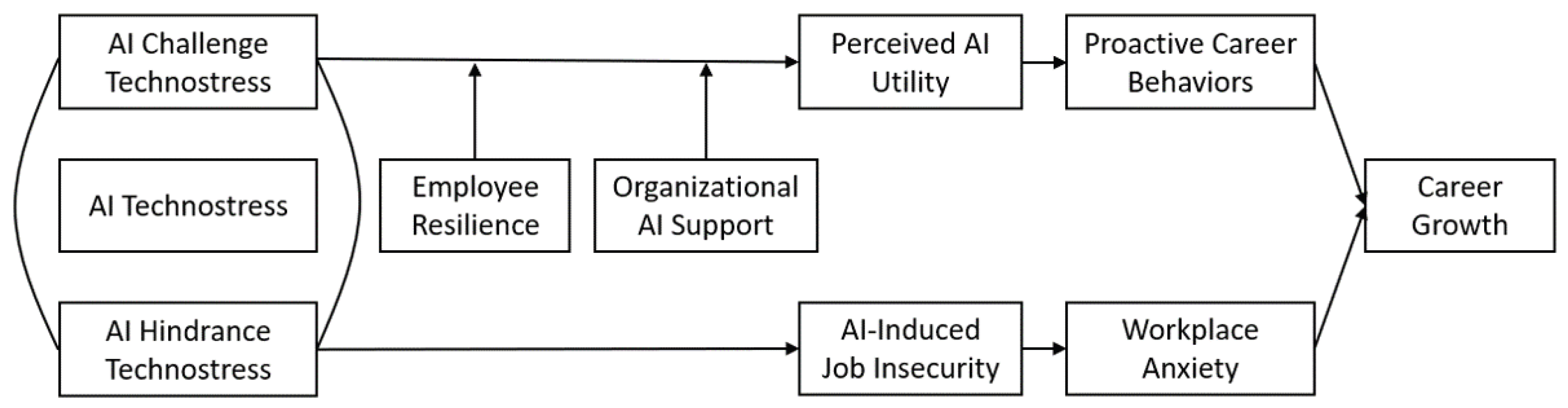
3.2.1. Mediating Role of AI Personal Utility and Proactive Career Behaviors
3.2.2. Moderating Role of Organizational AI Support
3.2.3. Moderating Role of Organizational AI Support: An External Resource
3.2.4. Moderating Role of Employee Resilience
3.3. AI Hindrance-Related Technostress: A Systems Perspective
Mediating Role of AI-Related Job Insecurity and Workplace Anxiety
3.4. Integrative Research Model: A Systems Framework
4. Data and Results: A Systems Perspective
4.1. Survey Design and Variable Measurement
4.1.1. Data Collection for the Socio-Technical System Model
- Stage 1 (Employee self-assessment): Employee data were collected in two waves to capture temporal dynamics.
- Wave 1 (14 October 2024): Employees completed the initial survey measuring variables in Table 1, along with demographic information.
- Wave 2 (4 November 2024): Three weeks later, the same employees completed the second survey measuring the variables in Table 1. (Sample questionnaires for the employee self-assessment (Wave 1 and Wave 2) can be accessed at: https://www.wjx.cn/vm/OEggdMg.aspx, accessed on 14 October 2024 and https://www.wjx.cn/vm/tkxxHP2.aspx, accessed on 4 November 2024).
- Stage 2 (Supervisor evaluation): Concurrently with the second wave of employee surveys (4 November 2024), the immediate supervisors of these employees were invited to assess their subordinates’ Career Growth. This separation of data sources (employees rating stressors vs. supervisors rating outcomes), combined with the temporal separation between independent and dependent variables, was strictly implemented to minimize transient mood effects and potential common method bias. (The supervisor evaluation questionnaire can be accessed at: https://www.wjx.cn/vm/wzzEL6z.aspx, accessed on 4 November 2024).
4.1.2. Variable Measurement and Analysis Strategy
- Measurement Model Assessment: We evaluated the reliability and validity of the constructs by examining outer loadings, Cronbach’s , Composite Reliability (CR), Average Variance Extracted (AVE), and the Heterotrait-Monotrait ratio (HTMT).
- Structural Model Assessment: We tested the hypothesized relationships (path coefficients) and specific indirect effects using a bootstrapping procedure with 5000 subsamples.
4.1.3. Descriptive and Correlation Analysis
4.1.4. Measurement Model Assessment
4.2. Structural Equation Modeling and Results
4.2.1. Direct Effects Within the System
4.2.2. Moderating Effects of Organizational AI Support
4.2.3. Moderating Effects of Employee Resilience
4.2.4. Robustness and Dual-Path Verification
4.2.5. System-Level Implications
4.3. The Mechanism of AI Challenge-Related Technostress on Employees’ Career Growth (B)
4.3.1. Impact of AI Challenge-Related Technostress on Employees’ Career Growth
Direct Effect of AI Challenge-Related Technostress on Career Growth
Testing the Direct Effect
Measurement Model Evaluation of the Resource Gain Chain
4.3.2. Structural Relationships Among Latent Variables
4.3.3. Testing Specific Indirect Effects
Chain Mediation Pathway
Moderating Role of Organizational AI Support
Summary of Mechanism
4.4. The Mechanism of AI Hindrance-Related Technostress on Employees’ Career Growth (C)
4.4.1. Impact of AI Hindrance-Related Technostress on Employees’ Career Growth
Direct Effect of AI Hindrance-Related Technostress on Career Growth
Testing the Direct Effect
Measurement Model Evaluation of the Resource Loss Chain
4.4.2. Effects Among Latent Variables
4.4.3. Analysis of Specific Indirect Effects
Chain Mediation Pathway
Summary of Mechanism
5. Conclusions: A Systems Perspective on AI-Related Technostress
- Summary of Dual-Path Mechanisms
- Theoretical Contributions
- Practical Implications
- Concluding Remarks
Author Contributions
Funding
Informed Consent Statement
Data Availability Statement
Acknowledgments
Conflicts of Interest
References
- Ayyagari, R.; Grover, V.; Purvis, R. Technostress: Technological antecedents and implications. MIS Q. 2011, 35, 831–858. [Google Scholar] [CrossRef]
- Tarafdar, M.; Cooper, C.L.; Stich, J.F. The technostress trifecta—Techno eustress, techno distress and design: Theoretical directions and an agenda for research. Inf. Syst. J. 2019, 29, 6–42. [Google Scholar] [CrossRef]
- Califf, C.B.; Sarker, S.; Sarker, S. The bright and dark sides of technostress: A mixed-methods study involving healthcare IT. MIS Q. 2020, 44, 1217–1256. [Google Scholar] [CrossRef]
- Maier, C.; Laumer, S.; Weitzel, T. Technostress and the hierarchical levels of personality: A two-wave study with multiple data samples. Eur. J. Inf. Syst. 2022, 31, 123–144. [Google Scholar] [CrossRef]
- Tarafdar, M.; Pullins, E.B.; Ragu-Nathan, T.S. Technostress: Negative effect on performance and possible mitigations. Inf. Syst. J. 2015, 25, 103–132. [Google Scholar] [CrossRef]
- Srivastava, S.C.; Chandra, S.; Shirish, A. Technostress creators and job outcomes: Theorising the moderating influence of personality traits. Inf. Syst. J. 2015, 25, 355–401. [Google Scholar] [CrossRef]
- Brooks, S.; Califf, C. Social media-induced technostress: Its impact on the job performance of it professionals and the moderating role of job characteristics. Comput. Netw. 2017, 114, 143–153. [Google Scholar] [CrossRef]
- Ragu-Nathan, T.S.; Tarafdar, M.; Ragu-Nathan, B.S.; Tu, Q. The consequences of technostress for end users in organizations: Conceptual development and empirical validation. Inf. Syst. Res. 2008, 19, 417–433. [Google Scholar] [CrossRef]
- Ayyagari, R.; Grover, V. Coping with technostress: A theoretical review. Inf. Syst. Res. 2018, 29, 563–590. [Google Scholar]
- Pirkkalainen, H.; Salo, M.; Makkonen, M.; Tarafdar, M. Coping with technostress: When emotional responses fail. Inf. Syst. J. 2019, 29, 313–344. [Google Scholar]
- Shu, Q.; Tu, Q.; Wang, K. The impact of computer self-efficacy and technology dependence on technostress. Comput. Hum. Behav. 2011, 27, 2200–2206. [Google Scholar]
- Jena, R.K. Technostress in ICT-enabled collaborative learning environment: An empirical study among Indian academic staff. Comput. Hum. Behav. 2015, 51, 1116–1123. [Google Scholar]
- Tarafdar, M.; Pullins, E.B.; Ragu-Nathan, T.S. Examining impacts of technostress on the professional salesperson’s behavioural performance. J. Pers. Sell. Sales Manag. 2019, 39, 259–276. [Google Scholar] [CrossRef]
- Lepine, J.A.; Podsakoff, N.P.; Lepine, M.A. A meta-analytic test of the challenge stressor–hindrance stressor framework: An explanation for inconsistent relationships among stressors and performance. Acad. Manag. J. 2005, 48, 764–775. [Google Scholar] [CrossRef]
- Tarafdar, M.; Gupta, A.; Turel, O. The dark side of information technology use: A longitudinal study. Inf. Syst. J. 2013, 23, 269–299. [Google Scholar] [CrossRef]
- Ayyagari, R.; Grover, V.; Purvis, R. Technostress research: A critical review and future directions. J. Assoc. Inf. Syst. 2019, 20, 301–329. [Google Scholar]
- Folkman, S. Personal control and stress and coping processes: A theoretical analysis. J. Personal. Soc. Psychol. 1984, 46, 839. [Google Scholar] [CrossRef]
- Chen, Y.; Benitez, J.; Cheung, C.M.K. Understanding the Dynamic and Episodic Nature of Technostressors and Their Effects on Cyberdeviance: A Daily Field Investigation. Inf. Syst. Res. 2024, 36, 614–632. [Google Scholar] [CrossRef]
- Klonek, F.E.; Parker, S.K. Does AI at Work Increase Stress? Text Mining Social Media about Human–AI Team Processes and AI Control. J. Organ. Behav. 2025. [Google Scholar] [CrossRef]
- Zhang, S.; Guo, P.; Yuan, Y.; Ji, Y. Anxiety or Engaged? Technostress and Employees’ Innovative Behavior in the Era of AI. Acta Psychol. 2025, 259, 105442. [Google Scholar] [CrossRef]
- von Bertalanffy, L. General System Theory: Foundations, Development, Applications; George Braziller: New York, NY, USA, 1968. [Google Scholar]
- Checkland, P.B. Systems Thinking, Systems Practice; John Wiley & Sons: Chichester, UK, 1981. [Google Scholar]
- Trist, E.L.; Bamforth, K.W. Some Social and Psychological Consequences of the Longwall Method of Coal-Getting. Hum. Relat. 1951, 4, 3–38. [Google Scholar] [CrossRef]
- Bankins, S.; Ocampo, A.C.; Marrone, J.; Restubog, S.L.D.; Woo, S.E. A Multilevel Review of Artificial Intelligence in Organizations: Implications for Organizational Behavior Research and Practice. J. Organ. Behav. 2024, 45, 159–182. [Google Scholar] [CrossRef]
- Nisafani, A.S.; Kiely, G.; Mahony, C. Workers’ Technostress: A Review of its Causes, Strains, Inhibitors, and Impacts. J. Decis. Syst. 2020, 29, 243–258. [Google Scholar] [CrossRef]
- Cavanaugh, M.A.; Boswell, W.R.; Roehling, M.V.; Boudreau, J.W. An empirical examination of self-reported work stress among U.S. managers. J. Appl. Psychol. 2000, 85, 65–74. [Google Scholar] [CrossRef] [PubMed]
- Brooks, S. Does personal social media usage affect efficiency and well-being? Comput. Hum. Behav. 2015, 46, 26–37. [Google Scholar] [CrossRef]
- Zhu, J.; Zhang, B.; Wang, H. The Double-Edged Sword Effects of Perceived Algorithmic Control on Platform Workers’ Service Performance. Humanit. Soc. Sci. Commun. 2024, 11, 316. [Google Scholar] [CrossRef]
- Weng, Q.; McElroy, J.C. Organizational career growth, affective occupational commitment and turnover intentions. J. Vocat. Behav. 2012, 80, 256–265. [Google Scholar] [CrossRef]
- De Vos, A.; Soens, N. Protean attitude and career success: The mediating role of self-management. J. Vocat. Behav. 2008, 73, 449–456. [Google Scholar] [CrossRef]
- Liu, Y.; Perrewé, P.L. Another look at the role of emotion in the stress process: Challenge to the hindrance model. J. Occup. Health Psychol. 2005, 10, 105–117. [Google Scholar]
- Podsakoff, N.P.; LePine, J.A.; LePine, M.A. Differential challenge stressor–hindrance stressor relationships with job attitudes, turnover intentions, turnover, and withdrawal behavior: A meta-analysis. J. Appl. Psychol. 2007, 92, 438–454. [Google Scholar] [CrossRef]
- Boswell, W.R.; Olson-Buchanan, J.B.; LePine, M.A. Relations between stress and work outcomes: The role of felt challenge and hindrance. J. Vocat. Behav. 2004, 64, 165–181. [Google Scholar] [CrossRef]
- Kim, B.J.; Kim, M.J.; Lee, J. The Dark Side of AI Adoption: Linking Artificial Intelligence Adoption to Employee Depression via Psychological Safety and Ethical Leadership. Humanit. Soc. Sci. Commun. 2025, 12, 704. [Google Scholar] [CrossRef]
- Maier, C.; Laumer, S.; Eckhardt, A.; Weitzel, T. Giving too much social support: Social overload on social networking sites. Eur. J. Inf. Syst. 2015, 24, 447–464. [Google Scholar] [CrossRef]
- Lazarus, R.S.; Folkman, S. Stress, Appraisal, and Coping; Springer: New York, NY, USA, 1984. [Google Scholar]
- Demerouti, E.; Bakker, A.B.; Nachreiner, F.; Schaufeli, W.B. The job demands–resources model of burnout. J. Appl. Psychol. 2001, 86, 499–512. [Google Scholar] [CrossRef] [PubMed]
- Wu, W.; Chin, W.; Liu, Y. Technostress and the smart hospitality employee. J. Hosp. Tour. Technol. 2022, 13, 404–426. [Google Scholar] [CrossRef]
- Bauwens, R.; Denissen, M.; Van Beurden, J.; Coun, M. Can leaders prevent technology from backfiring? Empowering leadership as a double-edged sword for technostress in care. Front. Psychol. 2021, 12, 702648. [Google Scholar] [CrossRef]
- Pirkkalainen, H.; Salo, M.; Tarafdar, M.; Makkonen, M. Deliberate or instinctive? Proactive and reactive coping for technostress. J. Manag. Inf. Syst. 2019, 36, 1179–1212. [Google Scholar] [CrossRef]
- Becker, J.; Derra, N.D.; Regal, C.; Kühlmann, T.M. Mitigating the negative consequences of ICT use: The moderating effect of active-functional and dysfunctional coping. J. Decis. Syst. 2022, 31, 374–406. [Google Scholar]
- Tiwari, V. Countering effects of technostress on productivity: Moderating role of proactive personality. Benchmarking Int. J. 2021, 28, 636–651. [Google Scholar]
- Chiu, C.M.; Tan, C.M.; Hsu, J.S.C.; Cheng, H.L. Employee deviance: The impacts of techno-insecurity and moral disengagement. Inf. Technol. People 2023, 36, 140–164. [Google Scholar] [CrossRef]
- Saleem, F.; Malik, M.I.; Qureshi, S.S.; Farid, M.F.; Qamar, S. Technostress and employee performance nexus during COVID-19: Training and creative self-efficacy as moderators. Front. Psychol. 2021, 12, 595119. [Google Scholar] [CrossRef]
- Ballout, H.I. Career commitment and career success: Moderating role of self-efficacy. Career Dev. Int. 2009, 14, 655–670. [Google Scholar] [CrossRef]
- Chang, P.C.; Zhang, W.; Cai, Q.; Guo, H. Does AI-driven technostress promote or hinder employees’ artificial intelligence adoption intention? A moderated mediation model of affective reactions and technical self-efficacy. Psychol. Res. Behav. Manag. 2024, 17, 413–427. [Google Scholar] [CrossRef] [PubMed]
- Chen, W.; Kang, C.; Yang, Y.; Wan, Y. The potential substitution risk of artiticial intelligence and employees’ professional ability development: From the perspective of employees’ insecurity. Hum. Resour. Dev. China 2022, 39, 84–97. [Google Scholar]
- Wang, C.; Zhou, W.; Zhao, S. Study on the relationship between massive-scale utilization of industrial robots and job insecurity: The moderating effects of employee’s career ability. Bus. Manag. J. 2019, 41, 111–126. [Google Scholar]
- Jia, N.; Luo, X.; Fang, Z.; Liao, C. When and how artificial intelligence augments employee creativity. Acad. Manag. J. 2024, 67, 5–32. [Google Scholar] [CrossRef]
- Wang, D.; Zhou, X. The Impact of AI Awareness on Employees’ Job Burnout: A Chain Mediation of Perceived Organizational Support and Organizational Commitment. Sage Open 2025, 15, 21582440251400532. [Google Scholar] [CrossRef]
- Ding, L. Employees’ challenge-hindrance appraisals toward STARA awareness and competitive productivity: A micro-level case. Int. J. Contemp. Hosp. Manag. 2021, 33, 2950–2969. [Google Scholar] [CrossRef]
- Kong, H.; Yuan, Y.; Baruch, Y.; Bu, N.; Jiang, X.; Wang, K. Influences of artificial intelligence (AI) awareness on career competency and job burnout. Int. J. Contemp. Hosp. Manag. 2021, 33, 717–734. [Google Scholar] [CrossRef]
- Mahlasela, S.; Chinyamurindi, W.T. Technology-related factors and their influence on turnover intentions: A case of government employees in South Africa. Electron. J. Inf. Syst. Dev. Ctries. 2020, 86, e12126. [Google Scholar] [CrossRef]
- Li, J.J.; Bonn, M.A.; Ye, B.H. Hotel employee’s artificial intelligence and robotics awareness and its impact on turnover intention: The moderating roles of perceived organizational support and competitive psychological climate. Tour. Manag. 2019, 73, 172–181. [Google Scholar] [CrossRef]
- Park, J.; Woo, S.E.; Kim, J. Attitudes towards artificial intelligence at work: Scale development and validation. J. Occup. Organ. Psychol. 2024, 97, 920–951. [Google Scholar] [CrossRef]
- Kang, D.Y.; Hur, W.M.; Shin, Y. Smart technology and service employees’ job crafting: Relationship between STARA awareness, performance pressure, receiving and giving help, and job crafting. J. Retail. Consum. Serv. 2023, 73, 103282. [Google Scholar] [CrossRef]
- Zhang, F.; Parker, S.K. Reorienting job crafting research: A hierarchical structure of job crafting concepts and integrative review. J. Organ. Behav. 2019, 40, 126–146. [Google Scholar] [CrossRef]
- Gardner, W.L.; Gabriel, S.; Lee, A.Y. “I” value freedom, but “we” value relationships: Self-construal priming mirrors cultural differences in judgment. Psychol. Sci. 1999, 10, 321–326. [Google Scholar] [CrossRef]
- Kitayama, S.; Markus, H.R. The pursuit of happiness and the realization of sympathy: Cultural patterns of self, social relations, and well-being. In Culture and Subjective Well-Being; Diener, E., Suh, E.M., Eds.; MIT Press: Cambridge, MA, USA, 2000; pp. 113–161. [Google Scholar]
- Super, D.E. A life-span, life-space approach to career development. J. Vocat. Behav. 1980, 16, 282–298. [Google Scholar] [CrossRef]
- Parker, S.K.; Bindl, U.K.; Strauss, K. Making things happen: A model of proactive motivation. J. Manag. 2010, 36, 827–856. [Google Scholar] [CrossRef]
- Yuan, F.; Woodman, R.W. Innovative behavior in the workplace: The role of performance and image outcome expectations. Acad. Manag. J. 2010, 53, 323–342. [Google Scholar] [CrossRef]
- Chiu, Y.T.; Zhu, Y.Q.; Corbett, J. In the hearts and minds of employees: A model of pre-adoptive appraisal toward artificial intelligence in organizations. Int. J. Inf. Manag. 2021, 60, 102379. [Google Scholar] [CrossRef]
- Kuntz, J.R.; Näswall, K.; Malinen, S. Resilient employees in resilient organizations: Flourishing beyond adversity. Ind. Organ. Psychol. 2016, 9, 456–462. [Google Scholar] [CrossRef]
- Luthans, F.; Youssef, C.M.; Sweetman, D.S.; Harms, P.D. Meeting the leadership challenge of employee well-being through relationship PsyCap and health PsyCap. J. Leadersh. Organ. Stud. 2013, 20, 118–133. [Google Scholar] [CrossRef]
- Lengnick-Hall, C.A.; Beck, T.E.; Lengnick-Hall, M.L. Developing a capacity for organizational resilience through strategic human resource management. Hum. Resour. Manag. Rev. 2011, 21, 243–255. [Google Scholar] [CrossRef]
- McLarnon, M.J.; Rothstein, M.G. Development and initial validation of the workplace resilience inventory. J. Pers. Psychol. 2013, 12, 63–73. [Google Scholar] [CrossRef]
- Näswall, K.; Malinen, S.; Kuntz, J.; Hodliffe, M. Employee resilience: Development and validation of a measure. J. Manag. Psychol. 2019, 34, 353–367. [Google Scholar] [CrossRef]
- Brougham, D.; Haar, J. Technological disruption and employment: The influence on job insecurity and turnover intentions: A multi-country study. Technol. Forecast. Soc. Change 2020, 161, 120276. [Google Scholar]
- Lingmont, D.N.; Alexiou, A. The contingent effect of job automating technology awareness on perceived job insecurity: Exploring the moderating role of organizational culture. Technol. Forecast. Soc. Change 2020, 161, 120302. [Google Scholar]
- Nam, T. Technology usage, expected job sustainability, and perceived job insecurity. Technol. Forecast. Soc. Change 2019, 138, 155–165. [Google Scholar] [CrossRef]
- Brougham, D.; Haar, J. Smart technology, artificial intelligence, robotics, and algorithms (STARA): Employees’ perceptions of our future workplace. J. Manag. Organ. 2018, 24, 239–257. [Google Scholar] [CrossRef]
- Chatterjee, S.; Rana, N.P.; Dwivedi, Y.K.; Baabdullah, A.M. Understanding AI adoption in manufacturing and production firms using an integrated TAM-TOE model. Technol. Forecast. Soc. Change 2021, 170, 120880. [Google Scholar] [CrossRef]
- Wu, C.H.; Parker, S.K.; Wu, L.Z.; Lee, C. When and why people engage in different forms of proactive behavior: Interactive effects of self-construals and work characteristics. Acad. Manag. J. 2018, 61, 293–323. [Google Scholar] [CrossRef]
- Parker, D.F.; DeCotiis, T.A. Organizational determinants of job stress. Organ. Behav. Hum. Perform. 1983, 32, 160–177. [Google Scholar] [CrossRef]
- Weng, Q.; McElroy, J.C.; Morrow, P.C.; Liu, R. The relationship between career growth and organizational commitment. J. Vocat. Behav. 2010, 77, 391–400. [Google Scholar] [CrossRef]
- Yan, B.; Teng, Y. The double-edged sword effect of artificial intelligence awareness on organisational citizenship behaviour: A study based on knowledge workers. Behav. Inf. Technol. 2025, 1–17. [Google Scholar] [CrossRef]
- Gomes, A.; Ke, W.; Lm, S.K.; Siu, A.; Mendes, A.J.; Marcelino, M.J. A teacher’s view about introductory programming teaching and learning — Portuguese and Macanese perspectives. In Proceedings of the 2017 IEEE Frontiers in Education Conference (FIE), Indianapolis, IN, USA, 18–21 October 2017; pp. 1–8. [Google Scholar] [CrossRef]
- Tondro, M.; Jahanbakht, M.; Ozay, D. Enhancing IoT Technology Acquisition in Emerging Economies: Insights and Recommendations Using Analytical Case Study Review of IoT Startups. Businesses 2025, 5, 20. [Google Scholar] [CrossRef]
- Xu, Y.; Deng, Z.; Zhu, T.; Han, L.; Sun, L.; Chen, Z.; Sheng, H. Generating evolving region embedding with memory-based graph for dynamic urban sensing. Inf. Fusion 2025, 115, 103341. [Google Scholar]
- Han, L.; Sun, L.; Zhu, T.; Tao, T.; Wang, J.; Lv, W. JiuTian· Chuanliu: A Large Spatiotemporal Model for General-purpose Dynamic Urban Sensing. ACM Trans. Intell. Syst. Technol. 2025, 16, 1–21. [Google Scholar] [CrossRef]
- Xu, Y.; Han, L.; Zhu, T.; Sun, L.; Du, B.; Lv, W. Generic dynamic graph convolutional network for traffic flow forecasting. Inf. Fusion 2023, 100, 101946. [Google Scholar] [CrossRef]


| Variable | Code | Items | Source |
|---|---|---|---|
| AI Personal Utility | uti | 4 | Park, Woo, & Kim (2024); e.g., [55], “Using AI enhances my confidence in my job skills.” ( = 0.87) |
| Job Insecurity | inse | 4 | Park, Woo, & Kim (2024); e.g., [55], “I worry that my job skills will be replaced by AI.” ( = 0.94) |
| AI-related Technostress | tech (ctech/htech) | 7 | Ding (2021) [51]; challenge stress (4 items, = 0.76), hindrance stress (3 items, = 0.81) |
| Organizational AI Support | support | 4 | Adapted from Chatterjee et al. (2021) [73]; e.g., “With company support, I have sufficient resources to learn AI.” ( = 0.87) |
| Employee Resilience | tenacity | 9 | Näswall et al. (2019); e.g., [68], “I can work effectively with others to address workplace challenges.” ( = 0.91) |
| Proactive Career Behaviors | active | 3 | Wu et al. (2018); e.g., [74], “I take on tasks that help advance my career.” ( = 0.79) |
| Workplace Anxiety | anxiety | 5 | Parker & DeCotiis (1983); e.g., [75], “My work makes me feel anxious.” ( = 0.74) |
| Career Growth | growth | 15 | Weng et al. (2010); e.g., [76], “My current job brings me closer to my career goals.” ( = 0.936) |
| Indicator | Loading (O) | t-Value | p-Value | 95% CI (Bias Corrected) |
|---|---|---|---|---|
| ctech1 ← CTech | 0.892 | 45.254 | 0.000 | [0.848, 0.925] *** |
| ctech2 ← CTech | 0.891 | 44.414 | 0.000 | [0.847, 0.926] *** |
| ctech3 ← CTech | 0.910 | 60.419 | 0.000 | [0.877, 0.937] *** |
| ctech4 ← CTech | 0.838 | 27.804 | 0.000 | [0.774, 0.890] *** |
| uti1 ← Utility | 0.886 | 57.266 | 0.000 | [0.853, 0.913] *** |
| uti2 ← Utility | 0.893 | 40.668 | 0.000 | [0.845, 0.930] *** |
| uti3 ← Utility | 0.885 | 57.399 | 0.000 | [0.853, 0.913] *** |
| uti4 ← Utility | 0.845 | 36.506 | 0.000 | [0.796, 0.886] *** |
| acti1 ← Proactive | 0.806 | 28.961 | 0.000 | [0.760, 0.850] *** |
| acti2 ← Proactive | 0.909 | 51.267 | 0.000 | [0.883, 0.932] *** |
| acti3 ← Proactive | 0.917 | 73.640 | 0.000 | [0.876, 0.927] *** |
| grow1 ← Career Growth | 0.818 | 34.030 | 0.000 | [0.765, 0.859] *** |
| grow2 ← Career Growth | 0.791 | 24.769 | 0.000 | [0.722, 0.847] *** |
| grow3 ← Career Growth | 0.864 | 50.006 | 0.000 | [0.827, 0.894] *** |
| grow4 ← Career Growth | 0.883 | 55.368 | 0.000 | [0.847, 0.910] *** |
| grow5 ← Career Growth | 0.854 | 43.569 | 0.000 | [0.813, 0.890] *** |
| grow6 ← Career Growth | 0.865 | 47.412 | 0.000 | [0.825, 0.897] *** |
| grow7 ← Career Growth | 0.867 | 49.323 | 0.000 | [0.829, 0.899] *** |
| grow8 ← Career Growth | 0.853 | 42.597 | 0.000 | [0.811, 0.890] *** |
| grow9 ← Career Growth | 0.627 | 11.400 | 0.000 | [0.504, 0.717] *** |
| grow10 ← Career Growth | 0.696 | 14.774 | 0.000 | [0.588, 0.772] *** |
| grow11 ← Career Growth | 0.669 | 12.101 | 0.000 | [0.543, 0.762] *** |
| grow12 ← Career Growth | 0.544 | 8.965 | 0.000 | [0.412, 0.648] *** |
| grow13 ← Career Growth | 0.430 | 5.805 | 0.000 | [0.267, 0.558] *** |
| grow14 ← Career Growth | 0.597 | 10.231 | 0.000 | [0.469, 0.695] *** |
| grow15 ← Career Growth | 0.414 | 5.415 | 0.000 | [0.246, 0.545] *** |
| Path | Coefficient (O) | t-Value | p-Value | 95% CI (Bias Corrected) |
|---|---|---|---|---|
| ctech → uti | 0.430 | 7.511 | 0.000 | [0.319, 0.540] *** |
| uti → acti | 0.448 | 8.452 | 0.000 | [0.340, 0.547] *** |
| acti → grow | 0.413 | 7.323 | 0.000 | [0.307, 0.525] *** |
| tena → acti | 0.254 | 4.314 | 0.000 | [0.143, 0.374] *** |
| sup → uti | −0.011 | 0.183 | 0.855 | [−0.124, 0.104] n.s. |
| sup × ctech → uti | 0.094 | 1.925 | 0.054 | [−0.002, 0.192] † |
| tena × uti → acti | 0.054 | 1.114 | 0.265 | [−0.042, 0.148] n.s. |
| Indirect Path | Estimate (O) | t-Value | p-Value | Significance |
|---|---|---|---|---|
| AI Personal Utility → Proactive Career Behaviors → Career Growth | 0.185 | 6.518 | 0.000 | *** |
| Challenge Technostress → AI Personal Utility → Proactive Career Behaviors → Career Growth | 0.080 | 4.771 | 0.000 | *** |
| Employee Resilience → Proactive Career Behaviors → Career Growth | 0.105 | 3.340 | 0.001 | ** |
| Employee Resilience → Workplace Anxiety → Career Growth | 0.038 | 2.050 | 0.040 | * |
| Employee Resilience × Job Insecurity → Workplace Anxiety → Career Growth | −0.030 | 1.988 | 0.047 | * |
| Challenge Technostress → AI Personal Utility → Proactive Career Behaviors | 0.193 | 6.691 | 0.000 | *** |
| Job Insecurity → Workplace Anxiety → Career Growth | −0.028 | 1.811 | 0.070 | † |
| Hindrance Technostress → Job Insecurity → Workplace Anxiety → Career Growth | −0.016 | 1.779 | 0.075 | † |
| Organizational AI Support × Challenge Technostress → AI Personal Utility → Proactive Career Behaviors → Career Growth | 0.017 | 1.788 | 0.074 | † |
| Organizational AI Support → Job Insecurity → Workplace Anxiety | −0.051 | 1.696 | 0.090 | n.s. |
| Organizational AI Support → Job Insecurity → Workplace Anxiety → Career Growth | 0.013 | 1.693 | 0.091 | n.s. |
| Organizational AI Support → AI Personal Utility → Proactive Career Behaviors → Career Growth | −0.002 | 0.182 | 0.855 | n.s. |
| Organizational AI Support → AI Personal Utility → Proactive Career Behaviors | −0.005 | 0.185 | 0.854 | n.s. |
| Employee Resilience × AI Personal Utility → Proactive Career Behaviors → Career Growth | 0.022 | 1.093 | 0.274 | n.s. |
| Organizational AI Support × Hindrance Technostress → Job Insecurity → Workplace Anxiety | −0.001 | 0.121 | 0.904 | n.s. |
| Organizational AI Support × Hindrance Technostress → Job Insecurity → Workplace Anxiety → Career Growth | 0.000 | 0.119 | 0.905 | n.s. |
| Hindrance Technostress → Job Insecurity → Workplace Anxiety | 0.064 | 1.791 | 0.073 | † |
| Indirect Path | Coefficient (O) | t-Value | p-Value | 95% CI (Bias Corrected) |
|---|---|---|---|---|
| ctech → uti → acti | 0.193 | 6.691 | 0.000 | [0.136, 0.250] *** |
| ctech → uti → acti → grow | 0.080 | 4.771 | 0.000 | [0.049, 0.115] *** |
| uti → acti → grow | 0.185 | 6.518 | 0.000 | [0.131, 0.242] *** |
| tena → acti → grow | 0.105 | 3.340 | 0.001 | [0.052, 0.174] ** |
| sup × ctech → uti → acti | 0.042 | 1.708 | 0.088 | [−0.001, 0.097] † |
| sup × ctech → uti → acti → grow | 0.017 | 1.788 | 0.074 | [0.000, 0.038] † |
| tena × uti → acti → grow | 0.022 | 1.093 | 0.274 | [−0.018, 0.062] n.s. |
| sup → uti → acti | −0.005 | 0.185 | 0.854 | [−0.054, 0.048] n.s. |
| sup → uti → acti → grow | −0.002 | 0.182 | 0.855 | [−0.024, 0.019] n.s. |
| Indicator | Loading (O) | t-Value | p-Value | 95% CI (Bias Corrected) |
|---|---|---|---|---|
| htech1 ← HTech | 0.946 | 78.065 | 0.000 | [0.920, 0.967] *** |
| htech2 ← HTech | 0.968 | 134.635 | 0.000 | [0.952, 0.980] *** |
| htech3 ← HTech | 0.956 | 107.239 | 0.000 | [0.936, 0.971] *** |
| inse1 ← Job Insecurity | 0.887 | 63.230 | 0.000 | [0.858, 0.912] *** |
| inse2 ← Job Insecurity | 0.893 | 51.935 | 0.000 | [0.856, 0.923] *** |
| inse3 ← Job Insecurity | 0.905 | 66.279 | 0.000 | [0.875, 0.928] *** |
| inse4 ← Job Insecurity | 0.782 | 23.990 | 0.000 | [0.710, 0.837] *** |
| anxie1 ← Anxiety | 0.841 | 32.724 | 0.000 | [0.786, 0.905] *** |
| anxie2 ← Anxiety | 0.865 | 27.996 | 0.000 | [0.860, 0.883] *** |
| anxie3 ← Anxiety | 0.908 | 73.238 | 0.000 | [0.883, 0.932] *** |
| anxie4 ← Anxiety | 0.907 | 68.957 | 0.000 | [0.876, 0.927] *** |
| anxie5 ← Anxiety | 0.501 | 6.447 | 0.000 | [0.323, 0.630] *** |
| grow1 ← Career Growth | 0.818 | 34.030 | 0.000 | [0.765, 0.859] *** |
| grow2 ← Career Growth | 0.791 | 24.769 | 0.000 | [0.722, 0.847] *** |
| grow3 ← Career Growth | 0.864 | 50.006 | 0.000 | [0.827, 0.894] *** |
| grow4 ← Career Growth | 0.883 | 55.368 | 0.000 | [0.847, 0.910] *** |
| grow5 ← Career Growth | 0.854 | 43.569 | 0.000 | [0.813, 0.890] *** |
| grow6 ← Career Growth | 0.865 | 47.412 | 0.000 | [0.825, 0.897] *** |
| grow7 ← Career Growth | 0.867 | 49.323 | 0.000 | [0.829, 0.899] *** |
| grow8 ← Career Growth | 0.853 | 42.597 | 0.000 | [0.811, 0.890] *** |
| grow9 ← Career Growth | 0.627 | 11.400 | 0.000 | [0.504, 0.717] *** |
| grow10 ← Career Growth | 0.696 | 14.774 | 0.000 | [0.588, 0.772] *** |
| grow11 ← Career Growth | 0.669 | 12.101 | 0.000 | [0.543, 0.762] *** |
| grow12 ← Career Growth | 0.544 | 8.965 | 0.000 | [0.412, 0.648] *** |
| grow13 ← Career Growth | 0.430 | 5.805 | 0.000 | [0.267, 0.558] *** |
| grow14 ← Career Growth | 0.597 | 10.231 | 0.000 | [0.469, 0.695] *** |
| grow15 ← Career Growth | 0.414 | 5.415 | 0.000 | [0.246, 0.545] *** |
| Path | Coefficient (O) | t-Value | p-Value | 95% CI (Bias Corrected) |
|---|---|---|---|---|
| htech → inse | 0.575 | 12.342 | 0.000 | [0.481, 0.662] *** |
| inse → anxie | 0.111 | 1.825 | 0.068 | [−0.009, 0.229] † |
| anxie → grow | −0.253 | 5.243 | 0.000 | [−0.341, −0.147] *** |
| sup → inse | −0.460 | 7.509 | 0.000 | [−0.569, −0.326] *** |
| resi → anxie | −0.149 | 2.495 | 0.013 | [−0.257, −0.025] ** |
| resi → grow | 0.087 | 2.140 | 0.033 | [0.008, 0.166] * |
| sup × htech → inse | −0.007 | 0.134 | 0.894 | [−0.099, 0.108] n.s. |
| resi × inse → anxie | 0.117 | 2.159 | 0.031 | [0.010, 0.224] * |
| Indirect Path | Estimate (O) | t-Value | p-Value | Significance |
|---|---|---|---|---|
| Job Insecurity → Workplace Anxiety → Career Growth | −0.028 | 1.811 | 0.070 | † |
| Hindrance Technostress → Job Insecurity → Workplace Anxiety → Career Growth | −0.016 | 1.779 | 0.075 | † |
| Organizational AI Support → Job Insecurity → Workplace Anxiety → Career Growth | 0.013 | 1.693 | 0.091 | n.s. |
| Employee Resilience → Workplace Anxiety → Career Growth | 0.038 | 2.050 | 0.040 | * |
| Employee Resilience × Job Insecurity → Workplace Anxiety → Career Growth | −0.030 | 1.988 | 0.047 | * |
Disclaimer/Publisher’s Note: The statements, opinions and data contained in all publications are solely those of the individual author(s) and contributor(s) and not of MDPI and/or the editor(s). MDPI and/or the editor(s) disclaim responsibility for any injury to people or property resulting from any ideas, methods, instructions or products referred to in the content. |
© 2026 by the authors. Licensee MDPI, Basel, Switzerland. This article is an open access article distributed under the terms and conditions of the Creative Commons Attribution (CC BY) license.
Share and Cite
Jin, T.; Yang, X.; Zhang, L. Understanding AI Technostress and Employee Career Growth from a Socio-Technical Systems Perspective: A Dual-Path Model. Systems 2026, 14, 58. https://doi.org/10.3390/systems14010058
Jin T, Yang X, Zhang L. Understanding AI Technostress and Employee Career Growth from a Socio-Technical Systems Perspective: A Dual-Path Model. Systems. 2026; 14(1):58. https://doi.org/10.3390/systems14010058
Chicago/Turabian StyleJin, Tiezeng, Xinglan Yang, and Li Zhang. 2026. "Understanding AI Technostress and Employee Career Growth from a Socio-Technical Systems Perspective: A Dual-Path Model" Systems 14, no. 1: 58. https://doi.org/10.3390/systems14010058
APA StyleJin, T., Yang, X., & Zhang, L. (2026). Understanding AI Technostress and Employee Career Growth from a Socio-Technical Systems Perspective: A Dual-Path Model. Systems, 14(1), 58. https://doi.org/10.3390/systems14010058