Modeling Individual Risk Decision-Making: A Self-Organization Based Psychological Game Framework [F(T, P, C, R)]



Abstract
1. Introduction
2. Literature Review
2.1. The Evolving Conception of Systemic Risk and Governance
2.2. Behavioral Science: From Decision Biases to Policy Tools
2.3. Risk Perception and Behavior in Context: The Case of Automotive Systems
Note: In this section, we review literature employing the general terms “perceive control” and “perceived destructive power”. These broad constructs correspond conceptually to the more precise operational definitions of Perceived Control (C) and Perceived Destructive Power (R) that are central to our proposed F(T, P, C, R) model, as formally defined in Section 3.1.
2.4. Self-Organization and Complex Adaptive Systems in Social Domains
2.5. Synthesis and Identified Gap: The Imperative for an Integrative Micro-Macro Model
3. Constructing an Individual Psychological Game Model Under Probabilistic Risk
3.1. Theoretical Provenance of the Core Constructs
3.2. Research Questions
3.3. The Integrated F(T, P, C, R) Model
4. Methodological Approach: Theory Synthesis and Model Development
4.1. Methodological Positioning: A Theory-Synthesis Approach
4.2. Research Procedure: A Four-Step Model Development Process
4.3. Model Exposition and Case Analysis
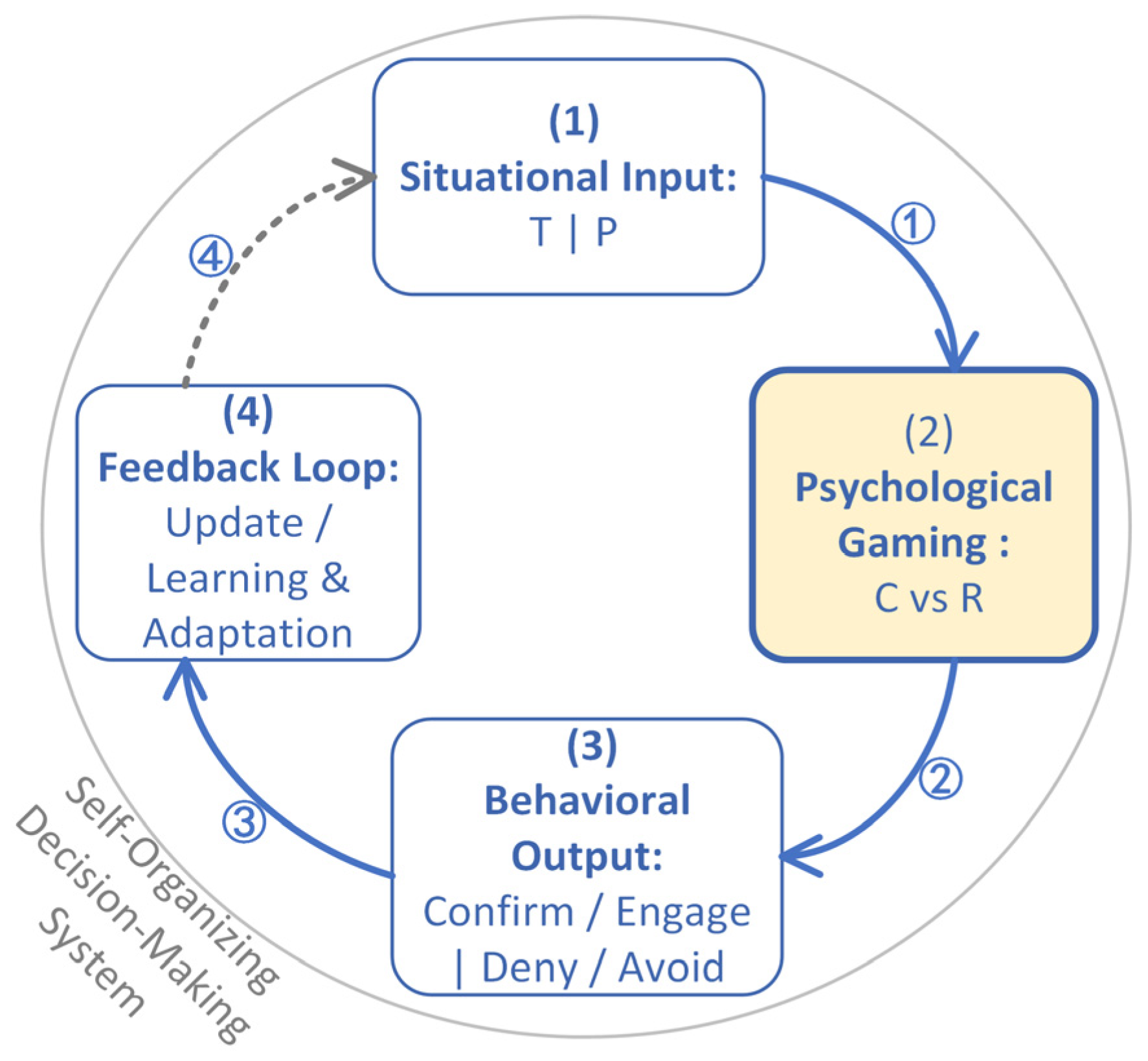
4.3.1. Explication of Core Elements: The Situational Frame and Cognitive Game
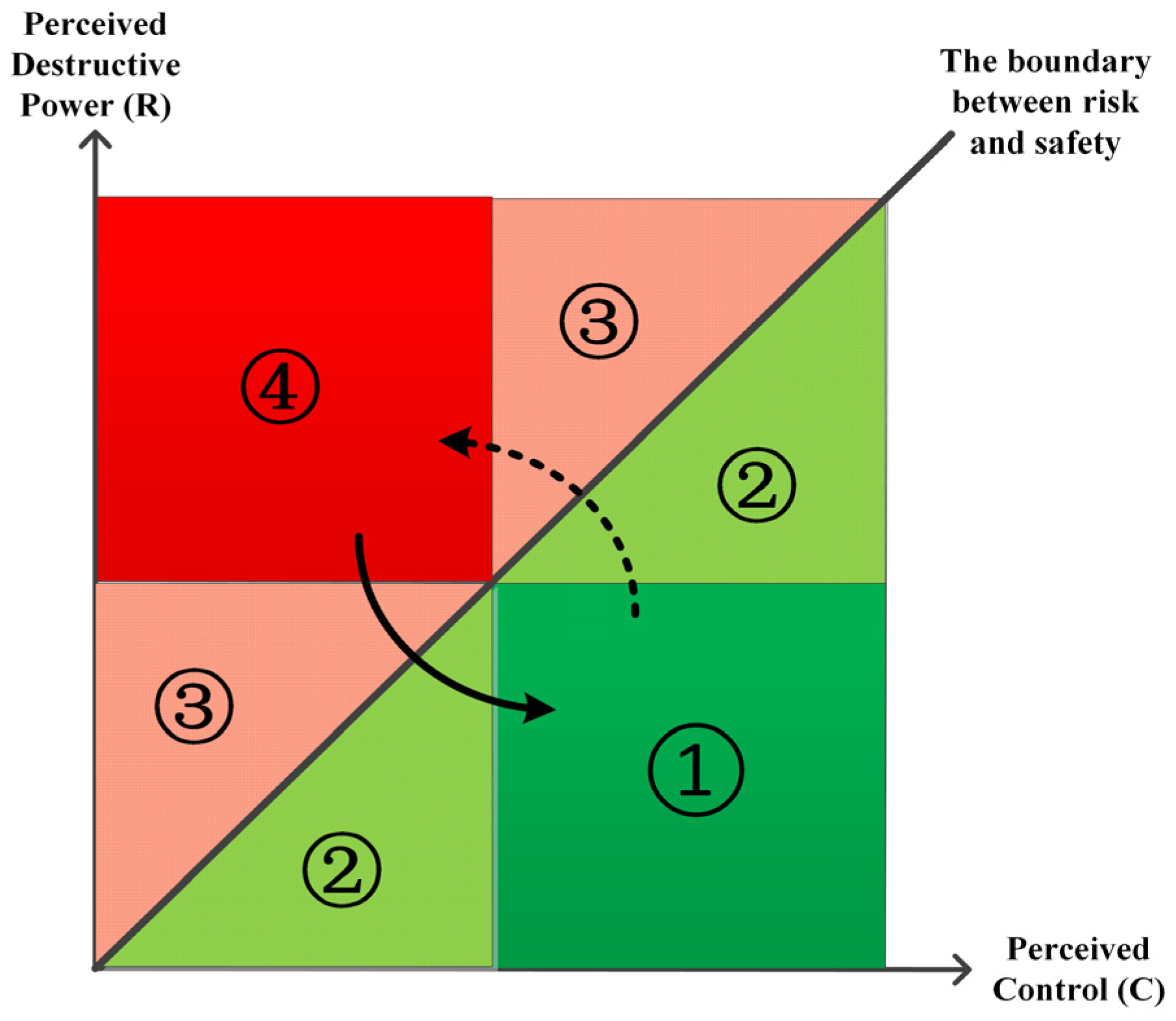
4.3.2. The Psychological Game Space, Dynamic Principles and the Decision Matrix
- (1)
- The Psychological Game Space
- (2)
- Core Dynamic Principles: Conservation and Radicalization
- (3)
- The Dynamic Risk-Decision Matrix
4.3.3. Dual-Case Exposition in the Driving Context
- (1)
- An Instantaneous Decision: The Yellow Light Dilemma
- (2)
- An Evolving Decision: The Adoption of Autonomous Driving Features
5. Theoretical Analysis and Practical Implications
5.1. The Matrix as a Diagnostic Lens: From Behavior to Underlying Cognitive-Affective States
5.2. Theoretical Integration: Positioning the F(T, P, C, R) Model
5.3. Practical Implications: A Framework for Targeted Intervention Design
6. Synthesis, Conclusion, and Future Trajectory
6.1. Limitations and Synthesis of Contributions
6.1.1. Limitations
6.1.2. Synthesis of the Argument: Answers to the Research Questions
6.2. Theoretical and Practical Valorization
6.3. Future Research Trajectory
Author Contributions
Funding
Data Availability Statement
Conflicts of Interest
References
- Beck, U. Risk Society: Towards a New Modernity; Sage: Thousand Oaks, CA, USA, 1992; Volume 2, pp. 53–74. [Google Scholar]
- Schweizer, P.J. Systemic risks–concepts and challenges for risk governance. J. Risk Res. 2021, 24, 78–93. [Google Scholar] [CrossRef]
- Renn, O. New challenges for risk governance: Systemic risks and cognitive biases. J. Risk Res. 2022, 25, 679–695. [Google Scholar]
- Aven, T.; Renn, O. Risk Management and Governance: Concepts, Guidelines and Applications; Springer Science & Business Media: Heidelberg, Germany, 2010; Volume 16. [Google Scholar]
- Sjoberg, L. Factors in risk perception. Risk Anal. 2000, 20, 1–11. [Google Scholar] [CrossRef] [PubMed]
- Kahneman, D.; Sibony, O.; Sunstein, C.R. Noise: A Flaw in Human Judgment; Hachette UK: London, UK, 2021. [Google Scholar]
- World Bank. Global Review of Behavioral Science Teams; World Bank Group: Washington, DC, USA, 2021. [Google Scholar]
- Mertens, S.; Herberz, M.; Hahnel, U.J.J.; Brosch, T. The Effectiveness of Nudging: A Meta-Analysis of Choice Architecture Interventions Across Behavioral Domains. Proc. Natl. Acad. Sci. USA 2022, 119, e2107346118. [Google Scholar]
- Rundmo, T.; Iversen, H. Risk perception, worry and driver behaviour. Saf. Sci. 2021, 144, 105456. [Google Scholar]
- Hergeth, S.; Lorenz, L.; Vilimek, R.; Krems, J.F. Trust in Automation: A Meta-Analysis of Recent Empirical Studies. Hum. Factors 2020, 62, 552–582. [Google Scholar]
- König, M.; Neumayr, L. Users’ resistance towards radical innovations: The case of the self-driving car. Transp. Res. Part F Traffic Psychol. Behav. 2022, 84, 223–239. [Google Scholar] [CrossRef]
- Jing, L.; Shan, W.; Zhang, Y. Risk Preference, Risk Perception as Predictors of Risky Driving Behaviors: The Moderating Effects of Gender, Age, and Driving Experience. J. Transp. Saf. Secur. 2023, 15, 467–492. [Google Scholar] [CrossRef]
- Kimbrough, E.O.; Vostroknutov, A. Norms, rules, and values: The dynamics of risk-sharing arrangements. Exp. Econ. 2023, 26, 891–923. [Google Scholar]
- Wang, Z.; Li, S. Self-organization and emergence of cooperation in networked agent-based models. Proc. Natl. Acad. Sci. USA 2025, 122, e2312456120. [Google Scholar]
- Heylighen, F. Complexity and evolution: A new synthesis for ecology and economics? Ecol. Econ. 2021, 189, 107164. [Google Scholar]
- Nespeca, V.; Comes, T.; Meesters, K.; Brazier, F. Towards coordinated self-organization: An actor-centered framework for the design of disaster management information systems. Int. J. Disaster Risk Reduct. 2020, 51, 101887. [Google Scholar] [CrossRef]
- Nugroho, S.; Uehara, T. Systematic Review of Agent-Based and System Dynamics Models for Social-Ecological System Case Studies. Systems 2023, 11, 530. [Google Scholar] [CrossRef]
- Gilbert, N. Agent-Based Models, 2nd ed.; SAGE Publications: Thousand Oaks, CA, USA, 2023. [Google Scholar]
- Zhang, Y.; Gracia-Lázaro, C.; Moreno, Y. Behavioral heterogeneity and systemic risk in financial networks: An agent-based approach. Sci. Rep. 2023, 13, 10258. [Google Scholar]
- Gibson, J.J. The Ecological Approach to Visual Perception: Classic Edition; Psychology Press: New York, NY, USA, 2014. [Google Scholar]
- Heft, H. Foundations of an ecological psychology: Events, places, and affordances. J. Environ. Psychol. 2023, 88, 102018. [Google Scholar]
- Bandura, A. On the functional properties of perceived self-efficacy revisited. J. Manag. 2020, 46, 9–44. [Google Scholar] [CrossRef]
- Slovic, P. Perception of risk. Science 1987, 236, 280–285. [Google Scholar] [CrossRef]
- Klinke, A.; Renn, O. The Coming of Age of Risk Governance. Risk Anal. 2021, 41, 544–557. [Google Scholar] [CrossRef]
- Mishra, S. Decision-making under risk: Integrating perspectives from biology, economics, and psychology. Personal. Soc. Psychol. Rev. 2014, 18, 280–307. [Google Scholar] [CrossRef]
- Chen, X.; Perc, M. Risk attitude dynamics in evolutionary games: A meta-analysis and model. J. Econ. Behav. Organ. 2024, 217, 22–38. [Google Scholar]
- Jaakkola, E. Designing conceptual articles: Four approaches. AMS Rev. 2020, 10, 18–26. [Google Scholar] [CrossRef]
- Lubashevskiy, V.; Lubashevsky, I. Self-organized criticality and cognitive control reasoned by effort minimization. Systems 2023, 11, 271. [Google Scholar] [CrossRef]
- Hertwig, R.; Plonsky, L. From description to prescription: The science of improving risk decisions. Perspect. Psychol. Sci. 2024, 19, 386–406. [Google Scholar]
- Guo, S.; Feng, W.; Zhang, G.; Wen, Y. Evolutionary game analysis of government–Enterprise collaboration in Coping with Natech risks. Systems 2024, 12, 275. [Google Scholar] [CrossRef]



| Zone | Perceived Control (C) | Perceived Destructive Power (R) | Behavioral Tendency | Typical Cognitive & Emotional State |
|---|---|---|---|---|
| ① Confirm | High | Low | Decisive Execution. Swift, confident engagement in the risky behavior. | Overconfidence/Complacency. Possible underestimation of actual risk, stemming from high trust in one’s own control. |
| ② Tend-to-Confirm | Moderately High | Moderately Low | Inclination to Execute. After deliberation, more likely to engage, but retains caution. | Cautious Optimism. Engages in cost–benefit analysis; responsive to “nudges” that enhance C or reduce R. |
| ③ Tend-to-Deny | Moderately Low | Moderately High | Inclination to Avoid. Leans towards abandoning the risky behavior amidst anxiety; decision-making is slow. | Anxiety/Hesitation. High alertness to threat but low perceived coping efficacy; prone to “decision paralysis.” |
| ④ Deny | Low | High | Decisive Rejection. Swift, resolute avoidance of the risky behavior. | Fear/Avoidance. Considers the risk uncontrollable and its consequences unacceptable; opts for complete withdrawal. |
Disclaimer/Publisher’s Note: The statements, opinions and data contained in all publications are solely those of the individual author(s) and contributor(s) and not of MDPI and/or the editor(s). MDPI and/or the editor(s) disclaim responsibility for any injury to people or property resulting from any ideas, methods, instructions or products referred to in the content. |
© 2026 by the authors. Licensee MDPI, Basel, Switzerland. This article is an open access article distributed under the terms and conditions of the Creative Commons Attribution (CC BY) license.
Share and Cite
Cao, H.; Huang, R. Modeling Individual Risk Decision-Making: A Self-Organization Based Psychological Game Framework [F(T, P, C, R)]. Systems 2026, 14, 60. https://doi.org/10.3390/systems14010060
Cao H, Huang R. Modeling Individual Risk Decision-Making: A Self-Organization Based Psychological Game Framework [F(T, P, C, R)]. Systems. 2026; 14(1):60. https://doi.org/10.3390/systems14010060
Chicago/Turabian StyleCao, Huimin, and Ruoxi Huang. 2026. "Modeling Individual Risk Decision-Making: A Self-Organization Based Psychological Game Framework [F(T, P, C, R)]" Systems 14, no. 1: 60. https://doi.org/10.3390/systems14010060
APA StyleCao, H., & Huang, R. (2026). Modeling Individual Risk Decision-Making: A Self-Organization Based Psychological Game Framework [F(T, P, C, R)]. Systems, 14(1), 60. https://doi.org/10.3390/systems14010060