Article

Intra-Provincial Buzz vs. Inter-Provincial Pipeline: Unveiling the Effects of Different Innovation Cooperation Patterns on Urban Economic Resilience in China

1
Research Institute of Resource-Based Economics, Shanxi University of Finance and Economics, Taiyuan 030006, China
2
School of Management, College of Business and Law, Adelaide University, Adelaide, SA 5001, Australia
*
Author to whom correspondence should be addressed.
Systems 2026, 14(1), 51; https://doi.org/10.3390/systems14010051
Submission received: 19 November 2025 / Revised: 21 December 2025 / Accepted: 31 December 2025 / Published: 5 January 2026

Abstract

In the context of open innovation, innovation cooperation has become an important path to strengthen the resilience of urban economics. This study aims to explore how different innovation cooperation patterns impact urban economic resilience by utilizing panel data from 280 Chinese cities from 2010 to 2020. The results show that intra-provincial buzz has a nonlinear relationship with economic resilience, while the inter-provincial pipeline consistently enhances that resilience. Furthermore, intra-provincial buzz primarily promotes economic resilience by improving the technology agglomeration level, while the inter-provincial pipeline achieves the same by fostering innovation and entrepreneurship vitality. Further analysis reveals heterogeneous effects across geographic locations, city sizes, and levels of industrial diversification. These findings highlight the complex impacts of two innovation cooperation patterns on urban economic resilience, underscoring the requirement for strategies tailored to specific situations depending on geographic and economic contexts.

1. Introduction

The world is undergoing profound changes driven by economic globalization and international order. Countries face multiple risks and uncertainties, including economic downturn, geopolitical conflicts, and other extreme events. In this context, resilience thinking has attracted significant attention from both scholars and policymakers, particularly regarding economic resilience [1,2]. Regional economies are complex and dynamic systems influenced by multitude factors such as variations in economic structure, governance policies, labor market circumstances, financial arrangements, and network relationships. These structural differences lead to the diversification of regional development paths [3]. Economies differ significantly in their capacity to resist, recover, and evolve in response to external shocks. While some cities can adapt to challenges by reallocating resources, adjusting the industrial structure, and achieving a smooth transformation and upgrades, others may experience stagnation [4]. Therefore, enhancing economic resilience has become crucial for navigating both internal and external complexities, ensuring sustainable urban development [5].
Innovation plays a vital role in leading urban development [6,7]. With the expansion of the city size and the transformation and upgrades of the economic structure, the challenges faced by a single city are increasingly complex, necessitating inter-city collaboration to address and solve common issues [8]. Inter-city innovation cooperation has thus become a vital strategy to accessing innovation resources, sharing scientific and technological achievements, and improving complementarity [9]. These processes are beneficial to enhancing the innovation capacity, industrial interaction, and sustainable development of cities. The innovation collaboration network offers a fresh research viewpoint for examining disparities in urban economic resilience through the lens of spatial correlation and inter-city links [10,11].
Local buzz and global pipelines are two important patterns in innovative collaborative networks first proposed by Bathelt [12]. The interaction and cooperation within a region are defined as “buzz”, which allows innovators to exploit complementary and heterogeneous knowledge through face-to-face contact; whereas “pipelines” denote the cross-region ties that enable the acquisition, interpretation and re-deployment of knowledge residing in other regions [12,13]. Given the variety of regional scales adopted in the literature, such as industrial clusters, urban boundaries, or urban agglomerations, scholars employ different regional scales to characterize inter-city innovation cooperation [14,15,16]. For example, Cao et al. distinguished between buzz and pipelines based on the boundaries of urban agglomerations in China, and they show that intra-regional buzz and inter-regional pipelines function as complementary channels in boosting the knowledge production capacity [17].
However, the provinces are the core administrative units for designing and implementing economic, fiscal, and science and technology policies in China [18]. Fiscal decentralization also intensified the competition at the provincial level, leading local governments to coordinate innovation resources to maximize local economic growth [19,20]. A growing number of studies have demonstrated that innovation collaboration networks in China are sharply segmented by provincial administrative borders [21,22]. This effect of provincial barriers brings intra-provincial interactions naturally into alignment with the “buzz” characteristics of a high frequency and institutional proximity. In contrast, inter-provincial collaborations are treated as “pipelines”—more formal, strategic, and deliberate channels for knowledge exchange across longer distances, which require a greater cost to establish and maintain. Thus, this paper adopts provincial boundaries as the regional unit of analysis, and then intra-provincial cooperation is defined as “intra-provincial buzz” and inter-provincial cooperation is defined as an “inter-provincial pipeline”.
In conclusion, economic resilience is a dynamic and interconnected concept, with innovation serving as a key driver. Given the specificities of China’s fiscally decentralized and province-centric governance, examining the distinct impacts of two innovation cooperation patterns, i.e., “intra-provincial buzz” versus the “inter-provincial pipeline”, on urban economic resilience is crucial for developing policies to foster innovative regional growth and resilient cities. The scientific question we are trying to answer is as follows: how do two innovation cooperation patterns differently shape urban economic resilience in China, and what about their synergy effect and underlying mechanisms? Thus, by utilizing data on inter-city joint patent ties for 280 Chinese prefecture-level cities from 2010 to 2020, this study systematically examines the impact of “intra-provincial buzz” and the “inter-provincial pipeline” on urban economic resilience.
Our study makes three marginal contributions as follows. First, while prior studies on economic resilience have largely focused on urban intrinsic attributes, such as industrial diversification, human capital, and infrastructure, this research emphasizes the critical role of external inter-city connections. By shifting the perspective from “attributes” to “relations”, we demonstrate the effect of the inter-city innovation network on urban economic resilience. Second, we extend the “buzz–pipeline” framework to the Chinese institutional context, where the province is the fiscal and political unit that plays a critical role in governing resource allocation [20]. The existing literature has primarily explored the “buzz–pipeline” effect at the industrial cluster [12], city [23], or urban agglomeration scales [17]. Most of these studies only focused on the impact of the different innovative cooperation patterns on innovation output, rather than the performance of the urban economy itself. Our paper is the first to test whether “intra-provincial buzz” and the “inter-provincial pipeline” translate into city-level economic resilience. The results will help to reveal how the theory operates differently under China’s highly provincialized governance and provide more policy-relevant insights. Third, this paper attempts to unpack the black box of network to resilience by showing the differentiated mechanisms and heterogeneous effects across city sizes, geographical locations, and industrial structures. Consequently, our findings provide guidance that enables cities to tailor innovation cooperation strategies and resilience-boosting schemes to their specific contextual conditions.
This paper is organized as follows: a review of the prior literature is the second section; Section 3 presents a theoretical analysis and hypotheses; Section 4 outlines the empirical model, variable selection, and dataset; Section 5 reports the data analysis results; and Section 6 discusses the empirical findings related to heterogeneity. Lastly, Section 7 concludes this paper with the major findings and policy implications.

2. Literature Review

2.1. Research on Urban Economic Resilience

The concept of resilience has evolved over time and is now widely used in fields such as ecology, economics, and urban planning [24]. Martin et al. [1] introduced “adaptive resilience” into the economic context, viewing regional development as a complex process where responses to crises and recovery can lead to a new growth direction [1,24]. Resilience, in this framework, is not just returning to the pre-crisis state, but evolving toward a better one [25]. Much of the previous research on urban resilience has focused on economic aspects, with studies examining economic resilience in response to shocks and how resilient it is to withstand shocks [26,27]. This includes capabilities of restructuring, adaptation, immunity, and path renewal, which are embedded in the micro-level responses of firms, meso-level evolution of industries and technologies, and macro-level institutional architecture [28,29,30]. After the COVID-19 pandemic, it has been found that acute shocks now coincide with many kinds of chronic stresses [31]. This renders the separation of resilience to a specific shock empirically infeasible. Consequently, short-run “operational” resilience has received much attention, with a focus on the stability and sustainability of economic development [32]. Following this conceptual evolution, the urban economic resilience in this paper is defined as a city’s general capacity to maintain steady economic growth in the short term, measured by GDP output growth.
Previous research on urban economic resilience has focused on metrics, its spatiotemporal evolution, and influencing factors. In China, studies mainly concentrate on urban agglomerations [33], and specific regions like the Yellow River Basin [34], Yangtze River Delta [35], and Pearl River Delta [36]. Studies reveal that the economic resilience for different cities is characterized by substantial spatial heterogeneity. Existing research highlights factors like the industrial structure [32,37], population agglomeration [38], openness [39], and innovation capacity [40]. While a city’s internal structure and attributes influence its resilience, its external relationships and collaboration networks also play a key role [41,42]. Related research has shown that the structure of innovation networks may influence economic resilience by lowering transaction costs, raising expected returns, and facilitating knowledge exchange and sharing [43]. Therefore, integrating urban resilience with inter-city innovation networks is essential for comprehensively understanding the causes of the disparities in economic resilience across cities from a dynamic perspective [44].

2.2. Relevant Research on Innovation Network

With rapid advances in information and communication technology, innovation has shifted to a “network mode”, characterized by the global, large-scale flow of knowledge resources [45]. Given the limited local innovation resources, cities must actively engage in knowledge cooperation and build collaborative networks to sustain innovation and avoid technological lock-ins. As information and communication technology advances and regional economic integration improves, “flow space” has replaced “local space” as the dominant spatial organization form. Urban networks explain this new structure [46]. The concept of the innovation network, first proposed by Freeman [47], enables the seamless flow of innovation components through collaboration. Both formal and informal connections are formed to exchange standardized and tacit knowledge between enterprises. Innovation networks are key for knowledge sharing, matching, learning, and the exchange and diffusion of innovation elements [9,15].
There are two primary methods for constructing urban innovation networks. The first method measures innovation relationships between cities by constructing spatial interaction models and modified gravity models [48,49]. However, such measures rely on assumptions and overemphasize the hierarchical relationship between cities, reducing their explanatory power [50]. The second method directly measures the innovation connections between cities using knowledge flow carriers, such as scientific research papers [17], patents [51], skilled professional mobility [52], and the multi-city distribution of innovative enterprises [53]. These inter-city linkages more accurately reflect the real and asymmetric innovation relationship between cities within the urban network. Most existing studies on urban innovation networks use diverse data sources and social network analysis methods to assess factors such as the spatial pattern, hierarchical structure, and collaboration types [13,23]. These studies reveal how cities function as nodes within the innovation network and how knowledge flows amongst them. However, rigorous evidence linking innovation cooperation to economic performance remains scarce.

2.3. Research Gap

Previous studies have explored the mechanism affecting innovation network development, focusing on how urban characteristics and proximity in space, technology, and society influence inter-city innovation linkages. In the open innovation framework, urban networks for knowledge sharing, matching, and learning are seen as vital for fostering innovation and economic growth. Bathelt’s “buzz–pipeline” dynamic model [12] has significantly deepened the understanding of knowledge production and innovation across spatial scales and has recently been expanded to a broader region, such as urban agglomerations [13,17]. However, most of the existing research focused on the impact of intra-region and inter-region collaboration linkages on innovation output, while their further promoting effect on economic resilience has been less explored. More importantly, given the province-centric governance in China, cities within the same province have geographical proximity and non-geographical proximity such as similar knowledge structures, institutional frameworks, cognitive patterns, and cultural customs [18,20]. Thus, it is more in line with China’s national conditions to distinguish between buzz and pipelines based on provincial boundaries. Following the “structure–process–performance” paradigm, a clearer understanding of how innovation cooperation patterns shape urban economic resilience in the context of China’s highly provincialized governance is highly needed.

3. Theoretical Framework and Research Hypotheses

3.1. Direct Effect of Innovation Cooperation Patterns on Economic Resilience

Intra-provincial buzz refers to the formal and informal cooperative networks formed among urban entities within the same province due to geographical proximity and low administrative barriers [54]. It influences urban economic resilience through dual mechanisms of collaboration and competition. On the one hand, new regionalism emphasizes the localized nature of knowledge and the importance of local knowledge sources [55]. Building on geographical proximity and institutional similarity, intra-provincial innovation cooperation facilitates the smooth flow of talent, capital, and knowledge. Additionally, it effectively reduces knowledge search costs and collaboration risks, thereby driving technological progress and enhancing resilience [56]. On the other hand, based on “Porter externalities”, when a large amount of innovation resource concentrates within limited geographical spaces and markets, it places competitive pressure on enterprises in the region [57]. This pressure not only motivates leading firms, as innovation pioneers, to continuously expand their R&D advantages and raise industry entry barriers but also compels small and medium-sized enterprises, as innovation followers, to increase their innovation investment in order to maintain their market share. This collective effort ultimately strengthens the regional innovation capability and resilience [58].
However, intra-provincial buzz may also exhibit a “dark side”, where over-embeddedness in the local collaboration network can hinder regional development. On the one hand, cities may become overly reliant on existing homogeneous knowledge bases, leading to a lack of knowledge diversity [59]. This could result in the local technological trajectory falling into a state of “path dependence”, constraining the development of economic resilience. On the other hand, excessively dense local connections can trigger “information overload” and weaken systemic diversity and competitive vitality, ultimately undermining the stability of the economic system [60]. Accordingly, we propose the following hypothesis:
H1. 
Within local innovation cooperation networks, intra-provincial buzz exhibits an inverted U-shaped relationship with urban economic resilience.
The inter-provincial pipeline refers to formalized and standardized cooperation and communication between cities across provincial administrative boundaries, enabling the exchange of diverse knowledge, technology, and information [13]. Unlike informal “buzz”, the inter-provincial pipeline offers cities access to external expertise and market data [17]. Firstly, inter-provincial pipelines transcend geographical distances and administrative barriers, facilitating the flow of diverse knowledge and mitigating regional technology homogenization and spatial lock-ins, thereby accelerating technological progress and fostering high-quality urban economic development. Secondly, the inter-provincial pipeline can promote resource integration and industrial linkages through cross-regional collaboration, improving economic efficiency and resilience. Lastly, the broad spatial network scope of the inter-provincial pipeline helps cities break from local knowledge systems, driving innovation and optimizing the industrial structure [13]. Accordingly, we propose the following:
H2. 
Inter-provincial pipelines can enhance urban economic resilience.

3.2. Synergistic Effect of Two Innovative Cooperation Patterns on Economic Resilience

Intra-provincial buzz and the inter-provincial pipeline are not separate forces; rather, they are interconnected. Intra-provincial buzz cannot address the local production scale and market expansion needs without the broader reach of inter-provincial cooperation. Inter-provincial pipelines extend the spatial scope of innovation cooperation, enhancing the influence of the innovation cooperation network on urban entities [12]. Thus, urban economic resilience benefits from the coordinated development of both the inter-provincial pipeline and intra-provincial buzz. While intra-provincial buzz facilitates the sharing of tacit knowledge, the inter-provincial pipeline provides more formalized and standardized interaction and cooperation, promoting the exchange of diverse knowledge. Together, they complement each other’s strengths, improve the overall innovation level, and mitigate risks like knowledge and technology lock-ins [17]. For external knowledge to have a meaningful impact, it must be integrated locally via intra-provincial buzz. Accordingly, we propose the following:
H3. 
The coordinated development of intra-provincial buzz and inter-provincial pipeline may enhance urban economic resilience.

3.3. Mechanism Effects: Technology Agglomeration and Vitality of Innovation and Entrepreneurship

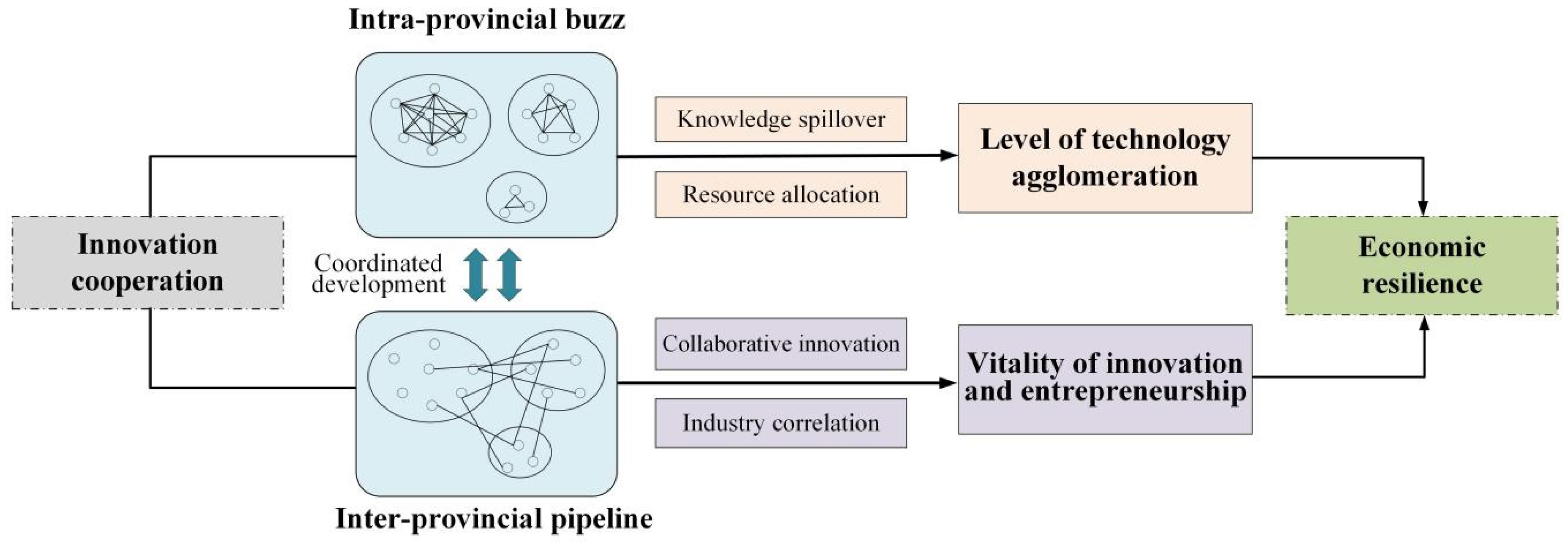
Intra-provincial buzz primarily refers to short-distance communication and information exchange among economic entities within a province through face-to-face interactions, which can be described as a “local communication platform” characterized by informal, frequent creation and exchange of information. In this process, geographic proximity facilitates communication and collaboration among innovators, accelerating knowledge spillover and diffusion. This helps overcome resource constraints, promotes the recombination of innovation factors, and enhances the urban innovation capacity, thereby strengthening the levels of technology agglomeration [43]. Meanwhile, as technology clusters, traditional industries undergo transformation and upgrading, while emerging industries are cultivated and developed. This enhances synergy across upstream and downstream segments of industrial chains, improves overall industrial competitiveness, and contributes to a more rational industrial structure. As a result, cities become better equipped to cope with external economic fluctuations and achieve stable economic development.
Inter-provincial pipelines emphasize long-distance interaction and connectivity across different regions. This mode of interaction provides an effective channel for cities to access diversified knowledge and technologies, integrate into broader innovation cooperation networks, and enhance innovation capabilities through network externalities [12]. Through collaborative innovation, inter-provincial pipelines help reduce uncertainties and transaction costs in innovation activities, thereby stimulating the vitality of urban innovation and entrepreneurship. Concurrently, urban entrepreneurial activities give rise to numerous new enterprises and industries, intensifying market competition and accelerating industrial metabolism. This drives the expansion of the market scale and increases the demand for production factors. This process expands the scope for a free flow of factors, improves resource allocation efficiency, and unleashes the development potential of innovation factors. Therefore, enhancing the vitality of urban innovation and entrepreneurship contributes to injecting new dynamism into urban economic resilience.
H4. 
Intra-provincial buzz and inter-provincial pipeline enhance urban economic resilience by boosting technology agglomeration and stimulating innovation and entrepreneurship, respectively.
Figure 1 illustrates the mechanism through which the two innovative cooperation patterns—intra-provincial buzz and the inter-provincial pipeline—impact urban economic resilience.

4. Research Design

4.1. Sample Election and Data Source

In this study, we use prefecture-level cities in China to test our theoretical predictions. Excluded are samples lacking information on key factors, and finally, our sample cities comprise 280 Chinese cities at the prefecture level. The primary data on innovation cooperation are derived from the patent information service platform of the State Intellectual Property Office. We construct measures of innovation collaboration using the authors address co-occurrence information from patent records. These data enable us to analyze two innovation cooperation patterns: intra-provincial buzz and the inter-provincial pipeline. Firstly, joint patent applications with two or more applicants are extracted, and data where the applicant cannot be matched to a corresponding city were eliminated. Secondly, for joint patent applications with three or more applicants, they are recorded as multiple patent cooperation data by the pin-two crossing method; finally, applicant addresses were matched to the corresponding prefecture-level city, and an undirected weighting matrix was established. Additional data sources included the National Bureau of Statistics, the China City Statistical Yearbook, and statistical yearbooks issued by provinces and municipalities.

4.2. Variable Definitions

4.2.1. Urban Economic Resilience

The term “urban economic resilience” describes a city’s resistance, resilience, and ability to reorganize and renew paths when a crisis comes [1]. Most studies measure the resilience of the urban economy by constructing a multidimensional index system [61], measuring the elasticity of a one-dimensional variable [62], or using counterfactual estimation [63]. Because multidimensional indicators are chosen in various ways and weights are measured differently, the existing research findings are inconsistent and difficult to verify or compare. Moreover, single-indicator measurement is based on straightforward calculations and is not likely to confuse causality, meaning one-dimensional variables are frequently employed in the evaluation of urban economic resilience [64]. Scholars usually choose the employment rate or economic output as the core indicator to assess the resilience of economic variables. Building on the studies of Hu et al. [31] and Feng et al. [32], this paper employs GDP as the indicator of economic output to measure the vulnerability and resistance dimension of urban economic resilience. It is constructed by comparing the actual amount change in GDP with the expected change (national level) using the following formula:
R e s i t = Y i t Y i , t 1 Y i , t 1 Y n t Y n , t 1 Y n , t 1 Y n t Y n , t 1 Y n , t 1
In the formula, Y i t and Y i , t 1 represent the actual GDP of city i during periods t and t − 1, respectively; and Y n t and Y n , t 1 reflect the total country’s actual GDP over times t and t − 1, respectively.
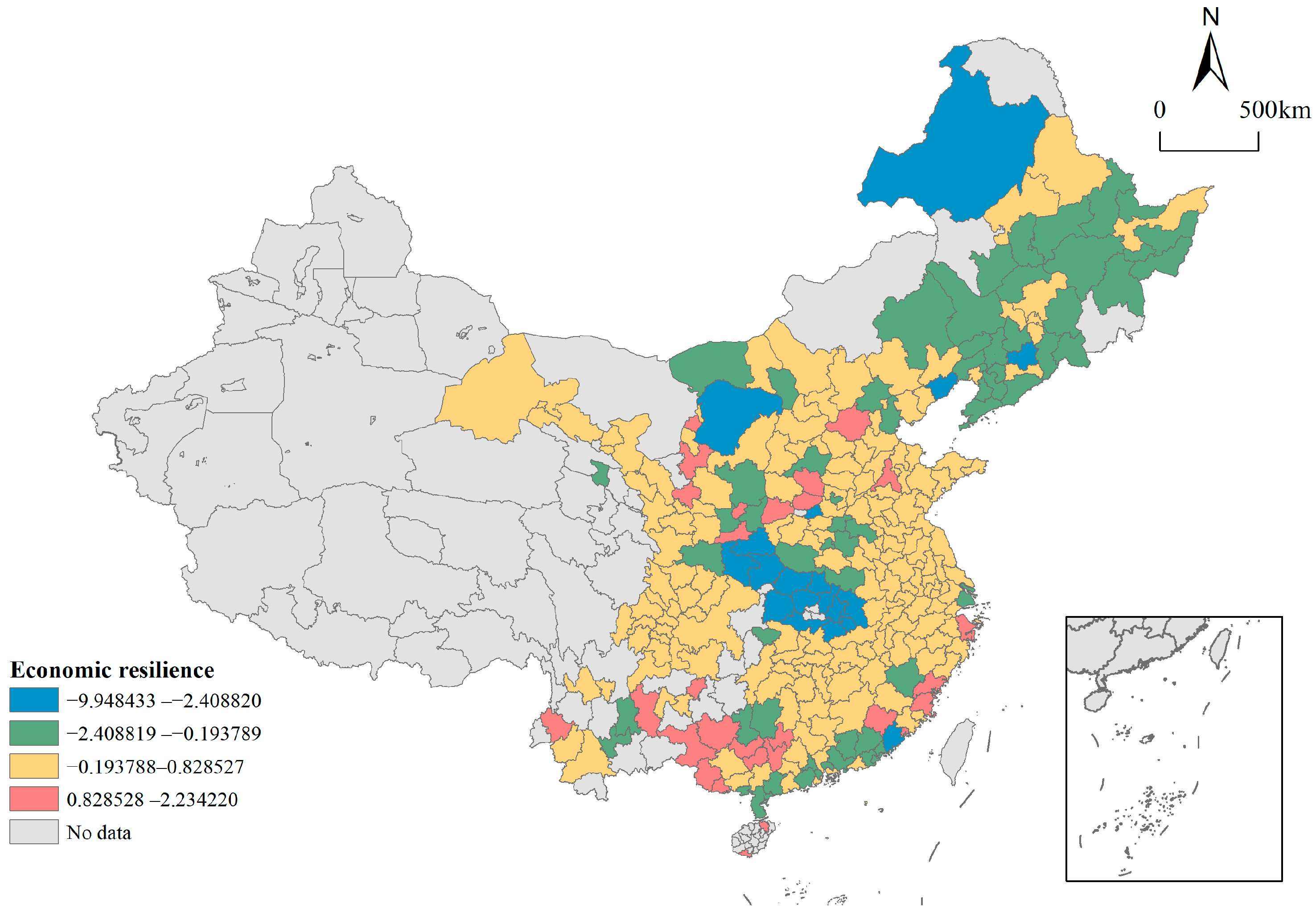
As an illustration, Figure 2 demonstrates the degree of urban economic resilience in China’s 280 cities for the year 2020.

4.2.2. Intra-Provincial Buzz and Inter-Provincial Pipeline

This paper considers prefecture-level cities as nodes and constructs innovation cooperation networks using data of inter-city patent application collaborations in the following steps. (i) If a joint patent involves n different cities, that patent is considered to represent n × (n − 1)/2 instances of cross-city collaboration. By aggregating and superimposing these collaborations, intra-provincial and inter-provincial cooperation networks are constructed, respectively. (ii) The more connections a city possesses in the network, the greater its potential to access and absorb external knowledge spillovers, reflecting its ability to acquire a wide range of knowledge resources [17]. Therefore, intra-provincial buzz and the inter-provincial pipeline in our study can be represented by the reciprocal sum of the shortest path lengths [65,66]. The smaller the sum of the shortest path lengths between a given city and all other cities in the network, the more knowledge resources it can access. (iii) Furthermore, when the shortest paths between node cities are identical, the cooperation intensity is incorporated as a weight into the measurement of these indicators [13]. This allows for a more precise measurement of the potential scale of knowledge flow. The specific formula can be presented as below:
b u z z i t p = i = 1 n p 1 w d i k  
p i p e l i n e i t p = i = 1 n q 1 w d i f  
In the formula, b u z z i t p represents the intra-provincial buzz of city i during the period t; the weighted shortest path length between cities i and k is represented by w d i k ; both cities are located in the same province p; the inter-provincial pipeline of city i in the period t is denoted by p i p e l i n e i t p ; the shortest path length between city i and city f is represented by w d i f ; and city i is located in province p while city f is located in province q.

4.2.3. Mechanistic Variables

Mechanism Variable 1: Technology agglomeration. Technology agglomeration of a city reflects the spatial over-concentration of technological elements relative to the national average. Considering that the innovation labor and technology output are two representative dimensions, we measure the technology agglomeration with these two indicators using a Location Quotient (LQ)-based approach. First, we compute separate LQs for R&D personnel [67] and patent applications [68], by calculating the city’s share of the national total. A value of LQ higher than 1 indicates an above-average spatial concentration. Then, two LQs are standardized and averaged with equal weights (0.5) to form the composite tech index, with higher values denoting a stronger agglomeration of technological factors.
Mechanism Variable 2: Vitality of innovation and entrepreneurship. This concept refers to the extent to which new enterprises, new capital, and new inventions emerge in the process of urban development [69]. Referring to the method employed in the study of Su et al. [70], three indicators are compiled to represent the vitality of innovation and entrepreneurship: (i) annual number of patent applications in each city, (ii) annual counts of newly registered enterprises, and (iii) the proportion of self-employed and private-sector employees. After standardizing the data of these three indicators to eliminate scale differences, the entropy weight method is applied to yield a composite vital index between 0 and 1, with higher values indicating higher innovation and entrepreneurship vitality.

4.2.4. Control Variables

The following five control variables were chosen for this paper: (1) Human capital (hum): the proxy variable is the logarithm of the number of college students per 10,000 persons. (2) Traffic accessibility (trf): measured by the logarithm of highway passenger traffic. (3) Consumption level (consu): the entire amount of urban consumer goods sold via retail this year is represented by the logarithm. (4) Degree of informatization (inter): calculated using the logarithm of the total number of people with Internet broadband connection. (5) Marketization level: represented by the Fan Gang Marketization index [71]. Table 1 provides descriptive statistics for the variables.

4.3. Model Setting

In order to explore the effects of two innovative cooperation patterns, i.e., intra-provincial buzz and the inter-provincial pipeline, on urban economic resilience, we took advantage of the panel data of 280 cities in China over the period of 2010–2020 and chose a two-way fixed-effect model to carry out the analysis. The following is the formulation of the model:
r e s i t = α 0 + α 1 buzz i t + α 2 buzz i t 2 + β 1 Z i t + σ i + λ t + ε i t
r e s i t = α 0 + α 1 pipeline i t + β 1 Z i t + σ i + λ t + ε i t
Considering the complementary relationship between intra-provincial buzz and the inter-provincial pipeline, the synergistic effect of the two innovative cooperation patterns was further tested by adding the interaction terms to the model:
r e s i t = α 0 + α 1 b u z z i t + α 2 p i p e l i n e i t + α 3 b u z z i t × p i p e l i n e i t + β 1 Z i t + σ i + λ t + ε i t
In the formula, i and t represent the city and year, respectively, r e s i t denotes the economic resilience, b u z z i t represents the intra-provincial buzz, p i p e l i n e i t indicates the inter-provincial pipeline, and b u z z i t × p i p e l i n e i t is the interaction term of the two, reflecting the synergistic development level of buzz and the pipeline. Z i t is a set of control variables at the city level that affect city economic resilience in this paper; σ i t represents city fixed effects; and λ i t represents time fixed effects.
To verify the mechanism of intra-provincial buzz and inter-provincial pipeline innovation cooperation patterns affecting urban economic resilience, we examined the potential influence paths based on theoretical analysis: intra-provincial buzz enhances urban economic resilience by improving the level of technology agglomeration; the inter-provincial pipeline enhances urban economic resilience by boosting the vitality of city innovation and entrepreneurship. Accordingly, we introduced a mediating effect model to verify this hypothesis, as shown in Equation (7).
r e s i t = γ 0 + γ 1 M i t + γ 2 b u z z i t / p i p e l i n e i t + γ 3 Z i t + σ i + λ t + ε i t
In the formula, M i t represents the mediating variable. Specifically, M i t is the technology agglomeration level t e c h i t when the explanatory variable is intra-provincial buzz, and it is the vitality of innovation and entrepreneurship vitality ( v i t a l i t ) when the explanatory variables is the inter-provincial pipeline. The meanings of the other explanatory variables remain as previously defined.

5. Empirical Analysis and Results

5.1. Results of Intra-Provincial Buzz and Inter-Provincial Pipeline

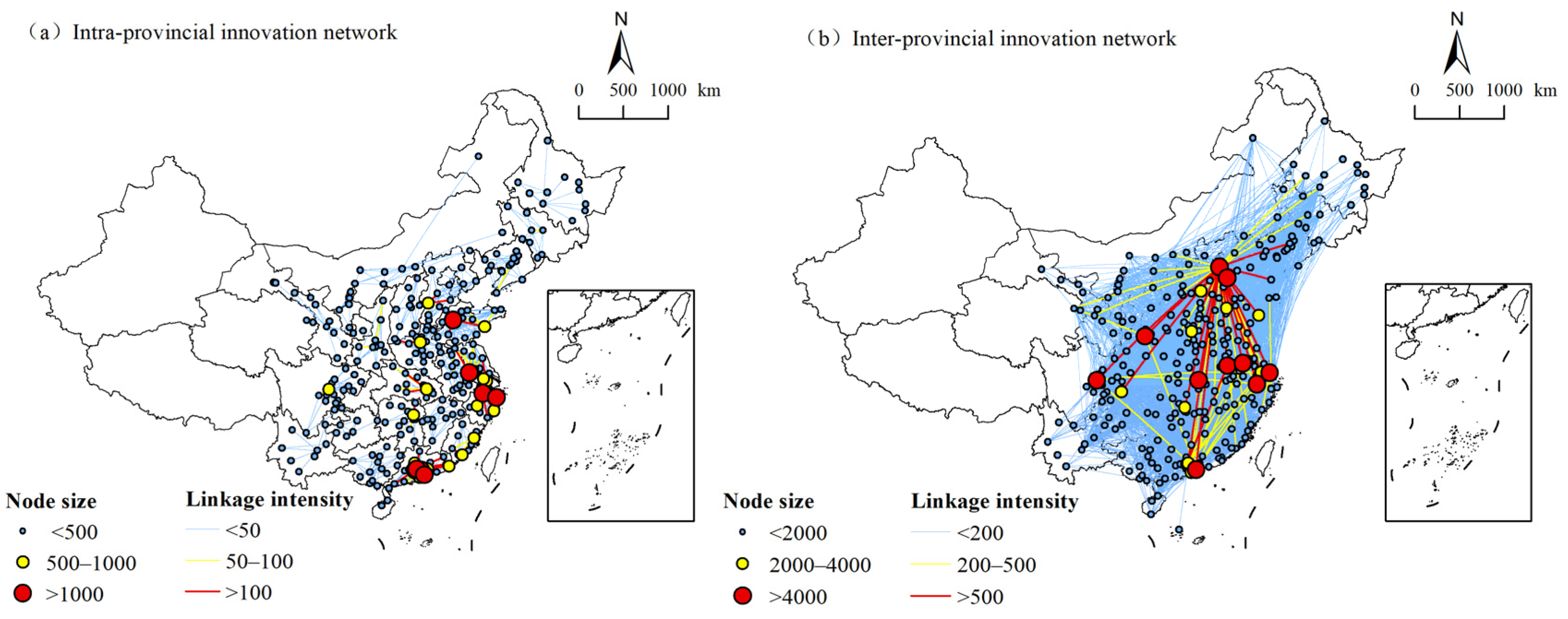
Figure 3 visualizes the characteristics of the intra-provincial buzz and inter-provincial pipeline network constructed in this study for 2020. It can be seen that the intra-provincial buzz is markedly denser in the east and sparser in the west. Guangdong and Zhejiang Provinces host the strongest within-province ties, with Guangzhou, Hangzhou, Dongguan, Shenzhen, Nanjing, Ningbo, and Jinan acting as high-intensity buzz hub cities (Figure 3a). As for the inter-provincial pipeline network, Beijing occupies the core position, and Shanghai, Nanjing, Shenzhen, Tianjin, Chengdu, Wuhan, and Xi’an emerge as key hub cities, radially linked to Beijing in an umbrella-like skeleton that underpins the entire national pipeline (Figure 3b).

5.2. Benchmark Regression Results

Considering that potential missing variables that might not change over time and could bias the regression results, a dual fixed-effect model (involving both time and region) was used to empirically test the causal relationship between intra-provincial buzz, the inter-provincial pipeline, and urban economic resilience. In Table 2, columns (1) and (2) display the regression results regarding the nonlinear influence of intra-provincial buzz on economic resilience. The outcomes indicate that, regardless of whether control variables are included, an inverted “U”-shaped relationship between intra-provincial buzz and economic resilience is suggested by the first term’s significantly positive coefficients and the second term’s significantly negative coefficients. It shows that intra-provincial buzz first promotes urban economic resilience but eventually inhibits that buzz. The probable reason could be that even though intra-provincial buzz has the potential to boost the enhancement of economic resilience by facilitating the flow and sharing of information, excessive intra-provincial buzz may lead to issues such as information overload and solidification, which can accordingly impede the improvement of economic resilience. Hypothesis 1 is confirmed.
To verify the inverted “U”-shaped relationship’s validity further, this paper combined the fact data in 2020 and examined the distribution of samples relative to both sides of the inflection point. According to the U-test, the provincial buzz value at the inflection point was 0.8592, falling within the value range of [0.0001, 2.0336], and about 97.11% of the samples were located on the left side of the inflection point. Specifically, the intra-provincial buzz values for eight cities in the study sample—Guangzhou, Dongguan, Foshan, Shenzhen, Shantou, Hangzhou, Ningbo, and Huizhou—were located on the right side of the inverted “U” curve’s inflection point. These cities are predominantly highly developed cities located in the eastern coastal region, with high levels of economic output and innovation activity. This finding indicates that top-tier cities should focus on optimizing and diversifying their inter-city innovation cooperation network to guard against the risks of excessive embeddedness in intra-provincial networks and avoid the homogenization of knowledge and technology.
Overall, it can be observed that the relationship between intra-provincial buzz and urban economic resilience remains predominantly positive. The potential negative effect is relevant only for a small subset of top-tier cities with exceptionally dense intra-provincial innovation networks. For the vast majority of cities in our sample, which remain on the ascending part of the curve, strengthening intra-provincial buzz continues to generate positive resilience gains.
Columns (3) and (4) of Table 2 demonstrate that the inter-provincial pipeline’s impact on urban economic resilience possesses a coefficient that is highly positive, regardless of the inclusion of control variables, indicating that inter-provincial innovation cooperation positively promotes urban economic resilience. The finding suggests that inter-provincial innovation cooperation can overcome geographical limitations and administrative barriers, attract entrepreneurs, investors, and innovative enterprises from different cities and fields, and expand innovative development paths. Consequently, it enhances economic resilience and strengthens urban risk resistance, thereby providing strong support for Hypothesis 2.
Columns (5) and (6) show the findings of the investigation into how urban economic resilience is affected by the interaction between intra-provincial buzz and the inter-provincial pipeline. The results indicate that intra-provincial buzz and the inter-provincial pipeline have complementary effects, and the synergized development of the two patterns can achieve the effect of “1 + 1 > 2”, significantly promoting urban economic resilience and thereby confirming Hypothesis 3. It is agreed that without cross-provincial cooperation to introduce non-redundant and heterogeneous new knowledge and technologies, high-intensity intra-provincial buzz can lead to solidification of the local knowledge base, which in turn limits breakthrough innovations and creates technological lock-ins, hindering the improvement in urban economic resilience. Conversely, without effective local cooperation, the new external knowledge acquired by a strong inter-provincial pipeline struggles to be localized and effectively disseminated with the region, making it difficult to apply and transform innovative knowledge.

5.3. Test of Robustness and Endogeneity

5.3.1. Robustness Tests

To verify the results’ robustness, the following steps have been taken in this paper. Firstly, municipalities immediately under the central government and provincial capitals were excluded from the analysis. The reasons for the exclusion included that these regions have abundant innovation resources, complete industrial systems, comprehensive infrastructure, and a more advanced resource endowment structure, meaning they easily attract more partners and establish economic ties. As a result, the concentration of resources can restrict the influence of the innovation cooperation network in promoting urban economic resilience, leading to potential bias in the estimation results. Consequently, the estimated outcomes of the robustness test, excluding municipalities directly under the central government and provincial capitals, are shown in columns (1)–(3) of Table 3. The findings imply that the relationship between intra-provincial buzz and urban economic resilience remained nonlinear, illustrating an initial promotion followed by inhibition. On the other side, the inter-provincial pipeline continued to significantly enhance urban economic resilience, indicating a strong robustness of the baseline regression results. The synergistic coefficient of the two patterns was positive but not significant, suggesting that high-grade cities are more likely to benefit from the combined effects of intra-provincial buzz and the inter-provincial pipeline on urban economic resilience.
Secondly, following the study of Agrawal et al. [72], small and medium-sized cities with fewer than one million residents were excluded from the analysis. The results of columns (4)–(6) in Table 3 reveal that the significance level and sign of the coefficients for intra-provincial buzz, the inter-provincial pipeline, and their interaction remained consistent, indicating a strong robustness of the regression results across the whole sample. Thirdly, the top ten cities with the highest number of cooperative connections were excluded from the analysis, including Beijing, Shanghai, Nanjing, Wuhan, Xi’an, Shenzhen, Tianjin, Chengdu, Hangzhou, and Guangzhou. This paper aimed to examine whether cities with strong network links are more affected by the integration of innovative collaboration networks in terms of urban economic resilience. The results displayed in columns (7)–(9) of Table 3 indicate that the benchmark regression results retain their strong robustness, confirming that the findings are not overly influenced by cities with particularly high levels of cooperative connections.

5.3.2. Endogeneity Test

To address potential endogeneity issues, this study employs the first-order lagged terms of the intra-provincial buzz and the inter-provincial pipeline as instrumental variables, and it conducts a regression analysis using both the two-stage least squares (2SLS) method and two-step optimal generalized method of moments (GMM) approach (Table 4). Columns (1) to (4) present the 2SLS regression results. Specifically, columns (1) and (3) show that the estimated coefficients of the instrumental variables are statistically significant and positive, with first-stage F-statistics all exceeding 10, indicating no weak instrument concerns. In columns (2) and (4), the Kleibergen–Paap rk LM statistics are significant at the 1% level, rejecting the null hypothesis of “under-identification of instruments”, and the Cragg–Donald Wald F statistics exceed the critical value of 16.38, further ruling out the possibility of weak instruments. In the second-stage regression, after controlling for endogeneity, both intra-provincial buzz and the inter-provincial pipeline continue to exhibit statistically significant positive effects on urban economic resilience, consistent with the baseline model.
Similarly, the GMM regression results in columns (5) to (8) show that the under-identification tests and weak instrument tests, both significantly reject their respective null hypotheses, confirming the validity and appropriateness of the instrumental variables. After accounting for endogeneity, the signs and statistical significance of the core explanatory variables remain consistent with the baseline regression results. These results consistently support the conclusions of this study.

5.4. Mechanism Analysis

This paper further examined the differentiated impact mechanisms of these two innovative cooperation patterns on urban economic resilience. Columns (1)–(3) in Table 5 present the test results when treating the technology agglomeration level (tech) as an intermediary variable. Column (1) shows that intra-provincial buzz has a significant promoting effect on economic resilience. Column (2) presents a significantly positive coefficient of intra-provincial buzz, indicating that intra-provincial buzz significantly improves the degree of technology agglomeration. With the advantages of geographical proximity and fewer administrative barriers, knowledge and technology elements could flow freely between cities within the province, which facilitates the exchange and cooperation of innovation subjects and promotes the transformation of innovation achievements into real productivity, leading to a notable technology agglomeration effect. Column (3) shows that the regression coefficient of technology agglomeration on economic resilience is significantly positive at the 5% level. The finding indicates that intra-provincial buzz can raise the level of technology agglomeration to improve urban economic resilience. The underlying mechanism could be that the innovation connection within the province makes it easier for knowledge and technological factors to flow freely and be shared, which as a result, improves the level of technology agglomeration. In return, this elevates economic production efficiency and propels the optimization of the industrial structure, and all these elements play a part in enhancing the resilience of the urban economy.
Columns (4)–(6) in Table 5 provide insights into the role of innovation and entrepreneurship vitality as an intermediary variable. Column (4) verifies that the results are consistent with those from the baseline regression, thus confirming the previous findings. Column (5) shows that the inter-provincial pipeline significantly improves the vitality of urban innovation and entrepreneurship, indicating that inter-provincial innovation cooperation promotes the interaction of new knowledge and new technology, contributes to the improvement of the level of collaborative innovation, and enhances industrial correlation, thus creating more opportunities for innovation and entrepreneurship. Column (6) shows that when the vitality of innovation and entrepreneurship is included in the benchmark regression model as an intermediary variable, it is significant at the level of 1%. This indicates that the inter-provincial pipeline stimulates the activity of urban innovation and entrepreneurship, thereby enhancing cities’ resilience to keep steady growth. The underlying reason could be that cross-provincial innovation cooperation facilitates the local application and transformation of heterogeneous knowledge and new technology, which, in turn, improves the level of inter-city collaborative innovation and infuses the innovation and entrepreneurship market with new development potential. At the same time, the inter-provincial pipeline fosters the extension of the urban industrial value chain by promoting inter-city industrial linkages. This creates additional opportunities for innovation and entrepreneurship, thereby enhancing the resilience of the industrial chain by stimulating the enthusiasm for innovation and entrepreneurship. Therefore, these pipelines accelerate a city’s productivity and vitality, and ultimately, help its economy achieve sustainable growth.

6. Heterogeneity Analysis

6.1. Heterogeneity Analysis: Geographical Locations of Sample Cities

The cities in China illustrate significant regional differences in innovation ability and economic development. Consequently, the sample cities within this research were classified into three regions: the eastern, central, and western regions (see Table 6). The results show that the impact of intra-provincial buzz on urban economic resilience is significant in the central and western regions, but not in the eastern regions. This pattern of innovation cooperation in the central and western regions facilitates the technological exchange among local enterprises and fosters a regional economic agglomeration effect. Consequently, it promotes the rapid development of the local innovation ecosystem and enhances regional economic resilience. On the other hand, inter-provincial pipelines have a significant effect on urban economic resilience in the eastern areas, but not in the central or western ones. This may be attributed to the eastern regions’ more advanced infrastructure and more extensive human resources, which offer a better platform for innovation cooperation and facilitate the sharing of technical knowledge. Such advantages are conducive to the concentration of high-end technology and innovation factors in the regions, thus enhancing their urban economic resilience. These findings reflect how the two innovative cooperation patterns’ effects on urban economic resilience vary by geographical region.

6.2. Heterogeneity Analysis: Population Size of Sample Cities

The size of a city has a significant impact on its industrial base, human capital, and consequently, its economic resilience. Based on population size, this study’s sample cities were divided into two categories: large cities (>1 million), and small and medium-sized cities (<1 million) [73]. This classification allowed for an examination of how the impact of intra-provincial buzz and the inter-provincial pipeline on economic resilience varies between these two categories of cities (see Table 7).
The results in columns (1) and (3) indicate that intra-provincial buzz significantly enhances urban economic resilience in both large cities and small and medium-sized cities, while the results in columns (2) and (4) indicate that the influence of the inter-provincial pipeline on economic resilience is substantially beneficial for large cities, whereas it is not significant for medium-sized and small cities. Large cities exhibit a higher capability of agglomerating important elements like capital, talents, and technology, which provides strong support for inter-provincial innovation cooperation. Due to the small number of small and medium-sized cities in China, the imbalanced sample may bring about uncertainty in estimation, which might be the reason why the subgroup regression of medium and small-sized cities for the inter-provincial pipeline is not significant. Furthermore, due to their greater population density and more pronounced industrial agglomeration effect, large cities have fostered a more comprehensive innovation ecosystem and cooperation network, which facilitate more frequent personnel exchange, technology transfer, and cooperation between enterprises. This network effect in large cities can further strengthen inter-provincial innovation cooperation and improve economic resilience.

6.3. Heterogeneity Analysis: Industrial Structural Diversification of Sample Cities

Another important factor influencing economic resilience is the industrial structure. A city with a diverse range of industries can mitigate the impact of fluctuations in any single industry sector of its economy. When a certain industry experiences a downturn or recession, other industries can stabilize the economy by softening the negative impacts of the downturned industry. Following the methodology outlined in the study of Xu and Zhang [4], this study measured the degree of diversity in the industrial structure and examined how it affected economic resilience (see Table 8).
The results show that in areas with a great extent of industrial diversification, intra-provincial buzz considerably improves economic resilience; however, the impact is not significant in areas with lower levels of industrial diversification. Conversely, the impact of the inter-provincial pipeline exhibited the opposite pattern. The probable reason is that, through innovation spillover and efficient resource allocation, intra-provincial buzz can boost the economy’s anti-risk capabilities and lessen economic instability in cities with high levels of industry diversity. For cities with lower levels of industrial diversification, inter-provincial cooperation can introduce new, heterogenous knowledge and technologies, compensates for deficiencies in the local industrial structure, improves the local industrial chain, and reduces the reliance on a single industry, thereby enhancing economic resilience.

7. Conclusions and Policy Recommendation

7.1. Conclusions

Using panel data from 280 Chinese prefecture-level cities from 2010 to 2020, this research carried out an in-depth examination of the relationship between intra-provincial buzz and the inter-provincial pipeline and urban economic resilience. It also investigated the mechanisms through which the two innovative cooperation patterns influence economic resilience. Additionally, taking into account variables including geographic location, city size, and the degree of industrial structure diversification, it investigated the disparate impacts of the two innovative cooperation patterns on economic resilience.
The following are this study’s primary conclusions. (1) Relationship between two innovative cooperation patterns and urban economic resilience: Intra-provincial buzz exhibits an inverted U-shaped relationship with urban economic resilience, yet the vast majority of cities are now on the ascending segment of the curve. In contrast, the inter-provincial pipeline consistently improves economic resilience. When the inter-provincial pipeline and intra-provincial buzz are developed in a synergetic effect, they increase metropolitan economic resilience to a higher degree. (2) Mechanism of influence: The transmission pathways through which intra-provincial buzz and the inter-provincial pipeline influence economic resilience differ. Whereas intra-provincial buzz increases the degree of technology agglomeration, inter-provincial pipelines improve economic resilience by enhancing the vitality of urban innovation and entrepreneurship. (3) Heterogeneous effects: Depending on the region, city size, and degree of industrial diversification, the impacts of intra-provincial buzz and the inter-provincial pipeline on urban economic resilience vary. Specifically, the inter-provincial pipeline shows a more significant impact for cities in the eastern region, with larger populations and with lower levels of industrial diversification, whereas intra-provincial buzz contributes more significantly to urban economic resilience in the central and western regions and in cities with higher levels of industrial diversification.

7.2. Policy Recommendation

Building on the above empirical findings, this study offers the following policy implications for fostering an open innovation pattern, building resilient cities. (1) Governments at all levels should be committed to the creation of an innovative cooperation ecosystem, which includes establishing joint laboratories, research centers, and innovation hubs to foster innovation collaboration and knowledge exchange, thereby promoting more extensive inter-city innovation cooperation. (2) It is crucial to carefully manage and balance the intensity of intra-provincial innovation cooperation and ensure that it remains at a level that maximizes benefits without leading to diminishing returns or technology lock-in. Top-tier cities should focus on optimizing and diversifying their cooperation network (e.g., by strategically integrating external pipelines) to guard against the risks of excessive embeddedness in local networks. (3) Governments can optimize investment and talent policies to fit local conditions, provide tailored services for innovative and entrepreneurial enterprises, develop a favorable business environment that supports the growth and success of innovative and entrepreneurial enterprises and increases the overall dynamism and adaptability of the urban economy, and consequently, enhance urban economic resilience. (4) Cities should tailor their innovation cooperation strategies to their specific needs. Eastern cities with lower industrial diversification should prioritize enhancing local buzz to effectively absorb and re-innovate knowledge acquired through inter-provincial pipelines. Large cities in central and western regions can act as “regional gateways”, and strategically build inter-provincial pipelines while continue to strengthen their intra-provincial buzz, to maximize economic resilience.


Author Contributions

Conceptualization, J.R.; methodology, J.R. and H.B.; software, Y.W. and X.S.; validation, Y.W. and X.S.; formal analysis, Y.W. and H.B.; investigation, H.B.; resources, Z.W.; data curation, X.S.; writing—original draft preparation, J.R.; writing—review and editing, Y.W. and Z.W.; visualization, Y.W.; supervision, Z.W.; project administration, J.R.; funding acquisition, J.R. All authors have read and agreed to the published version of the manuscript.

Funding

This research was funded by the Humanities and Social Science Research Foundation in the Ministry of Education of China, grant number 23YJC790108.

Data Availability Statement

The dataset used during the current study is available from the corresponding author upon reasonable request.

Conflicts of Interest

The authors declare no conflicts of interest.

References

  1. Martin, R. Regional Economic Resilience, Hysteresis and Recessionary Shocks. J. Econ. Geogr. 2011, 12, 1–32. [Google Scholar] [CrossRef]
  2. Amirzadeh, M.; Sobhaninia, S.; Sharifi, A. Urban resilience: A Vague or an Evolutionary Concept? Sustain. Cities Soc. 2022, 81, 103853. [Google Scholar] [CrossRef]
  3. Boschma, R.; Coenen, L.; Frenken, K.; Truffer, B. Towards a Theory of Regional Diversification: Combining Insights from Evolutionary Economic Geography and Transition Studies. Reg. Stud. 2017, 51, 31–45. [Google Scholar] [CrossRef]
  4. Xu, Y.; Zhang, L. The Economic Resilience of Chinese Cities and Its Origin: From the Perspective of Diversification of Industrial Structure. Financ. Trade Econ. 2019, 40, 110–126. [Google Scholar] [CrossRef]
  5. He, C.; Sheng, H. Regional Economic Resilience: A Review and Future Development Outlook. Hum. Geog. 2023, 38, 1–10. [Google Scholar] [CrossRef]
  6. Cooke, P.; Leydesdorff, L. Regional Development in the Knowledge-based Economy: The Construction of Advantage. J. Technol. Transf. 2006, 31, 5–15. [Google Scholar] [CrossRef]
  7. Florida, R.; Adler, P.; Mellander, C. The City as Innovation Machine. Reg. Stud. 2017, 51, 86–96. [Google Scholar] [CrossRef]
  8. Martin, R.; Simmie, J. Path Dependence and Local Innovation Systems in City-regions. Innovation 2008, 10, 183–196. [Google Scholar] [CrossRef]
  9. Owen-Smith, J.; Powell, W.W. Knowledge Networks as Channels and Conduits: The Effects of Spillovers in the Boston Biotechnology Community. Organ. Sci. 2004, 15, 5–21. [Google Scholar] [CrossRef]
  10. Bathelt, H.; Li, P. Processes of Building Cross-border Knowledge Pipelines. Res. Policy 2020, 49, 103928. [Google Scholar] [CrossRef]
  11. Coe, N.M.; Dicken, P.; Hess, M. Global Production Networks: Realizing the Potential. J. Econ. Geogr. 2008, 8, 271–295. [Google Scholar] [CrossRef]
  12. Bathelt, H. Buzz-and-Pipeline Dynamics: Towards a Knowledge-Based Multiplier Model of Clusters. Geogr. Compass. 2007, 1, 1282–1298. [Google Scholar] [CrossRef]
  13. Cao, Z.; Derudder, B.; Dai, L.; Peng, Z. ‘Buzz-and-Pipeline’ Dynamics in Chinese Science: The Impact of Interurban Collaboration Linkages on Cities’ Innovation Capacity. Reg. Stud. 2021, 56, 290–306. [Google Scholar] [CrossRef]
  14. Ma, H.; Wang, K. The Effect of Urban Technological Innovation and Cooperation on Green Development: A Case Study of the Three Urban Agglomerations in the Yangtze River Economic Belt. Geogr. Res. 2022, 41, 3287–3304. [Google Scholar] [CrossRef]
  15. Matthiessen, C.; Schwarz, A.; Find, S. World Cities of Scientific Knowledge: Systems, Networks and Potential Dynamics. An Analysis Based on Bibliometric Indicators. Urban Stud. 2010, 47, 1879–1897. [Google Scholar] [CrossRef]
  16. Trippl, M.; Tödtling, F.; Lengauer, L. Knowledge Sourcing Beyond Buzz and Pipelines: Evidence from the Vienna Software Sector. Econ. Geogr. 2009, 85, 443–462. [Google Scholar] [CrossRef]
  17. Cao, Z.; Dai, L.; Yang, Y. Knowledge Collaboration Patterns of Chinese Cities and Their Impacts on Knowledge Output: An Empirical Study Based the” Buzz-and-Pipelines” Model. Acta Geogr. Sin. 2022, 77, 960–975. [Google Scholar] [CrossRef]
  18. Yang, Y.; Wu, S.; Zhang, X.; Hao, L. Provincial Border Effects on Capital Flows in China: A Study Based on Enterprise Cross-Regional Investment Data. Cities 2025, 162, 105984. [Google Scholar] [CrossRef]
  19. Bai, C.-E.; Du, Y.; Tao, Z.; Tong, S.Y. Local Protectionism and Regional Specialization: Evidence from China’s Industries. J. Int. Econ. 2004, 63, 397–417. [Google Scholar] [CrossRef]
  20. Zhao, R.; He, P. Government Spending Efficiency, Fiscal Decentralization and Regional Innovation Capability: Evidence from China. Econ. Anal. Policy 2024, 84, 693–706. [Google Scholar] [CrossRef]
  21. Yao, L.; Li, J. Intercity Innovation Collaboration and the Role of High-Speed Rail Connections: Evidence from Chinese Co-Patent Data. Reg. Stud. 2022, 56, 1845–1857. [Google Scholar] [CrossRef]
  22. Feng, T.; Wu, X.; Guo, J. Racing to the Bottom or the Top? Strategic Interaction of Environmental Protection Expenditure among Prefecture-Level Cities in China. J. Cleaner Prod. 2023, 384, 135565. [Google Scholar] [CrossRef]
  23. Ren, C.; Wang, T.; Wang, L.; Zhang, Y. ‘Buzz-and-Pipeline’ Dynamics of Urban Dual Innovation: Evidence from China’s Biomedical Industry. Appl. Geogr. 2023, 158, 103048. [Google Scholar] [CrossRef]
  24. Simmie, J.; Martin, R. The Economic Resilience of Regions: Towards an Evolutionary Approach. Camb. J. Reg. Econ. Soc. 2010, 3, 27–43. [Google Scholar] [CrossRef]
  25. Pike, A.; Dawley, S.; Tomaney, J. Resilience, Adaptation and Adaptability. Camb. J. Reg. Econ. Soc. 2010, 3, 59–70. [Google Scholar] [CrossRef]
  26. Boschma, R. Towards an Evolutionary Perspective on Regional Resilience. Reg. Stud. 2015, 49, 733–751. [Google Scholar] [CrossRef]
  27. Wang, Z.; Wei, W. Regional Economic Resilience in China: Measurement and Determinants. Reg. Stud. 2021, 55, 1228–1239. [Google Scholar] [CrossRef]
  28. Walker, B.; Holling, C.S.; Carpenter, S.R.; Kinzig, A. Resilience, Adaptability and Transformability in Social–ecological systems. Ecol. Soc. 2003, 9, 5. [Google Scholar] [CrossRef]
  29. Christopherson, S.; Michie, J.; Tyler, P. Regional Resilience: Theoretical and Empirical Perspectives. Camb. J. Reg. Econ. Soc. 2010, 3, 3–10. [Google Scholar] [CrossRef]
  30. Martin, R.; Sunley, P.; Gardiner, B.; Tyler, P. How Regions React to Recessions: Resilience and the Role of Economic Structure. Reg. Stud. 2016, 50, 561–585. [Google Scholar] [CrossRef]
  31. Hu, X.; Li, L.; Dong, K. What Matters for Regional Economic Resilience Amid Covid-19? Evidence from Cities in Northeast China. Cities 2022, 120, 103440. [Google Scholar] [CrossRef]
  32. Feng, Y.; Lee, C.-C.; Peng, D. Does Regional Integration Improve Economic Resilience? Evidence from Urban Agglomerations in China. Sustain. Cities Soc. 2023, 88, 104273. [Google Scholar] [CrossRef]
  33. Xu, X.; Wang, M.; Wang, M.; Yang, Y.; Wang, Y. The Coupling Coordination Degree of Economic, Social and Ecological Resilience of Urban Agglomerations in China. Int. J. Environ. Res. Public Health 2023, 20, 413. [Google Scholar] [CrossRef]
  34. Li, H.; Wang, Y.; Zhang, H.; Yin, R.; Liu, C.; Wang, Z.; Fu, F.; Zhao, J. The Spatial-temporal Evolution and Driving Mechanism of Urban Resilience in the Yellow River Basin cities. J. Cleaner Prod. 2024, 447, 141614. [Google Scholar] [CrossRef]
  35. Chen, X.; Quan, R. A Spatiotemporal Analysis of Urban Resilience to the COVID-19 Pandemic in the Yangtze River Delta. Nat. Hazard. 2021, 106, 829–854. [Google Scholar] [CrossRef]
  36. Du, Z.; Zhang, H.; Ye, Y.; Jin, L.; Xu, Q. Urban Shrinkage and Growth: Measurement and Determinants of Economic Resilience in the Pearl River Delta. J. Geogr. Sci. 2019, 29, 1331–1345. [Google Scholar] [CrossRef]
  37. Zhang, L.; Lin, G.; Lyu, X.; Su, W. Suppression or Promotion: Research on the Impact of Industrial Structure Upgrading on Urban Economic Resilience. Humanit. Soc. Sci. Commun. 2024, 11, 843. [Google Scholar] [CrossRef]
  38. Jiang, J.; Zhang, X.; Huang, C. Influence of Population Agglomeration on Urban Economic Resilience in China. Sustainability 2022, 14, 10407. [Google Scholar] [CrossRef]
  39. He, Y.; Ma, J. Collaborative Development of Logistics Hubs and Free Trade Zones, Digital Finance and Economic Resilience. Financ. Res. Lett. 2025, 85, 108229. [Google Scholar] [CrossRef]
  40. Hu, X.; Hassink, R. Exploring Adaptation and Adaptability in Uneven Economic Resilience: A Tale of Two Chinese Mining Regions. Camb. J. Reg. Econ. Soc. 2017, 10, 527–541. [Google Scholar] [CrossRef]
  41. Christopherson, S.; Sunley, P.; Tyler, P. Reindustrialising Regions: Rebuilding the Manufacturing Economy? Camb. J. Reg. Econ. Soc. 2014, 7, 351–358. [Google Scholar] [CrossRef]
  42. McCann, P.; Ortega-Argilés, R. Smart Specialization, Regional Growth and Applications to European Union Cohesion Policy. Reg. Stud. 2015, 49, 1291–1302. [Google Scholar] [CrossRef]
  43. Wang, P.; Zhong, M. Industrial Cluster Networks, Technological Innovation, and Urban Economic Resilience. Urban Probl. 2021, 8, 63–71. [Google Scholar] [CrossRef]
  44. Liu, Z.; Tang, T.; Pan, J.; Han, G. Anatomizing Resilience: The Multi-Dimensional Evolution and Drivers of Regional Collaborative Innovation Networks. Systems 2025, 13, 1017. [Google Scholar] [CrossRef]
  45. Rothwell, R. Successful Industrial Innovation: Critical Factors for the 1990s. R&D Manag. 1992, 22, 221–240. [Google Scholar] [CrossRef]
  46. Camagni, R.; Capello, R. The City Network Paradigm: Theory and Empirical Evidence. Contrib. Econ. Anal. 2004, 266, 495–529. [Google Scholar] [CrossRef]
  47. Freeman, C. Networks of Innovators: A Synthesis of Research Issues. Res. Policy 1991, 20, 499–514. [Google Scholar] [CrossRef]
  48. Haynes, K.E.; Fotheringham, A.S. Gravity and Spatial Interaction Models; Sage Publications: Thousand Oaks, CA, USA, 1985; Chapter 1. [Google Scholar]
  49. Maggioni, M.A.; Uberti, T.E. Inter-regional Knowledge Flows in Europe: An Econometric Analysis. In Applied Evolutionary Economics and Economic Geography; Edward Elgar Publishing: Cheltenham, UK, 2007; pp. 230–255. [Google Scholar] [CrossRef]
  50. Wang, F.; Zeng, G.; Ye, Q.; Chen, H. Analysis of City Network Based on Innovation Cooperation: Case Study of Yangtze River Economic Belt. Resour. Environ. Yangtze Basin. 2017, 26, 797–805. [Google Scholar] [CrossRef]
  51. Hu, F.; Mou, S.; Wei, S.; Liping, Q.; Hu, H.; Zhou, H. Research on the Evolution of China’s Photovoltaic Technology Innovation Network from the Perspective of Patents. Energy Strategy Rev. 2024, 51, 101309. [Google Scholar] [CrossRef]
  52. Bhardwaj, B.; Sharma, D. Migration of Skilled Professionals across the Border: Brain Drain or Brain Gain? Eur. Manag. J. 2023, 41, 1021–1033. [Google Scholar] [CrossRef]
  53. Wang, C.; Hu, Q. Knowledge Sharing in Supply Chain Networks: Effects of Collaborative Innovation Activities and Capability on Innovation Performance. Technovation 2020, 94–95, 102010. [Google Scholar] [CrossRef]
  54. Maskell, P.; Malmberg, A. The Competitiveness of Firms and Regions ‘Ubiquitification’ and the Importance of Localized Learning. Eur. Urban Reg. Stud. 1999, 6, 9–25. [Google Scholar] [CrossRef]
  55. Si, Y.; Zeng, G.; Cao, X.; Zhu, Y. Research Progress of Glocal Innovation Networks. Prog. Geogr. 2016, 35, 600–609. [Google Scholar] [CrossRef]
  56. Boschma, R.A.; ter Wal, A.L.J. Knowledge Networks and Innovative Performance in an Industrial District: The Case of a Footwear District in the South of Italy. Ind. Innov. 2007, 14, 177–199. [Google Scholar] [CrossRef]
  57. Ketels, C. Recent Research on Competitiveness and Clusters: What Are the Implications for Regional Policy? Camb. J. Reg. Econ. Soc. 2013, 6, 269–284. [Google Scholar] [CrossRef]
  58. Yao, C.; Wu, K. Agglomeration Externalities, Network Externalities and Urban Innovation Development. Geogr. Res. 2022, 41, 2330–2349. [Google Scholar] [CrossRef]
  59. Storper, M.; Venables, A.J. Buzz: Face-to-Face Contact and the Urban Economy. J. Econ. Geogr. 2004, 4, 351–370. [Google Scholar] [CrossRef]
  60. Boschma, R. Proximity and Innovation: A Critical Assessment. Reg. Stud. 2005, 39, 61–74. [Google Scholar] [CrossRef]
  61. Guan, X.; Ma, H. The Impact of Basic Public Service Provision on Urban Economic Resilience: Evidence from 281 Cities in China. Int. Rev. Econ. Finance 2025, 104, 104678. [Google Scholar] [CrossRef]
  62. Chen, A. Agglomeration and Urban Economic Resilience in China. J. World Econ. 2022, 45, 158–181. [Google Scholar] [CrossRef]
  63. Di Pietro, F.; Lecca, P.; Salotti, S. Regional Economic Resilience in the European Union: A Numerical General Equilibrium Analysis. Spat. Econ. Anal. 2021, 16, 287–312. [Google Scholar] [CrossRef]
  64. Giannakis, E.; Bruggeman, A. Regional Disparities in Economic Resilience in the European Union across the Urban–Rural Divide. Reg. Stud. 2020, 54, 1200–1213. [Google Scholar] [CrossRef]
  65. Borgatti, S.P. Identifying Sets of Key Players in a Social Network. Comput. Math. Organ. Theory 2006, 12, 21–34. [Google Scholar] [CrossRef]
  66. Opsahl, T.; Panzarasa, P. Clustering in Weighted Networks. Soc. Networks 2009, 31, 155–163. [Google Scholar] [CrossRef]
  67. Fingleton, B.; Igliori, D.; Moore, B. Cluster Dynamics: New Evidence and Projections for Computing Services in Great Britain. J. Reg. Sci. 2005, 45, 283–311. [Google Scholar] [CrossRef]
  68. Song, R. Digital Economy, Innovation Factor Agglomeration and Regional Industrial Structure Upgrading. Doctoral Dissertation, Yunnan University of Finance and Economics, Kunming, China, 2024. [Google Scholar] [CrossRef]
  69. Xuan, H.; Guo, C.; Dai, J. Do Innovation and Entrepreneurship Vitality Enhance University-Industry Collaboration? Roles of Financial Development and Educational Investment. Int. Rev. Econ. Financ. 2025, 103, 104412. [Google Scholar] [CrossRef]
  70. Su, R.; Zhao, X.; Fang, Y. The Development of Innovation and Entrepreneurship, Government Empowerment and Urban Economic Resilience. Sci. Sci. Manag. S&T 2023, 44, 93–113. [Google Scholar] [CrossRef]
  71. Fan, G.; Ma, G.; Wang, X. Institutional Reform and Economic Growth of China: 40-Year Progress toward Marketization. Acta Oecon. 2019, 69, 7–20. [Google Scholar] [CrossRef]
  72. Agrawal, A.; Kapur, D.; McHale, J. How do spatial and social proximity influence knowledge flows? Evidence from patent data. J. Urban. Econ. 2008, 64, 258–269. [Google Scholar] [CrossRef]
  73. Chen, Y.; Wu, W. Research and Analysis on Industrial Agglomeration, Industrial Diversification and Urban Economic Resilience. Sci. Technol. Prog. Policy 2021, 38, 64–73. [Google Scholar] [CrossRef]
Figure 1. Theoretical framework of this study. In the figure, the circles represent cities, with larger circles outlining provincial boundaries. The lines indicate inter-city innovation collaboration links, illustrating both intra-provincial "buzz" and inter-provincial "pipeline" dynamics.
Systems 14 00051 g001
Figure 2. The urban economic resilience in 2020.
Systems 14 00051 g002
Figure 3. The spatial structure and key hub cities of intra-provincial (a) and inter-provincial (b) innovation cooperation network in China in 2020.
Systems 14 00051 g003
Table 1. Descriptive statistics for each variable.
VariableDefinitionObs.MeanS.D.Min.Max.
resEconomic resilience3002−0.00360.5472−9.94842.2342
buzzIntra-provincial buzz29580.05570.143402.0336
pipelineInter-provincial pipeline30020.86421.6359016.7859
humHuman capital30024.64161.1100−4.34697.5660
trfTraffic accessibility30028.34491.05972.197212.5656
consuConsumption level300215.56251.05785.472318.8865
interDegree of informatization300213.37910.97469.210317.7617
marketMarketization level300211.65982.39124.6819.69
techLevel of technology agglomeration26850.10310.08240.00440.9026
vitalVitality of innovation and entrepreneurship 30020.01670.01700.00060.2068
Table 2. Results of benchmark regression.
Variable(1)(2)(3)(4)(5)(6)
resresresresresres
buzz0.499 **0.631 *** −0.314 **−0.263 **
(0.197)(0.208) (0.124)(0.133)
buzz2−0.314 ***−0.354 ***
(0.121)(0.125)
pipeline 0.027 **0.038 ***0.0290.037 **
(0.013)(0.014)(0.019)(0.018)
buzz × pipeline 0.087 **0.089 **
(0.036)(0.036)
hum 0.061 0.069 * 0.070 *
(0.039) (0.041) (0.041)
trf 0.016 0.016 0.019
(0.029) (0.028) (0.028)
consu 0.069 0.067 0.061
(0.048) (0.047) (0.045)
inter 0.112 *** 0.111 *** 0.120 ***
(0.034) (0.032) (0.034)
market −0.003 −0.010 −0.006
(0.037) (0.034) (0.037)
Constant0.175 ***−2.647 ***0.176 ***−2.593 ***0.174 ***−2.666 ***
(0.020)(0.941)(0.020)(0.894)(0.020)(0.919)
CityYESYESYESYESYESYES
YearYESYESYESYESYESYES
Observations295829583002300229582958
R20.1030.1090.1040.1100.1050.112
Note: Standard errors are reported in parentheses, *** p < 0.01, ** p < 0.05, * p < 0.1.
Table 3. Results of robustness test.
Provincial Capitals and Municipalities Directly Under the Central Government Were ExcludedSmall and Medium-Sized Cities Were ExcludedTop 10 Cities with More Cooperative Cities Were Excluded
(1) res(2) res(3) res(4) res(5) res(6) res(7) res(8) res(9) res
buzz0.705 *** −0.383 *0.630 *** −0.268 **0.693 *** −0.365 *
(0.217) (0.221)(0.210) (0.133)(0.209) (0.208)
buzz2−0.463 *** −0.346 *** −0.476 ***
(0.131) (0.124) (0.133)
pipeline 0.060 ***0.063 ** 0.038 ***0.037 ** 0.046 ***0.043 **
(0.023)(0.031) (0.014)(0.018) (0.016)(0.019)
buzz × pipeline 0.110 0.093 ** 0.124 *
(0.069) (0.036) (0.072)
hum0.070 *0.072 *0.073 *0.0620.0700.0710.067 *0.069 *0.069 *
(0.041)(0.042)(0.042)(0.042)(0.043)(0.044)(0.041)(0.041)(0.042)
trf0.0090.0130.0130.0230.0220.0260.0100.0120.012
(0.029)(0.029)(0.029)(0.030)(0.028)(0.029)(0.029)(0.028)(0.029)
consu0.0550.0510.0490.0600.0580.0520.0660.0610.060
(0.044)(0.043)(0.043)(0.045)(0.044)(0.043)(0.047)(0.045)(0.045)
inter0.125 ***0.131 ***0.132 ***0.112 ***0.112 ***0.121 ***0.112 ***0.117 ***0.118 ***
(0.036)(0.036)(0.037)(0.035)(0.032)(0.035)(0.034)(0.034)(0.034)
market−0.006−0.006−0.008−0.013−0.019−0.016−0.0020.003−0.001
(0.040)(0.039)(0.039)(0.038)(0.034)(0.038)(0.038)(0.036)(0.037)
Constant−2.505 ***−2.568 ***−2.540 ***−2.504 ***−2.466 ***−2.526 ***−2.573 ***−2.623 ***−2.603 ***
(0.938)(0.918)(0.923)(0.925)(0.875)(0.904)(0.931)(0.934)(0.920)
Year/CityYESYESYESYESYESYESYESYESYES
Observations270127012701285128952851288128922881
R20.1100.1110.1120.1070.1090.1100.1110.1120.113
Note: Standard errors are reported in parentheses, *** p < 0.01, ** p < 0.05, * p < 0.1.
Table 4. Results of IV validity tests.
2SLS MethodGMM Estimation
(1)(2)(3)(4)(5)(6)(7)(8)
buzzrespipelineresbuzzrespipelineres
buzz 0.283 ** 0.276 **
(0.143) (0.115)
L.buzz 1.057 *** 0.887 ***
(0.011) (0.015)
pipeline 0.036 * 0.036 ***
(0.019) (0.134)
L.pipeline 1.041 *** 0.886 ***
(0.007) (0.010)
F 156.16 2479.89 3549.81 7411.51
K-P LM statistics 16.479 28.122 1631.267 2098.264
<0.000> <0.000> <0.000> <0.000>
C-D Wald F statistics 156.16 2479.89 3549.806 7411.513
[16.38] [16.38] [16.38] [16.38]
ControlYESYESYESYESYESYESYESYES
Year/CityYESYESYESYESYESYESYESYES
Observations27702770281028102770277028102810
R2 0.103 0.090 0.292 0.296
Note: *** p < 0.01, ** p < 0.05, * p < 0.1. < > is a p value, [] are critical values for the Stock–Yogo weak ID test at the 10% significance level.
Table 5. Results of mechanism test result.
Intra-Provincial BuzzInter-Provincial Pipeline
(1) res(2) tech(3) res(4) res(5) vital(6) res
buzz0.205 *0.077 ***0.037
(0.114)(0.016)(0.092)
pipeline 0.038 ***0.002 ***0.032 **
(0.014)(0.001)(0.014)
tech 0.602 **
(0.250)
vital 3.601 ***
(1.047)
hum0.058−0.009 ***0.0110.069 *−0.0010.072 *
(0.039)(0.003)(0.032)(0.041)(0.001)(0.040)
trf0.010−0.004 *−0.042 **0.016−0.002 **0.021
(0.029)(0.002)(0.021)(0.028)(0.001)(0.028)
consu0.067−0.0050.0510.0670.003 *0.056
(0.047)(0.004)(0.037)(0.047)(0.002)(0.043)
inter0.111 ***−0.007 **0.073 **0.111 ***0.002 **0.105 ***
(0.034)(0.003)(0.032)(0.032)(0.001)(0.032)
market−0.005−0.004 *−0.011−0.0100.001−0.013
(0.037)(0.002)(0.022)(0.034)(0.001)(0.034)
Constant−2.525 ***0.347 ***−1.134−2.593 ***−0.047 *−2.424 ***
(0.937)(0.073)(0.729)(0.894)(0.027)(0.857)
Year/CityYESYESYESYESYESYES
Observations295826452645300230023002
R20.1070.4850.2580.1100.0910.113
Note: Standard errors are reported in parentheses, *** p < 0.01, ** p < 0.05, * p < 0.1.
Table 6. Heterogeneity analysis grouped by the geographical location of sample cities.
Eastern RegionCentral and Western Regions
(1)(2)(3)(4)
buzz−0.124 1.096 **
(0.103) (0.510)
pipeline 0.024 * 0.023
(0.014) (0.024)
ControlYESYESYESYES
Year/CityYESYESYESYES
Observations1054108719041915
N97100179180
R20.2230.2220.1120.111
Note: Standard errors are reported in parentheses, ** p < 0.05, * p < 0.1. Observation denotes the actual measured value; “N” is the number of distinct cities covered in the subsample.
Table 7. Heterogeneity analysis grouped by urban population size of sample cities.
Large CitiesSmall and Medium-Sized Cities
(1)(2)(3)(4)
buzz0.212 * 12.471 **
(0.116) (5.126)
pipeline 0.038 *** 0.565
(0.014) (0.509)
ControlYESYESYESYES
Year/CityYESYESYESYES
Observations28512895107107
N2682721414
R20.1050.1090.2500.242
Note: Standard errors are reported in parentheses, *** p < 0.01, ** p < 0.05, * p < 0.1. Observation denotes the actual measured value; “N” is the number of distinct cities covered in the subsample.
Table 8. Heterogeneity analysis grouped by industrial structure diversification of sample cities.
Cities with Low Levels of Industrial DiversificationCities with High Levels of Industrial Diversification
(1)(2)(3)(4)
buzz0.199 0.270 *
(0.181) (0.153)
pipeline 0.073 *** 0.024
(0.025) (0.015)
ControlYESYESYESYES
Year/CityYESYESYESYES
Observations1426143213941432
N200202206210
R20.0650.0720.1580.156
Note: Standard errors are reported in parentheses, *** p < 0.01, * p < 0.1. Observation denotes the actual measured value; “N” is the number of distinct cities covered in the subsample.
Disclaimer/Publisher’s Note: The statements, opinions and data contained in all publications are solely those of the individual author(s) and contributor(s) and not of MDPI and/or the editor(s). MDPI and/or the editor(s) disclaim responsibility for any injury to people or property resulting from any ideas, methods, instructions or products referred to in the content.