A Conceptualization of Agility: Utilization and Future Research for the Development of Mechatronic Systems


Abstract
1. Introduction
1.1. Background
- Individuals and interactions over processes and tools;
- Working software over comprehensive documentation;
- Customer collaboration over contract negotiation;
- Responding to change over following a plan.
1.2. Challenges in Agile Product Design and Development
1.3. Purpose and Aim
- (I)
- Classification of agility within the context of product design and development;
- (II)
- Contribute to theory by providing a systemic perspective on the construct of agility, enabling effective and efficient agile system behavior within the context of product design and development;
- (III)
- Foster additional systems-theoretical investigation of the agility construct.
- How can agility be conceptualized from a systems-theoretical perspective to support its context- and situation-specific application in product design and development?
2. Research Approach, Materials and Methods
3. Fundamentals of Product Design and Development
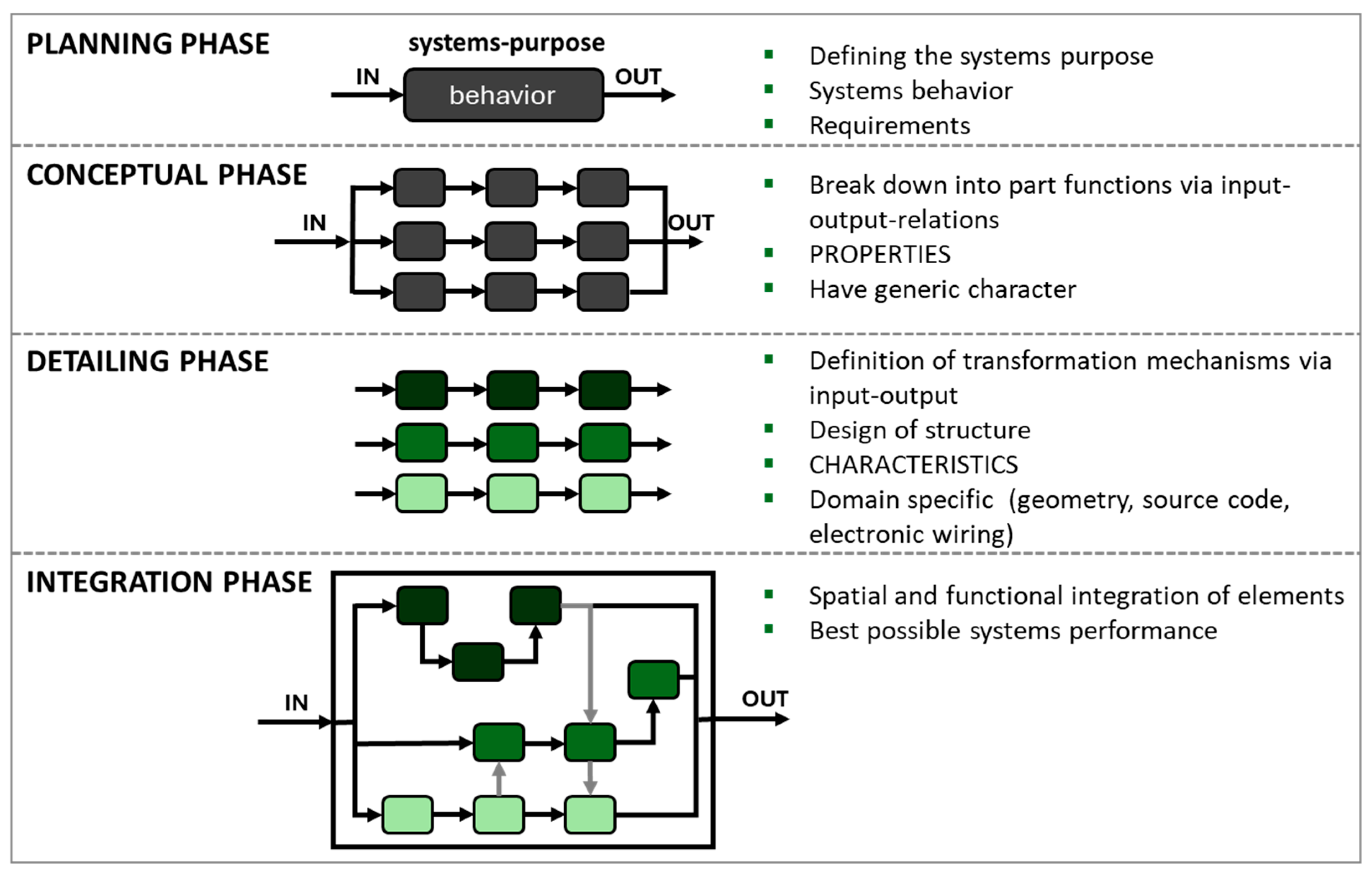
3.1. Characteristics of Product Development Processes
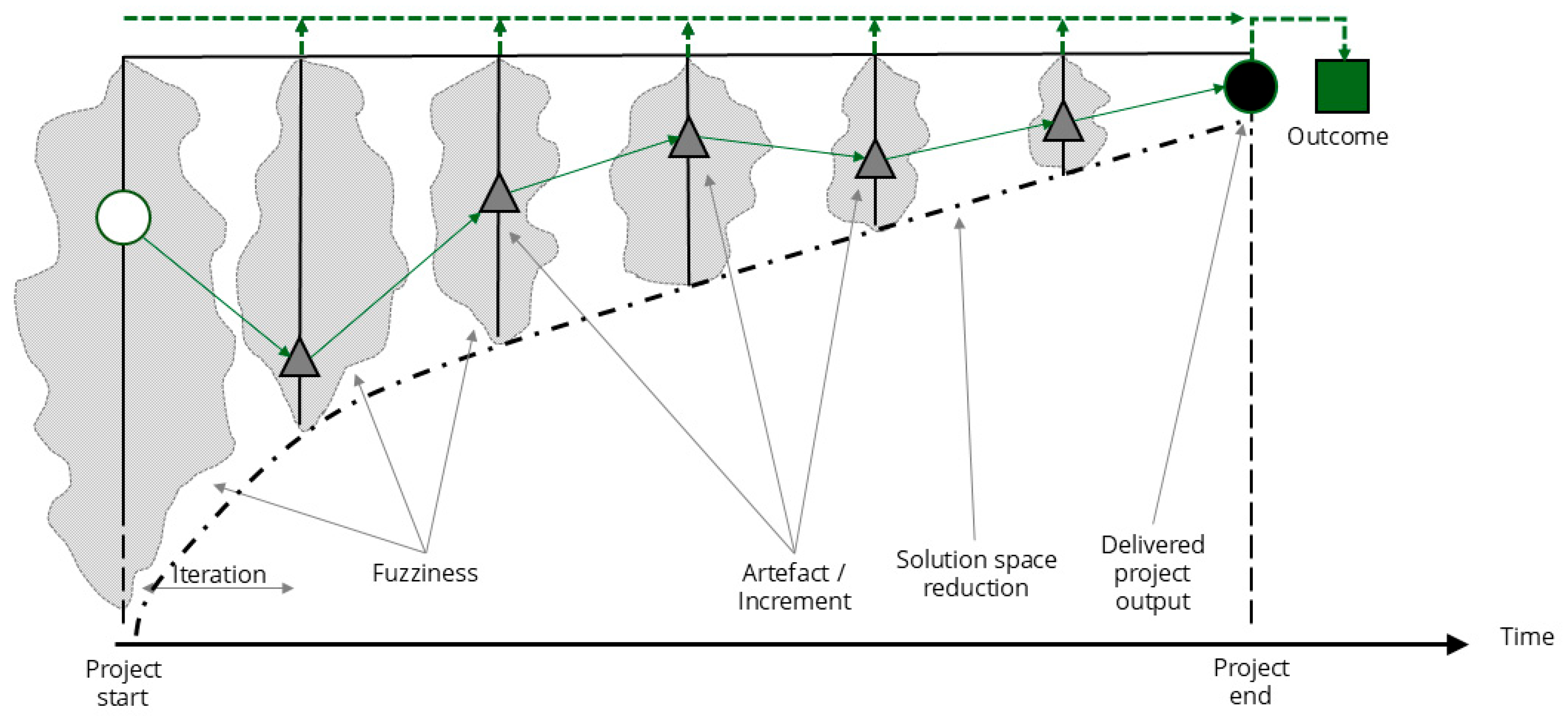
- Initially, the system of objectives for development represents a mental conception of the technical system to be developed, which is only successively completed and concretized in the course of development through the choice of solution principles [59].
- Working in interdisciplinary teams is necessary to provide knowledge from the different domains, but it also involves the risk of ambiguities since domain specific different terminologies are used, and model approaches from the domains can be interpreted differently [60].
- Development activities run concurrently for reasons of efficiency. Appropriate interface management is needed to provide sufficient information requirements for decision-making, not only from a formal, but also from an organizational and process perspective [61].
- The more functions a product provides, the more complicated it becomes in predicting requirements [62].
- Volatility describes the effect of relative changeability, which is more pronounced and associated with instability and turbulence [66]. Fluctuations in influencing parameters can have a significant impact but can be described as a statistical problem for which strategies for dealing with them can indeed be derived [67,68].
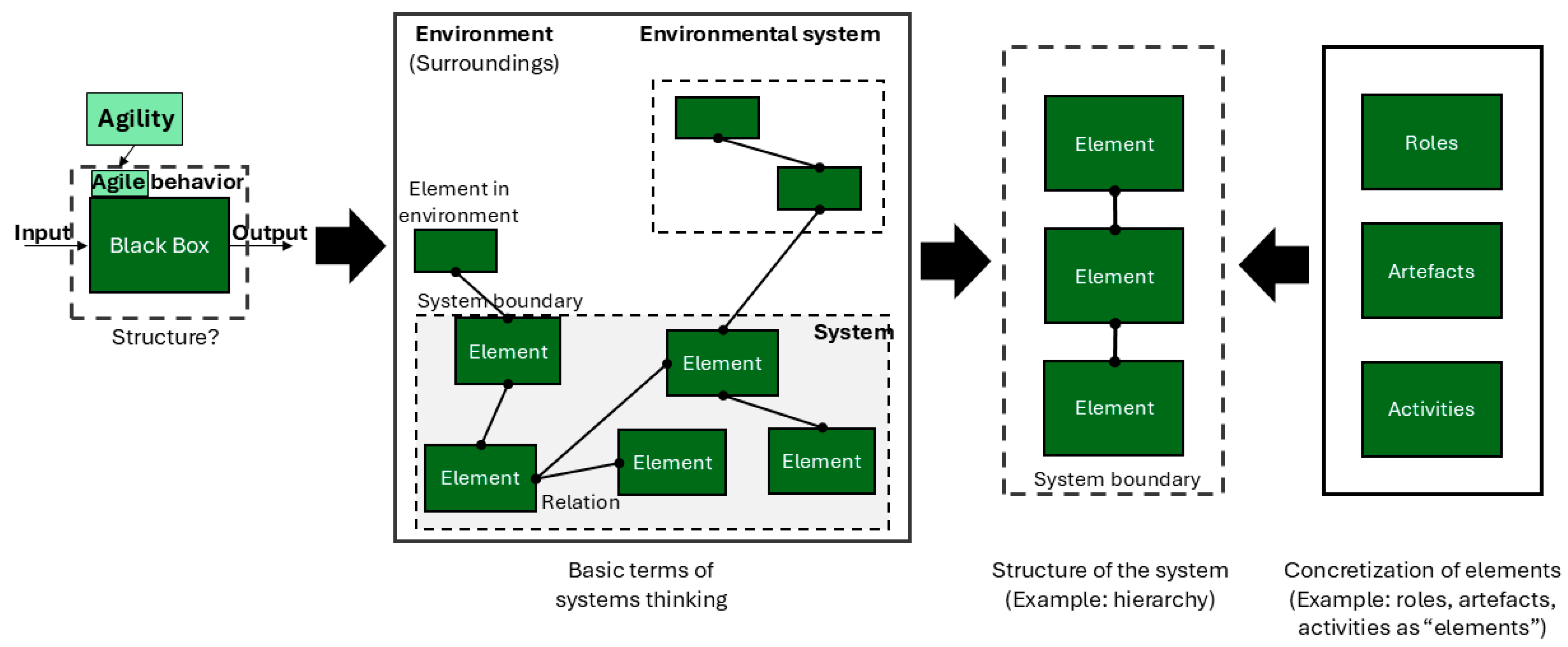
- Complexity is based on a system-theoretical perspective, according to which a system is composed of elements and relations between them and thus generates a system behavior [51]. A system is considered complex if the elements or relations between them cannot be objectively known or explained [71,72].
- Ambiguity means that no definite assertion can be made about information regarding the decision making process, which will impact the decision, even if it is based on a proper understanding of the system [66].
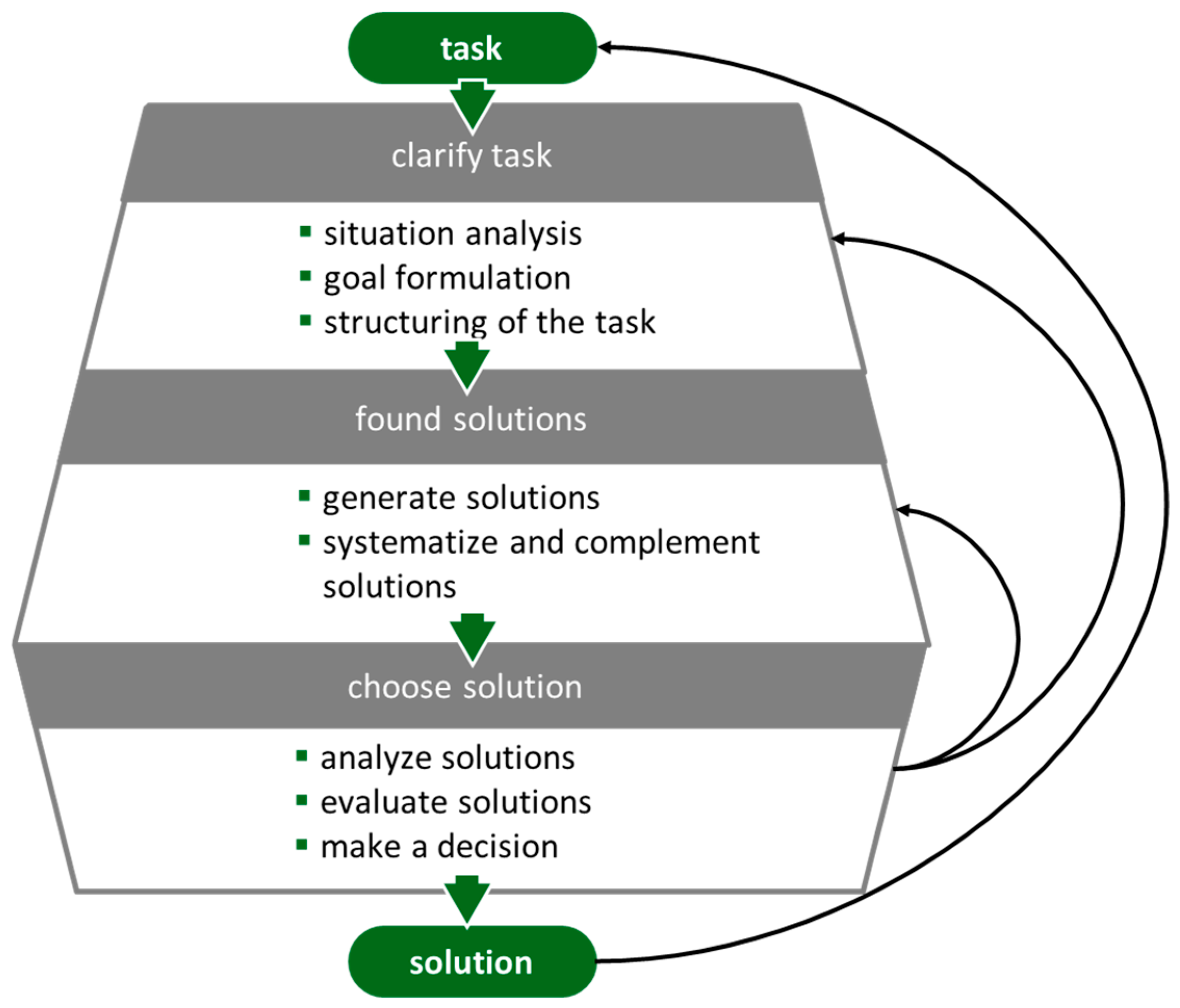
3.2. Understanding of Procedural Models
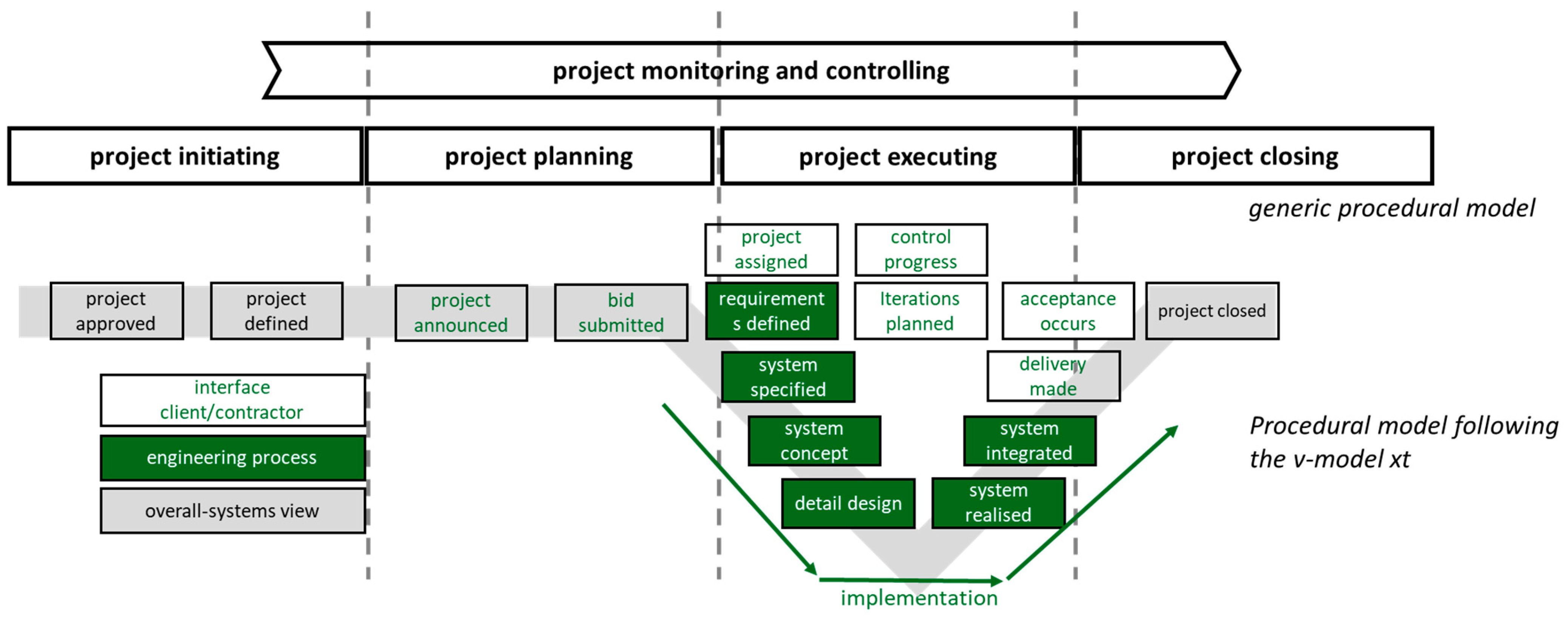
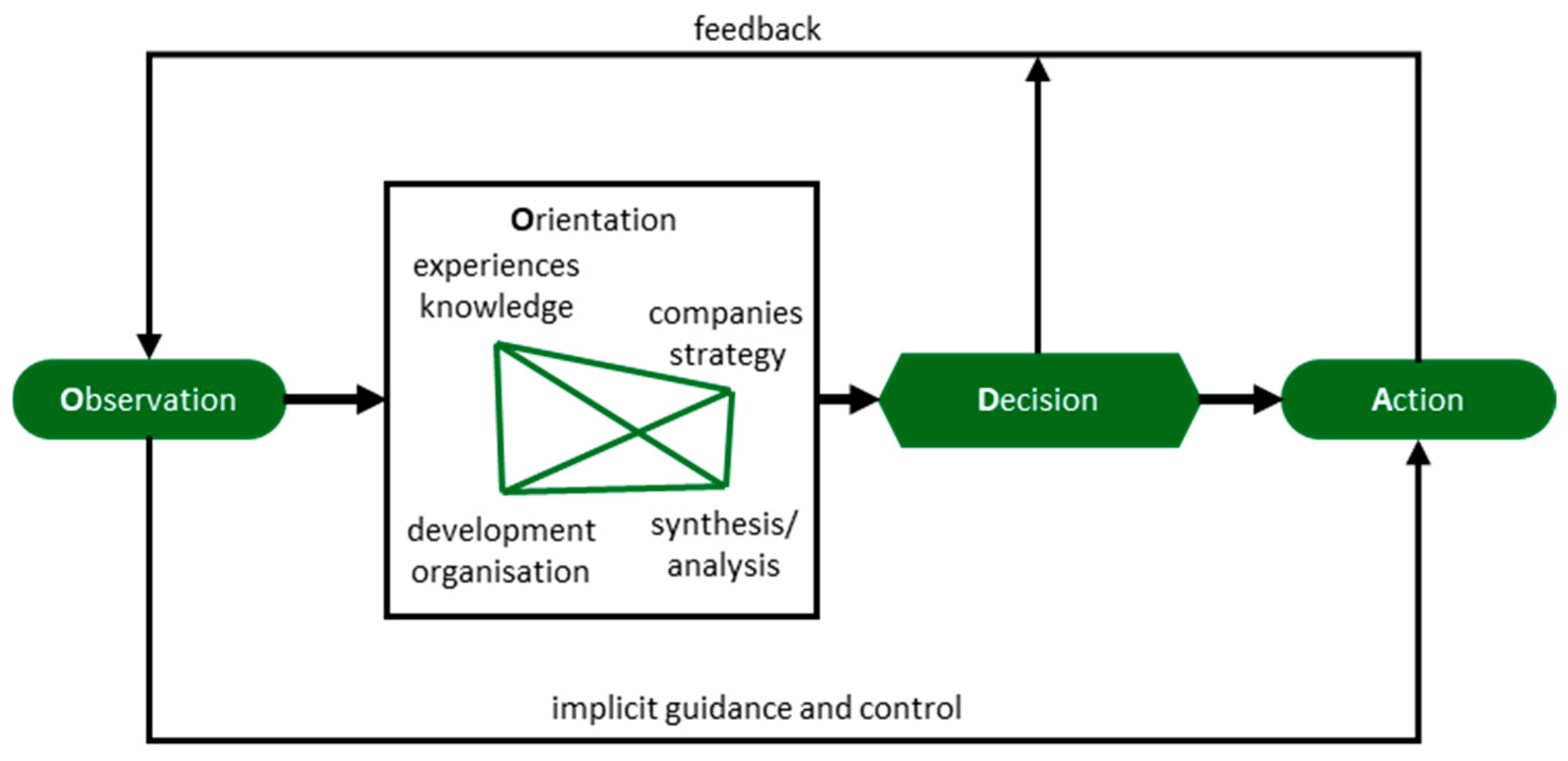
3.3. Project Management in Context of Design Methodologies
3.4. Significance for Agile Product Design and Development
4. Results: Clarifying the Concept of Agility—Interpretation and Classification in Product Design and Development
4.1. Agility as an Attribute
- Incremental development reduces complexity by breaking down a larger system into manageable features. The breakdown into experienceable features ensures a focus in development organizations and enables regular, early delivery and frequent validation directly by the customer.
- Breaking down design tasks into smaller steps generates a higher frequency of intermediate results, aligning with the inherently iterative procedure preferred in product development. The increased frequency of verification provides objective proof for the developed technical artefacts to meet the design task requirements. Necessary adjustments must be made in accordance with the requirements specified.
- Responsiveness as a functional focus to increase benefits with appropriate measures under a competitive and reasonable speed by assessing opportunities and risks in turbulent environments (not necessarily) and due unstable requirements that exceed predefined parameters.
- High-frequency customer integration reduces misunderstandings and misinterpretations of needs. Furthermore, the objectives of the design task are repeatedly checked against actions to fulfill the needs. They are adapted, concretized, and explored if necessary to align with the needs to create value. Integrating stakeholders increases transparency in the design process and the relevance of the product for the customer. Additionally, the customer actively participates in learning processes and assesses solution options presented within their context. The involvement helps them to formulate their problems better and articulate their needs.
- Empowered collaboration not only simplifies coordination and supports communication for finding solutions but also helps to provide a broad knowledge base necessary for accomplishing tasks. Therefore, teams should have cross-functional capabilities and be self-organized to promote transparency, decision-making, and the team’s learning capacity.
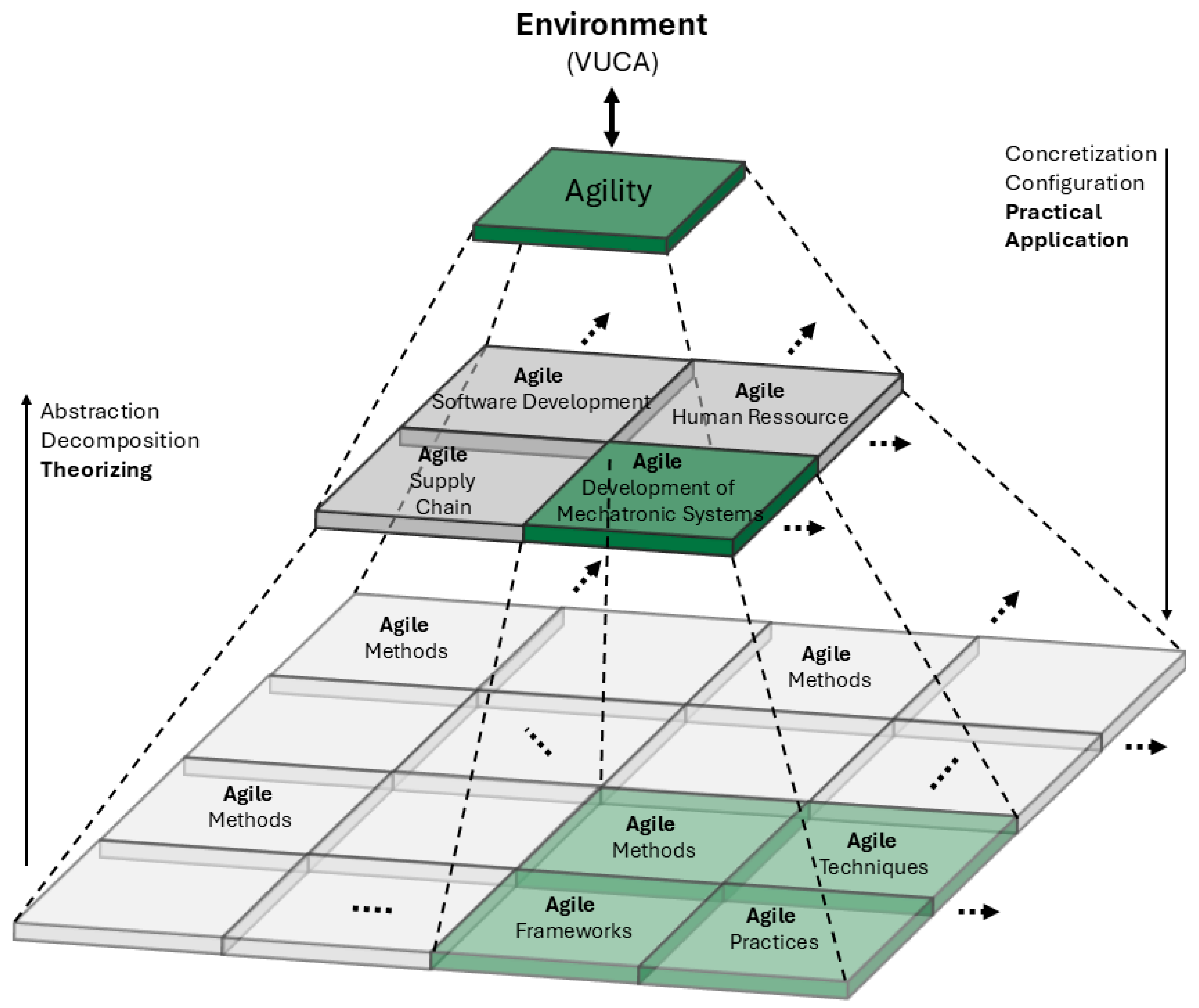
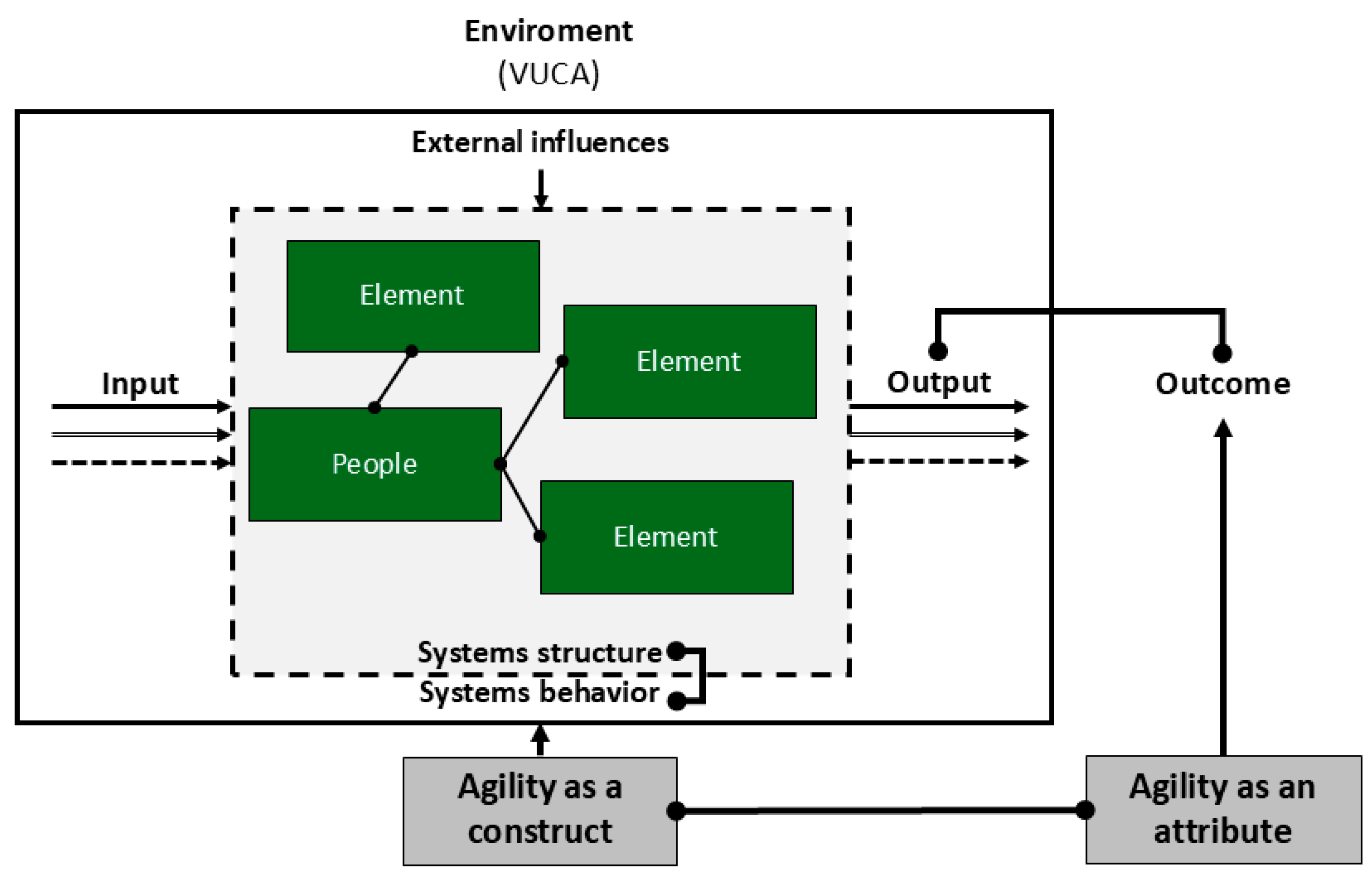
4.2. Agility as a Construct
5. Discussion
5.1. Positioning of the Proposed Conceptualization of Agility for Product Design and Development
5.2. Implications of Agility in Product Design and Development Considering Design Methodologies
6. Conclusions and Future Research
Author Contributions
Funding
Institutional Review Board Statement
Informed Consent Statement
Data Availability Statement
Acknowledgments
Conflicts of Interest
References
- Papalambros, P.Y. Design Science: Why, What and How. Des. Sci. 2015, 1, e1. [Google Scholar] [CrossRef]
- Hevner, A.R.; March, S.T.; Park, J.; Ram, S. Design Science in Information Systems Research. MIS Q. 2004, 28, 75–105. [Google Scholar] [CrossRef]
- Gericke, K.; Eckert, C.; Campean, F.; Clarkson, P.J.; Flening, E.; Isaksson, O.; Kipouros, T.; Kokkolaras, M.; Köhler, C.; Panarotto, M.; et al. Supporting designers: Moving from method menagerie to method ecosystem. Des. Sci. 2020, 6, e21. [Google Scholar] [CrossRef]
- Ehrlenspiel, K.; Meerkamm, H. Integrierte Produktentwicklung—Denkabläufe, Methodeneinsatz, Zusammenarbeit; Carl Hanser Verlag GmbH & Co. KG: München, Germany, 2017. [Google Scholar]
- Albers, A.; Behrendt, M.; Klingler, S.; Reiß, N.; Bursac, N. Agile product engineering through continuous validation in PGE—Product Generation Engineering. Des. Sci. 2017, 3, e5. [Google Scholar] [CrossRef]
- Atzberger, A. Agility in Mechatronics Unveiled—A Value Model for Describing the Interdependencies of Agile Development in Mechatronics; Universität der Bundeswehr München: Neubiberg, Germany, 2022. [Google Scholar]
- Schrof, J.I. A Coordination Perspective of Agility in Automotive Product Development; Universität der Bundeswehr München: Neubiberg, Germany, 2023. [Google Scholar]
- Schmidt, T.S. Towards a Method for Agile Development in Mechatronics; Universität der Bundeswehr München: Neubiberg, Germany, 2019. [Google Scholar]
- Atzberger, A.; Nicklas, S.J.; Schrof, J.; Weiss, S.; Paetzold, K. Agile Entwicklung Physischer Produkte—Eine Studie zum Aktuellen Stand in der Industriellen Praxis; University of the German Federal Armed Forces: München, Germany, 2020. [Google Scholar]
- Meier, A.; Kock, A. Agile R&D Units’ Organization Beyond Software—Developing and Validating a Multidimensional Scale in an Engineering Context. IEEE Trans. Eng. Manag. 2022, 69, 3476–3488. [Google Scholar]
- Nicklas, S.J.; Michalides, M.; Atzberger, A.; Weiss, S.; Paetzold, K. Agile Entwicklung Physischer Produkte—Eine Studie zum Stand in der Industriellen Praxis Während der COVID-19-Pandemie; University of the German Federal Armed Forces: München, Germany, 2021. [Google Scholar]
- Michalides, M.; Bursac, N.; Nicklas, S.J.; Weiss, S.; Paetzold, K. Analyzing Current Challenges on Scaled Agile Development of Physical Products. Procedia CIRP 2023, 119, 1188–1197. [Google Scholar] [CrossRef]
- Heimicke, J.; Czech, C.; Schoeck, M.; Mueller, J.; Rapp, S.; Albers, A. Introducing Agility into the Processes of Manufacturing Companies: A Method for Evaluating Success, Support and Applicability. Proc. Des. Soc. 2022, 2, 2463–2472. [Google Scholar] [CrossRef]
- Zhao, Z.; Alli, H.; Me, R.C. A Systematic Review on the Implementation of Agility in Sustainable Design Development. Designs 2023, 7, 111. [Google Scholar] [CrossRef]
- Michalides, M.; Bursac, N.; Nicklas, S.J.; Weiss, S.; Paetzold, K. Why Companies Scale Agile Development of Physical Products: An Empirical Study. In Design in the Era of Industry 4.0—Volume 3; Chakrabarti, A., Singh, V., Eds.; Springer: Singapore, 2023; pp. 1163–1174. [Google Scholar]
- Weiss, S.; Michalides, M.; Pendzik, M.; Scharold, F.; Stoiber, L.; Paetzold, K. Agile Entwicklung Physischer Produkte 2023—Eine Studie zum Aktuellen Stand in der Industriellen Praxis; Technische Universität Dresden: Dresden, Germany, 2023. [Google Scholar]
- Sutherland, J. Scrum: The Art of Doing Twice the Work in Half of the Time; Radnom House Business Books: New York, NY, USA, 2014. [Google Scholar]
- Takeuchi, H.; Nonaka, I. The new new product development game—Stop running the relay race and take up rugby. Harv. Bus. Rev. 1986, 64, 137–146. [Google Scholar]
- Beck, K.; Beedle, M.; van Bennekum, A.; Cockburn, A.; Cunningham, W.; Fowler, M.; Martin, R.C.; Mellor, S.; Thomas, D.; Grenning, J.; et al. Manifesto for Agile Software Development. 2001. Available online: https://agilemanifesto.org/ (accessed on 10 September 2025).
- Dingsøyr, T.; Dybå, T.; Moe, N.B. Agile Software Development: An Introduction and Overview. In Agile Software Development: Current Research and Future Directions; Dingsøyr, T., Dybå, T., Moe, N.B., Eds.; Springer: Berlin/Heidelberg, Germany, 2010; pp. 1–13. [Google Scholar]
- Mattmann, I. Modellintegrierte Produkt-und Prozessentwicklung; Springer Vieweg: Wiesbaden, Germany, 2017. [Google Scholar]
- Gemino, A.; Reich, B.H.; Serrador, P.M. Agile, Traditional, and Hybrid Approaches to Project Success: Is Hybrid a Poor Second Choice? Proj. Manag. J. 2021, 52, 161–175. [Google Scholar] [CrossRef]
- Schmidt, T.S.; Weiss, S.; Paetzold, K. Agile Development of Physical Products—An Empirical Study About Motivations, Potentials and Applicability; University of the German Federal Armed Forces: München, Germany, 2018. [Google Scholar]
- Atzberger, A.; Paetzold, K. Current Challenges of Agile Hardware Development: What Are Still the Pain Points Nowadays? Proc. Des. Soc. Int. Conf. Eng. Des. 2019, 1, 2209–2218. [Google Scholar] [CrossRef]
- Palsodkar, M.; Yadav, G.; Nagare, M.R. Recent trends in agile new product development: A systematic review and agenda for future research. Benchmarking Int. J. 2023, 30, 3194–3224. [Google Scholar] [CrossRef]
- Schuh, G.; Riesener, M.; Kantelberg, J.; Steireif, N. Transmission of software-related agile mechanisms of action towards product development processes for technical products. In Proceedings of the 2017 IEEE International Conference on Industrial Engineering and Engineering Management (IEEM), Singapore, 10–13 December 2017. [Google Scholar]
- Heimicke, J.; Niever, M.; Zimmermann, V.; Klippert, M.; Marthaler, F.; Albers, A. Comparison of Existing Agile Approaches in the Context of Mechatronic System Development: Potentials and Limits in Implementation. Proc. Des. Soc. Int. Conf. Eng. Des. 2019, 1, 2199–2208. [Google Scholar] [CrossRef][Green Version]
- Ovesen, N. The Challgenes of Becoming Agile: Implementing and Conducting Scrum in Integrated Product Development. Ph.D. Thesis, Aalborg University, Aalborg, Denmark, 2012. [Google Scholar]
- Schmidt, T.S.; Chahin, A.; Kößler, J.; Paetzold, K. Agile Development and the Constraints of Physicality: A Network Theory-Based Cause-and-Effect Analysis. In Proceedings of the 21st International Conference on Engineering Design, Vancouver, BC, Canada, 21–25 August 2017; pp. 199–208. [Google Scholar]
- Schuh, G.; Dölle, C.; Schloesser, S. Agile Prototyping for Technical Systems—Towards an Adaption of the Minimum Viable Product Principle. In Proceedings of the NordDesign 2018, Linköping, Sweden, 14–17 August 2018. [Google Scholar]
- Nicklas, S.J.; Atzberger, A.; Briede-Westermeyer, J.C.; Paetzold, K. The User-Driven Minimum Feasible Product—Towards a Novel Approach on User Integration. Proc. Des. Soc. Des. Conf. 2020, 1, 1495–1504. [Google Scholar] [CrossRef]
- Camburn, B.; Viswanathan, V.; Linsey, J.; Anderson, D.; Jensen, D.; Crawford, R.; Otto, K.; Wood, K. Design prototyping methods: State of the art in strategies, techniques, and guidelines. Des. Sci. 2017, 3, e13. [Google Scholar] [CrossRef]
- Koppenhagen, F.; Blümel, T.; Held, T.; Wecht, C.H.; Kollmer, P.D. Hybrid development of physical products based on systems engineering and design thinking: Towards a new process model. J. Des. Res. 2024, 21, 210–261. [Google Scholar] [CrossRef]
- Kruchten, P. Contextualizing agile software development. J. Softw. Evol. Process 2013, 25, 351–361. [Google Scholar] [CrossRef]
- Wöhr, F.; Uhri, E.; Königs, S.; Trauer, J.; Stanglmeier, M.; Zimmermann, M. Coordination and complexity: An experiment on the effect of integration and verification in distributed design processes. Des. Sci. 2023, 9, e1. [Google Scholar] [CrossRef]
- Maurer, M. Structural Awareness in Complex Product Design. In Lehrstuhl für Produktentwicklung; Technische Universität München: München, Germany, 2007. [Google Scholar]
- Michalides, M.; Nicklas, S.J.; Weiss, S.; Paetzold, K. Agile Entwicklung Physischer Produkte: Eine Studie zum Aktuellen Stand in der Industriellen Praxis; Universität der Bundeswehr München: Neubiberg, Germany, 2022. [Google Scholar]
- Schmidt, T.S.; Atzberger, A.; Gerling, C.; Schrof, J.; Weiss, S.; Paetzold, K. Agile Development of Physical Products—An Empirical Study about Potentials, Transition and Applicability; University of the German Federal Armed Forces: München, Germany, 2019. [Google Scholar]
- Schrof, J.I.; Rathert, F.; Paetzold, K. Relevance of Product Integration in Scaled Agile Mechatronic Product Development. Proc. Des. Soc. Des. Conf. 2020, 1, 717–726. [Google Scholar] [CrossRef]
- Schrof, J.; Atzberger, A.; Papoutsis, E.; Paetzold, K. Potential of Technological Enablement for Agile Automotive Product Development. In Proceedings of the 2019 IEEE International Conference on Engineering, Technology and Innovation (ICE/ITMC), Valbonne Sophia-Antipolis, France, 17–19 June 2019; pp. 1–8. [Google Scholar]
- Heimicke, J.; Roebenack, S.; Frobieter, C.; Albers, A. Evaluation of Challenges in the Implementation of Scrum in a large German Plant Engineering Company: Derivation of Hypotheses for an Improved Introduction of Agile Approaches into the Processes of Physical Product Development. In Proceedings of the R&D Management Conference 2021—Innovation in an Era of Disruption, Online, 6–8 July 2021. [Google Scholar]
- Cooper, R.G.; Fürst, P. Deploying Agile for Physical-Product Development: Big Challenges and Clever Solutions. IEEE Eng. Manag. Rev. 2023, 52, 15–27. [Google Scholar]
- Rößler, L.; Gericke, K. Analysing Paradigms for Managing Product Development: Conventional, Agile and Hybrid Approaches. Proc. Des. Soc. 2022, 2, 263–272. [Google Scholar] [CrossRef]
- Baham, C.; Hirschheim, R. Issues, challenges, and a proposed theoretical core of agile software development research. Inf. Syst. J. 2021, 32, 103–129. [Google Scholar] [CrossRef]
- Conboy, K. Agility from First Principles: Reconstructing the Concept of Agility in Information Systems Development. Inf. Syst. Res. 2009, 20, 329–354. [Google Scholar] [CrossRef]
- Wang, X.; Conboy, K. Understanding agility in software development from a complex adaptive systems perspective. In Proceedings of the 17th European Conference on Information Systems, ECIS 2009, Verona, Italy, 8–10 June 2009. [Google Scholar]
- Ozkan, N.; Gok, M.S. Definition Synthesis of Agility in Software Development: Comprehensive Review of Theory to Practice. Int. J. Mod. Educ. Comput. Sci. 2022, 14, 26–44. [Google Scholar] [CrossRef]
- Conforto, E.C.; Amaral, D.C.; da Silva, S.L.; Di Felippo, A.; Kamikawachi, D.S.L. The agility construct on project management theory. Int. J. Proj. Manag. 2016, 34, 660–674. [Google Scholar] [CrossRef]
- Lee, G.; Xia, W. Toward Agile: An Integrated Analysis of Quantitative and Qualitative Field Data on Software Development Agility. MIS Q. 2010, 34, 87–114. [Google Scholar] [CrossRef]
- Ulrich, H. Anwendungsorientierte Wissenschaft. Die Unternehm. 1982, 36, 1–10. [Google Scholar]
- Patzak, G. Systemtheoretische Grundlagen. In Systemtechnik—Planung Komplexer Innovativer Systeme: Grundlagen, Methoden, Techniken; Springer: Berlin/Heidelberg, Germany, 1982; pp. 18–77. [Google Scholar]
- Hevner, A. A Three Cycle View of Design Science Research. Scand. J. Inf. Syst. 2007, 19, 4. [Google Scholar]
- Machi, L.A.; McEvoy, B.T. The Literature Review: Six Steps to Success, 3rd ed.; Sage Publications Ltd.—Corwin: Thousand Oaks, CA, USA, 2016. [Google Scholar]
- Pendzik, M.; Sembdner, P.; Paetzold, K. Identification and Classification of Uncertainties as the Foundation of Agile Methods. Proc. Des. Soc. 2023, 3, 2165–2174. [Google Scholar] [CrossRef]
- Paetzold-Byhain, K.; Stoiber, L.; Ognevoj, R. Potential and Limitations of Prototypes in Developer-User Communication. In DS 140: Proceedings of the 36th Symposium Design for X (DFX2025); TU Dresden: Dresden, Germany, 2025. [Google Scholar]
- Paetzold, K. Data and Information Flow Design in Product Development. In Design Methodology for Future Products: Data Driven, Agile and Flexible; Krause, D., Heyden, E., Eds.; Springer International Publishing: Cham, Switzerland, 2022; pp. 201–218. [Google Scholar]
- Eckert, C.M.; Wynn, D.C.; Maier, J.F.; Albers, A.; Bursac, N.; Chen, H.L.X.; Clarkson, P.J.; Gericke, K.; Gladysz, B.; Shapiro, D. On the integration of product and process models in engineering design. Des. Sci. 2017, 3, e3. [Google Scholar] [CrossRef]
- Paetzold, K. Product and Systems Engineering/CA* Tool Chains. In Multi-Disciplinary Engineering for Cyber-Physical Production Systems: Data Models and Software Solutions for Handling Complex Engineering Projects; Biffl, S., Lüder, A., Gerhard, D., Eds.; Springer International Publishing: Cham, Switzerland, 2017; pp. 27–62. [Google Scholar]
- Negele, H. Systemtechnische Methodik zur ganzheitlichen Modellierung am Beispiel der integrierten Produktentwicklung. In Raumffahrttechnik; Technische Universität München: München, Germany, 1998. [Google Scholar]
- Horvath, I.; Gerritsen, B. Cyber-Physical Systems: Concepts, Technologies and Implementation Principles. In Proceedings of the Ninth International Symposium on Tools and Methods of Competitive Engineering—TCME-2012, Karlsruhe, Germany, 7–11 May 2012. [Google Scholar]
- Browning, T.R. The many views of a process: Toward a process architecture framework for product development processes. Syst. Eng. 2009, 12, 69–90. [Google Scholar] [CrossRef]
- Thomke, S.; Reinertsen, D. Agile Product Development: Managing Development Flexibility in Uncertain Environments. Calif. Manag. Rev. 1998, 41, 8–23. [Google Scholar] [CrossRef]
- Turner, R. Toward agile systems engineering processes. CrossTalk J. Def. Softw. Eng. 2007, 21, 11–15. [Google Scholar]
- Barber, H.F. Developing Strategic Leadership: The US Army War College Experience. J. Manag. Dev. 1992, 11, 4–12. [Google Scholar] [CrossRef]
- Warren, B.; Burt, N. Leaders: The Strategies for Taking Charge, by Warren Bennis and Burt Nanus; Harper & Row: New York, NY, USA, 1985; p. 244. [Google Scholar]
- Bennett, N.; Lemoine, G.J. What a difference a word makes: Understanding threats to performance in a VUCA world. Bus. Horiz. 2014, 57, 311–317. [Google Scholar] [CrossRef]
- Snowden, D.J.; Boone, M.E. A Leader’s Framework for Decision Making. Harv. Bus. Rev. 2007, 85, 68–76. [Google Scholar]
- Theobald, S.; Prenner, N.; Krieg, A.; Schneider, K. Agile Leadership and Agile Management on Organizational Level—A Systematic Literature Review. In International Conference on Product-Focused Software Process Improvement PROFES2020; Springer International Publishing: Cham, Switzerland, 2020. [Google Scholar]
- Eckert, C.M.; Clarkson, P.J. Planning development processes for complex products. Res. Eng. Des. 2010, 21, 153–171. [Google Scholar] [CrossRef]
- Pich, M.T.; Loch, C.H.; Meyer, A.D. On Uncertainty, Ambiguity, and Complexity in Project Management. Manag. Sci. 2002, 48, 1008–1023. [Google Scholar] [CrossRef]
- Kurtz, C.F.; Snowden, D.J. The new dynamics of strategy: Sense-making in a complex and complicated world. IBM Syst. J. 2003, 42, 462–483. [Google Scholar] [CrossRef]
- Ropohl, G. Allgemeine Systemtheorie: Einführung in Transdisziplinäres Denken; Edition Sigma: Baden-Baden, Germany, 2012. [Google Scholar]
- Lindemann, U. Methodische Entwicklung technischer Produkte. In Methoden Flexibel und Situationsgerecht Anwenden 3., Korrigierte Auflage; Springer: Berlin/Heidelberg, Germany, 2009. [Google Scholar]
- Wynn, D.C.; Clarkson, P.J. The Design and Development Process: Perspectives, Approaches and Models; Springer International Publishing: Cham, Switzerland, 2024. [Google Scholar]
- Gericke, K.; Bender, B.; Pahl, G.; Beitz, W.; Feldhusen, J.; Grote, K.-H. Der Produktentwicklungsprozess. In Pahl Beitz Konstruktionslehre—Methoden und Anwendung Erfolgreicher Produktentwicklung; Bender, B., Gericke, K., Eds.; Springer: Berlin/Heidelberg, Germany, 2021; pp. 57–90. [Google Scholar]
- Pahl, G.; Beitz, W.; Feldhusen, J.; Grote, K.-H. Engineering Design: A Systematic Approach; Springer: London, UK, 2007. [Google Scholar]
- Bender, B.; Gericke, K. Pahl Beitz Konstruktionslehre—Methoden und Anwendung Erfolgreicher Produktentwicklung; Springer: Berlin/Heidelberg, Germany, 2021. [Google Scholar]
- Wynn, D.C.; Clarkson, P.J. Process models in design and development. Res. Eng. Des. 2017, 29, 161–202. [Google Scholar] [CrossRef]
- Isaksson, O.; Wynn, D.C.; Eckert, C. Design Perspectives, Theories, and Processes for Engineering Systems Design. In Handbook of Engineering Systems Design; Maier, A., Oehmen, J., Vermaas, P.E., Eds.; Springer International Publishing: Cham, Switzerland, 2020; pp. 1–47. [Google Scholar]
- Gausemeier, J.; Dumitrescu, R.; Echterfeld, J.; Pfänder, T.; Steffen, D.; Thielemann, F. Innovationen für die Märkte von Morgen: Strategische Planung von Produkten, Dienstleistungen und Geschäftsmodellen; Carl Hanser Verlag GmbH & Co. KG: München, Germany, 2018. [Google Scholar]
- VDI, VDI-Richtlinie 2221 Blatt 1; Entwicklung Technischer Produkte und Systeme—Modell der Produktentwicklung. Beuth Verlag GmbH: Berlin, Germany, 2019.
- Eigner, M. Überblick Disziplin-spezifische und-übergreifende Vorgehensmodelle. In Modellbasierte Virtuelle Produktentwicklung; Eigner, M., Daniil, R., Zafirov, R., Eds.; Springer Vieweg: Berlin/Heidelberg, Germany, 2014; p. 402. [Google Scholar]
- Gericke, K.; Meißner, M.; Paetzold, K. Understanding the context of product development. In International Conference on Engineering Design ICED13; Design Society: Seoul, Republic of Korea, 2013. [Google Scholar]
- VDI, VDI-Richtlinie 2206; Entwicklung Cyber-Physischer Mechatronischer Systeme. Beuth Verlag GmbH: Berlin, Germany, 2021.
- Boehm, B.W. A Spiral Model of Software Development and Enhancement. Computer 1988, 21, 61–72. [Google Scholar] [CrossRef]
- Miller, G.A.; Galanter, E.; Pribram, K.H.; Aebli, H. Strategie des Handelns; Klett: Stuttgart, Germany, 1973; p. 228. [Google Scholar]
- Lin, L.; Müller, R.; Zhu, F.; Liu, H. Choosing suitable project control modes to improve the knowledge integration under different uncertainties. Int. J. Proj. Manag. 2019, 37, 896–911. [Google Scholar] [CrossRef]
- DIN, DIN 69901; Projektmanagement—Projektmanagementsysteme. Beuth Verlag GmbH: Berlin, Germany, 2009.
- Turner, J.R.; Müller, R. On the nature of the project as a temporary organization. Int. J. Proj. Manag. 2003, 21, 1–8. [Google Scholar] [CrossRef]
- Project Management Institute. A Guide to the Project Management Body of Knowledge (PMBOK® Guide); Project Management Institute: Newtown Square, PA, USA, 2021. [Google Scholar]
- Webster, F.M., Jr.; Reynolds, H.; Adams, J.; Sawle, S.W.; Taspinar, A.; Gordon, D.; Stolba, L.; Nevison, J.M.; Ionata, E.; Hulett, D.T.; et al. A Guide to the Project Management Body of Knowledge (PMBOK Guide), 4th ed.; Cabanis, J.M., Messer, D.L., Jenkins, S., Pennypacker, J.S., Eds.; Project Management Institute, Inc.: Newtown Square, PA, USA, 2008. [Google Scholar]
- Rausch, A.; Broy, M. Die V-Modell XT Grundlagen. In Das V-Modell XT: Grundlagen, Methodik und Anwendungen; Springer: Berlin/Heidelberg, Germany, 2008; pp. 1–27. [Google Scholar]
- Stelzmann, E.S. Agile Systems Engineering—Eine Methodik zum besseren Umgang mit Veränderungen bei der Entwicklung komplexer Systeme. In Fakultät für Maschinenbau und Wirtschaftswissenschaften; Technische Universität Graz: Graz, Austria, 2011; p. 212. [Google Scholar]
- Boyd, J.R. The Essence of Winning and Losing. 2012. Available online: https://slightlyeastofnew.com/wp-content/uploads/2010/03/essence_of_winning_losing.pdf (accessed on 10 September 2025).
- Browning, T.R. On the alignment of the purposes and views of process models in project management. J. Oper. Manag. 2010, 28, 316–332. [Google Scholar] [CrossRef]
- Qureshi, A.J.; Gericke, K.; Blessing, L.T.M. Design process commonalities in trans-disciplinary design. In Proceedings of the 19th International Conference on Engineering Design, ICED13, Seoul, Republic of Korea, 19–22 August 2013. [Google Scholar]
- Cooper, R.G.; Sommer, A.F. Agile–Stage-Gate for Manufacturers. Res.-Technol. Manag. 2018, 61, 17–26. [Google Scholar] [CrossRef]
- Cooper, R.G. Stage-gate systems: A new tool for managing new products. Bus. Horiz. 1990, 33, 44–54. [Google Scholar] [CrossRef]
- Walden, D.D.; Shortell, T.M.; Roedler, G.J.; Delicado, B.A.; Mornas, O.; Yew-Seng, Y.; Endler, D. (Eds.) INCOSE, Systems Engineering Handbook: A Guide for System Life Cycle Processes and Activities; Wiley: Hoboken, NJ, USA, 2015. [Google Scholar]
- Lindemann, U. Handbuch Produktentwicklung; Carl Hanser Verlag GmbH & Co. KG: München, Germany, 2016. [Google Scholar]
- Feldhusen, J.; Grote, K.-H. (Eds.) Pahl Beitz Konstruktionslehre—Methoden und Anwendung Erfolgreicher Produktentwicklung; Springer: Berlin/Heidelberg, Germany, 2013. [Google Scholar]
- Braun, T.; Lindemann, U. Supporting Selection, Adaptation and Application of Methods in Product Development. In Proceedings of the 14th International Conference on Engineering Design, ICED 03, Stockholm, Sweden, 19–21 August 2003. [Google Scholar]
- Highsmith, J. Adaptive Software Development: A Collaborative Approach to Managing Complex Systems; Dorset House: London, UK, 1999. [Google Scholar]
- Weiss, S.; Michalides, M.; Koch, A. Transforming Milestone Trend Analysis for Utilization in Scrum: The Increment Drift Analysis. In Proceedings of the NordDesign 2024, Reykjavik, Iceland, 12–14 August 2024. [Google Scholar]
- Haberfellner, R.; de Weck, O.; Fricke, E.; Vössner, S. Systems Engineering—Fundamentals and Applications; Birkhäuser: Cham, Switzerland, 2019. [Google Scholar]
- Zwikael, O.; Huemann, M. Project benefits management: Making an impact on organizations and society through projects and programs. Int. J. Proj. Manag. 2023, 41, 102538. [Google Scholar] [CrossRef]
- Kumar Das, K.; Ara, A. Leadership in a VUCA World: A Case of Lenovo. Int. J. Curr. Res. 2014, 6, 6410–6419. [Google Scholar]
- Tseng, Y.-H.; Lin, C.-T. Enhancing enterprise agility by deploying agile drivers, capabilities and providers. Inf. Sci. 2011, 181, 3693–3708. [Google Scholar] [CrossRef]
- Sherehiy, B.; Karwowski, W.; Layer, J.K. A review of enterprise agility: Concepts, frameworks, and attributes. Int. J. Ind. Ergon. 2007, 37, 445–460. [Google Scholar] [CrossRef]
- Brand, M.; Tiberius, V.; Bican, P.M.; Brem, A. Agility as an innovation driver: Towards an agile front end of innovation framework. Rev. Manag. Sci. 2021, 15, 157–187. [Google Scholar] [CrossRef]
- Christofi, M.; Pereira, V.; Vrontis, D.; Tarba, S.; Thrassou, A. Agility and flexibility in international business research: A comprehensive review and future research directions. J. World Bus. 2021, 56, 101194. [Google Scholar] [CrossRef]
- Walter, A.-T. Organizational agility: Ill-defined and somewhat confusing? A systematic literature review and conceptualization. Manag. Rev. Q. 2021, 71, 343–391. [Google Scholar] [CrossRef]
- Atzberger, A.; Wallisch, A.; Nicklas, S.; Paetzold, K. Antagonizing Ambiguity—Towards a Taxonomy for Agile Development. Procedia CIRP 2020, 91, 464–471. [Google Scholar] [CrossRef]
- Smith, P.G. Understanding Flexibility. In Flexible Product Development: Building Agility for Changing Enviroments; Jossey-Bass, Wiley: San Francisco, CA, USA, 2007; pp. 1–29. [Google Scholar]
- Wynn, D.C.; Eckert, C.M. Perspectives on iteration in design and development. Res. Eng. Des. 2017, 28, 153–184. [Google Scholar] [CrossRef]
- Brown, J.L.; Agnew, N.M. Corporate agility. Bus. Horiz. 1982, 25, 29–33. [Google Scholar] [CrossRef]
- Kidd, P.T. Agile Manufacturing: Forging New Frontiers; AddisonWesley: Reading, MA, USA, 1994. [Google Scholar]
- Goldman, S.L.; Nagel, R.N.; Preiss, K. Agile Competitors and Virtual Organizations: Strategies for Enriching the Customer; Van Nostrand Reinhold: New York, NY, USA, 1995. [Google Scholar]
- Dove, R.; Hartman, S.; Benson, S. Agile Enterprise Reference Model and Case Study of Remmele Engineering; Agile Forum: Boston, MA, USA, 1996; p. 1. [Google Scholar]
- Dove, R. Knowledge management, response ability, and the agile enterprise. J. Knowl. Manag. 1999, 3, 18–35. [Google Scholar] [CrossRef]
- Yusuf, Y.Y.; Sarhadi, M.; Gunasekaran, A. Agile manufacturing:: The drivers, concepts and attributes. Int. J. Prod. Econ. 1999, 62, 33–43. [Google Scholar] [CrossRef]
- Christopher, M. The Agile Supply Chain: Competing in Volatile Markets. Ind. Mark. Manag. 2000, 29, 37–44. [Google Scholar] [CrossRef]
- Sambamurthy, V.; Bharadwaj, A.; Grover, V. Shaping Agility Through Digital Options: Reconceptualizing the Role of Information Technology in Contemporary Firms. MIS Q. 2003, 27, 237–263. [Google Scholar] [CrossRef]
- Larman, C. Agile and Iterative Development: A Manager’s Guide; Addison-Wesley Professional: Boston, MA, USA, 2004; p. 342. [Google Scholar]
- Conboy, K.; Fitzgerald, B. Toward a Conceptual Framework of Agile Methods; Springer: Berlin/Heidelberg, Germany, 2004. [Google Scholar]
- Erickson, J.; Lyytinen, K.; Siau, K. Agile Modeling, Agile Software Development, and Extreme Programming: The State of Research. J. Database Manag. (JDM) 2005, 16, 88–100. [Google Scholar] [CrossRef]
- Haberfellner, R.; de Weck, O. 10.1.3 Agile SYSTEMS ENGINEERING versus AGILE SYSTEMS engineering. INCOSE Int. Symp. 2005, 15, 1449–1465. [Google Scholar] [CrossRef]
- van Oosterhout, M.; Waarts, E.; van Hillegersberg, J. Assessing Business Agility: A Multi-Industry Study in The Netherlands. In Business Agility and Information Technology Diffusion; Springer: Boston, MA, USA, 2005. [Google Scholar]
- Agarwal, A.; Shankar, R.; Tiwari, M.K. Modeling the metrics of lean, agile and leagile supply chain: An ANP-based approach. Eur. J. Oper. Res. 2006, 173, 211–225. [Google Scholar] [CrossRef]
- Lyytinen, K.; Rose, G.M. Information system development agility as organizational learning. Eur. J. Inf. Syst. 2006, 15, 183–199. [Google Scholar] [CrossRef]
- Overby, E.; Bharadwaj, A.; Sambamurthy, V. Enterprise agility and the enabling role of information technology. Eur. J. Inf. Syst. 2006, 15, 120–131. [Google Scholar] [CrossRef]
- Highsmith, J. Agile Project Management: Creating Innovative Products, 2nd ed.; The Agile Software Development Series; Cockburn, A., Highsmith, J., Eds.; Addison-Wesley, Pearson Education Inc.: Boston, MA, USA, 2009; p. 13. [Google Scholar]
- Ganguly, A.; Nilchiani, R.; Farr, J.V. Evaluating agility in corporate enterprises. Int. J. Prod. Econ. 2009, 118, 410–423. [Google Scholar] [CrossRef]
- Tallon, P.P.; Pinsonneault, A. Competing Perspectives on the Link Between Strategic Information Technology Alignment and Organizational Agility: Insights from a Mediation Model. MIS Q. 2011, 35, 463–486. [Google Scholar] [CrossRef]
- Wang, Z.; Pan, S.L.; Ouyang, T.H.; Chou, T.C. Achieving IT-Enabled Enterprise Agility in China: An IT Organizational Identity Perspective. IEEE Trans. Eng. Manag. 2014, 61, 182–195. [Google Scholar] [CrossRef]
- Winby, S.; Worley, C.G. Management processes for agility, speed, and innovation. Organ. Dyn. 2014, 43, 225–234. [Google Scholar] [CrossRef]
- Böhmer, A.; Beckmann, A.; Lindemann, U. Open Innovation Ecosystem—Makerspaces within an Agile Innovation Process. In Proceedings of the The ISPIM Innovation Summit, Brisbane, Australia, 6–9 December 2015. [Google Scholar]
- Teece, D.J.; Petefraf, M.; Leih, S. Dynamic Capabilities and Organizational Agility: Risk, Uncertainty, and Strategy in the Innovation Economy. Calif. Manag. Rev. 2016, 58, 13–35. [Google Scholar] [CrossRef]
- Vanharanta, H.; Kantola, J.; Markopoulos, E.; Salo, M.; Einolande, J.; Hanhisalo, T. The degree of agility in a technology company’s strategy, management, and leadership. Manag. Prod. Eng. Rev. 2018, 9, 129–137. [Google Scholar]
- Albers, A.; Heimicke, J.; Müller, J.; Spadinger, M. Agility and its Features in Mechatronic System Development: A Systematic Literature Review. In Proceedings of the ISPIM Innovation Conference (30th ISPIM), Florence, Italy, 16–19 June2019. [Google Scholar]
- Attar, M.; Abdul-Kareem, A. The Role of Agile Leadership in Organisational Agility. In Agile Business Leadership Methods for Industry 4.0; Akkaya, B., Ed.; Emerald Publishing Limited: Leeds, UK, 2020; pp. 171–191. [Google Scholar]
- Kuhn, M.; Dölle, C.; Riesener, M.; Schuh, G. Organizational Agility in Development Networks. In Congress of the German Academic Association for Production Technology; Springer: Berlin/Heidelberg, Germany, 2021. [Google Scholar]
- Zhu, M.; Gao, H. The antecedents of supply chain agility and their effect on business performance: An organizational strategy perspective. Oper. Manag. Res. 2021, 14, 166–176. [Google Scholar] [CrossRef]
- Agarwal, V.; Hameed, A.Z.; Malhotra, S.; Mathiyazhagan, K.; Alathur, S.; Appolloni, A. Role of Industry 4.0 in agile manufacturing to achieve sustainable development. Bus. Strategy Environ. 2023, 32, 3671–3688. [Google Scholar] [CrossRef]
- Kettunen, P.; Laanti, M. Combining agile software projects and large-scale organizational agility. Softw. Process Improv. Pract. 2008, 13, 183–193. [Google Scholar] [CrossRef]
- Tsourveloudis, N.C.; Valavanis, K.P. On the Measurement of Enterprise Agility. J. Intell. Robot. Syst. 2002, 33, 329–342. [Google Scholar] [CrossRef]
- Gunasekaran, A. Agile Manufacturing: Enablers and an Implementation Framework. Int. J. Prod. Res. 1998, 36, 1223–1247. [Google Scholar] [CrossRef]
- Sharifi, H.; Zhang, Z. Agile manufacturing in practice—Application of a methodology. Int. J. Oper. Prod. Manag. 2001, 21, 772–794. [Google Scholar] [CrossRef]
- Christopher, M.; Towill, D. An integrated model for the design of agile supply chains. Int. J. Phys. Distrib. Logist. Manag. 2001, 31, 235–246. [Google Scholar] [CrossRef]
- Williams, L.; Cockburn, A. Agile software development: It’s about feedback and change. Computer 2003, 36, 39–43. [Google Scholar] [CrossRef]
- Eckert, C.; Clarkson, P.J.; Zanker, W. Change and customisation in complex engineering domains. Res. Eng. Des. 2004, 15, 1–21. [Google Scholar] [CrossRef]
- Thomke, S.H. The role of flexibility in the development of new products: An empirical study. Res. Policy 1997, 26, 105–119. [Google Scholar] [CrossRef]
- Shaked, H.; Schechter, C. Definitions and Development of Systems Thinking. In Systems Thinking for School Leaders: Holistic Leadership for Excellence in Education; Shaked, H., Schechter, C., Eds.; Springer International Publishing: Cham, Switzerland, 2017; pp. 9–22. [Google Scholar]
- Bianchi, M.; Marzi, G.; Guerini, M. Agile, Stage-Gate and their combination: Exploring how they relate to performance in software development. J. Bus. Res. 2020, 110, 538–553. [Google Scholar] [CrossRef]
- Batra, D.; Xia, W.; Rathor, S. Agility Facilitators for Contemporary Software Development. J. Database Manag. 2016, 27, 1–28. [Google Scholar] [CrossRef][Green Version]
- Tallon, P.P.; Queiroz, M.; Coltman, T.; Sharma, R. Information technology and the search for organizational agility: A systematic review with future research possibilities. J. Strateg. Inf. Syst. 2019, 28, 218–237. [Google Scholar] [CrossRef]
- Podsakoff, P.M.; MacKenzie, S.B.; Podsakoff, N.P. Recommendations for Creating Better Concept Definitions in the Organizational, Behavioral, and Social Sciences. Organ. Res. Methods 2016, 19, 159–203. [Google Scholar] [CrossRef]
- Sutherland, J.; Schwaber, K. The Scrum Guide—The Definitive Guide to Scrum: The Rules of the Game; Scrum Alliance: Westminster, OC, USA, 2020. Available online: https://scrumguides.org/docs/scrumguide/v2020/2020-Scrum-Guide-US.pdf (accessed on 10 September 2025).
- VersionOneInc. 10th Annual State of Agile Report; Digital.ai Software, Inc.: Raleigh, NC, USA, 2016. [Google Scholar]
- VersionOneInc. 15th Annual State of Agile Report; Digital.ai Software, Inc.: Raleigh, NC, USA, 2021. [Google Scholar]
- Abbas, N.; Gravell, A.M.; Wills, G.B. Historical Roots of Agile Methods: Where Did “Agile Thinking” Come From? In Agile Processes in Software Engineering and Extreme Programming; Springer: Berlin/Heidelberg, Germany, 2008. [Google Scholar]
- Abrahamsson, P.; Salo, O.; Ronkainen, J.; Warsta, J. Agile Software Development Methods: Review and Analysis; VTT Publications; VTT Technical Research Centre of Finland: Espoo, Finland, 2002; pp. 1–112. [Google Scholar]
- Gericke, K.; Eckert, C.; Stacey, M. Elements of a design method—A basis for describing and evaluating design methods. Des. Sci. 2022, 8, e29. [Google Scholar] [CrossRef]
- Schrof, J.; Paetzold, K. Agile Produktentwicklung in einer zunehmend dynamischen Automobilwirtschaft: Potentiale und Grenzen. In Proceedings of the 41st Internationales Wiener Motorensymposium, Vienna, Austria, 22–24 April 2020; pp. 362–376. [Google Scholar]
- Koppenhagen, F.; Wecht, C.H. Warum das nächste iPhone wieder nicht aus Deutschland kommt: Der Zusammenhang zwischen Entwicklungsmethodik und radikalen Produktinnovationen—Ein Vergleich zwischen Stanford und Deutschland/Why the next iPhone won‘t come from Germany again: The connection between design methodology and radical product innovations—A comparison between Stanford and Germany. Konstruktion 2023, 75, 68–74. [Google Scholar] [CrossRef]
- Malik, M.; Sarwar, S.; Orr, S. Agile practices and performance: Examining the role of psychological empowerment. Int. J. Proj. Manag. 2021, 39, 10–20. [Google Scholar] [CrossRef]
- Dingsøyr, T.; Moe, N.B.; Fægri, T.E.; Seim, E.A. Exploring software development at the very large-scale: A revelatory case study and research agenda for agile method adaptation. Empir. Softw. Eng. 2017, 23, 490–520. [Google Scholar] [CrossRef]
- Dingsøyr, T.; Moe, N.B.; Seim, E.A. Coordinating Knowledge Work in Multiteam Programs. Proj. Manag. J. 2018, 49, 64–77. [Google Scholar] [CrossRef]
- Moe, N.B.; Šmite, D.; Paasivaara, M.; Lassenius, C. Finding the sweet spot for organizational control and team autonomy in large-scale agile software development. Empir. Softw. Eng. 2021, 26, 101. [Google Scholar] [CrossRef]
- Okhuysen, G.A.; Bechky, B.A. Coordination in Organizations: An Integrative Perspective. Acad. Manag. Ann. 2009, 3, 463–502. [Google Scholar] [CrossRef]





| Study | Reference | Year | Research Focus | Key Insights and Considerations |
|---|---|---|---|---|
| Agile Development of Physical Products—An Empirical Study about Motivations, Potentials and Applicability | [23] | 2018 | Motivation, Potentials, Applicability | The study indicates that agility is more than the application of methods. Roles, values, and an agile working attitude are relevant elements in adapting Agile to product development. Furthermore, the study does not confirm the direct impact of agility on key performance indicators. The real value of agile in product development is improved communication, increased transparency, reduced reaction time to expected and unexpected changes. The effectiveness of agile approaches needs to be evaluated and reflected upon in the dynamics within the specific context or environment. |
| Agile Development of Physical Products—An Empirical Study about Potentials, Transition and Applicability | [38] | 2019 | Potentials, Transition, Applicability | The study indicates different application barriers in agile product development such as prototyping, external dependencies, corporate culture, organizational structure. Furthermore, as the degree of agility progresses within the organization, additional methods and challenges come into play. Elements from traditional and agile process models are combined. The effectiveness of agility constitutes a balance among various elements that are neglected. A more in-depth understanding of constitutive elements and their function is required. |
| Agile Development of Physical Products—A Study on the current State of Industrial Practice | [9] | 2020 | Applicability, Understanding, Challenges, Scaling | The study indicates that the interactions with the physical nature of the products are still identified as difficulties. Especially, aspects such as external regulations, waiting times for components are perceived as hindering factors. Scaling Agile is an important topic. Agile product development is still not a sound and finished concept. The central obstacle is the underlying understanding to be most effective. Accordingly, the mechanisms at work remain unclear. A more in-depth understanding of constitutive elements and their interrelation is required. |
| Agile Development of Physical Products—A Study on the current State of Industrial Practice during the COVID-19 Pandemic | [11] | 2021 | Applicability, Understanding, Prototyping, COVID-19 Pandemic | The study indicates that timeframes of three to five years must be anticipated for successful implementations regarding agility. The values of agile work remain valid even during the COVID pandemic. Adopting agile approaches and methods strictly by the book or copying from templates does not appear to be effective. The degree of adaptation is typically on the higher side. Elements need to be understood in order to adapt effectively. The necessity of a systemic approach to conceptualizing agility remains. |
| Agile Development of Physical Products—A Study on the current State of Industrial Practice | [37] | 2022 | Applicability, Understanding, Prototyping, Scaling | The study indicates that there are diverse perspectives on scaling agile (e.g., team size and composition), as the interaction with the physical nature of products is highly context dependent. However, self-organization is regarded as the most critical factor for project success. Only a few companies have not implemented agile methods yet. Agile development has become somewhat established, although adaptations (e.g., designing increments) remain necessary. The benefits of agile approaches are acknowledged although barriers to adaptation remain. |
| Agile Development of Physical Products—A Study on the current State of Industrial Practice | [16] | 2023 | Applicability, Utilization, Challenges, Measurability | The study indicates that cultural and product-structural complexity are still drivers of challenges. The potentials of digital product development and agile product development, as well as their combined application, have been identified but remain largely under-researched. Within the organization, changes are described as necessary. Measurability is based on various indicators with an emphasis on soft factors. The interaction among the multitude of elements constitutes the greatest challenge or problem in integrating agility. A systemic approach could mitigate this issue by concentrating research efforts to understand constitutive elements of agility. |
| Publication | Definition of Agility |
|---|---|
| [116] | “Agility—the capacity to react quickly to rapidly changing circumstances.” |
| [117] | “Agility—a rapid and proactive adaptation of enterprise elements to unexpected and unpredicted changes.” |
| [118] | “Agility is the ability to thrive in a competitive environmental of continuous and unanticipated change and to respond quickly to rapidly changing, fragmenting global markets that are served by networked competitors with routine access to a worldwide production system and are driven by demand for high-quality, high-performance, low-cost, customer-configurated products and services.” |
| [119] | “Agility—the ability of an organization to adapt proficiently (thrive) in a continuously changing, unpredictable business environment.” |
| [120] | “Agility—the ability to manage and apply knowledge effectively.” |
| [121] | “Agility is the successful exploration of competitive bases (speed, flexibility, innovation proactivity, quality and profitability) through the integration of reconfigurable resources and best practices in a knowledge-rich environment to provide customer-driven products and services in a fast-changing market environment.” |
| [122] | “Agility might, therefore, be defined as the ability of an organization to respond rapidly to changes in demand, both in terms of volume and variety.” |
| [123] | “Agility—the ability to detect and seize market opportunities with speed and surprise.” |
| [124] | “Agility—rapid and flexible response to change.” |
| [125] | “Agility—The continual readiness of an entity to rapidly or inherently, proactively or reactively, embrace change, through high quality, simplistic, economical components and relationships with its environment.” |
| [126] | “Agility—At its core, agility means to strip away as much of the heaviness, commonly associated with traditional software-development methodologies, as possible to promote quick response to changing environments, changes in user requirements, accelerated project deadlines, and the like.” |
| [127] | “Agility—Property of a system that can be changed rapidly.” |
| [128] | “Business agility is being able to swiftly and easily change business and business processes outside the normal level of flexibility to effectively deal with highly unpredictable external and internal changes.” |
| [129] | “Agility is a business-wide capability that embraces organizational structures, information systems, logistic processes and in particular, mindsets.” |
| [130] | “Agility can be defined in general as the quality or capability of being quick moving and nimble. In the context of information system development (ISD), agility can be defined as an ISD organization’s ability to sense and respond swiftly to technical changes and new business opportunities.” |
| [131] | “Agility is defined as the ability of firms to sense environmental change and respond readily.” |
| [45] | “The ability of an ISD method to rapidly or inherently, create change, or to proactively or reactively embrace change through its internal components and relationships with its environment” |
| [132] | “Agility is the ability to balance stability and flexibility.” “Agility is the ability to both create and respond to change in order to profit in a turbulent business environment.” |
| [133] | “Agility—An effective integration of response ability and knowledge management in order to rapidly, efficiently and accurately adapt to any unexpected (or unpredictable) change in both proactive and reactive business/customer needs and opportunities without compromising with the cost or the quality of the product/process.” |
| [134] | “Agility—defined as the ability to detect and respond to opportunities and threats with ease, speed, and dexterity.” |
| [135] | “Agility—which is defined as the ability to sense changes in the environment and respond in a timely, cost-effective manner.” |
| [136] | “Agility as the capability to make timely, effective, and sustained organization changes.” |
| [137] | “Agility is the capability to react, and adopt to expected and unexpected changes within a dynamic environment constantly and quickly; and to use those changes (if possible) as an advantage.” |
| [48] | “Agility is the project team’s ability to quickly change the project plan as a response to customer or stakeholders needs, market or technology demands in order to achieve better project and product performance in an innovative and dynamic project environment. “ |
| [138] | “Agility as the capacity of an organization to efficiently and effectively redeploy/redirect its resources to value creating and value protecting (and capturing) higher-yield activities as internal and external circumstances warrant.” |
| [139] | “Agility—being gently rolling, light, flexible, witty and nimble.” |
| [140] | “Agility—based on the system triple theory—is the ability of an operation system to continuously check and question the validity of a project plan with regard to the planning stability of the elements in the system triple and, in the case of an unplanned information constellation, to implement a situation- and demand-oriented adaptation of the sequence of synthesis and analysis activities, whereby the customer-, user- and provider-benefits are increased in a targeted manner.” |
| [141] | “Agility—is basically an organisation-wide capability to proactively and relentlessly anticipate, respond, react and capture unique market opportunities in the quest to thrive in this current unpredictable, volatile and global competitive business environment.” |
| [44] | “Agility—as a software development team’s ability to anticipate, create, learn from and respond to changes in user requirements through a process of continual readiness.” |
| [142] | “Agility—in this context describes the ability to quickly adapt the organizational structure to changing requirements.” |
| [112] | “Agility—is a learned, permanently-available dynamic capability that can be performed to a necessary degree in a quick and efficient fashion, and whenever needed in order to increase business performance in a volatile market environment.” |
| [143] | “Agility—is commonly described as the firm’s ability to sense and respond to environmental changes in a timely manner.” |
| [47] | “Agility—the ability of software development entities including processes, people, technology, tools and approaches to sense and embrace predicted, unpredicted, certain, uncertain external and internal changes, and responding to them reactively or proactively in a timely and inherently manner.” |
| [14] | “Agility—is the capacity of a company to detect changes in its business environment and reconfigure its resources, processes, and strategies to respond quickly to those changes.” |
| [144] | “Agility is an organization’s dynamic skill for managing change and uncertainty in the environment.” |
| Publication | Contribution of Publication | Added Value of Our Work |
|---|---|---|
| [121] | A definition of agility is provided. A hierarchy of agility is introduced. Concepts for agile manufacturing are derived in a comprehensive sense. | Extends the proposed distinction between micro- and macro-level agility and operationalizes it by focusing on structural elements using a systems-theoretical approach. |
| [45] | A definition of agility is provided. A taxonomy of agility is provided, defined by the components that an agile method needs to incorporate. | Extends beyond a method-focused perspective by operationalizing agile elements and coherently linking them to agility’s outcome perspective through a systems-theoretical approach. |
| [132] | A definition of agility is provided. Two Agile Frameworks are provided. | “Extends the structural organization (Enterprise Framework) and the process organization (Delivery Framework) by delving deeper into the constitutive agile elements to enable context-specific methodological support. |
| [48] | A definition of agility is provided. A set of frame semantics elements for constructing the variables model is provided. | Extend variables or measurements by using a system-theoretical approach to enable their methodological support regarding practical utilization. |
| [140] | A definition of agility is provided. No further approach is provided. The focus is on condensing a basic understanding of agility. | Extends the understanding by linking the perspective to a construct which is based on a system-theoretical approach. |
| [10] | No definition of agility is provided. An overview of agility’s outcome and capability perspectives is provided. A measure of agile R&D units’ organization is provided. | Extends the proposed perspectives by explicitly linking those by using a system-theoretical approach. The mentioned elements (e.g., iterative work methods) are to be operationalized through our approach, enabling their methodological support in terms of utilization. |
| [44] | A definition of agility is provided. A framework for agility in practice is provided that incorporate concepts, methods, techniques and guiding principles in a comprehensive sense. | Extends the proposed framework for agility by applying a system-theoretical approach to operationalize Methods and Techniques by focusing on the structural elements. |
Disclaimer/Publisher’s Note: The statements, opinions and data contained in all publications are solely those of the individual author(s) and contributor(s) and not of MDPI and/or the editor(s). MDPI and/or the editor(s) disclaim responsibility for any injury to people or property resulting from any ideas, methods, instructions or products referred to in the content. |
© 2025 by the authors. Licensee MDPI, Basel, Switzerland. This article is an open access article distributed under the terms and conditions of the Creative Commons Attribution (CC BY) license.
Share and Cite
Paetzold-Byhain, K.; Michalides, M.; Weiss, S. A Conceptualization of Agility: Utilization and Future Research for the Development of Mechatronic Systems. Systems 2026, 14, 28. https://doi.org/10.3390/systems14010028
Paetzold-Byhain K, Michalides M, Weiss S. A Conceptualization of Agility: Utilization and Future Research for the Development of Mechatronic Systems. Systems. 2026; 14(1):28. https://doi.org/10.3390/systems14010028
Chicago/Turabian StylePaetzold-Byhain, Kristin, Marvin Michalides, and Stefan Weiss. 2026. "A Conceptualization of Agility: Utilization and Future Research for the Development of Mechatronic Systems" Systems 14, no. 1: 28. https://doi.org/10.3390/systems14010028
APA StylePaetzold-Byhain, K., Michalides, M., & Weiss, S. (2026). A Conceptualization of Agility: Utilization and Future Research for the Development of Mechatronic Systems. Systems, 14(1), 28. https://doi.org/10.3390/systems14010028