3.1. Formal Description
The three-sided matching problem can be formally described as follows: there are three disjoint finite principal sets and their elements , , (m, n, p are all positive integers), whose triples are denoted as (, , ). The matching M is a subset of triples, and any two triples , satisfied (that is, each subject appears in at most one triplet).
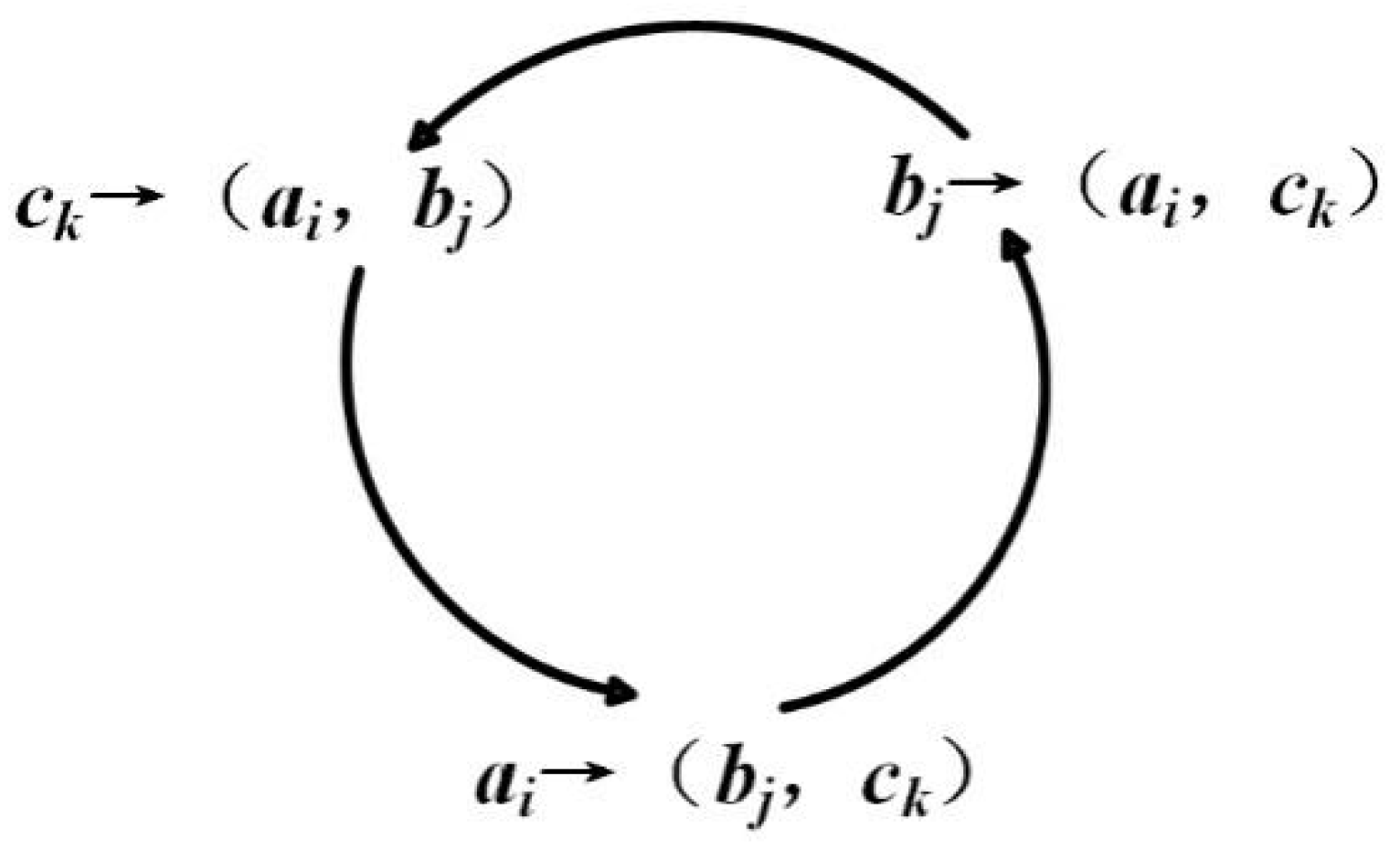
If the subject preferences are all given in the form of subject pairs formed by one subject to the other two, then such preferences are called combinatorial preferences [
4] (as shown in
Figure 1). That is, element
ai in subject
A has a certain preference for the tuple
in subject
, element
bj in subject
B has a certain preference for the tuple
in subject
, and element
ck in subject
C has a certain preference for the tuple
in subject
. In the case of combined preference, if the preference of the first subject within the binary group is prioritized for sorting, and only when there is no difference in the preferences of the first subject, and then the preference of the second subject within the group is used for sorting, such preferences are called dictionary-based preferences.
3.2. Stability Conditions
Matching M is stable if and only if there are no-blocking triples.
Definition 1 [4]. For a three-sided match M with a combinatorial preference structure, if there exists a matching group such that the subjects in the group, respectively, satisfy the following conditions:
- (1)
For , satisfy ;
- (2)
For , satisfy ;
- (3)
For , satisfy ;
Then is called the blocking group of M.
Theorem 1.
When the preference structure of a three-sided matching problem satisfies the combinatorial preference, if the following constraints are simultaneously satisfied:
Then a stable match can be generated. Among them, match
M is a matrix composed of 0 and 1, where
x,
y, and
z, respectively, represent mismatch or match, taking values of 0 or 1.
denotes that the preferred direction of
is
.
Proof. Sufficiency proof.
Suppose the constraint conditions hold, but the match M is unstable—that is, there exists a blocking triplet such that
prefers over the current match, that is , and the summation term is 0 (there is no better match). This contradicts the first constraint .
The proof of and is the same.
Therefore, the assumption does not hold, and the match M is stable.□
Proof of necessity. Let M be stable, but a certain constraint does not hold (for example, for ai):
There exists such that . That is, does not match and does not match any better combination. Therefore, prefers rather than the current match.
If bj and ck are not matched to a better combination either, then is a blocking triplet, which contradicts stability. Therefore, the constraint must hold true. □
Meanwhile, in this study, a fuzzy stability threshold is introduced into the trilateral matching problem under combinatorial preference, aiming to quantify the satisfaction degree of the matching scheme through the membership degree of fuzzy mathematics, thereby addressing the issue where traditional strict stability may be too rigid or difficult to achieve.
In the subject set , the subject ai generates a preference order for the elements in according to the arrangement rule from the most preferred to the least preferred, and assigns the preference order value in sequence to represent the grade of the subject elements in B in subject ai’s preference order, denoted by . The preference order processing method for other preference directions is the same.
Let
represent the grade of the subject
bj in the subject
ai preference order. Then, the satisfaction of subject
ai with the matching triplet
under the combined preference can be expressed as the degree to which
approaches the highest preference level in the
ai preference order—that is, the membership degree
:
where
and
are the primary priority weights. When
, the triple performance is not a dictionary type combination preference, on the other hand, the preference for dictionary type combination. It is not difficult to see that
, for matching triples
,
represents
bj’s satisfaction with the combination
, and
represents
ck’s satisfaction with the combination
. The closer the membership degree is to 0, the lower the preference intensity is; that is, the less satisfied the matching subject is with the current matching (among which, the default membership degree of the unmatched element is 0—that is, the most dissatisfied).
Traditional weak stability requires complete non-blocking, but in actual situations, the matching subject also allows for a certain degree of non-satisfaction. Now, a fuzzy stability is constructed to represent this degree. Define the fuzzy blocking strength
of triple
for matching
M as
where
M (
ai) represents the current matching combination of
ai in
M.
Definition 2.
Sets a threshold , stating that the match M is -fuzzily stable if
Meanwhile
where when
, it degenerates into the traditional weak stability (completely non-blocking triad); when
, slight blocking is allowed, but the intensity does not exceed
.
This next section focuses on the core connotation of the “fuzzy” concept—that is, allowing a slight disruption not exceeding the threshold
τ, rather than pursuing a rigid stability with absolute no-blocking. The larger the
τ value is, the higher the tolerance for fuzziness becomes, and the stronger the flexibility of matching becomes; the smaller the
τ value is, the lower the tolerance for fuzziness becomes, and the more similar the matching is to the traditional rigid stability. The following clarifies the linguistic definition of “fuzzy” and clearly distinguishes it from “no-blocking”:
Here are examples to illustrate the fuzzy blocking strength and -fuzzy stability.
Example 1.
Suppose there is a three-sided matching problem, where , , . The preference order of subject a is as follows:
A to B: , that is ;
a to C: , that is .
Set weights
, then for
a, the membership degree of the combination
is
Similarly, calculate the membership degree of each element in B and C, where the preference order of each element is . Suppose the current match is , then for a, b2, c2, the current matching membership degrees are all 0.
Now consider the fuzzy blocking strength of the unmatched triplet
. This match has a membership degree of 1 for
a,
b1,
c1. Now calculate the fuzzy blocking strength
of the triplet
:
Now, according to the range of values for τ as defined in Definition 2, it can be known that regardless of how τ is taken, there is always . Therefore, does not constitute τ-fuzzy stability.
3.3. Graph-Based Modeling
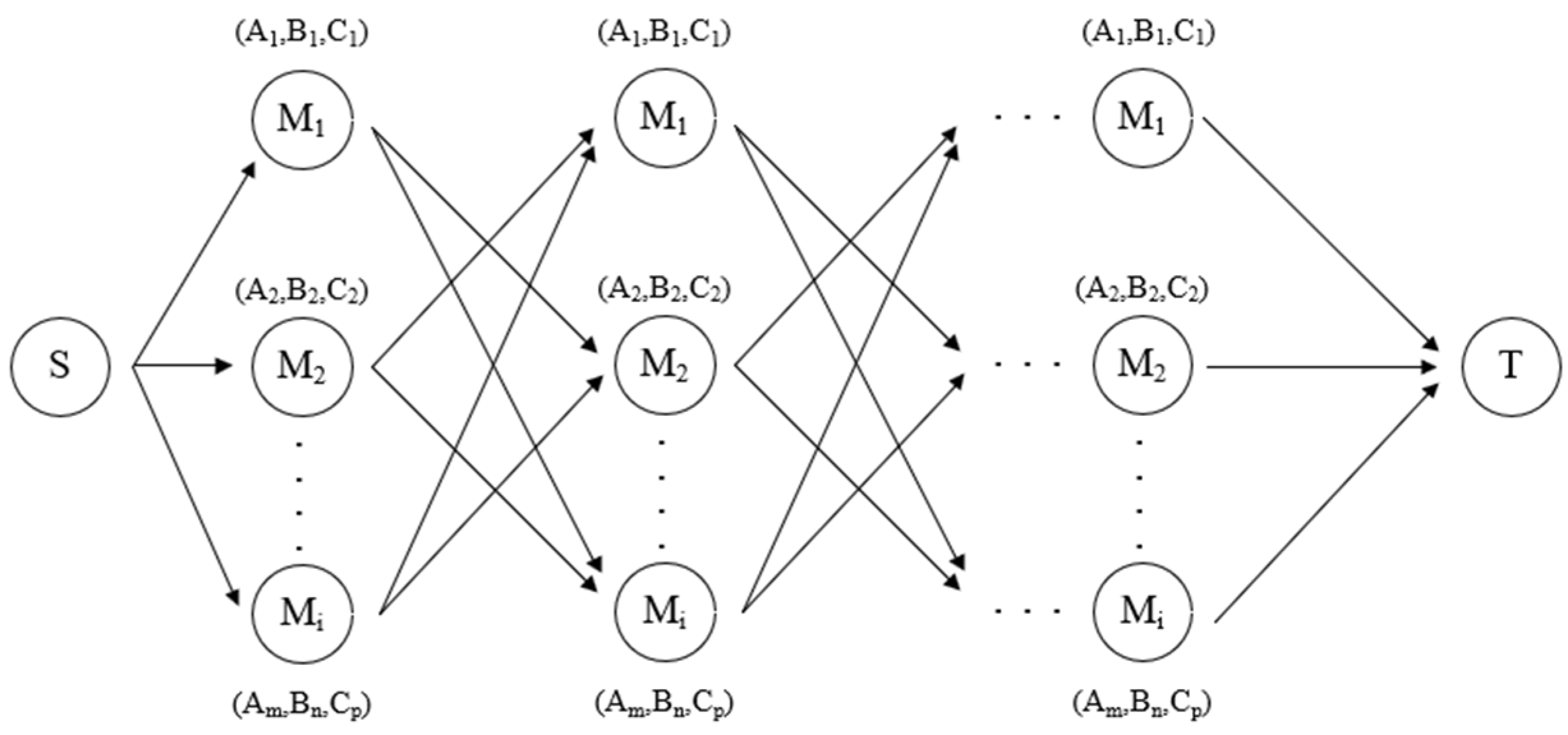
This section, in combination with the relevant knowledge of graphs, models the three-sided matching process with a combined preference structure as a graph path search problem, as shown below. The matching ends after all the elements in either subject are matched, so there are
columns in
Figure 2,
S is the starting point,
T is the end point, and
Mi is the matching triple.
A directed graph
G is an ordered tuple (
N,
E), denoted as
, where
(
) is the set of points of
G, and each point represents a matching triplet
,
is the edge set of
G,
epq is an ordered tuple
, if
, then it is said that
epq connects
np and
nq, and points
np and
nq are called the endpoints of
epq. In the search process of the graph, the matching triples
and
represented by any two points on each feasible path, satisfied
, ensure the uniqueness of each subject match. The weight of the edge
represents the preference deviation degree of the point
nq in
. Thus, the graph model of three-sided
-fuzzy stable matching problem can be obtained as follows:
where the weight of the edge
. The
s and
t, respectively, represent the starting point and the ending point in the shortest path diagram. The threshold of the fuzzy blocking intensity
,
out (
p) represents the set of edges leaving point
p, and
in (
p) represents the set of edges entering point
p. When
, the optimization model for the three-sided weakly stable matching problem can be obtained:
This section has established a complete mathematical model of trilateral fuzzy stable matching under combined preference through formal description, stability condition definition, and graph model construction, providing a theoretical basis for subsequent algorithm design and solution.