Systematic Review

Data-Driven Decision-Making in Marketing: A Systematic Literature Review of Emerging Themes and Research Gaps


by
Rui Nunes Cruz
1,* and
Albérico Travassos Rosário
2,3
1
UNIDCOM of the Faculty of Design, Technology, and Communication (IADE), Universidade Europeia, Oriente Green Campus, Moscavide, 1886-502 Lisboa, Portugal
2
Instituto Politécnico de Setúbal, Escola Superior de Ciências Empresariais de Setúbal, Campus do Instituto Politécnico de Setúbal, Edifício ESTS, Estefanilha, 2914-504 Setúbal, Portugal
3
The Research Unit on GOVCOPP–Governance, Competitiveness and Public Policies, Campus Universitário de Santiago, Rua de S. Tiago DCSPT Room 12.3.8, 3810-193 Aveiro, Portugal
*
Author to whom correspondence should be addressed.
Systems 2025, 13(12), 1114; https://doi.org/10.3390/systems13121114 (registering DOI)
Submission received: 9 September 2025 / Revised: 28 November 2025 / Accepted: 2 December 2025 / Published: 10 December 2025
(This article belongs to the Special Issue Data-Driven Insights with Predictive Marketing Analysis)

Abstract

This study assesses how Data-Driven Decision-Making (DDDM) impacts marketing practices and research. Using the PRISMA 2020 protocol, this research conducted systematic reviews of 94 peer-reviewed articles and utilized bibliometric and thematic analyses. From this, four major themes emerged: improvement in the customer experience via the personalization of marketing; marketing driven by innovation through data resource versatility, Machine Learning, analytics, and Artificial Intelligence; performance enhancement through the optimal allocation of resources; and the data governance and ethical use of such resources, and the use of such data resources. This study illustrates how the combination of multi-level theory and methodical stricture accounts for the systemic influence of DDDM in marketing. This study adds to these theories by proposing a cohesive and synthesized understanding of the interplay of the technological, organizational, and governance elements in data-driven marketing. This research provides organizations with actionable guidance aimed at increasing effective analytics-driven decision-making, while also ensuring the responsible use of data.

1. Introduction

Data-driven decision-making consists of utilizing quantitative information, methods of data collection, analytic models, and predictive algorithms in marketing in order to help make strategic and operational decisions. Unlike methods based on intuition, DDDM incorporates data on clients’ preferences, behaviors, and the performance of other marketing campaigns [1,2]. By combining data from social media, transactions, and client reviews, organizations can attain actionable data regarding segmentation and targeting, customizing communications, and pricing. There is ample evidence confirming that the transition to personalization due to DDDM positively affected companies’ revenues and gained efficiency in marketing on a larger scale [3].
The increasing capabilities of AI, Machine Learning, and Big Data have made DDDM more accessible and have encouraged instantaneous reflection and agile decision-making [4,5]. In more saturated and competitive marketplaces, the ability to pull value from digital data becomes profoundly ingrained, and DDDM enables improved marketing ROI, customer acquisition and retention, and operational efficacy [6,7]. The advancement of Machine Learning, Artificial Intelligence, and Cloud-based analytics have offered real-time analysis of Big Data to marketers and the ability to anticipate and respond to consumer demand [8,9].
Even though the literature on DDDM is particularly important, the literature on DDDM marketing is still fragmented in terms of technology and industry, as well as in terms of theory. Streams of research on AI-driven personalization, the adoption of Big Data, and Predictive Analytics, for example, run individually and without much interlacing of concepts.
Furthermore, the literature on DDDM in marketing remains fragmented not only across technological and industrial domains, (Appendix A) but also across academic frameworks [10,11]. Existing review studies often rely on limited or insufficiently robust theoretical lenses and do not account for the complex interactions between technological capabilities, ethical considerations, and managerial decision-making structures. This gap reinforces the need for a more integrative and theoretically grounded assessment of DDDM in marketing.
Lack of technical know-how is not the most critical reason executives fail, according to Grandhi et al. [12]. Also, existing reviews tend to overlook the interaction of technology, ethics, and combination of those things with management positing in their work. With the emergence of Big Data, marketers are now able to pull together or aggregate data from their customers, social media, websites, and even census and demographic data, which only exacerbates the confusion of the environments in which marketers work [5].
Considering the rapid development of analytical technologies, and the multidimensional characteristics of consumer behavior, an integrated approach is to develop the intellectual mapping, thematically organize, and identify the shortcomings present in the literature. Undertaking a systematic literature review enables researchers to disseminate information, understand the evolution of the domain, and formulate meaningful contributions for scholars and practitioners. Fulfilling these objectives, the current study implements a systematic review of DDDM in marketing, in accordance with the PRISMA 2020 protocol. A thorough search in the Scopus database resulted in 104 studies, of which 94 were finally included in the review. This review concentrates on the field’s core themes and its intellectual structure through bibliometric and thematic analyses. This study offers a contribution to the literature of DDDM in marketing with three arms: (1) the consolidation of the technological, ethical, and managerial components of DDDM into a comprehensive framework; (2) the identification of respiratory issues, access gaps, and novel constructs in the literature; and (3) the elucidation of a roadmap for actionable theorization, and a responsible advancement of data-driven marketing.
To address this fragmentation, this review takes a multi-level approach, considering DDDM as a whole system. For the micro-level, we adopted the Technology Acceptance Model (TAM) to clarify the reason behind the adoption and use of some of the analytical tools. Resource-Based View and Dynamic Capabilities are employed at the meso-level to explain the mobilization and the reconfiguration of data, analytical infrastructures, and skills. For the macro-level, DDDM practices are framed by Institutional Theory and the Ethics of Governance, which explain how DDDM practices are kept legitimate and socially acceptable. This multi-theoretical approach informs the way we have structured the findings, as well as the integrated framework and the propositions we develop in the latter sections of the paper.

2. Materials and Methods

2.1. Review Protocol

This study followed the Preferred Reporting Items for Systematic Reviews and Meta-Analyses (PRISMA) 2020 guidelines to ensure methodological transparency, replicability, and rigor [6,13]. A combined bibliometric and thematic analysis approach was adopted to systematically examine the literature on Data-Driven Decision-Making (DDDM) in marketing, allowing for the identification of thematic clusters, research trends, and knowledge gaps.
The PRISMA 2020 framework provides a structured framework for identifying, screening, and evaluating relevant studies, ensuring transparency, replicability, and methodological rigor in systematic reviews [6]. Documenting each phase of the research process minimizes the risk of bias and enhances the reliability of findings.
The LRSB methodology offers a distinct alternative to traditional literature reviews by identifying relevant sources and synthesizing key findings. This approach is grounded in a replicable, transparent, and scientific framework, which aims to reduce bias by systematically analyzing the published and unpublished literature on this research topic [7,8,14].

2.2. Search Strategy

The Scopus database was selected as the primary source for this study because it systematically indexes scholarly articles within the disciplines of Business, Management, and Marketing. The search string used was as follows:
TITLE-ABS-KEY “data-driven” AND “decision-making” AND “marketing”.
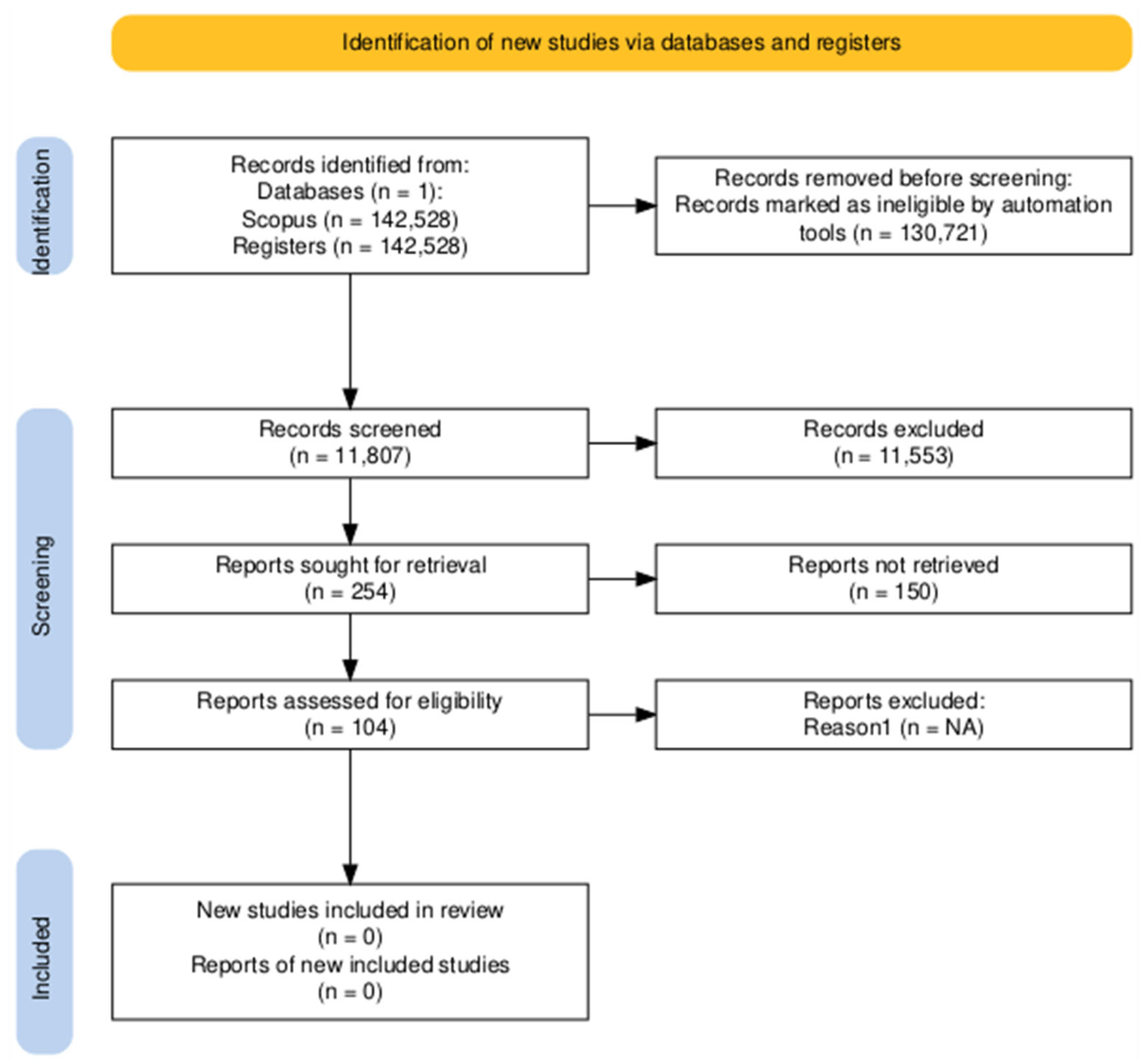
The search was conducted within the titles, abstracts, and keywords of the publications indexed in Scopus until November 2024. The initial search produced 142,528 documents for the term “data driven.” These documents were narrowed down first by “decision-making” and then “marketing”, resulting in 254 documents. Focusing the subject area on Business, Management, and Accounting further narrowed the set to 104 documents.
The researchers structure the LRSB framework into three distinct phases that subdivide into six steps each [7,8,14] (Table 1). This systematic framework facilitates thoroughness and striving for reliability within the research process.
Scopus was used as the primary database for the research because it is well-respected in the scientific and academic community, enabling the identification and selection of high-quality sources. Still, a critical limitation of this study stems from the fact that it only used Scopus, which may result in the omission of the important literature from other significant scientific and academic databases. It was advised that the literature search was completed before November 2024 to improve comprehensiveness.
Table 1. Process of systematic LRSB.
StepPRISMA PhaseDescription of ActionRecords (n)
1IdentificationDatabase search in Scopus, Web of Science, and B-On using defined keywords related to Data-Driven Decision-Making in marketing. No date restriction applied.142.528
Additional records identified through reference list checks and citation tracking.130.721
2ScreeningRemoval of duplicates across databases.11.553
Title and abstract screening to exclude studies unrelated to DDDM in marketing.254
3EligibilityFull-text review to exclude studies not meeting inclusion criteria (e.g., non-English, non-peer-reviewed, outside marketing scope).104
4IncludedFinal set of studies meeting all criteria for systematic literature review.94
Source: Adapted from Page et al. [13], PRISMA 2020 statement. Numbers correspond to those reported in Figure 1.
Figure 1. PRISMA 2020 flow diagram of the literature search and screening process From Page et al. [13].
Systems 13 01114 g001

2.3. Inclusion and Exclusion Criteria

To ensure relevance and methodological rigor, explicit inclusion and exclusion criteria were applied during the screening process. Studies were included if they were peer-reviewed journal articles, conference papers, or book chapters written in English, published up to November 2024, and explicitly addressed Data-Driven Decision-Making (DDDM) within a marketing context. Only research that presented empirical findings, conceptual frameworks, or systematic analyses relevant to marketing strategy, consumer behavior, or marketing analytics was retained. Studies were excluded if they lacked a clear marketing focus, were non-peer-reviewed (e.g., reports, editorials, dissertations), did not provide sufficient methodological detail, or were duplicates. This filtering process ensured that the final dataset comprised high-quality, thematically aligned sources suitable for bibliometric and thematic analysis.

2.4. Screening Process

Adherence to the PRISMA 2020 protocol was observed at each stage of the screening process for purpose of avoiding bias and providing clear procedures for reproducibility. To minimize selection bias and enhance methodological rigor, all screening decisions were independently reviewed by multiple researchers. Initial classifications were cross-checked, and disagreements were resolved through iterative discussion and re-evaluation of the eligibility criteria. This procedure ensured consistency and reliability throughout the PRISMA screening stages. In the identification stage, applying the defined search string to the Scopus database yielded a total of 254 records. In the title and abstract screening stage, 150 records were removed because they either did not attend to Data-Driven Decision-Making in the context of marketing or did not qualify based on the established criteria. The remaining 104 publications were assessed for methodological quality, thematic alignment, and relevance to the research objectives through a full-text review. After this thorough assessment, 94 studies were chosen for final analysis. Such publications formed the core dataset for the bibliometric and thematic analyses. The entire processes, including counts of records and their identification, screening, exclusion, and inclusion at each stage can be found in the PRISMA 2020 flow diagram (Table 1).
The researchers opted for the Scopus database as the primary literature source because of its comprehensive coverage of peer-reviewed business and marketing articles.

2.5. Data Extraction

Data extraction was performed systematically to capture all relevant information from the selected studies for analysis. For each of the 94 included publications, key bibliographic, methodological, and thematic details were recorded in a structured spreadsheet.
The extracted variables included the following: (1) author(s) and year of publication; (2) country or region of study; (3) journal title and qualitative indicators like SJR, best quartile, and H-index; (4) research objectives and questions; (5) methodological approach (qualitative, quantitative, or mixed methods); (6) data sources and sample description; (7) core findings and contributions; (8) keywords of thematic relevance to Data-Driven Decision-Making (DDDM) in marketing. The information was useful for supporting bibliometric and thematic mapping as well as coding. For accuracy, extraction was performed independently by each author, and discrepancies were reconciled through comparison.
The approach outlined here will ensure the dataset is reliable and appropriate for further analysis.
Analysis and structuring of the findings was performed through thematic analysis as indicated by Rosário et al. [8]. Thematic analysis was practical for this research, as the approach involves the identification, analysis, and documentation of patterns or recurring themes within a dataset of information.
The PRISMA 2020 guidelines were implemented to make certain that this systematic review maintained compliance with the standards for transparency and rigor.
They consist of a detailed checklist (see Supplementary Materials for details) and a flow diagram which assists the researchers in reporting their systematic reviews in a complete and unambiguous manner. This framework helps to improve the strength and reliability of scientific evidence, which facilitates evidence-based decisions throughout the continuum of scientific inquiry and clinical practice.

2.6. Data Analysis

The evidence was synthesized through two synthesizing methods: bibliometric analysis and thematic analysis. Using VOS viewer software (Version 1.6.20), the bibliometric analysis was performed to map the intellectual structure of the field as well as identify patterns in the literature. Conducting keyword co-occurrence analysis enabled detection of thematic clusters, while citation and co-citation analyses exposed the most influential publications, authors, and journals. Collectively, these bibliometric indicators offered a quantitative summary of the research landscape. Thematic analysis was performed based on the framework proposed by [7,14], which involves coding and grouping the studies into coherent themes on conceptual similarity. Using the extracted data, the authors independently studied each paper’s objectives, findings, and keywords to identify recurring topics.
These topics were then aggregated into higher-level thematic clusters that represented the primary research areas in Data-Driven Decision-Making (DDDM) in marketing. Differences in coding were discussed and resolved through collaborative discussions to ensure uniformity. The combination of bibliometric mapping and thematic coding offered a comprehensive interpretation of the literature that facilitated the identification of prevailing themes, developing research areas, and gaps in existing scholarship.
Such a dual approach made sure that the review not only captured the measurable features of the field, but that there was also an attempt to understand how the field evolved regarding its concepts.

2.7. Reliability and Limitations

As noted in Section 2.6, transparency and reliability were provided through the removal bias in the review process. All review triage steps, including study selection, data extraction, and coding, were performed independently by the authors and were cross-checked afterwards for errors and bias.
All disputes were resolved through discussions and agreements. Following the PRISMA 2020 guidelines also added structure, rigor, and transparency to the study. Every review has limitations, and this one is no exception.
While Scopus encompasses a wide array of peer-reviewed research therein management and marketing, it is important to consider that the reliance of a single database does bear some methodological limitations. Using Scopus exclusively may omit relevant and high-impact research that is indexed elsewhere, especially in interdisciplinary and/or technical research outlets. To increase coverage and address potential selection bias, future reviews ought to include other literature databases such as Web of Science or IEEE Xplore, which represent the literature that is often not captured in Scopus. A multi-database approach, therefore, would enhance the potential methodological rigor and quality of future research.
This constraint is especially applicable to works performed in 2023–2024 concerning responsible AI, algorithmic governance, and data ethics, which are more visible in databases not included in Scopus. Since our review followed PRISMA eligibility criteria and relied solely on Scopus search results, these most recent additions were absent from the dataset. This highlights the necessity for subsequent systematic reviews to expand the range of databases to more fully document the rising body of research on governance.
The same is true for the focus on peer-reviewed publications in English, as this may lead to the omission of high-quality research published in other languages or deemed ‘gray literature.’
Finally, albeit bibliometric and thematic analyses are important for examining trends and the thematic structure in research, these methods are dependent on the precision of the provided metadata and keywords.
These restrictions could likely be overcome with broader database coverage, including multilingual databases, as well as with alternative or additional techniques. This exclusive reliance on Scopus is a deliberate methodological boundary aligned with PRISMA, and its implications are discussed transparently in the Section 2.2.
In regard to these issues, we would like to explain that the use of Scopus was an intentional methodological decision that aligned with the aims and boundaries of this appraisal. Scopus encompasses one of the largest collections, and offers the most trusted peer-reviewed journals, which are in the areas of Marketing, Management, Decision Sciences, and Information Systems, which are the core fields of this review. Scopus has a well-defined structure of journals based on SJR, quartile, and cite patterns, which allow for a bibliometric study to certain high levels of accuracy and dependability: this is a fundamental requirement towards a possible realization of thematic grouping and co-citation mapping. Furthermore, as compared to Google Scholar and other open databases, Scopus has a much tighter indexing and intake criteria, meaning that there is a much lower chance of including non-peer-reviewed and unsubstantiated sources.
Nonetheless, we recognize that some relevant interdisciplinary contributions, especially from the technical domains of data governance, AI ethics, cybersecurity, and algorithmic transparency, tend to be more visible in the Web of Science, IEEE Xplore, and ACM Digital Library. Given that all eligibility criteria conformed to the PRISMA protocol and that we confined the dataset to Scopus-indexed publications, these emerging works were not included in the current corpus. We want to be clear that this methodological limitation is not a theoretical gap, but rather is a consequence of the database scope. It is highly recommended that future research includes strategies to search across multiple data sources to capture more of the valuable work in computer science, information engineering, and interdisciplinary governance research.

2.8. Systemic Implications of the Methodology

The fusion of the PRISMA 2020 procedures and the bibliometric and thematic analyses ‘occupation’ was purposefully set up to work as a ‘systemic’ mapping approach. PRISMA provides workflow clarity and replicability, which in turn allows for the construction of a rigorous evidentiary system where inclusion and exclusion choices are documented and verifiable.
Coupled with bibliometric co-occurrence and clustering techniques, this review goes beyond synthesis to reveal structural connections across the corpus of the literature. This two-tiered approach is reminiscent of the operation of complex systems.
At the micro-level, each article is subjected to screening and coding as a self-contained entity. At the meso-level, articles are organized into thematic clusters in accordance with citation and keyword networks. At the macro-level, these clusters are integrated to form a cohesive conceptual framework.
Collectively, these elements of the methodology enable the extraction of interdependencies, feedback loops, and knowledge gaps concealed across 94 studies.
Thus, the methodology is systemic, allowing for the mapping of DDDM in marketing to be achieved not as a disparate collection of contributions, but rather as a living, interrelated set of knowledge.

3. Publication Distribution

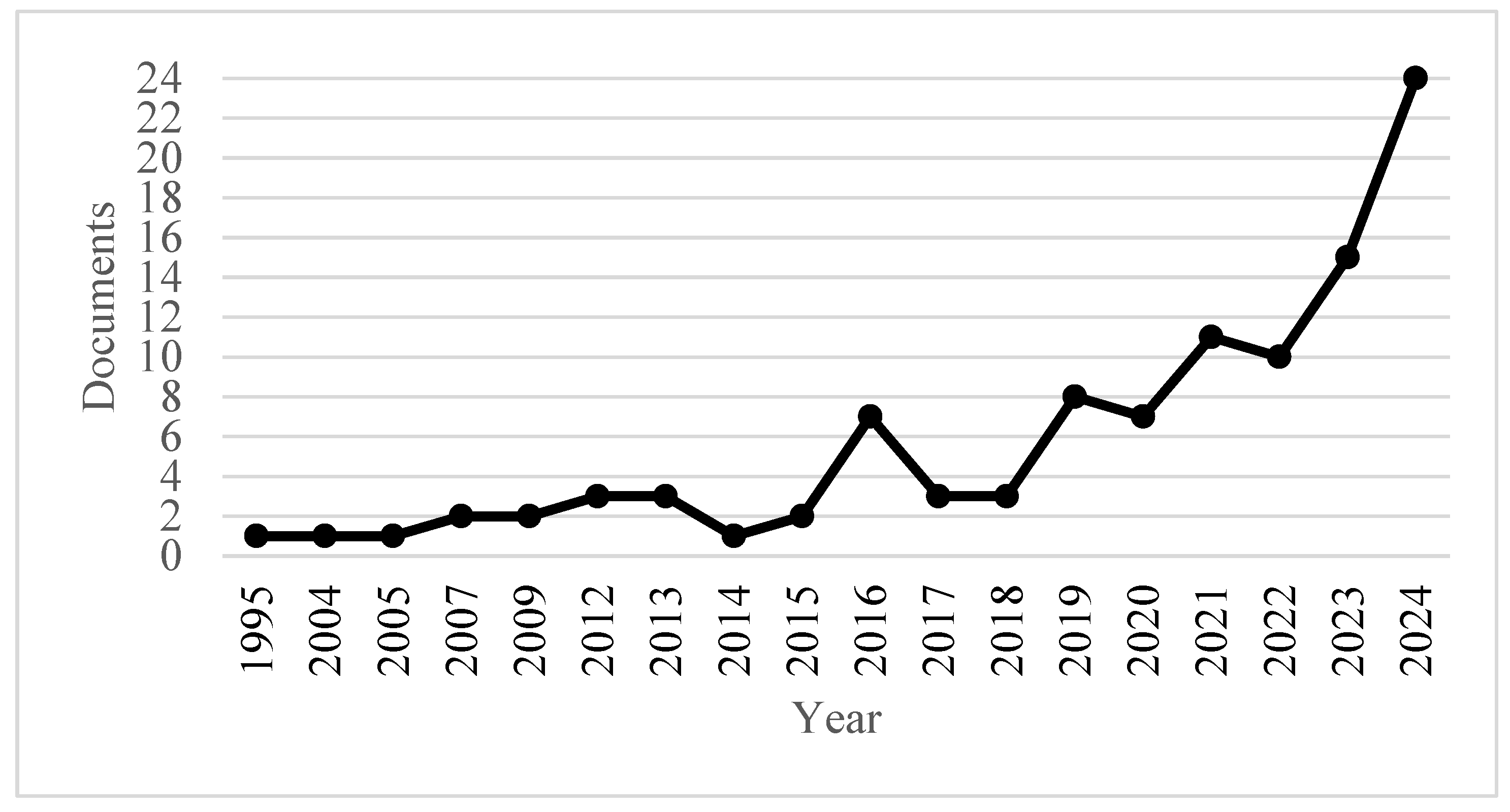
We examined the use of data to inform decisions in marketing up to October 2024. The year 2024 appears to be the most prolific year, with 24 publications. The published peer-reviewed literature up to November 2024 is available in Figure 2.
We categorized the publications as follows: Developments in Marketing Science Proceedings of The Academy of Marketing Science (six); Industrial Marketing Management (five); Journal of Marketing Analytics (three); with two documents (Psychology and Marketing; Omega United Kingdom; MIS Quarterly Management Information Systems; Lecture Notes in Business Information Processing; Journal of Strategic Marketing; Journal of Business Research; International Conference on Information and Knowledge Management Proceedings; Data Driven Marketing for Strategic Success; Data-Driven Decision-Making for Long Term Business Success); and the remaining publications with one document.
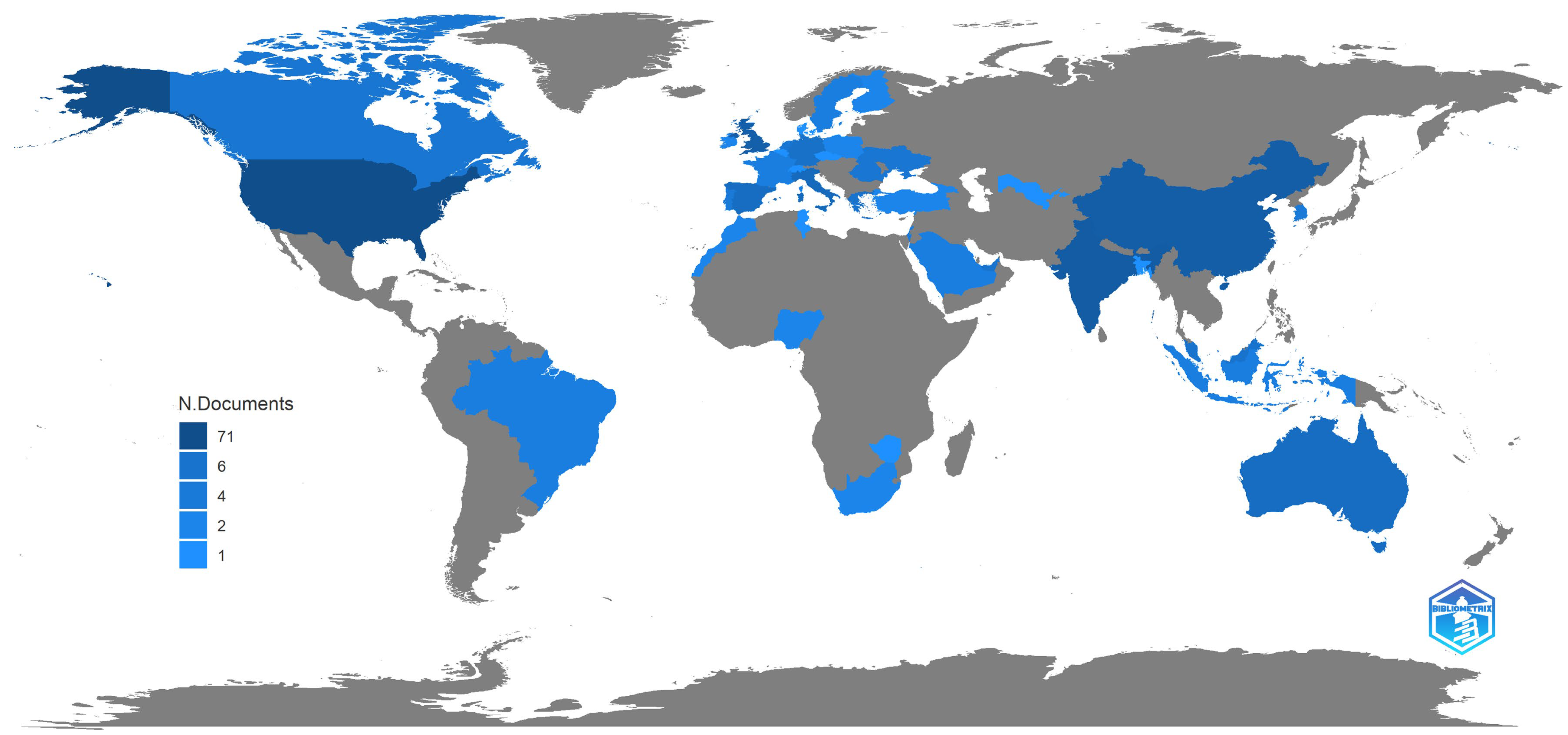
In the same manner, the USA, India, China, and the UK were surveyed as the primary contributor nations in scientific production, as noted in Figure 3, in relation to the research, as were other countries that are continually issuing articles about the issue under discussion.
The leading ten countries making significant scientific contributions in the areas of focus are illustrated in Figure 3 and Table 2. This analysis recognizes the countries’ primary contributions pertaining to the use of data in marketing within the context of technology-driven cities and other sectors fueled by innovation.
As shown in Table 3, the Scimago Journal & Country Rank (SJR), the best quartile and H-index of Journal of Management World, reveals an SJR of 7.540, a Q1 classification, and a H-index of 280.
We may conclude that, out of the 84 publications analyzed, 34 are in Q1, 6 in Q2, 7 in Q3, and 5 in Q4. Q1 constitutes 40% of the total titles and Q2 7%, while Q3 is 8% and Q4 6%.
It is worth noting that 32 publications are also missing the indexing data, which is 38%. Table 3 shows that Q1 had the highest-quality publications, but the lowest in number in the analyzed set.
The scientific and/or academic documents described fall under the following subject areas of the Curriculum Business, Management and accounting (104), Economics, econometrics, and finance (41), Computer science (30), Decision sciences (24), Social sciences (16), Engineering (9), Psychology (6), Mathematics (4), Environmental science (3), Arts and humanities (3), Medicine (2), and Biochemistry, genetics, and molecular biology (2), materials science (1), and Health professions (1).
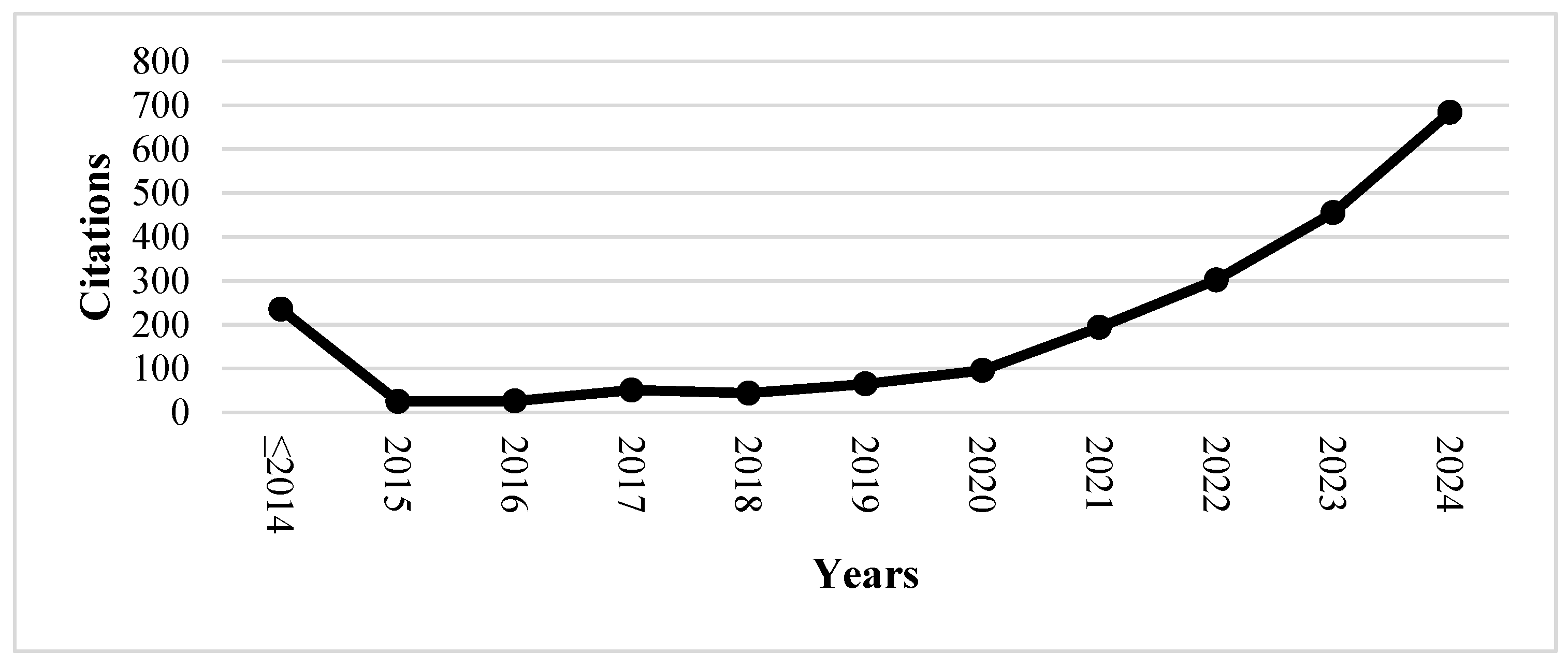
The first among the most cited was ‘User heterogeneity and its impact on electronic auction market design: An empirical exploration’, with 254 citations. MIS Quarterly: Management Information Systems had a 4110 (SJR) and the best quartile (Q1), with a H-index (271). This paper aims to address the use of a data-driven inductive approach to develop a taxonomy of biding behavior in online auctions. For documents published up to November 2024, we can analyze the citation changes, as shown in Figure 4. The period from 2014 to 2024 shows a positive net growth in citations, with an R2 of 53%, reaching 684 by November 2024.
The H-index evaluates both the productivity and the impact of published work by determining the highest number of documents that have been cited with a minimum number of times to be a citation. In this case, the 23 documents were cited a minimum of 23 times.
Citations of all documents, scientific and/or academic from 2014 and prior up to 2024 from November 2024, total 1976 citations. Out of the 104 documents, 31 went uncited. The period from 2014 to November 2024 indicates a period of ten total self-citations within documents.
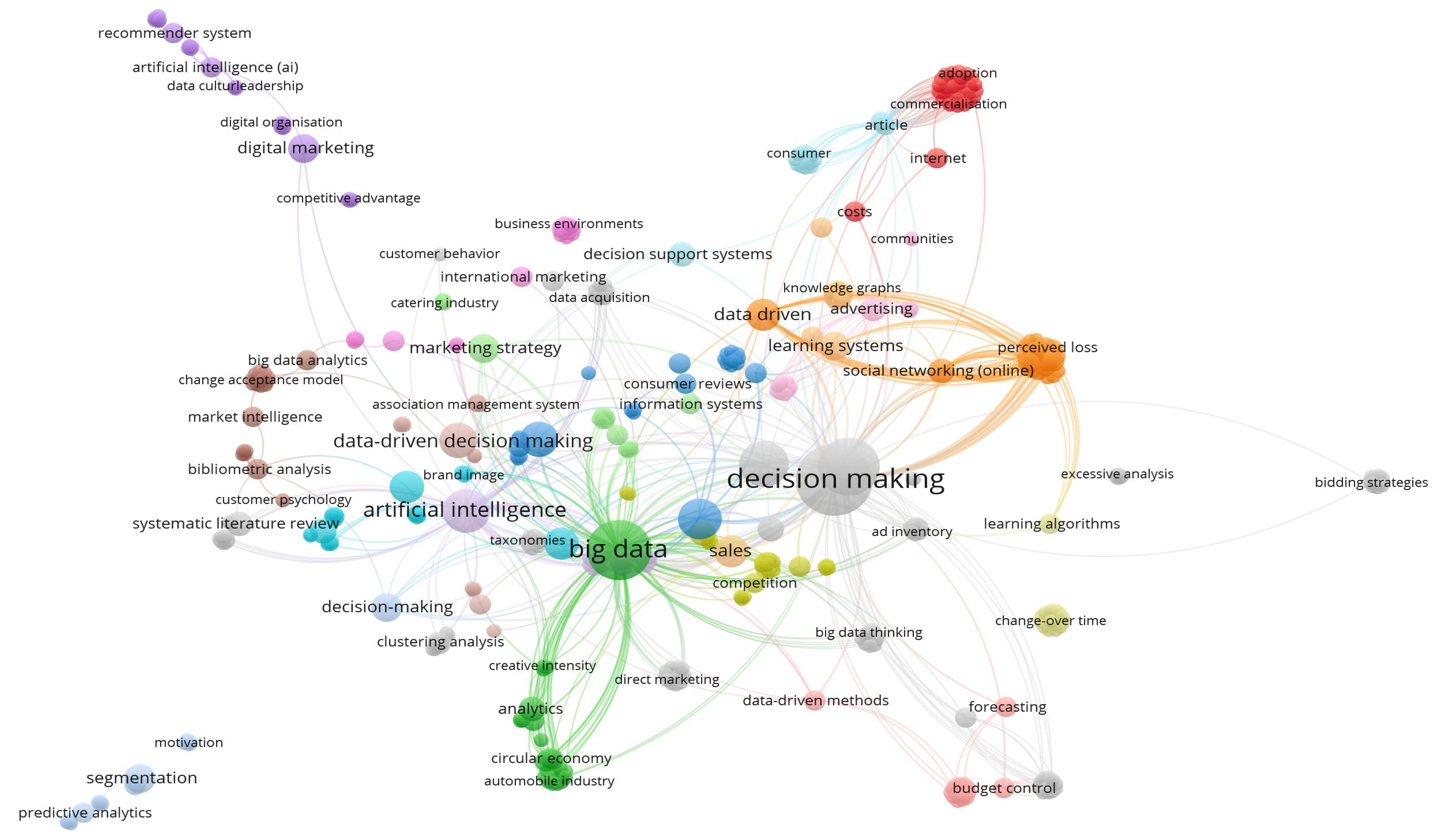
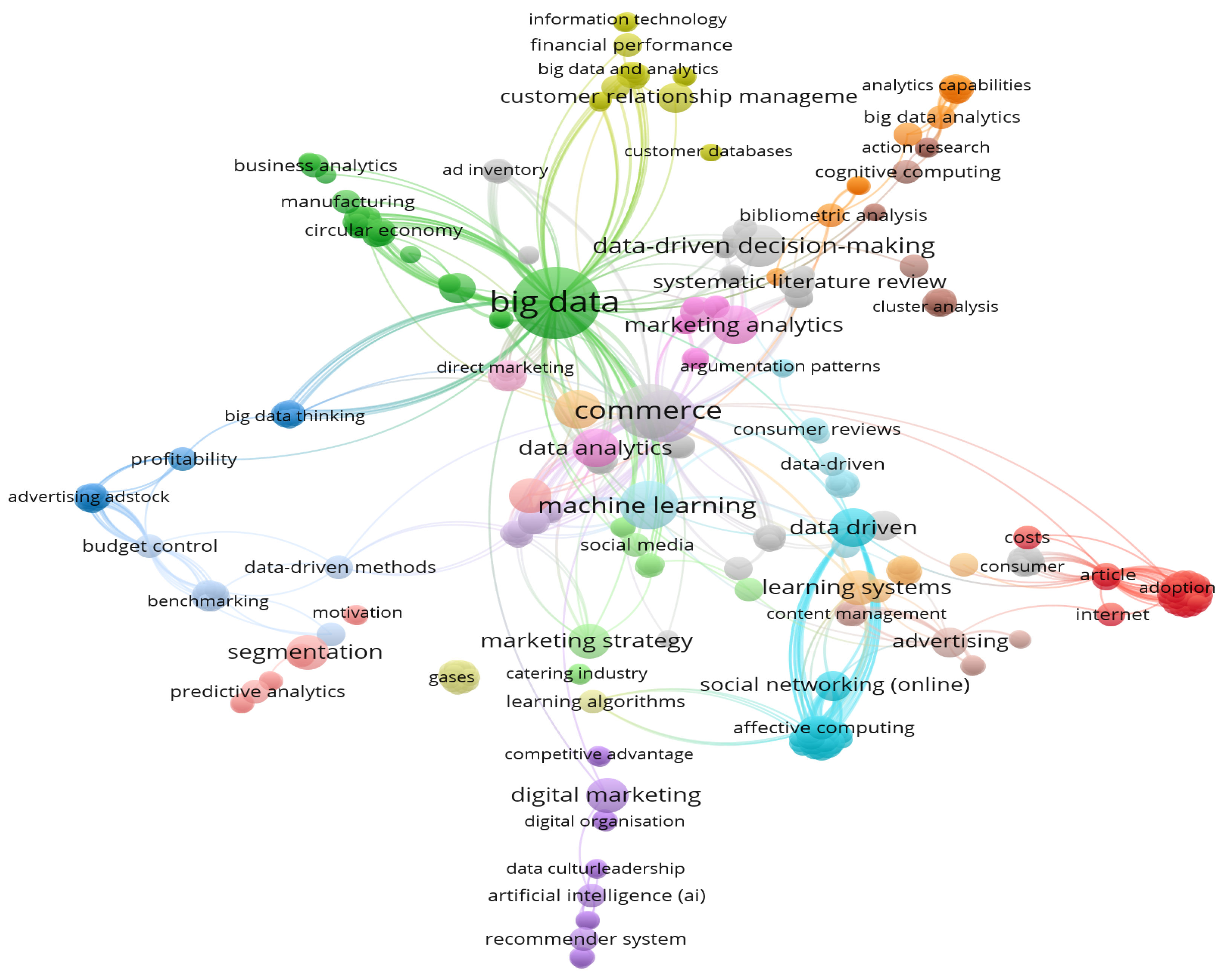
The specific focus of the bibliometric analysis centered on acquiring scholarly metrics which reveal patterns and trends of the scientific and academic content of the documents. In particular, the analysis emphasized pivotal words as illustrated in Figure 5. The visualization feature exhibits the most significant nodes within the network. The size of each node represents the number of times the keyword occurs. Further, the links which exist between nodes represent the co-occurrence of keywords cooperatively, as described in the previously provided explanation. The thickness of these links indicates the strength of these connections in question.
In these diagrams, each node’s size illustrates the frequency of its associated keyword, and the thickness of the links between the nodes depicts the frequency of keyword co-occurrences.
Different colors are used to demarcate distinct thematic clusters. The nodes display the topics available within each cluster, while the links indicate the interrelations of these topics within the cluster.
For this, we used VOSviewer (Version 1.6.20), a scientific software, to perform the analysis for the key search term “Data-Driven Decision-Making in Marketing” and generate the corresponding outputs. The scope of this analysis was restricted to scientific and scholarly documents within these thematic frameworks.
As a focus of this analysis, Figure 6 displays keyword interrelations revealing a network of co-occurring terms in the various articles analyzed.
This type of analysis is useful for understanding the scope of the topics within which active researchers focus their efforts, and it reveals new dimensions that could inform emerging research.
As Figure 5 shows, the full co-occurrence network of all keywords from the literature gives a broad overview of the underlying themes. Figure 6 demonstrates isolating the keywords that directly relate to the core search terms and illuminates the most pertinent connections relevant to Data-Driven Decision-Making in marketing.
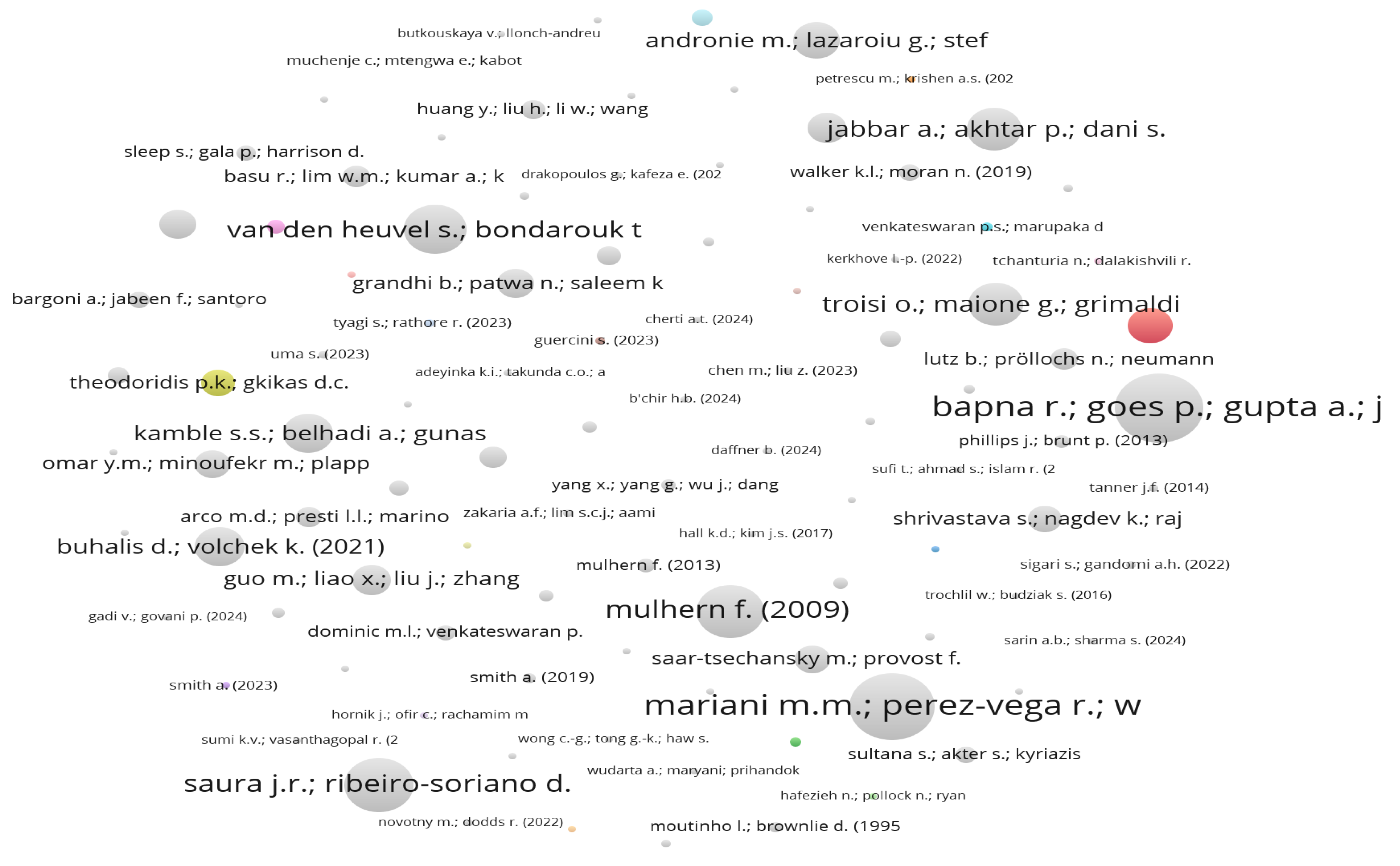
Figure 7 shows a detailed bibliographic coupling from the document analysis, which offers an interactive visualization of the co-citation network. This tool enables the exploration of the network to recognize patterns concerning the “Data-Driven Decision-Making in Marketing” discourse from several studies.
The methodological approach taken in this review guarantees precision and comprehensive data collection, thus providing reliable groundwork for other researchers to utilize this review as a foundation. Careful attention to resolving key concerns increased coherence, validity, and reliability. The integration of systematic review and meta-analytic techniques, coupled with adherence to methodological benchmarks, speaks to the high rigor of this study, which will be discussed in the following sections.

4. Theoretical Perspectives

The arrival and acceptance of data-driven technologies in marketing and their use have changed the techniques of business decision-making. Organizations can now access and analyze customer data in real-time [9]. This shift allows for organizations to optimize resource allocation, achieve precise targeting, improve customer engagement, and effective and efficient marketing strategies [15]. At any point in time, the evolution of data technologies presents opportunities to improve personalization, stimulate innovation, and improve business performance. Therefore, Data-Driven Decision-Making is crucial in the contemporary business environment and marketing practices.

4.1. Systemic Layering of Theoretical Perspectives

The theories used in the literature review can be viewed as interrelated building blocks in a framework of appropriate tiered reasoning for understanding the role of information in marketing decisions. At the micro-level, the Technology Acceptance Model (TAM) individually and in teams ‘adopt and adapt’ to the use of analytics, thus shaping the frontline practice of DDDM. At the meso-level, the Resource-Based View (RBV) and Dynamic Capabilities models construct data and analytics as strategic assets, connecting ‘technological’ with ‘capabilities-driven’ competitive advantage and performance. At the macro-level, the frameworks of Institutional Theory and Ethical DDD tell us how regulatory, governance, and social frameworks and ‘soft’ DDDM controls bounding its use respond to the ‘must’ in Responsible DDDM. Collectively, these lenses do not function in a vacuum, but rather as a self-sustaining theoretical system: for example, micro-level adoption underpins meso-level resource mobilization, whereas macro-level governance describes the limits in which organizations compete and innovate. Understanding these relationships emphasizes the systemic DDDM and the integrative constructs of analysis that level these frameworks.

4.2. Research Theoretical Contexts in Marketing DDDM

The literature reveals a more diverse yet uneven application of theory concerning DDDM in marketing. The customer experience improvement cluster tends to use the Technology Acceptance Model (TAM) to justify the adoption of analytics tools either (fully) or remain atheoretical relying on a case description [16,17,18,19,20,21]. Research on marketing innovation appears to apply the Resource-Based View (RBV) alongside Dynamic Capabilities Theory to view the data analytics capabilities as resources which constitute a strategic asset for the firm, thereby enabling a competitive advantage [12,22,23,24]. The performance improvement cluster draws on Decision Science to order analytic tasks with differing levels of structure [1,25,26,27]. The ethics and governance cluster incorporates elements of Institutional Theory and Ethical Decision-Making to account for data governance responsibilities of responsible data usage and regulatory burdens [28,29,30]. With all the above-mentioned frameworks, 36% of the reviewed studies were lacking a theoretical framework [31,32,33,34]. This lack of theory informs design stems from the absence of a more robust and cohesive theoretical structure.
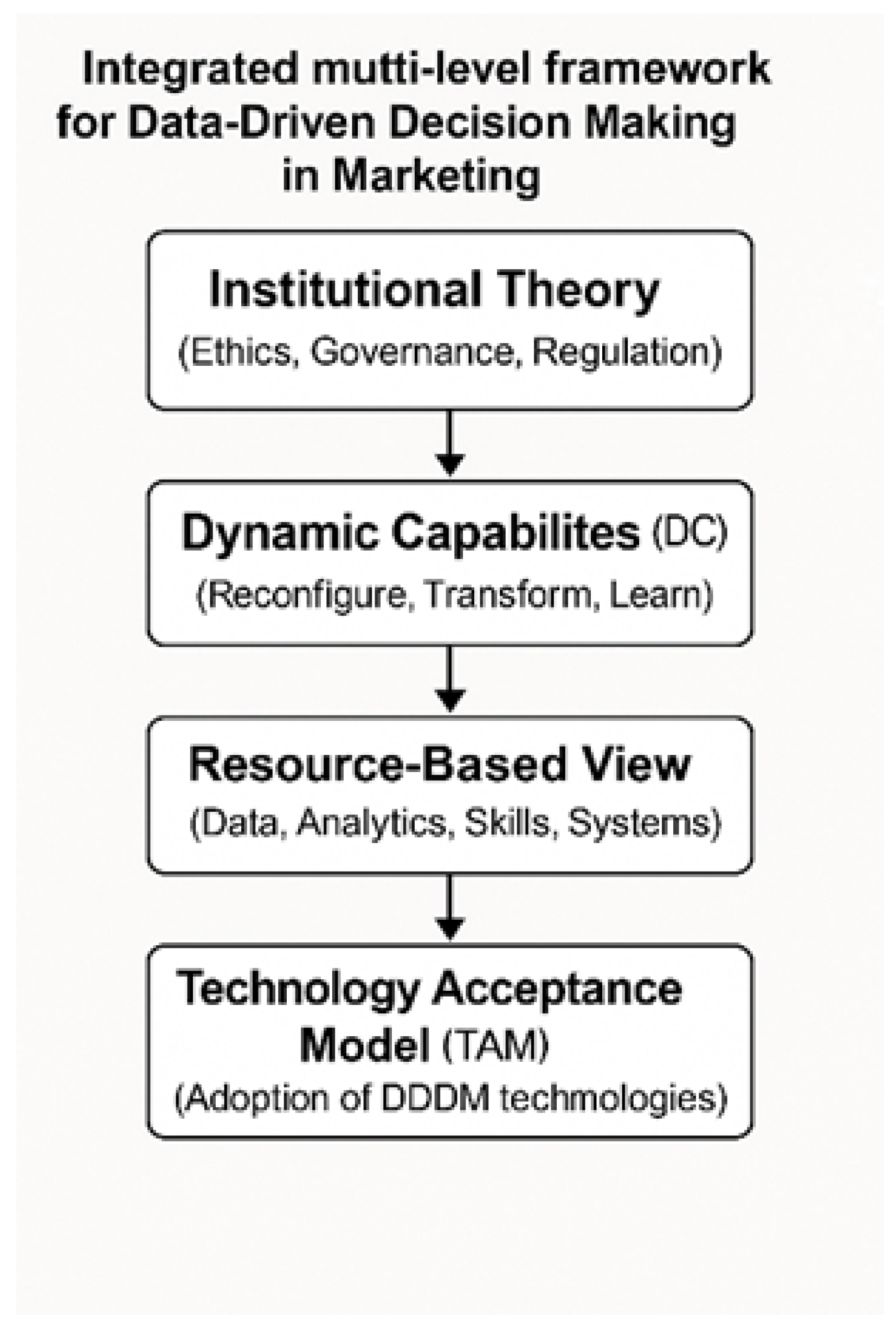
As 36 percent of the studies lacked theoretical grounding, the current review proposes an integrated multi-level and multi-theoretical approach consisting of the Technology acceptance model, Resource-Based View, Dynamic Capabilities, and Institutional Theory. TAM explains the micro-level (individual and team) participation of analytic tool adoption; RBV understands data and infrastructure along with skills as valuable (strategic) resources; Dynamic Capabilities explains the ways in which a firm adapts and reconfigures those resources to detect and react to market opportunities; and Institutional Theory describes the ethical, legal, and governance frameworks that define the boundaries of DDDM practices. Convergently, these ideas explain a unified system where the adoption of technology (TAM) facilitates the mobilization of resources (RBV), which further enables the development of capabilities (DC) and are bounded by the societal and ethical constraints of Institutional Theory. This integrated model provides a response to the theoretical inconsistency in the literature and opens the door to further conceptual and empirical explorations.
This figure illustrates the conceptual articulation between TAM (technology adoption at the micro-level), RBV (data and analytics as organizational resources), Dynamic Capabilities (reconfiguration and value creation through data-driven processes), and Institutional Theory (ethical, regulatory, and governance boundaries). The model provides the theoretical foundation recommended by the reviewer to address gaps in the existing literature.
Based on the thematic clusters of the existing literature and theoretical considerations, the present study attempts to address the following questions:
  • RQ1: What is the impact of Data-Driven Decision-Making on the experience outcomes of customers in various industries over time?
  • RQ2: How do advanced data-driven technologies perform in fostering marketing innovation, and what are the organizational and industry contextual constraints to their impact?
  • RQ3: How do data-driven marketing processes relate to measurable performance outcomes, and how can this relationship be contextualized in a model?
  • RQ4: What is the impact of ethical governance frameworks and organizational preparedness on the adoption and efficacy of marketing decision-making processes grounded in data?

4.3. Conceptualizing DDDM in Marketing

Within the 94 studies, the definition of DDDM reflects a consensus of its definition as data driven decision-making or the use of data, analysis, and modeling to make marketing decisions. From a customer-centric point of view, DDDM represents a kind of personalization, as well as customer segmentation and predictive modeling, intended to improve customer experience [19,20,35,36,37]. Performance-centered perspectives focus on the efficacy of an organization’s marketing endeavors, resource allocation, return on investment (ROI), and marketing efficiency [26,33,38,39,40]. There is a smaller, but striking, body of literature that considers ethics and governance, juxtaposing DDDM with the issues of data quant privacy, bias mitigation, and DDDM’s usage in a more responsibly framed usage of DDDM [28,29,30,41]. This range of perspectives is as compelling as the lack of a single encompassing model that outlines the steps, processes, and conditions delineated to apply DDDM in marketing.

4.4. Identified Gaps and Potential Avenues for Further Research

This study identifies three distinct gaps. The first is the lack of broad application of the Dynamic Capabilities Theory, which still helps explain the firm’s coping with data saturation environments during the shift in their marketing strategies [12,22]. The second gap concerns the lack of application of Institutional Theory in ethics and governance works [29,30] considering the growing regulatory and social forces concerning the marketing of data. The last gap is the absence of Service-Dominant Logic frameworks that would align DDDM with value co-creation. All these gaps seem to require more primary research, particularly in longitudinal, cross-context, and comparative frameworks.
Of the submitted studies, however, only some and often implicitly use Dynamic Capabilities to understand how firms manage in data-rich environments. Some studies refer to the faster detection of certain market signals and the implementation of analytics-driven campaigns and marketing process reconfigurations, but there is little to no explanation of these behaviors in terms of sensing, seizing, and transforming. Consequently, the potential of DC theory to understand the reorientation of marketing strategy in response to the abundance of data has been overlooked. It is in this light that this review proposes that future research adopts DC theory more purposely in its attempts to understand how firms adjust their marketing strategies to use DDDM.
Similarly, Service-Dominant Logic (S-DL) is also missing from the 94 job studies. However, S-DL has the potential to bridge DDDM and value co-creation. From an S-DL perspective, data, analytics, and AI tool are conceptualized as operant resources that allow for actors to integrate resources, co-create value, and reconfigure service ecosystems. This absence of S-DL from the DDDM literature is, thus, an additional void. A possible extension of the S-DL and Dynamic Capabilities literature could be the exploration of the role of data-driven insights in value co-creation of and between firms and its evolving mechanisms in complex service systems.

4.5. Toward a Comprehensive Framework

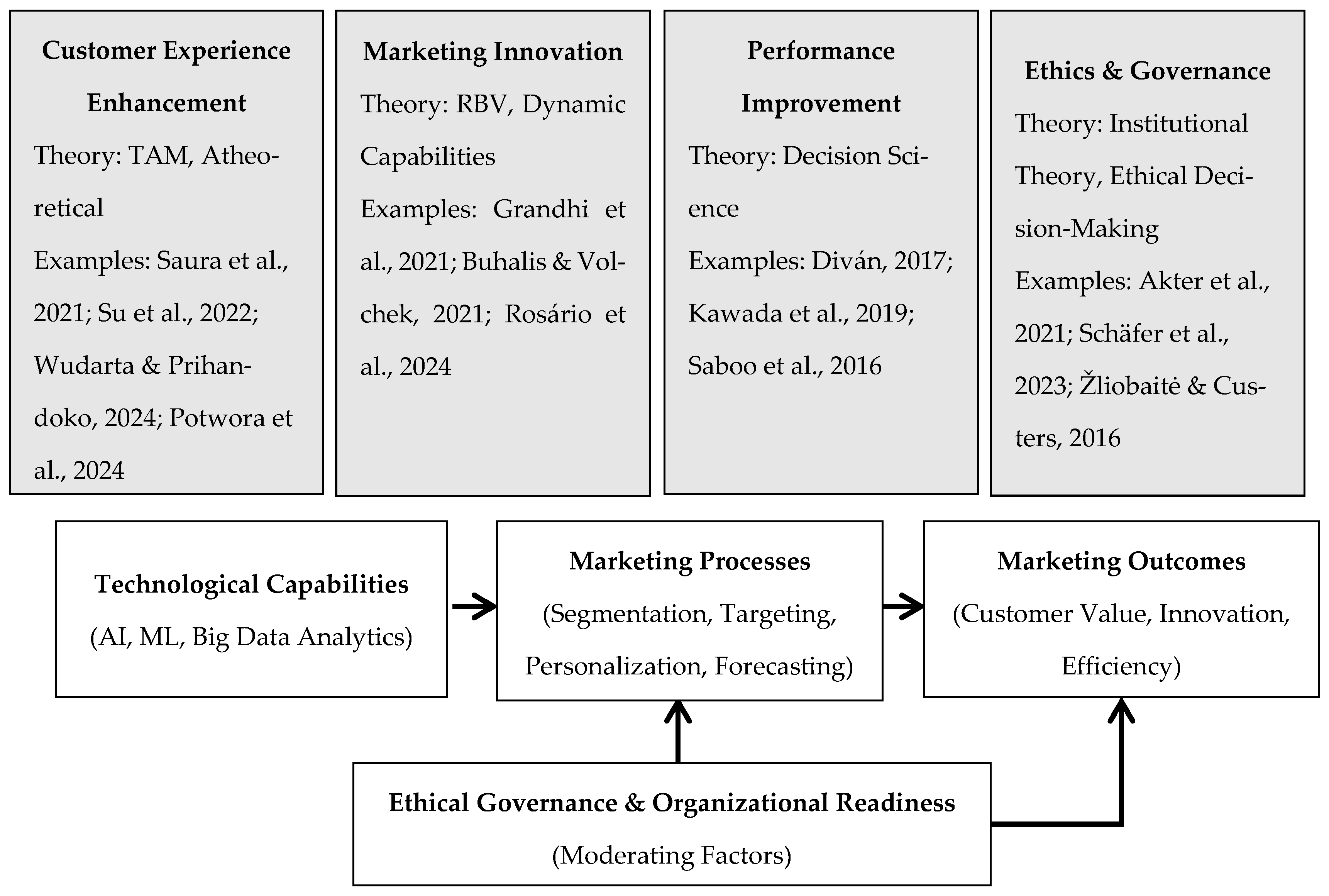
An integrated conceptual framework pertaining to four themes that have emerged from the review is DDDM in marketing: (1) customer experience augmentation; (2) marketing innovation caused by new technologies; (3) operational performance improvement; and (4) ethical and operational barriers.
Enabling resources, defined as technologies that aid in the marketing processes of AI, Machine Learning, and Big Data Analytics, enhance marketing activities like segmentation, targeting, personalization, and forecasting [17,39,42,43,44,45,46,47,48].

Systemic Integration of Thematic Clusters

In this review, the four clusters identified—including customer experience enhancement, emerging technology marketing, performance improvement, and the ethical and implementation challenges arising from them—should not be regarded as isolated areas, but rather as interrelated subsystems of the overarching marketing decision system, as well as the customer experience and its touchpoints (e.g., personalization and journey mapping) impact certain business performance indicators (e.g., ROI and customer lifetime value) and vice versa.
Likewise, these outcomes are facilitated and sped up by technological as well as organizational innovations, resulting in feedback loops where customer experience and innovation mutually bolster one another.
Ethical governance and organizational readiness function as overarching moderators that cut across the entire system: they shape the governance technology adoption, throttle the innovation system, and collar the performance gains to ensure they are not made at the expense of trust and fairness.
This review integrates the clusters into an overarching conceptual framework (Figure 8) to show that DDDM in marketing is a functioning, dynamic system where the technological, organizational, and ethical components are in perpetual interaction, generating outcomes that are emergent and cannot be understood in isolation.
Figure 8. Integrated multi-level theoretical model (TAM–RBV–DC–Institutional Theory). Source: Own elaboration. This framework summarizes the empirical structure of the field, combining the dominant themes, technologies, capabilities, challenges and outcomes identified across the 94 reviewed studies. Unlike Figure 8, which provides the conceptual theoretical model, Figure 9 presents the empirical integration resulting from the bibliometric and thematic analyses. The advanced technological tools of Artificial Intelligence (AI), Machine Learning (ML), and Big Data Analytics have made it possible to perform marketing processes (segmentation, targeting, customization, forecasting), which in turn influence customer value, innovation, and efficiency as marketing outcomes. The ethical governance of an organization and its readiness to engage with such technology, as well as its decision-making processes serve as moderators to these relationships. The integrated framework combines four umbrella categories: (1) enhancement of customer experience, (2) marketing innovation for development of new and emergent technologies, (3) improvement of performance, and (4) ethical concerns and challenges of implementation. Source: Own elaboration.
Systems 13 01114 g008
Figure 9. Synthesized integrated framework for Data-Driven Decision-Making in marketing. [1,8,12,17,18,19,20,22,25,26,28,29,30].
Systems 13 01114 g009
These processes, in turn, shape marketing outcomes pertaining to the value of the customers, innovation, and creation, as well as operational efficiency [12,20,34]. Organizational preparedness and ethical governance influence these systems and their frameworks alongside organizational readiness and structure [29,41,49].
Because these elements are all essential, this creates an opportunity where all of the technological, strategic, and ethical aspects of a system are brought together in one framework to model reasoning and theory, thus honing the need for empirical studies, refinement, and even interindustry analysis.

4.6. Comparison with Related Reviews

The prior literature review focused on the frameworks of marketing analytics and Big Data [9,43], indicating issues concerning the lack of theory-based frameworks and absence of an ethical oversight framework. This review specifically focuses on the integration of ethics and governance into the primary DDDM model, thus creating supplementary frameworks in consideration of all models poorly targeted by those theoretical gaps. Representative studies in the reviewed corpus also note similar gaps in ethical oversight frameworks and theoretical integration [28,29,30,34,49].
Furthermore, the boundary DDDM encompasses organizational capabilities and processes and outcomes, which operate within explicit moderating relationships and, in turn, adds more dimensions to the discourse.

4.7. Technologies Supporting Data-Driven Marketing Decision-Making

This review pinpoints several Internet-driven technologies that assist firms in making marketing decisions informed by relevant data. Each technology seeks to improve and analyze the relationship between a business and its customers. Collectively, these technologies equip organizations with the needed information and the requisite processes to devise and implement strategies that ensure enhanced customer value and improved marketing outcomes. This review notes these critical technologies to be Artificial Intelligence, Machine Learning, Advanced Data Analytics, Marketing Analytics, Predictive Analytics, Consumer Recommender Systems, and the Internet of Things. Examples of these applications are documented extensively in the reviewed studies (e.g., AI and ML for personalization [19,42,50,51,52,53], marketing analytics for ROI optimization [9,26,54,55,56], and IoT for operational responsiveness [34,39,57,58]).
To facilitate an understanding of the technologies, theories, and their relationships, Table 4 presents a summary of the proportion of studies involving each technology, featured theory, and the principal theoretical gaps evidenced in the corpus.
While the individual analysis of AI, ML, Big Data, Marketing Analytics, Predictive Analytics, and IoT provides valuable detail, a comparative synthesis helps to clarify how these technologies collectively shape the intellectual landscape of DDDM research. To enhance analytical coherence, we introduce a consolidated comparison that highlights their relative frequency, theoretical grounding, and associated research gaps across the 94 studies.
Although this subsection falls within the broader Results and Discussion Section 5, the analysis of technologies necessarily incorporates theoretical perspectives. For this reason, the comparative synthesis below integrates both empirical frequencies and theoretical lenses.
According to Table 5, AI, ML, and Big Data reign over DDDM, but there is still an absence of them being mathematically meshed with governance and ethics. Predictive and marketing analytics are closely connected to the science of decisions and are performance-optimized, but are ingrained in strategy only on rare occasions. IoT and recommender systems are less frequent, but are mathematically defined, and are, unfortunately, censoring primary marketing capabilities as opposed to marketing tools, and this is something that future scholars should examine more closely.

4.7.1. Artificial Intelligence (AI)

Artificial Intelligence refers to the use of machines and computer algorithms to assist in a variety of processes such as decision-making, engagement, as well as improving system efficiency and user personalization. From the corpus of articles, [63,64] highlighted the use of AI in customer experience personalization, in addition to 28% of the articles. AI has become commonplace, as it is integrated into ML systems associated with segmentation and recommendation, as discussed in the literature review. This means that AI is a component of deeper analytic systems.
These applications closely follow the Resource-Based View (RBV) model in which AI is considered to be a strategic capability for sustaining a competitive advantage [12]. This trend further corroborates the observations detailed in Section 5.1, which discusses the use of AI in customer engagement and personalization, noting a direct increase in customer relationship management, client retention, and overall satisfaction within customer-driven marketing paradigms.

4.7.2. Machine Learning (ML)

ML is a sub-field of AI that optimizes the performance of a system through automation and iterative learning based on the data received. In this review, ML appeared in 23% of studies, most notably in customer segmentation and predictive modeling activities [50,51]. ML combined with Big Data Analytics is beneficial in dealing with vast amounts of unstructured data, particularly in the domains that pertain to system performance. ML applications are regarded, within the literature, under the domains of Decision Science, pertaining to the exactness with which customer behavior and campaign performance are forecasted [25]. In further studies, ML appeared to be scoped with little regard to the ethics or governance frameworks, which demonstrates the lack of a practical approach to the theories integrating AI technologies in a socially responsible manner.
From a practical perspective, the integration of ML adds to the existing frameworks of Decision Science and aids in the precision of forecasts, hence reducing the uncertainty inherent in marketing decisions [25]. These findings correlate with the discussion in Section 5.2 where marketing enabled by ML technology was discussed and where rationalized and sophisticated segmentation and forecasting were the order of the day, but very few governance ethics frameworks were discussed.

4.7.3. Big Data Analytics

Social media interactions, website visits, and transaction activities create complicated datasets which need to be examined using Big Data Analytics. This technology did appear in 31% of examined studies, making it the most common technology in the dataset [22,26,101]. The most significant uses were in anticipating market trends, tracking customers’ and prospects’ sentiments, and modeling campaign attributions. Theoretical grounding was often tied to Dynamic Capabilities Theory, in which the capabilities of Big Data allows for firms to market changes in real-time. However, in the ethics and governance cluster, Big Data was treated in a more descriptive manner when it came to the theory of data collection and governance, suggesting a lack of theory-informed research in the field.
The focus of Big Data in the literature strengthens the Dynamic Capabilities Theory, which underscores the importance of identifying and responding to changes in the market as quickly as possible. This correlates with the findings stated in Section 5.3, which highlight the role of Big Data Analytics as a driver of enhanced business performance in relation to budget allocation and spending. These patterns are consistent with the studies that applied Big Data Analytics for segmentation, forecasting, and campaign optimization [17,18,42,47,69,70,102].

4.7.4. Marketing Analytics

Marketing analytics measure and evaluate the effectiveness of marketing efforts. With respect to optimizing ROI and multichannel attribution, these tools were cited in 18% of the analyzed articles. In the absence of marketing analytics, the available innovation-related literature seemed to rely on the Technology Acceptance Model (TAM) to justify the analytic adoption gaps and non-competitive positions of organizations. Representative applications of marketing analytics within the corpus include ROI optimization [9,26,54,56,103,104] and multichannel attribution modeling [35,39,56,105].
It is striking that marketing analytics platforms were virtually absent from innovation-focused studies, indicating a lack of correlation between the adoption of analytics and competitive market positioning.
Works that relate to the Technology Acceptance Model (TAM) focus on explaining adoption behavior for these analytics platforms. The adoption patterns that were described in this excerpt connect to Section 5.3, where marketing analytics were described to improve profits via precise targeting and sophisticated ROI evaluation.

4.7.5. Predictive Analytics

Predictive Analytics utilizes historical data together with statistical techniques to forecast future events. Its use in the papers we examined was 21%, mostly in the demand forecasting and churn prediction [57]. Relationships were made with Decision Science, particularly with the model validation and evaluation processes. In the designated areas of performance improvement, Predictive Analytics were crucial to budgeting and customer retention efforts, but the integration of ethics into the decision-making frameworks of the studies was rather sparse, creating ample opportunity for further investigation.
The literature on Predictive Analytics tends to mention Decision Science without fail when it comes to model building. This is, however, consistent with the findings discussed in Section 5.3, which highlighted the lack of strategically embedded analytics at the organizational level and the presence of Predictive Analytics in inventory management, churn, and profit optimization.

4.7.6. Consumer Recommender Systems

Recommender systems suggesting products or services are represented in 12% of the studies. Most of these cases were found in the e-commerce industry and applied collaborative or content-based filtering. Regardless of the prominence of these systems, few studies integrated them into marketing theory, treating them as mere stand-alone, non-innovative, technical systems. This example demonstrates the disparity between marketing theory and system architecture.
Recommender systems, critical as they are for the personalization of services, were infrequently connected to explicit marketing theory. These findings support the argument in Section 5.1, which claimed that personalization facilitated by recommendation systems positively influences customer lifetime value, retention, and business performance. Examples include studies applying collaborative filtering and content-based recommendation for personalization in e-commerce [19,52,62].

4.7.7. Internet of Things (IoT)

As the least-cited technology in the review, IoT devices, which integrate hardware with sensors and communications systems to collect and exchange information, appeared in only 9% of the studies. Uses included customer tracking in real-time, inventory control, and marketing to very local areas. Though the majority of studies described scenarios, IoT does align with the Dynamic Capabilities framework which focuses on customer-response agility. Pertinent IoT use-cases have already been covered in the discussion of Dynamic Capabilities in Section 5.3 where the focus is more operational, looking at IoT’s role in streamlining logistics and inventory control, which is rarely associated with more strategic, higher level objectives. Overall, patterns related to technologies focused on AI, ML, Big Data Analytics, Marketing Analytics, Predictive Analytics, Recommender Systems, and IoT are ascertained to be in concordance with these exemplar studies presented in Section 5.1, Section 5.2, Section 5.3 and Section 5.4 and Table 4, corroborating the consistent convergence of these domains of technology with the 94 articles that tested empirical material evidence [17,18,20,39,42,47,69,70,106].

4.8. Development of Conceptual Framework and the Research Questions

The review of literature reveals four thematic clusters that outline the current understanding of Data-Driven Decision-Making (DDDM) in marketing:
  • Enhancement of customer experience.
  • Emerging technologies and marketing innovation.
  • Improvement in organizational performance.
  • Ethics and challenges of implementation.
These clusters highlight the differences in the areas of research (see Appendix B). There is a problem of a lack of theoretical integration and consistency of method in synthesis and divergent interdisciplinary approaches. An overarching conceptual framework, shown in Figure 8, integrates technological capabilities—AI, Machine Learning, Big Data, marketing and Predictive Analytics, recommender systems, and IoT—which enable the marketing processes that drive outcomes moderated by ethical governance and organizational readiness.
The alignment of this review’s main conclusions with the authored research questions is shown in Table 5. For DDDM’s contribution to customer experience management in RQ1, it discusses journey mapping, behavioral segmentation, customer personalization, and relationship management that drives loyalty and differentiation in very competitive markets. RQ2 looks at automation’s contribution to innovation in the marketing and the development of consumer-friendly, sustainability-driven marketing innovation strategies. DDDM improves business performance in the gaps DDDM has in business performance, incorporating real-time budget reallocations, ROI-optimized spending, and predictive demand modeling designed to cut costs and enhance innovation cycle times, operational efficiency, and future-oriented innovation strategies. The last section discusses ethics and implementation, identifying enduring issues of privacy, bias, cost, and system integration, alongside the fact that system’s success adoption hinges largely on ethical governance and organizational readiness and preparedness.

4.8.1. Improvement of Customer Experience

An extensive number of studies, specifically 58 out of 93 (62%), emphasize the customer experience, particularly focusing on the applications of DDDM in personalization, segmentation, and predictive modeling, which aim to foster customer satisfaction and loyalty. There is empirical evidence suggesting that customer engagement may be augmented using AI-powered recommendation systems, dynamic pricing, and other analytics tools. Nevertheless, most of the studies have cross-sectional or case study designs centered on single firms, restricting their conclusions to longitudinal scope and cross-industry generalizability. Moreover, almost one-third of the studies focused on customer experience frameworks lack a theoretical underpinning, which hinders the research community from developing a cumulative foundation from which they can build upon one another’s efforts.
RQ1: 
In what ways and to what extent does Data-Driven Decision-Making affect customer experience across various sectors and overtime?

4.8.2. Emerging Technologies and the New Marketing Innovation

The focus of this innovation cluster is on the more impactful AI, ML, Big Data Analytics, and the IoT on the metamorphosing of marketing. These technologies make it possible to accelerate product development, instantly revise marketing campaigns, and identify prospective markets. The prior literature has shown DDDM enhances the pace of innovation by enabling rapid innovation cycles and accelerated creation [42,107,108,109,110,111,112]. Nonetheless, research is lacking in coherence and there is disparity across sectors and the level of advancement of the firm in question [4,34,113,114].
RQ2: 
How do organizational and industry contexts moderate the impacts of advanced data-driven technologies on marketing innovation and its facilitation?

4.8.3. Measurement of Enhanced Results

Approximately 48% of the empirical literature noted the relationship of Data-Driven Decision-Making (DDDM) systems with measurable business performance indicators like ROI, conversion rates, and operational efficiency [9,12,20,22,26,33,35,39,40,54,56,69,73,74,75,76,77,79,80,81,82,83,87,115,116]. Clearly, optimizing resource allocation [12,26,39,54,116], tending to high-value customers [35,39,40,69], and real-time campaign monitoring [9,26,35,54,56] can enhance profitability. Analysis of performance metrics tends to ignore the frameworks of DDDM systems which link specific technological functions with business functions and influence business results [26,54,56,69], which hampers the formulation of well-founded theories.
RQ3: 
How are measurable performance results linked to data-driven marketing processes, and how can this relationship be framed within different contexts?

4.8.4. Ethical and Implementation Challenges

The most potential, albeit unaddressed, focuses were on algorithm biases, issues of data confidentiality, as well as the readiness of the firm adopting the technology [14,28,29,30,41,49,89,90,91,92,95,97,98,100,117]. The findings demonstrate the risk of employing granular customer profiling information vis-a-vis the legal privacy restrictions [28,29,30,41,89], as well as the culture impact on adoption [49,95,117]. Regardless of these findings, there is a dearth of scholarly discourse that empirically analyzes governance frameworks as moderator variables on the adoption and DDDM impact.
Thus, Scopus’ temporal corpus is yet another limitation. The studies analyzed in this review, although from very recently increased publications (2023–2024), do not include research focused on governance, ethics, and responsible AI. This is not a gap in the field, but rather a result of the methodological limitations based on Scopus. Future studies should expand the database coverage to include these new contributions and provide a more contemporary perspective on governance and ethics in data-driven marketing.
Only 19% of the literature focuses on governance policies of data privacy, algorithms, fairness, and transparency concerning the adoption and impact of Data-Driven Decision-Making in marketing ([28,29,30,41,89,90,91]). Also, 24% of the literature focuses on organizational readiness prerequisites, leadership, analytics maturity, and cross-functional integration as key enablers ([29,30,34,39,49,94,95,117]). The literature shows that comprehensive governance frameworks [28,29,41,89] bolster trust and compliance with regulatory requirements among consumers, while readiness factors [34,49,94,117] enhance implementation and ROI post adoption. Very limited empirical research integrates both governance and readiness gaps as frameworks that hinder cross-disciplinary stagnation and the innovation and practical knowledge of innovation.
RQ4: 
In what ways do ethical governance frameworks and organizational preparedness impact the effectiveness and adoption of Data-Driven Decision-Making in marketing?

4.9. Propositions Emerging from the Systematic Review

P1. 
Organizations that achieve higher adoption of DDDM technologies are more likely to convert data-related resources into Dynamic Capabilities that enhance marketing performance [17,20,39,40,42,59,60,69,70].
P2. 
The positive effect of AI/ML-enabled personalization on customer trust is strengthened when robust governance and ethical oversight mechanisms are present [17,28,29,30,41,51,61,95].
P3. 
Firms with higher analytics maturity and stronger data governance are more likely to translate DDDM insights into sustained strategic benefits through Dynamic Capabilities [26,39,42,49,94,110,112,117].
P4. 
Cross-functional integration strengthens the effect of DDDM technologies on marketing innovation and operational agility [42,49,69,70,94,108,112,117].

5. Results and Discussion

The value of this review comes from its particular technological focus on DDDM research where AI, Machine Learning, and Big Data Analytics are the primary drivers of outcomes; these are customer-oriented, innovatively transformative, and performatively efficient. Although there technologies improve personalization and predictive abilities, the scope of such technologies reveals an inherent structural problem. Most of the DDDM literature examines the operational gains and advantages of such technologies, while the ethical, governance, and organizational prerequisites are largely ignored. This structural imbalance is significant in the literature. The literature on adoption decisions through TAM precludes any discussion on competitive advantage, and that is because there needs to be a discussion on the resource structures that constitute the core of the RBV, and the resource realigning mechanisms of Adaptive or Dynamic Capabilities.
Using a multi-leveled approach to Data-Driven Decision-Making (DDDM) adds to our understanding of the reasons why the implementation of technology is not enough. To use the Technology Acceptance Model (TAM) at the micro-level to achieve desired outcomes, it is necessary to utilize the meso-level, which involves resource structure and dynamic state capability (RBV, DC), and is woven into wide-ranging institutional frameworks that define the legitimacy and align the strategy of the organization. These interdependencies strengthen the demand for more empirical studies focused on how these levels of interaction across differing systems of organization, regulation, and culture.
The most important of these implications of this review is that organizations may adopt and use advanced analytics systems and technologies, but if there is no corresponding governance framework deployed, it may result in a breach of trust and a violation of regulation. This is particularly dangerous, as only 19% of the sampled studies were found to be as concerned about the framework of algorithmic fairness, privacy, transparency, and organizational preparedness. These purportedly macro constraints, in accordance with Institutional Theory, will then result in these precise restraints on organizational practices. Therefore, the focus on personalization, segmentation, and Predictive Analytics that the literature has espoused is dramatically at odds with the thin, albeit developed, understanding of the theoretically certain limits to ethical and socially acceptable practices on such predictive technologies.
Another limitation of the evidence base is that the improvements that come with DDDM, such as increased ROI, customer retention, and operational efficiencies, is captured predominately through cross-sectional studies. In our corpus of 94 articles, these performance outcomes are almost always reported at a single point in time (for example, survey data, one-shot experiments, or single-period case studies), and no true longitudinal panel designs were identified. Herein lies the challenge of ascertaining the temporal nature of such benefits. Do such benefits linger in the long run, or do they fade with the plateau of new technological adoptions or with augmentation of competitive pressures? Cross-sectional designs can show that firms using DDDM tend to perform better than their counterparts at a given moment, but they cannot reveal whether these advantages are sustained, amplified, or eroded as technologies and competitive conditions evolve. To help facilitate this, future studies could use longitudinal designs to determine how DDDM-driven financial performance varies, remains constant, or goes through cycles of change over different time periods and across different organizational contexts.
Firms should be aware that they will be able to improve consumer experience and decrease the amount and time of innovation cycles if they use artificial intelligent and Machine Learning. However, if the companies do not have the necessary prerequisites, such as having the required analytical and data management processes, such investments will yield no strategic benefits. The review shows that companies have the option to integrate their instruments of DDDM with the other components of governance and readiness. This will enable the companies to techno-organizationally imbalance, promote capacity, and align with the ethical framework.
For empirical research to have a theoretic framework, scholarly work has to adapt the models that involve the adoption of technology, the resource allocation, and the development of capabilities with the limit set by governance. This approach will be a litmus test for the advanced technologies that yield diverse results in the organizational settings and it will help the companies to reduce the risks associated with algorithmic biases, loss of sensitive data, and the trust of the consumer.

5.1. Results for RQ1: Customer-Centric Marketing and Experience Improvement

Of the 94 studies analyzed, 61% explicitly linked DDDM with a customer-centric approach, emphasizing the areas of personalization, customer segmentation, and customer journey mapping. The most common approaches for personalized offer tailoring, needs forecasting, and real-time engagement delivery were AI and Machine Learning (Section 4.7.1 and Section 4.7.2). This pattern held true across all industries, but emerged most prominently in e-commerce, tourism, and retail.
In the Asia-Pacific region, the focus on recommender systems surpassed that of European studies, which concentrated on customer engagement and interactions within privacy-compliant frameworks. These models further reinforce the customer experience improvement thematic cluster developed in Section 4.1 and offer frameworks with the Technology Acceptance Model (TAM), which describes technology adoption for systems designed for tailored personalization.
Answer to RQ1: The provided information substantiates the conclusion that DDDM promotes customer-centric marketing strategies via better customer engagement, satisfaction, and loyalty through improved interaction and feedback during the course of engagement.
Gap and Implications: An integration of data stewardship frameworks that focus on responsibility with data personalization frameworks is a glaring gap. Under 15% of the studies that made ethical appendices to the governance frameworks centered on bias mitigation, underscoring the desperate need for frameworks that integrate responsible data governance with personalization.

5.2. Results for RQ2: Innovations in Marketing and Technology Driven by Data

Forty-two percent of studies indicated that DDDM enables the occurrence of marketing innovation primarily through product innovation with AI, ML-driven trend forecasting, and campaign optimization utilizing Big Data (Section 4.7.3 and Section 4.7.5). The DDDM technologies went beyond mere process enhancement, as they prompted the creation of novel customer value propositions, for example, adaptive and sustainability-driven pricing models.
It is interesting that the manufacturing and logistics subsectors focused on the operational innovation of IoT in the scholarly work (Section 4.7.7), while the service industries employed marketing analytical systems for innovations regarding customer experience. From a scholarly standpoint, these findings validate the RBV and Dynamic Capabilities Theory, allocating the high-level analytical DDDM capabilities as core competences necessary for sustaining market dominance as the ongoing market leader.
Answer to RQ2: Technologies based on data, analytics, and metrics sharpen the detection of market changes, enable refined customer segmentation, and provide continuously evolving service offers causing innovation in marketing.
Gap and implications: The literature shows a lack of work analyzing innovation from a cross industry perspective. There is a need to analyze how industrial determinants impact the structure and scope of innovations designed driven by DDDM.

5.3. Results for RQ3: Business Performance and Profitability

Fifty-three percent of firms surveyed in the studies analyzed indicated that DDDM adoption positively impacted ROI, conversion rates, and operational metrics. Predictive Analytics (Section 4.7.5) proved to be a central enabler, as firms were able to curtail spending on advertisements, reduce customer churn, and forecast inventory requirements with a high degree of precision.
Geographic distribution shows a pronounced focus for North American studies on profit and budgetary spending, whereas European research concentrated more on efficiency improvements brought about through integrated marketing–supply chain analytics. These tendencies align more with the Decision Science domain, that emphasizes the politically motivated marketing of scarce resources to reap the maximum return on investment.
Answer to RQ3: DDDM enhanced strategic decision-making and improved the effectiveness of resource allocation, operational alignment with demand signals, and, thus, business performance and profit.
Gap and implications: There are no longitudinal studies which determine whether enhanced financial performance is maintained over longer periods, and there are gaps in the DDDM evidence base concerning strategic implications over time.

5.4. Results for RQ4: Ethics and Implementation Considerations

While most of the literature recognizes ethical leadership as an influencing element for applying Data-Driven Decision-Making (DDDM) in marketing, only a fraction, 19%, of the surveyed literature demonstrated some form of relationship between governance issues such as data governance, algorithmic fairness, and transparency compliance and the outcomes of adoption. Organizational preparedness, which encompasses engagement from the leadership, the maturity of analytics capabilities, and integration of data horizontally as opposed to within silos were within more than a fourth of the studies as critical for sustained engagement as adoption.
In Section 5.1, the data stewardship frameworks within organizations were shown to enhance the adoption of personalization technologies, which mitigate trust and regulatory risks for consumers; in Section 5.3, it was demonstrated that the faster return on investment for firms with strong data governance and analytics capabilities achieved from DDDM investments was proportional to the strength of their governance frameworks.
These interactions and some hypothetical frameworks, like the Institutional Theory, which emphasizes external enforcement and internal adoption as joint determinants, as well as the Technology–Organization–Environment (TOE), which examines the interplay between readiness, technology, and the external context, can be justified further.
Answer to RQ4: Ethical governance frameworks enable the legitimacy and trust necessary for DDDM, while the organizational preparedness describes the level at which data-driven skills and competencies are integrated within the frameworks of the decision-making processes of the organization. Without these prerequisites, even the most advanced technological investments are unlikely to yield any strategic or operational value.
Gap and Implications: A blending of governance with organizational readiness to evaluate the pace and depth of adoption within a given organization seems to be absent empirically. Such frameworks are needed that capture these effects and examine the causative effects across industries and within differing regulatory environments.

6. Conclusions

The evolution of technologies such as Artificial Intelligence (AI), Machine Learning (ML), and Big Data Analytics has empowered industries and organizations to adopt decision-making frameworks based on data (DDDM), which builds upon and refines earlier established sound theories, models, and concepts in a myriad of disciplines, including marketing. Data-driven decision-making (DDDM) as a skill enables organizations to comprehend and interpret consumer behavior, market forces, and resource allocation. DDDM justifies a scientific and conceptual rationale based on Machine Learning, Predictive Modeling, and analytics for the prediction of market trends and optimal resource allocation. A thorough analysis of 94 available peer-reviewed studies arranged within the thematic clusters of industry, geography, and publication years reveal that the appropriate governance framework for DDDM proves to be beneficial for nurturing innovation and improving personalization and business performance.
Advanced technologies like GIS, marketing automation, and social media enable valuable personal interactions and enhance customer experiences through the evaluation of customer journey maps, behavioral segmentation, and customer lifetime value analysis. Sustained engagement with the brand and loyalty is achieved through the resulting satisfaction. Integration with marketing automation platforms enhances overall efficiency through the elimination of repetitive tasks and through the adoption of proactive responsiveness to emerging customer needs and market trends through Predictive Analytics.
The analysis substantiates that DDDM improves experiential mapping through journey mapping, behaviorally based segmentation, and bespoke interaction tailoring. Enforced loyalty forecasted via CLV targeting, in conjunction with dynamic behavioral analytics, sustain relevance in turbulent markets. Individualized message tailoring is a differentiator that strengthens both engagement and satisfaction.
Dobrica’s synthesis argues that DDDM assists in sharpening marketing expenditures, boosting ROI, and achieving better consolidation in the supply chain. Real-time campaign-driven allocation coupled with demand forecasting using predictive models stunts the rate of new product introductions while increasing total costs. This heightened agility and captured value enhanced responsiveness in aggressive market structures.
Within the scope of marketing innovation, DDDM facilitates precise targeting in audience segmentation, accelerates the custom-tailoring of products, and bolsters environmentally conscious marketing. Unlike traditional approaches, a DDDM-driven supply chain and inventory management approach increases operational effectiveness and reduces costs by minimizing waste and optimizing inventory management. This, in turn, enhances the firm’s competitiveness and sustainability over time. In addition, DDDM advanced analytics ensures optimal allocation of advertising expenditures considering the return on investment. Still, the adoption of DDDM faces unshakable hurdles. Trust and decision-making processes can be undermined and distorted due to data privacy, security, and algorithmic bias. There is a gap in the analytics expertise described, coupled with high implementation costs and difficulty merging with legacy systems. Every mentioned challenge requires insufficient algorithm transparency and governance combined with steady workforce capability investments, and enhanced frameworks proven in this review to be critical moderators of adoption effectiveness.
Research suggests that the ethical governance frameworks of data transparency, bias identification, and privacy policies serve as protective measures and are critical in maintaining trust in DDDM systems. Readiness of the organization, which includes the maturity of data governance, collaboration across departments, and competency of the workforce, has a crucial bearing on the adoption pace, outcomes, and overall impact. There remains a consensus that the availability of advanced and sophisticated technologies, in the absence of appropriate organizational governance and preparedness, hampers DDDM and essentially undermines the return on investment.
Quantum computing, edge computing, augmented analytics, and blockchain are all new technologies that may impact the future of DDDM, as they offer advanced capabilities of analysis, enhanced security, and transparency. Moreover, the concept of federated learning and differential privacy offers a means to generate insight while simultaneously safeguarding user data. At the same time, marketing informed by neuroscience and hyper-responsive AI systems that are emotionally aware could provide means through which extreme hyper-personalization could be achieved.
At the technologies and innovation level, the review highlights that the marketing automation innovation driven by technology, along with preference and forecasting analytics, is certainly a pillar of marketing innovations. Preference convergence across channels and adaptive-semantics alteration of products respond proactively to shifts in the market. The intertwining of innovation process with sustainability goals enhances the attractiveness for the consumers classified as socially responsible investors by presenting sustainable innovation as a strategic advantage.
From this synthesis, the following DDDM priorities have outlined the frameworks of further investigation:
(i) Design energy-efficient data center algorithms to mitigate the environmental impact of Big Data Analytics.
(ii) Create advanced real-time adaptive campaign Machine Learning systems.
(iii) Develop algorithms that incorporate bias detection and unbiasing systems to ensure the analyzed systems operate without prejudice.
(iv) Create marketing and business KPIs that are analytically based and incorporate sustainability objectives into the targets.
(v) Expand research on non-marketing domains with DDDM relevance through cross-industry comparative studies.
Contribution to Literature:
This review contributes to DDDM scholarships through the following ways:
  • Formulating a cross-cluster theoretical mapping that connects the applicative domains of DDDM to The Technology Acceptance Model, The Resource-Based View, Dynamic Capabilities Theory, and even Institutional Theory for better conceptual cross research integration.
  • Providing a multi-dimensional synthesis of 94 peer-reviewed articles organized into thematic clusters which include customer experience enhancement, marketing innovation, performance improvement, and ethical/implementation challenges, along with industry, geography, and time, detailing the empirical basis for describing sectoral and regional patterns.
  • Enhancing systematic literature review protocols in marketing by applying PRISMA for bounded topic research at the center of inclusion and exclusion criteria and keyword and thematic coding through network and cluster mapping.
  • Noticing a sparse set of cross-industry comparisons and longitudinal studies on integrated governance frameworks assessing the impact of DDDM on performance, and thus building a foundation for further scholarship on the subject.
  • Emphasizing the infrequent use of Dynamic Capabilities Theory and the almost total neglect of Service-Dominant Logic within the current DDDM corpus and proposing the potential integration of these theories as fruitful approaches to understanding the ways in which Data-Driven Decision-Making facilitates strategic change and the co-creation of value within service ecosystems.
Future research should also explore the joint use of Dynamic Capabilities and Service-Dominant Logic to frame DDDM not only as a source of performance improvement, but also as a mechanism for value co-creation and service innovation across evolving marketing ecosystems.
Systemic Contribution:
One of the main contributions of this review is establishing the systemic nature of Data-Driven Decision-Making in marketing. Conceptually, the combination of PRISMA protocols with bibliometrics and thematic analysis offers a systemic mapping approach that goes beyond quantifying research to capturing the systemic interrelations among studies.
Therefore, the thematic clusters identified and explored in the review—customer experience, innovation, performance, and ethical challenges—function as subsystems in a ‘decision marketing system’, with feedback and overlaying outcome-shaping moderators’ systems at multiple organizational tiers.
From the perspective of theory, the reviewed literature forms a nested system: micro-level adoption frameworks (e.g., Technology Adoption Model (TAM)), meso-level resource and capability lenses (Resource-Based View (RBV), Dynamic Capabilities), and macro-level governance systems (Institutional Theory, Ethical Theory) in polycentric interlocks to explain DDDM adoption, usage, and impacts. This research adds to the literature ‘interdependent’ lenses which show DDDM as a non-bundled system of practices which include the co-evolution of technology, people, organizations, and governance. Such a systemic approach to the problem of DDDM is needed to help integrate the theory and practice of creating marketing systems that are technologically driven, strategically coherent, and ethically responsible.
New Recommendations and Research Directions:
There are several implementable research opportunities based on the findings of this review. First, there is a need for longitudinal research across sectors to determine the sustainability of the gains of AI-driven personalization, Predictive Analytics, and automation. Such research would also help delineate how governance frameworks may moderate the effects of analytics on consumers’ trust, which is another aspect of the relationship that empirical studies appear to overlook.
Second, there is a need to explore how the maturity of data governance and the level of organizational preparedness influence the impact of DDDM. While 19% of the reviewed studies touched on issues of fairness, transparency, and privacy, very few investigated how this governance mechanisms interact with resource endowments (RBV) and dynamic capability (DC) reconfiguration. Empirical research on these interactions would help shed light on the phenomenon of analytics for responsible high-performance adoption.
Third, there is a considerable need for comparative, cross-industry research that investigates DDDM outcomes. There are sectors where there are cultural expectations and competitive pressures. There are also those with strict regulatory frameworks (e.g., finance and healthcare) which may impact on the adoption of AI-driven personalization and algorithmic decision-making compared to consumer-facing sectors, which are more flexible. Such research will help delineate the boundaries within which DDDM is most effective.
Lastly, it is important for practitioners to focus on integrating governance principles including transparency, explainability, and bias mitigation at the stages of implementing AI and ML. It is observed that having strong governance and cross-functional collaborations along with technological investments enables the organization to derive substantial and sustainable value from DDDM. This suggests that future managerial designs should incorporate ethics by design, along with analytics literacy, and provisions to mitigate the unintended consequences of algorithmic decision-making.
Lastly, ethical governance, transparency, and the responsible practice of AI, while becoming the focus of the discussions revolving around marketing in a technological world, remain underrepresented in the current Scopus-based corpus. As a result, future research should begin to collect, represent, and visualize the contributions of different databases to the corpus to reflect the state of the art of the rapidly evolving field of data governance and algorithmic accountability. Filling the corpus with evidence will lead to resourceful theorizing about the ways ethical and regulatory frameworks constrain, or facilitate, the adoption and efficiency of DDDM technologies.
Final Remark:
DDDM exemplifies a paradigm shift to scalable, adaptive, and ethically sound evidence-based marketing. Governance rigor, the integration of technological and analytical strength, and robust governance frameworks will allow for organizations to thrive in a competitive, data-rich landscape.

Supplementary Materials

The following supporting information can be downloaded at: https://www.mdpi.com/article/10.3390/systems13121114/s1. PRISMA 2020 Checklist—completed for this review.

Author Contributions

Conceptualization, A.T.R. and R.N.C.; methodology, A.T.R. and R.N.C.; software, A.T.R. and R.N.C.; validation, A.T.R. and R.N.C.; formal analysis, A.T.R. and R.N.C.; investigation, A.T.R. and R.N.C.; resources, A.T.R. and R.N.C.; data curation, A.T.R. and R.N.C.; writing—original draft preparation, A.T.R. and R.N.C.; writing—review and editing, A.T.R. and R.N.C.; visualization, A.T.R. and R.N.C.; supervision, A.T.R. and R.N.C.; project administration, A.T.R. and R.N.C.; funding acquisition, A.T.R. and R.N.C. All authors have read and agreed to the published version of the manuscript.

Funding

The first author receives financial support from the Research Unit on Governance, Competitiveness, and Public Policies (UIDB/04058/2020) + (UIDP/04058/2020), funded by national funds through FCT—Fundação para a Ciência e a Tecnologia.

Institutional Review Board Statement

Not applicable.

Informed Consent Statement

Not applicable.

Data Availability Statement

No new data were created or analized in this study. Data sharing is not applicable to this article.

Acknowledgments

We would like to express our gratitude to the Editor and the Referees. They offered valuable suggestions or improvements. The authors were supported by the GOVCOPP Research Center of the University of Aveiro, the Centre for Research in Applied Communication, Culture, and UNIDCOM-IADE—Universidade Europeia, Lisboa, Portugal.

Conflicts of Interest

The funders had no role in the study’s design, data collection, analysis, interpretation, manuscript writing, or decision to publish the results.

Appendix A

Table A1. Overview of document citations in the period from ≤2014 to 2024.
Documents ≤20142015201620172018201920202021202220232024Total
Exploring Customer Segmentation in E-commerce Using RFM Analysis with Clustering Techniques2024000000000011
Consumer Experience and Decision-Making in the Metaverse2024000000000011
The use of artificial intelligence in marketing strategies: Automation, personalization and forecasting2024000000000022
A pricing optimization modelling for assisted decision-making in telecommunication product-service bundling2024000000000044
Growth hacking and international dynamic marketing capabilities: a conceptual framework and research propositions202400000000011314
Harnessing data analytics and marketing intelligence for sustainable marketing innovation2024000000000022
Supply chain analytics: Overview, emerging issues, and research outlook2024000000000000
Research trends in market intelligence: a review through a data-driven quantitative approach2024000000000011
Theorizing Data-Driven Innovation Capabilities to Survive and Thrive in the Digital Economy202400000000021315
A comprehensive review on leveraging business intelligence for enhanced marketing analytics2023000000000055
The synergy of management information systems and predictive analytics for marketing202300000000001212
Marketing automation and decision making: The role of heuristics and AI in marketing2023000000000123
Marketing analytics: The bridge between customer psychology and marketing decision-making202300000000022325
Building a strong brand: Future strategies and insights2023000000000022
Abridging the digital marketing gap: Artificial intelligence (AI) and Internet of Things (IoT) in boosting global economic growth2023000000000044
Removing silos to enable data-driven decisions: The importance of marketing and IT knowledge, cooperation, and information quality202300000000031013
Unveiling the Dynamic Journey from Data Insights to Action in Data Science2023000000000033
Diversity representation in advertising2023000000000055
Consumer Behaviour and Analytics, Second Edition2023000000000022
Innovative Integration of Embedded Voice and Digital Forensics Systems for Optimal Financial Cost Management: Commercialization and Marketing Strategies2023000000000022
Quantitative Anxiety and Insights for Preparing Students for Data-Driven Marketing Jobs: An Abstract2023000000000167
Analyzing the past, improving the future: a multiscale opinion tracking model for optimizing business performance2022000000000134
THE COG 2022-Transforms in Behavioral and Affective Computing (Revisited)2022000000001001
The Future of Destination Marketing Organizations in the Insight Era2022000000000358
Are longer reviews always more helpful? Disentangling the interplay between review length and line of argumentation202200000000281424
AI in marketing, consumer research and psychology: A systematic literature review and research agenda2022000000002775127229
Data-driven method for mobile game publishing revenue forecast2022000000000112
Neuro management decision-making and cognitive algorithmic processes in the technological adoption of mobile commerce apps20210000000023242370
Data-driven marketing for growth and profitability2021000000034122746
Setting B2B digital marketing in artificial intelligence-based CRMs: A review and directions for future research202100000007285663154
Modelling relationships between retail prices and consumer reviews: A machine discovery approach and comprehensive evaluations2021000000012148
A large multi-group decision-making technique for prioritizing the big data-driven circular economy practices in the automobile component manufacturing industry202100000001019292381
Bridging marketing theory and big data analytics: The taxonomy of marketing attribution202100000001727231683
Deep Neural Network Model for Improving Price Prediction of Natural Gas2021000000002013
Ceding to their fears: a taxonomic analysis of the heterogeneity in COVID-19 associated perceived risk and intended travel behaviour20210000000415181451
Retail analytics: store segmentation using Rule-Based Purchasing behaviour analysis2021000000001236
Lifestyles in Amazon: Evidence from online reviews enhanced recommender system20200000011236619
Cognitive computing, Big Data Analytics and data-driven industrial marketing20200000001626520
Real-time big data processing for instantaneous marketing decisions: A problematization approach202000000051725213098
Growth hacking: Insights on data-driven decision-making from three firms202000000011814293496
Consumer preference analysis: A data-driven multiple criteria approach integrating online information202000000028892047
THE DATA HIERARCHY: factors influencing the adoption and implementation of data-driven decision-making20190000000124512
Establishing an automated brand index based on opinion mining: analysis of printed and social media2019000000111317
Consumer behaviour and analytics2019000000020046
Consumer Information for Data-Driven Decision Making: Teaching Socially Responsible Use of Data20190000011311815
How Artificial Intelligence Affects Digital Marketing2019000000223112139
Social Network Advertising Classification Based on Content Categories2019000000201104
Embracing AI and Big Data in customer journey mapping: From literature review to a theoretical framework20190000001256923
Business analytics in manufacturing: Current trends, challenges and pathway to market leadership2019000000351291443
A hierarchical framework for ad inventory allocation in programmatic advertising markets20180000001222411
Unlocking competitiveness through scent names: A data-driven approach2018000000041005
Redefining HR using People Analytics: The Case of Google2018000000363121539
Quantitative Analysis for Country Classification in the Construction Industry20170001139135225
The rise (and fall?) of HR analytics: A study into the future application, value, structure, and system support20170002171319232833126
Using Big Data to model time-varying effects for marketing resource (re)allocation2016002310991379668
Sport business analytics: Using data to increase revenue and improve operational efficiency2016000000001102
Multiperiod Multiproduct Advertising Budgeting: Stochastic Optimization Modeling20160013422201116
The Big Data Hierarchy: A Multi-stage Perspective on Implementing Big Data2016000000100001
Data-driven marketing decision making: An application of DEA in tourism marketing channels2016000002001115
Creating a market analytics tool that marketers LOVE to use: A case of digital transformation at Beiersdorf2016000001100204
Innovation of enterprise profit patterns based on Big Data2015000110000024
Analytics and Dynamic Customer Strategy: Big Profits from Big Data2014000001011003
Integrated marketing communications: From media channels to digital connectivity20130000010102711
The development and diffusion of customer relationship management (CRM) intelligence in business-to-business environments20130348337543245
Tourist differentiation: Developing a typology for the winter sports market2013001031400009
Bayesian multi-resolution spatial analysis with applications to marketing20122004001412012
Return on marketing investment: Pizza Hut Korea’s case2012200000000000
Improved understanding of tourists’ needs: Cross-classification for validation of data-driven segments2012100000001002
Integrated marketing communications: From media channels to digital connectivity200919109161221131413103129
Building relationships with major-gift donors: A major-gift decision-making, relationship-building model20091010100224113
Decision-centric active learning of binary-outcome models200722101132120518
User heterogeneity and its impact on electronic auction market design: An empirical exploration200415111811791010946254
Stratlogics: Towards an expert systems approach to the analysis of competitive positioning1995300100000023
Total2352526514465961943024556841976

Appendix B

Table A2. Mapping of reviewed studies to thematic clusters, conceptual framework components, and research questions.
Ref. No.ClusterFramework ComponentSpecific FocusLinked RQ
1Customer Experience EnhancementMarketing ProcessesSegmentation, targeting, personalizationRQ1
2Customer Experience EnhancementMarketing ProcessesPersonalization, predictive modelingRQ1
19Customer Experience EnhancementTechnological CapabilitiesAI for personalizationRQ1
21Customer Experience EnhancementTechnological CapabilitiesData-driven marketing strategyRQ1
23Customer Experience EnhancementTechnological CapabilitiesAI in marketing decision-makingRQ1
28Customer Experience EnhancementTechnological CapabilitiesAI applications in personalizationRQ1
40Customer Experience EnhancementTechnological CapabilitiesRecommender systemsRQ1
41Customer Experience EnhancementMarketing ProcessesRecommendation-based targetingRQ1
42Customer Experience EnhancementMarketing ProcessesSpatial analysis for targetingRQ1
45Customer Experience EnhancementTechnological CapabilitiesAI-based CRM systemsRQ1
46Customer Experience EnhancementTechnological CapabilitiesAI impact on marketingRQ1
47Customer Experience EnhancementOutcomesEnhanced customer decision-makingRQ1
50Customer Experience EnhancementTechnological CapabilitiesMarketing tech readinessRQ1
59Customer Experience EnhancementMarketing ProcessesForecasting for personalizationRQ1
66Customer Experience EnhancementOutcomesConsumer behavior insightsRQ1
67Customer Experience EnhancementOutcomesAnalytics for consumer understandingRQ1
68Customer Experience EnhancementMarketing ProcessesSegmentation via RFM analysisRQ1
69Customer Experience EnhancementOutcomesDigital marketing practicesRQ1
72Customer Experience EnhancementOutcomesRelationship buildingRQ1
73Customer Experience EnhancementOutcomesCRM intelligenceRQ1
75Customer Experience EnhancementOutcomesTourist market segmentationRQ1
78Customer Experience EnhancementOutcomesConsumer targeting in manufacturingRQ1
80Customer Experience EnhancementMarketing ProcessesConsumer preference modelingRQ1
85Customer Experience EnhancementOutcomesSustainable marketing innovationRQ1
89Customer Experience EnhancementOutcomesROI improvementsRQ1
94Customer Experience EnhancementOutcomesBusiness performance in digital marketingRQ1
100Customer Experience EnhancementMarketing ProcessesIntro to data-driven marketingRQ1
117Customer Experience EnhancementMarketing ProcessesEnhanced recommender systemsRQ1
4Marketing InnovationTechnological CapabilitiesML for decision-makingRQ2
24Marketing InnovationTechnological CapabilitiesAI in consumer researchRQ2
25Marketing InnovationTechnological CapabilitiesBalancing AI and human interactionRQ2
26Marketing InnovationTechnological CapabilitiesML in automotive decision-makingRQ2
29Marketing InnovationOutcomesB2C positioning with dataRQ2
33Marketing InnovationTechnological CapabilitiesBig Data for circular economyRQ2
43Marketing InnovationTechnological CapabilitiesIoT for marketing growthRQ2
44Marketing InnovationTechnological CapabilitiesRetail price modelingRQ2
50Marketing InnovationTechnological CapabilitiesMarketing tech readinessRQ2
53Marketing InnovationTechnological CapabilitiesLeadership and tech trendsRQ2
58Marketing InnovationTechnological CapabilitiesCustomer journey mapping with AIRQ2
60Marketing InnovationTechnological CapabilitiesData science applicationsRQ2
61Marketing InnovationTechnological CapabilitiesBusiness analyticsRQ2
62Marketing InnovationTechnological CapabilitiesBig Data in consumer behaviorRQ2
79Marketing InnovationOutcomesOmnichannel retail balanceRQ2
85Marketing InnovationOutcomesSustainable marketing innovationRQ2
97Marketing InnovationTechnological CapabilitiesSupply chain analyticsRQ2
5Performance ImprovementOutcomesProfitability from data-driven marketingRQ3
12Performance ImprovementTechnological CapabilitiesMarketing analyticsRQ3
30Performance ImprovementTechnological CapabilitiesBig Data for marketing resource allocationRQ3
31Performance ImprovementTechnological CapabilitiesCustomer strategy from analyticsRQ3
32Performance ImprovementTechnological CapabilitiesLinking marketing theory and Big DataRQ3
34Performance ImprovementTechnological CapabilitiesPsychology and marketing analyticsRQ3
35Performance ImprovementMarketing ProcessesCustomer segment optimizationRQ3
36Performance ImprovementTechnological CapabilitiesAutomated brand indexRQ3
56Performance ImprovementOutcomesOperational efficiency in sports businessRQ3
57Performance ImprovementOutcomesForecasting business persistencyRQ3
63Performance ImprovementTechnological CapabilitiesRetail segmentation analyticsRQ3
78Performance ImprovementOutcomesBusiness analytics in manufacturingRQ3
81Performance ImprovementTechnological CapabilitiesQuantitative classificationRQ3
82Performance ImprovementTechnological CapabilitiesCompetitive positioningRQ3
83Performance ImprovementTechnological CapabilitiesCompetitive analysisRQ3
84Performance ImprovementOutcomesMarketing budget allocationRQ3
86Performance ImprovementOutcomesBrand building strategiesRQ3
89Performance ImprovementOutcomesROI improvementsRQ3
90Performance ImprovementTechnological CapabilitiesAd inventory allocationRQ3
91Performance ImprovementTechnological CapabilitiesAdvertising budget optimizationRQ3
92Performance ImprovementOutcomesDiversity in advertisingRQ3
93Performance ImprovementOutcomesOpinion tracking for performanceRQ3
94Performance ImprovementOutcomesDigital marketing performanceRQ3
98Performance ImprovementTechnological CapabilitiesPricing optimization modelingRQ3
8Ethical and Implementation ChallengesModeratorsIoT ethics in tourismRQ4
16Ethical and Implementation ChallengesModeratorsFactors influencing adoptionRQ4
17Ethical and Implementation ChallengesModeratorsRemoving silos for DDDMRQ4
101Ethical and Implementation ChallengesModeratorsData protection to avoid discriminationRQ4
102Ethical and Implementation ChallengesModeratorsSecurity risk assessmentRQ4
103Ethical and Implementation ChallengesModeratorsCybersecurity in Big DataRQ4
104Ethical and Implementation ChallengesModeratorsData privacy challengesRQ4
105Ethical and Implementation ChallengesModeratorsAlgorithmic bias risksRQ4
106Ethical and Implementation ChallengesModeratorsBias in ML-based marketing modelsRQ4
107Ethical and Implementation ChallengesModeratorsBias in AI-driven innovationRQ4
108Ethical and Implementation ChallengesModeratorsCognitive computing ethicsRQ4
111Ethical and Implementation ChallengesModeratorsInnovation capabilities and readinessRQ4
113Ethical and Implementation ChallengesModeratorsData integration challengesRQ4
114Ethical and Implementation ChallengesModeratorsGenomics data integration ethicsRQ4
116Ethical and Implementation ChallengesModeratorsBig Data integration ethicsRQ4

References

  1. Kawada, K.; Miyake, T.; Akiyama, A.; Mugita, T. Data-driven marketing to accelerate decision making. Fujitsu Sci. Tech. J. 2019, 55, 50–56. [Google Scholar]
  2. Troisi, O.; Maione, G.; Grimaldi, M.; Loia, F. Growth hacking: Insights on data-driven decision-making from three firms. Ind. Mark. Manag. 2020, 90, 538–557. [Google Scholar]
  3. Chandra, S.; Verma, S.; Lim, W.M.; Kumar, S.; Donthu, N. Personalization in personalized marketing: Trends and ways forward. Psychol. Mark. 2022, 39, 1529–1562. [Google Scholar] [CrossRef]
  4. Abakouy, R.; En-Naimi, E.M.; Haddadi, A.E.; Lotfi, E. Data-driven marketing: How machine learning will improve decision-making for marketers. In Proceedings of the 4th International Conference on Smart City Applications, Casablanca, Morocco, 2–4 October 2019; pp. 1–5. [Google Scholar] [CrossRef]
  5. Borges, M.; Bernardino, J.; Pedrosa, I. Data-driven decision-making strategies applied to marketing. In Proceedings of the 2021 16th Iberian Conference on Information Systems and Technologies (CISTI), Chaves, Portugal, 23–26 June 2021; pp. 1–7. [Google Scholar] [CrossRef]
  6. Haddaway, N.R.; Page, M.J.; Pritchard, C.C.; McGuinness, L.A. PRISMA 2020: An R package and Shiny app for producing PRISMA 2020-compliant flow diagrams, with interactivity for optimized digital transparency and Open Synthesis. Campbell Syst. Rev. 2022, 18, e1230. [Google Scholar] [CrossRef]
  7. Rosário, A.; Moreira, C.; Macedo, P. Competitive dynamics of strategic groups in the Portugueses Banking Industrry. Cuad. De Gestión 2021, 21, 1–15. [Google Scholar] [CrossRef]
  8. Rosário, A.T.; Fernandes, F.; Raimundo, R.G.; Cruz, R.N. Determinants of Nascent Entrepreneurship Development. In Handbook of Research on Nascent Entrepreneurship and Creating New Ventures; Moreira, C., Dantas, J., Eds.; IGI Global Scientific Publishing: Hershey, PA, USA, 2021; pp. 172–193. [Google Scholar] [CrossRef]
  9. Petrescu, M.; Krishen, A.S. Marketing analytics in 2024 conferences: AI and data-driven decision-making. J. Mark. Anal. 2024, 12, 743–745. [Google Scholar] [CrossRef]
  10. Walker, K.L.; Moran, N. Consumer Information for Data-Driven Decision Making: Teaching Socially Responsible Use of Data. J. Mark. Educ. 2019, 41, 109–126. [Google Scholar] [CrossRef]
  11. Andronie, M.; Lazaroiu, G.; Stefanescu, R.; Ionescu, L.; Cocosatu, M. Neuromanagement decision-making and cognitive algorithmic processes in the technological adoption of mobile commerce apps. Oeconomia Copernic. 2021, 12, 1033–1062. [Google Scholar] [CrossRef]
  12. Grandhi, B.; Patwa, N.; Saleem, K. Data-driven marketing for growth and profitability. EuroMed J. Bus. 2021, 16, 381–398. [Google Scholar] [CrossRef]
  13. Page, M.J.; McKenzie, J.E.; Bossuyt, P.M.; Boutron, I.; Hoffmann, T.C.; Mulrow, C.D.; Shamseer, L.; Tetzlaff, J.M.; Akl, E.A.; Brennan, S.E.; et al. The PRISMA 2020 statement: An updated guideline for reporting systematic reviews. BMJ 2021, 372, n71. [Google Scholar] [CrossRef]
  14. Rosário, A.T.; Dias, J.C. Exploring the Landscape of Smart Tourism: A Systematic Bibliometric Review of the Literature of the Internet of Things. Adm. Sci. 2024, 14, 22. [Google Scholar] [CrossRef]
  15. Venkateswaran, P.S.; Marupaka, D.; Parate, S.; Bhanushali, A.; Thammareddi, L.; Paramasivan, P. A comprehensive review on leveraging business intelligence for enhanced marketing analytics. In Data-Driven Decision Making for Long-Term Business Success; IGI Global: Hershey, PA, USA, 2023; pp. 34–48. [Google Scholar] [CrossRef]
  16. Chen, M.; Liu, Z. Innovative Integration of Embedded Voice and Digital Forensics Systems for Optimal Financial Cost Management: Commercialization and Marketing Strategies. J. Commer. Biotechnol. 2023, 28, 316–326. [Google Scholar] [CrossRef]
  17. Potwora, M.; Vdovichena, O.; Semchuk, D.; Lipych, L.; Saienko, V. The use of artificial intelligence in marketing strategies: Automation, personalization and forecasting. J. Manag. World 2024, 2024, 41–49. [Google Scholar] [CrossRef]
  18. Saura, J.R.; Ribeiro-Soriano, D.; Palacios-Marqués, D. Setting B2B digital marketing in artificial intelligence-based CRMs: A review and directions for future research. Ind. Mark. Manag. 2021, 98, 161–178. [Google Scholar] [CrossRef]
  19. Su, Y.; Backlund, P.; Engström, H. Data-driven method for mobile game publishing revenue forecast. Serv. Oriented Comput. Appl. 2022, 16, 67–76. [Google Scholar] [CrossRef]
  20. Wudarta, A.; Prihandoko, D. The impact of big data technology on marketing information systems and consumer behaviour. In Proceedings of the 2024 3rd International Conference on Creative Communication and Innovative Technology, ICCIT, Kuala Lumpur, Malaysia, 7–8 August 2024. [Google Scholar]
  21. Smith, A. Consumer Behaviour and Analytics; Taylor and Francis: Abingdon, UK, 2019. [Google Scholar] [CrossRef]
  22. Buhalis, D.; Volchek, K. Bridging marketing theory and big data analytics: The taxonomy of marketing attribution. Int. J. Inf. Manag. 2021, 56, C7-102253. [Google Scholar] [CrossRef]
  23. Ali, A.; Ahmed, M.K.; Aliyuda, K.; Bello, A.M. Deep Neural Network Model for Improving Price Prediction of Natural Gas. In Proceedings of the 2021 International Conference on Data Analytics for Business and Industry ICDABI, Virtual, 25–26 October 2021. [Google Scholar]
  24. Rosário, A.T.; Cruz, R.; Moniz, L.; Figueiredo, J. Introduction to data-driven marketing. In Data-Driven Marketing for Strategic Success; IGI Global: Hershey, PA, USA, 2024; pp. 1–36. [Google Scholar] [CrossRef]
  25. Diván, M.J. Data-driven decision making. In Proceedings of the 2017 International Conference on Infocom Technologies and Unmanned Systems (Trends and Future Directions) (ICTUS), Dubai, United Arab Emirates, 18–20 December 2017; pp. 50–56. [Google Scholar]
  26. Saboo, A.R.; Kumar, V.; Park, I. Using big data to model time-varying effects for marketing resource (RE)allocation. MIS Q. Manag. Inf. Syst. 2016, 40, 911–939. [Google Scholar] [CrossRef]
  27. Hornik, J.; Ofir, C.; Rachamim, M.; Graguer, S. Fog Computing-Based Smart Consumer Recommender Systems. J. Theor. Appl. Electron. Commer. Res. 2024, 19, 597–614. [Google Scholar] [CrossRef]
  28. Žliobaitė, I.; Custers, B. Using sensitive personal data may be necessary for avoiding discrimination in data-driven decision models. Artif. Intell. Law 2016, 24, 183–201. [Google Scholar] [CrossRef]
  29. Schäfer, F.; Gebauer, H.; Gröger, C.; Gassmann, O.; Wortmann, F. Data-driven business and data privacy: Challenges and measures for product-based companies. Bus. Horiz. 2023, 66, 493–504. [Google Scholar] [CrossRef]
  30. Akter, S.; McCarthy, G.; Sajib, S.; Michael, K.; Dwivedi, Y.K.; D’Ambra, J.; Shen, K.N. Algorithmic bias in data-driven innovation in the age of AI. Int. J. Inf. Manag. 2021, 60, 102387. [Google Scholar] [CrossRef]
  31. Hui, S.K.; Bradlow, E.T. Bayesian multi-resolution spatial analysis with marketing applications. Quant. Mark. Econ. 2012, 10, 419–452. [Google Scholar] [CrossRef]
  32. Jabbar, A.; Akhtar, P.; Dani, S. Real-time big data processing for instantaneous marketing decisions: A problematization approach. Ind. Mark. Manag. 2020, 90, 558–569. [Google Scholar] [CrossRef]
  33. Karulkar, Y.; Jain, S. Forecasting Business Persistency at HDFC Life: Smart Insights Powered by Data Analytics. South Asian J. Bus. Manag. Cases 2020, 9, 343–358. [Google Scholar] [CrossRef]
  34. Tchanturia, N.; Dalakishvili, R. Harnessing data analytics and marketing intelligence for sustainable marketing innovation. In Contemporary Trends in Innovative Marketing Strategies; IGI Global: Hershey, PA, USA, 2024; pp. 71–90. [Google Scholar] [CrossRef]
  35. Guha, P.; Echagarruga, C.; Tian, E.Q. Optimising marketing strategies by customer segments and lifetime values, with a/b testing. Appl. Mark. Anal. 2021, 7, 144–153. [Google Scholar] [CrossRef]
  36. Dominic, M.L.; Venkateswaran, P.S.; Reddi, L.T.; Rangineni, S.; Regin, R.; Suman Rajesh, S. The synergy of management information systems and predictive analytics for marketing. In Data-Driven Decision Making for Long-Term Business Success; IGI Global: Hershey, PA, USA, 2023; pp. 49–63. [Google Scholar] [CrossRef]
  37. Tarnanidis, T. Consumer Experience and Decision-Making in the Metaverse; IGI Global: Hershey, PA, USA, 2024. [Google Scholar] [CrossRef]
  38. Bapna, R.; Goes, P.; Gupta, A.; Jin, Y. User heterogeneity and its impact on electronic auction market design: An empirical exploration. MIS Q. Manag. Inf. Syst. 2004, 28, 21–43. [Google Scholar] [CrossRef]
  39. Omar, Y.M.; Minoufekr, M.; Plapper, P. Business analytics in manufacturing: Current trends, challenges and pathway to market leadership. Oper. Res. Perspect. 2019, 6, C7-100127. [Google Scholar] [CrossRef]
  40. Lee, S.; Yoo, S. Return on marketing investment: Pizza Hut Korea’s case. Manag. Decis. 2012, 50, 1661–1685. [Google Scholar] [CrossRef]
  41. Akter, S.; Dwivedi, Y.K.; Sajib, S.; Biswas, K.; Bandara, R.J.; Michael, K. Algorithmic bias in machine learning-based marketing models. J. Bus. Res. 2022, 144, 201–216. [Google Scholar] [CrossRef]
  42. Guercini, S. Marketing Automation and Decision Making: The Role of Heuristics and AI in Marketing; Edward Elgar Publishing Ltd.: Cheltenham, UK, 2023. [Google Scholar] [CrossRef]
  43. Mariani, M.M.; Perez-Vega, R.; Wirtz, J. AI in marketing, consumer research and psychology: A systematic literature review and research agenda. Psychol. Mark. 2022, 39, 755–776. [Google Scholar] [CrossRef]
  44. De Sousa, G.N.; Almeida, G.R.; Lobato, F. Social network advertising classification based on content categories. In Lecture Notes in Business Information Processing; Springer: Berlin/Heidelberg, Germany, 2019. [Google Scholar]
  45. Drakopoulos, G.; Kafeza, E. THECOG 2022—Transforms in Behavioral and Affective Computing (Revisited). In Proceedings of the International Conference on Information and Knowledge Management, Atlanta, GA, USA, 17–21 October 2022. [Google Scholar]
  46. Frandina, P.; Rossi, D. Have a market focus for high performance. PPI Pulp Pap. Int. 2007, 49, 52. [Google Scholar]
  47. Guo, M.; Liao, X.; Liu, J.; Zhang, Q. Consumer preference analysis: A data-driven multiple criteria approach integrating online information. Omega 2020, 96, C7-102074. [Google Scholar] [CrossRef]
  48. Huang, Y.; Liu, H.; Li, W.; Wang, Z.; Hu, X.; Wang, W. Lifestyles in Amazon: Evidence from online reviews enhanced recommender system. Int. J. Mark. Res. 2020, 62, 689–706. [Google Scholar] [CrossRef]
  49. Sleep, S.; Hulland, J.; Gooner, R.A. The Data Hierarchy: Factors influencing the adoption and implementation of data-driven decision making. AMS Rev. 2019, 9, 230–248. [Google Scholar] [CrossRef]
  50. Ahaggach, H. Data Analytics and Machine Learning for Smart Decision Making in Automotive Sector. In Lecture Notes in Business Information Processing; Springer: Berlin/Heidelberg, Germany, 2023. [Google Scholar]
  51. Chouaten, K.; Rodriguez Rivero, C.; Nack, F.; Reckers, M. Unlocking high-value football fans: Unsupervised machine learning for customer segmentation and lifetime value. Front. Sports Act. Living 2024, 6, C7-1362489. [Google Scholar] [CrossRef]
  52. Zhu, B.; Xu, P.; Ren, P. Online Information Serves Offline Sales: Knowledge Graph-Based Attribute Preference Learning. IEEE Trans. Eng. Manag. 2024, 71, 11813–11827. [Google Scholar] [CrossRef]
  53. Drakopoulos, G.; Kafeza, E. THECOG–Transforms in Behavioral and Affective Computing. In Proceedings of the International Conference on Information and Knowledge Management, Gold Coast, QLD, Australia, 1–5 November 2021; pp. 4876–4877. [Google Scholar]
  54. Basu, R.; Lim, W.M.; Kumar, A.; Kumar, S. Marketing analytics: The bridge between customer psychology and marketing decision-making. Psychol. Mark. 2023, 40, 2588–2611. [Google Scholar] [CrossRef]
  55. Tyagi, S.; Rathore, R. Unveiling the dynamic journey from data insights to action in data science. In Proceedings of the 2023 IEEE International Conference on Research Methodologies in Knowledge Management, Artificial Intelligence and Telecommunication Engineering, RMKMATE, Chennai, India, 1–2 November 2023. [Google Scholar]
  56. Bilgic, E.; Cakir, O.; Kantardzic, M.; Duan, Y.; Cao, G. Retail analytics: Store segmentation using Rule-Based Purchasing behaviour analysis. Int. Rev. Retail. Distrib. Consum. Res. 2021, 31, 457–480. [Google Scholar] [CrossRef]
  57. Annansingh, F.; Sesay, J.B. Data Analytics for Business: Foundations and Industry Applications; Taylor and Francis: London, UK, 2022. [Google Scholar] [CrossRef]
  58. Matiza, T.; Kruger, M. Ceding to their fears: A taxonomic analysis of the heterogeneity in COVID-19 associated perceived risk and intended travel behaviour. Tour. Recreat. Res. 2021, 46, 158–174. [Google Scholar] [CrossRef]
  59. Adeyinka, K.I.; Takunda, C.O.; Adeyinka, T.I. Artificial Intelligence (AI) algorithms in Nigeria’s integrated marketing communications. In AI-Driven Marketing Research and Data Analytics; IGI Global: Hershey, PA, USA, 2024; pp. 67–81. [Google Scholar] [CrossRef]
  60. Rosário, A.T.; Cruz, R.N.; Moniz, L.B. Data-Driven Marketing for Strategic Success; IGI Global: Hershey, PA, USA, 2024. [Google Scholar] [CrossRef]
  61. Rosário, A.T.; Cruz, R.; Moniz, L.B.; Casaca, J.A. Predictive Analytics for Customer Behavior. In A Data-Driven Marketing for Strategic Success; Rosário, R., Cruz, R., Moniz, L., Eds.; IGI Global Scientific Publishing: Hershey, PA, USA, 2024; pp. 37–72. [Google Scholar] [CrossRef]
  62. Arco, M.D.; Presti, L.L.; Marino, V.; Resciniti, R. Embracing AI and Big Data in customer journey mapping: From literature review to a theoretical framework. Innov. Mark. 2019, 15, 102–115. [Google Scholar] [CrossRef]
  63. Wong, C.G.; Tong, G.K.; Haw, S.C. Exploring Customer Segmentation in E-Commerce using RFM Analysis with Clustering Techniques. J. Telecommun. Digit. Econ. 2024, 12, 97–125. [Google Scholar] [CrossRef]
  64. Hafezieh, N.; Pollock, N.; Ryan, A. Hacking marketing: How do firms develop marketers’ expertise and practices in a digital era? J. Enterp. Inf. Manag. 2023, 36, 655–679. [Google Scholar] [CrossRef]
  65. B’Chir, H.B. Role of data-driven marketing in developing lasting customer relationships. In Data-Driven Marketing for Strategic Success; IGI Global: Hershey, PA, USA, 2024; pp. 190–221. [Google Scholar] [CrossRef]
  66. Stein, A.D.; Smith, M.F.; Lancioni, R.A. The development and diffusion of customer relationship management (CRM) intelligence in business-to-business environments. Ind. Mark. Manag. 2013, 42, 855–861. [Google Scholar] [CrossRef]
  67. Bargoni, A.; Jabeen, F.; Santoro, G.; Ferraris, A. Growth hacking and international dynamic marketing capabilities: A conceptual framework and research propositions. Int. Mark. Rev. 2024, 41, 74–106. [Google Scholar] [CrossRef]
  68. Phillips, J.; Brunt, P. Tourist differentiation: Developing a typology for the winter sports market. Tourism 2013, 61, 219–243. [Google Scholar]
  69. Nuortimo, K.; Harkonen, J. Establishing an automated brand index based on opinion mining: Analysis of printed and social media. J. Mark. Anal. 2019, 7, 141–151. [Google Scholar] [CrossRef]
  70. Huang, A.; De la Mora Velasco, E.; Haney, A.; Alvarez, S. The Future of Destination Marketing Organizations in the Insight Era. Tour. Hosp. 2022, 3, 803–808. [Google Scholar] [CrossRef]
  71. Theodoridis, P.K.; Gkikas, D.C. How Artificial Intelligence Affects Digital Marketing. In Proceedings in Business and Economics; Springer: Berlin/Heidelberg, Germany, 2019; pp. 1319–1327. [Google Scholar]
  72. Osiyevskyy, O.; Umantsiv, Y.; Kavun, O. Strategy for striking the omnichannel balance in Retail 4.0. Strategy Leadersh. 2024, 52, 7–19. [Google Scholar] [CrossRef]
  73. Lee, K.W.; Han, S.H. Quantitative Analysis for Country Classification in the Construction Industry. J. Manag. Eng. 2017, 33, C7-04017014. [Google Scholar] [CrossRef]
  74. Moutinho, L.; Brownlie, D. Stratlogics: Towards an expert systems approach to the analysis of competitive positioning. J. Strateg. Mark. 1995, 3, 245–256. [Google Scholar] [CrossRef]
  75. Moutinho, L.; Brownlie, D. The Stratlogic approach to the Analysis of Competitive Position. In Developments in Marketing Science: Proceedings of the Academy of Marketing Science; Springer Nature: Berlin, Germany, 2015; pp. 492–497. [Google Scholar] [CrossRef]
  76. Hall, K.D.; Kim, J.S. Millions for Marcom, but Not One Cent for Research: A Structured Abstract. In Developments in Marketing Science: Proceedings of the Academy of Marketing Science; Springer Nature: Berlin, Germany, 2017; pp. 1253–1257. [Google Scholar] [CrossRef]
  77. Muchenje, C.; Mtengwa, E.; Kabote, F. Building a strong brand: Future strategies and insights. In Sustainable Marketing, Branding, and Reputation Management: Strategies for a Greener Future; IGI Global: Hershey, PA, USA, 2023; pp. 238–257. [Google Scholar] [CrossRef]
  78. Novotny, M.; Dodds, R. Developing a destination management information system: A case study of Ottawa, Canada. In Proceedings of the ICTR 2022 5th International Conference on Tourism Research, Conde, Portugal, 19–20 May 2022. [Google Scholar]
  79. Li, J.; Ni, X.; Yuan, Y.; Wang, F.Y. A hierarchical framework for ad inventory allocation in programmatic advertising markets. Electron. Commer. Res. Appl. 2018, 31, 40–51. [Google Scholar] [CrossRef]
  80. Beltran-Royo, C.; Escudero, L.F.; Zhang, H. Multiperiod Multiproduct Advertising Budgeting: Stochastic Optimization Modeling. Omega 2016, 59, 26–39. [Google Scholar] [CrossRef]
  81. Campbell, C.; Sands, S.; McFerran, B.; Mavrommatis, A. Diversity representation in advertising. J. Acad. Mark. Sci. 2023, 53, 588–616. [Google Scholar] [CrossRef]
  82. Sigari, S.; Gandomi, A.H. Analyzing the past, improving the future: A multiscale opinion tracking model for optimizing business performance. Humanit. Soc. Sci. Commun. 2022, 9, 341. [Google Scholar] [CrossRef]
  83. Cherti, A.T. The influence of digital marketing on business performance: A case study of selected Moroccan companies. In AI and Data Engineering Solutions for Effective Marketing; IGI Global: Hershey, PA, USA, 2024; pp. 241–265. [Google Scholar] [CrossRef]
  84. Chunfang, G.; Zhongliang, G. Innovation of enterprise profit patterns based on Big Data. In Proceedings of the 2015 International Conference on Logistics, Informatics and Service Science, LISS, Barcelona, Spain, 27–29 July 2015. [Google Scholar]
  85. Trochlil, W.; Budziak, S. Mission impossible: Using data to drive organizational excellence: Collecting, managing, and using member and prospect data. In Membership Essentials: Recruitment, Retention, Roles, Responsibilities, and Resources; Wiley: Hoboken, NJ, USA, 2016; pp. 93–109. [Google Scholar] [CrossRef]
  86. Ülkü, M.A.; Mansouri, B. Supply chain analytics: Overview, emerging issues, and research outlook. In The Palgrave Handbook of Supply Chain Management; Springer International Publishing: Berlin/Heidelberg, Germany, 2024; pp. 1275–1299. [Google Scholar] [CrossRef]
  87. Zakaria, A.F.; Lim, S.C.J.; Aamir, M. A pricing optimization modelling for assisted decision making in telecommunication product-service bundling. Int. J. Inf. Manag. Data Insights 2024, 4, 100212. [Google Scholar] [CrossRef]
  88. Saar-Tsechansky, M.; Provost, F. Decision-centric active learning of binary-outcome models. Inf. Syst. Res. 2007, 18, 4–22. [Google Scholar] [CrossRef]
  89. Cha, S.C.; Yeh, K.H. A data-driven security risk assessment scheme for personal data protection. IEEE Access 2018, 6, 50510–50517. [Google Scholar] [CrossRef]
  90. Rawat, D.B.; Doku, R.; Garuba, M. Cybersecurity in big data era: From securing big data to data-driven security. IEEE Trans. Serv. Comput. 2019, 14, 2055–2072. [Google Scholar] [CrossRef]
  91. Daneshjou, R.; Smith, M.P.; Sun, M.D.; Rotemberg, V.; Zou, J. Lack of transparency and potential bias in artificial intelligence data sets and algorithms: A scoping review. JAMA Dermatol. 2021, 157, 1362–1369. [Google Scholar] [CrossRef]
  92. Lytras, M.; Visvizi, A.; Zhang, X.; Aljohani, N.R. Cognitive computing, Big Data Analytics and data-driven industrial marketing. Ind. Mark. Manag. 2020, 90, 663–666. [Google Scholar] [CrossRef]
  93. Dolničar, S. Improved understanding of tourists’ needs: Cross-classification for validation of data-driven segments. In Hospitality, Tourism, and Lifestyle Concepts: Implications for Quality Management and Customer Satisfaction; Taylor and Francis: Abingdon, UK, 2012; pp. 141–156. [Google Scholar] [CrossRef]
  94. Soykoth, M.W.; Sim, W.; Frederick, S. Research trends in market intelligence: A review through a data-driven quantitative approach. J. Mark. Anal. 2024, 13, 236–262. [Google Scholar] [CrossRef]
  95. Sultana, S.; Akter, S.; Kyriazis, E. Theorising Data-Driven Innovation Capabilities to Survive and Thrive in the Digital Economy. J. Strateg. Mark. 2024, 32, 864–890. [Google Scholar] [CrossRef]
  96. Sleep, S.; Gooner, R.; Hulland, J. The Big Data Hierarchy: A Multi-stage Perspective on Implementing Big Data. In Developments in Marketing Science: Proceedings of the Academy of Marketing Science; Springer Nature: Berlin, Germany, 2016; p. 617. [Google Scholar] [CrossRef]
  97. Kadadi, A.; Agrawal, R.; Nyamful, C.; Atiq, R. Challenges of data integration and interoperability in big data. In Proceedings of the 2014 IEEE International Conference on Big Data (Big Data), Anchorage, AK, USA, 27 June–2 July 2014; pp. 38–40. [Google Scholar]
  98. Davis-Turak, J.; Courtney, S.M.; Hazard, E.S.; Glen, W.B., Jr.; da Silveira, W.A.; Wesselman, T.; Harbin, L.P.; Wolf, B.J.; Chung, D.; Hardiman, G. Genomics pipelines and data integration: Challenges and opportunities in the research setting. Expert Rev. Mol. Diagn. 2017, 17, 225–237. [Google Scholar] [CrossRef]
  99. Ishida, C.; Tong, P.Y.; Kaufman, P. Quantitative Anxiety and Insights for Preparing Students for Data-Driven Marketing Jobs: An Abstract. In Developments in Marketing Science: Proceedings of the Academy of Marketing Science; Springer Nature: Berlin, Germany, 2023; pp. 201–202. [Google Scholar] [CrossRef]
  100. Rozony, F.Z.; Aktar, M.N.A.; Ashrafuzzaman, M.; Islam, A. A Systematic Review of Big Data Integration Challenges and Solutions For Heterogeneous Data Sources. Acad. J. Bus. Adm. Innov. Sustain. 2024, 4, 1–18. [Google Scholar] [CrossRef]
  101. Smith, A. Consumer Behaviour and Analytics, 2nd ed.; Taylor and Francis: Abingdon, UK, 2023. [Google Scholar] [CrossRef]
  102. Knowles, P.; Gomes, R. Building relationships with major-gift donors: A major-gift decision-making, relationship-building model. J. Nonprofit Public Sect. Mark. 2009, 21, 384–406. [Google Scholar] [CrossRef]
  103. Sufi, T.; Ahmad, S.; Islam, R. Systematic Literature Review (SLR) on the Application of Regression Techniques in Hospitality Management. Asia Pac. J. Innov. Hosp. Tour. 2022, 11, 241–266. [Google Scholar]
  104. Butkouskaya, V.; Llonch-Andreu, J.; Alarcón-del-Amo, M.D.C. Variation of Customer Performance Influence on IMC Outcomes in Different Size Companies in Inter-Country Context: An Abstract. In Developments in Marketing Science: Proceedings of the Academy of Marketing Science; Springer Nature: Berlin, Germany, 2023; pp. 349–350. [Google Scholar] [CrossRef]
  105. Dolnicar, S. Improved understanding of tourists’ needs: Cross-classification for validation of data-driven segments. J. Qual. Assur. Hosp. Tour. 2005, 5, 141–156. [Google Scholar] [CrossRef]
  106. Mulhern, F. Integrated marketing communications: From media channels to digital connectivity. J. Mark. Commun. 2009, 15, 85–101. [Google Scholar] [CrossRef]
  107. Sarin, A.B.; Sharma, S. Harmonizing AI and human interaction: Enhancing modern marketing strategies. In Balancing Automation and Human Interaction in Modern Marketing; IGI Global: Hershey, PA, USA, 2024; pp. 151–174. [Google Scholar] [CrossRef]
  108. Ranjani, K.S.; Jha, S.; Pandey, N. DealShare: Value-Based Positioning in B2C Markets. Emerald Emerg. Mark. Case Stud. 2024, 14, 1–23. [Google Scholar] [CrossRef]
  109. Kamble, S.S.; Belhadi, A.; Gunasekaran, A.; Ganapathy, L.; Verma, S. A large multi-group decision-making technique for prioritizing the big data-driven circular economy practices in the automobile component manufacturing industry. Technol. Forecast. Soc. Change 2021, 165, C7-120567. [Google Scholar] [CrossRef]
  110. Yang, X.; Yang, G.; Wu, J.; Dang, Y.; Fan, W. Modeling relationships between retail prices and consumer reviews: A machine discovery approach and comprehensive evaluations. Decis. Support Syst. 2021, 145, C7-113536. [Google Scholar] [CrossRef]
  111. Daffner, B. Are you AI-ready? A roadmap to mastering marketing technology in a data-driven world. J. Digit. Soc. Media Mark. 2024, 12, 117–128. [Google Scholar] [CrossRef]
  112. Sumi, K.V.; Vasanthagopal, R. Business Analytics for Effective Decision Making; Bentham Science Publishers: Sharjah, United Arab Emirates, 2024. [Google Scholar] [CrossRef]
  113. Uma, S. Abridging the digital marketing gap: Artificial intelligence (AI) and internet of things (IoT) in boosting global economic growth. In Global Applications of the Internet of Things in Digital Marketing; IGI Global: Hershey, PA, USA, 2023; pp. 187–212. [Google Scholar] [CrossRef]
  114. Gadi, V.; Govani, P. Megatrends in leadership and technology across industries. In Impact of New Technology on Next-Generation Leadership; IGI Global: Hershey, PA, USA, 2024; pp. 250–274. [Google Scholar] [CrossRef]
  115. Tanner, J.F. Analytics and Dynamic Customer Strategy: Big Profits from Big Data; Wiley: Hoboken, NJ, USA, 2014. [Google Scholar]
  116. Harrison, C.K.; Bukstein, S. Sports Business Analytics: Using Data to Increase Revenue and Improve Operational Efficiency; CRC Press: Boca Raton, FL, USA, 2016. [Google Scholar] [CrossRef]
  117. Sleep, S.; Gala, P.; Harrison, D.E. Removing silos to enable data-driven decisions: The importance of marketing and IT knowledge, cooperation, and information quality. J. Bus. Res. 2023, 156, C7-113471. [Google Scholar] [CrossRef]
Figure 2. Documents by year.
Systems 13 01114 g002
Figure 3. Documents by geographical area.
Systems 13 01114 g003
Figure 4. Evolution of citations between 2014 and 2024.
Systems 13 01114 g004
Figure 5. Network of all keywords, which presents the complete co-occurrence network of keywords from all reviewed articles, providing an overview of the broader conceptual landscape.
Systems 13 01114 g005
Figure 6. Network of linked keywords, which only displays the subset of keywords directly linked to the core search terms, highlighting the most thematically relevant relationships.
Systems 13 01114 g006
Figure 7. Network of co-citation, which illustrates the thematic clusters derived from the keyword analysis, grouping related concepts to reveal the primary research streams in DDDM within marketing.
Systems 13 01114 g007
Table 2. Top ten countries by number of publications.
CountryNumber of Publications
USA71
India27
China24
UK22
Italy11
Australia9
Spain9
Germany7
Greece6
Malaysia6
Source: Own elaboration.
Table 3. List of Academic Documents.
TitleSJRBest QuartileH
Index
Journal of Management World7.540Q1280
Developments in Marketing Science Proceedings of the Academy of Marketing Science7.19Q1207
Journal of the Academy of Marketing Science7.190Q1207
International Journal of Information Management5.780Q1177
Information Systems Research4.180Q1185
MIS Quarterly Management Information Systems4.110Q1271
Journal of Business Research3.130Q1265
Technological Forecasting and Social Change3.120Q1179
Psychology and Marketing2.760Q1143
Industrial Marketing Management2.710Q1117
Business Horizons2.440Q1118
Ams Review2.240Q129
Decision Support Systems2.210Q1180
International Journal of Information Management Data Insights2.140Q134
Journal of Enterprise Information Management1.650Q182
Journal of Management in Engineering1.480Q192
Quantitative Marketing and Economics1.410Q139
International Marketing Review1.390Q1106
Electronic Commerce Research and Applications1.340Q1101
Consumer Behaviour and Analytics1.240Q162
IEEE Transactions on Engineering Management1.200Q1112
Management Decision1.140Q1126
Journal of Strategic Marketing1.010Q167
Oeconomia Copernicana0.990Q130
Euromed Journal of Business0.970Q136
Journal of Marketing Education0.940Q166
Tourism Recreation Research0.920Q163
Journal of Marketing Communications0.900Q160
Journal of Theoretical and Applied Electronic Commerce Research0.890Q147
Humanities and Social Sciences Communications0.870Q135
International Journal of Market Research0.860Q163
Operations Research Perspectives0.810Q131
Journal of Organizational Effectiveness0.790Q228
Journal of Marketing Analytics0.740Q121
Journal of Quality Assurance in Hospitality and Tourism0.710Q242
Frontiers in Sports and Active Living0.670Q121
International Review of Retail Distribution and Consumer
Research
0.660Q249
Journal of Nonprofit and Public Sector Marketing0.630Q239
Service Oriented Computing and Applications0.560Q231
Tourism0.360Q230
Lecture Notes in Business Information Processing0.340Q363
Innovative Marketing0.270Q320
Tourism and Hospitality0.260Q322
Strategy and Leadership0.240Q354
South Asian Journal of Business and Management Cases0.230Q310
Journal of Digital and Social Media Marketing0.210Q36
Journal of Commercial Biotechnology0.200Q419
Journal of Telecommunications and the Digital Economy0.180Q314
Asia Pacific Journal of Innovation in Hospitality and Tourism0.160Q48
Applied Marketing Analytics0.160Q45
Springer Proceedings in Business and Economics0.150- *20
Emerald Emerging Markets Case Studies0.140Q49
Proceedings of the International Conference on Tourism Research0.130- *6
Human Resource Management International Digest0.100Q417
International Conference on Information and Knowledge
Management Proceedings
0- *144
PPI Pulp and Paper International0- *8
Management for Professionals0- *18
2024 3rd International Conference on Creative Communication and
Innovative Technology Iccit 2024
0- *13
2015 International Conference on Logistics Informatics and
Service Science Liss 2015
0- *0
Omega United Kingdom- *- *- *
Data-Driven Marketing for Strategic Success- *- *- *
Data-Driven Decision-Making for Long-Term Business Success- *- *- *
Sustainable Marketing Branding and Reputation Management Strategies for a Greener Future- *- *- *
Sport Business Analytics Using Data to Increase Revenue and
Improve Operational Efficiency
- *- *- *
Shaping the Digital Enterprise Trends and Use Cases in Digital
Innovation and Transformation
- *- *- *
Palgrave Handbook of Supply Chain Management- *- *- *
Modelling and New Trends in Tourism: A Contribution to Social and Economic Development- *- *- *
Membership Essentials: Recruitment Retention Roles Responsibilities and Resources- *- *- *
Marketing Automation and Decision Making: The Role of
Heuristics and AI in Marketing
- *- *- *
Impact of New Technology on Next-Generation Leadership- *- *- *
Hospitality Tourism and Lifestyle Concepts Implications for
Quality Management and Customer Satisfaction
- *- *- *
Global Applications of the Internet of Things in Digital Marketing- *- *- *
Evolution of Integrated Marketing Communications the
Customer-Driven Marketplace
- *- *- *
Data Analytics for Business Foundations and Industry
Applications
- *- *- *
Contemporary Trends in Innovative Marketing Strategies- *- *- *
Consumer Experience and Decision-Making in the Metaverse- *- *- *
Consumer Behaviour and Analytics Second Edition- *- *- *
Business Analytics for Effective Decision-Making- *- *- *
Balancing Automation and Human Interaction in Modern
Marketing
- *- *- *
Analytics and Dynamic Customer Strategy Big Profits from Big Data- *- *- *
AI-Driven Marketing Research and Data Analytics- *- *- *
AI and Data Engineering Solutions for Effective Marketing- *- *- *
2023 IEEE International Conference on Research Methodologies in Knowledge Management Artificial Intelligence and Telecommunication Engineering Rmkmate 2023- *- *- *
2021 International Conference on Data Analytics for Business and Industry Icdabi 2021- *- *- *
* Data not available. Source: Own elaboration.
Table 4. Comparative summary of technologies, theoretical lenses and research gaps in DDDM studies (n = 94).
Technology% of StudiesMain Theoretical LensesTypical ApplicationsMain Research Gaps
Artificial Intelligence (AI)28%RBV; Dynamic CapabilitiesPersonalization; customer engagement; sentiment analysisLimited integration of governance and ethics
Machine Learning (ML)23%Decision Science; TAMCustomer segmentation; predictive modeling; churnLack of longitudinal validation; limited governance linkage
Big Data Analytics31%Dynamic Capabilities; Institutional TheoryTrend prediction; behavioral analysis; real-time analyticsFragmented theoretical integration
Marketing Analytics18%TAM (platform adoption)ROI optimization; multichannel attribution; dashboardsWeak strategic and innovative linkage
Predictive Analytics21%Decision ScienceForecasting; budgeting; retentionEthics and governance rarely incorporated
Recommender Systems12%Mostly atheoreticalPersonalized recommendations; e-commerceUnder-theorized; limited marketing-centric study
Internet of Things (IoT)9%Dynamic CapabilitiesCustomer tracking; logistics; sensorsUnderexplored in marketing; highly operational focus
Source: Own elaboration. Note: The percentages exceed 100% because several studies employ more than one technology simultaneously; each technology is coded independently.
Table 5. Alignment of research questions with key findings, insights, and representative studies.
RQMain FindingsKey InsightsRepresentative Studies (from 94-Set)
RQ1: DDDM → Customer ExperienceImproves journey mapping, behavioral segmentation, relationship-building, personalizationPredictive journey analytics and CLV targeting increase loyalty; personalization differentiates in saturated markets[17,19,51,52,56,59,60,61,62,63,64,65,66,67,68]
RQ2: Technologies → InnovationAutomation, preference analysis, forecasting enable proactive, sustainable innovationCross-channel preference convergence is a novel driver; sentiment-driven sustainability increases resonance[17,18,34,39,42,47,69,70,71,72,73,74,75,76,77,78]
RQ3: DDDM → Business PerformanceOptimizes budget, increases ROI, improves supply chain integrationReal-time budget reallocation and predictive demand shorten innovation cycles and cut costs[20,24,26,40,70,79,80,81,82,83,84,85,86,87,88]
RQ4: Ethics and ImplementationData privacy, bias, cost, integration challenges persistEthical governance and organizational readiness are critical moderating factors[28,29,30,41,48,89,90,91,92,93,94,95,96,97,98,99,100]
Source: Own elaboration.
Disclaimer/Publisher’s Note: The statements, opinions and data contained in all publications are solely those of the individual author(s) and contributor(s) and not of MDPI and/or the editor(s). MDPI and/or the editor(s) disclaim responsibility for any injury to people or property resulting from any ideas, methods, instructions or products referred to in the content.