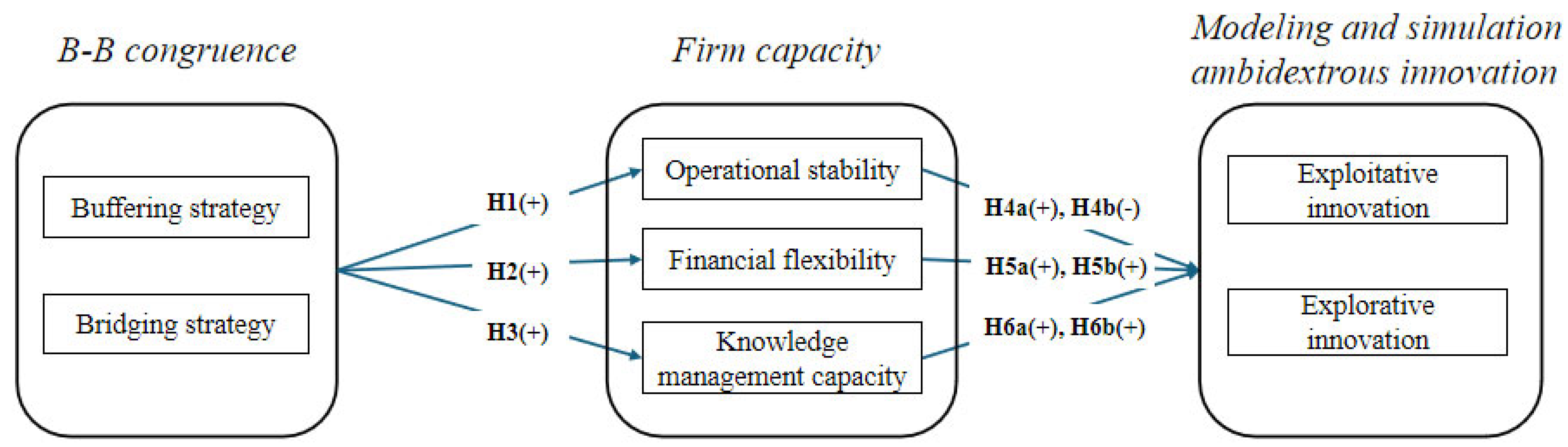



From Strategic Congruence to Modeling and Simulation Ambidextrous Innovation: Evidence from Maritime Logistics

Abstract
1. Introduction
2. Literature Review and Hypothesis Development
2.1. Buffering Strategy, Bridging Strategy, and Modeling and Simulation Ambidextrous Innovation
2.2. Theoretical Foundation
2.3. Hypothesis Development
Buffering–Bridging Congruence and Organizational Capability
3. Method
3.1. Sampling and Survey Design
3.2. Data Collection and Sample Profile
3.3. Measurement Items Design
3.4. Bias Tests
4. Empirical Analysis Results
4.1. Construct Reliability and Validity
4.2. Hypothesis Testing Results
4.2.1. Polynomial Regression Model and Response Surface Analyses
4.2.2. Structural Equation Modeling Analysis
5. Discussion
5.1. Theoretical Implications
5.2. Managerial Implications
6. Conclusions
Author Contributions
Funding
Data Availability Statement
Conflicts of Interest
References
- Soto-Acosta, P.; Popa, S.; Martinez-Conesa, I. Information Technology, Knowledge Management and Environmental Dynamism as Drivers of Innovation Ambidexterity: A Study in SMEs. J. Knowl. Manag. 2018, 22, 824–849. [Google Scholar] [CrossRef]
- Mishra, D.; Sharma, R.R.K.; Kumar, S.; Dubey, R. Bridging and Buffering: Strategies for Mitigating Supply Risk and Improving Supply Chain Performance. Int. J. Prod. Econ. 2016, 180, 183–197. [Google Scholar] [CrossRef]
- Kumar, S.; Liu, J.; Scutella, J. The Impact of Supply Chain Disruptions on Stockholder Wealth in India. Int. J. Phys. Distrib. Logist. Manag. 2015, 45, 938–958. [Google Scholar] [CrossRef]
- Oliver, C. Strategic Responses to Institutional Processes. Acad. Manag. Rev. 1991, 16, 145–179. [Google Scholar] [CrossRef]
- Bode, C.; Wagner, S.M.; Petersen, K.J.; Ellram, L.M. Understanding Responses to Supply Chain Disruptions: Insights from Information Processing and Resource Dependence Perspectives. Acad. Manag. J. 2011, 54, 833–856. [Google Scholar] [CrossRef]
- Raj Sinha, P.; Whitman, L.E.; Malzahn, D. Methodology to Mitigate Supplier Risk in an Aerospace Supply Chain. Supply Chain Manag. Int. J. 2004, 9, 154–168. [Google Scholar] [CrossRef]
- Chattopadhyay, P.; Glick, W.H.; Huber, G.P. Organizational Actions in Response to Threats and Opportunities. Acad. Manag. J. 2001, 44, 937–955. [Google Scholar] [CrossRef]
- Wei, S.; Wu, Y.; Chen, X.; Ding, R.; Liu, H. How Does Buffering–Bridging Alignment Influence Supply Chain Resilience? A Polynomial Regression Analysis. Inf. Manag. 2025, 63, 104241. [Google Scholar] [CrossRef]
- Premkumar, G.; Ramamurthy, K.; Saunders, C.S. Information Processing View of Organizations: An Exploratory Examination of Fit in the Context of Interorganizational Relationships. J. Manag. Inf. Syst. 2005, 22, 257–294. [Google Scholar] [CrossRef]
- Wagner, S.M.; Bode, C. An Empirical Examination of Supply Chain Performance along Several Dimensions of Risk. J. Bus. Logist. 2008, 29, 307–325. [Google Scholar] [CrossRef]
- Laari, S.; Lorentz, H.; Jonsson, P.; Lindau, R. Procurement’s Role in Resolving Demand–Supply Imbalances: An Information Processing Theory Perspective. Int. J. Oper. Prod. Manag. 2023, 43, 68–100. [Google Scholar] [CrossRef]
- Simchi-Levi, D.; Wang, H.; Wei, Y. Increasing Supply Chain Robustness through Process Flexibility and Inventory. Prod. Oper. Manag. 2018, 27, 1476–1491. [Google Scholar] [CrossRef]
- Marley, K.A.; Ward, P.T.; Hill, J.A. Mitigating Supply Chain Disruptions—A Normal Accident Perspective. Supply Chain Manag. Int. J. 2014, 19, 142–152. [Google Scholar]
- Manhart, P.; Summers, J.K.; Blackhurst, J. A Meta-Analytic Review of Supply Chain Risk Management: Assessing Buffering and Bridging Strategies and Firm Performance. J. Supply Chain Manag. 2020, 56, 66–87. [Google Scholar]
- Al-Balushi, Z.; Durugbo, C.M. Management Strategies for Supply Risk Dependencies: Empirical Evidence from the Gulf Region. Int. J. Phys. Distrib. Logist. Manag. 2020, 50, 457–481. [Google Scholar] [CrossRef]
- Spieske, A.; Gebhardt, M.; Kopyto, M.; Birkel, H. Improving Resilience of the Healthcare Supply Chain in a Pandemic: Evidence from Europe during the COVID-19 Crisis. J. Purch. Supply Manag. 2022, 28, 100748. [Google Scholar] [CrossRef]
- Lee, J.Y.H.; Chou, C.Y.; Chang, H.L.; Hsu, C. Building Digital Resilience against Crises: The Case of Taiwan’s COVID-19 Pandemic Management. Inf. Syst. J. 2024, 34, 39–79. [Google Scholar] [CrossRef]
- Jansen, J.J.; Van den Bosch, F.A.; Volberda, H.W. Exploratory Innovation, Exploitative Innovation, and Ambidexterity: The Impact of Environmental and Organizational Antecedents. Schmalenbach Bus. Rev. 2005, 57, 351–363. [Google Scholar] [CrossRef]
- Ngo, L.V.; Bucic, T.; Sinha, A.; Lu, V.N. Effective Sense-and-Respond Strategies: Mediating Roles of Exploratory and Exploitative Innovation. J. Bus. Res. 2019, 94, 154–161. [Google Scholar] [CrossRef]
- March, J.G. Exploration and Exploitation in Organizational Learning. Organ. Sci. 1991, 2, 71–87. [Google Scholar] [CrossRef]
- O’Reilly, C.A.; Tushman, M.L. The Ambidextrous Organization. Harv. Bus. Rev. 2004, 82, 74–83. [Google Scholar]
- Gibson, C.B.; Birkinshaw, J. The Antecedents, Consequences, and Mediating Role of Organizational Ambidexterity. Acad. Manag. J. 2004, 47, 209–226. [Google Scholar] [CrossRef]
- van Lieshout, J.W.; Van Der Velden, J.M.; Blomme, R.J.; Peters, P. The Interrelatedness of Organizational Ambidexterity, Dynamic Capabilities and Open Innovation: A Conceptual Model towards a Competitive Advantage. Eur. J. Manag. Stud. 2021, 26, 39–62. [Google Scholar] [CrossRef]
- 2025–2030 China Port Construction Industry Development Strategy and Market In-Depth Research Analysis Report; China Industry Research Network: Beijing, China, 2025; Available online: https://www.chinairn.com/hyzx/20251201/174909525.shtml (accessed on 1 December 2025).
- Boumgarden, P.; Nickerson, J.; Zenger, T.R. Sailing into the Wind: Exploring the Relationships among Ambidexterity, Vacillation, and Organizational Performance. Strateg. Manag. J. 2012, 33, 587–610. [Google Scholar] [CrossRef]
- Hirst, G.; Van Knippenberg, D.; Zhou, Q.; Zhu, C.J.; Tsai, P.C.F. Exploitation and Exploration Climates’ Influence on Performance and Creativity: Diminishing Returns as Function of Self-Efficacy. J. Manag. 2018, 44, 870–891. [Google Scholar] [CrossRef]
- Enkel, E.; Heil, S. Preparing for Distant Collaboration: Antecedents to Potential Absorptive Capacity in Cross-Industry Innovation. Technovation 2014, 34, 242–260. [Google Scholar] [CrossRef]
- Srisathan, W.A.; Ketkaew, C.; Naruetharadhol, P. Assessing the Effectiveness of Open Innovation Implementation Strategies in the Promotion of Ambidextrous Innovation in Thai Small and Medium-Sized Enterprises. J. Innov. Knowl. 2023, 8, 100418. [Google Scholar] [CrossRef]
- Enkel, E.; Heil, S.; Hengstler, M.; Wirth, H. Exploratory and Exploitative Innovation: To What Extent Do the Dimensions of Individual Level Absorptive Capacity Contribute? Technovation 2017, 60, 29–38. [Google Scholar] [CrossRef]
- Benner, M.J.; Tushman, M.L. Exploitation, Exploration, and Process Management: The Productivity Dilemma Revisited. Acad. Manag. Rev. 2003, 28, 238–256. [Google Scholar] [CrossRef]
- Chen, R.R.; Kannan-Narasimhan, R.P. Formal Integration Archetypes in Ambidextrous Organizations. RD Manag. 2015, 45, 267–286. [Google Scholar] [CrossRef]
- O’Reilly, C.A., III; Tushman, M.L. Organizational Ambidexterity in Action: How Managers Explore and Exploit. Calif. Manag. Rev. 2011, 53, 5–22. [Google Scholar] [CrossRef]
- Felício, J.A.; Caldeirinha, V.; Dutra, A. Ambidextrous Capacity in Small and Medium-Sized Enterprises. J. Bus. Res. 2019, 101, 607–614. [Google Scholar] [CrossRef]
- Levinthal, D.A.; March, J.G. The Myopia of Learning. Strateg. Manag. J. 1993, 14, S95–S112. [Google Scholar] [CrossRef]
- Andriopoulos, C.; Lewis, M.W. Exploitation–Exploration Tensions and Organizational Ambidexterity: Managing Paradoxes of Innovation. Organ. Sci. 2009, 20, 696–717. [Google Scholar] [CrossRef]
- Junni, P.; Sarala, R.M.; Taras, V.A.S.; Tarba, S.Y. Organizational Ambidexterity and Performance: A Meta-Analysis. Acad. Manag. Perspect. 2013, 27, 299–312. [Google Scholar] [CrossRef]
- Wang, N.; Li, Y.; Liu, W.; Hao, R.Y. Navigating the Innovation Maze: The Role of Supervisor Developmental Feedback in Fostering Ambidextrous Learning and Ambidextrous Innovation. Curr. Psychol. 2024, 43, 32079–32101. [Google Scholar] [CrossRef]
- Liu, M.; Li, C.; Wang, S.; Li, Q. Digital Transformation, Risk-Taking, and Innovation: Evidence from Data on Listed Enterprises in China. J. Innov. Knowl. 2023, 8, 100332. [Google Scholar] [CrossRef]
- Xing, M.; Gong, C.; Moon, G.H.; Ge, X. Digital Economy, Dual Innovation Capability and Enterprise Labor Productivity. Int. Rev. Financ. Anal. 2025, 101, 104005. [Google Scholar] [CrossRef]
- Galbraith, J. Designing Complex Organizations; Addison-Wesley: Boston, MA, USA, 1973. [Google Scholar]
- Tiwari, M.; Bryde, D.J.; Stavropoulou, F.; Dubey, R.; Kumari, S.; Foropon, C. Modelling Supply Chain Visibility, Digital Technologies, Environmental Dynamism and Healthcare Supply Chain Resilience: An Organisation Information Processing Theory Perspective. Transp. Res. Part E 2024, 188, 103613. [Google Scholar] [CrossRef]
- Pang, Q.; Lai, P.L.; Su, M.; Xing, J.; Fang, M. Talk is Cheap; Show Me the Code: Managing the Sustainable Performance of Shipping Firms through Big Data Analytics. Marit. Policy Manag. 2025, 52, 1162–1177. [Google Scholar] [CrossRef]
- Pang, Q.; Cai, L.; Wang, X.; Fang, M. Digital Transformation as the Fuel for Sailing toward Sustainable Success: The Roles of Coordination Mechanisms and Social Norms. J. Enterp. Inf. Manag. 2024, 37, 1069–1096. [Google Scholar] [CrossRef]
- Fang, M.; Liu, F.; Xiao, S.; Park, K. Hedging the Bet on Digital Transformation in Strategic Supply Chain Management: A Theoretical Integration and an Empirical Test. Int. J. Phys. Distrib. Logist. Manag. 2023, 53, 512–531. [Google Scholar] [CrossRef]
- Fang, M.; Liu, F.; Xiao, S.; Park, K.; Gao, Y. Navigating Ethical Dilemmas in Supply Chain Finance: The Interplay Between Digitalization and Cultural Congruence. J. Bus. Logist. 2025, 46, e70027. [Google Scholar] [CrossRef]
- Yadav, S.; Samadhiya, A.; Kumar, A.; Luthra, S.; Kumar, V.; Garza-Reyes, J.A.; Upadhyay, A. The Interplay Effects of Digital Technologies, Green Integration, and Green Innovation on Food Supply Chain Sustainable Performance: An Organizational Information Processing Theory Perspective. Technol. Soc. 2024, 77, 102585. [Google Scholar] [CrossRef]
- Gupta, S.; Drave, V.A.; Bag, S.; Luo, Z. Leveraging Smart Supply Chain and Information System Agility for Supply Chain Flexibility. Inf. Syst. Front. 2019, 21, 547–564. [Google Scholar] [CrossRef]
- Srinivasan, R.; Swink, M. An Investigation of Visibility and Flexibility as Complements to Supply Chain Analytics: An Organizational Information Processing Theory Perspective. Prod. Oper. Manag. 2018, 27, 1849–1867. [Google Scholar] [CrossRef]
- Behl, A.; Gaur, J.; Pereira, V.; Yadav, R.; Laker, B. Role of Big Data Analytics Capabilities to Improve Sustainable Competitive Advantage of MSME Service Firms during COVID-19—A Multi-Theoretical Approach. J. Bus. Res. 2022, 148, 378–389. [Google Scholar] [CrossRef]
- Lu, H.T.; Li, X.; Yuen, K.F. Digital Transformation as an Enabler of Sustainability Innovation and Performance–Information Processing and Innovation Ambidexterity Perspectives. Technol. Forecast. Soc. Chang. 2023, 196, 122860. [Google Scholar] [CrossRef]
- Marchica, M.T.; Mura, R. Financial Flexibility, Investment Ability, and Firm Value: Evidence from Firms with Spare Debt Capacity. Financ. Manag. 2010, 39, 1339–1365. [Google Scholar] [CrossRef]
- Wang, C.; Chin, T.; Lin, J.H. Openness and Firm Innovation Performance: The Moderating Effect of Ambidextrous Knowledge Search Strategy. J. Knowl. Manag. 2020, 24, 301–323. [Google Scholar] [CrossRef]
- Chopra, S.; Sodhi, M.S. Managing Risk to Avoid Supply-Chain Breakdown. MIT Sloan Manag. Rev. 2004, 46, 53–61. [Google Scholar]
- Wright, P.M.; Snell, S.A. Toward a Unifying Framework for Exploring Fit and Flexibility in Strategic Human Resource Management. Acad. Manag. Rev. 1998, 23, 756–772. [Google Scholar] [CrossRef]
- Uzzi, B. Social Structure and Competition in Interfirm Networks: The Paradox of Embeddedness. In The Sociology of Economic Life; Routledge: London, UK, 2018; pp. 213–241. [Google Scholar]
- Sheffi, Y.; Rice, J.B., Jr. A Supply Chain View of the Resilient Enterprise. MIT Sloan Manag. Rev. 2005. [Google Scholar]
- Aissa Fantazy, K.; Kumar, V.; Kumar, U. An Empirical Study of the Relationships among Strategy, Flexibility, and Performance in the Supply Chain Context. Supply Chain Manag. Int. J. 2009, 14, 177–188. [Google Scholar] [CrossRef]
- Zhou, K.Z.; Li, C.B. How Knowledge Affects Radical Innovation: Knowledge Base, Market Knowledge Acquisition, and Internal Knowledge Sharing. Strateg. Manag. J. 2012, 33, 1090–1102. [Google Scholar] [CrossRef]
- Ko, W.W.; Liu, G. How Information Technology Assimilation Promotes Exploratory and Exploitative Innovation in the Small-and Medium-Sized Firm Context: The Role of Contextual Ambidexterity and Knowledge Base. J. Prod. Innov. Manag. 2019, 36, 442–466. [Google Scholar] [CrossRef]
- Chesbrough, H.W. Open Innovation: The New Imperative for Creating and Profiting from Technology; Harvard Business Press: Boston, MA, USA, 2003. [Google Scholar]
- Cohen, W.M.; Levinthal, D.A. Absorptive Capacity: A New Perspective on Learning and Innovation. Adm. Sci. Q. 1990, 35, 128–152. [Google Scholar] [CrossRef]
- Jia, R.; Hu, W.; Li, S. Ambidextrous Leadership and Organizational Innovation: The Importance of Knowledge Search and Strategic Flexibility. J. Knowl. Manag. 2022, 26, 781–801. [Google Scholar] [CrossRef]
- Sheffi, Y. The Resilient Enterprise: Overcoming Vulnerability for Competitive Advantage; MIT Press: Cambridge, MA, USA, 2007. [Google Scholar]
- Yu, W.; Chavez, R.; Jacobs, M.A.; Wong, C.Y. Openness to Technological Innovation, Supply Chain Resilience, and Operational Performance: Exploring the Role of Information Processing Capabilities. IEEE Trans. Eng. Manag. 2022, 71, 1258–1270. [Google Scholar] [CrossRef]
- Benner, M.J.; Tushman, M.L. Reflections on the 2013 Decade Award—“Exploitation, Exploration, and Process Management: The Productivity Dilemma Revisited” Ten Years Later. Acad. Manag. Rev. 2015, 40, 497–514. [Google Scholar] [CrossRef]
- Denis, D.J. Financial Flexibility and Corporate Liquidity. J. Corp. Financ. 2011, 17, 667–674. [Google Scholar] [CrossRef]
- O’Brien, J.P. The Capital Structure Implications of Pursuing a Strategy of Innovation. Strateg. Manag. J. 2003, 24, 415–431. [Google Scholar] [CrossRef]
- Hao, Z.; Zhang, X.; Wei, J. Research on the Effect of Enterprise Financial Flexibility on Sustainable Innovation. J. Innov. Knowl. 2022, 7, 100184. [Google Scholar] [CrossRef]
- Chen, M.; Liu, S.; Gao, L. Digital Finance, Financial Flexibility and Corporate Green Innovation. Financ. Res. Lett. 2024, 70, 106313. [Google Scholar] [CrossRef]
- Grant, R.M. Toward a Knowledge-Based Theory of the Firm. Strateg. Manag. J. 1996, 17, S109–S122. [Google Scholar] [CrossRef]
- Liao, C.; Chuang, S.H.; To, P.L. How Knowledge Management Mediates the Relationship Between Environment and Organizational Structure. J. Bus. Res. 2011, 64, 728–736. [Google Scholar] [CrossRef]
- Lichtenthaler, U.; Lichtenthaler, E. A Capability-Based Framework for Open Innovation: Complementing Absorptive Capacity. J. Manag. Stud. 2009, 46, 1315–1338. [Google Scholar] [CrossRef]
- Easterby-Smith, M.; Prieto, I.M. Dynamic Capabilities and Knowledge Management: An Integrative Role for Learning? Br. J. Manag. 2008, 19, 235–249. [Google Scholar] [CrossRef]
- Golob, T.F. Structural Equation Modeling for Travel Behavior Research. Transp. Res. Part B Methodol. 2003, 37, 1–25. [Google Scholar] [CrossRef]
- Sher, P.J.; Lee, V.C. Information Technology as a Facilitator for Enhancing Dynamic Capabilities Through Knowledge Management. Inf. Manag. 2004, 41, 933–945. [Google Scholar] [CrossRef]
- Tseng, S.-M.; Lee, P.-S. The Effect of Knowledge Management Capability and Dynamic Capability on Organizational Performance. J. Enterp. Inf. Manag. 2014, 27, 158–179. [Google Scholar] [CrossRef]
- Olabode, O.E.; Nalmpanti, A.D.; Essuman, D.; Leonidou, C.N.; Hultman, M.; Boso, N. How and When Bridging and Buffering Strategies Drive Financial Performance: Evidence from Companies Using Key Account Management. Ind. Mark. Manag. 2025, 131, 137–151. [Google Scholar] [CrossRef]
- Brandon-Jones, E.; Squire, B.; Autry, C.W.; Petersen, K.J. A Contingent Resource-Based Perspective of Supply Chain Resilience and Robustness. J. Supply Chain Manag. 2014, 50, 55–73. [Google Scholar] [CrossRef]
- Rojo, A.; Stevenson, M.; Lloréns Montes, F.J.; Perez-Arostegui, M.N. Supply Chain Flexibility in Dynamic Environments: The Enabling Role of Operational Absorptive Capacity and Organisational Learning. Int. J. Oper. Prod. Manag. 2018, 38, 636–666. [Google Scholar] [CrossRef]
- Guo, J.; Lin, J.; Luo, X. Enhancing Organizational Resilience Through Big Data Analytics Capability: The Mediating Role of Strategic Flexibility. Inf. Technol. People, 2025; ahead of print. [Google Scholar]
- Mendes, L.; Machado, J. Employees’ Skills, Manufacturing Flexibility and Performance: A Structural Equation Modelling Applied to the Automotive Industry. Int. J. Prod. Res. 2015, 53, 4087–4101. [Google Scholar] [CrossRef]
- Hair, J.F. Multivariate Data Analysis; Prentice-Hall: Upper Saddle River, NJ, USA, 2009. [Google Scholar]
- Armstrong, J.S.; Overton, T.S. Estimating Nonresponse Bias in Mail Surveys. J. Mark. Res. 1977, 14, 396–402. [Google Scholar] [CrossRef]
- Edwards, J.R.; Cable, D.M. The Value of Value Congruence. J. Appl. Psychol. 2009, 94, 654–677. [Google Scholar] [CrossRef]
- Fornell, C.; Larcker, D.F. Evaluating Structural Equation Models with Unobservable Variables and Measurement Error. J. Mark. Res. 1981, 18, 39–50. [Google Scholar] [CrossRef]
- Fang, M.; Yuen, K.F.; Xie, D.; Wang, X.; Pang, Q. Are We on the Same Page? Effects of Sustainability Orientation (In)Congruence on Sustainable Shipping Performance. Oper. Manag. Res. 2025, 19, 1–18. [Google Scholar] [CrossRef]
- Fang, M.; Cai, L.; Park, K.; Su, M. Trust (In)congruence, Open Innovation, and Circular Economy Performance: Polynomial Regression and Response Surface Analyses. J. Environ. Manag. 2024, 358, 120930. [Google Scholar] [CrossRef]
- Fang, M.; Lai, P.-L.; Wang, X. The Value of Congruence in Social Exchanges: A Dyadic Trust Perspective on Servitization. Ind. Mark. Manag. 2024, 123, 317–329. [Google Scholar] [CrossRef]
- Pang, Q.; Wang, M.; Yao, J.; Fang, M. Employees’ Perceived Respect and Performance in Logistics 4.0: A Dyadic Perspective of the Congruence Between Employee Voice and Supervisor Listening. Int. J. Phys. Distrib. Logist. Manag. 2025; ahead of print. [Google Scholar]
- Zhou, Y.; Wang, X.; Yuen, K.F. Sustainability Disclosure for Container Shipping: A Text-Mining Approach. Transp. Policy 2021, 110, 465–477. [Google Scholar] [CrossRef]
- Zhou, Y.; Yuen, K.F.; Tan, B.; Thai, V.V. Maritime Knowledge Clusters: A Conceptual Model and Empirical Evidence. Mar. Policy 2021, 123, 104299. [Google Scholar] [CrossRef]
- Zhou, Y.; Munim, Z.H. A Systematic Review on Human-centred Maritime Operations Analytics Involving Psychophysiological Data. Marit. Policy Manag. 2025, 52, 1208–1235. [Google Scholar] [CrossRef]
- Zhou, Y.; Yuen, K.F. Prepare for the Sustainability Era: A Quantitative Risk Analysis Model for Container Shipping Sustainability-related Risks. J. Clean. Prod. 2024, 475, 143661. [Google Scholar] [CrossRef]
- Yuen, K.F.; Thai, V. Barriers to Supply Chain Integration in the Maritime Logistics Industry. Marit. Econ. Logist. 2017, 19, 551–572. [Google Scholar] [CrossRef]


| Category | Item | Frequency | Percentage (%) |
|---|---|---|---|
| Firm type | Shipping companies | 98 | 33.9 |
| Port/terminal operators | 83 | 28.7 | |
| Freight forwarders | 65 | 22.5 | |
| Maritime technology providers | 43 | 14.9 | |
| Firm size (number of employees) | <200 | 64 | 22.1 |
| 200–1000 | 132 | 45.7 | |
| >1000 | 93 | 32.2 | |
| Firm age | <5 years | 98 | 33.9 |
| 5–10 years | 72 | 24.9 | |
| 10–20 years | 79 | 27.3 | |
| More than 20 years | 40 | 13.9 | |
| Position | Department manager | 121 | 41.9 |
| Senior manager/director | 100 | 34.6 | |
| Executive/project leader | 68 | 23.5 | |
| Work experience (years) | <5 | 47 | 16.3 |
| 5–15 | 38 | 13.1 | |
| >15 | 204 | 70.6 |
| Construct | Measures | References |
|---|---|---|
| Buffering strategy (BUF) | Strongly disagree (1)/Strongly agree (7) BUF1. We source from geographically diverse suppliers to reduce the risk of disruptions in any single region. BUF2. We collaborate with several supply chain partners to lower potential supply uncertainties. BUF3. Our operations do not rely heavily on any single supply chain partner. | [75,76] |
| Bridging strategy (BRI) | Strongly disagree (1)/Strongly agree (7) BRI1. Our company shares information with business partners. BRI2. We maintain strong and ongoing cooperative relationships with our supply chain partners. BRI3. Different departments within our firm work in a well-integrated manner. | [5,77] |
| Operational stability (OPS) | Strongly disagree (1)/Strongly agree (7) OPS1. The supply chain would still be able to carry out its regular functions. OPS2. We are able to maintain stable production levels despite fluctuations in supply or demand. OPS3. Unexpected external changes have limited impact on our day-to-day operations. OPS4. Our organization can quickly restore normal operations when faced with interruptions. | [78,79] |
| Financial flexibility (FIN) | Strongly disagree (1)/Strongly agree (7) FIN1. Our firm can obtain external financing when needed without significant barriers. FIN2. We can adjust our capital allocation quickly in response to market changes. FIN3. We maintain sufficient financial buffers to cope with unexpected disruptions. FIN4. We are able to pursue new strategic opportunities when they arise due to available financial resources. | [80,81] |
| Knowledge management capability (KMC) | Strongly disagree (1)/Strongly agree (7) KMC1. We regularly acquire and update knowledge relevant to our business operations. KMC2. We are able to effectively integrate individual knowledge into organizational-level capabilities. KMC3. Employees clearly understand one another’s responsibilities and areas of expertise. KMC4. We are able to collaborate smoothly across departments to share and apply knowledge. | [75,76] |
| Exploitative innovation (EXI) | Strongly disagree (1)/Strongly agree (7) EXI1. We continually refine and improve our existing modeling and simulation tools to support routine operational needs. EXI2. We make incremental adjustments to our current simulation models to enhance their accuracy or performance. EXI3. We emphasize reliability and stability when using modeling and simulation to support ongoing processes. EXI4. We primarily employ simulation to fine-tune existing workflows, resource allocation, or decision procedures. | [29] |
| Explorative innovation (ERI) | Strongly disagree (1)/Strongly agree (7) ERI1. We develop new modeling and simulation approaches to explore potential future business or technological opportunities. ERI2. We use simulation to experiment with novel or uncertain ideas, even when outcomes are not yet predictable. ERI3. We apply modeling and simulation to new markets, emerging contexts, or unfamiliar operational scenarios. ERI4. We conduct simulation-based experimentation to identify potential breakthroughs, even when short-term benefits are unclear. | [29] |
| Construct | Item | λ | AVE | CR |
|---|---|---|---|---|
| BUF | BUF1 | 0.724 | 0.551 | 0.786 |
| BUF2 | 0.769 | |||
| BUF3 | 0.733 | |||
| BRI | BRI1 | 0.764 | 0.584 | 0.808 |
| BRI2 | 0.776 | |||
| BRI3 | 0.752 | |||
| OPS | OPS1 | 0.914 | 0.825 | 0.950 |
| OPS2 | 0.923 | |||
| OPS3 | 0.883 | |||
| OPS4 | 0.913 | |||
| FIN | FIN1 | 0.865 | 0.708 | 0.907 |
| FIN2 | 0.857 | |||
| FIN3 | 0.809 | |||
| FIN4 | 0.834 | |||
| KMC | KMC1 | 0.885 | 0.794 | 0.939 |
| KMC2 | 0.869 | |||
| KMC3 | 0.906 | |||
| KMC4 | 0.904 | |||
| EXI | EXI1 | 0.822 | 0.657 | 0.884 |
| EXI2 | 0.812 | |||
| EXI3 | 0.802 | |||
| EXI4 | 0.805 | |||
| ERI | ERI1 | 0.804 | 0.663 | 0.887 |
| ERI2 | 0.814 | |||
| ERI3 | 0.825 | |||
| ERI4 | 0.813 |
| BUF | BRI | OPS | FIN | KMC | EXI | ERI | |
|---|---|---|---|---|---|---|---|
| BUF | 0.742 | ||||||
| BRI | 0.503 | 0.764 | |||||
| OPS | 0.229 | 0.119 | 0.908 | ||||
| FIN | 0.0139 | 0.212 | 0.146 | 0.841 | |||
| KMC | 0.102 | 0.279 | 0.0838 | 0.264 | 0.891 | ||
| EXI | 0.235 | 0.498 | 0.0755 | 0.205 | 0.260 | 0.811 | |
| ERI | 0.584 | 0.522 | 0.194 | 0.152 | 0.239 | 0.581 | 0.814 |
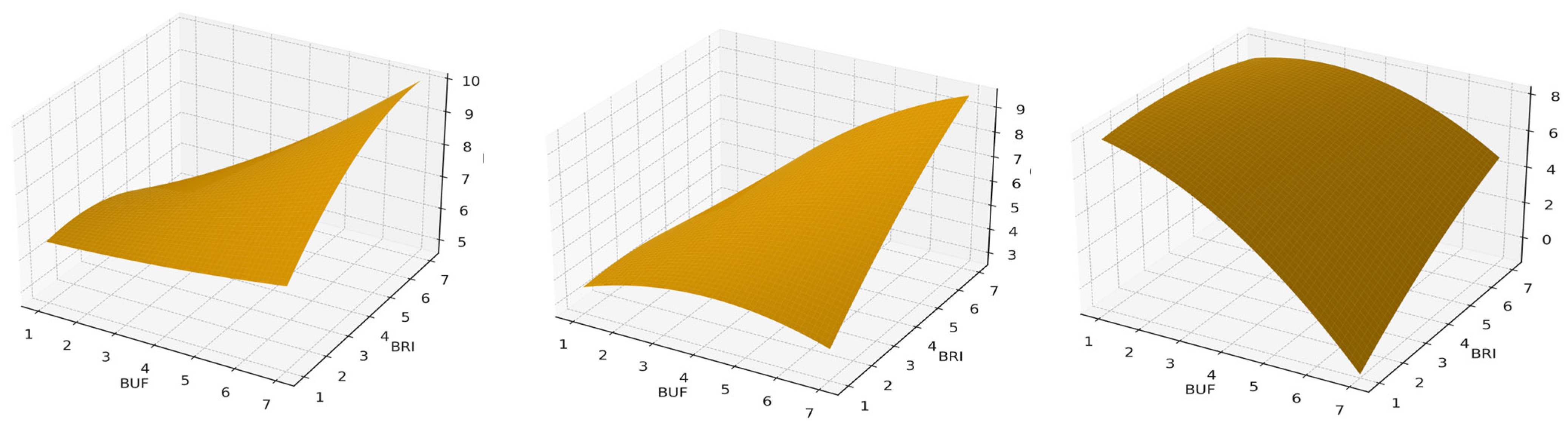
| Model 1 | Model 2 | Model 3 | |
|---|---|---|---|
| Constant | 2.8882 ** | 8.1769 *** | 6.3088 *** |
| (1.3016) | (0.9648) | (1.1192) | |
| Firm age | 0.7145 ** | 0.2050 | −0.1985 |
| (0.2797) | (0.2074) | (0.2405) | |
| Firm size | 0.1920 | −0.2352 | 0.0820 |
| (0.1941) | (0.1438) | (0.1669) | |
| ROA | −0.7372 ** | −0.3501 | −0.0945 |
| (0.3298) | (0.2445) | (0.2836) | |
| Polynomial terms | |||
| b1 BUF | 0.6119 *** | −0.3401 ** | −0.1085 |
| (0.2030) | (0.1505) | (0.1745) | |
| b2 BRI | 0.0386 | 0.1675 *** | 0.2179 *** |
| (0.0624) | (0.0463) | (0.0537) | |
| b3 BUF2 | −0.0961 * | −0.1722 *** | 0.0111 |
| (0.0502) | (0.0372) | (0.0432) | |
| b4 BUF × BRI | 0.1878 *** | 0.1846 *** | 0.1303 ** |
| (0.0612) | (0.0454) | (0.0526) | |
| b5 BRI2 | −0.0482 | −0.0591 ** | −0.0811 ** |
| (0.0405) | (0.0300) | (0.0348) | |
| Response surface features | |||
| Congruence line (BUF = BRI) | |||
| Slope (b1 + b2) | 0.6505 *** | −0.1726 | 0.1094 |
| (0.1947) | (0.1443) | (0.1674) | |
| Curvature (b3 + b4 + b5) | 0.0435 | −0.0467 | 0.0602 |
| (0.0576) | (0.0427) | (0.0495) | |
| Incongruence line (BUF = −BRI) | |||
| Slope (b1 − b2) | 0.5733 ** | −0.5077 *** | −0.3263 * |
| (0.2286) | (0.1695) | (0.1966) | |
| Curvature (b3 − b4 + b5) | −0.3321 *** | −0.4159 *** | −0.2004 ** |
| (0.1113) | (0.0825) | (0.0957) | |
| Observations | 289 | 289 | 289 |
| Ajd-R2 | 7.86% | 10.27% | 5.72% |
| Hypothesis Path | Path Coefficient | T-Value | p-Value | Test Result |
|---|---|---|---|---|
| H4a: OPS → EXI | 0.016 | 0.264 | n.s. | Rejected |
| H4b: OPS → ERI | 0.119 | 1.958 | * | Rejected |
| H5a: FIN → EXI | 0.132 | 2.029 | * | Supported |
| H5b: FIN → ERI | 0.074 | 1.153 | n.s. | Rejected |
| H6a: KMC → EXI | 0.198 | 3.114 | ** | Supported |
| H6b: KMC → ERI | 0.179 | 2.825 | ** | Supported |
Disclaimer/Publisher’s Note: The statements, opinions and data contained in all publications are solely those of the individual author(s) and contributor(s) and not of MDPI and/or the editor(s). MDPI and/or the editor(s) disclaim responsibility for any injury to people or property resulting from any ideas, methods, instructions or products referred to in the content. |
© 2025 by the authors. Licensee MDPI, Basel, Switzerland. This article is an open access article distributed under the terms and conditions of the Creative Commons Attribution (CC BY) license (https://creativecommons.org/licenses/by/4.0/).
Share and Cite
Wang, X.; Fang, M.; Shen, J. From Strategic Congruence to Modeling and Simulation Ambidextrous Innovation: Evidence from Maritime Logistics. Systems 2025, 13, 1102. https://doi.org/10.3390/systems13121102
Wang X, Fang M, Shen J. From Strategic Congruence to Modeling and Simulation Ambidextrous Innovation: Evidence from Maritime Logistics. Systems. 2025; 13(12):1102. https://doi.org/10.3390/systems13121102
Chicago/Turabian StyleWang, Xinchen, Mingjie Fang, and Jia Shen. 2025. "From Strategic Congruence to Modeling and Simulation Ambidextrous Innovation: Evidence from Maritime Logistics" Systems 13, no. 12: 1102. https://doi.org/10.3390/systems13121102
APA StyleWang, X., Fang, M., & Shen, J. (2025). From Strategic Congruence to Modeling and Simulation Ambidextrous Innovation: Evidence from Maritime Logistics. Systems, 13(12), 1102. https://doi.org/10.3390/systems13121102