Article

In Silico-Identified Peptides of Five Borrelia burgdorferi Proteins Binding with High Affinity to Human Leukocyte Antigen (HLA) Class II Alleles


by
Apostolos P. Georgopoulos
1,2,3,*,†,
Lisa M. James
1,2,4,† and
Matthew Sanders
1,2,3
1
The HLA and Chronic Diseases Research Groups, Brain Sciences Center, Department of Veterans Affairs Health Care System, Minneapolis, MN 55417, USA
2
Department of Neuroscience, University of Minnesota Medical School, Minneapolis, MN 55455, USA
3
Institute for Health Informatics, University of Minnesota Medical School, Minneapolis, MN 55455, USA
4
Department of Psychiatry, University of Minnesota Medical School, Minneapolis, MN 55455, USA
*
Author to whom correspondence should be addressed.
These authors contributed equally to this work.
Biology 2026, 15(7), 547; https://doi.org/10.3390/biology15070547
Submission received: 19 December 2025 / Revised: 25 February 2026 / Accepted: 26 March 2026 / Published: 28 March 2026

Simple Summary

Development of a vaccine against Lyme disease is ongoing and important in light of the major public health concerns related to increased incidence and geographic spread of the disease by infected ticks and the potential for chronic sequalae due to infection. For all vaccines, key considerations are safety and effectiveness, both of which partially depend on individual variation in human leukocyte antigens which are critically involved in the human immune system response; yet, the immunogenetic makeup of vaccinees is typically not taken into consideration in vaccine development. Here, we determined the predicted ability of common human leukocyte antigens to bind with Lyme-associated proteins, a critical first step in effective antibody production to protect against Lyme disease. We identified several protein peptides that are computationally predicted to bind with strong affinity to specific human leukocyte antigens and do not overlap with proteins of the human proteome, reducing the potential for autoimmunity. We propose that these peptides may potentially be good vaccine candidates, although additional research is necessary to confirm their potential efficacy. We also identified peptides which bind with moderate affinity to various human leukocyte antigens and which could be potential vaccine candidates. These findings emphasize the importance of a personalized vaccine approach based on the vaccinee’s human leukocyte antigen genetic makeup and offer specific vaccine-candidate peptides that are predicted to maximize vaccine effectiveness and safety.

Abstract

To date, Lyme vaccine development has largely overlooked the vaccinee’s human leukocyte antigen (HLA) genetic makeup on which antibody production critically depends. Here, we evaluated in silico the predicted binding affinities of 192 HLA-II alleles with all 15-mer peptide sequences of five Borrelia burgdorferi proteins to identify peptides with strong binding affinity, as they would be the best candidates for antibody production in response to vaccination. We found the following: (a) 226 of the 1067 peptides tested (21.2%) were found to bind strongly to HLA-II molecules; (b) decorin-binding protein A had the greatest number of strongly binding peptides; and (c) 69 HLA-II alleles (primarily of the DRB1 gene) bound with strong affinity to peptides from Borrelia burgdorferi proteins. Finally, we tested for possible susceptibility to autoimmunity by any one of the 226 peptides above by searching for their occurrence in ~84,000 proteins of the human proteome and found overlap with only two 8-mer peptide sequences (embedded within the 226 15-mer peptides), neither of which was characterized by strong binding to HLA-I, suggesting a reduced likelihood of autoimmunity. These findings emphasize the importance of a personalized vaccine approach based on the vaccinee’s human leukocyte antigen genetic makeup and offer specific vaccine-candidate peptides that are predicted to maximize vaccine effectiveness and safety. The results of this computational study provide novel directions for future development of Lyme vaccines.

1. Introduction

1.1. Lyme Disease

Lyme disease is a common vector-borne infectious disease resulting from transmission of Borrelia burgdorferi (B. burgdorferi) or other related Borrelia bacteria from infected ticks [1]. Infection typically begins with local erythema migrans, a characteristic bullseye-shaped rash, at the site of the tick bite, often accompanied by malaise, fatigue, headache, and joint/muscle pain. If left untreated, the infection can spread to other skin sites and organs including the brain, heart, and joints, and may eventually lead to Lyme arthritis and other late-stage manifestations [1,2]. Typically, symptoms resolve following a course of antibiotic therapy; however, some individuals experience persistent and impairing fatigue, musculoskeletal pain, and difficulties with concentration and memory, commonly referred to as post-treatment Lyme disease syndrome (PTLDS) [3]. Persistent B. burgdorferi antigen has been identified in the synovial fluid of individuals with PTLDS arthritis [4]. Though endemic to certain areas, the geographic distribution of Lyme disease is expanding [5], with reported Lyme disease activities extending to many countries around the world [6]. An estimated 14.5% of the global population is seroprevalent for Lyme disease [7] and the disease incidence is increasing [8], highlighting the need for preventive strategies. Prevention of Lyme disease has largely focused on personal protective measures to limit exposure to ticks; however, other prophylactic strategies such as the use of antibiotics [9] and vaccines [10,11] have been extensively investigated for both disease prevention and treatment. With regard to the former, early administration of oral antibiotics such as doxycycline within 72 h of tick removal is recommended for prophylaxis to prevent Lyme disease from “high-risk” bites (e.g., at least 36 h attachment of tick from an identified vector species in an endemic area) but is not recommended for routine use after tick bites [12]. Longer courses of antibiotics are recommended for patients with objective evidence of infection such as erythema migrans to prevent dissemination and sequelae [12]; however, approximately 10% of patients do not respond to antibiotic treatment and develop antibiotic-refractory Lyme arthritis [1]. For those with PTLDS, antibiotic treatment is controversial, with evidence suggesting questionable benefits and enhanced adverse events compared to placebo [13,14].

1.2. Vaccines for Lyme Disease

Vaccines represent an alternative prevention approach. Strategies aimed at controlling Lyme disease through vaccination of animal reservoirs and development of anti-tick vaccines are promising avenues aimed at preventing Lyme disease by blocking transmission of Borrelia to humans [11,15] Alternative vaccine strategies have targeted the spirochete itself, largely involving outer surface protein A (OspA) of B. burgdoferi. LYMErix, a Lyme disease vaccine developed in the 1990s and the only Lyme vaccine approved by the Food and Drug Administration to date, was promising with regard to high efficacy, but consumer safety concerns and vaccine hesitancy resulted in it being taken off the market in 2002 [16]. Efforts to develop Lyme vaccines are ongoing with several vaccines in advanced clinical development [17]. Multivalent OspA vaccines have undergone the most clinical testing [17,18,19]; however, other B. burgdoferi proteins are also considered vaccine candidates that have shown promise in canine and murine studies [10,11,17]. Identification of immunogenic B. burgdoferi antigens is an active area of investigation [20]. Like many other pathogens, Borrelia changes the expression of surface antigens in an effort to evade immune system responses aimed at its elimination [2,21]. For example, OspA, the primary target of current vaccine efforts, is expressed during tick colonization, whereas OspC is expressed during early infection followed by expression of variable large protein (VLP) [2]. On the one hand, this antigenic variation thwarts the adaptive immune system responses, permitting persistence and long-term sequelae [22] and, on the other hand, offers multiple Borrelia antigens as potential vaccine targets.

1.3. Vaccines and Human Leukocyte Antigen (HLA)

Vaccination, whether preventive or therapeutic, is aimed to protect the host against non-self antigens. Preventive vaccines stimulate production of antibodies against given antigens, priming the immune system to neutralize that antigen in the event of future exposure, to prevent disease. Therapeutic vaccines harness the immune system to target specific antigens (e.g., viruses, bacteria, cancer antigens) associated with an existing disease. In both cases, human leukocyte antigens (HLAs) are instrumental. In case of an infection, HLA molecules bind and present non-self antigens to T cells to stimulate immune response aimed at eliminating non-self antigens. There are two main classes of classical HLA—Class I (HLA-A, HLA-B, and HLA-C genes) and Class II (HLA-DPB1, HLA-DQB1, and HLA-DRB1 genes). Class I molecules are expressed on the surface of all nucleated cells and are involved in presentation of small (8–10 amino acid residues; mostly 9-mer) endogenous antigen peptides to cytotoxic CD8+ T cells to signal cell destruction. Class II molecules are expressed on professional APCs including macrophages, B cells, and DCs, and present larger (15–22 amino acid residues; mostly 15-mer) exogenous antigens to CD4+ helper T cells to stimulate production of antibodies and facilitate immunological memory to enable immune system response to re-infection. HLA composition is genetically determined and includes two alleles from each of the classical Class I genes (A, B, C) and two from each Class II gene (DPB1, DQB1, DRB1) that determine the cell-surface molecules each individual possesses. Some HLA alleles are common across populations [23]; nonetheless, there is tremendous variation across individuals, as reflected in the fact that the HLA region is the most polymorphic in the human genome [24]. Most of the variability across HLA polymorphisms is located in the binding groove, determining the repertoire of antigens that can bind with sufficient affinity to promote an immune response [25,26,27,28]. Structural differences in the binding groove for HLA Class I and Class II determine the number of amino acids of a given peptide that can be accommodated [29]; the specific sequence of the binding groove determines which specific peptides can bind with high affinity, i.e., strong binding, with single amino acid differences altering binding affinity [26]. The importance of HLA–antigen binding is relevant for both natural host adaptive immunity and for vaccine effectiveness. That is, the ability of an individual to mount an effective immune response to an antigen, either through natural exposure or vaccination, is predicated on strong HLA binding to an antigen. Indeed, variation in individual HLA composition is related to vaccine response [30,31,32]. Similarly, individual variation in HLA is associated with susceptibility to, or protection from, various conditions including autoimmune diseases, cancers, and chronic illnesses [33,34,35]. With regard to HLA and Borrelia infection, HLA-DRB1 Class II molecules have been implicated in Lyme disease and linked to pro-inflammatory immune dysregulation and autoimmunity, potentially resulting from molecular mimicry of Borrelia protein (OspA) with host proteins [36,37]. Here, we investigated in silico the binding affinity of antigens from five proteins that are widely expressed in Borrelia and have been used frequently in vaccine development (particularly OspA) [10] to a large number of HLA-II molecules. We identified peptides with strong predicted binding affinity and searched for their potential presence in 83,607 proteins of the human proteome to reduce likelihood of autoimmunity, a major concern in previously approved Lyme vaccines and an important consideration for future vaccines for Lyme disease.

2. Materials and Methods

2.1. B. burgdorferi Antigens

We tested 5 protein antigens of B. burgdorferi (Table 1). The amino acid (AA) sequences of those proteins were obtained from the UniProt website https://www.uniprot.org/uniprotkb/ (accessed on 5 May 2024) [38] and are shown in Table S1 (Supplementary Materials).

2.2. HLA Alleles

We investigated 192 HLA-II alleles (Table S2) [23].

2.3. In Silico Determination of Predicted Binding Affinities (PBAs) to B. burgdorferi Antigens

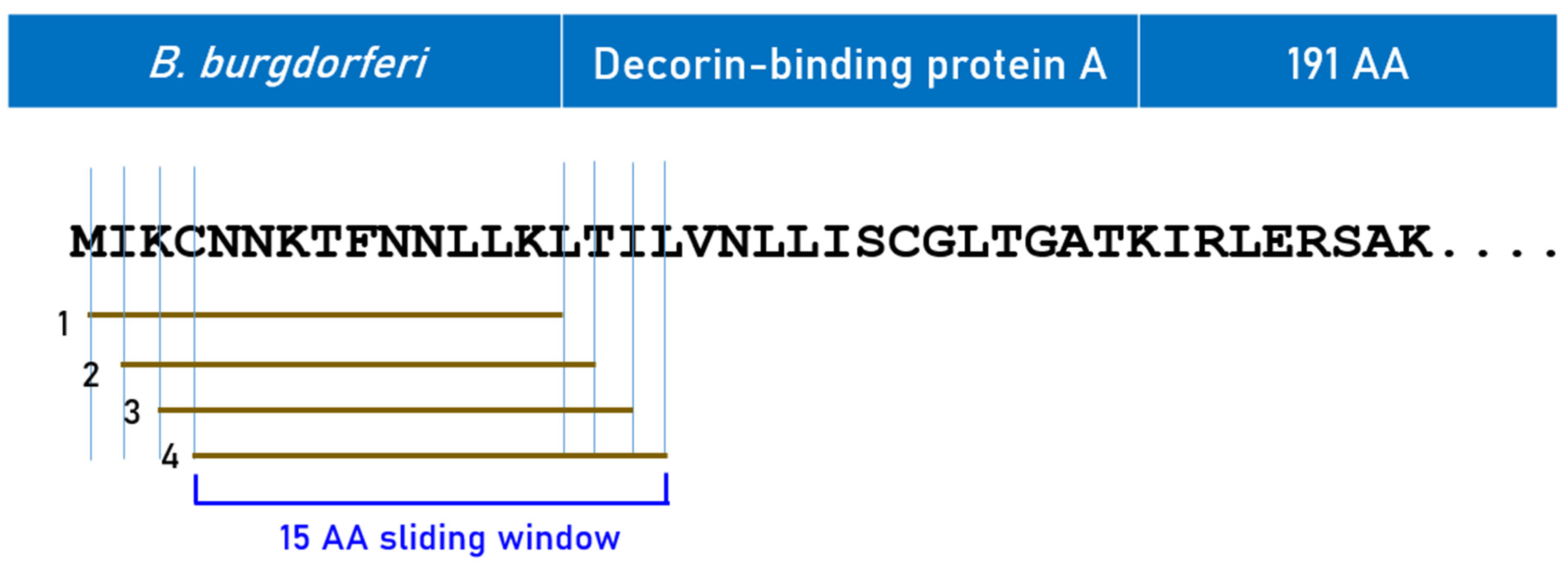
Predicted binding affinities were obtained for antigen peptides using the Immune Epitope Database (IEDB) NetMHCpan MHC-II Binding/Elution (ver. 4.1 BA; recommended binding predictor 2023-09) tool [39,40]. More specifically, we used the sliding window approach [41,42,43] to test exhaustively all possible linear 15-mer (HLA-II predictions) peptides of the 5 antigens analyzed (Table 1). The method is illustrated in Figure 1. For each pair of peptide–HLA molecule tested, this tool gave, as an output, the IC50 of the predicted binding affinity; the smaller the IC50, the stronger the binding affinity. IC50 values of <50 nM (nanomolar) are regarded as strong, and values of 50 nM ≤ IC50 < 500 nM are regarded as moderate [44]. All predicted binding affinities <500 nM were analyzed. Given a protein with an amino acid length of N and a peptide length of k AA, N-k+1 IC50 values were returned by the prediction tool. The numbers of peptides tested for each antigen are given in Table 1. Finally, the NetMHCpan MHC-I Binding/Elution (ver. 4.1 BA; recommended binding predictor 2023-09) tool [39,40] was used to determine the estimated binding affinity of two octamers (against 142 HLA-I alleles) encountered while testing for autoimmunity.

2.4. Protein Comparisons

Target sequences were compared against the human proteome dataset version 24.1, provided by The Human Protein Atlas [45], comprising a total of 83,607 human proteins. Assuming that 15-mer peptides will likely be cleaved to shorter peptides that could trigger autoimmunity by engaging the HLA-I, we also searched for the possible occurrence of shorter peptides (embedded within 15-mers) in the proteins above. For that purpose, we utilized a substring identification method to examine every potential substring of a given length (8–14 amino acids) in the target sequence against the sequences contained in the proteome dataset. We stopped at 8-mers because this is the lower limit of peptide length for strong binding to HLA Class I molecules [46,47]. Given a peptide of m-AA length to be tested, a sliding window of the same m-AA length was used to identify possible peptides with the same sequence for each one of the 83,607 proteins above. The comparison was performed using the STRPOS function built in PHP (hypertext processor). The function returns the start AA position in the protein sequence where an identical peptide was found. A return of zero means that no peptides were found of the same sequence as the test peptide. No modifications or substitutions were made to the target sequence or proteome sequences.

2.5. Statistical Analyses

The IBM-SPSS statistical package (version 30.0.0.0 172) was used for implementing statistical analyses. Standard statistical methods were used; all correlations are Pearson. All p-values reported are two-sided, a = 0.05.

3. Results

3.1. Predicted Binding Affinities of B. burgdoferi Antigens and 192 HLA Alleles

Here, we evaluated the predicted binding affinities of five B. burgdorferi antigens (Table 1; Table S1, Supplementary Materials) to 192 common HLA-II allele molecules (Table S2) by testing exhaustively in silico 1067 linear 15-mer peptides (epitopes), for a total of 1067 × 192 = 204,464 determinations (Table 1). Overall, we identified 1087/204,464 (0.532%) cases of peptide–allele complexes (pHLA) with predicted strong binding affinities (IC50 < 50 nM). Details of the peptide/HLA composition of these complexes are given in Table S3, including their placement in a particular protein and the associated HLA-II allele.
As expected, the number of pHLA complexes with moderate binding was much higher (20,152/204,464 = 9.86%).

3.2. B. burgdorferi Antigens

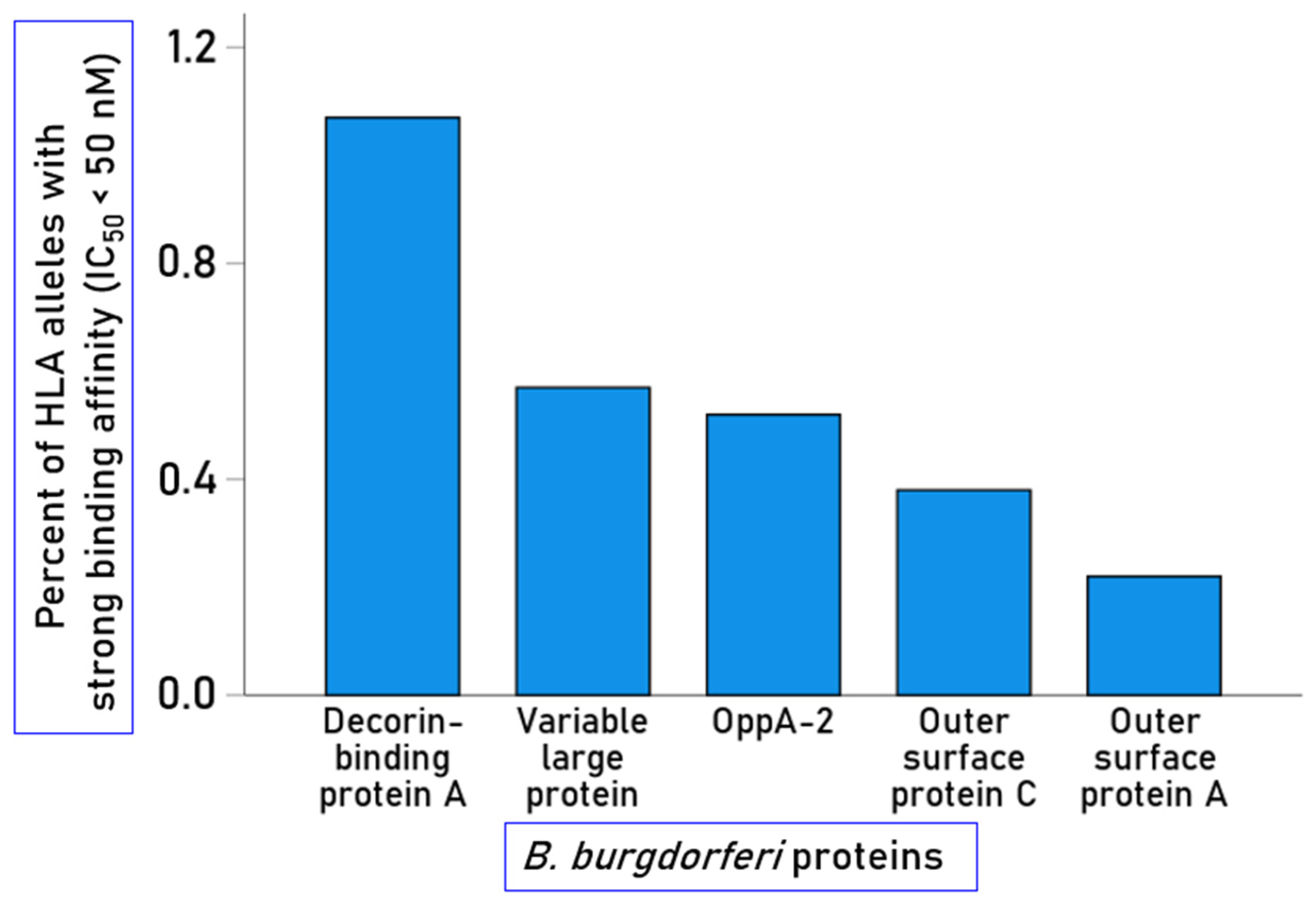
The numbers and percentages of peptides identified as binding with strong affinity per B. burgdorferi protein are given in Table 2 and illustrated in Figure 2; the numbers and percentages of peptides binding with moderate affinity are also provided in Table 2. It can be seen that the highest percentage of strong (and moderate) binding was observed for decorin-binding protein A. The number of strong binders in a given protein was not significantly correlated with the AA protein length (r = 0.503, p = 0.388).
As expected, the number of peptides with moderate binding (N = 20,152, 9.837%) was much more frequent than that of strong binders (N = 1087, 0.532%). The moderate and strong counts were highly correlated (r = 0.51, p = 0.013, N = 5 proteins).

3.3. HLA-II Alleles

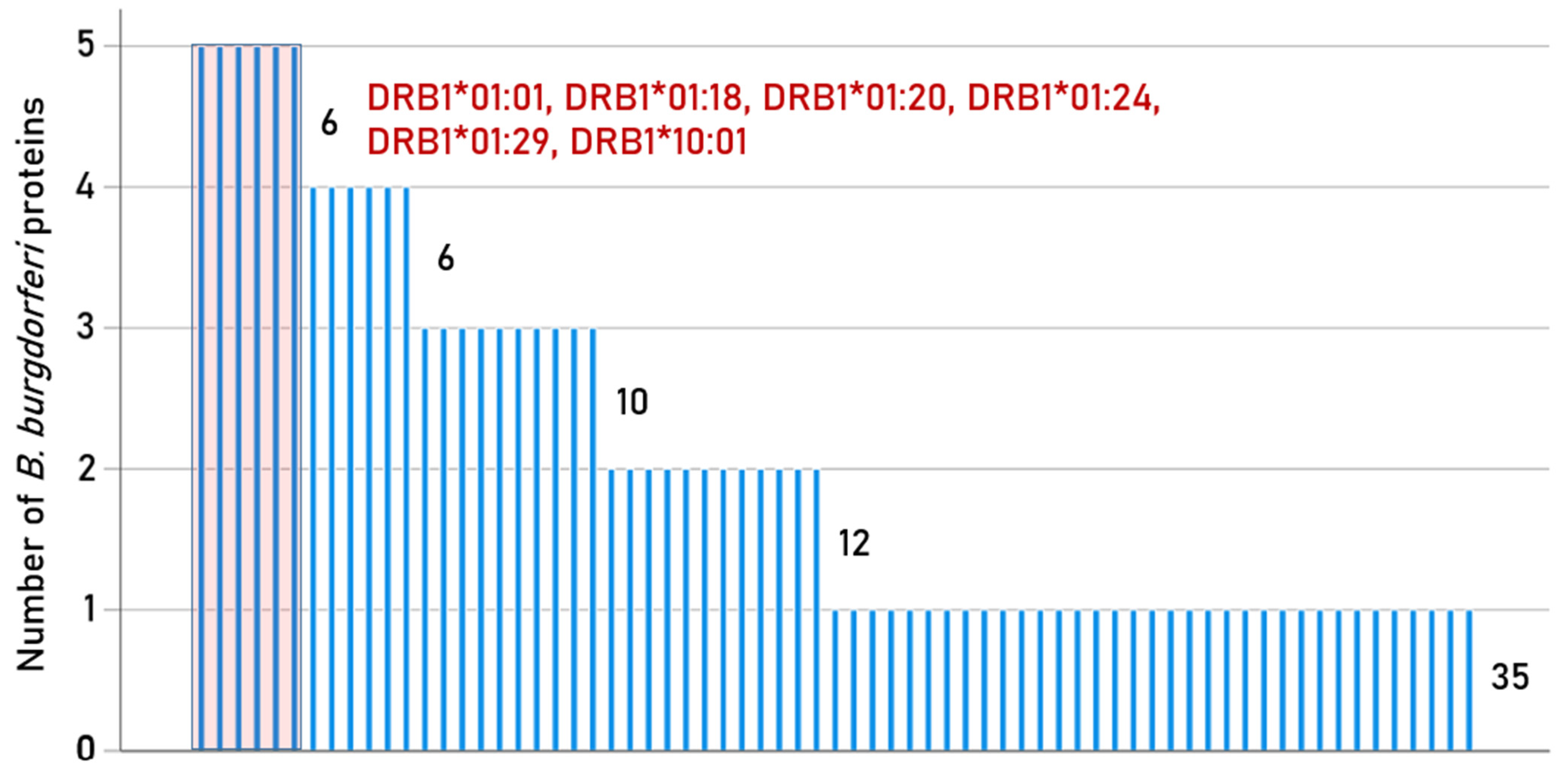
Of the 192 HLA-II alleles tested, strong binding to any B. burgdorferi protein was observed in 69 (35.9%) cases (Table 3, Figure 3). Notably, most (66/69, 96%) of these alleles belonged to the DRB1 gene, whereas 3/69 (4%) belonged to the DBP1 gene; no strong binder was found from the DQB1 gene. Summary details of protein-HLA strong binders are given in Table S4. The estimated prevalence of 46 of the alleles in six ethnic populations obtained from donor registries spanning the globe [23] is shown in Table 4 (the prevalence of the remaining alleles was not available). It can be seen that the coverage is substantial in all populations for the 3 DRB1 alleles but very small for the 3 DPB1 alleles.
Moderate binding was observed in 169/192 (88.0%) of alleles tested (Table S7). There were 40 DPB1 alleles with moderate binding (vs. 3 with strong binding), 14 DQB1 alleles (vs. none with strong binding), and 115 DRB1 alleles with moderate binding (vs. 36 with strong binding).

3.4. Protein–Allele Combinations

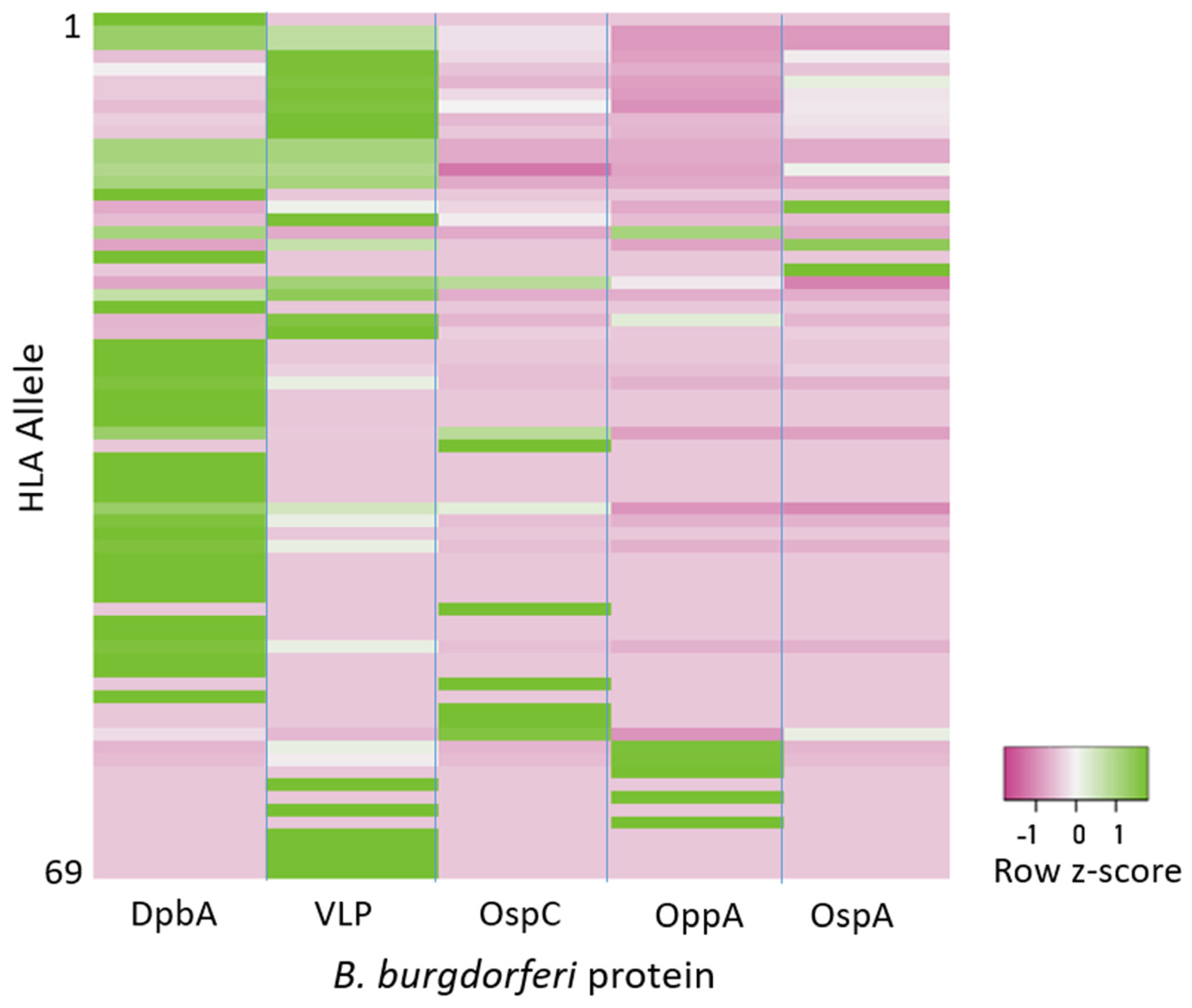
The numbers of strongly binding peptides per allele and protein are given in Table 5 and illustrated in Figure 4. It can be seen that there was substantial variation in the occurrence of strong binders among proteins and alleles, with decorin-binding protein A (DpbA) having the highest allele coverage (48/69 = 69.6%) and OspA the lowest (14/69 = 20.3%).

3.5. Strongly Binding Peptides and Their Amino Acid Sequences

Of the 1067 peptides tested from the 5 B. burgdorferi proteins (Table 1), 226 (21.2%) distinct peptides were found to bind strongly (IC50 < 50 nM) to at least one HLA-II allele molecule. The amino acid sequences of these peptides and associated descriptive statistics (number of occurrences, mean and minimum [strongest] estimated binding affinity) are given in Table S5. Each peptide occurred only in one of the five proteins tested, as many times as the number in column N in Table S5.
As expected, the number of distinct, moderately binding peptides was much higher (731/1067 = 68.51%). The AA sequences of those peptides are given in Table S8.

3.6. Possible Autoimmunity of Strong Binders

We tested for possible susceptibility to autoimmunity by any one of the 226 peptides above by searching for its occurrence in any of 83,607 human proteins. We did not find any such occurrence. In addition, we searched for the presence of amino acid subsequences (8–14 mers, embedded within the 15-mer peptides), to identify peptides present in human proteins. Indeed, we found two 8-mers shown in color in Table S5 (GKLFESVE, LVKAVKTA); GKLFESVE occurred in protein Q9H2C0 (Uniprot ID; Gigaxonin), whereas LVKAVKTA occurred in protein Q6MZZ7 (Uniprot ID; Calpain-13). We then estimated the binding affinity of these two 8-mers to 142 common HLA-I alleles shown in Table S6. Neither 8-mer peptide had strong affinity to any of the 142 HLA-I allele molecules; the lowest IC50 was 6408. Altogether, these results indicate a reduced likelihood of possible autoimmunity by the 226 15-mer linear epitopes evaluated, at least for the HLA-I and HLA-II allele molecules tested.

4. Discussion

4.1. The Current Lyme Vaccine Landscape

Development of a safe and effective vaccine for Lyme disease is an active area of research that is aimed to stem the increasing incidence and geographic spread of Lyme disease and sequalae. The leading current vaccine candidate, VLA15, is a multivalent OspA-based vaccine for which several Phase I and Phase 2 trials have recently been completed with encouraging initial results [48,49,50,51,52,53]. Nevertheless, there are a good number of other approaches in developing a Lyme vaccine (reviewed in detail in [10,17]), including the targeting of B. burgdorferi proteins other than OspA such as VLsE [54], OspC [55], and other proteins [20]. In addition, different technologies are being explored, such as DNA-based [56], m-RNA lipid nanoparticle-based [57], and bioinformatic methods for vaccine design in general [58]. It should be mentioned that none of the studies above have taken into account the HLA genetic makeup of prospective vaccinees in selecting Borrelia epitopes, a central point in the present study, as discussed below.

4.2. Dependence of Vaccine Effectiveness on the Vaccinee’s HLA

The foundation of the present study rests on the fact that vaccine effectiveness depends highly on the vaccinee’s HLA composition [30,31,32,59,60,61,62]. HLA-II is involved in the production of antibodies against foreign antigens including viruses and bacteria, and in immunological memory, the very basis of preventative vaccines. Production of antibodies, however, is predicated on binding affinity between a given antigen and HLA-II, which varies across individuals. Strong HLA–peptide binding affinity is optimal for antibody production. Since B. burgdorferi antigen expression changes across the life cycle [21], several Borrelia antigens may be relevant vaccine candidates. Here, we utilized an in silico approach to evaluate the predicted binding affinities of five B. burgdorferi antigens to 192 common HLA-II allele molecules. Strong binding affinity was primarily associated with HLA-II DRB1 alleles, six of which (DRB1*01:01, DRB1*01:18, DRB1*01:20, DRB1*01:24, DRB1*01:29 DRB1*10:01) were found to bind strongly to all five B. burgdorferi proteins. Thus, individuals possessing any of those six alleles are predicted to have the most robust immune protection against Lyme disease subsequent to exposure to B. burgdorferi antigens, either via infection or preventive vaccination. Still, sixty additional HLA-II DRB1 alleles and three DPB1 alleles had strong binding to at least one of the B. burgdorferi proteins, also conferring protection against B. burgdorferi. Of the five B. burgdorferi antigens tested, the highest percentage of strong binders was documented for decorin-binding protein A (DpbA). DpbA is known to provoke an immune response, although its role in the disease course and utility for therapeutics are uncertain due to opposing findings with regard to protection conferred by DpbA antibodies [63]. All of the B. burgdorferi protein antigens were, to some extent, predicted to bind strongly to common HLA-II alleles; OspA, the dominant antigen used in vaccine studies [10,48], had the lowest percentage of strong binding with common Class II alleles. Notably, murine studies have shown that mice immunized with the DpbA-OspA combination were protected 100-fold more against B. burgdorferi challenge relative to single-antigen vaccines [64]. Those findings, coupled with predictions from the present study, suggest that vaccines combining antigens from different Borrelia proteins may maximize protection. Furthermore, the present findings highlight the potential for developing personalized HLA-based vaccines, in which the B. burgdorferi antigens with strong binding affinity for a given individual’s HLA composition are administered, along the same lines as nucleic-acid-based vaccines for other infectious diseases and cancers [65].
Obviously, the most effective vaccines are expected to be for peptide–HLA allele molecule (pHLA) complexes of high stability conferred by strong binding affinity (predicted IC50 < 50 nM). Such cases were observed for 69/192 (35.9%) of the HLA-II alleles tested (3 PBB1, 66 DRB1). In contrast, as expected, moderate binding affinity (lower stability) of pHLA complexes (50 nM ≤ IC50 < 500 nM) was observed in a wider set of HLA-II alleles (169/192 = 88.0%), namely 40 DPB1, 14 DQB1, and 115 DRB1 alleles. From the perspective of personalized HLA-based Lyme vaccine development, sequences with moderate affinity binding could be used for individuals lacking alleles with strong binding. Although such vaccines may not be as effective as those based on strong binders, they would nevertheless offer a degree of protection. It is worth noting that more than one-third of the DRB1 alleles evaluated in this study (43/115) commonly occur in global donor registries regardless of ethnicity [23], highlighting the potential global reach of HLA-based vaccines against Lyme disease.

4.3. Reduced Autoimmunity Risk for Strongly Binding Peptides

Given the controversial history of Lyme vaccine efforts [66], a major emphasis in the ongoing development of vaccines for Lyme disease is focused on reducing potential for autoimmune responses and molecular mimicry [67], which was previously proposed to play a role in Lyme arthritis [37]. Here, we tested all 226 unique 15-mer B. burgdorferi peptides that bound with strong affinity to HLA-II against 83,607 proteins of the human proteome and did not find any overlap. Furthermore, exhaustive testing of shorter peptides (8–14 mer) revealed only two 8-mer sequences that occurred in the entire human proteome, neither of which was found to bind strongly with HLA-I alleles. These findings suggest that the 226 B. burgdorferi peptide sequences identified as potential strong vaccine candidates here may have relatively reduced likelihood of contributing to autoimmunity.

4.4. Next Steps for Vaccine Application

This study provides a list of 69 HLA-II alleles which were found in silico to bind with strong affinity (predicted IC50 < 50 nM) to at least one of the five B. burgdorferi proteins tested using NetMHCpan 4.1, a gold standard in the field [68]. The key innovation of our study lies in the exhaustive testing of all possible linear epitopes of the standard 15-AA length for HLA-II presentation, thus screening for the most promising epitopes to be evaluated further by in vitro, ex vivo, and in vivo methods. In addition, selecting epitopes with strong predicted binding affinities would reduce false positives that would occur more frequently in cases of weak binding affinities.
Since discrepancies may exist between predicted and actual binding affinities, the next step would be to determine in vitro the binding affinities of the identified 1087 pHLA-II complexes in Table S3 using current methods [69,70] and select those pHLA-II complexes with strong binding affinity and stability. Next, these complexes would be evaluated in their capacity to elicit adequate CD4+ engagement and proliferation, and their capacity (alone or with a suitable adjuvant) to elicit the production of neutralizing antibodies and, ultimately, protect vaccinated animals from Lyme disease upon exposure to Borrelia infection. This last step would also be crucial in evaluating the safety of the vaccine, adverse reactions, etc., before entering the clinical trial stage. Now, all of this testing, evaluation, and vaccine production would be possible only for pHLA-II complexes with strong binding affinity, and it is at this very first stage that screening the predicted binding affinity in silico of these complexes is instrumental in vaccine design, a screening provided by this study.

5. Conclusions

In summary, we propose a novel approach to Lyme vaccination based on host immunogenetics. Each individual carries six HLA-II alleles which determine the cell-surface molecules that can bind and present foreign peptide antigens to helper T cells to stimulate antibody production. We have identified specific Borrelia peptide sequences that bind with strong affinity to common HLA-II (primarily HLA-DRB1) alleles (Table S3, Figure 3) and are not found to overlap with human proteins, thereby reducing the likelihood of autoimmunity. Conceivably, off-the-shelf vaccines containing multiple Borrelia peptide antigens that bind with strong affinity to a variety of HLA-DR alleles could be developed for testing. Alternatively, vaccines could be highly personalized, containing specific antigens that are predicted to bind with strong (or at least moderate) affinity to a given individual’s HLA-II composition. The development of effective vaccines against Lyme disease, whether personalized to an individual’s HLA composition or off-the-shelf approaches aimed at maximizing population coverage based on strong HLA binding affinity to frequently occurring alleles, will reduce the public health burden associated with Lyme disease [71,72,73]. Computational approaches to epitope identification have been successfully applied to zoonotic and vector-borne pathogens of medical and veterinary importance [74] and hold promise for the future of host-informed vaccine development against Lyme disease.

Supplementary Materials

The following supporting information can be downloaded at https://www.mdpi.com/article/10.3390/biology15070547/s1, Table S1. Amino acid sequences of the 5 proteins of B. burgdorferi used. Table S2. The 192 HLA-II alleles used. Table S3. All strong 15-mer strong binders (IC50 < 50 nM). Table S4. Cross-tabulation of counts of occurrences of strong binders between alleles and B. burgdorferi proteins. N denotes the number of proteins for which an allele showed strong binding. Total denotes the number of strong peptide binders for the associated allele and protein. Table S5. The 226 unique (distinct) peptides with strong binding affinities. N is the number of occurrences. The 8-mers in color denote subsequences that were found in 2/83,607 (0.24%) human proteins tested. See text for details. Table S6. The 142 HLA Class I alleles used to estimate predicted binding affinities of GKLFESVE, LVKAVKTA 8-mers. See text for details. Table S7. Number of 15-mer peptides with moderate predicted binding affinity to B. burgdorferi proteins (50 nM ≤ IC50 < 500 nM). Table S8. The 731 distinct 15-mer peptides with moderate predicted binding affinity to 5 B. burgdorferi antigens tested.

Author Contributions

A.P.G.: formal analysis, methodology, conceptualization, writing—methods, results, visualization, review and editing. L.M.J.: writing—original draft, review and editing. M.S.: HLA analysis, writing—methods, review and editing. All authors have read and agreed to the published version of the manuscript.

Funding

The authors disclosed receipt of the following financial support for the research, authorship, and/or publication of this article: partial funding for this study was provided by the University of Minnesota (the American Legion Brain Sciences Chair) and the U.S. Department of Veterans Affairs.

Institutional Review Board Statement

This article does not contain any studies with human participants performed by any of the authors.

Data Availability Statement

All data used were retrieved from freely accessible websites and, as such, are publicly and freely available in ref. [38]: https://www.uniprot.org/uniprotkb (accessed on 5 May 2024); ref. [40]: http://tools.iedb.org/mhci/ (accessed on 18 October 2025); and ref. [45]: https://www.proteinatlas.org/about/download#protein_atlas_data (accessed on 14 December 2025).

Acknowledgments

We thank Phillip K. Peterson for seminal discussions of this research.

Conflicts of Interest

The authors declared no potential conflicts of interest with respect to the research, authorship, and/or publication of this article. The sponsors had no role in the current study design, analysis or interpretation, or in the writing of this paper. The contents do not represent the views of the U.S. Department of Veterans Affairs or the United States Government.

References

  1. Stanek, G.; Wormser, G.P.; Gray, J.; Strle, F. Lyme borreliosis. Lancet 2012, 379, 461–473. [Google Scholar] [CrossRef]
  2. Steere, A.; Strle, F.; Wormser, G.; Hu, L.T.; Branda, J.A.; Hovius, J.W.; Li, X.; Mead, P.S. Lyme borreliosis. Nat. Rev. Dis. Primers 2016, 2, 16090. [Google Scholar] [CrossRef] [PubMed]
  3. Wong, K.H.; Shapiro, E.D.; Soffer, G.K. A review of Post-treatment Lyme Disease Syndrome and chronic Lyme disease for the practicing immunologist. Clin. Rev. Allergy Immunol. 2022, 62, 264–271. [Google Scholar] [CrossRef]
  4. Jutras, B.L.; Lochhead, R.B.; Kloos, Z.A.; Biboy, J.; Strle, K.; Booth, C.J.; Govers, S.K.; Gray, J.; Schumann, P.; Vollmer, W.; et al. Borrelia burgdorferi peptidoglycan is a persistent antigen in patients with Lyme arthritis. Proc. Natl. Acad. Sci. USA 2019, 116, 13498–13507. [Google Scholar] [CrossRef] [PubMed]
  5. Kugeler, K.J.; Farley, G.M.; Forrester, J.D.; Mead, P.S. Geographic distribution and expansion of human Lyme disease, United States. Emerg. Infect. Dis. 2015, 21, 1455–1457. [Google Scholar] [CrossRef]
  6. Ozdenerol, E. GIS and remote sensing use in the exploration of Lyme disease epidemiology. Int. J. Environ. Res. Public Health 2015, 12, 15182–15203. [Google Scholar] [CrossRef]
  7. Dong, Y.; Zhou, G.; Cao, W.; Xu, X.; Zhang, Y.; Ji, Z.; Yang, J.; Chen, J.; Liu, M.; Fan, Y.; et al. Global seroprevalence and sociodemographic characteristics of Borrelia burgdorferi sensu lato in human populations: A systematic review and meta- analysis. BMJ Glob. Health 2022, 7, e007744. [Google Scholar] [CrossRef]
  8. How Many People Get Lyme Disease? Available online: https://www.cdc.gov/lyme/data-research/facts-stats/index.html (accessed on 25 March 2026).
  9. Zhou, G.; Xu, X.; Zhang, Y.; Yue, P.; Luo, S.; Fan, Y.; Chen, J.; Liu, M.; Dong, Y.; Li, B.; et al. Antibiotic prophylaxis for prevention against Lyme disease following tick bite: An updated systematic review and meta-analysis. BMC Infect. Dis. 2021, 21, 1141. [Google Scholar] [CrossRef] [PubMed]
  10. Tamanna, S.; Kim, D.-M. Revolutionizing Lyme disease vaccination: A systematic review and meta-analysis of promising candidates. Front. Cell. Infect. Microbiol. 2025, 15, 1554360. [Google Scholar] [CrossRef]
  11. Gomes-Solecki, M.; Arnaboldi, P.M.; Backenson, P.B.; Benach, J.L.; Cooper, C.L.; Dattwyler, R.J.; Diuk-Wasser, M.; Fikrig, E.; Hovius, J.W.; Laegreid, W.; et al. Protective immunity and new vaccines for Lyme disease. Clin. Infect. Dis. 2020, 70, 1768–1773. [Google Scholar] [CrossRef]
  12. Lantos, P.M.; Rumbaugh, J.; Bockenstedt, L.K.; Falck-Ytter, Y.T.; Aguero-Rosenfeld, M.E.; Auwaerter, P.G.; Baldwin, K.; Bannuru, R.R.; Belani, K.K.; Bowie, W.R.; et al. Clinical Practice Guidelines by the Infectious Diseases Society of America (IDSA), American Academy of Neurology (AAN), and American College of Rheumatology (ACR): 2020 Guidelines for the Prevention, Diagnosis and Treatment of Lyme Disease. Clin. Infect. Dis. 2021, 72, e1–e48. [Google Scholar] [CrossRef] [PubMed]
  13. Zhang, X.; Jiang, Y.; Chen, Y.; Vang, J.; Zhang, X.; Xing, L.; Liu, A.; Bao, F. Efficacy and safety of antibiotic therapy for post-Lyme disease? A systematic review and network meta-analysis. BMC Infect. Dis. 2023, 23, 22. [Google Scholar] [CrossRef]
  14. Dersch, R.; Torbahn, G.; Rauer, S. Treatment of post-treatment Lyme disease symptoms—A systematic review. Eur. J. Neurol. 2024, 31, e16293. [Google Scholar] [CrossRef] [PubMed]
  15. Johnson, E.E.; Hart, T.M.; Fikrig, E. Vaccination to prevent Lyme disease: A movement towards anti-tick approaches. J. Infect. Dis. 2024, 230, S82–S86. [Google Scholar] [CrossRef]
  16. Wormser, G.P. A brief history of OspA vaccines including their impact on diagnostic testing for Lyme disease. Diagn. Microbiol. Infect. Dis. 2022, 102, 115572. [Google Scholar] [CrossRef]
  17. Plotkin, S.A.; Shapiro, E.D. The current and future state of vaccines for Lyme disease. Clin. Infect. Dis. 2025, 81, 687–692. [Google Scholar] [CrossRef]
  18. Wressnigg, N.; Barrett, P.N.; Pöllabauer, E.M.; O’Rourke, M.; Portsmouth, D.; Schwendinger, M.G.; Crowe, B.A.; Livey, I.; Dvorak, T.; Schmitt, B.; et al. A novel multivalent OspA vaccine against Lyme borreliosis is safe and immunogenic in an adult population previously infected with Borrelia burgdorferi sensu lato. Clin. Vaccine Immunol. 2014, 21, 1490–1499. [Google Scholar] [CrossRef]
  19. Comstedt, P.; Hanner, M.; Schüler, W.; Meinke, A.; Schlegl, R.; Lundberg, U. Characterization and optimization of a novel vaccine for protection against Lyme borreliosis. Vaccine 2015, 33, 5982–5988. [Google Scholar] [CrossRef] [PubMed]
  20. Yaş, O.B.; Coleman, A.S.; Lipman, R.M.; Sharma, K.; Raghunandanan, S.; Alanazi, F.; Rana, V.S.; Kitsou, C.; Yang, X.; Pal, U. A systemic approach to identify non-abundant immunogenic proteins in Lyme disease pathogens. mSystems 2024, 9, e0108723. [Google Scholar] [CrossRef]
  21. Norris, S.J. The dynamic proteome of Lyme disease Borrelia. Genome Biol. 2006, 7, 209. [Google Scholar] [CrossRef]
  22. Norris, S.J.; Brangulis, K. Meta-analysis of the Vmp-like sequences of Lyme disease Borrelia: Evidence for the evolution of an elaborate antigenic variation system. Front. Microbiol. 2024, 15, 1469411. [Google Scholar] [CrossRef]
  23. Hurley, C.K.; Kempenich, J.; Wadsworth, K.; Sauter, J.; Hofmann, J.A.; Schefzyk, D.; Schmidt, A.H.; Galarza, P.; Cardozo, M.B.; Dudkiewicz, M.; et al. Common, intermediate and well-documented HLA alleles in world populations: CIWD version 3.0.0. HLA 2020, 95, 516–531. [Google Scholar] [CrossRef]
  24. Trowsdale, J.; Knight, J.C. Major histocompatibility complex genomics and human disease. Annu. Rev. Genomics Hum. Genet. 2013, 14, 301–323. [Google Scholar] [CrossRef]
  25. Hov, J.R.; Kosmoliaptsis, V.; Traherne, J.A.; Olsson, M.; Boberg, K.M.; Bergquist, A.; Schrumpf, E.; Bradley, J.A.; Taylor, C.J.; Lie, B.A.; et al. Electrostatic modifications of the human leukocyte antigen-DR P9 peptide-binding pocket and susceptibility to primary sclerosing cholangitis. Hepatology 2011, 53, 1967–1976. [Google Scholar] [CrossRef]
  26. Davenport, M.P.; Quinn, C.L.; Chicz, R.M.; Green, B.N.; Willis, A.C.; Lane, W.S.; Bell, J.I.; Hill, A.V. Naturally processed peptides from two disease-resistance-associated HLA-DR13 alleles show related sequence motifs and the effects of the dimorphism at position 86 of the HLA-DR beta chain. Proc. Natl. Acad. Sci. USA 1995, 92, 6567–6571. [Google Scholar] [CrossRef]
  27. van Deutekom, H.W.; Keşmir, C. Zooming into the binding groove of HLA molecules: Which positions and which substitutions change peptide binding most? Immunogenetics 2015, 67, 425–436. [Google Scholar] [CrossRef]
  28. Paul, S.; Weiskopf, D.; Angelo, M.A.; Sidney, J.; Peters, B.; Sette, A. HLA class I alleles are associated with peptide-binding repertoires of different size, affinity, and immunogenicity. J. Immunol. 2013, 191, 5831–5839. [Google Scholar] [CrossRef]
  29. Cruz-Tapias, P.; Castiblanco, J.; Anaya, J.M. Major histocompatibility complex: Antigen processing and presentation. In Autoimmunity: From Bench to Bedside; Anaya, J.M., Shoenfeld, Y., Rojas-Villarraga, A., Levy, R.A., Carvera, R., Eds.; El Rosario University Press: Bogota, Colombia, 2013; Chapter 10. Available online: https://www.ncbi.nlm.nih.gov/books/NBK459467/ (accessed on 25 March 2026).
  30. Poland, G.A.; Ovsyannikova, I.G.; Jacobson, R.M.; Smith, D.I. Heterogeneity in vaccine immune response: The role of immunogenetics and the emerging field of vaccinomics. Clin. Pharmacol. Ther. 2007, 82, 653–664. [Google Scholar] [CrossRef] [PubMed]
  31. Posteraro, B.; Pastorino, R.; Di Giannantonio, P.; Ianuale, C.; Amore, R.; Ricciardi, W.; Boccia, S. The link between genetic variation and variability in vaccine responses: Systematic review and meta-analyses. Vaccine 2014, 32, 1661–1669. [Google Scholar] [CrossRef] [PubMed]
  32. Charonis, S.A.; James, L.M.; Georgopoulos, A.P. SARS-CoV-2 in silico binding affinity to human leukocyte antigen (HLA) Class II molecules predicts vaccine effectiveness across variants of concern (VOC). Sci. Rep. 2022, 12, 8074. [Google Scholar] [CrossRef] [PubMed]
  33. Dendrou, C.; Petersen, J.; Rossjohn, J.; Fugger, L. HLA variation and disease. Nat. Rev. Immunol. 2018, 18, 325–339. [Google Scholar] [CrossRef]
  34. James, L.M.; Georgopoulos, A.P. Immunogenetic clustering of 30 cancers. Sci. Rep. 2022, 12, 7235. [Google Scholar] [CrossRef]
  35. James, L.M.; Georgopoulos, A.P. At the root of 3 “long” diseases: Persistent antigens inflicting chronic damage on the brain and other organs in Gulf War Illness, Long-COVID-19, and Chronic Fatigue Syndrome. Neurosci. Insights 2022, 17, 26331055221114817. [Google Scholar] [CrossRef]
  36. Lochhead, R.B.; Strle, K.; Arvikar, S.L.; Weis, J.J.; Steere, A.C. Lyme arthritis: Linking infection, inflammation and autoimmunity. Nat. Rev. Rheumatol. 2021, 17, 449–461. [Google Scholar] [CrossRef]
  37. Steere, A.C.; Falk, B.; Drouin, E.E.; Baxter-Lowe, L.A.; Hammer, J.; Nepom, G.T. Binding of outer surface protein A and human lymphocyte function-associated antigen 1 peptides to HLA-DR molecules associated with antibiotic treatment-resistant Lyme arthritis. Arthritis Rheum. 2003, 48, 534–540. [Google Scholar] [CrossRef]
  38. Uniprot. Available online: https://www.uniprot.org/uniprotkb (accessed on 15 October 2025).
  39. Reynisson, B.; Alvarez, B.; Paul, S.; Peters, B.; Nielsen, M. NetMHCpan-4.1 and NetMHCIIpan-4.0: Improved predictions of MHC antigen presentation by concurrent motif deconvolution and integration of MS MHC eluted ligand data. Nucleic Acids Res. 2020, 48, W449–W454. [Google Scholar] [CrossRef]
  40. IEDB Analysis Resource. Available online: http://tools.iedb.org/mhci/ (accessed on 18 October 2025).
  41. Charonis, S.; James, L.M.; Georgopoulos, A.P. In silico assessment of binding affinities of three dementia-protective Human Leukocyte Antigen (HLA) alleles to nine human herpes virus antigens. Curr. Res. Transl. Med. 2020, 68, 211–216. [Google Scholar] [CrossRef] [PubMed]
  42. Charonis, S.; Tsilibary, E.P.; Georgopoulos, A. SARS-CoV-2 virus and Human Leukocyte Antigen (HLA) Class II: Investigation in silico of binding affinities for COVID-19 protection and vaccine development. J. Immunol. Sci. 2020, 4, 12–23. [Google Scholar] [CrossRef] [PubMed]
  43. Charonis, S.A.; Tsilibary, E.P.; Georgopoulos, A.P. In silico investigation of binding affinities between human leukocyte antigen class I molecules and SARS-CoV-2 virus spike and ORF1ab proteins. Explor. Immunol. 2021, 1, 16–26. [Google Scholar] [CrossRef]
  44. Istrail, S.; Florea, L.; Halldórsson, B.V.; Kohlbacher, O.; Schwartz, R.S.; Yap, V.B.; Yewdell, J.W.; Hoffman, S.L. Comparative immunopeptidomics of humans and their pathogens. Proc. Natl. Acad. Sci. USA 2004, 101, 13268–13272. [Google Scholar] [CrossRef] [PubMed]
  45. The Human Protein Atlas. Available online: https://www.proteinatlas.org/about/download#protein_atlas_data (accessed on 22 October 2025).
  46. Cerundolo, V.; Elliott, T.; Elvin, J.; Bastin, J.; Rammensee, H.G.; Townsend, A. The binding affinity and dissociation rates of peptides for class I major histocompatibility complex molecules. Eur. J. Immunol. 1991, 21, 2069–2075. [Google Scholar] [CrossRef]
  47. Engelhard, V.H. Structure of peptides associated with class I and class II MHC molecules. Annu. Rev. Immunol. 1994, 12, 181–207. [Google Scholar] [CrossRef]
  48. Bézay, N.; Hochreiter, R.; Kadlecek, V.; Wressnigg, N.; Larcher-Senn, J.; Klingler, A.; Dubischar, K.; Eder-Lingelbach, S.; Leroux-Roels, I.; Leroux-Roels, G.; et al. Safety and immunogenicity of a novel multivalent OspA-based vaccine candidate against Lyme borreliosis: A randomised, phase 1 study in healthy adults. Lancet Infect. Dis. 2023, 23, 1186–1196. [Google Scholar] [CrossRef]
  49. Bézay, N.; Wagner, L.; Kadlecek, V.; Obersriebnig, M.; Wressnigg, N.; Hochreiter, R.; Schneider, M.; Dubischar, K.; Derhaschnig, U.; Klingler, A.; et al. Optimisation of dose level and vaccination schedule for the VLA15 Lyme borreliosis vaccine candidate among healthy adults: Two randomised, observer-blind, placebo-controlled, multicentre, phase 2 studies. Lancet Infect. Dis. 2024, 24, 1045–1058, Erratum in Lancet Infect. Dis. 2025, 25, e68. https://doi.org/10.1016/S1473-3099(24)00859-4. [Google Scholar] [CrossRef] [PubMed]
  50. Wagner, L.; Obersriebnig, M.; Kadlecek, V.; Hochreiter, R.; Ghadge, S.K.; Larcher-Senn, J.; Hegele, L.; Maguire, J.D.; Derhaschnig, U.; Jaramillo, J.C.; et al. Immunogenicity and safety of different immunisation schedules of the VLA15 Lyme borreliosis vaccine candidate in adults, adolescents, and children: A randomised, observer-blind, placebo-controlled, phase 2 trial. Lancet Infect. Dis. 2025, 25, 986–999, Erratum in Lancet Infect. Dis. 2025, 25, e627. https://doi.org/10.1016/S1473-3099(25)00597-3. [Google Scholar] [CrossRef]
  51. Ghadge, S.K.; Schneider, M.; Dubischar, K.; Wagner, L.; Kadlecek, V.; Obersriebnig, M.; Hochreiter, R.; Klingler, A.; Larcher-Senn, J.; Derhaschnig, U.; et al. Immunogenicity and safety of an 18-month booster dose of the VLA15 Lyme borreliosis vaccine candidate after primary immunisation in healthy adults in the USA: Results of the booster phase of a randomised, controlled, phase 2 trial. Lancet Infect. Dis. 2024, 24, 1275–1286. [Google Scholar] [CrossRef]
  52. Wagner, L.; Obersriebnig, M.; Hochreiter, R.; Kadlecek, V.; Larcher-Senn, J.; Hegele, L.; Maguire, J.D.; Murphy, T.; Derhaschnig, U.; Bézay, N.; et al. Immunogenicity and safety of an 18-month booster dose of the VLA15 Lyme borreliosis vaccine candidate after primary immunisation in children, adolescents, and adults in the USA: A randomised, observer-blind, placebo-controlled, phase 2 trial. Lancet Infect. Dis. 2025, 26, 314–328. [Google Scholar] [CrossRef]
  53. Wressnigg, N.; Pöllabauer, E.M.; Aichinger, G.; Portsmouth, D.; Löw-Baselli, A.; Fritsch, S.; Livey, I.; Crowe, B.A.; Schwendinger, M.; Brühl, P.; et al. Safety and immunogenicity of a novel multivalent OspA vaccine against Lyme borreliosis in healthy adults: A double-blind, randomised, dose-escalation phase 1/2 trial. Lancet Infect. Dis. 2013, 13, 680–689. [Google Scholar] [CrossRef] [PubMed]
  54. Batool, M.; Caoili, S.E.C.; Dangott, L.J.; Gerasimov, E.; Ionov, Y.; Piontkivska, H.; Zelikovsky, A.; Waghela, S.D.; Rogovskyy, A.S. Identification of surface epitopes associated with protection against highly immune-evasive VlsE-expressing Lyme disease spirochetes. Infect. Immun. 2018, 86, e00182-18. [Google Scholar] [CrossRef]
  55. Izac, J.R.; O’Bier, N.S.; Oliver, L.D., Jr.; Camire, A.C.; Earnhart, C.G.; LeBlanc Rhodes, D.V.; Young, B.F.; Parnham, S.R.; Davies, C.; Marconi, R.T. Development and optimization of OspC chimeritope vaccinogens for Lyme disease. Vaccine 2020, 38, 1915–1924. [Google Scholar] [CrossRef] [PubMed]
  56. Guibinga, G.H.; Sahay, B.; Brown, H.; Cooch, N.; Chen, J.; Yan, J.; Reed, C.; Mishra, M.; Yung, B.; Pugh, H.; et al. Protection against Borreliella burgdorferi infection mediated by a synthetically engineered DNA vaccine. Hum. Vaccin. Immunother. 2020, 16, 2114–2122. [Google Scholar] [CrossRef]
  57. Pine, M.; Arora, G.; Hart, T.M.; Bettini, E.; Gaudette, B.T.; Muramatsu, H.; Tombácz, I.; Kambayashi, T.; Tam, Y.K.; Brisson, D.; et al. Development of an mRNA-lipid nanoparticle vaccine against Lyme disease. Mol. Ther. 2023, 31, 2702–2714. [Google Scholar] [CrossRef] [PubMed]
  58. Yurina, V.; Adianingsih, O.R. Predicting epitopes for vaccine development using bioinformatics tools. Ther. Adv. Vaccines Immunother. 2022, 10, 25151355221100218. [Google Scholar] [CrossRef] [PubMed]
  59. Haslund, M.M.; Sørensen, J.K.; Graff Stensballe, L. Genetics and measles, mumps and rubella vaccine response in childhood and adolescence—A systematic review. Scand. J. Immunol. 2023, 97, e13266. [Google Scholar] [CrossRef]
  60. Wolday, D.; Fung, C.Y.J.; Morgan, G.; Casalino, S.; Frangione, E.; Taher, J.; Lerner-Ellis, J.P. HLA variation and SARS-CoV-2 specific antibody response. Viruses 2023, 15, 906. [Google Scholar] [CrossRef] [PubMed]
  61. Kuijpers, Y.; Rietman, M.L.; Picavet, H.S.J.; Engelfriet, P.; Verschuren, W.M.M.; Buisman, A.M. Genetic differences in the HLA region contribute to the variability in SARS-CoV-2 vaccine responsiveness of older persons: The Doetinchem Cohort Study. Clin. Transl. Immunol. 2025, 14, e70058. [Google Scholar] [CrossRef]
  62. Poland, G.A.; Ovsyannikova, I.G.; Jacobson, R.M. Immunogenetics of seasonal influenza vaccine response. Vaccine 2008, 26, D35–D40. [Google Scholar] [CrossRef]
  63. Rudolph, M.J.; Muriuki, B.M.; Chen, Y.; Vance, D.J.; Vorauer, C.; Piazza, C.L.; Freeman-Gallant, G.; Golonka, R.M.; Mirabile, G.; Guttman, M.; et al. Germline encoded residues dominate the interaction of a human monoclonal antibody with decorin binding protein A of Borrelia burgdorferi. Front. Immunol. 2025, 16, 1611828. [Google Scholar] [CrossRef]
  64. Hanson, M.S.; Patel, N.K.; Cassatt, D.R.; Ulbrandt, N.D. Evidence for vaccine synergy between Borrelia burgdorferi decorin binding protein A and outer surface protein A in the mouse model of lyme borreliosis. Infect. Immun. 2000, 68, 6457–6460. [Google Scholar] [CrossRef]
  65. Barbier, A.J.; Jiang, A.Y.; Zhang, P.; Wooster, R.; Anderson, D.G. The clinical progress of mRNA vaccines and immunotherapies. Nat. Biotechnol. 2022, 40, 840–854. [Google Scholar] [CrossRef]
  66. Poland, G.A. Vaccines against Lyme disease: What happened and what lessons can we learn? Clin. Infect. Dis. 2011, 52, s253–s258. [Google Scholar] [CrossRef] [PubMed]
  67. Nayak, A.; Schüler, W.; Seidel, S.; Gomez, I.; Meinke, A.; Comstedt, P.; Lundberg, U. Broadly protective multivalent OspA vaccine against Lyme borreliosis, developed based on surface shaping of the C-terminal fragment. Infect. Immun. 2020, 88, e00917-9. [Google Scholar] [CrossRef]
  68. Yang, Y.; Wei, Z.; Cia, G.; Song, X.; Pucci, F.; Rooman, M.; Xue, F.; Hou, Q. MHCII-peptide presentation: An assessment of the state-of-the-art prediction methods. Front. Immunol. 2024, 15, 1293706. [Google Scholar] [CrossRef]
  69. Wendorff, M.; Garcia Alvarez, H.M.; Østerbye, T.; ElAbd, H.; Rosati, E.; Degenhardt, F.; Buus, S.; Franke, A.; Nielsen, M. Unbiased characterization of peptide-HLA Class II interactions based on large-scale peptide microarrays; Assessment of the impact on HLA Class II ligand and epitope prediction. Front. Immunol. 2020, 11, 1705. [Google Scholar] [CrossRef]
  70. Bi, J.; Jiang, L.; Zhao, J.; Zhuang, X.; Pan, L. Targeting peptide-HLA complexes for precision immunotherapy. Trends Pharmacol. Sci. 2026. Epub ahead of printing. [Google Scholar] [CrossRef]
  71. Kugeler, K.J.; Schwartz, A.M.; Delorey, M.J.; Mead, P.S.; Hinckley, A.F. Estimating the frequency of Lyme Disease diagnoses, United States, 2010–2018. Emerg Infect Dis. 2021, 27, 616–619. [Google Scholar] [CrossRef]
  72. Hook, S.A.; Jeon, S.; Niesobecki, S.A.; Hansen, A.P.; Meek, J.I.; Bjork, J.K.H.; Dorr, F.M.; Rutz, H.J.; Feldman, K.A.; White, J.L.; et al. Economic burden of reported Lyme Disease in high-incidence areas, United States, 2014–2016. Emerg Infect Dis. 2022, 28, 1170–1179. [Google Scholar] [CrossRef]
  73. Angell, K.E.; Broadhurst, M.J.; Dong, J.J.; Michaud, T.L.; Degarege, A.; Cortinas, R.; Brett-Major, D.M. Quantifying the public health impact of Lyme Disease in Minnesota: A simulation analysis of reported and unreported cases. J. Health Econ. Outcomes Res. 2025, 12, 221–228. [Google Scholar] [CrossRef] [PubMed]
  74. El-Sayed, S.A.E.-S.; Rizk, M.A.; Eldoumani, H.; Sorour, S.S.; Terkawi, M.A.; AbouLaila, M.; Igarashi, I.; Sayed-Ahmed, M.Z. Identification and characterization of P0 protein as a vaccine candidate against Babesia divergens, blood parasite of veterinary and zoonotic importance. Front. Vet. Sci. 2022, 8, 795906. [Google Scholar] [CrossRef] [PubMed]
Figure 1. Schematic diagram to illustrate the sliding window approach to estimate in silico binding affinities of HLA alleles to decorin-binding protein A.
Biology 15 00547 g001
Figure 2. Percent of strongly binding 15-mer peptides for the 5 B. burgdorferi proteins tested.
Biology 15 00547 g002
Figure 3. Bar graph illustrating the number of proteins (out of 5 total B. burgdorferi proteins) containing peptides that bind strongly to the 69 HLA-II alleles. Sixty-nine alleles bind strongly to at least 1 B. burgdorferi protein; six HLA-II alleles are capable of strong binding affinity to all 5 B. burgdorferi proteins.
Biology 15 00547 g003
Figure 4. Heatmap of counts of strong binders per protein and allele, normalized (expressed as z-scores) per protein (row). Z-scores are those of data in the rows of Table 5.
Biology 15 00547 g004
Table 1. B. burgdorferi antigens tested. AA = amino acid length. N = the number of 15-mer sequences for a given protein. N tested refers to the total number of HLA-15-mer peptide sequences tested per protein.
ProteinUNIPROT IDAAN (15-mer)N Tested (×192 Alleles)
1Decorin-binding protein AO5091719117733,984
2OppA-2Q6RH121079317,856
3Outer surface protein AP0CL6627325949,728
4Outer surface protein CQ0733721019637,632
5Variable large proteinO0687835634265,664
Total11371067204,864
Table 2. Counts (and % of tested) of strongly (IC < 50 nM) and moderately strong (50 nM ≤ IC50 < 500 nM) binding peptides per B. burgdorferi antigen. N tested reflects total number of HLA-15-mer peptide sequences tested per protein from Table 1.
ProteinUNIPROT IDN TestedN (%) Strong
(IC50 < 50 nM)
N (%) Moderate
(50 nM ≤ IC50 < 500 nM)
Decorin-binding protein AO5091733,984364 (1.07)4879 (14.36)
OppA-2Q6RH1217,85693 (0.52)2484 (13.91)
Outer surface protein AP0CL6649,728109 (0.22)3151 (6.34)
Outer surface protein CQ0733737,632145 (0.38)3635 (9.66)
Variable large proteinO0687865,664376 (0.57)6003 (9.14)
Total204,8641087 (0.532%)20,152 (9.837%)
Table 3. Counts (N) of Lyme proteins with 15-mer sequences strongly binding (IC50 < 50 nM) to the HLA-II allele molecule listed. The ‘x’ in the Common column indicates the availability of ethnicity prevalence of the specific allele in ref. [23].
AlleleCommonN Proteins
1DPB1*15:01x1
2DPB1*33:01x3
3DPB1*71:01x3
4DRB1*01:01x5
5DRB1*01:02x4
6DRB1*01:11 4
7DRB1*01:18 5
8DRB1*01:20 5
9DRB1*01:24 5
10DRB1*01:29 5
11DRB1*03:01x2
12DRB1*03:04x2
13DRB1*03:11 4
14DRB1*03:13x2
15DRB1*03:15x1
16DRB1*04:01x3
17DRB1*04:04x2
18DRB1*04:05 2
19DRB1*04:08x3
20DRB1*04:10x1
21DRB1*04:72 1
22DRB1*07:01x4
23DRB1*08:04 2
24DRB1*08:24 1
25DRB1*09:01x2
26DRB1*10:01x5
27DRB1*11:01x1
28DRB1*11:02x1
29DRB1*11:03x3
30DRB1*11:04x3
31DRB1*11:08x1
32DRB1*11:10x1
33DRB1*11:12x1
34DRB1*11:13x3
35DRB1*11:14x1
36DRB1*11:27x1
37DRB1*11:28x1
38DRB1*11:29x1
39DRB1*11:37 1
40DRB1*11:42 4
41DRB1*11:46 3
42DRB1*11:49 1
43DRB1*11:58 3
44DRB1*11:62 1
45DRB1*11:65 1
46DRB1*11:74 1
47DRB1*13:01x1
48DRB1*13:02x1
49DRB1*13:05x1
50DRB1*13:07x1
51DRB1*13:11x3
52DRB1*13:14x1
53DRB1*13:21x1
54DRB1*13:23 1
55DRB1*13:50 1
56DRB1*13:96 1
57DRB1*13:97 1
58DRB1*14:32 4
59DRB1*15:01x2
60DRB1*15:02x2
61DRB1*15:03x1
62DRB1*15:06x2
63DRB1*15:07x1
64DRB1*15:15 2
65DRB1*15:37 1
66DRB1*16:01x1
67DRB1*16:02x2
68DRB1*16:05x1
69DRB1*16:09 1
Table 4. Reported prevalences of Common alleles (Table 3) in 6 ethnic populations. Values are approximate percentages (allele frequency × 200) computed from ref. [23].
EthnicitiesDRB1 Gene
(43 Alleles)
DPB1 Gene
(3 Alleles)
AFA (African/African American)70.3%0.56%
API (Asian/Pacific Islands)71.10.65
EURO (European/European descent)84.60.76
MENA (Middle East/North Coast of Africa)75.60.87
HIS (South or Central America/Hispanic/Latino)61.50.49
NAM (Native American populations)64.50.46
Table 5. Numbers of strongly binding peptides per B. burgdorferi protein and HLA allele.
AlleleDpbAVLPOspCOppAOspA
1DPB1*15:0130000
2DPB1*33:0197300
3DPB1*71:0197300
4DRB1*01:01145018921
5DRB1*01:02311101
6DRB1*01:11212105
7DRB1*01:181951211223
8DRB1*01:20144622820
9DRB1*01:24323115
10DRB1*01:29326315
11DRB1*03:0122000
12DRB1*03:0422000
13DRB1*03:1155013
14DRB1*03:1322000
15DRB1*03:1510000
16DRB1*04:0102106
17DRB1*04:0405100
18DRB1*04:0520020
19DRB1*04:0804106
20DRB1*04:1020000
21DRB1*04:7200004
22DRB1*07:0117630
23DRB1*08:0423000
24DRB1*08:2430000
25DRB1*09:01010040
26DRB1*10:01335656
27DRB1*11:0190000
28DRB1*11:0270000
29DRB1*11:03131001
30DRB1*11:04176100
31DRB1*11:0860000
32DRB1*11:1090000
33DRB1*11:1290000
34DRB1*11:13102800
35DRB1*11:1400600
36DRB1*11:2730000
37DRB1*11:2890000
38DRB1*11:2990000
39DRB1*11:3730000
40DRB1*11:4220131110
41DRB1*11:46176100
42DRB1*11:4990000
43DRB1*11:58176100
44DRB1*11:6290000
45DRB1*11:6570000
46DRB1*11:7490000
47DRB1*13:0170000
48DRB1*13:0200600
49DRB1*13:0590000
50DRB1*13:0730000
51DRB1*13:11176100
52DRB1*13:1490000
53DRB1*13:21120000
54DRB1*13:2300600
55DRB1*13:5090000
56DRB1*13:9600300
57DRB1*13:9700600
58DRB1*14:3221703
59DRB1*15:0103090
60DRB1*15:0201050
61DRB1*15:0300050
62DRB1*15:0603000
63DRB1*15:0700060
64DRB1*15:1501000
65DRB1*15:3700050
66DRB1*16:0104000
67DRB1*16:0208000
68DRB1*16:0502000
69DRB1*16:0903000
Disclaimer/Publisher’s Note: The statements, opinions and data contained in all publications are solely those of the individual author(s) and contributor(s) and not of MDPI and/or the editor(s). MDPI and/or the editor(s) disclaim responsibility for any injury to people or property resulting from any ideas, methods, instructions or products referred to in the content.