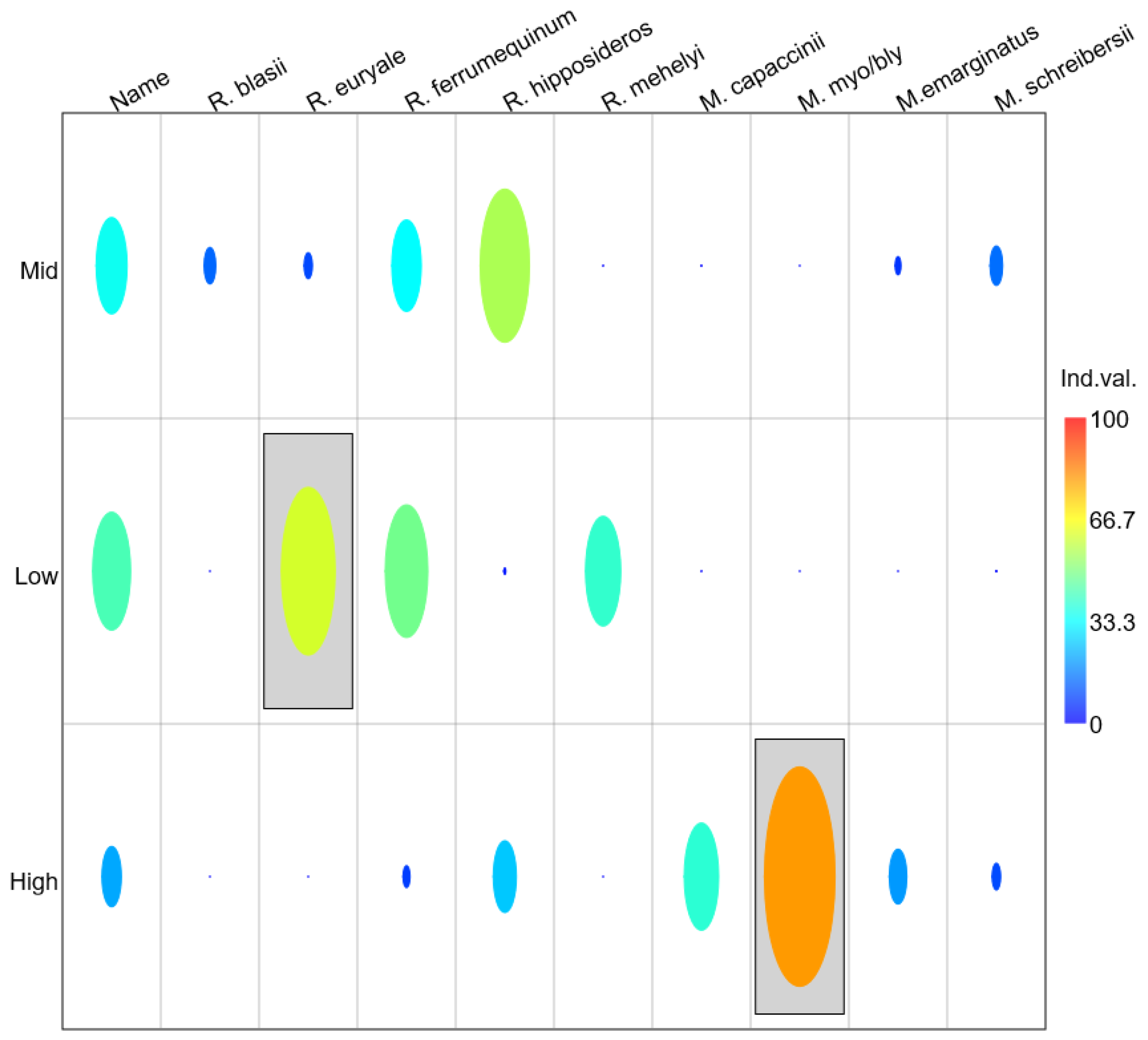
Thermal Niche Differentiation Shapes the Hibernating Bat Assemblages in Bulgarian Caves Across an Elevational Gradient

 ,
,  , , , , and
Simple Summary
Abstract
1. Introduction
2. Materials and Methods
2.1. Material
2.1.1. Study Region


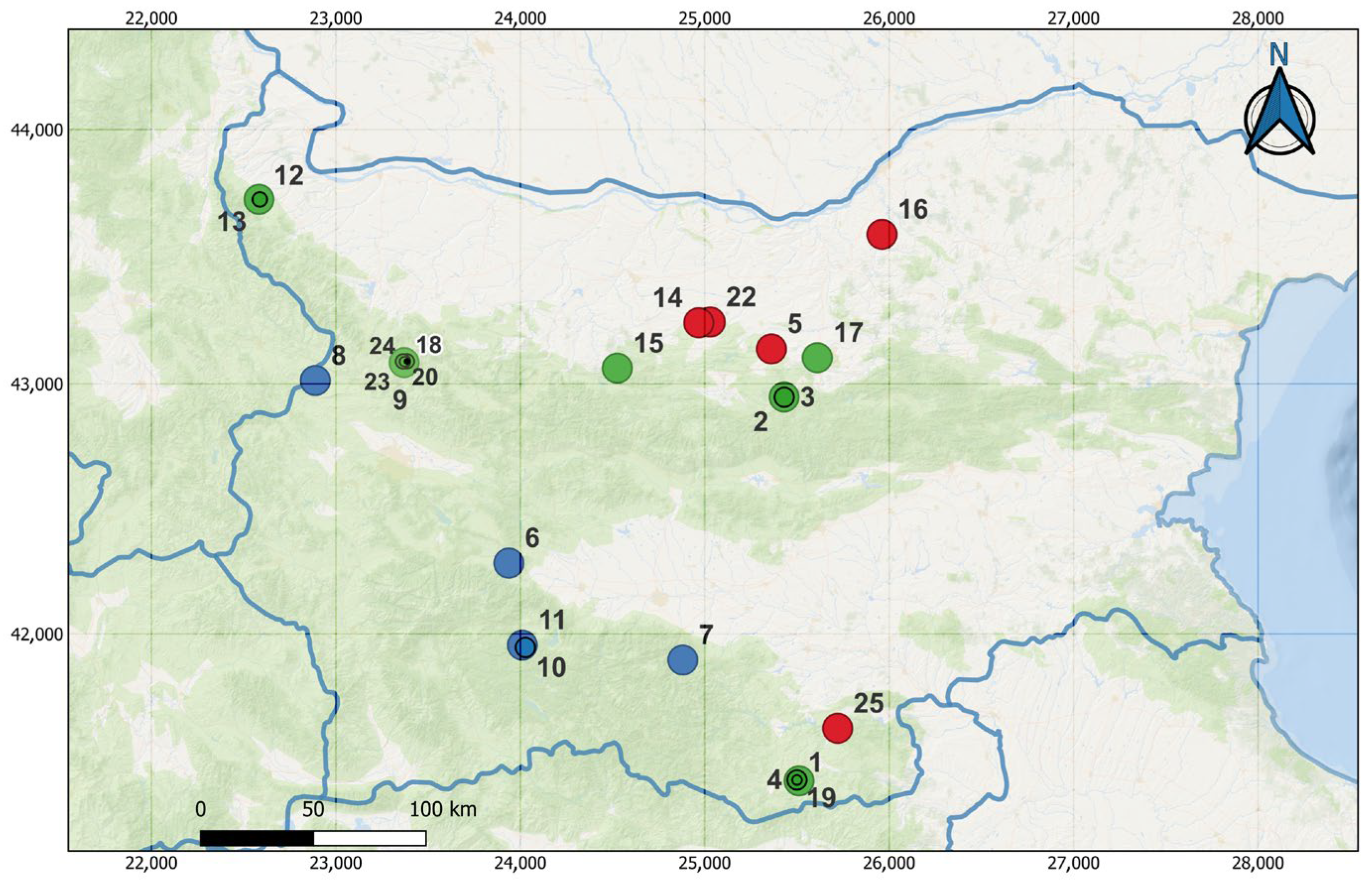
| Subterranean Sites | Cave ID | Latitude (N) | Longitude (E) | Altitude (m) | Roost Length (m) | Species Richness |
|---|---|---|---|---|---|---|
| Aina-Ini Cave | 1 | 41.4 | 25.51 | 389 | 21 | 2 |
| Andaka Cave | 2 | 42.94 | 25.43 | 323 | 5000 | 7 |
| Bacho Kiro Cave | 3 | 42.94 | 25.43 | 335 | 3500 | 2 |
| Cave next to Samara Cave | 4 | 41.4 | 25.49 | 382 | 50 | 1 |
| Emenska Cave | 5 | 43.13 | 25.36 | 264 | 264 | 6 |
| Golak mine | 6 | 42.28 | 23.93 | 688 | 688 | 4 |
| Ivanova Voda Cave | 7 | 41.89 | 24.88 | 1336 | 657 | 2 |
| Kalotinska Temna Dupka Cave | 8 | 43.01 | 22.88 | 683 | 674 | 4 |
| Kozarskata Cave | 9 | 43.08 | 23.36 | 493 | 709 | 1 |
| Lednikat Cave | 10 | 41.94 | 24.02 | 1218 | 1390 | 4 |
| Lepenitsa Cave | 11 | 41.95 | 24.01 | 1073 | 600 | 5 |
| Magura Cave | 12 | 43.72 | 22.58 | 384 | 3645 | 4 |
| Ringova Pesht Cave | 13 | 43.72 | 22.58 | 365 | 200 | 2 |
| Mandrata Cave | 14 | 43.24 | 24.96 | 220 | 530 | 3 |
| Mikrenska Cave | 15 | 43.06 | 24.52 | 422 | 1921 | 1 |
| Orlova Chuka Cave | 16 | 43.59 | 25.96 | 130 | 13,437 | 6 |
| Ovcharskata Cave | 17 | 43.1 | 25.61 | 406 | 12 | 4 |
| Razhishka Cave | 18 | 43.09 | 23.38 | 503 | 316 | 4 |
| Samara Cave | 19 | 41.89 | 24.88 | 389 | 338 | 8 |
| Svinskata Dupka Cave | 20 | 43.08 | 23.37 | 472 | 383 | 3 |
| Temnata Dupka Cave | 21 | 43.08 | 23.38 | 435 | 9000 | 2 |
| Urushka-Maara Cave | 22 | 43.24 | 25.02 | 230 | 1600 | 2 |
| Vrazhi Dupki 14 Cave | 23 | 43.08 | 23.36 | 511 | 215 | 2 |
| Vrazhi Dupki 9 Cave | 24 | 43.08 | 23.36 | 488 | 43 | 2 |
| Zandana Cave | 25 | 41.61 | 25.72 | 177 | 76 | 3 |
2.1.2. Subterranean Sites
2.2. Methods
2.2.1. Hibernacula Survey and Counting Monitoring
2.2.2. Environmental Variables
2.2.3. Bat Community Data
2.2.4. Multivariate Community Analysis
2.2.5. Species-Level Analyses
3. Results
3.1. Bat Species Abundance and Elevation Distribution
3.2. Bat Community Composition Pattern Across Elevation Gradients
3.3. Permutational Multivariate Analysis of Variance (PERMANOVA)
3.4. Species Contributions to Elevation Group Dissimilarity
3.5. Indicator Species Analysis
3.6. Alpha Diversity Across Elevation Groups
4. Discussion
4.1. Environmental Structuring of Bat Assemblages
4.2. Thermal Niche Differentiation Between Rhinolophus and Myotis Species
4.3. Species Turnover Rather than Diversity Gradients
4.4. Mid-Elevation as an Ecotone and Transition Zone
4.5. Physiological Limitations
4.6. Climate Change Implications
4.7. Limitation of the Study
5. Conclusions
Author Contributions
Funding
Institutional Review Board Statement
Informed Consent Statement
Data Availability Statement
Acknowledgments
Conflicts of Interest
References
- Raesly, R.L.; Gates, J.E. Winter Habitat Selection by North Temperate Cave Bats. Am. Midl. Nat. 1987, 118, 15–31. [Google Scholar] [CrossRef] [Scilit]
- Smirnov, D.G.; Vekhnik, V.P. Abundance and Community Structure of Bats (Chiroptera: Vespertilionidae) Hibernating in Artificial Caves of Samarskaya Luka. Russ. J. Ecol. 2011, 42, 71–79. [Google Scholar] [CrossRef] [Scilit]
- Smith, L.M.; Doonan, T.J.; Sylvia, A.L.; Gore, J.A. Characteristics of Caves Used by Wintering Bats in a Subtropical Environment. J. Fish Wildl. Manag. 2021, 2, 139–150. [Google Scholar] [CrossRef] [Scilit]
- Webb, P.I.; Speakman, J.R.; Racey, P.A. How Hot Is a Hibernaculum? A Review of the Temperatures at Which Bats Hibernate. Can. J. Zool. 1996, 74, 761–765. [Google Scholar] [CrossRef] [Scilit]
- Ransome, R. The Natural History of Hibernating Bats; Helm: London, UK, 1990. [Google Scholar]
- Brack, V. Temperatures and Locations Used by Hibernating Bats, Including Myotis sodalis (Indiana Bat), in a Limestone Mine: Implications for Conservation and Management. Environ. Manag. 2007, 40, 739–746. [Google Scholar] [CrossRef] [Scilit]
- Nagy, Z.L.; Postawa, T. Seasonal and Geographical Distribution of Cave-Dwelling Bats in Romania: Implications for Conservation. Anim. Conserv. 2011, 14, 74–86. [Google Scholar] [CrossRef] [Scilit]
- Voigt, C.C.; Kingston, T. (Eds.) Bats in the Anthropocene: Conservation of Bats in a Changing World; Springer International Publishing: Cham, Switzerland, 2016. [Google Scholar]
- Kovalyov, D.N. Hibernacula of Myotis Bats in Artificial Caves in the Leningrad Region. Russ. J. Theriol. 2017, 16, 94–109. Available online: https://kmkjournals.com/upload/PDF/RJT/16/ther16_1_094_109.pdf (accessed on 6 March 2026). [CrossRef] [Scilit]
- Geiser, F.; Stawski, C. Hibernation and Torpor in Tropical and Subtropical Bats in Relation to Energetics, Extinctions, and the Evolution of Endothermy. Integr. Comp. Biol. 2011, 51, 337–348. [Google Scholar] [CrossRef] [Scilit] [PubMed]
- Turbill, C.; Bieber, C.; Ruf, T. Hibernation Is Associated with Increased Survival and the Evolution of Slow Life Histories among Mammals. Proc. R. Soc. B Biol. Sci. 2011, 278, 3355–3363. [Google Scholar] [CrossRef] [Scilit]
- Day, K.M.; Tomasi, T.E. Winter Energetics of Female Indiana Bats Myotis Sodalis. Physiol. Biochem. Zool. 2014, 87, 55–64. [Google Scholar] [CrossRef] [Scilit] [PubMed]
- Stawski, C.; Willis, C.K.R.; Geiser, F. The Importance of Temporal Heterothermy in Bats. J. Zool. 2014, 292, 86–100. [Google Scholar] [CrossRef] [Scilit]
- Boyles, J.G.; Johnson, J.S.; Blomberg, A.; Lilley, T.M. Optimal Hibernation Theory. Mammal Rev. 2020, 50, 91–100. [Google Scholar] [CrossRef] [Scilit]
- Johnson, L.E.; Johnson, J.S. Preference for Hibernacula Microclimates Varies among 3 Bat Species Susceptible to White-Nose Syndrome. J. Mammal. 2024, 105, 1022–1031. [Google Scholar] [CrossRef] [Scilit]
- Perry, R.W. A Review of Factors Affecting Cave Climates for Hibernating Bats in Temperate North America. Environ. Rev. 2013, 21, 28–39. [Google Scholar] [CrossRef] [Scilit]
- Nigrelli, G.; Fratianni, S.; Zampollo, A.; Turconi, L.; Chiarle, M. The Altitudinal Temperature Lapse Rates Applied to High Elevation Rockfalls Studies in the Western European Alps. Theor. Appl. Climatol. 2018, 131, 1479–1491. [Google Scholar] [CrossRef] [Scilit]
- McGuire, L.P.; Boyle, W.A. Altitudinal Migration in Bats: Evidence, Patterns, and Drivers. Biol. Rev. 2013, 88, 767–786. [Google Scholar] [CrossRef] [Scilit]
- Piksa, K.; Nowak, J.; Żmihorski, M.; Bogdanowicz, W. Nonlinear Distribution Pattern of Hibernating Bats in Caves along an Elevational Gradient in Mountain (Carpathians, Southern Poland). PLoS ONE 2013, 8, e68066. [Google Scholar] [CrossRef] [Scilit] [PubMed]
- Turner, R.C.; Alexander, A.B.; Wellehan, J.F.X.; Heard, D.; Abbott, J.R.; Crevasse, S.E.; Plummer, C.E. Retrospective Analysis of Ocular Disease in a Population of Captive Pteropodid Bats, 2003–2020. Vet. Ophthalmol. 2021, 24, 240–251. [Google Scholar] [CrossRef] [Scilit]
- Kim, S.-S.; Choi, Y.-S.; Yoo, J.-C. The Thermal Preference and the Selection of Hibernacula in Seven Cave-Dwelling Bats. Korean J. Ecol. Environ. 2014, 47, 258–272. [Google Scholar] [CrossRef] [Scilit]
- Haase, C.G.; Fuller, N.W.; Hranac, C.R.; Hayman, D.T.S.; Olson, S.H.; Plowright, R.K.; McGuire, L.P. Bats Are Not Squirrels: Revisiting the Cost of Cooling in Hibernating Mammals. J. Therm. Biol. 2019, 81, 185–193. [Google Scholar] [CrossRef] [Scilit]
- McGuire, L.P.; Fuller, N.W.; Dzal, Y.A.; Haase, C.G.; Klüg-Baerwald, B.J.; Silas, K.A.; Plowright, R.K.; Lausen, C.L.; Willis, C.K.R.; Olson, S.H. Interspecific Variation in Evaporative Water Loss and Temperature Response, but Not Metabolic Rate, among Hibernating Bats. Sci. Rep. 2021, 11, 20759. [Google Scholar] [CrossRef] [Scilit] [PubMed]
- Remmers, S.; Dausmann, K.; Schoroth, M.; Rabarison, H.; Reher, S. Intraspecific Variation in Metabolic Responses to Diverse Environmental Conditions in the Malagasy Bat Triaenops menamena. J. Comp. Physiol. B 2025, 195, 247–262. [Google Scholar] [CrossRef] [Scilit]
- Paksuz, S.; Özkan, B.; Postawa, T. Seasonal Changes of Cave-Dwelling Bat Fauna, and Their Relationship with Microclimate in Dupnisa Cave System (Turkish Thrace). Acta Zool. Cracoviensia-Ser. A Vertebr. 2007, 50, 57–66. [Google Scholar] [CrossRef] [Scilit]
- Frick, W.F.; Kingston, T.; Flanders, J. A Review of the Major Threats and Challenges to Global Bat Conservation. Ann. N. Y. Acad. Sci. 2020, 1469, 5–25. [Google Scholar] [CrossRef] [Scilit] [PubMed]
- Smeraldo, S.; Di Febbraro, M.; Bosso, L.; Flaquer, C.; Guixé, D.; Lisón, F.; Meschede, A.; Juste, J.; Prüger, J.; Puig-Montserrat, X.; et al. Ignoring Seasonal Changes in the Ecological Niche of Non-Migratory Species May Lead to Biases in Potential Distribution Models: Lessons from Bats. Biodivers. Conserv. 2018, 27, 2425–2441. [Google Scholar] [CrossRef] [Scilit]
- Festa, F.; Ancillotto, L.; Santini, L.; Pacifici, M.; Rocha, R.; Toshkova, N.; Amorim, F.; Benítez-López, A.; Domer, A.; Hamidović, D.; et al. Bat Responses to Climate Change: A Systematic Review. Biol. Rev. 2023, 98, 19–33. [Google Scholar] [CrossRef] [Scilit]
- Deleva, S.; Toshkova, N.; Kolev, M.; Tanalgo, K. Important Underground Roosts for Bats in Bulgaria: Current State and Priorities for Conservation. Biodivers. Data J. 2023, 11, e98734. [Google Scholar] [CrossRef] [Scilit]
- KryŠtufek, B. A Quantitative Assessment of Balkan Mammal Diversity. In Balkan Biodiversity; Springer: Dordrecht, The Netherlands, 2004; pp. 79–108. [Google Scholar]
- Pandurska, R.S.; Beshkov, V.A. Species Diversity of Bats in Underground Roosts of the Western Stara Planina Mts. (Bulgaria). Vespertilio 1998, 3, 81–91. Available online: https://netopiere.sk/media/upload/3_12.pdf (accessed on 6 March 2026).
- Dundarova, H. Bat Diversity in Lednitsata and Forgovskata Dupka Caves: Two Potentially Important Swarming Sites in the Western Rhodopes Mts., Bulgaria. Acta Zool. Bulg. 2018, 70, 139–142. Available online: https://acta-zoologica-bulgarica.eu/downloads/acta-zoologica-bulgarica/2018/70-1-139-142.pdf (accessed on 6 March 2026).
- Dundarova, H.; Pikula, J.; Zukalova, K.; Bednarikova, S.; Mrhalek, P.; Piacek, V.; Petrov, B.; Kirov, K.; Trifonov, V.; Rashid, R.; et al. A Site of Bat Conservation Concern: Madzharovo, Eastern Rhodopes, Bulgaria. Eur. J. Wildl. Res. 2024, 70, 84. [Google Scholar] [CrossRef] [Scilit]
- Toshkova, N.; Zhelyzkova, V.; Koseva, K.; Dimitrova, K.; Elshaer, F.; Lacombe, R.V.; Lecerf, M.; Pashov, A.; Dimitrov, J.D. An Integrative Approach for Profiling Antibody Responses in Bats to Human Pathogens. EMI Anim. Environ. 2025, 1, 2504048. [Google Scholar] [CrossRef] [Scilit]
- Toshkova, N.; Simov, N. Notes on Winter Bat Mortality, Hibernation Preferences, and the Demographic Structure of Deceased Individuals from One of Europe’s Largest Bat Colonies. Conservation 2026, 6, 3. [Google Scholar] [CrossRef] [Scilit]
- Beron, P. Cave Fauna of Bulgaria; East West: Sofia, Bulgaria, 2015. [Google Scholar]
- Tzonev, R.; Pachedjieva, K.; Petrova, G.; Gussev, C.; Dimitrov, M.; Iakushenko, D. High Mountain Grassland and Shrub Vegetation of Central Balkan Mountains (Central Stara Planina Mountains, Bulgaria). Plant Biosyst.-Int. J. Deal. All Asp. Plant Biol. 2025, 159, 458–475. [Google Scholar] [CrossRef] [Scilit]
- Matev, S.; Bojkov, P.; Krenchev, D.; Nikolova, N. Temperature Gradient along the Northern Slope of the Western Rhodopes. Rev. Bulg. Geol. Soc. 2023, 84, 249–252. [Google Scholar] [CrossRef] [Scilit]
- Petrova, A.; Venkova, D.; Sopotlieva, D. Contribution to the Flora of the Rhodopes and the Thracian Plain. Hist. Nat. Bulg. 2006, 17, 27–33. Available online: https://www.nmnhs.com/historia-naturalis-bulgarica/pdfs/000279000172006.pdf (accessed on 6 March 2026).
- 92/43/EEC; Council of the European Communities Council Directive 92/43/EEC of 21 May 1992 on the Conservation of Natural Habitats and of Wild Fauna and Flora. European Union: Brussels, Belgium, 1992.
- Ministry of Environment and Water. Bulgaria Biological Diversity Act. State Gazette No 77; Ministry of Environment and Water: The Hague, The Netherlands, 2002. [Google Scholar]
- Dietz, C.; von Helversen, O. Illustrated Identification Key to the Bats of Europe; Bloomsbury Natural History: London, UK, 2004. [Google Scholar]
- Deleva, S. Counting Bats from Photographs Using ImageJ. Available online: https://www.protocols.io/view/counting-bats-from-photographs-using-imagej-cqczvsx6.pdf (accessed on 6 March 2026).
- Legendre, P.; Gallagher, E.D. Ecologically Meaningful Transformations for Ordination of Species Data. Oecologia 2001, 129, 271–280. [Google Scholar] [CrossRef] [Scilit]
- Anderson, M.J. Permutation Tests for Univariate or Multivariate Analysis of Variance and Regression. Can. J. Fish. Aquat. Sci. 2001, 58, 626–639. [Google Scholar] [CrossRef]
- Anderson, M.J. Distance-Based Tests for Homogeneity of Multivariate Dispersions. Biometrics 2006, 62, 245–253. [Google Scholar] [CrossRef] [Scilit]
- Hammer, Ø.; Harper, D.A.T.; Ryan, P.D. PAST: Paleontological Statistics Software Package for Education and Data Analysis. Palaeontol. Electron. 2001, 4, 9. Available online: http://palaeo-electronica.org/2001_1/past/issue1_01.htm (accessed on 6 March 2026).
- Kraft, N.J.B.; Adler, P.B.; Godoy, O.; James, E.C.; Fuller, S.; Levine, J.M. Community Assembly, Coexistence and the Environmental Filtering Metaphor. Funct. Ecol. 2015, 29, 592–599. [Google Scholar] [CrossRef] [Scilit]
- Geiser, F. Metabolic Rate and Body Temperature Reduction During Hibernation and Daily Torpor. Annu. Rev. Physiol. 2004, 66, 239–274. [Google Scholar] [CrossRef] [Scilit]
- McCain, C.M. Could Temperature and Water Availability Drive Elevational Species Richness Patterns? A Global Case Study for Bats. Glob. Ecol. Biogeogr. 2007, 16, 1–13. [Google Scholar] [CrossRef] [Scilit]
- Cisneros, L.M.; Burgio, K.R.; Dreiss, L.M.; Klingbeil, B.T.; Patterson, B.D.; Presley, S.J.; Willig, M.R. Multiple Dimensions of Bat Biodiversity along an Extensive Tropical Elevational Gradient. J. Anim. Ecol. 2014, 83, 1124–1136. [Google Scholar] [CrossRef] [Scilit]
- Tuttle, M.D.; Stevenson, D.E. Variation in the Cave Environment and Its Biological Implications. In Proceedings of the National Cave Management Symposium Proceedings; Zuber, R., Chester, J., Gilbert, S., Rhodes, D., Eds.; Adobe Press: Albuquerque, NM, USA, 1977; pp. 108–121. Available online: https://www.oclw.org/uploads/3/1/6/2/31627513/bat_conference.pdf#page=24 (accessed on 6 March 2026).
- Hosken, D.J.; Withers, P.C. Temperature Regulation and Metabolism of an Australian Bat, Chalinolobus Gouldii (Chiroptera: Vespertilionidae) When Euthermic and Torpid. J. Comp. Physiol. B 1997, 167, 71–80. [Google Scholar] [CrossRef] [Scilit]
- Park, K.J.; Jones, G.; Ransome, R.D. Torpor, Arousal and Activity of Hibernating Greater Horseshoe Bats (Rhinolophus ferrumequinum). Funct. Ecol. 2000, 14, 580–588. Available online: https://www.jstor.org/stable/2656391?seq=1 (accessed on 6 March 2026). [CrossRef] [Scilit]
- Geiser, F.; Ruf, T. Hibernation versus Daily Torpor in Mammals and Birds: Physiological Variables and Classification of Torpor Patterns. Physiol. Zool 1995, 68, 935–966. [Google Scholar] [CrossRef] [Scilit]
- Daan, S. Activity during Natural Hibernation in Three Species of Vespertilionid Bats. Neth. J. Zool. 1973, 23, 1–71. Available online: https://pure.rug.nl/ws/portalfiles/portal/14698609/1973NethJZoolDaan1.pdf (accessed on 6 March 2026).
- Speakman, J.R.; Thomas, D.W.; Kunz, T.H.; Fenton, M.B. Physiological Ecology and Energetics of Bats. In Bat Ecology; Kunz, H.T., Fenton, M.B., Eds.; The University of Chicago Press: Chicago, IL, USA, 2003; pp. 430–490. [Google Scholar]
- Boyles, J.G.; Brack, V. Modeling Survival Rates of Hibernating Mammals with Individual-Based Models of Energy Expenditure. J. Mammal. 2009, 90, 9–16. [Google Scholar] [CrossRef] [Scilit]
- Langwig, K.E.; Frick, W.F.; Bried, J.T.; Hicks, A.C.; Kunz, T.H.; Marm Kilpatrick, A. Sociality, Density-dependence and Microclimates Determine the Persistence of Populations Suffering from a Novel Fungal Disease, White-nose Syndrome. Ecol. Lett. 2012, 15, 1050–1057. [Google Scholar] [CrossRef] [Scilit]
- Humphries, M.M.; Thomas, D.W.; Speakman, J.R. Climate-Mediated Energetic Constraints on the Distribution of Hibernating Mammals. Nature 2002, 418, 313–316. [Google Scholar] [CrossRef] [Scilit] [PubMed]
- Kerth, G.; Weissmann, K.; König, B. Day Roost Selection in Female Bechstein’s Bats (Myotis bechsteinii): A Field Experiment to Determine the Influence of Roost Temperature. Oecologia 2001, 126, 1–9. [Google Scholar] [CrossRef] [Scilit]
- Johnson, J.B.; Gates, J.E.; Zegre, N.P. Monitoring Seasonal Bat Activity on a Coastal Barrier Island in Maryland, USA. Environ. Monit. Assess. 2011, 173, 685–699. [Google Scholar] [CrossRef] [Scilit]
- Kalko, E.K.V.; Herre, E.A.; Handley, C.O. Relation of Fig Fruit Characteristics to Fruit-eating Bats in the New and Old World Tropics. J. Biogeogr. 1996, 23, 565–576. [Google Scholar] [CrossRef] [Scilit]
- Willig, M.R.; Presley, S.J. Reproductive Phenologies of Phyllostomid Bat Populations and Ensembles from Lowland Amazonia. J. Mammal. 2023, 104, 752–769. [Google Scholar] [CrossRef] [Scilit] [PubMed]
- Dietz, C.; Dietz, I.; Ivanova, T.; Siemers, B.M. Seasonal and Regional Scale Movements of Horseshoe Bats (Rhinolophus, Chiroptera: Rhinolophidae) in Northern Bulgaria. Nyctalus 2009, 14, 52–64. Available online: https://bats.greenbalkans.org/files/modules/216/32-dietz-et-al-2009-movements-of-horseshoebats-small-639.pdf (accessed on 6 March 2026).
- Ruedi, M.; Mayer, F. Molecular Systematics of Bats of the Genus Myotis (Vespertilionidae) Suggests Deterministic Ecomorphological Convergences. Mol. Phylogenetics Evol. 2001, 21, 436–448. [Google Scholar] [CrossRef] [Scilit]
- Arlettaz, R.; Perrin, N.; Hausser, J. Trophic Resource Partitioning and Competition between the Two Sibling Bat Species Myotis myotis and Myotis blythii. J. Anim. Ecol. 1997, 66, 897. [Google Scholar] [CrossRef] [Scilit]
- Fenton, M.B.; Acharya, L.; Audet, D.; Hickey, M.B.C.; Merriman, C.; Obrist, M.K.; Syme, D.M.; Adkins, B. Phyllostomid Bats (Chiroptera: Phyllostomidae) as Indicators of Habitat Disruption in the Neotropics. Biotropica 1992, 24, 440. [Google Scholar] [CrossRef] [Scilit]
- Brown, J.H.; Gillooly, J.F.; Allen, A.P.; Savage, V.M.; West, G.B. Toward a metabolic theory of ecology. Ecology 2004, 85, 1771–1789. [Google Scholar] [CrossRef] [Scilit]
- Patterson, B.D.; Ballard, J.W.O.; Wenzel, R.L. Distributional Evidence for Cospeciation between Neotropical Bats and Their Bat Fly Ectoparasites. Stud. Neotrop. Fauna Environ. 1998, 33, 76–84. [Google Scholar] [CrossRef] [Scilit]
- Rowe, R.J. Environmental and Geometric Drivers of Small Mammal Diversity along Elevational Gradients in Utah. Ecography 2009, 32, 411–422. [Google Scholar] [CrossRef] [Scilit]
- Rahbek, C. The Elevational Gradient of Species Richness: A Uniform Pattern? Ecography 1995, 18, 200–205. Available online: https://www.jstor.org/stable/3682769 (accessed on 6 March 2026). [CrossRef] [Scilit]
- McCain, C.M. Elevational Gradients in Diversity of Small Mammals. Ecology 2005, 86, 366–372. [Google Scholar] [CrossRef] [Scilit]
- Lomolino, M.V. Elevation Gradients of Species-density: Historical and Prospective Views. Glob. Ecol. Biogeogr. 2001, 10, 3–13. [Google Scholar] [CrossRef] [Scilit]
- Qian, H.; Ricklefs, R.E.; White, P.S. Beta Diversity of Angiosperms in Temperate Floras of Eastern Asia and Eastern North America. Ecol. Lett. 2005, 8, 15–22. [Google Scholar] [CrossRef] [Scilit]
- Jankowski, J.E.; Ciecka, A.L.; Meyer, N.Y.; Rabenold, K.N. Beta Diversity along Environmental Gradients: Implications of Habitat Specialization in Tropical Montane Landscapes. J. Anim. Ecol. 2009, 78, 315–327. [Google Scholar] [CrossRef] [Scilit] [PubMed]
- Colwell, R.; Lees, D. The Mid-Domain Effect: Geometric Constraints on the Geography of Species Richness. Trends Ecol. Evol. 2000, 15, 70–76. Available online: https://www.cell.com/trends/ecology-evolution/fulltext/S0169-5347(99)01767-X?large_figure=true (accessed on 6 March 2026). [CrossRef] [Scilit] [PubMed]
- Rahbek, C. The Role of Spatial Scale and the Perception of Large-scale Species-richness Patterns. Ecol. Lett. 2005, 8, 224–239. [Google Scholar] [CrossRef] [Scilit]
- Rowe, K.C.; Rowe, K.M.C.; Tingley, M.W.; Koo, M.S.; Patton, J.L.; Conroy, C.J.; Perrine, J.D.; Beissinger, S.R.; Moritz, C. Spatially Heterogeneous Impact of Climate Change on Small Mammals of Montane California. Proc. R. Soc. B Biol. Sci. 2015, 282, 20141857. [Google Scholar] [CrossRef] [Scilit]
- Brunet, A.K.; Medellín, R.A. The Species–Area Relationship in Bat Assemblages of Tropical Caves. J. Mammal. 2001, 82, 1114–1122. [Google Scholar] [CrossRef] [Scilit]
- Risser, P.G. The Status of the Science Examining Ecotones. Bioscience 1995, 45, 318–325. [Google Scholar] [CrossRef] [Scilit]
- Kark, S.; van Rensburg, B.J. Ecotones: Marginal or Central Areas of Transition? Isr. J. Ecol. Evol. 2006, 52, 29–53. [Google Scholar] [CrossRef] [Scilit]
- Rodrigues, L.; Palmeirim, J.M. Migratory Behaviour of the Schreiber’s Bat: When, Where and Why Do Cave Bats Migrate in a Mediterranean Region? J. Zool. 2008, 274, 116–125. [Google Scholar] [CrossRef] [Scilit]
- Popa-Lisseanu, A.G.; Kramer-Schadt, S.; Quetglas, J.; Delgado-Huertas, A.; Kelm, D.H.; Ibáñez, C. Seasonal Variation in Stable Carbon and Nitrogen Isotope Values of Bats Reflect Environmental Baselines. PLoS ONE 2015, 10, e0117052. [Google Scholar] [CrossRef] [Scilit]
- Moritz, C.; Patton, J.L.; Conroy, C.J.; Parra, J.L.; White, G.C.; Beissinger, S.R. Impact of a Century of Climate Change on Small-Mammal Communities in Yosemite National Park, USA. Science 2008, 322, 261–264. [Google Scholar] [CrossRef] [Scilit]
- Stofer, A.; Murphy, M.A.; Spear, S.F.; Holderegger, R.; Waits, L.P. Landscape Genetics: Where Are We Now? Mol. Ecol. 2010, 19, 3496–3514. [Google Scholar] [CrossRef] [Scilit]
- Kravchenko, K.; Voigt, C.C.; Volkholz, J.; Courtiol, A.; Currie, S.E. Shorter and Warmer Winters Expand the Hibernation Area of Bats in Europe. Ecol. Lett. 2025, 28, e70119. [Google Scholar] [CrossRef] [Scilit]
- Ruf, T.; Geiser, F. Daily Torpor and Hibernation in Birds and Mammals. Biol. Rev. 2015, 90, 891–926. [Google Scholar] [CrossRef] [Scilit]
- Thomas, D.W.; Dorais, M.; Bergeron, J.-M. Winter Energy Budgets and Cost of Arousals for Hibernating Little Brown Bats, Myotis lucifugus. J. Mammal. 1990, 71, 475–479. [Google Scholar] [CrossRef] [Scilit]
- Hock, R. The Metabolic Rates and Body Temperatures of Bats. Biol. Bull. 1951, 101, 289–299. [Google Scholar] [CrossRef] [Scilit]
- Studier, E. Energetic Advantages of Slight Drops in Body Temperature in Little Brown Bats, Myotis lucifugus. Comp. Biochem. Physiol. A Physiol. 1981, 70, 537–540. [Google Scholar] [CrossRef] [Scilit]
- Hodkinson, I.D. Terrestrial Insects along Elevation Gradients: Species and Community Responses to Altitude. Biol. Rev. 2005, 80, 489–513. [Google Scholar] [CrossRef] [Scilit] [PubMed]
- Sergio, F.; Marchesi, L.; Pedrini, P.; Penteriani, V. Coexistence of a Generalist Owl with Its Intraguild Predator: Distance-Sensitive or Habitat-Mediated Avoidance? Anim. Behav. 2007, 74, 1607–1616. [Google Scholar] [CrossRef] [Scilit]
- Altizer, S.; Ostfeld, R.S.; Johnson, P.T.J.; Kutz, S.; Harvell, C.D. Climate Change and Infectious Diseases: From Evidence to a Predictive Framework. Science 2013, 341, 514–519. [Google Scholar] [CrossRef] [Scilit]
- Sunday, J.M.; Bates, A.E.; Dulvy, N.K. Thermal tolerance and the global redistribution of animals. Nat. Clim. Change 2012, 2, 686–690. [Google Scholar] [CrossRef] [Scilit]
- Badino, G. Underground meteorology-“What’s the weather underground?”. Acta Carsologica 2010, 39, 427–448. [Google Scholar] [CrossRef] [Scilit]
- Mammola, S.; Piano, E.; Cardoso, P.; Vernon, P.; Domínguez-Villar, D.; Culver, D.C.; Pipan, T.; Isaia, M. Climate change going deep: The effects of global climatic alterations on cave ecosystems. Anthr. Rev. 2019, 6, 98–116. [Google Scholar] [CrossRef] [Scilit]
- Geiser, F. Ecological Physiology of Daily Torpor and Hibernation, 1st ed.; Springer: Berlin/Heidelberg, Germany, 2021; p. 311. [Google Scholar] [CrossRef] [Scilit]
- Sherwin, H.A.; Montgomery, W.I.; Lundy, M.G. The impact and implications of climate change for bats. Mammal Rev. 2012, 43, 171–182. [Google Scholar] [CrossRef] [Scilit]


| Cave Name | Cave ID | R. blasii | R. euryale | R. ferrumequinum | R. hipposideros | R. mehelyi | M. capaccinii | M. myo/bly | M. emarginatus | M. schreibersii |
|---|---|---|---|---|---|---|---|---|---|---|
| Aina-Ini Cave | 1 | 539 | 78 | 0 | 0 | 0 | 0 | 0 | 0 | 0 |
| Andaka Cave | 2 | 0 | 300 | 4136 | 1 | 0 | 0 | 0 | 0 | 896 |
| Bacho Kiro Cave | 3 | 0 | 0 | 105 | 271 | 0 | 0 | 0 | 0 | 0 |
| Cave next to Samara Cave | 4 | 0 | 1 | 0 | 2 | 0 | 0 | 0 | 0 | 0 |
| Emenska cave | 5 | 0 | 9 | 199 | 2 | 1 | 4 | 0 | 0 | 203 |
| Golak mine | 6 | 0 | 1 | 3 | 9 | 0 | 0 | 0 | 0 | 170 |
| Ivanova Voda Cave | 7 | 0 | 0 | 0 | 0 | 0 | 15,000 | 5267 | 0 | 0 |
| Kalotinska Temna Dupka Cave | 8 | 0 | 0 | 36 | 128 | 0 | 0 | 1 | 0 | 1190 |
| Kazarskata Cave | 9 | 0 | 0 | 0 | 27 | 0 | 0 | 0 | 0 | 0 |
| Lednikat Cave | 10 | 0 | 0 | 3 | 1 | 0 | 0 | 1 | 2 | 0 |
| Lepenitsa Cave | 11 | 0 | 0 | 633 | 136 | 0 | 3 | 16 | 7 | 0 |
| Magura Cave | 12 | 0 | 7373 | 2716 | 1126 | 0 | 959 | 0 | 1 | 0 |
| Ringova Pesht Cave | 13 | 0 | 0 | 1 | 7 | 0 | 0 | 0 | 0 | 0 |
| Mandrata Cave | 14 | 0 | 1000 | 432 | 18 | 0 | 0 | 0 | 0 | 0 |
| Mikrenska Cave | 15 | 0 | 0 | 300 | 0 | 0 | 0 | 0 | 0 | 0 |
| Orlova Chuka Cave | 16 | 0 | 6321 | 144 | 0 | 4842 | 0 | 0 | 0 | 0 |
| Ovcharskata Cave | 17 | 0 | 0 | 4 | 1 | 0 | 0 | 1 | 0 | 0 |
| Razhishka Cave | 18 | 0 | 0 | 1059 | 18 | 0 | 0 | 0 | 0 | 11,125 |
| Samara Cave | 19 | 26 | 26 | 26 | 26 | 26 | 26 | 26 | 26 | 26 |
| Svinskata dupka cave | 20 | 0 | 1 | 4 | 115 | 0 | 0 | 0 | 0 | 0 |
| Temnata Dupka Cave | 21 | 0 | 0 | 14 | 11 | 0 | 0 | 0 | 0 | 0 |
| Urushka-Maara Cave | 22 | 0 | 0 | 2459 | 4 | 0 | 0 | 0 | 0 | 0 |
| Vrazhi dupki 14 (Prilepska) cave | 23 | 0 | 0 | 18 | 11 | 0 | 0 | 0 | 0 | 0 |
| Vrazhi dupki 9 cave | 24 | 0 | 0 | 7 | 1 | 0 | 0 | 0 | 0 | 0 |
| Zandana Cave | 25 | 0 | 1000 | 3 | 1 | 0 | 0 | 0 | 0 | 0 |
| Total | 565 | 16,110 | 12,302 | 1916 | 4869 | 15,992 | 5312 | 36 | 13,610 |
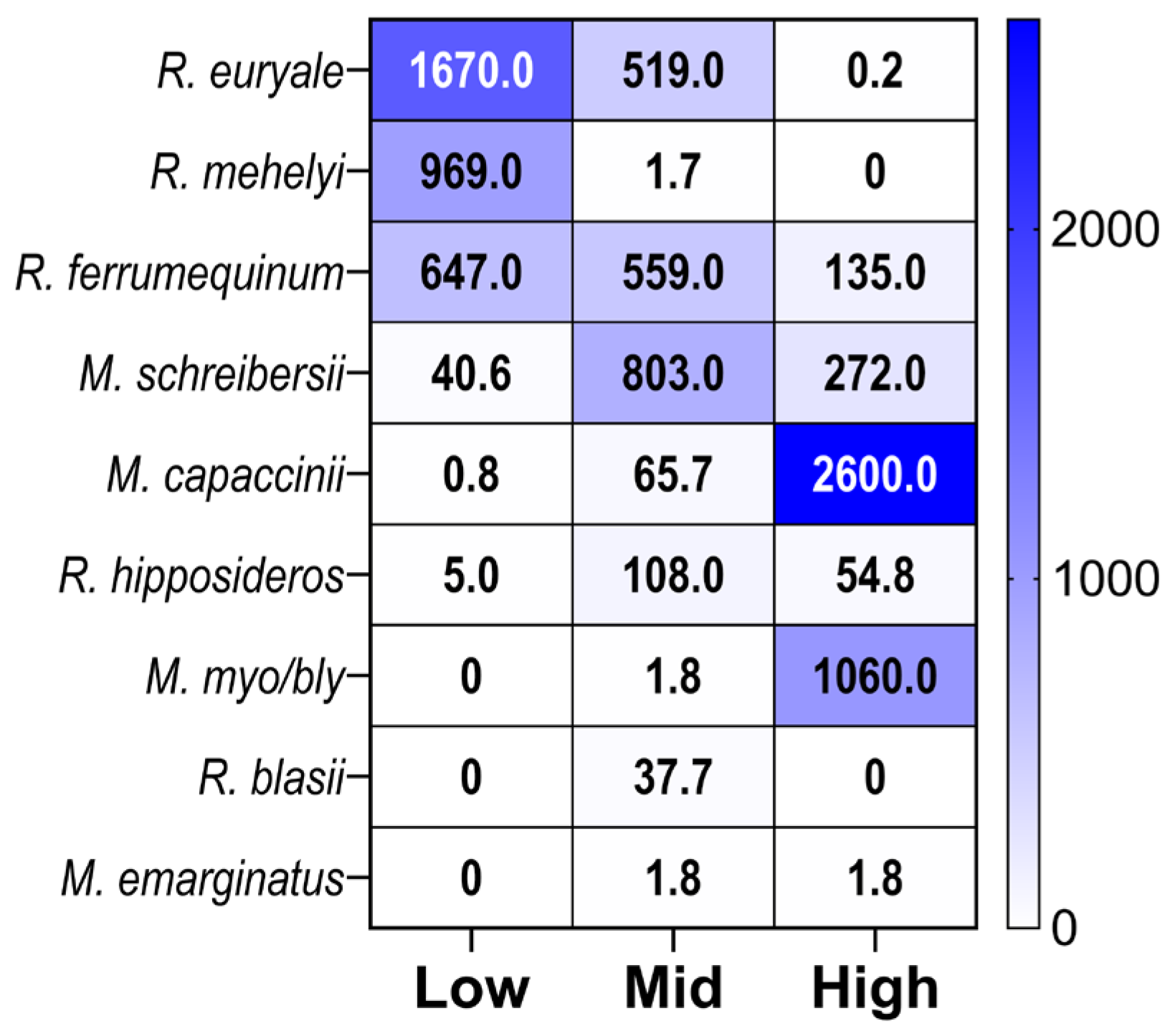
| Comparison of Elevation Groups | Rank | Species | Contribution % | Cumulative % | Abundance Pattern |
|---|---|---|---|---|---|
| Mid vs. Low | 1 | R. euryale | 40.66 | 40.66 | Low >> Mid (1670 vs. 519) |
| 2 | R. ferrumequinum | 32.03 | 72.69 | Low > Mid (647 vs. 559) | |
| 3 | M. schreibersii | 13.02 | 85.71 | Mid >> Low (803 vs. 40.6) | |
| 4 | R. mehelyi | 8.46 | 94.17 | Low >> Mid (969 vs. 1.73) | |
| Mid vs. High | 1 | M. schreibersii | 24.04 | 56.14 | Mid >> High (559 vs. 135) |
| 2 | R. ferrumequinum | 15.21 | 71.35 | High >> Mid (2600 vs. 65.7) | |
| 3 | M. capaccinii | 11.16 | 82.51 | Mid > High (108 vs. 54.8) | |
| 4 | R. hipposideros | 24.04 | 56.14 | Mid >> High (559 vs. 135) | |
| Low vs. High | 1 | R. euryale | 32.41 | 32.41 | Low >> High (1670 vs. 0.2) |
| 2 | R. ferrumequinum | 25.10% | 57.51 | Low >> High (647 vs. 135) | |
| 3 | M. capaccinii | 13.65 | 71.16 | High >> Low (2600 vs. 0.8) | |
| 4 | M. schreibersii | 12.81 | 83.98 | High > Low (272 vs. 40.6) |
Disclaimer/Publisher’s Note: The statements, opinions and data contained in all publications are solely those of the individual author(s) and contributor(s) and not of MDPI and/or the editor(s). MDPI and/or the editor(s) disclaim responsibility for any injury to people or property resulting from any ideas, methods, instructions or products referred to in the content. |
© 2026 by the authors. Licensee MDPI, Basel, Switzerland. This article is an open access article distributed under the terms and conditions of the Creative Commons Attribution (CC BY) license.
Share and Cite
Dundarova, H.; Acosta-Pankov, I.; Nedyalkova, E.; Lubenova, A.; Kolev, M.; Kirov, K.; Lakovski, K.; Genova, O.; Parvanov, V.; Iskrenova, P.; et al. Thermal Niche Differentiation Shapes the Hibernating Bat Assemblages in Bulgarian Caves Across an Elevational Gradient. Biology 2026, 15, 484. https://doi.org/10.3390/biology15060484
Dundarova H, Acosta-Pankov I, Nedyalkova E, Lubenova A, Kolev M, Kirov K, Lakovski K, Genova O, Parvanov V, Iskrenova P, et al. Thermal Niche Differentiation Shapes the Hibernating Bat Assemblages in Bulgarian Caves Across an Elevational Gradient. Biology. 2026; 15(6):484. https://doi.org/10.3390/biology15060484
Chicago/Turabian StyleDundarova, Heliana, Ilya Acosta-Pankov, Elena Nedyalkova, Andrea Lubenova, Maksim Kolev, Krasimir Kirov, Krasimir Lakovski, Olya Genova, Valeri Parvanov, Plamenka Iskrenova, and et al. 2026. "Thermal Niche Differentiation Shapes the Hibernating Bat Assemblages in Bulgarian Caves Across an Elevational Gradient" Biology 15, no. 6: 484. https://doi.org/10.3390/biology15060484
APA StyleDundarova, H., Acosta-Pankov, I., Nedyalkova, E., Lubenova, A., Kolev, M., Kirov, K., Lakovski, K., Genova, O., Parvanov, V., Iskrenova, P., Trifonov, V., & Chassovnikarova, T. (2026). Thermal Niche Differentiation Shapes the Hibernating Bat Assemblages in Bulgarian Caves Across an Elevational Gradient. Biology, 15(6), 484. https://doi.org/10.3390/biology15060484