Article

Protective Effects and Mechanisms of Taxus cuspidata Seed Oil on CCl4-Induced Hepatic Fibrosis in Mice

School of Agriculture, Liaodong University, Dandong 118003, China
*
Author to whom correspondence should be addressed.
Biology 2026, 15(5), 442; https://doi.org/10.3390/biology15050442
Submission received: 23 January 2026 / Revised: 5 March 2026 / Accepted: 6 March 2026 / Published: 9 March 2026

Simple Summary

This study aimed to discover new approaches to combat liver fibrosis. We focused on investigating whether oil extracted from the seeds of Taxus cuspidata (abbreviated as TCSO) possesses liver-protective effects. The experimental results show that TCSO can effectively reduce liver damage in mice caused by toxic chemicals. It primarily works through three pathways: reducing liver cell damage, enhancing the liver’s own antioxidant defenses, and preventing excessive scar tissue formation. This research confirms that TCSO significantly improves liver fibrosis in animal models. It provides an important scientific basis for the future development of natural ingredient-based liver protective products or drugs, offering new hope for patients with liver disease.

Abstract

This study aimed to investigate the effect and underlying mechanism of Taxus cuspidata seed oil (TCSO) on carbon tetrachloride (CCl4)-induced hepatic fibrosis in mice. A mouse model of hepatic fibrosis was established by CCl4 induction, and the model mice were subsequently treated orally with high dose or low dose TCSO for eight weeks. The degree of liver fibrosis and the mechanism of action were assessed through organ indices, serum biochemical markers, oxidative stress levels, histopathological examination, and molecular biological analyses. The results demonstrated that TCSO significantly reduced serum levels of alanine transaminase (ALT), aspartate transaminase (AST), and alkaline phosphatase (ALP). Concurrently, it decreased the concentrations of liver fibrosis markers, including procollagen III (PC III), collagen IV (IV-C), hyaluronic acid (HA), and laminin (LN), and reduced hepatic collagen deposition. Furthermore, TCSO enhanced the activities of the antioxidants superoxide dismutase (SOD) and glutathione (GSH) while inhibiting the production of the lipid peroxidation product malondialdehyde (MDA), and it ameliorated histopathological alterations in liver tissue. Additionally, TCSO markedly downregulated the expression of key fibrogenic proteins, such as transforming growth factor-β1 (TGF-β1), matrix metalloproteinase-2 (MMP-2), and tissue inhibitor of metalloproteinases-1 (TIMP-1), thereby effectively suppressing the progression of hepatic fibrosis. In conclusion, TCSO ameliorates hepatic fibrosis in mice by reducing hepatotoxic enzyme activity and collagen deposition, enhancing antioxidant capacity, and downregulating the expression of fibrosis-related proteins.

1. Introduction

Liver cirrhosis poses a global health challenge, claiming approximately one million lives annually. Hepatic fibrosis, the precursor lesion to cirrhosis, is characterized by the abnormal accumulation of extracellular matrix within the liver. Despite the liver’s remarkable regenerative capacity, harmful stimuli such as chemical toxins, alcohol, and viral infections can drive the progression of fibrosis to cirrhosis [1]. The mechanisms underlying hepatic fibrosis have been extensively investigated. It is established that activated hepatic stellate cells (HSCs) are the primary source of extracellular matrix, with macrophages also playing a crucial role in this process [2]. Oxidative stress is recognized as a significant driver promoting inflammatory and fibrotic responses. The activation of HSCs is closely associated with the sequential expression of key pro-fibrogenic cytokines and the activation of their surface receptors, including transforming growth factor-β1 (TGF-β1), matrix metalloproteinase-2 (MMP-2), and tissue inhibitor of metalloproteinases-1 (TIMP-1) [3]. For instance, TGF-β1 expression is low under normal conditions but increases markedly following liver injury; thus, inhibiting its expression represents a potential therapeutic target for mitigating fibrosis [4]. However, to date, no approved drugs effectively reverse hepatic fibrosis [5].
Taxus cuspidata has a medicinal history in China spanning over 1200 years. Its important active constituent, paclitaxel, a well-known anticancer compound found in its branches and leaves, is a classic tricyclic diterpenoid antitumor agent. Paclitaxel uniquely stabilizes cellular microtubules, inhibiting their depolymerization and thereby blocking tumor cell mitosis [6]. It is now widely used clinically for treating various solid tumors, including ovarian, breast, and non-small cell lung cancers [7]. Recent studies suggest that Taxus species exhibit multi-target potential in regulating anti-fibrotic effects. Research demonstrated that low-dose paclitaxel significantly alleviated bile duct ligation-induced hepatic fibrosis in rats, a mechanism associated with the inhibition of pro-fibrotic factors TGF-β1 and c-Myc, alongside the promotion of the anti-fibrotic factor IL-10 [8]. Furthermore, paclitaxel can specifically interfere with TGF-β1 signaling between biliary epithelial cells and myofibroblasts, thereby suppressing collagen I synthesis [9]. On the other hand, polyprenols extracted from Taxus needles have also been confirmed to significantly delay fibrosis progression in a carbon tetrachloride-induced rat model. Their mechanism involves enhancing the body’s antioxidant capacity, inhibiting HSC activation, and downregulating pro-fibrotic cytokines, potentially via inhibition of the TGF-β/Smad signaling pathway [10]. Independent studies have also reported therapeutic effects of needle polyprenols on chronic immune-mediated liver injury and fibrosis induced by porcine serum in rats [11].
Taxus cuspidata seed oil (TCSO) is rich in unsaturated fatty acids (total content up to 94.59%), featuring a high proportion of 48.4% oleic acid and 42.2% linoleic acid [12]. It exhibits a broad range of biological activities, including anti-inflammatory, antioxidant, hepatoprotective, and blood cholesterol-lowering effects. It has shown efficacy in ameliorating hepatic steatosis in a non-alcoholic fatty liver disease mouse model by activating the PPARα pathway [13]. Furthermore, toxicological studies on Taxus seeds preliminarily indicated no acute oral toxicity [14]. However, research on the anti-fibrotic effects of Taxus oils remains limited, and the specific active components and their mechanisms of action are not yet clearly defined. Therefore, this study aims to systematically investigate the potential alleviating effect of TCSO on hepatic fibrosis and its possible mechanisms by establishing a CCl4-induced liver fibrosis mouse model, combined with biochemical marker detection and histopathological analysis.

2. Materials and Methods

2.1. Materials and Reagents

2.1.1. Animal Materials

Thirty 4-week-old specific pathogen-free (SPF) healthy male C57BL/6 mice, weighing 16–18 g, were purchased from Hangzhou Ziyuan Laboratory Animal Technology Co., Ltd., Hangzhou, China (Production License No.: SCXK (Zhe) 2019-0004; Animal Quality Certificate No.: 20230625Abzz0105000159). The mice were acclimatized for 7 days before the experiment commenced. The laboratory environment was maintained at a humidity of 60% ± 5% and a temperature of 20 ± 2 °C, with normal access to water and food and a standard light/dark cycle. All procedures were conducted in accordance with the “Guiding Principles in the Care and Use of Animals” (China) and were approved by the Laboratory Animal Ethics Committee of Liaodong University (20241023-8).

2.1.2. Reagents and Instruments

Carbon tetrachloride (CCl4, Lot No.: C132016) and olive oil (Lot No.: O1514) were purchased from Aladdin Biochemical Technology Co., Ltd. (Shanghai, China). Assay kits for alanine transaminase (ALT, Lot No.: SP30122), aspartate transaminase (AST, Lot No.: SP1300), albumin (ALB, Lot No.: SP14900), and alkaline phosphatase (ALP, Lot No.: SP14295) were purchased from Saipu Biotechnology Co., Ltd. (Wuhan, China). Enzyme-linked immunosorbent assay (ELISA) kits for hyaluronic acid (HA, Lot No.: J24514), laminin (LN, Lot No.: J23540), procollagen type III (PC-III, Lot No.: J25408), and collagen type IV (IV-C, Lot No.: J23731) were obtained from Jilaide Biotechnology Co., Ltd. (Wuhan, China). Assay kits for superoxide dismutase (SOD, Lot No.: A033-1), malondialdehyde (MDA, Lot No.: A003-1), and glutathione (GSH, Lot No.: A006-1) were provided by the Nanjing Jiancheng Bioengineering Institute (Nanjing, China). A hematoxylin and eosin (H&E) staining kit (Lot No.: G1120) was purchased from Solaibao Technology Co., Ltd. (Beijing, China). TRIzol reagent (Lot No.: 15596026CN), a reverse transcription kit (Lot No.: K1691), and a real-time quantitative polymerase chain reaction (RT-qPCR) kit (Lot No.: 11732076) were procured from Thermo Fisher Scientific (Waltham, MA, USA).
The instruments used included: a PUZS-300 fully automated biochemical analyzer (Beijing Pulang Health Technology Co., Ltd., Beijing, China); a JRA98-IIIL ultrasonic cell disruptor (Wuxie Jieruian Instrument Co., Ltd., Wuxi, China); a TGL-18MC benchtop high-speed refrigerated centrifuge (Shanghai Tuohe Electromechanical Technology Co., Ltd., Shanghai, China); an ELB700 microplate reader (Bio-Tek Instruments, Winooski, VT, USA); and a CFX96TOUCH real-time PCR detection system (Bio-Rad, Hercules, CA, USA).

2.2. Experimental Methods

2.2.1. Preparation of TCSO

Taxus cuspidata seeds were manually dehulled to obtain the kernels. The kernels were dried to a constant weight in an air-drying oven at 70 °C, subsequently crushed, and sieved through a 50-mesh standard sieve. The crushed sample was loaded into a custom-built miniature screw press device (screw diameter: 20 mm, pressing chamber length: 150 mm). The pressing process was conducted with the outlet temperature of the pressing head set at 50 °C. The collected pressed liquid was centrifuged at 5000 r/min for 10 min, and the supernatant was filtered to obtain clear and transparent TCSO.

2.2.2. Animal Treatment

After the acclimatization period, all mice were randomly assigned to five experimental groups based on weight stratification and block design (n = 6 per group): normal control (NC) group, model (Model) group, low-dose TCSO (LDT; 2 mL/kg) group, high-dose TCSO (HDT; 10 mL/kg) group, and colchicine positive control group (Col; 0.1 mg/kg) [15]. The NC group received olive oil via oral gavage. The Model group received intraperitoneal (i.p.) injections of CCl4 to induce hepatic fibrosis. The successful establishment of the liver fibrosis model was confirmed when Model group mice exhibited signs such as disheveled and lusterless fur, weight loss, and sluggishness, combined with the assessment of liver function and fibrosis markers. The LDT and HDT groups received CCl4 (i.p.) along with their respective doses of TCSO via oral gavage. The Col group received CCl4 (i.p.) along with colchicine (0.1 mg/kg, oral gavage). After 8 consecutive weeks of treatment, all mice were euthanized, and blood and organ samples were collected.

2.2.3. Determination of Organ Index

Following euthanasia, the liver, spleen, and kidneys were excised. The surface blood was rinsed off with ice-cold physiological saline, and residual moisture was gently absorbed using filter paper. The wet weight (g) of each organ was measured using an electronic balance, and the fasting body weight (g) of each mouse prior to euthanasia was recorded. The organ index was calculated using the formula: Organ Index (%) = [Organ Wet Weight (g)/Body Weight (g)] × 100%.

2.2.4. Determination of Liver Function Indices

Blood samples from the mice were centrifuged at 4000 r/min for 20 min at 4 °C, and the supernatant (serum) was collected for biochemical analysis. The concentrations of ALT, AST, ALP, and ALB in the serum were measured using the PUZS-300 fully automated biochemical analyzer (Beijing Pulangxin Technology Co., Ltd., Beijing, China).

2.2.5. Determination of Oxidation and Fibrosis Indices

The contents of SOD, GSH, and MDA in liver tissue homogenates were measured using commercial kits to assess oxidative stress levels. The levels of liver fibrosis biomarkers, including PC-III, IV-C, HA, and LN, were measured using ELISA kits (Jingmei Biotech Co., Ltd., Shenzhen, China).

2.2.6. Histopathological Observation of Liver Tissue

After dissection, the liver was immediately washed with ice-cold physiological saline. Following weighing, the left lateral lobe was taken and fixed in 4% paraformaldehyde solution. The fixed liver tissues were subsequently processed, embedded in paraffin, and sectioned into 4 μm-thick slices. The liver sections were stained with H&E for observation of pathological changes. To evaluate the degree of liver fibrosis, a numerical scoring system was employed: 0 = no fibrosis; 1–2 = fibrous connective tissue mainly confined to portal areas or with portal expansion; 3 = fibrosis present in most portal areas, with occasional portal-to-portal bridging; 4 = significant portal bridging fibrosis; 5 = significant portal bridging fibrosis with occasional nodule formation; 6 = cirrhosis.

2.2.7. RT-qPCR Analysis

Approximately 20 mg of liver tissue was homogenized in 1 mL of TRIzol reagent, and total RNA was extracted according to the kit instructions. The RNA was then reverse transcribed into cDNA using a reverse transcription kit. A relative quantitative method (the 2−ΔΔCt method) was used to calculate changes in mRNA expression. GAPDH served as the internal reference gene. Primer sequences are listed in Table 1.

2.2.8. Statistical Analysis of Data

The experiment used a split-plot design with the TCSO treatment as the main plot with six replications for each treatment. The experimental data were subjected to normality check and significance analysis using JMP Pro 16 software. Means separation among treatments was conducted using Tukey’s honestly significant difference multiple comparison. A p-value of less than 0.05 (p < 0.05) was considered statistically significant.

3. Results

3.1. Effect of TCSO on Organ Indices in Mice

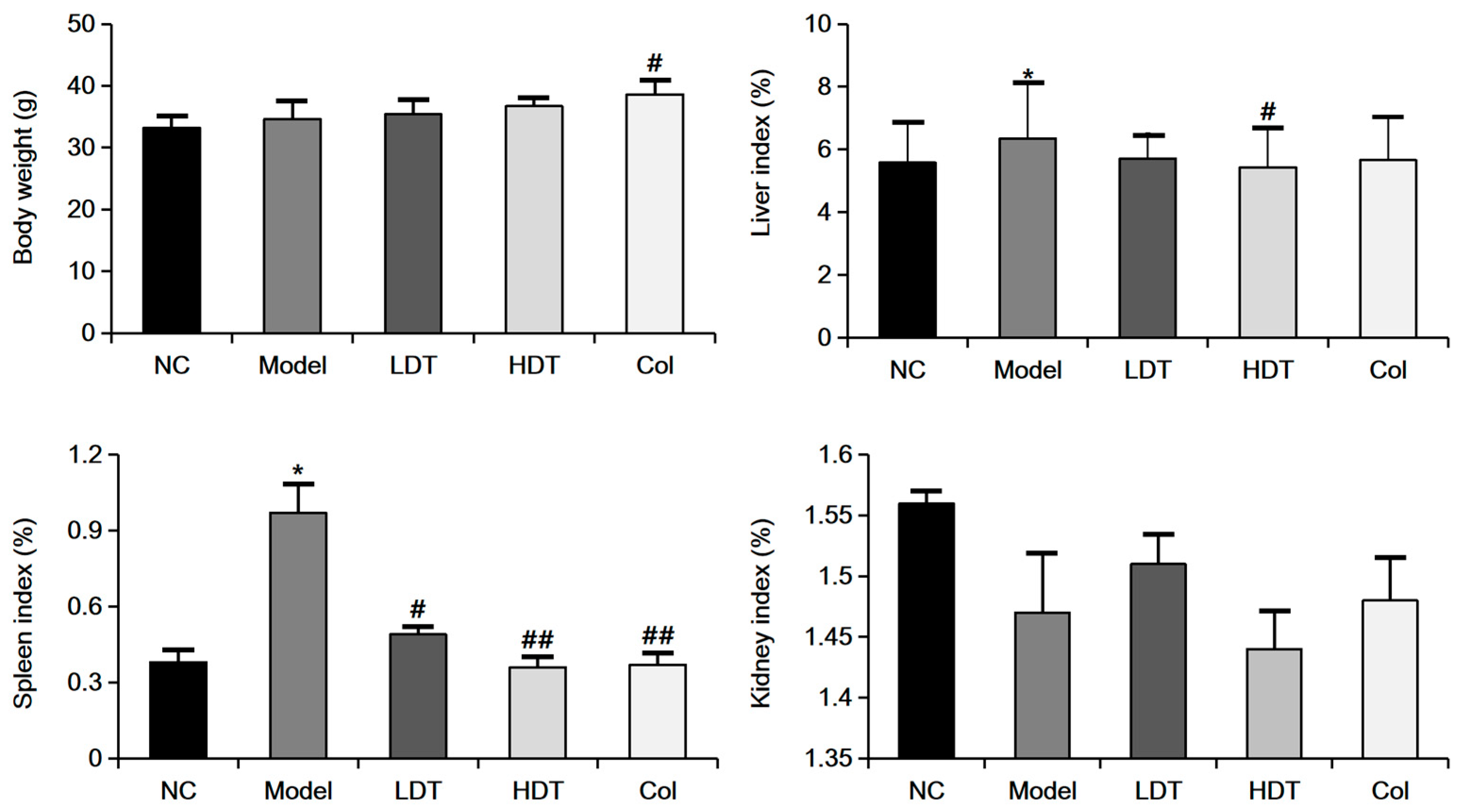
The effect of TCSO on body weight and organ weights in mice with hepatic fibrosis is shown in Figure 1. Compared to the other groups, the liver and spleen indices of mice in the NC group were significantly lower (p < 0.05). Further inter-group comparisons revealed that, compared to the Model group, the liver and spleen indices in the HDT group were significantly reduced (p < 0.05). However, there were no significant differences in body weight or kidney indices among the various treatment groups.

3.2. Effect of TCSO on Serum Liver Function Indices in Mice

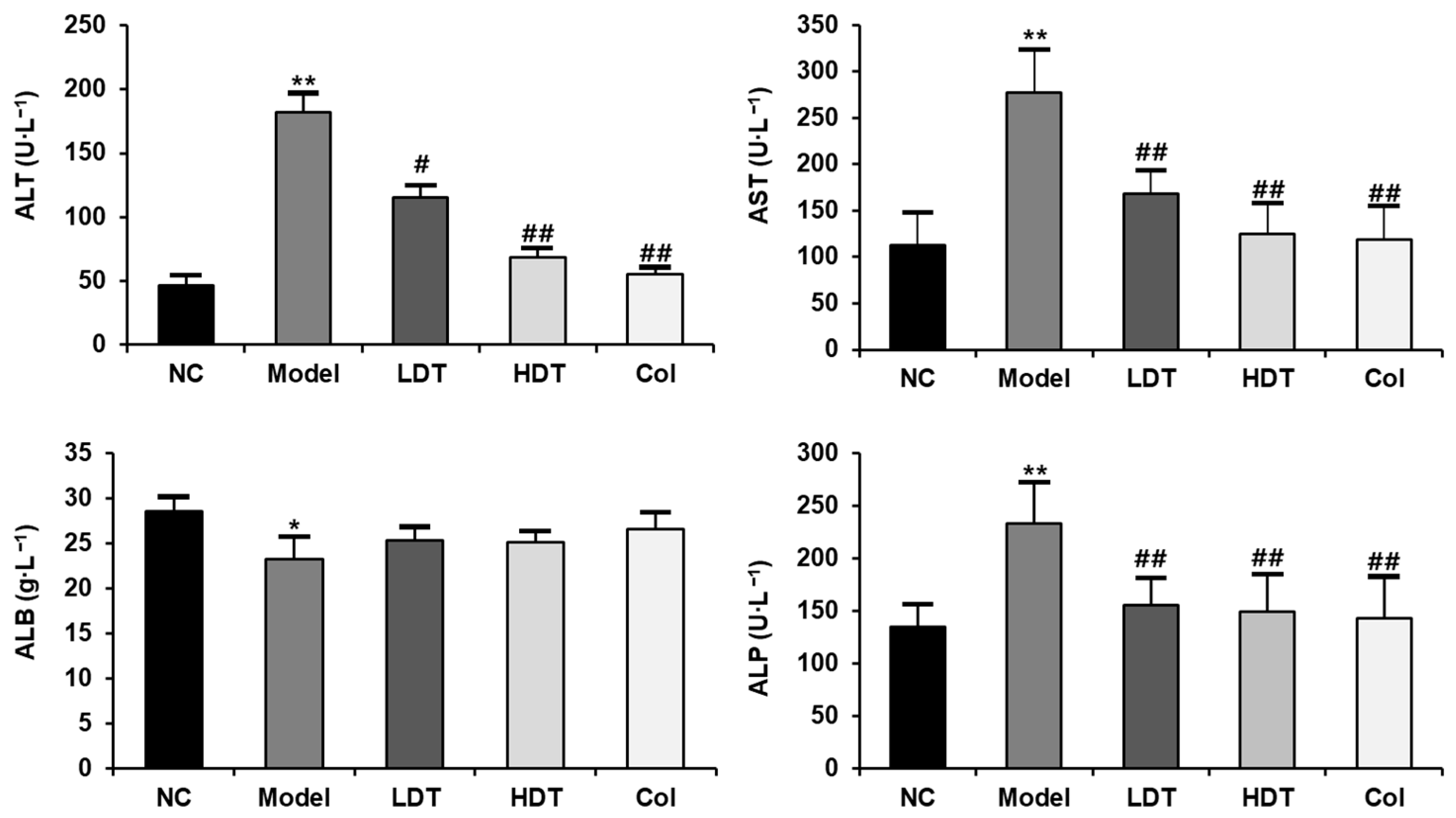
The effect of TCSO on serum liver function indices in mice with hepatic fibrosis is shown in Figure 2. Following CCl4 treatment, serum levels of ALT, AST, and ALP in the Model group increased significantly (p < 0.01), while the ALB level decreased significantly (p < 0.05). Further analysis indicated that the HDT treatment effectively reduced these abnormally elevated levels of ALT, AST, and ALP (p < 0.01), but had no significant effect on the ALB level. These results suggest that TCSO can ameliorate liver function in mice with CCl4-induced hepatic fibrosis.

3.3. Effect of TCSO on Hepatic Oxidative Stress Levels in Mice

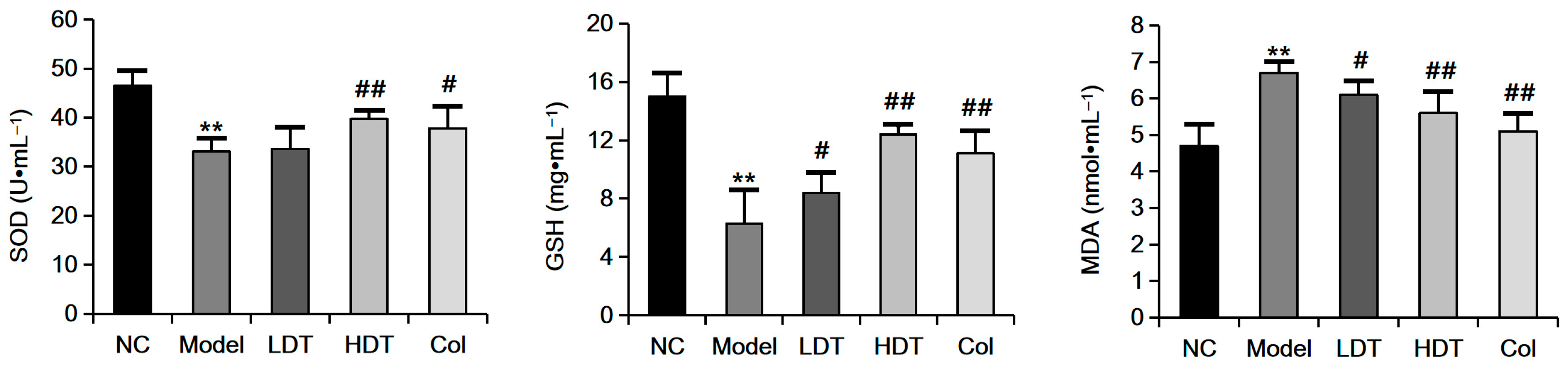
The effect of TCSO on hepatic oxidative stress levels is shown in Figure 3. Compared to the NC group, the Model group exhibited a significant reduction in SOD and GSH levels in liver tissue (p < 0.01). In contrast, the HDT treatment group significantly reversed the CCl4-induced depletion of SOD and GSH (p < 0.01). Furthermore, the Model group showed a significant increase in MDA levels (p < 0.01), while HDT treatment significantly lowered MDA levels (p < 0.05). In summary, TCSO may exert a hepatoprotective effect against CCl4-induced injury by inhibiting hepatic oxidative stress.

3.4. Effect of TCSO on Collagen-Related Indices in Mice

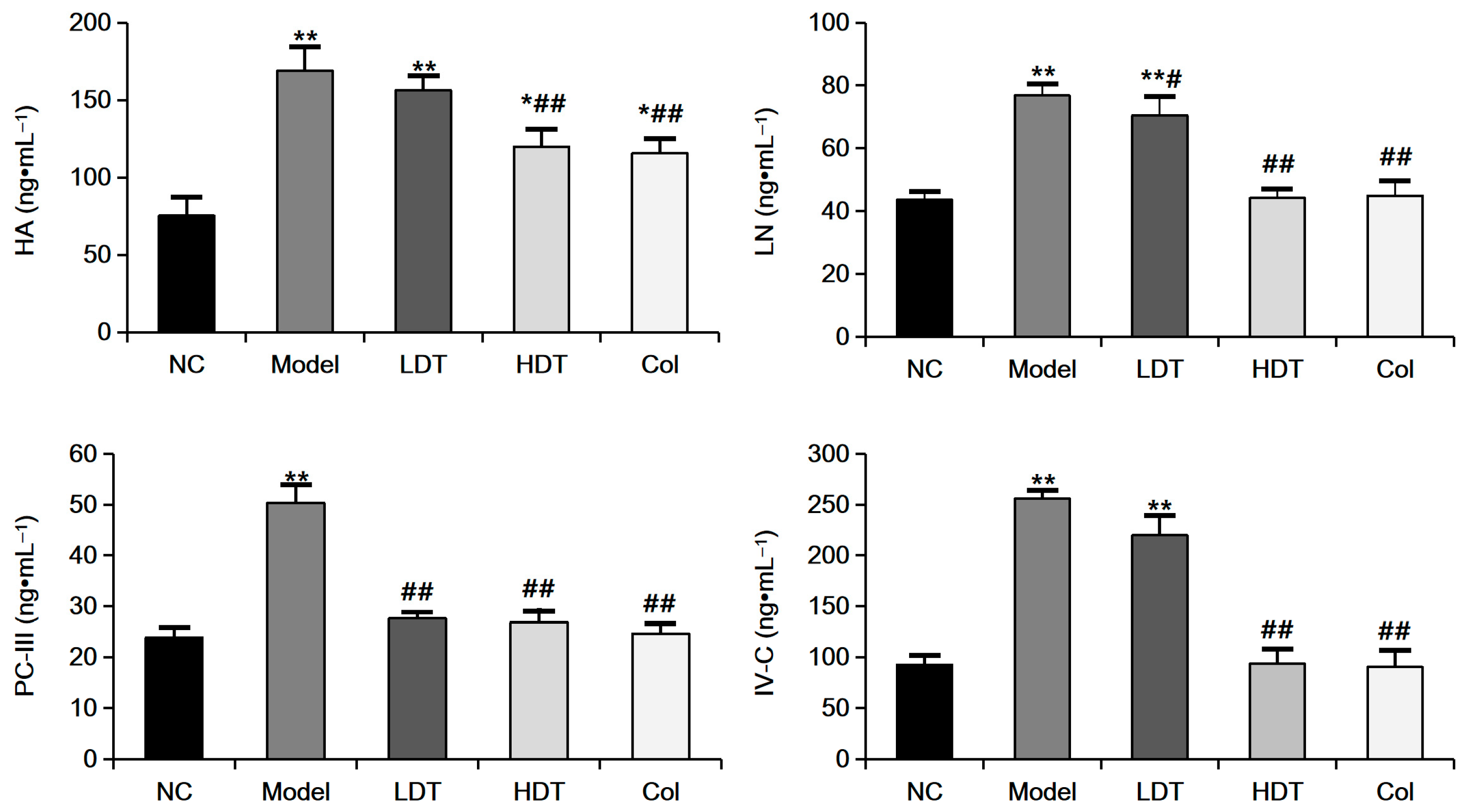
The effect of TCSO on collagen related indices in mice with hepatic fibrosis is shown in Figure 4. Compared to the NC group, serum levels of these procollagen markers were significantly elevated in the Model group (p < 0.01). However, compared to the Model group, TCSO treatment significantly reduced the PC III level (p < 0.01), as shown in Figure 4. For other serological markers related to liver fibrosis, such as HA, IV-C, and LN, a dose-dependent effect was observed; the reduction in these markers in liver tissue was more pronounced in the HDT group compared to the LDT group. This indicates that TCSO can mitigate CCl4-induced liver injury, reduce collagen deposition in liver tissue, and improve the degree of hepatic fibrosis.

3.5. Effect of TCSO on Liver Histopathology in Mice

To evaluate the effect of TCSO on CCl4-induced hepatic fibrosis, H&E staining was used to quantify the fibrotic area. In the NC group, the hepatic lobule structure remained normal, with clear central veins and radially arranged hepatic cords. In contrast, the Model group, after CCl4 treatment, exhibited severe vacuolar degeneration of hepatocytes, inflammatory cell infiltration, and substantial proliferation of fibrous connective tissue, leading to the formation of fibrous septa. TCSO treatment significantly alleviated inflammatory cell infiltration and pseudo-lobule formation, improving the pathological structure of the liver tissue. Particularly in the HDT treatment group, the liver tissue structure showed almost no significant abnormalities compared to the NC group, as illustrated in Figure 5 and Table 2.

3.6. Effect of TCSO on the Expression of Pro-Fibrotic Enzyme Genes in Mice

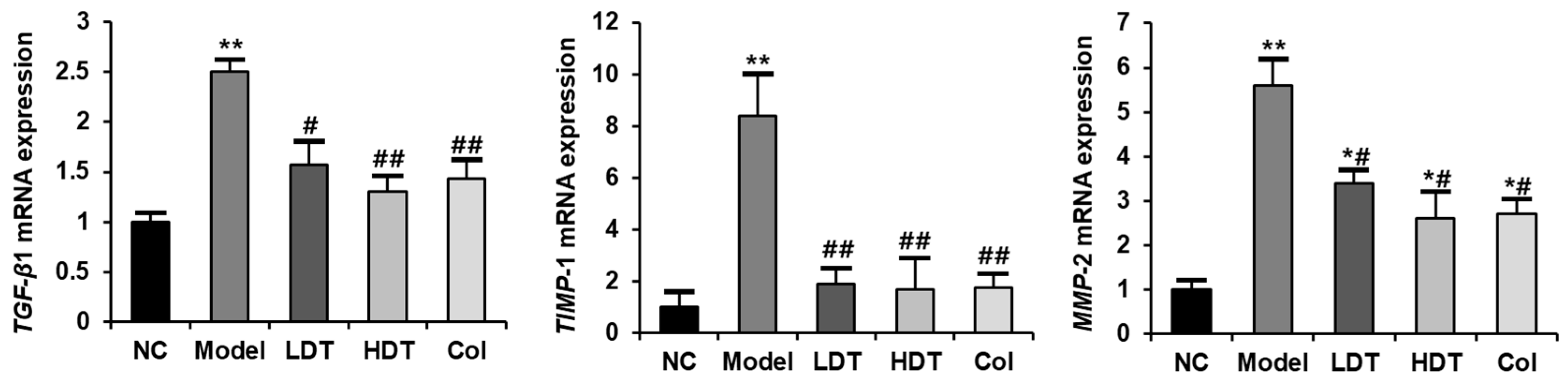
The effect of TCSO on the mRNA expression of enzymes related to pro-fibrotic cytokines is shown in Figure 6. Compared to the NC group, the mRNA expression levels of TGF-β1, TIMP-1, and MMP-2 in the livers of the CCl4-treated Model group were significantly upregulated (p < 0.01). In contrast, both the LDT and HDT treatment groups with TCSO significantly downregulated the expression levels of these factors (p < 0.05). These findings reveal an inhibitory effect of TCSO on the expression of CCl4-induced pro-fibrotic cytokines, thereby contributing to the amelioration of the hepatic fibrosis process.

4. Discussion

Emerging evidence suggests that the hepatoprotective effects of woody plant seed oils may involve specific bioactive components that modulate key molecular pathways in hepatic fibrogenesis such as unsaturated fatty acids (e.g., oleic acid, linoleic acid, and linolenic acid) and trace elements. These components not only possess lipid-lowering and immune-enhancing effects but can also mitigate chemical liver injury. Existing studies have shown that natural woody plant oils, such as Cornus wilsoniana oil [15] and camellia oil [5,16], exhibit antioxidant activity and can inhibit the progression of hepatic fibrosis by alleviating lipid peroxidation damage. To verify the hepatoprotective effect of TCSO, this study evaluated liver function and the degree of fibrosis by detecting serological markers and collagen content. The results demonstrated that TCSO could dose-dependently reduce serum levels of ALT, AST, and ALP, as well as decrease the content of liver fibrosis serum markers such as PC-III, HA, IV-C, and LN, indicating that TCSO significantly alleviates liver injury and fibrosis.
Concurrently, histopathological analysis served as a direct means to assess the protective effects of TCSO. Typical histological features of hepatic fibrosis include disordered hepatocyte architecture, extensive steatosis, ballooning degeneration, inflammatory necrosis, collagen deposition, and the formation of diffuse fibrous septa [17]. The H&E staining results in this study revealed that TCSO alleviated hepatic inflammation, inhibited collagen fiber deposition, and improved liver tissue structure. Similarly, camellia oil has been shown to ameliorate histopathological lesions in both an alcohol-induced gastric mucosal injury model and a CCl4-induced hepatic fibrosis model in mice [18].
Regarding the mechanisms of hepatic fibrosis, a growing body of research indicates that oxidative stress contributes to the formation of fibrosis. Abnormal oxidative stress promotes lipid peroxidation, activates hepatic stellate cells (HSCs), and accelerates the development of fibrosis [19]. Oxidative stress markers SOD and GSH can inhibit free radical-induced lipid peroxidation, protecting the body from free radical damage. In contrast, the accumulation of the peroxidation product MDA can denature biological membranes and produce cytotoxicity. Therefore, their levels in liver tissue reflect the organ’s antioxidant capacity [20]. In this study, compared to the NC group, the CCl4-treated Model group showed decreased hepatic levels of SOD and GSH and increased MDA. However, TCSO treatment reversed this trend, reducing CCl4-induced hepatic oxidative stress. The mechanism may be related to TCSO’s richness in unsaturated fatty acids and other antioxidant components. This suggests that TCSO exerts a protective effect against hepatic fibrosis by inhibiting oxidative stress.
Hepatic inflammation is another crucial mechanism in the development of fibrosis. Chronic liver inflammation is often accompanied by the upregulation of inflammatory factors, including TGF-β, MMP-2, and TIMP-1. Among these, TGF-β is the most potent inducer of HSC activation [4]. MMP-2, expressed by vascular wall cells, primarily degrades type III collagen in the basement membrane, thereby promoting fibrosis [21]. TIMP-1 is a specific glycoprotein inhibitor of MMPs and can inhibit the apoptosis of activated HSCs [22]. Therefore, downregulating the expression of TGF-β1, MMP-2, and TIMP-1 genes can reverse the formation of hepatic fibrosis. The results of this experiment showed that the HDT group significantly reduced the gene expression of TGF-β1, MMP-2, and TIMP-1 in mice, indicating that TCSO can suppress the expression of pro-fibrotic factors in CCl4-induced fibrotic mice, inhibit HSC activation, and slow the progression of hepatic fibrosis.
Therefore, which specific components in TCSO exert anti-fibrotic effects? Studies have shown that fatty acid components in vegetable oils can influence the progression of liver fibrosis through multiple mechanisms, including the regulation of hepatic stellate cell activation, TGF-β signaling pathway, oxidative stress, and inflammatory responses. For instance, α-linolenic acid, abundant in flaxseed oil, alleviates inflammation and downregulates the expression of type IV collagen genes by increasing hepatic n-3 polyunsaturated fatty acids (PUFAs) levels [23]. Meanwhile, omega-3 PUFAs exert anti-fibrotic effects by inhibiting betacellulin-mediated activation of hepatic stellate cells [24]. In addition, oil-associated minor components also exhibit significant bioactivity: oleacein reduces oxidative stress and suppresses hepatic stellate cell activation through selective inhibition of NADPH Oxidase 1(NOX1) [25]; α-tocopherol in wheat germ oil demonstrates a protective effect against lipotoxicity in human hepatocytes [26]. Fatty acid chain length is also a critical factor, as long-chain fatty acids are more prone to accelerate the progression of liver fibrosis associated with non-alcoholic steatohepatitis compared to medium-chain fatty acids [27]. In summary, the anti-fibrotic effect of TCSO may be attributed to its specific fatty acids and associated bioactive components, although the exact constituents and underlying mechanisms warrant further investigation. These findings provide a scientific basis for the development of plant oil-based nutritional strategies against liver fibrosis.

5. Conclusions

This study demonstrated that TCSO significantly ameliorates CCl4-induced liver fibrosis in mice. The hepatoprotective effect is primarily achieved by attenuating hepatocellular injury, as shown by significant reductions in ALT, AST, and ALP. Consistent with this hepatic protection, TCSO also decreased serum levels of extracellular matrix components (PC III, IV-C, HA, and LN), enhanced hepatic antioxidant capacity (by increasing SOD and GSH while reducing MDA), and down regulated the expression of key fibrosis-related factors (TGF-β1, MMP-2, and TIMP-1). Therefore, TCSO likely exerts its anti-fibrotic effects through a multi-pathway synergistic mechanism, providing an experimental basis for its potential development as an intervention agent for liver fibrosis.

Author Contributions

Conceptualization, Y.Z.; methodology, L.G.; software, H.T.; validation, X.B. and L.G.; investigation, L.G.; writing—original draft preparation, L.G.; writing—review and editing, Y.Z.; supervision, Y.Z. All authors have read and agreed to the published version of the manuscript.

Funding

This research was funded by Joint Project of Liaoning Provincial Science and Technology Program “Germplasm Resource Innovation and New Variety Promotion and Demonstration of Taxus cuspidata”, grant number 2024JH2/102600132.

Institutional Review Board Statement

The animal study protocol was approved by the Laboratory Animal Ethics Com-mittee of Liaodong University (20241023-8).

Informed Consent Statement

Not applicable.

Data Availability Statement

The data that support the findings of this study are available from the corresponding author upon reasonable request.

Acknowledgments

We thank Liu Qiang from Central South University of Forestry and Technology for the English editing assistance during the manuscript submission process.

Conflicts of Interest

The authors declare that the research was conducted without any commercial or financial relationships construed as a potential conflict of interest.

Abbreviations

The following abbreviations are used in this manuscript:
TCSOTaxus cuspidata seed oil
HSCHepatic stellate cell
TLAThree-letter acronym
ALTAlanine transaminase
ASTAspartate transaminase
ALPAlkaline phosphatase
PC IIIProcollagen III
IV-CCollagen IV
HAHyaluronic acid
LNLaminin
CCl4Carbon tetrachloride
TIMP-1Tissue inhibitor of metalloproteinases-1
TGF-β1Transforming growth factor-β1
MMP-2Matrix metalloproteinase-2
PUFAPolyunsaturated Fatty Acids
NOX1NADPH Oxidase 1

References

  1. Kostallari, E.; Hirsova, P.; Prasnicka, A.; Verma, V.K.; Shah, V.H. Hepatic stellate cell derived platelet derived growth factor receptor alpha enriched extracellular vesicles promote liver fibrosis in mice through SHP2. Hepatology 2018, 68, 333–348. [Google Scholar] [CrossRef]
  2. Long, T.; Wang, L.; Yang, Y.; Yuan, L.; Zhao, H.; Chang, C.C.; Yang, G.L.; Ho, C.T.; Li, S.M. Protective effects of trans 2,3,5,4′-tetrahydroxystilbene 2-O-beta-D-glucopyranoside on liver fibrosis and renal injury induced by CCl4 via down-regulating p-ERK1/2 and p-Smad1/2. Food Funct. 2019, 10, 5115–5123. [Google Scholar] [CrossRef] [PubMed]
  3. Liu, T.; Wang, X.; Karsdal, M.A.; Leeming, D.J.; Genovese, F. Molecular serum markers of liver fibrosis. Biomark. Insights 2012, 7, 105–117. [Google Scholar] [CrossRef]
  4. Guo, Y.; Liang, X.; Meng, M.; Chen, H.; Wei, X.; Li, M.; Li, J.; Huang, R.; Wei, J. Hepatoprotective effects of Yulangsan flavone against carbon tetrachloride (CCl4)-induced hepatic fibrosis in rats. Phytomedicine 2017, 33, 28–35. [Google Scholar] [CrossRef]
  5. Xiang, D.M.; Sun, W.; Ning, B.F.; Zhou, T.F.; Li, X.F.; Cheng, W.Z.; Xia, M.Y.; Wang, X.; Deng, X. The HLF/IL-6/STAT3 feedforward circuit drives hepatic stellate cell activation to promote liver fibrosis. Gut 2018, 67, 1704–1715. [Google Scholar] [CrossRef] [PubMed]
  6. Rai, A.; Liu, T.; Glauser, S.; Katrukha, E.A.; Estévez-Gallo, J.; Rodríguez-García, R.; Fang, W.; Díaz, J.F.; Steinmetz, M.O.; Altmann, K.H.; et al. Taxanes convert regions of perturbed microtubule growth into rescue sites. Nat. Mater. 2020, 19, 355–365. [Google Scholar] [CrossRef] [PubMed]
  7. Joerger, M. Treatment regimens of classical and newer taxanes. Cancer Chemother. Pharmacol. 2016, 77, 221–233. [Google Scholar] [CrossRef]
  8. Sharawy, M.H.; Abdel-Rahman, N.; Megahed, N.; El-Awady, M.S. Paclitaxel alleviates liver fibrosis induced by bile duct ligation in rats: Role of TGF-β1, IL-10 and c-Myc. Life Sci. 2018, 211, 245–251. [Google Scholar] [CrossRef]
  9. Choi, H.S.; Savard, C.E.; Choi, J.W.; Kuver, R.; Lee, S.P. Paclitaxel interrupts TGF-beta1 signaling between gallbladder epithelial cells and myofibroblasts. J. Surg. Res. 2007, 141, 183–191. [Google Scholar] [CrossRef]
  10. Yu, J.H. Studies on the isolation and purification of polyprenols from Taxus chinensis var. mairei and its antifibrotic effect. Ph.D. Thesis, Zhejiang University, Hangzhou, China, 2012. [Google Scholar]
  11. Zheng, G.Y.; He, L.; Bo, C.Y.; Zhang, L.; Yang, H. Therapeutic effects of polyprenols from pine needles on liver fibrosis induced by chronic immune liver injury in rats. Lishizhen Med. Mater. Medica Res. 2013, 24, 395–397. [Google Scholar]
  12. Huang, R.Z.; Fang, X.T.; Guo, X.Q.; Zheng, K.H.; Luo, L.X. Analysis of chemical composition in the seed of Taxus chinensis var. mairei. Chin. J. Appl. Environ. Biol. 2002, 8, 392–394. [Google Scholar]
  13. Zhang, Y.; Qian, C.; Zeng, W.; Liu, Y.; Wang, X. Sciadonic acid rich Torreya grandis oil improves hepatic steatosis via PPARα activation and arachidonic-acid remodeling. Food Biosci. 2025, 74, 107910. [Google Scholar] [CrossRef]
  14. Tang, K.H. Nutritional Components of Taxus chinensis var. mairei Seeds and Acute Toxicity of Its Aril. Food Sci. 2012, 33, 298–301. [Google Scholar]
  15. Liu, Q.; Liu, Q.; Lei, X.; Cao, Z.; Zhang, J.; Kuang, T.; Liu, G.; Fang, Y.; Qian, K.; Fu, J. Hepatoprotective effect of oil from Cornus wilsoniana fruits against carbon tetrachloride-induced hepatic fibrosis in mice. Food Nutr. Res. 2020, 64, 4205. [Google Scholar] [CrossRef]
  16. Chou, T.Y.; Lu, Y.F.; Inbaraj, B.S.; Chen, B.H. Camelia oil and soybean-camelia oil blend enhance antioxidant activity and cardiovascular protection in hamsters. Nutrition 2018, 51–52, 86–94. [Google Scholar] [CrossRef]
  17. Lee, Y.A.; Wallace, M.C.; Friedman, S.L. Pathobiology of liver fibrosis: A translational success story. Gut. 2015, 64, 830–841. [Google Scholar] [CrossRef]
  18. Lei, X.; Liu, Q.; Liu, Q.; Cao, Z.; Zhang, J.; Kuang, T.; Fang, Y.; Liu, G.; Qian, K.; Fu, J. Camellia oil (Camellia oleifera Abel.) attenuates CCl4-induced liver fibrosis via suppressing hepatocyte apoptosis in mice. Food Funct. 2020, 11, 4582–4590. [Google Scholar] [CrossRef]
  19. Noori, M.; Jafari, B.; Hekmatdoost, A. Pomegranate juice prevents development of non-alcoholic fatty liver disease in rats by attenuating oxidative stress and inflammation. J. Sci. Food Agric. 2017, 97, 2327–2332. [Google Scholar] [CrossRef]
  20. Carnevale, R.; Pastori, D.; Nocella, C.; Cammisotto, V.; Bartimoccia, S.; Novo, M.; Ben, M.D.; Farcomeni, A.; Angelico, F.; Violi, F. Gut-derived lipopolysaccharides increase post-prandial oxidative stress via Nox2 activation in patients with impaired fasting glucose tolerance: Effect of extra-virgin olive oil. Eur. J. Nutr. 2019, 58, 843–851. [Google Scholar] [CrossRef]
  21. Kim, T.H.; Mars, W.M.; Stolz, D.B.; Michalopoulos, G.K. Expression and activation of pro-MMP-2 and pro-MMP-9 during rat liver regeneration. Hepatology 2000, 31, 75–82. [Google Scholar] [CrossRef]
  22. Boeker, K.H.W.; Haberkorn, C.I.; Michels, D.; Flemming, P.; Manns, M.P.; Lichtinghagen, R. Diagnostic potential of circulating TIMP-1 and MMP-2 as markers of liver fibrosis in patients with chronic hepatitis C. Clin. Chim. Acta. 2002, 316, 71–81. [Google Scholar] [CrossRef]
  23. Zhang, M.; Li, X.; Liu, Y.; Wang, J.; Chen, S. Flaxseed oil attenuates hepatic inflammation and fibrosis induced by high-carbohydrate diet in Nile tilapia by regulating liver n-3 PUFA levels and fatty acid composition. Aquaculture 2021, 536, 736421. [Google Scholar]
  24. Liu, J.; Yang, P.; Zuo, G.; Zhang, H.; Li, Y. Omega-3 polyunsaturated fatty acids attenuate non-alcoholic steatohepatitis-induced fibrosis through inhibition of betacellulin in mice. Hepatol. Commun. 2022, 6, 1984–1998. [Google Scholar]
  25. El-Sayed, M.M.; El-Hazek, R.M.; El-Gharbawy, S.M.; Abdel-Moneim, A.; El-Din, S.M. Olive oil and flaxseed oil nanoemulsion with ginger extract alleviates CCl4-induced liver fibrosis in rats via modulation of oxidative stress and TGF-β/MMP9 signaling pathway. Food Chem. Toxicol. 2024, 185, 114456. [Google Scholar]
  26. Mastaloudis, A.; Wood, S.M.; Hester, S.N.; Bartolome, A.; Packer, L. Wheat germ oil vitamin E protects against lipotoxicity in human hepatoma cells: A transcriptomic analysis reveals distinct gene expression patterns compared to pure α-tocopherol. Nutrients 2022, 14, 1412. [Google Scholar]
  27. Wang, B.; Zhang, Y.; Liu, H.; Chen, L.; Zhao, X. Dietary long-chain saturated fatty acids accelerate MASH-related fibrosis progression compared to medium-chain fatty acids: A comparative study of cocoa butter and coconut oil. Hepatology 2023, 77, 1658–1672. [Google Scholar]
Figure 1. Effect of Taxus cuspidata seed oil on organ indexes of mice with CCl4-induced liver fibrosis. The data are presented as mean + standard deviation (SD). Compared with NC group, * p < 0.05; Compared with Model group, # p < 0.05, ## p < 0.01. NC, Normal Control; LDT, Low-Dose TCSO, HDT, High-Dose TCSO; Col, Colchicine.
Biology 15 00442 g001
Figure 2. Effect of Taxus cuspidata seed oil on serum biochemical indicators of mice with liver fibrosis. The data are presented as mean + standard deviation (SD). Compared with NC group, * p < 0.05, ** p < 0.01; Compared with Model group, # p < 0.05, ## p < 0.01. NC, Normal Control; LDT, Low-Dose TCSO, HDT, High-Dose TCSO; Col, Colchicine.
Biology 15 00442 g002
Figure 3. Effect of Taxus cuspidata seed oil on the oxidative stress level in CCl4-induced mice. The data are presented as mean + standard deviation (SD). Compared with NC group, ** p < 0.01; Compared with Model group, # p < 0.05, ## p < 0.01. NC, Normal Control; LDT, Low-Dose TCSO, HDT, High-Dose TCSO; Col, Colchicine.
Biology 15 00442 g003
Figure 4. The effect of Taxus cuspidata seed oil on collagen indicators in CCl4-induced mice. The data are presented as mean + standard deviation (SD). Compared with NC group, * p < 0.05, ** p < 0.01; Compared with Model group, # p < 0.05, ## p < 0.01. NC, Normal Control; LDT, Low-Dose TCSO, HDT, High-Dose TCSO; Col, Colchicine.
Biology 15 00442 g004
Figure 5. The effect of Taxus cuspidata seed oil on the pathological changes in liver tissue in mice with liver fibrosis. The black arrows indicate vacuolar degeneration of hepatic fat cells. NC, Normal Control; LDT, Low-Dose TCSO, HDT, High-Dose TCSO; Col, Colchicine.
Biology 15 00442 g005
Figure 6. Effects of Taxus cuspidata seed oil on mRNA expression of TGF-β1, TIMP-1 and MMP-2 in liver tissue of mice with liver fibrosis. The data in legends are presented as mean + standard deviation (SD). Compared with NC group, * p < 0.05, ** p < 0.01; Compared with Model group, # p < 0.05, ## p < 0.01. NC, Normal Control; LDT, Low-Dose TCSO, HDT, High-Dose TCSO; Col, Colchicine.
Biology 15 00442 g006
Table 1. Primer sequences.
GenePrimer Sequence (5′→3′)Product Size (bp)
GAPDHF: AACCTTGGTTCGTACCCT
R: TTAGCCTTTAAAGTCCGGA
263
TGF-β1F: TAAAGCCCTTAGCCTTAC
R: GATCCTAGGTCCATTCGTTA
215
TIMP-1F: GGGTCAAGTCCTAGGGCCT
R: TCGGGATCCGGTATTACCGGTA
186
MMP-2F: ACACTTTGGCTAAGCCCTTAAA
R: CCCTTAAGTCAAGCCTAGAAT
246
Note: GAPDH, Glyceraldehyde-3-phosphate dehydrogenase; TIMP-1, Tissue inhibitor of metalloproteinases-1; TGF-β1, Transforming growth factor-β1; MMP-2, Matrix metalloproteinase-2.
Table 2. Pathological grade statistics of Taxus cuspidata seed oil on CCl4-induced liver fibrosis.
GroupsnPathological Grade of Mice with Liver Fibrosis (0~6)p
0123456
NC66000000-
Model60001221a
LDT60221100b
HDT62310000c
Col63120000c
Note: The lowercase of a means the significant difference between the Model and NC group (p < 0.001), b means the significant difference in LDT versus Model group (p < 0.05), and c means the significant difference in HDT or Col versus model group (p < 0.01). NC, Normal Control; LDT, Low-Dose TCSO, HDT, High-Dose TCSO; Col, Colchicine.
Disclaimer/Publisher’s Note: The statements, opinions and data contained in all publications are solely those of the individual author(s) and contributor(s) and not of MDPI and/or the editor(s). MDPI and/or the editor(s) disclaim responsibility for any injury to people or property resulting from any ideas, methods, instructions or products referred to in the content.