Pelecyphora chihuahuensis (Britton & Rose) D. Aquino & Dan. Sánchez: A Review on Its Taxonomy, Ecology and Conservation of an Endemic Mexican Cactus Species with Biotechnological Perspectives
 , , , , , , ,
  and
and
Simple Summary
Abstract
1. Introduction
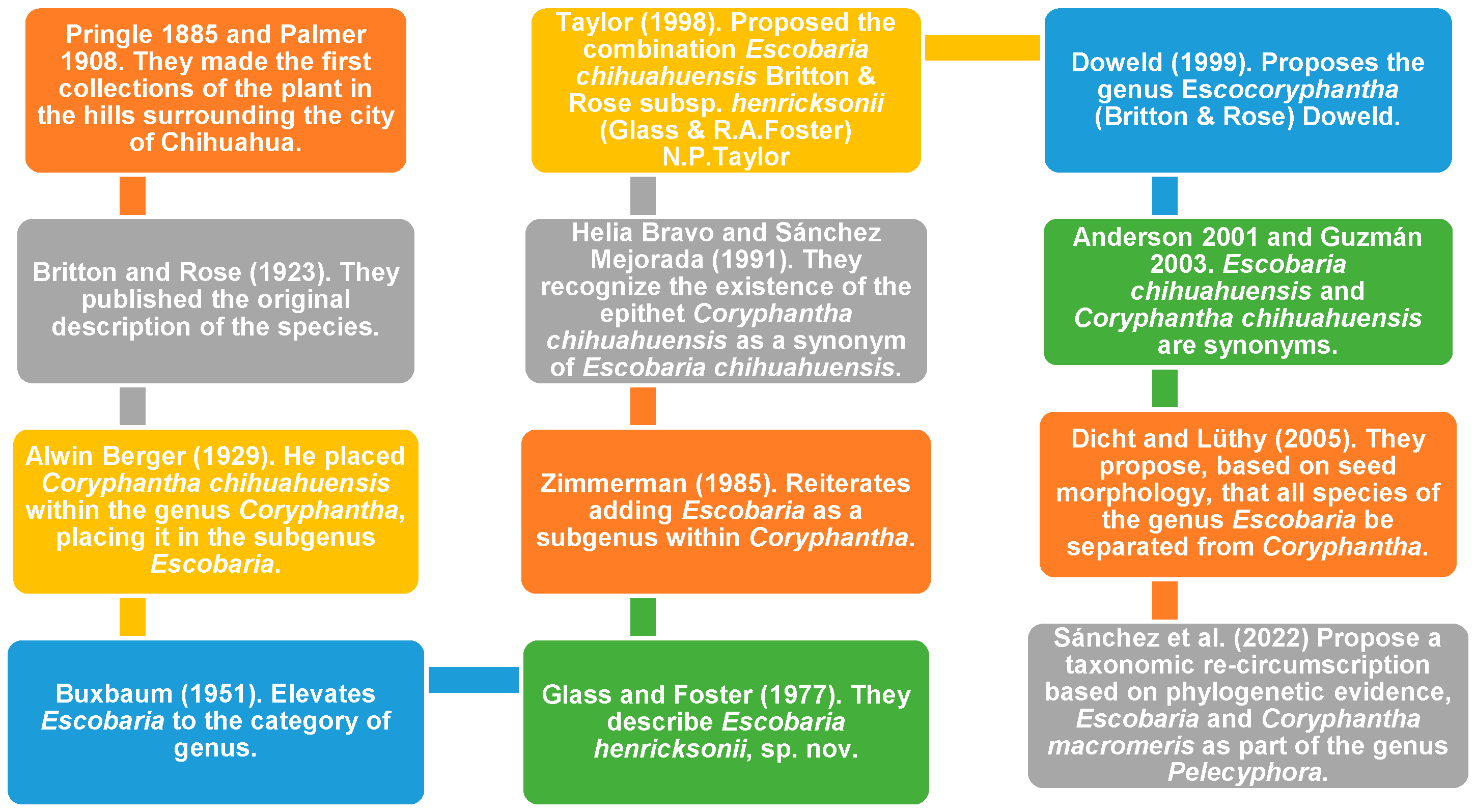
2. Systematic Background
2.1. The Morphological Era: The Escobaria vs. Coryphantha Conflict (1923–2005)
2.2. The Molecular Era: Phylogenetic Resolution and Transfer to Pelecyphora (2022)
3. In Situ and Ex Situ Conservation Approaches
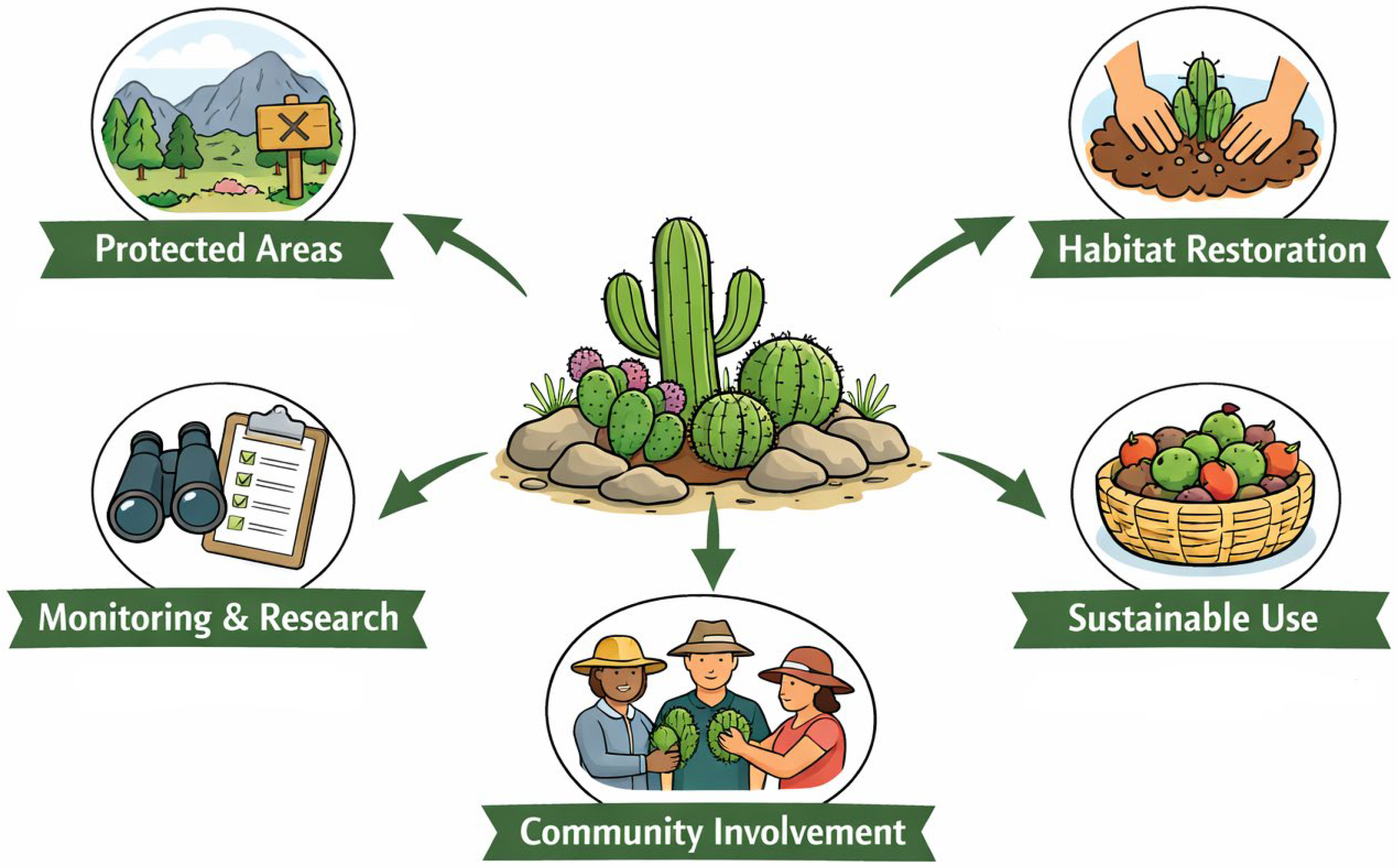
3.1. In Situ Methods for Cactus Conservation
3.1.1. Protected Areas
3.1.2. Habitat Restoration
3.1.3. Monitoring and Research
3.1.4. Sustainable Use and Community Involvement
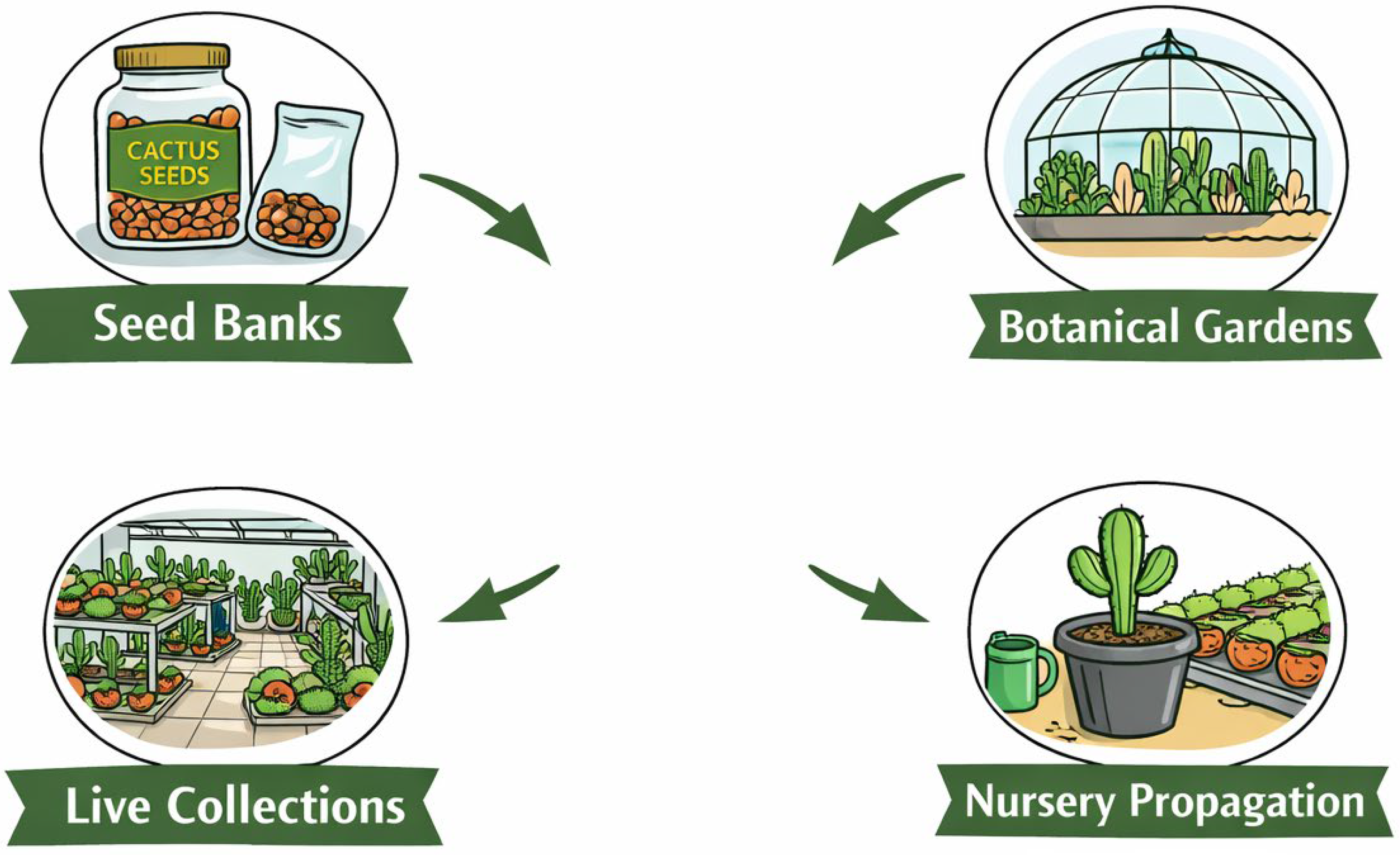
3.2. Ex Situ Methods for Cactus Conservation
3.2.1. Seed Banks
3.2.2. Botanical Gardens and Live Collections
3.2.3. Nursery Propagation
3.2.4. Integration of In Situ and Ex Situ Conservation
4. Biotechnological Innovations in Ex Situ Conservation
4.1. In Vitro Micropropagation
4.2. Cryopreservation
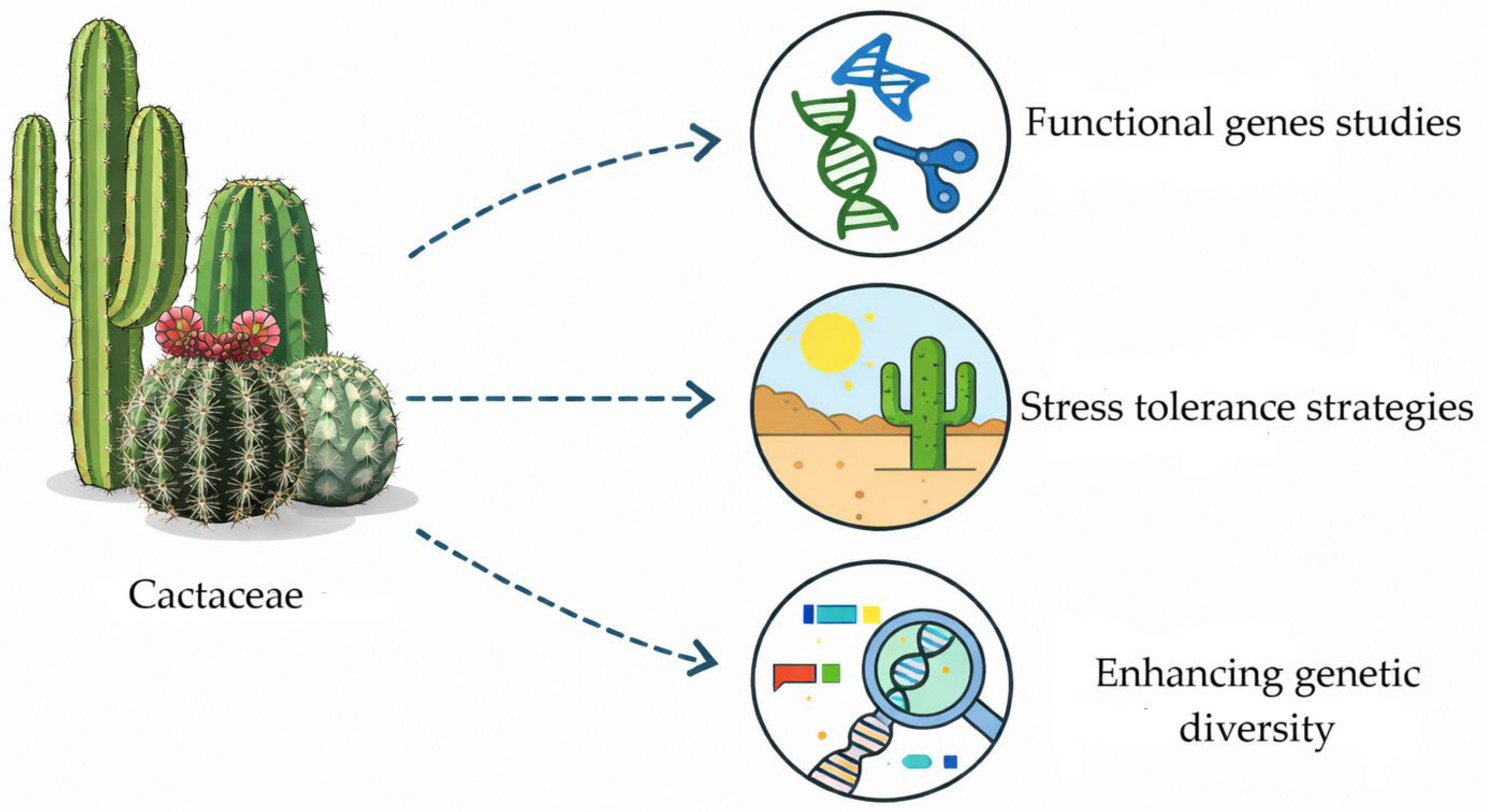
4.3. Genomic and Transcriptomic Tools as a Framework for Cactus Conservation
5. Biocultural and Policy Perspectives
5.1. The Biocultural Heritage of Cacti in the Chihuahuan Desert
5.2. Illegal Trafficking and Socioeconomic Pressure
5.3. Regulatory and Policy Framework for Conservation
5.4. Integrating Scientific Evidence, Public Policy, and Social Action
6. Conclusions
7. Research Gaps and Future Directions
Author Contributions
Funding
Data Availability Statement
Conflicts of Interest
References
- Bravo-Hollis, H.; Sánchez-Mejorada, R.H. Las Cactáceas de México, 2nd ed.; Universidad Nacional Autónoma de México: Mexico City, Mexico, 1978; Volume 1, pp. 1, 84, 88. [Google Scholar]
- Alanís Flores, G.J.; Velazco Macías, C.G. Importancia de las cactáceas como recurso natural en el noreste de México. Ciencia UANL 2008, 11, 5–11. [Google Scholar]
- Anderson, E.F. The Cactus Family; Timber Press: Portland, OR, USA, 2001; pp. 39, 43–67. [Google Scholar]
- Goettsch, B.; Hilton-Taylor, C.; Cruz-Piñón, G.; Duffy, J.P.; Frances, A.; Hernández, H.M.; Inger, R.; Pollock, C.; Schipper, J.; Superina, M.; et al. A high proportion of cactus species are threatened with extinction. Nat. Plants 2015, 1, 15142. [Google Scholar] [CrossRef]
- Hernández, H.M.; Gómez-Hinostrosa, C. Areas of endemism of Cactaceae and the effectiveness of the protected area network in the Chihuahuan desert. Oryx 2011, 45, 191–200. [Google Scholar] [CrossRef]
- Lebgue, K.T.; Quintana, M.G. Cactáceas de Chihuahua, 2nd ed.; Gobierno del Estado de Chihuahua-Instituto Chihuahuense de la Cultura: Chihuahua, Mexico, 2013; pp. 51–52. [Google Scholar]
- Estrada-Castillón, E.; Villarreal-Quintanilla, J.A. Flora del centro del estado de Chihuahua, México. Acta Bot. Mex. 2010, 92, 51–118. [Google Scholar] [CrossRef]
- Ibarra-Díaz Velarde, I.; Lebgue-Keleng, T.; Viramontes-Olivas, O.; Reyes-Cortes, I.; Ortega-Gutierrez, J.A.; Morales-Nieto, C. Modelo de nicho fundamental para Coryphantha chihuahuensis (Cactaceae) en el Estado de Chihuahua, México. Ecol. Apl. 2016, 15, 11–17. [Google Scholar] [CrossRef]
- Britton, N.L.; Rose, J.N. Escobaria. In The Cactaceae: Descriptions and Illustrations of Plants of the Cactus Family; Carnegie Institution of Washington: Washington, DC, USA, 1923; Volume 4, p. 55. [Google Scholar]
- Berger, A. Kakteen: Anleitung zur Kultur und Kenntnis der Wichtigsten Eingeführten Arten; Verlagsbuchhandlung von Eugen Ulmer: Stuttgart, Germany, 1929; p. 280. [Google Scholar] [CrossRef]
- Doweld, A.B. Escocoryphantha. Sukkulenty 1999, 1, 10. [Google Scholar]
- Sánchez, D.; Vázquez-Benítez, B.; Vázquez-Sánchez, M.; Aquino, D.; Arias, S. Phylogenetic relationships in Coryphantha and implications on Pelecyphora and Escobaria (Cacteae, Cactoideae, Cactaceae). PhytoKeys 2022, 188, 115–165. [Google Scholar] [CrossRef] [PubMed]
- Robbins, C.S. (Ed.) Prickly Trade: Trade and Conservation of Chihuahuan Desert Cacti; TRAFFIC North America, World Wildlife Fund: Washington, DC, USA, 2003; 137p. [Google Scholar]
- Buxbaum, F. Die Phylogenie der nordamerikanischen Echinocacteen. Trib. Euechinocactineae F. Buxb. Österr. Bot. Z. 1951, 98, 61–104. [Google Scholar] [CrossRef]
- Zimmerman, A.D. Systematics of the Genus Coryphantha (Cactaceae). Ph.D. Thesis, University of Texas, Austin, TX, USA, 1985. [Google Scholar]
- Glass, C.; Foster, R.A. Escobaria henricksonii, sp. nov. Cact. Succ. J. 1977, 49, 195–196. [Google Scholar]
- Taylor, N.P. Escobaria chihuahuensis subsp. henricksonii (Glass & R.A. Foster) N.P. Taylor. Cactaceae Consensus Init. 1998, 5, 13. [Google Scholar]
- Dicht, R.F.; Lüthy, A.D. Coryphantha: Cacti of Mexico and Southern USA; Springer: Berlin/Heidelberg, Germany, 2005. [Google Scholar]
- Mohanty, S.; Mishra, B.K.; Dasgupta, M.; Acharya, G.C.; Singh, S.; Naresh, P.; Bhue, S.; Dixit, A.; Sarkar, A.; Sahoo, M.R. Deciphering phenotyping, DNA barcoding, and RNA secondary structure predictions in eggplant wild relatives provide insights for their future breeding strategies. Sci. Rep. 2023, 13, 13829. [Google Scholar] [CrossRef]
- Devi, M.P.; Dasgupta, M.; Mohanty, S.; Sharma, S.K.; Hegde, V.; Roy, S.S.; Renadevan, R.; Kumar, K.B.; Patel, H.K.; Sahoo, M.R. DNA Barcoding and ITS2 Secondary Structure Predictions in Taro (Colocasia esculenta L. Schott) from the North Eastern Hill Region of India. Genes 2022, 13, 2294. [Google Scholar] [CrossRef]
- CBOL Plant Working Group. A DNA barcode for land plants. Proc. Natl. Acad. Sci. USA 2009, 106, 12794–12797. [Google Scholar] [CrossRef]
- International Botanical Congress; Turland, N.J.; Wiersema, J.H.; Barrie, F.R.; Gandhi, K.N.; Gravendyck, J.; Greuter, W.; Hawksworth, D.L.; Herendeen, P.S.; Knapp, S.; et al. International Code of Nomenclature for Algae, Fungi, and Plants (Madrid Code); Regnum Vegetabile 162; University of Chicago Press: Chicago, IL, USA, 2025. [Google Scholar] [CrossRef]
- Wei, L.; Pacheco-Reyes, F.C.; Villarreal-Quintanilla, J.A.; Robledo-Torres, V.; Encina-Domínguez, J.A.; Lara-Ramírez, E.E.; Pérez-Rodríguez, M.A. Effectiveness of DNA barcodes (rbcL, matK, ITS2) in identifying genera and species in Cactaceae. Pak. J. Bot. 2024, 56, 1911–1928. [Google Scholar] [CrossRef]
- The Angiosperm Phylogeny Group. An update of the Angiosperm Phylogeny Group classification for the orders and families of flowering plants: APG IV. Bot. J. Linn. Soc. 2016, 181, 1–20. [Google Scholar] [CrossRef]
- Korotkova, N.; Aquino, D.; Arias, S.; Eggli, U.; Franck, A.; Gómez-Hinostrosa, C.; Guerrero, P.C.; Hernández, H.M.; Kohlbecker, A.; Köhler, M.; et al. Cactaceae at Caryophyllales.org—A dynamic online species-level taxonomic backbone for the family. Willdenowia 2021, 51, 251–270. [Google Scholar] [CrossRef]
- Aguilar, S.A.R.; Lujano, S.S. Los cactus: Patrimonio natural de México. Rev. Digit. Univ. 2024, 25, 1–12. [Google Scholar] [CrossRef]
- Schwertner-Charão, L.; Delgado-Martínez, R.; Treviño-Carreón, J.; Jiménez-Sierra, C.L.; Astudillo-Sánchez, C.C.; Osorio-Hernández, E. Interactions between facilitator species and Lophophora williamsii (Lem. ex Salm-Dyck) JM Coult. (Cactaceae) in a rosetophyllus desert scrub in México. J. Arid Environ. 2022, 205, 104824. [Google Scholar] [CrossRef]
- CONANP (Comisión Nacional de Áreas Naturales Protegidas). Available online: https://www.gob.mx/conanp/ (accessed on 7 January 2025).
- Goettsch, B.; Durán, A.P.; Gaston, K.J. Global gap analysis of cactus species and priority sites for their conservation. Conserv. Biol. 2019, 33, 369–376. [Google Scholar] [CrossRef]
- Téllez-Valdés, O.; Talonia, C.M.; Arenas-Navarro, M.; Solórzano Lujano, S.; Lira-Saade, R.; Dávila-Aranda, P. Identification of priority areas for cactaceae conservation in arid and semiarid zones. In Arid and Semi-Arid Zones of Mexico, 1st ed.; Solórzano-Lujano, S., Avila-Acevedo, J.G., Valencia-Quiroz, I., Eds.; Bentham Books: Singapore, 2025; pp. 308–334. [Google Scholar] [CrossRef]
- IUCN SSC. Conservation Success Stories 2021–2025, 1st ed.; IUCN: Gland, Switzerland, 2025; 70p. [Google Scholar]
- Salafsky, N.; Salzer, D.; Stattersfield, A.J.; Hilton-Taylor, C.; Neugarten, R.; Butchart, S.H.M.; Collen, B.; Cox, N.; Master, L.L.; O’connor, S.; et al. A standard lexicon for biodiversity conservation: Unified classifications of threats and actions. Conserv. Biol. 2008, 22, 897–911. [Google Scholar] [CrossRef]
- Badalamenti, O.; Carra, A.; Oddo, E.; Carimi, F.; Sajeva, M. Is in vitro micrografting a possible valid alternative to traditional micropropagation in Cactaceae? Pelecyphora aselliformis as a case study. SpringerPlus 2016, 5, 201. [Google Scholar] [CrossRef]
- CONABIO (Comisión Nacional para el Conocimiento y Uso de la Biodiversidad). Evaluación del Estado de Conservación de Especies Prioritarias: Informe Final del Proyecto XA008: México City, Mexico. Available online: http://www.conabio.gob.mx/institucion/proyectos/resultados/InfXA008.pdf (accessed on 8 January 2025).
- Navarro, L.R.; Contreras-MacBeath, T. Community projects for the conservation of cacti in the state of Morelos, Mexico. In Cactus and Succulent Plants Specialist Group, 1st ed.; Goettsch, B., Majure, L.C., Eds.; CSSG Newsletters: Phoenix, AZ, USA, 2023; pp. 6–7. Available online: https://iucn-cssg.org/assets/newsletters/newsletter_2023_en.pdf (accessed on 8 January 2025).
- McGough, N. CITES and Cacti: A User’s Guide. Available online: https://www.kew.org/sites/default/files/2019-09/CITESandCacti_full.pdf (accessed on 8 January 2025).
- Luna-Nieves, A.L.; García-Frapolli, E.; Bonfil, C.; Meave, J.A.; Ibarra-Manríquez, G. Integrating conservation and socioeconomic development: The potential of community nurseries in Mexican protected areas. Environ. Conserv. 2019, 46, 310–317. [Google Scholar] [CrossRef]
- Pulido, M.T.; Cuevas-Cardona, C. Cactus nurseries and conservation in a biosphere reserve in Mexico. Ethnobiol. Lett. 2013, 4, 96–104. [Google Scholar] [CrossRef]
- Pérez-Negrón, E.; Dávila, P.; Casas, A. Use of columnar cacti in the Tehuacán Valley, Mexico: Perspectives for sustainable management of non-timber forest products. J. Ethnobiol. Ethnomed. 2014, 10, 79. [Google Scholar] [CrossRef] [PubMed]
- Chávez-Hernández, M.G.; Gómez-Barreiro, P.; White, J.D.M.; Way, M. Sonoran Desert ex situ conservation gap analysis: Charting the path towards conservation. bioRxiv 2024, 11, 1–22. [Google Scholar] [CrossRef]
- Nascimento, J.P.B.; Vieira, D.C.M.; Meiado, M.V. Ex situ seed conservation of Brazilian cacti. Gaia Sci. 2015, 9, 111–116. [Google Scholar]
- Guzmán-Vázquez, I.; Castillo-Argüero, S.; Orozco-Segovia, A.; Collazo-Ortega, M. Spatial and temporal dynamics of two cacti seed banks in a xerophytic shrubland in Mexico City. Bot. Sci. 2021, 99, 560–572. [Google Scholar] [CrossRef]
- Briseño-Sánchez, M.I.; Nava-Osorio, J.; Rojas-Aréchiga, M.; Mandujano, M.C. Effect of seed age on germination, and seedling survival of Lophophora diffusa (Cactaceae). Acta Bot. Mex. 2024, 131, e2146. [Google Scholar] [CrossRef]
- de Almeida, T.M.H.; Gonzaga, D.R.; Peixoto, A.L. Cacti in distress: How to enhance ex situ conservation strategies through living collections. Oryx 2024, 58, 565–575. [Google Scholar] [CrossRef]
- Nóbrega-Gomes, V.G.; Lins-Cassimiro, C.A.; Gomes-Freitas, J.; Pessoa-Felix, C.M.; da Costa Batista, F.R. Ex situ conservation in the Brazilian semiarid: Cactaceae housed in the collection of the Guimarães Duque Cactarium. Braz. J. Dev. 2020, 6, 62608–62625. [Google Scholar] [CrossRef]
- Camel, V.; Pillpa, F.; Colqui, V.; Ataucusi, J.; Quispe-Huañahue, J.; Felix, E.; Ninanya-Parra, Z.; Maravi-Hinostroza, K.; Caysahuana, K.; Cabello-Torres, R. Mortality, structure, propagation, and microhabitat characterization of Haageocereus acranthus: A case study on coastal lomas. Front. Plant Sci. 2025, 16, 1577533. [Google Scholar] [CrossRef]
- Hernández, D.A.G. Variabilidad Genética y Viabilidad de Semillas de Escontria chiotilla y Stenocereus pruinosus (Cactaceae) Conservadas ex situ y Enterradas in situ en un Matorral Xerófilo en el Valle de Tehuacán. Master’s Thesis, Universidad Autónoma Metropolitana, Ciudad de México, México, 2018. [Google Scholar] [CrossRef]
- Bobadilla-Peñaló, E.M.; García-Rodríguez, R. Cactus collection of the Botanical Garden of Santiago (Dominican Republic). Cienc. Ambient. Clim. 2022, 5, 17–29. [Google Scholar] [CrossRef]
- Rubluo, A. Micropropagation of Mammillaria species (Cactaceae). In Biotechnology in Agriculture and Forestry 40; Bajaj, Y.P.S., Ed.; Springer: Berlin/Heidelberg, Germany, 1997; pp. 193–205. [Google Scholar]
- Jenkins, M. The Wild Plant Trade in Europe—Results of a TRAFFIC Europe Survey of European Nurseries; TRAFFIC Europe: Brussels, Belgium, 1993; 74p. [Google Scholar]
- Vidican, T.L. Investigation on the effect of 2,4-dichlorophenoxyacetic acid (2,4-D) on the process of callus from in vitro cultures Echinocactus (Pfeiff.) mihanovichii. An. Univ. Oradea Fasc. Prot. Med. 2012, 19, 305–311. [Google Scholar]
- Vidican, T.L.; Cachita-Cosma, D.; Romocea, J.E. The initiation of Echinocactus mihanovichii, Echinopsis chamaecereus f. lutea and Aylostera heliosa vitrocultures. Stud. Univ. Vasile Goldis Arad Ser. Stiint. Vietii 2009, 19, 351–357. [Google Scholar]
- Jeong, I.M.; Cho, H.C.; Lee, J.M. Production and breeding of cacti for grafting in Korea. Chron. Hortic. 2004, 44, 7–10. [Google Scholar]
- Lema-Rumińska, J.; Kulus, D. Micropropagation of cacti—A review. Haseltonia 2014, 19, 46–63. [Google Scholar] [CrossRef]
- Roque-Borda, C.A.; Kulus, D.; Vacaro de Souza, A.; Kaviani, B.; Vicente, E.F. Cryopreservation of agronomic plant germplasm using vitrification-based methods: An overview of selected case studies. Int. J. Mol. Sci. 2021, 22, 6157. [Google Scholar] [CrossRef] [PubMed]
- Vendrame, W.; Takane, R.J.; Cardoso de Oliveira, L.S.; Alvarez Rios, L.; Tadeu de Faria, R. Cryopreservation of seeds of Melocactus zehntneri Braun ex Ritter f. and Cereus gounellei Luetzelb ex Schum k. by the vitrification method. Agron. Sci. Biotechnol. 2020, 6, 1–7. [Google Scholar] [CrossRef]
- Narzary, D.; Boro, I. CRISPR and wildlife conservation: Gene editing as a tool for preserving biodiversity. EDUZONE 2025, 14, 24–27. [Google Scholar]
- Giusti, P.; Vitti, D.; Fiocchetti, F.; Colla, G.; Saccardo, F.; Tucci, M. In vitro propagation of three endangered cactus species. Sci. Hortic. 2002, 95, 319–332. [Google Scholar] [CrossRef]
- Murashige, T.; Skoog, F. A revised medium for rapid growth and bioassays with tobacco tissue cultures. Physiol. Plant. 1962, 15, 473–497. [Google Scholar] [CrossRef]
- Pérez-Molphe-Balch, E.; Dávila-Figueroa, C.A. In vitro propagation of Pelecyphora aselliformis Ehrenberg and P. strobiliformis Werdermann (cactaceae). In Vitro Cell. Dev. Biol.-Plant 2002, 38, 73–78. [Google Scholar] [CrossRef]
- Arias, A.A. Micropropagación de Pelecyphora strobilliformis (Werdermann) Fric et Scheelle (Cactaceae) Especie Mexicana en Peligro de Extinción. Bachelor’s Thesis, Universidad de Guadalajara, Guadalajara, Mexico, 2002. [Google Scholar]
- Santos-Díaz, M.S.; Méndez-Ontiveros, R.; Arredondo-Gómez, A.L.; Santos-Díaz, M.L. In vitro organogenesis of Pelecyphora aselliformis Erhenberg (Cactaceae). In Vitro Cell. Dev. Biol.-Plant 2003, 39, 480–484. [Google Scholar] [CrossRef]
- Chincoya, D.A.; Arias, S.; Vaca-Paniagua, F.; Dávila, P.; Solórzano, S. Phylogenomics and biogeography of the Mammilloid clade revealed an intricate evolutionary history arose in the Mexican Plateau. Biology 2023, 12, 512. [Google Scholar] [CrossRef] [PubMed]
- Bhau, B.S.; Wakhlu, A.K. A highly efficient in vitro propagation protocol for elephant tusk cactus: Coryphantha elephantidens (Lem.) Lem. J. Genet. Eng. Biotechnol. 2015, 13, 215–219. [Google Scholar] [CrossRef]
- Ruvalcaba-Ruiz, D.; Rojas-Bravo, D.; Juliá, A. In vitro propagation of Coryphantha retusa (Britton & Rose) an endemic and endangered cactus. Trop. Subtrop. Agroecosyst. 2009, 12, 139–143. [Google Scholar]
- Bhau, B.S.; Wakhlu, A.K. Effect of some antibiotics on the in vitro morphogenetic response from callus cultures of Coryphantha elephantidens. Biol. Plant. 2001, 44, 19–24. [Google Scholar] [CrossRef]
- Wakhlu, A.K.; Bhau, B.S. Callus formation and plant regeneration from tubercles of Coryphantha elephantidens (Lem.) Lem. In Vitro Cell. Dev. Biol.-Plant 2000, 36, 211–214. [Google Scholar] [CrossRef]
- Bhau, B.S. Regeneration of Coryphantha elephantidens (Lem.) Lem. (Cactaceae) from root explants. Sci. Hortic. 1999, 81, 337–344. [Google Scholar] [CrossRef]
- Pérez-Molphe-Balch, E.; Pérez-Reyes, M.E.; Villalobos Amador, E.; Meza Rangel, E.; del Rocío Morones Ruiz, L.; Lizalde Viramontes, H.J. Micropropagation of 21 species of Mexican cacti by axillary proliferation. In Vitro Cell. Dev. Biol.-Plant 1998, 34, 131–135. [Google Scholar] [CrossRef]
- Smith, R.H.; Burdick, P.J.; Anthony, J.; Reilley, A.A. In vitro propagation of Coryphantha macromeris. HortScience 1991, 26, 315. [Google Scholar] [CrossRef]
- Devi, S.P.; Kumaria, S.; Rao, S.R.; Tandon, P. Genetic fidelity assessment in micropropagated plants using cytogenetical analysis and heterochromatin distribution: A case study with Nepenthes khasiana Hook f. Protoplasma 2015, 252, 1305–1312. [Google Scholar] [CrossRef]
- Quatrano, R.S. Freeze-preservation of cultured flax cells utilizing dimethyl sulfoxide. Plant Physiol. 1968, 43, 2057–2061. [Google Scholar] [CrossRef]
- Veiga-Barbosa, L.; González-Benito, M.E.; Assis, J.G.A.; Pérez-García, F. Germination and cryopreservation of several cactus species from NE Brazil. Seed Sci. Technol. 2010, 38, 218–224. [Google Scholar] [CrossRef]
- Marchi, M.N.G.; Civatti, L.M.; Viana, C.M.; Assis, J.G.A.; Bellintani, M.C.; Santana, J.R.F. Seed cryopreservation of the native cacti Discocactus zehntneri, Pilosocereus gounellei and Stephanocereus luetzelburgii from Bahia, Brazil. Afr. J. Biotechnol. 2013, 12, 3250–3254. [Google Scholar]
- Civatti, L.M.; Marchi, M.N.G.; Bellintani, M.C. Cryopreservation of cacti seeds of three ornamental species endemic to the state of Bahia, Brazil. Seed Sci. Technol. 2015, 43, 284–290. [Google Scholar] [CrossRef]
- Sakai, A.; Kobayashi, S.; Oiyama, I. Cryopreservation of nucellar cells of navel orange (Citrus sinensis Osb. var. brasiliensis Tanaka) by vitrification. Plant Cell Rep. 1990, 9, 30–33. [Google Scholar] [CrossRef] [PubMed]
- Cruz Plancarte, D.; Solórzano, S. Structural and gene composition variation of the complete mitochondrial genome of Mammillaria huitzilopochtli (Cactaceae, Caryophyllales), revealed by de novo assembly. BMC Genom. 2023, 24, 509. [Google Scholar] [CrossRef] [PubMed]
- Fawcett, S.; Escalona, M.; Marimuthu, M.P.A.; Nguyen, O.; Chumchim, N.; Beraut, E.; Seligmann, W.; Fairbairn, C.W.; Toffelmier, E.; Miller, C.; et al. A chromosome-level genome assembly of the beavertail cactus, Opuntia basilaris. J. Hered. 2025, 116, 835–845. [Google Scholar] [CrossRef]
- Copetti, D.; Búrquez, A.; Shimizu, K.K.; Wing, R.A.; Sanderson, M.J.; Wojciechowski, M.F. An improved genome assembly of the saguaro cactus (Carnegiea gigantea (Engelm.) Britton & Rose). bioRxiv 2023. [Google Scholar] [CrossRef]
- Armstrong, J.; Hickey, G.; Diekhans, M.; Fiddes, I.T.; Novak, A.M.; Deran, A.; Fang, Q.; Xie, D.; Feng, S.H.; Stiller, J.; et al. Progressive Cactus is a multiple-genome aligner for the thousand-genome era. Nature 2020, 587, 246–251. [Google Scholar] [CrossRef] [PubMed]
- Amaral, D.T.; Bombonato, J.R.; da Silva Andrade, S.C.; Moraes, E.M.; Franco, F.F. The genome of a thorny species: Comparative genomic analysis among South and North American Cactaceae. Planta 2021, 254, 44. [Google Scholar] [CrossRef] [PubMed]
- Enríquez-González, C.; Garcidueñas-Piña, C.; Castellanos-Hernández, O.A.; Enríquez-Aranda, S.; Loera-Muro, A.; Ocampo, G.; Pérez-Molphe Balch, E.; Morales-Domínguez, J.F. De Novo Transcriptome of Mammillaria bombycina (Cactaceae) under in vitro conditions and identification of glyoxalase genes. Plants 2022, 11, 399. [Google Scholar] [CrossRef] [PubMed]
- Torres-Silva, G.; Correia, L.N.F.; Batista, D.S.; Koehler, A.D.; Resende, S.V.; Romanel, E.; Cassol, D.; Almeida, A.M.R.; Strickler, S.R.; Specht, C.D.; et al. Transcriptome analysis of Melocactus glaucescens (Cactaceae) reveals metabolic changes during in vitro shoot organogenesis induction. Front. Plant Sci. 2021, 12, 697556. [Google Scholar] [CrossRef]
- Liu, J.; Feng, Y.; Chen, C.; Yan, J.; Bai, X.; Li, H.; Lin, C.; Xiang, Y.; Tian, W.; Qi, Z.; et al. Genomic insights into the clonal reproductive Opuntia cochenillifera: Mitochondrial and chloroplast genomes of the cochineal cactus for enhanced understanding of structural dynamics and evolutionary implications. Front. Plant Sci. 2024, 15, 1347945. [Google Scholar] [CrossRef]
- Romeiro-Brito, M.; Telhe, M.C.; Amaral, D.T.; Franco, F.F.; Moraes, E.M. A target capture probe set useful for Deep- and Shallow-Level phylogenetic studies in Cactaceae. Genes 2022, 13, 707. [Google Scholar] [CrossRef]
- Esvelt, K.M.; Gemmell, N.J. Conservation demands safe gene drive. PLoS Biol. 2017, 15, e2003850. [Google Scholar] [CrossRef]
- Ahmad, S.; Wei, X.; Sheng, Z.; Hu, P.; Tang, S. CRISPR/Cas9 for development of disease resistance in plants: Recent progress, limitations and future prospects. Brief. Funct. Genom. 2020, 19, 26–39. [Google Scholar] [CrossRef]
- Revive and Restore. Reviving the Black-Footed Ferret with CRISPR. Available online: https://reviverestore.org/projects/black-footed-ferret/ (accessed on 16 December 2015).
- Song, J.-M.; Xie, W.-Z.; Wang, S.; Guo, Y.-X.; Koo, D.-H.; Kudrna, D.; Gong, C.; Huang, Y.; Feng, J.-W.; Zhang, W.; et al. Two gap-free reference genomes and a global view of the centromere architecture in rice. Mol. Plant 2021, 14, 1757–1767. [Google Scholar] [CrossRef]
- Chen, C.; Han, J.; Bai, X.; Yan, J.; Feng, Y.; Liu, J.; Xu, X.; Xiang, Y.; Lin, C.; Li, H.; et al. Comprehensive plastome analysis in prickly pear cactus (Opuntia, Cactaceae), a key genus for sustainable fuel and food: Uncovering evolutionary dynamics and germplasm. Ind. Crops Prod. 2025, 234, 121477. [Google Scholar] [CrossRef]
- Zaman, Q.U.; Raza, A.; Hui, L.; Nazir, M.F.; Garg, V.; Ikram, M.; Wang, G.; Lv, W.; Khan, D.; Khokhar, A.A.; et al. Chromosome-level genome assembly of the autotetraploid yellow pitaya provides novel insights into evolution of trait patterning in pitaya species with different ploidy. Genome Biol. 2025, 26, 234. [Google Scholar] [CrossRef]
- Li, J.; Luo, W.; Jiang, B.; Kumar, S.; Lin, M.; Sun, Q. A chromosome-level haplotype-resolved genome assembly and annotation of pitaya (Selenicereus polyrhizus). Sci. Data 2025, 12, 549. [Google Scholar] [CrossRef]
- Amaral, D.T.; Trier, C.; Copetti, D.; Franco, F.F.; Moraes, E.M. Chromosome-level genome assembly of the iconic South American mandacaru cactus (Cereus jamacaru DC, Tribe Cereeae, Cactaceae). Planta 2025, 262, 42. [Google Scholar] [CrossRef] [PubMed]
- Maleka, M.K.; Modise, T.J.; Plessis, M.D.; Coetzer, G.M. Identification and characterization of sequence variants from a de novo-assembled partial pan-genome of cactus pear (Opuntia L.). S. Afr. J. Bot. 2024, 175, 241–252. [Google Scholar] [CrossRef]
- Zheng, J.; Meinhardt, L.W.; Goenaga, R.; Zhang, D.; Yin, Y. The chromosome-level genome of dragon fruit reveals whole-genome duplication and chromosomal co-localization of betacyanin biosynthetic genes. Hortic. Res. 2021, 8, 63. [Google Scholar] [CrossRef]
- Pedrosa, K.M.; Lucena, C.M.; de Lucena, R.F.P.; de Faria Lopes, S. Traditional Techniques for the Management of Cactaceae in the Americas: The Relationship between Use and Conservation. Ethnobiol. Lett. 2018, 9, 276–282. [Google Scholar] [CrossRef]
- Nobel, P.S. (Ed.) Cacti: Biology and Uses; University of California Press: Berkeley, CA, USA, 2002. [Google Scholar]
- Kumar, K.; Singh, D.; Singh, R.S. Cactus Pear: Cultivation and Uses; Technical Bulletin No. 73; ICAR-Central Institute for Arid Horticulture: Bikaner, Rajasthan, India, 2018. [Google Scholar]
- Muñoz-Gómez, R.J.; Rivero-Cruz, I.; Ovalle-Magallanes, B.; Linares, E.; Bye, R.; Tovar, A.R.; Noriega, L.G.; Tovar-Palacio, C.; Mata, R. Antidiabetic sterols from Peniocereus greggii roots. ACS Omega 2022, 7, 13144–13154. [Google Scholar] [CrossRef] [PubMed]
- Sharma, A.; Flores-Vallejo, R.C.; Cardoso-Taketa, A.; Villarreal, M.L. Antibacterial activities of medicinal plants used in Mexican traditional medicine. J. Ethnopharmacol. 2017, 208, 264–329. [Google Scholar] [CrossRef]
- Gibson, A.C.; Nobel, P.S. The Cactus Primer; Harvard University Press: Cambridge, MA, USA, 1986. [Google Scholar]
- Hunt, D. (Ed.) The New Cactus Lexicon; DH Books: Milborne Port, UK, 2006. [Google Scholar]
- Safford, W.E. Cactaceæ of Northeastern and Central Mexico, Together with a Synopsis of the Principal Mexican Genera. Contr. U.S. Natl. Herb. 1909, 12, 525–562. [Google Scholar]
- Robbins, C.S. (Ed.) Comercio Espinoso: Comercio y Conservación de Cactos en el Desierto Chihuahuense; TRAFFIC North America: Washington, DC, USA, 2003. [Google Scholar]
- Senanayaka, S.G.M.S.D.; Senanayake, G.; Ratnayake, R.M.C.S. Propagation and management of ornamental and commercial cacti–A review. J. Hortic. Sci. Biotechnol. 2023, 99, 267–288. [Google Scholar] [CrossRef]
- CITES. Appendices I, II and III. Available online: https://cites.org/eng/app/appendices.php (accessed on 30 September 2025).
- Yesson, C.; Bárcenas, R.T.; Hernández, H.M.; Ruiz-Maqueda, M.L.; Prado, A.; Rodríguez, V.M.; Hawkins, J.A. DNA barcodes for Mexican Cactaceae, plants under pressure from wild collecting. Mol. Ecol. Resour. 2011, 11, 775–783. [Google Scholar] [CrossRef] [PubMed]
- Corral-Díaz, R. Escobaria chihuahuensis. The IUCN Red List of Threatened Species; IUCN: Washington, DC, USA, 2017; p. e.T152469A121536280. [Google Scholar] [CrossRef]
- SEMARNAT. NORMA Oficial Mexicana NOM-059-SEMARNAT-2010, Protección ambiental-Especies nativas de México de flora y fauna silvestres-Categorías de riesgo y especificaciones para su inclusión, exclusión o cambio-Lista de especies en riesgo. Diario Oficial de la Federación, 30 December 2010. [Google Scholar]
- SEMARNAT. PROYECTO de Modificación del Anexo Normativo III de la Norma Oficial Mexicana NOM-059-SEMARNAT-2010. Diario Oficial de la Federación, 14 April 2025. [Google Scholar]
- SEMARNAT. MODIFICACIÓN del Anexo Normativo III, Lista de especies en riesgo de la Norma Oficial Mexicana NOM-059-SEMARNAT-2010. Diario Oficial de la Federación, 14 November 2019. [Google Scholar]
- Martel-Ortiz, D.; Zayas, R.G.-D.; Concepción, O.; Escalona, M.; Hajari, E.; Lorenzo, J.C.; Hernández-Fernández, L. In vitro culture of Consolea millspaughii subsp. millspaughii (Cactaceae): A critically endangered species. Vegetos 2025, 38, 1707–1712. [Google Scholar] [CrossRef]
- Chávez, L.; Perez-Molphe-Balch, E.; de la Rosa, L. Importancia de la conservación de especies de plantas: Creación del banco de germoplasma en la Universidad Autónoma de Aguascalientes, México. Biognosis 2024, 1, 8–19. [Google Scholar] [CrossRef]
- Secretariat of the Convention on Biological Diversity. Nagoya Protocol on Access to Genetic Resources and the Fair and Equitable Sharing of Benefits Arising from Their Utilization to the Convention on Biological Diversity; UNEP: Montreal, QC, Canada, 2011. [Google Scholar]



| Species | Culture Medium and Growth Regulators | Main Results | References |
|---|---|---|---|
| Coryphantha elephantidens (Lem.) | MS with 1.5 mg L−1 6BAP or Kin. | 6.9 (transverse) and 12.4 (longitudinal) axillary shoots. | [64] |
| Coryphantha retusa (Britton & Rose) | Half-strength MS + 6BAP (0–3 mg L−1), NAA (0–1 mg L−1). | Highest bud propagation at 2 mg L−1 6BAP; rooting in MS without hormones. | [65] |
| C. elephantidens | MS + 2,4-D (0.2–2.0 mg L−1), Kin (0.5–1.5 mg L−1), various antibiotics. | Callus induction; kanamycin enhanced morphogenesis. | [66] |
| C. elephantidens | MS + auxins (IAA, IBA, NAA, 2,4-D: up to 4.4 µM), cytokinins (up to 18.4 µM). | Max. shoot regeneration with 6.9 µM Kin + 2.3 µM 2,4-D; 100% survival after acclimatization. | [67] |
| C. elephantidens | MS + 4.6 µM Kin, auxins (2,4-D, IAA, NAA, IBA) at varied concentrations. | Enhanced callus and shoot induction with 9 µM 2,4-D + 4.6 µM Kin. | [68] |
| Coryphantha radians (DC.) Britton & Rose | MS + 1 mg L−1 BA, 0.5 mg L−1 IBA. | Avg. 4.15 ± 0.475 shoots per explant. | [69] |
| C. macromeris actually Pelecyphora macromeris (Engelm.) D.Aquino & Dan.Sánchez | MS + 44 µM BA, 0.5 µM 2,4-D, thiamine, sucrose, inositol. | Callus maintained for 4 years; up to 20 shoots per tube in 6–8 weeks. | [70] |
| Species/Genome Resource | Genome Type | Notes |
|---|---|---|
| O. basilaris | Chromosome-level nuclear assembly (GenBank accession numbers: SRR30989399, SRR30989400) | It represents the first nuclear genome to be sequenced in subfamily Opuntioideae, and the most complete cactus nuclear genome at present [78] |
| Opuntia spp. and 32 Cactaceae’s species | Plastome analysis (sizes ranging from 121,985 bp to 152,717 bp). The GenBank accession numbers for the 16 species analyzed are available in Table 1 of the cited article. | As a result, 101 species-specific SSRs and six plastid markers were identified in Opuntia plastomes, offering effective tools for precise germplasm identification and molecular studies [90] |
| Selenicereus megalanthus (K. Schum. ex Vaupel) Moran | Chromosome-level nuclear assembly (The data are available in the NCBI Sequence Read Archive (SRA) under BioProject accession number PRJNA1117350.) | S. megalanthus is an auto-tetraploid with high heterozygosity (AAAB) [91] |
| Selenicereus polyrhizus (A.Berger) Britton & Rose, 1909 | Chromosome-level nuclear assembly (The data are available at Genome Warehouse in National Genomics Data Center, Beijing Institute of Genomics, under accession numbers GWHEUSQ00000000.1 and GWHEUSR00000000.1) | The high-quality genome assembly of two haplotype [92] |
| C. jamacaru | Chromosome-level nuclear assembly (GenBank under the accession number JBOBQE000000000) | The assembly is highly complete and contiguous, with 1652 sequences totaling approximately 1.64 Gb [93] |
| Opuntia ficus-indica (L.) Mill., 1768 and Opuntia robusta H.L.Wendl. ex Pfeiff., 1837 | Sequence and de novo assemble using nuclear genomic DNA (sizes ranging in length from 70 to 125 bp). | Although only a limited number of genomic sequences were collected, a significant portion could not be annotated in the NCBI NR or UniProtKB/SwissProt databases, as the Opuntia sequences primarily matched proteins from other plant species [94] |
| C. gigantea | Nuclear genome sequences were obtained for the progeny: SGP5p, with a length of 5,085,408 bp, and SGP5, with a length of 648,566 bp. This Whole Genome has been deposited at DDBJ/ENA/GenBank under the accession number JAKOGI000000000 | Improved saguaro assembly [79] |
| Mammillaria huitzilopochtli D.R. Hunt, 1979 | Mitochondrial genome with a linear chromosome length of 2,052,004 bp. The genome generated has been deposited at GenBank under the accession number OP081771 | First mitochondrial genome (mtDNA) assembly for cactus [77] |
| C. fernambucensis | Nuclear genome. The datasets generated and/or analyzed during this study are available in the NCBI SRA database under project ID PRJNA587492 | ~1.58 Gb assembly with comparative data [81] |
| Hylocereus undatus (Haw.) D.R.Hunt, 2017 | Chromosome-level nuclear assembly. The Whole Genome Shotgun accession number is JACYFF000000000 | The chromosomal-level genome assembly contains 11 longest scaffolds corresponding to the 11 chromosomes [95] |
| Index and Criterion | Subcriteria and Scoring | Maximum Score | Subtotal Calculation |
|---|---|---|---|
| I. RARITY INDEX | |||
| A. Geographic Distribution | (1) Extent of distribution: | 11 | Subtotal A = (Sum A/11) |
| ≤1 km2 = 4 | |||
| >1 km2 but <1% of National Territory = 3 | |||
| >1–≤5% of National Territory = 2 | |||
| >5–≤40% = 1 | |||
| >40% = 0 | |||
| (2) Number of populations: | |||
| 1–3 = 3; 4–8 = 2; 9–25 = 1; ≥26 = 0 | |||
| (3) Number of biogeographic provinces: | |||
| 1 = 3; 2–3 = 2; 4–5 = 1; ≥6 = 0 | |||
| (4) Representativeness of distribution: | |||
| Peripheral/Extralimital = 1; Non-peripheral = 0 | |||
| B. Habitat Characteristics | (1) Number of vegetation types present: | 9 | Subtotal B = (Sum B/9) |
| 1 = 3; 2 = 2; 3 = 1; ≥4 = 0 | |||
| (2) Specialized habitat: Yes = 1; No = 0 | |||
| (3) Dependence on primary habitat: Yes = 1; No = 0 | |||
| (4) Dependence on disturbance: Yes = 1; No = 0 | |||
| (5) Altitudinal range: | |||
| <200 m = 3; 200 m–<500 m = 2 | |||
| 500 m–<1000 m = 1; ≥1000 m = 0 | |||
| C. Biological Vulnerability | C1. Demography: | 23 | Subtotal C = (Sum C/23) |
| (1) Total no. of individuals: ≤500 = 3; 501–5000 = 2; 5001–50,000 = 1; ≥50,001 = 0 | |||
| (2) Recruitment: All populations = 0; Some populations = 2; Absence = 4 | |||
| (3) Demographic attributes (Yes = 1, No = 0): | |||
| Density dependence | |||
| Clonality | |||
| Population decrease | |||
| High fecundity variance | |||
| Dioecy | |||
| Few propagules | |||
| Synchronous flowering | |||
| C-2. Genetics: | |||
| (1) Molecular variation: Low (10%) = 1; High (>10%) = 0 | |||
| (2) Molecular genetic structure: Low (20%) = 1; High (>20%) = 0 | |||
| (3) Amount of genetic variation: Low = 1; High = 0 | |||
| (4) Differentiation level: Low = 0; High = 1 | |||
| C-3. Specialized biotic interactions (Yes = 0, No = 1 [except as noted]): | |||
| (1) Nurse plant required? | |||
| (2) Specific host required? | |||
| (3) Specific pollinator required? | |||
| (4) Specific disperser required? | |||
| (5) Obligate myrmecophily? | |||
| (6) Is mycorrhizal dependence strict? | |||
| (7) Significant effect by predators/pathogens? | |||
| II. ANTHROPOGENIC IMPACT INDEX | |||
| D. Impact of Human Activity | (1) Habitat alteration: Benefited = −1; No effect/Unknown = 0; Harmed = 1 | 10 | Subtotal D = (Sum D/10) |
| (2) Impact level of human activities on habitat: | |||
| Precludes population viability = 4 | |||
| Strong, affects all populations = 3 | |||
| Strong in some/moderate in all = 2 | |||
| Moderate, affects only some = 1 | |||
| No significant impact = 0 | |||
| (3) Deterioration due to global changes: No = 1; Yes = 0 | |||
| (4) Impact of use (extraction): | |||
| Population removal = 4 | |||
| Strong, affects all populations = 3 | |||
| Strong in some/moderate in all = 2 | |||
| Moderate, affects only some = 1 | |||
| No impact = 0 | |||
| (5) Cultivated or propagated ex situ: No = 1; Yes = 0 |
Disclaimer/Publisher’s Note: The statements, opinions and data contained in all publications are solely those of the individual author(s) and contributor(s) and not of MDPI and/or the editor(s). MDPI and/or the editor(s) disclaim responsibility for any injury to people or property resulting from any ideas, methods, instructions or products referred to in the content. |
© 2026 by the authors. Licensee MDPI, Basel, Switzerland. This article is an open access article distributed under the terms and conditions of the Creative Commons Attribution (CC BY) license.
Share and Cite
Loweree-Rivera, F.D.; Pérez-Álvarez, S.; Castillo, A.M.; Vega Mares, J.H.; Leyva-Hernández, H.A.; Sánchez Chávez, E.; Escobedo-Bonilla, C.M.; Uranga-Valencia, L.P.; Chávez Medina, J.A. Pelecyphora chihuahuensis (Britton & Rose) D. Aquino & Dan. Sánchez: A Review on Its Taxonomy, Ecology and Conservation of an Endemic Mexican Cactus Species with Biotechnological Perspectives. Biology 2026, 15, 413. https://doi.org/10.3390/biology15050413
Loweree-Rivera FD, Pérez-Álvarez S, Castillo AM, Vega Mares JH, Leyva-Hernández HA, Sánchez Chávez E, Escobedo-Bonilla CM, Uranga-Valencia LP, Chávez Medina JA. Pelecyphora chihuahuensis (Britton & Rose) D. Aquino & Dan. Sánchez: A Review on Its Taxonomy, Ecology and Conservation of an Endemic Mexican Cactus Species with Biotechnological Perspectives. Biology. 2026; 15(5):413. https://doi.org/10.3390/biology15050413
Chicago/Turabian StyleLoweree-Rivera, Fernando Daniel, Sandra Pérez-Álvarez, Alicia Melgoza Castillo, José Humberto Vega Mares, Héctor Alejandro Leyva-Hernández, Esteban Sánchez Chávez, César Marcial Escobedo-Bonilla, Luisa Patricia Uranga-Valencia, and Jesús Alicia Chávez Medina. 2026. "Pelecyphora chihuahuensis (Britton & Rose) D. Aquino & Dan. Sánchez: A Review on Its Taxonomy, Ecology and Conservation of an Endemic Mexican Cactus Species with Biotechnological Perspectives" Biology 15, no. 5: 413. https://doi.org/10.3390/biology15050413
APA StyleLoweree-Rivera, F. D., Pérez-Álvarez, S., Castillo, A. M., Vega Mares, J. H., Leyva-Hernández, H. A., Sánchez Chávez, E., Escobedo-Bonilla, C. M., Uranga-Valencia, L. P., & Chávez Medina, J. A. (2026). Pelecyphora chihuahuensis (Britton & Rose) D. Aquino & Dan. Sánchez: A Review on Its Taxonomy, Ecology and Conservation of an Endemic Mexican Cactus Species with Biotechnological Perspectives. Biology, 15(5), 413. https://doi.org/10.3390/biology15050413