
Review

In Vitro Fish Cell Culture: From Primary Muscle Cells to Cell-Based Meat in Cyprinidae
by
Piyathip Setthawong
1,
Chanati Jantrachotechatchawan
2,
Suppakorn Netmanee
3,
Napat Tandikul
4,
Chaiyaboot Ariyachet
5,
Witchukorn Phuthong
4,* and
Kornsorn Srikulnath
6,7,8,9,*
1
Department of Physiology, Faculty of Veterinary Medicine, Kasetsart University, Bangkok 10900, Thailand
2
AI-XENIX Co., Ltd., Bangkok 10220, Thailand
3
Department of Biochemistry, Faculty of Science, Kasetsart University, Bangkok 10900, Thailand
4
Department of Physics, Faculty of Science, Kasetsart University, Bangkok 10900, Thailand
5
Department of Biochemistry, Faculty of Medicine, Chulalongkorn University, Bangkok 10330, Thailand
6
Animal Genomics and Bioresource Research Unit (AGB Research Unit), Faculty of Science, Kasetsart University, Bangkok 10900, Thailand
7
Department of Genetics, Faculty of Science, Kasetsart University, Bangkok 10900, Thailand
8
Special Research Unit for Wildlife Genomics (SRUWG), Department of Forest Biology, Faculty of Forestry, Kasetsart University, Bangkok 10900, Thailand
9
Biodiversity Center, Kasetsart University (BDCKU), Bangkok 10900, Thailand
*
Authors to whom correspondence should be addressed.
Biology 2026, 15(3), 291; https://doi.org/10.3390/biology15030291
Submission received: 18 January 2026 / Revised: 1 February 2026 / Accepted: 4 February 2026 / Published: 6 February 2026

Simple Summary

Fish provide high-quality protein and important nutrients, but wild fish stocks are declining because of growing food demand and climate change. Cultivated fish meat, which is grown directly from cells, has therefore emerged as a promising approach to support a sustainable and reliable food supply. This review explains the basic structure of fish muscle and describes how scientists grow muscle cells outside the body. We focus particularly on fish from the Cyprinidae family, which includes many widely farmed species. The review outlines common methods for obtaining muscle cells, such as allowing small pieces of tissue to grow out in a dish or using gentle enzymes to separate individual cells. We also describe the conditions needed for these cells to grow, including suitable temperatures, nutrients, and supportive materials that help the cells form muscle-like structures. Recent progress in three-dimensional growing systems and controlled vessels may enable larger-scale production in the future. However, challenges remain, including the limited number of well-characterized Cyprinidae muscle cell types and the high cost of the nutrients required for cell growth. Continued research will help improve these methods and support sustainable food production and aquaculture.

Abstract

Fish offer an excellent source of high-quality protein with balanced nutrients and low fat content. However, the increasing global demand for food and the impacts of climate change have led to a significant decline in wild fish stocks. Cultivated fish meat has therefore emerged as a promising sustainable food alternative. In this review, we summarize the structural and physiological characteristics of fish muscle and highlight the methods used to establish primary muscle cell cultures, including explant outgrowth and enzymatic dissociation, alongside the optimization of environmental conditions and growth media composition. Particular attention is given to the isolation, development, and characterization of Cyprinidae muscle-derived cell lines via morphological assessments, gene expression profiling, and karyotyping. In addition, we discuss recent advances in scaffold-based and three-dimensional culture systems as well as the application of bioreactors for large-scale production. Current challenges include the limited availability of standardized muscle cell lines, dependence on serum-containing media, and the high cost of growth factors. Future progress will depend on innovations in serum-free formulations, cost-effective media, and reproducible culture protocols. Ultimately, fish muscle cell culture supports not only the development of alternative protein sources but also aquatic health research, disease modeling, and sustainable bioproduction.

1. Introduction

The global food system, particularly aquaculture, is facing escalating challenges due to the overuse of natural resources and climate change [1]. Overfishing, driven by the growing global demand for seafood, has resulted in the depletion of numerous fish stocks, with over a third of global stocks being fished at biologically unsustainable levels, which is threatening the long-term viability of marine ecosystems [2]. Pollution, including pervasive plastic waste, nutrient-rich agricultural runoff, and toxic industrial discharge, has produced widespread habitat degradation [3,4]. It further causes direct harm to aquatic life through ingestion and entanglement, thereby creating hypoxic “dead zones.” Rising water temperatures, ocean and freshwater acidification, and pollution have collectively disrupted aquatic ecosystems, which has led to a marked decline in fish productivity and biodiversity [5,6,7]. Such stressors have altered species distribution, disrupted food webs, and degraded critical habitats [8]. These combined effects threaten traditional fisheries, not only marine but also entire aquatic species.
Among freshwater fish, the Cyprinidae family is the largest and most diverse, as it encompasses thousands of species distributed across the globe [9]. These fish offer particular promise due to their nutritional value and established significance in aquaculture [10]. Moreover, the Cyprinidae species are economically important across Asia and Europe, as it supports both subsistence and commercial aquaculture systems [11]. Especially in Southeast Asia, the Tor genus or Mahseer fish, which also belong Cyprinidae family, are economically valuable. For example, Tor soro are consumed as food and found in lakes, rivers and waterfalls. They live in clean, highly oxygenated and strong currents. They contained high protein, low-fat compositions, macrominerals and microminerals [12]. However, the threatening stressors, such as overfishing, have driven them close to extinction [13]. The exemplification emphasizes alternative sustainable protein sources, balancing the consumption and biodiversity conservation [2,14].
The understanding of the complex fish muscle development process could facilitate addressing these challenges. It is governed by the interplay of two primary mechanisms: hyperplasia, the formation of new muscle fibers, and hypertrophy, the expansion of existing fibers [15,16]. Central to these processes are myosatellite cells, a population of resident muscle stem cells. In response to growth signals or injury, these quiescent cells become activated, proliferate as myoblasts, and subsequently differentiate and fuse to form new multinucleated myotubes or to augment existing muscle fibers [17,18]. This cellular-level activity directly determines the ultimate texture, structure, and yield of the muscle tissue. The dynamics of hyperplasia and hypertrophy vary significantly across fish species and life stages, influencing the final quality of the flesh [19].
Adopting this fundamental knowledge, the current aquaculture practices have demonstrated that the physiological characteristics of fish muscle are highly plastic and can be modulated through targeted interventions. Specifically, nutritional strategies have proven effective in enhancing flesh quality. For instance, the optimization of dietary amino acid profiles, such as the supplementation of leucine or glutamine, can stimulate protein synthesis and muscle growth through signaling pathways like AMPK/Sirt1 [20]. Similarly, the inclusion of specific lipids, vitamins, and minerals in aquafeeds can influence the fatty acid composition, oxidative stability, and overall nutritional value of the muscle [21]. These interventions highlight that a sophisticated understanding of muscle cell physiology allows for the precise control of flesh quality attributes, a principle that is directly relevant to emerging food technologies.
The level of control is becoming increasingly important as contemporary expectations for meat quality are more rigorous than ever. To predict the approaching trend, modern consumers will demand not only a safe and affordable product but also one that delivers a superior sensory experience and a robust nutritional profile [22]. Key quality attributes such as texture (firmness, juiciness, and tenderness), flavor, color, and water-holding capacity are now critical determinants of market success. The demand for high-quality protein, rich in essential amino acids and beneficial lipids like omega-3 fatty acids, further underscores the need for a deep understanding of the biological factors that shape these characteristics [21,23].
Cultivated fish meat, which is produced through the in vitro culture of fish muscle cells, represents an emerging solution consistent with the principles of sustainability, food security, and animal welfare [24,25]. The successful development of cell-based fish meat that meets high consumer expectations is contingent upon recapitulating the complex biological processes of myogenesis in a controlled environment. The established knowledge of how nutrient interventions modulate muscle cell physiology and flesh quality in conventional aquaculture provides an invaluable roadmap for such an endeavor. By applying these principles, it is possible to guide the proliferation and differentiation of myosatellite cells in vitro to create structured, nutritious, and palatable muscle tissue. While terrestrial cell-cultivated meat development can draw upon a robust body of biomedical tissue-engineering research and a comparatively comprehensive knowledge base in mammalian and avian cell biology, the scientific foundations supporting cell-cultivated fish remain considerably less mature, resulting in a longer route toward large-scale production [24]. Harnessing the proliferative and myogenic potential of these satellite cells in vitro thus forms the fundamental basis of the production of cell-based or cultivated meat [26].
Despite substantial progress in mammalian cell culture and cultivated meat research, the application of similar techniques to aquatic species remains underdeveloped. Major limitations include the absence of standardized protocols for primary cell isolation, serum-free growth media formulations, and scalable culture systems [27,28]. Addressing these issues requires a detailed understanding of fish muscle physiology, cellular differentiation, and the environmental parameters that are optimal for growth and maintenance [29]. The development of cell-based fish meat is occurring within an evolving global regulatory framework. Agencies such as the U.S. Food and Drug Administration and the European Food Safety Authority are establishing guidelines to assess the safety and labeling of these novel food products, as these factors will be critical for their commercialization and to secure public trust [30].
In this review, we examine the current state of knowledge on Cyprinidae muscle cell culture, with an emphasis on methodological approaches, cell line characterization, and technological innovations, such as scaffolds, three-dimensional systems, and bioreactors. We further highlight existing technical and economic constraints and identify research priorities to advance cell-based aquatic foods as a viable component of sustainable aquaculture and the future food system.

2. Methods

To provide an overview of cyprinid cell culture studies, a comprehensive literature search was conducted using the Scopus database. Representative publications were selected for in-depth analysis of methodologies related to cyprinid cell isolation, in vitro culture conditions, and subsequent characterization protocols (Table 1). Cyprinid fish cell lines are most commonly derived from fin tissue, which predominantly yields fibroblast-like cells [29]. Although fibroblasts support extracellular matrix (ECM) production, an excess can alter tissue composition and reduce muscle yield, which is a key consideration for cell-based meat production. Strategies to enhance myogenic purity include pre-plating, optimized enzymatic dissociation, and supplementation with myogenic growth factors (e.g., bFGF) under reduced serum conditions [25]. Implementing these approaches is essential for advancing cyprinid muscle cultures toward scalable and reproducible cell-based meat applications [27]. To support methodological comparisons, Table 2 summarizes key operational parameters critical for successful muscle cell isolation and early-stage culture in Cyprinidae species, as reported in the original studies. Additionally, Table 3 presents a summary of Cyprinidae fish cell lines registered in the Cellosaurus database.
Table 1. Summary of the Cyprinidae fish cell lines.
SpeciesOriginal Cell SourceMorphologyMediumMethodIncubationPassagesChromosome Analysis Characterization Reference
Tor putitora
(Ham)
1. Muscle
2. Fin
Fibroblast-like morphology- L-15 with 20% FBS and 10% fish muscle extract (FME)
- After 10 passages: L-15 with 10% FBS
Enzyme digest: 0.2% trypsin until the fluid became turbid28 °CMore than 20100 chromosomes at passages 10 and 20- [3H]-thymidine uptake assay to measure growth
- Cell cycle analysis by fluorescence-activated cell sorting (FACS) revealed that most of the cells on the first and fourth day of culture were in S-phase, indicating a high growth rate
[31]
Carassius auratus
(Goldfish)
1. Muscle
2. Swim bladder
1. Muscle cells were epithelial in primary culture, with spider-like projections
2. Swim bladder cells were fibroblastic from the initial to the current passage
L-15 with 20% FBS + 1% antibiotics (100 µg/mL penicillin, 100 IU/mL streptomycin) + 25 ng/mL epidermal growth factor (EGF) + 25 ng/mL bFGFExplant technique: 25 tissue fragments (1–2 mm3) were individually explanted into 25 cm2 tissue culture flasks.30 °CMore than 35104 chromosomes- Ribosomal RNA analysis
- Viral susceptibility test
[32]
Cyprinus carpio
(common carp)
1. Fin
2. Heart
- Cell migration observed at 2–3 days
- Fin cells were fibroblasts and epithelial cells during initial growth, and changed to epithelial-like cells
- Heart cells were fibroblasts and myocytes in primary culture
L-15 with 10% FBS + bFGF 10 ng/mLExplant technique: 25 tissue fragments (1–2 mm3) were individually explanted into 25 cm2 tissue culture flasks.28 °C1. Fin: 49
2. Heart: 51
1. Fin: varied from 46 to 121
2. Heart: varied from 47 to 126
Cell lines originated from common carp, amplifications of 551 and 655 bp fragments of 16S rRNA and COI gene sequences[33]
Tor tor
(Tor mahseer)
1. Fin
2. Heart
- Cell migration observed at 3 days
1. Fin: Heterogeneous cell layer (epithelial and fibroblastic cells) around fin after 7–10 days
2. Heart: Homogeneous layer of fibroblastic cells (a sharp and clear outline) from heart cells after 12–13 days
L-15 with 20% FBS + antibiotics (500 IU/mL penicillin and 500 µg/mL
streptomycin and 2.5 mg/mL fungizone) at pH 7.4
Explant technique:
Tissues were minced into small pieces and
seeded into cell culture flasks and allowed to
attach to the surface.
28 °C1. Fin: 15
2. Heart: 13
-Phase-contrast photomicrographs[34]
Labeo rohita
(Rohu)
1. Fin
2. Heart
3. Swim bladder
- Both epithelial and fibroblast-like cells in initial subcultures of fin and swim bladder cell lines
- Fibroblast-like cells and myocytes in the heart cell line
- Initial 10 passages: L-15 with 15% FBS (Invitrogen, Carlsbad, CA, USA)
- After 10 passages: L-15 with 10% FBS (Invitrogen, Carlsbad, CA, USA)
Explant technique: 25 tissue fragments (1–2 mm3) were individually explanted into 25 cm2 tissue culture flasks.28 °C1. Fin: 50
2. Heart: 55
3. Swim bladder: 51
50 chromosomesThe amplification of 496 and 655 bp fragments of 16S rRNA and cytochrome oxidase subunit I of mtDNA[35]
Puntius denisonii
(Miss Kerala)
1. Fin
2. Heart
- Cell migration observed at 4–5 days- Initial 10 passages: L-15 with 15% FBS (Invitrogen, Carlsbad, CA, USA)
- After 10 passages: L-15 with 10% FBS (Invitrogen, Carlsbad, CA, USA)
Explant technique: 25 tissue fragments (1–2 mm3) were individually explanted into 25 cm2 tissue culture flasks.26 °C1. Fin: 60
2. Heart: 55
50 chromosomes at passages 50- Phase-contrast photomicrographs
- The amplification of 653 bp fragments of cytochrome oxidase subunit I of mitochondrial DNA genes.
[36]
Puntius sophore
(Hamilton)
Caudal fin- Cell migration observed at 2–3 days.
- Confluent monolayer in 5–7 days.
- Both epithelial and fibroblast-like cells in the initial subcultures of the cell line
- In later cultures, predominance of fibroblast cells only
- Initial 10 passages: L-15 with 15% FBS (Invitrogen, Carlsbad, CA, USA)
- After 10 passages: L-15 with 10% FBS (Invitrogen, Carlsbad, CA, USA)
Explant technique: 25 tissue fragments (1–2 mm3) were individually explanted into 25 cm2 tissue culture flasks.28 °C104 over a period of 1.5 years- 50 chromosomes at 25 and 50 passages
- 52 chromosomes at 70, 85, and 100 passages
- Population doubling time of 25 h
- Immunocytochemical staining was positive for vimentin and negative for cytokeratin.
- The origin of the cell lines was confirmed by the amplification of 581 and 655 bp fragments of 16S rRNA.
- Microsatellite analysis
[37]
Puntius (Tor) chelynoides1. Eye
2. Fin
3. Heart
4. Swim bladder
- Cell migration observed at 2–3 days
- Eye: epithelial and fibroblast-like cells
- Fin and heart: epithelial and fibroblast-like cells
- Swim bladder: fibroblast-like cells
L-15 with 20% FBS Explant technique: 25 tissue fragments (1–2 mm3) were individually explanted into 25 cm2 tissue culture flasks.24 °C1. Eye: 31
2. Fin: 15
3. Heart: 9
4. Swim bladder: 7
100 chromosomesAmplification of mitochondrial cytochrome oxidase subunit I (COI) and 16S rRNA genes[38]
Anabarilius grahamiCaudal fin- Cell migration at 5–6 days
- Fibroblast-like morphology
- Monolayers of primary cells after 30–40 days
DMEM/F12 with 20% FBS (Gibco, Grand Island, NY, USA) + antibiotics (100 IU/mL penicillin, 100 mg/mL streptomycin)Explant technique: minced into about 1 mm2 and transferred into T-25 flasks28 °CMore than 6048 chromosomesCell origin identification by chromosome analysis[39]
Tor TorCaudal fin - Cell migration observed at 3–4 days
- Both fibroblast- and epithelial-like cells during the initial subcultures
- Predominantly fibroblast cells after 7 passages
L-15 with 20% FBS (Invitrogen, Carlsbad, CA, USA) + bFGF 10 ng/mLExplant technique: 25 tissue fragments (1–2 mm3) were individually explanted into 25 cm2 tissue culture flasks.28 °C64 over a period of 1.5 years100 chromosomes at passages 15, 30, 45 and 60 - Immunocytochemical staining showed positive for vimentin and negative for cytokeratin.
- The origin of the cell lines was confirmed by the amplification of 578 and 655 bp sequences of 16S rRNA and cytochrome oxidase subunit I genes of mitochondrial DNA.
[40]
Danio
rerio (Zebrafish)
Muscle Spindle-shaped fibroblast cellsL-15 with 10% FBS (Invitrogen, Carlsbad, CA, USA) + bFGF 10 ng/mL without the use of antibioticsExplant technique: chopped into small pieces (1 mm3) 28 °C61 over a period of 12 months-- DNA barcoding (16S rRNA and COX1) was used to authenticate the cell line.
- Immunocytochemistry: positive staining to vimentin
[41]
Danio
rerio (Zebrafish)
Muscle - Formation of early myotube after 3–4 days in differentiation medium
- Late-stage: myotubes
L-15 with 0.8 mM CaCl2, 2 mM glutamine, 20% FBS, 100 µg/mL penicillin/streptomycinEnzyme digest: 5 mg/mL collagenase type 1 at room temperature for 45 min in a shaker at 200 rpm28 °C--- Differentiation to fuse and form multinucleated myotubes
- Desmin positive, which reflected their muscle specificity
- mRNA expression of the muscle regulatory factors MyoD, myogenin, and Myf6
[42]
Pimephales promelas (fathead minnow)Muscle -M199 with 10% FBS-27 °C with 2% CO2 in 98% air4–5-- Sequence analysis and phylogenetic analysis
- Gene expression analysis by real-time quantitative RT-PCR (qRT-PCR)
[43]
Carassius auratus
(grass goldfish)
Muscle - Migration of mononuclear muscle cells began from the explants after day 5
- Long, spindle-like and multipolar-like cells
L-15 with 15% FBS (Gibco, Grand Island, NY, USA) and 10% fish muscle extractEnzyme digest and explant: 0.25% trypsin solution digested at room temperature for 20 min and tissue explant23 °CMore than 89150 chromosomes- Chromosome analysis and COI gene analysis[44]
Labeo rohitaMuscleActivated satellite cells or myoblasts- Initial 5 passages: L-15 with 10% FBS + 10 ng/mL bFGF
- After 5 passages: L-15 with 15% FBS + 10 ng/mL bFGF
Explant technique: Muscle tissue explanted into a flask. Cell radiation from the explant started after 120 h. The first subculture was after 12 days. 28 °C
pH 7.4
More than 34-- Authentication: mitochondrial 16S rRNA sequencing analysis
- qRT-PCR: Mrf4, MyoD, MyoG, Myf5, MEF2A, and ꞵ-actin
- Transfection capacity: pmaxGFP by Lipofectamine 3000®
- Susceptibility: extracellular products of Aeromonas hydrophilla and Edwardsiella tarda
[45]
Carassius carassiusGill cellCell migration with a fibrillar morphology was observed at 2 days- Initial 8 passages: M199 with 20% FBS (Gibco, Grand Island, NY, USA) + antibiotics (200 IU/mL penicillin, 200 mg/mL streptomycin, 50 mg/mL gentamicin, and 5 mg/mL
amphotericin B)
- After 8 passages: M199 with 15% FBS (Gibco, Grand Island, NY, USA)
Enzyme digest: 0.25% trypsin at room temperature
for 25 min
25 °C 9046 (ranged from 18 to 68) at passage 50Species authentication: The 16S rRNA analysis confirmed that the CCG cell line was exclusively derived from Carassius auratus, with a 98% sequence match.[46]
Table 2. Key Operational Parameters for Muscle Cell Isolation and Culture in Cyprinidae.
SpeciesEnzymatic Dissociation (Enzyme, Concentration, Time, Temperature)Explant Method (Tissue Size, Incubation)Culture Conditions (Medium, FBS %)TemperatureReported OutcomeReferences
Carassius auratus (Goldfish)Trypsin, 0.25%, 20 min, room temperatureExplant fragments (1–2 mm3)L-15 or DMEM supplemented with 15–20% FBS (10% FME, bFGF or EGF)23 °C, 30 °CRobustly proliferating muscle-derived cell lines with fibroblast-like morphology.[32,44]
Danio rerio (Zebrafish)Collagenase type I, 5 mg/mL, 45 min, room temperatureMinced tissue (~1 mm3)L-15 supplemented with 10–20% FBS (bFGF)28 °CMyogenic muscle cell line capable of differentiation and formation of aligned myotubes, including in three-dimensional collagen constructs.[41,42]
Labeo rohitaNot reportedMinced tissueL-15 supplemented with 15–20% FBS (bFGF)28 °CMuscle-derived cell line exhibiting stable proliferation and expression of myogenic markers, suitable for in vitro functional studies.[45]
Tor putitoraTrypsin, 0.2%, until tissue dissociationMinced tissueL-15 supplemented with 20% FBS (10% FME), later reduced to 10% FBS28 °CFibroblast-like cell line exhibiting stable proliferation, primarily applied to general cell biology and aquaculture research.[31]
Table 3. Summary of Cyprinidae fish cell lines registered in Cellosaurus.
NameSynonym/DescriptionCellosaurus
Accession
SpeciesCommentsReference
CCF-K104Carp Caudal Fin-Kochi 104CVCL_X184Cyprinus carpio
(Common carp)
Optimal growth: 25–30 °C[47]
FtGFFantail Goldfish FinCVCL_A8S3Carassius auratus
(Fantail goldfish)
Doubling time: 33.9 h at 25th passage[48]
RyuF-2Ryukin Fin-2CVCL_UC76Carassius auratus
(Ryukin goldfish)
[49]
GiCBGibel Carp BrainCVCL_CW64Carassius gibelio
(Prussian carp)
Alias: Cyprinus gibelio
[50]
EPCEpithelioma Papulosum CypriniCVCL_4361Pimephales promelas
(Fathead minnow)
Family: Leuciscidae
Doubling time: ~36 h (American Type Culture Collection: CRL-2872)
Cell type: Epithelial cell
[51]
KF1Koi Fin-1; KF-1CVCL_W095Cyprinus carpio
(Koi common carp)
Cell type: Fibroblast[52]
CCBCommon Carp Brain; Cyprinus Carpio BrainCVCL_W096Cyprinus carpio
(Common carp)
[53]
CCKFKCF; Cyprinus Carpio Koi FinCVCL_1G73Cyprinus carpio
(Koi common carp)
[54]
CTECatla Thymus EpithelialCVCL_R826Labeo catla
(Catla)
Alias: Catla catla
Cell type: Thymic epithelial cell[55]
CTMCatla Thymus MacrophageCVCL_1G80Labeo catla
(Catla)
Alias: Catla catla
Cell type: Thymic macrophage[56]
FHMT-W1FHMT; Fat Head Minnow TestisCVCL_L018Pimephales promelas
(Fathead minnow)
Family: Leuciscidae
[57]
CIKCtenopharyngodon Idellus KidneyCVCL_CV32Ctenopharyngodon idella (Grass carp)
Family: Xenocyprididae
[58]
CFS (Carassius)Carassius Fin from Lake SuwaCVCL_6F75Carassius langsdorfii (Japanese silver, Ginbuna crucian carp) [59]

3. Muscle Fiber Organization and Function in Cyprinidae Fish

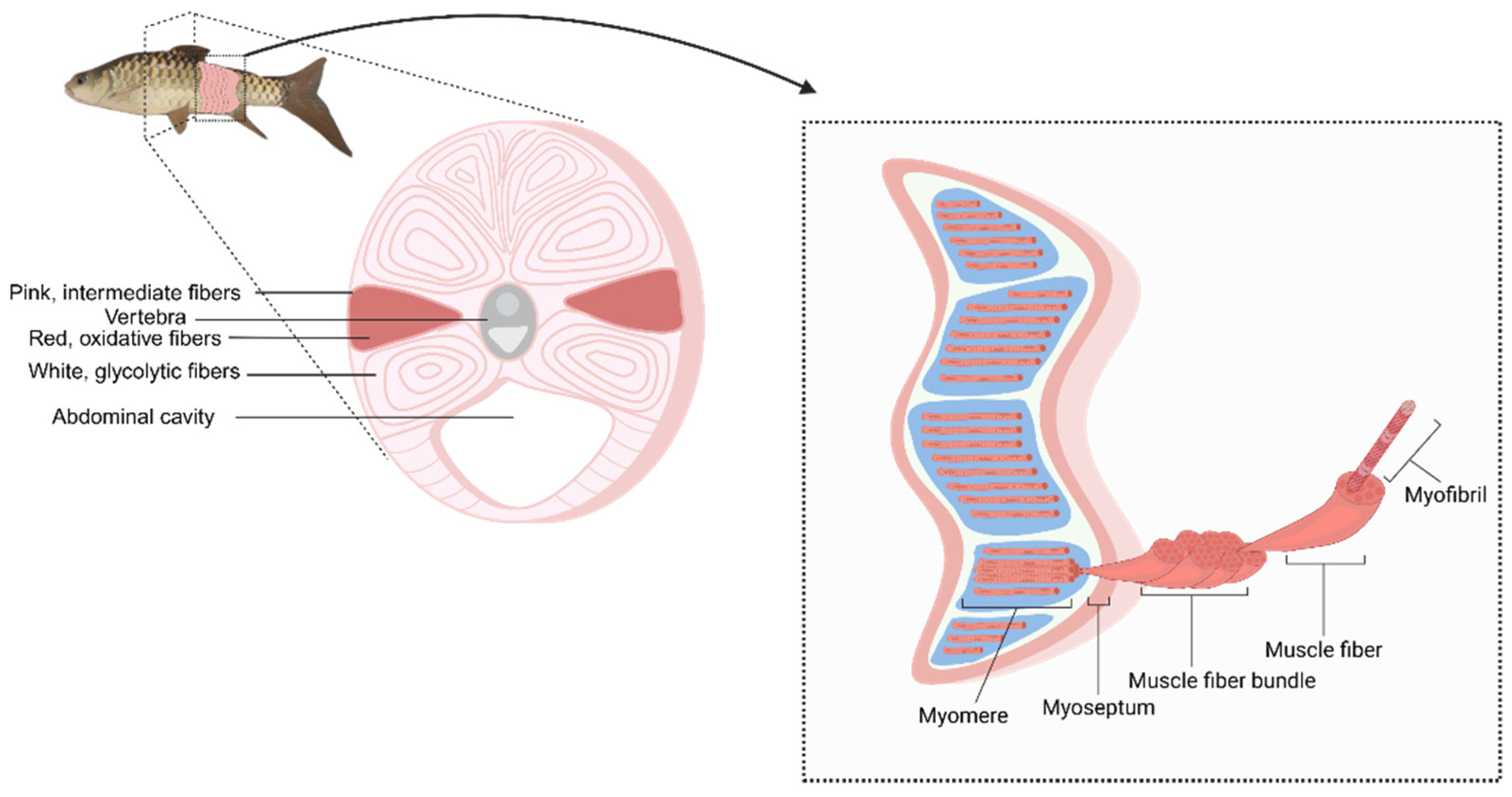
Skeletal muscle in fish constitutes the primary edible portion, and its structural characteristics influence both the locomotor performance and nutrient composition of fish. Muscle growth occurs through hypertrophy (an increase in myofiber size) and hyperplasia (an increase in myofiber numbers). Fish skeletal muscles are generally classified into three fiber types based on their morphology and metabolic properties: white, red, and pink fibers [60].
White fibers are fast-twitch, anaerobic, and highly glycolytic and support short-duration, high-intensity swimming. Due to limited vascularization, white fibers rely primarily on anaerobic glycolysis for rapid ATP production. In contrast, red fibers are slow-twitch, highly aerobic, and located as a triangular band along the lateral line [61]. Extensively vascularized and characterized by dense capillary networks that support their high oxygen demands, red fibers help fish maintain sustained, moderate-speed swimming. These fibers, which are rich in myoglobin, mitochondria, glycogen, and lipids, typically account for less than 10% of total skeletal muscle. Meanwhile, pink fibers represent an intermediate type: they combine fast contractions with a moderate aerobic capacity to provide a functional and morphological transition between the white and red fibers [61,62].
Similarly to all other vertebrates, the muscle fiber microstructure of fish comprises myosin, which is composed of two heavy chains and four light chains. Fast-twitch (white) muscle fibers and pink fibers, which have intermediate contraction speeds, display an identical light chain myosin composition. White muscle fibers, which express fast-twitch myosin heavy chain (MyHC) isoforms, are adapted for anaerobic glycolysis and constitute the majority of fish muscle mass. Red muscle fibers, which express slow-twitch MyHC isoforms, are highly aerobic and form a distinct band beneath the lateral line, while pink muscle fibers exhibit intermediate properties and co-express different MyHC isoforms [62]. To examine the higher-order organization within fish muscle tissue, the structure can be considered the connection of repeated segments called myomeres, which are separated by connective tissue sheaths known as myosepta (Figure 1). Each myomere has a three-dimensional W-shaped structure that enables contractions for the efficient bending and flexing of the spine. Locomotion involves the coordinated activity of myomeres and interspersed adipose tissue, with the latter intramuscular fat deposits present between fibers to support energy storage and mechanical function [60].
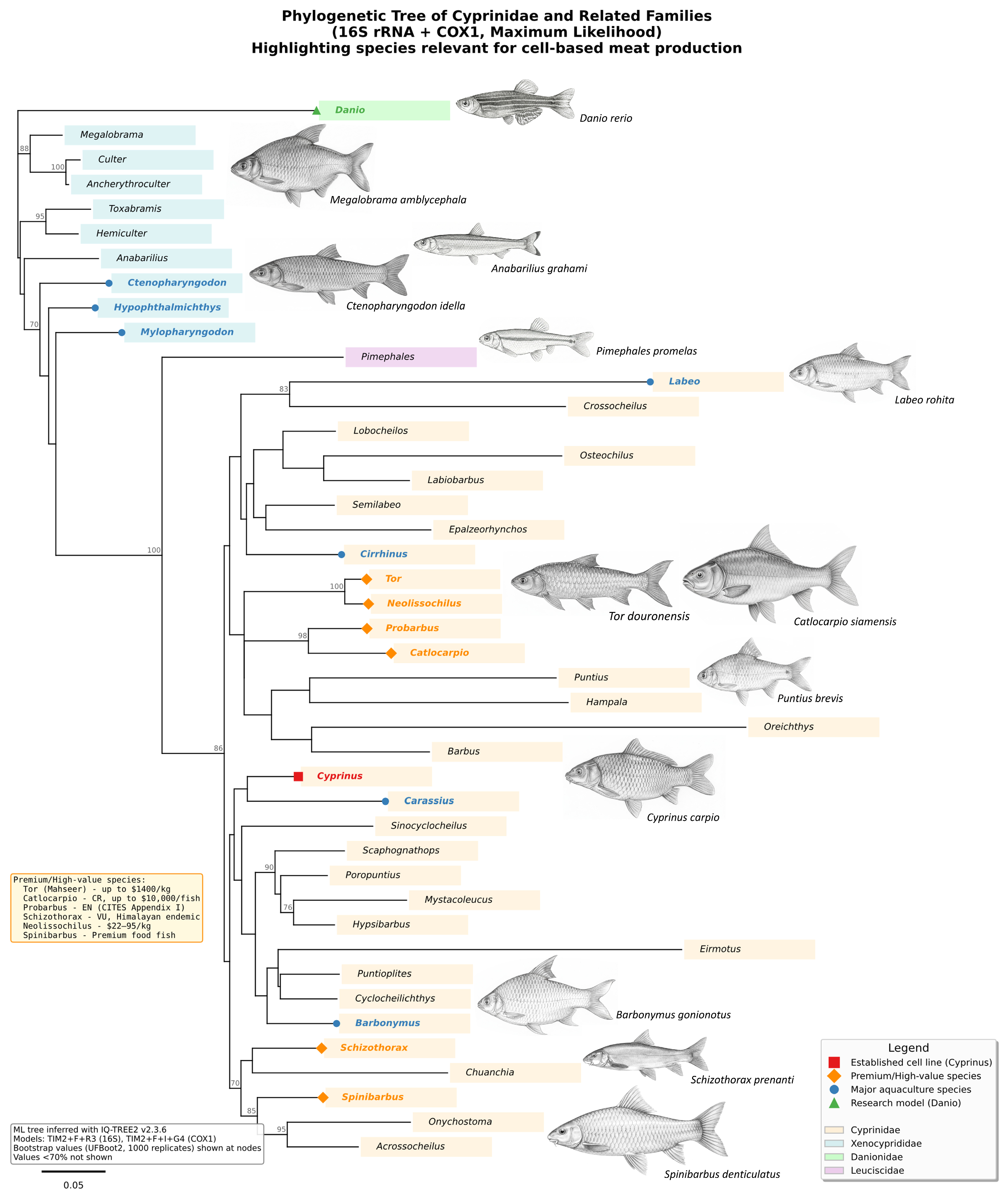
These muscle structural and functional characteristics are particularly relevant in the family Cyprinidae, which is currently considered the largest family of freshwater fishes (Class Actinopterygii) and comprises 3006 recognized species across 367 genera [10]. Members of this family include ecologically and economically important species, such as the ornamental Amur carp or koi (Cyprinus rubrofuscus), the goldfish (Carassius auratus), the common silver barb (Barbonymus gonionotus), and the semah mahseer (Tor douronensis), which is a valued food fish in Southeast Asia. All of these species contribute substantially to inland fisheries and aquaculture production. In addition to food species, some cyprinids, such as koi and goldfish (Carassius auratus), also hold commercial value in the ornamental fish industry. Cyprinids belong to the order Cypriniformes. This order also includes related families, such as Danionidae, represented by zebrafish (Danio rerio), which is an established vertebrate model organism in developmental and biomedical research [63] (Figure 2). Cyprinidae habitats are remarkably diverse and range from standard freshwater ecosystems to extreme environments, such as high-altitude streams and, in rare cases, brackish waters or those of variable salinity [64].
While recent taxonomic revisions place major aquaculture species like the grass carp (Ctenopharyngodon idella) into the sister family Xenocyprididae, both families share exceptional hypoxia tolerance and robust metabolic adaptability, which facilitate scalable bioreactor culture. Nonetheless, the strict Cyprinidae clade offers a unique dual advantage: it encompasses both well-characterized model species that have up to 70 cell lines, including muscle cells and high-value ‘premium’ targets such as Tor (Mahseer), Neolissochilus, Catlocarpio (Giant Barb), and Spinibarbus. These species command high market values in Southeast Asian and Indian markets, comparable to marine delicacies, yet they retain the favorable cell-culture attributes of freshwater teleosts [44,45]. This contrasts sharply with high-value marine competitors like Bluefin tuna or Atlantic salmon, which have shown low success in muscle cell culture in terms of isolation yield and post-isolation growth rate [65]. Thus, Cyprinidae provides a strategic ‘sweet spot’: it allows for the development of high-value cultivated products using accessible, scientifically robust biological systems.
Figure 2. Maximum likelihood phylogenetic tree of Cyprinidae and related families based on concatenated 16S rRNA from 2 datasets and COX1 sequences from NCBI GenBank (1254 bp) [66,67]. The tree was inferred using IQ-TREE v2.3.6 with partition-specific models (TIM2+F+R3 for 16S, TIM2+F+I+G4 for COX1) selected by ModelFinder using BIC [68,69]. Numbers at nodes indicate ultrafast bootstrap support values (1000 replicates) evaluated by SH-like approximate likelihood ratio test (SH-aLRT); values < 70% are not shown [70]. Branch lengths are proportional to the number of nucleotide substitutions per site (scale bar = 0.05). Taxa are colored by family: Cyprinidae (peach), Xenocyprididae (blue), Danionidae (green), and Leuciscidae (purple). Genera with established cell culture systems or major aquaculture importance for cell-based meat production are highlighted: red square = established cell line (Cyprinus carpio), orange diamonds = premium/high-value species with potential for cell-based meat production (Tor douronensis), blue circles = major aquaculture species, green triangle = research model organism (Danio rerio).
Biology 15 00291 g002

4. Primary Culture of Fish Muscle Cells

4.1. Methods for Establishing Primary Cells

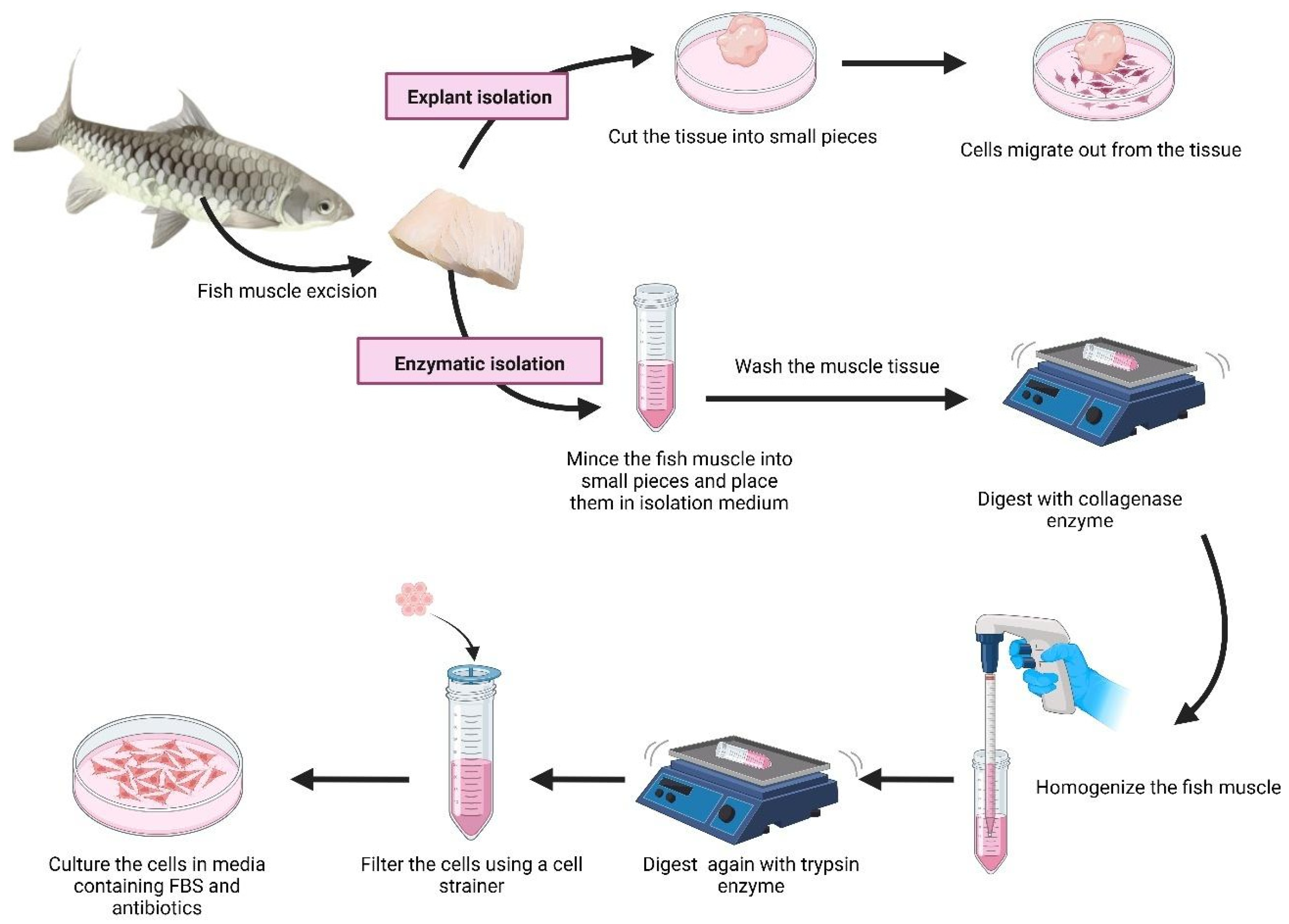
There are two principal approaches for establishing primary fish muscle cell cultures: the explant outgrowth method and the tissue digestion or dissociation method (Figure 3). Each technique has specific advantages and limitations, and its suitability is determined based on the species, tissue characteristics, and research objectives.

4.1.1. Explant Outgrowth Method

The explant outgrowth technique is a classic method used to obtain primary cells directly from tissue fragments. In fish, white skeletal muscle is commonly collected from the epaxial region. The tissue is aseptically dissected and cut into small pieces. These fragments are then placed onto a culture surface with an appropriate growth medium [71]. After the cells migrate from the tissue explant, they form a monolayer on the culture plate. When a sufficient number of cells have proliferated, the remaining muscle explant is either removed or transferred to a new culture dish to allow for further outgrowth.
This method is relatively simple, requires minimal equipment, and is cost-effective, which makes it suitable for laboratories with limited resources [72]. However, one major limitation is the heterogeneity of the resulting cell population. Different cell types, such as myoblasts, fibroblasts, and adipocytes, can migrate from the tissue. The resultant mixed cultures may complicate downstream analyses [73]. Furthermore, since the tissue remains exposed to culture conditions for extended periods, there is an increased risk of microbial or fungal contamination, so rigorous aseptic techniques are necessary [74].

4.1.2. Tissue Digestion or Dissociation Method

The tissue digestion method involves the enzymatic dissociation of muscle tissue to obtain a suspension of single cells. Typically, white muscle from the epaxial region above the lateral line is excised and digested using collagenase and/or protease to separate individual cells from the ECM [75]. The resulting cell suspension is then initially filtered through a 100 µm cell strainer to remove debris, with a smaller pore size of around 40 µm used to obtain single cells suitable for culture [76].
This approach generally yields a higher number of viable cells and allows for the enrichment of specific populations, such as muscle satellite cells, through techniques like pre-plating [77]. During pre-plating, fibroblastic cells adhere more rapidly to uncoated or ECM-coated culture surfaces, enabling the selective recovery of less adherent myogenic cells from the supernatant.
Nevertheless, enzymatic digestion can impose harsh mechanical and chemical stress on cells, thereby potentially reducing their viability or damaging the cell surface receptors [78,79]. Proper optimization is species-specific. Careful optimization with respect to enzyme choice (e.g., collagenase, trypsin, dispase), concentration, temperature, and incubation time is therefore critical to improve the cell yield and health.

4.2. Culture Conditions

4.2.1. Base Media

Media originally designed for mammalian cell cultures are used for many fish cultures. The factors that are essential for the culture media of fish cells are salt levels, buffer, temperature, sources of carbon, and pH levels [80]. Eagle’s minimal essential medium (MEM) and Leibowitz’s 15 (L-15) medium are the common base media used in fish muscle cell cultures [81].
MEM with fetal bovine serum (FBS) is a favored culture medium suitable for cells from mammals, birds, reptiles, amphibians, and fish [82]. Meanwhile, L-15, a nutrient-rich medium that is high in amino acids and uses a phosphate-based buffer system instead of sodium bicarbonate, does not require a carbon dioxide (CO2)-controlled atmosphere [83]. It can maintain pH values within the normal range without additional CO2, which allows cells to be grown conveniently at room temperature in any undisturbed area. Because of this advantage, numerous fish cell lines have been successfully established using L-15 media [31,34,84,85,86].

4.2.2. Sera (FBS and Fish Serum)

Animal sera, especially FBS, are widely used in cultures of both mammalian and fish cells. Besides nutrients and pH buffering, FBS contains a variety of growth factors to promote proliferation, signal adhesion to the culture plate, and important soluble proteins, such as metal-ion binding transferrin, which plays a role in iron transport and oxidative stress modulation [87]. Researchers found that increasing the concentration of FBS from 5% to 20% increased the growth rate of muscle cells. However, a concentration of 10–15% FBS resulted in relatively good cell growth, which is advantageous for maintaining cell lines at a lower cost [31,82,85].
Using fish serum or fish muscle extract as substitutes for FBS in fish muscle cultures could be beneficial. According to the findings of a study by Dong et al., fish muscle extract can replace FBS to promote cell proliferation while preserving cell viability and gene expression [31,88]. Replacing FBS is considered a challenge in terms of reducing costs and improving standardization. A defined, serum-free medium for fish muscle cells typically includes a basal medium, such as L-15 or DMEM, and various supplements with various recombinant growth factors, as described in Section 4.2.3 [89].

4.2.3. Supplementation

Basic fibroblast growth factor (bFGF), specifically a human recombinant, is a potent proliferation stimulator that is frequently added to culture media. bFGF plays a crucial role in regulating muscle development and homeostasis and accelerating the regeneration of injured skeletal muscle through the activation of the phosphatidylinositol 3-kinase/protein kinase B/mechanistic target of rapamycin (PI3K/Akt/mTOR) signaling pathway [90]. Despite the inclusion of bFGF in FBS, the concentrations may be insufficient for optimal stem cell proliferation and differentiation prevention. bFGF has been used in several studies to culture myogenic and fibroblast-like cells but not adipogenic cells. bFGF is necessary for the self-renewal of satellite cells as well as for the maintenance and repair of skeletal muscle [91].
Insulin-like growth factor 1 (IGF1) plays a crucial role in protein synthesis and the growth of fish muscle. IGF1 regulates upstream PI3K signaling and is essential for stimulating amino acid metabolism to enhance muscle development. bFGF and IGF1 have the potential to support and enhance the proliferation rate of muscle cell cultures [92]. Other essential components include transferrin (for iron delivery), insulin, selenium, non-essential amino acids, and lipid supplements (especially omega-3 fatty acids). Cost-effective nutrient sources, such as yeast- and plant-based hydrolysates (from soy, peas, and rice), are currently being explored as replacements for expensive recombinant proteins [58].
Epidermal growth factor (EGF) and its receptor (EGFR), a transmembrane glycoprotein with tyrosine kinase activity, constitute a fundamental signaling system regulating cellular proliferation, differentiation, and survival [93]. In teleost fish, the egfr gene family has expanded following fish-specific whole genome duplication, resulting in duplicated genes such as egfra and egfrb, which allow for specialized functions in growth signaling [94]. While the hypothalamic-pituitary-somatotropic axis is the primary endocrine driver of fish growth, the EGF system serves as a vital local regulator [95]. Specifically, EGF binding triggers autophosphorylation of the receptor’s intracellular domain, activating downstream pathways like MAPK/ERK and PI3K/Akt, which are essential for the recruitment and proliferation of myosatellite cells [93,96]. This process is a prerequisite for both hyperplastic and hypertrophic muscle growth, ultimately influencing the muscle cellularity and flesh quality of aquaculture species [96]. In practical applications, studies on teleost species such as the brown-marbled grouper (Epinephelus fuscoguttatus) have shown that EGF at a concentration of 20 ng/mL, supplemented with 20 ng/mL bFGF, 20% FBS, and 10% fish muscle extract in L-15 medium, provides the optimal conditions for cell proliferation and the long-term maintenance of stemness across more than 50 passages [97].

4.2.4. ECM

In teleost fish, as in other vertebrates, muscle satellite cells reside in a specialized microenvironment or “niche” located between the sarcolemma of the myofiber and the surrounding basement membrane [98]. This niche is composed of ECM proteins, such as laminin and collagen, which play a critical role in maintaining satellite cell quiescence and regulating their activation, proliferation, and differentiation [99]. Understanding and replicating this niche in vitro is a key goal for successful muscle cell culture. Fish cells may therefore require surfaces that comprise various ECM proteins, such as collagen, fibronectin, polylysine, and laminin, for efficient adhesion and growth. Optimizing these ECM proteins may be critical for efficient fish muscle culture [80,100]. Differences in ECM protein affinity can also influence cell attachment behavior and thereby support selective enrichment strategies during primary muscle cell culture. The difference in ECM protein affinity would also assist cell purification, since the initial cell isolate is a heterogeneous population [99]. Both the cyprinid clade and Atlantic salmon primary muscle cells have been successfully cultured and differentiated on laminin-coated tissue culture plates [100,101]. Consequently, research into the ECM required for fish cell survival and proliferation in vitro is a significant area of investigation.

4.2.5. Temperature

Fish cell cultures have several differences compared to mammalian cell cultures. These include their ability to adapt to a wide range of temperatures and a higher tolerance to hypoxia [102]. As fish are ectothermic animals, the optimal temperatures for fish cell cultures may vary depending on the natural habitats of the fish, which may vary from 15 °C to 30 °C. The primary muscle cells of trout and sea bream were maintained at temperatures of 15–21 °C [103].
Culturing fish muscle cells at lower temperatures can reduce the energy required to maintain controlled culture conditions. This reduction in energy demand may translate into cost savings during large-scale production of cell-based aquatic foods. Compared with cell-based terrestrial meats, cell-based aquatic foods therefore have the potential to offer economic advantages at an industrial scale [80].

4.2.6. CO2

While mammalian cells need 5% CO2 to maintain a pH of around 7.4 via a bicarbonate buffer system catalyzed by carbonic anhydrase, excessive levels of CO2 in the aquatic environments of aquaculture can be detrimental to fish. When the concentration of CO2 surpasses the safe threshold, it significantly reduces the capacity of fish blood hemoglobin to carry oxygen, leading to results in fish experiencing respiratory distress [104]. This can happen even when the water contains high concentrations of dissolved oxygen. However, fish cells are well adapted to pH variability and do not need CO2 regulation. Nonetheless, fish cells still require culture media with a pH buffer quality. L-15 with HEPES for extra buffering capacity is therefore widely used as a culture medium for fish cells [80].

5. Characterization of Cell Culture Systems

5.1. Morphology

Muscle tissue contains two primary cell types that are capable of expansion and differentiation into muscle fibers, namely, satellite cells and myoblasts. Satellite cells function as muscle stem cells, are typically small and flattened, and reside between the sarcolemma and basal lamina [83]. In primary culture, a satellite cell generally assumes a spindle shape. Given their metabolically quiescent state, satellite cells exhibit a high nucleus-to-cytoplasm ratio, with a densely packed, heterochromatic nucleus and few organelles aside from ribosomes, which are required to synthesize the proteins essential for myogenesis [105].
In response to stress or muscle injury, satellite cells are activated to proliferate and differentiate into myoblasts. Myoblasts are larger and more round or oval than satellite cells. A larger cytoplasm ratio and more organelles reflect their increased metabolism. Myoblasts retain a proliferative potential and ultimately fuse to form multinucleated myotubes, which mature into functional muscle fibers. Importantly, myoblasts are differentiated from satellite cells primarily by their active participation in muscle growth and repair rather than by their distinct morphological characteristics [106].
Another key cell type within muscle tissue is the fibroblast. Fibroblast-like cells can be derived from multiple sources, including muscle tissue and the caudal fin. Proliferative fibroblasts are typically elongated and spindle-shaped [107]. When ready to produce ECM, fibroblasts assume more extensive cytoplasmic branching and accumulate a rough endoplasmic reticulum. While mature fibroblasts and their ECM products are essential to muscle development and regeneration by satellite cells, an excessive number of mature fibroblasts or myofibroblasts may cause fibrosis and subsequent muscle dysfunction [108].
Primary preadipocytes are proliferative precursors to lipid-storing adipocytes. These cells exhibit a fibroblast-like morphology characterized by a small, thin cytoplasm devoid of lipid droplets. When isolated from the adipose tissue of grass carp (Ctenopharyngodon idella) and cultured with 10% FBS at 28 °C in a humidified 5% CO2 atmosphere, they reach confluence within 10 days. They subsequently gradually accumulate lipid droplets and adopt a rounder morphology until they become fully differentiated by day 20 [6]. The optimal culture temperature for preadipocytes varies among fish species, thus reflecting their native habitats. For example, common carp preadipocytes are cultured at 23 °C and those of Atlantic salmon at 12 °C [109,110].
Cellular senescence is a state of stable cell cycle arrest, in which cells remain viable and metabolically active but lose the ability to divide. This poses a significant challenge for the development of cell lines, which require the capacity for continuous proliferation. Senescent cells are typically characterized by flattened and enlarged cell bodies with heterochromatic nuclei. While satellite cells may also exhibit a flattened morphology within their physiological niche, they generally adopt a compact spindle shape in 2D culture systems. Nevertheless, unbiased morphological assessments of senescence across large cell populations remain challenging using conventional methods. To address this, deep learning models have been developed to facilitate senescence detection [111,112]. Recent models have shown that senescence can be accurately inferred from nuclear morphology alone, with features such as a high aspect ratio and low convexity serving as reliable markers [112].
Differentiation via induction, which is typically achieved by reducing the growth factors in the medium, can be assessed by applying distinct methods. The observed ability of myoblasts to fuse into multinucleated myotubes can be determined using the fusion index, which is defined as the percentage of total nuclei within MyHC-positive myotubes (see Section 5.2 for more on MyHC). Morphological inspections can also be performed concurrently with contractility assessments [113,114]. The latter can be conducted either by observing spontaneous contractions or those induced in response to electrical stimulation. The use of microscopes allows karyotyping (analysis of the chromosome number and structure) and the examination of genetic stability. Since long-term culture can lead to chromosomal abnormalities and genetic drift, periodic karyotyping is essential to ensure the genetic stability of cell lines, as such stability is critical for both research reproducibility and food safety.

5.2. Molecular Characterization in Fish Muscle Cell Cultures

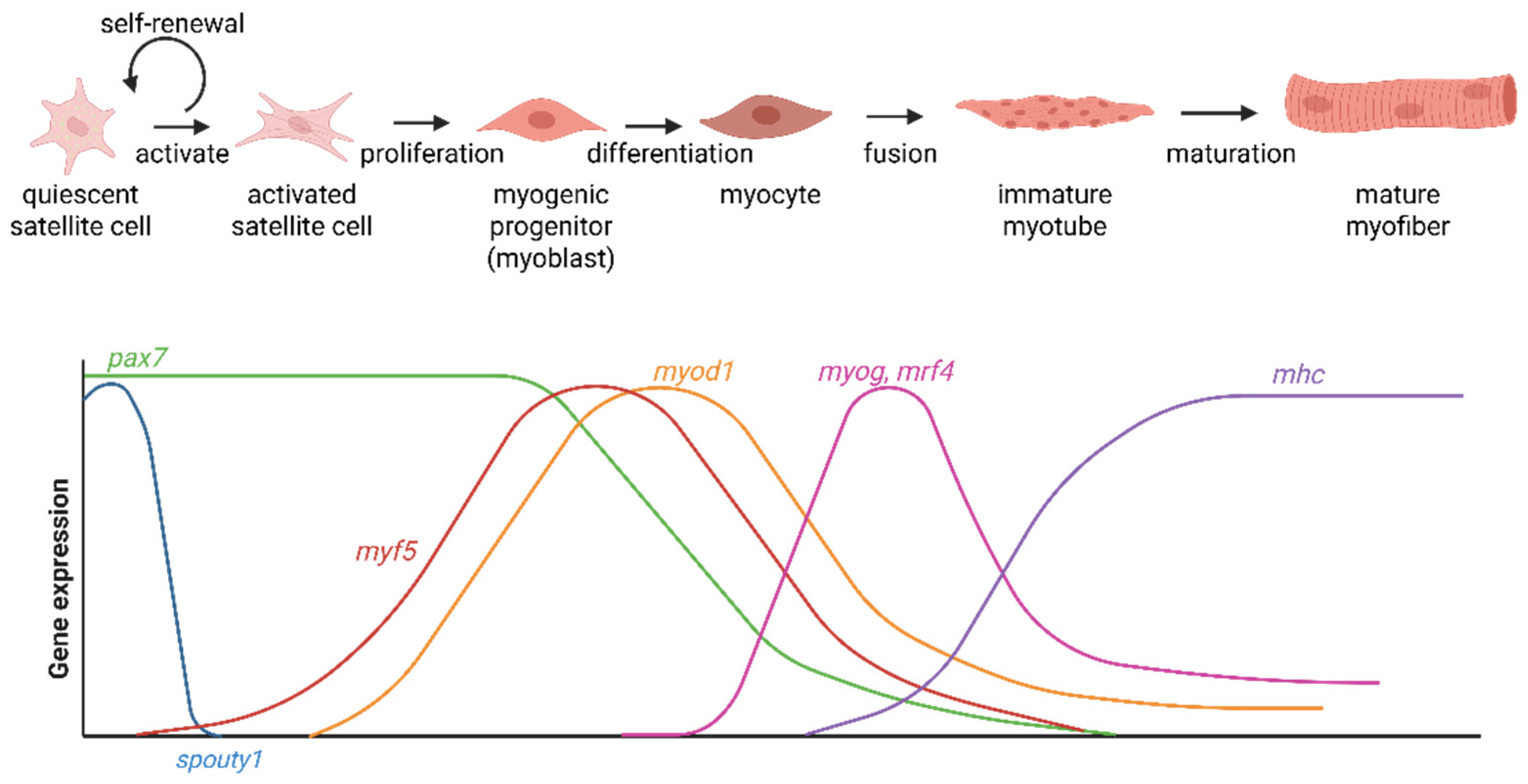
Satellite cells and myoblasts, which are key progenitors in muscle development, are marked by at least Paired Box 7 (Pax7), a paired-box transcription factor protein, and Myogenic Differentiation 1 (MyoD), a member of the myogenic regulatory factor (MRF) family. Pax7, the expression of which is typically downregulated as cells commit to terminal differentiation, is the definitive marker for quiescent and proliferating satellite cells [115]. In Cyprinus carpio, the primary satellite cells exhibit a brief proliferative phase before differentiating and fusing into myotubes, largely independent of the tissue source or media composition. In marine species, such as Sebastes schlegelii, Pax7-positive satellite cells rapidly differentiate into myoblasts within five passages, with the resulting myoblast pool capable of stable expansion for over 50 passages [116]. Some fish species also express a related factor, Pax3 [117], in muscle progenitors; zebrafish have Pax3a/Pax3b genes whose expression overlaps with Pax7 in early myogenesis. Both Pax7 and Pax3 are considered conserved markers of the muscle stem cell lineage across vertebrates [118]. Satellite cells can be identified by distinctive cell-surface proteins. Notably, the receptor for hepatocyte growth factor c-Met (also known as Met) and the adhesion molecule M-cadherin (Cadherin-15) are classic satellite cell markers in mammals, and fish satellite cells appear to share these features [119]. Another surface marker is Syndecan-4, a cell membrane proteoglycan, expressed in fish muscle satellite cell populations [117]. Mammalian satellite cells are also known to express CD34 (a stem cell surface marker) and VCAM-1 (vascular cell adhesion molecule) on their surface, and while less documented in fish, the conserved presence of such receptors in the fish myogenic satellite cells is likely. These surface markers are important because they would enable the isolation and purification of muscle stem cells by fluorescence-activated cell sorting (FACS) or magnetic sorting in principle. Indeed, combinations like Pax7+/c-Met+ or Syndecan-4+ could be applied for the fish muscle progenitors.
In myoblasts that have committed to the myogenic lineage, MyoD expression increases during proliferation and early differentiation [120]. MyoD expression fluctuates during differentiation but generally decreases in myotubes. As shown in Figure 4, typically, an activated progenitor will upregulate MyoD while Pax7 levels decline, indicating that the cell is leaving the stem state and becoming a committed myoblast. MyoD is a conserved master regulator of myogenic fate, and its expression is a hallmark of myoblast identity in fish and mammals alike. Other intracellular markers of myoblasts include Myf5 (myogenic factor 5, another early MRF, which often initiates slightly earlier than MyoD) and desmin, an intermediate filament protein [121,122]. Desmin is a muscle-specific structural protein; in mammals, activated satellite cells begin expressing desmin as they differentiate. In zebrafish primary muscle cell cultures and spotted skat cell cultures, proliferating muscle progenitors have indeed been reported as desmin-positive, underscoring that the myogenic lineage is maintained [42]. Myogenin (MyoG), a helix–loop–helix transcription factor specifically for muscle fiber differentiation (another MRF), increases from the onset of terminal differentiation and peaks during myoblast fusion or functional myotube formation. MyHC is upregulated only after functional maturation, thereby contributing directly to muscle contraction and acting as a marker for mature, fused myotubes. MyHC is expressed only in terminally differentiated muscle cells [123] (Figure 4). For example, in cultured Atlantic mackerel (a teleost fish) muscle cells, researchers confirmed differentiation by the presence of MHC in multinucleated cells [65]. Similarly, Troponin proteins (such as Troponin T and I, components of the thin filament regulatory complex) are upregulated in differentiating fish muscle; the study of mackerel cells also tracked TNNT3a (troponin T isoform) as a differentiation gene that increases alongside myogenin [65]. Mammalian myoblasts (derived from activated satellite cells) are known to express NCAM (neural cell adhesion molecule, also known as CD56), and retain M-cadherin and c-met [124]. It is likely that fish myoblasts share some of the adhesive proteins for surface markers as seen in other vertebrates.
Differentiation can be monitored using multiple other markers. Ki67, which is expressed during all active cell cycle phases (G1, S, G2, M), declines sharply as myoblasts exit the cycle. Proliferating cell nuclear antigen (PCNA) persists longer and may remain detectable in early differentiated cells. Cell proliferation is antagonistically regulated with differentiation and apoptosis: PI3K/Akt-associated β1-integrin decreases during differentiation; however, caspase-9 increases, with a peak around day 2 and a return to baseline upon functional myotube formation. In Labeo rohita myogenic cell lines, satellite cells dominate the initial population, while MyoD-positive myoblasts are the main proliferative population by passage 15. Later passages (≥25) show increased expression of MEF2A, Mrf-4, and MyoG, which reflects mixed populations of differentiated myotubes and mitotic myoblasts, although detailed cell subtype profiling has not been conducted to date [45]. Notably, zebrafish muscle stem cells exhibit peak MyoD expression during early myotube formation rather than in the myoblast phase, likely due to the gradual accumulation of MyoD mRNA during differentiation [42].
These markers can therefore be used for immunocytochemistry characterization, such as immunofluorescence, and allow for the quantification of gene expression using real-time polymerase chain reaction (RT-PCR) throughout the culture and differentiation process as measurements of myogenic progression [125,126].
In addition to myogenic composition, the muscle consists of fibroblasts and some adipocytes. Fibroblast-like cells are common in established Cyprinid cell lines and are characterized by vimentin expression. Tor caudal fin fibroblasts express vimentin but not cytokeratin [35]. In marine fish, turbot (Scophthalmus maximus L.) muscle fibroblasts express TCF-4, a signaling factor that promotes myogenesis, but lack Pax7 and desmin [127]. Preadipocytes, which are proliferative precursors of lipid-storing adipocytes, maintain a fibroblast-like morphology before confluence. Differentiation is accompanied by increased glycerol-3-phosphate dehydrogenase activity and the upregulation of peroxisome proliferator-activated receptor gamma (PPAR-γ), with lipid droplet formation visualized via Oil Red O staining [128].

6. Applications of Cultivated Fish Meat and Future Perspectives

6.1. End-Product Landscape: From Unstructured Biomass to Final Consumer Goods

The ultimate goal of cultivated fish production is to deliver safe, nutritious, and appealing products to consumers. The transition from cellular biomass to a final product involves sophisticated multi-disciplinary fields, such as bioprocess and tissue engineering and food science, to replicate the complex sensory attributes of conventional aquatic food. The initial output from bioreactors is typically an unstructured slurry of muscle (or myogenic lineage) cells, which can be readily used for products where the original muscle structure is not critical, such as surimi, fish balls, fish cakes, dumplings, or fillings [80,129]. However, to replicate high-value conventional aquatic food, the industry is focused on creating structured products like fillets and steaks.
Achieving the characteristic texture, flavor, and appearance of a fish fillet requires the co-culturing of muscle, fat, and connective tissue cells on edible scaffolds that guide their organization into aligned fibers [75,130]. The composition and distribution of intramuscular fat, for instance, are critical for delivering the desired juiciness, mouthfeel, and species-specific flavor profile. Furthermore, hybrid products, which combine cultivated fish cells with plant-based or fungal-derived proteins and fats, could represent a pragmatic near-term strategy. This approach can significantly improve texture, reduce production costs, and accelerate market entry while still delivering an authentic aquatic food experience that is superior to purely plant-based alternatives [131]. Companies like BlueNalu and Finless Foods are actively developing both fully cultivated and hybrid products, targeting high-demand species such as bluefin tuna and salmon, where the environmental impacts—conservation of the species’ natural habitats, and supply chain benefits—no longer require transporting fish over long distances—are most pronounced [132].

6.2. Market Integration: Consumer Acceptance, Regulatory Pathways, and Commercial Viability

The successful application of cultivated fish meat relies on three interconnected factors: consumer acceptance, a clear regulatory pathway, and commercial viability. First, consumer interest is driven by a growing awareness of the environmental unsustainability of conventional fishing [129], including overfishing, habitat destruction, and bycatch, as well as concerns about contaminants like heavy metals [133] and microplastics [134] found in wild-caught fish. Cultivated aquatic food offers a compelling solution, providing a clean, safe, and ethically produced protein source with a significantly lower environmental footprint [80]. However, consumer neophobia, price sensitivity, and “unnaturalness” perceptions remain significant obstacles to widespread and mass adoption [135]. Overcoming these barriers will require transparent communication, educational marketing, and achieving comparable pricing with conventional aquatic food.
Second, the regulatory landscape is also a critical factor for market entry. Singapore was the first to approve the sale of a cultivated meat product in 2020 [136]. The United States followed with its first approvals in 2023, establishing a dual-agency framework between the FDA and USDA for safety, production and labelling cultivated meat, while the FDA is solely responsible for cultivated seafood [137]. This progress provides a roadmap for other nations, but navigating the regulatory requirements in major markets like the European Union remains a complex and time-consuming process. As of 2024, the cultivated seafood sector includes over 25 companies globally, signaling strong commercial interest, but achieving the scale and cost-efficiency required for mass-market viability remains a primary long-term challenge [132]. Intertwined with these two described factors, the viable commercialization of cell-based aquatic food would still hinge on the foundational technologies for its mass production elaborated in the subsequent section.

6.3. Enabling Technologies for Cultivated Fish Meat Production Beyond Cell Line Development

Cell-based fish systems represent a promising approach to the production of animal-free aquatic foods. By combining advances in biomedical engineering and aquaculture, these systems enable the cultivation of marine animal cells at scale [138]. The techniques developed for mammalian cell production, such as closed-system bioreactors, can be adapted for large-scale fish cell culture. Compared to mammalian muscle, fish muscle tissue is particularly amenable to bioreactor cultivation owing to its physiological characteristics [28]. Cyprinids are attractive targets for cell-based meat due to their abundant intermuscular bones, which pose health risks and reduce consumer appeal [139,140]. Fish cells also exhibit enhanced hypoxia tolerance, which reduces the need for intensive oxygenation in bioreactors. Furthermore, their broad pH tolerance allows growth across a wider pH range, and their ability to thrive at lower temperatures reduces their heat transfer requirements and overall production costs [141].

6.3.1. Scaffolds for Three-Dimensional Tissue Cultivation

In fish cell culture, the process of cultivating three-dimensional tissues is dependent on the presence of scaffolds. Scaffolds are biocompatible materials that serve as a support system for the growth and differentiation of fish cells by providing an ideal morphology, chemical composition, and structural template [142]. They play a crucial role in mimicking the natural microenvironment of fish tissues, thereby facilitating the formation of functional tissue structures. They provide physical support to the cells, which allows them to organize and interact with one another in a manner similar to their natural counterparts [143]. Scaffolds can also influence cellular behavior and promote cell adhesion, proliferation, and differentiation [144].
Several types of scaffolding materials used in medical tissue engineering, such as cellulose, alginate, and chitosan, can be applied in fish cell culture [144]. Cellulose, a polysaccharide found in plant cell walls, is known for its biocompatibility and mechanical strength. Alginate, which is sourced from seaweed, possesses excellent gel-forming properties and can encapsulate fish cells for further cultivation [145]. Chitosan, derived from the exoskeleton of crustaceans, exhibits antibacterial properties and can promote cell adhesion and growth [141]. Beyond cellulose, alginate, and chitosan, decellularized ECM scaffolds derived from plant tissues (e.g., spinach, apple) and fungal mycelium are emerging as promising, edible scaffolds. These materials can provide a pre-existing vascular-like network and natural structural support. By employing suitable scaffolds in fish cell culture, researchers aim to create environments that support the growth and development of fish tissues in vitro to ultimately advance the field of cultivated fish products and contribute to sustainable aquatic foods production [80,146].

6.3.2. Bioreactors

The success of cell-based aquaculture depends on several key factors, including the development of suitable muscle cell sources, the optimization of culture conditions, and the ability to achieve large-scale cell production in bioreactors [147]. Bioreactors provide a controlled and optimized environment for cell growth by regulating parameters such as pH, temperature, and oxygen concentration [148]. A large surface area is required to generate sufficient numbers of muscle cells for downstream applications [149]. In vitro meat production, therefore, necessitates the use of large-capacity bioreactors capable of supporting the expansion of stem cells and differentiated skeletal muscle cells. Importantly, the bioreactor environment must closely mimic the physiological conditions found in vivo, particularly with respect to temperature and oxygen levels. Cell cultivation can be performed using either fed-batch or continuous culture systems [150,151].
The most commonly used bioreactor types in cell-based aquaculture and cultured meat production are stirred-tank and fixed-bed bioreactors [138]. In large-scale production, stirred-tank bioreactors are well suited for suspended cell cultures, but they can also be adapted for adherent cells through the use of microcarriers (i.e., small beads that are generally 100–300 µm in diameter), which provide a large surface area for attachment. The agitation speed needs to be carefully controlled to ensure adequate nutrient mixing and oxygen transfer without causing excessive shear stress on the cells [152]. In contrast, fixed-bed bioreactors are typically employed for adherent cell types. These systems contain stationary scaffolds (e.g., packed or hollow fiber matrix materials) that provide a large surface area for cell attachment and growth, and the culture medium is perfused through the bed [149,153]. This configuration can reduce shear stress and is particularly suitable for cells that are sensitive to mechanical forces. Nonetheless, scaling up from laboratory flasks to industrial-scale bioreactors presents significant challenges. Maintaining homogeneity in large volumes, ensuring sterility, managing heat transfer, and controlling critical process parameters (i.e., pH, dissolved oxygen, glucose, lactate) all become more complex. The implementation of process analytical technology, which involves real-time monitoring and feedback control, is essential for achieving consistent product quality at scale [154].

6.3.3. Advanced Cellular Characterization Using Single-Cell Transcriptomics for Optimizing Piscine Myogenic Cultures

While traditional marker analysis provides valuable insights, the advent of single-cell RNA sequencing (scRNA-seq) has revolutionized the understanding of cellular heterogeneity within muscle tissue by enabling high-resolution transcriptomic profiling of individual cells [155]. This technology overcomes the limitations of bulk RNA sequencing, which provides only an averaged view of gene expression, and has been instrumental in dissecting the complex cellular landscape of myogenesis. scRNA-seq studies have revealed that the satellite cell pool, once thought to be relatively homogeneous, is composed of multiple subpopulations with distinct transcriptional signatures and functional potentials [156,157]. For instance, scRNA-seq has been used to identify functionally heterogeneous human satellite cells and to characterize a reference atlas of human skeletal muscle tissue, revealing bifurcated muscle stem cell populations [158,159].
Furthermore, scRNA-seq allows for the reconstruction of developmental trajectories, providing a dynamic view of the transitions from quiescent satellite cells to activated myoblasts and their subsequent differentiation into myotubes. This has led to the identification of transient cellular states and novel regulatory networks that govern cell fate decisions during myogenesis [160]. The application of scRNA-seq to aquaculture species holds significant promise for advancing our understanding of fish muscle development and for optimizing cell-based meat production. By characterizing the cellular heterogeneity of fish muscle cell cultures, scRNA-seq can facilitate the identification of superior cell lines, the development of more effective differentiation protocols, and the discovery of novel biomarkers for monitoring cell state and quality. The high-resolution data provides a transcriptomic roadmap to rationally design culture conditions and select for cell populations with high-performing myogenic potential, which is essential for optimizing the efficiency, scalability, and consistency of piscine muscle production.

7. Limitations

Despite substantial progress, several key challenges remain for the cultivated meat industry, particularly in the development of cell-based aquatic foods [81]. Although multiple protocols have been reported for the isolation and culture of fish muscle cells, the lack of standardized criteria for defining myogenic fish cultures remains a persistent challenge in cell-based meat research. The wide variability in tissue source, isolation methods, culture media, and differentiation conditions limits reproducibility and meaningful comparison across studies. Therefore, there is a clear need to establish standardized criteria to define and validate myogenic fish cultures. Such criteria should include confirmation of myogenic identity through conserved marker expression, including Pax7 for satellite cells, MyoD, Myf5, or desmin for proliferating myoblasts, and myogenin and myosin heavy chain for differentiated myotubes [115,120,123]. In addition, quantitative assessment of fusion capacity and myotube formation, as well as systematic evaluation of fibroblast contamination using morphological characteristics and molecular markers such as vimentin, should be routinely performed [35]. Long-term passage stability, including proliferative capacity, maintenance of myogenic marker expression, and chromosomal integrity, should also be evaluated over extended culture [161]. The adoption of standardized definitions and evaluation criteria would improve reproducibility, facilitate cross-study comparisons, and support the development of scalable cultivated fish meat systems.

7.1. Limited Aquatic Foods Cell Lines

Only a limited number of established fish muscle cell lines are currently available, which poses a major obstacle to the large-scale production of cell-based aquatic foods. In the absence of commercially available fish muscle cell lines, researchers must rely on freshly obtained fish specimens to isolate primary muscle cells. Moreover, the lack of optimized culture conditions for many fish species has limited the successful establishment and maintenance of stable fish cell lines [97]. To promote the broader application of fish cell lines as standard research tools, standardized methodologies, including the use of defined media and reagents, consistent equipment, and rigorous quality control protocols, need to be implemented. The proper characterization and detailed documentation of newly developed cell lines would further enhance reproducibility, accelerate progress, and expand research potential in aquatic cell culture [1,80].

7.2. Lack of Effective Serum-Free Media

One of the major challenges in cultivated meat production is the development of suitable serum-free culture media. Alternatives that optimize the composition of media while lowering costs and reducing dependence on animal-derived components have not been fully explored [162]. Currently, FBS is widely used, but it introduces several limitations, including high costs, potential contamination, supply instability, batch variability, ethical issues, and downstream processing difficulties [163]. To date, no fish cell lines have been reported that can sustain robust proliferation under completely serum-free conditions. Addressing this limitation requires focused efforts to optimize culture formulations and identify affordable, serum-free alternatives, which will ultimately promote the cost-effective and ethically sustainable production of cultivated fish meat [81,132].

7.3. High Production Costs

Reducing production costs to compete with conventional piscine meat remains a primary goal for the commercialization of cell-based fish. Techno-economic analyses have indicated that the culture medium is the single largest cost driver, as it can account for over 50% of the total cost of unoptimized processes [164]. The high prices of recombinant growth factors (especially bFGF, which can cost thousands of dollars per gram) and FBS are the main contributors [25].
Evaluating the scalability of cultivated fish meat requires a thorough analysis of production yield and efficiency, particularly in comparison to more established terrestrial cultured meat systems. For terrestrial cultured meat, significant progress has been made in reducing production costs—from the initial multi-million-dollar burger to current techno-economic targets of approximately $63/kg [165]. The projected figure was derived from assumptions related to growth medium, bioreactors, equipment, and labor under many best-case scenarios—e.g., the successful development and commercialization of serum-free media and a reduction in growth medium costs to $374/L. These advancements are closely tied to improvements in key production metrics, such as achieving high cell densities in large-scale bioreactors (e.g., 10–20 m3) and optimizing the metabolic efficiency of cell lines [164]. The inherent physiological advantages of cell-based fish could yield superior production efficiencies to that of terrestrial animals, such as lower culture temperature, reducing energy to heat the bioreactors, hypoxia tolerance and wider pH range, simplifying the bioreactor designs and supporting higher cell density [80]. Forsea, a cell-based fish company, reported cell densities exceeding 300 million cells/mL for eel cells, a benchmark that is substantially higher than what is typically achieved in terrestrial cell cultures [166].
Therefore, future research should focus on innovating affordable media components (e.g., low-cost growth factor alternatives) and scalable formulations that can maintain cell growth, differentiation, and product quality. Implementing cost-effective bioprocess strategies and developing large-scale production systems will also be essential to achieving the target production cost of $63/kg or less, which will make cultivated fish meat economically viable and a competitive alternative to conventional aquaculture and wild-caught seafood [165,167]. Cultivated fish meat is unlikely to supplant conventional aquaculture or the employment it supports; rather, it is expected to serve as a complementary source that helps meet anticipated growth in future consumption while alleviating pressure on wild fisheries.

8. Outlook

The transition of cultivated fish meat from laboratory research to industrial scale depends on the strategic selection of species, cell sources, and cultivation methodologies. Among the diverse taxa studied, fish in the Cyprinidae family, particularly Carassius auratus (goldfish) and Cyprinus carpio (common carp), emerge as the most promising candidates for large-scale production due to their biological resilience and established genomic data. Recent breakthroughs have demonstrated the successful preparation of centimeter-scale cultivated meat from C. auratus using scalable expansion techniques [168]. Additionally, high-value species such as the Japanese eel (Anguilla japonica) and Large yellow croaker (Larimichthys crocea) are highly promising due to the establishment of stable, spontaneously immortalized myoblast cell lines, which ensure consistency in long-term manufacturing [169,170]. This technological framework provides a robust foundation for developing cultivated products from high-value local Cyprinids, such as those found in Southeast Asia, which could significantly impact regional prosperity. Regarding the tissue source, satellite cells derived from epaxial skeletal muscle remain the gold standard. These cells exhibit superior myogenic potential and robust proliferation rates, which are essential for generating dense muscle tissue [171]. However, as observed in our review of primary cultures, maintaining cell purity throughout successive passages is a critical challenge. The encroachment of fibroblast-like cells can diminish the myogenic quality of the final product, necessitating rigorous selective enrichment or single-cell cloning strategies to maintain lineage integrity.
The most effective culture strategies involve a transition toward serum-free media supplemented with specific growth enhancers like hydrocortisone, bFGF, and IGF-1 to ensure food safety and cost-efficiency [170]. For structural development, the integration of 3D edible porous microcarriers, often composed of natural polymers like gelatin or chitosan, within bioreactor systems is currently the most viable approach for achieving mass production [168]. Furthermore, innovative co-culture systems or the use of versatile cell populations (e.g., fibroblasts capable of both myogenic and adipogenic differentiation) represent a significant frontier. These strategies aim to replicate the complex lipid profiles and textural integrity of conventional fish fillets [172].
Beyond the core challenges of cell line availability and culture media costs, several additional factors will be critical to the future success of cultivated fish meat. One key factor is genetic and epigenetic stability. Long-term cell culture can lead to genetic drift, chromosomal abnormalities, and cellular senescence (the Hayflick limit). Therefore, routine karyotyping and monitoring of telomerase activity at predetermined passages will be necessary to ensure the stability and safety of cell lines used for food production. In some cases, controlled immortalization strategies may be required to extend the replicative lifespan of cells; however, these approaches must be carefully evaluated for safety.
Sensory and nutritional fidelity should also be considered. Replicating the complex texture and flavor of conventional fish meat remains a major challenge. This process involves not only the culture of muscle cells but also their co-culture with adipocytes to achieve the desired marbling and lipid profile, particularly the beneficial omega-3 fatty acids, including eicosapentaenoic acid (EPA) and docosahexaenoic acid (DHA), which are hallmarks of fish nutrition. The texture of the final product depends on the alignment and maturation of muscle fibers, which can be influenced by mechanical stimulation and electrical pacing during culture. While early products may be unstructured (e.g., minced fish for fish cakes or sausages), the production of structured products, such as fillets, will require advanced edible scaffolds to guide three-dimensional cell organization. Ideally, these scaffolds should be derived from sustainable sources, such as plants or algae, and should degrade or integrate into the final product. Finally, successful commercialization will depend on navigating regulatory frameworks and gaining consumer trust. Clear labeling, transparent communication regarding the production process, and rigorous safety testing will be essential. Acceptance by future generations of consumers is likely to increase if the environmental and ethical benefits of cultivated fish meat are clearly communicated.

9. Conclusions

The reviewed literature indicates that cyprinid species show strong potential for cultivated fish meat production. White skeletal muscle from the epaxial region emerges as the most suitable tissue source due to its enrichment in myogenic progenitors and direct relevance to edible muscle formation. Culture strategies integrating enzymatic dissociation, selective enrichment, and supplementation with myogenic growth factors (e.g., bFGF, IGF-1, and EGF) appear most effective for expanding myogenic populations while supporting differentiation.
Cultivated fish meat offers a promising avenue for sustainable protein production through the integration of aquaculture, biotechnology, and food security. Species within the Cyprinidae family, supported by advances in primary culture techniques, optimized growth conditions, and emerging technologies, such as scaffolds and bioreactors, provide a valuable foundation for the development of muscle cell culture systems. However, progress remains constrained by the limited availability of standardized cell lines, a dependence on serum-based media, and the high cost of large-scale production. Addressing these challenges will require coordinated efforts across the fields of cell biology, materials science, and bioengineering. With continued innovation, cell-based fish products could reduce reliance on wild fisheries and provide safe, sustainable, and accessible protein for human consumption into the future.

Author Contributions

Conceptualization, P.S., C.J. and W.P.; methodology, P.S., C.J., S.N., N.T., C.A. and W.P.; software, P.S., C.J., S.N., N.T. and C.A.; validation, P.S., C.J., W.P. and K.S.; formal analysis, P.S., C.J., S.N., N.T., C.A. and W.P.; investigation, P.S., C.J., S.N., N.T., C.A. and W.P.; resources, P.S., C.J., S.N., N.T., C.A. and W.P.; data curation, P.S., C.J., S.N., N.T., C.A. and W.P.; writing—original draft preparation, P.S., C.J. and W.P.; writing—review and editing, P.S., C.J. and W.P.; visualization, P.S., C.J., S.N., N.T., C.A., W.P. and K.S.; supervision, W.P. and K.S.; project administration, P.S., C.J. and W.P.; funding acquisition, P.S., W.P. and K.S. All authors have read and agreed to the published version of the manuscript.

Funding

This work has received funding support from the National Science, Research and Innovation Fund (NSRF) via the Program Management Unit for Human Resources & Institutional Development, Research and Innovation grant number B36G660006 and via Kasetsart University (KU)’s Fundamental Fund grant number FF17.68, and the International Science Branding (ISB) grant support to W.P., from Faculty of Science, Kasetsart University.

Institutional Review Board Statement

Not applicable.

Informed Consent Statement

Not applicable.

Data Availability Statement

No new data were created or analyzed in this study. Data sharing is not applicable to this article.

Acknowledgments

The authors acknowledge the support provided by the Faculty of Veterinary Medicine, and the Faculty of Science, Kasetsart University.

Conflicts of Interest

Author Chanati Jantrachotechatchawan was employed by Aixenix Co. Ltd. The remaining authors declare that the research was conducted in the absence of any commercial or financial relationships that could be construed as a potential conflict of interest.

References

  1. Potter, G.; Smith, A.S.T.; Vo, N.T.K.; Muster, J.; Weston, W.; Bertero, A.; Maves, L.; Mack, D.L.; Rostain, A. A More Open Approach Is Needed to Develop Cell-Based Fish Technology: It Starts with Zebrafish. One Earth 2020, 3, 54–64. [Google Scholar] [CrossRef]
  2. Pham, C.-V.; Wang, H.-C.; Chen, S.-H.; Lee, J.-M. The Threshold Effect of Overfishing on Global Fishery Outputs: International Evidence from a Sustainable Fishery Perspective. Fishes 2023, 8, 71. [Google Scholar] [CrossRef]
  3. Thushari, G.G.N.; Senevirathna, J.D.M. Plastic pollution in the marine environment. Heliyon 2020, 6, e04709. [Google Scholar] [CrossRef]
  4. Azevedo-Santos, V.M.; Brito, M.F.G.; Manoel, P.S.; Perroca, J.F.; Rodrigues-Filho, J.L.; Paschoal, L.R.P.; Gonçalves, G.R.L.; Wolf, M.R.; Blettler, M.C.M.; Andrade, M.C.; et al. Plastic pollution: A focus on freshwater biodiversity. Ambio 2021, 50, 1313–1324. [Google Scholar] [CrossRef]
  5. Guinotte, J.M.; Fabry, V.J. Ocean acidification and its potential effects on marine ecosystems. Ann. N. Y. Acad. Sci. 2008, 1134, 320–342. [Google Scholar] [CrossRef] [PubMed]
  6. Li, Y. Establishment and evaluation of a new model for studying lipogenesis in grass carp (Ctenopharyngodon idella) preadipocytes. In Vitro Cell. Dev. Biol. Anim. 2012, 48, 37–42. [Google Scholar] [CrossRef]
  7. Talukder, B.; Ganguli, N.; Matthew, R.; vanLoon, G.W.; Hipel, K.W.; Orbinski, J. Climate change-accelerated ocean biodiversity loss & associated planetary health impacts. J. Clim. Chang. Health 2022, 6, 100114. [Google Scholar] [CrossRef]
  8. Doney, S.C.; Busch, D.S.; Cooley, S.R.; Kroeker, K.J. The Impacts of Ocean Acidification on Marine Ecosystems and Reliant Human Communities. Annu. Rev. Environ. Resour. 2020, 45, 83–112. [Google Scholar] [CrossRef]
  9. Chen, W.-J.; Mayden, R.L. Molecular systematics of the Cyprinoidea (Teleostei: Cypriniformes), the world’s largest clade of freshwater fishes: Further evidence from six nuclear genes. Mol. Phylogenet. Evol. 2009, 52, 544–549. [Google Scholar] [CrossRef]
  10. Wang, Y.; Zhang, X.; Wang, J.; Wang, C.; Xiong, F.; Qian, Y.; Meng, M.; Zhou, M.; Chen, W.; Ding, Z.; et al. Genomic insights into the seawater adaptation in Cyprinidae. BMC Biol. 2024, 22, 87. [Google Scholar] [CrossRef]
  11. Jian, Z. Use and exchange of aquatic resources relevant for food and aquaculture: Common carp (Cyprinus carpio L.). Rev. Aquac. 2009, 1, 163–173. [Google Scholar] [CrossRef]
  12. Haryono, H. Morphological Study for Identification Improvement Tambra Fish (Tor spp.: Cyprinidae) from Indonesia. Biodivers. J. Biol. Divers. 2006, 7, 59–62. [Google Scholar] [CrossRef]
  13. Chasanah, E.; Fithriani, D.; Poernomo, A.; Jeinie, M.; Huda, N. The nutritional profile of indonesian salmon van Java mahseer T. soro species. Potravin. Slovak J. Food Sci. 2021, 15, 566–574. [Google Scholar] [CrossRef]
  14. Jolaosho, T.L.; Rasaq, M.F.; Omotoye, E.V.; Araomo, O.V.; Adekoya, O.S.; Abolaji, O.Y.; Hungbo, J.J. Microplastics in freshwater and marine ecosystems: Occurrence, characterization, sources, distribution dynamics, fate, transport processes, potential mitigation strategies, and policy interventions. Ecotoxicol. Environ. Saf. 2025, 294, 118036. [Google Scholar] [CrossRef]
  15. Zhu, K.; Wang, H.; Wang, H.; Gul, Y.; Yang, M.; Zeng, C.; Wang, W. Characterization of muscle morphology and satellite cells, and expression of muscle-related genes in skeletal muscle of juvenile and adult Megalobrama amblycephala. Micron 2014, 64, 66–75. [Google Scholar] [CrossRef]
  16. Singha, K.P.; Phelps, M.; Overturf, K.; Kumar, V. Muscle hyperplasia and hypertrophy dynamics in rainbow trout (Oncorhynchus mykiss): Impact of high plant-based protein and additive mixtures on muscle physiology. Br. J. Nutr. 2025, 134, 617–633. [Google Scholar] [CrossRef]
  17. Johnston, I.A. Environment and plasticity of myogenesis in teleost fish. J. Exp. Biol. 2006, 209, 2249–2264. [Google Scholar] [CrossRef] [PubMed]
  18. Keenan, S.R.; Currie, P.D. The Developmental Phases of Zebrafish Myogenesis. J. Dev. Biol. 2019, 7, 12. [Google Scholar] [CrossRef] [PubMed]
  19. Wang, Z.; Qiao, F.; Zhang, W.-B.; Parisi, G.; Du, Z.-Y.; Zhang, M.-L. The flesh texture of teleost fish: Characteristics and interventional strategies. Rev. Aquac. 2024, 16, 508–535. [Google Scholar] [CrossRef]
  20. Wang, M.-M.; Guo, H.-X.; Huang, Y.-Y.; Liu, W.-B.; Wang, X.; Xiao, K.; Xiong, W.; Hua, H.-K.; Li, X.-F.; Jiang, G.-Z. Dietary Leucine Supplementation Improves Muscle Fiber Growth and Development by Activating AMPK/Sirt1 Pathway in Blunt Snout Bream (Megalobrama amblycephala). Aquac. Nutr. 2022, 2022, 7285851. [Google Scholar] [CrossRef] [PubMed]
  21. Yu, Z.; Li, M. Application of nutrition interventions strategy to enhance fish flesh quality. J. Food Compos. Anal. 2025, 138, 107010. [Google Scholar] [CrossRef]
  22. Rodrigues, S.S.Q. Feeding and Processing Affect Meat Quality and Sensory Evaluation. Foods 2025, 14, 3756. [Google Scholar] [CrossRef]
  23. Bland, J.M.; Bett-Garber, K.L.; Li, C.H.; Brashear, S.S.; Lea, J.M.; Bechtel, P.J. Comparison of sensory and instrumental methods for the analysis of texture of cooked individually quick frozen and fresh-frozen catfish fillets. Food Sci. Nutr. 2018, 6, 1692–1705. [Google Scholar] [CrossRef]
  24. Goswami, M.; Ovissipour, R.; Bomkamp, C.; Nitin, N.; Lakra, W.; Post, M.; Kaplan, D.L. Cell-cultivated aquatic food products: Emerging production systems for seafood. J. Biol. Eng. 2024, 18, 43. [Google Scholar] [CrossRef] [PubMed]
  25. Trace, A.; Wankell, M.; McFarlane, C.; Hebbard, L. The challenges of using fish cells for cultivated seafood production. Food Sci. Biotechnol. 2025, 34, 1565–1579. [Google Scholar] [CrossRef]
  26. Rossi, G.; Messina, G. Comparative myogenesis in teleosts and mammals. Cell Mol. Life. Sci. 2014, 71, 3081–3099. [Google Scholar] [CrossRef] [PubMed]
  27. Gu, H.; Kong, Y.; Huang, D.; Wang, Y.; Raghavan, V.; Wang, J. Scaling Cultured Meat: Challenges and Solutions for Affordable Mass Production. Compr. Rev. Food Sci. Food Saf. 2025, 24, e70221. [Google Scholar] [CrossRef]
  28. Khan, I.; Sun, J.; Liang, W.; Li, R.; Cheong, K.-L.; Qiu, Z.; Xia, Q. Innovations, Challenges, and Regulatory Pathways in Cultured Meat for a Sustainable Future. Foods 2025, 14, 3183. [Google Scholar] [CrossRef]
  29. Nguyen, T.V.; Kumar, A.; Trang, P.N. The use of fish cell lines as in-vitro ecotoxicological tools: A cellular solution to aquaculture sustainability. Aquaculture 2024, 593, 741302. [Google Scholar] [CrossRef]
  30. Chan, D.L.-K.; Lim, P.-Y.; Sanny, A.; Georgiadou, D.; Lee, A.P.; Tan, A.H.-M. Technical, commercial, and regulatory challenges of cellular agriculture for seafood production. Trends Food Sci. Technol. 2024, 144, 104341. [Google Scholar] [CrossRef]
  31. Lakra, W.S.; Bhonde, R.R.; Sivakumar, N.; Ayyappan, S. A new fibroblast like cell line from the fry of golden mahseer Tor putitora (Ham). Aquaculture 2006, 253, 238–243. [Google Scholar] [CrossRef]
  32. Rougée, L.; Ostrander, G.K.; Richmond, R.H.; Lu, Y. Establishment, characterization, and viral susceptibility of two cell lines derived from goldfish Carassius auratus muscle and swim bladder. Dis. Aquat. Org. 2007, 77, 127–135. [Google Scholar] [CrossRef]
  33. Lakra, W.S.; Goswami, M.; Rajaswaminathan, T.; Rathore, G. Development and characterization of two new cell lines from common carp, Cyprinus carpio (Linn). Biol. Res. 2010, 43, 385–392. [Google Scholar] [CrossRef]
  34. Kamalendra, Y.; Lakra, W.; Sharma, J.; Goswami, M.; Sharma, B.S. Development of cell culture from caudal fin and heart of Tor tor (Hamilton-Buchanan). J. Indian Fish. Assoc. 2010, 37, 37–43. [Google Scholar]
  35. Lakra, W.S.; Swaminathan, T.R.; Rathore, G.; Goswami, M.; Yadav, K.; Kapoor, S. Development and characterization of three new diploid cell lines from Labeo rohita (Ham.). Biotechnol. Prog. 2010, 26, 1008–1013. [Google Scholar] [CrossRef]
  36. Lakra, W.S.; Goswami, M.; Yadav, K.; Gopalakrishnan, A.; Patiyal, R.S.; Singh, M. Development and characterization of two cell lines PDF and PDH from Puntius denisonii (Day 1865). In Vitro Cell. Dev. Biol. Anim. 2011, 47, 89–94. [Google Scholar] [CrossRef]
  37. Lakra, W.S.; Goswami, M. Development and characterization of a continuous cell line PSCF from Puntius sophore. J. Fish. Biol. 2011, 78, 987–1001. [Google Scholar] [CrossRef]
  38. Goswami, M.; Sharma, B.S.; Tripathi, A.K.; Yadav, K.; Bahuguna, S.N.; Nagpure, N.S.; Lakra, W.S.; Jena, J.K. Development and characterization of cell culture systems from Puntius (Tor) chelynoides (McClelland). Gene 2012, 500, 140–147. [Google Scholar] [CrossRef]
  39. Wang, X.A.; Yang, J.X.; Chen, X.Y.; Pan, X.F. Establishment and characterization of a fibroblast-like cell line from Anabarilius grahami (Cypriniformes: Cyprinidae). Zool. Res. 2012, 33, E89–E97. [Google Scholar] [CrossRef]
  40. Yadav, K.; Lakra, W.S.; Sharma, J.; Goswami, M.; Singh, A. Development and characterization of a cell line TTCF from endangered mahseer Tor tor (Ham.). Fish. Physiol. Biochem. 2012, 38, 1035–1045. [Google Scholar] [CrossRef] [PubMed]
  41. Kumar, A.; Singh, N.; Goswami, M.; Srivastava, J.K.; Mishra, A.K.; Lakra, W.S. Establishment and Characterization of a New Muscle Cell Line of Zebrafish (Danio rerio) as an In Vitro Model for Gene Expression Studies. Anim. Biotechnol. 2016, 27, 166–173. [Google Scholar] [CrossRef] [PubMed]
  42. Vishnolia, K.K.; Martin, N.R.W.; Player, D.J.; Spikings, E.; Lewis, M.P. Zebrafish skeletal muscle cell cultures: Monolayer to three-dimensional tissue engineered collagen constructs. bioRxiv 2020. [Google Scholar] [CrossRef]
  43. Chen, X.; Wang, Q.; Guo, Z.; Zhao, Y.; Luo, S.; Yu, T.; Zhang, D.; Wang, G. Identification of the Nrf2 in the fathead minnow muscle cell line: Role for a regulation in response to H2O2 induced the oxidative stress in fish cell. Fish Physiol. Biochem. 2020, 46, 1699–1711. [Google Scholar] [CrossRef]
  44. Li, N.; Guo, L.; Guo, H. Establishment, characterization, and transfection potential of a new continuous fish cell line (CAM) derived from the muscle tissue of grass goldfish (Carassius auratus). In Vitro Cell Dev. Biol. Anim. 2021, 57, 912–931. [Google Scholar] [CrossRef] [PubMed]
  45. Yashwanth, B.S.; Pinto, N.; Sathiyanarayanan, A.; Chaudhari, A.; Rasal, K.D.; Goswami, M. Functional characterization of Labeo rohita muscle cell line for in vitro research. Mol. Biol. Rep. 2023, 50, 5635–5646. [Google Scholar] [CrossRef]
  46. Wu, H.-J.; Liu, F.; Du, H.-Y.; He, Y.-G.; Bao, C.-H.; Wei, Z.; Zhu, R.-L. Establishment and susceptibility to cyprinid herpesvirus 2 of Carassius carassius gill cell line. Aquac. Rep. 2022, 27, 101382. [Google Scholar] [CrossRef]
  47. Imajoh, M.; Fujioka, H.; Furusawa, K.; Tamura, K.; Yamasaki, K.; Kurihara, S.; Yamane, J.; Kawai, K.; Oshima, S. Establishment of a new cell line susceptible to Cyprinid herpesvirus 3 (CyHV-3) and possible latency of CyHV-3 by temperature shift in the cells. J. Fish. Dis. 2015, 38, 507–514. [Google Scholar] [CrossRef]
  48. Dharmaratnam, A.; Kumar, R.; Valaparambil, B.S.; Sood, N.; Pradhan, P.K.; Das, S.; Swaminathan, T.R. Establishment and characterization of fantail goldfish fin (FtGF) cell line from goldfish, Carassius auratus for in vitro propagation of Cyprinid herpes virus-2 (CyHV-2). PeerJ 2020, 8, e9373. [Google Scholar] [CrossRef]
  49. Shibata, T.; Nanjo, A.; Saito, M.; Yoshii, K.; Ito, T.; Nakanishi, T.; Sakamoto, T.; Sano, M. In vitro characteristics of cyprinid herpesvirus 2: Effect of kidney extract supplementation on growth. Dis. Aquat. Org. 2015, 115, 223–232. [Google Scholar] [CrossRef]
  50. Ma, J.; Jiang, N.; LaPatra, S.E.; Jin, L.; Xu, J.; Fan, Y.; Zhou, Y.; Zeng, L. Establishment of a novel and highly permissive cell line for the efficient replication of cyprinid herpesvirus 2 (CyHV-2). Vet. Microbiol. 2015, 177, 315–325. [Google Scholar] [CrossRef] [PubMed]
  51. Fijan, N.; Sulimanović, D.; Bearzotti, M.; Muzinić, D.; Zwillenberg, L.O.; Chilmonczyk, S.; Vautherot, J.F.; de Kinkelin, P. Some properties of the Epithelioma papulosum cyprini (EPC) cell line from carp cyprinus carpio. Ann. Inst. Pasteur 1983, 134, 207–220. [Google Scholar] [CrossRef]
  52. Hedrick, R.P.; Gilad, O.; Yun, S.; Spangenberg, J.V.; Marty, G.D.; Nordhausen, R.W.; Kebus, M.J.; Bercovier, H.; Eldar, A. A Herpesvirus Associated with Mass Mortality of Juvenile and Adult Koi, a Strain of Common Carp. J. Aquat. Anim. Health 2000, 12, 44–57. [Google Scholar] [CrossRef] [PubMed]
  53. Karger, A.; Bettin, B.; Lenk, M.; Mettenleiter, T.C. Rapid characterisation of cell cultures by matrix-assisted laser desorption/ionisation mass spectrometric typing. J. Virol. Methods 2010, 164, 116–121. [Google Scholar] [CrossRef] [PubMed]
  54. Swaminathan, T.R.; Basheer, V.S.; Kumar, R.; Kathirvelpandian, A.; Sood, N.; Jena, J.K. Establishment and characterization of fin-derived cell line from ornamental carp, Cyprinus carpio koi, for virus isolation in India. In Vitro Cell. Dev. Biol. Anim. 2015, 51, 705–713. [Google Scholar] [CrossRef]
  55. Chaudhary, D.K.; Sood, N.; Swaminathan, T.R.; Rathore, G.; Pradhan, P.K.; Agarwal, N.K.; Jena, J.K. Establishment and characterization of an epithelial cell line from thymus of Catla catla (Hamilton, 1822). Gene 2013, 512, 546–553. [Google Scholar] [CrossRef]
  56. Chaudhary, D.K.; Sood, N.; Rathore, G.; Pradhan, P.K.; Punia, P.; Agarwal, N.K.; Jena, J.K. Establishment and characterization of macrophage cell line from thymus of Catla catla (Hamilton, 1822). Aquac. Res. 2014, 45, 299–311. [Google Scholar] [CrossRef]
  57. Lee, L.; Werner, J.; Weil, R.; Denslow, N.; Law, R. Development of a Liver Cell Line from Fathead Minnow, Pimephales promelas, and their Molecular and Biochemical Characterization. In Vitro Cell. Dev. Biol. Anim. 2009, 45, S48–S49. [Google Scholar]
  58. Gui, L.; Zhang, P.; Liang, X.; Su, M.; Wu, D.; Zhang, J. Adaptive responses to osmotic stress in kidney-derived cell lines from Scatophagus argus, a euryhaline fish. Gene 2016, 583, 134–140. [Google Scholar] [CrossRef]
  59. Hasegawa, S.; Nakayasu, C.; Okamoto, N.; Nakanishi, T.; Ikeda, Y. Fin cell line from isogeneic ginbuna crucian carp. In Vitro Cell. Dev. Biol. Anim. 1997, 33, 232–233. [Google Scholar] [CrossRef]
  60. Listrat, A.; Lebret, B.; Louveau, I.; Astruc, T.; Bonnet, M.; Lefaucheur, L.; Picard, B.; Bugeon, J. How Muscle Structure and Composition Influence Meat and Flesh Quality. Sci. World J. 2016, 2016, 3182746. [Google Scholar] [CrossRef]
  61. Grunow, B.; Stange, K.; Bochert, R.; Tönißen, K. Histological and biochemical evaluation of skeletal muscle in the two salmonid species Coregonus maraena and Oncorhynchus mykiss. PLoS ONE 2021, 16, e0255062. [Google Scholar] [CrossRef]
  62. SäNger, A.M.; Stoiber, W. 7—Muscle Fiber Diversity and Plasticity. In Fish Physiology; Johnston, I.A., Ed.; Academic Press: Cambridge, MA, USA, 2001; Volume 18, pp. 187–250. [Google Scholar]
  63. Howe, K.; Clark, M.D.; Torroja, C.F.; Torrance, J.; Berthelot, C.; Muffato, M.; Collins, J.E.; Humphray, S.; McLaren, K.; Matthews, L.; et al. The zebrafish reference genome sequence and its relationship to the human genome. Nature 2013, 496, 498–503. [Google Scholar] [CrossRef]
  64. Hughes, T.P.; Kerry, J.T.; Baird, A.H.; Connolly, S.R.; Dietzel, A.; Eakin, C.M.; Heron, S.F.; Hoey, A.S.; Hoogenboom, M.O.; Liu, G.; et al. Global warming transforms coral reef assemblages. Nature 2018, 556, 492–496. [Google Scholar] [CrossRef]
  65. Saad, M.K.; Yuen, J.S.K.; Joyce, C.M.; Li, X.; Lim, T.; Wolfson, T.L.; Wu, J.; Laird, J.; Vissapragada, S.; Calkins, O.P.; et al. Continuous fish muscle cell line with capacity for myogenic and adipogenic-like phenotypes. Sci. Rep. 2023, 13, 5098. [Google Scholar] [CrossRef]
  66. Thai, B.; Si, V.; Phan, P.; Austin, C. Phylogenetic evaluation of subfamily classification of the Cyprinidae focusing on Vietnamese species. Aquat. Living Resour. 2007, 20, 143–153. [Google Scholar] [CrossRef]
  67. Yang, L.; Mayden, R.L.; Sado, T.; He, S.; Saitoh, K.; Miya, M. Molecular phylogeny of the fishes traditionally referred to Cyprinini sensu stricto (Teleostei: Cypriniformes). Zool. Scr. 2010, 39, 527–550. [Google Scholar] [CrossRef]
  68. Kalyaanamoorthy, S.; Minh, B.Q.; Wong, T.K.F.; von Haeseler, A.; Jermiin, L.S. ModelFinder: Fast model selection for accurate phylogenetic estimates. Nat. Methods 2017, 14, 587–589. [Google Scholar] [CrossRef] [PubMed]
  69. Minh, B.Q.; Schmidt, H.A.; Chernomor, O.; Schrempf, D.; Woodhams, M.D.; von Haeseler, A.; Lanfear, R. IQ-TREE 2: New Models and Efficient Methods for Phylogenetic Inference in the Genomic Era. Mol. Biol. Evol. 2020, 37, 1530–1534. [Google Scholar] [CrossRef]
  70. Hoang, D.T.; Chernomor, O.; von Haeseler, A.; Minh, B.Q.; Vinh, L.S. UFBoot2: Improving the Ultrafast Bootstrap Approximation. Mol. Biol. Evol. 2018, 35, 518–522. [Google Scholar] [CrossRef]
  71. Merrick, D.; Chen, H.C.; Larner, D.; Smith, J. Adult and embryonic skeletal muscle microexplant culture and isolation of skeletal muscle stem cells. J. Vis. Exp. 2010, 43, 2051. [Google Scholar] [CrossRef]
  72. Shahini, A.; Vydiam, K.; Choudhury, D.; Rajabian, N.; Nguyen, T.; Lei, P.; Andreadis, S.T. Efficient and high yield isolation of myoblasts from skeletal muscle. Stem Cell Res. 2018, 30, 122–129. [Google Scholar] [CrossRef] [PubMed]
  73. Hendijani, F. Explant culture: An advantageous method for isolation of mesenchymal stem cells from human tissues. Cell Prolif. 2017, 50, e12334. [Google Scholar] [CrossRef]
  74. Smith, L.R.; Meyer, G.A. Skeletal muscle explants: Ex-vivo models to study cellular behavior in a complex tissue environment. Connect Tissue Res. 2020, 61, 248–261. [Google Scholar] [CrossRef]
  75. Xu, E.; Niu, R.; Lao, J.; Zhang, S.; Li, J.; Zhu, Y.; Shi, H.; Zhu, Q.; Chen, Y.; Jiang, Y.; et al. Tissue-like cultured fish fillets through a synthetic food pipeline. Npj Sci. Food 2023, 7, 17. [Google Scholar] [CrossRef]
  76. Miersch, C.; Stange, K.; Röntgen, M. Effects of trypsinization and of a combined trypsin, collagenase, and DNase digestion on liberation and in vitro function of satellite cells isolated from juvenile porcine muscles. In Vitro Cell. Dev. Biol. Anim. 2018, 54, 406–412. [Google Scholar] [CrossRef]
  77. Yoshioka, K.; Kitajima, Y.; Okazaki, N.; Chiba, K.; Yonekura, A.; Ono, Y. A Modified Pre-plating Method for High-Yield and High-Purity Muscle Stem Cell Isolation From Human/Mouse Skeletal Muscle Tissues. Front. Cell Dev. Biol. 2020, 8, 793. [Google Scholar] [CrossRef]
  78. Baquero-Perez, B.; Kuchipudi, S.V.; Nelli, R.K.; Chang, K.-C. A simplified but robust method for the isolation of avian and mammalian muscle satellite cells. BMC Cell Biol. 2012, 13, 16. [Google Scholar] [CrossRef] [PubMed]
  79. Striedinger, K.; Barruet, E.; Pomerantz, J.H. Purification and preservation of satellite cells from human skeletal muscle. STAR Protoc. 2021, 2, 100302. [Google Scholar] [CrossRef]
  80. Rubio, N.R.; Datar, I.; Stachura, D.L.; Kaplan, D.L.; Krueger, K. Cell-Based Fish: A Novel Approach to Seafood Production and an Opportunity for Cellular Agriculture. Front. Sustain. Food Syst. 2018, 3, 435832. [Google Scholar] [CrossRef]
  81. Goswami, M.; Belathur Shambhugowda, Y.; Sathiyanarayanan, A.; Pinto, N.; Duscher, A.; Ovissipour, R.; Lakra, W.S.; Chandragiri Nagarajarao, R. Cellular Aquaculture: Prospects and Challenges. Micromachines 2022, 13, 828. [Google Scholar] [CrossRef]
  82. Lakra, W.S.; Swaminathan, T.R.; Joy, K.P. Development, characterization, conservation and storage of fish cell lines: A review. Fish Physiol. Biochem. 2011, 37, 1–20. [Google Scholar] [CrossRef]
  83. Leibovitz, A. The Growth And Maintenance Of Tissue-Cell Cultures In Free Gas Exchange with The Atmosphere. Am. J. Hyg. 1963, 78, 173–180. [Google Scholar] [CrossRef]
  84. Fernandez, R.D.; Yoshimizu, M.; Ezura, Y.; Kimura, T. Comparative Growth Response of Fish Cell Lines in Different Media, Temperatures, and Sodium Chloride Concentrations. Fish. Pathol. 1993, 28, 27–34. [Google Scholar] [CrossRef]
  85. Lai, Y.-S.; Murali, S.; Ju, H.-Y.; Wu, M.-F.; Guo, I.-C.; Chen, S.-C.; Fang, K.; Chang, C.-Y. Two iridovirus-susceptible cell lines established from kidney and liver of grouper, Epinephelus awoara (Temminck & Schlegel), and partial characterization of grouper iridovirus. J. Fish Dis. 2000, 23, 379–388. [Google Scholar] [CrossRef]
  86. Sahul Hameed, A.S.; Parameswaran, V.; Shukla, R.; Bright Singh, I.S.; Thirunavukkarasu, A.R.; Bhonde, R.R. Establishment and characterization of India’s first marine fish cell line (SISK) from the kidney of sea bass (Lates calcarifer). Aquaculture 2006, 257, 92–103. [Google Scholar] [CrossRef]
  87. Lee, D.Y.; Lee, S.Y.; Yun, S.H.; Jeong, J.W.; Kim, J.H.; Kim, H.W.; Choi, J.S.; Kim, G.D.; Joo, S.T.; Choi, I.; et al. Review of the Current Research on Fetal Bovine Serum and the Development of Cultured Meat. Food Sci. Anim. Resour. 2022, 42, 775–799. [Google Scholar] [CrossRef] [PubMed]
  88. Dong, N.; Xue, C.; Yang, Y.; Chang, Y.; Wang, Y.; Guo, H.; Liu, Y.; Wang, Y. Auxenochlorella pyrenoidosa extract supplementation replacing fetal bovine serum for Carassius auratus muscle cell culture under low-serum conditions. Food Res. Int. 2023, 164, 112438. [Google Scholar] [CrossRef] [PubMed]
  89. Jozef, B.; Zhang, Z.R.; Kaltenbach, H.-M.; Schirmer, K. A systematic approach towards long-term, serum-free cultivation of fish cells with the RTgill-W1 cell line as example. NAM J. 2025, 1, 100008. [Google Scholar] [CrossRef]
  90. Shi, H.; Xie, H.; Zhao, Y.; Lin, C.; Cui, F.; Pan, Y.; Wang, X.; Zhu, J.; Cai, P.; Zhang, H.; et al. Myoprotective effects of bFGF on skeletal muscle injury in pressure-related deep tissue injury in rats. Burns Trauma 2016, 4, 26. [Google Scholar] [CrossRef]
  91. Pawlikowski, B.; Vogler, T.O.; Gadek, K.; Olwin, B.B. Regulation of skeletal muscle stem cells by fibroblast growth factors. Dev. Dyn. 2017, 246, 359–367. [Google Scholar] [CrossRef] [PubMed]
  92. Duran, B.O.S.; Zanella, B.T.T.; Perez, E.S.; Mareco, E.A.; Blasco, J.; Dal-Pai-Silva, M.; Garcia de la Serrana, D. Amino Acids and IGF1 Regulation of Fish Muscle Growth Revealed by Transcriptome and microRNAome Integrative Analyses of Pacu (Piaractus mesopotamicus) Myotubes. Int. J. Mol. Sci. 2022, 23, 1180. [Google Scholar] [CrossRef]
  93. Herbst, R.S. Review of epidermal growth factor receptor biology. Int. J. Radiat. Oncol. Biol. Phys. 2004, 59, S21–S26. [Google Scholar] [CrossRef]
  94. Laisney, J.A.G.C.; Braasch, I.; Walter, R.B.; Meierjohann, S.; Schartl, M. Lineage-specific co-evolution of the Egf receptor/ligand signaling system. BMC Evol. Biol. 2010, 10, 27. [Google Scholar] [CrossRef]
  95. Triantaphyllopoulos, K.A.; Cartas, D.; Miliou, H. Factors influencing GH and IGF-I gene expression on growth in teleost fish: How can aquaculture industry benefit? Rev. Aquac. 2020, 12, 1637–1662. [Google Scholar] [CrossRef]
  96. Johnston, I.A. Muscle development and growth: Potential implications for flesh quality in fish. Aquaculture 1999, 177, 99–115. [Google Scholar] [CrossRef]
  97. Xue, T.; Zheng, H.; Zhao, Y.; Zhao, Z.; Wang, J.; Zhang, Y.; Li, Y.; Wang, S.; Liu, Y.; Xue, C.; et al. A spontaneously immortalized muscle stem cell line (EfMS) from brown-marbled grouper for cell-cultured fish meat production. Commun. Biol. 2024, 7, 1697. [Google Scholar] [CrossRef]
  98. Siegel, A.L.; Gurevich, D.B.; Currie, P.D. A myogenic precursor cell that could contribute to regeneration in zebrafish and its similarity to the satellite cell. FEBS J. 2013, 280, 4074–4088. [Google Scholar] [CrossRef]
  99. Kühl, U.; Ocalan, M.; Timpl, R.; von der Mark, K. Role of laminin and fibronectin in selecting myogenic versus fibrogenic cells from skeletal muscle cells in vitro. Dev. Biol. 1986, 117, 628–635. [Google Scholar] [CrossRef] [PubMed]
  100. Froehlich, J.M.; Seiliez, I.; Gabillard, J.C.; Biga, P.R. Preparation of primary myogenic precursor cell/myoblast cultures from basal vertebrate lineages. J. Vis. Exp. 2014, 86, 51354. [Google Scholar] [CrossRef]
  101. Oestbye, T.K.; Ytteborg, E. Preparation and Culturing of Atlantic Salmon Muscle Cells for In Vitro Studies. Methods Mol. Biol. 2019, 1889, 319–330. [Google Scholar] [CrossRef] [PubMed]
  102. He, L.; Zhao, C.; Xiao, Q.; Zhao, J.; Liu, H.; Jiang, J.; Cao, Q. Profiling the Physiological Roles in Fish Primary Cell Culture. Biology 2023, 12, 1454. [Google Scholar] [CrossRef]
  103. Montserrat, N.; Sánchez-Gurmaches, J.; García de la Serrana, D.; Navarro, M.I.; Gutiérrez, J. IGF-I binding and receptor signal transduction in primary cell culture of muscle cells of gilthead sea bream: Changes throughout in vitro development. Cell Tissue Res. 2007, 330, 503–513. [Google Scholar] [CrossRef]
  104. Hu, Y.; Ni, Q.; Wu, Y.; Zhang, Y.; Guan, C. Study on CO2 removal method in recirculating aquaculture waters. Procedia Eng. 2011, 15, 4780–4789. [Google Scholar] [CrossRef]
  105. Yin, H.; Price, F.; Rudnicki, M.A. Satellite cells and the muscle stem cell niche. Physiol. Rev. 2013, 93, 23–67. [Google Scholar] [CrossRef] [PubMed]
  106. Kaczmarek, A.; Kaczmarek, M.; Ciałowicz, M.; Clemente, F.M.; Wolański, P.; Badicu, G.; Murawska-Ciałowicz, E. The Role of Satellite Cells in Skeletal Muscle Regeneration-The Effect of Exercise and Age. Biology 2021, 10, 1056. [Google Scholar] [CrossRef]
  107. Mauger, P.E.; Labbé, C.; Bobe, J.; Cauty, C.; Leguen, I.; Baffet, G.; Le Bail, P.Y. Characterization of goldfish fin cells in culture: Some evidence of an epithelial cell profile. Comp. Biochem. Physiol. B Biochem. Mol. Biol. 2009, 152, 205–215. [Google Scholar] [CrossRef]
  108. Chapman, M.A.; Meza, R.; Lieber, R.L. Skeletal muscle fibroblasts in health and disease. Differentiation 2016, 92, 108–115. [Google Scholar] [CrossRef]
  109. Ljubojević Pelić, D.; Pelić, M.; Novakov, N.; Lazic, S.; Lupulovic, D.; Cirkovic, M.; Todorcevic, M. The establishment of the cell culture of preadipocytes of common carp (Cyprinus carpio L.). Food Feed Res. 2014, 41, 103–108. [Google Scholar] [CrossRef]
  110. Ytteborg, E.; Todorcevic, M.; Krasnov, A.; Takle, H.; Kristiansen, I.; Ruyter, B. Precursor cells from Atlantic salmon (Salmo salar) visceral fat holds the plasticity to differentiate into the osteogenic lineage. Biol. Open 2015, 4, 783–791. [Google Scholar] [CrossRef] [PubMed]
  111. Kusumoto, D.; Seki, T.; Sawada, H.; Kunitomi, A.; Katsuki, T.; Kimura, M.; Ito, S.; Komuro, J.; Hashimoto, H.; Fukuda, K.; et al. Anti-senescent drug screening by deep learning-based morphology senescence scoring. Nat. Commun. 2021, 12, 257. [Google Scholar] [CrossRef] [PubMed]
  112. Heckenbach, I.; Mkrtchyan, G.V.; Ezra, M.B.; Bakula, D.; Madsen, J.S.; Nielsen, M.H.; Oró, D.; Osborne, B.; Covarrubias, A.J.; Idda, M.L.; et al. Nuclear morphology is a deep learning biomarker of cellular senescence. Nat. Aging 2022, 2, 742–755. [Google Scholar] [CrossRef]
  113. Cha, S.; Lee, H.J.; Koh, W.-G. Study of myoblast differentiation using multi-dimensional scaffolds consisting of nano and micropatterns. Biomater. Res. 2017, 21, 1. [Google Scholar] [CrossRef]
  114. Terrie, L.; Burattini, M.; Van Vlierberghe, S.; Fassina, L.; Thorrez, L. Enhancing Myoblast Fusion and Myotube Diameter in Human 3D Skeletal Muscle Constructs by Electromagnetic Stimulation. Front. Bioeng. Biotechnol. 2022, 10, 892287. [Google Scholar] [CrossRef] [PubMed]
  115. Seale, P.; Sabourin, L.A.; Girgis-Gabardo, A.; Mansouri, A.; Gruss, P.; Rudnicki, M.A. Pax7 Is Required for the Specification of Myogenic Satellite Cells. Cell 2000, 102, 777–786. [Google Scholar] [CrossRef]
  116. Kong, X.; Wang, X.; Li, M.; Song, W.; Huang, K.; Zhang, F.; Zhang, Q.; Qi, J.; He, Y. Establishment of myoblast cell line and identification of key genes regulating myoblast differentiation in a marine teleost, Sebastes schlegelii. Gene 2021, 802, 145869. [Google Scholar] [CrossRef]
  117. Froehlich, J.M.; Galt, N.J.; Charging, M.J.; Meyer, B.M.; Biga, P.R. In vitro indeterminate teleost myogenesis appears to be dependent on Pax3. In Vitro Cell. Dev. Biol. Anim. 2013, 49, 371–385. [Google Scholar] [CrossRef]
  118. Sultan, S.H.A.; Dyer, C.; Knight, R.D. Notch Signaling Regulates Muscle Stem Cell Homeostasis and Regeneration in a Teleost Fish. Front. Cell Dev. Biol. 2021, 9, 726281. [Google Scholar] [CrossRef]
  119. Zhang, H.; Anderson, J.E. Satellite cell activation and populations on single muscle-fiber cultures from adult zebrafish (Danio rerio). J. Exp. Biol. 2014, 217, 1910–1917. [Google Scholar] [CrossRef]
  120. Wood, W.M.; Etemad, S.; Yamamoto, M.; Goldhamer, D.J. MyoD-expressing progenitors are essential for skeletal myogenesis and satellite cell development. Dev. Biol. 2013, 384, 114–127. [Google Scholar] [CrossRef] [PubMed]
  121. Weber, C.M.; Martindale, M.Q.; Tapscott, S.J.; Unguez, G.A. Activation of Pax7-Positive Cells in a Non-Contractile Tissue Contributes to Regeneration of Myogenic Tissues in the Electric Fish S. macrurus. PLoS ONE 2012, 7, e36819. [Google Scholar] [CrossRef] [PubMed]
  122. Koganti, P.; Yao, J.; Cleveland, B.M. Molecular Mechanisms Regulating Muscle Plasticity in Fish. Animals 2021, 11, 61. [Google Scholar] [CrossRef]
  123. Hernández-Hernández, J.M.; García-González, E.G.; Brun, C.E.; Rudnicki, M.A. The myogenic regulatory factors, determinants of muscle development, cell identity and regeneration. Semin. Cell Dev. Biol. 2017, 72, 10–18. [Google Scholar] [CrossRef]
  124. Capkovic, K.L.; Stevenson, S.; Johnson, M.C.; Thelen, J.J.; Cornelison, D.D.W. Neural cell adhesion molecule (NCAM) marks adult myogenic cells committed to differentiation. Exp. Cell Res. 2008, 314, 1553–1565. [Google Scholar] [CrossRef]
  125. Schmidt, M.; Schüler, S.C.; Hüttner, S.S.; von Eyss, B.; von Maltzahn, J. Adult stem cells at work: Regenerating skeletal muscle. Cell. Mol. Life Sci. 2019, 76, 2559–2570. [Google Scholar] [CrossRef]
  126. Bomkamp, C.; Musgrove, L.; Marques, D.M.C.; Fernando, G.F.; Ferreira, F.C.; Specht, E.A. Differentiation and Maturation of Muscle and Fat Cells in Cultivated Seafood: Lessons from Developmental Biology. Mar. Biotechnol. 2023, 25, 1–29. [Google Scholar] [CrossRef]
  127. Gao, Y.; Zhou, H.; Gao, Z.; Jiang, H.; Wang, X.; Mai, K.; He, G. Establishment and characterization of a fibroblast-like cell line from the muscle of turbot (Scophthalmus maximus L.). Fish Physiol. Biochem. 2019, 45, 1129–1139. [Google Scholar] [CrossRef] [PubMed]
  128. Hansen, J.B.; Zhang, H.; Rasmussen, T.H.; Petersen, R.K.; Flindt, E.N.; Kristiansen, K. Peroxisome Proliferator-activated Receptor δ (PPARδ)-mediated Regulation of Preadipocyte Proliferation and Gene Expression Is Dependent on cAMP Signaling. J. Biol. Chem. 2001, 276, 3175–3182. [Google Scholar] [CrossRef] [PubMed]
  129. Chandimali, N.; Park, E.H.; Bak, S.-G.; Won, Y.-S.; Lim, H.-J.; Lee, S.-J. Not seafood but seafood: A review on cell-based cultured seafood in lieu of conventional seafood. Food Control 2024, 162, 110472. [Google Scholar] [CrossRef]
  130. Zhou, X.; Zheng, H.; Wu, Y.; Yin, H.; Mao, X.; Li, N.; Guo, H.; Chang, Y.; Jiang, X.; Ai, Q.; et al. Scalable production of muscle and adipose cell-laden microtissues using edible macroporous microcarriers for 3D printing of cultured fish fillets. Nat. Commun. 2025, 16, 1740. [Google Scholar] [CrossRef]
  131. Kaplan, D.; McClements, D. Hybrid alternative protein-based foods: Designing a healthier and more sustainable food supply. Front. Sci. 2025, 3, 1599300. [Google Scholar] [CrossRef]
  132. Borriello, A.; Pierucci, A. A global comprehensive review on cultured seafood. Npj Sci. Food 2025, 9, 142. [Google Scholar] [CrossRef]
  133. Xu, H.; Newton, R.; Love, D.C.; Zhao, Y.; Toppe, J.; Zhang, W. Heavy metal risks in aquatic foods. Environ. Int. 2025, 205, 109831. [Google Scholar] [CrossRef]
  134. Alberghini, L.; Truant, A.; Santonicola, S.; Colavita, G.; Giaccone, V. Microplastics in Fish and Fishery Products and Risks for Human Health: A Review. Int. J. Environ. Res. Public Health 2023, 20, 789. [Google Scholar] [CrossRef]
  135. Siegrist, M.; Hartmann, C. Perceived naturalness, disgust, trust and food neophobia as predictors of cultured meat acceptance in ten countries. Appetite 2020, 155, 104814. [Google Scholar] [CrossRef]
  136. Li, A.Z.; Yeo, Y.T.; Chen, W.N. Safeguarding sustenance: Singapore’s strategic commitment to enhancing food security through advancing food research and innovation. Philos. Trans. R. Soc. Lond. B 2025, 380, 20240164. [Google Scholar] [CrossRef]
  137. Consavage Stanley, K.; Koivusaari, K.; Grieger, K.; Wood, A.; Jaffe, G.; Aimutis, W.R.; Wilson, N.L.W.; Shirwaiker, R.A. Exploring the U.S. Regulatory and Legislative Landscapes for Cell-Cultivated Meat and Seafood. Trends Food Sci. Technol. 2025, 170, 105527. [Google Scholar] [CrossRef]
  138. Goswami, M.; Yashwanth, B.S.; Trudeau, V.; Lakra, W.S. Role and relevance of fish cell lines in advanced in vitro research. Mol. Biol. Rep. 2022, 49, 2393–2411. [Google Scholar] [CrossRef]
  139. Yang, K.; Jiang, W.; Wang, X.; Zhang, Y.; Pan, X.; Yang, J. Evolution of the intermuscular bones in the Cyprinidae (Pisces) from a phylogenetic perspective. Ecol. Evol. 2019, 9, 8555–8566. [Google Scholar] [CrossRef] [PubMed]
  140. Mubango, E.; Tavakoli, S.; Liu, Y.; Zheng, Y.; Huang, X.; Benjakul, S.; Yuqing, T.; Luo, Y.; Hong, H. Intermuscular Bones in Asian Carps: Health Threats, Solutions, and Future Directions. Rev. Fish. Sci. Aquac. 2023, 31, 233–258. [Google Scholar] [CrossRef]
  141. Zhang, M.; Zhang, F.; Li, C.; An, H.; Wan, T.; Zhang, P. Application of Chitosan and Its Derivative Polymers in Clinical Medicine and Agriculture. Polymers 2022, 14, 958. [Google Scholar] [CrossRef] [PubMed]
  142. Ranasinghe, N.; Lee, S.S.; Gamage, L.; Lee, T.H. 3D cell culture model—A substitution for future in vivo fish study? Mol. Biol. Rep. 2025, 52, 726. [Google Scholar] [CrossRef]
  143. Park, S.M.; Ryoo, J.H.; Kwon, H.C.; Han, S.G. Scaffold Biomaterials in the Development of Cultured Meat: A Review. Food Sci. Anim. Resour. 2025, 45, 688–710. [Google Scholar] [CrossRef] [PubMed]
  144. Bomkamp, C.; Skaalure, S.C.; Fernando, G.F.; Ben-Arye, T.; Swartz, E.W.; Specht, E.A. Scaffolding Biomaterials for 3D Cultivated Meat: Prospects and Challenges. Adv. Sci. 2022, 9, 2102908. [Google Scholar] [CrossRef]
  145. Brovold, M.; Almeida, J.I.; Pla-Palacín, I.; Sainz-Arnal, P.; Sánchez-Romero, N.; Rivas, J.J.; Almeida, H.; Dachary, P.R.; Serrano-Aulló, T.; Soker, S.; et al. Naturally-Derived Biomaterials for Tissue Engineering Applications. Adv. Exp. Med. Biol. 2018, 1077, 421–449. [Google Scholar] [CrossRef]
  146. Aarattuthodi, S.; Dharan, V. Applications of Fish Cell Cultures. In Biotechnological Advances in Aquaculture Health Management; Gupta, S.K., Giri, S.S., Eds.; Springer Nature: Singapore, 2021; pp. 123–163. [Google Scholar]
  147. Post, M.J. Cultured meat from stem cells: Challenges and prospects. Meat. Sci. 2012, 92, 297–301. [Google Scholar] [CrossRef] [PubMed]
  148. Palladino, F.; Marcelino, P.R.; Schlogl, A.E.; José, Á.H.; Rodrigues, R.D.; Fabrino, D.L.; Santos, I.J.; Rosa, C.A. Bioreactors: Applications and Innovations for a Sustainable and Healthy Future—A Critical Review. Appl. Sci. 2024, 14, 9346. [Google Scholar] [CrossRef]
  149. Allan, S.; De Bank, P.; Ellis, M. Bioprocess Design Considerations for Cultured Meat Production with a Focus on the Expansion Bioreactor. Front. Sustain. Food Syst. 2019, 3, 44. [Google Scholar] [CrossRef]
  150. Moslemy, N.; Sharifi, E.; Asadi-Eydivand, M.; Abolfathi, N. Review in edible materials for sustainable cultured meat: Scaffolds and microcarriers production. Int. J. Food Sci. Technol. 2023, 58, 6182–6191. [Google Scholar] [CrossRef]
  151. Bodiou, V.; Moutsatsou, P.; Post, M.J. Microcarriers for Upscaling Cultured Meat Production. Front. Nutr. 2020, 7, 10. [Google Scholar] [CrossRef]
  152. Jin, A.; Bennie, R.Z.; Ogilvie, O.J.; Trlin, H.J.F.; Kong, N.S.; Yu, H.; Dobson, R.C.J.; Domigan, L.J. Sculpting the future of meat: Biomaterial approaches and structural engineering for large-scale cell-based production. Sustain. Food Proteins 2024, 2, 3–20. [Google Scholar] [CrossRef]
  153. Kulus, M.; Jankowski, M.; Kranc, W.; Golkar Narenji, A.; Farzaneh, M.; Dzięgiel, P.; Zabel, M.; Antosik, P.; Bukowska, D.; Mozdziak, P.; et al. Bioreactors, scaffolds and microcarriers and in vitro meat production-current obstacles and potential solutions. Front. Nutr. 2023, 10, 1225233. [Google Scholar] [CrossRef]
  154. Doran, P.M. Bioprocess Engineering Principles, 2nd ed.; Academic Press: Cambridge, MA, USA, 2012; pp. 1–919. [Google Scholar]
  155. Cai, C.; Yue, Y.; Yue, B. Single-cell RNA sequencing in skeletal muscle developmental biology. Biomed. Pharmacother. 2023, 162, 114631. [Google Scholar] [CrossRef]
  156. Cho, D.S.; Doles, J.D. Single cell transcriptome analysis of muscle satellite cells reveals widespread transcriptional heterogeneity. Gene 2017, 636, 54–63. [Google Scholar] [CrossRef] [PubMed]
  157. Andre, A.; Rees, K.; O’Connor, S.; Severson, G.; Newbern, J.; Wilson-Rawls, J.; Plaisier, C.; Rawls, A. Single cell analysis reveals satellite cell heterogeneity for proinflammatory chemokine expression. Front. Cell Dev. Biol. 2023, 11, 1084068. [Google Scholar] [CrossRef]
  158. Barruet, E.; Garcia, S.M.; Striedinger, K.; Wu, J.; Lee, S.; Byrnes, L.; Wong, A.; Xuefeng, S.; Tamaki, S.; Brack, A.S.; et al. Functionally heterogeneous human satellite cells identified by single cell RNA sequencing. ELife 2020, 9, e51576. [Google Scholar] [CrossRef] [PubMed]
  159. De Micheli, A.J.; Spector, J.A.; Elemento, O.; Cosgrove, B.D. A reference single-cell transcriptomic atlas of human skeletal muscle tissue reveals bifurcated muscle stem cell populations. Skelet. Muscle 2020, 10, 19. [Google Scholar] [CrossRef] [PubMed]
  160. Nalbandian, M.; Zhao, M.; Kato, H.; Jonouchi, T.; Nakajima-Koyama, M.; Yamamoto, T.; Sakurai, H. Single-cell RNA-seq reveals heterogeneity in hiPSC-derived muscle progenitors and E2F family as a key regulator of proliferation. Life Sci. Alliance 2022, 5, e202101312. [Google Scholar] [CrossRef]
  161. Li, Y.; Xue, T.; Wang, S.; Zhang, Y.; Luan, G.; Wang, J.; Guo, H. Establishment of two continuous adult stem cell lines from muscle and adipose tissues of rainbow trout (Oncorhynchus mykiss) for marbled fish meat production. Aquac. Rep. 2025, 43, 102913. [Google Scholar] [CrossRef]
  162. Jiang, J.; Tan, J.; Jiang, B.; Wu, D.; Yao, X.; Zhao, Z.; Zhao, Y.; Wu, W.; Fu, Y. Serum-free media for cultured meat: Insights into protein hydrolysates as proliferation enhancers. Food Res. Int. 2025, 219, 117016. [Google Scholar] [CrossRef]
  163. Iqbal, G.; Singh, A.; Piyushbhai, M.K.; Quyoom, N.; Singh, L.S.; Yadav, S.; Dar, S.A. Innovations in fish muscle cell lines: New frontiers in aquaculture and biotechnology. Aquac. Sci. Manag. 2025, 2, 17. [Google Scholar] [CrossRef]
  164. Humbird, D. Scale-up economics for cultured meat. Biotechnol. Bioeng. 2021, 118, 3239–3250. [Google Scholar] [CrossRef]
  165. Garrison, G.L.; Biermacher, J.T.; Brorsen, B.W. How much will large-scale production of cell-cultured meat cost? J. Agric. Food Res. 2022, 10, 100358. [Google Scholar] [CrossRef]
  166. Wong, A. Forsea Achieves Record-Breaking Cell Density for Cultivated Seafood. Food & Beverage Asia, 13 November 2024. Available online: https://foodbeverageasia.com/forsea-achieves-record-breaking-cell-density-for-cultivated-seafood/ (accessed on 18 January 2026).
  167. Munteanu, C.; Mireşan, V.; Răducu, C.; Ihuţ, A.; Uiuiu, P.; Pop, D.; Neacşu, A.; Cenariu, M.; Groza, I. Can Cultured Meat Be an Alternative to Farm Animal Production for a Sustainable and Healthier Lifestyle? Front. Nutr. 2021, 8, 749298. [Google Scholar] [CrossRef]
  168. Yin, H.; Wang, L.; Hur, S.J.; Liu, Y.; Cong, P.; Liu, H.; Jiang, X.; Zheng, H.; Xue, C. Cell-Cultured Fish Meat via Scale-Up Expansion of Carassius auratus Skeletal Muscle Cells Using Edible Porous Microcarriers and Quality Evaluation. J. Agric. Food Chem. 2024, 72, 16475–16483. [Google Scholar] [CrossRef] [PubMed]
  169. Ikeda, D.; Otsuka, Y.; Kan-no, N. Development of a novel Japanese eel myoblast cell line for application in cultured meat production. Biochem. Biophys. Res. Commun. 2024, 734, 150784. [Google Scholar] [CrossRef]
  170. Zhang, S.; Lu, H.; Lou, H.; Shi, Y.; Liu, D.; Chen, Q. An efficient serum-free medium for ex vivo expansion of myoblasts from Larimichthys crocea for cultured meat production. Food Res. Int. 2024, 196, 115073. [Google Scholar] [CrossRef]
  171. Choi, K.-H.; Yoon, J.W.; Kim, M.; Lee, H.J.; Jeong, J.; Ryu, M.; Jo, C.; Lee, C.-K. Muscle stem cell isolation and in vitro culture for meat production: A methodological review. Compr. Rev. Food Sci. Food Saf. 2021, 20, 429–457. [Google Scholar] [CrossRef]
  172. Pierezan, M.D.; Verruck, S. Cattle, swine, poultry, and fish cells for meat production: Addressing challenges of co-culture and the innovative approaches for muscle and fat integration. Curr. Opin. Food Sci. 2024, 60, 101230. [Google Scholar] [CrossRef]
Figure 1. Schematic representation of the hierarchical structure of vertebrate muscles represented by the muscle of a Cyprinid fish cut longitudinally and in cross-section to show a cross-sectional view of a muscle with a single fascicle, muscle fiber, and myofibril. The single muscle is oriented such that the muscle fibers run parallel to the page.
Biology 15 00291 g001
Figure 3. Methods for establishing primary cells using outgrowth and tissue digestion techniques.
Biology 15 00291 g003
Figure 4. Schematic of fish skeletal muscle development and stage-specific myogenic markers. This diagram illustrates fish myogenesis, in which Pax7+ satellite cells become activated and proliferate into Myf5+/MyoD+ myoblasts. These cells subsequently differentiate into myogenin+ myotubes before maturing into functional myofibers that express structural markers such as MyHC and Mylz2.
Biology 15 00291 g004
Disclaimer/Publisher’s Note: The statements, opinions and data contained in all publications are solely those of the individual author(s) and contributor(s) and not of MDPI and/or the editor(s). MDPI and/or the editor(s) disclaim responsibility for any injury to people or property resulting from any ideas, methods, instructions or products referred to in the content.