
Complex Relationship Between Critical Flicker Fusion Frequency and Established Cognitive Tests Unveiled by Hyperbaric Exposure

 , , , and
Simple Summary
Abstract
1. Introduction
- CFFF changes will correlate with Simon task but not with Digit Span or Corsi Block-Tapping performance,
- Different breathing gas mixtures will produce differential effects on CFFF. Specifically, helium-rich mixtures should show less pronounced changes than nitrogen-rich air, due to helium’s minimal narcotic properties and rapid tissue kinetics,
- Changes occurring at 4 ATA will not persist after returning to normobaric conditions for helium-rich gases but may show prolonged elevation for nitrogen-rich breathing mixtures.
2. Materials and Methods
2.1. Participants
2.2. Procedure
- Stage “before”: prior to entering the chamber (1 ATA, ambient air),
- Stage “4 ATA”: during exposure at 4 ATA while breathing one of the experimental gas mixtures,
- Stage “after”: following decompression back to 1 ATA (ambient air).
2.3. Flicker Test
2.4. Cognitive Assessment
2.5. Data Preparation
2.6. Statistical Analysis
3. Results
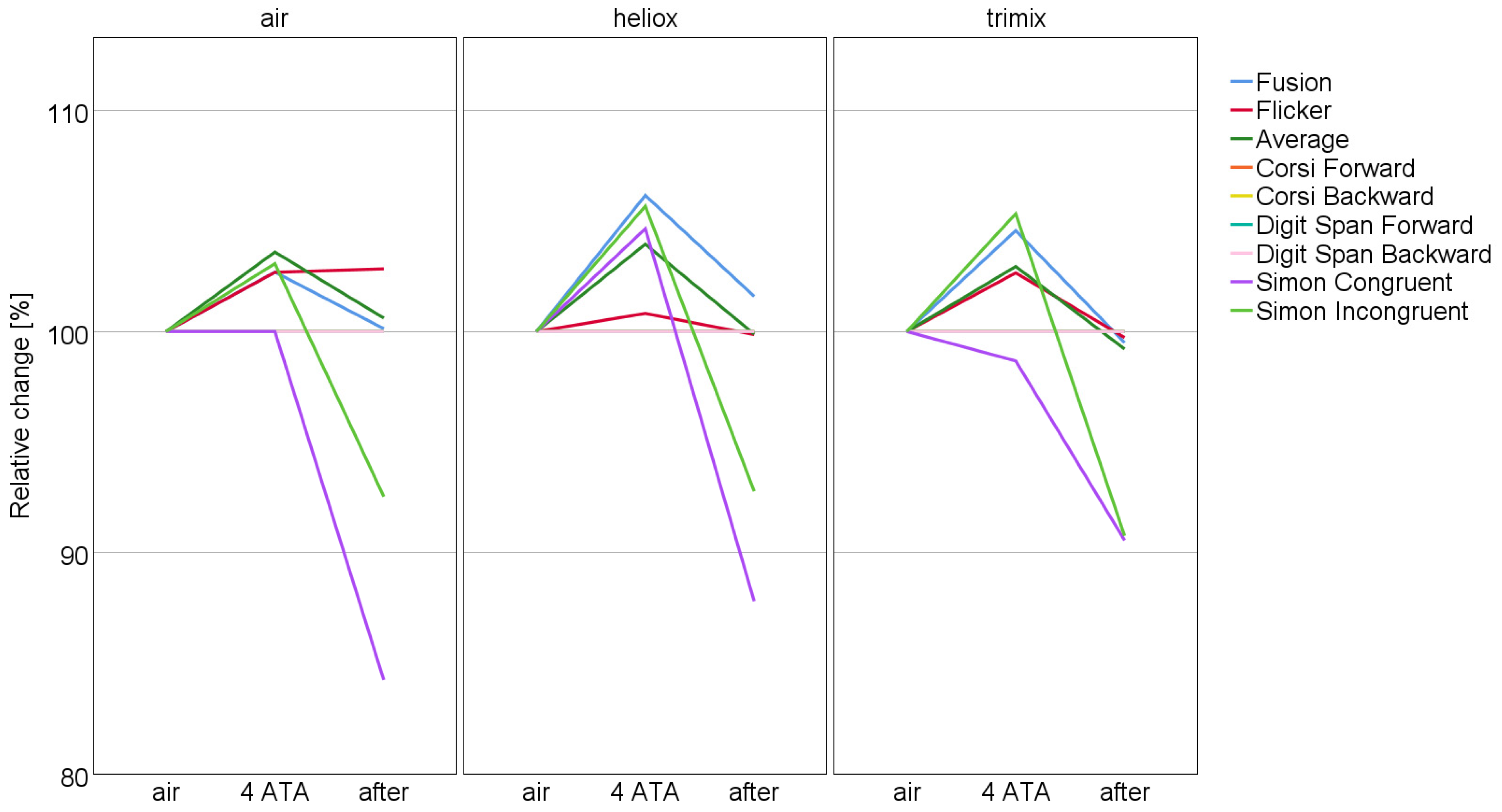
3.1. Relative Changes
3.1.1. Flicker Test—Air
3.1.2. Flicker Test—Heliox
3.1.3. Flicker Test—Trimix
3.1.4. Cognitive Assessment
3.2. Flicker Test and Neuropsychological Assessment
4. Discussion
4.1. Critical Flicker Fusion Frequency Changes Due to Hyperbaric Exposure and Effects of Breathing Gas Composition
Implications and Interpretation
4.2. Relationship Between Critical Flicker Fusion Frequency and Cognitive Performance
4.3. Sex Differences: Absence of Effects
4.4. Potential Involvement of the Noradrenergic System and Arousal Dynamics
4.5. Limitations
4.6. Future Directions and Clinical Applications
5. Conclusions
Author Contributions
Funding
Institutional Review Board Statement
Informed Consent Statement
Data Availability Statement
Conflicts of Interest
References
- Piispanen, W.W.; Lundell, R.V.; Tuominen, L.J.; Räisänen-Sokolowski, A.K. Assessment of Alertness and Cognitive Performance of Closed Circuit Rebreather Divers with the Critical Flicker Fusion Frequency Test in Arctic Diving Conditions. Front. Physiol. 2021, 12, 722915. [Google Scholar] [CrossRef]
- Lafère, P.; Balestra, C.; Hemelryck, W.; Donda, N.; Sakr, A.; Taher, A.; Marroni, S.; Germonpré, P. Evaluation of Critical Flicker Fusion Frequency and Perceived Fatigue in Divers after Air and Enriched Air Nitrox Diving. Diving Hyperb. Med. 2010, 40, 114–118. [Google Scholar] [PubMed]
- Balestra, C.; Lafere, P.; Germonpre, P. Persistence of Critical Flicker Fusion Frequency Impairment after a 33 Mfw SCUBA Dive: Evidence of Prolonged Nitrogen Narcosis? Eur. J. Appl. Physiol. 2012, 112, 4063–4068. [Google Scholar] [CrossRef]
- Balestra, C.; Machado, M.-L.; Theunissen, S.; Balestra, A.; Cialoni, D.; Clot, C.; Besnard, S.; Kammacher, L.; Delzenne, J.; Germonpré, P.; et al. Critical Flicker Fusion Frequency: A Marker of Cerebral Arousal during Modified Gravitational Conditions Related to Parabolic Flights. Front. Physiol. 2018, 9, 1403. [Google Scholar] [CrossRef]
- Hemelryck, W.; Rozloznik, M.; Germonpré, P.; Balestra, C.; Lafère, P. Functional Comparison between Critical Flicker Fusion Frequency and Simple Cognitive Tests in Subjects Breathing Air or Oxygen in Normobaria. Diving Hyperb. Med. 2013, 43, 138–142. [Google Scholar] [PubMed]
- Al-Kuraishy, H.M.; Al-Gareeb, A.I. Central Beneficial Effects of Trimetazidine on Psychomotor Performance in Normal Healthy Volunteers. Adv. Biomed. Res. 2017, 6, 69. [Google Scholar] [CrossRef]
- Mankowska, N.D.; Sharma, R.I.; Marcinkowska, A.B.; Kot, J.; Winklewski, P.J. Assessing the Relationship Between the Flicker Test and Cognitive Performance. Biology 2025, 14, 1469. [Google Scholar] [CrossRef]
- Mankowska, N.D.; Marcinkowska, A.B.; Waskow, M.; Sharma, R.I.; Kot, J.; Winklewski, P.J. Critical Flicker Fusion Frequency: A Narrative Review. Medicina 2021, 57, 1096. [Google Scholar] [CrossRef] [PubMed]
- Sharma, R.I.; Mankowska, N.D.; Marcinkowska, A.B.; Winklewski, P.J.; Kot, J. Critical Flicker Fusion Frequency Results during Oxygen Decompression in Standard HBOT Session–Observational Study. Int. Marit. Health 2024, 75, 167–176. [Google Scholar] [CrossRef]
- Kot, J.; Winklewski, P.J.; Sicko, Z.; Tkachenko, Y. Effect of Oxygen on Neuronal Excitability Measured by Critical Flicker Fusion Frequency Is Dose Dependent. J. Clin. Exp. Neuropsychol. 2015, 37, 276–284. [Google Scholar] [CrossRef]
- Oei, G.T.; Weber, N.C.; Hollmann, M.W.; Preckel, B. Cellular Effects of Helium in Different Organs. Anesthesiology 2010, 112, 1503–1510. [Google Scholar] [CrossRef]
- Berganza, C.J.; Zhang, J.H. The Role of Helium Gas in Medicine. Med. Gas Res. 2013, 3, 18. [Google Scholar] [CrossRef]
- Mewborn, C.; Renzi, L.M.; Hammond, B.R.; Stephen Miller, L. Critical Flicker Fusion Predicts Executive Function in Younger and Older Adults. Arch. Clin. Neuropsychol. 2015, 30, 605–610. [Google Scholar] [CrossRef]
- Jensen, A.R. Critical Flicker Frequency and Intelligence. Intelligence 1983, 7, 217–225. [Google Scholar] [CrossRef]
- Prabu Kumar, A.; Omprakash, A.; Kuppusamy, M.; Maruthy, K.N.; Sathiyasekaran, B.W.C.; Vijayaraghavan, P.V.; Padmavathi, R. How Does Cognitive Function Measured by the Reaction Time and Critical Flicker Fusion Frequency Correlate with the Academic Performance of Students? BMC Med. Educ. 2020, 20, 507. [Google Scholar] [CrossRef] [PubMed]
- Aston-Jones, G.; Cohen, J.D. An Integrative Theory of Locus Coeruleus-Norepinephrine Function: Adaptive Gain and Optimal Performance. Annu. Rev. Neurosci. 2005, 28, 403–450. [Google Scholar] [CrossRef]
- Zerbi, V.; Floriou-Servou, A.; Markicevic, M.; Vermeiren, Y.; Sturman, O.; Privitera, M.; von Ziegler, L.; Ferrari, K.D.; Weber, B.; De Deyn, P.P.; et al. Rapid Reconfiguration of the Functional Connectome after Chemogenetic Locus Coeruleus Activation. Neuron 2019, 103, 702–718.e5. [Google Scholar] [CrossRef] [PubMed]
- Sara, S.J. The Locus Coeruleus and Noradrenergic Modulation of Cognition. Nat. Rev. Neurosci. 2009, 10, 211–223. [Google Scholar] [CrossRef] [PubMed]
- Arnsten, A.F.T.; Li, B.M. Neurobiology of Executive Functions: Catecholamine Influences on Prefrontal Cortical Functions. Biol. Psychiatry 2005, 57, 1377–1384. [Google Scholar] [CrossRef]
- Ramos, B.P.; Arnsten, A.F.T. Adrenergic Pharmacology and Cognition: Focus on the Prefrontal Cortex. Pharmacol. Ther. 2007, 113, 523–536. [Google Scholar] [CrossRef]
- Wang, M.; Ramos, B.P.; Paspalas, C.D.; Shu, Y.; Simen, A.; Duque, A.; Vijayraghavan, S.; Brennan, A.; Dudley, A.; Nou, E.; et al. A2A-Adrenoceptors Strengthen Working Memory Networks by Inhibiting CAMP-HCN Channel Signaling in Prefrontal Cortex. Cell 2007, 129, 397–410. [Google Scholar] [CrossRef]
- Hagena, H.; Hansen, N.; Manahan-Vaughan, D. β-Adrenergic Control of Hippocampal Function: Subserving the Choreography of Synaptic Information Storage and Memory. Cereb. Cortex 2016, 26, 1349–1364. [Google Scholar] [CrossRef]
- O’Dell, T.J.; Connor, S.A.; Guglietta, R.; Nguyen, P.V. β-Adrenergic Receptor Signaling and Modulation of Long-Term Potentiation in the Mammalian Hippocampus. Learn. Mem. 2015, 22, 461–471. [Google Scholar] [CrossRef]
- Kot, J.; Sićko, Z. New Polish Occupational Health and Safety Regulations for Underwater Works. Int. Marit. Health 2007, 58, 149–156. [Google Scholar] [PubMed]
- Stoet, G. PsyToolkit: A Software Package for Programming Psychological Experiments Using Linux. Behav. Res. Methods 2010, 42, 1096–1104. [Google Scholar] [CrossRef] [PubMed]
- Stoet, G. PsyToolkit: A Novel Web-Based Method for Running Online Questionnaires and Reaction-Time Experiments. Teach. Psychol. 2017, 44, 24–31. [Google Scholar] [CrossRef]
- Lezak, M.D.; Howieson, D.B.; Bigler, E.D.; Tranel, D. Neuropsychological Assessment, 5th ed.; Lezak, M.D., Howieson, D.B., Loring, D.W., Fischer, J.S., Eds.; Oxford University Press: New York, NY, USA, 2012. [Google Scholar]
- Miller, G.A. The Magical Number Seven, plus or Minus Two: Some Limits on Our Capacity for Processing Information. Psychol. Rev. 1956, 63, 81–97. [Google Scholar] [CrossRef] [PubMed]
- Corsi, P.M. Human Memory and the Medial Temporal Region of the Brain. Ph.D. Thesis, McGill University, Montreal, QC, Canada, 1972. [Google Scholar]
- Kessels, R.P.C.; Van Zandvoort, M.J.E.; Postma, A.; Kappelle, L.J.; De Haan, E.H.F. The Corsi Block-Tapping Task: Standardization and Normative Data. Appl. Neuropsychol. 2000, 7, 252–258. [Google Scholar] [CrossRef]
- Borgmann, K.W.U.; Risko, E.F.; Stolz, J.A.; Besner, D. Simon Says: Reliability and the Role of Working Memory and Attentional Control in the Simon Task. Psychon. Bull. Rev. 2007, 14, 313–319. [Google Scholar] [CrossRef]
- Simon, J.; Wolf, J.D. Choice Reaction Time as a Function of Angular Stimulus-Response Correspondence And Age. Ergonomics 1963, 6, 99–105. [Google Scholar] [CrossRef]
- Farrell Pagulayan, K.; Busch, R.; Medina, K.; Bartok, J.; Krikorian, R. Developmental Normative Data for the Corsi Block-Tapping Task. J. Clin. Exp. Neuropsychol. 2006, 28, 1043–1052. [Google Scholar] [CrossRef]
- Woods, D.L.; Kishiyama, M.M.; Yund, E.W.; Herron, T.J.; Edwards, B.; Poliva, O.; Hink, R.F.; Reed, B. Improving Digit Span Assessment of Short-Term Verbal Memory. J. Clin. Exp. Neuropsychol. 2011, 33, 101–111. [Google Scholar] [CrossRef]
- Iñesta, C.; Oltra-Cucarella, J.; Bonete-López, B.; Calderón-Rubio, E.; Sitges-Maciá, E. Regression-Based Normative Data for Independent and Cognitively Active Spanish Older Adults: Digit Span, Letters and Numbers, Trail Making Test and Symbol Digit Modalities Test. Int. J. Environ. Res. Public Health 2021, 18, 9958. [Google Scholar] [CrossRef]
- Koopman, H.N.; Westgate, A.J. Solubility of Nitrogen in Marine Mammal Blubber Depends on Its Lipid Composition. J. Exp. Biol. 2012, 215, 3856–3863. [Google Scholar] [CrossRef]
- Matsumoto, A.; Uesono, Y. Establishment of the Meyer-Overton Correlation in an Artificial Membrane without Protein. Biochim. Biophys. Acta Gen. Subj. 2024, 1868, 130717. [Google Scholar] [CrossRef]
- Antkowiak, B. How Do General Anaesthetics Work? Naturwissenschaften 2001, 88, 201–213. [Google Scholar] [CrossRef] [PubMed]
- Sandberg, W.S.; Miller, K.W. The Meyer-Overton Relationship and Its Exceptions. In Neural Mechanisms of Anesthesia; Antognini, J.F., Carstens, E., Raines, D.E., Eds.; Humana Press: Totowa, NJ, USA, 2003; pp. 371–394. ISBN 978-1-59259-322-4. [Google Scholar]
- Doolette, D.J.; Mitchell, S.J. The Physiological Kinetics of Nitrogen and the Prevention of Decompression Sickness. Clin. Pharmacokinet. 2001, 40, 1–14. [Google Scholar] [CrossRef] [PubMed]
- Hamilton, J.A.; Hillard, C.J.; Spector, A.A.; Watkins, P.A. Brain Uptake and Utilization of Fatty Acids, Lipids and Lipoproteins: Application to Neurological Disorders. J. Mol. Neurosci. 2007, 33, 2–11. [Google Scholar] [CrossRef]
- Lyapunov, S.I.; Shoshina, I.I.; Lyapunov, I.S. Modeling the Critical Flicker Fusion Frequency in the Human Visual System. Biophysics 2023, 68, 857–863. [Google Scholar] [CrossRef]
- Kastner, S.; O’Connor, D.H.; Fukui, M.M.; Fehd, H.M.; Herwig, U.; Pinsk, M.A. Functional Imaging of the Human Lateral Geniculate Nucleus and Pulvinar. J. Neurophysiol. 2004, 91, 438–448. [Google Scholar] [CrossRef] [PubMed]
- Jiang, Y.; Zhou, K.; He, S. Human Visual Cortex Responds to Invisible Chromatic Flicker. Nat. Neurosci. 2007, 10, 657–662. [Google Scholar] [CrossRef]
- Herrmann, C.S. Human EEG Responses to 1-100 Hz Flicker: Resonance Phenomena in Visual Cortex and Their Potential Correlation to Cognitive Phenomena. Exp. Brain Res. 2001, 137, 346–353. [Google Scholar] [CrossRef]
- Carmel, D.; Lavie, N.; Rees, G. Conscious Awareness of Flicker in Humans Involves Frontal and Parietal Cortex. Curr. Biol. 2006, 16, 907–911. [Google Scholar] [CrossRef]
- Muth, T.; Schipke, J.D.; Brebeck, A.K.; Dreyer, S. Assessing Critical Flicker Fusion Frequency: Which Confounders? A Narrative Review. Medicina 2023, 59, 800. [Google Scholar] [CrossRef]
- Sharma, R.; Mankowska, N.; Marcinkowska, A.; Winklewski, P.; Kot, J. Critical Fusion Flicker Frequency Results with 1 or 2 Diodes during HBOT Session–Observational Study among Hyperbaric Attendants. Int. Marit. Health 2025, 76, 216–223. [Google Scholar] [CrossRef] [PubMed]
- Welch, D.B.; Seitz, A.R. Processing Irrelevant Location Information: Practice and Transfer Effects in a Simon Task. PLoS ONE 2013, 8, e64993. [Google Scholar] [CrossRef] [PubMed][Green Version]
- Cespón, J.; Hommel, B.; Korsch, M.; Galashan, D. The Neurocognitive Underpinnings of the Simon Effect: An Integrative Review of Current Research. Cogn. Affect. Behav. Neurosci. 2020, 20, 1133–1172. [Google Scholar] [CrossRef] [PubMed]
- Mankowska, N.D.; Grzywinska, M.; Winklewski, P.J.; Marcinkowska, A.B. Neuropsychological and Neurophysiological Mechanisms behind Flickering Light Stimulus Processing. Biology 2022, 11, 1720. [Google Scholar] [CrossRef]
- Altınok, A.; Moruzzi, M.; Akyürek, E.G. Acute Effects of Cocoa Flavanols on Cognitive Control and Response Inhibition. Nutrition 2025, 139, 112860. [Google Scholar] [CrossRef]
- Zurek, G.; Lenart, D.; Lachowicz, M.; Zebrowski, K.; Jamro, D. Factors Influencing the Executive Functions of Male and Female Cadets. Int. J. Environ. Res. Public Health 2022, 19, 17043. [Google Scholar] [CrossRef]
- Muth, T.; Schipke, J.D.; Brebeck, A.K.; Dreyer, S. Critical Flicker Fusion Frequency: Confounders and Caveats. Eur. J. Appl. Physiol. 2025, 1–10. [Google Scholar] [CrossRef]
- Kessels, R.P.C.; Van Den Berg, E.; Ruis, C.; Brands, A.M.A. The Backward Span of the Corsi Block-Tapping Task and Its Association with the WAIS-III Digit Span. Assessment 2008, 15, 426–434. [Google Scholar] [CrossRef] [PubMed]
- Haarlem, C.S.; O’Connell, R.G.; Mitchell, K.J.; Jackson, A.L. The Speed of Sight: Individual Variation in Critical Flicker Fusion Thresholds. PLoS ONE 2024, 19, e0298007. [Google Scholar] [CrossRef]
- Misiak, H. Age and Sex Differences in Critical Flicker Frequency. J. Exp. Psychol. 1947, 37, 318–332. [Google Scholar] [CrossRef]
- Liu, M.X.; Yan, Y.; Xue, Q.; Gong, L. The Research and Analysis of Factors Affecting Critical Flicker Frequency. Procedia Manuf. 2015, 3, 4279–4286. [Google Scholar] [CrossRef][Green Version]
- Wilson, T.R. Flicker Fusion Frequency, Age and Intelligence. Gerontologia 1963, 7, 200–208. [Google Scholar] [CrossRef] [PubMed]
- Ginsburg, N.; Jurenovskis, M.; Jamieson, J. Sex Differences in Critical Flicker Frequency. Percept. Mot. Skills 1982, 54, 1079–1082. [Google Scholar] [CrossRef]
- Deepthi, T.S.; Maruthy, K.N. Digital Screens Accelerates Visual Fatigue in Young Females than Young Males. Int. J. Physiol. 2019, 7, 251–254. [Google Scholar] [CrossRef]
- Anstey, K.J.; Ehrenfeld, L.; Mortby, M.E.; Cherbuin, N.; Peters, R.; Kiely, K.M.; Eramudugolla, R.; Huque, M.H. Gender Differences in Cognitive Development in Cohorts of Young, Middle, and Older Adulthood over 12 Years. Dev. Psychol. 2021, 57, 1403–1410. [Google Scholar] [CrossRef]
- Petrie, J.A.; Kowallis, L.R.; Kamhout, S.; Bills, K.B.; Adams, D.; Fleming, D.E.; Brown, B.L.; Steffensen, S.C. Gender-Specific Interactions in a Visual Object Recognition Task in Persons with Opioid Use Disorder. Biomedicines 2023, 11, 2460. [Google Scholar] [CrossRef]
- Evans, K.L.; Hampson, E. Sex-Dependent Effects on Tasks Assessing Reinforcement Learning and Interference Inhibition. Front. Psychol. 2015, 6, 1044. [Google Scholar] [CrossRef]
- Orsini, A.; Grossi, D.; Capitani, E.; Laiacona, M.; Papagno, C.; Vallar, G. Verbal and Spatial Immediate Memory Span: Normative Data from 1355 Adults and 1112 Children. Ital. J. Neurol. Sci. 1987, 8, 537–548. [Google Scholar] [CrossRef] [PubMed]
- Andreano, J.M.; Cahill, L. Sex Influences on the Neurobiology of Learning and Memory. Learn. Mem. 2009, 16, 248–266. [Google Scholar] [CrossRef]
- Postma, A.; Jager, G.; Kessels, R.P.C.; Koppeschaar, H.P.F.; Van Honk, J. Sex Differences for Selective Forms of Spatial Memory. Brain Cogn. 2004, 54, 24–34. [Google Scholar] [CrossRef]
- Teixeira, R.A.A.; Zachi, E.C.; Roque, D.T.; Taub, A.; Ventura, D.F. Memory Span Measured by the Spatial Span Tests of the Cambridge Neuropsychological Test Automated Battery in a Group of Brazilian Children and Adolescents. Dement. Neuropsychol. 2011, 5, 129. [Google Scholar] [CrossRef]
- Bernardi, L.; Costa, V.P.; Oto Shiroma, L. Flicker Perimetry in Healthy Subjects: Influence of Age and Gender, Learning Effect and Short-Term Fluctuation. Arq. Bras. Oftalmol. 2007, 70, 91–99. [Google Scholar] [CrossRef]
- Ripamonte, G.C.; Fonseca, E.M.; Frias, A.T.; Patrone, L.G.A.; Vilela-Costa, H.H.; Silva, K.S.C.; Szawka, R.E.; Bícego, K.C.; Zangrossi, H.; Plummer, N.W.; et al. Locus Coeruleus Noradrenaline Depletion and Its Differential Impact on CO2-Induced Panic and Hyperventilation in Male and Female Mice. Prog. Neuropsychopharmacol. Biol. Psychiatry 2024, 134, 111063. [Google Scholar] [CrossRef] [PubMed]
- De Bels, D.; Pierrakos, C.; Bruneteau, A.; Reul, F.; Crevecoeur, Q.; Marrone, N.; Vissenaeken, D.; Borgers, G.; Balestra, C.; Honoré, P.M.; et al. Variation of Cognitive Function During a Short Stay at Hypobaric Hypoxia Chamber (Altitude: 3842 M). Front. Physiol. 2019, 10, 806. [Google Scholar] [CrossRef] [PubMed]
- Raut, R.V.; Rosenthal, Z.P.; Wang, X.; Miao, H.; Zhang, Z.; Lee, J.M.; Raichle, M.E.; Bauer, A.Q.; Brunton, S.L.; Brunton, B.W.; et al. Arousal as a Universal Embedding for Spatiotemporal Brain Dynamics. Nature 2025, 647, 454–461. [Google Scholar] [CrossRef]


| Test | Stage | N | M | Me | SD |
|---|---|---|---|---|---|
| Fusion | 4 ATA | 112 | 104.57 | 104.35 | 9.69 |
| after | 113 | 100.36 | 100.15 | 7.38 | |
| Flicker | 4 ATA | 112 | 102.95 | 101.57 | 7.30 |
| after | 113 | 100.70 | 100.20 | 6.67 | |
| Average | 4 ATA | 112 | 103.41 | 103.60 | 6.72 |
| after | 113 | 100.22 | 99.95 | 5.34 | |
| Corsi Forward | 4 ATA | 102 | 99.13 | 100.00 | 27.39 |
| after | 110 | 103.64 | 100.00 | 27.44 | |
| Corsi Backward | 4 ATA | 102 | 103.92 | 100.00 | 37.29 |
| after | 108 | 105.10 | 100.00 | 40.01 | |
| Digit Span Forward | 4 ATA | 102 | 100.80 | 100.00 | 20.28 |
| after | 110 | 104.59 | 100.00 | 19.17 | |
| Digit Span Backward | 4 ATA | 101 | 108.38 | 100.00 | 28.81 |
| after | 110 | 109.54 | 100.00 | 33.86 | |
| Simon Congruent | 4 ATA | 103 | 102.66 | 101.01 | 22.17 |
| after | 109 | 87.31 | 87.63 | 17.53 | |
| Simon Incongruent | 4 ATA | 103 | 105.02 | 104.44 | 16.45 |
| after | 109 | 91.00 | 92.49 | 16.87 |
| Test | Fusion | Flicker | Average | ||||||
|---|---|---|---|---|---|---|---|---|---|
| N | r | p | N | r | p | N | r | p | |
| Simon Congruent | 322 | 0.063 | 0.261 | 322 | −0.083 | 0.138 | 322 | 0.051 | 0.362 |
| Simon Incongruent | 322 | 0.110 | 0.048 * | 322 | 0.049 | 0.379 | 322 | 0.123 | 0.028 * |
| Corsi Forward | 321 | −0.055 | 0.328 | 321 | 0.120 | 0.032 * | 321 | 0.025 | 0.653 |
| Corsi Backward | 317 | −0.093 | 0.098 | 317 | −0.022 | 0.690 | 317 | −0.057 | 0.315 |
| Digit Span Forward | 321 | −0.038 | 0.495 | 321 | 0.072 | 0.200 | 321 | 0.011 | 0.841 |
| Digit Span Backward | 320 | 0.003 | 0.953 | 320 | 0.144 | 0.010 * | 320 | 0.013 | 0.822 |
Disclaimer/Publisher’s Note: The statements, opinions and data contained in all publications are solely those of the individual author(s) and contributor(s) and not of MDPI and/or the editor(s). MDPI and/or the editor(s) disclaim responsibility for any injury to people or property resulting from any ideas, methods, instructions or products referred to in the content. |
© 2026 by the authors. Licensee MDPI, Basel, Switzerland. This article is an open access article distributed under the terms and conditions of the Creative Commons Attribution (CC BY) license.
Share and Cite
Mankowska, N.D.; Sharma, R.I.; Marcinkowska, A.B.; Winklewski, P.J.; Kot, J. Complex Relationship Between Critical Flicker Fusion Frequency and Established Cognitive Tests Unveiled by Hyperbaric Exposure. Biology 2026, 15, 242. https://doi.org/10.3390/biology15030242
Mankowska ND, Sharma RI, Marcinkowska AB, Winklewski PJ, Kot J. Complex Relationship Between Critical Flicker Fusion Frequency and Established Cognitive Tests Unveiled by Hyperbaric Exposure. Biology. 2026; 15(3):242. https://doi.org/10.3390/biology15030242
Chicago/Turabian StyleMankowska, Natalia D., Rita I. Sharma, Anna B. Marcinkowska, Pawel J. Winklewski, and Jacek Kot. 2026. "Complex Relationship Between Critical Flicker Fusion Frequency and Established Cognitive Tests Unveiled by Hyperbaric Exposure" Biology 15, no. 3: 242. https://doi.org/10.3390/biology15030242
APA StyleMankowska, N. D., Sharma, R. I., Marcinkowska, A. B., Winklewski, P. J., & Kot, J. (2026). Complex Relationship Between Critical Flicker Fusion Frequency and Established Cognitive Tests Unveiled by Hyperbaric Exposure. Biology, 15(3), 242. https://doi.org/10.3390/biology15030242