


Simple Summary
The red king crab is a large, commercially significant decapod that has been introduced into the Barents Sea to enhance regional fishery yields. In its invasive range, this host has become colonized by a diverse epibiotic community. Here, we report two novel amphipod epibionts (Metopa pusilla and Crassicorophium bonellii) on red king crabs in the Barents Sea. These records expand the known biodiversity of crab-associated amphipods in this region and provide some biological data on each symbiont. Both species exhibited low prevalence and intensity of infestation, and their attachment sites (limbs and carapace) suggest minimal risk to host health.
Abstract
Monitoring epibiotic communities on the invasive red king crab (Paralithodes camtschaticus) in the Barents Sea is crucial for understanding the co-adaptation between this species and the local benthic fauna. Red king crabs were collected during regular diving surveys conducted in the coastal Barents Sea in 2015, 2021, and 2022. A detailed examination revealed the presence of two amphipod species, Metopa pusilla and Crassicorophium bonellii, which were not previously documented as epibionts on this host. With these additions, the total number of epibiotic amphipods on Barents Sea red king crabs rises to nine species (versus two in the native Sea of Okhotsk). Amphipod colonization was skewed toward large males, likely reflecting their greater migratory behavior. The prevalence of Metopa pusilla ranged from 1.9% to 4.3%, with a mean intensity of one individual per infested crab; Crassicorophium bonellii exhibited prevalence of 4.7–14.3% and mean intensity of 1.3–3.3 individuals. The primary colonization sites were the carapace and limbs. Given the low infestation parameters and the epibionts’ localization away from critical structures like the gills and egg clutches, it is concluded that these amphipods pose a negligible risk to host health.
1. Introduction
Epibiotic associations—interactions between a basibiont (host) and an epibiont attached to the host’s external surface—are ubiquitous in marine ecosystems, as these facultative partnerships often confer advantages to at least one participating organism [1,2]. These associations are of significant scientific interest as they involve a wide variety of ecologically and economically important species [3]. In the Barents Sea, a prominent example is the red king crab, Paralithodes camtschaticus (Tilesius, 1815). This large crustacean, prized for its meat quality [4], was introduced in the 1960s to establish a new commercial fishery [5]. This initiative aimed to utilize the region’s high productive potential both in terms of primary production [6] and fishery productivity [7], driven by inflows of warm Atlantic water [8], in an area otherwise lacking commercially significant crab species [9]. The introduction has been successful [10], and the red king crab now constitutes a major fishery in its non-native range [11]. For instance, in 2022, 2023, and 2024, the annual catch of red king crab in Russian waters of the Barents Sea accounted for landings accounting 12,529, 10,420, and 12,468 metric tons [12,13].
Like many invasive species, the red king crab has substantially expanded its distribution in the Barents Sea through a combination of adult migration and larval dispersal [14]. It has achieved high abundances in both coastal and open-sea areas [15,16,17,18,19], raising concerns about its impact on native benthic communities [20,21,22]. Recent research indicates that the crab can alter the structure and composition of coastal habitats through its feeding and burrowing activities [23,24,25,26,27,28]. A further important consideration is the colonization of the crab’s exoskeleton and gill chambers by various benthic organisms, both sessile and mobile [29,30,31,32,33,34]. Long-term monitoring has demonstrated that migratory crabs facilitate the regional dispersal of associated symbionts such as amphipods and fish leeches, thereby reshaping local benthic assemblages [33,35]. Additionally, such studies yield novel data on the biology of symbiotic organisms [36,37,38,39,40,41,42], which can be particularly valuable for species that are difficult to sample using conventional methods [43,44,45,46].
The aim of the present study is to document the occurrence of two amphipod species, not previously recorded as epibionts, on red king crabs in the coastal Barents Sea. This finding contributes to understanding the formation of novel symbiotic relationships in the context of biological invasions.
2. Materials and Methods
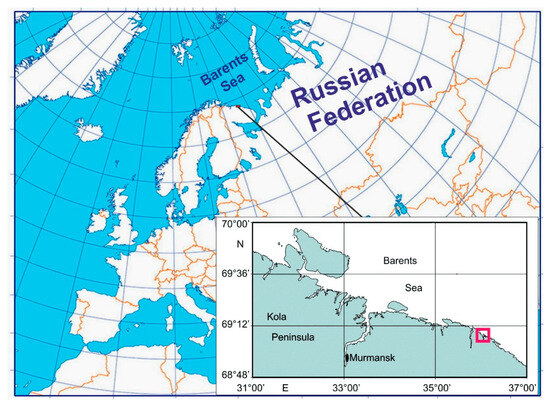
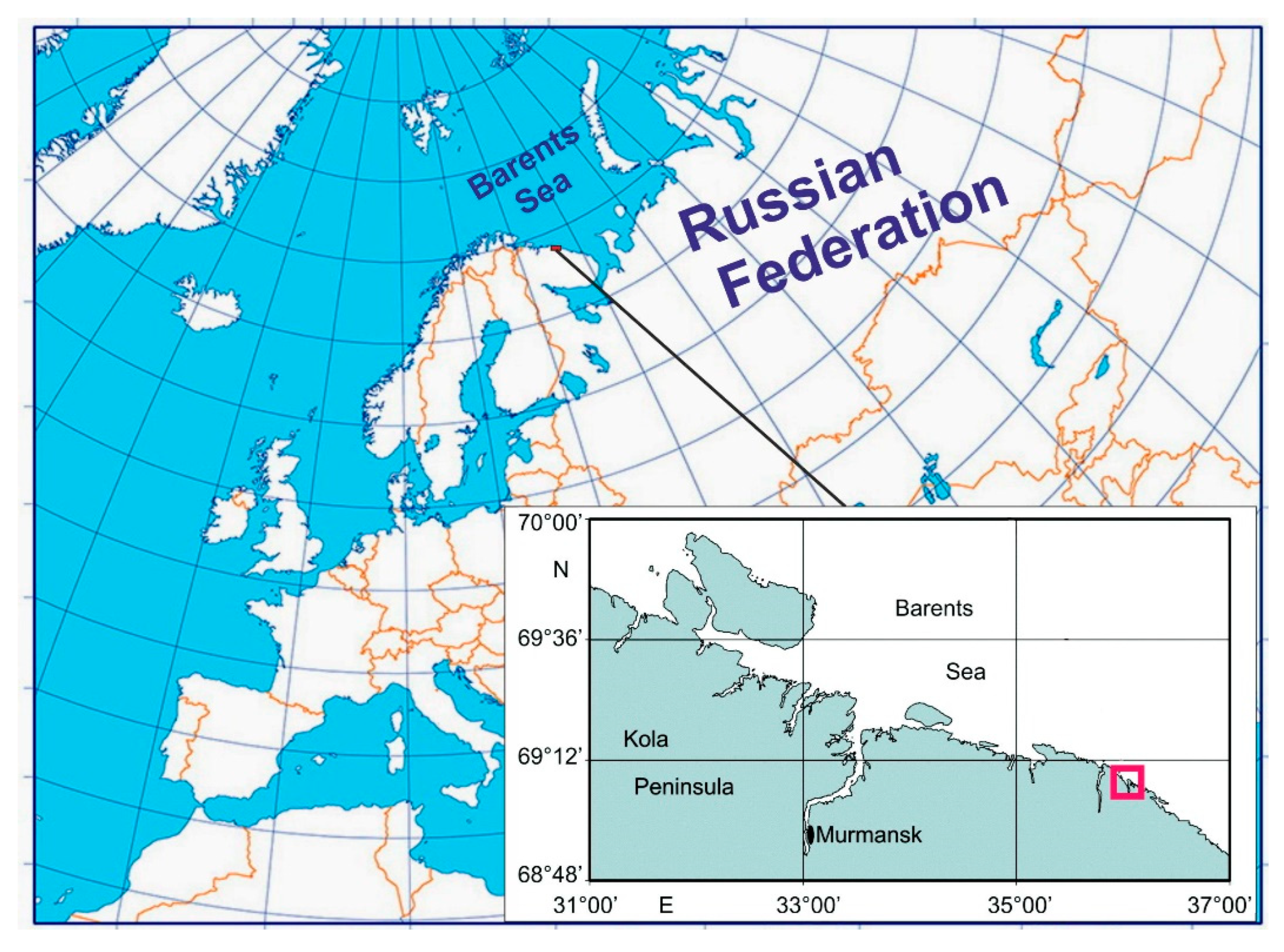
Specimens of the red king crab were collected in Dalnezelenetskaya Bay (Figure 1), a semi-enclosed gulf separated from the open Barents Sea by five islands.
Figure 1.
Map of the study area showing the location of Dalnezelenetskaya Bay (red square) in the coastal Barents Sea.
Tidal amplitudes in this bay reach up to 4.2 m, i.e., considerably lower than in adjacent open habitats [47]. While maximum depths reach 200 m, the mean depth ranges from 7 to 18 m. The site is characterized by a variable hydrological regime [48]: surface water temperature fluctuates seasonally from 0.7 °C in February to 9.7 °C in August, and salinity ranges from 32.2 to 34 psu [49]. The predominant substrates are small stones, gravel, and silty sand [50].
SCUBA diving surveys were conducted in July 2015, 2021 and 2022 at depths of 5–40 m. In each survey, a standardized transect grid consisting of 12 transects was employed in sample areas exhibiting the highest crab abundance. All collected crabs were transported live to the coastal laboratory for immediate examination. For each host crab, the following data were recorded: sex (determined visually by the morphology of the abdominal flaps), carapace width (CW; measured as the greatest straight-line distance between the lateral spines using calipers), and shell condition (categorized visually according to the scale proposed by Donaldson and Byersdorfer [51]).
Each crab was examined for epibionts following a standard protocol established in our previous studies [33,35]. The host’s body was divided into five sections for systematic inspection: carapace, limbs, abdomen, mouthparts, and gills. The gill chambers were examined after the dissection of the crab. All associated epibionts were carefully removed, fixed in a 4% formaldehyde solution, and subsequently transported to the laboratory in Murmansk for identification. Amphipods were identified to species level using an MBS-10 stereomicroscope (Lytkarinsky Optical Glass Plant, Lytkarino, Moscow region, Russia) and standard taxonomic keys [52]. The current taxonomic nomenclature was verified against the World Register of Marine Species [53].
Epibiotic infestation was quantified by calculating (1) prevalence, defined as the percentage of crabs colonized by each associate species, and (2) intensity, defined as the mean number of epibiont specimens per colonized host [54].
Percentages (sex ratio, prevalence, occurrence of colonized crabs at different depths) were analyzed using Chi-square tests, while quantitative data (crab size) were compared using non-parametric Kruskal–Wallis tests, as the data failed assumptions of normality [55]. All mean values are presented alongside their standard errors (mean ± SE).
3. Results and Discussion
A total of 250 red king crabs were collected during the study period (2015: n = 53; 2021: n = 127; 2022: n = 70). The sampled population was predominantly composed of mature individuals, with proportions of 92.5% (2015), 97.3% (2021), and 98.6% (2022), yielding a combined maturity prevalence of 94.8%. The sex ratio was significantly skewed towards females in 2015 (2.8:1; χ2 = 11.79, df = 1, p < 0.001) and 2021 (5.4:1; χ2 = 59.59, df = 1, p < 0.001). In contrast, a balanced 1:1 sex ratio was observed in 2022 (χ2 = 0, df = 1, p = 1). This demographic composition is consistent with previous findings in this coastal area, where a shift towards larger individuals has been documented since 2010, attributed to higher juvenile mortality resulting from significant temperature fluctuations [49]. The female bias in summer samples reflects their lower migratory activity compared to males [56]. The balanced sex ratio in 2022 is likely associated with favorable climatic conditions—such as elevated water temperature and nutrient concentration—that promoted population growth, improved feeding opportunities for males in coastal waters, and their active migration from deeper habitats [13,57].
During our surveys, two amphipod species were recorded on Paralithodes camtschaticus for the first time: Metopa pusilla Sars, 1892 and Crassicorophium bonellii (Milne Edwards, 1830) (Table 1; Figure 2).
Table 1.
Key morphological characteristics for the identification of the symbiotic amphipods Metopa pusilla and Crassicorophium bonellii found on red king crabs in the Barents Sea, summarized from Crawford [58] and Gurjanova [52].
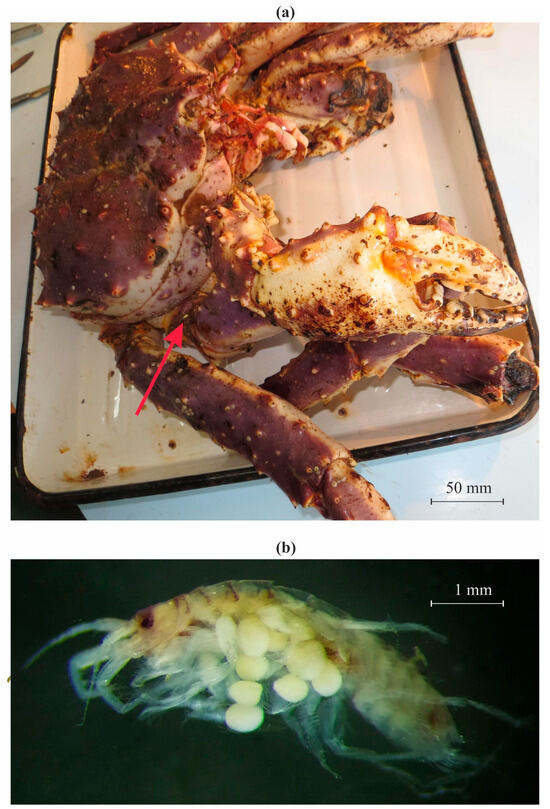
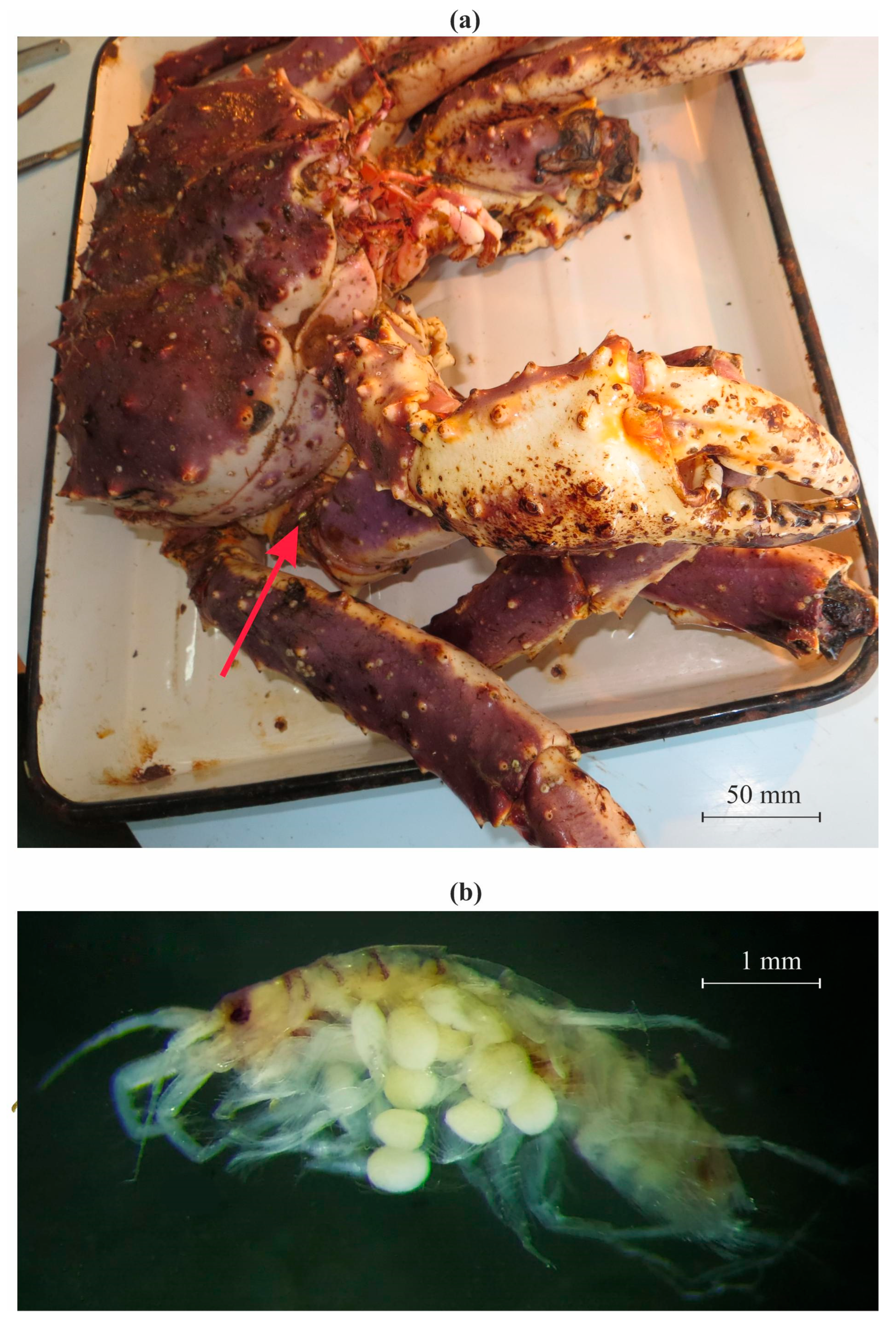
Figure 2.
Photographs of a male red king crab, Paralithodes camtschaticus, hosting the amphipod Crassicorophium bonellii from Dalnezelenetskaya Bay. (a) The crab and amphipod (indicated by arrow) located on the host’s pereiopod. (b) Close-up view of the egg-bearing female Crassicorophium bonellii. Scale bars are provided.
Metopa pusilla has a wide distribution in European shallow waters (down to 50 m), ranging from the North Sea (English and Danish waters) and Skagerrak to northern Norway. It is also present in the Barents Sea, off the east coast of Greenland, and around Franz Josef Land [52]. Crassicorophium bonellii is a highly widespread species found along European coasts from Novaya Zemlya to the Mediterranean and Black Seas, along the Atlantic coast of the Americas, and noted off the coast of Chile. It typically inhabits shallow-water kelp forests and clean sands at depths of 2–20 m [52].
Prior to this study, the following amphipod species had been reported as epibionts on red king crabs in the Barents Sea [33,35,59]: Ampelisca sp., Caprella septentrionalis Krøyer, 1838, Gammarellus homari (J.C. Fabricius, 1779), Ischyrocerus anguipes Krøyer, 1838, Ischyrocerus commensalis Chevreux, 1900, Ischyrocerus latipes Krøyer, 1842, and Ischyrocerus megacheir (Boeck, 1871). With the addition of the two species reported here, the list of amphipods known to form associations with red king crabs in the Barents Sea now stands at nine species. For comparison, only two amphipod species, Ischyrocerus commensalis (prevalence: 49%, mean intensity: 10 specimens per crab) and Caprella ungulina Mayer, 1903 (prevalence: 3%, mean intensity: 6 specimens per crab), have been recorded as epibionts of this crab in its native area, Sea of Okhotsk [60].
Detailed data for the crabs with the newly recorded amphipods are summarized in Table 2.
Table 2.
Morphometric and demographic data of red king crabs (Paralithodes camtschaticus) colonized by symbiotic amphipods in Dalnezelenetskaya Bay.
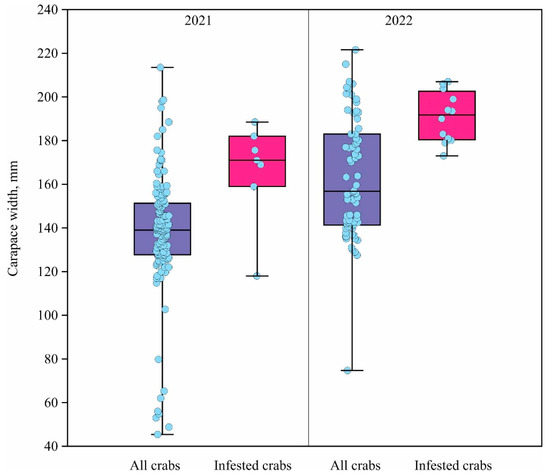
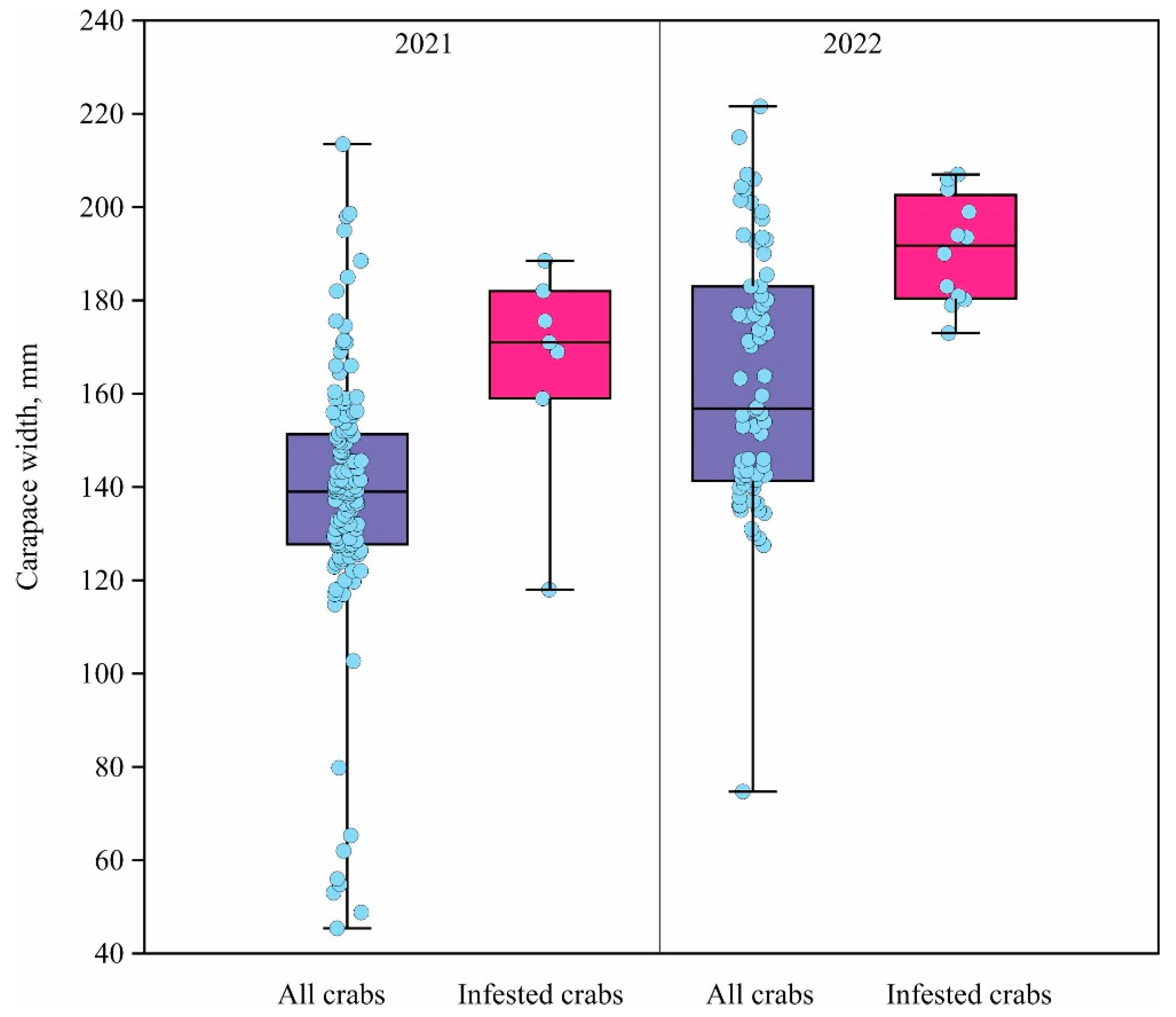
Depth did not influence the occurrence of symbiotic amphipods, as colonized crabs showed no tendency to be associated with a specific depth range. A comparison between depths of less than 15 m, 15–20 m, and greater than 20 m revealed no significant differences (χ2 = 5.44, df = 2, p = 0.066). Statistical analysis revealed a significant tendency for both amphipod species to colonize larger crabs (Kruskal–Wallis test: 2021, H = 7.24, df = 1, p = 0.007; 2022, H = 11.58, df = 1, p = 0.001; Figure 3).
Figure 3.
Carapace width (mm) of red king crabs sampled in Dalnezelenetskaya Bay. Box-plots compare the size distribution of all captured crabs versus those colonized by symbiotic amphipods (Metopa pusilla and Crassicorophium bonellii) in 2021 and 2022.
This pattern is likely attributable to the greater surface area available for colonization on larger hosts, a phenomenon commonly observed in marine symbiotic relationships worldwide [45,61,62,63,64,65,66,67,68].
Amphipods were found predominantly on male crabs (18 males vs. 2 females; χ2 = 12.81, df = 1, p < 0.001). In contrast, the shell condition of the host had no significant effect on epibiont occurrence (χ2 = 1.57, df = 2, p = 0.486). This male bias aligns with previous studies and can be explained by the larger average size and greater body dimensions of male crabs [69,70], as well as their higher migratory activity, which may increase encounter rates with potential symbionts [56].
The five specimens of Metopa pusilla collected consisted of four females (body length 2.1–2.6 mm) and one male (2.0 mm). These sizes are slightly below the typical body length of 3 mm reported for this species in the literature [52,71]. A total of 41 specimens of Crassicorophium bonellii were recorded, comprising 7 juveniles (0.9–3.3 mm, mean ± SE: 2.3 ± 0.3 mm) and 34 females (2.7–6.0 mm, 3.6 ± 0.1 mm). The sizes of the females align with previous reports, where lengths of up to 4 mm [58], 6 mm [52], and 5.5 mm [71] have been documented. The pronounced female bias observed is a known characteristic of Crassicorophium bonellii populations [52,58].
An association with a large, mobile host like the red king crab offers several potential advantages for amphipods. The defensive behavior of adult crabs against conspecifics and predators [72] provides the epibionts with indirect protection. Furthermore, the extensive migratory movements of the crabs [73] facilitate the dispersal of amphipods across large areas. The host may also serve as a source of food in the form of food remnants, detritus, or other epibionts, a benefit previously documented for other amphipod symbionts (e.g., Ischyrocerus commensalis and Ischyrocerus anguipes) on red king crabs in the Barents Sea [30,32,40].
Detrimental effects on red king crabs from amphipod epibionts are typically associated with high infestation intensities, particularly when symbionts colonize sensitive areas such as egg clutches [74,75] or gill chambers [32]. However, both Metopa pusilla and Crassicorophium bonellii exhibited low prevalence and mean intensity (Table 3). It should be noted that the prevalence of Metopa pusilla did not differ significantly over the study period (χ2 = 2.82, df = 2, p = 0.244). In contrast, for Crassicorophium bonellii, we observed a significantly lower prevalence in 2021 compared to 2022 (χ2 = 4.24, df = 1, p = 0.039), most likely due to a higher occurrence of old- and very-old-shelled crabs in 2022 (Table 2, χ2 = 11.43, df = 1, p = 0.003).
Table 3.
Infestation indices of the amphipods Metopa pusilla and Crassicorophium bonellii on the red king crab population in Dalnezelenetskaya Bay across sampling years.
Moreover, these amphipod species were found predominantly on the carapace and limbs (75% and 94% of individuals, for Metopa pusilla and Crassicorophium bonellii, respectively). This suggests that their current level of infestation is unlikely to negatively impact host health.
4. Conclusions
This study provides the first documented evidence of the amphipods Metopa pusilla and Crassicorophium bonellii as epibionts of the red king crab in the Barents Sea, increasing the known number of amphipod symbionts associated with this invasive host in the region to nine. Both amphipod species demonstrated a significant tendency to infest larger, male crabs, correlating with the higher migratory activity of males in the coastal zone. The low infestation indices, combined with their localization on the carapace and limbs, indicate a commensal relationship that is unlikely to adversely affect the host. For the amphipods, this association likely offers benefits including protection from predators, enhanced dispersal capability, and access to food resources. These findings contribute to understanding the ongoing integration of the red king crab into the Barents Sea ecosystem and the formation of novel symbiotic relationships.
Author Contributions
A.G.D.: conceptualization, investigation, validation, methodology, data curation, and writing—original draft; V.G.D.: formal analysis, project administration, data curation, visualization, software, supervision, and writing—review and editing. All authors have read and agreed to the published version of the manuscript.
Funding
This study was funded by the Ministry of Science and Higher Education of the Russian Federation.
Institutional Review Board Statement
This study was approved by the Institutional Review of Murmansk Marine Biological Institute RAS (No. 188-1252/14, approved on 19 December 2023).
Informed Consent Statement
Not applicable.
Data Availability Statement
The data presented in this study are available on request from the corresponding author (the data are not publicly available due to privacy restrictions).
Acknowledgments
We are grateful to the three anonymous reviewers for their constructive feedback.
Conflicts of Interest
The authors declare no conflicts of interest.
References
- Wahl, M. Marine epibiosis. I. fouling and antifouling: Some basic aspects. Mar. Ecol. Prog. Ser. 1989, 58, 175–189. [Google Scholar] [CrossRef] [Scilit]
- Wahl, M. Ecological lever and interface ecology: Epibiosis modulates the interactions between host and environment. Biofouling 2008, 24, 427–438. [Google Scholar] [CrossRef] [Scilit]
- Fernandez-Leborans, G. Epibiosis in Crustacea: An overview. Crustaceana 2010, 83, 549–640. [Google Scholar] [PubMed]
- Dvoretsky, A.G.; Bichkaeva, F.A.; Baranova, N.F.; Dvoretsky, V.G. Fatty acid composition of the Barents Sea red king crab (Paralithodes camtschaticus) leg meat. J. Food Compos. Anal. 2021, 98, 103826. [Google Scholar] [CrossRef] [Scilit]
- Kuzmin, S.A.; Gudimova, E.N. Introduction of the Kamchatka (Red King) Crab in the Barents Sea: Peculiarities of Biology, Perspectives of Fishery; KSC RAS Press: Apatity, Russia, 2002. (In Russian) [Google Scholar]
- Dvoretsky, A.G.; Dvoretsky, V.G. Fluctuations of net primary production along a standard transect in the Barents Sea and their relationships with environmental factors. Environ. Res. 2026, 288, 123177. [Google Scholar]
- Haug, T.; Bogstad, B.; Chierici, M.; Gjøsæter, H.; Hallfredsson, E.H.; Høines, Å.S.; Hoel, A.H.; Ingvaldsen, R.B.; Jørgensen, L.L.; Knutsen, T.; et al. Future harvest of living resources in the Arctic Ocean north of the Nordic and Barents Seas: A review of possibilities and constraints. Fish. Res. 2017, 188, 38–57. [Google Scholar] [CrossRef] [Scilit]
- Kuznetsov, V.V. The Biology of Abundant and the Most Common Species of Crustaceans in the Barents and White Seas; Nauka: Moscow, Russia, 1964. (In Russian) [Google Scholar]
- Wassmann, P.; Reigstad, M.; Haug, T.; Rudels, B.; Carroll, M.L.; Hop, H.; Gabrielsen, G.W.; Falk-Petersen, S.; Denisenko, S.G.; Arashkevich, E.; et al. Food webs and carbon flux in the Barents Sea. Prog. Oceanogr. 2006, 71, 232–287. [Google Scholar] [CrossRef] [Scilit]
- Dvoretsky, A.G.; Dvoretsky, V.G. Red king crab (Paralithodes camtschaticus) fisheries in Russian waters: Historical review and present status. Rev. Fish Biol. Fish. 2018, 28, 331–353. [Google Scholar] [CrossRef] [Scilit]
- Dvoretsky, A.G.; Dvoretsky, V.G. Renewal of the recreational red king crab fishery in Russian waters of the Barents Sea: Potential benefits and costs. Mar. Policy 2022, 136, 104916. [Google Scholar]
- Bakanev, S.V. Red king crab. In Materials of Total Allowable Catches of Water Biological Resources in Fishing Areas in Inland Seas of the Russian Federation, on the Continental Shelf of the Russian Federation, in the Exclusive Economical Zone of the Russian Federation, in the Azov and Caspian Seas in 2026; FGBUN VNIRO: Murmansk, Russia, 2025; pp. 6–21. (In Russian) [Google Scholar]
- Dvoretsky, A.G.; Dvoretsky, V.G. Stock dynamics of female red king crab in a small bay of the Barents Sea in relation to environmental factors. Animals 2025, 15, 99. [Google Scholar] [CrossRef] [Scilit]
- Dvoretsky, A.G.; Dvoretsky, V.G. Ecology and distribution of red king crab larvae in the Barents Sea: A review. Water 2022, 14, 2328. [Google Scholar] [CrossRef] [Scilit]
- Pavlova, L.V.; Zuyev, Y.A. The red king crab (Paralithodes camtschaticus) in Kola bay: Distribution, population and size/age structure changes from 2006 to 2008. Rybn. Khoz. 2010, 6, 66–69. (In Russian) [Google Scholar]
- Zuyev, Y.A. The Upper Sublitoral Megabenthos of Kola Bay (Barents Sea). Ph.D. Thesis, MMBI RAS, Murmansk, Russia, 2012. (In Russian) [Google Scholar]
- Stesko, A.V. Distribution and status of the king crab stock in the Russian territorial waters of the Barents Sea. Number Dyn. 2015, 16, 175–192. (In Russian) [Google Scholar]
- Bakanev, S.V.; Stesko, A.V. Red king crab. In Materials of Total Allowable Catches of Water Biological Resources in Fishing Areas in Inland Seas of the Russian Federation, on the Continental Shelf of the Russian Federation, in the Exclusive Economical Zone of the Russian Federation, in the Azov and Caspian Seas in 2022; Sologub, D.O., Ed.; FGBUN VNIRO: Murmansk, Russia, 2021; pp. 2–16. (In Russian) [Google Scholar]
- Pavlova, L.V.; Zuyev, Y.A.; Dvoretsky, A.G. Shallow-water benthic communities on soft bottoms of a sub-Arctic fjord (Southern Barents Sea, Russia) along a gradient of ecological factors. Diversity 2023, 15, 84. [Google Scholar] [CrossRef] [Scilit]
- Pavlova, L.V. Red king crab trophic relations and its influence on bottom biocenoses. In Biology and Physiology of the Red King Crab from the Coastal Zone of the Barents Sea; Matishov, G.G., Ed.; KSC RAS Press: Apatity, Russia, 2008; pp. 77–104. (In Russian) [Google Scholar]
- Pedersen, T.; Fuhrmann, M.M.; Lindstrøm, U.; Nilssen, E.M.; Ivarjord, T.; Ramasco, V.; Jørgensen, L.L.; Sundet, J.H.; Sivertsen, K.; Källgren, E.; et al. Effects of the invasive red king crab on food web structure and ecosystem properties in an Atlantic fjord. Mar. Ecol. Prog. Ser. 2018, 596, 13–31. [Google Scholar] [CrossRef] [Scilit]
- Pavlova, L.V. Ration of the red king crab on coastal shoals of the Barents Sea. Dokl. Biol. Sci. 2015, 463, 200–204. [Google Scholar] [CrossRef] [Scilit]
- Falk-Petersen, J.; Renaud, P.; Anisimova, N. Establishment and ecosystem effects of the alien invasive red king crab (Paralithodes camtschaticus) in the Barents Sea—A review. ICES J. Mar. Sci. 2011, 68, 479–488. [Google Scholar]
- Oug, E.; Cochrane, S.K.J.; Sundet, J.H.; Norling, K.; Nilsson, H.C. Effects of the invasive red king crab (Paralithodes camtschaticus) on soft-bottom fauna in Varangerfjorden, northern Norway. Mar. Biodiv. 2011, 41, 467–479. [Google Scholar] [CrossRef] [Scilit]
- Oug, E.; Sundet, J.H.; Cochrane, S.K.J. Structural and functional changes of soft-bottom ecosystems in northern fjords invaded by the red king crab (Paralithodes camtschaticus). J. Mar. Syst. 2018, 180, 255–264. [Google Scholar] [CrossRef] [Scilit]
- Fuhrmann, M.M.; Pedersen, T.; Nilssen, E.M. Trophic niche of the invasive red king crab Paralithodes camtschaticus in a benthic food web. Mar. Ecol. Prog. Ser. 2017, 565, 113–129. [Google Scholar] [CrossRef] [Scilit]
- Pavlova, L.V. The red king crab Paralithodes camchaticus (Tilesius, 1815) (Decapoda: Anomura): The use of species equality indicators to assess the influence on the benthos of the Barents Sea. Russ. J. Mar. Biol. 2021, 47, 508–514. [Google Scholar] [CrossRef] [Scilit]
- Pavlova, L.V.; Dvoretsky, A.G. Prey selectivity in juvenile red king crabs from the coastal Barents Sea. Diversity 2022, 14, 568. [Google Scholar] [CrossRef] [Scilit]
- Hemmingsen, W.; Jansen, P.A.; MacKenzie, K. Crabs, leeches and trypanosomes: An unholy trinity? Mar. Pollut. Bull. 2005, 50, 336–339. [Google Scholar] [CrossRef] [Scilit] [PubMed]
- Dvoretsky, A.G.; Dvoretsky, V.G. Some aspects of the biology of the amphipods Ischyrocerus anguipes associated with the red king crab, Paralithodes camtschaticus, in the Barents Sea. Polar Biol. 2009, 32, 463–469. [Google Scholar]
- Dvoretsky, A.G.; Dvoretsky, V.G. Fouling community of the red king crab, Paralithodes camtschaticus (Tilesius 1815), in a subarctic fjord of the Barents Sea. Polar Biol. 2009, 32, 1047–1054. [Google Scholar] [CrossRef] [Scilit]
- Dvoretsky, A.G.; Dvoretsky, V.G. Distribution of amphipods Ischyrocerus on the red king crab, Paralithodes camtschaticus: Possible interactions with the host in the Barents Sea. Estuar. Coast. Shelf Sci. 2009, 82, 390–396. [Google Scholar]
- Dvoretsky, A.G.; Dvoretsky, V.G. Epifauna associated with an introduced crab in the Barents Sea: A 5-year study. ICES J. Mar. Sci. 2010, 67, 204–214. [Google Scholar]
- Dvoretsky, A.G.; Dvoretsky, V.G. Copepods associated with the red king crab Paralithodes camtschaticus (Tilesius, 1815) in the Barents Sea. Zool. Stud. 2013, 52, 17. [Google Scholar] [CrossRef] [Scilit]
- Dvoretsky, A.G.; Dvoretsky, V.G. Epibionts of an introduced king crab in the Barents Sea: A second five-year study. Diversity 2023, 15, 29. [Google Scholar]
- Wahl, M.; Mark, O. The predominantly facultative nature of epibiosis: Experimental and observational evidence. Mar. Ecol. Prog. Ser. 1999, 187, 59–66. [Google Scholar] [CrossRef] [Scilit]
- Dvoretsky, A.G.; Dvoretsky, V.G. Epifauna associated with the northern stone crab Lithodes maia in the Barents Sea. Polar Biol. 2008, 31, 1149–1152. [Google Scholar] [CrossRef] [Scilit]
- De Bruyn, C.; Rigaud, T.; David, B.; De Ridder, C. Symbiosis between the pea crab Dissodactylus primitivus and its echinoid host Meoma ventricosa: Potential consequences for the crab mating system. Mar. Ecol. Prog. Ser. 2009, 375, 173–183. [Google Scholar] [CrossRef] [Scilit]
- Karmanova, I.V.; Romeyko, L.V. Bivalve mollusks Mytilus trossulus and Arvella manshurica—Symbionts of the red king crab Paralithodes camtschaticus in the Sea of Okhotsk. Vest. Kamchat. State Tech. Univ. 2010, 4, 168–175. (In Russian) [Google Scholar]
- Dvoretsky, A.G.; Dvoretsky, V.G. Population biology of Ischyrocerus commensalis, a crab-associated amphipod, in the southern Barents Sea: A multi-annual summer study. Mar. Ecol. 2011, 32, 498–508. [Google Scholar]
- Dvoretsky, A.G. Epibionts of the great spider crab, Hyas araneus (Linnaeus, 1758), in the Barents Sea. Polar Biol. 2012, 35, 625–631. [Google Scholar]
- Abe, H.; Sato-Okoshi, W.A.K.A. Novel symbiotic relationship between a spionid polychaete and Lingula (Brachiopoda: Lingulata: Lingulidae), with description of Polydora lingulicola sp. nov. (Annelida: Spionidae). Zoosymposia 2020, 19, 103–120. [Google Scholar] [CrossRef] [Scilit]
- Eleftheriou, A.; McIntyre, A. Methods for the Study of Marine Benthos; Blackwell Science Ltd.: Oxford, UK, 2005. [Google Scholar]
- Bojko, J.; Stebbing, P.D.; Dunn, A.M.; Bateman, K.S.; Clark, F.; Kerr, R.C.; Stewart-Clark, S.; Johannesen, A.; Stentiford, G.D. Green crab Carcinus maenas symbiont profiles along a North Atlantic invasion route. Dis. Aquat. Org. 2018, 128, 147–168. [Google Scholar] [CrossRef] [Scilit]
- Dvoretsky, A.G.; Dvoretsky, V.G. Winter epibiotic community of the red king crab Paralithodes camtschaticus in Sayda Bay (Barents Sea). Animals 2024, 15, 100. [Google Scholar]
- Purivirojkul, W.; Songsuk, A. New records of fish parasitic isopods (Crustacea: Isopoda) from the Gulf of Thailand. Animals 2020, 10, 2298. [Google Scholar] [CrossRef] [Scilit]
- Evseeva, O.Y.; Ishkulova, T.G.; Dvoretsky, A.G. Environmental drivers of an intertidal bryozoan community in the Barents Sea: A case study. Animals 2022, 12, 552. [Google Scholar] [CrossRef] [Scilit] [PubMed]
- Il’in, G.V.; Moiseev, D.V.; Shirokolobov, D.V.; Deryabin, A.A. Long-term dynamics of hydrological conditions of the Zelenetskaya Bay, East Murman. Vestn. MSTU 2016, 19, 268–277. (In Russian) [Google Scholar]
- Dvoretsky, A.G.; Dvoretsky, V.G. Effects of environmental factors on the abundance, biomass, and individual weight of juvenile red king crabs in the Barents Sea. Front. Mar. Sci. 2020, 7, 726. [Google Scholar] [CrossRef] [Scilit]
- Evseeva, O.Y.; Dvoretsky, A.G. Littoral bryozoan communities in the high Arctic: A latitudinal comparison. Sci. Nat. 2026, 113, 4. [Google Scholar]
- Donaldson, W.E.; Byersdorfer, S.E. Biological Field Techniques for Lithodid Crabs; Alaska Sea Grant College Program, University of Alaska Fairbanks: Fairbanks, AK, USA, 2005. [Google Scholar]
- Gurjanova, E.F. Amphipods of the seas of the USSR and surrounding waters (Amphipoda-Gammaridea). In Guides to Fauna of USSR; Academy of Sciences of USSR: Moscow/Leningrad, Russia, 1951; Volume 41. (In Russian) [Google Scholar]
- World Register of Marine Species. 2025. Available online: http://www.marinespecies.org/ (accessed on 20 November 2025).
- Bush, A.O.; Lafferty, K.D.; Lotz, J.M.; Shostak, A.W. Parasitology meets ecology on its own terms: Margolis et al. revisited. J. Parasitol. 1997, 83, 575–583. [Google Scholar] [CrossRef] [Scilit] [PubMed]
- Hecke, T.V. Power study of anova versus Kruskal-Wallis test. J. Stat. Manag. Syst. 2012, 15, 241–247. [Google Scholar] [CrossRef] [Scilit]
- Dvoretsky, A.G.; Dvoretsky, V.G. Population dynamics of the invasive lithodid crab, Paralithodes camtschaticus, in a typical bay of the Barents Sea. ICES J. Mar. Sci. 2013, 70, 1255–1262. [Google Scholar] [CrossRef] [Scilit]
- Dvoretsky, A.G.; Dvoretsky, V.G. Inter-annual dynamics of the Barents Sea red king crab (Paralithodes camtschaticus) stock indices in relation to environmental factors. Polar Sci. 2016, 10, 541–552. [Google Scholar] [CrossRef] [Scilit]
- Crawford, G.I. A review of the amphipod genus Corophium, with notes on the British species. J. Mar. Biol. Assoc. UK 1937, 21, 589–630. [Google Scholar]
- Vader, W.; Tandberg, A.H.S. Amphipods as associates of other Crustacea: A survey. J. Crustac. Biol. 2015, 35, 522–532. [Google Scholar] [CrossRef] [Scilit]
- Dvoretsky, A.G.; Dvoretsky, V.G. Symbionts of red king crab from the Sea of Okhotsk: A review of Russian studies. Biology 2025, 14, 148. [Google Scholar] [CrossRef] [Scilit]
- Williams, J.D.; McDermott, J.J. Hermit crab biocoenoses; a worldwide review of the diversity and natural history of hermit crab associates. J. Exp. Mar. Biol. Ecol. 2004, 305, 1–128. [Google Scholar] [CrossRef] [Scilit]
- McGaw, I.J. Epibionts of sympatric species of Cancer crabs in Barkley sound, British Columbia. J. Crust. Biol. 2006, 26, 85–93. [Google Scholar]
- Di Camillo, C.; Bo, M.; Puce, S.; Tazioli, S.; Froglia, C.; Bavestrello, G. The epibiontic assemblage of Geryon longipes (Crustacea: Decapoda: Geryonidae) from the Southern Adriatic Sea. Ital. J. Zool. 2008, 75, 29–35. [Google Scholar]
- Miller, D.C.; Muir, C.L.; Hauser, O.A. Detrimental effects of sedimentation on marine benthos: What can be learned from natural processes and rates? Ecol. Eng. 2002, 19, 211–232. [Google Scholar] [CrossRef] [Scilit]
- Ibrahim, N.K. Epibiont communities of the two spider crabs Schizophrys aspera (H. Milne Edwards, 1834) and Hyastenus hilgendorfi (De Man, 1887) in Great Bitter Lakes, Suez Canal, Egypt. Egypt. J. Aquat. Biol. Fish. 2012, 16, 133–144. [Google Scholar]
- Dvoretsky, A.G.; Dvoretsky, V.G. Epibiotic communities of common crab species in the coastal Barents Sea: Biodiversity and infestation patterns. Diversity 2022, 14, 6. [Google Scholar]
- Acar, S. Epibionts of mediterranean green crab, Carcinus aestuarii Nardo, 1847 in Çanakkale Strait: Based on seasonal, sexual and color variation. Biologia 2024, 79, 3625–3635. [Google Scholar] [CrossRef] [Scilit]
- Oanh, L.T.K.; Ha, V.T.; Lien, N.P.; Yurakhno, V.; Dang, B.T. The infestation status of symbiotic crustaceans on the swimming crab Charybdis truncata (Fabricius, 1798) from Nha Trang Bay, Vietnam (the East Sea). Mar. Biol. J. 2024, 9, 58–71. [Google Scholar]
- Dvoretsky, A.G.; Dvoretsky, V.G. Size-at-age of juvenile red king crab (Paralithodes camtschaticus) in the coastal Barents Sea. Cah. Biol. Mar. 2014, 55, 43–48. [Google Scholar]
- Dvoretsky, A.G.; Dvoretsky, V.G. Size at maturity of female red king crab, Paralithodes camtschaticus, from the coastal zone of Kola Peninsula (southern Barents Sea). Cah. Biol. Mar. 2015, 56, 49–54. [Google Scholar]
- Ashton, G.V.; Brandt, A.; Isaac, M.J.; Makings, P.; Moyse, J.; Naylor, E.; Smaldon, G.; Spicer, G.I. Crustaceans (Phylum Arthropoda, Subphylum Crustacea). In Handbook of the Marine Fauna of North-West Europe; Hayward, P.G., Ryland, J.S., Eds.; Oxford University Press: Oxford, UK, 2017; pp. 283–440. [Google Scholar]
- Pereladov, M.V. Some aspects of distribution and behavior of red king crab (Paralithodes camtschaticus), on the Barents Sea shallow coastal water. Tr. VNIRO 2003, 142, 103–119, (In Russian with English abstract). [Google Scholar]
- Talberg, N.B. Comparative characteristics in the red king crab migration pattern in the shallows of the Barents and Okhotsk Sea. Coast. Hydrobiol. Investig. VNIRO Proc. 2005, 142, 91–101, (In Russian with English abstract). [Google Scholar]
- Kuris, A.M.; Blau, S.F.; Paul, A.J.; Shields, J.D.; Wickham, D.E. Infestation by brood symbionts and their impact on egg mortality in the red king crab, Paralithodes camtschatica, in Alaska: Geographic and temporal variation. Can. J. Fish. Aquat. Sci. 1991, 48, 559–568. [Google Scholar] [CrossRef] [Scilit]
- Dvoretsky, A.G.; Dvoretsky, V.G. The amphipod Ischyrocerus commensalis on the eggs of the red king crab Paralithodes camtschaticus: Egg predator or scavenger? Aquaculture 2010, 298, 185–189. [Google Scholar] [CrossRef] [Scilit]

Disclaimer/Publisher’s Note: The statements, opinions and data contained in all publications are solely those of the individual author(s) and contributor(s) and not of MDPI and/or the editor(s). MDPI and/or the editor(s) disclaim responsibility for any injury to people or property resulting from any ideas, methods, instructions or products referred to in the content. |
© 2026 by the authors. Licensee MDPI, Basel, Switzerland. This article is an open access article distributed under the terms and conditions of the Creative Commons Attribution (CC BY) license.