
This is an early access version, the complete PDF, HTML, and XML versions will be available soon.
Palmitic Acid-Induced Hepatotoxicity in Adult Zebrafish: Molecular Mechanisms and Advances in Intervention




1
College of Animal Science and Technology, Inner Mongolia Minzu University, Tongliao 028000, China
2
Department of Chemistry and Chemical Engineering, Beijing Forestry University, Beijing 100083, China
*
Author to whom correspondence should be addressed.
Biology 2026, 15(14), 1170; https://doi.org/10.3390/biology15141170
Submission received: 16 June 2026
/
Revised: 10 July 2026
/
Accepted: 12 July 2026
/
Published: 16 July 2026
(This article belongs to the Section Biochemistry and Molecular Biology)
Simple Summary
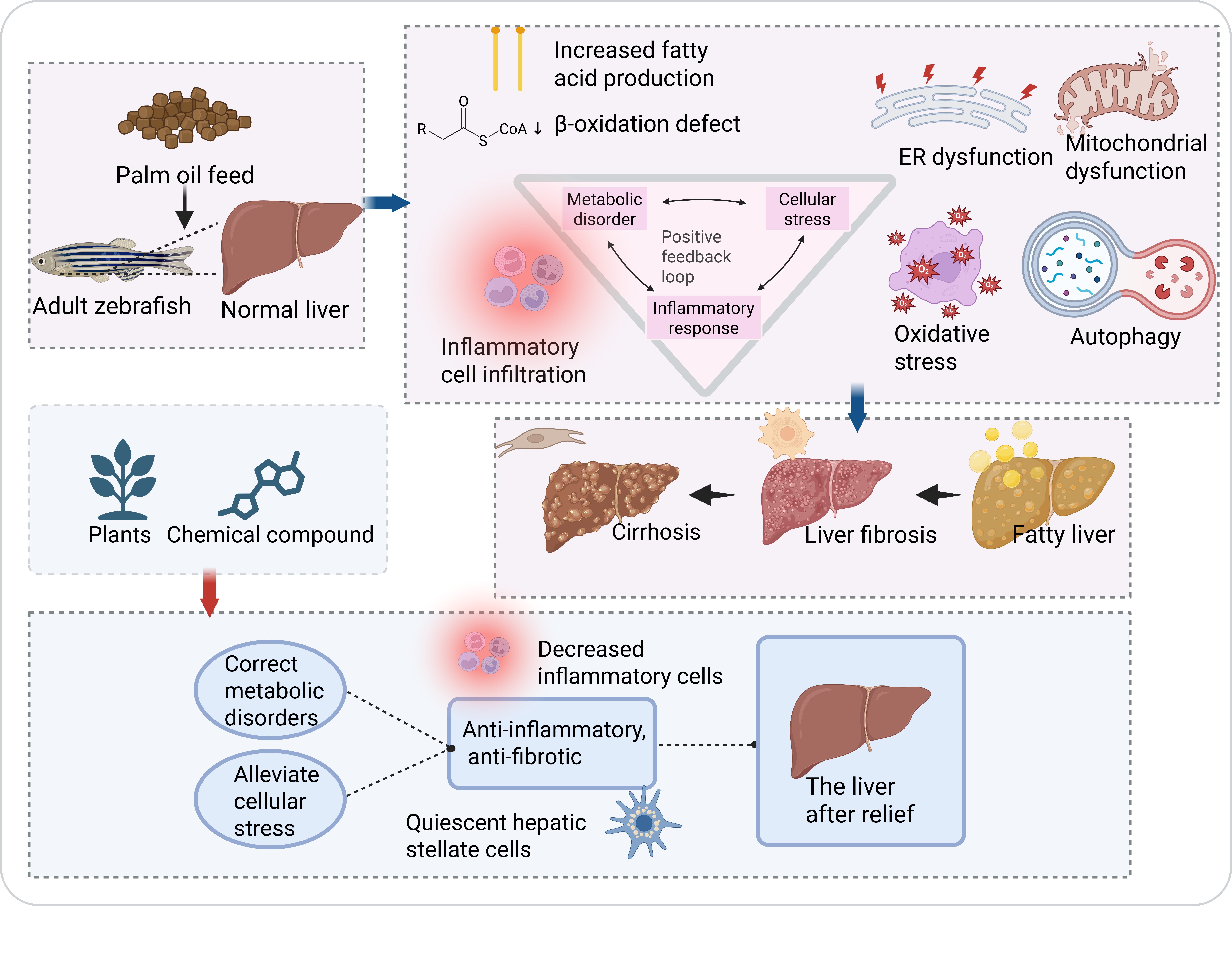
Palmitic acid is a commonly used fish oil substitute in aquatic feed; excessive intake can cause lipotoxic liver damage in animals and is closely associated with non-alcoholic fatty liver disease. Adult zebrafish, with their high genetic homology to humans and conserved lipid metabolic pathways, serve as ideal model organisms for studying liver damage. This article provides a comprehensive narrative review of the pathological features, molecular mechanisms, and intervention strategies related to palmitic acid-induced liver injury in adult zebrafish. It elucidates how palmitic acid disrupts lipid synthesis and oxidation, induces mitochondrial and endoplasmic reticulum stress, and activates inflammatory signaling pathways, ultimately leading to liver fibrosis, and summarizes intervention strategies targeting these mechanisms. This research provides a theoretical basis for the safe application of palmitic acid in aquaculture and offers important insights for the prevention and treatment of non-alcoholic fatty liver disease in humans.
Abstract
Palmitic acid (PA) can be used as a substitute for fish oil in aquaculture; however, excessive intake can easily cause lipotoxic liver damage in animals, and the progression of non-alcoholic fatty liver disease (NAFLD) is closely associated with it. Adult zebrafish (Danio rerio) share a high degree of genetic homology with humans and possess conserved lipid metabolism pathways, making them ideal model organisms for studying hepatic lipotoxicity. This paper presents a comprehensive narrative review of studies on PA-induced hepatic lipotoxicity, with a primary focus on the adult zebrafish model: it elucidates the morphological and functional abnormalities in liver tissue caused by PA exposure; explains the molecular mechanisms by which PA induces metabolic disorders and cellular stress through upregulation of lipid synthesis and inhibition of β-oxidation, which further activates inflammatory signaling pathways such as NF-κB/JNK and may ultimately contribute to liver fibrosis; and summarizes intervention strategies targeting these mechanisms. Studies using embryonic or larval zebrafish are included only as supplementary mechanistic evidence where adult data are unavailable and are clearly distinguished throughout the text. To ensure transparency, the literature search and screening process are reported in detail, although formal systematic review methodologies (e.g., PRISMA, dual independent screening, and quantitative risk-of-bias assessment) were not applied. This study aims to refine the evaluation system for PA-induced hepatic lipotoxicity, providing both theoretical support for the scientific application of PA in aquaculture and important references for elucidating the pathogenesis of human NAFLD/NASH and developing preventive and therapeutic measures.