Article

The Genome-Wide Identification of the GST Gene Family and Functional Characterization of PsGSTF8 in Anthocyanin Accumulation in Chinese Plum Fruit (Prunus salicina)

1
College of Food and Bioengineering, Henan University of Science and Technology, Luoyang 471023, China
2
Research Institute of Non-Timber Forestry, Chinese Academy of Forestry, Zhengzhou 450003, China
*
Authors to whom correspondence should be addressed.
Biology 2026, 15(13), 1002; https://doi.org/10.3390/biology15131002 (registering DOI)
Submission received: 23 May 2026 / Revised: 22 June 2026 / Accepted: 23 June 2026 / Published: 25 June 2026
(This article belongs to the Special Issue Recent Advances in Biosynthesis and Degradation of Plant Anthocyanin)

Simple Summary

Chinese plum is an important fruit crop with a wide range of fruit colors, among which red and purple cultivars are particularly appreciated by consumers. This coloration is mainly attributed to the accumulation of anthocyanins. In addition to biosynthesis, the efficient transport of these pigments into the vacuole is required for stable anthocyanin accumulation in fruit. Glutathione S-transferases (GSTs) are believed to mediate this transport process; however, the specific GST members involved in anthocyanin accumulation in Chinese plum remain unclear. We identified and characterized 39 PsGST genes in the Chinese plum genome. Fruit color phenotypes, anthocyanin content and gene expression profiles were jointly analyzed to screen candidate PsGST genes potentially associated with anthocyanin accumulation. Among these, PsGSTF8 was selected for functional validation, and its role in anthocyanin accumulation was supported by functional assays. In summary, these findings provide new insights into GST-mediated anthocyanin transport in Chinese plum and offer a valuable candidate gene for molecular breeding aimed at improving fruit coloration and related quality traits.

Abstract

Anthocyanins are major determinants of both the color and nutritional quality of fruit. Their accumulation in plant tissues depends on biosynthesis as well as efficient transport into the vacuole, a process in which glutathione S-transferases (GSTs) are believed to play an important role. Through genome-wide identification and analysis, this study identified 39 Chinese plum (Prunus salicina) glutathione S-transferase (PsGST) genes. Phylogenetic analysis grouped these PsGST genes into seven subfamilies. Dispersed duplication appeared to be the main driver of family expansion, and the duplicated genes appear to have largely evolved under purifying selection. The cultivar ‘Fengweimeigui’ (FWMG), with purple peel and red pulp, and the cultivar ‘Fengweihuanghou’ (FWHH), with yellow peel and yellow pulp, were used as contrasting materials because of their distinct anthocyanin pigmentation. We then profiled anthocyanin accumulation and the expression patterns of all PsGST genes across fruit development using quantitative real-time PCR (qRT-PCR). PsGSTF8 was identified as a candidate gene, and its expression patterns in both peel and pulp were consistent with anthocyanin accumulation, with higher relative transcript levels in the deeply colored cultivar ‘FWMG’ and undetectable expression in ‘FWHH’. The transient overexpression of PsGSTF8 in Chinese plum fruit promoted anthocyanin accumulation, and the complementation of the Arabidopsis thaliana transparent testa 19 (tt19) mutant further supported the potential role of PsGSTF8 in anthocyanin accumulation and GST-mediated transport. These results provide new clues for understanding potential GST-mediated anthocyanin transport and accumulation and offer a basis for the further investigation of the molecular mechanisms underlying fruit coloration in Chinese plum.

1. Introduction

Anthocyanins are a key group of secondary metabolites of plants, which apart from fruit coloration also provide antioxidant protection and stress resistance [1,2]. Their stable accumulation not only is regulated by biosynthesis but also requires efficient transport from the cytosol into the vacuole [3]. To date, three major mechanisms have been proposed for anthocyanin transport. Of these, glutathione S-transferase (GST)-mediated transport is considered an important step in anthocyanin transport into the vacuole [4].
GSTs are members of a large, evolutionarily conserved family of enzymes that are widely distributed in eukaryotes and prokaryotes [5]. However, plant genomes generally contain larger numbers of GST genes than many other organisms, mainly due to the expansion of two subfamilies, the GSTU and plant-specific GSTF subfamilies [6]. Most GST genes linked to anthocyanin accumulation and transport are members of the GSTF subfamily, with only a few belonging to the GSTU subfamily [7]. Some GSTs are thought to associate with anthocyanins in the cytosol, thereby helping to maintain their stability and facilitate their transport into the vacuole [8].
Genome-wide analyses have identified and characterized GST family members and revealed their structural and evolutionary features in diverse plant species. Early evidence for the involvement of GSTs in anthocyanin accumulation came from maize, where Bz2 was shown to be required for anthocyanin accumulation and vacuolar deposition [9]. This idea gained further support when researchers observed that Arabidopsis thaliana mutants lacking AtGSTF12 (also known as TT19) fail to accumulate anthocyanins properly [10]. Since then, evidence has accumulated that GST-mediated anthocyanin transport may represent a relatively conserved mechanism in plants. For example, in cyclamen, CkmGST3 can recover pigment accumulation in the Arabidopsis transparent testa 19 (tt19) background, implying a function in anthocyanin accumulation [11].
In fruit crops, GSTs have also been increasingly recognized as important contributors to anthocyanin accumulation and fruit coloration. In grapevine, VviGST1, VviGST3, and VviGST4 exhibit functional specialization and show distinct preferences for different flavonoids, with VviGST3 favoring proanthocyanidin transport and VviGST4 contributing to anthocyanin and proanthocyanidin deposition [12]. In kiwifruit, the AcGST1 expression pattern is closely associated with anthocyanin accumulation [13], and in blueberry, VcGSTF8 has been identified as a strong candidate gene associated with fruit anthocyanin accumulation [14]. In Rosaceae fruit species, GST-mediated anthocyanin transport has also been linked to fruit pigmentation. For example, in peach, PpGST1 appears to be mainly involved in anthocyanin transport rather than proanthocyanidin transport [15], while in apple, MdGSTU12 shows a strong correlation with anthocyanin accumulation in the fruit peel and has been functionally associated with anthocyanin transport [16]. Additional studies of RAP in strawberry, PcGSTF12 in pear, and PavGST1 in sweet cherry also support the view that GSTs may play a conserved role in flavonoid accumulation, particularly anthocyanin-related pigmentation, within this family [17,18,19].
Recent studies have improved our understanding of how anthocyanins accumulate and contribute to fruit coloration in Chinese plum. Red pulp or red peel cultivars generally accumulate higher levels of anthocyanins, whereas yellow or lightly colored genotypes tend to accumulate lower levels. Cyanidin-3-O-glucoside represented the dominant anthocyanin compound detected in Chinese plum fruit [20]. The transcriptional regulation of anthocyanin accumulation is partly mediated by PsMYB10 family members. Among them, PsMYB10.1 is closely related to peel coloration, while PsMYB10.2 is associated with red pulp genotypes and promotes pulp pigmentation through the activation of downstream genes, including PsUFGT [21]. In ‘Kongxin’ plum, the red pigmentation of the peel is linked to the enhanced transcription of key structural genes in the anthocyanin biosynthetic pathway, represented by PsPAL1, PsC4H, PsCHS1, and PsDFR2 [22]. Light and temperature treatments also affect anthocyanin accumulation; in ‘Akihime’, suitable conditions enhance peel anthocyanin accumulation through a PsMYB10.1-mediated pathway [23]. During the low-temperature storage of ‘Xiushi’ plum, PsERF1B participates in cold-triggered pigmentation by forming a regulatory module with PsMYB10.1 and PsbHLH3, activating PsUFGT transcription and enhancing anthocyanin biosynthesis [24].
Overall, previous studies in Chinese plum have mainly focused on MYB-mediated transcriptional regulation and anthocyanin biosynthetic structural genes, whereas less attention has been paid to the post-biosynthetic intracellular transport and vacuolar accumulation of anthocyanins. Several Chinese plum (Prunus salicina) glutathione S-transferase (PsGST) genes have been suggested to function downstream of PsMYB10.1 or PsMYB10.2 and may be involved in anthocyanin transport. However, information on the genome-wide characteristics of the PsGST family, their expression patterns in cultivars with contrasting pigmentation, and the potential functions of individual PsGST genes remains limited [25]. Therefore, the further characterization of PsGST genes may help improve our understanding of anthocyanin accumulation in Chinese plum fruit.
In the present study, we performed a comprehensive genome-wide analysis of the GST gene family in Chinese plum. ‘Fengweimeigui’ (FWMG; purple peel and red pulp) and ‘Fengweihuanghou’ (FWHH; yellow peel and yellow pulp) were selected because they represent distinct fruit pigmentation phenotypes. This clear phenotypic contrast provides suitable material for exploring GST genes potentially associated with anthocyanin transport and accumulation in Chinese plum fruit. To investigate the potential roles of PsGST genes in Chinese plum pigmentation, we combined expression analysis, transient expression assays, and genetic complementation in the Arabidopsis transparent testa 19 (tt19) mutant to screen candidate PsGST genes and assess the potential role of PsGSTF8 in anthocyanin accumulation and GST-mediated transport. These findings may provide useful information for further understanding the post-biosynthetic regulation of anthocyanin accumulation and fruit pigmentation in Chinese plum.

2. Materials and Methods

2.1. Plant Materials

Fruits of two Chinese plum cultivars, ‘Fengweimeigui’ (FWMG) and ‘Fengweihuanghou’ (FWHH), were harvested from the Prunoideae Germplasm Resource Nursery at the Yuanyang Experimental Base of the Chinese Academy of Forestry. For each cultivar, three trees of similar age and showing normal growth without visible disease or pest symptoms were selected as independent biological replicates. Fruit materials were collected at three developmental stages, namely the green stage (G), color-break stage (B), and mature stage (M). These stages were defined based on days after full bloom (DAFB) and visual fruit coloration characteristics. Specifically, the G, B, and M stages corresponded to 90, 120, and 150 DAFB, respectively, in both cultivars (Table S1). The G stage was characterized by predominantly green peel, the B stage by the initial appearance of cultivar-specific peel coloration, and the M stage by fully developed cultivar-specific peel coloration. For each cultivar at each developmental stage, fruits were collected from three individual trees, with 10 fruits from each tree pooled as one biological replicate, yielding three biological replicates per cultivar at each stage (n = 3) and a total of 30 fruits per cultivar per stage. After collection, the fruit peel and pulp were rapidly separated, snap-frozen in liquid nitrogen, and stored at −80 °C.
The Arabidopsis thaliana materials used in this study included the wild-type Columbia-0 ecotype (Col-0) and the tt19 mutant (SALK_113164C). Seeds of the tt19 mutant were obtained from the AraShare Arabidopsis Genetic Resource Center (http://www.arashare.cn/). All Arabidopsis plants were grown in a controlled growth chamber under a 16 h light/8 h dark photoperiod at 22 ± 2 °C, with a light intensity of 100 μmol m−2 s−1.

2.2. Identification and Physicochemical Characterization of GST Gene Family Members

The genome sequences, gene annotation files (GFF3), and predicted protein sequences of Chinese plum were acquired from the GDR (https://www.rosaceae.org/; accessed on 15 October 2025). For comparative purposes, corresponding genomic datasets of apricot (Prunus armeniaca), sweet cherry (Prunus avium), peach (Prunus persica), and Japanese apricot (Prunus mume) were likewise retrieved from the same database [26]. Arabidopsis thaliana GST protein sequences, obtained from TAIR (https://www.arabidopsis.org; accessed on 15 October 2025), served as queries for a BLASTP (https://blast.ncbi.nlm.nih.gov/Blast.cgi?PAGE=Proteins, accessed on 15 October 2025) homology search against the Chinese plum predicted protein database under an E-value cutoff of 1 × 10⁻⁵ [27]. As a complementary approach, the HMM profiles of the conserved GST_N and GST_C domains were sourced from the InterPro (Pfam) database (https://www.ebi.ac.uk/interpro; accessed on 20 October 2025) and screened against the predicted proteins with HMMER v3.4 (http://hmmer.org; accessed on 27 October 2025) at the same E-value threshold [28]. After merging candidate sequences obtained from BLASTP and HMMER, redundant or truncated sequences were removed. Domain architecture was then confirmed via the SMART database (https://smart.embl.de/; accessed on 25 October 2025) [29]. The finalized sequences are listed in Table S2. The key physicochemical parameters including the protein length, isoelectric point (pI), molecular weight (MW), instability index and grand average of hydropathicity (GRAVY) were estimated using ProtParam on the ExPASy platform (https://web.expasy.org/protparam/; accessed on 29 October 2025) (Table S3).

2.3. Sequence Alignment and Phylogenetic Tree Construction

GST protein sequences from Arabidopsis thaliana, Chinese plum, apricot, sweet cherry, peach, and Japanese apricot were aligned using MAFFT v7.526 [30]. The alignment was subsequently manually checked and trimmed to remove poorly aligned, gap-rich, and non-conserved regions. Based on this refined alignment, a maximum likelihood (ML) phylogenetic tree was inferred in MEGA v11.0.13 with branch support evaluated over 1000 bootstrap replicates [31,32]. The resulting tree was plotted and labeled using the package ggtree (v4.0.5) from Bioconductor in R v4.5.1 [33].

2.4. Gene Structure, Conserved Motif, and Conserved Domain Analysis of PsGSTs

The structural organization of PsGST genes was analyzed using the Chinese plum genome annotation data. Genomic and CDS sequences for each identified GST member were extracted with TBtools v1.120 and used to draw exon–intron organization diagrams. The conserved domain positions were annotated in NCBI Conserved Domain Database and displayed together with TBtools to visualize gene structures and domain architecture. Motif analysis was performed with MEME v5.5.8, setting the maximum number of motifs to 15.

2.5. Chromosomal Localization, Gene Duplication, Comparative Synteny, and Ka/Ks Analysis

The genomic positions of PsGST members were displayed on Chinese plum chromosomes using TBtools. Duplication types among PsGST family members were classified with the duplicate_gene_classifier module of MCScanX v1.0, based on gene collinearity and physical positions [34]. Interspecific synteny across the five Prunus species was analyzed using the JCVI module in TBtools, and cross-species syntenic homologous gene pairs of PsGSTs were identified. For each duplicated gene pair, coding sequence alignments were generated with ParaAT v2.0. For each duplicated gene pair, Ka and Ks were estimated using the Nei–Gojobori (NG) model in KaKs_Calculator. Selection patterns after duplication were inferred from the corresponding Ka/Ks values [35].

2.6. Analysis of Transcription Factor Binding Sites and Cis-Regulatory Elements

The promoter analysis of PsGST genes began with the selection of a representative transcript for each gene from the Chinese plum genome annotation file. The 2000 bp sequence upstream of each transcription start site was retrieved and defined as the putative promoter region. The promoter sequences were submitted to PlantCARE (https://bioinformatics.psb.ugent.be/webtools/plantcare/html/; accessed on 28 October 2025) for the prediction and functional classification of putative cis-regulatory elements (CREs) [36]. The transcription factor binding sites (TFBSs) were predicted using the FIMO tool in MEME Suite v5.5.3, with a significance threshold of p ≤ 1 × 10⁻⁵. The resulting datasets from both analyses were then combined and visualized using with the R package ggplot2.

2.7. Anthocyanin Content Determination

Total anthocyanin levels were measured based on absorbance differences under two pH conditions using the pH differential method [37]. In brief, 0.5 g of fresh tissue was homogenized after liquid nitrogen freezing and then extracted with 1 mL of 1% HCl–methanol solution at 4 °C for 24 h without light exposure. The extract was clarified by centrifugation at 12,000 rpm for 10 min, after which the supernatant was retained for subsequent analysis. The extraction solution was diluted with KCl buffer (0.025 mol·L−1) at pH 1.0 and sodium acetate buffer (0.4 mol·L−1) at pH 4.5. Absorbance at 520 nm and 700 nm was measured after room temperature equilibration. The absorbance difference was derived from A = [(A520 − A700) pH 1.0 − (A520 − A700) pH 4.5]. Total anthocyanins were quantified as cyanidin-3-glucoside equivalent content and reported as mg per 100 g fresh weight [38].

2.8. qRT-PCR Analysis

We extracted total RNA using TRIzol reagent (TransGen Biotech, Beijing, China). Reverse transcription was performed using the PrimeScript™ RT reagent kit to generate cDNA (TaKaRa, Dalian, China). A LightCycler® 480 II system (Roche, Basel, Switzerland) was used for qRT-PCR with SYBR Green qPCR Premix (2×) (Koton Biotechnology, Beijing, China). Each sample included three independent biological replicates. Transcript abundance was estimated using the 2−ΔΔCt method, with PsActin serving as the internal reference gene [39]. Supplementary Table S4 lists all primer sequences, which were generated with Primer Premier 5.0 and ordered from Sangon Bioengineering Co., Ltd. (Shanghai, China).

2.9. Construction of Overexpression Vector

The complete coding sequence of PsGSTF8 was amplified from cDNA synthesized from the peel of mature ‘FWMG’ fruit. The pGreenII 62-SK plasmid was linearized by double digestion with SpeI and EcoRI. Primers with homologous extensions matching the vector ends were designed in Primer Premier 5.0 (Table S5). After gel recovery and the purification of the PCR products, the PsGSTF8 fragment was inserted into the pGreenII 62-SK vector using the ClonExpress II One Step Cloning Kit (Vazyme, Nanjing, China), resulting in the construction of the CaMV 35S promoter-driven PsGSTF8 overexpression vector 35S::PsGSTF8. Following validation by sequencing, the recombinant vector was introduced into Agrobacterium tumefaciens GV3101.

2.10. Transient Overexpression of PsGSTF8

To ensure the reproducibility of Agrobacterium-mediated injection infiltration and subsequent sampling, preliminary infiltration tests were first performed using different Chinese plum cultivars. Based on these tests, mature ‘WeiDi’ (WD) fruit was selected as the most suitable material for PsGSTF8 transient overexpression. ‘WD’ was selected only for transient functional validation because its fruits had relatively uniform maturity, no visible mechanical damage, and a firm but injectable texture. In contrast, the soft tissue of ‘FWMG’ fruit tended to cause the leakage of the bacterial suspension, local tissue collapse, and inconsistent sampling after injection, whereas the excessively firm tissue of ‘FWHH’ fruit made needle penetration difficult, increased resistance during syringe plunger depression, caused the local cracking of the dense pulp tissue during injection, and restricted the uniform diffusion of the infiltration suspension. Therefore, ‘WD’ fruit was used to improve the consistency of injection infiltration, PsGSTF8 transient expression, anthocyanin accumulation analysis, and downstream sampling. The fruits were harvested as described in Section 2.1.
Agrobacterium cultures harboring either the 35S::PsGSTF8 (PsGSTF8-OE) construct or the empty vector were resuspended in infiltration buffer according to Zhao et al. [15]. For each fruit, the empty vector and PsGSTF8-OE suspensions were injected into two opposite sides of the same fruit using a sterile 1 mL syringe, with the needle inserted approximately 3–4 mm into the fruit tissue. A total of 2 mL of Agrobacterium suspension was injected into each fruit, with 1 mL of each suspension applied to the corresponding injection site. The fruits were kept at 25 °C for 5 d after injection. Three biological replicates were used, each consisting of infiltrated tissues from 10 independently injected fruits. For each replicate, tissues from the empty vector- and PsGSTF8-OE-infiltrated sides were collected separately and pooled by treatment. The pooled samples were immediately frozen in liquid nitrogen and stored at −80 °C until further analysis. The collected infiltrated tissues were used for PsGSTF8 expression analysis and total anthocyanin content determination using the pH differential method, a spectrophotometric method described in Section 2.7.

2.11. Generation of Arabidopsis tt19 Lines Overexpressing PsGSTF8

Positive Agrobacterium colonies were isolated and cultured. Bacterial cells were resuspended in infiltration medium to an OD600 of 0.8–1.0. Arabidopsis tt19 mutant plants were grown in a controlled growth under the same controlled conditions as described in Section 2.1. The plants were transformed using the floral dip method [40]. Harvested T1 seeds were sown on 1/2 MS medium containing 30 mg/L kanamycin for selection and cultured under the same conditions described above. The selected transgenic lines were propagated to the T3 generation. T3 seeds from independent transgenic lines were germinated and grown under the same controlled conditions, and the resulting seedlings were used for phenotypic observation, a qRT-PCR analysis of PsGSTF8 expression and anthocyanin content determination. The method for anthocyanin determination is described in Section 2.7, and primer information is provided in Table S5.

2.12. Statistical Analysis

Data were analyzed by GraphPad Prism v10.6.0 and presented as the mean ± standard deviation (SD). Group differences were assessed by a two-tailed Student’s t-test (two groups) or one-way ANOVA with Tukey’s multiple comparisons test (more than two groups).

3. Results

3.1. Identification and Physicochemical Characterization of GST Gene Family in Chinese Plum

Based on the genome and proteome information of Chinese plum, the candidate GST sequences were first retrieved by HMM-based domain search and then validated for their domain architectures. This systematic screening workflow resulted in the identification of 39 high-confidence GST gene family members. The PsGST proteins ranged in length from 86 to 421 amino acids, with corresponding molecular weights (MWs) ranging from 9.23 to 47.92 kDa. The pI values ranged from 4.24 to 9.80, with 23 proteins classified as acidic proteins (pI < 7) and 16 as basic proteins (pI > 7). The instability index varied from 25.00 to 56.31. Using 40 as the threshold, 16 proteins were predicted to be unstable, whereas the remaining 23 were predicted to be stable. In addition, 36 PsGST proteins had negative GRAVY values, indicating that most members were predicted to be hydrophilic (Table S6).

3.2. Phylogenetic Relationships of GST Proteins from Different Species

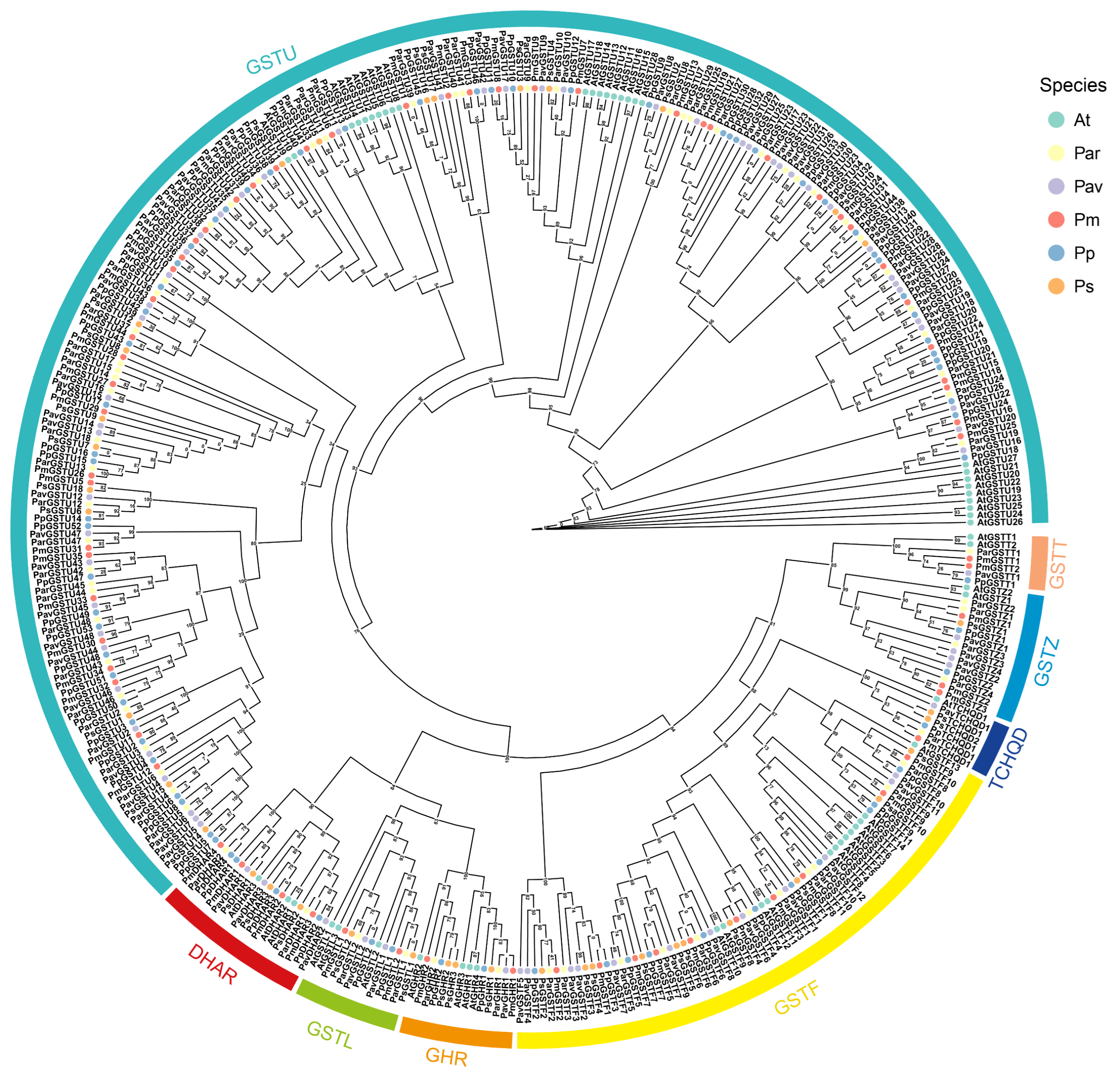
A dataset comprising 326 GST proteins from Chinese plum, apricot, sweet cherry, peach, and Japanese apricot was assembled for evolutionary relationship analysis. These sequences were combined with 56 GST proteins from Arabidopsis thaliana as references. The aligned GST protein dataset was used for ML phylogenetic analysis (Figure 1). According to the tree topology and the classical classification system of the Arabidopsis GST family, all GST proteins were assigned to their corresponding subfamilies. The Arabidopsis GST proteins served as subfamily references, and the classification of PsGSTs was supported by their clustering with Arabidopsis members from the corresponding GST subfamilies.
In total, 382 GST proteins, including 39 PsGSTs, 71 ParGSTs, 72 PavGSTs, 68 PmGSTs, 76 PpGSTs, and 56 AtGSTs, were classified into eight subfamilies (Table S6). Among the identified subfamilies, GSTU contained the highest number of members, totaling 239, whereas GSTF was the second largest, with 67 members. Most PsGST members were grouped within the GSTU and GSTF subfamilies, consistent with the expansion pattern commonly observed in plant GST families. It should be noted that no GSTT subfamily members were identified within the PsGST family. Accordingly, the Chinese plum GST family was assigned to seven subfamilies, including Tau (GSTU), Phi (GSTF), Lambda (GSTL), DHAR, Zeta (GSTZ), TCHQD, and GHR (Table S2). Among these, DHAR, GSTL, and GHR clustered within the same major branch, suggesting a relatively close phylogenetic relationship. Based on the phylogenetic tree, PsGST members did not form large Chinese plum-specific clades. Instead, most PsGSTs were grouped with GST proteins from other Prunus species and Arabidopsis GSTs from the corresponding subfamilies. This pattern was particularly evident in the GSTU and GSTF subfamilies.

3.3. Analysis of Gene Structures, Conserved Motifs, and Conserved Domains of PsGSTs

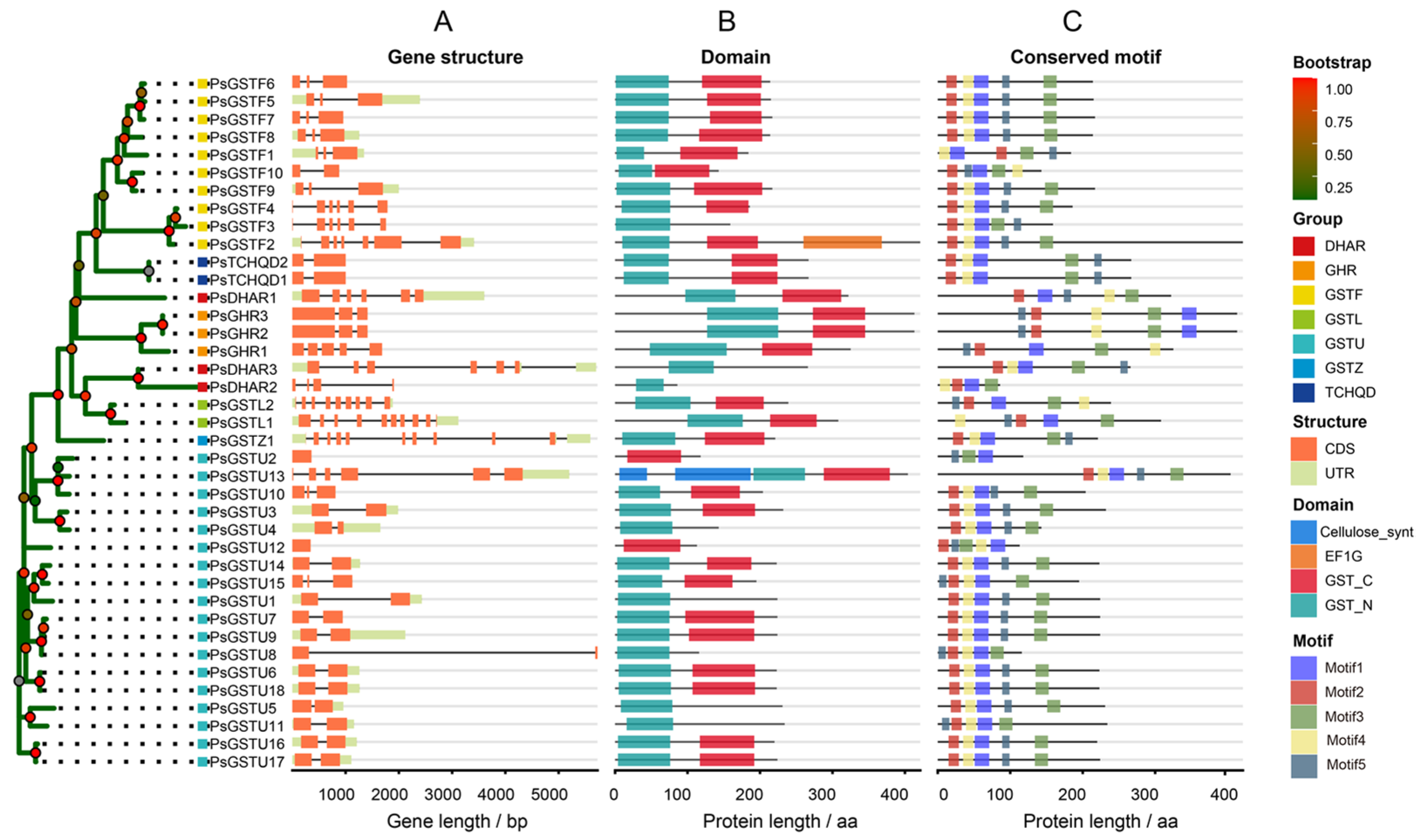
Comparative gene structure analysis showed clear differences in exon–intron organization across subfamilies of the PsGST family, while members within the same subfamily generally exhibited more conserved gene structural patterns. Within the GSTU subfamily, most members contained two exons and one intron (13/18). Gene structures in the GSTF subfamily were relatively diverse compared with those in other GST subfamilies. PsGSTF1, PsGSTF5, PsGSTF6, PsGSTF7, PsGSTF8, and PsGSTF9 each contained three exons and two introns; PsGSTF3 and PsGSTF4 contained six exons and five introns; PsGSTF2 contained seven exons and six introns; and PsGSTF10 contained only two exons and one intron. The GSTZ subfamily contained 11 exons and 10 introns (Figure 2A).
The majority of PsGST proteins were predicted to contain the canonical GST_N and GST_C domains (26/39), whereas some members showed variation in domain composition. In particular, ten proteins were predicted to contain only the GST_N domain, and two proteins were predicted to contain only the GST_C domain. Based on the current genome annotation and domain prediction results, these sequences were retained as PsGST candidates, although they may represent partial or truncated predictions. In addition, EF1G and Cellulose_synt domains were additionally predicted in PsGSTF2 and PsGSTU13, respectively (Figure 2B; Table S7). In total, five conserved motifs ranging from 11 to 21 amino acids were identified in the PsGST proteins (Figure S1). Most PsGST members had the full complement of five motifs, except for the absence of Motif 5 in PsDHAR2 and the presence of only three motifs (1, 3, and 5) in PsGSTU2 (Figure 2C).

3.4. Chromosomal Localization, Gene Duplication, and Synteny Analysis of PsGST Genes

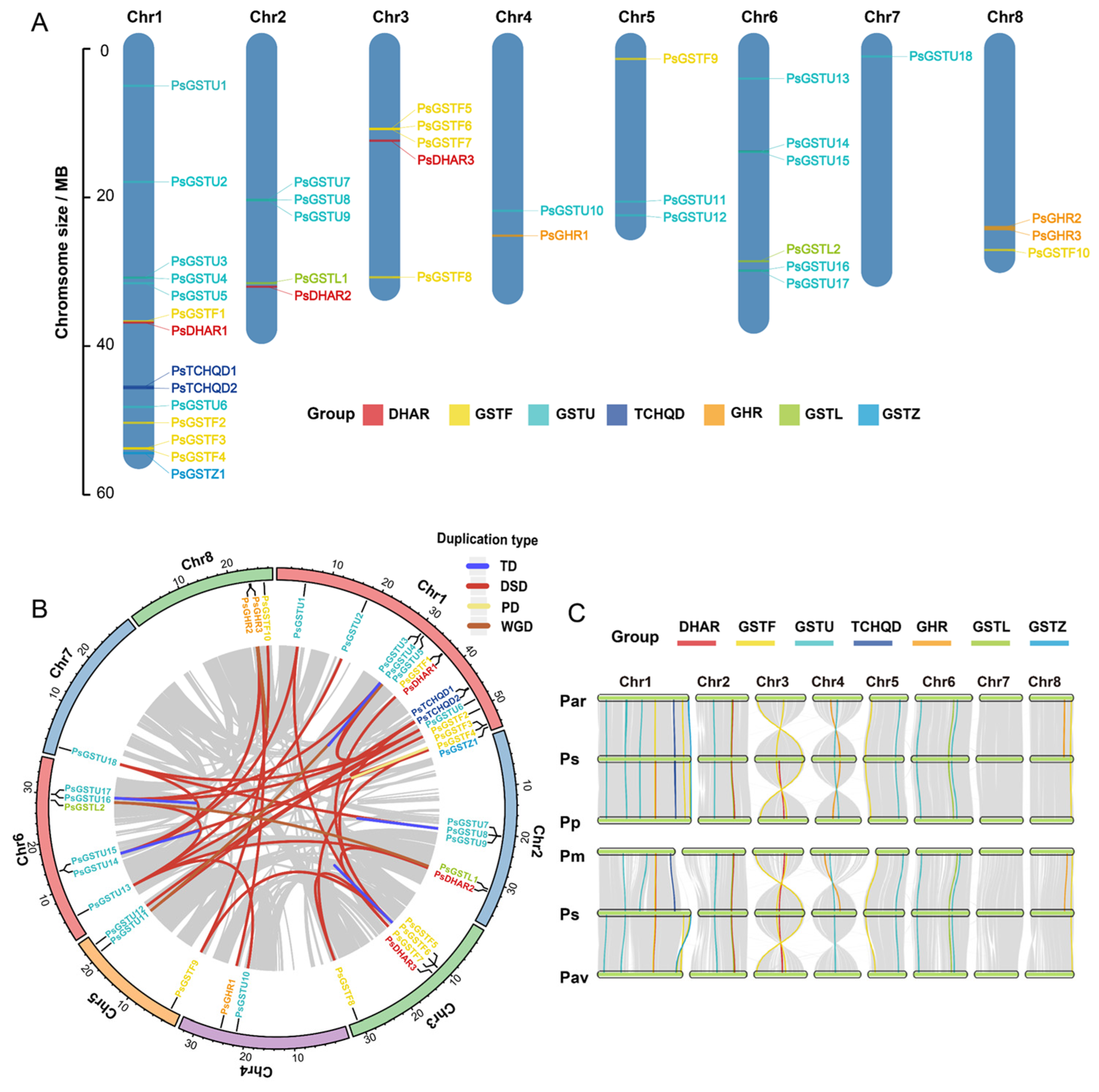
Chromosomal mapping revealed that the 39 PsGST genes were unevenly distributed across the eight chromosomes of Chinese plum (Figure 3A). Among them, chromosome 1 harbored the largest number of PsGST members (14 genes), followed by chromosome 6 with six members, while chromosomes 2 and 3 each carried five members. Three PsGST genes were located on each of chromosomes 5 and 8, two on chromosome 4, and only one on chromosome 7. In addition, adjacent gene clusters consisting of PsGSTU7PsGSTU9 and PsGSTF5PsGSTF7 were identified on chromosomes 2 and 3, respectively.
An analysis of the duplication patterns within the PsGST gene family identified 46 duplicated pairs, including 35 dispersed duplication (DSD) pairs, six tandem duplication (TD) pairs, three whole-genome duplication (WGD) pairs, and two proximal duplication (PD) pairs (Figure 3B). DSD represented the dominant duplication type among the duplicated gene pairs (76.1%), indicating that it may have been a major contributor to PsGST family expansion. Comparative collinearity analysis between Chinese plum and the other four Prunus species identified 21, 23, 31, and 19 collinear homologous GST gene pairs with apricot, peach, Japanese apricot, and sweet cherry, respectively (Figure 3C).

3.5. Selection Pressure Analysis of Duplicated PsGST Gene Pairs

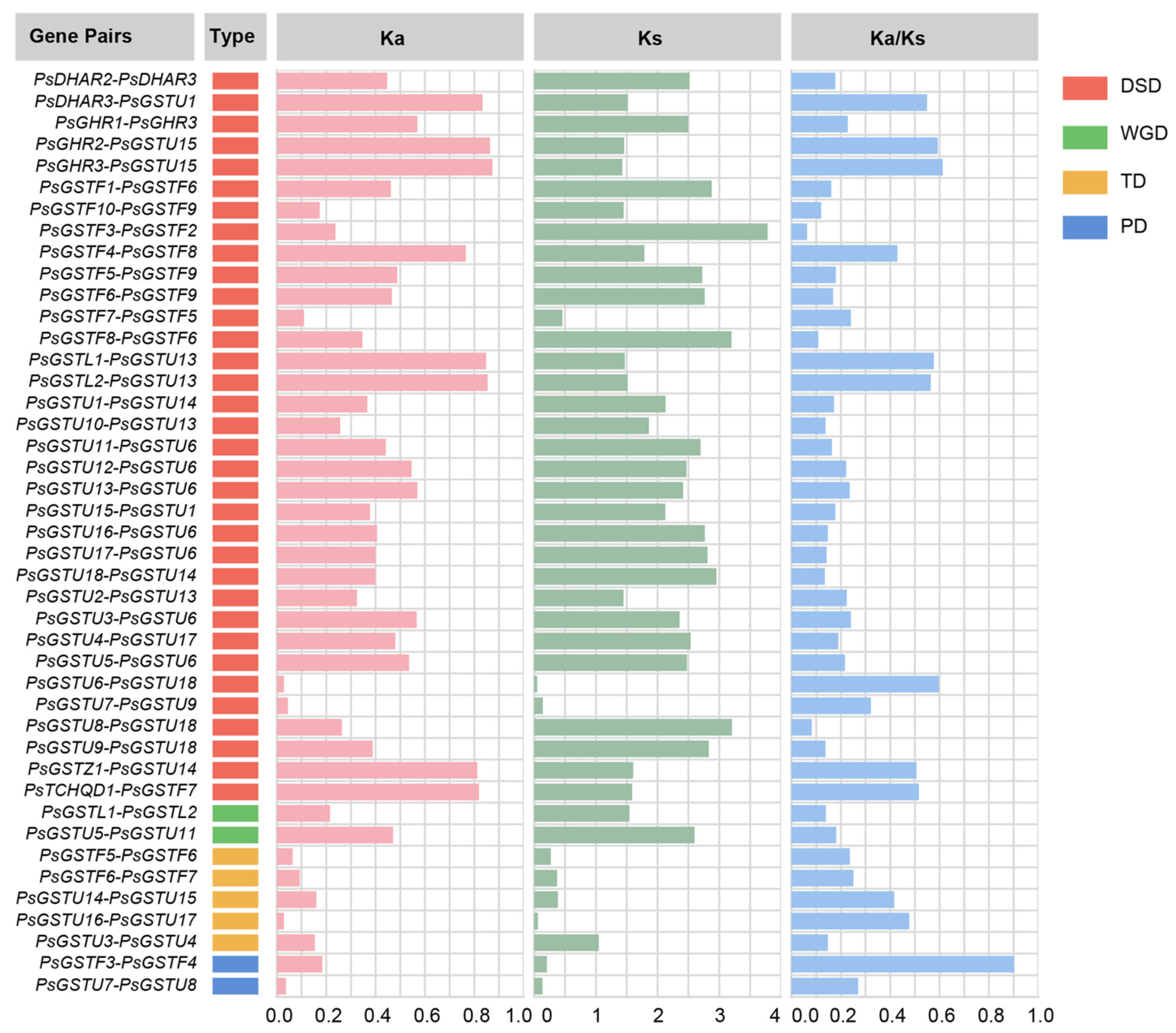
To evaluate whether duplicated PsGST gene pairs experienced selective pressure after duplication, Ka, Ks, and Ka/Ks values were calculated using the Nei–Gojobori (NG) model. Selection patterns were then inferred from these metrics (Figure 4). In total, 44 duplicated PsGST gene pairs were retained after discarding gene pairs with a Ka or Ks value equal to 0. The mean Ka/Ks ratio was 0.287 (0.062–0.901), with most values between 0.108 and 0.269. Overall, the duplicated PsGST genes in Chinese plum mainly evolved under purifying selection.

3.6. Transcription Factor Binding Site Prediction and Cis-Regulatory Element Analysis of PsGST Genes

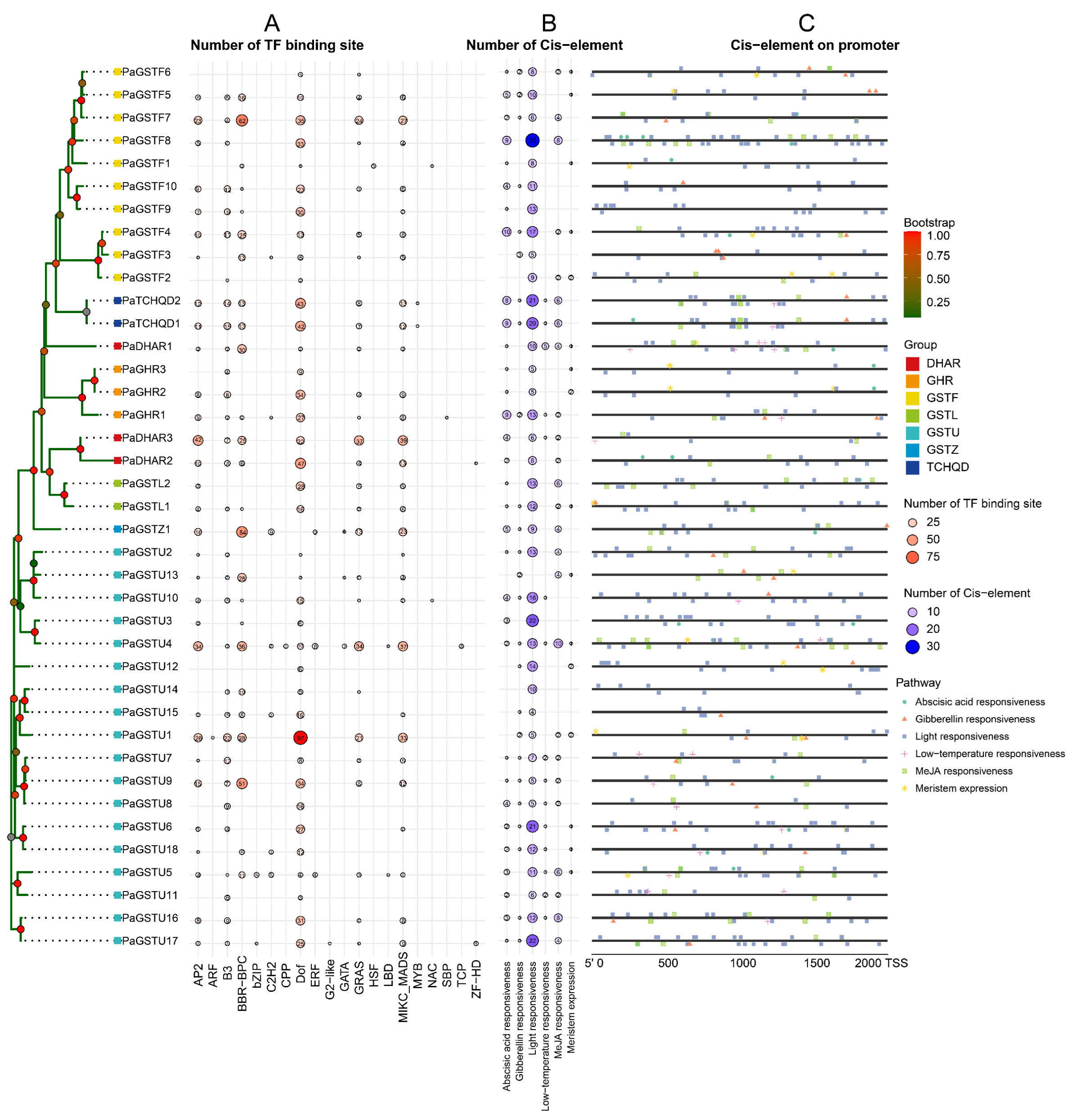
The potential regulatory features of PsGST promoters were explored by analyzing the 2000 bp upstream regions of PsGST genes for TFBSs and CREs (Figure 5). The PsGST promoters were predicted to contain various TFBSs, predominantly Dof (743), BBR-BPC (443), MIKC_MADS (306), AP2 (282), and B3 (198) (Figure 5A). Among these, Dof-binding sites were the most prevalent in PsGST promoters, although their numbers varied markedly among genes. The highest number was observed in the PsGSTU1 promoter, which contained 97 Dof-binding sites, whereas no Dof-binding site was predicted in the PsGSTZ1 promoter.
The functional classification of predicted CREs showed that PsGST promoters contained elements associated with abscisic acid responsiveness, gibberellin responsiveness, low-temperature responsiveness, light responsiveness, methyl jasmonate responsiveness, and meristem expression (Figure 5B). Among the CREs identified in PsGST promoters, light-responsive elements constituted the predominant category, accounting for 61.2% of all identified CREs. They were followed by abscisic acid-responsive elements (14.7%) and methyl jasmonate-responsive elements (14.1%). These predicted promoter features suggest that some PsGST genes may be responsive to light-related regulation.

3.7. Phenotypic Characteristics of Peel and Pulp Coloration and Total Anthocyanin Content at Different Stages of Fruit Development

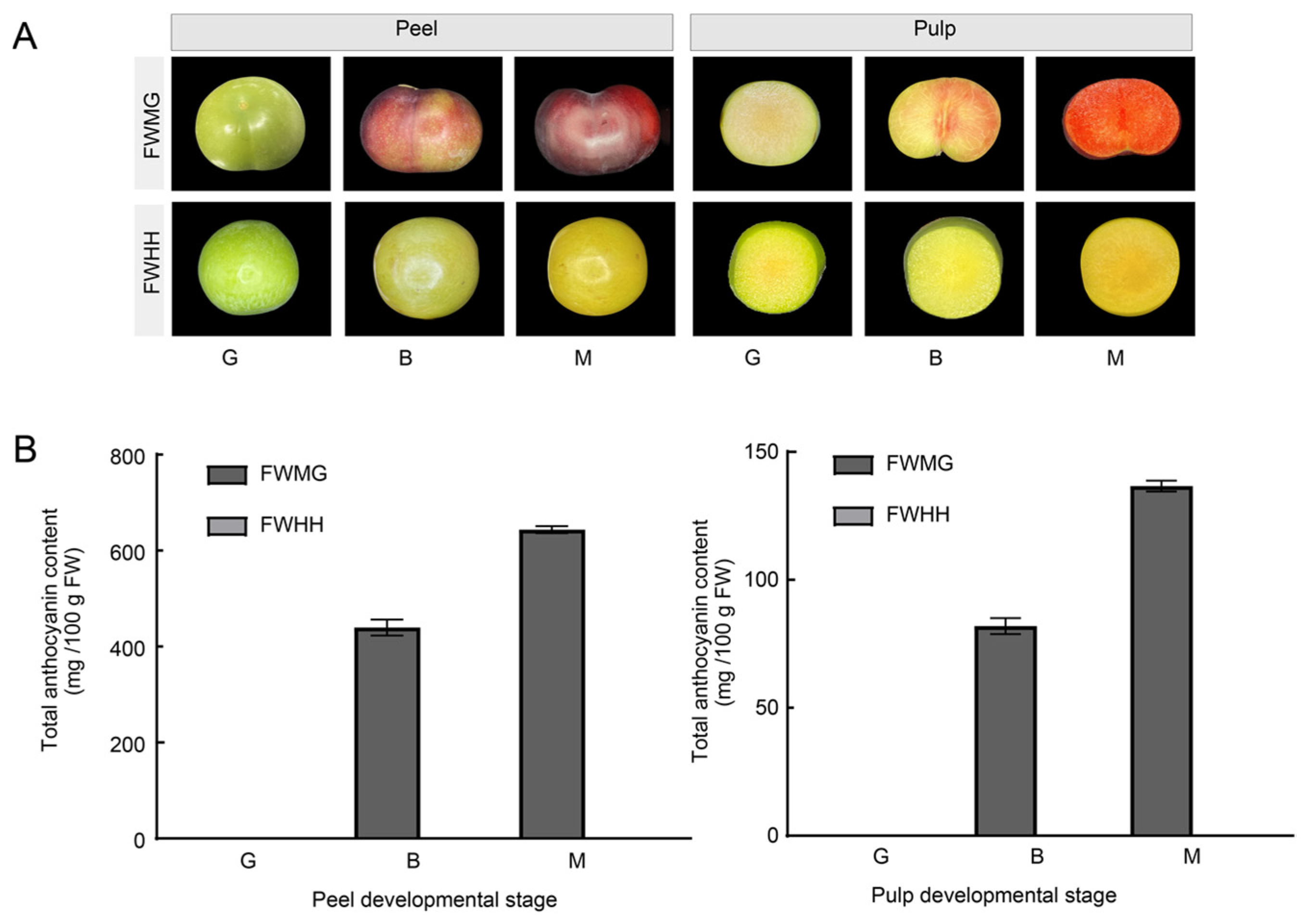
During fruit development, ‘FWMG’ gradually developed purple and red coloration in both the peel and pulp, reaching the highest color intensity at the M stage. In contrast, the peel of ‘FWHH’ remained predominantly green to yellow during development, and no red pigmentation was observed in the pulp (Figure 6A). Consistent with the phenotypic observations, total anthocyanin content in both the peel and pulp of ‘FWMG’ fruits increased as development progressed, reaching the highest level at the M stage, with greater accumulation detected in the peel than in the pulp. By comparison, total anthocyanin content was not detected in either the peel or pulp of ‘FWHH’ fruit samples at the G, B, or M stages under the conditions used in this study (Figure 6B).

3.8. Spatiotemporal Expression Patterns of GST Family Genes in Two Chinese Plum Cultivars

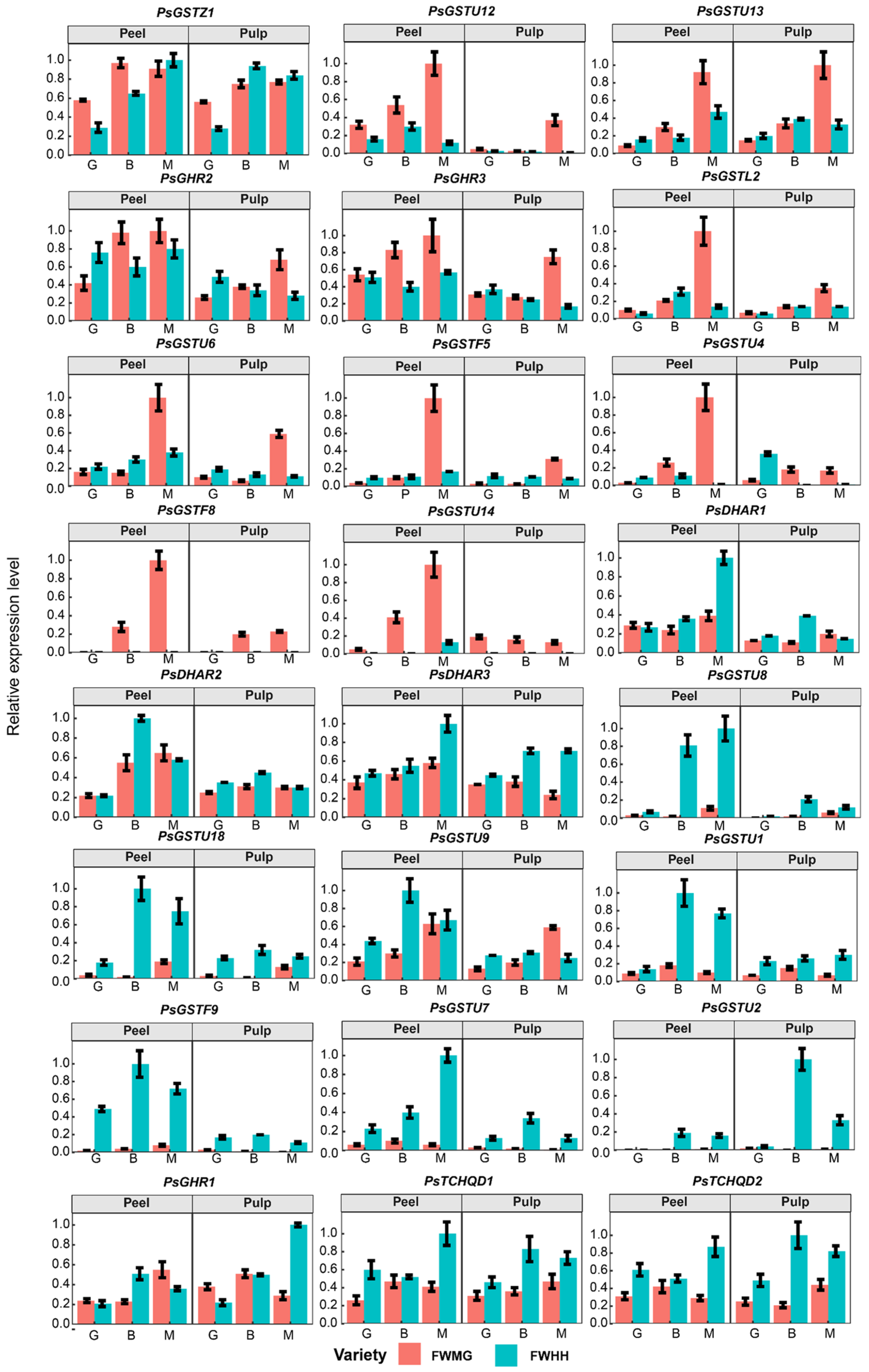
The transcript abundance of the 39 PsGST members was assessed in ‘FWMG’ and ‘FWHH’ peel and pulp tissues across fruit development using qRT-PCR (Figure 7 and Figure S2). Because the expression values in the heatmap were normalized to the maximum value for each gene, these data were used to compare expression patterns within each gene across samples, rather than absolute transcript levels among different genes. Except for PsGSTU3, PsGSTU11, and PsGSTU15, whose expression was not detected under the conditions examined in this study, the remaining 36 genes were classified into three groups with distinct expression profiles (Figure S3). Among these, Group I genes tended to show higher relative expression at the B and M stages in ‘FWMG’ peel and at the M stage in pulp (Figure 7). Notably, PsGSTF8 showed high relative expression in the peel and pulp of the ‘FWMG’ fruit at both the B and M stages, whereas its expression was not detected in the corresponding stages of ‘FWHH’ fruit. Pearson correlation analysis was performed between PsGST gene expression and total anthocyanin content across 12 matched samples (Figure S4). Among the analyzed PsGST genes, PsGSTF8 showed the strongest positive correlation with anthocyanin content (r = 0.96, p < 0.001). Several other genes, including PsGSTL2, PsGSTU4, PsGSTU12, PsGSTU14, PsGSTF5, PsGSTU6, PsGHR2, and PsGHR3, also showed positive correlations with anthocyanin content. However, their correlation coefficients were lower than the coefficient for PsGSTF8. Together, the expression pattern, anthocyanin accumulation profile, and correlation analysis support PsGSTF8 as the most suitable candidate for further functional validation.
Genes in Group II exhibited distinct tissue and stage specificity but lacked a consistent expression pattern (Figures S2 and S3). Most Group III genes showed relatively higher expression in ‘FWHH’ peel and pulp at the B and M stages, within their respective expression profiles, implying a potential negative correlation with anthocyanin accumulation (Figure 7 and Figure S3). Consistently, Pearson correlation analysis showed that several Group III genes were negatively correlated with anthocyanin content, with PsGSTF2 and PsGSTF6 showing significant negative correlations (p < 0.05; Figure S4).

3.9. Transient Overexpression of PsGSTF8 in ‘WD’ Fruit

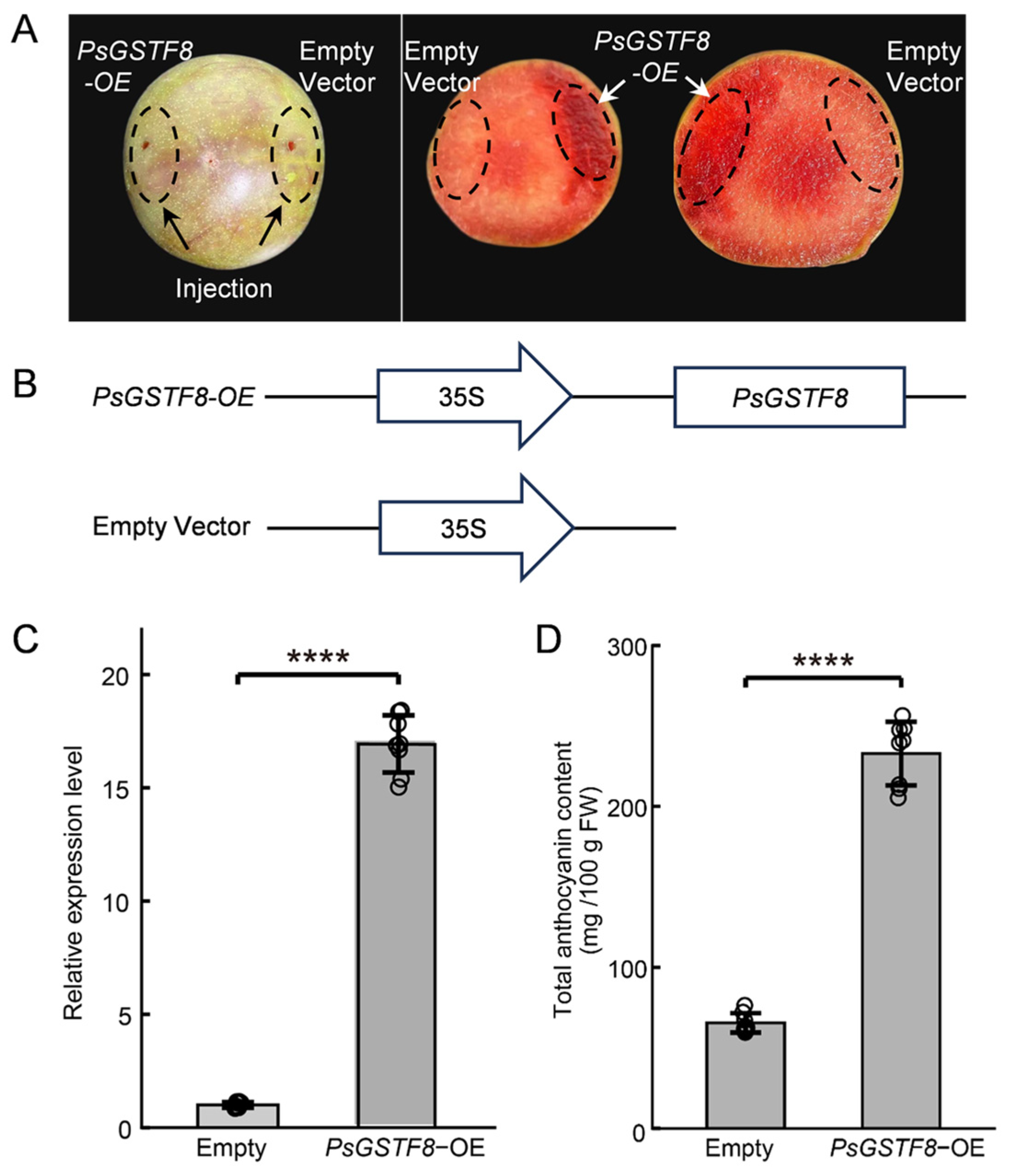
To evaluate whether PsGSTF8 could promote anthocyanin accumulation in fruit, we constructed a PsGSTF8 overexpression vector and used an empty vector as a control. ‘WD’ fruits with uniform size and physiological status were selected as transient overexpression materials. Agrobacterium-mediated infiltration was performed by injecting Agrobacterium suspensions containing the empty vector or the PsGSTF8-OE recombinant plasmid into two opposite positions on the same fruit. The fruits were incubated at 25 °C for 5 d after infiltration. Phenotypic observation showed that the tissue transiently overexpressing PsGSTF8 developed darker coloration than the empty vector control (Figure 8A,B). The transient overexpression of PsGSTF8 in ‘WD’ fruits was validated by qRT-PCR, which showed an approximately 16-fold-higher expression level relative to the empty vector control (p < 0.0001; Figure 8C). To determine whether the visible pigmentation was associated with a measurable change in anthocyanin content, total monomeric anthocyanins in the infiltrated tissues were quantified using the pH differential method (a spectrophotometric method). PsGSTF8-overexpressing tissues accumulated 247.6 mg/100 g FW total monomeric anthocyanins, representing a 3.54-fold increase compared with the empty vector treatment (p < 0.0001; Figure 8D). These results suggest that PsGSTF8 may promote anthocyanin accumulation in plum fruit tissue under the transient overexpression conditions used in this study.

3.10. Functional Analysis of PsGSTF8 in tt19 Mutant

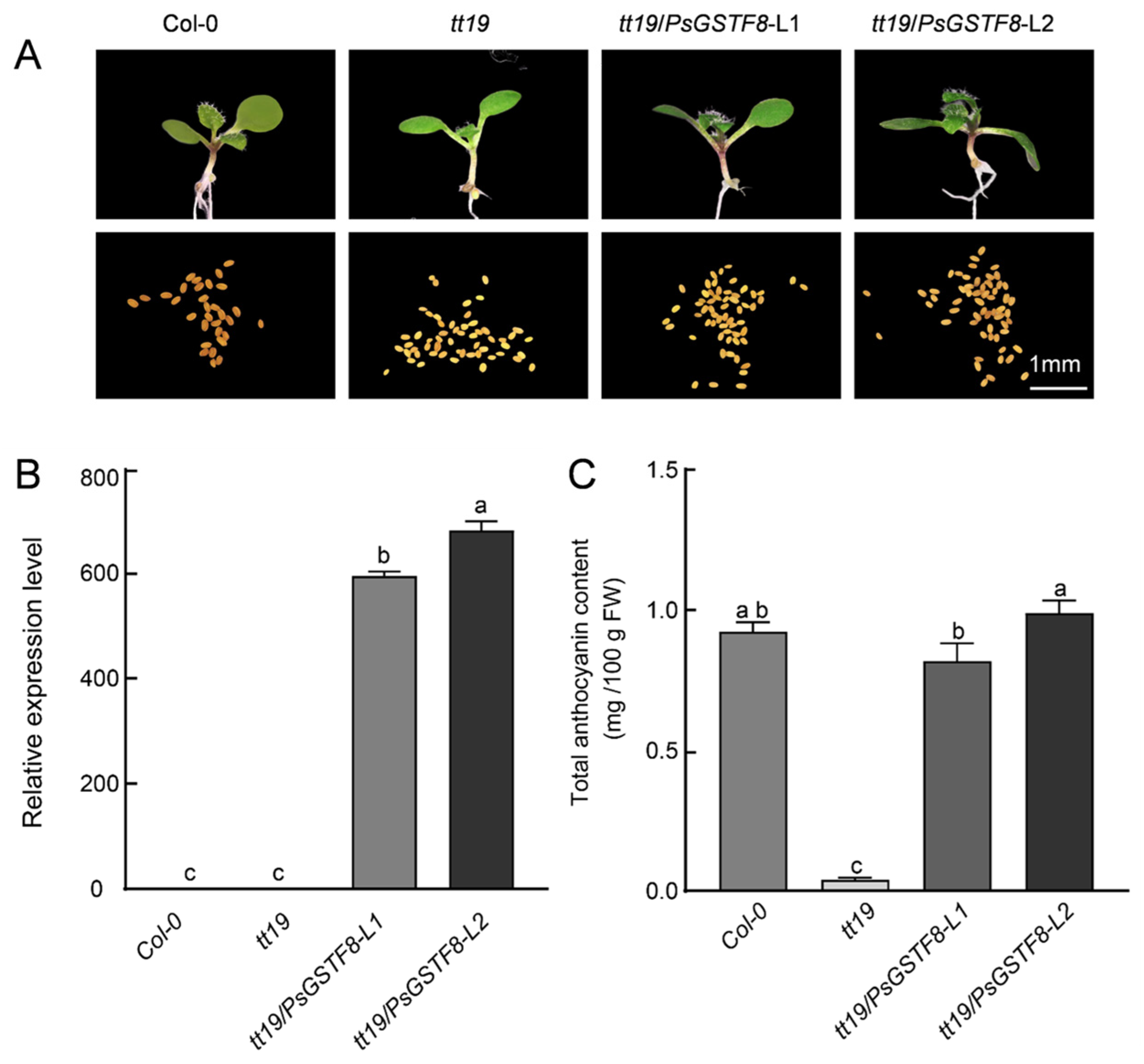
To evaluate the potential role of PsGSTF8 in anthocyanin accumulation and GST-mediated transport, 35S::PsGSTF8 was expressed in the Arabidopsis tt19 mutant for heterologous functional complementation [10]. Under the growth conditions used in this study, the hypocotyls of wild-type Col-0 seedlings were red. The tt19 mutant, which is defective in an anthocyanin-related GST gene, showed reduced red pigmentation in the hypocotyls. In contrast, the PsGSTF8 transgenic lines restored the red hypocotyl phenotype, while the seed coat color of mature seeds was partially restored toward the Col-0 phenotype (Figure 9A). qRT-PCR analysis confirmed PsGSTF8 expression in the transgenic lines L1 and L2, whereas PsGSTF8 transcripts were not detected in Col-0 or tt19 plants (Figure 9B). Total monomeric anthocyanin content, quantified using the pH differential method, was significantly increased in L1 and L2 compared with the tt19 mutant, levels approximately 20-fold higher than that in tt19. The anthocyanin levels in L1 and L2 were comparable to those in Col-0 and were significantly higher than those in tt19 (p < 0.05; Figure 9C). These results suggest that PsGSTF8 expression was associated with increased anthocyanin accumulation in the tt19 mutant background.

4. Discussion

The stable accumulation of anthocyanins in plant vacuoles is a major determinant of red, purple, and blue coloration in fruits [41]. GSTs are conserved multifunctional proteins involved in the intracellular transport and vacuolar accumulation of anthocyanins [42]. In the present study, 39 GST members were identified in Chinese plum, providing a basis for exploring GST-mediated anthocyanin transport in this species. Phylogenetic analysis classified these members into seven subfamilies, whereas no GSTT members were identified in the current Chinese plum genome annotation. This pattern may be associated with lineage-specific gene loss, annotation limitations, or differential retention during evolution. Compared with the GST families reported in some closely related Rosaceae species, the relatively small size of the PsGST family suggests that GST expansion in Chinese plum may have been limited [43]. Four duplication types were identified in the PsGST gene family, with DSD accounting for the highest proportion, whereas TD events were relatively rare. This pattern differs from previous reports in some Rosaceae species, where GST family expansion was mainly associated with TD [43], suggesting that the mechanisms underlying GST family expansion may vary among Rosaceae fruit trees. The relatively low frequency of TD events may have contributed to the limited expansion of the PsGST family. These results suggest that Chinese plum maintains a relatively conserved GST repertoire, in which specific GSTF and GSTU members may play roles in flavonoid transport, oxidative stress responses, environmental adaptation, and anthocyanin-related fruit coloration [44].
Predicted promoter CREs provide important clues for understanding the potential regulatory mechanisms of PsGST genes. The high abundance of predicted light-responsive elements in PsGST promoters is consistent with previous reports in other fruit crops, suggesting that some PsGST genes may be associated with light-related regulation during anthocyanin accumulation and fruit color development. For example, UV-B and white light treatments induced the expression of MiGSTF8, MiGSTF9, and MiGSTU7 and were accompanied by anthocyanin accumulation in fruit peel [45], while in litchi, bag removal enhanced light exposure and promoted LcGST4 expression in association with anthocyanin accumulation [46]. The presence of elements related to abscisic acid response, gibberellin response, methyl jasmonate response, low-temperature response, and meristem expression further suggests that PsGST genes may be regulated by multiple hormonal, developmental, and environmental signals. However, these predictions do not directly demonstrate actual responsiveness to these signals, and their functional significance requires further validation through light or hormone treatment experiments, promoter activity assays, and transcription factor binding experiments.
Classical GST genes such as maize BZ2, petunia AN9, and Arabidopsis TT19 have been shown to mediate anthocyanin transport, and the tt19 mutant is widely used for functional validation [9,10,42]. Similar roles have also been reported for GST genes in several fruit crops. For instance, LcGST4 in litchi, MdGSTF6 in apple, PpGST1 in peach, MrGST1 in Chinese bayberry, PavGST1 in sweet cherry, and PcGST57 in pear have been reported to participate in anthocyanin transport or fruit coloration [15,19,46,47,48,49]. Their expression is frequently controlled by MYB transcription factors, suggesting that anthocyanin-related GST genes may act as downstream functional components of the anthocyanin regulatory network. The divergent expression patterns of the PsGST genes in this study suggest the potential for functional specialization in the GST family. The expression profile of PsGSTF8 was particularly notable, with the transcript levels of this gene paralleling anthocyanin accumulation in ‘FWMG’, while no such trend was observed in the pale-colored cultivar ‘FWHH’. This expression divergence was consistent with the anthocyanin concentration and fruit color of the two cultivars, and this is a major reason why PsGSTF8 was selected as a promising candidate for investigating its role in anthocyanin accumulation.
Because anthocyanin-related GSTs are generally not considered to directly catalyze anthocyanin biosynthesis, they are believed to contribute to the accumulation of anthocyanins in the vacuole by binding anthocyanins and facilitating their transport into the vacuole. PsGSTF8 may contribute to anthocyanin transport and vacuolar accumulation in Chinese plum. Given that the association between PsGSTF8 expression and anthocyanin accumulation was mainly observed in two contrasting cultivars, this result should not be interpreted as evidence that PsGSTF8 is a universal determinant of Chinese plum fruit color without further validation in additional cultivars or broader germplasm resources. Beyond PsGSTF8, several other PsGST genes showed expression patterns that partially paralleled anthocyanin accumulation in ‘FWMG’. However, similar associations were not observed in ‘FWHH’. This suggests that the relationship between PsGST expression and anthocyanin accumulation may depend on genotype, tissue type, developmental stage, and the cultivar-specific anthocyanin biosynthetic background. Functional differentiation among GSTs has been reported previously. For instance, grapevine VviGST1, VviGST3, and VviGST4 display distinct substrate preferences for anthocyanins and proanthocyanidins, and in Medicago, MtrGSTF7 regulates flavonoid accumulation in an organ- and stage-specific manner [12,50]. In this context, the high expression level of some Group III genes in the low-anthocyanin material ‘FWHH’ may reflect their involvement in other metabolic processes, antioxidant regulation, or fruit development, rather than directly promoting anthocyanin accumulation.
The transient overexpression of PsGSTF8 in ‘WD’ fruit deepened fruit coloration and significantly increased anthocyanin content, supporting a potential role for PsGSTF8 in fruit anthocyanin accumulation. Similar roles have been reported for anthocyanin-associated GST genes, including kiwifruit AcGST1, peach PpGST1, sweet cherry PavGST1, and pear PcGST57, suggesting partial functional conservation among anthocyanin-related GST genes in fruit crops [13,15,19,49]. However, because the transient assay was conducted in the non-target cultivar ‘WD’, the results should be interpreted with the consideration of cultivar-specific physiological and genetic backgrounds. Differences in endogenous anthocyanin levels, fruit developmental status, hormone balance, the basal expression of anthocyanin biosynthetic genes, and upstream regulatory activity between ‘WD’ and the main experimental cultivars ‘FWMG’ and ‘FWHH’ may influence the strength of the observed phenotype. Thus, the transient assay in ‘WD’ provides important evidence that PsGSTF8 has the capacity to promote anthocyanin accumulation under transient overexpression conditions, but further validation in the target cultivars, together with stable transformation or gene-editing approaches, is needed to further clarify its role in Chinese plum fruit coloration. The overexpression of PsGSTF8 restored the anthocyanin-deficient hypocotyl phenotype of the Arabidopsis tt19 mutant, suggesting that PsGSTF8 may be involved in anthocyanin accumulation and GST-mediated transport. This is consistent with reports that peach PpGST1 and apple MdGSTF6 can complement the tt19 anthocyanin-deficient phenotype [15,47]. However, seed coat coloration was only partially restored, suggesting that PsGSTF8 may have limited capacity to complement the proanthocyanidin-deficient phenotype of tt19 or that its function may depend on substrate type, tissue context, or heterologous genetic background. Whether PsGSTF8 is also associated with proanthocyanidin accumulation or transport requires further investigation.
In summary, the expression patterns and functional assays support PsGSTF8 as a promising candidate gene involved in anthocyanin accumulation in Chinese plum fruit. The comparative evolutionary and promoter analyses further suggest that the PsGST family may be relatively stable but functionally differentiated and that some members may be regulated by light, hormonal, low-temperature, and developmental signals that may influence fruit coloration or stress responses. Nevertheless, the results obtained from transient assays in the non-target cultivar should be interpreted cautiously. Further studies, such as subcellular localization, protein–anthocyanin binding assays, stable transformation, promoter activity assays, and an analysis of upstream transcriptional regulation, are needed to clarify how PsGSTF8 contributes to fruit coloration in Chinese plum.

5. Conclusions

In this study, a genome-wide analysis of the GST gene family in Chinese plum characterized the evolutionary, structural, and regulatory features of PsGST members, offering a basis for the further investigation of GST-mediated anthocyanin transport and accumulation in this species. Expression profiling and functional assays suggested that PsGSTF8 may be a promising candidate associated with anthocyanin accumulation and potentially involved in GST-mediated transport. These findings improve our understanding of anthocyanin-related fruit coloration in Chinese plum. After further validation in diverse germplasm resources and breeding populations, genetic variation associated with PsGSTF8 may provide useful information for developing molecular markers associated with fruit color and anthocyanin accumulation. Such information could support future marker-assisted selection for fruit color improvement and anthocyanin-related quality traits. Therefore, PsGSTF8 may serve as a promising candidate gene for further functional analysis and potential breeding applications in Chinese plum.

Supplementary Materials

The following supporting information can be downloaded at https://www.mdpi.com/article/10.3390/biology15131002/s1, Figure S1. Sequence logo analysis of conserved motifs in PsGST proteins; Figure S2. Relative expression levels of PsGST family genes determined by qRT-PCR in peel and pulp of ‘FWMG’ and ‘FWHH’ fruits at developmental stages; Figure S3. Hierarchical clustering analysis of PsGST family genes based on qRT-PCR expression data; Figure S4. Pearson correlation analysis between PsGST gene expression and total anthocyanin content across 12 matched samples. Table S1. Fruit developmental stages and sampling dates used in this study; Table S2. GST protein sequences identified in Arabidopsis thaliana, Prunus armeniaca, Prunus avium, Prunus mume, Prunus persica, and Prunus salicina; Table S3. Protein physicochemical properties; Table S4. Primers used for qRT-PCR; Table S5. Sequences related to PsGSTF8 expression vector construction; Table S6. The number of GSTs of six species in each subclass; Table S7. Genomic locations, gene structure features, and conserved domain annotations of GST family genes in Prunus salicina.

Author Contributions

Conceptualization, Y.W., G.Z., M.G. and G.D.; methodology, Y.W., M.W., S.L., G.Z., S.Y. and F.L.; validation, Y.W. and S.L.; formal analysis, Y.W., M.W., S.L. and Y.G.; investigation, Y.W., S.L., L.L., D.B., S.Y. and F.L.; resources, G.Z., S.Y., F.L., T.L. and G.D.; data curation, Y.W.; writing—original draft preparation, Y.W.; writing—review and editing, Y.W., G.Z., S.Y., F.L., T.L., M.G. and G.D.; visualization, Y.W., M.W. and T.L.; supervision, G.Z., S.Y., F.L., M.G. and G.D.; project administration, G.Z., T.L. and M.G.; funding acquisition, T.L. and G.D. All authors have read and agreed to the published version of the manuscript.

Funding

This work was supported by the Key Research and Development Program of Xinjiang Uygur Autonomous Region, China (2023B02016-1).

Institutional Review Board Statement

Not applicable.

Informed Consent Statement

Not applicable.

Data Availability Statement

The original contributions presented in this study are included in the article/Supplementary Materials. Further inquiries can be directed to the corresponding authors.

Acknowledgments

The authors thank the Research Institute of Non-Timber Forestry, Chinese Academy of Forestry, for assistance with plant management.

Conflicts of Interest

The authors declare no conflicts of interest.

References

  1. Sadowska-Bartosz, I.; Bartosz, G. Antioxidant Activity of Anthocyanins and Anthocyanidins: A Critical Review. Int. J. Mol. Sci. 2024, 25, 12001. [Google Scholar] [CrossRef] [PubMed]
  2. Li, Z.; Ahammed, G.J. Plant Stress Response and Adaptation via Anthocyanins: A Review. Plant Stress 2023, 10, 100230. [Google Scholar] [CrossRef]
  3. Zhao, J. Flavonoid Transport Mechanisms: How to Go, and with Whom. Trends Plant Sci. 2015, 20, 576–585. [Google Scholar] [CrossRef] [PubMed]
  4. Zhao, J.; Dixon, R.A. The ‘Ins’ and ‘Outs’ of Flavonoid Transport. Trends Plant Sci. 2010, 15, 72–80. [Google Scholar] [CrossRef] [PubMed]
  5. Gao, J.; Chen, B.; Lin, H.; Liu, Y.; Wei, Y.; Chen, F.; Li, W. Identification and Characterization of the Glutathione S-Transferase (GST) Family in Radish Reveals a likely Role in Anthocyanin Biosynthesis and Heavy Metal Stress Tolerance. Gene 2020, 743, 144484. [Google Scholar] [CrossRef] [PubMed]
  6. Islam, M.S.; Choudhury, M.; Majlish, A.-N.K.; Islam, T.; Ghosh, A. Comprehensive Genome-Wide Analysis of Glutathione S-Transferase Gene Family in Potato (Solanum tuberosum L.) and Their Expression Profiling in Various Anatomical Tissues and Perturbation Conditions. Gene 2018, 639, 149–162. [Google Scholar] [CrossRef] [PubMed]
  7. Wang, R.; Ma, J.; Zhang, Q.; Wu, C.; Zhao, H.; Wu, Y.; Yang, G.; He, G. Genome-Wide Identification and Expression Profiling of Glutathione Transferase Gene Family under Multiple Stresses and Hormone Treatments in Wheat (Triticum aestivum L.). BMC Genom. 2019, 20, 986. [Google Scholar] [CrossRef] [PubMed]
  8. Pucker, B.; Selmar, D. Biochemistry and Molecular Basis of Intracellular Flavonoid Transport in Plants. Plants 2022, 11, 963. [Google Scholar] [CrossRef] [PubMed]
  9. Marrs, K.A.; Alfenito, M.R.; Lloyd, A.M.; Walbot, V. A Glutathione S-Transferase Involved in Vacuolar Transfer Encoded by the Maize Gene Bronze-2. Nature 1995, 375, 397–400. [Google Scholar] [CrossRef] [PubMed]
  10. Kitamura, S.; Shikazono, N.; Tanaka, A. TRANSPARENT TESTA 19 Is Involved in the Accumulation of Both Anthocyanins and Proanthocyanidins in Arabidopsis. Plant J. 2004, 37, 104–114. [Google Scholar] [CrossRef] [PubMed]
  11. Kitamura, S.; Akita, Y.; Ishizaka, H.; Narumi, I.; Tanaka, A. Molecular Characterization of an Anthocyanin-Related Glutathione S-Transferase Gene in Cyclamen. J. Plant Physiol. 2012, 169, 636–642. [Google Scholar] [CrossRef] [PubMed]
  12. Pérez-Díaz, R.; Madrid-Espinoza, J.; Salinas-Cornejo, J.; González-Villanueva, E.; Ruiz-Lara, S. Differential Roles for VviGST1, VviGST3, and VviGST4 in Proanthocyanidin and Anthocyanin Transport in Vitis vinifera. Front. Plant Sci. 2016, 7, 1166. [Google Scholar] [CrossRef] [PubMed]
  13. Liu, Y.; Qi, Y.; Zhang, A.; Wu, H.; Liu, Z.; Ren, X. Molecular Cloning and Functional Characterization of AcGST1, an Anthocyanin-Related Glutathione S-Transferase Gene in Kiwifruit (Actinidia chinensis). Plant Mol. Biol. 2019, 100, 451–465. [Google Scholar] [CrossRef] [PubMed]
  14. Zhang, Y.; Zhang, Z.; Guo, S.; Qu, P.; Liu, J.; Cheng, C. Characterization of Blueberry Glutathione S-Transferase (GST) Genes and Functional Analysis of VcGSTF8 Reveal the Role of ‘MYB/bHLH-GSTF’ Module in Anthocyanin Accumulation. Ind. Crops Prod. 2024, 218, 119006. [Google Scholar] [CrossRef]
  15. Zhao, Y.; Dong, W.; Zhu, Y.; Allan, A.C.; Lin-Wang, K.; Xu, C. PpGST1, an Anthocyanin-Related Glutathione S-Transferase Gene, Is Essential for Fruit Coloration in Peach. Plant Biotechnol. J. 2020, 18, 1284–1295. [Google Scholar] [CrossRef] [PubMed]
  16. Zhao, Y.W.; Wang, C.K.; Huang, X.Y.; Hu, D.G. Genome-Wide Analysis of the Glutathione S-Transferase (GST) Genes and Functional Identification of MdGSTU12 Reveals the Involvement in the Regulation of Anthocyanin Accumulation in Apple. Genes 2021, 12, 1733. [Google Scholar] [CrossRef] [PubMed]
  17. Luo, H.; Dai, C.; Li, Y.; Feng, J.; Liu, Z.; Kang, C. Reduced Anthocyanins in Petioles Codes for a GST Anthocyanin Transporter That Is Essential for the Foliage and Fruit Coloration in Strawberry. J. Exp. Bot. 2018, 69, 2595–2608. [Google Scholar] [CrossRef] [PubMed]
  18. Zhang, Z.; Tian, C.; Zhang, Y.; Li, C.; Li, X.; Yu, Q.; Wang, S.; Wang, X.; Chen, X.; Feng, S. Transcriptomic and Metabolomic Analysis Provides Insights into Anthocyanin and Procyanidin Accumulation in Pear. BMC Plant Biol. 2020, 20, 129. [Google Scholar] [CrossRef] [PubMed]
  19. Qi, X.; Liu, C.; Song, L.; Dong, Y.; Chen, L.; Li, M. A Sweet Cherry Glutathione S-Transferase Gene, PavGST1, Plays a Central Role in Fruit Skin Coloration. Cells 2022, 11, 1170. [Google Scholar] [CrossRef] [PubMed]
  20. Xiang, N.; Chang, X.; Qin, L.; Li, K.; Wang, S.; Guo, X. Insights into Tissue-Specific Anthocyanin Accumulation in Japanese Plum (Prunus salicina L.) Fruits: A Comparative Study of Three Cultivars. Food Chem. Mol. Sci. 2023, 7, 100178. [Google Scholar] [CrossRef] [PubMed]
  21. Fiol, A.; García-Gómez, B.E.; Jurado-Ruiz, F.; Alexiou, K.; Howad, W.; Aranzana, M.J. Characterization of Japanese Plum (Prunus salicina) PsMYB10 Alleles Reveals Structural Variation and Polymorphisms Correlating With Fruit Skin Color. Front. Plant Sci. 2021, 12, 655267. [Google Scholar] [CrossRef] [PubMed]
  22. Lin, X.; Huang, S.; Zhang, Q.; Dong, X. Integration of Transcriptomic and Metabolomic Profiling Unveil the Mechanisms in ‘Kongxin’ Plum (Prunus salicina L.) Peel Reddening during Storage. Sci. Hortic. 2025, 339, 113872. [Google Scholar] [CrossRef]
  23. Fang, Z.; Lin-Wang, K.; Jiang, C.; Zhou, D.; Lin, Y.; Pan, S.; Espley, R.V.; Ye, X. Postharvest Temperature and Light Treatments Induce Anthocyanin Accumulation in Peel of ‘Akihime’ Plum (Prunus salicina Lindl.) via Transcription Factor PsMYB10.1. Postharvest Biol. Technol. 2021, 179, 111592. [Google Scholar] [CrossRef]
  24. Xu, R.; Wang, Y.; Wang, L.; Zhao, Z.; Cao, J.; Fu, D.; Jiang, W. PsERF1B-PsMYB10.1-PsbHLH3 Module Enhances Anthocyanin Biosynthesis in the Flesh-Reddening of Amber-Fleshed Plum (cv. Friar) Fruit in Response to Cold Storage. Hortic. Res. 2023, 10, uhad091. [Google Scholar] [CrossRef] [PubMed]
  25. Fang, Z.-Z.; Zhou, D.-R.; Ye, X.-F.; Jiang, C.-C.; Pan, S.-L. Identification of Candidate Anthocyanin-Related Genes by Transcriptomic Analysis of ‘Furongli’ Plum (Prunus salicina Lindl.) during Fruit Ripening Using RNA-Seq. Front. Plant Sci. 2016, 7, 1338. [Google Scholar] [CrossRef] [PubMed]
  26. Jung, S.; Ficklin, S.P.; Lee, T.; Cheng, C.-H.; Blenda, A.; Zheng, P.; Yu, J.; Bombarely, A.; Cho, I.; Ru, S.; et al. The Genome Database for Rosaceae (GDR): Year 10 Update. Nucleic Acids Res. 2014, 42, D1237–D1244. [Google Scholar] [CrossRef] [PubMed]
  27. Reiser, L.; Bakker, E.; Subramaniam, S.; Chen, X.; Sawant, S.; Khosa, K.; Prithvi, T.; Berardini, T.Z. The Arabidopsis Information Resource in 2024. Genetics 2024, 227, iyae027. [Google Scholar] [CrossRef] [PubMed]
  28. Paysan-Lafosse, T.; Andreeva, A.; Blum, M.; Chuguransky, S.R.; Grego, T.; Pinto, B.L.; Salazar, G.A.; Bileschi, M.L.; Llinares-López, F.; Meng-Papaxanthos, L.; et al. The Pfam Protein Families Database: Embracing AI/ML. Nucleic Acids Res. 2025, 53, D523–D534. [Google Scholar] [CrossRef] [PubMed]
  29. Blum, M.; Andreeva, A.; Florentino, L.C.; Chuguransky, S.R.; Grego, T.; Hobbs, E.; Pinto, B.L.; Orr, A.; Paysan-Lafosse, T.; Ponamareva, I.; et al. InterPro: The Protein Sequence Classification Resource in 2025. Nucleic Acids Res. 2025, 53, D444–D456. [Google Scholar] [CrossRef] [PubMed]
  30. Katoh, K.; Standley, D.M. MAFFT Multiple Sequence Alignment Software Version 7: Improvements in Performance and Usability. Mol. Biol. Evol. 2013, 30, 772–780. [Google Scholar] [CrossRef] [PubMed]
  31. Tamura, K.; Stecher, G.; Kumar, S. MEGA11: Molecular Evolutionary Genetics Analysis Version 11. Mol. Biol. Evol. 2021, 38, 3022–3027. [Google Scholar] [CrossRef] [PubMed]
  32. Felsenstein, J. Confidence Limits on Phylogenies: An Approach Using the Bootstrap. Evolution 1985, 39, 783–791. [Google Scholar] [CrossRef] [PubMed]
  33. Yu, G.; Smith, D.K.; Zhu, H.; Guan, Y.; Lam, T.T.-Y. ggtree: An R Package for Visualization and Annotation of Phylogenetic Trees with Their Covariates and Other Associated Data. Methods Ecol. Evol. 2017, 8, 28–36. [Google Scholar] [CrossRef]
  34. Wang, Y.; Tang, H.; DeBarry, J.D.; Tan, X.; Li, J.; Wang, X.; Lee, T.-H.; Jin, H.; Marler, B.; Guo, H.; et al. MCScanX: A Toolkit for Detection and Evolutionary Analysis of Gene Synteny and Collinearity. Nucleic Acids Res. 2012, 40, e49. [Google Scholar] [CrossRef] [PubMed]
  35. Wang, D.; Zhang, Y.; Zhang, Z.; Zhu, J.; Yu, J. KaKs_Calculator 2.0: A Toolkit Incorporating Gamma-Series Methods and Sliding Window Strategies. Genom. Proteom. Bioinform. 2010, 8, 77–80. [Google Scholar] [CrossRef] [PubMed]
  36. Lescot, M.; Déhais, P.; Thijs, G.; Marchal, K.; Moreau, Y.; Van de Peer, Y.; Rouzé, P.; Rombauts, S. PlantCARE, a Database of Plant Cis-Acting Regulatory Elements and a Portal to Tools for In Silico Analysis of Promoter Sequences. Nucleic Acids Res. 2002, 30, 325–327. [Google Scholar] [CrossRef] [PubMed]
  37. Diaconeasa, Z.; Leopold, L.; Rugină, D.; Ayvaz, H.; Socaciu, C. Antiproliferative and Antioxidant Properties of Anthocyanin Rich Extracts from Blueberry and Blackcurrant Juice. Int. J. Mol. Sci. 2015, 16, 2352–2365. [Google Scholar] [CrossRef] [PubMed]
  38. Adiletta, G.; Liguori, L.; Albanese, D.; Russo, P.; Di Matteo, M.; Crescitelli, A. Soft-Seeded Pomegranate (Punica granatum L.) Varieties: Preliminary Characterization and Quality Changes of Minimally Processed Arils during Storage. Food Bioprocess Technol. 2017, 10, 1631–1641. [Google Scholar] [CrossRef]
  39. You, Y.; Zhang, L.; Li, P.; Yang, C.; Ma, F. Selection of Reliable Reference Genes for Quantitative Real-Time PCR Analysis in Plum (Prunus salicina Lindl.) under Different Postharvest Treatments. Sci. Hortic. 2016, 210, 285–293. [Google Scholar] [CrossRef]
  40. Clough, S.J.; Bent, A.F. Floral Dip: A Simplified Method for Agrobacterium-Mediated Transformation of Arabidopsis thaliana. Plant J. 1998, 16, 735–743. [Google Scholar] [CrossRef] [PubMed]
  41. Gu, K.-D.; Wang, C.-K.; Hu, D.-G.; Hao, Y.-J. How Do Anthocyanins Paint Our Horticultural Products? Sci. Hortic. 2019, 249, 257–262. [Google Scholar] [CrossRef]
  42. Mueller, L.A.; Goodman, C.D.; Silady, R.A.; Walbot, V. AN9, a Petunia Glutathione S-Transferase Required for Anthocyanin Sequestration, Is a Flavonoid-Binding Protein. Plant Physiol. 2000, 123, 1561–1570. [Google Scholar] [CrossRef] [PubMed]
  43. Ma, M.; Xu, D.; Chen, R.; Shang, J.; Ning, G. Genome-Wide Identification of the Glutathione S-Transferase (GST) Gene Family in Six Rosaceae Species and Expression Analysis of GST Genes in Rosa chinensis. Mol. Biol. Rep. 2025, 52, 227. [Google Scholar] [CrossRef] [PubMed]
  44. Estévez, I.H.; Hernández, M.R. Plant Glutathione S-Transferases: An Overview. Plant Gene 2020, 23, 100233. [Google Scholar] [CrossRef]
  45. Yuan, S.; Yang, C.; Zheng, B.; Ni, J.; Zhou, K.; Qian, M.; Wu, H. Genome-Wide Identification and Expression Analysis of GST Genes during Light-Induced Anthocyanin Biosynthesis in Mango (Mangifera indica L.). Plants 2024, 13, 2726. [Google Scholar] [CrossRef] [PubMed]
  46. Hu, B.; Zhao, J.; Lai, B.; Qin, Y.; Wang, H.; Hu, G. LcGST4 Is an Anthocyanin-Related Glutathione S-Transferase Gene in Litchi chinensis Sonn. Plant Cell Rep. 2016, 35, 831–843. [Google Scholar] [CrossRef] [PubMed]
  47. Jiang, S.; Chen, M.; He, N.; Chen, X.; Wang, N.; Sun, Q.; Zhang, T.; Xu, H.; Fang, H.; Wang, Y.; et al. MdGSTF6, Activated by MdMYB1, Plays an Essential Role in Anthocyanin Accumulation in Apple. Hortic. Res. 2019, 6, 40. [Google Scholar] [CrossRef] [PubMed]
  48. Xue, L.; Huang, X.; Zhang, Z.; Lin, Q.; Zhong, Q.; Zhao, Y.; Gao, Z.; Xu, C. An Anthocyanin-Related Glutathione S-Transferase, MrGST1, Plays an Essential Role in Fruit Coloration in Chinese Bayberry (Morella rubra). Front. Plant Sci. 2022, 13, 903333. [Google Scholar] [CrossRef] [PubMed]
  49. Li, B.; Zhang, X.; Duan, R.; Han, C.; Yang, J.; Wang, L.; Wang, S.; Su, Y.; Wang, L.; Dong, Y.; et al. Genomic Analysis of the Glutathione S-Transferase Family in Pear (Pyrus communis) and Functional Identification of PcGST57 in Anthocyanin Accumulation. Int. J. Mol. Sci. 2022, 23, 746. [Google Scholar] [CrossRef] [PubMed]
  50. Han, X.M.; Yang, Z.L.; Liu, Y.J.; Yang, H.L.; Zeng, Q.Y. Genome-Wide Profiling of Expression and Biochemical Functions of the Medicago Glutathione S-Transferase Gene Family. Plant Physiol. Biochem. 2018, 126, 126–133. [Google Scholar] [CrossRef] [PubMed]
Figure 1. A maximum likelihood (ML) phylogenetic tree of GST proteins from P. salicina (Ps), P. armeniaca (Par), P. avium (Pav), P. persica (Pp), P. mume (Pm), and A. thaliana (At), constructed based on aligned GST protein sequences. Arabidopsis GST proteins were included as references for subfamily classification. The terminal labels indicate GST protein names from different species, and the colored dots next to the labels represent species identity. Colored arcs in the outer ring indicate different GST subfamilies, including GSTU, GSTF, GSTT, GSTZ, TCHQD, GHR, GSTL, and DHAR. Numbers at the nodes indicate bootstrap support values.
Biology 15 01002 g001
Figure 2. Phylogenetic relationships, gene structures, conserved domains, and conserved motifs of PsGST family: (A) Exon–intron organization of PsGST genes. Gene models are displayed with orange boxes for coding regions, light green boxes for non-coding regions, and gray lines for introns. (B) Conserved domain architecture of PsGST proteins. Different colors of boxes represent different conserved domains, including GST_N, GST_C, EF1G, and Cellulose_synt. (C) Conserved motif patterns across PsGST proteins are displayed. Motifs are displayed as colored boxes (1–5), and scale bar represents protein’s length.
Biology 15 01002 g002
Figure 3. Genomic distribution, duplication modes, and syntenic relationships of PsGST genes: (A) Chromosomal distribution of PsGST genes in Chinese plum. Different colors indicate different GST subfamilies. (B) Duplication patterns of PsGST genes in Chinese plum genome. Eight chromosomes are displayed in outer circle, gray links represent intragenomic syntenic blocks and colored links indicate different duplication types, including dispersed duplication (DSD), tandem duplication (TD), whole-genome duplication (WGD), and proximal duplication (PD). (C) Comparative synteny between Chinese plum and other Prunus species. Green blocks represent chromosomes of each species, gray links represent genome-wide collinear regions, and colored links highlight collinear GST gene pairs from different subfamilies.
Biology 15 01002 g003
Figure 4. The Ka, Ks, and Ka/Ks values of duplicated PsGST gene pairs. The leftmost column lists the duplicated PsGST gene pairs, and the ‘Type’ column indicates the corresponding duplication mode. Horizontal bars show the calculated Ka values, Ks values, and Ka/Ks ratios for each duplicated gene pair, with pink, green, and blue bars indicating Ka, Ks, and Ka/Ks, respectively. Different colors in the ‘Type’ column represent four duplication modes: dispersed duplication (DSD, red), whole-genome duplication (WGD, green), tandem duplication (TD, yellow), and proximal duplication (PD, blue).
Biology 15 01002 g004
Figure 5. Predicted transcription factor binding sites (TFBSs) and cis-regulatory elements (CREs) in the promoter regions of PsGST genes: (A) The left panel displays the phylogenetic tree of PsGST proteins, with node colors from green to red indicating increasing bootstrap support and colored blocks beside gene names marking subfamily affiliation. The right panel shows a bubble plot of the number of predicted TFBSs across different transcription factor families in each PsGST promoter. (B) The profiles of predicted major CREs in PsGST promoters. Rows represent PsGST promoters, columns represent CRE types, and bubble size and color intensity indicate the abundance of each CRE type. (C) The spatial distribution of predicted CREs within the 2000 bp upstream promoter regions of PsGST genes. Different colors and shapes denote distinct functional categories of CREs.
Biology 15 01002 g005
Figure 6. Peel and pulp coloration and total monomeric anthocyanin content in ‘FWMG’ and ‘FWHH’ fruits at different developmental stages: (A) Representative phenotypes of the peel and pulp of ‘FWMG’ and ‘FWHH’ fruits at the green (G), color-break (B), and mature (M) stages. (B) Total monomeric anthocyanin content in the peel and pulp of ‘FWMG’ and ‘FWHH’ fruits at the G, B, and M stages, determined using the pH differential method and expressed as mg/100 g fresh weight (FW). The left and right bar charts show the anthocyanin content in peel and pulp, respectively. The absence of a ‘FWHH’ bar indicates that total monomeric anthocyanin was not detected in ‘FWHH’ in the corresponding tissue/stage. Data are presented as the mean ± SD of three biological replicates, and error bars indicate SD. ‘FWMG’, ‘Fengweimeigui’; ‘FWHH’, ‘Fengweihuanghou’.
Biology 15 01002 g006
Figure 7. The qRT-PCR analysis of selected PsGST genes in ‘Fengweimeigui’ (FWMG) and ‘Fengweihuanghou’ (FWHH) fruit peel and pulp across developmental stages. Each panel depicts the expression pattern of an individual gene in peel and pulp tissues. G, B, and M represent the green, color-break, and mature stages of fruit development, respectively, as defined in this study. Red and cyan bars denote ‘FWMG’ and ‘FWHH’, respectively. Expression values were normalized to the maximum value detected among all tested samples for each gene; therefore, the data indicate relative expression patterns within each gene rather than absolute expression levels among different genes. Data represent the mean ± SD of three independent biological replicates, with the remaining PsGST gene expression data shown in Figure S2.
Biology 15 01002 g007
Figure 8. The effect of transient PsGSTF8 overexpression on anthocyanin accumulation in Chinese plum ‘WeiDi’ (WD) fruit: (A) Representative phenotypes of ‘WD’ fruit tissues at 5 d after Agrobacterium-mediated infiltration with the empty vector or the PsGSTF8 overexpression construct (PsGSTF8-OE). Dashed circles indicate the infiltrated regions, and arrows indicate the injection sites. (B) Schematic diagrams of the CaMV 35S-driven PsGSTF8 overexpression construct and the empty vector. (C) Relative PsGSTF8 expression in tissues infiltrated with the empty vector or PsGSTF8-OE, as determined by qRT-PCR. (D) Total monomeric anthocyanin content in tissues infiltrated with the empty vector or PsGSTF8-OE, determined using the pH differential method and expressed as mg/100 g fresh weight (FW). Data are presented as the mean ± SD of three biological replicates, each consisting of pooled infiltrated tissues from 10 independently injected fruits. Statistical significance was assessed using a two-tailed Student’s t-test. Asterisks indicate significant differences between the PsGSTF8-OE and empty vector groups (****, p < 0.0001).
Biology 15 01002 g008
Figure 9. The functional complementation of the Arabidopsis tt19 mutant by PsGSTF8: (A) A phenotypic comparison of wild-type Col-0, the tt19 mutant, and two 35S::PsGSTF8 transgenic complementation lines (L1 and L2), including hypocotyl pigmentation and mature seed coat color. Scale bar = 1 mm. (B) Relative PsGSTF8 expression in Col-0, tt19, and the transgenic lines L1 and L2, as determined by qRT-PCR, with AtActin2 used as the internal reference gene. (C) Total monomeric anthocyanin content in Col-0, the tt19 mutant, and the two PsGSTF8 complementation lines grown on 1/2 MS medium containing 5% sucrose. Data are presented as the mean ± SD of three biological replicates. Different letters denote significant differences (one-way ANOVA with Tukey’s multiple comparisons test, p < 0.05).
Biology 15 01002 g009
Disclaimer/Publisher’s Note: The statements, opinions and data contained in all publications are solely those of the individual author(s) and contributor(s) and not of MDPI and/or the editor(s). MDPI and/or the editor(s) disclaim responsibility for any injury to people or property resulting from any ideas, methods, instructions or products referred to in the content.