Article

Complete Mitochondrial Genomes of Three Rhinoceros Beetles (Coleoptera: Scarabaeidae: Dynastinae) and Phylogenetic Implications


1
College of Plant Protection, Henan Agricultural University, Zhengzhou 450046, China
2
Centre for Bioinnovation, and School of Science, Technology and Engineering, University of the Sunshine Coast, 90 Sippy Downs Drive, Sunshine Coast, QLD 4556, Australia
3
Xizang Autonomous Region Field Scientific Observation and Research Station for Crop Pest Monitoring and Green Control, Lhasa 850000, China
4
Institute of Vegetable, Tibet Academy of Agricultural and Animal Husbandry Sciences, Lhasa 850011, China
*
Authors to whom correspondence should be addressed.
Biology 2026, 15(12), 953; https://doi.org/10.3390/biology15120953 (registering DOI)
Submission received: 27 April 2026 / Revised: 28 May 2026 / Accepted: 17 June 2026 / Published: 18 June 2026
(This article belongs to the Section Evolutionary Biology)

Simple Summary

This study advances our understanding of rhinoceros beetles (subfamily Dynastinae) by sequencing the mitochondrial genomes of three species, including the first representatives for the tribes Pentodontini and Cyclocephalini. While these genomes contain the standard set of 37 genes, we identified a tRNA gene rearrangement (trnQ-trnI-trnM) that is likely a shared derived trait (synapomorphy) for the subfamily. Additionally, the study reveals that these genomes contain expanded, complex non-coding control regions, which contribute to their larger overall size. By integrating these data into a broader phylogenetic analysis, our results showed that the tribes Dynastini and Oryctini were not monophyletic, suggesting the need for a taxonomic revision of these tribes. Notably, our findings corroborate the three-subtribe hypothesis within the tribe Dynastini, providing a more robust framework for future evolutionary research on these iconic beetles.

Abstract

The subfamily Dynastinae, commonly known as rhinoceros beetles, represents one of the most morphologically striking lineages within the Scarabaeidae. This distinctiveness arises from the elaborate horns present on the head and pronotum of many species, particularly in males. Despite their significant ecological and economic importance, the phylogenetic relationships within this subfamily remain poorly understood, and available mitochondrial genomic data are remarkably scarce, hindering comprehensive phylogenomic analyses. In this study, we sequenced the complete mitochondrial genomes of three dynastine species for the first time, including the first representatives for the tribes Pentodontini and Cyclocephalini. All three genomes contain the typical set of 37 mitochondrial genes; however, a rearrangement in the tRNA gene cluster trnQ-trnI-trnM was observed. Given that this rearrangement is also present in other lineages within the subfamily Dynastinae but not in any other subfamilies, we propose it as a potential synapomorphy for Dynastinae. Furthermore, all three newly sequenced genomes exhibit relatively large sizes, which may be attributed to their expanded control regions. By integrating these sequences with existing Scarabaeidae mitogenome data, we reconstructed the phylogeny of Dynastinae. Our results showed that the tribes Dynastini and Oryctini were not monophyletic, suggesting the need for a taxonomic revision of these tribes. Our results also support the three-subtribe hypothesis for the tribe Dynastini.

1. Introduction

The family Scarabaeidae (Coleoptera) is among the most diverse beetle groups, comprising more than 35,000 described species [1]. Within this massive radiation, the subfamily Dynastinae, commonly known as rhinoceros beetles, stands out as one of the most morphologically striking lineages. This common name is derived from the presence of elaborate horns on the head and/or pronotum of many species, particularly the males. These structures have rendered rhinoceros beetles both iconic subjects for insect collectors and primary models for evolutionary biologists investigating sexual selection and the development of secondary sexual characters [2]. Research into these structures has elucidated the evolutionary and developmental mechanisms driving the diversification of such extreme phenotypes. These horns, often utilized as weapons in male–male competition to secure access to mates and breeding sites, are products of intense sexual selection [3,4,5]. Furthermore, many dynastine species exhibit bimodal allometry, characterized by the development of dramatically different horn phenotypes between large and small males [6,7].
With approximately 225 genera and 1500 species, Dynastinae are distributed worldwide with their highest taxonomic and morphological diversity concentrated in the tropics [8]. As a primarily phytophagous scarab lineage, these beetles occupy distinct ecological niches across life stages: larvae typically feed on roots or decompose organic matter, while adults generally consume fruits, plant exudates, or decaying vegetation [9]. The subfamily Dynastinae comprises eight tribes: Agaocephalini, Cyclocephalini, Dynastini, Hexodontini, Oryctini, Oryctoderini, Pentodontini and Phileurini [10]. Among these, the tribe Cyclocephalini comprises approximately 500 species across 15 genera and includes essential pollinators of aroids and palms, as well as several significant agricultural pests and invasive species. Pentodontini stands as the largest tribe within the subfamily, containing roughly 100 genera and 550 species. Additionally, the tribe Dynastini, the giant rhinoceros beetle, contains some of the world’s largest insects and exhibits extreme sexual dimorphism [2]. Given their ecological and economic importance, a robust phylogenetic framework is essential [11]. Such a framework would provide a critical foundation for predicting species invasiveness in novel environments, elucidating co-evolutionary dynamics with host plants, and tracing the evolutionary origins of their remarkable traits [12]. Nevertheless, comprehensive phylogenetic studies of Dynastinae remain strikingly limited.
Mitogenome sequences have been utilized extensively to investigate beetle relationships across various taxonomic scales [13,14,15,16,17,18,19,20,21,22,23,24]. In particular, the advent of next-generation sequencing technologies has facilitated the efficient, simultaneous acquisition of complete mitogenomes for large-scale insect sampling. Despite these advancements, genomic data for the subfamily Dynastinae remains notably sparse. As of January 2026, the mitogenomes of only 31 rhinoceros beetle species and subspecies are available in GenBank, and few published studies have leveraged mitogenomic data to reconstruct the group’s phylogeny. This lack of comprehensive data continues to impede molecular research into the phylogenetic relationships of this subfamily.
In this study, we sequenced the mitogenomes of three rhinoceros beetle species, Cyclocephala signaticollis, Dasygnathus sp., and Xylotrupes australicus, representing three distinct genera, two of which were sequenced here for the first time. These newly generated data were integrated with publicly available Scarabaeidae mitogenomes to infer a preliminary phylogeny of Dynastinae. This study aims to provide new insights into the evolutionary history and diversification of this subfamily.

2. Materials and Methods

2.1. Specimens Collection

Individual insect specimens were hand-collected at the University of the Sunshine Coast (UniSC, Sippy Downs; 26°42′58″ S, 153°03′34″ E) between November and December 2023. No specific permits were required for the insect sampling conducted in this study. The specimens were preserved in absolute ethanol at −20 °C until DNA extraction. Species identification was performed using an integrated approach combining adult morphological characteristics and molecular analysis. For morphological identification, all specimens were examined under a Leica M205 A stereomicroscope (Leica Microsystems, Wetzlar, Germany) using diagnostic keys and descriptions in taxonomic literature [2,25,26,27,28,29]. The main diagnostic characters included a pale testaceous dorsum with distinct, symmetrical dark pronotal and cephalic markings for Cyclocephala signaticollis; a large, dark chocolate-brown to black body with striking sexual dimorphism—specifically featuring a small, hornless, coarsely punctured matte pronotum in females—for Xylotrupes australicus; and a pitch-black body with golden ventral setae, paired with dense, brush-like maxillary and labial setae for Dasygnathus sp., whose females had a reduced cephalic ridge. For molecular identification, mitochondrial cox1 gene fragments were sequenced and compared against public databases, specifically the Barcode of Life Data System (BOLD: https://id.boldsystems.org/, accessed on 18 June 2026) [30]. Species names were only confirmed if the sequence match yielded an identity percentage (ID%) greater than 99%.

2.2. DNA Extraction

Genomic DNA was extracted from the leg muscle tissue of a single specimen preserved in 100% ethanol. Extraction was performed using the TIANamp Genomic DNA Kit (Tiangen Biotech Co., Ltd., Beijing, China), strictly adhering to the manufacturer’s protocol. Following extraction, the DNA concentration of each sample was quantified using a Q5000 nucleic acid protein analyzer (Quawell Technology, Inc., San Jose, CA, USA).

2.3. Genome Sequencing and Quality Control

Total genomic sequencing was performed by Personal Biotechnology Co., Ltd. (Shanghai, China). Genomic sequencing was performed using the DNBSEQ-T7RS platform. Prior to sequencing, genomic DNA libraries were constructed with a target insert size of 400 bp using the TruSeq Nano DNA High Throughput Library Prep Kit in accordance with the manufacturer’s protocol. High-throughput sequencing was subsequently conducted using the DNBSEQ-T7RS High-throughput Sequencing Set V3.0, using a paired-end 150 bp strategy. The raw data underwent rigorous quality control, yielding 27 Gbp for C. signaticollis, 27.9 Gbp for Dasygnathus sp., and 26.7 Gbp for X. australicus. Fastp v0.23 [31] was used for initial assessment, and Trimmomatic v0.32 [32] was employed to remove adapter sequences and filter low-quality reads. Only high-quality reads with a Q30 score > 95% were retained for subsequent de novo assembly. Genome sequencing statistics are summarized in Table S1.

2.4. Mitogenome Assembly and Annotation

The complete mitogenome was assembled from the filtered paired-end reads using GetOrganelle v1.7.7.1 [33]. The assembly parameters were set to “animal mitochondrial” (animal_mt) using GetOrganelleDB 0.0.1 as the reference database. The circularity and completeness of the assembled mitogenomes were evaluated using the automated, graph-based validation workflow in GetOrganelle v1.7.7.1 [33]. Completeness was achieved through GetOrganelle’s seed-led recruitment strategy, which used a multi-K-mer gradient (ranging from 21 to 85) to iteratively extend mitochondrial genome reads until data saturation. Circularity was verified algorithmically when the software resolved terminal repeats within the assembly graph (FASTG/GFA format) into a single, closed-loop path, exporting the sequence with a “circular” designation. Assembly integrity was further validated downstream by confirming the presence of all 37 typical metazoan mitochondrial genes. Mapping to the mitogenome assembly was performed using Geneious R11 [34], which was also used to generate nucleotide coverage statistics.
Preliminary de novo annotation of the mitogenome was conducted using the MITOS2 [35]. To ensure accuracy, the boundaries of protein-coding genes and the two rRNA genes were manually refined through multiple sequence alignments with mitogenomes of closely related species available in GenBank. The secondary structures of tRNAs were initially predicted using MITOS v2 and subsequently confirmed with tRNAscan-SE v2.0 (https://trna.ucsc.edu/tRNAscan-SE/, accessed on 18 June 2026) [36]. The tRNAscan-SE v2.0 analysis utilized the ‘Invertebrate Mito’ genetic code for isotype prediction and a score cutoff of 10.0. The newly sequenced mitochondrial genomes have been submitted to the NCBI GenBank database; their respective accession numbers are as follows: PZ322948-PZ322950.
PhyloSuite v2 [37,38] was utilized for downstream analyses, including gene extraction, mitochondrial genome statistics calculation, as well as the generation of Relative Synonymous Codon Usage (RSCU) values and gene order visualization.

2.5. Sequence Alignment and Dataset Construction

Multiple sequence alignments of the 13 protein-coding genes (PCGs) were generated using MACSE v2 [39], which accounts for the invertebrate mitochondrial genetic code and prevents disruptions to the open reading frame. These alignments were automatically trimmed using the built-in refinement tools in MACSE v2. For the ribosomal RNA genes (rRNAs), sequences were aligned using the MAFFT v7 [40] with the E-INS-i strategy, followed by automated trimming with trimAl v1.2 [41] to remove poorly aligned regions.
All individual gene alignments were concatenated using FASconCAT-G v1.0 [42]. To evaluate the phylogenetic signal and potential biases, three distinct datasets were compiled: (1) PCG_rRNA: Nucleotide sequences of the 13 PCGs and 2 rRNAs; (2) PCG_nt: Nucleotide sequences of the 13 PCGs; (3) PCG_AA: Amino acid sequences of the 13 PCGs.

2.6. Phylogenetic Analyses

The species included in the phylogenetic analysis are listed in Table 1. The dataset comprises 38 species representing five tribes of the subfamily Dynastinae as the ingroup, with three species from Cetoniinae and three from Rutelinae serving as outgroups. Phylogenetic reconstruction was performed using Maximum Likelihood (ML) and Bayesian Inference (BI) criteria. For the ML analyses, we used IQ-TREE v2.0 [43]. The datasets were partitioned by gene, and the optimal substitution models and partitioning schemes were determined using ModelFinder [44]. Branch support was assessed with 10,000 ultrafast bootstrap (BS) [45] replicates ensure the robustness of the topology.
BI analyses were conducted using PhyloBayes MPI v1.8 [46]. To account for site-specific substitution processes, the site-heterogeneous CAT-GTR model was applied to the nucleotide datasets, while the CAT-mtArt model was used for the amino acid dataset. Two independent chains were run in parallel starting from random topologies [47]. Convergence was monitored using the bpcomp and tracecomp programs. The analysis was considered to have reached stationarity when the maximum discrepancy (maxdiff) was <0.1 and the minimum effective size was >300, after discarding the initial 1000 cycles as burn-in. The final consensus tree and posterior probabilities (BPP) were generated from the remaining trees.

3. Results

3.1. Mitogenome Organization and Composition

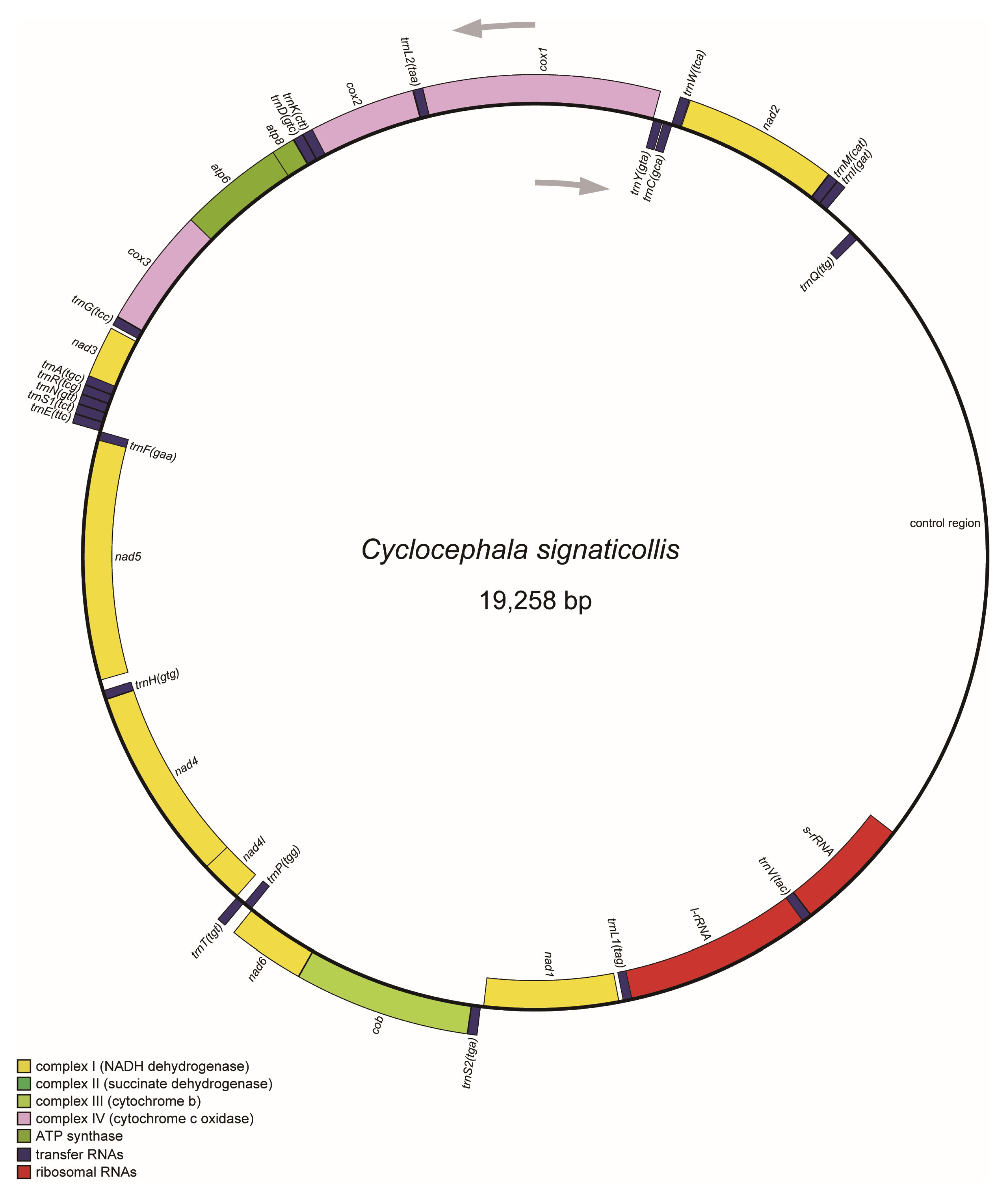
The three newly sequenced mitogenomes range in length from 17,274 bp (Dasygnathus sp.) to 19,258 bp (Cyclocephala signaticollis). GetOrganelle exported the assembled sequence of C. signaticollis with a “circular” designation. Although the assemblies of the other two species were not explicitly flagged as circular by GetOrganelle, subsequent annotation successfully identified the complete set of 37 typical mitochondrial genes in both species. While the three newly sequenced mitogenomes are larger than that of Drosophila yakuba (16,019 bp), they remain within the typical insect mitogenome range of 15–18 kb [48]. The observed size expansion is primarily attributed to large non-coding regions situated between rrnS and trnQ, measuring 4,390 bp in C. signaticollis, 2511 bp in Dasygnathus sp., and 2863 bp in Xylotrupes australicus. The mean base coverage was 32,277.3× for C. signaticollis (range: 3–58,549), 8353.8× for Dasygnathus sp. (range: 2–42,882), and 19,713.9× for X. australicus (range: 24–44,344).
Each mitogenome contains the standard set of 37 genes: 13 protein-coding genes (PCGs), 22 tRNA genes, and 2 rRNA genes (Figure 1, Supplementary Figure S1, and Table S2). These genomes exhibit a heavy A+T bias, with content ranging from 75.3% (Dasygnathus sp.) to 76.7% (X. australicus). Additionally, the major strand shows a positive AT skew, varying between 0.02 (Dasygnathus sp.) and 0.054 (C. signaticollis).

3.2. Protein-Coding Genes

The total length of the 13 protein-coding genes (PCGs) across the newly sequenced mitogenomes ranged from 11,114 bp (X. australicus) to 11,151 bp (Dasygnathus sp.), with an average A+T content between 74% (C. signaticollis) and 76% (X. australicus). All PCGs utilized the typical start codon ATN (including ATG, ATT, and ATA). Most PCGs across all species terminated with conventional stop codons (TAA or TAG). However, incomplete stop codons (TA or T) were identified in cox1-3 and nad5 for three species, as well as in nad3 for C. signaticollis.
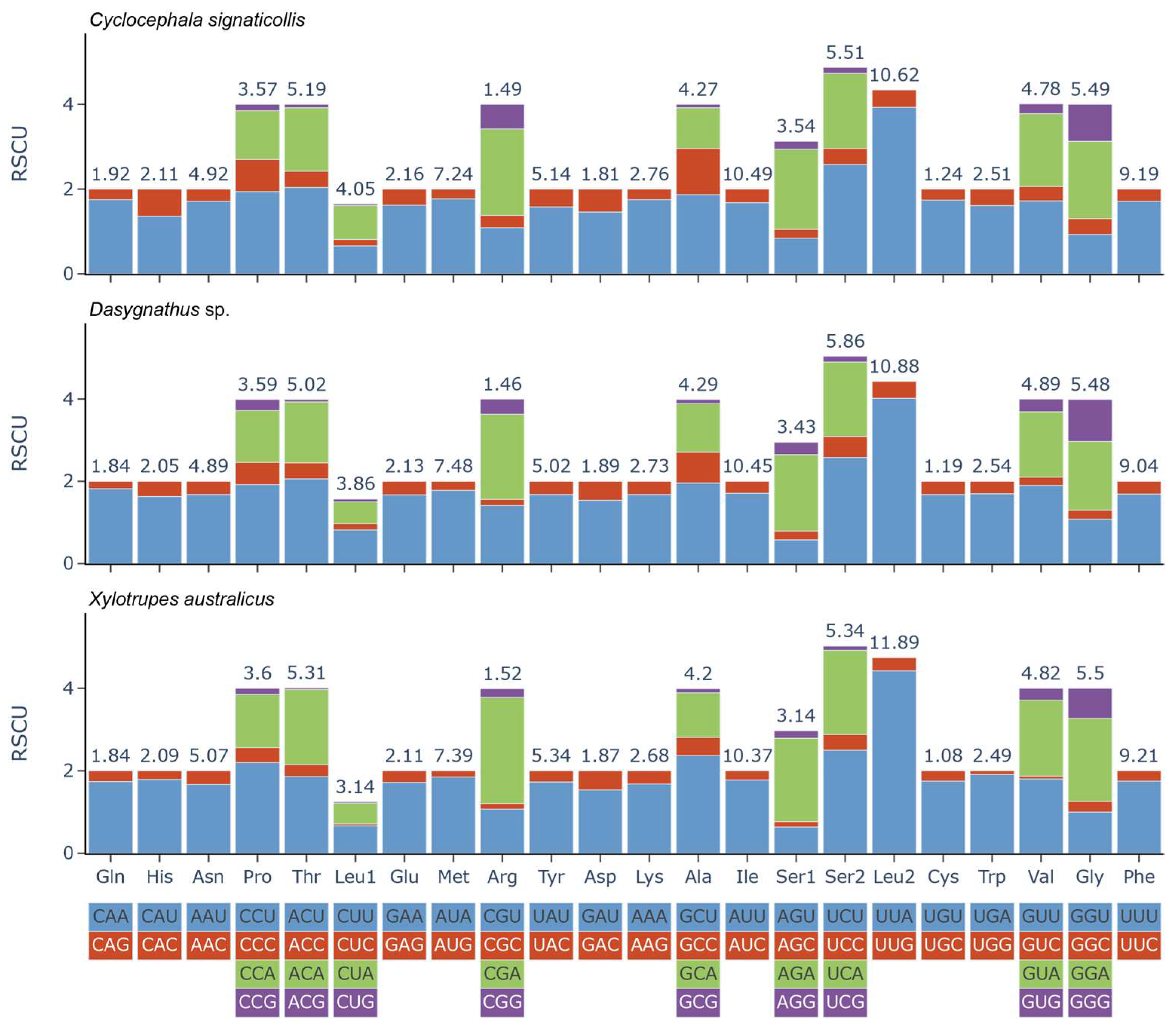
Relative synonymous codon usage (RSCU) is consistent across all three species, with UUA (Leu), UCU (Ser), CGU (Arg), and GGA (Gly) identified as the most frequently used codons (Figure 2). All dominant codons are A+T rich, suggesting that a strong AT mutation bias significantly influences codon selection.

3.3. Transfer RNA Genes and Ribosomal RNA Genes

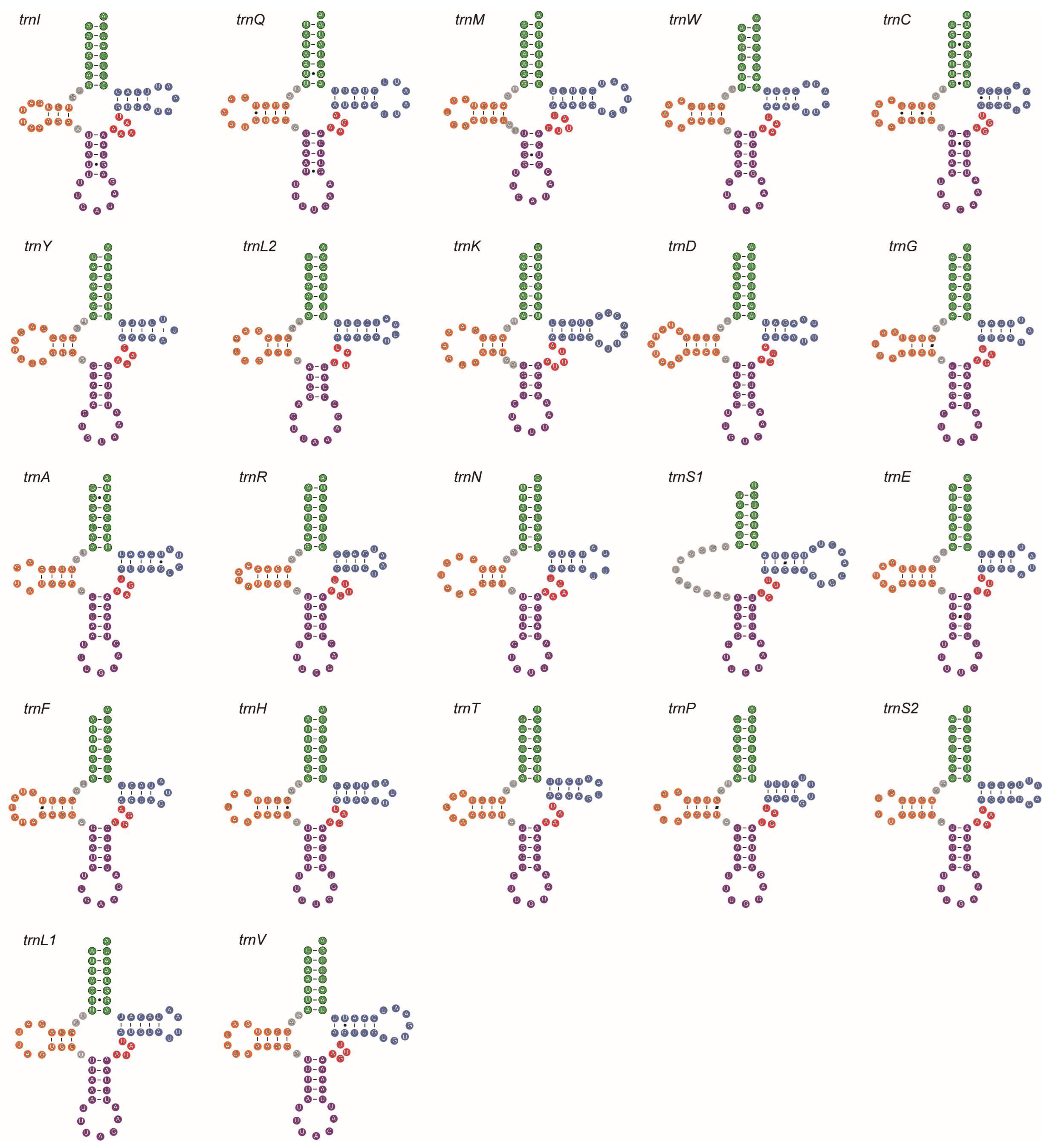
A total of 22 tRNA genes were identified in the mitogenomes of each of the three newly sequenced species. The lengths of these tRNA genes were largely consistent across species, with most specific tRNA types exhibiting identical lengths. These sequences ranged from 62 bp (found in trnC of Dasygnathus sp.) to 71 bp (found in trnK across all three species). The tRNA secondary structures for C. signaticollis are illustrated in Figure 3. All tRNA genes have the canonical cloverleaf structure, except for trnS1, which lacks the DHU arm. The other two mitogenomes exhibit highly similar tRNA gene sequences and secondary structures.
The two rRNA genes, rrnS and rrnL, are both encoded on the minor strand. rrnS is located between trnV and the control region, ranging from 792 to 796 bp in length. rrnL is located between trnL1 and trnV, varying in length from 1287 bp to 1325 bp.

3.4. Gene Rearrangements

Compared to the putative ancestral insect mitogenome, a distinct gene rearrangement was observed within the sampled taxa. While the six outgroup mitogenomes retain the ancestral tRNA gene order trnI-trnQ-trnM, all three newly sequenced mitogenomes and those of analyzed Dynastinae species, exhibit a derived gene order trnQ-trnI-trnM (Figure S1). This conserved rearrangement across the subfamily suggests a shared evolutionary event within the Dynastinae lineage that deviates from the ancestral insect mitochondrial gene arrangement.

3.5. Non-Coding Regions of the New Mitogenomes

The mitogenomes of the three Dynastinae species, C. signaticollis, Dasygnathus sp., and X. australicus, consistently feature two sections of the control region (i.e., CR1 and CR2 in Figure S2), characterized by high A+T content and complex repetitive architectures. This dual-section configuration indicates an ancestral duplication event within the lineage, with each section evolving specialized structural and functional roles.
In C. signaticollis, CR1 (2009 bp) is dominated by a massive tandem repeat array consisting of 7 copies of a 185-bp macro-repeat. The near-perfect sequence conservation among these units suggests recent expansion maintained by concerted evolution. Conversely, CR2 (2380 bp) exhibits a more complex, non-periodic architecture enriched with short microsatellites and putative regulatory signals, including long poly-T stretches and hairpin-forming sequences. While CR1 appears to drive genomic length variation through copy number fluctuations, CR2 likely hosts the primary replication and transcriptional control signals.
Dasygnathus sp. exhibits highly asymmetrical structural complexity between its two non-coding regions. CR1 (174 bp) is a truncated, non-repetitive segment primarily composed of simple (TA)n microsatellites. In contrast, CR2 (2336 bp) serves as the functional centerpiece for regulation and length variation. Its upstream region contains a tandem repeat array of three ~120 bp units (core motif: ATAAATCTCCCTG), while the downstream regulatory domain harbors extended poly-T/A tracks and potential stem-loop structures associated with the origin of light-strand replication. The 3′ terminus is further distinguished by unique G-clusters (e.g., GGGGG), which may facilitate specialized protein-binding or transcriptional termination.
For X. australicus, CR1 (2445 bp) contains central (TA)n or (AT)n motifs followed by a 3′ terminal region defined by three copies of a 91-bp macro-repeat, a hallmark of the Dynastinae subfamily. CR2 (419 bp), though significantly shorter, serves as a localized source of length polymorphism via two nearly identical (~98% identity) 123 bp tandem repeats. With an A+T content of 82.3%, CR2 is enriched with poly-A/T tracks indicative of replication slippage. Its 5′ flanking region (1–170 bp) contains potentially critical functional motifs, including a poly-T stretch and an A-rich promoter or protein-binding site (‘AAAAAACTCCATAAA’).

3.6. Phylogenetic Reconstruction

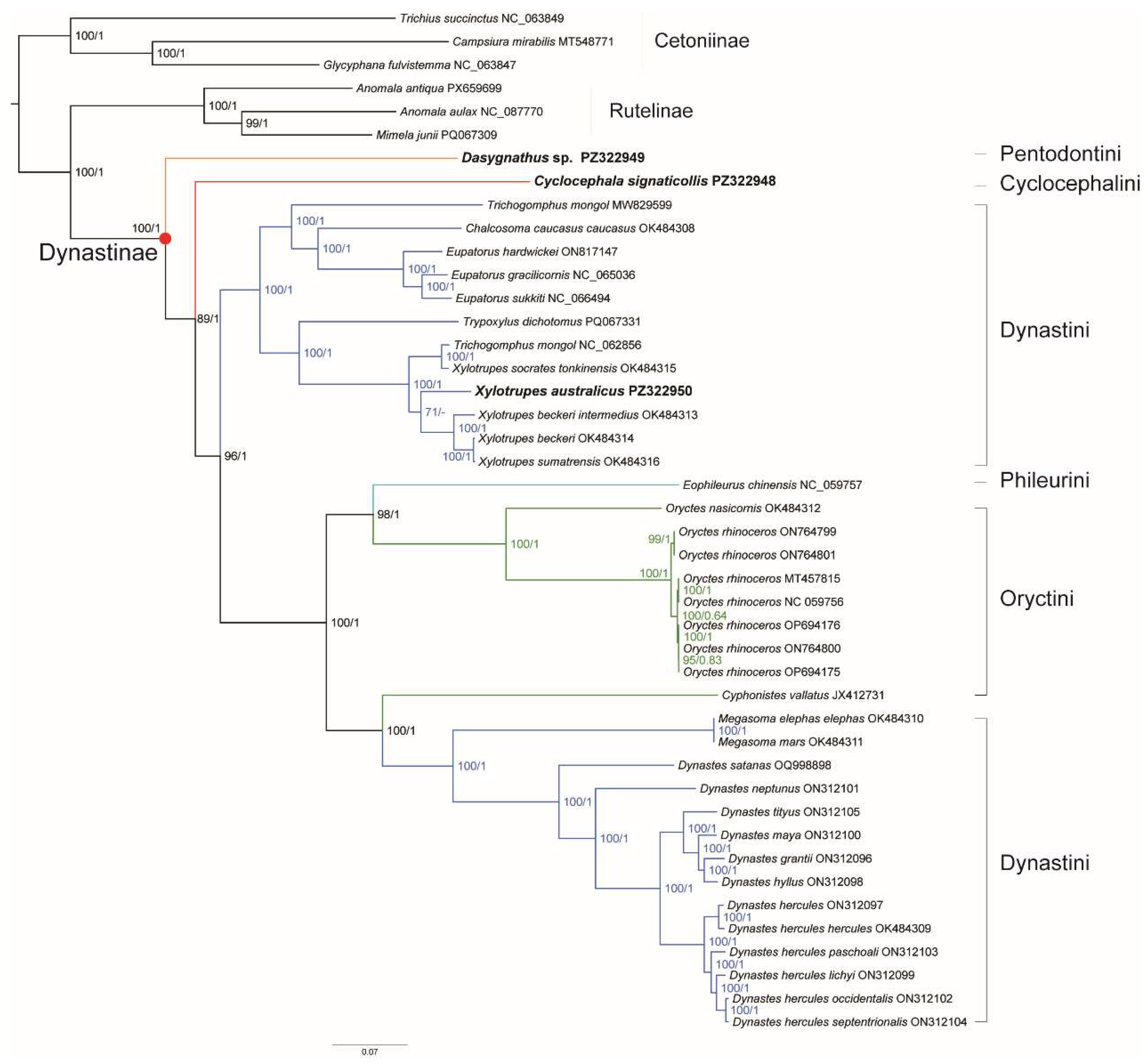
ML and BI analyses across all datasets yielded highly similar tree topologies (Figure 4 and Figures S3–S7). Within the subfamily Dynastinae, the newly sequenced Dasygnathus sp. (representing Pentodontini) was recovered as the sister species to all remaining taxa. C. signaticollis (representing Cyclocephalini), also newly sequenced, formed the subsequent diverging lineage. Both Dynastini and Oryctini were recovered as non-monophyletic. Specifically, Dynastini was rendered polyphyletic by the nested placements of Phileurini and Oryctini. For the species of Dynastini, two distinct lineages were identified: one comprising Trichogomphus, Chalcosoma, Eupatorus, Trypoxylus, and Xylotrupes, and another consisting of Megasoma and Dynastes. Similarly, Oryctini was found to be non-monophyletic due to the disparate phylogenetic positions of Oryctes and Cyphonistes.
At the generic level, all genera represented by more than two species were confirmed as monophyletic. However, the phylogenetic placement of Trichogomphus mongol (retrieved from GenBank) raised concerns regarding its taxonomic identity. Two T. mongol mitogenomes from NCBI are separated: NC_062856 nested within the genus Xylotrupes, whereas MW829599 sister to a clade comprising Chalcosoma and Eupatorus. A BOLD system identification query revealed that the cox1 sequence of NC_062856 shared 100% identity with T. mongol but also 98.54% identity with Xylotrupes socrates. Conversely, the cox1 sequence of MW829599 matched only T. mongol with no high-identity matches to Xylotrupes. Given its phylogenetic position and high sequence similarity, we propose that the GenBank entry for T. mongol (NC_062856) may be a misidentification and likely represents X. socrates.

4. Discussion

4.1. Mitochondrial Gene Rearrangements and Phylogenetic Utility

The utility of mitochondrial gene rearrangements as phylogenetic markers has been investigated for some time, with several studies validating their viability as informative characters. In insect phylogenetics, numerous studies have attempted to correlate these rearrangements with taxonomic divergence. While mitochondrial gene rearrangements are notably frequent and diverse in Hymenoptera, recent findings suggest no significant correlation between these genomic events and taxonomic divergence within a robust phylogenetic framework [49]. Our results support the specific tRNA gene rearrangement trnQ-trnI-trnM as a synapomorphy for the subfamily Dynastinae [13]. This observation is consistent with a previous mitogenomic study by He et al. [17]. Although the sampling of He et al. was relatively limited and focused exclusively on the genus Dynastes, their findings similarly suggested this rearrangement as a diagnostic feature of the subfamily Dynastinae. The emergence of such rearrangements may be linked to the unique life histories and ecological traits of Dynastinae. In Dynastinae, these traits are characterized by intense sexual selection and localized male–male competition for resources (e.g., specific mating and breeding sites). This ecological pressure has driven the evolution of extreme secondary sexual characters, such as elaborate cephalic or pronotal horns, as well as complex developmental strategies like bimodal allometry between large and small males [3,4,5,6,7].

4.2. Phylogenetic Relationships Within Dynastinae

Current phylogenetic study on Dynastinae remains remarkably limited, leaving the monophyly of several tribes in doubt. Although broad-scale analyses of Coleoptera or Scarabaeoidea have included rhinoceros beetles, taxon sampling has been insufficient to resolve internal relationships [50,51]. For instance, the phylogenomic analysis by Dietz et al. [52] included only two dynastine species; while their results recovered Dynastinae and Rutelinae as sister groups (together forming a sister clade to Cetoniinae), the tribal relationships within Dynastinae remained poorly understood [2].
In the present study, we included five of the eight recognized dynastine tribes (Pentodontini, Cyclocephalini, Dynastini, Phileurini, and Oryctini) in our phylogenetic analysis, featuring three newly sequenced mitogenomes alongside 41 mitogenomes retrieved from the NCBI GenBank database (Table 1). Although our overall sampling remains limited, the addition of newly sequenced mitogenomes—particularly for the tribes Pentodontini and Cyclocephalini and the genus Xylotrupes—provides critical new data. These expanded resources offer fresh insights into the evolutionary history of the subfamily.
Despite the significant importance of certain Cyclocephalini species as agricultural pests or invasive threats, the tribe’s phylogeny and internal classification have not been rigorously examined [53]. Previous morphological analysis of 77 adult characters previously suggested that Cyclocephalini, as currently circumscribed, is non-monophyletic, and that the genus Cyclocephala itself requires revision [12]. Historically, Endrödi [54,55] considered Cyclocephalini the most primitive dynastine tribe due to the characters shared with Rutelinae; however, Endrödi’s methodology for polarizing characters into primitive and derived states has been widely questioned. Our mitogenomic analysis recovered Cyclocephalini as the second diverging clade within Dynastinae, after the divergence of Pentodontini.
While Endrödi [55] hypothesized a close relationship between Pentodontini and Oryctini, our results did not support this relationship. Instead, we found Oryctini to be non-monophyletic and nested within a larger clade. Specifically, Oryctes was sister to Phileurini, while Cyphonistes was sister to a clade comprising Megasoma and Dynastes. Our results were consistent with Gunter et al. [50], whose analysis of 22 species also failed to support the monophyly of Pentodontini and Phileurini.
Previous research by Rowland and Miller [56] divided the tribe into three subtribes: Dynastina, Xylotrupina, and Chalcosomina, with the latter two forming a large “Asian/Oceanian clade”. Our findings are consistent with this subtribal classification, recovering three distinct clades: Chalcosoma + Eupatorus (Chalcosomina), Trypoxylus + Xylotrupes (Xylotrupina), and Megasoma + Dynastes (Dynastina). Furthermore, the sister-group relationship between Chalcosomina and Xylotrupina is consistent with the arrangement proposed by Rowland and Miller [56] and Jin et al. [57].
A notable representative in our study is the newly sequenced Xylotrupes australicus, an iconic large insect and a prominent representative of Dynastini in Australia, due to its remarkable size, distinct morphological traits, and high public and scientific visibility [58]. While Jin et al. [57] recovered a monophyletic Dynastini using a combination of mitochondrial (cox2, rrnL) and nuclear (H3, ArgKin) genes, our analyses consistently recovered the tribe as non-monophyletic. This discrepancy is likely due to differences in taxon sampling. Jin et al. [57] did not include representatives of Phileurini and Oryctini, which were interspersed within the Dynastini lineage in our analysis (Figure 4).
At the generic level, our analysis supported the monophyly of all genera represented by two or more species in the current study (Figure 4). In particular, we confirmed the monophyly of Xylotrupes and its sister-group relationship with Trypoxylus dichotomus, a finding that corroborates previous morphological analyses [59] and reinforces the stability of these relationships within the mitogenomic framework.

5. Conclusions

In this study, we sequenced the complete mitogenomes of three rhinoceros beetle species, including the first representatives for the tribes Pentodontini and Cyclocephalini. This expansion of mitogenomic data significantly contributes to our understanding of Dynastinae at the tribal level. Our analyses supported the hypothesis that a specific tRNA gene rearrangement (trnQ-trnI-trnM) serves as a synapomorphy for the subfamily, providing molecular support for its monophyly. Furthermore, our mitogenomic phylogenetic reconstruction demonstrates that the tribes Dynastini and Oryctini are not monophyletic as currently circumscribed. Notably, we recovered Pentodontini and Cyclocephalini as relatively basal clades within the Dynastinae, providing new insights into the subfamily’s early evolutionary divergence. Within the tribe Dynastini, our results corroborate the three-subtribe hypothesis proposed by Rowland and Miller [56]. These findings establish a vital foundation for future large-scale phylogenetic analyses and provide a refined framework for understanding the evolutionary diversification of rhinoceros beetles.

Supplementary Materials

The following supporting information can be downloaded at: https://www.mdpi.com/article/10.3390/biology15120953/s1, Figure S1: Gene arrangement of the 44 mitogenomes analyzed in this study. Figure S2: Structural organization of the mitogenomic control regions of the three newly sequenced Dynastinae species (Cylochelus signaticollis, Dasygnathus sp., and Xastronomes australicus). Figure S3: ML tree inferred from the 44taxa_PCG_nt123 nucleotide dataset. Numbers at nodes represent bootstrap values. Figure S4: ML tree inferred from the 44taxa_PCG_aa amino acid dataset. Numbers at nodes represent bootstrap values. Figure S5: BI tree inferred from the 44taxa_PCGrRNA nucleotide dataset. Numbers at nodes represent Bayesian posterior probabilities. Figure S6: BI tree inferred from the 44taxa_PCG_nt123 nucleotide dataset. Numbers at nodes represent Bayesian posterior probabilities. Figure S7: BI tree inferred from the 44taxa_PCG_aa amino acid dataset. Numbers at nodes represent Bayesian posterior probabilities. Table S1: Summary of whole genome sequencing statistics for the species analyzed in this study. Table S2: Organization of the newly sequenced mitogenomes. Supplementary Material: Nucleotide sequences of the three newly sequenced mitogenomes (FASTA format).

Author Contributions

Conceptualization, N.S., and R.S.; methodology, N.S. and R.S.; software, N.S. and R.S.; validation, N.S.; formal analysis, N.S.; investigation, N.S. and Q.Z.; resources, N.S.; data curation, N.S., and R.S.; writing—original draft preparation, N.S., and R.S.; writing—review and editing, N.S., R.S., and Q.Z.; visualisation, N.S. and R.S.; supervision, R.S. and Q.Z.; project administration, R.S. and Q.Z.; funding acquisition, N.S. and Q.Z. All authors have read and agreed to the published version of the manuscript.

Funding

This work was supported by the Natural Science Foundation of Henan Province (252300420190), and The Base and Talent Program of Xizang Autonomous Region (XZ202501JD0004).

Institutional Review Board Statement

Not applicable.

Informed Consent Statement

Not applicable.

Data Availability Statement

The newly sequenced mitochondrial genomes have been submitted to the NCBI GenBank database, with the accession numbers of PZ322948-PZ322950.

Conflicts of Interest

The authors declare that they have no known competing financial interests or personal relationships that could have appeared to influence the work reported in this paper.

Abbreviations

The following abbreviations are used in this manuscript:
ATPAdenosine triphosphate
MitogenomeMitochondrial genome
PCGsProtein-coding genes
tRNAsTransfer RNAs
DNADeoxyribonucleic acid
BOLDBarcode of Life Data System
ID%Identity percentage
BpBase pair
RSCURelative synonymous codon usage
MLMaximum likelihood
BIBayesian inference
BSBootstrap support
BPPBayesian posterior probabilities
CRControl region

References

  1. Cave, R.D.; Ratcliffe, B.C. Scarab Beetles (Coleoptera: Scarabaeoidea). In Encyclopedia of Entomology; Capinera, J.L., Ed.; Springer: Dordrecht, The Netherlands, 2008. [Google Scholar]
  2. Endrödi, S. The Dynastinae of the World; Dr W. Junk Publishers: The Hague, The Netherlands, 1985. [Google Scholar]
  3. Eberhard, W.G. The function of horns in Podischnus agenor (Dynastinae) and other beetles. In Sexual Selection and Reproductive Competition in Insects; Blum, M.S., Blum, N.A., Eds.; Academic Press: New York, NY, USA, 1979; pp. 231–258. [Google Scholar]
  4. Eberhard, W.G. Use of horns in fights by the dimorphic males of Ageopsis nigricollis (Coleoptera, Scarabaeidae, Dynastinae). J. Kans. Entomol. Soc. 1987, 60, 504–509. [Google Scholar]
  5. Palmer, T.J. A horned beetle which fights. Nature 1978, 274, 583–584. [Google Scholar] [CrossRef]
  6. Hongo, Y. Evolution of male dimorphic allometry in a population of the Japanese horned beetle Trypoxylus dichotomus septentrionalis. Behav. Ecol. Sociobiol. 2007, 62, 245–253. [Google Scholar] [CrossRef]
  7. McCullough, E.L.; Ledger, K.J.; O’Brien, D.M.; Emlen, D.J. Variation in the allometry of exaggerated rhinoceros beetle horns. Anim. Behav. 2015, 109, 133–140. [Google Scholar] [CrossRef]
  8. Weir, T.A.; Lawrence, J.F.; Lemann, C.; Gunter, N.L. Scarabaeidae: Dynastinae Macleay 1919. In Australian Beetles; CSIRO: Victoria, Australia, 2019. [Google Scholar]
  9. Ritcher, P.O. Biology of Scarabaeidae. Annu. Rev. Entomol. 1958, 3, 311–334. [Google Scholar] [CrossRef]
  10. Bouchard, P.; Bousquet, Y.; Davies, A.E.; Alonso-Zarazaga, M.A.; Lawrence, J.F.; Lyal, C.H.; Newton, A.F.; Reid, C.A.; Schmitt, M.; Ślipiński, S.A. Family-group names in Coleoptera (Insecta). ZooKeys 2011, 88, 1–972. [Google Scholar] [CrossRef] [PubMed]
  11. Trautwein, M.D.; Wiegmann, B.M.; Beutel, R.; Kjer, K.M.; Yeates, D.K. Advances in insect phylogeny at the dawn of the postgenomic era. Annu. Rev. Entomol. 2012, 57, 449–468. [Google Scholar] [CrossRef] [PubMed]
  12. Clark, D.R. Phylogenetic Analysis of the Scarab Beetle Tribe Cyclocephalini (Coleoptera: Scarabaeidae: Dynastinae) Based on Adult Morphological Characters. Master’s Thesis, Wichita State University, Wichita, KS, USA, 2011. [Google Scholar]
  13. Ayivi, S.P.G.; Tong, Y.; Storey, K.B.; Yu, D.-N.; Zhang, J.-Y. The Mitochondrial Genomes of 18 New Pleurosticti (Coleoptera: Scarabaeidae) Exhibit a Novel trnQ-NCR-trnI-trnM Gene Rearrangement and Clarify Phylogenetic Relationships of Subfamilies within Scarabaeidae. Insects 2021, 12, 1025. [Google Scholar] [CrossRef] [PubMed]
  14. Breeschoten, T.; Doorenweerd, C.; Tarasov, S.; Vogler, A.P. Phylogenetics and biogeography of the dung beetle genus Onthophagus inferred from mitochondrial genomes. Mol. Phylogenetics Evol. 2016, 105, 86–95. [Google Scholar] [CrossRef] [PubMed]
  15. Crampton-Platt, A.; Timmermans, M.J.; Gimmel, M.L.; Kutty, S.N.; Cockerill, T.D.; Vun Khen, C.; Vogler, A.P. Soup to tree: The phylogeny of beetles inferred by mitochondrial metagenomics of a Bornean rainforest sample. Mol. Biol. Evol. 2015, 32, 2302–2316. [Google Scholar] [CrossRef] [PubMed]
  16. Guo, S.; Lin, X.; Song, N. Mitochondrial phylogenomics reveals deep relationships of scarab beetles (Coleoptera, Scarabaeidae). PLoS ONE 2022, 17, e0278820. [Google Scholar] [CrossRef] [PubMed]
  17. He, X.; Wei, S.; Li, P.; Li, X. Complete mitochondrial genome of the Satanas beetle, Dynastes satanas Moser, 1909 (Coleoptera: Scarabaeidae). Mitochondrial DNA Part B 2024, 9, 1627–1631. [Google Scholar] [CrossRef] [PubMed]
  18. Li, Y.; Nie, R.-E.; Lu, Y.; Lee, S.; Zhao, Z.; Wu, L.; Sun, H.; Bai, M. Seven new mitochondrial genomes of phytophagous scarab beetles (Coleoptera: Scarabaeidae) and phylogenetic implications. Zootaxa 2022, 5138, 324–338. [Google Scholar] [CrossRef] [PubMed]
  19. Lin, X.; Song, N.; Wang, M. Six complete mitochondrial genomes of ground beetles from the Harpalinae and Carabinae (Coleoptera, Carabidae) with phylogenetic analysis based on mitogenomic data. Arch. Insect Biochem. Physiol. 2024, 115, e22108. [Google Scholar] [CrossRef] [PubMed]
  20. Song, N.; Li, X.; Yin, X.; Li, X.; Xi, Y. The mitochondrial genomes of ladybird beetles and implications for evolution and phylogeny. Int. J. Biol. Macromol. 2020, 147, 1193–1203. [Google Scholar] [CrossRef] [PubMed]
  21. Song, N.; Zhang, H. The mitochondrial genomes of phytophagous scarab beetles and systematic implications. J. Insect Sci. 2018, 18, 11. [Google Scholar] [CrossRef] [PubMed]
  22. Timmermans, M.J.; Barton, C.; Haran, J.; Ahrens, D.; Culverwell, C.L.; Ollikainen, A.; Vogler, A.P. Family-level sampling of mitochondrial genomes in Coleoptera: Compositional heterogeneity and phylogenetics. Genome Biol. Evol. 2016, 8, 161–175. [Google Scholar] [CrossRef]
  23. Yuan, M.L.; Zhang, Q.L.; Zhang, L.; Guo, Z.L.; Liu, Y.J.; Shen, Y.Y.; Shao, R. High-level phylogeny of the Coleoptera inferred with mitochondrial genome sequences. Mol. Phylogenetics Evol. 2016, 104, 99–111. [Google Scholar] [CrossRef] [PubMed]
  24. Gillett, C.P.; Crampton-Platt, A.; Timmermans, M.J.; Jordal, B.H.; Emerson, B.C.; Vogler, A.P. Bulk de novo mitogenome assembly from pooled total DNA elucidates the phylogeny of weevils (Coleoptera: Curculionoidea). Mol. Biol. Evol. 2014, 31, 2223–2237. [Google Scholar] [CrossRef] [PubMed]
  25. Allsopp, P.G.; Hutchinson, P. Extralimital Dynastinae (Coleoptera: Scarabaeidae) in Australia. J. Insect Biodivers. 2019, 12, 48–77. [Google Scholar] [CrossRef]
  26. Carne, P.B.; Scientific, C. A Systematic Revision of the Australian Dynastinae (Coleoptera: Scarabaeidae); Division of Entomology, Commonwealth Scientific and Industrial Research Organization: Canberra, Australia, 1957. [Google Scholar]
  27. Hangay, G.; Zborowski, P. A Guide to the Beetles of Australia; CSIRO Publishing: Victoria, Australia, 2010. [Google Scholar]
  28. Lawrence, J.; Slipinski, A. Australian Beetles Volume 1: Morphology, Classification and Keys; CSIRO Publishing: Victoria, Australia, 2013; Volume 1. [Google Scholar]
  29. Rowland, J.M. 0176. Notes on nomenclature in Xylotrupes Hope (Scarabaeidae: Dynastinae: Dynastini). Insecta Mundi 2011, 176, 1–10. [Google Scholar]
  30. Ratnasingham, S.; Wei, C.; Chan, D.; Agda, J.; Agda, J.; Ballesteros-Mejia, L.; Ait Boutou, H.; El Bastami, Z.M.; Ma, E.; Manjunath, R.; et al. BOLD v4: A Centralized Bioinformatics Platform for DNA-Based Biodiversity Data. In DNA Barcoding: Methods and Protocols; Springer: New York, NY, USA, 2024; pp. 403–441. [Google Scholar]
  31. Chen, S.; Zhou, Y.; Chen, Y.; Gu, J. Fastp: An ultra-fast all-in-one FASTQ preprocessor. Bioinformatics 2018, 34, i884–i890. [Google Scholar] [CrossRef] [PubMed]
  32. Bolger, A.M.; Lohse, M.; Usadel, B. Trimmomatic: A flexible trimmer for Illumina sequence data. Bioinformatics 2014, 30, 2114–2120. [Google Scholar] [CrossRef] [PubMed]
  33. Jin, J.J.; Yu, W.B.; Yang, J.B.; Song, Y.; Depandre, T.M.; Yu, X.Q.; Li, D.Z. GetOrganelle: A fast and versatile toolkit for accurate de novo assembly of organelle genomes. Genome Biol. 2020, 21, 241. [Google Scholar] [CrossRef] [PubMed]
  34. Kearse, M.; Moir, R.; Wilson, A.; Stones-Havas, S.; Cheung, M.; Sturrock, S.; Buxton, S.; Cooper, A.; Markowitz, S.; Duran, C. Geneious Basic: An integrated and extendable desktop software platform for the organization and analysis of sequence data. Bioinformatics 2012, 28, 1647–1649. [Google Scholar] [CrossRef] [PubMed]
  35. Bernt, M.; Bleidorn, C.; Braband, A.; Dambach, J.; Donath, A.; Fritzsch, G.; Golombek, A.; Hadrys, H.; Jühling, F.; Meusemann, K. A comprehensive analysis of bilaterian mitochondrial genomes and phylogeny. Mol. Phylogenetics Evol. 2013, 69, 352–364. [Google Scholar] [CrossRef] [PubMed]
  36. Chan, P.P.; Lin, B.Y.; Mak, A.J.; Lowe, T.M. tRNAscan-SE 2.0: Improved detection and functional classification of transfer RNA genes. Nucleic Acids Res. 2021, 49, 9077–9096. [Google Scholar] [CrossRef]
  37. Zhang, D.; Gao, F.; Jakovlić, I.; Zou, H.; Zhang, J.; Li, W.X.; Wang, G.T. PhyloSuite: An integrated and scalable desktop platform for streamlined molecular sequence data management and evolutionary phylogenetics studies. Mol. Ecol. Resour. 2020, 20, 348–355. [Google Scholar] [CrossRef] [PubMed]
  38. Zhao, D.; Ye, T.; Gao, F.; Jakovlić, I.; La, Q.; Tong, Y.; Zhang, D. PhyloSuite v2: The development of an all-in-one, efficient and visualization-oriented suite for molecular dating analysis and other advanced features. iMeta 2025, 4, e70095. [Google Scholar] [PubMed]
  39. Ranwez, V.; Douzery, E.J.; Cambon, C.; Chantret, N.; Delsuc, F. MACSE v2: Toolkit for the alignment of coding sequences accounting for frameshifts and stop codons. Mol. Biol. Evol. 2018, 35, 2582–2584. [Google Scholar] [CrossRef] [PubMed]
  40. Katoh, K.; Standley, D.M. MAFFT multiple sequence alignment software version 7: Improvements in performance and usability. Mol. Biol. Evol. 2013, 30, 772–780. [Google Scholar] [CrossRef] [PubMed]
  41. Capella-Gutiérrez, S.; Silla-Martínez, J.M.; Gabaldón, T. trimAl: A tool for automated alignment trimming in large-scale phylogenetic analyses. Bioinformatics 2009, 25, 1972–1973. [Google Scholar] [CrossRef] [PubMed]
  42. Kück, P.; Longo, G.C. FASconCAT-G: Extensive functions for multiple sequence alignment preparations concerning phylogenetic studies. Front. Zool. 2014, 11, 81. [Google Scholar] [CrossRef] [PubMed]
  43. Nguyen, L.T.; Schmidt, H.A.; von Haeseler, A.; Minh, B.Q. IQ-TREE: A fast and effective stochastic algorithm for estimating maximum-likelihood phylogenies. Mol. Biol. Evol. 2015, 32, 268–274. [Google Scholar] [PubMed]
  44. Kalyaanamoorthy, S.; Minh, B.Q.; Wong, T.K.; Von Haeseler, A.; Jermiin, L.S. ModelFinder: Fast model selection for accurate phylogenetic estimates. Nat. Methods 2017, 14, 587–589. [Google Scholar] [CrossRef] [PubMed]
  45. Hoang, D.T.; Chernomor, O.; von Haeseler, A.; Minh, B.Q.; Vinh, L.S. UFBoot2: Improving the ultrafast bootstrap approximation. Mol. Biol. Evol. 2018, 35, 518–522. [Google Scholar] [PubMed]
  46. Lartillot, N.; Rodrigue, N.; Stubbs, D.; Richer, J. PhyloBayes MPI: Phylogenetic reconstruction with infinite mixtures of profiles in a parallel environment. Syst. Biol. 2013, 62, 611–615. [Google Scholar] [CrossRef] [PubMed]
  47. Lartillot, N.; Philippe, H. A Bayesian mixture model for across-site heterogeneities in the amino-acid replacement process. Mol. Biol. Evol. 2004, 21, 1095–1109. [Google Scholar] [CrossRef] [PubMed]
  48. Cameron, S.L. Insect mitochondrial genomics: Implications for evolution and phylogeny. Annu. Rev. Entomol. 2014, 59, 95–117. [Google Scholar] [CrossRef] [PubMed]
  49. Song, N.; Wei, S.J.; Wang, M. Mitochondrial genome rearrangements and phylogenomics of the Hymenoptera (Insecta) using an expanded taxon sample. Mitochondrial DNA Part A 2023, 34, 49–65. [Google Scholar]
  50. Gunter, N.L.; Weir, T.A.; Slipinksi, A.; Bocak, L.; Cameron, S.L. If dung beetles (Scarabaeidae: Scarabaeinae) arose in association with dinosaurs, did they also suffer a mass co-extinction at the K-Pg boundary? PLoS ONE 2016, 11, e0153570. [Google Scholar] [PubMed]
  51. McKenna, D.D.; Wild, A.L.; Kanda, K.; Bellamy, C.L.; Beutel, R.G.; Caterino, M.S.; Farrell, B.D. The beetle tree of life reveals that Coleoptera survived end-Permian mass extinction to diversify during the Cretaceous terrestrial revolution. Syst. Entomol. 2015, 40, 835–880. [Google Scholar]
  52. Dietz, L.; Seidel, M.; Eberle, J.; Misof, B.; Pacheco, T.L.; Podsiadlowski, L.; Ahrens, D. A transcriptome-based phylogeny of Scarabaeoidea confirms the sister group relationship of dung beetles and phytophagous pleurostict scarabs (Coleoptera). Syst. Entomol. 2023, 48, 672–686. [Google Scholar]
  53. Moore, M.R.; Cave, R.D.; Branham, M.A. Synopsis of the cyclocephaline scarab beetles (Coleoptera, Scarabaeidae, Dynastinae). ZooKeys 2018, 745, 1–99. [Google Scholar] [CrossRef] [PubMed]
  54. Endrődi, S. Coleoptera: Melolonthidae, Subfamilia Dynastinae. In South African Animal Life: Results of the Lund University Expedition in 1950–1951; Hanström, B., Brinck, P., Rudebeck, G., Eds.; Almqvist and Wiksells: Uppsala, Sweden, 1960; Volume 7, pp. 34–82. [Google Scholar]
  55. Endrődi, S. Monographie der Dynastinae (Coleoptera, Lamellicornia). I. Teil. Entomol. Abh. Staatl. Mus. Tierkd. Dresd. 1966, 33, 1–457. [Google Scholar]
  56. Rowland, J.M.; Miller, K.B. Phylogeny and systematics of the giant rhinoceros beetles (Scarabaeidae: Dynastini). Insecta Mundi 2012, 0263, 1–15. [Google Scholar]
  57. Jin, H.; Yonezawa, T.; Zhong, Y.; Kishino, H.; Hasegawa, M. Cretaceous origin of giant rhinoceros beetles (Dynastini; Coleoptera) and correlation of their evolution with the Pangean breakup. Genes Genet. Syst. 2016, 91, 209–215. [Google Scholar] [CrossRef] [PubMed]
  58. Beetle, B. Care Guide: Xylotrupes australicus (Rhinoceros Beetle). Available online: https://www.bluebeetle.com.au/blogs/beetle-care-guides/care-guide-xylotrupes-australicus-rhinoceros-beetle (accessed on 25 May 2026).
  59. Rowland, J.M. Male horn dimorphism, phylogeny and systematics of rhinoceros beetles of the genus Xylotrupes (Scarabaeidae, Coleoptera). Aust. J. Zool. 2003, 51, 453–487. [Google Scholar] [CrossRef]
Figure 1. Circular map of the Cyclocephala signaticollis mitochondrial genome. Genes are abbreviated according to MITOS nomenclature. Arrows indicate the transcriptional orientation of the strands.
Biology 15 00953 g001
Figure 2. Relative synonymous codon usage (RSCU) in protein-coding genes. Data are derived from the three newly sequenced mitogenomes.
Biology 15 00953 g002
Figure 3. Predicted secondary structures of the 22 mitochondrial tRNAs in Cyclocephala signaticollis. Functional arms are color-coded: green (amino-acyl arm), orange (dihydrouracil arm), purple (anticodon arm), red (variable arm), and blue (TψC arm). Watson–Crick pairings are indicated by bars; G-U wobble pairs are indicated by dots.
Biology 15 00953 g003
Figure 4. Phylogenetic relationships of Dynastinae inferred via Maximum Likelihood analysis. The tree is based on the PCGrRNA dataset. The Bayesian tree based on the same dataset had a topology highly similar to that of the ML tree. Bootstrap support values and posterior probabilities are indicated at the nodes.
Biology 15 00953 g004
Table 1. Taxonomic information and mitogenome lengths for the species included in this study.
Accession NumberOrganismSubfamilyTribeFull Length (bp)
PZ322948Cyclocephala signaticollisDynastinaeCyclocephalini19,258
OK484308Chalcosoma caucasus caucasusDynastinaeDynastini19,444
ON312096Dynastes grantiiDynastinaeDynastini25,060
OK484309Dynastes hercules herculesDynastinaeDynastini17,813
ON312099Dynastes hercules lichyiDynastinaeDynastini24,357
ON312102Dynastes hercules occidentalisDynastinaeDynastini24,546
ON312103Dynastes hercules paschoaliDynastinaeDynastini25,593
ON312104Dynastes hercules septentrionalisDynastinaeDynastini24,784
ON312097Dynastes herculesDynastinaeDynastini25,542
ON312098Dynastes hyllusDynastinaeDynastini24,190
ON312100Dynastes mayaDynastinaeDynastini27,085
ON312101Dynastes neptunusDynastinaeDynastini23695
OQ998898Dynastes satanasDynastinaeDynastini16,973
ON312105Dynastes tityusDynastinaeDynastini28,021
NC_065036Eupatorus gracilicornisDynastinaeDynastini18,391
ON817147Eupatorus hardwickeiDynastinaeDynastini18,494
NC_066494Eupatorus sukkitiDynastinaeDynastini18,445
OK484310Megasoma elephas elephasDynastinaeDynastini16,785
OK484311Megasoma marsDynastinaeDynastini16,983
PQ067331Trypoxylus dichotomusDynastinaeDynastini19,189
PZ322950Xylotrupes australicusDynastinaeDynastini17,573
OK484314Xylotrupes beckeriDynastinaeDynastini18,434
OK484313Xylotrupes beckeri intermediusDynastinaeDynastini18,567
OK484315Xylotrupes socrates tonkinensisDynastinaeDynastini18,660
OK484316Xylotrupes sumatrensisDynastinaeDynastini19,687
JX412731Cyphonistes vallatusDynastinaeOryctini11,629
OK484312Oryctes nasicornisDynastinaeOryctini20,396
MT457815Oryctes rhinocerosDynastinaeOryctini20,898
NC_059756Oryctes rhinocerosDynastinaeOryctini15,339
ON764799Oryctes rhinocerosDynastinaeOryctini15,315
ON764800Oryctes rhinocerosDynastinaeOryctini15,475
ON764801Oryctes rhinocerosDynastinaeOryctini17,275
OP694175Oryctes rhinocerosDynastinaeOryctini15,484
OP694176Oryctes rhinocerosDynastinaeOryctini17,142
NC_062856Trichogomphus mongolDynastinaeOryctini17,377
MW829599Trichogomphus mongolDynastinaeOryctini16,737
PZ322949Dasygnathus sp.DynastinaePentodontini17,274
NC_059757Eophileurus chinensisDynastinaePhileurini16,624
NC_063847Glycyphana fulvistemmaCetoniinaeCetoniini16,701
MT548771Campsiura mirabilisCetoniinaeCremastocheilini16,123
NC_063849Trichius succinctusCetoniinaeTrichiini18,358
PX659699Anomala antiquaRutelinaeAnomalini16,430
NC_087770Anomala aulaxRutelinaeAnomalini16,246
PQ067309Mimela juniiRutelinaeAnomalini16,805
Bold indicates the species newly sequenced in this study.
Disclaimer/Publisher’s Note: The statements, opinions and data contained in all publications are solely those of the individual author(s) and contributor(s) and not of MDPI and/or the editor(s). MDPI and/or the editor(s) disclaim responsibility for any injury to people or property resulting from any ideas, methods, instructions or products referred to in the content.