Article

CaNAC61, CaNAC79, and CaNAC92 Act as Negative Regulators in Pepper Defense Response Against Phytophthora capsici


1
College of Life Sciences, Anhui Normal University, Wuhu 241000, China
2
Anhui Provincial Key Laboratory of Molecular Enzymology and Mechanism of Major Metabolic Diseases, Anhui Normal University, Wuhu 241002, China
3
Anhui Provincial Key Laboratory of the Conservation and Exploitation of Biological Resources, Anhui Normal University, Wuhu 241002, China
4
Anhui Provincial Engineering Research Centre for Molecular Detection and Diagnostics, Anhui Normal University, Wuhu 241002, China
*
Author to whom correspondence should be addressed.
These authors contributed equally to this work.
Biology 2026, 15(12), 943; https://doi.org/10.3390/biology15120943
Submission received: 6 May 2026 / Revised: 7 June 2026 / Accepted: 14 June 2026 / Published: 17 June 2026
(This article belongs to the Special Issue Advances in Research on Diseases of Plants (2nd Edition))

Simple Summary

Phytophthora blight of pepper is a major disease that severely reduces crop yield and quality. NAC transcription factors are known to play key roles in plant growth, development, and stress responses, but their contributions to pepper resistance against Phytophthora capsici remain largely unknown. In this study, three NAC transcription factors—CaNAC61, CaNAC79, and CaNAC92—were identified as strongly induced during P. capsici infection and were shown to be localized in the nucleus. Gain- and loss-of-function analyses demonstrated that these genes act as negative regulators of pepper resistance against P. capsici. These findings provide new insights into the molecular mechanisms underlying pepper defense and highlight potential targets for the development of disease-resistant pepper cultivars.

Abstract

Phytophthora blight, caused by the oomycete pathogen Phytophthora capsici, is a devastating disease that severely constrains pepper (Capsicum annuum) production, leading to significant yield reduction and quality deterioration. Pathogen infection elicits a host immune response that involves extensive transcriptional reprogramming, during which transcription factors (TFs) act as key regulatory hubs linking upstream signaling cascades to downstream defense gene expression networks. NAC TFs represent a plant-specific gene family and play crucial roles in plant growth, development, and response to various stresses. However, the infection-responsive transcriptional dynamics and functions of NAC TFs during pepper–P. capsici interactions remain poorly elucidated. In this study, transcriptome profiling and RT-qPCR analysis of pepper plants challenged with P. capsici identified three NAC TF genes—CaNAC61, CaNAC79, and CaNAC92—that were consistently upregulated at the infection stages. Subcellular localization assays demonstrated that all these three proteins localize to the nucleus. Silencing of CaNAC61, CaNAC79, or CaNAC92 in pepper conferred enhanced resistance to P. capsici. In contrast, their transient overexpression in pepper leaves significantly promoted lesion expansion and suppressed transcript levels of the defense marker genes CaPR1, CaDEF1, and CaLOX1. Consistently, heterologous overexpression in transgenic Nicotiana benthamiana further validated CaNAC61, CaNAC79, and CaNAC92 as negative regulators in resistance to P. capsici. Collectively, our findings demonstrated that CaNAC61, CaNAC79, and CaNAC92 negatively regulate plant resistance to P. capsici, expanding the functional diversity of NAC TFs in plant immune responses and providing valuable candidate targets for genetic improvement against Phytophthora blight.

1. Introduction

Pepper is an economically important vegetable crop valued for its culinary, coloring, and medicinal uses [1,2]. Phytophthora blight, caused by the oomycete pathogen P. capsici, is one of the most destructive diseases affecting pepper production [3,4]. Under warm and humid environmental conditions, P. capsici spreads rapidly and can infect multiple plant organs, including roots, stems, leaves, and fruits, leading to substantial yield losses and even plant mortality [5,6]. Current management strategies for this disease rely heavily on cultural practices (e.g., crop rotation) and chemical control; however, field efficacy is often inconsistent and inadequate under conditions highly favorable for pathogen infection [3]. Breeding for disease resistance is regarded as a more economical, effective, and sustainable strategy; however, germplasm resources for pepper resistance against P. capsici are limited, and the resistance is often quantitative with a complex genetic basis. These characteristics complicate the genetic improvement process and restrict the availability of stable, highly resistant commercial cultivars [3,4]. Therefore, there is an urgent need to identify valuable candidate genes in pepper’s defense response to P. capsici.
Plants have evolved a multilayered immune system through long-term coevolution with pathogens, which is broadly divided into pattern-triggered immunity (PTI) and effector-triggered immunity (ETI) [7]. Accumulating evidence indicates that PTI and ETI are not isolated pathways but function in a coordinated and integrated manner to activate downstream defense responses and restrict pathogen growth [8]. At the molecular level, immune signaling ultimately drives large-scale transcriptional reprogramming, which induces or represses numerous defense-related genes to initiate and fine-tune plant immune responses [9,10]. In this process, transcription factors (TFs) act as central regulatory hubs connecting upstream immune signaling cascades to downstream gene expression networks by recognizing cis-elements within target gene promoters and regulating their transcription, thereby mediating robust initiation, amplification, and fine-tuning of plant immune responses [10,11]. Multiple plant TF families—including AP2/ERF, MYB, bZIP, WRKY, bHLH, and NAC—have been identified as critical regulators of defense-related transcriptional reprogramming, collectively modulating plant defense responses against pathogen infection [12,13].
NAC (NAM/ATAF/CUC) transcription factors constitute a large plant-specific transcription factor family, typically characterized by a conserved N-terminal NAC domain and a divergent C-terminal transcriptional regulatory region [14]. NAC TFs not only participate in organ development, senescence, and adaptation to abiotic stress [15,16] but also function extensively in regulating plant immune responses against pathogen infection [12,17]. During plant–pathogen interactions, NAC TFs often act as important nodes in immune regulatory networks and modulate plant disease resistance via diverse modes of action [12,18]. For example, in tomato, SlNAP1 directly activates downstream genes involved in hormone metabolism, thereby enhancing resistance to Pseudomonas syringae pv. tomato (Pst) and Ralstonia solanacearum [12,19]. In diploid wheat, TuNAC69 positively regulates NLR (nucleotide-binding leucine-rich repeat)–mediated stripe rust resistance [20]. In addition, the RxLR effector Pi03192 from Phytophthora infestans targets the potato NAC TFs NTP1/NTP2 and promotes pathogen infection by inhibiting their translocation from the endoplasmic reticulum to the nucleus [21]. Conversely, some NAC TFs function as negative immune regulators: Arabidopsis ATAF1 (ANAC002) has been validated to negatively regulate defense responses against bacterial and necrotrophic fungal pathogens [22], and rice ONAC083 represses resistance to Magnaporthe oryzae by activating transcription of the RING-H2 gene OsRFPH2-6 [23]. Collectively, these studies highlight the diverse regulatory roles of NAC TFs in plant immunity across various plant–pathogen interaction systems.
Although the pepper NAC gene family has been systematically identified [24], the transcriptional dynamics and regulatory roles of NAC TFs during pepper–P. capsici interactions remain poorly elucidated [25,26]. In this study, we screened and identified three NAC transcription factors—CaNAC61, CaNAC79, and CaNAC92—exhibiting significant upregulation at distinct infection stages, based on our RNA-seq data from pepper during P. capsici infection. Using gain-of-function and loss-of-function strategies, we further demonstrated that CaNAC61, CaNAC79, and CaNAC92 negatively regulate pepper resistance to P. capsici. These findings provide valuable functional insights and potential candidate target genes for dissecting the immune regulatory network and advancing genetic improvement for Phytophthora blight resistance.

2. Materials and Methods

2.1. Plant Materials, Pathogen, and Culture Conditions

Pepper plants were cultivated in plastic pots filled with a substrate mixture of perlite and peat moss (1:2, v/v) in an artificial climate chamber under controlled conditions: 25 °C, 16 h light/8 h dark photoperiod, relative humidity of approximately 70%, and light intensity of 60–70 mmol photons m−2 s−1 [27]. Phytophthora capsici strain JX1 was initially cultured on 10% V8 agar medium in the dark at 25 °C. Subsequently, the mycelia were transferred to 10% V8 liquid medium and further incubated in the dark at 25 °C for 3 days. To induce zoospore release, the mycelia were intermittently washed three times with sterile water at 30 min intervals and then incubated at 25 °C until zoospores were released. The concentration of zoospores was adjusted to ~5 × 10⁵ zoospores·mL−1 before inoculation [28].

2.2. RNA-seq Data and Expression Profiling

RNA-seq data were retrieved from our prior study and are accessible in the NCBI Sequence Read Archive (SRA) under the accession number PRJNA627546 [27]. Briefly, the pepper line CM334 was hydroponically cultured with Hoagland nutrient solution until the five-true-leaf stage under the aforementioned growth conditions [27]. Roots were immersed in the zoospore suspension, and root samples were harvested at 0, 3, 6, 12, 24, 48, and 72 h post-inoculation (hpi). Three independent biological replicates were harvested at each time point for total RNA extraction and cDNA library construction. Paired-end libraries (PE150) were sequenced on an Illumina HiSeq2000 platform (Illumina, San Diego, CA, USA). Raw reads were quality-filtered using fastp (v0.23.2) and aligned to the pepper reference genome (CM334 v1.55) using HISAT2 (v2.2.1). Differential expression analysis was performed using DESeq2 (v1.36.0). Differentially expressed genes (DEGs) were identified using the criteria of |log2(fold change)| > 1 and FDR < 0.01.

2.3. RNA Extraction and RT-qPCR Analysis

Total RNA was extracted from plant tissues using TRIzol reagent (Invitrogen, Carlsbad, CA, USA) according to the manufacturer’s protocol. First-strand cDNA was synthesized with an All-in-One First-Strand cDNA Synthesis Super Mix kit (Yugong Biotech, Lianyungang, China). RT-qPCR assays were conducted using SYBR Green qPCR Master Mix with gene-specific primers (Table S1). Primer specificity was confirmed by melt-curve analysis, which yielded a single sharp peak for each primer pair, indicating no primer-dimer or non-specific amplification. Each treatment included three independent biological replicates. Relative transcript levels were computed using the 2−ΔΔCt method [29] and normalized to the housekeeping gene CaActin [27].

2.4. Phylogenetic Relationships and Conserved Domain Analysis

To investigate the evolutionary relationships of CaNAC61, CaNAC79, and CaNAC92 within the NAC transcription factor family, homologous NAC protein sequences from Arabidopsis thaliana, Solanum lycopersicum, Nicotiana benthamiana, Glycine max, Oryza sativa, and Zea mays were retrieved from the NCBI database. These sequences, together with CaNAC61, CaNAC79, and CaNAC92, were used for phylogenetic analysis. Multiple sequence alignment was carried out using ClustalW 2.1 with default parameters. A phylogenetic tree was constructed using the maximum likelihood (ML) method in MEGA 12 software, with 1000 bootstrap replicates to evaluate the statistical confidence of each branch. To further assess the sequence conservation of CaNAC61, CaNAC79, and CaNAC92, multiple sequence alignment was also performed using DNAMAN 10 software, and the conserved NAC domains were identified and characterized in detail.

2.5. Subcellular Localization

For subcellular localization analysis, the open reading frames (ORFs) of CaNAC61, CaNAC79, and CaNAC92 (without the stop codon) were individually cloned into the pBinGFP3 vector to generate C-terminal GFP fusion constructs. The resultant plasmids (35S:CaNAC61-GFP, 35S:CaNAC79-GFP, and 35S:CaNAC92-GFP), as well as the empty GFP vector (served as a negative control) and 35S:H2B-RFP (served as a nuclear marker), were transformed into Agrobacterium tumefaciens strain GV3101. The agrobacterial cultures harboring the GFP construct and the H2B-RFP construct were respectively resuspended in an induction buffer (10 mM MgCl2, 10 mM MES, 200 μM acetosyringone, pH 5.6) to an OD600 of 0.8, mixed thoroughly at a 1:1 (v/v) ratio and then infiltrated into N. benthamiana leaves via a needleless syringe. Fluorescence signals were visualized using a confocal laser scanning microscope (TCS SP8, Leica, Solms, Germany) at 48 h post-agroinfiltration (hpi) as described in our previous reports [30,31].

2.6. Transient Overexpression Assays in Pepper Leaves

Transient overexpression assays were conducted as previously described [31]. Agrobacterial cultures harboring the GFP fusion construct were resuspended in the induction buffer (10 mM MgCl2, 10 mM MES, 200 μM acetosyringone, pH 5.6) to an OD600 of 0.8 and then infiltrated into the third fully expanded leaves of eight-leaf-stage pepper plants. At 2 days post-infiltration (dpi), the infiltrated leaves were detached and inoculated with P. capsici zoospore suspension for disease assessment [30,31].

2.7. Virus-Induced Gene Silencing (VIGS) in Pepper

Virus-induced gene silencing was performed using the tobacco rattle virus (TRV)-based system as previously described [27]. To construct VIGS vectors, gene-specific silencing fragments of 314, 334, and 289 bp were designed for CaNAC61, CaNAC79, and CaNAC92, respectively, using the VIGS tool in the Sol Genomic Network (SGN) website (https://solgenomics.net). No off-target gene (which shares no more than a 19 bp matching fragment) was detected in the pepper genome cDNA database. The sequences of these silencing fragments are provided in Table S2. Then, these gene-specific fragments were individually cloned into the pTRV2 vector to generate recombinant constructs pTRV2: CaNAC61, pTRV2: CaNAC79, and pTRV2: CaNAC92. A. tumefaciens cultures harboring pTRV1, the respective pTRV2 derivatives (pTRV2: CaNAC61/79/92), as well as pTRV2:0 (empty vector, negative control) and pTRV2: PDS (indicator control), were resuspended in the induction buffer to an OD600 of 0.8. Equal volumes of TRV1 and each TRV2 culture (1:1, v/v) were mixed and incubated at 28 °C with gentle shaking (60 rpm) in the dark for 3 h. The mixed bacterial suspensions were infiltrated into cotyledons of 2–3 leaf-stage pepper seedlings. Following agroinfiltration, the seedlings were maintained at 16 °C in the dark for 56 h and then transferred to standard growth conditions. At approximately 3–4 weeks post-infiltration, the occurrence of photobleaching symptoms in TRV: PDS-infiltrated plants confirmed successful VIGS, and the silencing efficiencies of target CaNAC genes were further verified by RT-qPCR [30]. To verify the silencing specificity, RT-qPCR analyses were performed to assess the transcript levels of all three CaNAC genes in each VIGS treatment, which confirmed that silencing of any individual gene did not significantly affect the transcript levels of the other two genes (Figure S1).

2.8. Generation of Transgenic N. benthamiana Lines

To generate stable overexpression lines, the ORFs of CaNAC61, CaNAC79, and CaNAC92 were individually cloned into the binary vector pK7WG2, which is driven by the constitutive CaMV 35S promoter. The resultant constructs were transformed into A. tumefaciens strain GV3101 and then transformed into N. benthamiana via an Agrobacterium-mediated leaf-disc transformation method [30]. Kanamycin-resistant regenerated plants were selected to obtain independent T0 transgenic plants, which were further confirmed by PCR amplification with transgene-specific primers. A total of 17, 18, and 23 independent T0 transgenic N. benthamiana lines were obtained for CaNAC61, CaNAC79, and CaNAC92 transformants, respectively. All T0 lines were advanced to the T1 generation. Segregation analyses were performed to identify lines following the expected 3:1 Mendelian segregation ratio. Total RNA was isolated from T1 transgenic lines and reverse-transcribed into cDNA. RT-PCR was then performed to assess the expression levels of the target CaNAC genes, with NbActin used as the internal reference gene. For each CaNAC transformant, two independent T1 transgenic lines with high levels of transgene expression were selected for subsequent phenotyping assays [27].

2.9. P. capsici Infection Assays and Disease Evaluation

For the detached leaf inoculation assay, fully expanded leaves of pepper or N. benthamiana were placed on trays lined with pre-moistened tissue paper and inoculated with 5 μL of zoospore suspension (~5 × 10⁵ zoospores mL−1). The trays were sealed with plastic wrap to maintain high humidity and incubated in the dark at 25 °C for 2–3 days prior to disease evaluation [30]. Lesions on inoculated leaves were visualized under UV illumination and measured with a ruler. For the root inoculation assay, pepper or transgenic N. benthamiana plants were irrigated with 5 mL of the P. capsici zoospore suspension (~5 × 10⁵ zoospores mL−1). Disease indexes were recorded at the indicated days post-inoculation (dpi) as previously described [32]. Briefly, disease indexes were scored using a 0–5 scale: 0, asymptomatic; 1, basal stems slightly blackened with no leaf wilting; 2, basal stems blackened by 1–2 cm with some leaves wilted; 3, basal stems blackened by >2 cm with approximately half of the leaves wilted; 4, basal stems blackened and constricted with most leaves wilted; and 5, whole plant withered or dead. Each experiment was repeated twice, with six independent biological replicates per treatment.

2.10. Statistical Analysis

Statistical analyses were performed using SPSS 21.0, and data are presented as the mean ± standard deviation (SD). The data were analyzed by Student’s t-test, with statistical significance defined as p < 0.05 or p < 0.01.

3. Results

3.1. CaNAC61, CaNAC79, and CaNAC92 Are Induced by P. capsici Infection

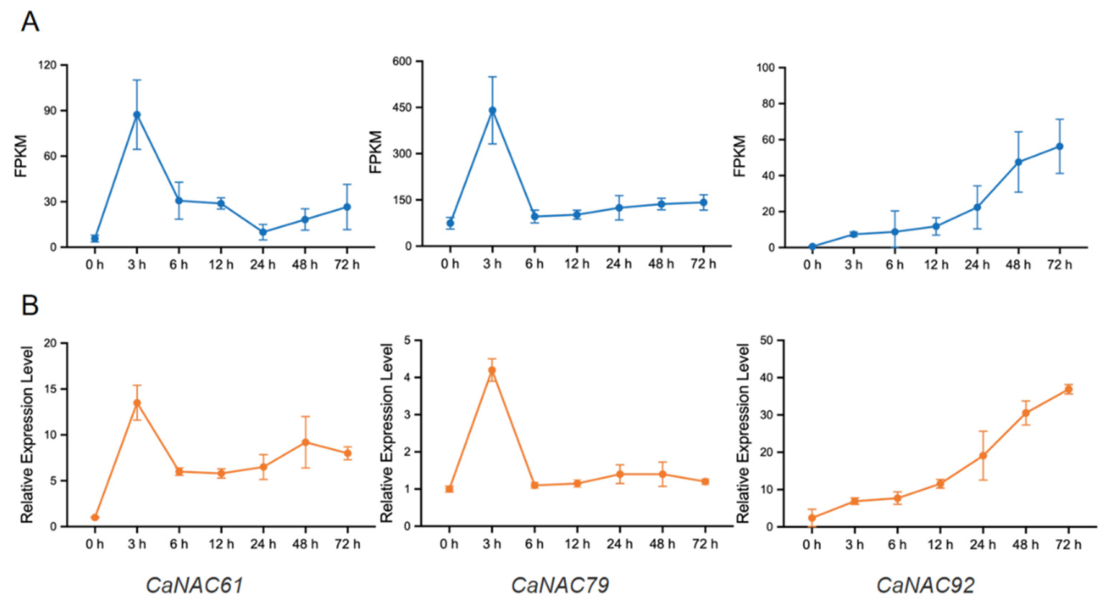
To identify NAC transcription factors involved in pepper’s defense response against P. capsici infection, we analyzed the transcriptional profiles of NAC family members using our previously published RNA-seq data from the pepper–P. capsici interaction [27]. We identified eight differentially expressed CaNAC genes in the RNA-seq dataset; among these, CaNAC61, CaNAC79, and CaNAC92 were selected for further analysis due to their significant upregulation during infection (Figure 1A and Figure S2). Specifically, CaNAC61 and CaNAC79 displayed an early and transient induction pattern, with transcript levels rapidly peaking at 3 h post-inoculation (hpi) and subsequently declining to relatively low levels from 6 to 72 hpi. In contrast, CaNAC92 exhibited a sustained late-phase induction pattern, with transcript levels gradually increasing during the infection and showing robust upregulation after 24 hpi, remaining at high levels at 48–72 hpi (Figure 1A). Thus, CaNAC61 and CaNAC79 represented early-responsive NAC genes, whereas CaNAC92 represented a late-responsive NAC gene, suggesting that these CaNAC members may function at different stages of the pepper defense response.
To validate the RNA-seq data, RT-qPCR analysis was performed to examine the transcript profiles of CaNAC61, CaNAC79, and CaNAC92 at different time points post-inoculation. The expression profiles revealed by RT-qPCR were largely consistent with the RNA-seq data, confirming the early and robust induction of CaNAC61/79 and the sustained induction of CaNAC92 during the infection (Figure 1B). These findings suggested that CaNAC61, CaNAC79, and CaNAC92 are pathogen-responsive transcription factors, implying that they may participate in the regulation of pepper defense response against P. capsici infection.

3.2. Phylogenetic Relationships and Conserved Domain Analysis of CaNAC61, CaNAC79, and CaNAC92

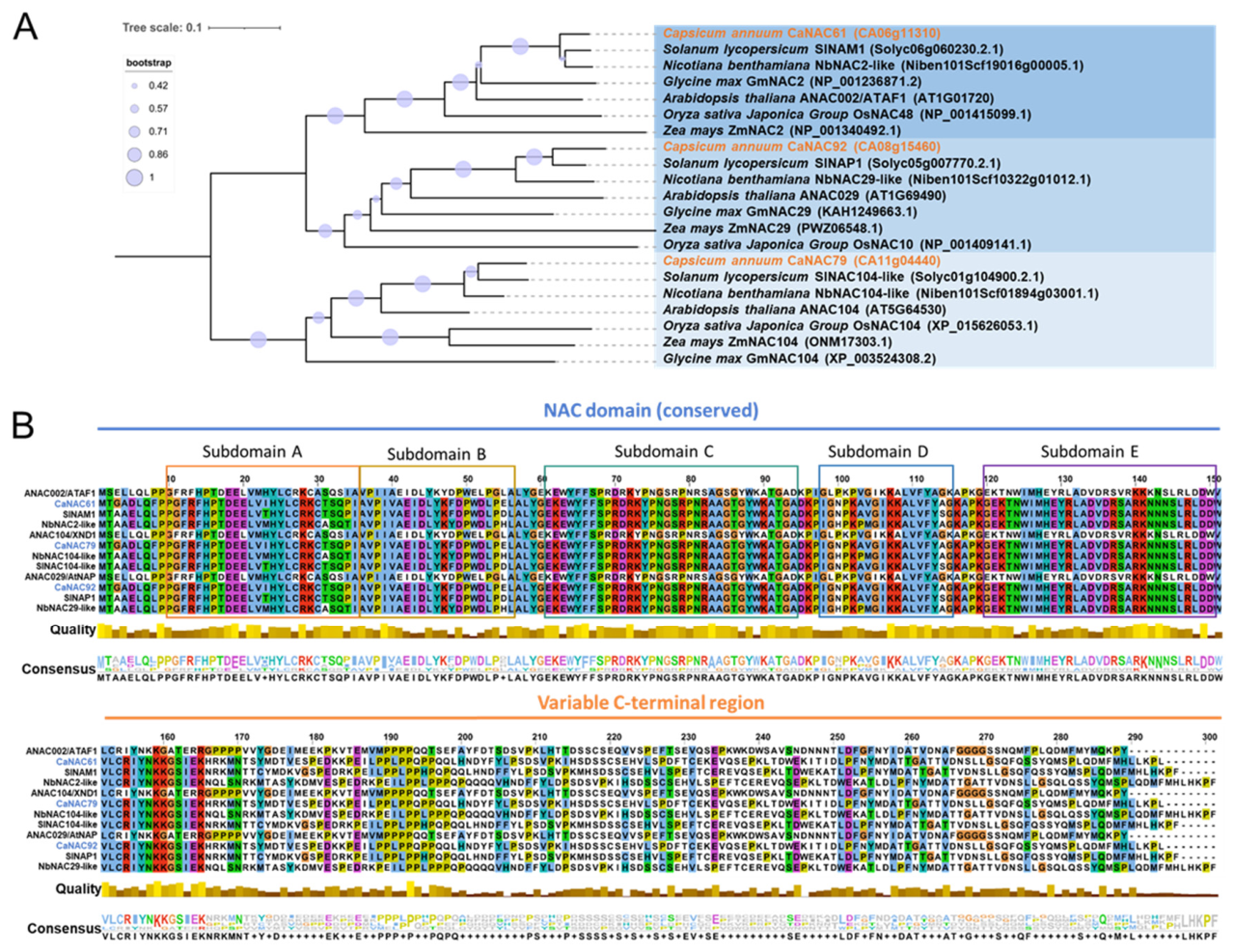
To investigate the evolutionary relationships of CaNAC61, CaNAC79, and CaNAC92 within the NAC transcription factor family, a phylogenetic tree was constructed using NAC protein sequences from a broader range of plant species, including Solanum lycopersicum, Nicotiana benthamiana, Glycine max, Arabidopsis thaliana, Oryza sativa, and Zea mays. The results showed that CaNAC61, CaNAC79, and CaNAC92 clustered into distinct clades together with their homologous NAC proteins from other plant species (Figure 2A).
To further examine the structural conservation of these NAC proteins, multiple sequence alignment was performed. The alignment revealed that CaNAC61, CaNAC79, and CaNAC92 harbor a conserved NAC domain at the N-terminus, which represents a canonical structural feature of NAC transcription factors [16]. The NAC domain could be further divided into five highly conserved subdomains (A–E) (Figure 2B). Among these subdomains, subdomains A, C, and D exhibited remarkable sequence conservation, whereas the C-terminal regions showed relatively high divergence.

3.3. CaNAC61, CaNAC79, and CaNAC92 Localize to the Nucleus

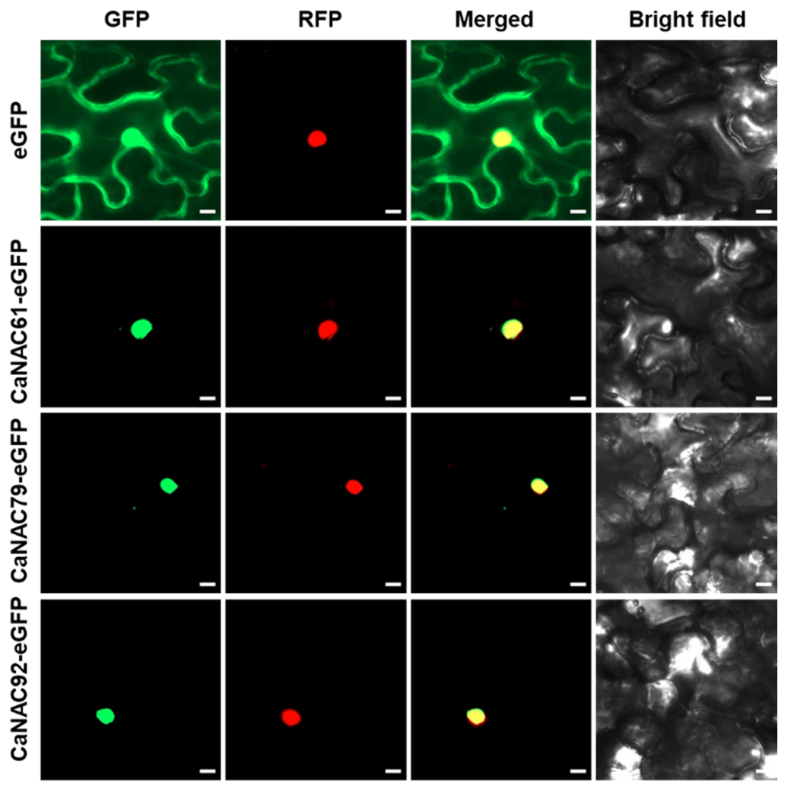
To determine the subcellular distribution of these NAC proteins, we generated GFP fusion constructs CaNAC61-GFP, CaNAC79-GFP, and CaNAC92-GFP driven by the constitutive CaMV 35S promoter and transiently expressed each of them in N. benthamiana leaves. Fluorescence microscopy observations revealed that the GFP signals of all three fusion proteins were exclusively localized in the nucleus, where they overlapped perfectly with the nuclear marker H2B-RFP. In contrast, the free GFP control showed fluorescence throughout the cytoplasm and nucleus (Figure 3).

3.4. Silencing of CaNAC61, CaNAC79, or CaNAC92 Enhances Pepper Resistance to P. capsici

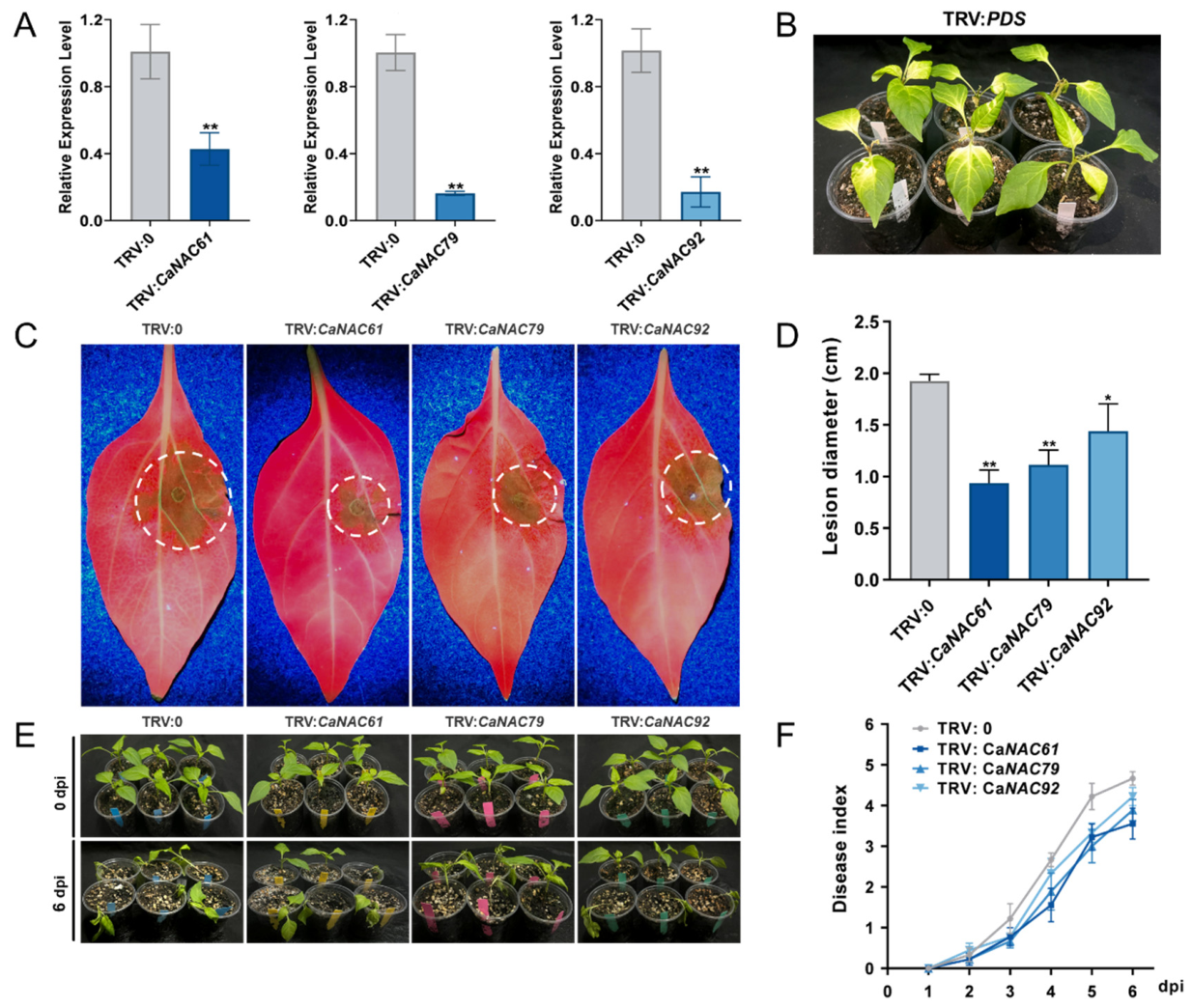
To further dissect the roles of CaNAC61, CaNAC79, and CaNAC92 in pepper immunity against P. capsici, a tobacco rattle virus (TRV)-based virus-induced gene silencing (VIGS) system was employed to specifically silence each of these three CaNAC genes in pepper plants. Approximately 3~4 weeks post-agroinfiltration, the TRV: PDS-treated plants exhibited typical photobleaching, and RT-qPCR analysis confirmed that the transcript levels of CaNAC61, CaNAC79, and CaNAC92 were effectively down-regulated in the corresponding TRV: CaNAC61, TRV: CaNAC79, and TRV: CaNAC92 plants, as compared with the TRV: 0 control plants (Figure 4A,B).
Detached leaves from the silenced pepper plants were subsequently challenged with P. capsici, and the inoculation assays revealed that lesion diameters were significantly reduced in the CaNAC61-, CaNAC79-, and CaNAC92-silenced leaves relative to the TRV: 0 control leaves (Figure 4C,D). Similarly, in the root-inoculation assays, CaNAC61-, CaNAC79-, and CaNAC92-silenced pepper plants exhibited milder disease symptoms and lower disease indexes compared with TRV: 0 control plants (Figure 4E,F). These results suggest that CaNAC61, CaNAC79, and CaNAC92 function as negative regulators of pepper resistance against P. capsici.

3.5. Transient Overexpression of CaNAC61/79/92 in Pepper Leaves Enhances Susceptibility to P. capsici

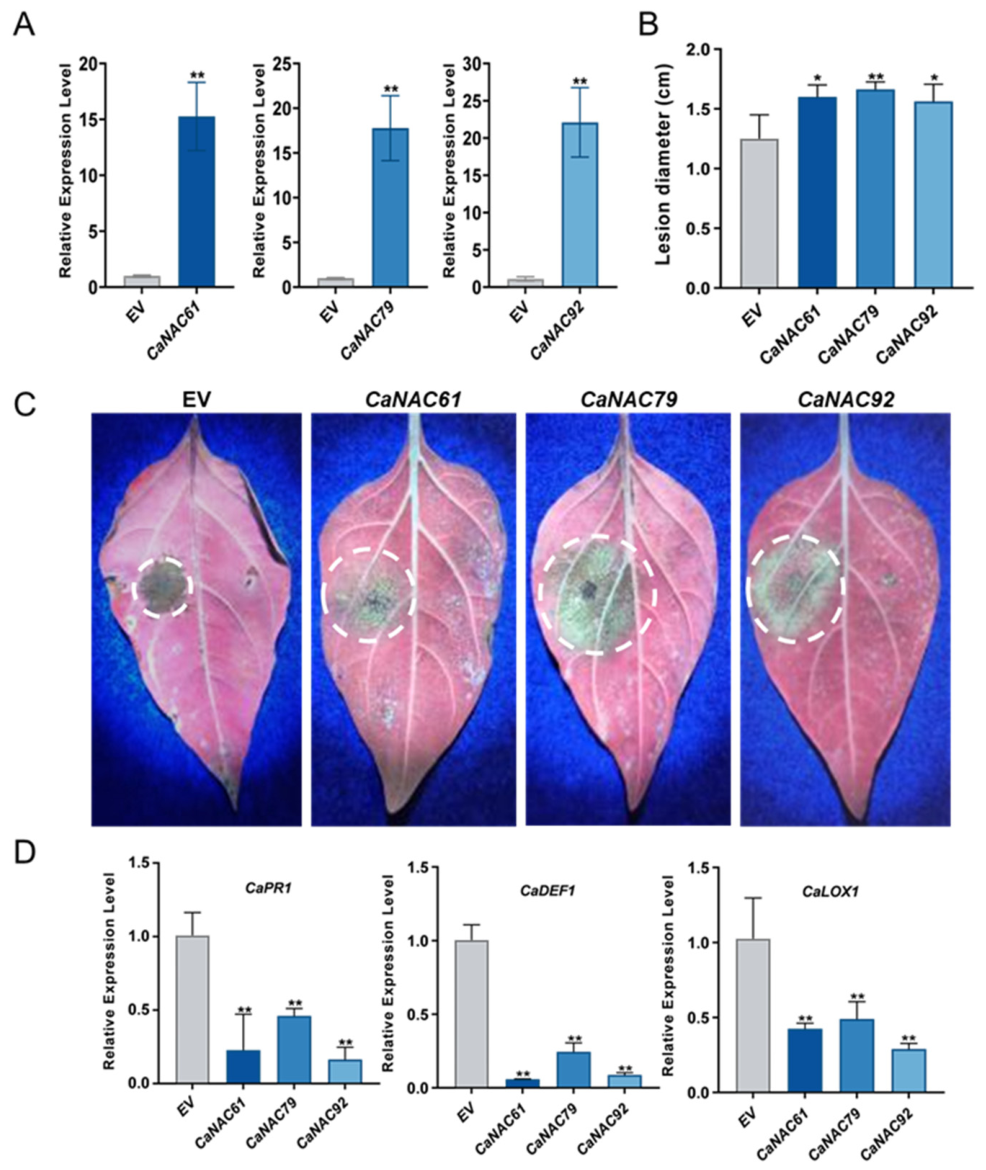
Given that stable genetic transformation in pepper is highly challenging, we employed an Agrobacterium-mediated transient expression system to individually overexpress CaNAC61, CaNAC79, and CaNAC92 in pepper leaves and investigate their roles during P. capsici infection. At 2 days post-agroinfiltration, successful overexpression of CaNAC61, CaNAC79, and CaNAC92 in the infiltrated leaves was confirmed by RT-qPCR (Figure 5A). The overexpressing leaves were then challenged with P. capsici zoospores to assess disease symptoms. Compared with the empty-vector (EV) control, pepper leaves overexpressing CaNAC61, CaNAC79, or CaNAC92 developed significantly larger lesions upon P. capsici inoculation (Figure 5B,C), suggesting that overexpression of these NAC genes enhances pepper susceptibility to the pathogen.
To test whether transient overexpression of CaNAC61, CaNAC79, or CaNAC92 alters defense-related gene expression in pepper plants, we examined the transcript levels of defense-related marker genes, including CaPR1, CaPR2, CaPR10, CaDEF1, CaLOX1, and CaACO1 [31,33]. Compared with the empty-vector control, the transcript levels of CaPR1, CaDEF1, and CaLOX1 were significantly downregulated in leaves overexpressing any of the three CaNAC genes (Figure 5D). However, CaPR2 was specifically repressed only by CaNAC61 overexpression, CaPR10 was uniquely downregulated by CaNAC92 overexpression, and CaACO1 expression remained largely unchanged across all three overexpression assays (Figure S3).

3.6. Stable Overexpression of CaNAC61/79/92 in N. benthamiana Increases Susceptibility to Phytophthora Blight

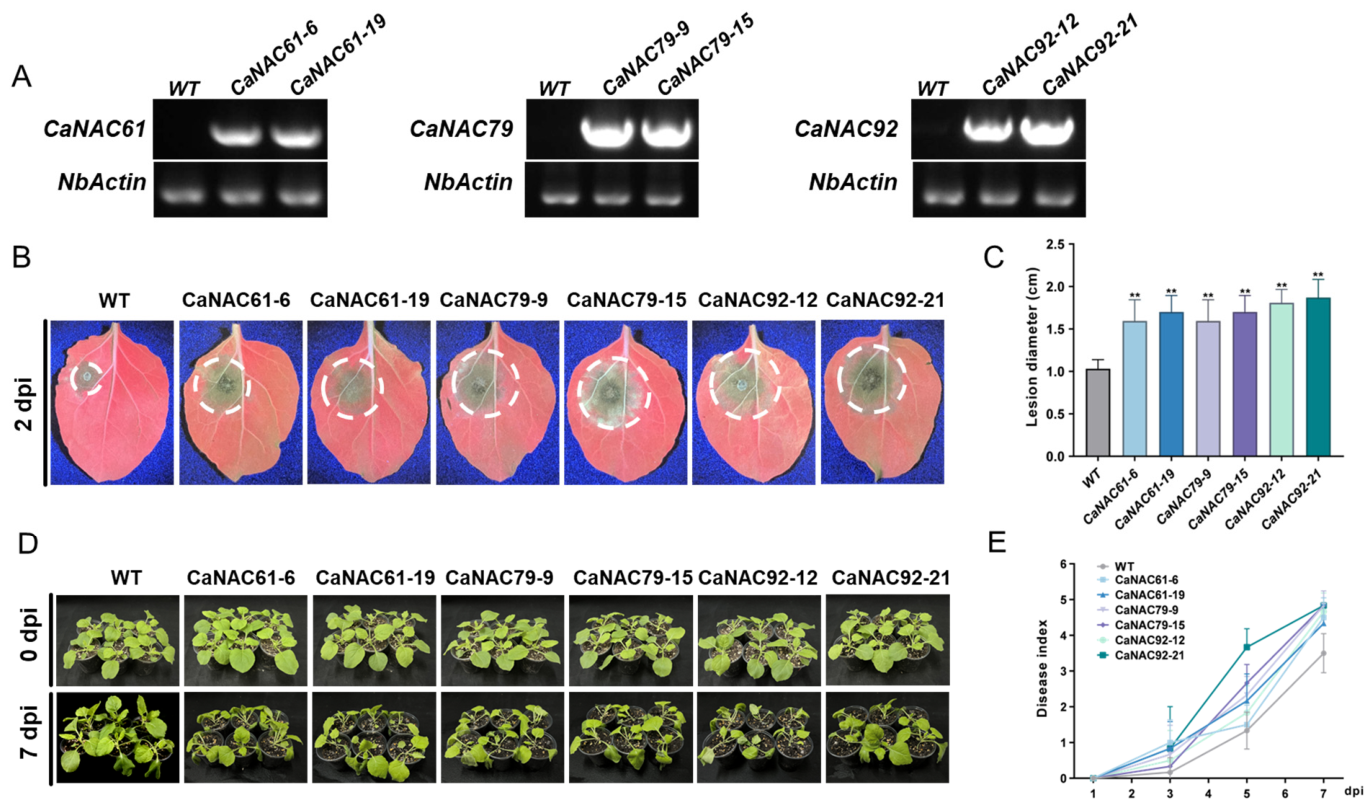
Because pepper is very recalcitrant to stable genetic transformation, we generated transgenic N. benthamiana lines overexpressing CaNAC61, CaNAC79, or CaNAC92 to further validate their functional roles against P. capsici infection. RT-PCR analysis confirmed successful overexpression of the three NAC genes in the corresponding transgenic lines (Figure 6A). Under normal growth conditions, transgenic lines overexpressing CaNAC61, CaNAC79, or CaNAC92 showed no obvious differences in growth or morphology compared with wild-type (WT) plants (Figure 6D). In detached leaf inoculation assays, leaves from these transgenic lines developed significantly larger lesions than those from WT plants following P. capsici inoculation (Figure 6B,C). In root inoculation assays, WT plants developed severe disease symptoms following P. capsici infection. In contrast, transgenic lines overexpressing CaNAC61, CaNAC79, or CaNAC92 exhibited markedly enhanced susceptibility, as evidenced by more severe disease symptoms and higher disease indexes (Figure 6D,E). All these data demonstrated that ectopic overexpression of CaNAC61, CaNAC79, or CaNAC92 compromises resistance to P. capsici, further validating their roles as negative regulators in defense response against the pathogen.

4. Discussion

Phytophthora blight, caused by P. capsici, is one of the most devastating diseases threatening pepper production worldwide [3,5,6]. This pathogen exhibits a broad host range and spreads rapidly under conducive environmental conditions, often causing severe plant wilting and mortality, leading to substantial losses in both yield and fruit quality [3]. Moreover, germplasm resources for resistance to P. capsici in pepper are inadequate, which greatly hinders the breeding of stable and durable resistant cultivars [4]. Thus, screening and identifying key regulators in pepper defense response against P. capsici is critical for elucidating plant–pathogen interactions and accelerating the breeding of disease-resistant varieties.
NAC transcription factors comprise a large family of plant-specific transcriptional regulators characterized by a conserved NAC domain at the N-terminus and a variable transcriptional regulatory region at the C-terminus [14]. Accumulating evidence has demonstrated that NAC transcription factors participate not only in plant development and abiotic stress responses but also in the regulation of plant immunity [12,17]. Although the NAC gene family in pepper has been identified in genome-wide analyses, and the expression patterns of several NAC genes in response to P. capsici infection have been documented [24], the functional role of NAC transcription factors in pepper resistance against P. capsici remains largely unclear.
In this study, our findings indicated that CaNAC61, CaNAC79, and CaNAC92 act as negative regulators of pepper immunity against P. capsici. Similar negative regulatory roles have been reported for NAC transcription factors in diverse plant–pathogen interaction systems. For example, in rice, the NAC transcription factor ONAC083 negatively regulates resistance to Magnaporthe oryzae by directly activating the expression of the RING-H2-type E3 ubiquitin ligase gene OsRFPH2-6 [23]. In wheat, TaNAC1 has also been shown to reduce resistance to stripe rust (Puccinia striiformis f. sp. tritici) and to suppress the expression of defense-related genes such as PR1, PR2, and WRKY70, indicating a similar negative regulatory role in plant immunity [34]. Moreover, in Arabidopsis, a regulatory module composed of NAC90, NAC36, and their interacting partner NAC61 restricts systemic immune responses by repressing N-hydroxypipecolic acid (NHP) biosynthesis [35]. Notably, a pepper NAC member, CaNAC4, has recently been implicated in the negative regulation of biotic stress responses, as CaNAC4-overexpressing transgenic N. benthamiana plants displayed enhanced susceptibility to Botrytis cinerea and Pseudomonas syringae pv. tabaci [36]. Together with these previous findings, our results extend the negative regulatory roles of NAC transcription factors in the pepper–P. capsici pathosystem.
Given that the crosstalk between NAC transcription factors and hormone signaling networks has been reported in multiple plant species [17,24], CaNAC61, CaNAC79, and CaNAC92 may also influence immune output through the regulation of defense-related hormone signaling pathways, such as SA, JA, and ET. In this study, we found that overexpression of CaNAC61, CaNAC79, or CaNAC92 significantly suppresses the transcript levels of the SA-responsive gene CaPR1 and the JA-responsive genes CaDEF1 and CaLOX1 but cannot significantly affect the ET-associated gene CaACO1 (Figure 5D and Figure S3), indicating that these three TFs likely attenuate plant immunity through SA- and JA-mediated defense pathways. Further investigation is needed to identify the direct targets of these CaNAC TFs and to elucidate the fundamental mechanisms underlying their negative regulation of pepper immunity against P. capsici.
As reported by Diao et al. [24], CaNAC61, CaNAC79, and CaNAC92 belong to different phylogenetic subgroups of the pepper CaNAC family. CaNAC61 was classified into the Group I ATAF subfamily. Notably, certain members of this subgroup—such as Arabidopsis ATAF1—have been shown to act as negative regulators of plant defense responses against both necrotrophic fungal and bacterial pathogens [22]. CaNAC92 was assigned to the Group I (4) subgroup, which exhibits high similarity to the AtNAP subgroup [24]. In contrast, CaNAC79 was classified into Group II, which exhibits relatively divergent sequence and motif features compared with Group I [24]. Moreover, CaNAC61, CaNAC79, and CaNAC92 displayed distinct expression dynamics during the P. capsici infection. Specifically, CaNAC61/79 were identified as early-responsive genes, whereas CaNAC92 was a late-responsive gene (Figure 1). Although the transcript levels of CaPR1, CaDEF1, and CaLOX1 were significantly downregulated by all three CaNAC genes (Figure 5D), the other two SA-responsive genes—CaPR2 and CaPR10—were specifically repressed by CaNAC61 and CaNAC92, respectively (Figure S3). These results indicated that these three genes may not act in a fully redundant manner.
It is noteworthy that our previous work demonstrated that the WRKY transcription factors CaWRKY01-10 and CaWRKY08-4 act as positive regulators of pepper resistance against P. capsici [30]. Combined with the findings presented in this study, it is suggested that both positive and negative regulatory modules coexist within the transcriptional regulatory network governing pepper immune responses to P. capsici. While positive regulators rapidly activate defense responses, negative regulators may function to prevent excessive immune activation that could otherwise impair plant growth and metabolism. The coordinated interplay of these regulatory modules illustrates that pepper immunity against P. capsici is not a simple on–off process but instead a precisely tuned dynamic balance controlled by multilayered and sophisticated transcriptional regulatory networks [10]. Given the considerable potential of negative regulators and susceptibility-related genes in resistance breeding, precisely downregulating their expression or implementing targeted gene editing offers a promising strategy to enhance plant resistance against pathogens [37,38].

5. Conclusions

Through time-series transcriptome and RT-qPCR analysis of pepper plants challenged with P. capsici, we identified three NAC TF genes—CaNAC61, CaNAC79, and CaNAC92—that were upregulated at the infection stages. Among them, CaNAC61 and CaNAC79 displayed an early and transient induction pattern, with transcript levels rapidly peaking at 3 h post-inoculation (hpi). In contrast, CaNAC92 exhibited a sustained late-phase induction pattern, with transcript levels gradually increasing during the infection and showing robust upregulation after 24 hpi, remaining at high levels at 48–72 hpi. Gain- and loss-of-function analyses further demonstrated that transient overexpression of CaNAC61, CaNAC79, and CaNAC92 in pepper leaves significantly promotes lesion expansion, whereas silencing each of these genes in pepper confers enhanced resistance to P. capsici. Consistently, heterologous overexpression in transgenic N. benthamiana further validated CaNAC61, CaNAC79, and CaNAC92 as negative regulators in resistance to P. capsici. Collectively, our findings indicated that CaNAC61, CaNAC79, and CaNAC92 negatively regulate plant resistance to P. capsici, thereby broadening our knowledge of NAC transcription factor functions in plant immunity and offering novel insights into the sophisticated regulatory network governing pepper resistance to P. capsici.

Supplementary Materials

The following supporting information can be downloaded at: https://www.mdpi.com/article/10.3390/biology15120943/s1, Table S1: Primers used in this study; Table S2: Sequences of the silencing fragments; Figure S1: Specificity verification of VIGS-mediated silencing of CaNAC61, CaNAC79, and CaNAC92; Figure S2: RNA-seq analysis of CaNAC gene expression levels in pepper leaves after P. capsici infection; Figure S3: Expression analysis of additional defense-related marker genes in pepper leaves transiently overexpressing CaNAC61, CaNAC79, or CaNAC92; Figure S4: Original image for PCR.

Author Contributions

Conceptualization, W.C.; methodology, Y.W., B.G. and X.L.; software, Y.W., Y.L. and M.C.; validation, J.W. and M.A.; formal analysis, Y.W. and M.C.; investigation, Y.W., B.G. and X.L.; resources, W.C.; data curation, Y.W. and B.G.; writing—original draft preparation, Y.W.; writing—review and editing, W.C.; visualization, Y.L. and M.C.; supervision, W.C. and M.C.; project administration, W.C.; funding acquisition, W.C. and M.C. All authors have read and agreed to the published version of the manuscript.

Funding

This work was supported by the National Natural Science Foundation of China (Grant Nos. 32472536 and 32302526); the Natural Science Foundation of Anhui Province, China (Grant No. 2208085MC64); the Outstanding Innovative Research Team for Molecular Enzymology and Detection in Anhui Provincial Universities (Grant No. 2022AH010012); the University Synergy Innovation Program of Anhui Province (Grant No. GXXT-2022-067); and the University Natural Science Research Program of Anhui Provincial Education Department (Grant No. KJ2021A0118).

Institutional Review Board Statement

Not applicable.

Informed Consent Statement

Not applicable.

Data Availability Statement

The data presented in this study are available in the article. Further information is available upon request from the corresponding author.

Acknowledgments

We would like to express our sincere appreciation to all the teachers and students at the Laboratory of Plant and Pathogen Interactions, Anhui Normal University.

Conflicts of Interest

The authors declare no conflicts of interest.

References

  1. Qin, C.; Yu, C.; Shen, Y.; Fang, X.; Chen, L.; Min, J.; Cheng, J.; Zhao, S.; Xu, M.; Luo, Y.; et al. Whole-genome sequencing of cultivated and wild peppers provides insights into Capsicum domestication and specialization. Proc. Natl. Acad. Sci. USA 2014, 111, 5135–5140. [Google Scholar] [CrossRef] [PubMed]
  2. Cvetković, T.; Ranilović, J.; Jokić, S. Quality of pepper seed by-products: A review. Foods 2022, 11, 748. [Google Scholar] [CrossRef] [PubMed]
  3. Granke, L.L.; Quesada-Ocampo, L.; Lamour, K.; Hausbeck, M.K. Advances in research on Phytophthora capsici on vegetable crops in the United States. Plant Dis. 2012, 96, 1588–1600. [Google Scholar] [CrossRef] [PubMed]
  4. Barchenger, D.W.; Lamour, K.H.; Bosland, P.W. Challenges and strategies for breeding resistance in Capsicum annuum to the multifarious pathogen, Phytophthora capsici. Front. Plant Sci. 2018, 9, 628. [Google Scholar] [CrossRef] [PubMed]
  5. Parada-Rojas, C.H.; Granke, L.L.; Naegele, R.P.; Hansen, Z.; Hausbeck, M.K.; Kousik, C.S.; McGrath, M.T.; Smart, C.D.; Quesada-Ocampo, L.M. A diagnostic guide for Phytophthora capsici infecting vegetable crops. Plant Health Prog. 2021, 22, 404–414. [Google Scholar] [CrossRef]
  6. Sanogo, S.; Lamour, K.; Kousik, C.S.; Lozada, D.N.; Parada-Rojas, C.H.; Quesada-Ocampo, L.M.; Wyenandt, C.A.; Babadoost, M.; Hausbeck, M.K.; Hansen, Z.; et al. Phytophthora capsici, 100 years later: Research mile markers from 1922 to 2022. Phytopathology 2023, 113, 921–930. [Google Scholar] [CrossRef] [PubMed]
  7. Jones, J.D.G.; Dangl, J.L. The plant immune system. Nature 2006, 444, 323–329. [Google Scholar] [CrossRef] [PubMed]
  8. Ngou, B.P.M.; Ding, P.; Jones, J.D.G. Thirty years of resistance: Zig-zag through the plant immune system. Plant Cell 2022, 34, 1447–1478. [Google Scholar] [CrossRef] [PubMed]
  9. Moore, J.W.; Loake, G.J.; Spoel, S.H. Transcription dynamics in plant immunity. Plant Cell 2011, 23, 2809–2820. [Google Scholar] [CrossRef] [PubMed]
  10. Tsuda, K.; Somssich, I.E. Transcriptional networks in plant immunity. New Phytol. 2015, 206, 932–947. [Google Scholar] [CrossRef] [PubMed]
  11. Birkenbihl, R.P.; Liu, S.; Somssich, I.E. Transcriptional events defining plant immune responses. Curr. Opin. Plant Biol. 2017, 38, 1–9. [Google Scholar] [CrossRef] [PubMed]
  12. Dong, B.; Liu, Y.; Huang, G.; Song, A.; Chen, S.; Jiang, J.; Chen, F.; Fang, W. Plant NAC transcription factors in the battle against pathogens. BMC Plant Biol. 2024, 24, 958. [Google Scholar] [CrossRef] [PubMed]
  13. Ng, D.W.-K.; Abeysinghe, J.K.; Kamali, M. Regulating the regulators: The control of transcription factors in plant defense signaling. Int. J. Mol. Sci. 2018, 19, 3737. [Google Scholar] [CrossRef] [PubMed]
  14. Olsen, A.N.; Ernst, H.A.; Leggio, L.L.; Skriver, K. NAC transcription factors: Structurally distinct, functionally diverse. Trends Plant Sci. 2005, 10, 79–87. [Google Scholar] [CrossRef] [PubMed]
  15. Podzimska-Sroka, D.; O’Shea, C.; Gregersen, P.L.; Skriver, K. NAC transcription factors in senescence: From molecular structure to function in crops. Plants 2015, 4, 412–448. [Google Scholar] [CrossRef] [PubMed]
  16. Xiong, H.; He, H.; Chang, Y.; Miao, B.; Liu, Z.; Wang, Q.; Dong, F.; Xiong, L. Multiple roles of NAC transcription factors in plant development and stress responses. J. Integr. Plant Biol. 2025, 67, 510–538. [Google Scholar] [CrossRef] [PubMed]
  17. Yuan, X.; Wang, H.; Cai, J.; Li, D.; Song, F. NAC transcription factors in plant immunity. Phytopathol. Res. 2019, 1, 3. [Google Scholar] [CrossRef]
  18. Bu, Q.; Jiang, H.; Li, C.-B.; Zhai, Q.; Zhang, J.; Wu, X.; Sun, J.; Xie, Q.; Li, C. Role of the Arabidopsis thaliana NAC transcription factors ANAC019 and ANAC055 in regulating jasmonic acid-signaled defense responses. Cell Res. 2008, 18, 756–767. [Google Scholar] [CrossRef] [PubMed]
  19. Wang, J.; Zheng, C.; Shao, X.; Hu, Z.; Li, J.; Wang, P.; Wang, A.; Yu, J.; Shi, K. Transcriptomic and genetic approaches reveal an essential role of the NAC transcription factor SlNAP1 in the growth and defense response of tomato. Hortic. Res. 2020, 7, 209. [Google Scholar] [CrossRef] [PubMed]
  20. Xu, Y.; Zou, S.; Zeng, H.; Wang, W.; Wang, B.; Wang, H.; Tang, D. A NAC transcription factor TuNAC69 contributes to ANK-NLR-WRKY NLR-mediated stripe rust resistance in the diploid wheat Triticum urartu. Int. J. Mol. Sci. 2022, 23, 564. [Google Scholar] [CrossRef] [PubMed]
  21. McLellan, H.; Boevink, P.C.; Armstrong, M.R.; Pritchard, L.; Gomez, S.; Morales, J.; Whisson, S.C.; Beynon, J.L.; Birch, P.R.J. An RxLR effector from Phytophthora infestans prevents re-localisation of two plant NAC transcription factors from the endoplasmic reticulum to the nucleus. PLoS Pathog. 2013, 9, e1003670. [Google Scholar] [CrossRef] [PubMed]
  22. Wang, X.; Basnayake, B.M.V.S.; Zhang, H.; Li, G.; Li, W.; Virk, N.; Mengiste, T.; Song, F. The Arabidopsis ATAF1, a NAC transcription factor, is a negative regulator of defense responses against necrotrophic fungal and bacterial pathogens. Mol. Plant Microbe Interact. 2009, 22, 1227–1238. [Google Scholar] [CrossRef] [PubMed]
  23. Bi, Y.; Wang, H.; Yuan, X.; Yan, Y.; Li, D.; Song, F. The NAC transcription factor ONAC083 negatively regulates rice immunity against Magnaporthe oryzae by directly activating transcription of the RING-H2 gene OsRFPH2-6. J. Integr. Plant Biol. 2023, 65, 854–875. [Google Scholar] [PubMed]
  24. Diao, W.; Snyder, J.C.; Wang, S.; Liu, J.; Pan, B.; Guo, G.; Ge, W.; Dawood, M.H.S.A. Genome-wide analyses of the NAC transcription factor gene family in pepper (Capsicum annuum L.): Chromosome location, phylogeny, structure, expression patterns, cis-elements in the promoter, and interaction network. Int. J. Mol. Sci. 2018, 19, 1028. [Google Scholar] [CrossRef] [PubMed]
  25. Wang, P.; Liu, X.; Guo, J.; Liu, C.; Fu, N.; Shen, H. Identification and expression analysis of candidate genes associated with defense responses to Phytophthora capsici in pepper line “PI 201234”. Int. J. Mol. Sci. 2015, 16, 11417–11438. [Google Scholar] [CrossRef] [PubMed]
  26. Lei, G.; Zhou, K.-H.; Chen, X.-J.; Huang, Y.-Q.; Yuan, X.-J.; Li, G.-G.; Xie, Y.-Y.; Fang, R. Transcriptome and metabolome analyses revealed the response mechanism of pepper roots to Phytophthora capsici infection. BMC Genom. 2023, 24, 626. [Google Scholar] [CrossRef] [PubMed]
  27. Cheng, W.; Jiang, Y.; Peng, J.; Guo, J.; Lin, M.; Jin, C.; Huang, J.; Tang, W.; Guan, D.; He, S. The transcriptional reprograming and functional identification of WRKY family members in pepper’s response to Phytophthora capsici infection. BMC Plant Biol. 2020, 20, 256. [Google Scholar] [CrossRef] [PubMed]
  28. Cheng, W.; Lin, M.; Qiu, M.; Kong, L.; Xu, Y.; Li, Y.; Wang, Y.; Ye, W.; Dong, S.; He, S.; et al. Chitin synthase is involved in vegetative growth, asexual reproduction and pathogenesis of Phytophthora capsici and Phytophthora sojae. Environ. Microbiol. 2019, 21, 4537–4547. [Google Scholar] [CrossRef] [PubMed]
  29. Livak, K.J.; Schmittgen, T.D. Analysis of relative gene expression data using real-time quantitative PCR and the 2−ΔΔCT method. Methods 2001, 25, 402–408. [Google Scholar] [CrossRef] [PubMed]
  30. Cheng, W.; Wang, N.; Li, Y.; Zhou, X.; Bai, X.; Liu, L.; Ma, X.; Wang, S.; Li, X.; Gong, B.; et al. CaWRKY01-10 and CaWRKY08-4 confer pepper’s resistance to Phytophthora capsici infection by directly activating a cluster of defense-related genes. J. Agric. Food Chem. 2024, 72, 11682–11693. [Google Scholar] [CrossRef] [PubMed]
  31. Wang, J.; Azeem, M.; Li, Y.; Gong, B.; Li, X.; Liu, L.; Wu, G.; Chu, M.; Cheng, W. Transcriptome profiling of AP2/ERF family members and functional characterization of CaAP2/ERF99 in pepper defense against Phytophthora capsici. Plant Sci. 2026, 365, 113026. [Google Scholar] [PubMed]
  32. Cheng, W.; Lin, M.; Chu, M.; Xiang, G.; Guo, J.; Jiang, Y.; Guan, D.; He, S. RNAi-based gene silencing of RXLR effectors protects plants against the oomycete pathogen Phytophthora capsici. Mol. Plant Microbe Interact. 2022, 35, 440–449. [Google Scholar] [CrossRef] [PubMed]
  33. Cheng, W.; Xiao, Z.; Cai, H.; Wang, C.; Hu, Y.; Xiao, Y.; Zheng, Y.; Shen, L.; Yang, S.; Liu, Z.; et al. A novel leucine-rich repeat protein, CaLRR51, acts as a positive regulator in the response of pepper to Ralstonia solanacearum infection. Mol. Plant Pathol. 2017, 18, 1089–1100. [Google Scholar] [PubMed]
  34. Wang, F.; Lin, R.; Feng, J.; Chen, W.; Qiu, D.; Xu, S. TaNAC1 acts as a negative regulator of stripe rust resistance in wheat, enhances susceptibility to Pseudomonas syringae, and promotes lateral root development in transgenic Arabidopsis thaliana. Front. Plant Sci. 2015, 6, 108. [Google Scholar] [CrossRef] [PubMed]
  35. Cai, J.; Panda, S.; Kazachkova, Y.; Amzallag, E.; Li, Z.; Meir, S.; Rogachev, I.; Aharoni, A. A NAC triad modulates plant immunity by negatively regulating N-hydroxy pipecolic acid biosynthesis. Nat. Commun. 2024, 15, 7212. [Google Scholar] [CrossRef] [PubMed]
  36. Jia, G.; Thinn, K.S.Z.; Kim, S.H.; Min, J.; Oh, S.K. Capsicum annuum NAC4 (CaNAC4) is a transcription factor with roles in biotic and abiotic stresses. Plant Pathol. J. 2024, 40, 512–524. [Google Scholar] [CrossRef] [PubMed]
  37. van Schie, C.C.N.; Takken, F.L.W. Susceptibility genes 101: How to be a good host. Annu. Rev. Phytopathol. 2014, 52, 551–581. [Google Scholar] [CrossRef] [PubMed]
  38. Garcia-Ruiz, H.; Szurek, B.; Van den Ackerveken, G. Stop helping pathogens: Engineering plant susceptibility genes for durable resistance. Curr. Opin. Biotechnol. 2021, 70, 187–195. [Google Scholar] [CrossRef] [PubMed]
Figure 1. Expression patterns of CaNAC61, CaNAC79, and CaNAC92 during P. capsici infection in pepper: (A) Transcriptional patterns of CaNAC61, CaNAC79, and CaNAC92 at 0, 3, 6, 12, 24, 48, and 72 h post-inoculation with P. capsici were determined by RNA-seq. (B) The expression patterns of CaNAC61, CaNAC79, and CaNAC92 at different time points post-inoculation were validated by RT-qPCR. Data are presented as the mean ± standard deviation (SD) from three independent biological replicates.
Biology 15 00943 g001
Figure 2. Phylogenetic relationships and conserved domain analysis of CaNAC61, CaNAC79, and CaNAC92: (A) A phylogenetic tree was constructed using NAC protein sequences from Capsicum annuum, Solanum lycopersicum, Nicotiana benthamiana, Glycine max, Arabidopsis thaliana, Oryza sativa, and Zea mays. CaNAC61, CaNAC79, and CaNAC92, which are highlighted in orange, were clustered into distinct phylogenetic clades with representative homologous NAC proteins from other plant species. Bootstrap values are represented by the size of the circles, and the scale bar indicates evolutionary distance. (B) Multiple sequence alignment was performed for CaNAC61, CaNAC79, and CaNAC92 with their homologous proteins. Sequence alignment revealed that all three proteins contain a conserved N-terminal NAC domain, a characteristic feature of the NAC transcription factor family that can be divided into five subdomains.
Biology 15 00943 g002
Figure 3. Subcellular localization of CaNAC61, CaNAC79, and CaNAC92. CaNAC61-eGFP, CaNAC79-eGFP, and CaNAC92-eGFP fusion proteins were transiently expressed in N. benthamiana leaves and co-expressed with the nuclear marker H2B-RFP. Confocal microscopy revealed that the GFP signals of CaNAC61, CaNAC79, and CaNAC92 strongly co-localized with the RFP signals, indicating that all three proteins are predominantly localized in the nucleus. eGFP was used as the empty vector control, showing fluorescence signals in both the nucleus and cytoplasm. GFP, green fluorescent protein. RFP, red fluorescent protein. Bar = 10 μm.
Biology 15 00943 g003
Figure 4. Silencing of CaNAC61, CaNAC79, and CaNAC92 enhances resistance to P. capsici in pepper: (A) Transcript levels of CaNAC61, CaNAC79, and CaNAC92 in TRV-mediated gene-silenced pepper plants were measured by RT-qPCR, with TRV: 0 serving as the negative control. Data represent the mean ± SD of three independent biological replicates. (B) Approximately 3–4 weeks post-agroinfiltration, TRV: PDS-treated plants exhibited typical photobleaching, confirming the effectiveness of the VIGS system. (C) Representative disease symptoms of detached VIGS leaves at 3 days post-inoculation (dpi) with P. capsici zoospores. (D) Lesion diameters after P. capsici inoculation at 3 dpi. (E) Representative disease symptoms of TRV-treated pepper plants subjected to root inoculation at 0 dpi and 6 dpi. (F) Disease indexes of these TRV-treated pepper plants after root inoculation with P. capsici zoospores. Data are presented as the mean ± SD from six independent biological replicates. Asterisks indicate significant differences based on Student’s t-test (* p < 0.05, ** p < 0.01).
Biology 15 00943 g004
Figure 5. Transient overexpression of CaNAC61, CaNAC79, and CaNAC92 enhances susceptibility of pepper leaves to P. capsici infection: (A) Transcript levels of CaNAC61, CaNAC79, and CaNAC92 in transiently overexpressing pepper leaves were measured by RT-qPCR. The empty vector (EV) served as the control. Data represent the mean ± SD of three independent biological replicates. (B) Lesion diameters in pepper leaves at 2 days post-inoculation (dpi) with P. capsici zoospores. Data are presented as the mean ± SD from six independent biological replicates. (C) Representative disease symptoms of pepper leaves following P. capsici inoculation at 2 dpi. (D) Expression of defense marker genes in pepper leaves transiently overexpressing CaNAC61, CaNAC79, or CaNAC92. Transcript levels of CaPR1, CaDEF1, and CaLOX1 were determined by RT-qPCR at 2 days post-agroinfiltration. Data were obtained from three independent biological replicates. The empty vector (EV) served as the control. All data are presented as the mean ± SD, and asterisks indicate significant differences based on Student’s t-test (* p < 0.05, ** p < 0.01).
Biology 15 00943 g005
Figure 6. Ectopic stable overexpression of CaNAC61, CaNAC79, and CaNAC92 enhances susceptibility to P. capsici in N. benthamiana: (A) RT-PCR analysis of CaNAC61, CaNAC79, and CaNAC92 transcript levels in transgenic N. benthamiana lines overexpressing each of these genes. NbActin was used as the internal reference, and wild-type (WT) plants served as the control. (Figure S4). (B) Representative disease symptoms of detached leaves from different transgenic N. benthamiana lines following P. capsici inoculation at 2 dpi. (C) Lesion diameters of these transgenic N. benthamiana leaves after P. capsici inoculation at 2 dpi. (D) Representative disease symptoms of these transgenic N. benthamiana plants subjected to root inoculation at 0 dpi and 7 dpi. (E) Disease indexes of different transgenic N. benthamiana lines after root inoculation with P. capsici zoospores. The data are presented as the mean ± SD from six independent biological replicates. Asterisks indicate significant differences based on Student’s t-test (** p < 0.01).
Biology 15 00943 g006
Disclaimer/Publisher’s Note: The statements, opinions and data contained in all publications are solely those of the individual author(s) and contributor(s) and not of MDPI and/or the editor(s). MDPI and/or the editor(s) disclaim responsibility for any injury to people or property resulting from any ideas, methods, instructions or products referred to in the content.