Long-Standing Activity with Characteristic Genomic Insertion Signatures in Reptilian Bov-B LINEs and Associated Sauria SINEs



Simple Summary
Abstract
1. Introduction
2. Materials and Methods
2.1. Nucleotide Sequences
2.2. Extraction of Copy Sequences and Search for TSD
2.3. Motif Discovery
2.4. Age Estimation of Bov-B
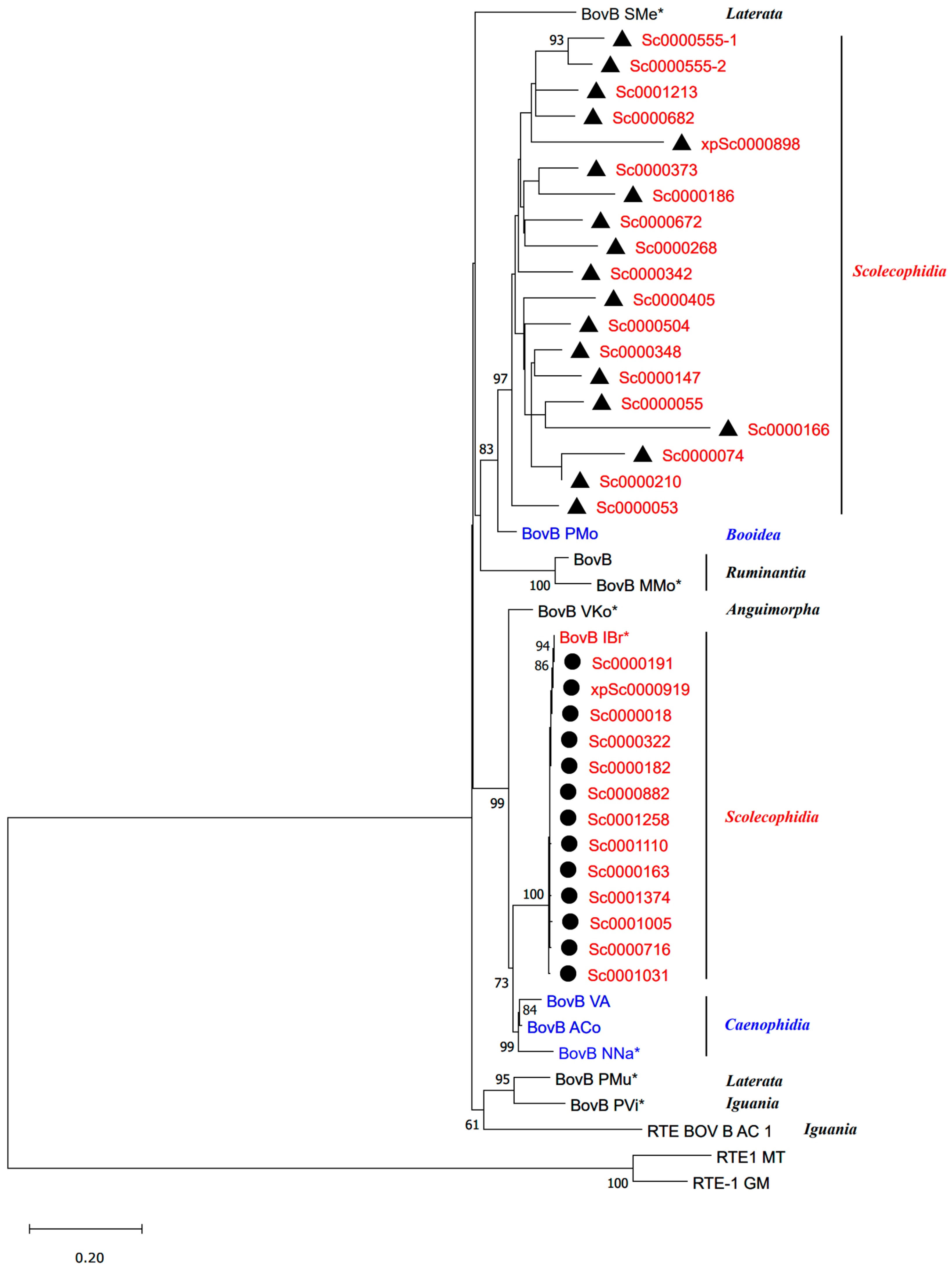
2.5. Phylogenetic Analysis and Divergence Time Estimation
3. Results
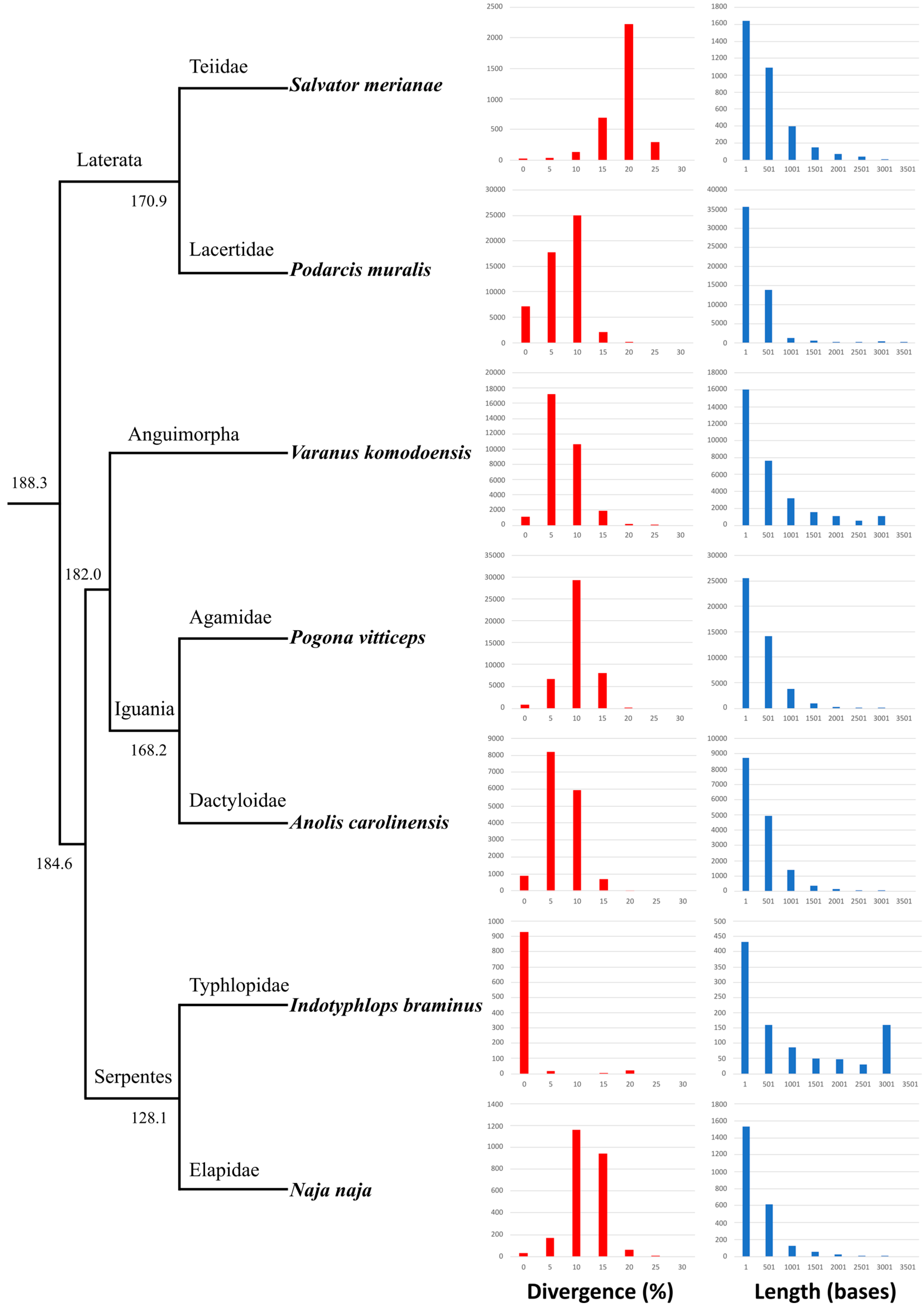
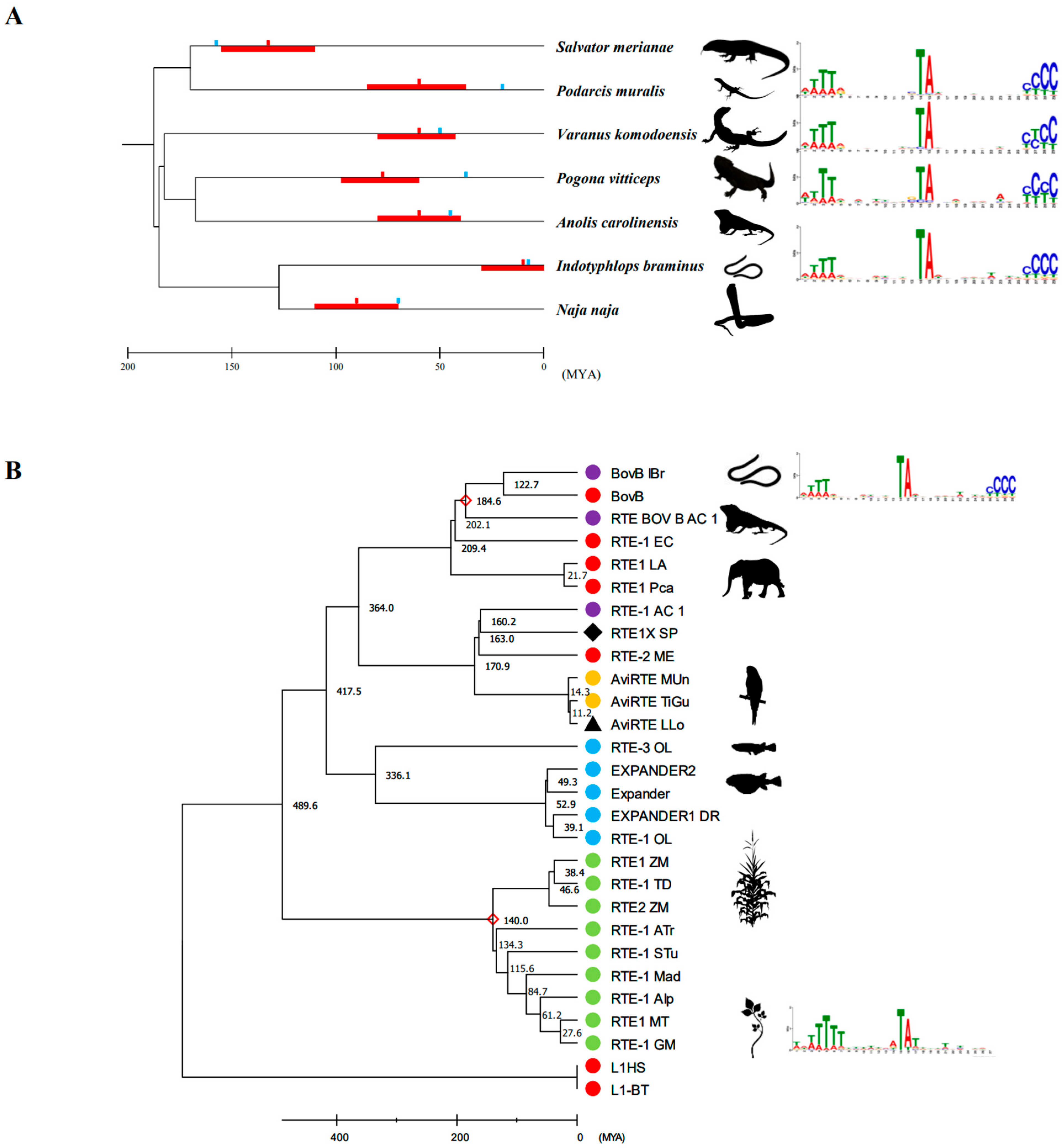
3.1. Long-Standing Activity of Reptilian Bov-B LINEs
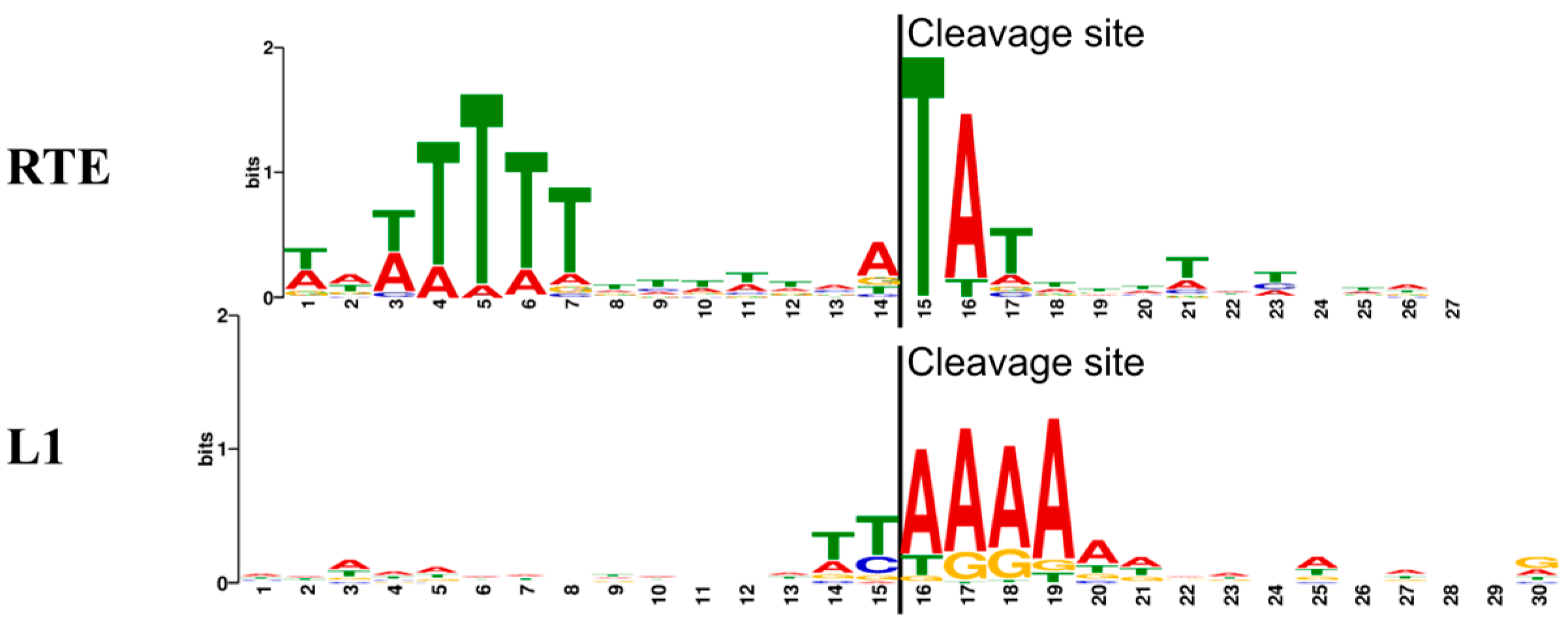
3.2. Insertion Signature near the DNA Cleavage Site in Bov-B LINEs

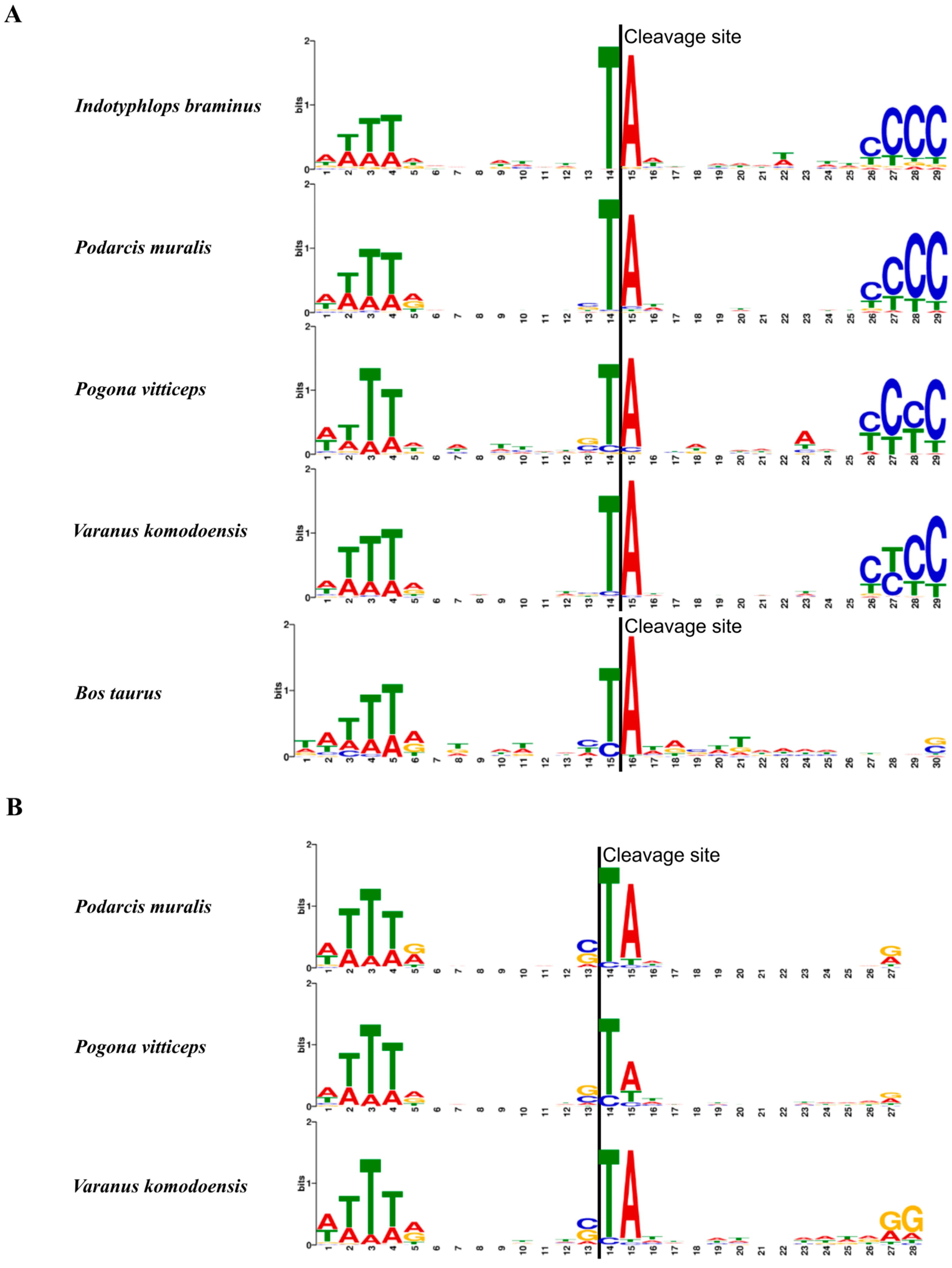
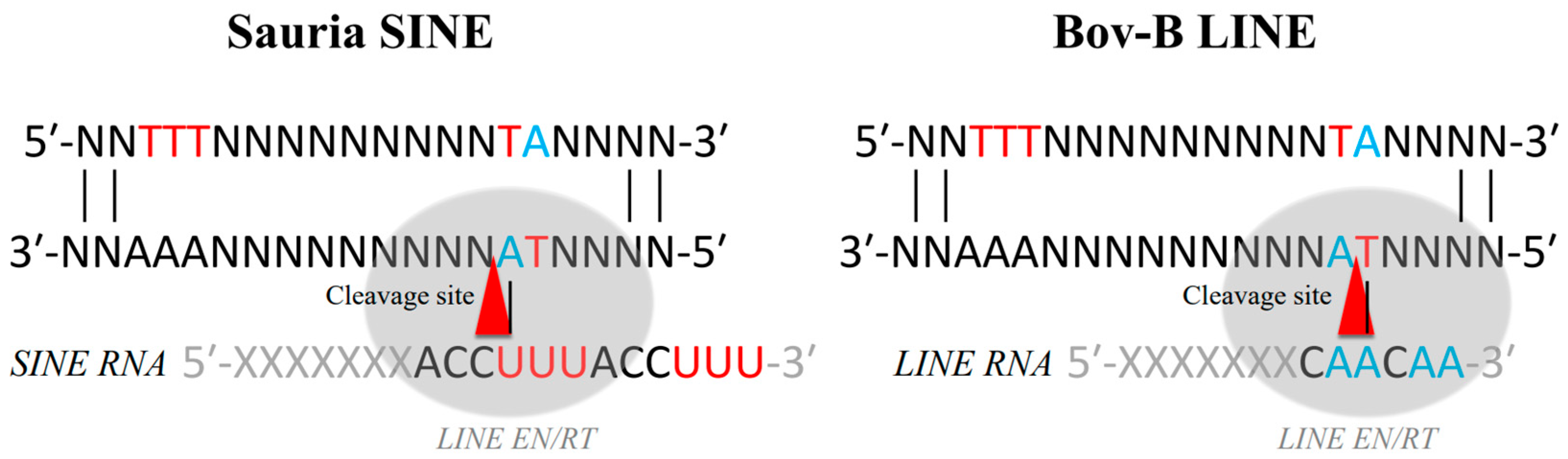
3.3. Variation in the Tn-TA Pattern Between Bov-B LINEs and Sauria SINEs and Correlation with 3′-End Microsatellite-Like Sequences
3.4. Evolutionary Time Scale of the Tn-TA Containing RTE-Clade LINEs
4. Discussion
4.1. Genomic Integration Machinery of Bov-B LINEs and Sauria SINEs
4.2. Ability of RTE-Clade LINEs to Propagate in a New Host Genome Following HT
5. Conclusions
Supplementary Materials
Author Contributions
Funding
Institutional Review Board Statement
Informed Consent Statement
Data Availability Statement
Acknowledgments
Conflicts of Interest
References
- Malik, H.S.; Burke, W.D.; Eickbush, T.H. The age and evolution of non-LTR retrotransposable elements. Mol. Biol. Evol. 1999, 16, 793–805. [Google Scholar] [CrossRef]
- Schaack, S.; Gilbert, C.; Feschotte, C. Promiscuous DNA: Horizontal transfer of transposable elements and why it matters for eukaryotic evolution. Trends Ecol. Evol. 2010, 25, 537–546. [Google Scholar] [CrossRef]
- Walsh, A.M.; Kortschak, R.D.; Gardner, M.G.; Bertozzi, T.; Adelson, D.L. Widespread horizontal transfer of retrotransposons. Proc. Natl. Acad. Sci. USA 2013, 110, 1012–1016. [Google Scholar] [CrossRef]
- Suh, A.; Witt, C.C.; Menger, J.; Sadanandan, K.R.; Podsiadlowski, L.; Gerth, M.; Weigert, A.; McGuire, J.A.; Mudge, J.; Edwards, S.V.; et al. Ancient horizontal transfers of retrotransposons between birds and ancestors of human pathogenic nematodes. Nat. Commun. 2016, 7, 11396. [Google Scholar] [CrossRef]
- Peccoud, J.; Loiseau, V.; Cordaux, R.; Gilbert, C. Massive horizontal transfer of transposable elements in insects. Proc. Natl. Acad. Sci. USA 2017, 114, 4721–4726. [Google Scholar] [CrossRef] [PubMed]
- Ivancevic, A.M.; Kortschak, R.D.; Bertozzi, T.; Adelson, D.L. Horizontal transfer of BovB and L1 retrotransposons in eukaryotes. Genome Biol. 2018, 19, 85. [Google Scholar] [CrossRef]
- Zhang, H.H.; Peccoud, J.; Xu, M.R.; Zhang, X.G.; Gilbert, C. Horizontal transfer and evolution of transposable elements in vertebrates. Nat. Commun. 2020, 11, 1362. [Google Scholar] [CrossRef]
- Melo, E.S.; Wallau, G.L. Mosquito genomes are frequently invaded by transposable elements through horizontal transfer. PLoS Genet. 2020, 16, e1008946. [Google Scholar] [CrossRef]
- Kambayashi, C.; Kakehashi, R.; Sato, Y.; Mizuno, H.; Tanabe, H.; Rakotoarison, A.; Künzel, S.; Furuno, N.; Ohshima, K.; Kumazawa, Y.; et al. Geography-dependent horizontal gene transfer from vertebrate predators to their prey. Mol. Biol. Evol. 2022, 39, msac052. [Google Scholar] [CrossRef] [PubMed]
- Kordis, D.; Gubensek, F. Unusual horizontal transfer of a long interspersed nuclear element between distant vertebrate classes. Proc. Natl. Acad. Sci. USA 1998, 95, 10704–10709. [Google Scholar] [CrossRef] [PubMed]
- Gallus, S.; Kumar, V.; Bertelsen, M.F.; Janke, A.; Nilsson, M.A. A genome survey sequencing of the Java mouse deer (Tragulus javanicus) adds new aspects to the evolution of lineage specific retrotransposons in Ruminantia (Cetartiodactyla). Gene 2015, 571, 271–278. [Google Scholar] [CrossRef] [PubMed]
- Puinongpo, W.; Singchat, W.; Petpradub, S.; Kraichak, E.; Nunome, M.; Laopichienpong, N.; Thongchum, R.; Intarasorn, T.; Sillapaprayoon, S.; Indananda, C.; et al. Existence of Bov-B LINE retrotransposons in snake lineages reveals recent multiple horizontal gene transfers with copy number variation. Genes 2020, 11, 1241. [Google Scholar] [CrossRef] [PubMed]
- Malik, H.S.; Eickbush, T.H. The RTE class of non-LTR retrotransposons is widely distributed in animals and is the origin of many SINEs. Mol. Biol. Evol. 1998, 15, 1123–1134. [Google Scholar] [CrossRef]
- Zupunski, V.; Gubensek, F.; Kordis, D. Evolutionary dynamics and evolutionary history in the RTE clade of non-LTR retrotransposons. Mol. Biol. Evol. 2001, 18, 1849–1863. [Google Scholar] [CrossRef] [PubMed]
- Kapitonov, V.V.; Tempel, S.; Jurka, J. Simple and fast classification of non-LTR retrotransposons based on phylogeny of their RT domain protein sequences. Gene 2009, 448, 207–213. [Google Scholar] [CrossRef]
- Gao, D.; Chu, Y.; Xia, H.; Xu, C.; Heyduk, K.; Abernathy, B.; Ozias-Akins, P.; Leebens-Mack, J.H.; Jackson, S.A. Horizontal transfer of non-LTR retrotransposons from arthropods to flowering plants. Mol. Biol. Evol. 2018, 35, 354–364. [Google Scholar] [CrossRef]
- Luan, D.D.; Korman, M.H.; Jakubczak, J.L.; Eickbush, T.H. Reverse transcription of R2Bm RNA is primed by a nick at the chromosomal target site: A mechanism for non-LTR retrotransposition. Cell 1993, 72, 595–605. [Google Scholar] [CrossRef]
- Cost, G.J.; Feng, Q.; Jacquier, A.; Boeke, J.D. Human L1 element target-primed reverse transcription in vitro. EMBO J. 2002, 21, 5899–5910. [Google Scholar] [CrossRef]
- Wilkinson, M.E.; Frangieh, C.J.; Macrae, R.K.; Zhang, F. Structure of the R2 non-LTR retrotransposon initiating target-primed reverse transcription. Science 2023, 380, 301–308. [Google Scholar] [CrossRef]
- Thawani, A.; Ariza, A.J.F.; Nogales, E.; Collins, K. Template and target-site recognition by human LINE-1 in retrotransposition. Nature 2024, 626, 186–193. [Google Scholar] [CrossRef]
- Feng, Q.; Moran, J.V.; Kazazian, H.H., Jr.; Boeke, J.D. Human L1 retrotransposon encodes a conserved endonuclease required for retrotransposition. Cell 1996, 87, 905–916. [Google Scholar] [CrossRef] [PubMed]
- Morrish, T.A.; Gilbert, N.; Myers, J.S.; Vincent, B.J.; Stamato, T.D.; Taccioli, G.E.; Batzer, M.A.; Moran, J.V. DNA repair mediated by endonuclease-independent LINE-1 retrotransposition. Nat. Genet. 2002, 31, 159–165. [Google Scholar] [CrossRef] [PubMed]
- Deng, P.; Tan, S.Q.; Yang, Q.Y.; Fu, L.; Wu, Y.; Zhu, H.Z.; Sun, L.; Bao, Z.; Lin, Y.; Zhang, Q.C.; et al. Structural RNA components supervise the sequential DNA cleavage in R2 retrotransposon. Cell 2023, 186, 2865–2879. [Google Scholar] [CrossRef] [PubMed]
- Zingler, N.; Weichenrieder, O.; Schumann, G.G. APE-type non-LTR retrotransposons: Determinants involved in target site recognition. Cytogenet. Genome Res. 2005, 110, 250–268. [Google Scholar] [CrossRef]
- Fujiwara, H. Site-specific non-LTR retrotransposons. Microbiol. Spectr. 2015, 3, MDNA3-0001–2014. [Google Scholar] [CrossRef]
- Cost, G.J.; Boeke, J.D. Targeting of human retrotransposon integration is directed by the specificity of the L1 endonuclease for regions of unusual DNA structure. Biochemistry 1998, 37, 18081–18093. [Google Scholar] [CrossRef]
- Szak, S.T.; Pickeral, O.K.; Makalowski, W.; Boguski, M.S.; Landsman, D.; Boeke, J.D. Molecular archeology of L1 insertions in the human genome. Genome Biol. 2002, 3, research0052. [Google Scholar] [CrossRef]
- Ichiyanagi, K.; Okada, N. Mobility pathways for vertebrate L1, L2, CR1, and RTE clade retrotransposons. Mol. Biol. Evol. 2008, 25, 1148–1157. [Google Scholar] [CrossRef]
- Nishiyama, E.; Ohshima, K. Cross-kingdom commonality of a novel insertion signature of RTE-related short retroposons. Genome Biol. Evol. 2018, 10, 1471–1483. [Google Scholar] [CrossRef]
- Matetovici, I.; Sajgo, S.; Ianc, B.; Ochis, C.; Bulzu, P.; Popescu, O.; Damert, A. Mobile element evolution playing jigsaw-SINEs in gastropod and bivalve mollusks. Genome Biol. Evol. 2016, 8, 253–270. [Google Scholar] [CrossRef]
- Nishihara, H.; Plazzi, F.; Passamonti, M.; Okada, N. MetaSINEs: Broad distribution of a novel SINE superfamily in animals. Genome Biol. Evol. 2016, 8, 528–539. [Google Scholar] [CrossRef] [PubMed]
- Kojima, K.K. LINEs contribute to the origins of middle bodies of SINEs besides 3′ tails. Genome Biol. Evol. 2018, 10, 370–379. [Google Scholar] [CrossRef]
- Seibt, K.M.; Schmidt, T.; Heitkam, T. The conserved 3′ Angio-domain defines a superfamily of short interspersed nuclear elements (SINEs) in higher plants. Plant J. 2020, 101, 681–699. [Google Scholar] [CrossRef] [PubMed]
- Okada, N. SINEs: Short interspersed repeated elements of the eukaryotic genome. Trends Ecol. Evol. 1991, 6, 358–361. [Google Scholar] [CrossRef]
- Kapitonov, V.V.; Jurka, J. A novel class of SINE elements derived from 5S rRNA. Mol. Biol. Evol. 2003, 20, 694–702. [Google Scholar] [CrossRef]
- Batzer, M.A.; Deininger, P.L. Alu repeats and human genomic diversity. Nat. Rev. Genet. 2002, 3, 370–379. [Google Scholar] [CrossRef] [PubMed]
- Ohshima, K.; Hamada, M.; Terai, Y.; Okada, N. The 3′ ends of tRNA-derived short interspersed repetitive elements are derived from the 3′ ends of long interspersed repetitive elements. Mol. Cell Biol. 1996, 16, 3756–3764. [Google Scholar] [CrossRef]
- Gogolevsky, K.P.; Vassetzky, N.S.; Kramerov, D.A. Bov-B-mobilized SINEs in vertebrate genomes. Gene 2008, 407, 75–85. [Google Scholar] [CrossRef]
- Ohshima, K. Parallel relaxation of stringent RNA recognition in plant and mammalian L1 retrotransposons. Mol. Biol. Evol. 2012, 29, 3255–3259. [Google Scholar] [CrossRef]
- Suh, A.; Bachg, S.; Donnellan, S.; Joseph, L.; Brosius, J.; Kriegs, J.O.; Schmitz, J. De-novo emergence of SINE retroposons during the early evolution of passerine birds. Mob. DNA 2017, 8, 21. [Google Scholar] [CrossRef]
- Han, G.; Zhang, N.; Jiang, H.; Meng, X.; Qian, K.; Zheng, Y.; Xu, J.; Wang, J. Diversity of short interspersed nuclear elements (SINEs) in lepidopteran insects and evidence of horizontal SINE transfer between baculovirus and lepidopteran hosts. BMC Genom. 2021, 22, 226. [Google Scholar] [CrossRef]
- Jurka, J. Sequence patterns indicate an enzymatic involvement in integration of mammalian retroposons. Proc. Natl. Acad. Sci. USA 1997, 94, 1872–1877. [Google Scholar] [CrossRef]
- Lenoir, A.; Lavie, L.; Prieto, J.L.; Goubely, C.; Coté, J.C.; Pélissier, T.; Deragon, J.M. The evolutionary origin and genomic organization of SINEs in Arabidopsis thaliana. Mol. Biol. Evol. 2001, 18, 2315–2322. [Google Scholar] [CrossRef]
- Gilbert, C.; Pace, J.K., II; Waters, P.D. Target site analysis of RTE1_LA and its AfroSINE partner in the elephant genome. Gene 2008, 425, 1–8. [Google Scholar] [CrossRef] [PubMed]
- Kojima, K.K. Different integration site structures between L1 protein-mediated retrotransposition in cis and retrotransposition in trans. Mob. DNA 2010, 1, 17. [Google Scholar] [CrossRef]
- Wenke, T.; Döbel, T.; Sörensen, T.R.; Junghans, H.; Weisshaar, B.; Schmidt, T. Targeted identification of short interspersed nuclear element families shows their widespread existence and extreme heterogeneity in plant genomes. Plant Cell 2011, 23, 3117–3128. [Google Scholar] [CrossRef]
- Noll, A.; Raabe, C.A.; Churakov, G.; Brosius, J.; Schmitz, J. Ancient traces of tailless retropseudogenes in therian genomes. Genome Biol. Evol. 2015, 7, 889–900. [Google Scholar] [CrossRef] [PubMed]
- Kögler, A.; Schmidt, T.; Wenke, T. Evolutionary modes of emergence of short interspersed nuclear element (SINE) families in grasses. Plant J. 2017, 92, 676–695. [Google Scholar] [CrossRef] [PubMed]
- Piskurek, O.; Austin, C.C.; Okada, N. Sauria SINEs: Novel short interspersed retroposable elements that are widespread in reptile genomes. J. Mol. Evol. 2006, 62, 630–644. [Google Scholar] [CrossRef]
- Martin, F.J.; Amode, M.R.; Aneja, A.; Austine-Orimoloye, O.; Azov, A.G.; Barnes, I.; Becker, A.; Bennett, R.; Berry, A.; Bhai, J.; et al. Ensembl 2023. Nucleic Acids Res. 2023, 51, D933–D941. [Google Scholar] [CrossRef]
- Khedkar, G.; Kambayashi, C.; Tabata, H.; Takemura, I.; Minei, R.; Ogura, A.; Kurabayashi, A. The draft genome sequence of the Brahminy blindsnake Indotyphlops braminus. Sci. Data 2022, 9, 410. [Google Scholar] [CrossRef]
- Bao, W.; Kojima, K.K.; Kohany, O. Repbase Update, a database of repetitive elements in eukaryotic genomes. Mob. DNA 2015, 6, 11. [Google Scholar] [CrossRef]
- Camacho, C.; Coulouris, G.; Avagyan, V.; Ma, N.; Papadopoulos, J.; Bealer, K.; Madden, T.L. BLAST+: Architecture and applications. BMC Bioinform. 2009, 10, 421. [Google Scholar] [CrossRef]
- Bailey, T.L.; Elkan, C. Fitting a mixture model by expectation maximization to discover motifs in biopolymers. Proc. Int. Conf. Intell. Syst. Mol. Biol. 1994, 2, 28–36. [Google Scholar]
- Bailey, T.L.; Johnson, J.; Grant, C.E.; Noble, W.S. The MEME Suite. Nucleic Acids Res. 2015, 43, W39–W49. [Google Scholar] [CrossRef]
- Katoh, K.; Rozewicki, J.; Yamada, K.D. MAFFT online service: Multiple sequence alignment, interactive sequence choice and visualization. Brief. Bioinform. 2019, 20, 1160–1166. [Google Scholar] [CrossRef]
- Tamura, K.; Stecher, G.; Kumar, S. MEGA11: Molecular Evolutionary Genetics Analysis Version 11. Mol. Biol. Evol. 2021, 38, 3022–3027. [Google Scholar] [CrossRef]
- Pasquesi, G.I.M.; Adams, R.H.; Card, D.C.; Schield, D.R.; Corbin, A.B.; Perry, B.W.; Reyes-Velasco, J.; Ruggiero, R.P.; Vandewege, M.W.; Shortt, J.A.; et al. Squamate reptiles challenge paradigms of genomic repeat element evolution set by birds and mammals. Nat. Commun. 2018, 9, 2774. [Google Scholar] [CrossRef]
- Perry, B.W.; Card, D.C.; McGlothlin, J.W.; Pasquesi, G.I.M.; Adams, R.H.; Schield, D.R.; Hales, N.R.; Corbin, A.B.; Demuth, J.P.; Hoffmann, F.G.; et al. Molecular adaptations for sensing and securing prey and insight into amniote genome diversity from the garter snake genome. Genome Biol. Evol. 2018, 10, 2110–2129. [Google Scholar] [CrossRef]
- Sookdeo, A.; Hepp, C.M.; Boissinot, S. Contrasted patterns of evolution of the LINE-1 retrotransposon in perissodactyls: The history of a LINE-1 extinction. Mob. DNA 2018, 9, 12. [Google Scholar] [CrossRef]
- Felsenstein, J. Confidence limits on phylogenies: An approach using the bootstrap. Evolution 1985, 39, 783–791. [Google Scholar] [CrossRef]
- Zhang, N.; Zeng, L.; Shan, H.; Ma, H. Highly conserved low-copy nuclear genes as effective markers for phylogenetic analyses in angiosperms. New Phytol. 2012, 195, 923–937. [Google Scholar] [CrossRef]
- Hertweck, K.L.; Kinney, M.S.; Stuart, S.A.; Maurin, O.; Mathews, S.; Chase, M.W.; Gandolfo, M.A.; Pires, J.C. Phylogenetics, divergence times and diversification from three genomic partitions in monocots. Bot. J. Linn. Soc. 2015, 178, 375–393. [Google Scholar] [CrossRef]
- Zheng, Y.; Wiens, J.J. Combining phylogenomic and supermatrix approaches, and a time-calibrated phylogeny for squamate reptiles (lizards and snakes) based on 52 genes and 4162 species. Mol. Phylogenet Evol. 2016, 94, 537–547. [Google Scholar] [CrossRef]
- Piskurek, O.; Nishihara, H.; Okada, N. The evolution of two partner LINE/SINE families and a full-length chromodomain-containing Ty3/Gypsy LTR element in the first reptilian genome of Anolis carolinensis. Gene 2009, 441, 111–118. [Google Scholar] [CrossRef]
- Chambeyron, S.; Bucheton, A.; Busseau, I. Tandem UAA repeats at the 3′-end of the transcript are essential for the precise initiation of reverse transcription of the I factor in Drosophila melanogaster. J. Biol. Chem. 2002, 277, 17877–17882. [Google Scholar] [CrossRef]
- Kajikawa, M.; Okada, N. LINEs mobilize SINEs in the eel through a shared 3′ sequence. Cell 2002, 111, 433–444. [Google Scholar] [CrossRef]
- Suh, A. The specific requirements for CR1 retrotransposition explain the scarcity of retrogenes in birds. J. Mol. Evol. 2015, 81, 18–20. [Google Scholar] [CrossRef]
- Doucet, A.J.; Wilusz, J.E.; Miyoshi, T.; Liu, Y.; Moran, J.V. A 3′ poly(A) tract is required for LINE-1 retrotransposition. Mol. Cell 2015, 60, 728–741. [Google Scholar] [CrossRef]
- Volff, J.N.; Körting, C.; Sweeney, K.; Schartl, M. The non-LTR retrotransposon Rex3 from the fish Xiphophorus is widespread among teleosts. Mol. Biol. Evol. 1999, 16, 1427–1438. [Google Scholar] [CrossRef]
- Girbig, M.; Misiaszek, A.D.; Müller, C.W. Structural insights into nuclear transcription by eukaryotic DNA-dependent RNA polymerases. Nat. Rev. Mol. Cell Biol. 2022, 23, 603–622. [Google Scholar] [CrossRef]
- Baldwin, E.T.; van Eeuwen, T.; Hoyos, D.; Zalevsky, A.; Tchesnokov, E.P.; Sánchez, R.; Miller, B.D.; Di Stefano, L.H.; Ruiz, F.X.; Hancock, M.; et al. Structures, functions and adaptations of the human LINE-1 ORF2 protein. Nature 2024, 626, 194–206. [Google Scholar] [CrossRef]
- Tay, W.T.; Behere, G.T.; Batterham, P.; Heckel, D.G. Generation of microsatellite repeat families by RTE retrotransposons in lepidopteran genomes. BMC Evol. Biol. 2010, 10, 144. [Google Scholar] [CrossRef]
- Piskurek, O.; Okada, N. Poxviruses as possible vectors for horizontal transfer of retroposons from reptiles to mammals. Proc. Natl. Acad. Sci. USA 2007, 104, 12046–12051. [Google Scholar] [CrossRef]
- Del Re, B.; Giorgi, G. Long INterspersed element-1 mobility as a sensor of environmental stresses. Environ. Mol. Mutagen. 2020, 61, 465–493. [Google Scholar] [CrossRef]
- Pizarro, J.G.; Cristofari, G. Post-transcriptional control of LINE-1 retrotransposition by cellular host factors in somatic cells. Front. Cell Dev. Biol. 2016, 4, 14. [Google Scholar] [CrossRef]
- Furano, A.V.; Jones, C.E.; Periwal, V.; Callahan, K.E.; Walser, J.C.; Cook, P.R. Cryptic genetic variation enhances primate L1 retrotransposon survival by enlarging the functional coiled coil sequence space of ORF1p. PLoS Genet. 2020, 16, e1008991. [Google Scholar] [CrossRef]
- Luqman-Fatah, A.; Miyoshi, T. Human LINE-1 retrotransposons: Impacts on the genome and regulation by host factors. Genes Genet. Syst. 2023, 98, 121–154. [Google Scholar] [CrossRef]



| Retroposons | Species | Common Name | Genome Size (Mb) (1) | Number of Hits (2) | TSD Interval (Bases) (3) | TSDs (4) |
|---|---|---|---|---|---|---|
| Bov-B LINE | Salvator merianae | Argentine black and white tegu | 2026 | 3393 | ≥2999 | 1 |
| Podarcis muralis | Common wall lizard | 1511 | 52,041 | ≥2999 | 353 | |
| Pogona vitticeps | Central bearded dragon | 1816 | 45,093 | ≥3099 | 62 | |
| Anolis carolinensis | Green anole | 1799 | 15,740 | ≥2999 | 41 | |
| Varanus komodoensis | Komodo dragon | 1508 | 31,077 | ≥2999 | 509 | |
| Indotyphlops braminus | Brahminy blindsnake | 1856 | 968 | ≥2999 | 123 | |
| Naja naja | Indian cobra | 1769 | 2370 | ≥2999 | 3 | |
| Pseudonaja textilis | Eastern brown snake | 1590 | 1919 | ≥2999 | 2 | |
| Notechis scutatus | Mainland tiger snake | 1666 | 1981 | ≥2999 | 2 | |
| Laticauda laticaudata | Blue-lipped sea krait | 1559 | 668 | ≥2999 | 3 | |
| Bos taurus | Cow | 2716 | 365,688 | ≥3699 | 153 | |
| Bison bison bison | American bison | 2954 | 346,426 | ≥3499 | 82 | |
| Capra hircus | Goat | 2923 | 292,528 | ≥3499 | 487 | |
| Ovis aries | Sheep | 2870 | 334,914 | ≥3499 | 408 | |
| Moschus moschiferus | Siberian musk deer | 3070 | 357,380 | ≥3499 | 105 | |
| Cervus hanglu yarkandensis | Yarkand deer | 2594 | 219,829 | ≥3499 | 38 | |
| Sauria SINE | Salvator merianae | Argentine black and white tegu | 2026 | 0 | n/a | n/a |
| Podarcis muralis | Common wall lizard | 1511 | 77,228 | ≥99 | 40,838 | |
| Pogona vitticeps | Central bearded dragon | 1816 | 10,602 | ≥99 | 5807 | |
| Anolis carolinensis | Green anole | 1799 | (5) 78,442 | ≥99 | (5) 33,597 | |
| Varanus komodoensis | Komodo dragon | 1508 | 845 | ≥99 | 378 | |
| Indotyphlops braminus | Brahminy blindsnake | 1856 | 497 | ≥99 | 129 | |
| Naja naja | Indian cobra | 1769 | 1041 | ≥99 | 233 | |
| Pseudonaja textilis | Eastern brown snake | 1590 | 986 | ≥99 | 227 | |
| Notechis scutatus | Mainland tiger snake | 1666 | 408 | ≥99 | 86 | |
| Laticauda laticaudata | Blue-lipped sea krait | 1559 | 448 | ≥99 | 90 |
| Species | Mean Pairwise Divergence (%) (1) | Mean Divergence from a Copy (% ± SD) (2) | Age (MYA) (3) |
|---|---|---|---|
| Salvator merianae | 25.0 | 21.3 ± 3.6 | 133 (111–156) |
| Podarcis muralis | 3.0 | 9.7 ± 3.7 | 61 (37–84) |
| Pogona vitticeps | 6.0 | 12.6 ± 2.9 | 78 (60–97) |
| Anolis carolinensis | 7.0 | 9.5 ± 3.1 | 60 (40–79) |
| Varanus komodoensis | 8.0 | 9.8 ± 3.2 | 61 (42–81) |
| Indotyphlops braminus (4) | 1.0 | 1.4 ± 3.3 | 9 (0–30) |
| Indotyphlops braminus (5) | n/a | 21.4 ± 1.6 | 134 (124–144) |
| Naja naja | 11.0 | 14.3 ± 3.3 | 89 (69–110) |
| Pseudonaja textilis | 11.0 | 14.8 ± 3.0 | 92 (74–111) |
| Notechis scutatus | 11.0 | 13.2 ± 2.9 | 82 (64–101) |
| Laticauda laticaudata | 15.0 | 15.2 ± 2.4 | 95 (80–110) |
| Species | Length > 3 kb (1) | Divergence < 0.15 (2) | Tn-TA Trend (3) |
|---|---|---|---|
| Salvator merianae | 0.003 (11) | 0.054 (183) | − |
| Podarcis muralis | 0.008 (435) | 0.960 (49,938) | +(265/353) |
| Pogona vitticeps | 0.004 (164) | 0.815 (36,760) | +(37/62) |
| Anolis carolinensis | 0.004 (65) | 0.954 (15,020) | +(37/41) (4) |
| Varanus komodoensis | 0.035 (1076) | 0.934 (29,019) | +(313/509) |
| Indotyphlops braminus | 0.164 (159) | 0.976 (945) | +(108/123) |
| Naja naja | 0.004 (9) | 0.574 (1360) | − |
| Pseudonaja textilis | 0.003 (5) | 0.492 (944) | − |
| Notechis scutatus | 0.004 (8) | 0.767 (1519) | − |
| Laticauda laticaudata | 0.007 (5) | 0.439 (293) | − |
| Bos taurus | 0.022 (8199) | 0.850 (310,773) | +(42/153) |
| Bison bison bison | 0.008 (2632) | 0.837 (289,932) | − |
| Capra hircus | 0.032 (9244) | 0.702 (205,434) | − |
| Ovis aries | 0.029 (9554) | 0.593 (198,506) | − |
| Moschus moschiferus | 0.012 (4265) | 0.806 (287,877) | +/−(27/105) (5) |
| Cervus hanglu yarkandensis | 0.023 (5005) | 0.599 (131,607) | − |
| Name | References | Species | 3′Repeat | TSD (1) | |
|---|---|---|---|---|---|
| LINE | Bov-B_PMu | This study | Podarcis muralis | (CAA)2–6 | A |
| Bov-B_PVi | This study | Pogona vitticeps | (CAA)3/(CA)4–8 | A | |
| RTE_BOV_B_AC_1 | Repbase | Anolis carolinensis | (GCA)2–4 | A [29] | |
| Bov-B_VKo | This study | Varanus komodoensis | (CAA)2–4 | A | |
| Bov-B_IBr | This study | Indotyphlops braminus | (CAA)2–5 | A | |
| Bov-B (BovB) | Repbase | Bos taurus | (CTGAA)3–5/(CTGAT)3–6 | A [29] | |
| Bov-B_MMo | This study | Moschus moschiferus | (CTGAA)3–4 | A | |
| SINE | Sauria_POM | Repbase; Piskurek et al. [49] | Podarcis muralis | (ACCTTT)1–2 | T |
| Sauria_PVi | This study | Pogona vitticeps | (ACCTTT)1–3 | T | |
| Sauria_ACA | Repbase; Piskurek et al. [49] | Anolis carolinensis | (ACCTTT)2–4 | T [29] | |
| Sauria_VKo | This study | Varanus komodoens | (ACCTTT)1–3 | T | |
| Sauria_IBr | This study | Indotyphlops braminus | (ACCTTT)1–2 | T | |
| Sauria_NNa | This study | Naja naja | (ACCTTT)1–2 | T | |
| Sauria_PTe | This study | Pseudonaja textilis | (ACCTTT)1–3 | T |
Disclaimer/Publisher’s Note: The statements, opinions and data contained in all publications are solely those of the individual author(s) and contributor(s) and not of MDPI and/or the editor(s). MDPI and/or the editor(s) disclaim responsibility for any injury to people or property resulting from any ideas, methods, instructions or products referred to in the content. |
© 2026 by the authors. Licensee MDPI, Basel, Switzerland. This article is an open access article distributed under the terms and conditions of the Creative Commons Attribution (CC BY) license.
Share and Cite
Nakatsuka, Y.; Ohshima, K. Long-Standing Activity with Characteristic Genomic Insertion Signatures in Reptilian Bov-B LINEs and Associated Sauria SINEs. Biology 2026, 15, 927. https://doi.org/10.3390/biology15120927
Nakatsuka Y, Ohshima K. Long-Standing Activity with Characteristic Genomic Insertion Signatures in Reptilian Bov-B LINEs and Associated Sauria SINEs. Biology. 2026; 15(12):927. https://doi.org/10.3390/biology15120927
Chicago/Turabian StyleNakatsuka, Yoshiki, and Kazuhiko Ohshima. 2026. "Long-Standing Activity with Characteristic Genomic Insertion Signatures in Reptilian Bov-B LINEs and Associated Sauria SINEs" Biology 15, no. 12: 927. https://doi.org/10.3390/biology15120927
APA StyleNakatsuka, Y., & Ohshima, K. (2026). Long-Standing Activity with Characteristic Genomic Insertion Signatures in Reptilian Bov-B LINEs and Associated Sauria SINEs. Biology, 15(12), 927. https://doi.org/10.3390/biology15120927