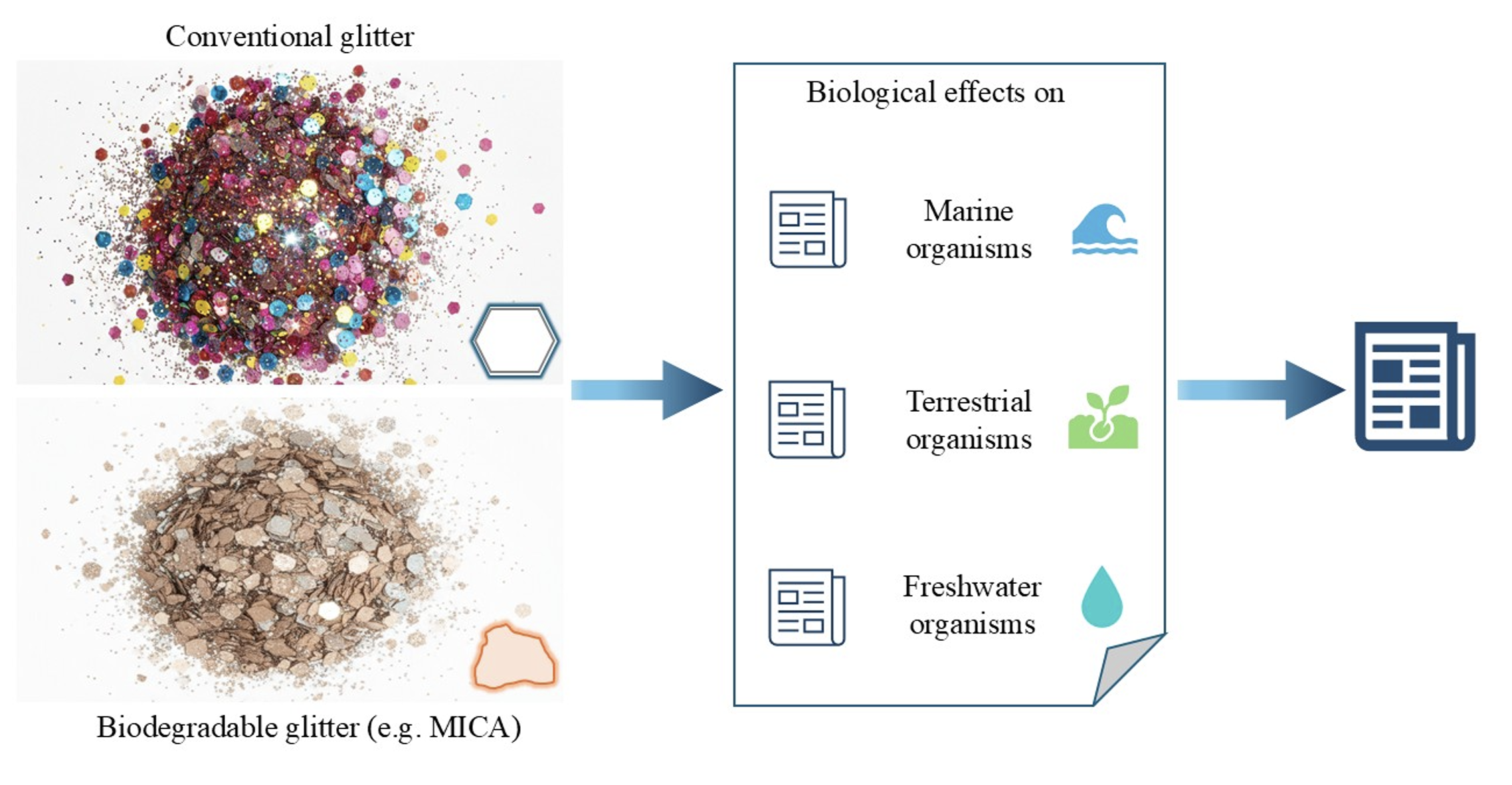
Ecotoxicological Effects of Conventional and Eco-Friendly Glitter: A Literature Review

 ,
,  ,
,  and
and 
Simple Summary
Abstract
1. Introduction: Conventional and Ecofriendly Glitter
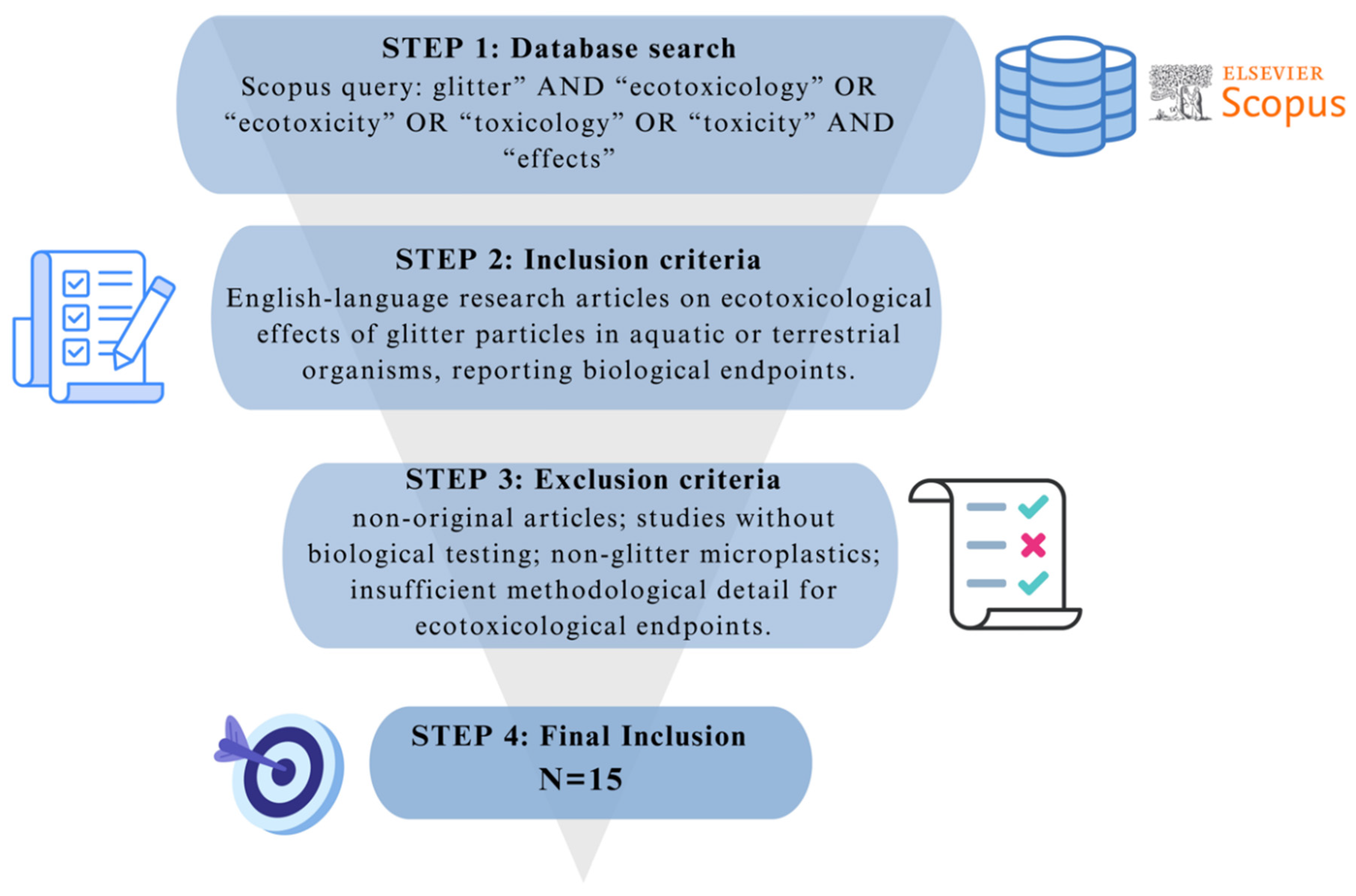
2. Methodology
3. Ecotoxicological Effects of Glitter
3.1. Ecotoxicity in Marine Organisms
3.1.1. Bacteria
3.1.2. Invertebrates
3.1.3. Microalgae and Cyanobacteria
3.2. Ecotoxicity in Freshwater Organisms
3.2.1. Invertebrates
3.2.2. Plants
3.2.3. Microalgae and Cyanobacteria
3.3. Ecotoxicity in Terrestrial Invertebrates
3.4. Preliminary Risk Tiering Framework for Glitter Materials
4. Conclusions
Author Contributions
Funding
Institutional Review Board Statement
Informed Consent Statement
Data Availability Statement
Acknowledgments
Conflicts of Interest
References
- Jolaosho, T.L.; Rasaq, M.F.; Omotoye, E.V.; Araomo, O.V.; Adekoya, O.S.; Abolaji, O.Y.; Hungbo, J.J. Microplastics in Freshwater and Marine Ecosystems: Occurrence, Characterization, Sources, Distribution Dynamics, Fate, Transport Processes, Potential Mitigation Strategies, and Policy Interventions. Ecotoxicol. Environ. Saf. 2025, 294, 118036. [Google Scholar] [CrossRef]
- Mishra, S.K.; Chowdhury, S.D.; Bhunia, P.; Sarkar, A.; Surampalli, R.Y.; Zhang, T.C. Degradation of Plastics and Formation of Primary and Secondary Microplastics. In Microplastics in the Environment; Wiley Online Library: Hoboken, NJ, USA, 2025; Available online: https://onlinelibrary.wiley.com/doi/abs/10.1002/9781394251100.ch3 (accessed on 13 April 2026).
- Henry, T.B.; Bucknall, D.G.; Catarino, A.I.; Gillanders, B.M.; Haave, M.; Kaminski, N.E.; Völker, C.; Wootton, N. Examining Misconceptions about Plastic-Particle Exposure from Ingestion of Seafood and Risk to Human Health. Environ. Sci. Technol. Lett. 2025, 12, 1453–1461. [Google Scholar] [CrossRef]
- Zorin, I.M.; Chelushkin, P.S.; Senchukova, A.S.; Fetin, P.A.; Kenny, J.M.; Lyulin, S.V. Study on Primary Microplastics in Cosmetics: Their Isolation, Spectral and Thermal Analysis. Anal. Methods 2025, 17, 4599–4606. [Google Scholar] [CrossRef]
- Song, J.; Wang, C.; Li, G. Defining Primary and Secondary Microplastics: A Connotation Analysis. ACS EST Water 2024, 4, 2330–2332. [Google Scholar] [CrossRef]
- Boots, B.; Green, D.S.; Olah-Kovacs, B.; De Falco, F.; Lupo, E. Physical and Chemical Effects of Conventional Microplastic Glitter versus Alternative Glitter Particles on a Freshwater Plant (Lemnaceae: Lemna minor). Ecotoxicol. Environ. Saf. 2023, 263, 115291. [Google Scholar] [CrossRef]
- Piccardo, M.; Anselmi, S.; Renzi, M. Journey into the Local Market in Search of “Glitter” Microparticles: Mini Product Investigation and Relative Chemical-Physical Characterization. Environments 2022, 9, 119. [Google Scholar] [CrossRef]
- Yurtsever, M. Glitters as a Source of Primary Microplastics: An Approach to Environmental Responsibility and Ethics. J. Agric. Environ. Ethics 2019, 32, 459–478. [Google Scholar] [CrossRef]
- Albanit, L.F.; Beverari, I.; CesarRibeiro, C.; Gimiliani, G.; Abessa, D. Toxicity of Glitter to Marine Organisms: A Baseline Study with Embryos of the Sand-Dollar Mellita quinquiesperforata. Int. Aquat. Res. 2023, 15, 181–189. [Google Scholar] [CrossRef]
- Provenza, F.; Anselmi, S.; Specchiulli, A.; Piccardo, M.; Barceló, D.; Prearo, M.; Pastorino, P.; Renzi, M. Sparkling Plastic: Effects of Exposure to Glitter on the Mediterranean Mussel Mytilus galloprovincialis. Environ. Toxicol. Pharmacol. 2022, 96, 103994. [Google Scholar] [CrossRef] [PubMed]
- Kar, M.K.; Önal, M.A.R.; Borra, C.R. Alumina recovery from bauxite residue: A concise review. Resour. Conserv. Recycl. 2023, 198, 107158. [Google Scholar] [CrossRef]
- Yurtsever, M. Tiny, shiny, and colorful microplastics: Are regular glitters a significant source of microplastics? Mar. Pollut. Bull. 2019, 146, 678–682. [Google Scholar] [CrossRef] [PubMed]
- Meirelles, J.V.; De Almeida, R.F.; Morgado, A.J.; De Castro, T.B.; Rocha, R.C.C.; Hauser-Davis, R.A.; Saint’Pierre, T.D. Metal and metalloid content, bioavailability and sorption processes in glitter and raw glitter materials and associations with human and ecological risk concerns. J. Trace Elem. Med. Biol. 2024, 82, 127350. [Google Scholar] [CrossRef]
- Piccardo, M.; Provenza, F.; Anselmi, S.; Renzi, M. Ecotoxicological Assessment of “Glitter” Leachates in Aquatic Ecosystems: An Integrated Approach. Toxics 2022, 10, 677. [Google Scholar] [CrossRef]
- Vernoud, L.; Bechtel, H.A.; Martin, M.C.; Reffner, J.A.; Blackledge, R.D. Characterization of Multilayered Glitter Particles Using Synchrotron FT-IR Microscopy. Forensic Sci. Int. 2011, 210, 47–51. [Google Scholar] [CrossRef]
- Blackledge, R.D. Forensic Analysis on the Cutting Edge: New Methods for Trace Evidence Analysis; John Wiley & Sons: Hoboken, NJ, USA, 2007. [Google Scholar]
- Reininger, A.S.W.; Tatsii, D.; Bhowmick, T.; Bagheri, G.; Stohl, A. The Atmospheric Settling of Commercially Sold Microplastics. Atmos. Meas. Tech. 2025, 25, 10691–10705. [Google Scholar] [CrossRef]
- Raju, S.; Carbery, M.; Kuttykattil, A.; Senthirajah, K.; Lundmark, A.; Rogers, Z.; Scb, S.; Evans, G.; Palanisami, T. Improved Methodology to Determine the Fate and Transport of Microplastics in a Secondary Wastewater Treatment Plant. Water Res. 2020, 173, 115549. [Google Scholar] [CrossRef]
- Ballent, A.; Corcoran, P.L.; Madden, O.; Helm, P.A.; Longstaffe, F.J. Sources and sinks of microplastics in Canadian Lake Ontario nearshore, tributary and beach sediments. Mar. Pollut. Bull. 2016, 110, 383–395. [Google Scholar] [CrossRef]
- Lusher, A.L.; Hurley, R.; Vogelsang, C.; Nizzetto, L.; Olsen, M. Mapping Microplastics in Sludge; NIVA Report; Norwegian Institute for Water Research (NIVA): Oslo, Norway, 2017; p. 7215-2017. [Google Scholar]
- Dehghani, S.; Moore, F.; Akhbarizadeh, R. Microplastic pollution in deposited urban dust, Tehran metropolis, Iran. Environ. Sci. Pollut. Res. 2017, 24, 20360–20371. [Google Scholar] [CrossRef]
- Lares, M.; Ncibi, M.C.; Sillanpää, M.; Sillanpää, M. Occurrence, identification and removal of microplastic particles and fibers in conventional activated sludge process and advanced MBR technology. Water Res. 2018, 133, 236–246. [Google Scholar] [CrossRef] [PubMed]
- Hurley, R.; Woodward, J.; Rothwell, J.J. Microplastic contamination of river beds significantly reduced by catchment-wide flooding. Nat. Geosci. 2018, 11, 251–257. [Google Scholar] [CrossRef]
- Sodré, G.I.; Martins, G.; Lopes, M.G.; Abude, R.R.S.; Augusto, M.; Cunha, M.M.; Branco, C.; Portugal, S.; Cabrini, T. Impact of large events on microplastic pollution on sandy beaches: A case study of Carnival in Rio de Janeiro, Brazil. Estuar. Coast. Shelf Sci. 2025, 327, 109582. [Google Scholar] [CrossRef]
- Zanini, M.L.d.O.; Fonseca, L.M.; Piecha, C.R.; Corrêa, C.d.P.L.; Dode, L.B.; Zavareze, E.d.R.; Diaz, P.S. A Review of Conventional and Environmentally Sustainable Glitter. Environ. Qual. Manag. 2024, 34, e22322. [Google Scholar] [CrossRef]
- Green, D.S.; Jefferson, M.; Boots, B.; Stone, L. All That Glitters Is Litter? Ecological Impacts of Conventional versus Biodegradable Glitter in a Freshwater Habitat. J. Hazard. Mater. 2021, 402, 124070. [Google Scholar] [CrossRef]
- Najjar, K.; Bridge, C.M. SEM-EDS Analysis and Characterization of Glitter and Shimmer Cosmetic Particles. Forensic Sci. Int. 2020, 317, 110527. [Google Scholar] [CrossRef]
- Da Costa, I.D.; Costa, L.L.; Da Silva Oliveira, A.; De Carvalho, C.E.V.; Zalmon, I.R. Microplastics in Fishes in Amazon Riverine Beaches: Influence of Feeding Mode and Distance to Urban Settlements. Sci. Total Environ. 2023, 863, 160934. [Google Scholar] [CrossRef] [PubMed]
- Abessa, D.M.D.S.; Gonçalves, A.R.N.; Ueda De Carvalho, M.; Spanghero, N.; Sales Soares Do Nascimento, N.; Fornari, M.; Perina, F.C.; Cruz, A.C.F. Not All That Glitters Is Gold: Glitter Causes Acute Toxicity to Nauplii of Artemia sp. Marit. Technol. Res. 2024, 6, 270722. [Google Scholar] [CrossRef]
- Doval-Miñarro, M.; López-Vivancos, A.; López-Castellanos, J.; Bayo, J. Characterization of Commercial Eco-Glitters Derived from Modified Regenerated Cellulose after Laboratory Exposure in Two Aquatic Media. Environ. Sci. Process. Impacts 2025, 27, 2329–2340. [Google Scholar] [CrossRef]
- Das Pramanik, D.; Lei, S.; Kay, P.; Goycoolea, F.M. Investigating on the Toxicity and Bio-Magnification Potential of Synthetic Glitters on Artemia salina. Mar. Pollut. Bull. 2023, 190, 114828. [Google Scholar] [CrossRef]
- Abessa, D.M.D.S.; Albanit, L.F.; Moura, P.H.P.D.; Nogueira, V.S.; Santana, F.T.; Fagundes, K.; Ueda, M.; Muller, O.P.D.O.; Cesar-Ribeiro, C. A Glow before Darkness: Toxicity of Glitter Particles to Marine Invertebrates. Toxics 2023, 11, 617. [Google Scholar] [CrossRef] [PubMed]
- Leite, H.S.; da Costa, J.R.; Calbo, B.B.; Capparelli, M.; Neves, C.; Gimiliani, G.T.; Augusto, A. Microplastic Impacts Physiological Mechanisms of Marine, Diadromous, and Freshwater Crustaceans. Comp. Biochem. Physiol. A Mol. Integr. Physiol. 2026, 311, 111946. [Google Scholar] [CrossRef]
- Machado, M.J.; Dextro, R.B.; Cruz, R.B.; Cotta, S.R.; Fiore, M.F. Response of Two Cyanobacterial Strains to Non-Biodegradable Glitter Particles. Aquat. Toxicol. 2023, 260, 106590. [Google Scholar] [CrossRef]
- Yoshida, L.L.; Bianchini, I., Jr.; Da Cunha-Santino, M.B. Interference of Glitter with the Photosynthetic Rates of a Submerged Macrophyte, Egeria densa. N. Z. J. Bot. 2025, 63, 507–520. [Google Scholar] [CrossRef]
- Wang, C.; Jiang, L.; Zhang, Y.; Wang, C.; He, M. Stealth Microplastics Pollutants: Toxicological Evaluation of Polyethylene Terephthalate-Based Glitters on the Microalga Desmodesmus sp. and Its Color Effect. Environ. Sci. Pollut. Res. 2023, 30, 95975–95987. [Google Scholar] [CrossRef]
- Trakić, T.; Popović, F.; Sekulić, J.; Hackenberger, D.K. Ecotoxicological Effects of Commercial Microplastics on Earthworm Eisenia fetida (Savigny, 1826) (Clitellata; Lumbricidae). Agriculture 2024, 14, 267. [Google Scholar] [CrossRef]
- Chen, P.-H.; Droguet, B.E.; Lam, I.; Green, D.S.; Vignolini, S.; Gu, Z.; De Silva, S.; Reichman, S.M. Assessing the Ecotoxicological Effects of Novel Cellulose Nanocrystalline Glitter Compared to Conventional Polyethylene Terephthalate Glitter: Toxicity to Springtails (Folsomia candida). Chemosphere 2024, 366, 143315. [Google Scholar] [CrossRef] [PubMed]
- Abbas, M.; Adil, M.; Ehtisham-ul-Haque, S.; Munir, B.; Yameen, M.; Ghaffar, A.; Shar, G.A.; Asif Tahir, M.; Iqbal, M. Vibrio fischeri Bioluminescence Inhibition Assay for Ecotoxicity Assessment: A Review. Sci. Total Environ. 2018, 626, 1295–1309. [Google Scholar] [CrossRef]
- Liu, C.; Qiu, J.; Tang, Z.; Hu, H.; Meng, F.; Li, A. Effects of Polystyrene Microplastics on Growth and Toxin Production of Alexandrium pacificum. Toxins 2021, 13, 293. [Google Scholar] [CrossRef] [PubMed]
- FAO (Food and Agriculture Organization of the United Nations). The State of World Fisheries and Aquaculture 2024; FAO: Rome, Italy, 2024. [CrossRef]
- Ofoe, R.; Thomas, R.H.; Asiedu, S.K.; Wang-Pruski, G.; Fofana, B.; Abbey, L. Aluminum in plant: Benefits, toxicity and tolerance mechanisms. Front. Plant Sci. 2023, 13, 1085998. [Google Scholar] [CrossRef]
- Ganzon-Fortes, E.T. Diurnal and Diel Patterns in the Photosynthetic Performance of the Agarophyte Gelidiella acerosa. Bot. Mar. 1997, 40, 93–100. [Google Scholar] [CrossRef]
- Lithner, D.; Larsson, Å.; Dave, G. Environmental and Health Hazard Ranking and Assessment of Plastic Polymers Based on Chemical Composition. Sci. Total Environ. 2011, 409, 3309–3324. [Google Scholar] [CrossRef]
- Yuan, Z.; Nag, R.; Cummins, E. Ranking of Potential Hazards from Microplastics Polymers in the Marine Environment. J. Hazard. Mater. 2022, 429, 128399. [Google Scholar] [CrossRef]
- Zimmermann, L.; Dombrowski, A.; Völker, C.; Wagner, M. Are Bioplastics and Plant-Based Materials Safer than Conventional Plastics? In Vitro Toxicity and Chemical Composition. Environ. Int. 2020, 145, 106066. [Google Scholar] [CrossRef] [PubMed]
- European Chemicals Agency (ECHA). Annex XV Restriction Report: Intentionally Added Microplastics. 2019. Available online: https://echa.europa.eu/hot-topics/microplastics (accessed on 26 May 2026).
- Zimmermann, L.; Dierkes, G.; Ternes, T.A.; Völker, C.; Wagner, M. Benchmarking the In Vitro Toxicity and Chemical Composition of Plastic Consumer Products. Environ. Sci. Technol. 2019, 53, 11467–11477. [Google Scholar] [CrossRef]
- Li, C.; Shi, L.; Liu, T.; Dong, K.; Ren, W.; Zhang, Y. Changes in Electron Distribution of Aged Microplastic and Their Environmental Impacts in Aquatic Environments. Environ. Geochem. Health 2025, 47, 124. [Google Scholar] [CrossRef] [PubMed]
- Gao, Y.; Gao, W.; Liu, Y.; Zou, D.; Li, Y.; Lin, Y.; Zhao, J. A Comprehensive Review of Microplastic Aging: Laboratory Simulations, Physicochemical Properties, Adsorption Mechanisms, and Environmental Impacts. Sci. Total Environ. 2024, 957, 177427. [Google Scholar] [CrossRef]
- Lee, Y.K.; Badalge, N.D.K.; He, W.; Guo, H.; Hur, J. Impacts of Climatic Stressors on Dissolved Organic Matter Leaching from Microplastics and Their Effects on Biogeochemical Processes: A Review. Water Res. 2025, 271, 122867. [Google Scholar] [CrossRef]
- Pastorino, P. Ecotoxicology Undergoing Transition: Addressing the Complex Challenges of Global Change. Environ. Int. 2025, 205, 109890. [Google Scholar] [CrossRef] [PubMed]


| Location | Environmental Matrix | Glitter Occurrence | Main Findings | Reference |
|---|---|---|---|---|
| Lake Ontario, Canada | Lake and beach sediments | Glitter particle identified among environmental microplastics | One of the earliest reports explicitly identifying glitter in environmental sediments | Ballent et al. [19] |
| Norway | Sewage sludge | Glitter represented ~1.7% of microplastics in sludge | Demonstrated accumulation of glitter in wastewater sludge | Lusher et al. [20] |
| Tehran, Iran | Urban deposited dust | Glitter-like particles detected in atmospheric fallout | Evidence of atmospheric transport of glitter-derived plastics | Dehghani et al. [21] |
| Finland | WWTP effluent and receiving waters | Glitter particles observed throughout treatment stages | WWTPs act as pathways and partial sinks for glitter particles | Lares et al. [22] |
| United Kingdom | River sediments | Glitter particles reported qualitatively | Demonstrated occurrence of glitter in freshwater sediments | Hurley et al. [23] |
| Newcastle, Australia | Raw wastewater, waste activated sludge, treated effluent | Glitter constituted ~24% of MPs in sludge and 2.41% in effluent | First study specifically investigating the fate of glitter during wastewater treatment | Raju et al. [18] |
| Rio de Janeiro, Brazil | Beach sand | Glitter and glitter-derived fragments increased after Carnival celebrations | Direct release of cosmetic glitter to coastal environments | Sodré et al. [24] |
| Organism | Glitter Color | Glitter Shape | Glitter Polymer | Size (µm) | Concentration | Effects | Major Findings | Reference |
|---|---|---|---|---|---|---|---|---|
| Marine | ||||||||
| Aliivibrio fisceri | Gray, yellow, pink, orange, violet, green pink, gold | Star, hexagon, rectangle, pentagon hexagon | PMMA, PE, PA, PET modified regenerated cellulose | 241.3–3073.8 500–1000 | 31.3–61.2% bioluminescence inhibition; hormesis (in marine medium); 21.3% bioluminescence inhibition (in freshwater medium); No effects | Piccardo et al. [7] Doval-Miñarro et al. [30] | ||
| Artemia sp. | White | MA-VC | 0.06–500 | 0.1 mg/L LOEC; LC50 48 h 0.35 mg/L | Abessa et al. [29] | |||
| Artemia salina Brine shrimp | Silver | PET | 10, 50, 100 mg/L | Lesions in the intestine; accumulation in the digestive tract; | 14.78 mg/L LD50 | Das Pramanik et al. [31] | ||
| Echinometra lcunter Rock urchin | Green, white | MA-VC | 2–6, 60–2000 | EC50, NOEC, LOEC 272.2, 200, 300 mg/L respectively (white) 105.9, <50, 50 mg/L respectively (green) | Abessa et al. [32] | |||
| Arbacia lixula Black sea uchin | Green | MA-VC | 2–6, 60–2000 | EC50, NOEC, LOEC 246.1, 100, 200 mg/L respectively | Abessa et al. [32] | |||
| Paracentrotus lividus Purple sea uchin | Gray, yellow, pink, orange, violet, green | Star, hexagon, rectangle, pentagon | PMMA, PE, PA, PET | 241.3–3073.8 | developmental delays and abnormalities | Piccardo et al. [7] | ||
| Mellita quinquiesperforata Keyhole sand dollar | White, green | MA-VC | 2–6, 60–2000 | 0.01, 0.1, 1, 10, 100 mg/L | morphological anomalies; alteration/delay in development | 0.01 mg/L LOEC; | Albanit et al. [9] | |
| Perna perna Brown mussel | Green, white | MA-VC | 2–6, 60–2000 | abnormalities in embryonic development at concentrations < 10 mg/L | EC50, NOEC, LOEC NC, <10, 10 mg/L (white) respectively 23, <10, 10 mg/L (green) respectively | Abessa et al. [32] | ||
| Mytilus galloprovincialis Mediterranean mussel | Gray, yellow, pink, orange, violet, green | Star, hexagon, rectangle, pentagon | PMMA, PE, PA, PET | 241.3–3073.8 | 12.5, 25 particles/L | Smaller particles accumulation; SOD, GPx, MDA significant oxidative responses, GST unchanged | Provenza et al. [10] | |
| Penaeus vanamei Whiteleg shrimp | white | methyl acrylate | 80 | 0, 0.4, 4, 40 mg/L | Mortality; oxygen consumption increase; ammonia excretion increase; mixture of proteins and lipids as energy source; gill lamellae bifurcation, detachment of the lamellar epithelium, interstitial edema, intestinal mucosa rupture, muscle tissue rupture, submucosal tissue increase | Leite et al. [33] | ||
| Macrobrachium amazonicum Amazon River prawn | white | methyl acrylate | 80 | 0, 0.4, 4, 40 mg/L | No mortality; oxygen consumption decrease, 70%; ammonia excretion increase; hemolymph osmolality reduced | Leite et al. [33] | ||
| Macrobrachium potiuna Brazilian freshwater prawn | white | methyl acrylate | 80 | 0, 0.4, 4, 40 mg/L | No mortality; decrease in oxygen consumption, 20%; ammonia excretion increase; hemolymph osmolality not affected | Leite et al. [33] | ||
| Nodularia spumigena Cyanobacteria | non-biodegradable | 277–1035 | 0–350 mg/L | Max growth at 100 mg/L; reduced cell density > 137.5 mg/L | Machado et al. [34] | |||
| Phaeodactylum tricornutum Marine pennate diatom | Gray, yellow, pink, orange, violet, green | Star, hexagon, rectangle, pentagon | PMMA, PE, PA, PET | 241.3–3073.8 | highly variable responses; hormesis; | Piccardo et al. [7] | ||
| Freshwater | ||||||||
| Daphnia magna Water flea | Gray, yellow, pink, orange, violet, green | Star, hexagon, rectangle, pentagon | PMMA, PE, PA, PET | 241.3–3073.8 | low sensitivity; | Piccardo et al. [7] | ||
| Potamopyrgus antipodarum New Zealand mud snail | Silver | PET, MRC, mica and synthetic mica | 500 mg/L | Growth rate increase; | Green et al. [26] | |||
| Lemna minor Common ducweed | PET | 10, 100, 1000 mg/L | root length increase; | Boots et al. [6] | ||||
| Egeria densa Brazilian waterweed | Green | non-biodegradable | 40 mg/L | Net (1.5-fold) and gross photosynthesis reduction | Yoshida et al. [34,35] | |||
| Raphidocelis subcapitata Green algae | Gray, yellow, pink, orange, violet, green | Star, hexagon, rectangle, pentagon | PMMA, PE, PA, PET | 241.3–3073.8 | 15.1% growth inhibition, 20.8% biostimulation; | Piccardo et al. [7] | ||
| Desmodesmus sp. Green algae | Silver, black, red, green, blue | PET | 150 | 50 mg/L | 4.9–6.2% reduction photosynthetic fluorescence parameters (ΦPSII, α, rETRmax) SOD activity increased; CAT and POD activity inhibited, 150.3% MDA content; 12.5% growth inhibition; 8.1% chlorophyll content | Wang et al. [36] | ||
| Microcystis aeruginosa Cyanobacteria | non-biodegradable | 277–1035 | 0, 50, 100, 200, 350 mg/L | Growth peak at 50 mg/L; lowest biomass at 200 mg/L; 0.25 μg/mL carotenoids decreased at 200–350 mg/L; dose-dependent increase cell biovolume | Machado et al. [34] | |||
| Phytoplankton | Silver | PET, MRC, mica and synthetic mica | 500 mg/L | no change in chlorophyll a; twofold increase in chlorophyll c in PET glitter–treated samples | Green et al. [26] | |||
| Terrestrial | ||||||||
| Eisenia fetida Red wiggler worm | Hexagonal, square, rectangular | BoPET | 7500, 15,000, 21,000 mg/Kg | mortality increased at 5% and 7%; lethargy at higher concentrations; particle presence in digestive tract | Trakić et al. [37] | |||
| Folsomia candida White springtail | Silver, multicolored | Hexagonal, irregular | PET, CNC | ~100, ~64–177 | 82–96% survival; no differences between treatments in adult body length; 61% reduced reproduction at 1000 mg/Kg PET glitter | Chen et al. [38] |
Disclaimer/Publisher’s Note: The statements, opinions and data contained in all publications are solely those of the individual author(s) and contributor(s) and not of MDPI and/or the editor(s). MDPI and/or the editor(s) disclaim responsibility for any injury to people or property resulting from any ideas, methods, instructions or products referred to in the content. |
© 2026 by the authors. Licensee MDPI, Basel, Switzerland. This article is an open access article distributed under the terms and conditions of the Creative Commons Attribution (CC BY) license.
Share and Cite
Futia, S.; Pastorino, P.; Solé, M.; Caldaroni, B.; Gentile, R.; Dörr, A.J.M.; Prearo, M.; Renzi, M.; Elia, A.C. Ecotoxicological Effects of Conventional and Eco-Friendly Glitter: A Literature Review. Biology 2026, 15, 889. https://doi.org/10.3390/biology15110889
Futia S, Pastorino P, Solé M, Caldaroni B, Gentile R, Dörr AJM, Prearo M, Renzi M, Elia AC. Ecotoxicological Effects of Conventional and Eco-Friendly Glitter: A Literature Review. Biology. 2026; 15(11):889. https://doi.org/10.3390/biology15110889
Chicago/Turabian StyleFutia, Sara, Paolo Pastorino, Montserrat Solé, Barbara Caldaroni, Rebecca Gentile, Ambrosius Josef Martin Dörr, Marino Prearo, Monia Renzi, and Antonia Concetta Elia. 2026. "Ecotoxicological Effects of Conventional and Eco-Friendly Glitter: A Literature Review" Biology 15, no. 11: 889. https://doi.org/10.3390/biology15110889
APA StyleFutia, S., Pastorino, P., Solé, M., Caldaroni, B., Gentile, R., Dörr, A. J. M., Prearo, M., Renzi, M., & Elia, A. C. (2026). Ecotoxicological Effects of Conventional and Eco-Friendly Glitter: A Literature Review. Biology, 15(11), 889. https://doi.org/10.3390/biology15110889