Genetic and Environmentally Induced Scalation Variation in Bisexual and Parthenogenetic Lizards

Simple Summary
Abstract
1. Introduction
2. Materials and Methods
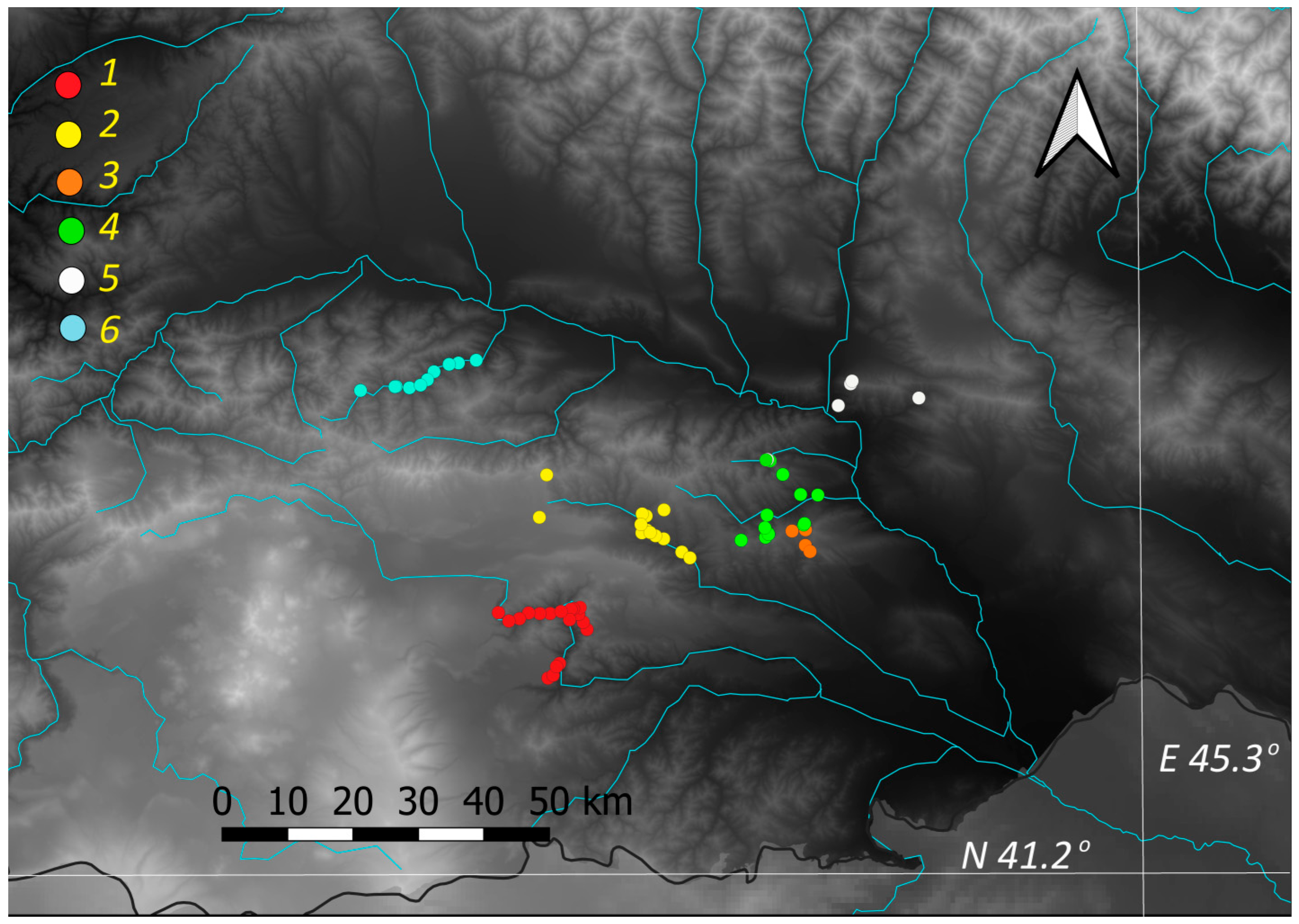
2.1. Studied System
2.2. Scoring Microsatellite Genotypes
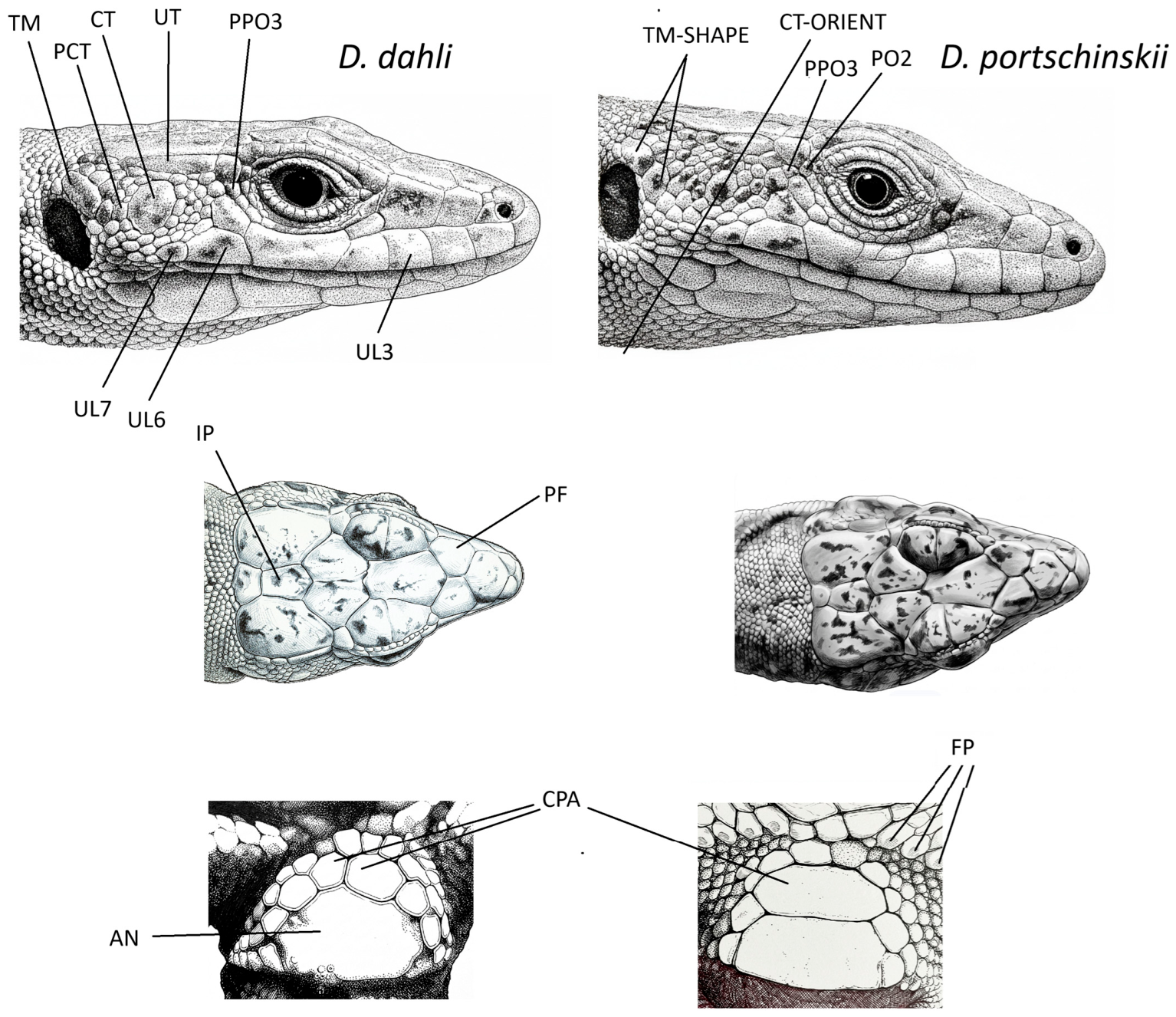
2.3. Describing Scalation
2.4. Data Analysis
2.4.1. Variability Within the Metapopulations
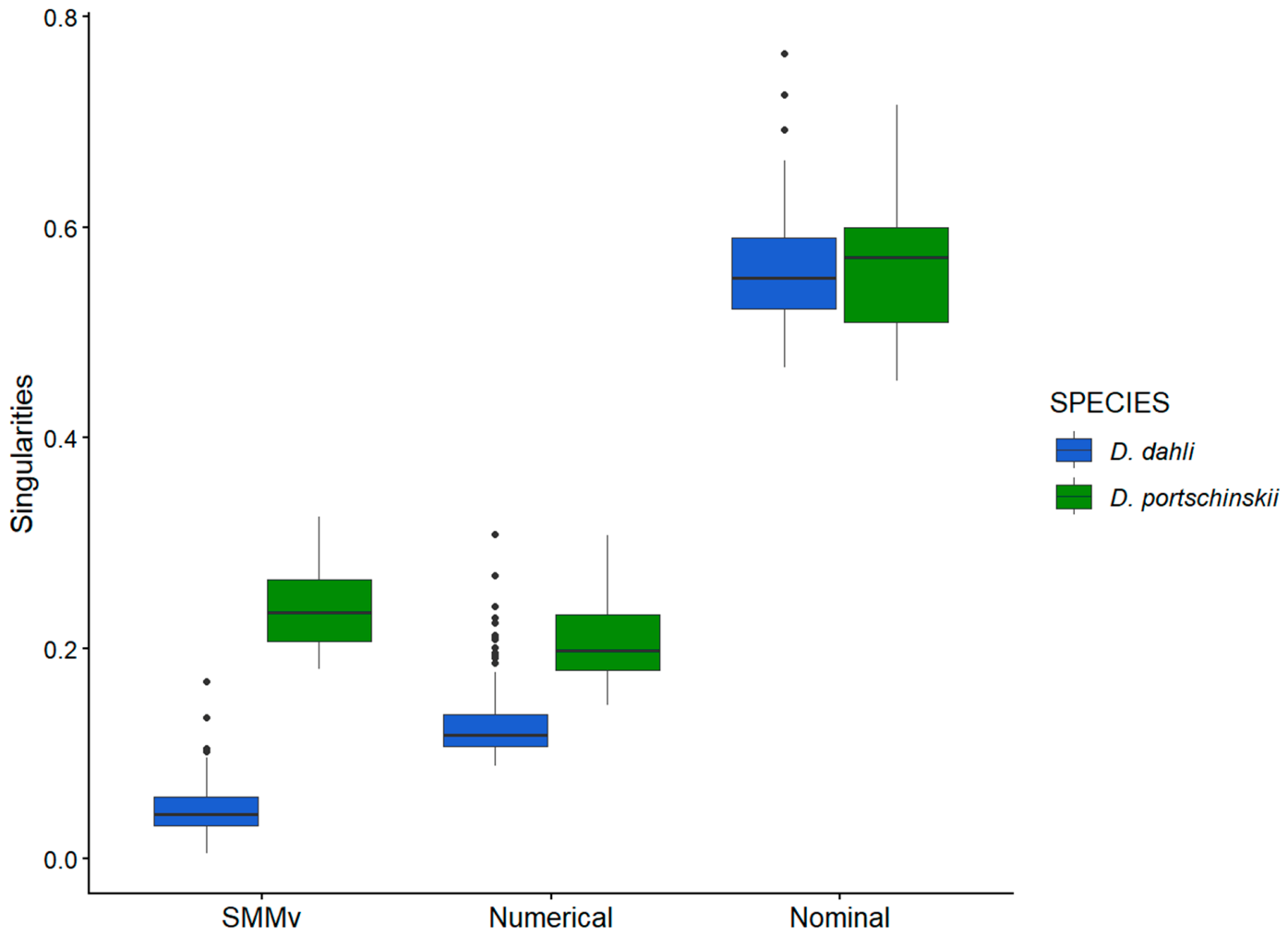
2.4.2. Uniqueness of Individuals and Metapopulations
2.4.3. Variability Among the Metapopulations
2.4.4. Association of Dissimilarities Between Phenotypes, Genotypes and Environmental Conditions
2.4.5. Association Analysis of Individual and Climate Differences, and Comparison of Phenotypic, Genotypic and Geographic Distances Between Metapopulations
2.5. Software Used
3. Results
3.1. Variability Within Each Species and Metapopulations
3.2. Differentiation Among Species and Metapopulations
3.3. Uniqueness of Individuals and Metapopulations
3.4. Association Between Individual Phenotypic and Genotypic Differences
3.5. Association of Genotypes and Phenotypes with Geography and Environmental Variables
4. Discussion
5. Conclusions
Supplementary Materials
Author Contributions
Funding
Institutional Review Board Statement
Informed Consent Statement
Data Availability Statement
Acknowledgments
Conflicts of Interest
References
- Green, R.F.; Noakes, D.L. Is a little bit of sex as good as a lot? J. Theor. Biol. 1995, 174, 87–96. [Google Scholar] [CrossRef]
- Knobil, E.; Neill, J.D. (Eds.) Encyclopedia of Reproduction; Academic Press: New York, NY, USA, 1998. [Google Scholar]
- Maynard Smith, J. Evolutionary Genetics; Oxford University Press: Oxford, UK, 1998. [Google Scholar]
- Bell, G. Selection: The Mechanism of Evolution; OUP: Oxford, UK, 2008. [Google Scholar]
- Glesener, R.R.; Tilman, D. Sexuality and the components of environmental uncertainty: Clues from geographic parthenogenesis in terrestrial animals. Am. Nat. 1978, 112, 659–673. [Google Scholar] [CrossRef]
- Kearney, M.; Shine, R. Developmental success, stability, and plasticity in closely related parthenogenetic and sexual lizards (Heteronotia, Gekkonidae). Evolution 2004, 58, 1560–1572. [Google Scholar] [CrossRef]
- Vrijenhoek, R.C.; Parker, E.D. Geographical parthenogenesis: General purpose genotypes and frozen niche variation. In Lost Sex: The Evolutionary Biology of Parthenogenesis; Schön, I., Martens, K., van Dijk, P., Eds.; Springer: Dordrecht, The Netherlands, 2009; pp. 99–131. [Google Scholar]
- Bell, G. The Masterpiece of Nature: The Evolution and Genetics of Sexuality; University of California Press: Oakland, CA, USA, 1982. [Google Scholar]
- Heimpel, G.E.; De Boer, J.G. Sex determination in the Hymenoptera. Annu. Rev. Entomol. 2008, 53, 209–230. [Google Scholar] [CrossRef]
- Simon, J.C.; Stoeckel, S.; Tagu, D. Evolutionary and functional insights into reproductive strategies of aphids. Comptes Rendus Biol. 2010, 333, 488–496. [Google Scholar] [CrossRef]
- Pandian, T.J. Reproduction and Development in Crustacea; CRC Press: Boca Raton, FL, USA, 2016. [Google Scholar]
- Subramoniam, T. Mode of reproduction: Invertebrate animals. Encycl. Reprod. 2018, 6, 32–40. [Google Scholar]
- Tarkhnishvili, D.; Yanchukov, A.; Böhne, A. Advantages, limitations, and evolutionary constraints of asexual reproduction: An empirical approach. Front. Ecol. Evol. 2023, 11, 1184306. [Google Scholar] [CrossRef]
- Mittwoch, U. Parthenogenesis. J. Med. Genet. 1978, 15, 165. [Google Scholar] [CrossRef]
- Neaves, W.B.; Baumann, P. Unisexual reproduction among vertebrates. Trends Genet. 2011, 27, 81–88. [Google Scholar] [CrossRef]
- Lampert, K.P. Facultative parthenogenesis in vertebrates: Reproductive error or chance? Sex. Dev. 2009, 2, 290–301. [Google Scholar] [CrossRef]
- Suomalainen, E.; Saura, A.; Lokki, J. Cytology and Evolution in Parthenogenesis; CRC Press: Boca Raton, FL, USA, 1987. [Google Scholar]
- Kearney, M.; Fujita, M.K.; Ridenour, J. Lost sex in the reptiles: Constraints and correlations. In Lost Sex: The Evolutionary Biology of Parthenogenesis; Schön, I., Martens, K., van Dijk, P., Eds.; Springer: Dordrecht, The Netherlands, 2009; pp. 447–474. [Google Scholar]
- da Barbiano, L.A.; Gompert, Z.; Aspbury, A.S.; Gabor, C.R.; Nice, C.C. Population genomics reveals a possible history of backcrossing and recombination in the gynogenetic fish Poecilia formosa. Proc. Natl. Acad. Sci. USA 2013, 110, 13797–13802. [Google Scholar] [CrossRef]
- Warren, W.C.; García-Pérez, R.; Xu, S.; Lampert, K.P.; Chalopin, D.; Stöck, M.; Loewe, L.; Lu, Y.; Kuderna, L.; Minx, P.; et al. Clonal polymorphism and high heterozygosity in the celibate genome of the Amazon molly. Nat. Ecol. Evol. 2018, 2, 669–679. [Google Scholar] [CrossRef]
- Cole, C.J.; Hardy, L.M.; Dessauer, H.C.; Taylor, H.L.; Townsend, C.R. Laboratory hybridization among North American whiptail lizards, including Aspidoscelis inornata arizonae× A. tigris marmorata (Squamata: Teiidae), ancestors of unisexual clones in nature. Am. Mus. Novit. 2010, 2010, 1–43. [Google Scholar] [CrossRef][Green Version]
- Cole, C.J.; Dessauer, H.C.; Paulissen, M.A.; Walker, J.M. Hybridization between whiptail lizards in Texas: Aspidoscelis laredoensis and A. gularis, with notes on reproduction of a hybrid. Am. Mus. Novit. 2020, 2020, 1–13. [Google Scholar] [CrossRef]
- Tarkhnishvili, D.; Murtskhvaladze, M.; Anderson, C.L. Coincidence of genotypes at two loci in two parthenogenetic rock lizards: How backcrosses might trigger adaptive speciation. Biol. J. Linn. Soc. 2017, 121, 365–378. [Google Scholar] [CrossRef]
- Tarkhnishvili, D.; Yanchukov, A.; Şahin, M.K.; Gabelaia, M.; Murtskhvaladze, M.; Candan, K.; Galoyan, E.; Arakelyan, M.; Iankoshvili, G.; Kumlutaş, Y.; et al. Genotypic similarities among the parthenogenetic Darevskia rock lizards with different hybrid origins. BMC Evol. Biol. 2020, 20, 122. [Google Scholar] [CrossRef]
- Kondrashov, A.S. Deleterious mutations and the evolution of sexual reproduction. Nature 1988, 336, 435–440. [Google Scholar] [CrossRef]
- Darevsky, I.S. Skal’nye Yashcheritsy Kavkaza; Nauka: Leningrad, Russia, 1967. (In Russian) [Google Scholar]
- Murphy, R.W.; Fu, J.; MacCulloch, R.D.; Darevsky, I.S.; Kupriyanova, L.A. A fine line between sex and unisexuality: The phylogenetic constraints on parthenogenesis in lacertid lizards. Zool. J. Linn. Soc. 2000, 130, 527–549. [Google Scholar] [CrossRef]
- Tarkhnishvili, D. Evolutionary history, habitats, diversification, and speciation in Caucasian rock lizards. Adv. Zool. Res. 2012, 2, 79–120. [Google Scholar]
- Freitas, S.; Rocha, S.; Campos, J.; Ahmadzadeh, F.; Corti, C.; Sillero, N.; Ilgaz, Ç.; Kumlutaş, Y.; Arakelyan, M.; Harris, D.J.; et al. Parthenogenesis through the ice ages: A biogeographic analysis of Caucasian rock lizards (genus Darevskia). Mol. Phylogenet. Evol. 2016, 102, 117–127. [Google Scholar] [CrossRef]
- Dedukh, D.; Altmanová, M.; Petrosyan, R.; Arakelyan, M.; Galoyan, E.; Kratochvíl, L. Premeiotic endoreplication is the mechanism of obligate parthenogenesis in rock lizards of the genus Darevskia. Biol. Lett. 2024, 20, 20240070. [Google Scholar] [CrossRef]
- Yanchukov, A.; Tarkhnishvili, D.; Erdolu, M.; Şahin, M.K.; Candan, K.; Murtskhvaladze, M.; Gabelaia, M.; Iankoshvili, G.; Barateli, N.; Ilgaz, Ç.; et al. Precise paternal ancestry of hybrid unisexual ZW lizards (genus Darevskia: Lacertidae: Squamata) revealed by Z-linked genomic markers. Biol. J. Linn. Soc. 2022, 136, 293–305. [Google Scholar] [CrossRef]
- Tarkhnishvili, D.; Avaliani, A.; Gavashelishvili, A.; Murtskhvaladze, M.; Mumladze, L. Unisexual rock lizard might be outcompeting its bisexual progenitors in the Caucasus. Biol. J. Linn. Soc. 2010, 101, 447–460. [Google Scholar] [CrossRef]
- Tarkhnishvili, D.; Barateli, N.; Murtskhvaladze, M.; Iankoshvili, G. Estimating phenotypic heritability of sexual and unisexually reproducing rock lizards (genus Darevskia). Zool. Anz. 2020, 285, 105–113. [Google Scholar] [CrossRef]
- Goldschmidt, R.B. Gen und Außeneigenschaft: (Untersuchungen an Drosophila) II. Z. Indukt. Abstamm. Vererbungslehre 1935, 69, 70–131. [Google Scholar]
- Lenz, W. Phenocopies. J. Med. Genet. 1973, 10, 34. [Google Scholar] [CrossRef]
- Wright, S. Evolution and the Genetics of Populations, Volume 1: Genetic and Biometric Foundations; University of Chicago Press: Chicago, IL, USA, 1984. [Google Scholar]
- Goldschmidt, R.B. Phenocopies. Sci. Am. 1949, 181, 46–49. [Google Scholar] [CrossRef]
- Falconer, D.S. Selection in different environments: Effects on environmental sensitivity (reaction norm) and on mean performance. Genet. Res. 1990, 56, 57–70. [Google Scholar] [CrossRef]
- West-Eberhard, M.J. Developmental Plasticity and Evolution; Oxford University Press: Oxford, UK, 2003. [Google Scholar]
- Burggren, W.W.; Mendez-Sanchez, J.F. “Bet hedging” against climate change in developing and adult animals: Roles for stochastic gene expression, phenotypic plasticity, epigenetic inheritance and adaptation. Front. Physiol. 2023, 14, 1245875. [Google Scholar] [CrossRef]
- Korchagin, V.I.; Badaeva, T.N.; Tokarskaya, O.N.; Martirosyan, I.A.; Darevsky, I.S.; Ryskov, A.P. Molecular characterization of allelic variants of (GATA)n microsatellite loci in parthenogenetic lizards Darevskia unisexualis (Lacertidae). Gene 2007, 392, 126–133. [Google Scholar] [CrossRef]
- Waits, L.P.; Luikart, G.; Taberlet, P. Estimating the probability of identity among genotypes in natural populations: Cautions and guidelines. Mol. Ecol. 2001, 10, 249–256. [Google Scholar] [CrossRef]
- Miller, C.R.; Joyce, P.; Waits, L.P. Assessing allelic dropout and genotype reliability using maximum likelihood. Genetics 2002, 160, 357–366. [Google Scholar] [CrossRef]
- Pompanon, F.; Bonin, A.; Bellemain, E.; Taberlet, P. Genotyping errors: Causes, consequences and solutions. Nat. Rev. Genet. 2005, 6, 847–859. [Google Scholar] [CrossRef]
- Kosman, E. Difference and diversity of plant pathogen populations: A new approach for measuring. Phytopathology 1996, 86, 1152–1155. [Google Scholar]
- Kosman, E.; Leonard, K.J. Conceptual analysis of methods applied to assessment of diversity within and distance between populations with asexual or mixed mode of reproduction. New Phytol. 2007, 174, 683–696. [Google Scholar] [CrossRef]
- Kosman, E. Measuring diversity: From individuals to populations. Eur. J. Plant Pathol. 2014, 138, 467–486. [Google Scholar] [CrossRef]
- Sneath, P.A.; Sokal, R.R. Numerical Taxonomy; W. H. Freeman: San Francisco, CA, USA, 1973. [Google Scholar]
- Kosman, E.; Leonard, K.J. Similarity coefficients for molecular markers in studies of genetic relationships between individuals for haploid, diploid, and polyploid species. Mol. Ecol. 2005, 14, 415–424. [Google Scholar] [CrossRef]
- Kosman, E.; Jokela, J. Dissimilarity of individual microsatellite profiles under different mutation models—Empirical approach. Ecol. Evol. 2019, 9, 4038–4054. [Google Scholar] [CrossRef]
- Scheiner, S.M.; Kosman, E.; Presley, S.J.; Willig, M.R. Decomposing functional diversity. Methods Ecol. Evol. 2017, 8, 809–820. [Google Scholar] [CrossRef]
- Kosman, E.; Chen, X.; Dreiseitl, A.; McCallum, B.; Lebeda, A.; Ben-Yehuda, P.; Gultyaeva, E.; Manisterski, J. Functional variation of plant–pathogen interactions: New concept and methods for virulence data analyses. Phytopathology 2019, 109, 1324–1330. [Google Scholar] [CrossRef]
- Sun, X.; Kosman, E.; Sharon, O.; Ezrati, S.; Sharon, A. Significant host- and environment-dependent differentiation among highly sporadic fungal endophyte communities in cereal crops-related wild grasses. Environ. Microbiol. 2020, 22, 3357–3374. [Google Scholar] [CrossRef]
- Kosman, E.; Burgio, K.R.; Presley, S.J.; Willig, M.R.; Scheiner, S.M. Conservation prioritization based on trait-based metrics illustrated with global parrot distributions. Divers. Distrib. 2019, 25, 1156–1165. [Google Scholar] [CrossRef]
- Gultyaeva, E.I.; Shaydayuk, E.L.; Kosman, E. Regional and temporal differentiation of virulence phenotypes of Puccinia triticina Eriks. from common wheat in Russia during the period 2001–2018. Plant Pathol. 2020, 69, 860–871. [Google Scholar] [CrossRef]
- Czajowski, G.; Kosman, E.; Słowacki, P.; Park, R.F.; Czembor, P. Assessing new SSR markers for utility and informativeness in genetic studies of brown rust fungi on wheat, triticale, and rye. Plant Pathol. 2021, 70, 1110–1122. [Google Scholar] [CrossRef]
- Kosman, E.; Ben-Yehuda, P.; Manisterski, J. Diversity of virulence phenotypes among annual populations of wheat leaf rust in Israel from 1993 to 2008. Plant Pathol. 2014, 63, 563–571. [Google Scholar] [CrossRef]
- Kosman, E.; Feijen, F.; Jokela, J. Effective number of different populations: A new concept and how to use it. Ecol. Evol. 2024, 14, e70303. [Google Scholar] [CrossRef]
- Legendre, P.; Fortin, M.-J.; Borcard, D. Should the Mantel test be used in spatial analysis? Methods Ecol. Evol. 2015, 6, 1239–1247. [Google Scholar] [CrossRef]
- Legendre, P.; Anderson, M.J. Distance-based redundancy analysis: Testing multispecies responses in multifactorial ecological experiments. Ecol. Monogr. 1999, 69, 1–24. [Google Scholar] [CrossRef]
- Dray, S.; Legendre, P.; Peres-Neto, P.R. Spatial modelling: A comprehensive framework for principal coordinate analysis of neighbour matrices. Ecol. Model. 2006, 196, 483–493. [Google Scholar] [CrossRef]
- Fick, S.E.; Hijmans, R.J. WorldClim 2: New 1-km spatial resolution climate surfaces for global land areas. Int. J. Climatol. 2017, 37, 4302–4315. [Google Scholar] [CrossRef]
- Oksanen, J.; Simpson, G.L.; Blanchet, F.G.; Kindt, R.; Legendre, P.; Minchin, P.R.; O’Hara, R.B.; Solymos, P.; Stevens, M.H.H.; Szoecs, E.; et al. Vegan: Community Ecology Package, R package version 2.8-0; Comprehensive R Archive Network: Vienna, Austria, 2026.
- Dray, S.; Bauman, D.; Blanchet, G.; Borcard, D.; Clappe, S.; Guenard, G.; Jombart, T.; Larocque, G.; Legendre, P.; Madi, N.; et al. Adespatial: Multivariate Multiscale Spatial Analysis, R package version 0.3-29; Comprehensive R Archive Network: Vienna, Austria, 2026.
- Microsoft Corporation. Microsoft Excel, Version 16.0; Microsoft Corporation: Redmond, WA, USA, 2021. Available online: https://www.microsoft.com/ (accessed on 26 May 2026).
- IBM Corp. IBM SPSS Statistics for Windows, Version 29.0; IBM Corp.: Armonk, NY, USA, 2022.
- Wright, S. Isolation by distance. Genetics 1943, 28, 114. [Google Scholar] [CrossRef]
- Slatkin, M. Inbreeding coefficients and coalescence times. Genet. Res. 1991, 58, 167–175. [Google Scholar] [CrossRef]
- Weir, B.S. Genetic Data Analysis: Methods for Discrete Population Genetic Data; Springer: New York, NY, USA, 1990. [Google Scholar]
- Slatkin, M. Isolation by distance in equilibrium and non-equilibrium populations. Evolution 1993, 47, 264–279. [Google Scholar] [CrossRef]
- Wright, J.W.; Lowe, C.H. Weeds, polyploids, parthenogenesis, and the geographical and ecological distribution of all-female species of Cnemidophorus. Copeia 1968, 1968, 128–138. [Google Scholar] [CrossRef]
- Moritz, C. The origin and evolution of parthenogenesis in Heteronotia binoei (Gekkonidae): Evidence for recent and localized origins of widespread clones. Genetics 1991, 129, 211–219. [Google Scholar] [CrossRef]
- Barateli, N.; Iankoshvili, G.; Tarkhnishvili, D.; Kokiashvili, L. Reproductive effort of unisexual and bisexual rock lizards (genus Darevskia). Zool. Anz. 2022, 301, 196–204. [Google Scholar] [CrossRef]
- Jablonka, E.; Lamb, M.J. Epigenetic Inheritance and Evolution: The Lamarckian Dimension; Oxford University Press: Oxford, UK, 1995. [Google Scholar]
- Pfennig, D.W.; Wund, M.A.; Snell-Rood, E.C.; Cruickshank, T.; Schlichting, C.D.; Moczek, A.P. Phenotypic plasticity’s impacts on diversification and speciation. Trends Ecol. Evol. 2010, 25, 459–467. [Google Scholar] [CrossRef]
- Scoville, A.G.; Pfrender, M.E. Phenotypic plasticity facilitates recurrent rapid adaptation to introduced predators. Proc. Natl. Acad. Sci. USA 2010, 107, 4260–4263. [Google Scholar] [CrossRef]
- Nijhout, H.F.; Davidowitz, G. Developmental perspectives on phenotypic variation, canalization, and fluctuating asymmetry. In Developmental Instability: Causes and Consequences; Markow, T.A., Ed.; Oxford University Press: New York, NY, USA, 2003; pp. 3–13. [Google Scholar]
- Fusco, G.; Minelli, A. Phenotypic plasticity in development and evolution: Facts and concepts. Philos. Trans. R. Soc. B Biol. Sci. 2010, 365, 547–556. [Google Scholar] [CrossRef]
- Sakich, N.B.; Tattersall, G.J. Bearded dragons (Pogona vitticeps) with reduced scalation lose water faster but do not have substantially different thermal preferences. J. Exp. Biol. 2021, 224, jeb234427. [Google Scholar] [CrossRef]
- Leary, R.F.; Allendorf, F.W.; Knudsen, K.L. Developmental instability and high meristic counts in interspecific hybrids of salmonid fishes. Evolution 1985, 39, 1318–1326. [Google Scholar] [CrossRef]
- Markow, T.A. Evolutionary ecology and developmental instability. Annu. Rev. Entomol. 1995, 40, 105–120. [Google Scholar] [CrossRef]
- Janick, J. Exploitation of heterosis: Uniformity and stability. In The Genetics and Exploitation of Heterosis in Crops; Coors, J.G., Pandey, S., Eds.; ASA–CSSA–SSSA: Madison, WI, USA, 1999; pp. 319–333. [Google Scholar]
- Freitas, S.; Westram, A.M.; Schwander, T.; Arakelyan, M.; Ilgaz, Ç.; Kumlutaş, Y.; Butlin, R.K. Parthenogenesis in Darevskia lizards: A rare outcome of common hybridization, not a common outcome of rare hybridization. Evolution 2022, 76, 899–914. [Google Scholar] [CrossRef]
- Garcia-Porta, J.; Irisarri, I.; Kirchner, M.; Rodríguez, A.; Kirchhof, S.; Brown, J.L.; MacLeod, A.; Turner, A.P.; Ahmadzadeh, F.; Albaladejo, G.; et al. Environmental temperatures shape thermal physiology as well as diversification and genome-wide substitution rates in lizards. Nat. Commun. 2019, 10, 4077. [Google Scholar] [CrossRef]
- Murtskhvaladze, M.; Tarkhnishvili, D.; Anderson, C.L.; Kotorashvili, A. Phylogeny of caucasian rock lizards (Darevskia) and other true lizards based on mitogenome analysis: Optimisation of the algorithms and gene selection. PLoS ONE 2020, 15, e0233680. [Google Scholar] [CrossRef]
- Burton, R.S.; Pereira, R.J.; Barreto, F.S. Cytonuclear genomic interactions and hybrid breakdown. Annu. Rev. Ecol. Evol. Syst. 2013, 44, 281–302. [Google Scholar] [CrossRef]
- Darevsky, I.S. Monsters of the rock-lizard Lacerta saxicola Eversmann which develop parthenogenetically. Dokl. Akad. Nauk SSR 1960, 132, 234–237. [Google Scholar]
- Barateli, N.; Iankoshvili, G.; Tsikolia, N.; Seropian, A.; Tarkhnishvili, D. The tail of the two: A study of twin embryos in Darevskia lizards. Amphib. Reptil. 2025, 46, 241–248. [Google Scholar] [CrossRef]
- Arakelyan, M.; Iryshkov, E.; Nikolaev, O.; Spangenberg, V.; Martirosyan, I.; Girnyk, A.; Stepanyan, I.; Brinev, I.; Pankin, M.; Mikhailovskaya, E.; et al. Triploid hybrid formation in sympatric populations of sexual Darevskia portschinskii and parthenogenetic D. dahli. Biol. J. Linn. Soc. 2025, 146, blaf128. [Google Scholar] [CrossRef]
- Fujita, M.K.; McGuire, J.A.; Donnellan, S.C.; Moritz, C. Diversification and persistence at the arid–monsoonal interface: Australia-wide biogeography of the Bynoe’s gecko (Heteronotia binoei; Gekkonidae). Evolution 2010, 64, 2293–2314. [Google Scholar] [CrossRef]
- Deeming, D.C. Post-hatching phenotypic effects of incubation in reptiles. In Reptilian Incubation: Environment, Evolution and Behaviour; Deeming, D.C., Ed.; Nottingham University Press: Nottingham, UK, 2004; pp. 229–252. [Google Scholar]
- Noble, D.W.; Stenhouse, V.; Schwanz, L.E. Developmental temperatures and phenotypic plasticity in reptiles: A systematic review and meta-analysis. Biol. Rev. 2018, 93, 72–97. [Google Scholar] [CrossRef] [PubMed]
- Booth, D.T. Incubation temperature induced phenotypic plasticity in oviparous reptiles: Where to next? J. Exp. Zool. Part A Ecol. Integr. Physiol. 2018, 329, 343–350. [Google Scholar] [CrossRef] [PubMed]



| D. dahli | D. portschinskii a | |||||||
|---|---|---|---|---|---|---|---|---|
| KW Estimate b/nENDI Estimate c | KW Estimate/nENDI Estimate | |||||||
| Site | N | SMMv d | Numeric e | Nominal f | N | SMMv | Numeric | Nominal |
| 1 | 13 | 0.051/0.037 | 0.173/0.132 | 0.771/0.556 | 2 | 0.228/0.228 | 0.235/0.187 | 0.733/0.613 |
| 2 | 8 | 0.091/0.088 | 0.184/0.132 | 0.816/0.570 | 4 | 0.312/0.307 | 0.210/0.202 | 0.800/0.650 |
| 3 | 13 | 0.055/0.048 | 0.164/0.128 | 0.756/0.555 | 6 | 0.207/0.203 | 0.284/0.243 | 0.533/0.440 |
| 4 | 6 | 0.125/0.115 | 0.163/0.116 | 0.787/0.570 | 4 | 0.220/0.208 | 0.237/0.192 | 0.775/0.577 |
| 5 | 9 | 0.054/0.041 | 0.155/0.138 | 0.686/0.588 | 7 | 0.338/0.328 | 0.215/0.193 | 0.643/0.581 |
| 6 | 5 | 0.074/0.067 | 0.168/0.142 | 0.678/0.557 | 4 | 0.206/0.201 | 0.260/0.220 | 0.650/0.518 |
| Mean | 0.075/0.066 | 0.168/0.131 | 0.749/0.566 | 0.252/0.246 | 0.240/0.206 | 0.689/0.563 | ||
| Pool | 54 | 0.083/0.072 | 0.192/0.188 | 0.834/0.836 | 27 | 0.349/0.339 | 0.297/0.298 | 0.830/0.841 |
| D. dahli/D. portschinskii a | |||
|---|---|---|---|
| SMMv b | Numeric c | Nominal d | |
| Coefficient of differentiation | 0.020/0.120 | 0.019/0.063 | 0.059/0.149 |
| Significance of differentiation (p-value) | 0.001/0.010 | 0.001/0.001 | 0.001/0.022 |
| ENDP e | 1.22/1.90 | 1.45/1.99 | 2.98/3.58 |
| ED = nENDP f | 0.045/0.180 | 0.064/0.141 | 0.282/0.368 |
| D. dahli/D. portschinskii a | |||
|---|---|---|---|
| SMMv b | Numeric c | Nominal d | |
| Mean, M | 0.052/0.240 | 0.130/0.208 | 0.559/0.563 |
| Standard Deviation, SD | 0.032/0.040 | 0.041/0.041 | 0.049/0.064 |
| Relative range, RR e | 0.970/0.446 | 0.716/0.525 | 0.389/0.366 |
| Coefficient of variation, CV f | 0.615/0.167 | 0.315/0.197 | 0.088/0.114 |
| Species | Phenotypes | Predictors | loc d | R e | p f | ind g | R | p |
|---|---|---|---|---|---|---|---|---|
| numeric | geodistance a | 65 | 0.152 | 0.020 | 186 | 0.088 | 0.010 | |
| D. dahli | numeric | temperature b | 65 | 0.040 | 0.231 | 186 | −0.002 | 0.499 |
| numeric | rainfall c | 65 | 0.220 | 0.021 | 186 | 0.105 | 0.026 | |
| nominal | geodistance | 65 | 0.071 | 0.058 | 186 | 0.079 | 0.000 | |
| D. dahli | nominal | temperature | 65 | −0.047 | 0.845 | 186 | −0.002 | 0.529 |
| nominal | rainfall | 65 | 0.025 | 0.326 | 186 | 0.000 | 0.491 | |
| numeric | geodistance | 38 | 0.096 | 0.088 | 54 | 0.106 | 0.018 | |
| D. portschinskii | numeric | temperature | 38 | 0.155 | 0.042 | 54 | 0.048 | 0.259 |
| numeric | rainfall | 38 | 0.100 | 0.118 | 54 | 0.046 | 0.250 | |
| nominal | geodistance | 38 | 0.096 | 0.053 | 54 | 0.120 | 0.002 | |
| D. portschinskii | nominal | temperature | 38 | 0.092 | 0.095 | 54 | 0.098 | 0.045 |
| nominal | rainfall | 38 | 0.113 | 0.054 | 54 | 0.093 | 0.051 |
| Species | Phenotype | R2 | p-Value | |||
|---|---|---|---|---|---|---|
| Model a | Adjusted b | Global c | Temperature d | Rainfall e | ||
| D. dahli | numeric | 0.051 | 0.015 | 0.005 | 0.098 | 0.015 |
| nominal | 0.041 | 0.005 | 0.122 | 0.618 | 0.023 | |
| D. portschinskii | numeric | 0.185 | 0.125 | 0.001 | 0.035 | 0.002 |
| nominal | 0.094 | 0.027 | 0.101 | 0.363 | 0.069 | |
Disclaimer/Publisher’s Note: The statements, opinions and data contained in all publications are solely those of the individual author(s) and contributor(s) and not of MDPI and/or the editor(s). MDPI and/or the editor(s) disclaim responsibility for any injury to people or property resulting from any ideas, methods, instructions or products referred to in the content. |
© 2026 by the authors. Licensee MDPI, Basel, Switzerland. This article is an open access article distributed under the terms and conditions of the Creative Commons Attribution (CC BY) license.
Share and Cite
Tarkhnishvili, D.; Kosman, E.; Barateli, N.; Iankoshvili, G. Genetic and Environmentally Induced Scalation Variation in Bisexual and Parthenogenetic Lizards. Biology 2026, 15, 882. https://doi.org/10.3390/biology15110882
Tarkhnishvili D, Kosman E, Barateli N, Iankoshvili G. Genetic and Environmentally Induced Scalation Variation in Bisexual and Parthenogenetic Lizards. Biology. 2026; 15(11):882. https://doi.org/10.3390/biology15110882
Chicago/Turabian StyleTarkhnishvili, David, Evsey Kosman, Natia Barateli, and Giorgi Iankoshvili. 2026. "Genetic and Environmentally Induced Scalation Variation in Bisexual and Parthenogenetic Lizards" Biology 15, no. 11: 882. https://doi.org/10.3390/biology15110882
APA StyleTarkhnishvili, D., Kosman, E., Barateli, N., & Iankoshvili, G. (2026). Genetic and Environmentally Induced Scalation Variation in Bisexual and Parthenogenetic Lizards. Biology, 15(11), 882. https://doi.org/10.3390/biology15110882