BRCA1/2 Reversion Mutations and Cancer Therapy Resistance
 ,
,  and
and
Simple Summary
Abstract
1. Introduction
2. Literature Search Strategy
3. Overview of BRCA1/2
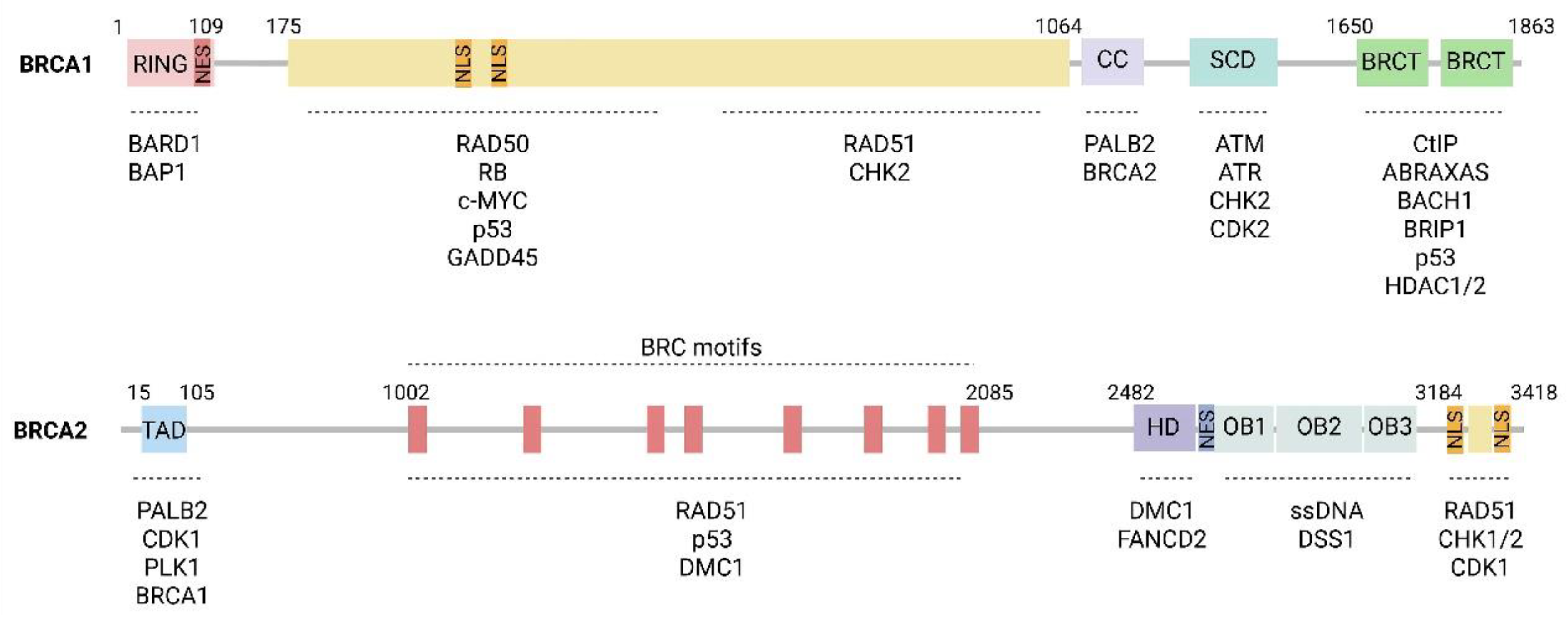
3.1. BRCA1/2 Structure and Function
3.2. Pathogenic Mutations of BRCA1/2 in Cancer
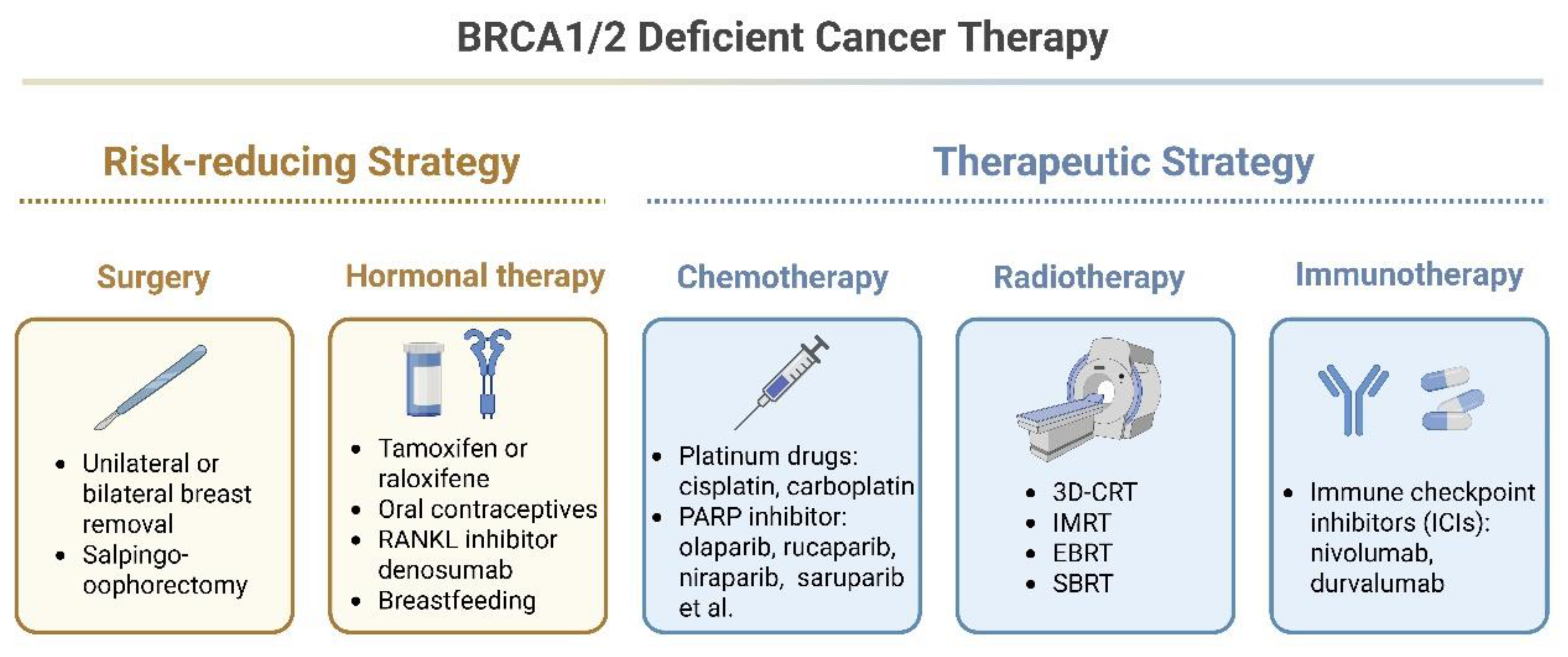
3.3. Treatment of BRCA1/2 Mutated Cancers
3.3.1. Risk-Reducing Strategies
3.3.2. Platinum-Based Chemotherapies
3.3.3. PARP Inhibition and Synthetic Lethality
3.3.4. Immunomodulatory Strategies
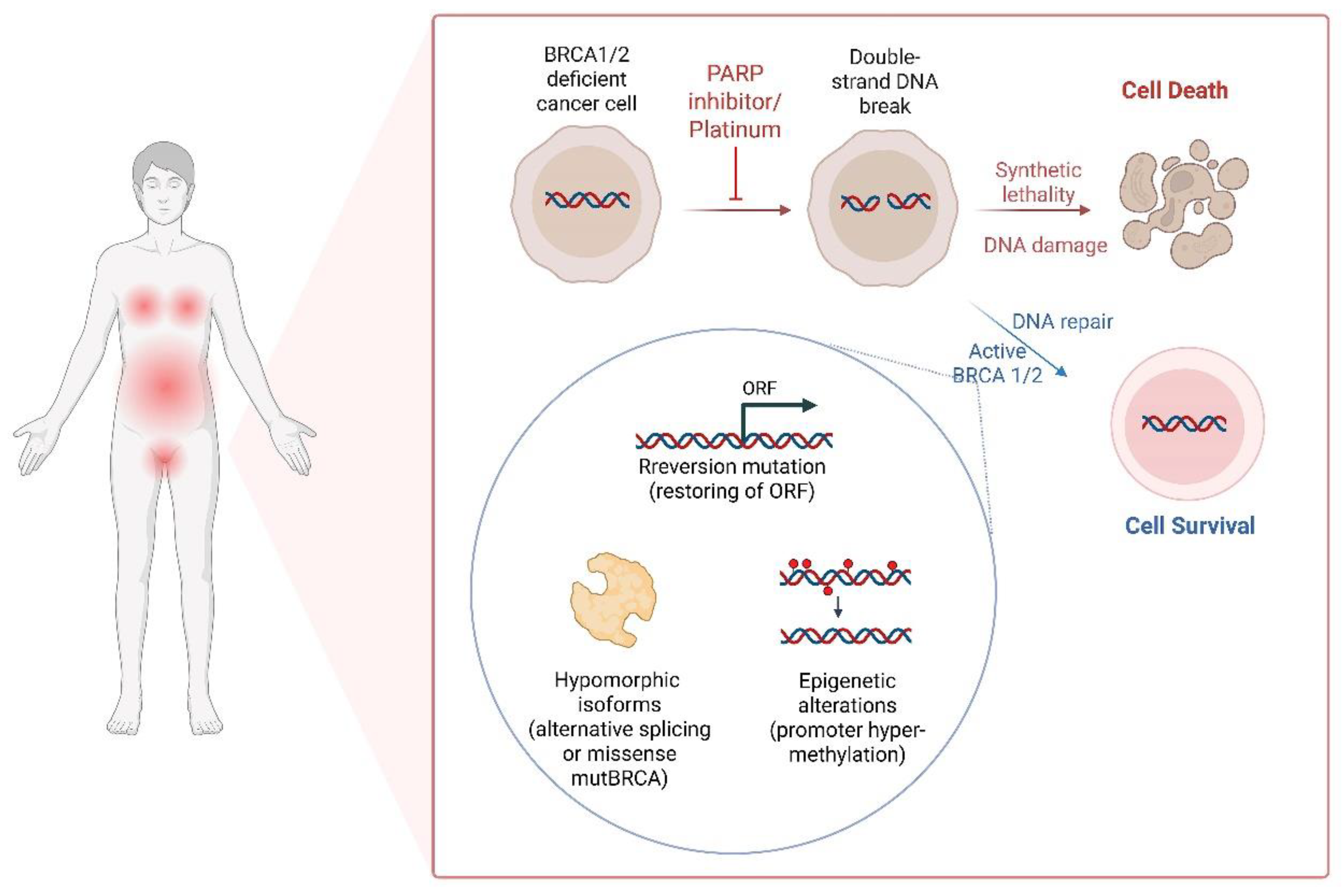
4. BRCA1/2 Reversion Mutations in Therapy Resistance
4.1. Reversion Mutations Restoring the Open Reading Frame (ORF)
4.2. Hypomorphic BRCA1/2
4.3. Epigenetic Alterations
4.4. Tumor Microenvironment Alterations
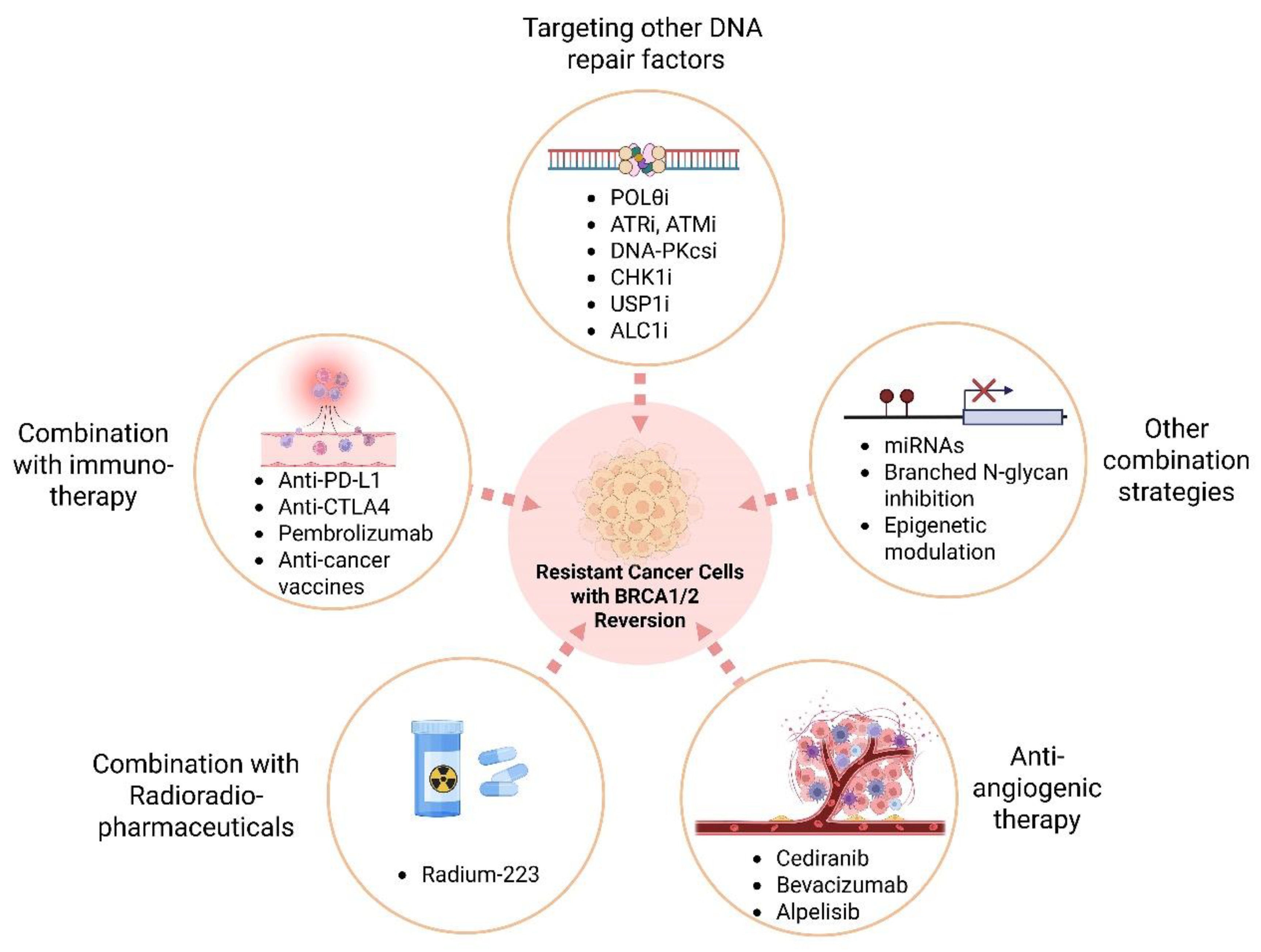
5. Attempts to Overcome BRCA1/2 Resistance
5.1. Targeting Other DNA Repair Factors
5.2. Combination of PARP Inhibitors with Immune Checkpoint Inhibitors
5.3. Other Combination Strategies
6. Conclusions
Future Directions
Author Contributions
Funding
Institutional Review Board Statement
Informed Consent Statement
Data Availability Statement
Conflicts of Interest
Abbreviations
| HRR | homologous recombination repair |
| PARPis | poly (ADP-ribose) polymerase inhibitors |
| DSBs | double-strand breaks |
| RING | interesting new gene |
| BRCT | BRCA1 C-terminus |
| BARD1 | BRCA1-associated RING domain protein 1 |
| NES | nuclear export sequences |
| Rb | retinoblastoma protein |
| NLS | nuclear localization sequence |
| PALB2 | partner and localizer of BRCA2 |
| SCD | serine cluster domain |
| CtIP | C-terminal binding protein 1-interacting protein |
| ABRAXAS | BRCA1 A complex subunit |
| BRIP1 | BRCA1-interacting protein C-terminal helicase 1 |
| BACH1 | BTB and CNC homology 1 |
| TAD | transcriptional activation domain |
| DBD | DNA-binding domain |
| CDK1 | cyclin-dependent kinase 1 |
| PLK1 | polo-like kinase 1 |
| HRD | homologous recombination deficiency |
| TNBC | triple-negative breast cancer |
| BIC | Breast Cancer Information Core |
| PCa | prostate cancer |
| PC | pancreatic cancer |
| PDAC | pancreatic ductal adenocarcinoma |
| RRSO | risk-reducing salpingo-oophorectomy |
| SSBs | single-strand breaks |
| PARP1 | poly (ADP-ribose) polymerase 1 |
| PDX | patient-derived xenograft |
| cGAS | cyclic GMP–AMP synthase |
| ICIs | immune checkpoint inhibitors |
| mCRPC | metastatic castration-resistant prostate cancer |
| MDR1 | multidrug resistance gene 1 |
| ORF | open reading frame |
| HGSOC | high-grade serous ovarian cancer |
| NMD | nonsense-mediated decay |
| SSMs | splice-site mutations |
| TME | tumor microenvironment |
| Polθ | DNA polymerase theta |
| TMEJ | theta-mediated end-joining |
| NHEJ | non-homologous end joining |
| PSA | prostate-specific antigen |
| miRNAs | microRNAs |
References
- Miki, Y.; Swensen, J.; Shattuck-Eidens, D.; Futreal, P.A.; Harshman, K.; Tavtigian, S.; Liu, Q.; Cochran, C.; Bennett, L.M.; Ding, W.; et al. A strong candidate for the breast and ovarian cancer susceptibility gene BRCA1. Science 1994, 266, 66–71. [Google Scholar] [CrossRef]
- Wooster, R.; Neuhausen, S.L.; Mangion, J.; Quirk, Y.; Ford, D.; Collins, N.; Nguyen, K.; Seal, S.; Tran, T.; Averill, D.; et al. Localization of a breast cancer susceptibility gene, BRCA2, to chromosome 13q12-13. Science 1994, 265, 2088–2090. [Google Scholar] [CrossRef] [PubMed]
- Cheng, H.H.; Shevach, J.W.; Castro, E.; Couch, F.J.; Domchek, S.M.; Eeles, R.A.; Giri, V.N.; Hall, M.J.; King, M.C.; Lin, D.W.; et al. BRCA1, BRCA2, and Associated Cancer Risks and Management for Male Patients: A Review. JAMA Oncol. 2024, 10, 1272–1281. [Google Scholar] [CrossRef] [PubMed]
- Lambertini, M.; Blondeaux, E.; Tomasello, L.M.; Agostinetto, E.; Hamy, A.-S.; Kim, H.J.; Franzoi, M.A.; Bernstein-Molho, R.; Hilbers, F.; Pogoda, K.; et al. Clinical Behavior of Breast Cancer in Young BRCA Carriers and Prediagnostic Awareness of Germline BRCA Status. J. Clin. Oncol. Off. J. Am. Soc. Clin. Oncol. 2025, 43, 1706–1719. [Google Scholar] [CrossRef]
- Sessa, C.; Balmaña, J.; Bober, S.L.; Cardoso, M.J.; Colombo, N.; Curigliano, G.; Domchek, S.M.; Evans, D.G.; Fischerova, D.; Harbeck, N.; et al. Risk reduction and screening of cancer in hereditary breast-ovarian cancer syndromes: ESMO Clinical Practice Guideline. Ann. Oncol. Off. J. Eur. Soc. Med. Oncol. 2022, 34, 33–47. [Google Scholar] [CrossRef]
- Cong, K.; Peng, M.; Kousholt, A.N.; Lee, W.T.C.; Lee, S.; Nayak, S.; Krais, J.; VanderVere-Carozza, P.S.; Pawelczak, K.S.; Calvo, J.; et al. Replication gaps are a key determinant of PARP inhibitor synthetic lethality with BRCA deficiency. Mol. Cell 2021, 81, 3128–3144.e3127. [Google Scholar] [CrossRef]
- Prakash, R.; Zhang, Y.; Feng, W.; Jasin, M. Homologous recombination and human health: The roles of BRCA1, BRCA2, and associated proteins. Cold Spring Harb. Perspect. Biol. 2015, 7, a016600. [Google Scholar] [CrossRef]
- Thakar, T.; Dhoonmoon, A.; Straka, J.; Schleicher, E.M.; Nicolae, C.M.; Moldovan, G.-L. Lagging strand gap suppression connects BRCA-mediated fork protection to nucleosome assembly through PCNA-dependent CAF-1 recycling. Nat. Commun. 2022, 13, 5323. [Google Scholar] [CrossRef]
- Savage, K.I.; Gorski, J.J.; Barros, E.M.; Irwin, G.W.; Manti, L.; Powell, A.J.; Pellagatti, A.; Lukashchuk, N.; McCance, D.J.; McCluggage, W.G.; et al. Identification of a BRCA1-mRNA splicing complex required for efficient DNA repair and maintenance of genomic stability. Mol. Cell 2014, 54, 445–459. [Google Scholar] [CrossRef] [PubMed]
- Ngoi, N.Y.L.; Gallo, D.; Torrado, C.; Nardo, M.; Durocher, D.; Yap, T.A. Synthetic lethal strategies for the development of cancer therapeutics. Nat. Rev. Clin. Oncol. 2024, 22, 46–64. [Google Scholar] [CrossRef]
- Dibitetto, D.; Widmer, C.A.; Rottenberg, S. PARPi, BRCA, and gaps: Controversies and future research. Trends Cancer 2024, 10, 857–869. [Google Scholar] [CrossRef]
- Jain, A.; Barge, A.; Parris, C.N. Combination strategies with PARP inhibitors in BRCA-mutated triple-negative breast cancer: Overcoming resistance mechanisms. Oncogene 2025, 44, 193–207. [Google Scholar] [CrossRef] [PubMed]
- Edwards, S.L.; Brough, R.; Lord, C.J.; Natrajan, R.; Vatcheva, R.; Levine, D.A.; Boyd, J.; Reis-Filho, J.S.; Ashworth, A. Resistance to therapy caused by intragenic deletion in BRCA2. Nature 2008, 451, 1111–1115. [Google Scholar] [CrossRef]
- Sakai, W.; Swisher, E.M.; Karlan, B.Y.; Agarwal, M.K.; Higgins, J.; Friedman, C.; Villegas, E.; Jacquemont, C.; Farrugia, D.J.; Couch, F.J.; et al. Secondary mutations as a mechanism of cisplatin resistance in BRCA2-mutated cancers. Nature 2008, 451, 1116–1120. [Google Scholar] [CrossRef] [PubMed]
- Pettitt, S.J.; Frankum, J.R.; Punta, M.; Lise, S.; Alexander, J.; Chen, Y.; Yap, T.A.; Haider, S.; Tutt, A.N.J.; Lord, C.J. Clinical BRCA1/2 Reversion Analysis Identifies Hotspot Mutations and Predicted Neoantigens Associated with Therapy Resistance. Cancer Discov. 2020, 10, 1475–1488. [Google Scholar] [CrossRef]
- Lin, K.K.; Harrell, M.I.; Oza, A.M.; Oaknin, A.; Ray-Coquard, I.; Tinker, A.V.; Helman, E.; Radke, M.R.; Say, C.; Vo, L.T.; et al. BRCA Reversion Mutations in Circulating Tumor DNA Predict Primary and Acquired Resistance to the PARP Inhibitor Rucaparib in High-Grade Ovarian Carcinoma. Cancer Discov. 2019, 9, 210–219. [Google Scholar] [CrossRef] [PubMed]
- Quigley, D.; Alumkal, J.J.; Wyatt, A.W.; Kothari, V.; Foye, A.; Lloyd, P.; Aggarwal, R.; Kim, W.; Lu, E.; Schwartzman, J.; et al. Analysis of Circulating Cell-Free DNA Identifies Multiclonal Heterogeneity of BRCA2 Reversion Mutations Associated with Resistance to PARP Inhibitors. Cancer Discov. 2017, 7, 999–1005. [Google Scholar] [CrossRef]
- Goodall, J.; Mateo, J.; Yuan, W.; Mossop, H.; Porta, N.; Miranda, S.; Perez-Lopez, R.; Dolling, D.; Robinson, D.R.; Sandhu, S.; et al. Circulating Cell-Free DNA to Guide Prostate Cancer Treatment with PARP Inhibition. Cancer Discov. 2017, 7, 1006–1017. [Google Scholar] [CrossRef]
- Kondrashova, O.; Nguyen, M.; Shield-Artin, K.; Tinker, A.V.; Teng, N.N.H.; Harrell, M.I.; Kuiper, M.J.; Ho, G.Y.; Barker, H.; Jasin, M.; et al. Secondary Somatic Mutations Restoring RAD51C and RAD51D Associated with Acquired Resistance to the PARP Inhibitor Rucaparib in High-Grade Ovarian Carcinoma. Cancer Discov. 2017, 7, 984–998. [Google Scholar] [CrossRef]
- Tobalina, L.; Armenia, J.; Irving, E.; O’Connor, M.J.; Forment, J.V. A meta-analysis of reversion mutations in BRCA genes identifies signatures of DNA end-joining repair mechanisms driving therapy resistance. Ann. Oncol. 2021, 32, 103–112. [Google Scholar] [CrossRef]
- Harvey-Jones, E.; Raghunandan, M.; Robbez-Masson, L.; Magraner-Pardo, L.; Alaguthurai, T.; Yablonovitch, A.; Yen, J.; Xiao, H.; Brough, R.; Frankum, J.; et al. Longitudinal profiling identifies co-occurring BRCA1/2 reversions, TP53BP1, RIF1 and PAXIP1 mutations in PARP inhibitor-resistant advanced breast cancer. Ann. Oncol. 2024, 35, 364–380. [Google Scholar] [CrossRef] [PubMed]
- Gorodetska, I.; Kozeretska, I.; Dubrovska, A. BRCA Genes: The Role in Genome Stability, Cancer Stemness and Therapy Resistance. J. Cancer 2019, 10, 2109–2127. [Google Scholar] [CrossRef] [PubMed]
- Lavoro, A.; Scalisi, A.; Candido, S.; Zanghì, G.N.; Rizzo, R.; Gattuso, G.; Caruso, G.; Libra, M.; Falzone, L. Identification of the most common BRCA alterations through analysis of germline mutation databases: Is droplet digital PCR an additional strategy for the assessment of such alterations in breast and ovarian cancer families? Int. J. Oncol. 2022, 60, 58. [Google Scholar] [CrossRef]
- Clark, S.L.; Rodriguez, A.M.; Snyder, R.R.; Hankins, G.D.V.; Boehning, D. Structure-Function Of The Tumor Suppressor BRCA1. Comput. Struct. Biotechnol. J. 2012, 1, e201204005. [Google Scholar] [CrossRef]
- Ismail, T.; Alzneika, S.; Riguene, E.; Al-Maraghi, S.; Alabdulrazzak, A.; Al-Khal, N.; Fetais, S.; Thanassoulas, A.; AlFarsi, H.; Nomikos, M. BRCA1 and Its Vulnerable C-Terminal BRCT Domain: Structure, Function, Genetic Mutations and Links to Diagnosis and Treatment of Breast and Ovarian Cancer. Pharmaceuticals 2024, 17, 333. [Google Scholar] [CrossRef] [PubMed]
- Yadav, S.; Couch, F.J.; Domchek, S.M. Germline Genetic Testing for Hereditary Breast and Ovarian Cancer: Current Concepts in Risk Evaluation. Cold Spring Harb. Perspect. Med. 2024, 14, a041318. [Google Scholar] [CrossRef]
- Wang, Y.; Krais, J.J.; Bernhardy, A.J.; Nicolas, E.; Cai, K.Q.; Harrell, M.I.; Kim, H.H.; George, E.; Swisher, E.M.; Simpkins, F.; et al. RING domain-deficient BRCA1 promotes PARP inhibitor and platinum resistance. J. Clin. Investig. 2016, 126, 3145–3157. [Google Scholar] [CrossRef]
- Pellegrino, B.; Herencia-Ropero, A.; Llop-Guevara, A.; Pedretti, F.; Moles-Fernández, A.; Viaplana, C.; Villacampa, G.; Guzmán, M.; Rodríguez, O.; Grueso, J.; et al. Preclinical In Vivo Validation of the RAD51 Test for Identification of Homologous Recombination-Deficient Tumors and Patient Stratification. Cancer Res. 2022, 82, 1646–1657. [Google Scholar] [CrossRef]
- Wang, Y.; Bernhardy, A.J.; Cruz, C.; Krais, J.J.; Nacson, J.; Nicolas, E.; Peri, S.; van der Gulden, H.; van der Heijden, I.; O’Brien, S.W.; et al. The BRCA1-Δ11q Alternative Splice Isoform Bypasses Germline Mutations and Promotes Therapeutic Resistance to PARP Inhibition and Cisplatin. Cancer Res. 2016, 76, 2778–2790. [Google Scholar] [CrossRef]
- Wang, Y.; Bernhardy, A.J.; Nacson, J.; Krais, J.J.; Tan, Y.-F.; Nicolas, E.; Radke, M.R.; Handorf, E.; Llop-Guevara, A.; Balmaña, J.; et al. BRCA1 intronic Alu elements drive gene rearrangements and PARP inhibitor resistance. Nat. Commun. 2019, 10, 5661. [Google Scholar] [CrossRef]
- Lee, H. Cycling with BRCA2 from DNA repair to mitosis. Exp. Cell Res. 2014, 329, 78–84. [Google Scholar] [CrossRef]
- Fradet-Turcotte, A.; Sitz, J.; Grapton, D.; Orthwein, A. BRCA2 functions: From DNA repair to replication fork stabilization. Endocr. Relat. Cancer 2016, 23, T1–T17. [Google Scholar] [CrossRef]
- Andreassen, P.R.; Seo, J.; Wiek, C.; Hanenberg, H. Understanding BRCA2 Function as a Tumor Suppressor Based on Domain-Specific Activities in DNA Damage Responses. Genes 2021, 12, 1034. [Google Scholar] [CrossRef]
- Halder, S.; Sanchez, A.; Ranjha, L.; Reginato, G.; Ceppi, I.; Acharya, A.; Anand, R.; Cejka, P. Double-stranded DNA binding function of RAD51 in DNA protection and its regulation by BRCA2. Mol. Cell 2022, 82, 3553–3565.e5. [Google Scholar] [CrossRef]
- Chapman, M.S.; Verma, I.M. Transcriptional activation by BRCA1. Nature 1996, 382, 678–679. [Google Scholar] [CrossRef]
- Monteiro, A.N.; August, A.; Hanafusa, H. Evidence for a transcriptional activation function of BRCA1 C-terminal region. Proc. Natl. Acad. Sci. USA 1996, 93, 13595–13599. [Google Scholar] [CrossRef] [PubMed]
- Scully, R.; Chen, J.; Plug, A.; Xiao, Y.; Weaver, D.; Feunteun, J.; Ashley, T.; Livingston, D.M. Association of BRCA1 with Rad51 in mitotic and meiotic cells. Cell 1997, 88, 265–275. [Google Scholar] [CrossRef]
- Bai, L.; Li, P.; Xiang, Y.; Jiao, X.; Chen, J.; Song, L.; Liang, Z.; Liu, Y.; Zhu, Y.; Lu, L.-Y. BRCA1 safeguards genome integrity by activating chromosome asynapsis checkpoint to eliminate recombination-defective oocytes. Proc. Natl. Acad. Sci. USA 2024, 121, e2401386121. [Google Scholar] [CrossRef] [PubMed]
- Foo, T.K.; Xia, B. BRCA1-Dependent and Independent Recruitment of PALB2-BRCA2-RAD51 in the DNA Damage Response and Cancer. Cancer Res. 2022, 82, 3191–3197. [Google Scholar] [CrossRef]
- Lim, P.X.; Zaman, M.; Feng, W.; Jasin, M. BRCA2 promotes genomic integrity and therapy resistance primarily through its role in homology-directed repair. Mol. Cell 2024, 84, 447–462.e10. [Google Scholar] [CrossRef] [PubMed]
- Kang, Z.; Fu, P.; Alcivar, A.L.; Fu, H.; Redon, C.; Foo, T.K.; Zuo, Y.; Ye, C.; Baxley, R.; Madireddy, A.; et al. BRCA2 associates with MCM10 to suppress PRIMPOL-mediated repriming and single-stranded gap formation after DNA damage. Nat. Commun. 2021, 12, 5966. [Google Scholar] [CrossRef] [PubMed]
- Quaas, M.; Kohler, R.; Nöltner, L.; Schmidbauer, L.F.; Uxa, S.; Müller, G.A.; Engeland, K. BRCA1 and BRCA2 gene expression: P53- and cell cycle-dependent repression requires RB and DREAM. Cell Death Differ. 2025, 33, 51–63. [Google Scholar] [CrossRef] [PubMed]
- Perez, Y.; Alhourani, F.; Patouillard, J.; Ribeyre, C.; Larroque, M.; Baldin, V.; Lleres, D.; Grimaud, C.; Julien, E. Cell-cycle dependent inhibition of BRCA1 signaling by the lysine methyltransferase SET8. Cell Cycle 2025, 24, 43–65. [Google Scholar] [CrossRef]
- Samstein, R.M.; Krishna, C.; Ma, X.; Pei, X.; Lee, K.-W.; Makarov, V.; Kuo, F.; Chung, J.; Srivastava, R.M.; Purohit, T.A.; et al. Mutations in BRCA1 and BRCA2 differentially affect the tumor microenvironment and response to checkpoint blockade immunotherapy. Nat. Cancer 2020, 1, 1188–1203. [Google Scholar] [CrossRef]
- Wang, J.; Chen, Y.; Li, S.; Liu, W.; Zhou, X.A.; Luo, Y.; Xu, Z.; Xiong, Y.; Cheng, K.; Ruan, M.; et al. PP2A inhibition causes synthetic lethality in BRCA2-mutated prostate cancer models via spindle assembly checkpoint reactivation. J. Clin. Investig. 2024, 134, e172137. [Google Scholar] [CrossRef]
- Morimatsu, M.; Donoho, G.; Hasty, P. Cells deleted for Brca2 COOH terminus exhibit hypersensitivity to gamma-radiation and premature senescence. Cancer Res. 1998, 58, 3441–3447. [Google Scholar] [PubMed]
- Khalizieva, A.; Moser, S.C.; Bouwman, P.; Jonkers, J. BRCA1 and BRCA2: From cancer susceptibility to synthetic lethality. Genes Dev. 2025, 39, 86–108. [Google Scholar] [CrossRef]
- Lahiri, S.; Hamilton, G.; Moore, G.; Goehring, L.; Huang, T.T.; Jensen, R.B.; Rothenberg, E. BRCA2 prevents PARPi-mediated PARP1 retention to protect RAD51 filaments. Nature 2025, 640, 1103–1111. [Google Scholar] [CrossRef]
- Bell, J.C.; Dombrowski, C.C.; Plank, J.L.; Jensen, R.B.; Kowalczykowski, S.C. BRCA2 chaperones RAD51 to single molecules of RPA-coated ssDNA. Proc. Natl. Acad. Sci. USA 2023, 120, e2221971120. [Google Scholar] [CrossRef]
- King, M.C.; Marks, J.H.; Mandell, J.B. Breast and ovarian cancer risks due to inherited mutations in BRCA1 and BRCA2. Science 2003, 302, 643–646. [Google Scholar] [CrossRef]
- Schlacher, K.; Christ, N.; Siaud, N.; Egashira, A.; Wu, H.; Jasin, M. Double-strand break repair-independent role for BRCA2 in blocking stalled replication fork degradation by MRE11. Cell 2011, 145, 529–542. [Google Scholar] [CrossRef] [PubMed]
- Schlacher, K.; Wu, H.; Jasin, M. A distinct replication fork protection pathway connects Fanconi anemia tumor suppressors to RAD51-BRCA1/2. Cancer Cell 2012, 22, 106–116. [Google Scholar] [CrossRef] [PubMed]
- Taglialatela, A.; Leuzzi, G.; Sannino, V.; Cuella-Martin, R.; Huang, J.W.; Wu-Baer, F.; Baer, R.; Costanzo, V.; Ciccia, A. REV1-Polζ maintains the viability of homologous recombination-deficient cancer cells through mutagenic repair of PRIMPOL-dependent ssDNA gaps. Mol. Cell 2021, 81, 4008–4025.e4007. [Google Scholar] [CrossRef]
- Simoneau, A.; Xiong, R.; Zou, L. The trans cell cycle effects of PARP inhibitors underlie their selectivity toward BRCA1/2-deficient cells. Genes Dev. 2021, 35, 1271–1289. [Google Scholar] [CrossRef]
- Cong, K.; Cantor, S.B. Exploiting replication gaps for cancer therapy. Mol. Cell 2022, 82, 2363–2369. [Google Scholar] [CrossRef] [PubMed]
- Hatchi, E.; Skourti-Stathaki, K.; Ventz, S.; Pinello, L.; Yen, A.; Kamieniarz-Gdula, K.; Dimitrov, S.; Pathania, S.; McKinney, K.M.; Eaton, M.L.; et al. BRCA1 recruitment to transcriptional pause sites is required for R-loop-driven DNA damage repair. Mol. Cell 2015, 57, 636–647. [Google Scholar] [CrossRef]
- Bhatia, V.; Barroso, S.I.; García-Rubio, M.L.; Tumini, E.; Herrera-Moyano, E.; Aguilera, A. BRCA2 prevents R-loop accumulation and associates with TREX-2 mRNA export factor PCID2. Nature 2014, 511, 362–365. [Google Scholar] [CrossRef]
- Shivji, M.K.K.; Renaudin, X.; Williams, Ç.H.; Venkitaraman, A.R. BRCA2 Regulates Transcription Elongation by RNA Polymerase II to Prevent R-Loop Accumulation. Cell Rep. 2018, 22, 1031–1039. [Google Scholar] [CrossRef]
- Swisher, E.M.; Gonzalez, R.M.; Taniguchi, T.; Garcia, R.L.; Walsh, T.; Goff, B.A.; Welcsh, P. Methylation and protein expression of DNA repair genes: Association with chemotherapy exposure and survival in sporadic ovarian and peritoneal carcinomas. Mol. Cancer 2009, 8, 48. [Google Scholar] [CrossRef]
- Li, X.; Zou, L. BRCAness, DNA gaps, and gain and loss of PARP inhibitor-induced synthetic lethality. J. Clin. Investig. 2024, 134, e181062. [Google Scholar] [CrossRef]
- Mavaddat, N.; Barrowdale, D.; Andrulis, I.L.; Domchek, S.M.; Eccles, D.; Nevanlinna, H.; Ramus, S.J.; Spurdle, A.; Robson, M.; Sherman, M.; et al. Pathology of breast and ovarian cancers among BRCA1 and BRCA2 mutation carriers: Results from the Consortium of Investigators of Modifiers of BRCA1/2 (CIMBA). Cancer Epidemiol. Biomark. Prev. 2012, 21, 134–147. [Google Scholar] [CrossRef] [PubMed]
- Loibl, S.; André, F.; Bachelot, T.; Barrios, C.H.; Bergh, J.; Burstein, H.J.; Cardoso, M.J.; Carey, L.A.; Dawood, S.; Del Mastro, L.; et al. Early breast cancer: ESMO Clinical Practice Guideline for diagnosis, treatment and follow-up. Ann. Oncol. 2024, 35, 159–182. [Google Scholar] [CrossRef] [PubMed]
- Calheiros, J.; Corbo, V.; Saraiva, L. Overcoming therapeutic resistance in pancreatic cancer: Emerging opportunities by targeting BRCAs and p53. Biochim. Biophys. Acta Rev. Cancer 2023, 1878, 188914. [Google Scholar] [CrossRef]
- Rebbeck, T.R.; Mitra, N.; Wan, F.; Sinilnikova, O.M.; Healey, S.; McGuffog, L.; Mazoyer, S.; Chenevix-Trench, G.; Easton, D.F.; Antoniou, A.C.; et al. Association of type and location of BRCA1 and BRCA2 mutations with risk of breast and ovarian cancer. JAMA 2015, 313, 1347–1361. [Google Scholar] [CrossRef]
- Patel, V.L.; Busch, E.L.; Friebel, T.M.; Cronin, A.; Leslie, G.; McGuffog, L.; Adlard, J.; Agata, S.; Agnarsson, B.A.; Ahmed, M.; et al. Association of Genomic Domains in BRCA1 and BRCA2 with Prostate Cancer Risk and Aggressiveness. Cancer Res. 2020, 80, 624–638. [Google Scholar] [CrossRef]
- Nyberg, T.; Tischkowitz, M.; Antoniou, A.C. BRCA1 and BRCA2 pathogenic variants and prostate cancer risk: Systematic review and meta-analysis. Br. J. Cancer 2022, 126, 1067–1081. [Google Scholar] [CrossRef]
- Dias Nunes, J.; Demeestere, I.; Devos, M. BRCA Mutations and Fertility Preservation. Int. J. Mol. Sci. 2023, 25, 204. [Google Scholar] [CrossRef]
- Saad, F.; Armstrong, A.J.; Shore, N.; George, D.J.; Oya, M.; Sugimoto, M.; McKay, R.R.; Hussain, M.; Clarke, N.W. Olaparib Monotherapy or in Combination with Abiraterone for the Treatment of Patients with Metastatic Castration-Resistant Prostate Cancer (mCRPC) and a BRCA Mutation. Target. Oncol. 2025, 20, 445–466. [Google Scholar] [CrossRef]
- Orth, M.; Metzger, P.; Gerum, S.; Mayerle, J.; Schneider, G.; Belka, C.; Schnurr, M.; Lauber, K. Pancreatic ductal adenocarcinoma: Biological hallmarks, current status, and future perspectives of combined modality treatment approaches. Radiat. Oncol. 2019, 14, 141. [Google Scholar] [CrossRef]
- Klein, A.P. Genetic susceptibility to pancreatic cancer. Mol. Carcinog. 2012, 51, 14–24. [Google Scholar] [CrossRef] [PubMed]
- Holter, S.; Borgida, A.; Dodd, A.; Grant, R.; Semotiuk, K.; Hedley, D.; Dhani, N.; Narod, S.; Akbari, M.; Moore, M.; et al. Germline BRCA Mutations in a Large Clinic-Based Cohort of Patients with Pancreatic Adenocarcinoma. J. Clin. Oncol. 2015, 33, 3124–3129. [Google Scholar] [CrossRef]
- Golan, T.; Kindler, H.L.; Park, J.O.; Reni, M.; Macarulla, T.; Hammel, P.; Van Cutsem, E.; Arnold, D.; Hochhauser, D.; McGuinness, D.; et al. Geographic and Ethnic Heterogeneity of Germline BRCA1 or BRCA2 Mutation Prevalence Among Patients with Metastatic Pancreatic Cancer Screened for Entry into the POLO Trial. J. Clin. Oncol. 2020, 38, 1442–1454. [Google Scholar] [CrossRef] [PubMed]
- Murphy, K.M.; Brune, K.A.; Griffin, C.; Sollenberger, J.E.; Petersen, G.M.; Bansal, R.; Hruban, R.H.; Kern, S.E. Evaluation of candidate genes MAP2K4, MADH4, ACVR1B, and BRCA2 in familial pancreatic cancer: Deleterious BRCA2 mutations in 17%. Cancer Res. 2002, 62, 3789–3793. [Google Scholar]
- Stadler, Z.K.; Salo-Mullen, E.; Patil, S.M.; Pietanza, M.C.; Vijai, J.; Saloustros, E.; Hansen, N.A.; Kauff, N.D.; Kurtz, R.C.; Kelsen, D.P.; et al. Prevalence of BRCA1 and BRCA2 mutations in Ashkenazi Jewish families with breast and pancreatic cancer. Cancer 2012, 118, 493–499. [Google Scholar] [CrossRef] [PubMed]
- Alkassis, S.; Yazdanpanah, O.; Philip, P.A. BRCA mutations in pancreatic cancer and progress in their targeting. Expert Opin. Ther. Targets 2021, 25, 547–557. [Google Scholar] [CrossRef]
- Kindler, H.L.; Hammel, P.; Reni, M.; Van Cutsem, E.; Macarulla, T.; Hall, M.J.; Park, J.O.; Hochhauser, D.; Arnold, D.; Oh, D.-Y.; et al. Overall Survival Results From the POLO Trial: A Phase III Study of Active Maintenance Olaparib Versus Placebo for Germline BRCA-Mutated Metastatic Pancreatic Cancer. J. Clin. Oncol. Off. J. Am. Soc. Clin. Oncol. 2022, 40, 3929–3939. [Google Scholar] [CrossRef]
- Paiella, S.; Azzolina, D.; Gregori, D.; Malleo, G.; Golan, T.; Simeone, D.M.; Davis, M.B.; Vacca, P.G.; Crovetto, A.; Bassi, C.; et al. A systematic review and meta-analysis of germline BRCA mutations in pancreatic cancer patients identifies global and racial disparities in access to genetic testing. ESMO Open 2023, 8, 100881. [Google Scholar] [CrossRef]
- Murai, J.; Pommier, Y. BRCAness, Homologous Recombination Deficiencies, and Synthetic Lethality. Cancer Res. 2023, 83, 1173–1174. [Google Scholar] [CrossRef] [PubMed]
- Metcalfe, K.; Gershman, S.; Ghadirian, P.; Lynch, H.T.; Snyder, C.; Tung, N.; Kim-Sing, C.; Eisen, A.; Foulkes, W.D.; Rosen, B.; et al. Contralateral mastectomy and survival after breast cancer in carriers of BRCA1 and BRCA2 mutations: Retrospective analysis. BMJ 2014, 348, g226. [Google Scholar] [CrossRef]
- Gootzen, T.A.; Steenbeek, M.P.; van Bommel, M.; IntHout, J.; Kets, C.M.; Hermens, R.; de Hullu, J.A. Risk-reducing salpingectomy with delayed oophorectomy to prevent ovarian cancer in women with an increased inherited risk: Insights into an alternative strategy. Fam. Cancer 2024, 23, 437–445. [Google Scholar] [CrossRef]
- Rocca, W.A.; Shuster, L.T.; Grossardt, B.R.; Maraganore, D.M.; Gostout, B.S.; Geda, Y.E.; Melton, L.J., 3rd. Long-term effects of bilateral oophorectomy on brain aging: Unanswered questions from the Mayo Clinic Cohort Study of Oophorectomy and Aging. Women’s Health 2009, 5, 39–48. [Google Scholar] [CrossRef]
- Vermeulen, R.F.M.; Beurden, M.V.; Korse, C.M.; Kenter, G.G. Impact of risk-reducing salpingo-oophorectomy in premenopausal women. Climacteric 2017, 20, 212–221. [Google Scholar] [CrossRef]
- Stuursma, A.; van Driel, C.M.G.; Wessels, N.J.; de Bock, G.H.; Mourits, M.J.E. Severity and duration of menopausal symptoms after risk-reducing salpingo-oophorectomy. Maturitas 2018, 111, 69–76. [Google Scholar] [CrossRef] [PubMed]
- Armstrong, K.; Schwartz, J.S.; Randall, T.; Rubin, S.C.; Weber, B. Hormone replacement therapy and life expectancy after prophylactic oophorectomy in women with BRCA1/2 mutations: A decision analysis. J. Clin. Oncol. 2004, 22, 1045–1054. [Google Scholar] [CrossRef]
- Gordhandas, S.; Norquist, B.M.; Pennington, K.P.; Yung, R.L.; Laya, M.B.; Swisher, E.M. Hormone replacement therapy after risk reducing salpingo-oophorectomy in patients with BRCA1 or BRCA2 mutations; a systematic review of risks and benefits. Gynecol. Oncol. 2019, 153, 192–200. [Google Scholar] [CrossRef]
- Kim, J.; Munster, P.N. Estrogens and breast cancer. Ann. Oncol. Off. J. Eur. Soc. Med. Oncol. 2025, 36, 134–148. [Google Scholar] [CrossRef] [PubMed]
- Kotsopoulos, J.; Gronwald, J.; Huzarski, T.; Aeilts, A.; Randall Armel, S.; Karlan, B.; Singer, C.F.; Eisen, A.; Tung, N.; Olopade, O.; et al. Tamoxifen and the risk of breast cancer in women with a BRCA1 or BRCA2 mutation. Breast Cancer Res. Treat. 2023, 201, 257–264. [Google Scholar] [CrossRef]
- Blondeaux, E.; Delucchi, V.; Mariamidze, E.; Bernstein-Molho, R.; Frank, S.; Ferrari, A.; Linn, S.; Kim, H.J.; Agostinetto, E.; Paluch-Shimon, S.; et al. Breastfeeding after breast cancer in young BRCA carriers. J. Natl. Cancer Inst. 2025, 117, 2229–2239. [Google Scholar] [CrossRef] [PubMed]
- Xia, Y.Y.; Kotsopoulos, J. Beyond the pill: Contraception and the prevention of hereditary ovarian cancer. Hered. Cancer Clin. Pract. 2022, 20, 21. [Google Scholar] [CrossRef]
- Barańska, A.; Błaszczuk, A.; Kanadys, W.; Malm, M.; Drop, K.; Polz-Dacewicz, M. Oral Contraceptive Use and Breast Cancer Risk Assessment: A Systematic Review and Meta-Analysis of Case-Control Studies, 2009–2020. Cancers 2021, 13, 5654. [Google Scholar] [CrossRef]
- Sigl, V.; Owusu-Boaitey, K.; Joshi, P.A.; Kavirayani, A.; Wirnsberger, G.; Novatchkova, M.; Kozieradzki, I.; Schramek, D.; Edokobi, N.; Hersl, J.; et al. RANKL/RANK control Brca1 mutation. Cell Res. 2016, 26, 761–774. [Google Scholar] [CrossRef]
- Nolan, E.; Vaillant, F.; Branstetter, D.; Pal, B.; Giner, G.; Whitehead, L.; Lok, S.W.; Mann, G.B.; Rohrbach, K.; Huang, L.Y.; et al. RANK ligand as a potential target for breast cancer prevention in BRCA1-mutation carriers. Nat. Med. 2016, 22, 933–939. [Google Scholar] [CrossRef] [PubMed]
- Mason, S.R.; Willson, M.L.; Egger, S.J.; Beith, J.; Dear, R.F.; Goodwin, A. Platinum-based chemotherapy for early triple-negative breast cancer. Cochrane Database Syst. Rev. 2023, 9, CD014805. [Google Scholar] [PubMed]
- Fazekas, T.; Széles, Á.D.; Teutsch, B.; Csizmarik, A.; Vékony, B.; Kói, T.; Ács, N.; Hegyi, P.; Hadaschik, B.; Nyirády, P.; et al. Poly (ADP-ribose) Polymerase Inhibitors Have Comparable Efficacy with Platinum Chemotherapy in Patients with BRCA-positive Metastatic Castration-resistant Prostate Cancer. A Systematic Review and Meta-analysis. Eur. Urol. Oncol. 2023, 7, 365–375. [Google Scholar] [CrossRef]
- Kelland, L. The resurgence of platinum-based cancer chemotherapy. Nat. Rev. Cancer 2007, 7, 573–584. [Google Scholar] [CrossRef]
- Rottenberg, S.; Nygren, A.O.; Pajic, M.; van Leeuwen, F.W.; van der Heijden, I.; van de Wetering, K.; Liu, X.; de Visser, K.E.; Gilhuijs, K.G.; van Tellingen, O.; et al. Selective induction of chemotherapy resistance of mammary tumors in a conditional mouse model for hereditary breast cancer. Proc. Natl. Acad. Sci. USA 2007, 104, 12117–12122. [Google Scholar] [CrossRef] [PubMed]
- Tutt, A.; Tovey, H.; Cheang, M.C.U.; Kernaghan, S.; Kilburn, L.; Gazinska, P.; Owen, J.; Abraham, J.; Barrett, S.; Barrett-Lee, P.; et al. Carboplatin in BRCA1/2-mutated and triple-negative breast cancer BRCAness subgroups: The TNT Trial. Nat. Med. 2018, 24, 628–637. [Google Scholar] [CrossRef]
- Martin, L.P.; Hamilton, T.C.; Schilder, R.J. Platinum resistance: The role of DNA repair pathways. Clin. Cancer Res. 2008, 14, 1291–1295. [Google Scholar] [CrossRef]
- Rottenberg, S.; Disler, C.; Perego, P. The rediscovery of platinum-based cancer therapy. Nat. Rev. Cancer 2021, 21, 37–50. [Google Scholar] [CrossRef]
- Bryant, H.E.; Schultz, N.; Thomas, H.D.; Parker, K.M.; Flower, D.; Lopez, E.; Kyle, S.; Meuth, M.; Curtin, N.J.; Helleday, T. Specific killing of BRCA2-deficient tumours with inhibitors of poly(ADP-ribose) polymerase. Nature 2005, 434, 913–917. [Google Scholar] [CrossRef]
- Farmer, H.; McCabe, N.; Lord, C.J.; Tutt, A.N.; Johnson, D.A.; Richardson, T.B.; Santarosa, M.; Dillon, K.J.; Hickson, I.; Knights, C.; et al. Targeting the DNA repair defect in BRCA mutant cells as a therapeutic strategy. Nature 2005, 434, 917–921. [Google Scholar] [CrossRef]
- Ray Chaudhuri, A.; Nussenzweig, A. The multifaceted roles of PARP1 in DNA repair and chromatin remodelling. Nat. Rev. Mol. Cell Biol. 2017, 18, 610–621. [Google Scholar] [CrossRef]
- Murai, J.; Huang, S.Y.; Das, B.B.; Renaud, A.; Zhang, Y.; Doroshow, J.H.; Ji, J.; Takeda, S.; Pommier, Y. Trapping of PARP1 and PARP2 by Clinical PARP Inhibitors. Cancer Res. 2012, 72, 5588–5599. [Google Scholar] [CrossRef] [PubMed]
- Paes Dias, M.; Tripathi, V.; van der Heijden, I.; Cong, K.; Manolika, E.M.; Bhin, J.; Gogola, E.; Galanos, P.; Annunziato, S.; Lieftink, C.; et al. Loss of nuclear DNA ligase III reverts PARP inhibitor resistance in BRCA1/53BP1 double-deficient cells by exposing ssDNA gaps. Mol. Cell 2021, 81, 4692–4708.e4699. [Google Scholar] [CrossRef]
- Petropoulos, M.; Karamichali, A.; Rossetti, G.G.; Freudenmann, A.; Iacovino, L.G.; Dionellis, V.S.; Sotiriou, S.K.; Halazonetis, T.D. Transcription-replication conflicts underlie sensitivity to PARP inhibitors. Nature 2024, 628, 433–441. [Google Scholar] [CrossRef]
- Mateo, J.; Lord, C.J.; Serra, V.; Tutt, A.; Balmaña, J.; Castroviejo-Bermejo, M.; Cruz, C.; Oaknin, A.; Kaye, S.B.; de Bono, J.S. A decade of clinical development of PARP inhibitors in perspective. Ann. Oncol. 2019, 30, 1437–1447. [Google Scholar] [CrossRef]
- Zeng, Y.; Arisa, O.; Peer, C.J.; Fojo, A.; Figg, W.D. PARP inhibitors: A review of the pharmacology, pharmacokinetics, and pharmacogenetics. Semin. Oncol. 2024, 51, 19–24. [Google Scholar] [CrossRef]
- Illuzzi, G.; Staniszewska, A.D.; Gill, S.J.; Pike, A.; McWilliams, L.; Critchlow, S.E.; Cronin, A.; Fawell, S.; Hawthorne, G.; Jamal, K.; et al. Preclinical Characterization of AZD5305, A Next-Generation, Highly Selective PARP1 Inhibitor and Trapper. Clin. Cancer Res. 2022, 28, 4724–4736. [Google Scholar] [CrossRef] [PubMed]
- Liu, F.; Chen, J.; Li, X.; Liu, R.; Zhang, Y.; Gao, C.; Shi, D. Advances in Development of Selective Antitumor Inhibitors That Target PARP-1. J. Med. Chem. 2023, 66, 16464–16483. [Google Scholar] [CrossRef]
- Johannes, J.W.; Balazs, A.; Barratt, D.; Bista, M.; Chuba, M.D.; Cosulich, S.; Critchlow, S.E.; Degorce, S.L.; Di Fruscia, P.; Edmondson, S.D.; et al. Discovery of 5-{4-[(7-Ethyl-6-oxo-5,6-dihydro-1,5-naphthyridin-3-yl)methyl]piperazin-1-yl}-N-methylpyridine-2-carboxamide (AZD5305): A PARP1-DNA Trapper with High Selectivity for PARP1 over PARP2 and Other PARPs. J. Med. Chem. 2021, 64, 14498–14512. [Google Scholar] [CrossRef] [PubMed]
- Dellavedova, G.; Decio, A.; Formenti, L.; Albertella, M.R.; Wilson, J.; Staniszewska, A.D.; Leo, E.; Giavazzi, R.; Ghilardi, C.; Bani, M.R. The PARP1 Inhibitor AZD5305 Impairs Ovarian Adenocarcinoma Progression and Visceral Metastases in Patient-derived Xenografts Alone and in Combination with Carboplatin. Cancer Res. Commun. 2023, 3, 489–500. [Google Scholar] [CrossRef]
- Herencia-Ropero, A.; Llop-Guevara, A.; Staniszewska, A.D.; Domènech-Vivó, J.; García-Galea, E.; Moles-Fernández, A.; Pedretti, F.; Domènech, H.; Rodríguez, O.; Guzmán, M.; et al. The PARP1 selective inhibitor saruparib (AZD5305) elicits potent and durable antitumor activity in patient-derived BRCA1/2-associated cancer models. Genome Med. 2024, 16, 107. [Google Scholar] [CrossRef]
- Pantelidou, C.; Sonzogni, O.; De Oliveria Taveira, M.; Mehta, A.K.; Kothari, A.; Wang, D.; Visal, T.; Li, M.K.; Pinto, J.; Castrillon, J.A.; et al. PARP Inhibitor Efficacy Depends on CD8(+) T-cell Recruitment via Intratumoral STING Pathway Activation in BRCA-Deficient Models of Triple-Negative Breast Cancer. Cancer Discov. 2019, 9, 722–737. [Google Scholar] [CrossRef] [PubMed]
- Ma, H.; Kang, Z.; Foo, T.K.; Shen, Z.; Xia, B. Disrupted BRCA1-PALB2 interaction induces tumor immunosuppression and T-lymphocyte infiltration in HCC through cGAS-STING pathway. Hepatology 2022, 77, 33–47. [Google Scholar] [CrossRef] [PubMed]
- Shen, J.; Zhao, W.; Ju, Z.; Wang, L.; Peng, Y.; Labrie, M.; Yap, T.A.; Mills, G.B.; Peng, G. PARPi Triggers the STING-Dependent Immune Response and Enhances the Therapeutic Efficacy of Immune Checkpoint Blockade Independent of BRCAness. Cancer Res. 2019, 79, 311–319. [Google Scholar] [CrossRef] [PubMed]
- Sen, T.; Rodriguez, B.L.; Chen, L.; Corte, C.M.D.; Morikawa, N.; Fujimoto, J.; Cristea, S.; Nguyen, T.; Diao, L.; Li, L.; et al. Targeting DNA Damage Response Promotes Antitumor Immunity through STING-Mediated T-cell Activation in Small Cell Lung Cancer. Cancer Discov. 2019, 9, 646–661. [Google Scholar] [CrossRef]
- Khoury, R.; Longobardi, G.; Barnatan, T.T.; Venkert, D.; García Alvarado, A.; Yona, A.; Green Buzhor, M.; Shahar, S.; Wang, Q.; Acúrcio, R.C.; et al. Radiation-guided nanoparticles enhance the efficacy of PARP inhibitors in primary and metastatic BRCA1-deficient tumors via immunotherapy. J. Control. Release 2025, 383, 113812. [Google Scholar] [CrossRef]
- Wang, Y.; Zheng, K.; Xiong, H.; Huang, Y.; Chen, X.; Zhou, Y.; Qin, W.; Su, J.; Chen, R.; Qiu, H.; et al. PARP Inhibitor Upregulates PD-L1 Expression and Provides a New Combination Therapy in Pancreatic Cancer. Front. Immunol. 2021, 12, 762989. [Google Scholar] [CrossRef]
- Inoue, T.; Sekito, S.; Kageyama, T.; Sugino, Y.; Sasaki, T. Roles of the PARP Inhibitor in BRCA1 and BRCA2 Pathogenic Mutated Metastatic Prostate Cancer: Direct Functions and Modification of the Tumor Microenvironment. Cancers 2023, 15, 2662. [Google Scholar] [CrossRef]
- Domchek, S.M.; Postel-Vinay, S.; Im, S.A.; Park, Y.H.; Delord, J.P.; Italiano, A.; Alexandre, J.; You, B.; Bastian, S.; Krebs, M.G.; et al. Olaparib and durvalumab in patients with germline BRCA-mutated metastatic breast cancer (MEDIOLA): An open-label, multicentre, phase 1/2, basket study. Lancet Oncol. 2020, 21, 1155–1164. [Google Scholar] [CrossRef]
- Drew, Y.; Kim, J.W.; Penson, R.T.; O’Malley, D.M.; Parkinson, C.; Roxburgh, P.; Plummer, R.; Im, S.A.; Imbimbo, M.; Ferguson, M.; et al. Olaparib plus Durvalumab, with or without Bevacizumab, as Treatment in PARP Inhibitor-Naïve Platinum-Sensitive Relapsed Ovarian Cancer: A Phase II Multi-Cohort Study. Clin. Cancer Res. 2024, 30, 50–62. [Google Scholar] [CrossRef] [PubMed]
- Tan, T.J.; Sammons, S.; Im, Y.H.; She, L.; Mundy, K.; Bigelow, R.; Traina, T.A.; Anders, C.; Yeong, J.; Renzulli, E.; et al. Phase II DORA Study of Olaparib with or without Durvalumab as a Chemotherapy-Free Maintenance Strategy in Platinum-Pretreated Advanced Triple-Negative Breast Cancer. Clin. Cancer Res. 2024, 30, 1240–1247. [Google Scholar] [CrossRef] [PubMed]
- Freyer, G.; Floquet, A.; Tredan, O.; Carrot, A.; Langlois-Jacques, C.; Lopez, J.; Selle, F.; Abdeddaim, C.; Leary, A.; Dubot-Poitelon, C.; et al. Bevacizumab, olaparib, and durvalumab in patients with relapsed ovarian cancer: A phase II clinical trial from the GINECO group. Nat. Commun. 2024, 15, 1985. [Google Scholar] [CrossRef]
- Fizazi, K.; González Mella, P.; Castellano, D.; Minatta, J.N.; Rezazadeh Kalebasty, A.; Shaffer, D.; Vázquez Limón, J.C.; Sánchez López, H.M.; Armstrong, A.J.; Horvath, L.; et al. Nivolumab plus docetaxel in patients with chemotherapy-naïve metastatic castration-resistant prostate cancer: Results from the phase II CheckMate 9KD trial. Eur. J. Cancer 2022, 160, 61–71. [Google Scholar] [CrossRef] [PubMed]
- Dimitrov, G.; Mangaldzhiev, R.; Slavov, C.; Popov, E. Precision Medicine in Castration-Resistant Prostate Cancer: Advances, Challenges, and the Landscape of PARPi Therapy-A Narrative Review. Int. J. Mol. Sci. 2024, 25, 2184. [Google Scholar] [CrossRef]
- Mohyuddin, G.R.; Aziz, M.; Britt, A.; Wade, L.; Sun, W.; Baranda, J.; Al-Rajabi, R.; Saeed, A.; Kasi, A. Similar response rates and survival with PARP inhibitors for patients with solid tumors harboring somatic versus Germline BRCA mutations: A Meta-analysis and systematic review. BMC Cancer 2020, 20, 507. [Google Scholar] [CrossRef] [PubMed]
- Waks, A.G.; Cohen, O.; Kochupurakkal, B.; Kim, D.; Dunn, C.E.; Buendia Buendia, J.; Wander, S.; Helvie, K.; Lloyd, M.R.; Marini, L.; et al. Reversion and non-reversion mechanisms of resistance to PARP inhibitor or platinum chemotherapy in BRCA1/2-mutant metastatic breast cancer. Ann. Oncol. 2020, 31, 590–598. [Google Scholar] [CrossRef]
- Drost, R.; Dhillon, K.K.; van der Gulden, H.; van der Heijden, I.; Brandsma, I.; Cruz, C.; Chondronasiou, D.; Castroviejo-Bermejo, M.; Boon, U.; Schut, E.; et al. BRCA1185delAG tumors may acquire therapy resistance through expression of RING-less BRCA1. J. Clin. Investig. 2016, 126, 2903–2918. [Google Scholar] [CrossRef]
- Nesic, K.; Krais, J.J.; Wang, Y.; Vandenberg, C.J.; Patel, P.; Cai, K.Q.; Kwan, T.; Lieschke, E.; Ho, G.Y.; Barker, H.E.; et al. BRCA1 secondary splice-site mutations drive exon-skipping and PARP inhibitor resistance. Mol. Cancer 2024, 23, 158. [Google Scholar] [CrossRef]
- Nakamura, K.; Hayashi, H.; Kawano, R.; Ishikawa, M.; Aimono, E.; Mizuno, T.; Kuroda, H.; Kojima, Y.; Niikura, N.; Kawanishi, A.; et al. BRCA1/2 reversion mutations in a pan-cancer cohort. Cancer Sci. 2024, 115, 635–647. [Google Scholar] [CrossRef]
- Barber, L.J.; Sandhu, S.; Chen, L.; Campbell, J.; Kozarewa, I.; Fenwick, K.; Assiotis, I.; Rodrigues, D.N.; Reis Filho, J.S.; Moreno, V.; et al. Secondary mutations in BRCA2 associated with clinical resistance to a PARP inhibitor. J. Pathol. 2013, 229, 422–429. [Google Scholar] [CrossRef] [PubMed]
- Tammaro, C.; Raponi, M.; Wilson, D.I.; Baralle, D. BRCA1 exon 11 alternative splicing, multiple functions and the association with cancer. Biochem. Soc. Trans. 2012, 40, 768–772. [Google Scholar] [CrossRef]
- Ter Brugge, P.; Kristel, P.; van der Burg, E.; Boon, U.; de Maaker, M.; Lips, E.; Mulder, L.; de Ruiter, J.; Moutinho, C.; Gevensleben, H.; et al. Mechanisms of Therapy Resistance in Patient-Derived Xenograft Models of BRCA1-Deficient Breast Cancer. J. Natl. Cancer Inst. 2016, 108, djw148. [Google Scholar] [CrossRef]
- Patch, A.-M.; Christie, E.L.; Etemadmoghadam, D.; Garsed, D.W.; George, J.; Fereday, S.; Nones, K.; Cowin, P.; Alsop, K.; Bailey, P.J.; et al. Whole-genome characterization of chemoresistant ovarian cancer. Nature 2015, 521, 489–494. [Google Scholar] [CrossRef]
- Noordermeer, S.M.; van Attikum, H. PARP Inhibitor Resistance: A Tug-of-War in BRCA-Mutated Cells. Trends Cell Biol. 2019, 29, 820–834. [Google Scholar] [CrossRef] [PubMed]
- Simmons, A.D.; Nguyen, M.; Pintus, E. Polyclonal BRCA2 mutations following carboplatin treatment confer resistance to the PARP inhibitor rucaparib in a patient with mCRPC: A case report. BMC Cancer 2020, 20, 215. [Google Scholar] [CrossRef]
- Vidula, N.; Rich, T.A.; Sartor, O.; Yen, J.; Hardin, A.; Nance, T.; Lilly, M.B.; Nezami, M.A.; Patel, S.P.; Carneiro, B.A.; et al. Routine Plasma-Based Genotyping to Comprehensively Detect Germline, Somatic, and Reversion BRCA Mutations among Patients with Advanced Solid Tumors. Clin. Cancer Res. 2020, 26, 2546–2555. [Google Scholar] [CrossRef]
- Domchek, S.M. Reversion Mutations with Clinical Use of PARP Inhibitors: Many Genes, Many Versions. Cancer Discov. 2017, 7, 937–939. [Google Scholar] [CrossRef]
- Jimenez-Sainz, J.; Mathew, J.; Moore, G.; Lahiri, S.; Garbarino, J.; Eder, J.P.; Rothenberg, E.; Jensen, R.B. BRCA2 BRC missense variants disrupt RAD51-dependent DNA repair. Elife 2022, 11, e79183. [Google Scholar] [CrossRef]
- Dimitrova, D.; Ruscito, I.; Olek, S.; Richter, R.; Hellwag, A.; Türbachova, I.; Woopen, H.; Baron, U.; Braicu, E.I.; Sehouli, J. Germline mutations of BRCA1 gene exon 11 are not associated with platinum response neither with survival advantage in patients with primary ovarian cancer: Understanding the clinical importance of one of the biggest human exons. A study of the Tumor Bank Ovarian Cancer (TOC) Consortium. Tumour Biol. 2016, 37, 12329–12337. [Google Scholar] [PubMed]
- Cao, L.; Li, W.; Kim, S.; Brodie, S.G.; Deng, C.X. Senescence, aging, and malignant transformation mediated by p53 in mice lacking the Brca1 full-length isoform. Genes Dev. 2003, 17, 201–213. [Google Scholar] [CrossRef]
- Cruz, C.; Castroviejo-Bermejo, M.; Gutiérrez-Enríquez, S.; Llop-Guevara, A.; Ibrahim, Y.H.; Gris-Oliver, A.; Bonache, S.; Morancho, B.; Bruna, A.; Rueda, O.M.; et al. RAD51 foci as a functional biomarker of homologous recombination repair and PARP inhibitor resistance in germline BRCA-mutated breast cancer. Ann. Oncol. 2018, 29, 1203–1210. [Google Scholar] [CrossRef] [PubMed]
- Swisher, E.M.; Lin, K.K.; Oza, A.M.; Scott, C.L.; Giordano, H.; Sun, J.; Konecny, G.E.; Coleman, R.L.; Tinker, A.V.; O’Malley, D.M.; et al. Rucaparib in relapsed, platinum-sensitive high-grade ovarian carcinoma (ARIEL2 Part 1): An international, multicentre, open-label, phase 2 trial. Lancet. Oncol. 2017, 18, 75–87. [Google Scholar] [CrossRef] [PubMed]
- Sokol, E.S.; Pavlick, D.; Khiabanian, H.; Frampton, G.M.; Ross, J.S.; Gregg, J.P.; Lara, P.N.; Oesterreich, S.; Agarwal, N.; Necchi, A.; et al. Pan-Cancer Analysis of BRCA1 and BRCA2 Genomic Alterations and Their Association with Genomic Instability as Measured by Genome-Wide Loss of Heterozygosity. JCO Precis. Oncol. 2020, 4, 442–465. [Google Scholar] [CrossRef]
- Wang, W.; Figg, W.D. Secondary BRCA1 and BRCA2 alterations and acquired chemoresistance. Cancer Biol. Ther. 2008, 7, 1004–1005. [Google Scholar] [CrossRef][Green Version]
- Rose, M.; Burgess, J.T.; O’Byrne, K.; Richard, D.J.; Bolderson, E. PARP Inhibitors: Clinical Relevance, Mechanisms of Action and Tumor Resistance. Front. Cell Dev. Biol. 2020, 8, 564601. [Google Scholar] [CrossRef]
- Zhou, P.; Wang, J.; Mishail, D.; Wang, C.Y. Recent advancements in PARP inhibitors-based targeted cancer therapy. Precis. Clin. Med. 2020, 3, 187–201. [Google Scholar] [CrossRef]
- Casolino, R.; Paiella, S.; Azzolina, D.; Beer, P.A.; Corbo, V.; Lorenzoni, G.; Gregori, D.; Golan, T.; Braconi, C.; Froeling, F.E.M.; et al. Homologous Recombination Deficiency in Pancreatic Cancer: A Systematic Review and Prevalence Meta-Analysis. J. Clin. Oncol. 2021, 39, 2617–2631. [Google Scholar] [CrossRef]
- Schrempf, A.; Bernardo, S.; Arasa Verge, E.A.; Ramirez Otero, M.A.; Wilson, J.; Kirchhofer, D.; Timelthaler, G.; Ambros, A.M.; Kaya, A.; Wieder, M.; et al. POLθ processes ssDNA gaps and promotes replication fork progression in BRCA1-deficient cells. Cell Rep. 2022, 41, 111716. [Google Scholar] [CrossRef]
- Belan, O.; Sebald, M.; Adamowicz, M.; Anand, R.; Vancevska, A.; Neves, J.; Grinkevich, V.; Hewitt, G.; Segura-Bayona, S.; Bellelli, R.; et al. POLQ seals post-replicative ssDNA gaps to maintain genome stability in BRCA-deficient cancer cells. Mol. Cell 2022, 82, 4664–4680.e4669. [Google Scholar] [CrossRef] [PubMed]
- Mann, A.; Ramirez-Otero, M.A.; De Antoni, A.; Hanthi, Y.W.; Sannino, V.; Baldi, G.; Falbo, L.; Schrempf, A.; Bernardo, S.; Loizou, J.; et al. POLθ prevents MRE11-NBS1-CtIP-dependent fork breakage in the absence of BRCA2/RAD51 by filling lagging-strand gaps. Mol. Cell 2022, 82, 4218–4231.e4218. [Google Scholar] [CrossRef]
- Brambati, A.; Sacco, O.; Porcella, S.; Heyza, J.; Kareh, M.; Schmidt, J.C.; Sfeir, A. RHINO directs MMEJ to repair DNA breaks in mitosis. Science 2023, 381, 653–660. [Google Scholar] [CrossRef] [PubMed]
- Gelot, C.; Kovacs, M.T.; Miron, S.; Mylne, E.; Haan, A.; Boeffard-Dosierre, L.; Ghouil, R.; Popova, T.; Dingli, F.; Loew, D.; et al. Polθ is phosphorylated by PLK1 to repair double-strand breaks in mitosis. Nature 2023, 621, 415–422. [Google Scholar] [CrossRef] [PubMed]
- Zatreanu, D.; Robinson, H.M.R.; Alkhatib, O.; Boursier, M.; Finch, H.; Geo, L.; Grande, D.; Grinkevich, V.; Heald, R.A.; Langdon, S.; et al. Polθ inhibitors elicit BRCA-gene synthetic lethality and target PARP inhibitor resistance. Nat. Commun. 2021, 12, 3636. [Google Scholar] [CrossRef]
- Chandramouly, G.; Fried, W.; Gordon, J.; Ralph, D.; Keuk, C.; Kumari, S.; Ramanjulu, M.; Auerbacher, W.; Minakhin, L.; Tredinnick, T.; et al. RTx-303, an Orally Bioavailable Polθ Polymerase Inhibitor That Potentiates PARP Inhibitors in BRCA Mutant Tumors. J. Med. Chem. 2025, 68, 22196–22215. [Google Scholar] [CrossRef]
- Oh, G.; Wang, A.; Wang, L.; Li, J.; Werba, G.; Weissinger, D.; Zhao, E.; Dhara, S.; Hernandez, R.E.; Ackermann, A.; et al. POLQ inhibition elicits an immune response in homologous recombination-deficient pancreatic adenocarcinoma via cGAS/STING signaling. J. Clin. Investig. 2023, 133, e165934. [Google Scholar] [CrossRef]
- Bazan Russo, T.D.; Mujacic, C.; Di Giovanni, E.; Vitale, M.C.; Ferrante Bannera, C.; Randazzo, U.; Contino, S.; Bono, M.; Gristina, V.; Galvano, A.; et al. Polθ: Emerging synthetic lethal partner in homologous recombination-deficient tumors. Cancer Gene Ther. 2024, 31, 1619–1631. [Google Scholar] [CrossRef]
- Biegała, Ł.; Gajek, A.; Szymczak-Pajor, I.; Marczak, A.; Śliwińska, A.; Rogalska, A. Targeted inhibition of the ATR/CHK1 pathway overcomes resistance to olaparib and dysregulates DNA damage response protein expression in BRCA2(MUT) ovarian cancer cells. Sci. Rep. 2023, 13, 22659. [Google Scholar] [CrossRef] [PubMed]
- Dibitetto, D.; Liptay, M.; Vivalda, F.; Dogan, H.; Gogola, E.; González Fernández, M.; Duarte, A.; Schmid, J.A.; Decollogny, M.; Francica, P.; et al. H2AX promotes replication fork degradation and chemosensitivity in BRCA-deficient tumours. Nat. Commun. 2024, 15, 4430. [Google Scholar] [CrossRef]
- Cadzow, L.; Brenneman, J.; Tobin, E.; Sullivan, P.; Nayak, S.; Ali, J.A.; Shenker, S.; Griffith, J.; McGuire, M.; Grasberger, P.; et al. The USP1 Inhibitor KSQ-4279 Overcomes PARP Inhibitor Resistance in Homologous Recombination-Deficient Tumors. Cancer Res. 2024, 84, 3419–3434. [Google Scholar] [CrossRef]
- Bagnolini, G.; Milano, D.; Manerba, M.; Schipani, F.; Ortega, J.A.; Gioia, D.; Falchi, F.; Balboni, A.; Farabegoli, F.; De Franco, F.; et al. Synthetic Lethality in Pancreatic Cancer: Discovery of a New RAD51-BRCA2 Small Molecule Disruptor That Inhibits Homologous Recombination and Synergizes with Olaparib. J. Med. Chem. 2020, 63, 2588–2619. [Google Scholar] [CrossRef]
- Roberti, M.; Schipani, F.; Bagnolini, G.; Milano, D.; Giacomini, E.; Falchi, F.; Balboni, A.; Manerba, M.; Farabegoli, F.; De Franco, F.; et al. Rad51/BRCA2 disruptors inhibit homologous recombination and synergize with olaparib in pancreatic cancer cells. Eur. J. Med. Chem. 2019, 165, 80–92. [Google Scholar] [CrossRef]
- Feng, Z.; Scott, S.P.; Bussen, W.; Sharma, G.G.; Guo, G.; Pandita, T.K.; Powell, S.N. Rad52 inactivation is synthetically lethal with BRCA2 deficiency. Proc. Natl. Acad. Sci. USA 2011, 108, 686–691. [Google Scholar] [CrossRef] [PubMed]
- Ramakrishnan, N.; Weaver, T.M.; Aubuchon, L.N.; Woldegerima, A.; Just, T.; Song, K.; Vindigni, A.; Freudenthal, B.D.; Verma, P. Nucleolytic processing of abasic sites underlies PARP inhibitor hypersensitivity in ALC1-deficient BRCA mutant cancer cells. Nat. Commun. 2024, 15, 6343. [Google Scholar] [CrossRef]
- Hill, B.R.; Ozgencil, M.; Buckley-Benbow, L.; Skingsley, S.L.P.; Tomlinson, D.; Eizmendi, C.O.; Agnarelli, A.; Bellelli, R. Loss of POLE3-POLE4 unleashes replicative gap accumulation upon treatment with PARP inhibitors. Cell Rep. 2024, 43, 114205. [Google Scholar] [CrossRef]
- Nie, H.; Saini, P.; Miyamoto, T.; Liao, L.; Zielinski, R.J.; Liu, H.; Zhou, W.; Wang, C.; Murphy, B.; Towers, M.; et al. Targeting branched N-glycans and fucosylation sensitizes ovarian tumors to immune checkpoint blockade. Nat. Commun. 2024, 15, 2853. [Google Scholar] [CrossRef]
- Pan, E.; Xie, W.; Ajmera, A.; Araneta, A.; Jamieson, C.; Folefac, E.; Hussain, A.; Kyriakopoulos, C.E.; Olson, A.; Parikh, M.; et al. A Phase I Study of Combination Olaparib and Radium-223 in Men with Metastatic Castration-Resistant Prostate Cancer (mCRPC) with Bone Metastases (COMRADE). Mol. Cancer Ther. 2023, 22, 511–518. [Google Scholar] [CrossRef]
- Biegała, Ł.; Kołat, D.; Gajek, A.; Płuciennik, E.; Marczak, A.; Śliwińska, A.; Mikula, M.; Rogalska, A. Uncovering miRNA-mRNA Regulatory Networks Related to Olaparib Resistance and Resensitization of BRCA2(MUT) Ovarian Cancer PEO1-OR Cells with the ATR/CHK1 Pathway Inhibitors. Cells 2024, 13, 867. [Google Scholar] [CrossRef]
- Ghanem, A.; Domchek, S.M. New Therapeutic Options for BRCA Mutant Patients. Annu. Rev. Med. 2025, 76, 175–187. [Google Scholar] [CrossRef] [PubMed]
- Gupta, V.G.; Hirst, J.; Petersen, S.; Roby, K.F.; Kusch, M.; Zhou, H.; Clive, M.L.; Jewell, A.; Pathak, H.B.; Godwin, A.K.; et al. Entinostat, a selective HDAC1/2 inhibitor, potentiates the effects of olaparib in homologous recombination proficient ovarian cancer. Gynecol. Oncol. 2021, 162, 163–172. [Google Scholar] [CrossRef] [PubMed]
- Kaur, G.; Roy, B. Decoding Tumor Angiogenesis for Therapeutic Advancements: Mechanistic Insights. Biomedicines 2024, 12, 827. [Google Scholar] [CrossRef] [PubMed]
- Miller, R.E.; El-Shakankery, K.H.; Lee, J.Y. PARP inhibitors in ovarian cancer: Overcoming resistance with combination strategies. J. Gynecol. Oncol. 2022, 33, e44. [Google Scholar] [CrossRef] [PubMed]
- Wang, R.; Liu, Y.; Liu, M.; Zhang, M.; Li, C.; Xu, S.; Tang, S.; Ma, Y.; Wu, X.; Fei, W. Combating tumor PARP inhibitor resistance: Combination treatments, nanotechnology, and other potential strategies. Int. J. Pharm. 2025, 669, 125028. [Google Scholar] [CrossRef]
- Altwerger, G.; Ghazarian, M.; Glazer, P.M. Harnessing the effects of hypoxia-like inhibition on homology-directed DNA repair. Semin. Cancer Biol. 2023, 98, 11–18. [Google Scholar] [CrossRef] [PubMed]
- Liu, Y.; Wang, W.; Yin, R.; Zhang, Y.; Zhang, Y.; Zhang, K.; Pan, H.; Wang, K.; Lou, G.; Li, G.; et al. A phase 1 trial of fuzuloparib in combination with apatinib for advanced ovarian and triple-negative breast cancer: Efficacy, safety, pharmacokinetics and germline BRCA mutation analysis. BMC Med. 2023, 21, 376. [Google Scholar] [CrossRef]



| Gene | Mutation Site/Type | Domain | Cancer Cluster Regions | Functional Consequence |
|---|---|---|---|---|
| BRCA1 | C24 *, C64 *, E23fs (185delAG), C61 * | RING | BCCR1: c.179–505 | Disrupt interaction with BARD1, BAP1; affect ubiquitin ligase activity |
| R163 *, N277 *, N319fs, N363fs, S551 *, V627 *, Y655 *, S694 *, S753 *, I815fs, P832fs, R951 *, I1019 *, N1121 *, S1178 *, Y1202 *, S1218 * | Central region | OCCR: c.1380–4062 (exon 11) | Alter p53, RAD50, GADD45, c-MYC, CHK2, and RAD51 interaction | |
| Y1429 *, D1533fs, S1613 * | Serine cluster domain (SCD) | - | Affect ATM/ATR/CHK2-dependent phosphorylation, DNA damage response | |
| R1670fs, E1682 *, Y1845 *, Q1756fs (5382insC) | C-terminal | BCCR2: c.4328–4945; BCCR2′: c.5261–5563 | Disrupt interactions with transcriptional regulators (p53, HDAC1/2, CtIP, etc.) | |
| BRCA2 | Y42 *, D153 *, S205 *, D244 *, S309 *, I332fs, L398fs | TAD | BCCR1: c.1–596; BCCR1′: c.772–1806 | Disrupt interaction with PALB2, BRCA1, RAD51 loading |
| C315fs (6174delT), Y1069 *, T1150fs, L1686 *, E1734 *, S1741 *, Y1751 *, E1806 *, K1875 *, S1989 * | BRC repeats | OCCR1: c.3249–5681, c.5946 delT; OCCR2: c.6645–7471 | Alter RAD51 binding, homologous recombination | |
| E2328 *, S2509 *, I2490 * | C-terminal (HD domain) | - | Impair DMC1/FANCD2 interaction | |
| E2641 *, E2663 *, G2793 *, Y3049 *, L3061 *, K3326 * | C-terminal (DBD/OB fold) | BCCR2: c.7394–8904 PCCR: c.7914–3′ | Impair ssDNA binding |
| Cancer Type | Primary Mutation | Secondary Mutation/Alteration | Resistance Mechanism | |
|---|---|---|---|---|
| Breast cancer | BRCA2 Y1655 * exon11 (c.4965C>A) | C1654-T1656del (c.4959-4967del) Y1655L (c.4964-4965AC>TA) K1649-T1656del (c.4947_4970del24) T1653-T1656del (c.4958-4969delCTTGTTACACAA) | Restore the open reading frame (ORF); retain RAD51-binding capacity | [130] |
| BRCA2 L24 * exon3 (c.71T>G) | L24W(c.71-72TA>GG) | Frameshift to restore the ORF | [130] | |
| BRCA2 I605 fs exon10 (c.1813del) | T598-G602>KNTER (c.1793-1806CATCTTATAAAGGA>AAAATACCGAAAGG) | Frameshift to restore the ORF | [130] | |
| BRCA2 exon 9–14 splice acceptor mutations (e.g., c.7008-1G>A) | Alternative splicing via secondary SNVs (c.7010C>G, c.7013C>G, c.7016A>G in exon14) and deletions (two 8 bp deletions in exon13) | Reconstitute functional splice acceptor sites; restore ORF | [21] | |
| BRCA1 E1214 * exon 11 (c.3640G>T) | K1183-T1256>RG (c.3548-3767>GAGG) | Restore ORF | [130] | |
| Pancreatic cancer | BRCA2 c.6174delT (exon11 26050-26052) | Intragenic deletion: exon 11-exon27 (25451-83997; 25375-83990), exon11-exon22 (25312-65211), exon11 (25857-26316) | Restore ORF, capable of nuclear translocation and RAD51 interaction | [13] |
| BRCA2 I605 fs exon10 (c.1813del) | I605_Q609>YRKTK (c.1813_1825ATACCGAAAGAAA>TACCGAAAGACCA) | Restore ORF | [130] | |
| BRCA2 L904fs exon11 (c.5709del) | L1908FS (c.5722-5723del) | Frameshift | [130] | |
| Prostate cancer | BRCA2 A2854fs exon20 (c.8589_8590insA) | A2864S (c.8590_8591GC>AG) A2864T(c.8590G>A) A2864_T2867>SLIH (c.8590-8601GCCTTATTAACT>AGCCTTATTAAC) | Re-establish mutation-induced disruption of the ORF | [130] |
| BRCA2 K1872X (nonsense, exon 11) | Secondary deletions (177 bp and 66 bp) removing the pathogenic K1872X mutation | Restore ORF; preserve C-terminal domain; partial homologous recombination repair (HRR) restored | [17] | |
| BRCA2 R259fs (frameshift) | >100 somatic indels clustered in exons 9-10; 34 predicted to restore ORF | Re-express functional BRCA2 | [17] | |
| Ovarian cancer | BRCA2 c.6174delT (exon11 26050-26052) | Intragenic deletion: exon11 (26058-26197; 26056-26165) | Restore ORF | [13] |
| BRCA2 R2318 * exon13 (c.6952C>T) | R2318W (c.6952-6954CGA>TGG) | Mutation to restore ORF and HRR activity | [130] | |
| BRCA2 Y1655 * exon11 (c.4965C>A) | Y1655F (c.4964A>T) | Mutation to restore ORF and HRR activity | ||
| BRCA1 frameshift mutations within exon 11 | Alternative splicing BRCA1 Δ11q (partial skipping of exon 11), Δ11 isoforms (skipping of exon 11) | Hypomorphic isoforms evade nonsense-mediated mRNA decay (NMD); retain partial HRR | [29,131,132] | |
| BRCA1 E1214 * exon 11 (c.3640G>T) | E1214W (c.3640-3641GA>TG) | Restore ORF | [130] | |
| BRCA1 E349 * (c.1045G>T) (nonsense); BRCA1 K894fs (c.2679delG) | Multiple distinct reversion mutations detected in cfDNA (base substitutions and small deletions) E349G (c.1046A>G), E349D (c.1047G>T), L347_P359del (c.1039_1077del39), D345_K351del (c.1035-1055del21), G914fs (c.2740-2750delGAGTCTAATAT) | Restore ORF; reconstitute HRR | [16] | |
| Gallbladder cancer | BRCA2 E881 * exon 11 (c.2641G>T) | Long deletions spanning BRC repeats: S879-D885del (c.2635-2655del21), D878-S1121del (c.2633_3364del732), E653-T1483del (c.1959-4451del2493) E881Y (c.2641-2643GAA>TAT) | Restore ORF and HRR activity | [130] |
| Ovarian & breast cancer | BRCA1 promoter hypermethylation (silencing) | Loss of methylation; BRCA1 de novo gene fusions (T127cis1 and T127nim2) | Promoter demethylation; gene rearrangements, leading to a heterologous promoter control; restore HRR | [133,134] |
Disclaimer/Publisher’s Note: The statements, opinions and data contained in all publications are solely those of the individual author(s) and contributor(s) and not of MDPI and/or the editor(s). MDPI and/or the editor(s) disclaim responsibility for any injury to people or property resulting from any ideas, methods, instructions or products referred to in the content. |
© 2026 by the authors. Licensee MDPI, Basel, Switzerland. This article is an open access article distributed under the terms and conditions of the Creative Commons Attribution (CC BY) license.
Share and Cite
Qi, W.; Yang, G.; Zhang, Y.; Han, L.; Mayo, K.H.; Zeng, X.; Mo, J. BRCA1/2 Reversion Mutations and Cancer Therapy Resistance. Biology 2026, 15, 866. https://doi.org/10.3390/biology15110866
Qi W, Yang G, Zhang Y, Han L, Mayo KH, Zeng X, Mo J. BRCA1/2 Reversion Mutations and Cancer Therapy Resistance. Biology. 2026; 15(11):866. https://doi.org/10.3390/biology15110866
Chicago/Turabian StyleQi, Wenjing, Gege Yang, Yingyi Zhang, Liping Han, Kevin H. Mayo, Xianlu Zeng, and Jingang Mo. 2026. "BRCA1/2 Reversion Mutations and Cancer Therapy Resistance" Biology 15, no. 11: 866. https://doi.org/10.3390/biology15110866
APA StyleQi, W., Yang, G., Zhang, Y., Han, L., Mayo, K. H., Zeng, X., & Mo, J. (2026). BRCA1/2 Reversion Mutations and Cancer Therapy Resistance. Biology, 15(11), 866. https://doi.org/10.3390/biology15110866