This is an early access version, the complete PDF, HTML, and XML versions will be available soon.
Climatic Niche Contraction and Refugial Persistence of an Invasive Tephritid Pest Across the Arabian Peninsula Under Contrasting Emission Scenarios
by
 , , , and
Hathal M. Al Dhafer
1,*,
Amr Mohamed
2 ,
,
Wei Zhang
3,
Ioannis Eleftherianos
4,
Nemat O. Keyhani
5 and
Mahmoud S. Abdel-Dayem
1,*
1
King Saud University Museum of Arthropods (KSMA), Plant Protection Department, College of Food and Agriculture Sciences, King Saud University, P.O. Box 2460, Riyadh 11451, Saudi Arabia
2
Department of Entomology, Faculty of Science, Cairo University, Giza 12613, Egypt
3
State Key Laboratory of Green Pesticide, Guizhou University, Guiyang 550025, China
4
School of Biological Sciences, Institute for Global Food Security, Queen’s University Belfast, Belfast BT9 5DL, UK
5
Department of Biological Sciences, University of Illinois, Chicago, IL 60607, USA
*
Authors to whom correspondence should be addressed.
Biology 2026, 15(10), 814; https://doi.org/10.3390/biology15100814 (registering DOI)
Submission received: 30 April 2026
/
Revised: 13 May 2026
/
Accepted: 19 May 2026
/
Published: 21 May 2026
(This article belongs to the Section Ecology)
Simple Summary
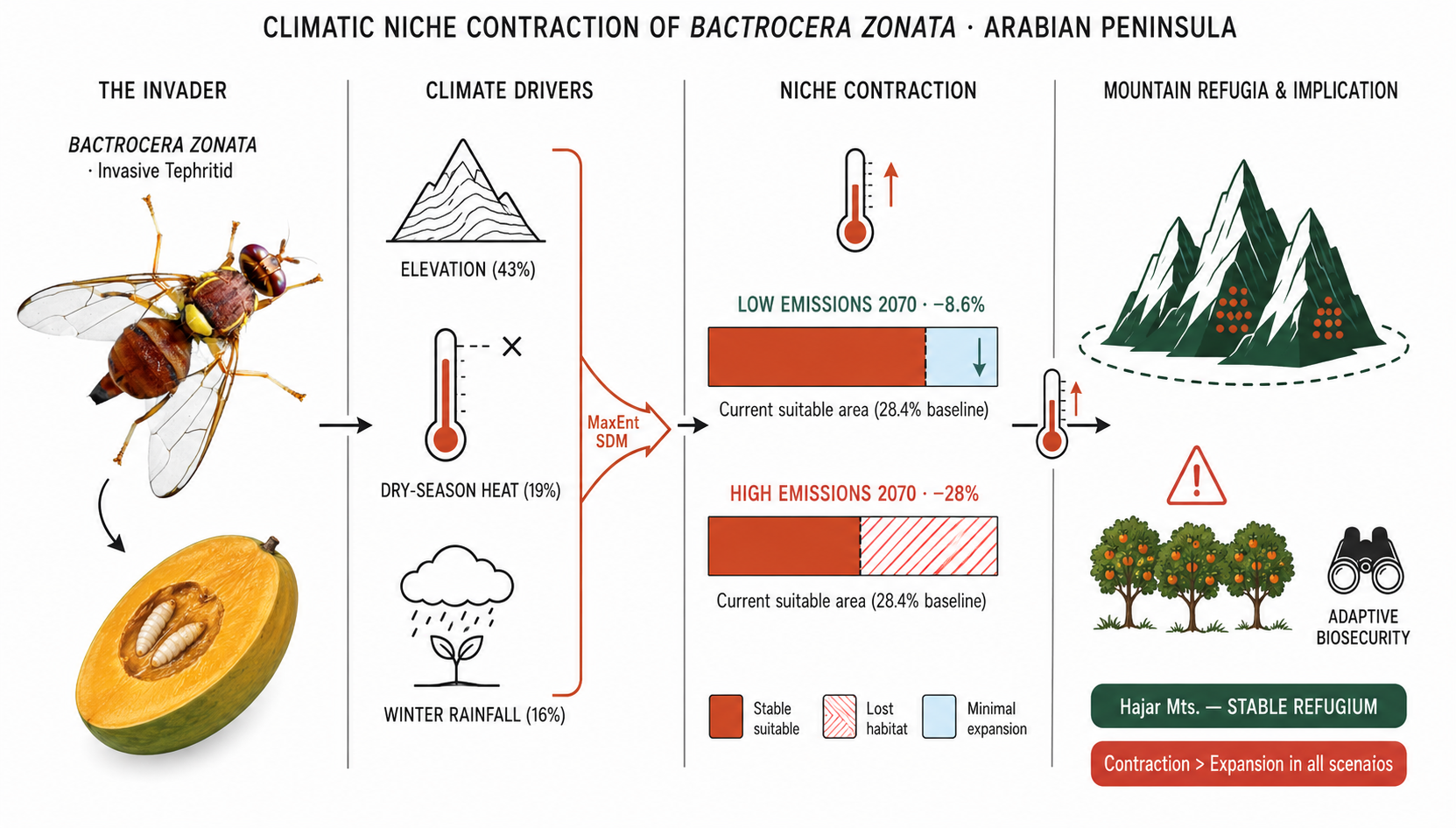
The peach fruit fly (Bactrocera zonata) is a serious pest of fruit crops in the Arabian Peninsula, but it cannot survive equally well in all places. Using climate-based species distribution models, we examined where the insect can live now and how its range may change in the future under different climate warming scenarios. We found that suitable habitat is mainly limited to coastal areas and cooler highlands, especially in Saudi Arabia, Yemen, and Oman. In the future, warming is expected to shrink suitable areas overall, with the greatest losses under the high-emissions scenario. Some mountain regions in Oman may remain important refuges for the species. These results can help guide pest surveillance, quarantine, and long-term management to protect fruit production in the region.
Abstract
The peach fruit fly, Bactrocera zonata (Saunders) (Diptera: Tephritidae), is a climate-sensitive agricultural invader that threatens fruit production across the Arabian Peninsula, yet its realized climatic niche and future exposure under warming remain insufficiently resolved. We used Maximum Entropy (MaxEnt) modeling to quantify current and projected habitat suitability across the region (~3.2 million km2) under two Shared Socioeconomic Pathway scenarios (SSP1-2.6 and SSP5-8.5) for the 2050s and 2070s, based on 55 spatially filtered occurrence records and seven non-collinear environmental predictors, with sampling bias controlled using a Gaussian kernel density bias file. Model performance was robust, with mean training AUC of 0.922 ± 0.011 (SD) and mean TSS of 0.538 ± 0.115 (SD; range: 0.368–0.692), indicating moderate variability across replicates. Suitability was governed primarily by elevation, mean temperature of the driest quarter (Bio 9), mean diurnal temperature range (Bio 2), and precipitation of the coldest quarter (Bio 19), which together contributed over 97% of the model output, indicating strong climatic and topographic control on range persistence. Under present conditions, 790,714 km2, or 28.38% of the study area, was suitable, concentrated in the southwestern highlands of Saudi Arabia and Yemen, the Omani mountain ranges, and coastal fringes of the Arabian Gulf and Gulf of Oman. Future projections showed a consistent net contraction of suitable habitat across all scenarios, from 7.4% under SSP1-2.6 in the 2050s to 28.0% under SSP5-8.5 in the 2070s. In all cases, contraction exceeded expansion, although the eastern Omani highlands remained a potential climatic refugium. These patterns indicate that warming is likely to reorganize rather than uniformly expand suitability, providing a spatial basis for climate-informed biosecurity, surveillance, and regional pest management.