1. Introduction
The Qinghai–Tibet Plateau is characterized by high elevation, harsh climatic conditions, a short growing season, weakly developed soils, and slow ecosystem recovery, and is therefore widely recognized as a fragile region highly sensitive to anthropogenic disturbance [
1,
2]. In recent years, intensified mineral exploitation, infrastructure construction, and urban expansion have increased local inputs and accumulation risks of toxic metals in soils. In particular, in areas affected by mining activities and tailing storage, potentially toxic elements such as Pb, Cd, Cr, and As can be transported into surrounding soils via dust deposition, surface runoff, and leachate migration, thereby altering vegetation performance, soil microbial communities, and the safety of agro-pastoral products [
2,
3,
4,
5]. Previous studies across the Qinghai–Tibet Plateau have documented heavy-metal enrichment and associated ecological risks in soils, identifying anthropogenic sources—especially industrial and mining-related inputs—as major contributors. Investigations of the soil–water–food system have further highlighted that As, Cd, Cr, and Pb may pose human health risks through food-chain transfer [
2,
6]. Therefore, developing efficient, low-disturbance, and sustainable remediation technologies for contaminated soils—particularly in cold, high-altitude mining regions—is of significant ecological and societal importance.
Among the various remediation approaches, phytoremediation has attracted substantial attention because it is comparatively cost-effective, environmentally friendly, and can be implemented in parallel with vegetation restoration [
7,
8]. Seminal studies proposed that plants can remediate contaminated sites by absorbing and accumulating pollutants in harvestable tissues or by reducing metal mobility and bioavailability through rhizosphere processes, often in concert with microbially mediated transformations that improve soil quality [
9,
10]. However, the application of phytoremediation in mining areas remains challenging. High metal loads, nutrient-poor substrates, degraded soil structure, abnormal pH and salinity, and intense wind and water erosion can all constrain plant establishment and biomass production, thereby limiting remediation efficiency [
7,
11,
12]. These constraints are particularly pronounced in high-altitude environments, where successful restoration relies on stress-tolerant plant materials capable of surviving, establishing persistent vegetative cover, and on appropriate agronomic management strategies [
7].
Invasive plants are currently exhibiting an expansion trend in plateau ecosystems. Plateau-scale assessments indicate that, under the combined influences of climate warming and the corridor effects associated with intensified human activities, multiple alien invasive species face an increased risk of expanding their potential suitable habitats across the Qinghai–Tibet Plateau, and this risk may further intensify in the future [
13]. Invasive plants often possess strong resource-acquisition capacity and high tolerance to environmental stress, enabling rapid establishment and dominance in mining sites and other disturbed habitats. Such traits may provide “highly adaptable plant materials” for remediation, but they also entail ecological risks and can raise management controversies. Consequently, the use of invasive plants for remediation of contaminated soils requires cautious evaluation and strict control to balance remediation benefits against the risk of further spread.
Datura stramonium L., native to the Americas, is widely recognized as an invasive plant that has expanded into plateau areas such as Tibet [
14,
15]. This species possesses strong reproductive capacity and ecological adaptability, showing a high tendency to spread, especially in highly human-disturbed habitats. To explore its resource utilization pathway—turning waste into wealth—and to address toxic metal pollution in strongly human-disturbed areas (such as mining regions), this study attempts to utilize this invasive plant for the phytoremediation of contaminated soils. Recent studies have analyzed the invasion mechanisms and potential distribution risks of
D. stramonium in Tibet from climatic and niche perspectives, emphasizing the need to enhance early warning and dispersal control [
14]. Concurrently, plants of the genus
Datura exhibit strong stress tolerance and characteristics of secondary metabolite accumulation, such as tropane alkaloids. They can grow in various adverse soil conditions and are considered to possess potential for tolerating and accumulating multiple metals (metalloids) [
16]. These attributes lend the species candidate value in scenarios involving the remediation of contaminated soils in high-altitude mining areas. During the early stages of ecological restoration, if
D. stramonium can rapidly establish ground cover and achieve absorption/immobilization of target metals, it may simultaneously serve functions such as dust suppression, soil stabilization, risk mitigation, and promotion of soil improvement [
11].
A foundation has been established regarding the remediation potential of
D. stramonium in toxic metal-contaminated soils. For example, studies have shown that the application of chitosan/chitosan nanoparticles can enhance the remediation of Cd-contaminated soil by
D. stramonium and improve its metal translocation efficiency, indicating a modifiable remediation potential [
17]. For Cr (VI)-contaminated soil, research has also investigated the enhancing mechanisms of chelation/conditioning agents such as EDTA and organic acids on the remediation process by
D. stramonium, providing a basis for optimization strategies [
18]. However, systematic evaluations remain scarce regarding its performance under the specific multi-metal contamination profiles and harsh high-altitude conditions typical of Qinghai–Tibet Plateau mining areas. Key unanswered questions include the remediation efficacy of
D. stramonium in this context, whether patterns exist in the distribution of metals among its root, stem, leaf, and fruit organs, and whether agronomic measures such as planting density can significantly enhance metal removal efficiency.
Based on the aforementioned context, this study focuses on the remediation capacity and mechanisms of the invasive plant D. stramonium in toxic metal-contaminated soils from mining areas on the Qinghai–Tibet Plateau. Therefore, we formulated the following hypotheses: (1) higher planting density will significantly improve the total multi-metal removal efficiency from the soil; and (2) D. stramonium will exhibit distinct, element-specific organ accumulation and translocation patterns. To test these hypotheses, this study compared the soil removal rates of Pb, Cd, Cr, and As under different planting densities, measured metal concentrations across different plant organs, and calculated the bioconcentration factor (BCF) and translocation factor (TF) to elucidate its remediation pathways (i.e., “stabilization-based” vs. “extraction-based”). Ultimately, by integrating “density regulation” with “accumulation–translocation mechanisms,” this research seeks to propose a quantifiable phytoremediation approach for the ecological restoration of contaminated soils in mining areas on the Qinghai–Tibet Plateau. Importantly, this work evaluates the remediation behavior of an invasive species under strictly controlled experimental conditions, and does not advocate for its unrestricted field deployment without rigorous ecological risk management.
2. Materials and Methods
2.1. Study Area Overview
The experiment was conducted from 2024 to 2025 at the Key Laboratory of Ecology Park, Tibet University (Lhasa City, Tibet Autonomous Region). The study area, Lhasa, is characterized by a plateau temperate semi-arid monsoon climate. Influenced by topography and monsoon patterns, Lhasa’s climate features abundant sunshine, significant diurnal temperature variation, and distinct wet and dry seasons. According to measurements from the Tibet Meteorological Bureau, Lhasa has an annual average temperature of 9 °C, an annual sunshine duration exceeding 3000 h, and an average annual precipitation of 472 mm. As reported in the Lhasa Municipal People’s Government Gazette, Issue 8 of 2023, the total annual solar radiation in Lhasa is greater than 7.6 × 10⁹ J/m2, with an annual average wind speed of 2.69 m/s.
2.2. Experimental Materials and Sources of Tested Soils
The tested soil samples were collected from a mining area in Tibet. This mining area is located in the core zone of the copper mining cluster on the Qinghai–Tibet Plateau, with an average elevation of approximately 5200 m, belonging to a typical high-altitude hypoxic environment. Geological background and mining activities in this region have led to varying degrees of combined toxic metal contamination in the local soils.
2.3. Experimental Design
Contaminated soil samples were collected from the surface layer (0–20 cm depth) of a mining area in Tibet. The soil was air-dried, followed by the removal of gravel and plant roots, and then sieved for later use. Prior to the pot experiment, the baseline concentrations of toxic metals in the homogenized soil were determined to be 42.1 mg/kg for Pb, 0.26 mg/kg for Cd, 65.4 mg/kg for Cr, and 31.2 mg/kg for As. General physicochemical properties (such as pH, organic matter, and cation exchange capacity) were not fully characterized prior to the experiment, which is recognized as a limitation of the current study. The test plant material consisted of seeds of D. stramonium.
A pot experiment was conducted to investigate the remediation effects of different planting densities of D. stramonium on the contaminated mining soil. The specific experimental design was as follows:
1. Pot Setup: Uniform plastic pots (upper diameter × height × bottom diameter = 26 cm × 20 cm × 16 cm) were used. Each pot was filled with 5 kg of the sieved contaminated soil.
2. Treatment Groups Based on Planting Density: Three planting density gradients were established:
Low-Density Group (LD): 2 D. stramonium plants per pot.
Medium-Density Group (MD): 6 D. stramonium plants per pot.
High-Density Group (HD): 10 D. stramonium plants per pot.
3. Control Group: An unplanted control group (CK), containing only the contaminated soil, was established.
4. Replication: Initially, each treatment (including the unplanted control) was established with four replicates. However, due to unexpected sample contamination during the preparation and digestion process, only one valid observation was ultimately retained for the unplanted control (CK) during the final soil toxic metal quantification.
5. Randomization and Arrangement: All pots were arranged in a completely randomized design (CRD) to minimize potential edge effects and account for environmental micro-variations. The positions of the pots were rotated regularly during the experiment.
2.4. Plant Cultivation and Management
Seeds of D. stramonium were germinated and raised in a nursery before being transplanted into the pots. The experiment was conducted over a 136-day period from 19 April 2025, to 2 September 2025. Thinning was performed once the seedlings had developed 4 true leaves, ensuring the final plant count in each pot aligned with the density gradients. During the trial, plants were watered regularly with deionized water every 5 days to maintain normal growth. Pots were equipped with drainage holes at the bottom, and plastic trays were placed underneath to collect any leachate, which was subsequently returned to the pots to prevent the loss of toxic metals. All pots were cultivated under consistent natural light and ambient temperature conditions.
2.5. Soil Sample Processing Principles and Procedures
The soil samples were converted into a homogeneous solution through acid digestion using a mixture of nitric acid (HNO3), hydrochloric acid (HCl), hydrofluoric acid (HF), and perchloric acid (HClO4). This digestate was then nebulized and transported by a carrier gas into the inductively coupled plasma (ICP) torch. Within the high-temperature plasma, the aerosol underwent desolvation, vaporization, dissociation, atomization, and ionization, generating positively charged ions. These ions were extracted into the mass spectrometer via an ion optics system. The mass spectrometer separates ions based on their mass-to-charge ratio (m/z). For a specific m/z, the signal intensity is directly proportional to the number of corresponding ions entering the detector, which in turn is proportional to the elemental concentration in the original sample. Thus, elemental concentrations in the sample solution were quantified by measuring the signal intensities obtained by the mass spectrometer.
Exactly 200 mg (weighed to the nearest 0.1 mg) of the air-dried and sieved soil samples were digested using an Aurora 6 microwave digestion system (PreeKem Scientific Instruments Co., Ltd., Shanghai, China) vessel and moistened with a small volume of deionized water. Inside an acid-resistant fume hood, HNO3, HCl, and HF were sequentially added to the vessel. The contents were mixed thoroughly to ensure complete contact between the sample and the acids. If a vigorous reaction occurred, the vessel was sealed only after the reaction subsided. The sealed vessel was then placed into the rotor of a microwave digestion system, ensuring proper function of the temperature and pressure sensors. A controlled microwave heating program was executed. Following digestion and subsequent cooling, the vessel was allowed to reach ambient temperature inside the fume hood. Pressure was released cautiously before opening.
The vessel cap was removed, and the contents were heated to evaporate excess acids. The presence of black residues indicated incomplete digestion of organic/carbonaceous material. In such cases, additional aliquots of HNO3, HF, and HClO4 were added. The mixture was heated at a gentle reflux with the cap loosely on for 30 min, followed by open-vessel heating until dense white fumes of HClO4 evolved and the liquid became viscous. This step was repeated if necessary until all black residues were eliminated.
After cooling slightly, the inner walls of the vessel were rinsed with small volumes of dilute HNO3 solution using a pipette, utilizing the residual heat to dissolve any adhering residues. The digest was quantitatively transferred into a 25 mL volumetric flask. The rinsing step was repeated, and all washings were combined in the flask. The solution was finally diluted to the mark with dilute HNO3, mixed thoroughly, and allowed to stand for 60 min. The supernatant was then taken for analysis. To ensure the analytical quality of soil digestion, procedural blanks and national standard soil reference materials were analyzed concurrently with the samples. The recovery rates for all elements remained within the acceptable range of 95–105%.
2.6. Principles and Procedures for Plant Sample Processing
Upon harvest, the plants were separated into roots, stems, leaves, and fruits. To remove adhering soil particles, the roots were thoroughly washed with tap water, followed by three rinses with deionized water. All plant organs were initially oven-dried at 105 °C for 30 min to deactivate enzymes, and subsequently dried at 70 °C to a constant weight. The dried samples were then ground into fine powder.
Exactly 500 mg (weighed to the nearest 0.1 mg) of the ground plant sample was placed into a microwave digestion vessel. After a low-temperature pre-heating step to remove potential gas-producing components, 5 mL of concentrated nitric acid (HNO3) was added. Digestion was performed following standard microwave protocols. Upon completion and cooling, the digested solution was degassed, transferred, and diluted to a final volume of 10 mL with deionized water. The elemental concentrations (Pb, Cd, Cr, and As) in the digestates were then determined using inductively coupled plasma mass spectrometry 7800 ICP-MS (Agilent Technologies Inc., Santa Clara, CA, USA). For chemical analysis, strict quality assurance and quality control (QA/QC) procedures were implemented to ensure data reliability. These included the use of procedural blanks, triplicate samples, and certified reference materials (CRMs) for both soil and plant matrices. The recovery rates for the targeted toxic metals (Pb, Cd, Cr, and As) ranged from 95% to 105%, and the relative standard deviation (RSD) of triplicate samples was less than 5%, ensuring the high accuracy and precision of the analytical data.
2.7. Data Analysis Methods
1. Toxic Metal Removal Efficiency from Soil: The removal rate for each toxic metal was calculated using Equation (1) [
19]:
2. Bioconcentration Factor (BCF): The BCF, which reflects the plant’s ability to accumulate toxic metals from the soil, was calculated. A BCF value greater than 1 indicates accumulation potential. The BCF was calculated according to previously described methods [
7] using Equation (2):
3. Translocation Factor (TF): The TF, which indicates the plant’s ability to transfer toxic metals from roots to above-ground parts, was calculated. A TF value greater than 1 suggests an effective upward translocation. This factor determines whether the plant acts primarily as a “stabilizer” (by immobilizing metals in roots) or an “extractor” (by transferring metals to above-ground biomass for harvest). To account for the entire above-ground biomass, the TF was calculated following previously described methods [
7] using Equation (3):
4. Statistical Analysis: All statistical analyses were performed using R (version 4.2.0, R Core Team). Prior to performing the analysis of variance (ANOVA), the datasets were tested for normality using the Shapiro–Wilk test and for homogeneity of variances using Levene’s test. Significant differences among planting density treatments were determined via one-way ANOVA followed by Tukey’s HSD post hoc test (p < 0.05). For treatments with missing or excluded data (e.g., the contaminated replicates in the CK group), the statistical comparisons were handled using a pairwise exclusion approach to maintain analytical integrity. All data visualization and figure generation were conducted using Python (version 3.9) with the Matplotlib (version 3.5.2) and Seaborn (version 0.11.2) libraries.
2.8. Biosafety and Waste Management
Given the invasive and toxic nature of D. stramonium, the pot experiment was conducted in a strictly controlled area to prevent natural seed dispersal. During the experiment, floral development was closely monitored. Upon completion of the study, all toxic metal-enriched plant biomass (including roots, stems, leaves, and fruits) and residual contaminated soils were carefully collected, sealed in dedicated hazardous waste bags, and transferred to a qualified hazardous waste treatment facility for safe destruction (e.g., high-temperature incineration). These protocols ensured no secondary environmental contamination or biological invasion occurred.
4. Discussion
This study systematically investigated the phytoremediation performance of
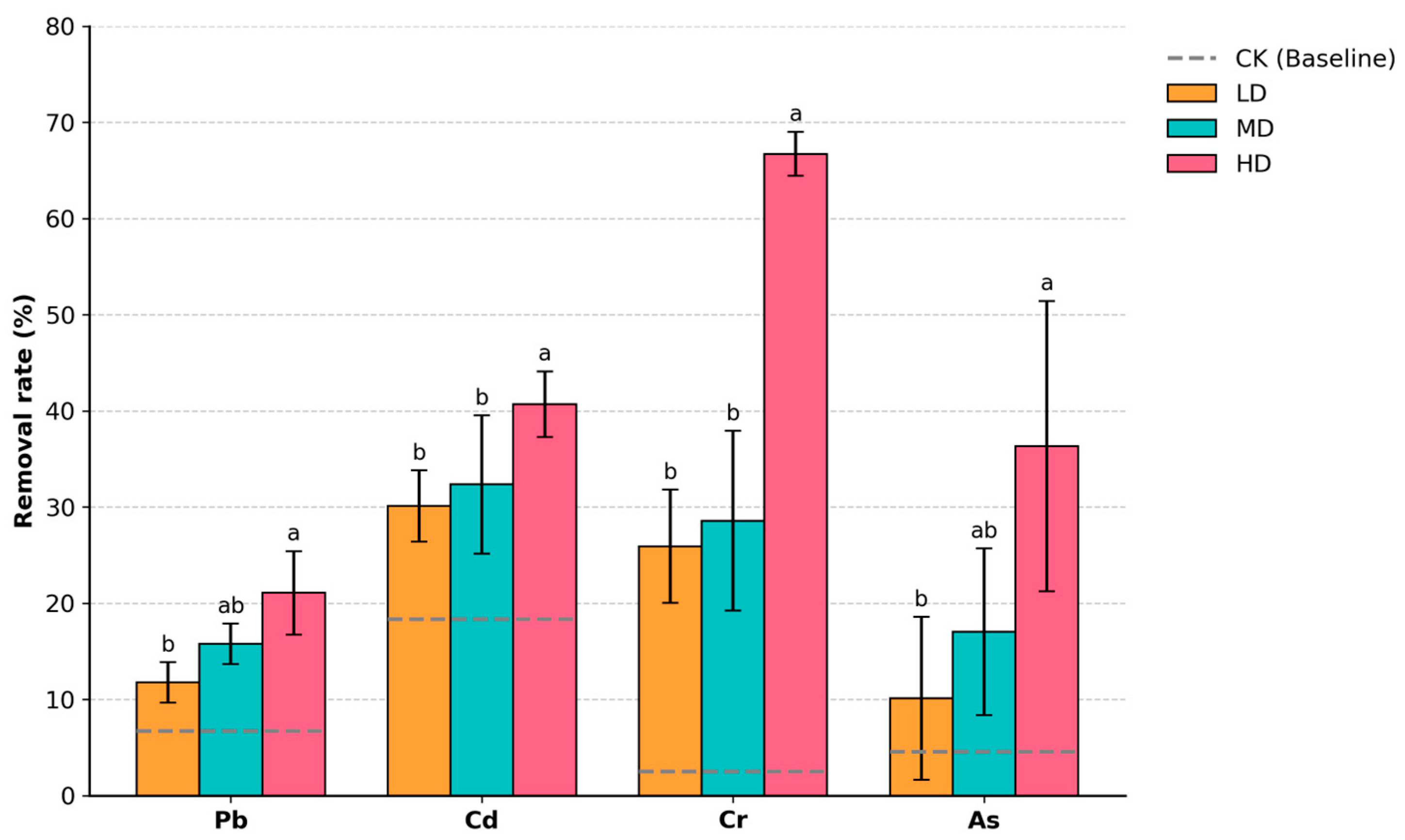
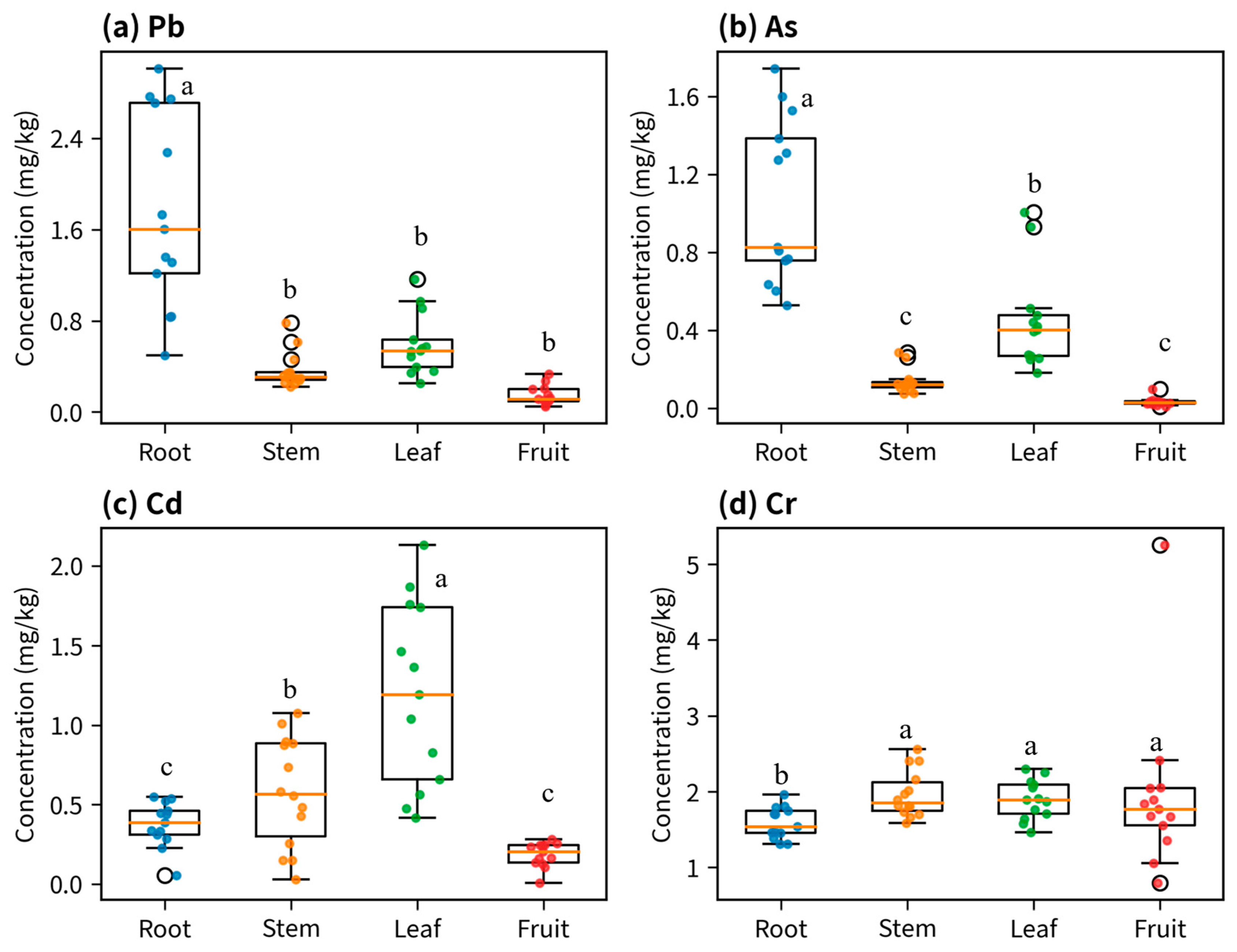
D. stramonium in multi-metal-contaminated soil, focusing on comparing soil removal rates under different planting densities and the differences in toxic metal concentrations, bioconcentration factors (BCF), and translocation factors (TF) across various plant organs. Overall, increasing planting density significantly enhanced the removal efficiency at the population level. Furthermore, the metals exhibited distinct element-specific patterns of “organ allocation—enrichment/translocation”: Pb and As were preferentially enriched in the roots, Cd showed the strongest accumulation in leaves, while Cr demonstrated low translocation and its removal rate was most sensitive to changes in planting density. These patterns collectively suggest that
D. stramonium exhibits element-specific remediation strategies: it shows partial aboveground accumulation for Cd, rhizosphere immobilization and belowground enrichment for Pb/As, and relies more on rhizosphere process-driven removal and stabilization for Cr [
20,
21].
The removal rate results showed that the high-density (HD) treatment generally outperformed the medium-density (MD) and low-density (LD) treatments, with the most pronounced enhancement observed for Cr. Increased planting density has been reported to improve phytoremediation efficiency through two primary pathways: first, by increasing the total biomass and root length per unit area/pot, thereby enhancing the “sink strength” for metal uptake; and second, by intensifying rhizospheric processes (root respiration, exudation, and microbial interactions), which can alter metal speciation and bioavailability, consequently increasing the bioavailable fraction [
21]. Although we did not directly measure specific root traits, root exudation, or microbial communities in this study, we hypothesize that these intensified rhizospheric factors may have contributed to the observed density effects.
In multi-metal scenarios, the magnitude of response to density varies among different metals. Existing field studies indicate that planting density and harvest strategies significantly influence the removal efficiency and system sustainability at multi-metal-contaminated sites. Notably, higher density is not always optimal for all metals, often necessitating a trade-off between efficiency and maintainability by integrating biomass management and harvest strategies [
20].
Therefore, the amplified effect on Cr removal observed in the HD group might not solely be attributed to increased biomass. Although we did not directly evaluate soil chemical speciation in this study, we hypothesize that this enhancement could theoretically be associated with rhizosphere environmental changes promoting the transformation/complexation of Cr (VI) and its subsequent adsorption/immobilization. Previous studies have demonstrated that exogenous chelating agents (e.g., EDTA, oxalic acid) significantly enhance Cr(VI) phytoextraction by
D. stramonium, further supporting the premise that effective Cr remediation relies heavily on modulating its soil chemical speciation [
18]. It is also important to address the background reduction of toxic metals observed in the unplanted control (CK) pots, which varied significantly among elements (e.g., 18.36% for Cd vs. 2.48% for Cr). Since no plants were present to extract the metals, this baseline attenuation can be attributed to abiotic experimental factors over the 136-day cultivation period. First, despite the use of bottom trays to return leachate, the inherent high mobility and solubility of certain elements in soils—particularly Cd—make them susceptible to minor leaching or downward spatial redistribution within the soil profile during repeated watering cycles. In contrast, elements like Cr and Pb are typically strongly adsorbed to soil colloids and form insoluble precipitates, thereby exhibiting much lower background losses. Second, potential long-term adsorption of free metal ions onto the inner walls of the plastic pots may also contribute to the apparent decrease in extractable soil concentrations. Regardless of these abiotic background losses, the overall removal efficiencies in all planted treatments were substantially higher than their respective CK baselines, confirming the active and primary role of
D. stramonium in the phytoremediation system.
The concentrations of toxic metals in roots, stems, leaves, and fruits (
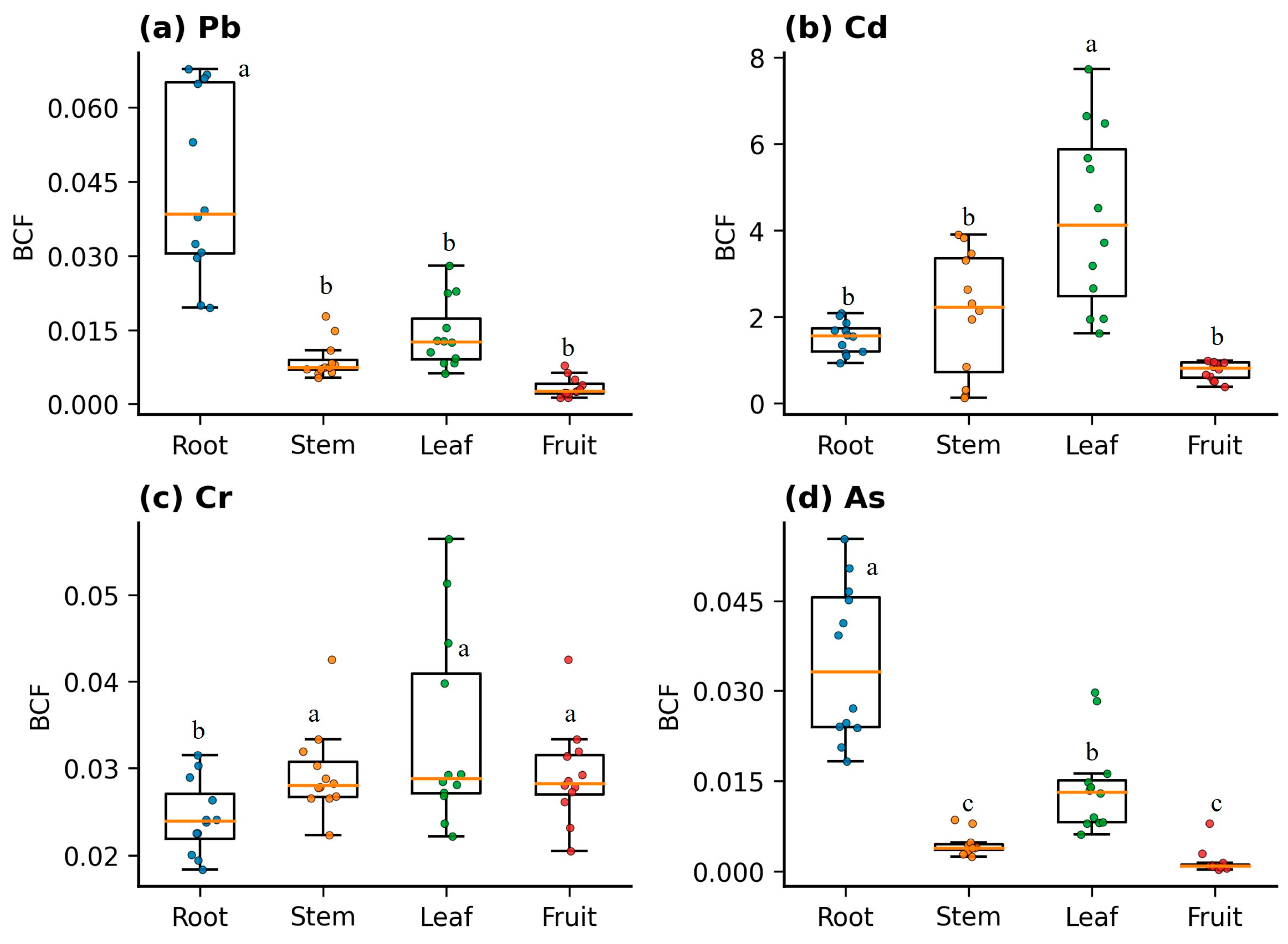
Table S5), along with the BCF results (
Table S3), consistently reveal that
D. stramonium employs differentiated allocation strategies for different metals. BCF and TF are two of the most commonly used indicators for evaluating phytoremediation potential: BCF reflects the plant’s enrichment capacity relative to the growth medium (soil or solution), while TF indicates the translocation capacity from roots to shoots [
22,
23]. For Pb and As, BCF values were significantly higher in roots than in other organs, as supported by ANOVA and Tukey’s test, indicating that these metals are primarily enriched and immobilized in belowground tissues. This observation aligns with the widely observed phenomenon that Pb tends to bind to root cell walls and extracellular matrices, leading to its sequestration in roots and restricted long-distance transport [
24]. In the case of As, although roots remain the main enrichment site, the higher BCF in leaves compared to stems and fruits suggests a certain capacity for As redistribution to aboveground parts, a finding further supported by subsequent TF results. The uptake and translocation of As in plants are closely linked to its chemical speciation: arsenate As(V) can enter via phosphate transport systems and participate in xylem loading, whereas arsenite As (III) is often associated with NIP-type aquaporins [
25,
26]. Consequently, under varying soil phosphorus levels and As speciation, the organ distribution and translocation of As exhibit greater plasticity and variability [
27].
The significantly highest BCF for Cd in the leaves indicates a localized tendency to accumulate in aboveground tissues. However, as our overall TF for Cd remained below 1, this indicates that the lower Cd concentrations in stems and fruits dilute the overall aboveground burden. Thus, while partial removal can be achieved via leaf harvesting, the plant does not function as a highly efficient whole-shoot extractor for Cd. After entering the roots, Cd can be loaded into the xylem via various metal transporters and transported over long distances to the leaves through the transpiration stream. Among these transporters, toxic metal ATPases such as HMA2/HMA4 are considered key players in root-to-shoot translocation [
28,
29]. Experiments on
D. stramonium have also reported its potential as a Cd-accumulating plant, with enhancement of remediation performance achievable through measures such as chitosan/chitosan nanoparticles (literature indicates TF values >1 under certain conditions) [
17]. Although the TF data in this study show Cd overall <1 (indicating restricted translocation), the BCF reveals significant enrichment in leaves. This suggests that under the experimental soil conditions and metal speciation background, the “root uptake–shoot allocation” of Cd may be environmentally constrained by factors such as soil available fractions, competing ions, rhizosphere pH, etc., resulting in a relatively low TF while leaves still serve as the main accumulation organ. This discrepancy underscores that the TF/BCF of a given plant are not fixed attributes but rather the outcome of the complex interaction among plant genotype, soil chemistry, and cultivation management [
21,
23].
Regarding Cr, the BCF values were generally low with relatively small differences among organs. However, combined with the TF results (overall significantly below 1, with notably low values observed), it can be concluded that Cr tends to be immobilized in the roots, with limited translocation to the aboveground parts. Numerous studies have indicated that Cr lacks specific transport systems in plants, often entering via non-specific channels such as sulfate or iron transporters, and primarily accumulates in root tissues with restricted translocation to shoots [
18,
26]. Therefore, the significant response of Cr removal rate to high planting density observed in this study likely reflects enhanced absorption/immobilization due to increased root system scale and intensified rhizosphere processes, rather than efficient aboveground extraction.
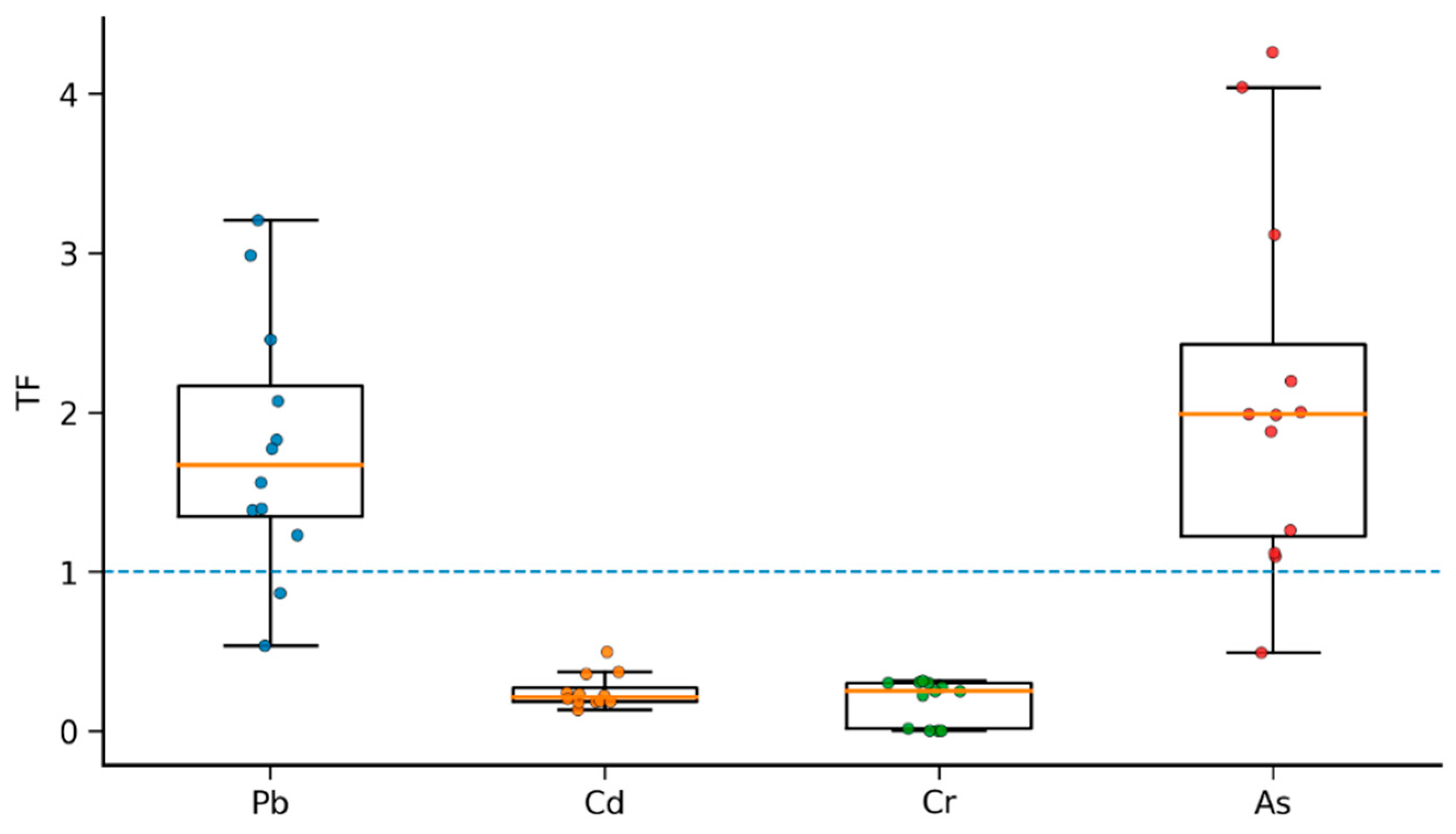
The TF results (
Table S4) clearly show that most samples of As and Pb exceeded 1, indicating a certain degree of root-to-shoot translocation capacity, with As exhibiting a broader fluctuation range; both Cd and Cr were significantly below 1, reflecting retention in belowground parts or restricted translocation. This pattern is closely associated with the detoxification/sequestration strategies of metals in plants. Pb is generally considered a “low-mobility” metal in most plants, where toxicity can be reduced through mechanisms such as cell wall binding and intracellular vacuolar sequestration in roots, often resulting in a pattern of “root enrichment with restricted shoot translocation” [
26]. In contrast, due to its coupling with phosphorus metabolism and the transmembrane transport characteristics of As (III), As may be more prone to long-distance transport under varying environmental conditions, particularly when plants absorb As(V) via phosphate transport systems, potentially leading to increased accumulation in aboveground tissues [
25,
27]. For Cd, a TF < 1 suggests limited loading to shoots or enhanced sequestration in roots; while the extremely low TF for Cr aligns well with literature reports that “Cr predominantly remains in roots with very limited translocation to stems and leaves” [
30,
31].
From an engineering application perspective, TF and organ-specific enrichment determine harvesting and disposal strategies: if the goal is “removal,” metals should be enriched in harvestable aboveground parts as much as possible; if the goal is “stabilization/risk control,” root immobilization is also meaningful, but precautions must be taken to prevent re-release upon root decay. For
D. stramonium, the prominent enrichment of Cd in leaves implies that partial removal can be achieved through aboveground harvesting; the stronger root enrichment of Pb/As suggests a more significant rhizosphere immobilization effect, which may be better suited for strategies involving root–soil matrix removal or stabilization management; Cr, however, requires a combination with soil amendments (e.g., speciation transformation, complexation/reduction) to enhance its removable fraction [
18,
21,
31].
Although higher planting density improved removal rates, practical applications must also consider issues such as growth inhibition per plant due to competition, increased lodging risk, greater demand for nutrients and water, and higher harvesting costs. Field studies indicate that the combination of planting density and harvesting methods affects system sustainability, and higher density is not always optimal [
20]. Furthermore, phytoremediation often faces the bottleneck of contaminated biomass disposal: plant residues enriched with metals can cause secondary contamination if not handled properly. Common disposal methods include pyrolysis, incineration, compaction, and secure landfilling, all of which involve cost or safety constraints [
21]. It is worth noting that
D. stramonium itself contains toxic alkaloids, which, while reducing the direct risk of entering the food chain, also necessitate strict management of the post-remediation biomass to prevent uncontrolled disposal or use as fodder. More importantly, we explicitly emphasize that our findings only support the remediation evaluation of this invasive species under strictly controlled experimental conditions; we do not advocate for its straightforward or unrestricted field deployment, which could pose severe ecological risks.
Based on pot experiments with density gradients and organ-specific distribution data, this study has revealed the differential enrichment and translocation patterns of
D. stramonium for different metals. However, several key questions warrant further investigation: First, isotopic or speciation analysis should be integrated to clarify changes in the bioavailable fractions of Pb, Cd, Cr, and As in the soil and the underlying rhizospheric mechanisms, which could explain why Cr responded most strongly to planting density. Second, a limitation of the current study is that we primarily focused on tissue metal concentrations and did not systematically record the final dry biomass of separated organs across all density treatments. Because total metal phytoextraction is fundamentally a function of both tissue concentration and biomass yield, future studies must incorporate precise biomass measurements to calculate the absolute mass balance and total extraction efficiencies under varying planting densities. Third, under safe preconditions, exploring the synergistic effects of soil amendments (e.g., organic acids, chelating agents, microbial enhancement) with density-based planting is recommended, particularly for low-mobility metals such as Cr and Pb [
18,
21,
32].
In summary, D. stramonium demonstrates strong adaptability and distinct element-specific remediation potential in multi-metal contaminated soils. Increasing planting density can enhance overall removal efficiency. Cd is more likely to be extracted via aboveground (leaf) enrichment, while Pb and As tend to be enriched and immobilized in the roots. Cr is characterized by low translocation and rhizosphere process-driven removal/stabilization. Furthermore, while pot experiments provide valuable baseline data, future field-scale implementation must carefully evaluate the economic feasibility of specialized biomass disposal facilities against the remediation benefits. Ultimately, practical implementation hinges on the development of optimal planting density combined with tailored harvesting and strict disposal protocols to balance remediation efficacy with ecological safety.




 ,
,